Child labor

Child labour is a term you might have heard about in news or movies. It refers to a crime where children are forced to work from a very early age. It is like expecting kids to perform responsibilities like working and fending for themselves. There are certain policies which have put restrictions and limitations on children working.

The average age for a child to be appropriate to work is considered fifteen years and more. Children falling below this age limit won’t be allowed to indulge in any type of work forcefully. Why is that so? Because child labour takes away the kids opportunity of having a normal childhood, a proper education, and physical and mental well-being. In some countries, it is illegal but still, it’s a far way from being completely eradicated.

Causes of Child Labour

Child Labour happens due to a number of reasons. While some of the reasons may be common in some countries, there are some reasons which are specific in particular areas and regions. When we look at what is causing child labour, we will be able to fight it better.

Firstly, it happens in countries that have a lot of poverty and unemployment. When the families won’t have enough earning, they put the children of the family to work so they can have enough money to survive. Similarly, if the adults of the family are unemployed, the younger ones have to work in their place.

Moreover, when people do not have access to the education they will ultimately put their children to work. The uneducated only care about a short term result which is why they put children to work so they can survive their present.

Furthermore, the money-saving attitude of various industries is a major cause of child labour. They hire children because they pay them lesser for the same work as an adult. As children work more than adults and also at fewer wages, they prefer children. They can easily influence and manipulate them. They only see their profit and this is why they engage children in factories.

Eradication of Child Labour

If we wish to eradicate child labour, we need to formulate some very effective solutions which will save our children. It will also enhance the future of any country dealing with these social issues. To begin with, one can create a number of unions that solely work to prevent child labour. It should help the children indulging in this work and punishing those who make them do it.

Furthermore, we need to keep the parents in the loop so as to teach them the importance of education. If we make education free and the people aware, we will be able to educate more and more children who won’t have to do child labour. Moreover, making people aware of the harmful consequences of child labour is a must.

In addition, family control measures must also be taken. This will reduce the family’s burden so when you have lesser mouths to feed, the parents will be enough to work for them, instead of the children. In fact, every family must be promised a minimum income by the government to survive.

In short, the government and people must come together. Employment opportunities must be given to people in abundance so they can earn their livelihood instead of putting their kids to work. The children are the future of our country; we cannot expect them to maintain the economic conditions of their families instead of having a normal childhood.

Doctrine of Notional Extension under the Workmen Compensation Act, 1923


There is no problem in detecting that the accident occurred in the course of employment when a workman is injured in the working place and in the working hour and doing his duty. The problem arises when these elements do not coincide together. But a workmen if injured just near the work premises or just before joining the work or in the way to work problem arises. To address this kind of problem and giving some kind of relief to the workmen the theory of notional extension evolved.

“As a rule, the employment of a workman does not commence until he has reached the place of employment and does not continue when he has left the place of employment, the journey to and from the place of employment being excluded. It is now well-settled, however, that this is subject to the theory of notional extension of the employer’s premises so as to include an area which the workman passes and repasses in going to and in leaving the actual place of work. There may be some reasonable extension in both time and place and a workman may be regarded as in the course of his employment even though he had not reached or had left his employer’s premises. The facts and circumstances of each case will have to be examined very carefully in order to determine whether the accident arose out of and in the course of the employment of a workman, keeping in view at all times this theory of notional extension.” 

Wider interpretation of duty:

Court has given a wider and popular meaning of “duty” to expand the scope of this section. The court also talks about the service contract to determine which can be come under the preview of this section. Justice Cozens-Hardy M. R. said “……… it was an implied term of the contract of service that these trains should be provided by the employers, and that the colliers should have the right, if not the obligation, to travel to and from without charge.” In the next case the court has interpreted the term “duty” in stricter sense.

In Weaver v. Tredegar Iron Coal Co.  House of Lords after examining a large number of authorities given a wider meaning of “duty” but did not negated the duty test.In this case lord Atkin said that there can be no doubt that the course of employment cannot be limited to the time or place of the specific work which the workman is employed to do. It does not necessarily end when the “‘down tools” signal is given, or when the actual workshop where he is working is left. In other words, the employment may run on its course by its own momentum beyond the actual stopping place. There may be some reasonable extension in both time and space.” Lord Porter further said that if an accident occurs while coming to the workplace or leaving the place can be out of and in the course of employment if he is bound by the way he proceed under the terms of the contract of service express or implied. Here duty test was confirmed.

Expanding the preview of Service Contract:

In St. Helens Colliery Co Ltd v. Hewlston  the court said that the injury did not occur in the course of employment because the employee was not bound or obliged to travel by that special train and he could have taken other transport. If he were bound by the service contract to travel by that train then it would have been in the course of employment (Lord Buckmaster). It was also added that if the place of work is like that there is no alternative means of transport other than the transport given by the employer then it can be concluded that there is an implied term in the service contract to use that transport (Lord Atkinson). The same view was taken in Mackenzie v. I.M. Issak says that a workman in a colliery is not in course of his employment while using the transport of the employer if he is not bound by the terms of the contract to travel by that transport.

There was a particular situation where employee has to take bus service to reach his workplace from home and vise versa. It was necessary for doing his duty efficiently and punctually which was a condition under his service  . So, travelling in that bus was an implied condition to his duty. It was also said that this doctrine was developed to cover the factory, workshops and harbors but it can be applied in this kind of situation also. Compensation was granted holding that the accident arising in the course of employment. Though the court said what would be the indicator that when the work starts and ceases that depends on case to case basis.

In Union of India v. Mrs . Noor Jahan  a railway gangman was ordered by his employer to go to another place for cleaning and in the way from one place to another accident happened. Justice Sukla observed that the accident has occurred in the duty hour and when he was going to do his duty on behalf of his employer and he concluded that the accident has occurred in the course of his employment.

Public Place and this Doctrine:

There are some situations where this doctrine does not apply. When a workman is on the public road or public place and not there for fulfilling the obligation and his work does not make necessary to be there. The proximity of the work premises and spot of accident become immaterial. The notional extension of the place of work cease when workman come to a public road. There were some clarification made in the next case in this matter.

In Saurashtra Salt Manufacturing Co. v. Valu Raja  Justice Jafer Imam said that,

“It is well settled that when a workman is on a public road or a public place or on a public transport he is there as any other member of the public and is not there in the course of his employment unless the very nature of his employment makes it necessary for him to be there. A workman is not in the course of his employment from the moment he leaves his home and is on his way to his work. He certainly is in the course of his employment if he reaches the place of work or a point or an area which comes within the theory of notional extension, outside of which the employer is not liable to pay compensation for any accident happening to him.”

Web Development

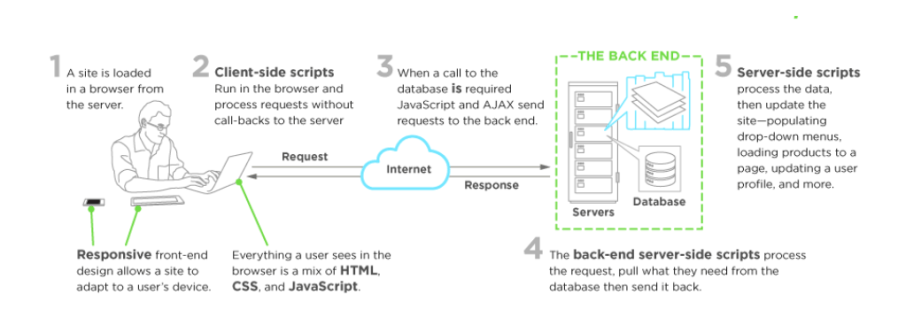
When browsing the internet and forging, do you ever feel like making various web pages? Ok, if yes, you can probably go to web development. One of the basic skills that almost every technological enthusiast should learn, this skill is one of the most fascinating and easiest. Now, what’s the web development?

Web development refers to building, creating, and maintaining websites. It includes aspects such as web designweb publishing, web programming, and database management.

While the terms “web developer” and “web designer” are often used synonymously, they do not mean the same thing. Technically, a web designer only designs website interfaces using HTML and CSS. A web developer may be involved in designing a website, but may also write web scripts in languages such as PHP and ASP. Additionally, a web developer may help maintain and update a database used by a dynamic website.

Web development includes many types of web content creation. Some examples include hand coding web pages in a text editor, building a website in a program like Dreamweaver, and updating a blog via a blogging website. In recent years, content management systems like WordPress, Drupal, and Joomla have also become a popular means of web development. These tools make it easy for anyone to create and edit their website using a web-based interface.

Web Development has many terms associated with it like front-end. back-end, and full-stack developer. What are they and in which perspective are they used?

front end developer

A front-end developer is a person who is responsible for the looks and design of the website. The design of the site aims to ensure that, when users open the site, they see the information in a format that is easily readable and relevant. This is further complicated by the fact that consumers are now using a vast range of devices of different screen sizes and resolutions, thereby requiring the designer to take these considerations into account when constructing the web. They need to ensure that their site is correctly positioned in different browsers (cross-browser), different operating systems (cross-platform) and different devices (cross-device), which require careful planning on the developer’s side.

The front end section is constructed using some of the languages discussed below:

HTML: HTML is the HyperText Markup Language. It is used to build the front end portion of a web page using a markup language. HTML is a mixture of Hypertext and Markup. Hypertext describes a connection between a web page. The markup language is used to define the text documentation within the tag that defines the web page structure.

CSS: Cascading Style Sheets affectionately referred to as CSS is a simple language designed to simplify the process of making web pages presentable. CSS allows you to apply styles to your web pages. More significantly, CSS helps you to do this independent of HTML.

JavaScript: JavaScript is a well-known scripting language used to build magic on blogs that render the web interactive for the user. It is used to improve the functionality of a website to run cool games and web-based applications.

Front End Framework and libraries

AngularJS: AngularJs is a front-end open-source JavaScript platform that is predominantly used to build single-page web applications (SPAs). It is a constantly growing and evolving platform that offers better ways to build web applications. Changes static HTML to dynamic HTML. It is an open-source project that can be freely used and updated by anyone. It extends HTML attributes with Directives, and data is bound with HTML.

React.js: React is a declarative, efficient, and flexible JavaScript library for creating user interfaces. ReactJS is an open-source, component-based front end library responsible for the view layer of the application only. It’s being maintained by Facebook.

Bootstrap: Bootstrap is a free and open-source collection of tools for creating responsive websites and web applications. It is the most popular HTML, CSS, and JavaScript framework for the development of responsive, mobile-first websites.

jQuery: jQuery is an open-source JavaScript library that simplifies the interaction between an HTML / CSS document or, more precisely, a Document Object Model (DOM) and a JavaScript document. Developing terminology, jQuery simplifies HTML document traversing and handling, browser event handling, DOM animations, Ajax interactions, and JavaScript cross-browser creation.

SASS: is the most accurate, mature, and robust CSS extension language. It is used to expand the features of the current site CSS, including everything from variables, inheritance, and nesting to ease.

Certain libraries and frameworks are Semantic-UI, Framework, Materialize, Backbone.js, Express.js, Ember.js, etc.

back-end developer

Backend is the server-side of the web. It stores and arranges data, and also ensures that everything on the client-side of the website works fine. It’s the part of the website you can’t see and interact with. It’s the portion of the software that doesn’t come into direct contact with users. Parts and features developed by backend designers are accessed indirectly by users through a front-end application. Activities such as writing APIs, creating libraries, and working with system components without user interfaces or even science programming systems are also included in the backend.

Back-end Languages

The back end component is built using some of the languages discussed below:

PHP: PHP is a server-side scripting language built specifically for web creation. Since PHP code is running on the server-side, it is called the server-side scripting language.

C++: It is a general programming language and is now widely used for competitive programming. It’s also used as a backend script.

Java: Java is one of the most common and widely used programming languages and platforms. It’s very scalable. Java components are readily available.

Python: Python is a programming language that helps you to work quickly and implement systems more efficiently.

JavaScript: Javascript can be used as both (front and back end) programming languages.

Node.js: Node.js is an open-source and cross-platform runtime environment for running JavaScript code outside the browser. You need to remember that NodeJS is not a framework and is not a programming language. Most people are confused and understand that it’s a framework or a programming language. We also use Node.js to create back-end services like Web App or Mobile App APIs. It is used in the development of major corporations such as Paypal, Uber, Netflix, Wallmart, and so on.

Back-end Frameworks

The list of back end frames is Express, Django, Rails, Laravel, Spring, etc.

The other back end programs/scripting languages are: C #, Ruby, REST, GO, etc.

Difference between Frontend and Backend:

Frontend and backend developments are quite different from each other, but there are still two aspects of the same situation. The frontend is what users see and interact with, and backend is how it works.

The frontend is a part of the website that users can see and interact with, such as the graphical user interface ( GUI) and command line, including design, navigation menus, text, pictures, videos, etc. Backend, on the other hand, is where part of the website users are unable to see and communicate.

The visual aspects of the website that users can see and experience are front-end. On the other hand, everything that happens in the background can be attributed to the backend

The languages used for the front end are HTML, CSS, Javascript, while those used for the backend are Java, Ruby, Python, .Net.

full stack developer

A full-stack web developer is a person who can develop both client and server software. Besides mastering HTML and CSS, he/she also knows how to:

Browser software (such as JavaScript, jQuery, Angular, or Vue)

Programming a server (like using PHP, ASP, Python, or Node)

Program a database (such as SQL, SQLite, or MongoDB)

Being a full-stack developer is a good practice because you know almost every aspect of web development. You can switch between front-end and back-end stuff according to the requirement.

Resources to learn

  • W3 School(Free)
  • Coursera(Paid)
  • Udemy(Paid)
  • FreeCode Camp(Free)
  • Treehouse(Paid)
  • Codeacademy(Free)
  • Traversy Media(Free)
  • HTMLDog(Free)

So, all the best guys for this amazing learning journey, hope you guys find this piece informative.


Can mid day meals solve the school education crisis in rural India ?

The roots of the mid day meal program can be traced back to the pre-independence era, when the British administration decided to come up with ways to help disadvantaged children. Today, this scheme seeks to address the following issues – food security, lack of nutritional food in rural areas, and access to education. It is hoped that by providing hot meals to children in lower primary and upper primary classes, more children will be encouraged to attend school regularly.    

Today, in India, 4 percent of the children do not attend school, and 58 percent of the children have not completed primary school. In fact, only 10 percent of the children in India make it to college. This is the education crisis that India is facing today. According to the government, the mid may meal program reaches out to more than 120 million children in over 1 million schools nationwide. However, has the number of children attending school increased over the past few years because of this scheme ?   

In fact, according to a government report, in Bihar, the attendance of children dropped by 9 percent in the last five years and in Madhya Pradesh, the attendance of children dropped from 67 percent to 54.5 percent between 2008 and 2011. And in other states such as Andhra Pradesh, Kerala and Uttar Pradesh, there is an increase in private school enrollment in rural areas over the past five years. This proves that the mid day meal program has not been effective in solving the school education crisis. Despite providing healthy meals for children, there is a significant decline in the enrollment of students in schools in rural areas. On paper, the government has urged schools to provide meals with a minimum of 300 calories for those studying in lower primary classes and meals with a minimum of 700 calories for those studying in upper primary classes.   

The Mid Day Meal is a significant part of the diet of Indian children. The meal is available to all primary and upper primary children (classes 1 to 8) in government schools, government-aided schools and Education Guarantee Scheme (EGS) schools. Two out of three Indian children go to government schools alone (according to the 2011-12 India Human Development Survey). Not every child entitled to the mid-day meal receives it; the survey shows that 82% of children in government schools reported getting a mid-day meal. In all, at least half of all children in classes 1-8 in India get a mid-day meal.

How many children get a mid-day meal ?

For many, the mid-day meal is invaluable. The 2011-12 National Sample Survey (NSS) data shows, 10% of the meals that all primary school-age children (5-9) in rural India receive in a month are from school. The Mid Day Meal’s self-selection works; the poorest children in both rural and urban India get more meals per head from school than richer children, the NSS data shows.

There is evidence that the Mid Day Meal has contributed to the gradual improvement in child malnutrition indicators. The Mid Day Meal scheme explained at least one-tenth of the total reduction in stunting in India in between 206 and 2016, researchers at the International Food Policy Research Institute found. Adolescent girls, now 12-17, who got meals under the Mid Day Meal Scheme in 2004 were taller, they found. The effects on health were multi-generational; children born to young women who had received school meals in 2004 were less likely to be stunted.

Yet, the nutritional value of the meal is far from perfect. On paper, each hot cooked meal is meant to provide a primary school child with 450 calories and 12 grams of protein, and an upper primary child with at least 700 calories and 20 grams of protein. This is often not the case; earlier this year, journalist Pawan Jaisal recorded a government school in Uttar Pradesh’s Mirzapur serving the children rotis and salt only. In 2012-13, 90% of school lunches served to primary school students in Delhi did not meet the energy and protein norms.

This becomes important in the context of general under-nourishment among school-going children. The CNNS shows that the diets of school-age children are highly deficient, and they consume lower than recommended amounts of most healthy foods.

School-age children have deficient diets

The outcomes are evident. 22% of children 5-9 were stunted (low height for age), and 23% were thin (low Body Mass Index for age). 24% of adolescents (age 10-14) were thin. The prevalence of stunting was higher among children who were out of school.

School-going children have significant rates of malnutrition and micronutrient deficiency

For those from richer families, availability of healthy foods is a lesser problem (though it exists) compared to obesity and related non-communicable diseases, which stem from poor nutritional awareness.

However, there is no government body to monitor these schools and ensure that nutritious meals are reaching the students. A survey conducted by the Department of Economic and Statistical Analysis shows that 72 percent of schools do not have kitchens and facilities to cook. So, food would be cooked miles away and transported to the schools. By the time the food reaches these poor children, it would have turned cold. Also, 69 percent of the schools that were surveyed did not have proper eating utensils.     

So, the mid day meal scheme is not a solution to the school education crisis in India. Steps have to be taken by the government to ensure that schools have the proper facilities for cooking. In the last few weeks, there have been incidents of a dead lizard and insecticide being detected in mid day meals. This shows that the government has no mechanism in place to check the quality of food before it is consumed by children. Government schools lack the proper infrastructure for teaching, which is why students prefer to study in private schools. Those who are unable to afford an education in private schools prefer to work because of the horrific conditions of government schools. So, it is time for the government to take responsibility of the education system and provide proper facilities for the welfare of the children in India.  

Lord Krishna – His side of the Management Guru

Janmashtmi has approached and his devotee will be celebrating it in vivid ways. Different people have different images of lord Shri Krishna but only handful of people are aware of His other side – The management guru. The teachings of Lord Krishna are known all over world and had been encrypted in the very famous Bhagavad – Geeta. Five thousand years back Lord Krishna taught Arjuna self-development which is the key to leadership skills. This leadership would eventually lead to Managerial skills. The teachings of Shri Krishna centuries back are applicable in present day where the knowledge of the individual is powerful.

Many corporate can follow his teachings for human resources development of the managers and workers.   

Shri Krishna started enlightening the world with knowledge right from his childhood days. Though many people feels that he was naughty in his childhood and hence used to steal Maakhan from various houses yet He had a different perspective all together. He was the leader of his poor friends who did not have butter at home. He would steal butter from the houses where it was in excess and would equally distribute it among the poor friends. The message Shri Krishna conveyed is that a true leader would always solve the problem of all those who look up to him, however small or big it might be.

” Karmanye Vadhikaraste ma phaleshu kadachna, Karmaphalehtur bhurma te sangostvakarman “

In the above quoted very famous shloka of Geeta Shri Krishna has beautifully explained about the relation between deeds and results. Shri Krishna says that every person has a right to perform his/her prescribed duty but should not be concerned only to the fruits of action. One must never consider himself as the cause of the result of his/her duty and at the same time should never be attached to not doing the duty. Not many people understand this.

In order to understand consider youth icon Vishwanathan Anand. Whenever he wins a game, he never takes the credit for winning rather he would say that his opponent did some mistakes.

By saying so he does not consider himself as the cause of the result of his deeds but at the same time he does perform his duty very well. In the above shloka, Shri Krishna also guides people to have a right attitude towards the work they perform. There is a very famous story of three stone-cutters who were engaged in constructing a temple. A man asked them what they were doing. The first stone cutter said with a dejected face, “I am a poor man. I have to maintain my family. I am making a living here”. “Well, I work because I want to show that I am the best stone-cutter in the country,’ said the second one with a sense of pride. The response of the third worker to this innocent-looking question is illuminating. He said “Oh, I want to build the most beautiful temple in the country,” with a visionary gleam. Their jobs were identical but their perspectives were different. What the Geeta tells us is to develop the visionary perspective in the work we do. It tells us to develop a sense of larger vision in our work for the common good.  

The famous epical story of Shri Krishna and Sudama is not unknown to anyone. After being the king of Dwarika when Shri Krishna once got to know that His childhood friend Sudama has come to meet Him, He left his throne and went to the main gate of the kingdom to receive Sudama and embraced him. The story clearly portrays a very humble and down to earth nature of Lord Shri Krishna. The message any management professional can take from the story is even after achieving the heights of success and glory one must keep his/her feet firmly on ground. More humble and down to earth a person is more he/she succeeds in the life and carrier.   

The Mahabharata war was fought three thousand years ago, on the battlefield of Kurukshetra. Shri Krishna gave up all his men-power to the Kauravas and was standing with Arjuna to guide him and to perform his responsibility of being a true leader. History has witnessed that though kauravas had enormous resources, yet it was the leadership of Shri Krishna who guided a handful people and Arjun’s sheer talent that led Pandavas towards success and victory. Kauravas had great archers like Dronacharya, Karan and many more yet they could not win. The reason being is lack of leadership. Clearly even best mind and talent cannot achieve success without a good leader. And looking on the other side of the coin, despite having limited resources a good leader can definitely take his company to the zenith and much above.   

In the battle of Mahabharata Shri Krishna had the most powerful weapon called “sudarshan Chakr” but never used it for anyone who was not guilty of any wrong deed. The message that he has conveyed through this is that even though a leader or manager might have the supreme powers but he/she should never misuse it. The lessons of Bhagwat Geeta are very much applicable in today’s scenario as well. The iconic industrialist Mr. Ajay Piramal Says “Bhagavad Geeta is one of the greatest management books as it prescribes optimism and freedom from stress”.

People generally get confused with effectiveness and efficiency and its applicability in management. In Bhagwat Geeta there is a beautiful extract in which the difference between effectiveness and efficiency has been distinguished in a crisp manner. It quotes; Effectiveness is doing the right things and Efficiency is doing things right. Management has become a part and parcel of everyday life, be it at home, in the office or factory and in Government. In all organizations, where a group of human beings assemble for a common purpose, management principles come into play through the management of resources, finance and planning, priorities, policies and practice. Management is a systematic way of carrying out activities in any field of human effort. The critical question in all managers’ minds is how to be effective in their job. The answer to this fundamental question is found in the Bhagavad Geeta, the teachings of Shri Krishna which repeatedly proclaims that you must try to manage yourself.’ The reason is that unless a manager reaches a level of excellence and effectiveness, he or she will be merely a face in the crowd.  

Indeed Lord Shri Krishna is teacher of the universe, “krishnam vande jagat gurum”. Although throughout his life he taught some body or the other but in battle field of Kurukshetra he taught Arjun, principles management and leadership. This conversation between Krishna and Arjuna is known as Bhagwat Geeta. This is not only Hindu holy book but it is for the whole of the mankind. And an idol book for management.

India tested more than 6 lakh COVID-19 samples for third consecutive day

India has tested more than 6 lakh COVID-19 samples for the third consecutive day in a row. India’s resolve to rapidly increase the number of tests done per day has resulted in a successful march towards 10 lakh per day testing capacity with 6 lakh 64 thousand 949 tests conducted in the last 24 hours.
 
The Tests Per Million too have seen a sharp rise to more than sixteen thousand. A key component for the successful implementation of the “Test, Track and Treat” strategy has been the continuously expanding network of diagnostic labs across the country. The lab network as on today consists of 1370 labs. These consist of 921 labs in the government sector and 449 private labs.

Top finalists under ‘AatmaNirbhar Bharat App Innovation Challenge’ to showcase apps in Mega Hackathon

A Mega Hackathon will be organised today where the top finalists selected under the ‘AatmaNirbhar Bharat App Innovation Challenge’ across categories will be showcasing their Apps.

The Mega Hackathon will be streamed live from 12 noon to 5 PM on Social Media platforms of MyGov India and Digital India.

The AatmaNirbhar Bharat App Innovation Challenge’, was launched by Prime Minister Narendra Modi on 4th of last month, which saw participation from 6 thousand 9 hundred 40 tech entrepreneurs and start-ups across the country.

The mega Challenge had entries for 9 different categories namely Business, eLearning, Entertainment, Games, Health, News, Office and Work from Home, Others and Social.

National Handloom Day being observed today

National Handloom Day is being organised today by the Ministry of Textiles on a virtual platform. Textiles Minister Smriti Irani will be the Chief Guest on the occasion. During the function, handloom clusters across India, NIFT campuses, all the 28 Weaver Service Centres, National Handloom Development Corporation and others will be connected online.

7th August was chosen as the National Handloom Day to commemorate the Swadeshi Movement which was launched on the same date in the year 1905. The objective is to generate awareness about the Handloom Industry among the public and its contribution to socio-economic development.

To mark the occasion and to instil pride in the workmanship of handloom weaving amongst citizens, a social media campaign is planned for the handloom weaving community.

Prime Minister Narendra Modi has said, the Handloom and Handicrafts of India encompass a glorious history of hundreds of years.

In his Mann Ki Baat address on All India Radio last month, the Prime Minister urged everyone to use Indian Handloom and Handicrafts as much as possible, and also communicate to more and more people about them. He said, local artisans and weavers will benefit from conversations about the richness and diversity of Indian handloom and handicrafts.

The Prime Minister emphasized that the correct and positive approach always goes a long way in transforming distressing times into opportunities, adversities into triggers of development and progress.

Country’s first Kisan Special Parcel Train to run from today to provide seamless supply of perishable produce

The country’s first Kisan Special Parcel Train or Kisan Rail will start from today. The train will start at 11 AM and it will transport material between Maharashtra’s Devlali and Bihar’s Danapur Railway station. The Kisan Rail will carry fruits and vegetables and will make stoppages at several stations and pick-up and deliver them.

Agriculture Minister Narendra Singh Tomar and Rail Minister Piyush Goyal will flag off the train through video link. The train is scheduled to reach its destination Danapur tomorrow at 6:45 PM, covering a distance of one thousand 519 kilometres in around 32 hours.

The train will halt at Nasik Road, Manmad, Jalgaon, Bhusaval, Burhanpur, Khandwa, ltarsi, Jabalpur, Satna, Katni, Manikpur, Prayagraj Chheoki, Pandit Deendayal Upadhyay Nagar and Buxar.

With the launch of Kisan Rail, the Railways aims to help double farmers’ income. The Railway Ministry said, this will help in bringing perishable agricultural products like vegetables, fruits to the market in a short period of time.

The Kisan Rail train with frozen containers is expected to build a seamless national cold supply chain for perishables, inclusive of fish, meat and milk. Our correspondent reports that, Finance Minister Nirmala Sitharaman had announced to start ‘Kisan Rail’ in the current year’s Budget, for providing a seamless supply chain of perishable produce. 

Manipur extends complete lockdown till August 15 amid rise in COVID-19 cases

The Manipur government has extended the ongoing complete lockdown and curfew in the state till 15th of August in view of the rise in COVID-19 cases.

The entire state was under complete lockdown and curfew from 23rd July till yesterday to contain the spread of the deadly virus.

A Cabinet meeting led by Manipur Chief Minister N. Biren Singh was held last evening to review the crisis. During the meeting, the decision was taken to extend the ongoing complete lockdown in the state till 15th of this month.

An official order issued by the State Chief Secretary said, certain relaxations will be allowed during this period. All locality based retails shops dealing with essential commodities will be opened in all districts from 8 am to 12 noon on all days except Sundays.

Moreover, certain parts of Imphal market and other markets in districts will be opened on roster basis to cater the requirement of retailers.

PM Modi to deliver Inaugural Address at ‘Conclave on Transformational Reforms in Higher Education under National Education Policy’ today

Prime Minister Narendra Modi will deliver the Inaugural Address at the ‘Conclave on Transformational Reforms in Higher Education under National Education Policy’ today.

The conclave that is being organised through video conference, will have sessions dedicated to significant aspects of education covered under the National Education Policy (NEP), 2020. These include holistic, multidisciplinary and futuristic education, Quality Research, and Equitable use of technology for better reach in Education.

Union Education Minister Ramesh Pokhriyal and Union Minister of State for Education, Sanjay Dhotre will also participate in the event. A number of dignitaries including the Chairman and Members, Committee for Draft NEP as well as eminent academicians and scientists will speak on different aspects of the National Education Policy.

Vice-Chancellors of universities, Directors of Institutions and Principals of colleges and other stakeholders will also participate in the programme. 

Tick- borne SFTS Virus

Tick-borne SFTS virus  has re-emerged in China, killing around  7 people and has infected almost 60 people. This was reported on August 5 ,2020. As the virus  is infecting several people , it has also set warning of transmission of virus from human to Human.

Over 37 of people  in Jiangsu province (East Japan) reportedly contracted the SFTS  virus in the first half 2020. And  around 23 more people were found to be infected by the same in East china’s Anhui Province.
The SFTS virus is tick – borne virus , but it is not a new born virus it is already  detected in 2009 and china isolated the Pathogen in 2011.This virus belong to Bunyavirus  category. Symptons – it causes severe fever with thrombocytopenia syndrome (SFTS), cough , vomitting ,diarrhea,low platelet count , multiple organ failure,elevated liver enzyme levels.
This virus infects the mammalian hosts  like cats ,yak ,mice ,hedgehogs etc. Blood sucking anthropods can spread or not , no gurantee. Human accidentally came across this virus. Although transmission is through tick bite but it can also spread from human whose  blood infected.
 This disease is emerging  , firstly found in central and Northeast china.Even in Japan and south korea it was found in 2015 ,mortality rate was found more than 30 % in both countries.

DOMESTIC VIOLENCE

INTRODUCTION 

Domestic violence is defined when victims including anyone, despite external identities which differ from citizen to citizen1. Domestic violence was initially known as wife abuse, Victims of domestic violence include: 

  • Spouses 
  • Sexual/Dating/Intimate partners 
  • Family members 
  • Children 
  • Cohabitants 

DATA 

The National Family Health Survey (NHFS) data shows that almost 30% of Indian women have been abused in some way or the other by their husbands at some points of their life.  

Thirty-one percent of respondents in NFHS (Round 3, 2005) – somewhat 20,000 women –complained that they were sufferers of domestic violence. Surprisingly, almost 75% did not look for assistance from anyone.2Instances of reporting to the police amplifies more than two folds when the cases of domestic violence are severe. Ergo, even then only 1.5% of women go to the police. 

The ethnographic data evinces, that of the women becoming the sufferers of severe atrocities – ranging from broken bones, bruises to burns – none approached the police to report violence except in one instance where a woman sought police help not for battery, but the abduction of her toddler son by her husband. 

Many have a sceptical attitude towards the working of police, that unless bribed they won’t work and that seeking police intervention would tarnish their reputation in the society. 

The extent to which women approached multiple sources of help is quite scanty. Of all women experiencing domestic violence, 26% seek help from at least one source, and 7% seek help from more than one sources. Many women in the rural areas continue to bear the atrocities inflicted upon them because they have nobody to rely on except for their husband, so they accept their fate and do not report to the authorities concerned. 

CONSTITUTIONAL RIGHTS 

  1. RIGHT TO BE FREE FROM VIOLENCE: 

Every citizen in the country has the right to be free from violence at any point in time. This is because everyone is equal despite age, colour, race, caste, sex. Everyone deserves a peaceful life. This right is applicable from women and children who undergo domestic violence as well. 

  1. RIGHT TO DIGNITY: 

The Constitution provides personal liberty to all persons. It includes, all the dimensions of life which makes a person’s life purposeful, complete and provides a reason for them to live.3 The human life has its reason and there is no reason why life should not be enjoyed with permitted legal pleasures. 

  1. RIGHT TO SHELTER: 

The need of human is different from that of an animal. For animals it is about the safe guarding of the body, whereas for a human being it is the residing The Constitution aims at fulfilling the development of every child.  The shelter does not have to satisfy the features of a luxurious houses, but it should be mud proof and fire proof. This is the basic shelter any being requires to run a life. The Court held that the right to shelter is a fundamental right to citizens of the nation and it was looked into Article 21 of the Constitution. The right to shelter serves as an vital right to make life function naturally.4 

WHAT REMEADY DOES THE LAW PROFFER? 

The Indian parliament was well cognisant of the quantum of atrocities faced by women. Hence, in order to put the kibosh on domestic violence, the protection of women from Domestic Violence Act 2005 was created. This act has the women and their concern in its fulcrum. Prior to the formulation of this exemplary piece of legislation, women had to approach the courts under IPC (498-A) which did not even make a mention of “domestic violence”. Further, the women had to leave the matrimonial place in fear of what might transpire out of retaliation by the husband. By the virtue of section 17 and section 19 of this act, women can continue to stay in the matrimonial house and file a complaint against the preparators, thus vanquishing the fear that the rural women had that where will they sojourn till any significant decision is taken. Fear of being homeless after filing the complaint against the husband was one of the driving forces of women not complaining the offence against the husband especially in rural areas.  Moreover, if the women decide on discontinuing to stay in her matrimonial home, then by the virtue of  section 6, the protection officer or a service provider (NGO) may request the person in charge of any shelter home and that person in charge is under an obligation to provide shelter to such aggrieved woman. The magistrate, after hearing both the parties, if comes to a conclusion that the domestic violence has taken place or is likely to take place, then he may pass orders of protection by the virtue of section 18.  

In the case of Sabita Mark Burges vs Mark Lionel Burges,5 the Bombay High Court ruled that the court may, if it deems fir, may pass orders directing the respondent from a shared household or the lone ownership  of a man, a man has no right to inflict violence on the violence he lives with and if such a misadventure occurs, he may be stalled form entering the premises to secure the person of the wife and children. However, an exception of this rule is found when the respondent is a female. 

Furthermore, unlike IPC which is oblivious of domestic violence, the DV ACT adduces an all-encompassing and exhaustive definition of the term under section 3. The definition is not limited to merely physical injury, but also sweepingly takes into account the emotional, economic, mental, verbal and sexual abuse. An important judgement comes of Gujrat HC which provided new dimensions to the definition of “domestic violence”, in Bhartiben Bipinbhai Tamboli vs State of Gujarat & others6 on 20 September, 2016. 

In the case of Smt. Haimanti Mal vs, The State of West Bengal7 on 09.07.2019. Calcutta High Court granted Rs.1,00,000/- as compensation to the wife for psychological anguish that she had gone through owing to the behaviour of the husband.  

Section 2(f) of the act defines domestic relationship. Domestic relationship relates to the relationship between two persons in which they stay in a shared household together, by the virtue of relation by marriage, blood, relation which is of similar nature to marriage, adoption or a joint family, thus the act includes but is not limited to the married woman, it also takes  into its shade the mother, sister, daughter live-in relationship etc. In the case of Sadhana V. Hemant8, Bombay High Court held that if at the time of filing of petition, the wife has already been divorced, there cannot exist any domestic relationship and, divorced wife cannot be entitled for protection under Domestic Violence Act. 

In the case of D. Veluswamy V. D. Patchaiammal9, the court recognised the status of women in live in relationships under the definition of “aggrieved person”. However, in the same case 5 key ingredients were laid down: 

  • Their demeanour must be such that they seem to be husband and wife and they must be recognized as husband and wife in the society. 
  • Both must be of valid and legal age of marriage. 
  • They must meet the qualification of entering into a matrimonial relationship. 
  • They must have cohabitated with consent for a significant time duration. 
  • They must live together in a shared household. 

Shared household has been more elaborately and unambiguously defined in the judgement of S.R. Batra And Anr vs Smt. Taruna Batra10, authored by M Katju, wife would be entitled to the possession of only a share household, a shared household, interpreted in the light of section 2(s) cannot be a property belonging to mother-in-law or father-in-law. it must be a property that the husband owns or has taken on rent of belongs to aa joint family of which the husband is a member. 

OBLIGATIONS OF THE GOVERNMENT 

Under section 8 of the herein mentioned act, the government must appoint a protection officer in each district. The number of such officers may vary in accordance with the need. Also, such an officer, preferably must be a woman 

Section 11 lays down the duties of the government. It speaks that the central and the state governments are duty bound to publicise the sections of this act in media through various conduits like T.V. radio, newspaper etc. at regular intervals in order to ensure that no woman stays oblivious to her rights. The central and state government officers must be given public sensitisation and awareness training. 

CONCLUSION 

To summarize, every citizen of our nation is equal as per the Indian Constitution, but unfortunately women and children are ill-treated. While the legislation has worked immensely well for the protection of women, extant poor implementation is still an issue. The protection officer is usually a part time officer or an incompetent officer who fails to do justice to the job. There is no provision in favour of male child. The legislation is highly women centric and is often exploited by cunning women, hence is often construed against the tenants of article 14. Providing such a superfluous definition of domestic violence can be used against men often times to persecute them. It also perceives that only women can be subject to domestic violence and turns a nelsons eye to the cases in which the men are aggrieved. 

HRD strategy and Industrial relation

HRD strategy

Attracting and keeping talented and skilled employees is one of the most important challenges organisations face in today’s dynamic business world. No strategy, no matter how well designed, will work unless the organisation has the right people, with the right skills and behaviour, in the right roles, motivated in the right way and supported by the right leaders.

A strategy is the long-term planning that is developed and implemented by top management. These plans are used to seize opportunities and allocate resources. It includes plans to create new products, to acquire other companies, to sell unprofitable aspects of the business, to make shares available, and to enter international markets. A strategy is the long-term planning that is developed and implemented by top management. These plans are used to seize opportunities and allocate resources. It includes plans to create new products, to acquire other companies, to sell unprofitable aspects of the business, to make shares available, and to enter international markets.

Strategic human resource development has multiple benefits, including:

  • Increasing extrinsic and intrinsic job satisfaction
  • Boosted customer satisfaction
  • Effective and efficient use of resources
  • Development of a working environment
  • Making human resource development activities proactive and impactful
  • Equipping human resources to apply theoretical knowledge practically
  • Increasing productivity

Develop effective strategy:

Step:1 know your company inside and outside : Before crafting your strategy, know your organization thoroughly. Understand the organization’s goals, current positions, current workforce, and workforce strengths. Ask yourself: “Can your organization’s internal capabilities deliver on its business goals?” To understand the organizational hierarchy and structure, talk to your employees and find out if they are motivated and/or if they have challenges.

Step:2 Craft your HR strategy: Once you have identified potential threats and opportunities, it is time to develop a strategy. The strategy should be simple, yet include all aspects of human resources development. It should also be communicated to individuals from other departments who must be involved in implementing the strategy.

Step:3 Resource analysis: Implementation of most HR strategies require a considerate amount of resources. It is important that you evaluate the company’s current and required monetary and logistic resources. Match the two and check for deviations. If there is a lack of resources, analyze ways to obtain funding.

Step:4 Implementation: Having the resources and having a perfect strategy would not be worth it if action is not taken. Implementation is the most important part of a developing a human resources strategy. Putting your plans into action and seeing the process through to completion is essential.

Step:5 Follow up: Once you start putting your strategy into action, keep track of the progress. Check for changes to be made along the way. Once you notice any change in performance, or deviation from the plan, identify the root cause of the issue and ensure it gets correctly in a timely fashion.

step:6 Corrective action: Identifying the cause is not enough; you need to take corrective action. Create a backup plan to ensure that performance results are back on track with the original strategy. In some cases, a modified strategy may be necessary to reach the desired goal.

Barriers:

  • Interdepartmenal conflict
  • Limited time, money and the resources
  • High resistance due to lack of corporation of bottom line
  • The commitment of entire senior management teams
  • Fear towards victimization in the wake of failure.
  • Economic and market pressures influenced the adoption of strategic HRM
  • Presence of an active labour union.

Industrial relation

According to “International Labour Organization (ILO)” Industrial Relations deal with either the relationship between the state and employers and workers organizations or the relation between the occupational organizations themselves”. Industrial relations refers to the relationship that exists between the employer and employees in the day-to-day working of an organization.

Industrial relations has become one of the most delicate and complex problems of modern industrial society. Industrial progress is impossible without cooperation of labors and harmonious relationships. Therefore, it is in the interest of all to create and maintain good relations between employees (labor) and employers (management).

Actors in the IR System

Employers: Employers possess certain rights with regard to labors. They have the right to hire and fire them. Management can also affect workers’ interests by exercising their right to relocate, close or merge the factory or to introduce technological changes.

Employees: Workers seek to improve the terms and conditions of their employment. They exchange views with management and voice their grievances. They also want to share decision making powers of management. Workers generally unite to form unions against the management and get support from these unions.

Government: The central and state government influences and regulates industrial relations through laws, rules, agreements, awards of court and the like. It also includes third parties and labor courts.

Objectives of IR

  • Raise productivity in the organisation to curb the employee turnover and absenteeism.
  • Avoid unnecessary interference of the government, as far as possible and practicable, in the matters of relationship between workers and management.
  • Establish industrial democracy based on labour partnership in the sharing of profits and of managerial decisions.
  • Socialise industrial activity by involving the government participation as an employer.
  • Establish and foster sound relationship between workers and management by safeguarding their interests.
  • Avoid industrial conflicts and strikes by developing mutuality among the interests of concerned parties.
  • Keep, as far as possible, strikes, lockouts and gheraos at bay by enhancing the economic status of workers.

Importance of IR

Reduction in Industrial Disputes: Good industrial relations reduce the industrial disputes. Disputes are reflections of the failure of basic human urges or motivations to secure adequate satisfaction or expression which are fully cured by good industrial relations. Strikes, lockouts, go-slow tactics, gherao and grievances are some of the reflections of industrial unrest which do not spring up in an atmosphere of industrial peace. It helps to promote co-operation and increasing production.

Promote Industrial Democracy: Industrial democracy means the government mandated worker participation at various levels of the organisation with regard to decisions that affect workers. It is mainly the joint consultations, which prepare the way for industrial democracy and cement relationship between workers and management.

Scope :

▪︎Employee-Employer relations : The relationship that pertains between the business owner and the employees of a particular company is known as the employer-employee relationship. To maintain sound relations, the employer must treat the employees fairly and should value their efforts.

Also adopting the various human resource strategies like employee relations program, performance-based promotions and even making the productive employees the stakeholders of the company.

▪︎Group relation: The interactions and communication between the workers belonging to different workgroups are studied under group relations.

▪︎Labour relations: In an organization, the relationship shared by the managers and the workers is termed as labour relations. It includes their behaviour, thoughts, actions and perception against each other.

▪︎Public relations : It is also termed as community relations. The interaction and relationship of the organization (i.e., its owner, management and employees) with the society or external bodies is termed as public relations. For long-term existence in the business, every organization needs to maintain cordial public ties.

Factors affecting of IR

Industrial Relations deal with human behaviour and management of personnel in an organizational setup. The various factors that influence the relationship between the administration and the employees in an organization are as follows:

Individual Behavior: Every person has a different perception, background, skills, knowledge, experience and achievements which influences an individual’s behaviour. The employees, therefore, behave differently in different situations, thus impacting the work environment in the organization.

Organisational structure : The hierarchical structure creates more formal relationships among the employees belonging to different hierarchical levels in an organization. Also, the delegation and execution of decision-making power by the superior influences the industrial relations between the managers and the employees.

Psychological factors: An employee’s attitude and mentality towards the employer and the given task; and the employer’s psychology towards the workers can be positive or negative, which ultimately impacts the employee-employer relationship.

Leadership style: Every manager possesses certain leadership traits and different style to function even in a formal organization. Through his/her formal or informal ways of generating team spirit and motivating the employees, he/she impacts the organization’s industrial relations.

Economic and technical environment: To cope up with the changes in the economic conditions or technology, organizations need to restructure the task of the employees including their work duration, conditions and wages; which leads to a difference in their behaviour, attitude, adapting spirit, etc. towards the organization and its people.

Legal and political environment: The legal framework and political circumstances influence the organization and its industrial relations. It contributes to the framing of rules, rights, authority, powers, roles and responsibilities of all the parties of the organization.

IR update

The Industrial Relations Code, 2019 was introduced in Lok Sabha by the Minister of Labour and Employment, Mr. Santosh Kumar Gangwar, on November 28, 2019. It seeks to replace three labour laws: (i) the Industrial Disputes Act, 1947, (ii) the Trade Unions Act, 1926, and (iii) the Industrial Employment (Standing Orders) Act, 1946.

.