Minority communities equally contributing in the fight against COVID-19

Union Minister for Minority Affairs Shri Mukhtar Abbas Naqvi today said here that more than 1500 Health Care Assistants, who have been trained under skill development programme of Minority Affairs Ministry, are assisting in treatment and well-being of Corona patients.

Shri Naqvi said here that these Health Care Assistants include 50 per cent girls who are helping in treatment of Corona patients in various hospitals and health care centres across the country. This year, more than 2000 other Health Care Assistants will be trained by the Minority Affairs Ministry. The Ministry is providing one-year training to Health Care Assistants through various health organisations and reputed hospitals of the country.

Shri Naqvi said that different waqf boards across the country have contributed Rs 51 crore in PM and CM relief funds for Corona pandemic with the support of various religious, social and educational organisations. Besides, these waqf boards are also distributing food and other essential commodities among the needy.

Shri Naqvi said that 16 Haj Houses across the country have been given to state governments for quarantine and isolation facilities for Corona affected people. Various state governments are utilising the facilities at these Haj Houses according to their needs.

Shri Naqvi informed that Aligarh Muslim University has contributed Rs 1.40 crore in “PM-CARES” fund. AMU Medical College has also arranged 100 beds for treatment of Corona patients. AMU has also arranged Corona tests, more than 9000 tests have been done till now.

Shri Naqvi further said that quarantine and isolation facilities were arranged at Khwaja Model School and KayadVishramsthali at Ajmer Sharif Dargah for Corona affected people. More than 4500 Jayarin belonging to all religions from across the country were provided food, accommodation and health facilities during lockdown. These facilities were arranged by Dargah Committee, Dargah Khadims and Sajjada-nashin. The Dargah Committee and its other associated organisations provided facilities worth about Rs 1 crore which also included arrangements to send the people back to their states.

Shri Naqvi said that face masks have been prepared on large scale under SeekhoAurKamao skill development programme of the Minority Affairs Ministry, these masks are being distributed among the needy. The Minority Affairs Ministry will launch “JaanBhi, Jahan Bhi” awareness campaign to make the people aware of social distancing and other guidelines for safety from Corona.

Shri Naqvi said that all people of the country are working united and strongly to defeat challenge of Corona pandemic on the appeal of Prime Minister Shri Narendra Modi. The people belonging to Minority communities are equally contributing in this fight along with all the people of the society.

Preparedness and containment measures taken for COVID-19

Dr. Harsh Vardhan, Union Minister of Health and Family Welfare held a high level meeting today with Arunachal Pradesh, Assam, Manipur, Meghalaya, Mizoram, Nagaland, Tripura and Sikkim to review the status of COVID-19 in the north-eastern States along with the measures being taken for its containment and management, in the presence of Sh. Ashwini Kumar Choubey, MoS (HFW), here today. The review meeting (over video conferencing) was attended by Dr. R Lalthangliana, Health Minister of Mizoram, Sh. Alo Libang, Health Minister of Arunachal Pradesh, and Shri Piyush Hazarika, MoS, Health and Family Welfare, Assam along with senior officers from the eight States.

At the outset, Dr. Harsh Vardhan appreciated the dedication of all the States in combating COVID-19 in the country. “It is a huge relief and very encouraging to see green zones in most North Eastern States. As of date, only Assam and Tripura have active COVID-19 cases; the other States are all in the green zone. Let us focus and work together by converting the orange zones to green zones and maintain the protective status across the States”, he stated. Dr Harsh Vardhan stated that as on 9th May 2020, a total of 59,662 cases have been reported from the country in which 17,847 persons have been cured and 1,981 deaths had occurred. In the last 24 hours, 3,320 new confirmed cases have been added and 1307 patients were found cured. He added that the fatality rate is 3.3% and recovery rate is 29.9%. He also added that (as of yesterday) there are 2.41% present active COVID-19 patients in ICU, 0.38% on ventilators and 1.88% on oxygen support. Dr. Harsh Vardhan also said, “The testing capacity has increased in the country and it is 95,000 tests per day with 332 Government laboratories and 121 private laboratories. Cumulatively, 15,25,631 tests have been done so far for COVID-19.”

During the detailed interaction with the NE States, they highlighted various issues related to testing facilities, health infrastructure, surveillance, contact tracing etc., and also shared their best practices. Dr Harsh Vardhan mentioned about the various measures taken by the Centre to combat COVID-19 so far. “Political commitment at the highest levels of the Government, led by the Hon’ble Prime Minister Shri Narendra Modi is leading the government’s response against Novel Coronavirus Disease (COVID-19). India is prepared and fighting with the pandemic through its various timely measures and sturdy systems of surveillance for Novel Coronavirus”. Dr. Harsh Vardhan said.

The Union Health Minister informed that appropriate measures are being taken to combat COVID-19 and with the cohesive efforts of both Centre and States, adequately growing numbers of dedicated COVID hospitals, Isolation & ICU beds and Quarantine centres being identified and developed. These provide us the assurance that the country is well-prepared to face any eventuality due to COVID-19. Centre is also supporting by providing sufficient number of masks & Personal Protective Equipments, Ventilators etc. to the States/ UTs / Central Institutions, he further added.

To maintain the positive status of COVID-19 management in the North East, Dr. Harsh Vardhan advised the States to ensure that the returning migrant labourers, students and those returning from abroad should be screened and quarantined as per the guidelines and protocol laid down by the by Ministry of Health and Family Welfare and Ministry of External Affairs. He also stated that the guidelines for discharging patients is also revised and needs to be followed by all the States.

Dr. Harsh Vardhan stated, “While some states have worked in this direction, others need to focus on more effective surveillance, contact tracing, house to house survey and early diagnosis”. He said, “Surveillance for Severe Acute Respiratory Infections (SARI)/ Influenza Like Illness (ILI) should be intensified in unaffected districts and districts which have not reported cases from last 14 days and more through the IDSP network in collaboration with Medical College Hospitals”, he added. He urged States to aggressively pursue the download of Aarogya Setu app to aid contact tracing and surveillance, and for self assessment by people. He advised the States to put the information of the earmarked facilities for COVID-19 like the dedicated COVID hospitals, COVID Health Centres and Care Centers in public domain to help people access the services. The States were informed that funds have been allocated by Minister of DONER (Ministry of DoNER) for strengthening of the health infrastructure, and states need to submit their proposals for availing of funds under this fund.

For the States that have international borders, Dr Harsh Vardhan stated that these States need to take adequate measures at the border areas to prevent exposure by conducting screening of all individual entering the State at entry points and following quarantine protocol as per the guidelines.

The States were reminded that in addition to the COVID-19 care, non-COVID-19 health services were equally important and should not be neglected. Due attention was required to be paid to health care services such as ANCs for pregnant women, immunization drives, OPD/IPD services, screening of NCDs and TB diagnosis and treatment. Adequate measures for prevention of vector borne diseases also need to be taken, they were advised. Also, facilities of telemedicine and tele-counselling could be used for reaching to a larger population for their healthcare needs.  States were also advised to ensure that payments, salaries and incentives were paid to the healthcare staff, paramedics and other healthcare workers, for which States were also advised to ensure that the NHM funds were transferred to the Health Department. States were also informed that helpline number 104 in addition to 1075 can be used for grievance redressal for non-COVID essential services, and for providing the needed information to the people on their location etc. States were also advised to keep adequate stock of essential medicines and explore home delivery by engaging volunteers for the purpose.

In view of the larger prevalence of non-smoking tobacco usage in some of the states, Dr Harsh Vardhan advised the States to ensure that concrete actions were taken for prohibiting their wide usage and for prohibiting spitting in public places which shall help in preventing spread of COVID-19. Strong reforms are needed in this direction, he stated. He appreciated the effort of States that have banned the use of chewing tobacco and imposition of fine for  spitting in public places.

Ms. Preeti Sudan, Secretary (HFW), Shri Rajesh Bhushan, OSD (HFW), Ms. Vandana Gurnani, AS & MD (NHM), Dr. Manohar Agnani, Joint Secretary (MoHFW), Dr. S.K. Singh, Director, NCDC along with Principal Secretary (Health) and other senior state health officials participated in the meeting.

Retailers and Practicing Engineers, Architects and Town planners

Union Minister for MSME and Road Transport and Highways, Shri Nitin Gadkari today assured the Retailers Association of India and Practicing Engineers, Architects and Town Planners Association (India) that their request for registering as MSMEs will be examined expeditiously. He felt that this need to be explored from the point of these bodies being employment creators and whether various benefits such as insurance, medical, pension, etc can be provided to workers.

He also called upon the retailers to start exploring option of home delivery and maintaining social distancing, availability of sanitizers for customers/employees and use of masks at all retail outlets.

The Minister was addressing meetings today via video conferencing with the representatives of Retailers Association of India and representatives of Practicing Engineers, Architects and Town Planners Association (India) on impact of COVID-19 on their respective sectors. During this interaction, the representatives expressed concerns regarding various challenges being faced by them amid COVID-19 pandemic along with few suggestions and requested support from the government to keep the sector afloat.

He also called upon the Engineers, Architects and Town planners to explore decongesting over crowded cities and   participate in the development of rural, tribal and backward regions especially along the Green Expressways like the new Delhi -Mumbai Exoressway which is passing through such areas. He said various clusters and logistics parks will come up up on this ambitious project offering huge opportunities.

Some of the major issues highlighted and the suggestions given included: registering retailers/restaurants/architectural firms as MSMEs, starting Malls with conditions of safety measures related to COVID-19, starting operations of e- Commerce companies for non-essential items, relief in rentals for retailers, extension of moratorium to 9 months, reduction in bank interest rate from 10% to 4-5%, adherence to RBI guidelines by private banks, applying GST on receivables only, registration of builders as MSME who are already registered under RERA Act, etc.

Shri Gadkari called upon the industry that it is needed to be ensured by industries that necessary preventive measures are taken to prevent the spread of COVID-19. He emphasized on usage of PPE (masks, sanitizer etc.) and advised to maintain social distancing norms during business operations.

He mentioned that all the stakeholders must adopt an integrated approach to come over the crisis while ensuring the lives and livelihood of the people. Shri Gadkari also urged the industry to have a positive attitude during this time to tide over this crisis.

The Union Minister emphasized that special focus towards export enhancement is the need of the hour and necessary practices shall be adopted to reduce power cost, logistics cost and production cost to become competitive in the global market. Further, he mentioned that there is also need to focus on import substitution to replace foreign imports with domestic production.

He further mentioned that work on Green Express Highway has already started, and this is an opportunity for industry to make future investments in industrial clusters, logistics parks equipped with state-of-art technology. He opined that there is a need to expand the horizon of industrial cluster in areas other than metro cities and urged industries for participation.

The Minister recalled that Government of Japan has offered special package to its industries for taking out Japanese investments from China and move elsewhere. He opined that it is an opportunity for India which should be grabbed.

Shri Gadkari responded to the questions from representatives and assured all possible help from the government. He informed that he would take up the issues with related departments. He emphasized that industry should take a positive approach and tap the opportunities that will be created when the COVID-19 crisis gets over.

Creating Infographics With Young Learners

Source: ASIDE, 2015

In our previous post, we wrote about the infographics that second grade students created for their social studies unit. We’ve created infographics this year with a number of our elementary grades, and through trial and error, we’ve perfected the process to help them gather their data facts for the topics they researched.

Source, ASIDE, 2015

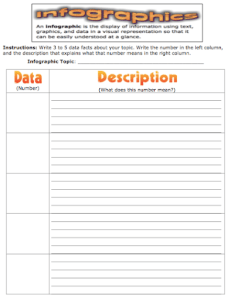
For younger learners, a clearly defined way of collecting the information is key. To do this, we designed the simple graphic organizer in this post to help them. The purpose of separating the number from the description is twofold. It not only clearly delineates the data from the facts, but it also aids in designing the actual infographic.

In order for the number to stand apart, it needs to be in its own textbox. This allows the data to be sized differently from the text in the infographic. The data piece is important. It should be more pronounced, in order to highlight each key fact in the overall design. We found that using this method with younger students also helped guide them through the editing process in writing the descriptions without repeating the number within the text.

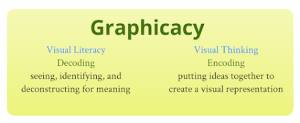
Empowering kids to be their own content creators helps them visually look at ways to encode the design of information. We firmly believe that building the skills of design literacy develops a keen sense of how to manipulate content for maximum impact. It develops visual literacy and visual thinking, the key components of graphicacy. The process of shifting from linear to visual information aids the learning process by providing context for content individually and by educating others about their topics.

Source: ASIDE, 2012

The earlier students learn to do this, the savvier they become at scrutinizing other information they see on a daily basis in the media. Understanding that design and media play a huge role in content creation can only help them as they go through the continual bombardment of advertising by infographics in the future.

Source: ASIDE, 2015

Sustainability workshop

Model based on The Natural Step idea. Curriculum DNA model – disciplines, needs, actions.
what is the concept of sustainable education – sustainable education – thesis by ?
looks at core values, transformative education. There is a specific language.

Discussion about how material will be presented e.g. via Internet or Intranet, and what should be open or private.
Four issues around education – knowledge, student-centred learning and action capability, ?

OP wants sustainability embedded in curriculum rather than starting with specialist options at most basic level of operation as sustainable graduates.

Staff development ideas
workshops: 1. what’s best? Decision-making for a sustainable future. From June 28 EDC and Steve.
2. Curriculum development for a sustainable future.
Should these be done in order or in parallell. Do we use inquiry, authentic-based, experiential?

Do we work within discipline or across discipline? There is a place for both.

How to Use a Planner Effectively

Some planners have additional features in the front or back sections, such as “dates to remember,” goal trackers and password logs. Use these sections!

Keeping a to-do list can help you feel organized, but without proper planning, it’s easy for that list to get out of control. Using a personal planner can help you prioritize your tasks, improve your time management skills, and allow you to be more successful both in and out of the classroom.

Today, there are many time management apps that make planning a breeze, and there are also traditional planners for those who like to keep a hard copy with them at all times. Whatever your preference, using a planner can help you tackle your growing to-do list.

Here’s how to choose the right type of planner for your lifestyle and make it work for you.

Choosing the right type of planner

There are several different formats of planners, some of which are geared toward managing your short-term to-dos and others that are better for long-term projects and planning. Your lifestyle, schedule and your personal preferences will help you determine the best option for you.

Here are three of the most common styles of planners:

  • Weekly/Monthly: This version uses a one-week-per-two-page spread, with planning space for each day of the week. It also includes a small monthly planning page at the start of each new month for more important reminders. This planner is useful for keeping track of weekly meetings and appointments. It can also be an effective method for college students to keep track of weekly due dates and homework assignments.
  • Monthly: These are ideal if you like to see your commitments for the month at a glance. This type of planner comes in a desk-size version for extra writing space, or a pocket-size version that fits perfectly in a backpack for on-the-go use.
  • Daily: The daily planner uses a one-day-per-page spread, which gives you ample space to plan out all of your daily tasks and reminders. This layout is ideal for college students or anyone who has a packed schedule or a long list of to-dos every day.

Each of these styles is also available in a digital format. Most smartphones come with a built-in calendar application that pulls in events and reminders from your connected email account. In addition to managing your daily schedule, you can set alerts and configure your calendar to pull in information from other apps, such as Notes or Reminders.

Google Calendar is one of the most popular digital planners, and it includes daily, weekly, and monthly spread options to meet your needs. Another digital planner that is specific to students is My Study Life. The app includes a homework tracker for due dates and assignments, as well as a calendar and a class schedule manager. Check out this blog post for more info on the best time management apps for students.

How to use your planner effectively

While choosing the right type of planner is important, learning how to use it effectively is the only way it will have a positive impact on your life.

Here are five tips to make the most of your planner:

1. Consistency is key

Studies have shown it takes up to two months to develop a new habit. Using a planner takes consistency and if you don’t use it every day, it will not be an effective tool. Keep your planner right by your bedside so that it’s the first thing see when you get up in the morning. Not only will this help you get into the habit of looking at your planner, it will also help you prepare for the day ahead.

2. Fill in important dates and deadlines right away

Get into the habit of writing down all important dates and deadlines as soon as you find out about them. This makes it easier for you to keep track of all of your responsibilities and ensures that all of your notes are in one place.

3.) Use color-coding to keep track of different items

Some students find it helpful to color-code their assignments, or use a bright color for important tasks or reminders. You might have up to five different classes as well as other commitments in a day, and it can be overwhelming if all of that information is crowded together in the same box in the same color pen. Using a different color for each class makes it easy to see what you have on your to-do list. This method can also be useful for remembering birthdays and other special events on a monthly basis.

4.) Implement time-blocking

Time blocking is the practice of planning out your day in advance and dedicating specific time blocks for certain tasks and responsibilities. This helps you predict what you can realistically accomplish each day and allows you to make better use of your free time. Setting aside a specific time for schoolwork can also help you improve your focus and your productivity.

5.) Use the extra features that the planner offers

Some planners have additional features in the front or back sections, such as “dates to remember,” goal trackers and password logs. Check to see if your planner offers any of these resources, and take advantage of them if so.

Personal planners are an effective way to organize your life and can positively improve your time management skills. It might take some trial and error to find what works best for you, but once you get into the routine of using a planner, it will most definitely make a difference in your life!

How to Stay on Top of Your Assignments in College

Here are some helpful tools and strategies you can use to stay on top of your homework and develop better time management skills.

College can be an extremely busy time, especially if you are balancing school with a career, a family or other commitments. A recent survey found that the average college student spends 17 hours each week preparing for classes. That’s a significant time commitment, and without strong planning and time management skills, it’s easy to feel overwhelmed.

The good news is that there are some helpful tools and strategies you can use to stay on top of your work and develop better time management skills in the process.

Follow these tips to get back on track with managing your college workload:

1.) Start your work early

If you’re a habitual procrastinator, it’s time to rethink your approach. Leaving assignments until last minute inevitably creates more stress and does not give you enough time to do your best work. Worse, you could forget about an assignment altogether and miss a deadline. It’s best to start important projects as early as possible and make a game plan for how you are going to complete the assignment before the due date. This way, you don’t have to panic or pull an all-nighter before it’s due and you have time to get extra help if you need it.

2.) Make to-do lists

Making a daily to-do list can help you keep track of your assignments and your other commitments. Studies have shown that writing something down helps you remember it better, so the next time you have a whole list of things to do scattered in your brain, relieve some stress by putting them down on paper. Your to-do list can include tasks as simple as remembering to check your email, exam deadlines and homework reminders. Whatever you think you will forget, be sure to include.

3.) Use a digital planner

There are many time management apps that can help you organize your to-do list. The app myHomework is a digital planner created specifically for students. It eliminates the need for a notepad with a million to-dos and instead syncs your assignments and reminders right to your phone. The app can also be programmed to send you alerts when you have something due soon, so there is no chance that you will forget.

Evernote is a note-taking app that can store all your notes and to-do lists in one place. Something unique about this program is that notes can be uploaded in any format, whether audio, video, web clips, or PDFs. The app also allows you to collaborate with others, which can be helpful for group projects.

4.) Prioritize what needs to be done first

Prioritizing is a critical part of making your to-do list. Consider which assignments are most urgent and make sure to complete those first. Tasks that are less urgent, such as going to the dry cleaner, can likely be tackled later when you have more time. Prioritizing your to-do list can help you improve your time management skills and ensure that you don’t put too much time and effort into something that may not be due for another month.

5.) School comes first

When things get chaotic (because at some point in the year, they probably will), remind yourself that your schoolwork comes before other activities. Pushing off your assignments to hang out with friends or pick up an extra shift at work will just make it harder to get everything done on time. Starting your assignments early can benefit you in this area and make it easier to stay on track in all aspects of your life.

6.) Pick one day per week to organize

Choose one day per week as your “organization day” where you can catch up on schoolwork and prioritize the week ahead. If it works for your schedule, Sunday is a great day to do this because it’s before the start of the regular work week. It doesn’t necessarily have be the whole day either; taking just one hour to sit down and acknowledge what you have going on for the upcoming week can be helpful. This way, you will have no confusion about what your priorities are for each day.

7.) Find a study buddy

Making a friend in your classes can be extremely helpful in getting your work done. You essentially have a guaranteed study buddy and you can hold each other accountable for getting your work done on time. It also makes preparing for projects and exams much easier because you have someone with which to collaborate, share ideas and ask questions. Forming a study group is another way to reduce procrastination and better prepare for your exams.

8.) Take breaks

The final and most important tip is to make sure you fit in some time to relax among all the hustle and bustle of college. Taking short breaks between assignments can be a great way to avoid burnout. You never want to compromise your own wellbeing just to get an assignment done. If you are feeling stressed out, take short break and come back with a fresh outlook. Chances are, the final product you develop will be much stronger.

Balancing college with the other aspects of your life can be a challenge, but a few positive lifestyle changes can make your busy schedule seem much more manageable. Try to start your work ahead of time or incorporate a new tool like myHomework or Evernote into your life to stay organized. By implementing these tips now, you’ll already be on track to a more productive year!

Find Your Program At Herzing University


Bureau of Labor Statistics (BLS), U.S. Department of Labor, Occupational Outlook Handbook. Multiple factors, including prior experience, age, geography and degree field, affect career outcomes. Herzing does not guarantee a job, promotion, salary increase or other career growth. BLS estimates do not represent entry-level wages and/or salary.

Subscribe to our Newsletter

SUBSCRIBE

How to Get a 4.0 GPA in College

Here are some simple steps that have been shown to help students improve their grades and reach their full potential.

Maintaining a strong college grade point average (GPA) is important because it can affect your eligibility for scholarships and other financial aid, and lead to better prospects for internships, employment and graduate school.

According to U.S. News and World Report, falling below a 2.0 GPA can come with consequences as dire as academic probation or even suspension from college. It can be easy to fall into an academic slump, so you need to take action as soon as you start to slip.

Here are some simple steps that have been shown to help students improve their grades and reach their full potential. While every student is different, implementing these tips can help you set yourself up for success.

1.) Don’t be afraid to ask your professors for help

Asking questions during class can seem intimidating, but that doesn’t mean you should avoid asking them altogether. If you’re feeling self-conscious about speaking up in class, make an appointment to speak with your professors one-on-one, or visit them during office hours. Your professors are a resource and they want to see you succeed. There is no harm in reaching out to them if you need clarity on a topic or help with an upcoming assignment. That’s what they are there for!

2.) Attend study sessions or join a study group

Some professors hold study sessions right before a major exam or project so students can get personalized help if they need it. It can be beneficial to attend these sessions, even if you don’t think you need help. You might uncover some gaps in your knowledge, or learn a new study technique you can use in the future. Some professors even offer a few points of extra credit for students who attend, which can be a huge grade booster.

Joining a study group with other students in your class also has its advantages. Meeting regularly with your classmates can help you prepare for exams, fill in any missing details in your notes, and build a support system you can go to when your professor is not immediately available.

3.) Attend ALL of your classes

Regular attendance is crucial. While many college professors stop taking attendance after the first couple of weeks, you should make an effort to attend every class. Skipping class means you could miss important lecture material that will appear on a test down the road, or you could get a zero on a pop quiz that will affect your grade.

If you know that you will not be able to attend class, be proactive and reach out to your professor to find out what you will miss. Ask to borrow notes from a classmate, and make sure that you do all your readings and assignments so that you are not behind the next time your class meets.

4.) Try sitting near the front of the classroom

Where you choose to sit can affect your concentration and productivity. If you know that you have a difficult time focusing during class, try sitting closer to the front of the classroom. You will find it easier to keep yourself on track and be attentive during a lecture.

5.) Research and develop good note-taking habits

While note-taking can be tedious and hard work at times, it truly is critical to succeeding in your classes. If you haven’t found a note-taking style that works for you, explore other options. Many college students like the Cornell method because the three-column system is especially helpful for studying.

Some people don’t care for the Cornell style and that’s okay – there are others. Pinterest can actually be a helpful resource for discovering new note-taking methods. Simply enter “Study Tip” in the search bar and thousands of images will appear, showing different ways that others have chosen to take their notes. Some of the ideas are extremely creative and can serve as positive inspiration if you are bored of more traditional styles. Just be careful not to create additional work for yourself by adopting an unnecessarily elaborate method.

6.) Sleep is important

Better sleep habits can also help you be more successful. As a college student, it can be easy to sacrifice sleep in order to get an assignment done. This is not a healthy habit to get into, as it can quickly wear you down. Getting enough sleep at night will make you feel much more refreshed and ready to take on the next day. It can also help with focus, decreased stress, and a stronger immune system.

According to the American Academy of Sleep Medicine, college students should aim for 7 to 8 hours of sleep each night. Check out our tips for getting a full night’s rest and morning routines to jumpstart a productive day.

7.) Dedicate the time to studying and doing homework

The most important thing you can do to maintain a high GPA is to complete your assignments on time and study regularly. If you dedicate the time and energy to finishing your assignments, you will be in a much better place when it comes time for an exam. Check out these time management tips to help you stay on track academically

. As important as your academic success is, you should not stress over having a perfect GPA. As long as you are committed to your education and are taking the necessary steps to do your best, you are on the right track. If you hit some bumps in the road along the way, it’s ok. It’s all part of the learning process, and you will be wiser and stronger because of it!

5 Reasons Why Healthcare is a Hot Career Field

If you’re contemplating your next career move, consider these reasons to pursue a job in healthcare.

Healthcare occupations are considered among the best jobs for 2019 and beyond. Recently, Business Insider listed healthcare as one of the top industries for job security based on information from the Bureau of Labor Statistics (BLS).

What makes healthcare such a hot career field? There are a variety of factors, but for one, healthcare is among the fastest-growing occupational fields today, with 1.9 million new jobs expected by 2028, according to the BLS.

If you’re contemplating your next career move, consider these reasons to pursue a job in healthcare:

1. Employment in healthcare is booming

While the number of manufacturing jobs in the U.S. has declined – due in part to the rise of automation – healthcare and social assistance jobs have nearly doubled over the last two decades. In 2018, healthcare surpassed nearly every other major sector of the economy in job growth, including food services, construction, manufacturing, and retail, according to an analysis of BLS data. More than 16 million people worked in the healthcare sector at the end of 2018, accounting for almost 11% of all jobs.

2. Demand for healthcare services is on the rise

As the baby boomer population ages, there are significantly more elderly Americans in need of medical care and health services. Healthcare organizations are striving to accommodate a growing number of patients, and this is creating new opportunities for healthcare professionals in a variety of roles, including medical assisting and physical therapy assisting.

Many organizations are also incorporating new technologies to streamline their billing processes and keep track of patient information. As a result, there is also a growing demand for health information management and health administration professionals, such as medical codersinsurance billing specialists and more.

3. Many older healthcare workers are nearing retirement

Many baby boomers will retire in the coming years from the healthcare workforce, creating a wave of new job openings in the next decade. Younger, but experienced healthcare workers will have the opportunity to step into higher-paying leadership and management roles as older leaders retire.

According to a 2018 survey by the National Council of State Boards of Nursing and The Forum of State Nursing Workforce Centers, more than half of the registered nurse (RN) workforce is age 50 or older. The Health Resources and Services Administration has estimated that more than 1 million RNs will retire from the workforce by 2025. Workforce shortages in other healthcare sectors, such as physical therapy and dental assisting, also have been projected to create job growth in the next several years.

4. Healthcare workers earn a higher than average salary

A career in healthcare offers the opportunity to earn a higher salary than what’s offered in some other industries. According to the BLS, the median annual wage for healthcare practitioners and technical healthcare occupations was $66,440 in May 2018, significantly higher than the median annual wage for all occupations in the economy, which was $38,640.

An advanced degree is one way that healthcare professionals can continue to increase their earning power throughout their careers. For example, many registered nurses are returning to school to earn their bachelor’s degree in nursing (BSN) or master’s degree (MSN). By doing so, they can increase their employment prospects, earning potential and opportunities for advancement.

5. There are a variety of healthcare career paths to choose from

While doctors or nurses might be the first healthcare job titles that come to mind, there are many other healthcare-related occupations that are experiencing significant employment growth. Whether you’re interested in caring for patients directly, or working behind the scenes to improve the patient experience, there is a healthcare-related career for you.

Not all healthcare careers require a four-year degree either. For those looking to enter the field and begin earning quickly, there are many healthcare degrees you can earn in two years or less.

If you’re looking for a stable, secure career, healthcare is the place to start. Learn more about Herzing’s healthcare degree programs and explore the career opportunities that could be a good fit for you.

Time is Money: 3 Ways to Get Your Degree and Start Earning Faster

As you begin your college search, make sure you’re looking at schools that offer certain benefits that will help you get your degree faster.

Your education is your investment – one that pays dividends when it comes to your career and your financial stability. Advanced education comes with a myriad of benefits, including higher earnings and better employment prospects, according to the Bureau of Labor Statistics (BLS). The quicker you earn your degree, the faster you can reach your career goals and see a worthwhile return on that investment.

Carving out the time and money needed to earn your degree can really pay off. College graduates earned weekly wages in 2018 that were 80% higher than those of high school grads. Plus, the BLS reports that Americans with a bachelor’s degree have average weekly earnings of $1,173, compared to $712 a week for those with a high school diploma. So, the sooner you can earn your degree, the more earning potential you’ll have.

The path to earning a degree isn’t always easy and fast, however. Adult learners may already be working full time, and have lives that can’t be interrupted to complete the traditional four-year, in-classroom college pathway. The good news is, you have options. Earning your degree faster starts with enrolling at a school that fits your lifestyle and your timeline.

Three Ways to Get Your Degree Faster

As you begin your school search, make sure you’re looking at institutions that offer the following to get you to your degree faster:

1. Flexible scheduling

Even though adult learners account for nearly 74% of the undergraduate student population, there are still schools that don’t offer flexible scheduling for those already working full time. Look for a school that fits your lifestyle – not the other way around. Schools with online courses, for example, allow you to earn your degree on your own time, while night courses can also accommodate a busy day-to-day work schedule. You also might want to look for a school that offers year-round classes online or on campus, which will allow for much quicker completion time.

2. Transfer credit and credit work for work/military experience

Always make sure the school you’re transferring to will allow most, if not all, of your credits to transfer along with you. You shouldn’t have to waste time and money re-taking all the course work you’ve already completed. Seek out a college or university that understands the value of your prior experience, whether that’s from work, school or the military. At Herzing University, it’s likely you’ll be able to build on what you already have, whether it’s credits from somewhere else or life experience.

3. Accelerated programs and dual-credit options

Accelerated programs and dual-credit options allow you to do more in less time, speeding up the process of getting your degree so you can start earning as soon as possible. With dual credits, many students find it much easier to reach their long-range educational goals and achieve more than they ever thought possible.

For example, at Herzing, qualifying students have the opportunity to complete up to four graduate-level courses, which can be applied as electives or course substitutions, setting yourself up for your next degree while earning your current one. Herzing students have the fastest way to get from point A to point B. We provide the exact classes and course work you need in the order you need them, helping you get on with the life you want, faster, reaching your financial, career and life goals at a pace that works for you.

What is an LPN’s Salary? And What Does an LPN Do?

According to the Bureau of Labor Statistics (BLS), the median annual wage for licensed practical nurses was $46,240 in May 2018, with the highest 10% earning

Licensed practical nurses (LPNs) are an important part of the healthcare team, supporting doctors and nurses in caring for patients of all ages.

If you’re interested in pursuing a career in nursing, becoming a licensed practical nurse (LPN) is an ideal place to start. The Bureau of Labor Statistics projects employment for LPNs to increase by as much as 11 percent through 2028, adding more than 78,000 new jobs.

Due to positive job growth and opportunities for advancement, LPN has ranked the #10 Best Healthcare Support Job for 2019 by U.S. News & World Report.

Here are some answers to common questions about LPN careers.

What is the average LPN’s salary?

According to the Bureau of Labor Statistics (BLS), the median annual salary for licensed practical nurses was $46,240 in May 2018, with the highest 10% earning more than $62,160. To find the closest LPN salary estimate for your state, check out this blog post.

You can increase your earning potential as a nurse by advancing your education. Many new nurses start out as an LPN to gain experience before advancing their career with an associate (ASN) or bachelor’s (BSN) degree.

What do LPNs do?

LPNs work closely with registered nurses (RNs) and physicians to provide patients with basic nursing care. Typical duties might include:

  • Monitoring patients
  • Taking patient vital signs and histories
  • Performing routine assessments, such as checking blood pressure
  • Changing bandages
  • Inserting IVs or catheters
  • Listening to patients’ concerns and reporting back to RNs and doctors
  • Ensuring patients are comfortable
  • Helping patients bathe or dress

An LPN’s duties can vary slightly depending on the healthcare setting and the state in which they work. For example, some states do not permit LPNs to administer medication or start IV drips. In other states, experienced LPNs are able to supervise and manage less-experienced nurses or nursing aides, according to the BLS.

LPNs can also work in a wide variety of healthcare settings, including hospitals, doctor’s offices and urgent care clinics. Due to an aging population, there is a growing need for LPNs in long-term care, such as rehabilitation centers, residential treatment centers and hospice. Most LPNs work in nursing and residential care facilities.

How do I become an LPN?

Earning your diploma in practical nursing (PN) is the fastest way to jumpstart your nursing career as a licensed practical nurse (LPN). Herzing University offers a diploma PN program that can be completed in as little as 12 months.

You might find some schools that offer a 6 month or 9-month path to a PN diploma. Be mindful that accelerated programs aren’t for everyone, and such a fast track can be overwhelming. Look for a program that will guide you and support you in reaching your goals.

After you graduate with your diploma, you will be eligible to sit for the National Council Licensing Examination for Practical Nurses exam (NCLEX-PN). Once you pass this exam, you are ready to start practicing as an LPN!

What are the opportunities for advancement?

With additional education and licensing, LPNs can become registered nurses. RNs are in increasingly high demand as healthcare organizations strive to accommodate a growing patient population and replace nurses who are retiring. Compare RN vs. LPN and discover the primary differences between the two jobs.

Herzing’s practical nursing curriculum is designed so that students who wish to advance their nursing education can enroll directly in the Associate of Science in Nursing (ASN) or Bachelor of Science in Nursing (BSN) program. Graduates of the LPN program may also be able to choose between several flexible learning options, including an LPN to ASN and LPN to BSN pathway.

Learn more about why LPN is a great career choice and how you can get started today.

How to Become a Paralegal in 6 Steps

Paralegals assist lawyers in the creation of legal documents, conduct research on laws and regulations, assist in court cases and more.

Becoming a paralegal is a great way to begin a career in the legal field. Paralegals assist lawyers in the creation of legal documents, conduct research on laws and regulations, assist in court cases and more. Some paralegals choose to specialize in a particular area of law, such as criminal law or real estate, and some even go on to law school to become lawyers.

Here are six steps you can follow to begin your career as a paralegal or legal assistant.

1. Learn more about career options

In addition to understanding what a paralegal does, you might wonder how much paralegals make, where they can work, and what the employment prospects look like. The Bureau of Labor Statistics (BLS) is an ideal place to start your research.

BLS has a positive employment outlook for paralegals and legal assistants:

  • 2018 Median Pay: $50,940/year
  • Number of Jobs in 2018: 325,700
  • Job Growth for 2018-28: 12% (Much faster growth than average)

Because of strong employment growth, paralegals rank #14 on U.S. News & World Report’s List of Best Social Services Jobs for 2019. To get a better understanding of what it’s like to work as a paralegal, you can also conduct a quick local job search. A good resource is Glassdoor, which is one of the world’s largest job sites. Browse open positions to get a feel for the typical duties of a paralegal, read employee reviews, and learn more about the types of companies you would like to work for as paralegal.

Discover how much a legal assistant/paralegal can make on average across all 50 US states.

2. Research educational requirements

According to the BLS, most paralegals or legal assistants have an associate degree or certificate in paralegal studies. A bachelor’s degree in legal studies is not required by all employers, but it might help you gain an edge over the competition for entry-level roles. Earning your bachelor’s degree can also help you position yourself for career advancement down the road. Take some time to consider which degree path is the right fit for you. If you are looking to earn your degree and start working as soon as possible, you might opt for an associate degree program. If you want to go to law school someday, you should start by earning your bachelor’s degree, as this is a prerequisite for graduate law programs.

3. Enroll in a degree program

Once you determine which degree you want to earn, look for a university that meets your needs and educational goals. Find a program that is flexible and will provide you with real-world experience and training. Herzing University offers several programs to help you get started as a paralegal or legal assistant, including an Associate of Science in Paralegal/Legal Assisting,

Associate of Science in Legal Studies and Bachelor of Science in Legal Studies. Keep in mind that the paralegal program is only offered at the Atlanta and New Orleans campuses, so if you are researching from another state, our Associate of Science in Legal Studies program would be the best option for you.

4. Earn professional experience

Pursuing relevant internships is an excellent way to earn professional experience while you are working on your degree, and it will also benefit your job search as you get closer to graduation. Most internships are part-time and can be flexible with your work and school schedule. Even if you find work in a legal setting that isn’t specifically a paralegal or legal assisting role, you can still include that as legal office experience on your resume!

Career Services can help you figure out the steps you need to take to find an internship and begin your job search. Herzing students and graduates also have access to an online job board where they can browse open positions and connect with local employers.

5. Network whenever possible

A huge part of job-hunting many people overlook is networking. While it may sound like something only experienced professionals can do, you’d be surprised at how much you can use networking to your advantage as a student.

Attend career fairs at your school, reach out to local legal firms to set up informational interviews, and ask your professors for their advice on getting started in the field. It’s also important to have a LinkedIn profile where you can connect with other industry professionals. Establishing a strong professional network is extremely important for your career growth and advancement, and it never hurts to start early.

6. Choose a specialty

As you gain experience and talk to others in the legal field, you’ll start to develop a sense of your career interests. Paralegals can specialize in different sectors and fields, so think about where you want to work and the type of work you want to do. There are three major sectors paralegals and legal assistants work in:

  • Private Sector: In this sector, you will be working for companies, most likely large or mid-sized, and law firms. You can expect to work on employee benefit plans, shareholder agreements, financial reporting, labor regulations and more.
  • Public Sector: In the public sector, you tend to work for government agencies. Often, this means working for organizations or individuals that offer legal services to those who cannot afford it. You will work on research, help prepare court documents, assist with data compilation and more.
  • Freelance: Depending on the state you are in, it may be possible to become a freelance paralegal and offer your assistance to lawyers, law firms or legal departments. As a freelancer, you can determine which jobs and specialties you want to focus on, allowing you to gain a diverse mix of experiences. You will bounce from company-to-company as contracts run out, however, so keep this in mind.


Radiologic Technologist vs. Radiologist: What’s the Difference?

A radiologist is a doctor who interprets medical images, and a radiologic technologist performs diagnostic imaging and procedures on patients.

Radiologic Technologist vs. Radiologist

While radiologic technologist and radiologist sound like similar careers, they are actually quite different. A radiologist is a doctor who interprets medical images, such as X-rays and MRIs, diagnoses patients and recommends treatment. A radiologic technologist is typically supervised by a radiologist and supports the doctor and other members of the healthcare team by performing the diagnostic imaging procedures.

Radiologists must also attend medical school. Radiologic technologists, on the other hand, can begin their career after completing a two-year associate degree program in radiologic technology. With additional experience and education, they can go on to specialize in areas like mammography, MRI or cardiovascular imaging.

career as a radiologic technologist is an excellent choice for anyone who wants to help others, has a passion for working with technology and is interested in joining the healthcare field quickly. In fact, U.S News and World Report rank radiologic technologist as #27 in Best Healthcare Support Jobs for 2019.

Let’s take a look at what it’s like to work as a radiologic technologist and how you can succeed in the field.

Important Qualities of Radiologic Technologist

In addition to the technical knowledge and skills gained through an associate degree program, radiologic technologists must have the right mix of soft skills to work successfully with patients and other members of the healthcare team.

Here are some of the most important qualities for radiologic technologists:

1. Empathy

As a radiologic technologist, you will work with patients on a regular basis. Some patients might be in pain or be extremely nervous about their exam, and part of your job is to ensure that the experience is as smooth and painless for them as possible. Radiologic technologists help put patients at ease by explaining what to expect before, during and after the examination. Having empathy and strong interpersonal skills will make it easier for you to develop a rapport with your patients and make the visit much more comfortable for them.

2. Strong communication skills

Communication skills are important for your interactions with patients as well as other staff members. Radiologic technologists need to be able to relay important information to doctors and nurses, educate patients, and ensure that results are recorded correctly after the exam. Being a strong communicator will help you build relationships with your patients and your colleagues to ensure a positive patient experience.

3. Teamwork

As a radiologic technologist, you will work with a variety of healthcare professionals – including from doctors, nurses and healthcare support staff. Personality differences are almost guaranteed, so that’s why it’s important to understand how to work as a team player. Someone might not be your favorite person (this applies to coworkers and patients), but you still need to work as a team to get the job done. Maintaining a professional attitude and composure in difficult situations will help you gain the respect of your colleagues and make it easier for everyone to work together.

4. Detail-oriented

Radiologic technologists must be extremely precise and detail-oriented. Physicians will often give detailed instructions as to which images need to be taken, and it is the radiologic technologist’s job to make sure the patient and the equipment are positioned correctly to capture the desired area.

5. Organizational skills

Part of your job as a radiologic technologist will be recording a patient’s medical history before an exam and updating patient records afterward. You need to understand the proper filing structure and be able to take detailed, organized notes. Radiologic technologists also need to keep the facilities and tools they use clean and organized for the next patient.

6. Analysis skills

Radiologic technologists may work with a physician to evaluate images after they have been taken. Having an analytical mindset will allow you to quickly determine whether additional images are needed for diagnosis.

Think you have what it takes to be an excellent radiologic technologist? Check out our radiologic technology degree program offered at Herzing’s Orlando campus and find out how you can get started on your career today!

10 Jobs You Could Land With a Marketing Degree

Marketing is a diverse and growing field. Here are 10 career paths you can aspire to if you have foundational skills based on a marketing degree.

Marketing is a diverse and growing field, with a variety of different opportunities to leverage your creative, analytic and problem-solving skills. If you’re interested in business, but looking for a way to employ your creativity, then a career in marketing could be a good fit for you.

Here are 10 jobs you can aspire to if you have foundational skills based on a marketing degree:

1. Marketing assistant

A marketing assistant is an entry-level position designed to expose you to a wide variety of roles and responsibilities on a marketing team. As a marketing assistant, you might be involved in communicating with clients, assisting with project management, or helping develop new campaigns and internal communications. With experience, you can advance to specialized roles in a particular marketing area, such as social media, advertising or analytics.

2. Market research analyst

Market research analysts look at consumer and market trends to help companies create campaigns or new products. These insights can also help a company understand their position in the marketplace, how they are faring against their competitors, and what their customers’ motivations and needs are. Analytical skills are essential for this job.

Employment for market research analysts is projected to grow 23 percent from 2016 to 2026, due to an increased use of data and market research across all industries, according to the Bureau of Labor Statistics (BLS).

3. Advertising sales

Advertising sales professionals work for media companies and agencies that sell ad space to other businesses. For example, if a company wants to run a commercial during primetime television, they have to work with sales representatives to secure and buy a time slot on a specific network. Advertising reps can also help a client determine the right advertising channels to reach their target audience at the right time.

Building and developing relationships with clients is a key part of this job. If you are a people person with strong communication and problem-solving skills, this job could be a good fit for you.

4. Media coordinator or planner

Media planners help businesses decide which advertising channels will be most effective for reaching their target audiences. They often work for a marketing agency and correspond with third-party advertising reps on behalf of their clients. Their job is to develop and implement a media plan that achieves the client’s goals.

For example, a media planner might recommend a social media-driven strategy for a company that wants to sell to millennials. If the company wants to reach an older audience, then traditional channels like print and TV advertising might be appropriate. This position requires advanced data analytics skills, as well as critical thinking and problem-solving abilities.

5. Public relations specialist

Public relations (PR) specialists, also called communications specialists or media specialists, help raise awareness for the organizations they represent. They can work for a specific company, or for a PR agency that represents multiple companies. As a PR professional, you will craft press releases, respond to information requests from the media, secure earned media coverage for your clients, manage events, develop social media programs, and more. Strong writing skills are especially important for this job.

In the age of social media, public opinion can shift quickly and brands need to be ready to respond to a crisis or take advantage of a trending moment. As a result, employment for PR specialists is expected to grow 9 percent from 2016 to 2026, according to the BLS.

6. Graphic designer

Graphic designers help design the look and feel for a company’s logo, website and marketing collateral, such as brochures and reports. They can also work for a marketing or creative advertising agencies to design campaigns for a variety of different clients.

This job requires creativity and knowledge of graphic design tools and software. If you already have a background in art and design and are familiar with these tools, a marketing degree can help you position yourself for advanced design or leadership roles.

7. Social media specialist

Social media is a key component of any company’s marketing strategy today, and there is a growing demand for individuals to create content for and monitor conversations on a company’s social media channels.

The day-to-day duties of a social media specialist vary widely and you won’t necessarily do the same thing every day. You’ll respond to customer reviews and questions, manage sponsored posts and ads, create engaging organic content and monitor the competition. Due to the real-time demands of responding to consumer comments, this can be a challenging position, but it’s a rewarding one and new enough that demand is still growing.

8. Content marketing specialist

Content specialists strategize, write and edit content for websites, blogs, emails, and more. Many companies have their own content production team in-house, but you can also find content writing roles at advertising and marketing agencies that assist with content management and strategy for their clients. If you are a creative individual with strong writing skills, this could be a good position for you.

9. Jr. Copywriter

A copywriter writes advertising campaigns, including slogans, jingles, emails, and catchphrases designed to break through the clutter and engage a potential buyer or consumer. Copywriters know how to tap into what motivates their audience and drive them to action. You might enjoy this role if you like creative writing and thinking outside the box. With experience, copywriters can advance to leadership roles on a marketing team, overseeing campaign strategy and creative direction.

10. Marketing manager

Marketing managers are involved in strategic planning and management of a marketing campaign or client relationship. This is a higher-level job that requires experience in managing budgets, timelines and teams of people, as well as industry expertise and knowledge. Employment for marketing managers is expected to grow by 10 percent through 2026, adding more than 22,000 new jobs, according to the BLS.

A bachelor’s degree in business or marketing is the first step to pursuing any of these fast-growing and competitive careers. Herzing University’s Bachelor of Science in Marketing program combines real-world business coursework with hands-on marketing exercises and projects to help students develop the creative, strategic and management capabilities needed to succeed in a variety of marketing roles.


Grammar Refresh: When and How to Use an Apostrophe

Apostrophes are commonly used to indicate possession or ownership of a noun, contractions, abbreviations and omissions.

Apostrophes can be tricky. It’s not always easy to determine when you need an apostrophe, and when you don’t.

For this lesson in grammar, we’ll explore the different uses for apostrophes and some common mistakes to avoid.

1. Apostrophes and possession

Apostrophes are used to indicate possession or ownership.

  • For example: My brother’s shoes are orange.

Adding apostrophe + s makes it clear that your brother owns the shoes. This rule is true for most singular nouns and plural nouns that do not end in s.

  • Singular noun, possessive
    • The boy’s toy
    • The cat’s tail
    • The building’s foundation
  • Plural noun, possessive
    • The children’s playground
    • The women’s bathroom
    • The geese’s pond

Here’s where it can get a little tricky: For plural nouns or words that do end in s, you only need to add an apostrophe to signal possession.

  • Plural noun ending in s:
    • The babies’ cribs rocked.
    • The kids’ room was a mess.
    • The siblings’ names all started with A.

For proper nouns that end in s, consult a style guide to determine the appropriate punctuation. The AP Stylebook, used by most American newspapers as well as businesses and other institutions, says that you only need an apostrophe after a proper noun that ends in s.

  • Thomas’ train rolled down the hill.
  • James’ car broke down.
  • Chris’ favorite TV show is “Game of Thrones.”

2. Apostrophes and contractions

Another major use of apostrophes – one that you’ve already seen in this blog post – is contractions. A contraction is when you take two words and combine them through the use of an apostrophe.

  • For example: I don’t want to do that.

The apostrophe signifies that you have combined “do not” into one word and takes the place of the missing letter o.

Contractions are often used in casual writing or speech. The use of a contraction can also help you convey a certain tone or accent. For example, the saying “y’all” is a contraction of “you all” and is often used in the American South.

3. Abbreviations and omissions

Apostrophes can also be used to show the omission of letters or numbers. You’ll most commonly see this in dates and mailing addresses, but sometimes they are used in normal sentences as well.

When abbreviating a year, you leave out the first two numbers and replace them with an apostrophe.

  • I graduated in ’99.

When you use an apostrophe to omit letters from a normal sentence, this is often an attempt to convey common speech or slang. Sometimes, a grammatically incorrect version of a word is simply how people speak and you want to convey that accurately.

  • Helpin’ yourself, are you?
  • Can I ask you somethin’?

4. Special cases and exceptions

Plural abbreviations

For the most part, apostrophes do NOT turn a word into its plural form. The only exception is when you have abbreviations that include periods between letters, such as M.D.

  • Ph.D. |Ph.D.’s (plural form)
  • M.D. | M.D.’s (plural form)

In this case, the apostrophe exists to make the abbreviation easier to read in a plural form.

It’s and its

Another BIG exception is its and it’s. In this case, apostrophe + s does not indicate the possessive form.

It’s is actually a contraction of “it is.” 

  • It’s raining outside.
  • It’s not too late.
  • It’s okay.

Its (with no apostrophe) is the possessive form.

  • The street got its name from a prominent politician.
  • The trashcan was tipped on its side.
  • The dog found its way home.

Keep these apostrophe rules and exceptions in mind next time you write, and don’t hesitate to visit our Writing Center for more one-on-one grammar help!