IMF's Chief praises India's economic growth.

India has emerged as “a bright light” at a time when the world is facing imminent prospects of a recession, the chief economist of the International Monetary Fund (IMF) said on 12 October, noting that the country, however, needed key structural reforms in order to achieve the ambitious target of being a USD 10 trillion economy.

Pierre-Olivier Gourinchas, chief economist of the IMF said: “Well, India is, I want to say, sort of bright light. The Indian economy has been doing reasonably well.”   In its World Economic Outlook, the IMF projected a growth rate of 6.8 per cent in 2022 as compared to 8.7 per cent in 2021 for India.

The projection for 2023 slides down further to 6.1 per cent, he noted.

Responding to a question on the ambitious goal of India becoming a USD 10 trillion economy, Gourinchas told PTI that he certainly believes this is achievable.

“Inflation is still above the central bank target in India. We expect India’s inflation at 6.9 per cent in 2022-23, which is likely to come down to 5.1 per cent next year. So, the overall stance of the policy we think that fiscal and monetary policy should be probably on the tightening side,” Gourinchas said.

What is Neighbourhood Planning


What is neighbourhood planning?


Neighbourhood planning gives your community the opportunity to plan for your local area, to decide what the place you live in should look like and define how your neighbourhood should grow and change in the future.

Neighbourhood planning gives your community the opportunity to set out proposals such as:

  • developing a shared vision for your neighbourhood
  • choosing where new homes, shops, offices, and other development should be built
  • identifying and protecting local green spaces
  • having a say on what new buildings should look like

While neighbourhood planning gives your community the opportunities to develop you own area, any neighbourhood plan must align with national planning policies as well as policies contained in our local plans for that area. It is important to mention that neighbourhood plans cannot block development already agreed through the council’s local plan or development which has already been agreed.

Who can start neighbourhood planning activity?

Anyone can identify the need for neighbourhood planning. However, only the relevant parish or town council can initiate this and in doing so, they will be responsible for the progression of the work required, in consultation with us.

In the absence of a parish or town council, you can create a neighbourhood forum (a community organisation) to carry out this role. The same measures for neighbourhood planning activity apply to both designated neighbourhood forums and parish / town councils. Its membership is open to:

  • anyone living in the neighbourhood area concerned
  • anyone working there
  • elected members of the county council, whose area falls within the geographic area concerned

Groups can either work individually or jointly in which case a lead authority would need to be nominated. For the purposes of this web page, we refer to all bodies undertaking neighbourhood planning activities as ‘neighbourhood planning groups’.

Types of neighbourhood planning activity

There are three types of neighbourhood planning that your community may wish to do:

  • Neighbourhood plan
  • Neighbourhood development order
  • Community right to build order

Neighbourhood plan

In addition to existing planning policies for your area, your neighbourhood planning group can develop further policies relating to the future development and use of land in your neighbourhood. This can include general or site specific policies.

Whilst our development plan for your area sets out the broad policies which neighborhood planning activity must conform with, your neighbourhood plan can provide greater detail. Future planning applications will be judged against a neighbourhood plan as well other relevant statutory plans. 

Neighbourhood plans have to meet particular tests (known as ‘basic conditions’) before they can be brought into force. You can find out more about basic conditions at Top tips on Neighbourhood Planning: Understanding the Basic Conditions. Before a neighbourhood plan can be brought into force it must pass an independent examination and gain support from a majority of residents through a referendum. Once a plan is in force, planning decisions for that area will take into account its policies as well as those set out in the current local plan. 

Neighbourhood development order

Neighbourhood development orders allow your community to identify development proposals which can go ahead without having to go through the formal planning application process.. Examples are:

  • extensions of a certain size or type
  • major development schemes
  • new houses (including affordable)
  • a new shop or pub
  • employment units

Community right to build order

Community right to build orders allow you to grant planning permission for your local community to build small-scale housing developments, community facilities or shops. Any benefit from this should stay within your community, for example providing or maintaining a playground, village hall or delivering affordable housing.

Any local community organisation can create a community right to build order, not just parish and town councils or a neighbourhood forum.

What neighbourhood plans cannot do

Neighbourhood plans cannot block development already agreed through our local plan, or development that has already been granted planning permission.


The Position of Women In India

 The women have held different status and
position at different times in India. She was regarded as mentally inferior to
man. Manu was of the view that the females should not enjoy any freedom in any
walk of life. They should ever remain under the strict control of their father
during girlhood; of their husband during their married life and of their sons
during widowhood.

The women could freely participate in the
religious and public life during the Vedic Period. The couple jointly performed
the sacrifices. A son’s birth always gave greater joy than daughter’s birth.
The brotherless married girls enjoyed the right of inheritance. The women could
attend the social gatherings and freely meet and converse with strangers. The
bride was most heartily welcomed. She reigned supreme over the household. The
could chant the Vedic Mantras. A window could remarry her own brother-in-law at
her sweet will. She stood high in the public. Even if she overstepped moral
laws she was judged mildly and with sympathy. She was her husband’s helpmate in
all the domestic affairs. The society was tolerant. Even the sons of a maiden
were accepted by the society. The son was known as the boat of salvation but
all the performances remained incomplete without the woman’s participation.

Later on she lost her place in the
religious sphere. The daughter’s birth was despised. Social laws and customs
stamped her with a sort of mental deficiency. The luckless girl was treated as
an intruder and was killed in certain tribes even in infancy. She was strictly
confined to home and domestic cares. She was not to be relied upon in matters
of serious concern. She had no free hand in expenditure.

Need to transform agriculture to advanced farming and maintain continuity

 The Union Minister for Agriculture and Farmers Welfare, Shri Narendra Singh Tomar has said that the Agriculture sector is the backbone of our country and our rural economy and agriculture have such strength that the country can easily overcome even the adverse situations. The Indian Agriculture sector has shown this during the Covid pandemic. The Government of India provided food security to 800 million people of the country, as well as helped friendly countries. Today we are in the first or second place in the world in terms of most of the agricultural produce. Despite this, there are some challenges before the Agriculture sector. There is a need to work in this direction to transform agriculture into advanced farming, technology should be used in agriculture and its continuity should be maintained.

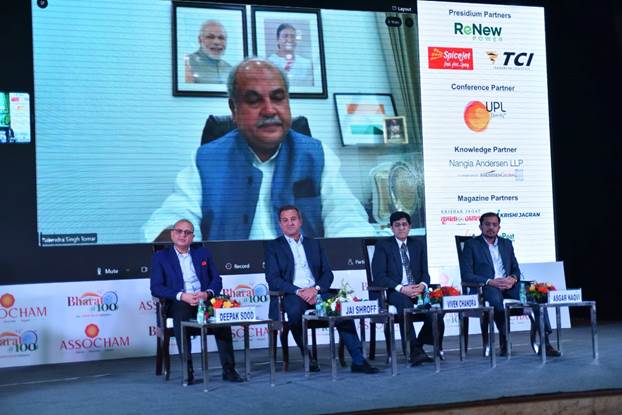
Shri Tomar said this in his virtual address to the National Conference on Enhancing Agricultural Productivity on the topic “Integration of Improved Seeds and Agri Inputs”, organized by the Associated Chamber of Commerce and Industry of India (ASSOCHAM) in New Delhi today. Shri Tomar said that the stronger and more profitable the Agriculture sector is, the stronger the country will be. There is a need to consider the challenges facing Agriculture today. In spite of all the favourable conditions, the area under farming and its profit and loss depend a lot on the nature. People’s curiosity and attachment towards agriculture should increase, agriculture should be attractive for the next generation and farmers can be retained for farming, more work needs to be done in this direction. Shri Tomar said that the government is working to reduce the gap between farmers and the market, providing infrastructure in rural areas and eliminate the role of middlemen. He said that the number of small farmers in the country is more, who have small acreage and do not have money for investment; for such farmers, the Central Government is setting up 10,000 new FPOs, for which a provision of Rs 6,865 crore has been made and small farmers are being mobilized. It is the effort of the government that farmers should do group farming, so that the input costs can be reduced, production quality improves and small farmers can shift to remunerative crops and get the price for their produce on their own terms. FPOs can also process products. For this, the government has extended loans up to Rs. 2 crore without guarantee.

Shri Tomar said that to reduce import dependence in oilseeds, the Oil Palm Mission has been started with a provision of Rs.11,000 crore. 28 lakh hectares of land in the country is suitable for oil palm cultivation. The prospects are high in the Northeast. Provision of Rupees One lakh crore Agri Infra Fund has been made for creation of infrastructure in the villages. Provision has also been made for special packages for Animal Husbandry, Fisheries and Medicinal Farming. Shri Tomar said that the Government of India is also working on the Digital Agriculture Mission, in which farmers, banks and other institutions will be linked, crop assessment made, data collected and crop losses will also be assessed with technology. Mapping will be done in such a way that farmers across the country can be advised through the State Governments as to where and which consumption is there, accordingly profit can be earned by producing as much needed. There will be no panic and there will be no loss. The Government has also emphasized on Natural Farming, in this direction we all need to work ahead. ASSOCHAM members including Secretary General Shri Deepak Sood, Shri Asghar Naqvi and Shri Jai Shroff were present in the programme. A knowledge paper was released on the occasion.

***

National Means cum Merit Scholarship scheme extended till 15th October, 2022

 The last date for submission of application for ‘NMCMSS for the year 2022-23 extended till 15th October, 2022’ Under the ‘National Means-cum-Merit Scholarship Scheme’ scholarships are awarded to meritorious students of economically weaker sections to arrest their drop out at class VIII and encourage them to continue their education at secondary stage. One lakh fresh scholarships are awarded to selected students from class IX every year and their continuation / renewal in classes X to XII for students studying in State Government, Government-aided and local body schools. The amount of scholarship is Rs. 12000/- per annum.

The National Means cum Merit Scholarship Scheme (NMMSS) is boarded on the National Scholarship Portal (NSP) – a one stop platform for scholarship schemes given to students. NMMSS scholarships are disbursed directly into the bank accounts of selected students by electronic transfer through Public Financial Management System (PFMS) following DBT mode. This is a 100% centrally sponsored scheme.

Students whose parental income from all sources is not more than Rs. 3,50,000/- per annum are eligible to avail the scholarships. The students must have minimum of 55% marks or equivalent grade in Class VII examination for appearing in the selection test for award of scholarship (relaxable by 5% for SC/ST students).

The last date of INO level (L1) verification is 31st October, 2022 and of DNO level (L2) verification is 15th November, 2022

*****

Take a glance at IMF’s latest report on world economy.

Global economic growth is likely to slow next year more than previously expected, the International Monetary Fund said, warning living conditions will worsen as soaring inflation harms people’s lives around the world.


The IMF attributed the weaker outlook primarily to the effects of inflation, Russia’s invasion of Ukraine and the slowdown in China brought on by frequent Covid-19 lockdowns and problems in its property sector.


Inflation, at the highest rates in decades, poses the most significant immediate threat to the global economy by squeezing incomes and destabilizing economic activities, said IMF economists.


The IMF expects global inflation to peak this year at 8.8%, before cooling to 6.5% in 2023 and 4.1% in 2024. At 7.2%, inflation in advanced economies this year is the highest since 1982.


The U.S. Federal Reserve is raising interest rates at the fastest clip in decades to try to tame inflation by slowing growth. Central banks around the world are rapidly moving in the same direction.


Further, The IMF, citing in its latest World Economic Outlook report, cut its forecast for India’s gross domestic product (GDP) growth in financial year 2022-23 (FY23) by 60 basis points (bps) to 6.8 per cent, warning of a long and tough economic winter.

Take a glance at IMF's latest report on world economy.

Global economic growth is likely to slow next year more than previously expected, the International Monetary Fund said, warning living conditions will worsen as soaring inflation harms people’s lives around the world.

The IMF attributed the weaker outlook primarily to the effects of inflation, Russia’s invasion of Ukraine and the slowdown in China brought on by frequent Covid-19 lockdowns and problems in its property sector.

Inflation, at the highest rates in decades, poses the most significant immediate threat to the global economy by squeezing incomes and destabilizing economic activities, said IMF economists.

The IMF expects global inflation to peak this year at 8.8%, before cooling to 6.5% in 2023 and 4.1% in 2024. At 7.2%, inflation in advanced economies this year is the highest since 1982.

The U.S. Federal Reserve is raising interest rates at the fastest clip in decades to try to tame inflation by slowing growth. Central banks around the world are rapidly moving in the same direction.

Further, The IMF, citing in its latest World Economic Outlook report, cut its forecast for India’s gross domestic product (GDP) growth in financial year 2022-23 (FY23) by 60 basis points (bps) to 6.8 per cent, warning of a long and tough economic winter.

Kailasagiri of Andhra Pradesh: Place for Pristine Beauty and Mediation

Kailasagiri is a hilltop park within Visakhapatnam city, Andhra Pradesh a wonderful tourist place with pristine beauty. The place was developed by the Visakhapatnam Metropolitan Region Development Authority (popularly known as VMRDA) and spread over to an area of 380 acres of land covered with exciting landscape gardens consisting of rich flora and tropical trees. Kailasagiri is located around 10 kilometers from the Visakhapatnam Railway Station and around eight kilometers from Visakhapatnam Bus Station. The Government of Andhra Pradesh awarded Kailasagiri as “the Best Tourist Spot” in 2003. The hilltop is well connected by all means of transport. It was reported that on average, three lakh Indian and foreign tourists visit the park every year. To protect the environment, VMRDA has declared the hill a plastic-free zone, a praiseworthy step. A cable car connects to the top of the hill, the first of its kind in Andhra Pradesh which I had the opportunity to enjoy. Also, it is pertinent to mention that Kailasagiri is a favourite location among filmmakers all over India. In addition to the eye-catching and holy statues of Bhagawan Shiva and Goddess Parvathi, the hilltop has many wonderful attractions such as the Titanic viewpoint, floral clock, Shanku-Chakra Namas of Bhagawan Venkateswara of Tirupati, gliding point, delicious food courts, etc. The floral clock one of the biggest in India with a diameter of 10 feet is located here. There is a Shanti Ashram on the top of the hill, where one can get huge peace by spending time in meditation. A number of wonderful viewpoints have been developed all around the hilltop. A capsule lift has been provided to fascinate the visitors to view the beauty of blue seawaters and the city along with the stunning beauties of the hilltop from further heights.

During my Kailasagiri visit in the month of September 2022, apart from watching the natural pristine beauty by the train, I felt happy that the train resolved many issues as many senior citizens can enjoy the beauty by sitting on the train as both sides were open so can watch through the windows. Also, those who had leg/knee/ankle problems or other health problems need not walk for long distances. While moving by train as I was in a non-airconditioned (non-AC) coach, observed beautiful butterflies, a few flying insects through windows entered our coach and came out. I personally felt as if these were well-coming us. It is pertinent to mention that altogether five coaches were attached to the train engine. Out of these, three were non-AC coaches and two were AC coaches but all had only chair cars. Each coach can accommodate 50 people. And the journey period was 20 minutes that is every after 20 minutes new people could board the train. Also, it may be mentioned here that the cost of a ticket per person for an AC coach was Rs. 150 and for a non-AC coach it was Rs.100. The most significant advantage of the running of such a train was that it generated employment for many youths such as ticket sellers, ticket checkers, train maintenance, cleaners, etc. The train was operated under the banner of ‘Sarada Roadways Kailasagiri Hills Tour’. Also, another noteworthy point is that there were many shops in the tourist place selling different items and some shops were owned by minorities (Muslims) which is the beauty of our country depicting religious harmony. Anyway, I suggest to all the State Governments wherever technically feasible and economically viable such a project (train journey of 20 to 30 minutes) may be implemented in the tourist places. 

(The author expresses his gratitude to Dr. P L K Murthy, Proprietor, Visakha Ads; Chairman, Public Relations Society of India, Visakhapatnam Chapter and Sri T. Lakshmi Pathi, former Chief Engineer, Vishakhapatnam Port Authority for arranging the visit to the place as well as in carrying out the study)

Dr. Shankar Chatterjee, Hyderabad

Kailasagiri of Andhra Pradesh: Place for Pristine Beauty and Mediation

Kailasagiri is a hilltop park within Visakhapatnam city, Andhra Pradesh a wonderful tourist place with pristine beauty. The place was developed by the Visakhapatnam Metropolitan Region Development Authority (popularly known as VMRDA) and spread over to an area of 380 acres of land covered with exciting landscape gardens consisting of rich flora and tropical trees. Kailasagiri is located around 10 kilometers from the Visakhapatnam Railway Station and around eight kilometers from Visakhapatnam Bus Station. The Government of Andhra Pradesh awarded Kailasagiri as “the Best Tourist Spot” in 2003. The hilltop is well connected by all means of transport. It was reported that on average, three lakh Indian and foreign tourists visit the park every year. To protect the environment, VMRDA has declared the hill a plastic-free zone, a praiseworthy step. A cable car connects to the top of the hill, the first of its kind in Andhra Pradesh which I had the opportunity to enjoy. Also, it is pertinent to mention that Kailasagiri is a favourite location among filmmakers all over India. In addition to the eye-catching and holy statues of Bhagawan Shiva and Goddess Parvathi, the hilltop has many wonderful attractions such as the Titanic viewpoint, floral clock, Shanku-Chakra Namas of Bhagawan Venkateswara of Tirupati, gliding point, delicious food courts, etc. The floral clock one of the biggest in India with a diameter of 10 feet is located here. There is a Shanti Ashram on the top of the hill, where one can get huge peace by spending time in meditation. A number of wonderful viewpoints have been developed all around the hilltop. A capsule lift has been provided to fascinate the visitors to view the beauty of blue seawaters and the city along with the stunning beauties of the hilltop from further heights.

During my Kailasagiri visit in the month of September 2022, apart from watching the natural pristine beauty by the train, I felt happy that the train resolved many issues as many senior citizens can enjoy the beauty by sitting on the train as both sides were open so can watch through the windows. Also, those who had leg/knee/ankle problems or other health problems need not walk for long distances. While moving by train as I was in a non-airconditioned (non-AC) coach, observed beautiful butterflies, a few flying insects through windows entered our coach and came out. I personally felt as if these were well-coming us. It is pertinent to mention that altogether five coaches were attached to the train engine. Out of these, three were non-AC coaches and two were AC coaches but all had only chair cars. Each coach can accommodate 50 people. And the journey period was 20 minutes that is every after 20 minutes new people could board the train. Also, it may be mentioned here that the cost of a ticket per person for an AC coach was Rs. 150 and for a non-AC coach it was Rs.100. The most significant advantage of the running of such a train was that it generated employment for many youths such as ticket sellers, ticket checkers, train maintenance, cleaners, etc. The train was operated under the banner of ‘Sarada Roadways Kailasagiri Hills Tour’. Also, another noteworthy point is that there were many shops in the tourist place selling different items and some shops were owned by minorities (Muslims) which is the beauty of our country depicting religious harmony. Anyway, I suggest to all the State Governments wherever technically feasible and economically viable such a project (train journey of 20 to 30 minutes) may be implemented in the tourist places. 

(The author expresses his gratitude to Dr. P L K Murthy, Proprietor, Visakha Ads; Chairman, Public Relations Society of India, Visakhapatnam Chapter and Sri T. Lakshmi Pathi, former Chief Engineer, Vishakhapatnam Port Authority for arranging the visit to the place as well as in carrying out the study)

Dr. Shankar Chatterjee, Hyderabad

Story of Track2Training

Once upon a time, there was a small town nestled in the mountains called Greenview. The town was known for its beautiful landscapes and friendly community, but it lacked resources for youth development. The town only had one school, and the students’ options for extracurricular activities were limited.
One day, a group of young adults from the town decided to start a program to help the youth in their community. They called it “Track2Training,” a program that focused on providing various vocational and skill-based training to students outside of school hours.
The group of young adults worked tirelessly to develop a curriculum and reach out to businesses and organizations that could provide hands-on training opportunities. They were able to secure partnerships with local carpenters, electricians, chefs, and artists who were willing to volunteer their time to teach the students.
The program became an instant hit, and soon, students from neighboring towns began to participate as well. The program’s success attracted attention from the state government, which recognized the initiative’s potential and decided to support it financially.
With the additional funding, Track2Training was able to expand its offerings and hire full-time staff to manage the program. They added courses on coding, graphic design, and marketing, providing students with valuable skills that could help them secure future employment.
The program’s success continued to grow, and many of the students who participated went on to start their own businesses or secure well-paying jobs. The program even attracted the attention of national media, and Track2Training became a model for other communities looking to provide similar opportunities for their youth.
The program’s founders were proud of what they had accomplished, but they knew that their work was not done. They continued to expand the program, offering more courses and resources to ensure that every student in their community had access to the tools and training they needed to succeed.
Years later, the town of Greenview had transformed into a hub of innovation and entrepreneurship, and Track2Training played a significant role in that transformation. The program had not only provided students with valuable skills but had also given them the confidence and support they needed to pursue their dreams.

India surpasses Japan in term of metro rail system length to become 4th largest metro system in the world.

India has a new title to boast on an international level. With the newest addition of the Ahmedabad metro, the length of metro projects in India has reached 810 km, surpassing the lines in Japan. India will overtake South Korea and the United States to be the second longest metro line in the world. This ambitious project is expected to be completed within the next one or two years. 

After the inauguration of Ahmedabad metro, the coverage of metrorail in India reaches 810 kilometers. It is a matter of pride, that India is among leading countries with respect to total length of metrorail”, the union minister Puri said during inauguration, adding that India has not only overtaken Japan, but also has 982 kilometers of Metro rail under construction. “Once this (982 kilometers of metro rail) finishes, India will overtake South Korea and United States and will reach the second position in the world. I am expecting this to happen within next 1-2 years,” he added.

India surpasses Japan in term of metro rail system length to become 4th largest metro system in the world.

India has a new title to boast on an international level. With the newest addition of the Ahmedabad metro, the length of metro projects in India has reached 810 km, surpassing the lines in Japan. India will overtake South Korea and the United States to be the second longest metro line in the world. This ambitious project is expected to be completed within the next one or two years. 

After the inauguration of Ahmedabad metro, the coverage of metrorail in India reaches 810 kilometers. It is a matter of pride, that India is among leading countries with respect to total length of metrorail”, the union minister Puri said during inauguration, adding that India has not only overtaken Japan, but also has 982 kilometers of Metro rail under construction. “Once this (982 kilometers of metro rail) finishes, India will overtake South Korea and United States and will reach the second position in the world. I am expecting this to happen within next 1-2 years,” he added.

Village Fair

 India is a land of fairs and
festivals. They provide us a lot of fun and amusement. The urban people have
many sources of attraction and recreation. They can visit the dazzling bazaars,
big restaurants and cinema halls. The weekly bazaars provide them the
facilities of marketing. The poor villagers lack all such facilities. The
bazaars are far off from the villages. The villagers’ life the very hard and
lacks all charm. They have no means of recreation. Their secludes life is cut off
from the urban modernisation.

Many fairs are held every year
in the villages. These fairs generally take place on the occasion of some
festival. The Holi fair, the Rakhi Bandhan fair, the Basant fair and the
Baisakhi fairs are the chief and common ones. The Baba Haridas Mela is the most
prominent one in our area. It is held at village Jharauda Kalan, twice a year.