ADVANCE VERSION OF CHILD MARRIAGE IN INDIA

Earlier India was one of the most backward countries. No doubt it was rich in resources and rich metals like Gold and diamond and hence was known as 'Golden Sparrow'.
Since it was not so developed, the society and thinking of people was also backward. Most of the population lived in the remote areas and hence circumference of their development was restricted.
Whenever a society is in the phase of underdevelopment, the section which suffers the most is the women class.
Women in India till today, despite this much development, are suffering and considered as a burden by many.
In the ancient period when Marwari rulers were ruling in some parts of the country, and the Mughals arrived, the Sati system was prevalent in the society.
Under the Sati system if a husband dies while fighting a war, or even by natural death, a wife too has to die with her husband. She has no right to live life further. She would sacrifice herself by jumping into the bowl of fire or on his funeral pyre.
After man, woman cannot live, she has to end her life. How can one be brutal towards someone? Sometimes if any of the woman didn’t want to die she was forced by the society to commit suicide.
Women were forced to live in the house to serve the family under purdah. She wasn't allowed to eat first, or along with the family members.
Today women themselves have adopted this system as their culture. They won't eat food until their husband does. That time it may be done forcefully, but today they have adapted it.
Women in one or the other way have to suffer a lot, because society has put so many rules and regulations on the women, from which they cannot come out. The system of Indian society is so dominating today even on the literate women.
Earlier child marriage was so normal. Every second girl was married at the age of 10-15 years. It didn't matter how old the boy was, he may have been a 35 year old man.
Education was not a priority in earlier times. Girls were not sent to school to receive education and hence at the age of 10 they were taught to work at home and then get married.
A time came when the Sati system was abolished from the society, which was a relief for the women section, but still she was never relieved.
When a girl after child marriage or a woman becomes a widow, again she was given a life worse than jailer. She was imprisoned in a room with a beam of sunlight. She was offered food separately. She had to live alone. She was neither allowed to meet anyone nor allowed to attend any family function. She wasn't allowed to marry another man, if she wanted to. The remaining entire life she had to live like she had no existence in the society.
This was the system made by the people of the society and everyone forced each other to follow it. What if someone doesn't follow it who the hell they are to beat, or to implement rules and regulations on anyone? This is what every individual needs to think about.
This was the system of the ancient period and slowly the thinking towards widows improved. The system of child marriage was also abolished, but as the history is the evidence that, Indian society cannot leave it's roots no matter how much it develops and adopts western culture.
Now the society has brought a new culture to the market. People don't do child marriages of their girls. They do child engagement in which at the age of puberty she is booked for a man or a boy. This becomes a symbol that the girl is now eligible for marriage. She is stopped from going to school. She learns the household chores and isn't allowed to come out of the house until she gets married.
After a few years as soon as she is near the legal age of getting married, they get married. Did anything change? No. Despite laws in the Constitution nothing changed. The only difference is they follow the criteria of legal age. The basic rights are still not given. The system continues to be the same.
The above mentioned case is in one section of society which I have seen first hand. There can be many other sections which are unknown where girls might be facing worse conditions than this.
Whenever a girl is born in the family, the first thought that comes in the mind of the members specially parents is how we will get her married. In India people worship goddesses, but when they come to know the gender of the baby in the womb and if it's a girl they decides for abortion. The level of hypocrisy is too high.
No matter how educated a family is, how much society says that women are equal to men, no matter how many laws and privileges given to a woman, except few parents , all say that we have to get our girl married. They consider their girl as a burden, not everybody but the majority. Parents work, earn and save because they have to get their two girls married. It doesn't matter how capable the girl is, at the end they just have to get her married. Is marriage the sole purpose of life? I wonder.
We are saying that the standard of women has improved. As compared to earlier times, it has improved a lot. But the true development is only when every woman and every section of society enjoys equal rights to that of man, not only in the field of education and basic rights but the equality at ground level, in behavior, in consideration and in preferences.
The ancient roots of evil society are very strong in India. We have adapted that evil system as our culture and don't want to rise above it. We are proud of our culture rather than questioning it. If we don't follow our culture and do something different, it is said that we are being influenced by the western culture.
The roots are too deep and strong. It would need centuries to uproot them. The struggle is so long and hard that not everyone wants to fight.


Superstitions

In this scientific era of the many discoveries and inventions, science making the impossible possible with the blink of an eye fixed , there’s no place for superstition. Science and superstitions are poles apart. Yet they’re the 2 sides of an equivalent coin unknown of their interdependence.
Superstitions are self-imposed selfish beliefs, something imaginary yet unimaginable disbelief, or mere beliefs. But science – the foremost well-known and popular word of this era. Science as is believed to be something realistic which even makes the unreal real; the unachievable achievable.
But still, these two unrealistic and realistic, unimaginable and imaginable, never-ending and ever ending concepts are interconnected somewhere beyond the universe by some unpredictable threads of God.
1. Eat curd and sugar before heading out Eating curd and sugar before stepping out for something new and important is taken into account to be good luck because the consumption of curd features a cooling effect on the stomach and sugar which is added provides instant glucose which makes your work easier and successful. This combination is indispensable for Indians and its consumption was slowly linked to good luck.
2. Don’t wash or cut hairs on certain days Washing or cutting hairs on certain days like on Tuesdays or Thursdays are considered to be bad luck but there’s no truth during this because it was one among the water management practices. And moreover, during those days, barbers got a vacation on those days. So, just to offer them a vacation people don’t cut hairs on those days.
3. Swallow tulsi leaves never chew
Tulsi leaves shouldn’t be chewed, it must be swallowed. The science behind his is that the tulsi leaves contain a touch amount of arsenic. Thus, chewing it directly could end in degradation of enamel.
4. Bathe after attending a funeral ceremony Earlier bathing was necessary after attending a funeral ceremony but today it’s not like earlier as our ancestors didn’t have vaccinations against smallpox, hepatitis and other deadly diseases. So they came up with this ritual of bathing so on prevent themselves from infection from the body .
5. Menstruating women are considered impure and unclean: during a country like India, it’s very prevalent and this gave rise to several other superstitious beliefs. At that point women weren’t allowed inside the kitchen, temples, mosques, and other religious spots. They are not allowed to perform any household duties. The reason is that at that time of your time women are comparatively weak due to tons of blood loss. So, they are given complete rest. Moreover, ancient stone statues of God maintain a particular equilibrium with the atmosphere and should collapse if any disturbance occurs. As women release tons of warmth during this era , they’re not allowed inside the temple since this might cause a disturbance within the natural equilibrium and should result in cracks in the idols.
6. Lizard falling on human is bad luck
It is said to be bad luck but the scientific reasons behind this is often that the lizard releases poisonous chemicals from its body so as to guard themselves from enemies and if it falls on physical body or food, it’s sure to contaminate it. So, bathe is taken after it falls on someone.
7. Using lemons and green chillies to avoid buri nazar The nimbhu mirchi tadka is one among the commonly visible superstitions among the society whose use is usually encouraged due to the qualities of lemon and chillies as they both are rich in several vitamins Ad create certain acidic odour which helps prevent insects. Thus, our ancestors used this as a logo during ceremonies which now became a tadka.
8. Bats entering the house means death it’s considered to be a nasty omen. The real reason behind this superstition is that the bats bring tons of deadly diseases along side them and when there was no medical facility available during those days, people would die thanks to rabies, Ebola, Nipah and other illness brought in by the illness.
9. Ghosts residing in peepal trees
This myth continues to prevail even today. But the scientific reason behind this is often that the trees use CO2 during the day and releases oxygen but in the dark , it’s the opposite way round. So, once you sleep under the tree, the surplus CO2 level can cause you to feel heavy within the fist and suffocated which is related to the sensation of being possessed by some spirits.
10. Throwing coins in fountains and rivers bring good
Most currencies in past were made from copper and by throwing copper coins into rivers, our forefathers apparently ensured that they were consuming pure water. Science has it that copper has antimicrobial property and it can kill 99.9% of infection-causing bacteria. However, today neither can we use copper coins nor can we drink water directly from the river. This belief has brought in additional pollution than good luck.

Is time travelling possible

Time travel has always been one of the biggest fantasies for all of us. It is generally thought as something fictional. It can be actually defined as the movement between certain points of time. Albert Einstein introduced a theory that if a person can move at a very high speed then time will be slowed down for him. Light moves very fast with a speed as high as 670,616,629 miles per hour. In just one second, light can go around the earth three times. The only way to achieve time travel is by traveling at the speed of light in space. Light always travels at the same constant speed in a vacuum 700 million mph.

Quick Facts: –

  • There are several paradoxes like twin paradox and paradox of a man with no past riddled with the time travel making the concept very complicated.
  • Despite all these complexities, it is believed by physicists that there are chances of time travel in the future.
  • Famous scientist Stephen Hawking claimed that time travel was impossible.
  • In the year of 2000, a person identified himself as John Titor and claimed to be a military time traveler.
  • Time is the fourth dimension along with the other three which are length, height, and width.
  • Going back to the past by time traveling is known as Retrocognition. It is also very much difficult to prove.
  • Travelling to the future using the concept is known as Precognition. It gives you knowledge of future events before they happen.
  • A time traveler was caught on a picture available on the Virtual Museum of Canada website

Top Desks and Rooms Schedule Management Softwares

“Scheduling is my favorite thing!” said no one, ever. Whether it’s for desks and rooms at your coworking space, or for meetings or events, booking time and space is usually much more complicated than it needs to be. Here are 10 tools that take the pain out of scheduling events and meetings for your coworking space. 
Desks and Rooms Schedule Management for Coworking 
1. Skedda
Skedda is an online booking and scheduling software for coworking spaces. It’s also used extensively at sports clubs and other types of businesses. The two main draws: it’s super easy and it has incredible customer service (according to the reviews). It’s also well-priced. A paid subscription starts at $5/month, but smaller spaces can probably get by just fine with the free option.
2. OfficeRnD
OfficeRnD is a full-service software platform built to empower coworking space managers. Its tools run the gamut from CRM, member billing, contracts, and of course, scheduling and booking rooms. The space management feature allows you to set up specific pricing and cancellation rules unique to your coworking space.
3. Cobot
Cobot is a simple coworking space management software. The best feature is the self-service booking calendar that integrates with the invoicing system to automatically charge members based on their usage of space, equipment, and so on. 
4. Nexudus
Nexudus is a full-service coworking management application. It was designed for bigger spaces and has more features than the others on this list, like multiple integrations, a real-time room availability app, and reporting.
5.Robin
Robin is a conference room booking solution that can also be used for individual flexible desks. Their platform allows for some cool advanced features like mapping of your office space and digital signage to view current room status and on demand booking. They charge per room, so it can grow as you do. Also, be sure to check out their slick mobile app in which workers can report issues within conference rooms, and can utilize bluetooth beacon technology for better usage metrics!
6. YArooms
YArooms is a conference room booking software. The clincher here is the easy-to-use iPhone app. As part of the package, you also get the YArooms Door app, which you can download onto a tablet mounted at the conference room door for real-time availability and booking.
Scheduling Meetings
When you need to schedule meetings at the coworking space, Appointlet’s got you covered. From 1-on-1 meetings to group conferences, all you need to do is set up a scheduling page and share the link with your partners. Everything’s fully automated, so you don’t have to send email confirmations or reminders. Plus it’s easy to keep track of everyone who will be joining you for the occasion!
8. Vyte
Vyte makes scheduling meetings a cinch by automating the tedious process of finding out when everyone is available. You pick a few possible meeting times and the app sends them to the group, finds the time that works, and then syncs with everyone’s calendar. They have a few different pricing levels with different features, but the app can be very helpful for those who are managing lots of schedules.
9. HubSpot Meetings
HubSpot Meetings is a part of the HubSpot Sales suite and helps save time booking meetings by letting others pick free time that you determine on your calendar, then integrating those meetings with Google Calendar, Office 365 Calendar, and HubSpot CRM. Perhaps its greatest strength is its integration with the HubSpot CRM and other HubSpot Sales tools like automated sequences and templates. Together, you can automate most of your usual daily sales tasks and track it all in your CRM.
10. Doodle
Doodle is great for scheduling meetings and events with random groups of people. Unlike almost every software, everywhere, you can use the tool without having to create an account. It only does one thing, but it does it well.
Want even more tips on creating an amazing member and visitor experience at your coworking space? Download our guide, “How To Implement a Visitor Management System At Your Coworking Space” here.
11. Bookafy
Bookafy is an online booking platform used for booking staff, rooms/resources, and group events. Integrate with your calendar to show real time availability, along with SMS text reminders, payments, and much more. Bookafy’s customer facing UI is beautiful, plugs into any website, and very customizable.
12. Calendly
Calendly also tries to solve the “find a time” problem that we face daily. Their advantage is that it could be your enterprise solution to this problem. With multiple integrations and a large support network, they are ready to handle and support a large number of employees.
Scheduling Events
For getting your event out onto the global radar, there’s really no better tool than Eventbrite. You create fun events, people search for fun events, and the word out gets out. Simple as that!
14. Splash
Splash calls itself an “experience management software.” Its event planning features include website creation, integrated email marketing, low-fee ticket-selling, and RSVP collection — everything you need to create not just an event, but an experience. 
15. Teamup
For planning member events, check out Teamup. This application lets you easily create and share a group calendar. There are several pricing tiers, but the basic free option allows you to have unlimited users on up to 8 sub-calendars, which is probably enough for most coworking spaces.
Coworking Room Scheduling and Space Management
Making sure that the room scheduling and desk booking process is just one part of managing coworking spaces, and these tools are just a few that we found help with the process. As a coworking space manager, making the workday stress-free for your members and their guests is your number one priority. There is other good Office booking software that is getting popular day by day. Keep trying new tools and techniques and find out which suits you the best.

Stephen Hawking

Stephen Hawking, in full Stephen William Hawking, (born January 8, 1942, Oxford, Oxfordshire, England—died March 14, 2018, Cambridge, Cambridgeshire), English theoretical physicist whose theory of exploding black holes drew upon both relativity theory and quantum mechanics. He also worked with space-time singularities.

Hawking studied physics at University College, Oxford (B.A., 1962), and Trinity Hall, Cambridge (Ph.D., 1966). He was elected a research fellow at Gonville and Caius College at Cambridge. In the early 1960s Hawking contracted amyotrophic lateral sclerosis, an incurable degenerative neuromuscular disease. He continued to work despite the disease’s progressively disabling effects.

Hawking worked primarily in the field of general relativity and particularly on the physics of black holes. In 1971 he suggested the formation, following the big bang, of numerous objects containing as much as one billion tons of mass but occupying only the space of a proton. These objects, called mini black holes, are unique in that their immense mass and gravity require that they be ruled by the laws of relativity, while their minute size requires that the laws of quantum mechanics apply to them also. In 1974 Hawking proposed that, in accordance with the predictions of quantum theory, black holes emit subatomic particles until they exhaust their energy and finally explode. Hawking’s work greatly spurred efforts to theoretically delineate the properties of black holes, objects about which it was previously thought that nothing could be known. His work was also important because it showed these properties’ relationship to the laws of classical thermodynamics and quantum mechanics.

Hawking’s contributions to physics earned him many exceptional honours. In 1974 the Royal Society elected him one of its youngest fellows. He became professor of gravitational physics at Cambridge in 1977, and in 1979 he was appointed to Cambridge’s Lucasian professorship of mathematics, a post once held by Isaac Newton. Hawking was made a Commander of the Order of the British Empire (CBE) in 1982 and a Companion of Honour in 1989. He also received the Copley Medal from the Royal Society in 2006 and the U.S. Presidential Medal of Freedom in 2009. In 2008 he accepted a visiting research chair at the Perimeter Institute for Theoretical Physics in Waterloo, Ontario, Canada.

His publications included The Large Scale Structure of Space-Time (1973; coauthored with G.F.R. Ellis), Superspace and Supergravity (1981), The Very Early Universe (1983), and the best sellers A Brief History of Time: From the Big Bang to Black Holes (1988), The Universe in a Nutshell (2001), A Briefer History of Time (2005), and The Grand Design (2010; coauthored with Leonard Mlodinow).

5 common mistakes students do during their college life while losing weight

Trying to shed the pounds and keep them off for good? I’ve rounded up the most common mistakes which college guys make during their weight-loss journey. They are usually busy with their studies so they don’t think twice about following any health tips or exercises given from any source.

Related: 5 common weight loss mistakes you’re probably making

1. Overestimating your calorie burn


Running eats up more calories than most other activities: the average man burns around 120 calories per Km and the average woman burns 105, but you can undo all your good work on a 5K, for example, with something as simple (and tempting) as a chocolate-chip cookie and a sugary coffee.

Correction: Get a better estimate of your calorie burn with an online calculator or a GPS watch or fitness tracker that allows you to input your height, weight, and other stats. If you tend to indulge after a run, avoid cancelling out your hard-earned calorie deficit by choosing ‘reward’ foods with easily controllable portions, such as single-serving snacks.

2.Running on empty


You may have heard this one: hit the road without breakfast and your body will burn fat. But it doesn’t always work that way. Rather than seeking out fat immediately, your muscles first use carbs that have been stored in your muscles as glycogen. When those stored carbs run out and your body starts to burn fat, your energy drops, forcing you to slow down and burn fewer calories than if you’d properly fuelled up.

Correction: If you’re heading out for 30 minutes or less on an easy run, you can skip a pre-run snack, since you probably have enough glycogen to power you. But if you run longer or harder, you should have a 100-200-calorie snack about an hour before your run. Choose carbs and a bit of protein, such as a banana with peanut butter, and drink water to hydrate.

3. Mid-race feasting


Addicted to mid-run refuelling? You may be piling on more calories than you need from energy bars, gels, drinks and shakes. ‘Calories from mid-race fuels are dense and don’t do much to suppress hunger.

Correction: For runs shorter than 60 minutes, skip the gels and sports drinks – water is just fine.

4. Not refuelling post-run


After tough workouts, such as long runs or speed work, your muscles will be hungry, but you may not be; many runners find their appetite is suppressed just after a workout. ‘But when your body realises its glycogen stores are low, you’ll feel much hungrier, leaving you prone to eating too much.

Correction: Refuel within an hour of tough or long workouts. A 3-to-1 ratio of carbs to protein is ideal, and ensure this snack contains no more than 300 calories. At around 250 calories per serving, chocolate milk fits the bill nicely.

5. Drowning in calories


Calories in a glass count just as much as those on your plate. Alcohol is particularly sneaky: according to the AIIMS New Delhi, the average wine drinker in India takes in around 2,000kcal from alcohol every month, while drinking five pints of lager a week adds up to 44,200kcal over a year. Add in calories from soft drinks and fruit juice, and you could be overdoing it. Studies show that, in general, liquid carbs don’t contribute to satiety the way solids do. That means if you are down 200 calories at the bar, you won’t compensate by eating 200 fewer calories at dinner.

Correction: Most of the fluid you drink should be calorie-free: water, diet soft drinks, unsweetened tea. Alcohol may trigger overeating as your inhibitions drop. Moderate drinking means one a day for women, two for men, cut calories by choosing light beer, wine or spirits mixed with soda.

Steve jobs

Steve Jobs, the American businessman and technology visionary who is best known as the co-founder, chairman, and chief executive officer of Apple Inc, was born on February 24, 1955. His parents were two University of Wisconsin graduate students, Joanne Carole Schieble and Syrian-born Abdulfattah Jandali. They were both unmarried at the time. Jandali, who was teaching in Wisconsin when Steve was born, said he had no choice but to put the baby up for adoption because his girlfriend’s family objected to their relationship.

The baby was adopted at birth by Paul Reinhold Jobs (1922–1993) and Clara Jobs (1924–1986). Later, when asked about his “adoptive parents,” Jobs replied emphatically that Paul and Clara Jobs “were my parents.” He stated in his authorized biography that they “were my parents 1,000%.” Unknown to him, his biological parents would subsequently marry (December 1955), have a second child, novelist Mona Simpson, in 1957, and divorce in 1962.

The Jobs family moved from San Francisco to Mountain View, California when Steve was five years old. The parents later adopted a daughter, Patti. Paul was a machinist for a company that made lasers, and taught his son rudimentary electronics and how to work with his hands. The father showed Steve how to work on electronics in the family garage, demonstrating to his son how to take apart and rebuild electronics such as radios and televisions. As a result, Steve became interested in and developed a hobby of technical tinkering. Clara was an accountant who taught him to read before he went to school.

Jobs’s youth was riddled with frustrations over formal schooling. At Monta Loma Elementary school in Mountain View, he was a prankster whose fourth-grade teacher needed to bribe him to study. Jobs tested so well, however, that administrators wanted to skip him ahead to high school—a proposal his parents declined. Jobs then attended Cupertino Junior High and Homestead High School in Cupertino, California. During the following years Jobs met Bill Fernandez and Steve Wozniak, a computer whiz kid.

Following high school graduation in 1972, Jobs enrolled at Reed College in Portland, Oregon. Reed was an expensive college which Paul and Clara could ill afford. They were spending much of their life savings on their son’s higher education. Jobs dropped out of college after six months and spent the next 18 months dropping in on creative classes, including a course on calligraphy. He continued auditing classes at Reed while sleeping on the floor in friends’ dorm rooms, returning Coke bottles for food money, and getting weekly free meals at the local Hare Krishna temple

In 1976, Wozniak invented the Apple I computer. Jobs, Wozniak, and Ronald Wayne, an electronics industry worker, founded Apple computer in the garage of Jobs’s parents in order to sell it. They received funding from a then-semi-retired Intel product-marketing manager and engineer Mike Markkula.

Through Apple, Jobs was widely recognized as a charismatic pioneer of the personal computer revolution and for his influential career in the computer and consumer electronics fields. Jobs also co-founded and served as chief executive of Pixar Animation Studios; he became a member of the board of directors of The Walt Disney Company in 2006, when Disney acquired Pixar.

Jobs died at his California home around 3 p.m. on October 5, 2011, due to complications from a relapse of his previously treated pancreatic cancer.

Anatula Sudhakar v. P. Buchi Reddy

Statement of Facts

This appeal for special leave is by the defendant in a suit for permanent injuction. Puli Chandra Reddy and Puli Buchi Reddy were the plaintiffs in the said suit. Both the plaintiffs claimed to be the respective owners in possession of the said two sites having purchased them under two registered sale deeds dated 9.12.1968 from Rukminibai. When they were digging trenches in order to commence construction, the defendant interfered with said work. The plaintiffs filed a suit for permanent injuction to restrain the defendant from interfering with their possession. Defendant resisted the suit claiming that suit property measuring 300sq. yards in premises No. 13/776 was purchased by him from K.V. Damodar Rao, brother of Rukminibai. He had also obtained a loan for such construction from the Central Government by mortgaging the said property. According to him, when he commenced construction in the said property, the plaintiffs tried to interfere with his possession and filed a false suit claiming to be in possession.

Issues Raised

  1. Whether the plaintiffs are in exclusive possession of the suit sites?
  2. Whether the defendant has interfered with the possession of the plaintiffs over the split plots?
  3. Whether the plaintiffs are entitled to permanent injunction? And to what relief?

Critical Analysis

A step in the right direction was taken by the High Court in its judgement of Anatula Sudhakar V. P. Buchi Reddy. The High Court by its judgement dated 18.1.1991 allowed the second appeal and restored the judgement and decree of the Irial Court and consequently held that plaintiffs had established their title in regard to the two vacant sites purchased by them and drew an inference that possession was presumed to be with them by applying the principle of possession follows title. The HC also held that it was not necessary to plaintiffs to sue for declaration of title, as the question of title could be examined incidental to the question of possession.

There was some confusion as to what circumstances the question of title will be directly and subsequently in issue in the suit for injunction simpliciter. In Vanagri Sri Selliamam Ayyanar Uthirasomasundareswarar Temple V. Rajanga Asari AIR 1965, Madras High Court considered an appeal arising from a suit for possession and injunction. The defendant contended that the plaintiff had filed an earlier suit for injunction which was dismissed, and therefore the plaintiff was precluded from agitating the issue of the title in the subsequent title suit, being barred by the principal of res judicata. It was held that the earlier suit was only for injunction and the averments in the plaint did not give rise to any question necessitating denial of plaintiffs title by the defendant, and as the earliest suit was only concerned only with possessory right and not title, the subsequent suit was not barred. There are several decisions taking similar view that in a suit for injunction, the question of title does not arise or would arise only incidentaly or collateraly, and therefore a subsequent suit for declaration oof title would not be barred. The judgement by the High Court has stated an effective decision and restoring the decree of the trial court in favour of the plaintiffs that the plaintiffs and their witnesses gave evidence to the effect that Damodar Rao represented that his sister Rukminibai was the owner of the plot and negotiated for the sale of the several portions thereof in favour of the plaintiffs. Further, where title of plaintiffs is disputed and claims for possession is purely based on tiltle, and the plaintiffs have to rely on various principles of law relating to ostensible ownership and section 41 of TPA, validity of an oral gift by way of ‘Pasupu Kumkumam’ under Hindu Law, estoppel and acquiescene, to put forth a case of title, such complicated questions could properly be examined only in a title suit, that is a suit for declaration and consequential reliefs and in a suit for an injunction simppliciter.

State of Haryana v. Bhajan Lal and Others

Statement of Facts

The first Respondent was a minister and subsequently Chief Minister of Haryana State. Later he became Union Minister. Bhajan Lal at the same time of the case was the Union Minister of Environment and Forests and Devi Lal was elected as the Chief Minister of the State of Haryana. In the same election Respondent 2, Dharam Pal lost the election against Smt. Jasma Devi, wife of Bhajan Lal . Owing to various political rivalries and institutions of various criminal cases there was a lot of bad blood between Bhajan Lal and Devi Lal. Consequently, Respondent 2 placed a complaint before the CM, Devi Lal against Bhajan Lal where he alleged that Bhajan Lal possesses disproportionate property or pecuniary resources compared to his indefinite sources of income. It was also alleged that the accumulation of that much property was far beyond his legal means. Special officer on duty in CM’s secretriat passed the message to the office Director General of Police stating that the CM has sought appropriate action in the said case. The complaint was further passed on to the Superintendent of Police (SP) asking for the necessary measure to be taken and report back. The SP asked the SHO (Station House Officer) to register the case and investigate. Subsequently, a case was filed under Sec. 161 and Sec. 165 of the IPC and Section 5(2) of the Prevention of Corruption Act in November 1987. The copy of the FIR was then sent to the magistrate and the investigation was started.

Issues Raised

  1. Whether just the allegations are enough to constitute a cognizable offences and give the power of investigation to the police?
  2. Whether the action of investigating on the part of SHO on just the order of one word “investigate” from SPis enough as per Sec. 5 of Prevention of Corruption Act, 1947?
  3. Whether the HC was justified in quashing the FIR and criminal proceedings and acted under the ambit of Article 226 of the Constitution and Sections 482, 154 and 157 of Cr.P.C., and to what extent the orders suffer from legal infirmity?

Critical Analysis

Cases of corruption against politocal leaders in India are not rare. This is one of such case that notified the alleged corruption carried out by a significant political figure leading to registration of a case against him by his rival. Inevitably the suit underwent the question of legitimacy that led to the appearance of the same before the SC. The case holds importance as it significantly points out the powers and limitations of various authorities at different points of time throughout the trial of matter. It re-emphasized the power of investigation that police hlods and in what nature of cases, the necessity of filing an FIR, and the extent to which High Courts should use their special power of quashing Criminal proceedings. The case re-established that our Constitution is based on the concept of Rule of Law which serves as an aorta of governance in our democratic system and no one or authority is higher than law and that law is supreme. Everybody exclusively and on the whole is undeniably under the authority of law irrespective of the wealth and power they possess. The case likewise relooks at the complete and resultant backlogs of evils like corruption that exist in our country. Therefore this parasite of bribery if not battled against all fronts and at the levels checked and completelly removed, will destabilize the very establishments of democracy and erode the foundations of rule of law and make the whole administration ineffectual and broken.

Sachin Tendulkar

Full name of ‘Sachin Tendulkar’ is Sachin Ramesh Tendulkar. He was born on 24 April 1973. His father, Ramesh Tendulkar, was a well-known Marathi novelist and his mother, Rajni, worked in the insurance industry. He married with Anjali Mehta, the paediatrician daughter of Gujarati industrialist Anand Mehta, in 1995

Sachin Tendulkar is a former Indian cricketer and captain. He took up cricket at the age of eleven, He is the only player to have scored one hundred international centuries. He is the first batsman to score a double century in a One Day International. He is the only player to complete more than 30,000 runs in international cricket.

Sachin Tendulkar received the Arjuna Award in 1994 for his outstanding sporting achievement. He received the Rajiv Gandhi Khel Ratna award in 1997, India’s highest sporting honour, and the Padma Shri and Padma Vibhushan awards in 1999 and 2008, respectively.

After a few hours of his final match on 16 November 2013, the Prime Minister’s Office announced the decision to award him the Bharat Ratna, India’s highest civilian award. He is the youngest recipient to date and the first ever sportsperson to receive the award. He also won the 2010 Sir Garfield Sobers Trophy for cricketer of the year at the ICC awards. In 2012, Tendulkar was nominated to the Rajya Sabha, the upper house of the Parliament of India.

In December 2012, Tendulkar announced his retirement from ODIs. He retired from Twenty-20 cricket in October 2013 and subsequently announced his retirement from all forms of cricket, retiring on 16 November 2013 after playing his 200th and final Test match, against the West Indies in Mumbai’s Wankhede Stadium.

Sachin Tendulkar is widely acknowledged as one of the greatest batsmen of all time. The Master Blaster is considered one of the complete batsmen ever. He has all the shots in the book. He is the most admired cricketer in the world. Every Indian should be proud of him. None of the batsmen can replace him and no words can express his amazing talent, power and achievement.

It is rightly said that if cricket were a religion, Sachin would be the god.

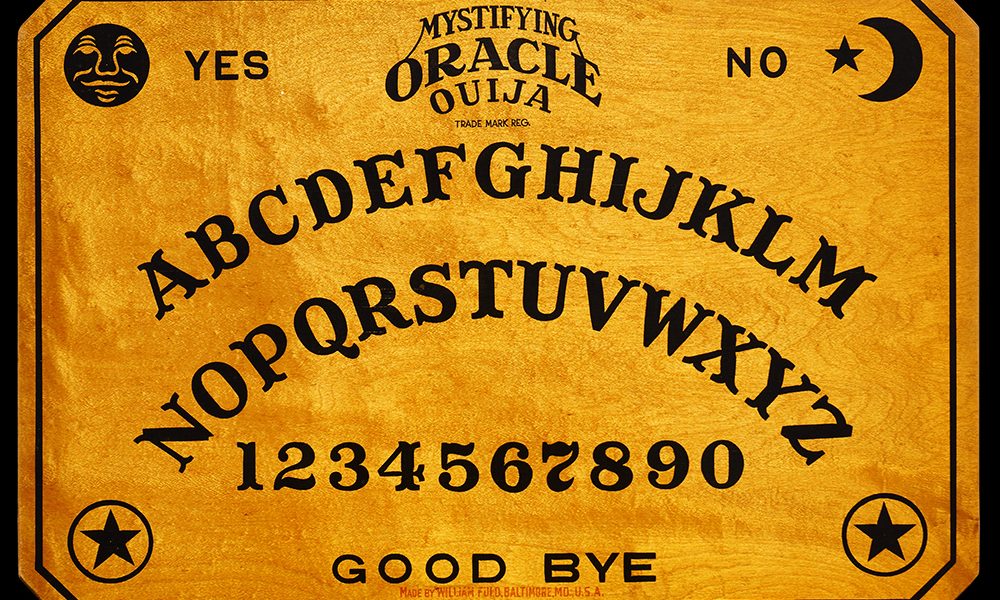
Ouija Board

The Ouija Board was invented within the early 1890’s by William Fuld. It is now sold by Parker Brothers. An Ouija may be a small board with various symbols printed on its surface. These symbols include all letters of the alphabet, the numbers 1 to 9 and 0 and therefore the words yes and no. A smaller board, shaped sort of a heart, called a planchette or pointer is employed to direct the answers.
Two or more people rest an Ouija on their laps and press their fingers lightly on the pointer. One of them asks the board an issue . The pointer supposedly answers by indicating a word or variety or by spelling out words. According to people that believe the Ouija , spirits guide the pointer. Others think the fingers of the questioner influence the pointer. There are basic guidelines that ought to be followed for using Ouija boards. If any of you’re willing to undertake one you ought to inspect a number of the safe things to try to to to guard yourself or anyone else from possible harm. As many of us improvise an Ouija as a game, it’s always best to guard yourself. Where there’s no protection from evil forces extremely frightening things can occur. Sinister messages are often spelt out, claimed to return from the devil. As to prove that nobody person is purposely pushing the pointer, tales are told of all removing their fingers except one and therefore the pointer continuing to whiz around in manic fashion – or of the pointer jumping up within the air or hurling itself off the table and smashing. Also evil spirits are known to lie around who they’re tricking the users into further danger.
You have to be the judge of the knowledge you receive. To believe everything that comes through on the board simply because it’s from the opposite side is extremely gullible and is like believing everything that you simply read within the newspaper or see on TV. If your mind tells you there’s something wrong, there probably is. If the knowledge you’re getting seems new you, compare it with other channeled material and see if you’re comfortable with it. The important point to recollect here is LIKE attracts LIKE. Ouija boards work , but the type of beings you’re likely to draw in is directly associated with the extent of spiritual development of the participants and their intent. Remember an Ouija is simply a tool for contact which relies on no practice, learning or spiritual development to form it work. It’s like dialing a random central and hoping for the simplest . However, with practice, learning and spiritual development the probabilities of getting through to the proper person are greatly increased.
If used properly, the Ouija are often a positive tool to creating new friends and gathering information. However, you should not just stop there and rely on the board. Work on your own spiritual development and this may not only enhance your use of the board, but may render it obsolete – while at an equivalent time improving your whole life.

Spirituality

Many folks have explored Spirituality in our own ways. Although this quest is extremely individual (i.e., we all have our own personal definition of Spirituality), it’s collective in spirit. This is because Spirituality in people’s minds is synonymous with an enquiry for meaning, for purpose and direction in life.
In Sanskrit, Spirituality or Spiritual science it’s called Paravidya (Supreme science), while all other sciences are called Aparāvidyā meaning inferior science. By ‘science’, we mean modern science. Rationalists and most of the people think that science and Spirituality are two separate disciplines. However, Spirituality is that the knowledge of infinity, that is, knowledge of all subjects. It covers the entire physical world and therefore the subtle unseen world, all the physical and spiritual regions, all physical and subtle frequencies, energies and vibrations, all positive and negative entities and every one living beings and non-living beings within the whole Universe. Spirituality contains all the knowledge and memory of the past, present and future, from the start to the top of the Universe.
Spirituality is that the capacity of persons to transcend themselves through knowledge and love, that is, to succeed in beyond themselves in relationship to others and thus become quite self-enclosed monads.” Spirituality may be a dimension of a person’s being that’s actualized as a life project and practice. Spirituality may be a developed relationality instead of a mere capacity. It is not generic. For example, we will distinguish during a qualitative sense between a healthy and rigid spirituality, even within a spiritual tradition. A spirituality is as unique as a personality is exclusive . Spirituality can be religious or secular. A secular spirituality remains a “relationship between what one truly is and everything that is” (Peter Van Ness). A religious/secular spirituality, according to Schneiders, is “the experience of conscious involvement in the project of life integration through self-transcendence toward the ultimate value one perceives.” Generally, the term spirituality is that the human capacity for self transcendence, no matter whether that have is religious or not. Here, the activity of the human spirit, not Holy Ghost , could also be the reference. The fact is that no religion has complete ownership of the term spirituality as it once had with reference to the Holy Spirit, the product of a religious tradition. There are definite qualities of the word spirituality which are made clear in today’s secular and non secular uses of the word. First, it denotes an experience. It is not abstract idea, or theory or movement. It is, however, a personal-lived reality with both active and passive dimensions. It is something that is experienced. Secondly, it is an experience of a conscious involvement in a project. It is not temporary, but an ongoing and coherent approach to life, always consciously pursued. Thirdly, it involves one’s whole life as an integrative process. It is not a short lived attitude, but rather an attitude about life that others model. It involves a life-integration, mind and body, emotions and thought, activity and passivity, social and individual aspects of life. Spirituality promotes an integrated synthesis of ongoing growth and development. Fourthly, spirituality pursues a uniform self-transcendence toward ultimate values. It is positive and not negative in direction. It excludes narcissistic egoism and self-destructive behaviors and thoughts. There must be a self-transcendent quality which is ultimate. This may include personal or social well-being, the good of the earth, justice for all or union with God as an ultimate value. In a culture without a self transcendent attitude in the form of gratitude, humility, awe and some form of a spiritual outlook, healing personal growth and well-being are often compromised.
Regardless of who we are and where we come from – our got to experience happiness in our lives drives all our worldly pursuits. This need is common to all or any folks no matter cultural background, religion, gender, social or financial status, etc. However, through spiritual research, we have found that on average people experience happiness only 30% of the time.
One of the most reasons we experience unhappiness is thanks to problems in life. Everyone knows about the physical and psychological causes of problems in life. However, what many folks don’t know is that problems that are physical or psychological in nature can have a spiritual root cause. This means that albeit a drag is primarily thanks to spiritual reasons, it can manifest as a physical or psychological problem.

Morality in Rule of Law

                                                            (Photo: Thought and action)

Rule of Law is the fundamental principle which ensures good governance as well as individual rights and liberties. It says no one is above the law and every person living in a particular society is subject to the law of that society. All other notions associated with the rule of law must also be considered alongside it. It is a mechanism that encourage the equality of all citizens before the law. It also secures a non-arbitrary form of government, and specifically prevents the arbitrary use of power. In general, the rule of law implies that the creation of laws, their enforcement, and the relationships among legal rules are themselves legally regulated, so that no one including the most highly placed official is above the law.

Moralityis a concept that distinguishes right from wrong. It also talks about conduct that is considered acceptable or unacceptable in a particular society. The source of morality is usually considered to be natural law and God’s instructions through sacred documents.

Morals provide a basis for the development of law by virtue of justice, equity, good faith, and conscience. Morality plays an important role in making of law and its interpretation. Morals are an intrinsic part of the laws. In the ancient time morals and laws were considered as one and the same. In the current period though law and morality have several distinctions yet the same are not completely different or distinct. A relationship can be established between morality and law on three grounds: –

1)     morals as the basis of law

2)      morals as test of positive law

3)      morals as the end of law.

According to Stammer “jurisprudence depends much upon moral ideas as just law has a need of ethical doctrine for its complete realization. Positive law and just law correspond to positive morality and rationally grounded ethics. There’s no difference and if any, it is only the difference of manner in which the desire for justice present itself”.

H.L.A Hart believes that there are several relations between law and morals. He was of the view that a legal system must exhibit some specific conformity with morality or justice or must rest on a widely diffused conviction that there is a moral obligation to obey it.

Ronald Dworkin has argued that both laws and constitutions are unavoidably rooted in political and moral principles. The law is not derived logically from accepted true moral principles. Rather, it is established by legislatures that come to agreement on public rules that are shaped by a political consensus about right and wrong.

Rule of law prioritizes the supremacy of law whereas morality prioritizes the moral values and consciences of the subjects of the state. For instance, a man is under no duty to help a beggar or the distressed and can neglect his sick and old parents without the fear of any legal or penal consequences, but morality does not allow a person to do so as it amounted to undesirable conduct condemned by morals and ethics. There is a close relation between the rule of law and morality.  Morality complements the rule of law. But it is a casual relationship, as laws are not made out of moral principles, rather, they are established and shaped by a “legal consensus of right and wrong”. Even though morality is ultimately involved in making and modifying the law, it is never legally binding and does not have constitutional value.  Laws have a marginal origin from the morals and ethics derived in the society which initially monitored the conduct of people, but morality solely cannot be the basis on which law has been derived. An acceptable statement is that both morality as well as rule of law have adapted to the development of society. Sometimes what seems right from the morality point of view may be contrary when viewed from the point of rule of law.  For instance, when a person tries to feed a needy person, by means of theft solely for the purpose of feeding that needy person, morally the act may be justified yet the same may not be the case under rule of law. Because under the concept of rule of law, a person has committed. Therefore, morality has a marginal presence in rule of law whereas it is highly contradictory of the same.

Morality in Rule of Law with reference to H.L.A. Hart theory

Professor Herbert Lionel Adolphus Hart (H.L.A. Hart) is an influential legal professor. Hart revolutionized the methods of jurisprudence and the philosophy of law. He authored ‘The Concept of Law’ and made major contributions to political philosophy. Law can be analyzed in terms of rules which is largely based on Hart’s theory of law. According to him, rules are concerned not with what happens but with what is to be done. Rules are imperative or prescriptive rather than indicative or descriptive. Rules have a certain independence or self-legitimating character. Rules are different from commands. Commands normally call for one unique performance whereas rules have a general application and demands repeated activity. According to Hart, ‘Law consists of rules which are of broad application and non-optional character, but which are at the same time amenable to formalization, legislation and adjudication. According to Hart the law consists of primary and secondary rules. Primary rules are duty imposing rules on the citizens and have a legal sanction. Secondary rules are power conferring laws that describe how laws should be recognized, adjudicated or changed. Hart says these rules form the heart of the legal system.

Hart’s version of natural law is empirical. His position is based on a theory of human nature which believes in certain truisms. For example, Hart believes that one truism of human nature is that the overwhelming majority of human beings wish to survive. It means they would rather live than die. If one wish to survive, it is imperative that a society be developed which will help ensure survival. Hart believes there are five features of the human condition which sometimes work against survival, and the legal system must take these into account.  Hart believes that: –

  •      there is the feature of human vulnerability.
  • .     there is the Hobbesian notion of approximate equality.
  • .      human beings possess at best a limited altruism.
  • .      the concept of limited resources governs our actions.
  • .     the idea of limited understanding and strength of will is important to any society.
     Conclusion
    The fundamental principle which ensures good governance as well as individual rights and liberties is the rule of law under which no one is above the law and every person living in a particular society is subject to the law of that society.  Morality, on the other hand, is concept that distinguishes right from wrong and may refer to conduct that is considered acceptable or unacceptable in a particular society.  Coercion and sanction may be important considerations but not the basic elements to make law work. The law is meant to facilitate. It is mechanism that resolves conflicts of interest among individuals. This idea of law brings us to the concept of rule of law which aims to treat every individual equally, irrespective of social status. Under the rule of law, individuals are protected from the element of coercion. Another element of the rule of law is equality, which is often confused with generality. Laws are based on generality and bind everyone, not any singular group. But equality here means that every individual is subject to the same law and procedures and has the same rights. A close relation exists between the rule of law and morality, since morality complements the rule of law. But it should still be considered a casual relationship, as laws are not made out of moral principles, rather, they are established and shaped by a “legal consensus of right and wrong”

Communicable Diseases

These are the diseases that may pass or carry from one human or animal to other. Communicable diseases are illnesses caused by grams such as bacteria, viruses, and spread by an infected person, animal, or object to other person.

Viral Diseases: The virus is parasitic which causes several diseases like:

(1) Bird Flu (H5 N1)- Bird Flu (Avian influenza) is a disease caused by an influenza virus-A, that primarily affects birds. The following persons who may be at higher risk for developing the bird flu are—

• Travellers, visiting affected countries.

• Farmers and others, who work with poultry.

• Those who have touched an infected bird.

• Those who eat raw or undercooked poultry meat, eggs, from infected birds.

Symptoms- Fever, cough, sore throat, muscle aches, and eye infection (conjunctivitis).

Treatment- Treatment with the anti-viral medication oseltamivir (Tamiflu), or zanamivir (Relena) may make the disease less severe. Oseltamivir may also be prescribed for persons, who live in the same house as those diagnosed with Avian flu.

Severe Acute Respiratory Syndrome (SARS): It is a serious form of pneumonia. It is caused by a virus that was first identified in 2003. Infection with the SARS virus causes acute respiratory distress( severe breathing difficulty) and sometimes death.

Symptoms- Cough usually starts 2-3 days after other symptoms like fever, headache, and muscle aches.

Treatment- Antibiotics to treat bacteria that cause pneumonia. Anti-viral medications. High dose of steroids to reduce swelling in the lungs. Oxygen, breathing support (mechanical ventilation), or cheat therapy.

Hepatitis: Hepatitis is swelling and inflammation of the liver. It is not a condition but is often used to refer to a viral infection of the liver. Hepatitis can be caused by—

• Immune cells in the body attacking the liver and causing autoimmune hepatitis. Infections from viruses such as hepatitis A, B, or C, bacteria, or parasites. Liver damage from alcohol, poisonous mushrooms, or other poisons.

• Medication such as an overdose of acetaminophen can cause harm or even death.

Symptoms- Abdominal pain or distention. Breasts development in males. Dark urine and pale or clay-colored stools. Fatigue, general itching, fever, usually low-grade jaundice(yellowing of the skin or eyes), and loss of appetite, nausea, vomiting, and weight loss.

(2) AIDS: Acquired Immuno Deficiency Syndrome(AIDS) is a disease of the human immune system caused by the Human Immunodeficiency Virus (HIV). AIDS was first recognized by the Centers for Disease Control and Prevention(CDC) in 1981.

HIV Infection: AIDS is a condition caused by HIV infection. The condition gradually destroys the immune system, which makes it harder for the body to fight infections.

Transmission- HIV can be spread by the following :

• Through sexual contact i.e. oral, vaginal, and anal sex.

• Through blood transfusions, accidental needle sticks, or needle sharing.

• From mother to child: A pregnant woman can transmit the virus to her fetus through their shared blood circulation or a nursing mother can pass it to her baby through breastfeeding.

Test for AIDS-

• Enzyme-Linked Immunosorbent Assay/ Enzyme Immuno Assay (ELISA/EIA).

• Radio Immuno Precipitation Assay/ Indirect Fluorescent Antibody Assay (RIP/IFA).

• Polymerase Chain Reaction(PCR)

• Western Bolt Confirmatory Test.

Generation Gap

Generation Gap is a term given to the gap or age difference between two sets of people; the young people and their elders, especially between children and their parents. Everything is influenced with the change of time- the age, the culture, mannerism and morality. This change affects every one. Generation gap is an endless social phenomenon. Every generation lives at a particular time under certain circumstances and conditions. So, all generations have their own set of values and views. Every generation wants to uphold the principles they believe . This is a problem that has continued for ages.
People born in several time periods under different conditions have their own views supported the circumstances they need been through. The patterns of life are changing continuously consistent with time. Everyone wants to measure and behave in his own way and nobody wants to compromise together with his or her values and views. There has always been a difference in attitude or lack of understanding between the younger and older generations. This attitude has augmented the generation gap and it’s becoming wider day-by-day. This gap now has started impacting our lives during a wrong way.
It is always good to possess a good range of ideas, views and opinions. It indicates how we are developing and advancing but sometimes this becomes worrisome when the views and concepts aren’t accepted by both the generations. Parents create a particular image in minds for his or her children. They want to mention their children with values that they need been mentioned with and expect their children to follow an equivalent . Parents want children to act in accordance with their values, as they believe, it’s for his or her benefit and would had best to them.
Children on the opposite hand have broader outlook and refuse to simply accept the normal ways. They want to try to to things in their own ways and don’t like going by any rulebook. Mostly, children experience conflict during their adolescence. They are desperately searching for self-identity. Parents sometimes fail to know the stress of this fast paced world. Ultimately, despite love and affection for every other both are drained out of energy and unable to grasp the opposite . Consequently there’s a scarcity of communication and abandoning on relationships.
Nothing are often as beautiful as a parent-child relationship within the world. It should be nurtured very delicately then it’s important to bridge the gap between the 2 generations. It is time to understand that neither is totally right nor wrong. Both the generations need to develop more understanding and acceptance for every other. Having a dialogue with one another calmly, with the thought of checking out conflict amicably in ideas, changing their mindset for every other and coming to a middle ground can be the foremost helpful instrument in bridging the gap between the 2 generations.
Spending longer with one another like family outings, vacations, picnics, shopping, watching movies together might be some effective ways to create up a robust bond with one another . Both the generations need to study the ways of the society during their growing period and have mutual respect for it. To reduce the friction between the 2 generations, both parents and youngsters need to give space to every other and define certain boundaries that the latter should respect an equivalent .
Generation gap occurs because society is constantly changing. It is the responsibility of both the generations to fill this gap amorously , affection and trust. Both the generations should have mutual respect for the views and opinions that they uphold and advance cautiously with the event of the society.
In order to shrink the generation gap, we must be open minded about learning from other generations. There is often a stigma within each generation that older or younger generations are wrong because their opinions and values are different. … there’s always room to grow and learn.