Naomi Osaka.

Naomi Osaka is the name that every sports enthusiast heard. She is professional tennis player and also ranked no. 1 as per Women’s Tennis Association . Her achievements are so great that it inspires everyone.

She was born on October 16 1997 in Japan. Osaka has lived and trained in United States since age 3. Her father inspired from Richard Williams trained his daughters , though he himself was never a tennis player. In 2006 they moved to Florida so that Naomi and her sister could get better trainings. Though Naomi spent most of her life in US , she represents Japan. Her parents said, “We made the decision that Naomi would represent Japan at an early age. She was born in Osaka and was brought up in the house of Japanese and Histian culture.Quite simply Naomi and her sister Mari have always felt Japanese so that was only our rationale. It was never a financially motivated decision nor we were swayed either way by any national federation”. Later United States Tennis Association offered Naomi training center in Boca Raton when she was 16 years old, but she declined.

Naomi is four times Gram Slam singles Champion and is the reigning Champion at US open and Australian Open. She also became the first woman to win successive Grand Slam singles titles since Serena Williams in 2015.

Indo China Relations

A ton is going on at India’s northern boundaries. Seemingly the most noticeably awful stalemate between the People’s Liberation Army (PLA) and the Indian powers in a very long time in Ladakh has entered its eleventh week. While de-heightening has occurred at a couple of focuses following a few rounds of talks, there is still substantial military development by the two sides close to the line. Then, at that point there is Pakistan, China’s all-climate companion and a never-ending cause of disturbance at India’s north-western lines, submitting continuous truce infringement. Curiously, another neighbor experiences began making difficulty for India. Nepal has singularly changed the norm of three questioned regions by adjusting its guide to incorporate them. In doing this, Nepal has dismissed every single past talk and has conveyed a solid message to India when it is occupied with a genuine stalemate with China. India is turning into an undeniably significant force for the remainder of the world. It is all around put to counter China’s developing impact in the district and the world on the loose. The Western world is looking well towards India. While India has been confining itself out of the dread of China’s objection, it is about time that India builds its commitment with its partners – be it military or something else. Quad, an enemy of China alliance comprising of the US, Japan, India, and Australia can be utilized by India for this reason. India should build joint military activities with different partners particularly in spaces of Chinese predominance, like the contested South China ocean. Going above and beyond, protection associations with partners ought to be extended with arrangements for military innovation move. India has effectively made the right strides toward this path by going into protection concurrences with the Quad nations. India ought to likewise use its space investigation ability for joint military observation and rocket improvement with its partners.

At the point when hostile to China assessments are high worldwide because of the pandemic, India should assume a more dynamic part in activating resistance against Chinese animosity. The policymakers anyway should be mindful so as to not distance other agreeable Eastern forces, like Russia, in this interaction. Arrangement with Western forces ought to painstakingly be adjusted as India has key interests in sustaining its long-standing binds with Russia. India is subject to Russia for its guard hardware and there is no question that Russia is philosophically nearer to China. The eventual fate of India’s international strategy will have China at its center, yet the capacity to offset relations with the US and Russia will to a great extent decide its prosperity.

China has a long-standing history of regional debates with upwards of 17 nations, ashore and water. It has been an assailant stomach muscle initio. India itself isn’t new to line deadlocks with China. Each time it has trusted that the financial interdependency will disseminate the momentary flare-ups. In any case, the circumstance India faces today is fairly unique. It is confronting line strains with 3 out of its 7 land neighbors , and at the focal point of this hostility against India is China and its authority in the locale. China is likewise attempting to charm Bangladesh by offering worthwhile economic alliance. Pioneering as China is, it has effectively reported multi-billion dollars of interests in Myanmar notwithstanding Myanmar’s new aftermath with the West. That makes it 5 out of 7 land neighbors for India! Then, at that point there is Sri Lanka where China has made gigantic interests in Hambantota Port for its oceanic silk course drive. Also, we should not get to the impact that China practices on non-adjoining nations through its obligation trap discretion. Territorial predominance to the side, China has regularly progressed the counter India story at the worldwide stage and has helped out Indian foes at different levels.

The billion-dollar question then, at that point emerges – regardless of whether India has fizzled in its Foreign Policy, especially its China Policy? In the following passages, let us attempt to address this inquiry. A concise history of India-China relations in the following not many passages would do well to set up a specific situation.

Generally, the Indo-China relationship has been that of co-activity and struggle. There have been issues, most appropriate being the regional issues at numerous boundaries, however to a great extent the nations have coordinated. After India accomplished its freedom in 1947, the pioneers were very clear in their essential needs. Hundreds of years of British misuse had left the nation poor and helpless. Improvement turned into the need and the Indian authority perceived the requirement for Western help if India somehow happened to arise as a considerable force. Simultaneously, the significance of a steady area couldn’t be disparaged. Relations with socialist China must be kept up with and supported. Subsequent to being overwhelmed for such countless years, there was additionally a hidden will to stay autonomous from unfamiliar powers and impact. This denoted the beginning of a free international strategy of India. Surprisingly, the Indian chiefs perceived the chance to assimilate the accepted procedures of the east and the west, and advantage from positive relations with both. Under the administration of Pandit J.N. Nehru, India, alongside a couple of recently shaped nations, chosen to follow ‘the strategy of non-arrangement’ in the setting of a developing virus war.

India and China got off to a promising start. India became one of the main nations to perceive the recently shaped People’s Republic of China and build up its political relations there in 1950. India additionally upheld China at different global fora and surprisingly preferred its confirmation in the United Nations when the greater part of the nations held a negative standpoint towards China. As a long time elapsed, India saw the developing US preference for Pakistan and wanted to foster better relations with this amazing neighbor. The nations consented to the notable Panchsheel Arrangement in 1954, stressing common peace and tranquil conjunction. In this understanding, India acknowledged Tibet, which was added by China in 1950, as a fundamental Chinese region.

Legal and policy challenges in space technology


                                                           (Photo: Outlook India)

History is agreed upon as an uninterrupted process in time and space.”

India before independence was very different from the India that we see today. Of course, it is common knowledge that pre 1947 India consisted of modern day, Pakistan and Bangladesh. The after-independence chase of India faced major developments and changes that we can see today. India has an impressive array of achievements in the development of space transport as well as aviation industry for various applications. From a humble beginning with a small RH 75 rocket in the sixties to the successful launch of PSLV-D2 with 804 kg IRS-P2 in October, 1994, the Indian space programme has made remarkable progress through a well-integrated, self-reliant programme. On the other hand, the civil aviation industry of India has emerged as one of the fastest growing industries in the country during the last three years. India has become the third largest domestic aviation market in the world and is expected to overtake UK to become the third largest air passenger market by 2024.

Every country’s success depends upon its government. The way it handles the whole economy largely affect its economic environment. In such a globalized environment, the governmental policies act as the key factor in determining its real success, be it in field of aviation, space technology or any other. The government however has reviewed its aviation policies from time to time and tried to make it friendlier however it lagged in certain jurisprudence. In the recent past, the outlook of the government of India has undergone substantial change. It has tried to adopt emerging trends and include different terminologies, ownership of private companies, more new projects, financing, hassle free management and its operations. The government has increased its investment in this sector. Moreover, it has tried to devise the privatization method to solve many problems attached to this sector. Privatization is needed for solving the problem of “distressed state syndrome”. The complete or partial privatization will give positive impact on efficiency, productivity and profitability. Trends of privatization is rising all around the world and it is important to analyze all consequences and specific results, which will be helpful to understand better difficulties and structural changes.

During the COVID time, there was a dramatic drop in demand for passenger air transport. This threatened the viability of many firms, putting many jobs at stake. While the aviation industry has often been a target of government policies, the COVID-19 crisis has precipitated a new suite of loans, loan guarantees, wage subsidies and equity injections, raising concerns about efficient use of public resources. The COVID-19 crisis has hit hard to the economy.

Although the aviation and space sector contribute a lot to the economy, however every coin has two sides. The other side of the story is that we have grown, but grown at the cost of our mother nature. The question that we need to dwell into is: “Do we belong to this earth or does this earth belong to us”. Commercial aviation is experiencing dramatic growth in various regions throughout the world but at the cost of what. It is leading to the pollution of the environment. Over the past 50 years global demand for air travel has risen by 9 per cent per annum. The environmental impact it has caused is very degrading. This has become a cause of concern.

INVESTMENT

According to the data released by Department for Promotion of Industry and Internal Trade (DPIIT), FDI inflow in India’s air transport sector (including air freight) reached US$ 2.79 billion between April 2000 and June 2020. The government has allowed 100% FDI under the automatic route in scheduled air transport service, regional air transport service and domestic scheduled passenger airline. However, FDI over 49% would require government approval.

India’s aviation industry is expected to witness Rs. 35,000 crore (US$ 4.99 billion) investment in the next four years. The Indian Government is planning to invest US$ 1.83 billion for development of airport infrastructure along with aviation navigation services by 2026.

Key investments and developments in India’s aviation industry includes:

  • In October 2020, Zurich Airport International signed the concession agreement for the development of Jewar Airport on the outskirts of Delhi. The agreement has granted Zurich Airport International the license to design, build and operate Noida International Airport (NIAL) for the next 40 years.
  • In October 2020, the Airports Authority of India (AAI) announced plan to upgrade runways at seven airports across the country by March 2022.
  • In January 2020, IndiGo became first Indian carrier to have an aircraft fleet size of 250 planes and became the first airline to operate 1,500 flights per day.
  • In December 2019, AAI announced its plans to set up India’s first three water aerodromes in Andaman & Nicobar.
  • As of December 2019, France-based Safran Group planned an investment of US$ 150 million in a new aircraft engine maintenance, repair and overhaul (MRO) unit in India to cater to its airline customers.
  • AAI plans to invest Rs. 25,000crore (US$ 3.58 billion) in next the five years to augment facilities and infrastructure at air transport.

THE NEED FOR SPACE LEGISLATION

What we can sketch out is that there’s a greater need for space legislation. With no legal obligation, the dream of ‘DIGITAL INDIA’ can’t be achieved. A robust legal regime would instill investor confidence, attract FDI and new technologies, reduce administrative and regulatory uncertainties, provide clarity on stamp duty, registration requirements, insurance, transfer of property, contractual obligation, space debris liability and intellectual property rights concerning space-related issues, and flourish space entrepreneurship by providing a level playing field to the private entities. 

The policymakers need to resolve the following issues in virtue of requisite space legislation:

·       Single Independent Regulator – In contradiction to the present multiple ministries, agencies and departments, namely, the Ministry of Home Affairs, the Department of Space, the satellite divisions of Department of Telecom, the Department of Telecommunications, the Telecom Engineering Centre, the Network Operation and Control Centre, the Ministry of Defense, and the Ministry of Defense, a single independent regulator is required to perform regulatory processes including the issuance of a place in orbit to launch a satellite and/or rocket, mandatory licenses to launch it, spectrum to communicate with it, and clearance for the technology and/or space equipment to be used. 

·       Space debris – Space debris or space junk encompasses both man-made and natural (meteoroid) particles that enhance the probability of disastrous collision that may cause damage to space vehicles. Although there is no specific international treaty or convention dealing with the imposition of liability, some long-standing guidelines were issued by NASA, on ‘how to deal with space debris’ which were later adopted by the UN General Assembly and COPUOS. However, well-defined provisions on liability of the launching state need to be formulated to reduce the persisting or potential conflicts among countries.

·       Security measures – With the rising threats to national peace and security by potential space and cyber warfare possibilities, countries need to invest adequately in adopting cyber and military security measures. Rules and regulations on lines with the Data protection laws need to be formulated to ensure that adequate cyber security measures are in place.

·       Granting of license – The process for granting a license is yet to be developed, but section 5 of the Bill envisages that there will be eligibility criteria, and a fee to pay, without giving any detail or indication as to what those criteria or fees might be. In particular, it sets out the obligation to provide a financial guarantee or insurance, which essentially addresses the broader liability question and the principles of liability that flow under the international space regime.

·        Intellectual property rights- Section 25 of the Bill states, Any invention, or other form of intellectual property rights, developed, generated or created during the course of any space activity shall be protected by any law for the time being in force, with the primary objective of safe guarding national security. such a provision might deter the potential participation of the private sector in the Indian space industry and thus needs to be looked into by the policymakers to enable innovation in the space industry.    

CONCLUSION

“Without your involvement you can’t succeed. With your involvement you can’t fail.”

Well said by APJ Abdul Kalam.India’s aviation and space transport are largely untapped with huge growth opportunities. It’s the need of the hour to grab these opportunities and the government should deeply involve in this process by making key changes in its policy and legal framework. A single policy should be adopted. In aviation industry, a lot of digital transformation is required. A big vision and strategy are needed to get through stormy waters. Cost pressure should be taken into account. New technology should be adopted. With the increase in competition and entry of private players, only the companies who do best will be able to survive. On the other hand, in space industry, policy changes are needed to make the space sector more accessible to private players. There’s a need of single space legislation. Changes are needed in New Space India Limited (NSIL). Last year, the finance minister announced the opening up of the ISRO’s facilities to the country’s private sector as part of its COVID-19 special economic stimulus. This was an early but a commendable step. Many a thing have changed since COVID.

As it is said, “Every cloud has a silver lining.” We should also hope for the best. It is at these times when the government was able to realize its incapability and failure and hopefully it has started considering legal and policy aspect that needs deeper consideration


The Degradation of Coral Reefs

Tropical coral reefs are the most diverse marine ecosystems on earth, giving shelter to thousands of animal species. Many millions of people depend on fisheries, tourism and coastal protection provided by healthy coral reefs. Yet today, coral reefs are dying at an alarming rate all around the globe.

Corals build the reef structure and provide the basis for a functioning coral reef ecosystem. Without corals, reefs will degrade and vanish within years. At present, coral reefs are facing multiple issues such as pollution, overfishing, and the ongoing climate change, which leads to raising sea water temperatures and causing coral bleaching worldwide. As a result, over 50% of the world’s coral reefs have died in the last 30 years and up to 90% may die within the next century.

The impact of our changing climate on coral reefs was manifested by the third global bleaching event in 2015 and 2016. This event has caused a mass destruction of corals, for instance, along the Great Barrier Reef. Unfortunately, there is a clear pattern of severe bleaching events increasing in frequency, to a point where there are now inadequate intervals for corals to recover in between.

A world without corals means not only will we have a less diverse and less beautiful ocean, but it will also be an economic disaster for many people, predominantly in developing countries. Fisheries and tourism provide important livelihoods that directly depend on healthy coral reefs. Reefs are nurseries for many fish species, including commercial ones, and attract millions of tourists every year. Coral reefs offer natural coastal protection, especially in areas frequently impacted by hurricanes and tropical storms. The great biodiversity of coral reefs serves as an important source for new medicinal remedies.

Altogether, coral reefs comprise an area of almost 300 000 km² and are estimated to have an economic value of US$100000 to 600000 per km², thus providing one of the most high-value ecosystems. Coral reefs are among the most complex ecosystems and are revealing the degraded status of coastal environments. Their alarming status represents the poor health of our oceans and if coral reefs disappear other marine realms will follow.

Corals have existed for more than 400 million years, yet stresses and changes from human activities are happening faster than their ability to adapt. Corals may not survive the intensity and swiftness of these ongoing changes. If we want to give coral reefs a fighting chance to survive and thrive for generations to come, we need active restoration measures to complement coral reef conservation.

Understanding Pegasus

How would you feel if someone says that you are being tapped 24/7 , someone is reading all your messages, accessing to all your private datas , recording you. Pretty sure everyone would be spooked out . This is what Pegasus project of Amnesty International claims.

What is Pegasus??

Pegasus has been derived from Greek mythology . It symbolizes a white horse with wings . But today Pegasus is a dangerous virus which can access your phone , steal your data and sell it to someone else. For this virus to enter your phone , you doesn’t have to click on any links , just a misscall is enough to infiltrate your phone.

Who developed this spyware and why?

This spyware was developed by NSO , an Israeli cyberarm firm . The actual motive behind this was to track down terrorist and criminals. This software is only sold to government. Maxican government confirmed that they used Pegasus spyware to capture Maxican druglord El Chappo.

What is the cost of installing this software?

Over half a million dollars ie over 3.5 crore rupees cost as installation fees and almost $650000 ie almost 5 crore to spy on just 10 Android or iPhone users. And hundreds of thousand dollars more for additional surveillance target.

What its relevance today??

Amnesty International with many others carried out Pegasus Project and alleged that many governments have been using this spyware to tap illegally its citizens. They listed out 50000 phone numbers in which pegasus infiltrated, or tried to, or are its potential targets. This list includes many known political leaders, media houses, journalist, lawyers and scholars.France’s President Macron charged his phone eversince his name was on the list.

This project alleged that countries like Togo, Rwanda ,Morocco, Saudi Arabia,Bahrain ,UAE,Azarbaizan,Kagakhstan,Mexico ,Hungary and India have used this spyware to spy on its citizens. It is important to note that this report clearly claims that just because numbers appears on the list it doesn’t means that their phone were attacked, its only suspicions.Many countries have already started investigation.

Though this project has not been proved right yet, this is a serious issue that needs to be addressed. It is terrifying just to know that such software even exist.

Removal of Article 370

Article 370 is a unique status offered to Jammu and Kashmir which has been the subject of debate between India, Pakistan, and China in 1947. It permits the state to have a different constitution, a state banner and self-rule over the inside organization of the state. The Article 370 typified six extraordinary arrangements for Jammu and Kashmir: a) It absolved the State from the total relevance of the Constitution of India. The State was permitted to have its own Constitution. b) Central administrative controls over the State were restricted, at the hour of outlining, to the three subjects of safeguard, international concerns and correspondences. c) Other protected forces of the Central Government could be reached out to the State just with the simultaneousness of the State Government. d) The ‘simultaneousness’ was just temporary. It must be approved by the State’s Constituent Assembly. e) The State Government’s power to give ‘simultaneousness’ endured distinctly until the State Constituent Assembly was gathered. e) Once the State Constituent Assembly concluded the plan of forces and scattered, no further augmentation of forces was conceivable. f) Article 370 could be annulled or changed uniquely upon the suggestion of the State’s Constituent Assembly.

The self-governance offered to Jammu and Kashmir by Article 370 has been an issue for a few reasons. Right off the bat, it was delighted in by a State that stayed split among India and Pakistan while being managed by a ruler. Also, the established arrangement applied to Kashmir which the solitary Muslim greater part State. These two highlights ought to have made it all the vital to save the confirmation kept up with in Article 370. Yet, for politcal reason, BJP government felt that consistency and unity is vital. Thus, the political pronouncement of Bharatiya Janata Party proclamation for the 2014 general political race was delivered, the hostile issue, the gathering swore to incorporate the province of Jammu and Kashmir into the Union of India. At the point when the gathering won the public political decision, BJP’s parent association, the Rashtriya Swayamsevak Sangh (RSS), required the revocation of Article 370. However, because of certain reasons, BJP didn’t take up the issue. While the PDP and BJP shaped government in the Jammu and Kashmir, there was a sharp distinction between them on the issue of Article 370. While, the Bharatiya Janata Party has been keeping up with its stand that Article 370 ought to be rejected. In any case, presently, since it won the subsequent time, it chose to execute its guarantee.

By revoking Article 370, bifurcating Jammu and Kashmir into Union Territories, the BJP government has utilized the force of Constitutions for its benefits. However this isn’t the first occasion when that the association government has utilized its forces to bifurcate a state without individuals’ assessment. For instance, the formation of Telangana in 2014 is one such. Aside from this, the formation of the Union Territory of Ladakh in one manner is refered to as a reaction to a long standing interest in this locale which has an enormous Buddhist populace. In any case, the current advance of the public authority to move the leftover piece of J&K State into a Union Territory, is something totally different from the past approach which could have a durable results in Kashmir, and furthermore solid ramifications on the government construction of Indian culture.

The Supreme Court’s choice to frame a general five-part Constitution Bench to look at the legitimacy of the repeal of the unique status given to Jammu and Kashmir stops superfluous misgivings. The top court knows about the established ethical quality of the remainder of the nation while choosing the predetermination of a State without the assent or cooperation of its residents. While there is solid mainstream support for the public authority’s choice to announce Article 370 broken and to partition the State into two Union Territories, the legal executive is compelled by a sense of honor to analyze the lawfulness of the actions taken by the President and Parliament. The court will give solid legitimate decision on the inquiries of sacred significance, since it has a sweeping ramifications for popular government and federalism.

There are solid contentions against and supporting revocation of Article 370. While one area contends that Article 370 is the lone established connection between the state and the remainder of India, other feel that it has been 70 year old hindrance which keeps on keeping from turning into a vital piece of India. Yet, actually since the time the formation of India and article 370, the kashmiri individuals are victims of the issue.

World’s Population Explosion

In the year 1900, Belgium and the Philippines had pretty much a similar populace, around 7 million individuals. Continuously 2000, the number of inhabitants in the Western European government had developed to 10 million residents, while the South East Asian republic when the new century rolled over as of now tallied 76 million residents. The number of inhabitants in Belgium has from that point forward surpassed 11 million residents, yet it is impossible that this number will ascend to 12 million continuously 2050. The number of inhabitants in the Philippines then again will keep on developing to a stunning 127 million residents by 2050, as indicated by the segment projections of the United Nations (UN 2013).

The segment development pace of the Philippines when the new century rolled over (2% per year) has effectively made gigantic difficulties and is unmistakably impractical in the long haul: such development suggests a multiplying of the populace like clockwork as an outcome of which there would be 152 million individuals by 2035, 304 million by 2070, etc. No one anticipates that such a growth should really happen. This commitment will examine the more sensible situations for what’s to come.

Indeed, even the somewhat unobtrusive Belgian segment development rate around the turn of this century (0.46%) isn’t practical in the long haul. Regardless, it surpasses by a wide margin the normal development pace of the human species (homo sapiens) that emerged in Africa some 200.000 years prior. Today, earth is possessed by exactly 7 billion individuals. To accomplish this number in 200.000 years, the normal yearly development rate over this term ought to have been around 0.011% yearly (so 11 additional people for every 1.000 individuals previously living on earth). The current Belgian development rate would infer that our nation would have developed to 7 billion in under 1500 years.

The mark of this story is that the current development numbers are truly extremely remarkable and indefensible in the long haul. The segment development rates are in reality on the decay worldwide and this paper will endeavor to clarify a portion of the components behind that cycle. That doesn’t change the reality, notwithstanding, that the development remains exceptionally high and the decrease in certain districts extremely sluggish. This is particularly the situation in Sub Saharan Africa. In supreme numbers, the total populace will keep on developing at any rate for a long while because of segment dormancy. This also will be additionally explained in this paper.

To be economical, the drawn out development pace of the populace ought not contrast much from 0%. That is on the grounds that a development rate surpassing 0% has outstanding ramifications. In straightforward terms: if a blend of birth and development figures just seems to cause an unassuming populace development at first, then, at that point this appears to suggest a hazardous development in the more extended term.

Thomas R. Malthus previously gained this perspective before the finish of the eighteenth century. In his well known “Exposition on the Principle of Population” (first version in 1789), Malthus contends evenhandedly that in time the development of the populace will unavoidably back off, either by an expansion of the demise rate or by a diminishing of the rate of birth. On a neighborhood scale, relocation likewise assumes a significant part.

It is no fortuitous event that Malthus’ paper showed up in England toward the finish of the eighteenth century. All things considered, the populace there had begun to develop at a generally concealed rate. All the more explicitly the low class had developed hugely and that stressed the educated people and the tip top. After quite a long time after year, new segment development records were recorded.

Toward the start of the nineteenth century, the quantity of 1 billion individuals was surpassed without precedent for history. Therefore development sped up and the quantity of 2 billion individuals was at that point outperformed around 1920. By 1960, another billion had been added, in 40 rather than 120 years time. Furthermore, it kept on going considerably quicker: 4 billion by 1974, 5 billion by 1987, 6 billion by 1999 and 7 billion in 2011This will unquestionably not stop at the current 7 billion. As indicated by the latest projections by the United Nations, the quantity of 8 billion will likely be surpassed by 2025, and around 2045 there will be in excess of 9 billion people1. The further one investigates the future, the more questionable these figures become, and with demography on a world scale one should consistently consider a safety buffer a several millions. Yet, as per every single conceivable situation, the quantity of 9 billion will be surpassed by 2050.

Segment development was and isn’t similarly appropriated all throughout the planet. The populace blast initially happened on a limited scale and with a somewhat moderate power in Europe and America, pretty much somewhere in the range of 1750 and 1950. From 1950 on, a considerably more generous and escalated populace blast began to happen in Asia, Latin America and Africa . Asia previously addressed more than 55% of the total populace in 1950 with its 1.4 billion residents and constantly 2010 this had expanded to 4.2 billion individuals or 60%. Of those individuals, more than 1.3 billion live in China and 1.2 billion in India, together representing more than 33% of the total populace.

Olympics

The advanced Olympic Games or Olympics are driving worldwide games including summer and winter sports rivalries in which a great many competitors from around the world take part in an assortment of contests. The Olympic Games are viewed as the world’s chief games contest with in excess of 200 countries participating. The Olympic Games are typically held at regular intervals, shifting back and forth between the Summer and Winter Olympics like clockwork in the four-year time frame.

Their creation was motivated by the antiquated Olympic Games , held in Olympia, Greece from the eighth century BC to the fourth century AD. Nobleman Pierre de Coubertin established the International Olympic Committee (IOC) in 1894, prompting the primary present day Games in Athens in 1896. The IOC is the administering body of the Olympic Movement[definition needed], with the Olympic Charter characterizing its construction and authority.

The advancement of the Olympic Movement during the twentieth and 21st hundreds of years has brought about a few changes to the Olympic Games. A portion of these changes incorporate the making of the Winter Olympic Games for snow and ice sports, the Paralympic Games for competitors with incapacities, the Youth Olympic Games for competitors matured 14 to 18, the five Continental games (Pan American, African, Asian, European, and Pacific), and the World Games for sports that are not challenged in the Olympic Games. The IOC additionally supports the Deaflympics and the Special Olympics. The IOC has expected to adjust to an assortment of financial, political, and mechanical progressions. The maltreatment of novice rules by the Eastern Bloc countries provoked the IOC to move away from unadulterated unprofessional quality, as imagined by Coubertin, to the acknowledgment of expert competitors taking an interest at the Games. The developing significance of broad communications has made the issue of corporate sponsorship and general commercialisation of the Games. Universal conflicts prompted the retraction of the 1916, 1940, and 1944 Olympics; enormous scope blacklists during the Cold War restricted interest in the 1980 and 1984 Olympics;[4] and the 2020 Olympics were delayed until 2021 because of the COVID-19 pandemic.

The Olympic Movement comprises of worldwide games alliances (IFs), National Olympic Committees (NOCs), and putting together boards of trustees for every particular Olympic Games. As the dynamic body, the IOC is liable for picking the host city for each Games, and arranges and supports the Games as indicated by the Olympic Charter. The IOC likewise decides the Olympic program, comprising of the games to be challenged at the Games. There are a few Olympic customs and images, like the Olympic banner and light, just as the opening and shutting functions. More than 14,000 competitors contended at the 2016 Summer Olympics and 2018 Winter Olympics consolidated, in 35 distinct games and more than 400 events. The principal, second, and third-place finishers in every occasion get Olympic awards: gold, silver, and bronze, separately.

The Games have become such a lot of that practically every country is presently addressed. This development has made various difficulties and discussions, including blacklists, doping, pay off, and a fear monger assault in 1972. Like clockwork the Olympics and its media openness furnish competitors with the opportunity to accomplish public and now and again worldwide notoriety. The Games likewise give a chance to the host city and country to exhibit themselves to the world.

THE JOURNEY OF PURI TOWARDS FIRST CITY TO PROVIDE 24 X 7 CLEAN WATER

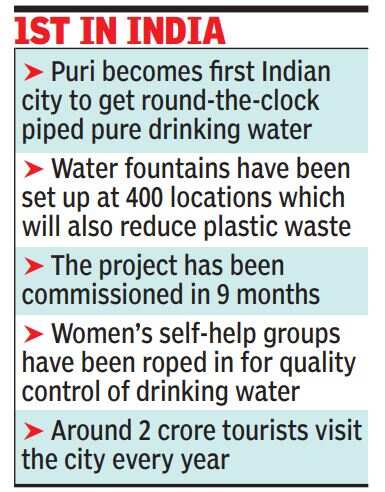
Puri is one of the major heritage cities of the country and every year more than 2 crore tourists visit every year. And this month the city earned an unique distinction of becoming the first Indian city to provide 24X7 pure drinking water. This is the landmark achievement for the city and state and is one of the major contributors for enhancing the status of sanitation and hygiene in Puri, Odisha. The city has become the first city to offer safe drinking water directly from taps to the residents and the tourists visiting the city every year and now has joined the group of global metropolitans like London and New York for providing safe drinking water.

The government launches “Sujal: Drink from Tap Mission” which has the goal of providing all time safe drinking water to all the residents and people visiting the cities directly through taps. The city has fulfilled and achieved the credentials of the ambitious mission and has achieved the goal of the mission. The 24 hour drink from tap facility provides water which can be used directly without filtration for different purposes such as drinking, cooking etc. This move is beneficial for the 2.5 lakh people residing in the city and the 2 crore tourists visiting the city every year. And the people don’t need to carry water bottles with them and can directly rely on the taps. This type of facility is present in very limited number of cities globally and Puri has established its place. Furthermore, the state government had installed 400 water fountains in different locations of the city with the aim of reducing the reliance and usage of plastic bottles in Puri. This will eventually reduce the amount of plastic wastes being can be reduced.

The government uses 5T initiative for increasing the efficiency and effectivity of the services being delivered across the city. The Chief Minister of the state emphasized on the linkage between safe drinking water with health, living standards and the economy, thereby, urging the people not to waste or pollute water. Transparency, teamwork, technology, time-frame and transformation form the 5Ts which has been adopted by the government for improving its governance. The budget for drinking water has been doubled in 5 years from Rs 200 crore to Rs 4000 crore thereby making the city the first heritage town in the country to get this facility. It is expected that the initiative will have great contribution in reducing the amount of plastic wastes generated. It is estimated that the amount of plastic waste being generated by the city will reduce by 400 tonne per annum. 1100 Stand posts were already present in the city and the state government has established additional 110 modern public stand posts along the Grand Road (Badadanda) and nine by the sea beach area have been installed. Old stand posts are being replaced with steel pipes and taps and at present 36 MLD clean water is being supplied everyday in the city. About 135 – 140 liters of drinking water per head per day is being provided to the residents everyday.

Digital literacy in India

Abstract 

Digital literacy is for a developing country like India. Digital literacy brings independence of easy accessibility of the internet among the people of urban as well as rural areas. The article discusses the need for digital literacy.

Keywords: digital literacy, need of digital literacy.

Introduction 

During the COVID-19 we all completely depended on the internet. Due to the safety of the people, the governments of different nations opposed the lockdown. Knowledge of the web world became a boon for an individual during this tough time. But we are also facing the challenges of accessibility of the internet. People are not aware or lack knowledge about using the internet. In India 26.8% of the population is not literate and they are suffering a lot due to lack of knowledge of the internet (census of 2011). Digital literacy is easy and helps every person. We all have smart phones and they consist of all the applications and are illiterate, literate and well qualified. Now we need to focus on how we can uplift digital literacy in rural as well as urban areas. 

Digital literacy:

As the word literacy implies, it involves some kind of basic knowledge or the ability to use the digital medium. However, digital literacy encompasses more than just knowledge of how to use the internet.

The ability of accessing the internet and using different applications to communicate, evaluate, create, share and deal with the information. It is not only about having knowledge about application and also the method of dealing technology with ethics.

The American Library Association’s digital-literacy task force offers this definition: “Digital literacy is the ability to use information and communication technologies to find, evaluate, create, and communicate information, requiring both cognitive and technical skills.

In India, across over 6,50,000 villages and 2,50,000 panchayats represented by 3 million panchayat members. Approx 40% population is living below poverty line, illiteracy rate is more than 25-30% and digital literacy is almost non-existent among more than 90% of India’s population.

Need of digital literacy

  • To enhance the digital skills: In India, a good number of the population lives in villages and small towns. They have technology but they don’t know how to use that technology for the betterment of their lives. Digital literacy helps to learn the access to technology efficiency.
  • To ensure security from online frauds: Sometimes people are not aware about online frauds. Especially, elderly, women and children are especially easy targets to become prey. Digital literacy helps them to learn to avoid this kind of fraud.
  • To increase the rate of using online banking: India is a developing country. Having knowledge of online banking and transition is important. India launched many applications such as BHIM and UMANG. Digital literacy helps an individual to access these applications and go cashless.
  • Education purpose: Rising invasion of digital media in the society pushes the need for digital literacy among students. So there is a great need for educating the power of the digital medium so students can play a vital role in defining their ability to succeed both in academic and personal life.
  • Digital citizenship: Digital literacy is one component of being a digital citizen – a person who is responsible for how they utilize technology to interact with the world around them.
  • Pedagogy:  It is up to us educators to decipher the best methods for teaching digital literacy and to help the students become fluent in this new type of literacy.

Opportunities of digital literacy 

  • Help in inclusion: Digital literacy helps in inclusion of people of different backgrounds. During COVID-19, the internet helps to reach the help of needy people. Digital literacy inclusive growth by enabling access to education, healthcare and government services to all the citizens of the country. People can get better advice on health services. Those who can’t afford school/ colleges can get a chance at an online education.
  • Less consumption of time: Opening accounts in banks, submitting bills and fees was a time consuming work but after digitalization the things got easier and became less time consuming.
  • It can help small businesses. People can use online tools to expand their business.
  • It can play a key role in GDP growth. According to analysts, digital India could boost GDP up to $1 trillion by 2025. According to a World Bank report a 10% increase in mobile and broadband penetration increases  in capita GDP by 0.81% and 1.31% respectively in developing countries (World bank report 2017).
  • Once the change is brought it could change the Indian education system, with all the Gram Panchayats having access to the internet will provide access to different teaching aids and materials and empower everyone and increase the literacy levels in the country.

Challenges of digital literacy

  •  Slow internet: The daily internet speed, as well as Wi-Fi hotspots, is slow as compared to other developed nations. In India the connectivity of the internet is not reachable in some places due to geographical background. 
  • Hurdle of small and medium scale industry: Most of the small and medium scale industry has to struggle a lot for adapting to the new modern technology. They are not aware about the terms and conditions of the online business or they don’t want to switch their method of trading.
  • Limited capability of entry-level smartphones for smooth internet access.
  • Unskilled labours: In India there is a lack of skilled manpower in the field of digital technology. They don’t know how to run applications and use them for their betterment.
  • Awareness about digital crime: To look for about one million cybersecurity experts to check and monitor the growing menace of digital crime.
  • Lack of user education: Users are not aware how to use technology or they are limited to Facebook and What-app. There is a need for digital literacy. It helps them to take the first step towards using technology.

Government initiatives:

  • National digital literacy mission: It was launched in 2012 by the Indian government to uplift the digital skills in rural India as well as urban areas. It is also known as the digital saksharta Abhiyan
Our Services – Reynard
  • Digital India was launched by the Prime Minister of India Narendra Modi on 1 July 2015, with an objective of connecting rural areas with high-speed Internet networks and improving digital literacy.
  • NASSCOM is working with SAP India to set up 25 new centres across the country to add to the 75 that already exist. These are the main vehicles of implementation of NDLM.

Conclusion:

Digital literacy is important for India because India is a developing country and we need to focus on sustainable development. According to a survey there is 90% digital literacy in India which is more than actual literacy that shows people are more aware about the web world. The need for digital literacy is really important. There are many challenges and opportunities. NDLM,  NASSCOM and digital India there are some schemes which help in upliftment of digital literacy. 

References 

Manpreet Singh – Flag bearer

Manpreet Singh was selected as the flag bearer of India for Tokyo Olympics 2020 Parade. He is captain of India Men’s National Hockey team since May 2017

Manpreet Singh was born on 26 June 1992 in Mithapur, Jalandar city of Punjab, India. In 2011 he played first time for India at the age of 11years. He also represented India at 2012 Summer Olympics and was named Asia’s Junior Player of the year 2014.

He and his team represented India in various sports events and gave new heights to India Hockey Team. They won 1 gold and 1 silver medal in 2014 Incheon Asian Games and 2018 Jakarta Asian Games. In 2017 Asia Cup they won 1 gold. They also secured 2 medals at Championship Trophy. The list of achievement goes on and on

Manpreet is also a keen listener of music and uses music as a means to relax before his games. He carries his PlayStation with him whenever he travels for matches. He is fan of Salman Khan and enjoys watching movies of sports genre, such as MS Dhone: The untold story, Chak de! India, and Bhaag Milkha Bhaag. His big dream is to “win big for India” and biggest goal is to inspire youngsters to play a sport, any sport.

Swachh Bharat Abhiyan

Swachh Bharat Mission (SBM), Swachh Bharat Abhiyan, or Clean India Mission is a nation wide mission started by the Government of India in 2014 to dispense with open crap and work on strong waste administration. It is a rebuilt form of the Nirmal Bharat Abhiyan dispatched in 2009 that neglected to accomplish its expected targets. Phase 1 of the Swachh Bharat mission kept going till October 2019. Stage 2 will be executed between 2020–21 and 2024-25.

Started by the Government of India, the mission meant to accomplish an “open-crap free” (ODF) India by 2 October 2019, the 150th commemoration of the introduction of Mahatma Gandhi. The destinations of the main period of the mission additionally included destruction of manual searching, producing mindfulness and achieving a conduct change with respect to sterilization practices, and expansion of limit at the neighborhood level. The second period of the mission plans to support the open crap free status and work on the administration of strong and fluid waste. The mission is pointed toward advancing towards target 6.2 of the Sustainable Development Goals Number 6 set up by the United Nations in 2015.

The mission’s true name is in Hindi. In English, it means “Clean India Mission”. The mission was authoritatively dispatched on 2 October 2014 at Rajghat, New Delhi by Prime Minister Narendra Modi. It is India’s biggest tidiness drive to date with 3,000,000 government representatives and understudies from all pieces of India taking an interest in 4,043 urban areas, towns, and provincial networks. At a convention in Champaran, the Prime priest called the mission Satyagrah se Swachhagrah concerning Gandhi’s Champaran Satyagraha dispatched on 10 April 1916.

The mission was parted into two: country and metropolitan. In country regions “SBM – Gramin” was financed and observed through the Ministry of Drinking Water and Sanitation; while “SBM – metropolitan” was managed by the Ministry of Housing and Urban Affairs.

As a feature of the mission, volunteers, known as Swachhagrahis, or “Ministers of tidiness”, advanced indoor pipes and local area ways to deal with disinfection (CAS) at the town level. Other exercises included public ongoing checking and updates from non-legislative associations like The Ugly Indian, Waste Warriors, and Swach Pune (Solid Waste Collection and Handling).

The public authority gave endowment to development of almost 110 million latrines somewhere in the range of 2014 and 2019, albeit a few Indians particularly in provincial regions decide to not utilize them. The mission was condemned for utilizing coercive ways to deal with power individuals to utilize latrines.

Delhi Pollution and Measures to Control

“Delhi, not surprisingly, is inundated into brown haze with beginning of winter. The Delhi Government promptly began faulting different states for air contamination in Delhi. The Central Government was at that point not in accordance with ranchers’ advantage, given another law on 29th October, 2020, expressing ranchers are liable for Delhi’s brown haze.” Said Dr Gurinder Kaur in an online class coordinated by Center for Environment, Sustainable Development and Climate Change, Impact and Policy Research Institute (IMPRI) and India Water Portal on Delhi’s Air Pollution and its Solution.

Consistently in the start of winter, Delhi, yet entire of the Northern India is encompassed in ‘Brown haze’. ‘Brown haze’ is a blend of ‘Mist’ and ‘Smoke’. Haze is a characteristic marvel during winters, and it vanishes before long dawn. Brown haze is shaped when the air is defiled with enormous measure of poisons and it gets thicker after dawn. In 1990-2000, when air in Delhi was intensely dirtied, the then Central Government was unprejudiced, saved Delhi’s air from being contaminated by diesel-driven engine vehicles by utilizing CNG instead of diesel.

From last decade air contamination has been causing destruction in Delhi and the Nation Capital Region. Dr Kaur said, “the genuine explanation of expanding air contamination in Delhi is its expanding number of vehicles, enterprises, fast expansion in development exercises, nuclear energy stations, bricklins, copying of landfills, aimless cutting of trees and air flights.”

She proved this with statistical data points which says in the new years, the quantity of vehicles expanded from 24 lakh (2000) to 1 crore(2018), delivering carbon dioxide (CO2), carbon monoxide (CO), Sulfur dioxide, ozone and different gases which dirty Delhi’s current circumstance. As per the Meteorological Department of Delhi and the Center for Science and Environment in 2012, 70 percent of air contamination in Delhi is brought about by vehicles as it were. An exploration by IIT Kanpur featured modern units discharge 98% of Nitrogen oxide, 60% of sulfur dioxide, 14% of PM I0 and 10 percent of PM 2.5.

Almost certainly consuming of paddy and wheat buildups contaminate the air, however it just goes on for 20-25 days in a year contributes just 4-6 percent in the generally existing contamination. Moreover, paddy was not the yield of Punjab and Haryana it was forced on these states for meeting the prerequisites of the focal pool of food grains through positive MSP and guaranteed obtainment.

Paddy estate season in Punjab was pushed from May to June to correspond with India’s storms. This has abbreviated the time between reaping of paddy and planting of wheat. Ranchers are compelled to consume paddy and wheat buildups because of their financial difficulty. APAU, Ludhiana research featured that in 2017, 2018 and 2019, wind speed was under five kilometers each hour which couldn’t have floated restricted brown haze from Punjab to Delhi and the National Capital Region.

Neither the Central Government nor the State Government discredits that these inside exercises of Delhi are answerable for contamination in Delhi in light of the fact that during the COVID-19 lockdown, the skies had cleared up. Simultaneously ranchers of Punjab, Haryana and Uttar Pradesh were reaping wheat yield and consuming wheat straws.

The Central Government ought not keep public and global reports from getting air contamination or discover a substitute to put it on rather ought to have a strong system to alleviate the current issues and tackle future dangers identified with air contamination. Air contamination is on ascent not just in Delhi and the National Capital Region yet in addition in different conditions of the country.

As indicated by a report of Greenpeace Organization, India, delivered on 21st January, 2020, 80 percent urban communities have contaminated air as per public air quality norm. In this way, both the Delhi and Central Governments should take drives as they did in 2000 to moderate the grave issue of air contamination yet not rebuff the helpless ranchers. The Central Government as opposed to rebuffing ranchers should co-work with them, understanding their issues, give accommodating arrangements and connected at the hip save the country’s air from getting dirtied.

It is basic for the public authority to find ways to control air contamination else our future looks bleak if genuine measures are not taken. The Indian Government needs to smooth out open vehicle administrations to diminish utilization of private vehicles. Person on foot walkway and bike paths ought to be developed on the streets. Sanitization gadgets ought to be introduced in modern units with the goal that the dangerous gases transmitted from the ventures don’t jeopardize the wellbeing of individuals.

Supplant diesel motors with energy from regular sources. Contamination from soil, sand and rock and so on during development work ought to be decreased. Air terminals both homegrown and worldwide ought to be worked with in each state to appropriate air traffic all the more consistently across the states which will assist with decreasing outrageous development of air contamination in Delhi. Drives, for example, National Clean Air program ought to be executed. Suitable fines on any contaminating modern units, vehicles, development unit ought to be forced.

Rather than playing attempt at finger pointing we should find prompt ways to guarantee that our postponements don’t lead guiltless individuals succumbed of air contamination. Other than the focal government, it is the obligation, everything being equal, to keep their environmental factors clean and secure our current circumstance.

Land and Property Conflicts in India

An expected 7.7 million individuals in India are influenced by struggle over 2.5 million hectares of land, compromising speculations worth $ 200 billion. Land questions obstruct all degrees of courts in India, and record for the biggest arrangement of cases as far as both supreme numbers and legal pendency. About 25% of all cases chose by the Supreme Court include land questions, of which 30% concern debates identifying with land procurement. Again,66% of all affable cases in India are identified with land/property questions. The normal pendency of a land securing debate, from formation of the question to goal by the Supreme Court, is 20 years. Since land is key to India’s formative direction, discovering an answer for land struggle is one of the chief arrangement challenges for India. Authoritative and regulatory elements are liable for the high rate of legitimate and particular struggles over land, and legal components are behind the pendency of land questions. Contending verifiable and current arrangement stories of property rights over land, have brought about the concurrence of various, clashing laws driving to legitimate arguments about land. This is the authoritative factor. This issue is compounded by regulatory inability to follow law and order. This is the authoritative factor. The pendency of contention, thusly, is an aftereffect of legitimate and evidentiary boundaries in bringing land debates to court, generally due to authoritative and legal insufficiency; this forestalls quick goal of land questions.

Where laws are clear, questions and clashes emerge in view of authoritative rebelliousness with law and order because of both reluctance and insufficiency. The LRI investigation of all Supreme Court cases ashore securing during 1950-2016 shows that 95% of the debates emerged due to authoritative resistance with the lawful system for obtaining of land, including the cycle of calculation of market esteem pay for land acquired.19 Around 34% of the debates included abnormalities in fulfillment of the system for obtaining. Practically 50% of such cases worried about procedural anomalies included managerial e reluctance to conform to law and order. The leftover portion of the cases included regulatory inadequacy to agree with law and order, to some degree as a result of legislative inability to routinely refresh authoritative manuals dependent on changes in the law. Additionally, the public authority was bound to lose than win these land debates under the steady gaze of the Supreme Court.

Furthermore, since pilgrim times, land in India has been extensively controlled by the income and backwoods offices. In any case, there have additionally consistently existed questions between the two offices with regards to which land has a place with which division. This thus makes and draws out land debates.

At last, lawful disagreements about land are additionally made by evidentiary hindrances for building up rights over land without narrative proof21 on account of obsolete/no land surveys22 and erroneous/obsolete land records23 in many states. The Department of Land Resources has tried to determine the issue of wrong land records through the ‘Digitisation of Land Records Modernisation Program’. Nonetheless, except if the public authority makes a genuine endeavor to refresh land records on the ground to mirror the property privileges, all things considered, digitizing them would not kill the issue of wrong land records.

Land struggle in India, both legitimate and particular, has existed from pilgrim times in light of the inconvenience by the British condition of the thought that all land not secretly held has a place with the ‘state’. This idea has been consistently opposed by ‘individuals’ who were debilitated by the provincial state’s hardship of their lawful property rights under precolonial organization. Over the long run, contending ‘state’ and ‘individuals’ accounts over land have prompted clashing strategy and lawful mediations. This has, thusly, prompted lawful disagreements regarding land. In any event, when laws are clear, authoritative inability to conform to law and order, because of reluctance and inadequacy, adds to the rate and pendency of land questions. Genuine legal inadequacy thusly delays pendency of land questions. Because of the pressing area, and the comparing interest for land to fuel the improvement motor, the scale and extent of land struggle today has expected massive extents, slowing down advancement projects and compromising jobs and speculations. Fair and effective intergenerational the board of land is fundamental for India’s monetary turn of events, yet additionally for its political and social security. Subsequently, pursuing settling land struggle, considering the above strategy proposals, is a basic plan for the new government.

EDUCATION SYSTEM IN INDIA

The current literacy rate of India is 64.8% in which state of Kerala has highest i.e 96.2% and least is of state of Bihar i.e 46.2%. In the ancient times education was not given much importance as feeding the stomach was far more important. At that time, either land owners, King's ministers or Brahmans were the only ones who were educated.
In India, during ancient times, the system of Varna was practiced. Entire society was divided into 4 sections: Brahaman, Kshatriya, Vaishya, Shudra. Brahmans were considered the superior ones, as they were assumed to be intelligent and knowledgeable in the society. Shudras were considered as the lowest of all and were made to feel left out from the society. They and their children weren't allowed to enter the village among other upper sections. Brahaman pandits used to teach only to the prince.
Later when the Varna system was abolished, due to poverty, people were unable to give education to their children. Only rich landlords and farmers could afford education for their children.
As time passed, India got independence from Britishers, and the government of independent India started to focus and upgrade the education system of India. It tried to uplift the literacy rate of India. As India was newly independent and lakhs of people were killed at the time of Partition, people were starving for food. The focal point of the government was to remove poverty and increase the production of grains in the country. Until the 4th five-year plan (1969-1974), improving education facilities was the second priority of the government.
Later after the emergency, in 1975, the education system began to improve. Government schools were built so that poor people could send their children to school with no fees. All sections of people could get education. Most of the people were from agriculture background and used to work in farming. In order to earn more income they wanted every member of the family to engage in work. And so they avoided sending their kids to school.
Decades passed and after 1990 the system of education improved, areas of study improved, standards of universities and schools improved, living standards of families improved. People started to afford education for their children in private schools. However, there are many children who are unable to go to school, especially girls despite a fundamental right mentioned in the Article 21 of Indian Constitution i.e right to education.
As people started to go to school and colleges, a time has come when people don’t go to school for knowledge. They want qualification certificate and a degree which gives them a sign of being literate
When the education system was built it revolved around exams. Pass or fail. I doesn't matter how a child passed, what amount of knowledge he gained? Did he explore anything on his own? Did he learn something to bring change in society as well as within himself? Only the bundles of sheets of homeworks were increased, and personality was still down. No doubt co-curricular activities are practised in Indian schools for personality development, but somewhere they are unsuccessful to find hidden talents of a child as they lack opportunities in many fields.
Whatever you teach a child from the beginning, he adapts it for his entire life. In childhood, from kindergarten, you start testing them, giving them grades and numbers and promoting them to the next class. From here the child starts thinking that he has to get good marks, so that he can be promoted to the next class. He can get that certificate of promotion. This is what every second student here does. They focus on numbers. It's not necessary that you are not a merit student so you have less knowledge. Sometimes low grade students turn out to be geniuses. As a single sheet of paper cannot decide your future and cannot declare your personality.
Along with this mentality of students, teachers who get job of teaching not only in government school, colleges and universities but also in government also have the mentality that no matter what you have taught to your children, doesn't matter even if you have taught or not, you just have to give them a number and grade because this reduces their burden as well this satisfies the student. Core knowledge, personality and perfection are not a priority here.
Now the problem arises when no proper input is given inside the brain of a student, but output is expected and the level of examination conducted is of a genius level.
Secondly corruption in India is practiced at its peak. Everyone wants a government job and hence bribes and political power are used for recruiting ineligible candidates due to which deserving ones who can manage well, who can think well, who can administer well fall behind.
Of course it's not true that each and every college adopts the same system. The nation is developing because many intelligent and deserving candidates are working in the fields of IT and space, but the sad thing is that at most of the places in India this type of wrong teaching and learning techniques are prevalent.
Earlier people were not aware of all the jobs and various examinations to qualify for those jobs. Also not everyone completed an undergraduate level degree and hence competition for jobs was least. But since awareness increased, facilities increased, technology increased the level of competition for jobs has raised to its peak.
In India if something has been amended it takes decades for its implementation. Let's say the NEW EDUCATION POLICY declared by the Modi government last year. It's hard to say when it's going to be implemented in the nation. That's a great challenge.
Another important thing which is lacking in the Indian education system is that children cannot decide their career on their own. They don't know what they have to do and what is their goal. Even if they set a goal here, they aren't dedicated towards it and keep on wasting years and years upon it and contribute to the increasing unemployment faced by the country.
In India, parents decide what their child is going to be, which subject he is going to choose, what degree he is going to pursue, what job he will do, which exam he will take and till when he will study. Independence of taking career decisions is not given here to the children and somewhere the child himself is responsible for their failure in career. Not earning a single penny and giving time to useless education is such nonsense.
No doubt that India is developing in every field. It's going ahead. It has given so much to the world. It has given birth to many geniuses and still it gives. It's also not necessary that every single child becomes a successful person of the nation, but India has a bad record on overall average. Literacy level and employment level needs to be increased, because the country is built by the members of the nation. Good level of employment leads to development of the nation and true knowledge leads to self development which is the most important thing in human life.