Using Technology in Business: From Account Planning Software to Avaya Voice Solutions

 In a world driven by digital transformation, businesses across the spectrum are turning to technology to streamline their operations and gain a competitive edge. From leveraging sophisticated sales account plan software to implementing state-of-the-art communication systems, the integration of tech tools has become indispensable. Increasingly, organizations recognize that the smart use of technology can result in remarkable efficiency gains and enhanced customer experiences. Below, we explore how these advancements influence various facets of business performance.

Sales Account Planning Software: Streamlining Financial Strategy

Alt text: Two business partners high-fiving after optimizing financial strategies with sales account planning software

Sales account planning is a critical function for businesses seeking to optimize their financial strategies and align sales processes with company goals. Innovative software solutions in this domain automate exhaustive tasks that involve tracking opportunities, managing client portfolios, and forecasting revenue. This transformative tool allows companies to plan with precision and allocate resources effectively, which is integral to financial stability and growth.

With sales account planning software, businesses can better understand client needs and preferences, allowing for the personalization of services and products. This targeted approach not only fosters customer loyalty but also serves to differentiate a brand in competitive markets. An enhanced account planning process thus directly contributes to tailored marketing and improved sales outcomes.

Integrating Voice Solutions for Enhanced Communication

In the heartbeat of every successful business lies effective communication, a realm that has been transformed by Avaya voice solutions. These systems revolutionize how businesses conduct internal and external communications, providing crystal-clear audio, scalable options, and an array of advanced features. By optimizing how organizations communicate, Avaya is shaping the future of business interactions.

Implementing such voice solutions transforms call centers into sophisticated customer engagement hubs. Beyond the traditional functions, these systems incorporate interactive voice responses and integrate with digital channels, allowing for a more responsive and personalized customer service experience. Avaya’s technology can thus become the cornerstone of excellent customer engagement strategies.

The Impact of Tech Advancements on Customer Relationship Management

Customer expectations are at an all-time high, fueled by the digital age’s demand for immediacy and personalization. Technological advancements have enabled businesses to meet these elevated expectations by revolutionizing Customer Relationship Management (CRM). Through sophisticated CRM solutions, companies can manage interactions with their customers like never before, fostering strong relationships and driving sales growth.

CRM technology provides businesses with a 360-degree view of customers, collecting and integrating data across multiple touchpoints. This holistic approach to customer data empowers businesses to deliver personalized experiences, leading to deepened customer loyalty and retention. With such data-driven insights, personalized marketing campaigns can be more effectively tailored to individual customer profiles.

Measuring the ROI of Technology Investments in Business Operations

The investment in technology is often sizeable, and businesses must evaluate the return on these investments to truly understand their value. It is important to measure how technological tools contribute to increased productivity, cost reductions, and revenue growth. By closely monitoring key performance indicators (KPIs) associated with tech implementations, companies can quantify their impact on business operations.

A primary benefit that most businesses observe with the integration of technology is time savings. For example, process automation removes the need for manual input in repetitive tasks, freeing up employee time for strategic endeavors. This not only leads to a more motivated workforce but also allows businesses to redeploy their efforts into areas that drive innovation and competitive advantage.

Customer satisfaction is another metric that often sees improvement with the use of technology. Whether through enhanced CRM tools, responsive communication systems, or customized offerings, technology can transform the customer experience. Satisfied customers are likely to be repeat buyers and can turn into vocal proponents for a brand, contributing to both direct and indirect revenue streams.

The Role of Technology in Modern Business Efficiency

img

Alt text: Business manager using sales account planning software at a desk

Technology has revolutionized the way companies operate by automating routine tasks, thereby allowing employees to focus on higher-level strategic work. Advanced software can now handle everything from financial transactions to payroll with minimal human intervention, reducing the potential for error and streamlining bureaucratic processes. This shift not only speeds up operations but also translates into cost savings and improved accuracy across departments.

Beyond automation, collaborative platforms have redefined team interactions, facilitating seamless communication regardless of geographical barriers. Teams can collaborate in real time, share resources, and maintain continuous communication channels, enabling a level of flexibility that was once unimaginable.

Overall, the intersection of technology and business operations lies at the core of modern corporate strategy. The effective use of technological tools, from sales account planning software to advanced communication solutions, has become a catalyst for efficiency, customer satisfaction, and financial success. As technological innovations continue to evolve, so too will the capabilities and achievements of forward-thinking enterprises.

Echoes in the Blockchain: Bitcoin-Influenced Cryptos Explored

 In the world of cryptocurrencies, Bitcoin reigns supreme as the pioneer and the most recognized digital asset. Its journey, from an obscure whitepaper by the pseudonymous Satoshi Nakamoto to a global financial phenomenon, has left an indelible mark on the world of blockchain technology. Navigating this dynamic market becomes more approachable with bitcoinavage.org , an invaluable resource for investment education. However, Bitcoin’s influence extends far beyond its status as a digital gold standard. This article explores the ripple effects of Bitcoin on the cryptocurrency landscape, as it birthed a new wave of cryptocurrencies, aptly termed “Bitcoin-influenced cryptos.”

Photo by Leeloo The First on Pexels.com

The Genesis: Understanding Bitcoin’s Influence

To understand Bitcoin’s influence, we must first appreciate the groundbreaking concepts that it introduced. Bitcoin operates on a decentralized ledger known as blockchain, which records all transactions in a transparent and immutable manner. It leverages cryptographic techniques to ensure security and enable peer-to-peer transactions without the need for intermediaries. These foundational principles have become the bedrock of the cryptocurrency space.

Altcoins and Forks: Varieties of Bitcoin-Influenced Cryptos

Altcoins, a term coined to refer to any cryptocurrency other than Bitcoin, come in various flavors. Some, like Litecoin and Bitcoin Cash, are direct forks of the Bitcoin codebase with minor modifications. These altcoins seek to address issues such as transaction speed and scalability while retaining the core principles of Bitcoin.

Others, like Ripple (XRP) and Stellar (XLM), focus on different use cases altogether, emphasizing cross-border payments and the facilitation of financial institutions. These cryptocurrencies draw inspiration from Bitcoin’s decentralized nature but bring their unique offerings to the table.

Ethereum: The Smart Contract Revolution

Among the most notable Bitcoin-influenced cryptocurrencies is Ethereum. While Bitcoin primarily serves as digital cash, Ethereum introduced a revolutionary concept – smart contracts. Smart contracts are self-executing contracts with the terms of the agreement directly written into code. They enable automated and trustless transactions, opening up a world of decentralized applications (DApps) and DeFi (Decentralized Finance) protocols.

Ethereum’s innovation showcases how Bitcoin’s influence extends beyond mere transactional capabilities to encompass a broader spectrum of use cases, pushing the boundaries of what blockchain technology can achieve.

Privacy Coins: Anonymity and Security

Bitcoin’s ledger is transparent, which means that anyone can trace transactions from one address to another. Recognizing this limitation, privacy-focused cryptocurrencies like Monero, Zcash, and Dash emerged. These cryptocurrencies prioritize user anonymity and transaction privacy by implementing advanced cryptographic techniques.

Monero, for instance, employs ring signatures and stealth addresses to obscure transaction details. Zcash uses zero-knowledge proofs to allow for private transactions while still maintaining a public blockchain. These developments address the need for enhanced privacy in the cryptocurrency space, a niche carved out by Bitcoin’s openness.

Proof of Stake vs. Proof of Work: A Shift in Consensus Mechanisms

Bitcoin relies on Proof of Work (PoW), a consensus mechanism that requires miners to solve complex mathematical puzzles to validate transactions and secure the network. However, Bitcoin’s energy-intensive PoW has led to the emergence of alternative consensus mechanisms, with Proof of Stake (PoS) gaining prominence.

Cryptocurrencies like Cardano, Polkadot, and Ethereum 2.0 have adopted PoS, which eliminates the need for resource-intensive mining. Instead, validators are chosen to create new blocks based on the number of coins they hold and are willing to “stake” as collateral. This shift is a response to concerns about the environmental impact of PoW and showcases how Bitcoin’s approach to consensus has influenced innovation.

Beyond Transactions: Utility Tokens and Blockchain Platforms

Bitcoin’s scripting language is intentionally limited to ensure security and prevent potential vulnerabilities. While this design choice enhances Bitcoin’s robustness, it also limits its programmability. Enter blockchain platforms and utility tokens.

Ethereum, once again, stands out as a pioneer. Its ERC-20 standard paved the way for the creation of thousands of utility tokens, each serving a unique purpose within the Ethereum ecosystem. These tokens fuel decentralized applications, govern governance systems, and represent digital assets, further expanding the scope of blockchain technology.

Challenges and Future Prospects

As Bitcoin-influenced cryptocurrencies continue to evolve, they face numerous challenges. Scalability remains a persistent concern, as network congestion and high transaction fees can hinder mass adoption. Regulatory scrutiny also looms large, with governments worldwide grappling with how to classify and tax these digital assets.

However, the future is promising. Innovations such as Layer 2 solutions like the Lightning Network for Bitcoin and rollups for Ethereum are poised to enhance scalability. Interchain communication protocols aim to create interoperability between various blockchain networks, potentially unlocking a new era of decentralized applications and services.

Conclusion

In conclusion, the influence of Bitcoin on the cryptocurrency ecosystem cannot be overstated. From its pioneering technology to the birth of altcoins, smart contracts, privacy coins, and alternative consensus mechanisms, Bitcoin’s impact is profound. As the crypto space continues to evolve, Bitcoin’s echoes will persist, shaping the future of blockchain technology and digital finance in unforeseen ways.

What is Factor Analysis Method

 Factor analysis is a statistical technique used to identify underlying factors or latent variables that explain the patterns of correlations among a set of observed variables. It’s widely employed in psychology, sociology, economics, and other fields where researchers seek to understand complex relationships between variables.

Here’s an overview of the process involved in factor analysis:

  1. Define the Research Question: Before conducting factor analysis, researchers need to have a clear understanding of the research question they want to address. They should identify the variables of interest and hypothesize about the underlying factors that may be influencing those variables.

  2. Data Collection: Researchers collect data on the variables of interest from a sample population. These variables could be anything from survey responses to physical measurements.

  3. Data Preparation: The collected data are then prepared for factor analysis. This may involve checking for missing values, assessing data quality, and ensuring that the variables are suitable for analysis (e.g., continuous variables, normally distributed).

  4. Choose the Factor Analysis Method: There are different types of factor analysis methods, including exploratory factor analysis (EFA) and confirmatory factor analysis (CFA). EFA is used when researchers don’t have preconceived ideas about the underlying factors, while CFA is used to test a specific hypothesis about the structure of the factors. Researchers select the appropriate method based on their research goals and the nature of the data.

  5. Factor Extraction: In EFA, this step involves extracting the initial set of factors from the data. Common techniques for factor extraction include principal component analysis (PCA) and principal axis factoring (PAF). These techniques identify linear combinations of variables that account for the maximum amount of variance in the data. The number of factors to extract can be determined based on statistical criteria (e.g., eigenvalues, scree plot) or theoretical considerations.

  6. Factor Rotation: Once the initial factors are extracted, researchers often apply factor rotation to simplify the interpretation of the factors. Rotation methods, such as varimax and oblimin, reorient the factors in a way that maximizes the variance of loadings (the correlations between variables and factors) and makes the factors easier to interpret.

  7. Interpretation: After rotation, researchers interpret the meaning of each factor based on the pattern of loadings. High loadings (positive or negative) indicate strong relationships between variables and factors, suggesting that the variables are influenced by the underlying factor. Researchers may label each factor based on the variables with high loadings and develop theories to explain the relationships between factors and variables.

  8. Assessment of Model Fit (CFA): In confirmatory factor analysis, researchers assess the fit of the hypothesized factor structure to the data using various fit indices (e.g., chi-square, comparative fit index, Tucker-Lewis index). This step involves comparing the observed data with the model-implied covariance matrix to determine how well the model fits the data.

  9. Reporting Results: Finally, researchers report the results of the factor analysis, including the number of factors extracted, the pattern of factor loadings, and any additional analyses conducted to validate the findings. They may also discuss the implications of the results for theory and practice in their respective fields.

Factor analysis is a powerful tool for uncovering the underlying structure of complex datasets, providing researchers with valuable insights into the relationships between variables and helping to advance knowledge in various disciplines.

Top Educational Management tools for Teachers

 Several educational management tools are invaluable for teachers, enhancing efficiency, organization, and communication within classrooms. Here are some top picks:

  1. Google Classroom: This platform integrates seamlessly with Google Workspace (formerly G Suite) and allows teachers to create, distribute, and grade assignments digitally. It facilitates communication with students, provides a centralized location for resources, and offers collaboration features.

  2. Canvas: Canvas is a learning management system (LMS) that offers a wide range of tools for course management, including assignment creation, grading, discussions, and multimedia content integration. It provides a customizable interface and supports mobile access for both teachers and students.

  3. Schoology: Schoology is another popular LMS that streamlines classroom management tasks such as lesson planning, grading, and communication. It offers features for creating interactive assignments, quizzes, and discussions, as well as tools for tracking student progress and performance.

  4. Edmodo: Edmodo is a user-friendly platform that enables teachers to create a virtual classroom environment for engaging students in discussions, assignments, and collaborative projects. It also offers features for parent communication and professional development.

  5. Microsoft Teams: Teams is a collaboration platform that integrates with Microsoft Office 365, providing tools for communication, file sharing, and project management. It allows teachers to host virtual meetings, share resources, and collaborate with students in real time.

  6. ClassDojo: ClassDojo is a communication platform that strengthens the connection between teachers, students, and parents. It offers features for behavior tracking, messaging, and sharing updates and announcements, fostering a positive classroom culture.

  7. Remind: Remind is a messaging app designed specifically for communication between teachers, students, and parents. It allows teachers to send announcements, reminders, and assignments via text message or email, ensuring that important information reaches everyone efficiently.

  8. Nearpod: Nearpod is an interactive presentation platform that engages students with multimedia content, polls, quizzes, and collaborative activities. It allows teachers to create dynamic lessons and assess student understanding in real time.

  9. Kahoot!: Kahoot! is a game-based learning platform that makes learning fun and interactive. Teachers can create quizzes, surveys, and discussions to assess student knowledge and engagement, fostering a competitive yet supportive learning environment.

  10. Flipgrid: Flipgrid is a video discussion platform that encourages student voice and participation. Teachers can create discussion prompts, and students respond with short video clips, promoting communication and collaboration among classmates.

These educational management tools empower teachers to streamline administrative tasks, enhance communication and collaboration, and create engaging learning experiences for their students. By leveraging these tools effectively, teachers can maximize their impact in the classroom and support student success.

Celebrating Eid al-Fitr: A Joyous Festival of Faith and Unity

 Eid al-Fitr, also known as the “Festival of Breaking the Fast,” is one of the most significant religious festivals celebrated by Muslims worldwide. It marks the end of Ramadan, the Islamic holy month of fasting, during which Muslims abstain from food, drink, and other physical needs from dawn until sunset. Eid al-Fitr holds immense cultural, spiritual, and social significance, bringing communities together in joyous celebration and reflection.

The festivities of Eid al-Fitr commence with the sighting of the new moon, signaling the end of Ramadan. This auspicious occasion is often referred to as “Chand Raat,” meaning “Night of the Moon,” as communities gather to observe the crescent moon, confirming the start of Eid. The following day, Muslims gather in mosques or open spaces for special prayers known as “Salat al-Eid.” These prayers, offered in congregation, express gratitude to Allah for the strength and perseverance shown during Ramadan and invoke blessings for the entire Muslim community.

One of the defining features of Eid al-Fitr is the spirit of charity and generosity that permeates the celebrations. Muslims are encouraged to give “Zakat al-Fitr,” a form of almsgiving, before the Eid prayers. This donation is typically in the form of staple food items and is aimed at ensuring that the less fortunate members of the community can also partake in the joyous festivities of Eid. Additionally, many Muslims choose to extend acts of kindness and charity by distributing gifts, clothing, and food to those in need, embodying the values of compassion and solidarity that lie at the heart of Islam.

Central to the celebration of Eid al-Fitr is the communal feasting and sharing of meals with family, friends, and neighbors. After the Eid prayers, families gather to enjoy elaborate feasts that feature an array of traditional dishes and sweets. From savory delicacies like biryani, kebabs, and samosas to delectable desserts such as baklava, sheer khurma, and maamoul, the Eid table is adorned with a rich tapestry of flavors and aromas that reflect the diverse culinary traditions of the Muslim world. The act of sharing meals and hospitality during Eid fosters a sense of unity, kinship, and camaraderie among individuals from all walks of life.

In addition to the feasting and festivities, Eid al-Fitr is also a time for personal reflection, forgiveness, and reconciliation. Muslims take this opportunity to seek forgiveness from Allah and reconcile with family members, friends, and acquaintances, thereby fostering harmony and goodwill within their communities. The spirit of forgiveness and reconciliation underscores the importance of compassion, empathy, and understanding in building strong and resilient relationships, echoing the teachings of Islam on mercy and forgiveness.

Moreover, Eid al-Fitr serves as a joyous occasion for cultural expression and heritage preservation. Across the globe, Muslims adorn themselves in vibrant attire, with colorful clothing and intricate designs reflecting their cultural backgrounds and traditions. Markets and bazaars come alive with the hustle and bustle of shoppers purchasing new clothes, accessories, and gifts for loved ones. The streets are adorned with festive decorations, and music fills the air as people come together to celebrate their shared identity and faith.

In conclusion, Eid al-Fitr is a cherished and festive occasion that holds deep spiritual, cultural, and social significance for Muslims around the world. It is a time of gratitude, reflection, and renewal, as well as a celebration of unity, compassion, and generosity. As Muslims come together to mark the end of Ramadan and the beginning of Eid, they reaffirm their bonds of brotherhood and sisterhood, spreading joy, peace, and goodwill to all.

Guidelines for Guest Post

 Thank you for your interest in contributing a guest post to our platform. We welcome insightful and informative content that aligns with our focus on education and news. To maintain the integrity of our platform and adhere to our editorial guidelines, please review the following criteria before submitting your guest post:

1. Relevance and Originality

Ensure that your content is relevant to our audience and falls within the scope of educational or news-related topics. We prioritize originality and encourage fresh perspectives on timely issues.

2. Content Restrictions

We do not publish content related to CBD (Cannabis) or other similar niches, such as casino gambling. Please refrain from submitting articles that promote or discuss these topics.

3. Quality and Depth

Provide well-researched and comprehensive content that adds value to our readers. Aim for a minimum word count of 500 words to ensure sufficient depth and detail.

4. Structure and Formatting

Organize your post with clear headings and subheadings to enhance readability. Use bullet points and numbered lists where applicable to present information in a structured manner.

5. Engaging Elements

Incorporate relevant images, infographics, or multimedia elements to complement your written content. Ensure that you have the necessary rights or permissions for any visuals you include.

6. Author Bio and Credentials

Include a brief author bio at the end of your post, highlighting your expertise or credentials in the subject matter. You may also provide links to your website or social media profiles.

Submission Process:

  1. Prepare your guest post according to the guidelines outlined above.
  2. Create a Google Docs file for your submission, ensuring that it adheres to formatting requirements and includes any images or multimedia elements.
  3. Share the Google Docs link with us via email at editor@pen2print.org
  4. Our editorial team will review your submission and notify you of the status within a reasonable timeframe.

Thank you for considering www.eduIndex.org , www.pen2Print.org , and www.edupub.org for your guest post. We look forward to receiving your contributions and providing valuable insights to our audience.

Issues related to countries of Sub-Saharan Africa

 In the last few years, the countries of Sub-Saharan Africa have been in the news because of humanitarian problems.

According to the World Bank (live.worldbank.org/en/), more than half a billion people in Sub-Saharan Africa are at risk of being left behind without electricity by 2030, with nearly 400 million living in countries subject to fragility, conflict, and violence. Africa is where the energy access battle will be won or lost. Without access to reliable, affordable, and sustainable energy, the region will not reach its development aspirations or achieve an economic transformation that can lift millions out of poverty. In this regard, I am presenting a few lines about the countries of Sub-Saharan Africa. 

Together with partners, the World Bank Group has already begun efforts to deploy innovative financial and technical solutions essential for accelerating electrification rates that outpace population growth. I hope the World Bank will be successful in its endeavours.

 Sub-Saharan Africa is the part of the African continent south of the Sahara Desert. It consists of the overwhelming majority of Africa’s landmass. It also includes most of the countries and people of the continent. It has many geographic features, including the Sahel region, savannahs, arid lowland terrain, and tropical rainforests. It also includes the longest rivers and largest lakes on the continent. According to the United Nations Geoscheme, Sub-Saharan Africa is divided into Four subregions: West Africa, Middle Africa, East Africa, and Southern Africa (worldatlas.com/regions/sub-saharan-africa).

 West Africa is comprised of 16 countries. The northern portion of the subregion includes the Sahel region, which is the semi-arid strip of land that separates the Sahara Desert in the north from the savannahs to the south. Some West African countries, including Nigeria, Togo, Ghana, Cote D’Ivoire (Ivory Coast), Liberia, Sierra Leone, and Guinea, are home to tropical rainforests. West Africa is also the subregion in which the Niger River, the third longest river in Africa, flows. It begins in Sierra Leone, flowing through the countries of Guinea, Mali, Niger, and Nigeria, all the way south to the Nigerian region of the Niger Delta, where it empties into the Atlantic Ocean.

Middle Africa is comprised of the central part of the African continent. The subregion consists of 9 countries, of which the Democratic Republic of the Congo (DRC) is the largest, and the island country of Sao Tome and Principe is the smallest. Middle Africa has the largest tropical rainforest area on the continent. East Africa consists of 18 countries. The mountainous Horn of Africa, including Eritrea, Ethiopia, and Djibouti, is the northernmost part of the subregion. Southern Africa is the smallest of the Sub-Saharan African subregions. It comprises five countries, with South Africa being the largest and Eswatini being the smallest.

According to the World Economic Forum on Africa, there are five major problems in Sub-Saharan Africa. These are – a)Unemployment and underemployment, b)Underinvestment in infrastructure, c) Fiscal crises (Debt crises), d)Political change, “Failure of national governance,” and e) Climate change.

A few years ago, as a resource person, I visited some countries in Africa and observed that the availability of safe water was a serious issue, unemployment was high, and industrial development in many countries was at a low ebb. But the people of Africa like and respect Indians, as many Indians work in different teaching jobs. Indian Hindi songs and movies are popular in many countries. The people like Indian goods than Chinese goods. I suggest our Indian Government should take the initiative to enhance exports to African countries wherever feasible. 

Prof Shankar Chatterjee, Hyderabad 

Over 73,000 applications received on Suvidha Portal since the announcement of General Elections 2024

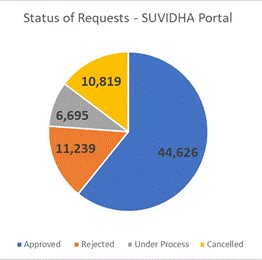
 In a span of just 20 days, since the announcement of elections and the Model Code of Conduct (MCC) becoming operational, the Suvidha platform received an impressive 73,379 permission requests from political parties and candidates, of which 44,626 requests (60%) had been approved. Nearly 11,200 requests had been rejected which is 15% of the total requests received and 10,819 applications cancelled as were invalid or duplicate. Rest of the applications are under process as per the details available till April 7, 2024.


Maximum requests were received from Tamil Nadu (23,239) followed by West Bengal (11,976) and Madhya Pradesh (10,636). Minimum requests received from Chandigarh (17), Lakshadweep (18) and Manipur (20). State wise applications received are placed at Annexure A.

The Suvidha portal is a technological solution developed by ECI to ensure a level playing-field upholding the democratic principles of free, fair and transparent elections. Demonstrating an impressive track record, the Suvidha Portal streamlined the process of obtaining and acting upon requests for permissions and facilities from political parties and candidates during the election period.

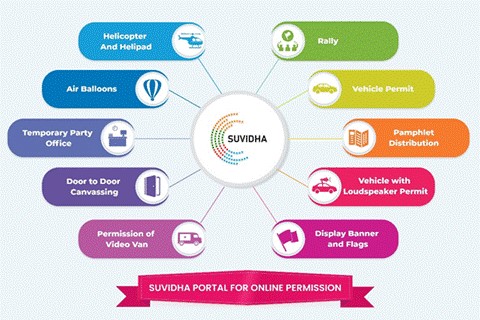
​​​​​​​Recognizing  the importance of the election campaign period, where parties and candidates engage in activities to reach out to voters, the Suvidha Portal caters to a diverse range of permission requests transparently on the First in First Out principle. It caters to permissions for organising rallies, opening temporary party offices, door-to-door canvassing, video vans, helicopters, obtaining vehicle permits, distributing pamphlets.

About SUVIDHA Portal- Critical Application to ECI IT Ecosystem

Accessible through the Suvidha Portal (https://suvidha.eci.gov.in ), political parties and candidates can seamlessly submit permission requests online from anywhere, at any time. Additionally, offline submission options are available to ensure inclusivity and equal opportunity for all stakeholders.

Supported by a robust IT platform, managed by nodal officers across various state departments, the Suvidha Portal facilitates efficient processing of permission requests. Suvidha also has a companion app that enables applicants to track the status of their requests in real time, adding further convenience and transparency to the process. The App is available on IoS and Android platforms.

The Suvidha Platform not only enhances the efficiency of the election process but also ensures transparency by providing real-time tracking of applications, status updates, timestamped submissions, and communication via SMS. Furthermore, the permission data available on the portal serves as a valuable resource for scrutinising election expenditures, contributing to greater accountability and integrity in the electoral process.

With the Suvidha Platform, the Election Commission of India reaffirms its commitment to facilitate a fair, efficient, and transparent electoral environment, where all political parties and candidates have equal access to the necessary permissions and clearances.

Annexure A:

S. No

State

Total Request

1

Andhra Pradesh

1153

2

Assam

2609

3

Bihar

861

4

Goa

28

5

Gujarat

648

6

Haryana

207

7

Himachal Pradesh

125

8

Karnataka

2689

9

Kerala

1411

10

Madhya Pradesh

10636

11

Maharashtra

2131

12

Manipur

20

13

Meghalaya

1046

14

Mizoram

194

15

Nagaland

46

16

Odisha

92

17

Punjab

696

18

Rajasthan

2052

19

Sikkim

44

20

Tamil Nadu

23239

21

Tripura

2844

22

Uttar Pradesh

3273

23

West Bengal

11976

24

Chhattisgarh

472

25

Jharkhand

270

26

Uttarakhand

1903

27

Telangana

836

28

Andaman & Nicobar Islands

468

29

Chandigarh

17

30

Dadra & Nagar Haveli and Daman & Diu

108

31

NCT OF Delhi

529

32

Lakshadweep

18

33

Puducherry

355

34

Jammu and Kashmir

383


Total

73,379


****

Ethical leadership is non-negotiable

 The Vice-President of India, Shri Jagdeep Dhankhar underscored the importance of core values in leadership, and cautioned the youth against succumbing to temptations and unethical shortcuts. “Ethical leadership is non-negotiable; compromising ethics cannot make you a winner of the kind that the world will salute,” he stated.

Addressing students and faculty members at the 6th Convocation Ceremony of the Indian Institute of Management (IIM) Bodh Gaya, the Vice-President highlighted their role as ‘torchbearers of India’s future’. “I urge you to be harbingers and ambassadors of a society where there is scrupulous and meticulous adherence to rule of law,” he further emphasised.

Underlining the significance of economic nationalism for the nation’s prosperity and sovereignty, the Vice-President appealed to citizens to make ‘Swadeshi’ and ‘Vocal for Local’ a national habit. Doing so would result in “significant positive contribution to our foreign exchange reserves, generation of employment opportunities and nurturing of entrepreneurship,” Shri Dhankhar elaborated.

Drawing attention to India’s rising economic trajectory in the face of global headwinds, Vice-President Dhankhar noted that the “national mood is upbeat with our surging global image.” Stressing on the presence of an enabling ecosystem and new vistas, he encouraged students “to harness talent and skills to script new chapters in India’s growth story”.

Highlighting India’s position as a frontrunner across various frontiers of cutting-edge technology such as quantum computing, machine learning, 6G and green hydrogen, the Vice-President underscored the “gold mine opportunities” that these present for young minds. Urging them to be unconventional and to think out-of-the-box, Shri Dhankhar said, “Be assured that you will never be starved of ideas as the startup ecosystem offers endless opportunities.”

Shri Rajendra Arlekar, Governor of Bihar; Shri Uday Kotak, Chairperson, IIM Bodh Gaya; Shri Amitabh Kant, India’s G20 Sherpa, and former CEO, NITI Aayog; Dr. Vinita S. Sahay, Director, IIM Bodh Gaya, and other dignitaries were also present on the occasion.

6th Convocation Ceremony of IIM Bodh Gaya

 In the last few weeks, I have had the good fortune of visiting institutes headed by women: Gujarat University, Jawaharlal Nehru University, and this place. My belief that women are more powerful than men is getting strengthened every day.Women directors are tougher than man directors. You will remember them during the course and afterwards for two different reasons: during the course, their being very harsh. After you graduate, you will be remembering them very pleasantly; they strengthen you to that extent, temper you like steel.


The event marks a significant milestone for IIM-Bodh Gaya as it is the first convocation ceremony at the recently inaugurated campus of the Institute defining changing profile of development and growth of this country.

Chairperson Udai Kotak, a luminary in Indian banking, bears unimpeachable credentials to be in this position. He draws respect both for his depth of knowledge, intellectual integrity and ever  readiness to stand for the cause of the nation.

 I firmly believe that education is the most impactful, transformative mechanism of societal change that realises equality and dispenses inequities. You all are fortunate beneficiaries of quality education.

Guest of Honour Shri Amitabh Kant, an IAS officer, a Chevening Scholar is an outstanding achiever. He is deeply  involved with evolution and execution of public policies in his several capacities including as CEO Niti Ayog- our own think tank. His books ‘Branding India-An Incredible Story,’ and ‘The Elephant Moves: are in a sense reflection of his contributions.

His prestigious positioning as G20 Sherpa of India during its Presidency year would ever be acknowledged as exemplary performance. The passage was mined by fault lines and at end of the day all went well. Among other aspects G20 enhanced our soft diplomacy powers and prowess.

Friends! Your institute is in perfect setting. Bodh Gaya, a site of spiritual importance and the land where the great Lord Buddha attained enlightenment. Bodh Gaya holds a special place in the collective consciousness of humanity.

As we gather here today, let us draw inspiration from the teachings of Lord Buddha and strive to emulate his message of love and compassion in our lives. The message is more relevant now than ever before.

My congratulations to the graduating students at this 6th convocation.This day marks a significant milestone in your journey. I am so delighted and happy that the track record of this institution is outstanding when it comes to placements. The address of the chairperson indicated the fun foundation has been laid of this institution and it is amongst one of the best in the country.

Friends, the convocation ceremony holds immense significance in the life of every student. It is a moment of pride and accomplishment not only for the graduates but also for their families, teachers, and mentors who have supported and guided them throughout their journey.

This moment marks a stepping stone for your entry into the wider world—a world that is filled with endless possibilities and opportunities.

 Friend- Bharat today is no longer a nation with just a potential or a sleeping giant. It is on the rise as never before. The rise of Bharat is unstoppable. All this is to your great advantage. You are fortunate as an enabling governance ecosystem and stable economy fundamentals offering you a platform for  unleashing your talent and energy. Perfectsetting for realising your aspirations and dreams. 

 All of you my friend are very lucky to be part of the marathon march towards the goal of Viksit Bharat@2047! Some of us may not be around, but it will be gratifying for everyone to ensure that by 2047, Bharat will be the pinnacle of the world!

Friends- A convocation address is an occasion for the speaker to impart guidance and sage advice or suggestions before you all step out from the ivory towers of academia to the real world outside.

A decade or so ago such advice or suggestions may been scary or even a nightmare. A speaker in my place  a decade ago would have been worried, What to tell you? What are prospects? Because we then had a worrisomely alarming economic environment. There were fragility all around, A despondent atmosphere but now the contemporaneous situation is soothing and inviting. In a sense there is now 360 degree turn as the national mood is upbeat-reflecting hope and possibility.

Each of you present here today is a torchbearer of India’s future. When it comes to talent intellect, and knowledge you are one of the best in the world. I encourage you to harness your talents and skills to script new chapters in India’s growth story. And what a remarkable story it is going to be!

Always remember, your hot pursuit for success, accolades, organisational and professional growth as leader should not let you forget the importance of humanity and empathy in business.

Today you will embark on a new voyage. You will venture out into an industry that unlike a decade ago. The scene a decade ago was very different, you would be losing your sleep.With this degree you would not know where to go but now the situation is very different situation is brimming with opportunities for you. The scenario is full of hope and possibility.

My young friends, the national scenario couldn’t be more soothing and inviting. The nation is on the rise and economic trajectory despite global headwinds is continually upwards; national mood is upbeat with our surging global image. You are discerning minds you know what Now means to be Indian outside of India. You know now what’s your what it means to the holder of Indian passport, You know more than I do what is the image of our country now and that is something you will relish all your life.

Soon to become the third largest global economy ahead of Germany and Japan, we are already global third in purchasing power. And this status of Bharat is more relevant to you and you know what is the potential of purchasing power and in this country we have this population this rich human resource this youthful components the change has to be exponential and geometric.

Friends – The world is at the cusp of something like another industrial revolution thanks to onslaught of disruptive technologies. These technologies are a challenge. There are opportunities you will be concerned with them in your future workings

By harnessing the seamless integration of these technologies, organisations can stay competitive in the digital era and shape a future where connectivity, trust, and intelligence drive success.

As a matter of fact, reflecting on a few years ago, this was not even a dream. We were not in a position to think about it or imagine it. I know this from experience. I was a Member of Parliament in 1989, and I was a Union Minister then. I had to suffer the pain of witnessing our gold, in solid form, being airlifted to be placed in two banks in Switzerland to sustain our fiscal credibility. Our foreign exchange then was dwindling between 1 billion and 2 billion dollars, and now, see the rise: 6 to 7 billion dollars in a week. It is over 600 billion now.

As young leaders in business, trade, commerce and industry, you will have the opportunity to take charge, harness the opportunities that are beyond the obvious and create impact that has the well-being of the society at heart. Happiness and satisfaction do not come with personal wealth being amassed. The greatest satisfaction comes when you have rewarding experience of serving your motherland Bharat and that I am sure you will be engaged in.

Can you ever imagine 500 million people getting into the banking industry? What could be more inclusive growth than this? Just imagine gas connections in every house, tap water in every house, toilets in every house, and education being available everywhere. Every village has a computer center. You are lucky to have this kind of ecosystem. This allows you full play in joints. You can play with straight bats, realize your ambition, and serve your motherland.

Just a decade ago, our economy was fragile. Five economies, the world institutions, were in a punishing mode for us. They used to advise how we handle our affairs and what are transformations. Just in a decade, we march ahead of Canada, UK, and France to be the 5th largest global economy. I have no doubt that by 2047, we will be at the peak or very close to getting at the peak.

 The World Bank, which used to question us earlier, now praises India for achieving its financial inclusion objectives within an impressively short span of six years, a feat that typically requires nearly five decades to accomplish. This is a tribute to our visionary leadership and fast execution. That is why the nation is experiencing not pyramidical growth, but plateau kind of growth; everyone is rising together in togetherness.

Similarly, the International Monetary Fund (IMF) has recognized India as a prime destination for investment and growth opportunities.

India’s inclusive Digital Payment system, which facilitates real-time transactions, has garnered attention worldwide and is being adopted by countries like Singapore.

In fact, 46% of the world’s total real-time digital transactions now occur in this land. Adaptability accessibility of internet is reflected in the statistics that our per capita internet consumption is more than that of China and USA taken together.

 In addition to its digital infrastructure, India has made remarkable strides in developing world-class physical infrastructure, thereby enhancing the quality of life for its vast population of 1.4 billion. Recent notable examples you will know Mandapam—a massive convention center, one of the top 10 in the world. We have Yashobhoomi and a new Parliament building, the kinds of roads, airports, and railway stations we have now were beyond our dreams and contemplation a decade ago. It reflects that India has human resources; the genius of its human resources is unrivaled. It needs visionary leadership, leadership that thinks out of the box, leadership that has the capacity to execute. I know for a fact, being chairman in Rajya Sabha, that despite the pandemic, the new parliament building came in 30 months. It was not just a building; it’s complete infrastructure that we could hold our sessions there. The world is amazed and stunned at our progress.

Friends these achievement underscore our capacity to construct such impressive structures with within remarkably short time frame. Let me give you a small illustration Chandrayaan-2 September 2022 it was to land on the moon I was governor state of West Bengal along with my wife, I went to the Science City the landing was little after midnight around 2:00 a.m. if I am not wrong Chandrayaan-2 reached very close within metres but the landing was not 100% success. How can you call it failure will reach there we reached quiet close the Prime Minister came from the behind to encourage the entire team and we had chandrayaan-3 landing on that part of the moon no one has landed so far. International aeronautical society has acknowledged Shiv-Shakti point on moon which mean the governance is so strong that it does not take failure it takes success. This is a message to you and a lesson to you never avoid taking a jump because you think you may fail I don’t suggest you take jumps recklessly think about it but fear should not deter you from trying out.

Effective execution of the vision of our leadership would not have been possible without weeding out corruption. There was a time when corruption was visible in every facet of life: a job, a contract, an opportunity—you could not avail without taking recourse to those who were corrupt. Corruption was your password to getting opportunity or relief; the power corridors were infested with corrupt elements who extra-legally leveraged decision-making. A decade ago, we had spectacles to see in the public domain, even ministerial berths, prerogatives of those in executive authority, were considered and decided elsewhere. But now, power corridors have been duly sanitized of corrupt elements.

Across various frontiers of cutting-edge technology, including quantum computing, machine learning, 6G technology, and green hydrogen, India is prominently positioned as a front runner. These new vistas are gold mine opportunities for you all.

Today, as the world is in a state of flux, change is the only constant. The rapid advancements in technology have ushered in a new era, creating a surge in demand for professionals who can harness these developments to drive their organization’s business goals forward.

Whether it’s artificial intelligence, machine learning, or analytics, the opportunities are limitless for those who are willing to embrace innovation and adapt to change.

In such a scenario of dynamism and volatility, your core values will be your Guide,  keeping you anchored ever as you stride ahead! So gear up to bring about the change you believe in.  During my time even if I believed in a change I would be in a state of hopelessness because I know I could not bring about it now you can bring it about. Look at the start-ups and unicorns these have emanated from minds like you.

Most of you are poised to carve out your niches in the business world. Remember, friends: ethical leadership and that is part of your oath this is not negotiable if you compromise on ethics then you can’t be winner of the kind that the world you salute you will be leaving inside silo because you compromised ethical standards. Temptations will be amazing like taking shortcut people loves to take shortcut even when there is a road available they will say why not take this shortcut. My experience tells me the shortcut is very painful when you lead.

Take a shortcut in law, take a shortcut in revenue matters and you know how people are suffering they are suffering for two reasons – The country has equality before law, rule of law is being in enforced in exemply manners those who thoughts we are beyond reach of law we are immune to law how can legal process reache they took shortcut you know how risky, how expensive, how painful shortcuts are, avoid them

I urge all of you to be harbingers, ambassadors in  kind of a society where you exemplify scrupulous, meticulous adherence to the rule of law. This should be your guiding North Star. Trust me, sleep is fundamental to good health. When you take shortcuts, when you violate the law, when you deviate from ethical standards, you can never have sound sleep. You will have sleepless nights, and your health will deteriorate.

You are the greatest stakeholders in democracy; you are the future of this country. You have to lead the marathon march, and therefore, I appeal to you, make it a habit.You are all discerning minds; you will always stand for the nation, always put the nation first. We can never compromise on that.

Unfortunately, there are certain categories of people who find it indigestible that India is progressing. Some of them are informed minds, You respect them. Don’t respect them just because they have a position of power. I am referring to the economic world. One may be an economic advisor to the Government of India or a Governor of a Bank, but if they tell you our economic growth can’t go beyond 5.5%, question them.

You said so, why? You are a knowledgeable man; you are capitalizing on the ignorance of people at large; you are trying to spread pessimism when the air is full of optimism. Just imagine, no regret, we had more than 7.5% growth.You represent the core of progress and innovation. Your path aligns with Bharat’s journey towards reaching new milestones!

 We must ever be good listener so that absorbing and sharing of knowledge is seamless. None is the ultimate repository of wisdom or knowledge. We suffered a system in our country where iconic was according not as parameter that are baffling no longer just look to the Padma awards there was a time when event management patronage was passage to Padma awards.They are now given longer than how you want to deserving people. the situation. You have to go beyond the normal cause if you entertain an Idea that this degree learning comes to an end trust me nothing can be more long conclusion to this learning is lifelong and if you learn lifelong you remain in feet health mental physical is spiritual to serve the nation.

One thing I find and that is very disturbing people don’t want to listen other points of you they want to reject others point of view for drop of a hat what can be more painful and challenge to logic and rationality that we don’t want to consider other point of view there is no compulsory to agree on other’s points of you and trust me my own experience tells more often the note the other points of view is the correct point of view.

If you have attend the seminars you would have some illustrious person addressing the seminar but in interactive session you would find the one whom you don’t look who according to you has no identity makes a brilliant point each of you is epicentre of making brilliant point and catalysing the big change.

I am reminded of a cartoon where the boss was with his core team indicating “I am looking for people who have a mind of their own and always think my way”.   Make your point know even if it is not accepted there will be a type when someone superior to you will tell you, how I wish I could go by your point of view. You turned out to be wrong,so always go in that  direction.

In your future positioning in normal course there would be compulsive interaction with business, trade, commerce and industry. You’ll have access to their structured platforms and associations. Avail the opportunity to serve the nation’s economy.

My suggestion is that there can be significant positive contribution to our foreign exchange reserves, generation of employment opportunities and nurturing of entrepreneurship if we become ‘Vocal for Local’ and ‘Swadeshi’ is promoted.

In a sense I am persuading you to believe and promote economic nationalism, a facet of nationalism.  Just imagine there is a massive drain-out of our foreign exchange because we are important avoidably we are importing toys, curtains, furniture and furnishing. We are mostly important something that are available in this country a look at the damage that we do to fabric of this Nation.On one hand over foreign exchange is drain out on the other hand we are snatching work from the hand of our people they would employee if they were make to these item here and three we are blunting, impeding the growth of entrepreneurship now you are in well position to neutralise it if you make it a mission and passion to promote economic nationalism, inculcate this is spirit take us long way both the three points.

There is another worrisome aspect is the reckless export of raw materials. Some people have natural resources at their disposal. If you go to a port in Goa you will know it iron ore is being exported now the man who controls the natural resource is making money, he says why should I make extra effort. I am making quick buck, I don’t have to learn anything but but we are losing is hugely. We must add value to raw material and real time value before the export it.

If we export raw material we are condemning ourselves that we are not in a position to add value to it. Fact is, we are in a position and the moment you engaged in value addition, you will find regarding results for both on the point of foreign exchange, employment and entrepreneurship growth.

My young friends!Always remember no economic gain, how so bountiful it may be can be entertained by compromising our Economic Nationalism be must make it habit and national habit.

This does result in easy and quick buck. Reflect at what cost to the nation. If there had been value addition to raw material within the country,  the gain would be enormous in terms of saving foreign exchange and generating opportunities for employment and enterprise.

This is imperative for our nation’s prosperity and sovereignty. Because if our security environment has to be looked at, the conventional days are going. If your economy is powerful, you are strong; your soft diplomacy gets cutting edge because your human resources are active in various fields. The human resources fully unleashing the power and prowess of digital infrastructure and disruptive technologies, and this is a national obligation you are called upon to discharge.

Friends- today you are on the launchpad for a jump in the larger domain – overflowing with opportunities and challenges. There is potential even for run away success and unexpected jolt. You graduating students make discerning choice as to what you seek to do. Today you have the luxury of multiple options, of choosing what kind of work you will do and how you will do it.

Go for the option/choice that emanates from within. For long we suffered in this country the child at birth was given a task “बच्चा घर मे आया है, इंजीनियर बनेगा, आईएएस बनेगा आईपीएस बनेगा डॉक्टर बनेगा” , and the poor child did not know what is happening around fortunately for you the days have changed. If you do not enjoy the job you are doing, if you do not feel you are a productive, contributing member of society, rapid promotion or increasing renown is of no help because from within you can’t relish it.If you do not like going to work every day, the fact that you are being chauffeured in a limousine is immaterial because it is not going to make it any more pleasant.

Why force someone who is good at cricket to play chess you are train to make your own choices you are under no compulsion use it with great discretion.

My suggestion to you is to reach out and explore. Try different things. Be unconventional. Think out of the box and assured you should ever be, you will never be out of ideas. There are ample avenues for creation of employment than just being an employee. People in bureaucracy are leaving their job to do unconventional things including selling vegetables, milk serving, serving the society showing way to many others.

There is tendency in the youth, it was during my days is also. We will be happy if we achieve a lot – we want fame and fortune, and as rapidly as possible. In the process we get robotised. Our humane approach gets blunted, our human face disappears. A robot is  of no use when a man becomes a robot man use a robot not himself or herself get robotized.

Never fall prey to Shakespearian Hamlet syndrome of “To be, or not to be:” This stance more often than not is a recipe for failure. If you have a brilliant idea get it executed.

Journey of your Chairperson Uday Kotak can be a case study on this point. He made such a choice, and from my perspective a difficult one in the early 1980. Then India was a closed economy and not a shade of economic growth and prosperity we see today almost around. In that challenging and daunting scenario, ignoring a lucrative job option from a Multinational, he decided to start out on his own. Look how he makes us all proud.

While Uday Kotak at that time must have had tough time in deciding, with his heart beating in the chest. Yet he did. You all are fortunate as facilitating governance policies give you greater play in the joints for decision making.

In conclusion, you are embarking on a most exciting journey. In a country that is home to one-sixth of humanity a country whose economy is on the rise. The world out there is fiercely competitive. There are bound to be challenges and air pockets. Be firm on your course. You should have no doubt about its success. You have been tampered by one of the most rigorous programs and obviously are now ready to show your mettle.

Friends- I have full faith in the capabilities and potential as students of IIM Bodh Gaya, the enlightening IIM situated lightly at the centre of enlightenment you can deliver you only have to do.


Remember one of the shoes company has tagline remember that “just do it”


Together, let us work towards a Bharat that is not just developed but also compassionate, and inclusive reflecting our civilisational ethos. 

 Thank you. Jai Hind!

*****

18 Free Exploratory Data Analysis Tools

Some of these tools are even better than programming (R, Python, SAS) tools.

All of us are born with special talents. It’s just a matter of time until we discover it and start believing in ourselves. We all have limitations, but should we stop there? No.

When I started coding in R, I struggled. Sometimes a lot more than one can ever think! Because I had never ever coded even  in my entire life.  My situation was similar to a guy who didn’t know swimming but was manhandled into deep ocean, who somehow saved himself from drowning but ended up gulping lot of salty water.

Now when I look back, I laugh at myself. Do you know why? Because, I could have chosen one of several non-coding tools available for data analysis, and could’ve avoided the suffering.

Data exploration is an inevitable part of predictive modeling. You can’t make predictions unless you know what happened in the past. The most important skill to master data exploration is ‘curiosity’, which is free of cost yet isn’t owned by everyone.

I have written this article to help you acknowledge various free tools available for exploratory data analysis. Now a days, ample of tools are available in the market which are free & quite interesting to work with. These tools doesn’t require you to code explicitly but simple drag – drop clicks do the job.

List of  Non Programming Tools

1. Excel / SpreadsheetExcel, data analytics

If you are transitioning into data science or have already survived for years, you would know, even after countless years, excel remains an indispensable part of analytics industry. Even today, most of the problems faced in analytics projects are solved using this software. With larger than ever community support, tutorials, free resources, learning this tool has become quite easier.

It supports all the important features like summarizing data, visualizing data, data wrangling etc. which are powerful enough to inspect data from all possible angles. No matter how many tools you know, excel must feature in your armory. Though, Microsoft excel is paid but you can still try various other spreadsheet tools like open office, google docs, which are certainly worth a try!

Free Download: Click Here


2. Trifactatrifacta, data cleaning

Trifacta’s Wrangler tool is challenging the traditional methods of data cleaning and manipulation. Since Excel possess limitations on data size, this tool has no such boundaries and you can securely work on big data sets. This tool has incredible features such as chart recommendations, inbuilt algorithms, analysis insights using which you can generate reports in no time. It’s an intelligent tool focused on solving business problems faster, thereby allowing us to be more productive at data related exercises.

Availability of such open source tools make us feel more confident and supportive, also that there are good people around the world who are working extremely hard to make our lives better.

Free Download: Click Here


3. Rapid Minerrapid miner, machine learning

This tool emerged as a leader in 2016 Gartner Magic Quadrant for Advanced Analytics. Yes, it’s more than a data cleaning tool. It extends its expertise in building machine learning models. Yes, it comprises all the ML algorithms which we use frequently. Not just a GUI, it also extends support to people using Python & R for model building.

It continues to fascinate people around the world with its remarkable capabilities. Above all, it claims to provide analytics experience at lightning fast level. Their product line has several products built for big data, visualizations, model deployment, some of which (enterprise) include a subscription fee. In short, we can say it’s a complete tool for any business which requires performing all tasks from data loading to model deployment.

Free Download: Click Here


4. Rattle GUI rattle, R

If you tried using R, but couldn’t get a knack of what’s going in, Rattle should be your first choice. This GUI is built on R and gets launched by typing install.packages("rattle") followed by library(rattle) then rattle() in R. Therefore, to use Rattle you must install R. It’s also more than just data mining tool. Rattle supports various ML algorithms such as Tree, SVM, Boosting, Neural Net, Survival, Linear models etc.

It’s being widely used these days. According to CRAN, Rattle is being installed 10000 times every month. It provides enough options to explore, transform and model data in just a few clicks. However, it has fewer options than SPSS for statistical analysis. Although, SPSS is a paid tool while Rattle is free of cost.

Free Download: Click Here


5. Qlikviewqlikview, business intelligence

Qlikview is one of the most popular tools in the business intelligence industry around the world. Deriving business insights and presenting it in an awesome manner, is what this tool does. With it’s state of the art visualization capabilities, you’d be amazed by the amount of control you get while working on data. It has an inbuilt recommendation engine to update you from time to time about the best visualization methods while working on data sets.

However, it is not a statistical software. Qlikview is incredible at exploring data, trends, insights but it can’t prove anything statistically. In that case, you might want to look at other softwares.

Free Download: Click Here


6. Weka weka, machine learning

An advantage of using Weka is that it is easy to learn. Being a machine learning tool, its interface is intuitive enough for you to get the job done quickly. It provides options for data preprocessing, classification, regression, clustering, association rules and visualization. Most of the steps you think of while model building can be achieved using Weka. It is built on Java.

Initially, it was designed for research purposes at University of Wakaito, but later it got accepted by more and more people around the world. However, over time I haven’t seen an enthusiastic Weka community like that of R and Python. The tutorial listed below should help you more.

Free Tutorial: Click Here


7. KNIME knime, machine learning, data visualization

Similar to RapidMiner, KNIME offers an open source analytics platform for analyzing data, which can later be deployed, scaled using other supportive KNIME products. This tool has an abundance of features on data blending and visualization, and advanced machine learning algorithms. Yes, using this tool you can build models as well. Although, there hasn’t been enough talk about this tool, but considering its state of the art design, I think it will soon come under much needed limelight.

Moreover, quick training lessons are available on their website to get you started with this tool right now.

Free Download: Click Here


8. Orange orange, machine learning, data cleaning

As cool as its sounds, this tool is designed to produce interactive data visualizations and data mining tasks. There are enough youtube tutorials to learn this tool. It has an extensive library of data mining tasks which includes all classification, regression, clustering methods. Along with this, the versatile visualizations which get formed during data analysis allow us to understand the data more closely.

To build any model, you’ll be required  to create a flowchart. This is interesting as it would help us further understand the exact procedure of data mining tasks.

Free Download: Click Here


9. Tableau Publictableau, data visualization

Tableau is a data visualization software. We can say, tableau and qlikview are the most powerful sharks in the business intelligence ocean. The comparison of superiority is never ending. It’s a fast visualization software which let’s you explore data, every observation using various possible charts. It’s intelligent algorithms figure out by self about the type of data, best method available etc.

If you want to understand data in real time, tableau can get the job done. In a way, tableau imparts a colorful life to data and let’s us share our work with others.

Free Download: Click Here


10. Data Wrapper datawrapper, business intelligence, data visualization

It’s a lightning fast visualization software. Next time, when someone in your team gets assigned BI work, and he/she has no clue what to do, this software is a considerable option. It’s visualization bucket comprises of line chart, bar chart, column chart, pie chart, stacked bar chart and maps. So, it’s a basic software and can’t be compared with giants like tableau and qlikview. This tool is browser enabled and doesn’t require any software installation.


11. Data Science Studio (DSS)

ikuIt is a powerful tool designed to connect technology, business and data. It is available in two segments: Coding & Non-Coding. It’s a complete package for any organization which aims to develop, build, deploy and scale models on network. DSS is also powerful enough to create smart data applications to solve real world problems. It comprises of features which facilitates team integration on projects. Among all features, the most interesting part is, you can reproduce your work in DSS as every action in the system is versioned through an integrated GIT repository.



Free Download: Click Here


12. OpenRefinerefine

It started as Google Refine but looks like google plummeted this project due to reasons unclear. However, this tool is still available renamed as Open Refine. Among the generous list of open source tools, openrefine specializes in messy data; cleaning, transforming and shaping it for predictive modeling purposes. As an interesting fact, during model building, 80% time of an analyst is spent in data cleaning. Sounds unpleasant, but it’s a fact. Using openrefine, analysts can not only save their time, but put it to use for productive work.

Free Download: Click Here


13. Talendtalend

Decision making these days is largely driven by data. Managers & professionals no longer take gut-based decisions. They require a tool which can help them quickly. Talend can help them to explore data and support their decision making. Precisely, it’s a data collaboration tool capable of clean, transform and visualize data.

Moreover, it also offers an interesting automation feature where you can save and redo your previous task on a new data set. This feature is unique and haven’t been found in many tools. Also, it makes auto discovery, provides smart suggestion to the user for enhanced data analysis.

Free Download: Click Here


14. Data Preparator data preparator, data cleaning

This tool is built on Java to assist us in data exploration, cleaning and analysis. It includes various inbuilt packages for discretization, numeration, scaling, attribute selection, missing values, outliers, statistics, visualization, balancing, sampling, row selection, and several other tasks. It’s GUI is intuitive and simple to understand. Once you start working on it, I’m sure you wouldn’t take lot of time to figure out how to work.

A unique advantage of this tool is, the data set used for analysis doesn’t get stored in computer memory. This means you can work on large data sets without having any speed or memory troubles.

Free Download: Click Here


15. DataCracker  datacracker, messy data, survey data

It’s a data analysis software which specializes on survey data. Many companies do survey but they struggle to analyze it statistically. Survey data are never clean. It comprises of multiple missing & inappropriate values. This tool reduces our agony and enhances our experience of working on messy data. This tool is designed such that it can load data from all major internet survey programs like surveymonkey, survey gizmo etc. There are several interactive features which helps to understand data better.

Free Download: Click Here


16. Data Applied data_applied, data visualization, data mining

This powerful interactive tool is designed to build, share, design data analysis reports. Creating visualization on large data sets can sometimes be troublesome. But this tool is robust in visualizing large amounts of data using tree maps. Like all other tools above, it has feature for data transformation, statistical analysis, detecting anomalies etc. All in all, it’s a multi usage data mining tool capable of of automatically extracting valuable knowledge (signal) from the raw data. You’d be amazed to see that such non-programming tools are no less than R or Python for data analysis.

Free Download: Click Here


17.  Tanagra Project tanagra

You might not like it because of its old fashioned UI, but this free data mining software is designed to build machine learning models. Tanagra project started as a free software for academic and research purposes. Being an open source project, it provides you enough space to devise your own algorithm and contribute.

Along with supervised learning algorithms, it is enabled with paradigms such as clustering, factorial analysis, parametric and nonparametric statistics, association rule, feature selection and construction algorithms etc. Some of its limitations include  unavailability of wide set of data sources, direct access to datawarehouses and databases, data cleansing, interactive utilization etc.

Free Download: Click Here


18. H2oh2o, machine learning

H2o is one of the most popular software in analytics industry today. In few years, this organization has succeeded in evangelizing the analytics community around the world. With this open source software, they bring lighting fast analytics experience, which is further extended using API for programming languages. Not just data analysis, but you can build advanced machine learning models in no time. The community support is great, hence learning this tool isn’t a worry. If you live in US, chances are they would be organizing a meetup nearby you. Do drop by!

Free Download: Click Here


Bonus Additions:

In addition to the awesome tools above, I also found some more tools which I thought you might be interested to look at. However, these tools aren’t free but you can still avail them for trial:

  1. Data Kleenr
  2. Data Ladder
  3. Data Cleaner
  4. WinPure

What Is Tableau? Features, Use Cases

Tableau is an analytics tool used to visualize data. Learn more about Tableau products, professional uses, and potential jobs that use the platform.

[Featured Image] A data analyst uses Tableau software in the office.

Tableau is an analytics tool that can help you visualize large quantities of data. It is a business intelligence (BI) platform that processes large amounts of raw data and transforms it into visual form to organize and analyze. As such, it can help you make strategic decisions about products or predict future performance based on current performance.

Tableau’s uses and functions

Tableau organizes different types of data covering a variety of topics into visual formats to make it easier to explain and analyze. Individuals and businesses use Tableau to understand data and make decisions.

The tool includes several different products, such as data analytics visualization with desktop and web versions, as well as server and cloud services. These services require a license and fees to use, but public and reader versions are available for free.

Tableau features

Tableau has several features that make it a good option if you need a data visualization tool. When deciding if Tableau is suitable for your project or organization, consider the following features: 

  • Charts: With Tableau, you can organize your data into various visual formats, which Tableau calls charts, although they include graphs, maps, tabular formats, and diagrams. Tableau charts include pie charts, bar charts, line charts, scatterplots, histograms, bullet graphs, packed bubble charts, box and whisker plots, and treemaps.

  • Data blending: Seamlessly pull data from different sources into one project with data blending. This feature allows you to compare different data sets to find potential answers to questions or help you better understand case queries.

  • Sharing and collaboration: You can use products like Tableau Server and Tableau Cloud to collaborate on projects with co-workers or other parties pulling from the same data. You can also share what you’ve created via Tableau Public.

  • Augmented analytics: This feature uses artificial intelligence (AI) and machine learning (ML) to contextualize data and make it more accessible for users. For example, you can ask it questions using natural language to get answers or have it create easy stories to explain your data.

Types of Tableau products

Tableau has several different products that you can use individually or together. They can help you visualize information for organizations, customers, or other end users. Here are some of Tableau’s products you can choose from to analyze, share, and make sense of data: 

Cloud

Tableau Cloud allows organizations and customers to put their data and visualization on a cloud server that is accessed remotely. This allows you to collaborate without relying on on-site servers for your company. You also get real-time updates and upgrades. It also integrates with other cloud-based tools like Google Analytics and Salesforce, the latter of which acquired Tableau in 2019.

Desktop

Tableau Desktop allows you to operate Tableau’s functionality from your desktop rather than a server or cloud version of the software. You can download a paid version of Tableau on your desktop to analyze data from your own computer system. and then share your data reports, graphs, maps, and other visualizations with others through Tableau Cloud, Tableau Server, or Tableau Public.

Server

Companies and organizations with in-house computer infrastructure may want to consider Tableau Server. This version of Tableau is similar to the cloud version, but the software and data are housed on a server that your organization controls rather than cloud-based operations. This version gives you more information control, especially if you have strict data security issues or compliance guidelines. 

Prep

It’s important to have your data digestible for Tableau to understand before it begins to sort, organize, and visualize your data. Tableau Prep is an ETL tool, meaning it allows you to extract, transform, and load data in a clean way to prepare it for visualization. Using an ETL tool like Tableau Prep will make your data more manageable for Tableau’s other features.

Data management

One key feature of Tableau is its ability to use data from different sources and pull different data sets together. Tableau Data Management can keep all of this information organized. It catalogs the information so you and those you collaborate with can easily find it.

Additional options

Not all users need Tableau’s enterprise options. Fortunately, two free options are available for users. Tableau Public lets you share data publicly with others or practice your skills as a Tableau user.

Tableau Reader allows you to work with data in Tableau with a desktop application. Reader is a bare-bones version of Tableau that lets you visualize data using data files on your desktop. Like Tableau Public, it’s a useful way to interact with Tableau and learn about its features for free.

Who uses Tableau?

Tableau works in a variety of industries. Here are some examples of fields in which Tableau could help companies and organizations.

  • Manufacturing: Tableau can help manufacturers pinpoint specific steps along the supply chain to reduce loss of money and resources.

  • Health care: Data from multiple hospital locations or offices can help organizations distribute resources better. 

  • Retail: A company can break down the profitability of its retail spaces based on location, segment types, or specific products. It can also use Tableau’s maps to visualize specific physical areas or locations that see the most profit or need improvement.

How to get started in a career using Tableau

Tableau is often used by data scientists who use analytics tools to extract meaningful information from data. In this role, you’re responsible for determining which data is important to solve issues, collecting and analyzing data, and making recommendations to companies or organizations based on your data analysis.

Data scientists usually need a bachelor’s degree in computer science, mathematics, or a related field. A master’s or doctoral degree can also help you advance in your field.

10 Data Analysis Tools and When to Use Them


Data analysis is an important process for businesses and professionals to find key insights from their data so they can make informed decisions and predictions. In today’s data-driven world, professionals increasingly rely on data analysis to make competitive decisions, engage effectively with their target audience, and successfully lead projects. One way to meet these targets is through the use of data analysis tools. 

By understanding which tool is right for your purpose, you can meet the needs of your project while boosting your overall productivity and efficiency. In this article, we will explore 10 data analysis tools, how they differ, and how you can showcase related skills to potential employers. 

What are data analysis tools?

Data analysis tools are software programs, applications, and other aids that professionals use to analyze data sets in ways that characterize the big picture of the information and provide usable information for meaningful insights, predictions, and decision-making purposes.

You can describe them as a collection of maps, diagrams, and charts designed to gather, interpret, and visualize data across diverse applications. Choosing the right data analysis tool is essential to maximize your efforts and make it easier to meet your professional goals.


10 powerful data analysis tools

With large amounts of data, it can become difficult to understand what the data is showing and produce useful insights. With the right data analysis tools, you can decipher the big picture of your data and then represent it in an appropriate format for stakeholders and people within your professional network with broad backgrounds.

Analysts commonly use tools during the following stages of the data analysis process:

  • Data mining: Data mining helps users find the key characteristics of their data so they can apply this knowledge to real-world problems, and data mining software helps automate this process by looking for patterns and trends within the data. Three common data mining software you may benefit from include the following.

  • Data visualizationData visualization is a powerful way to transform raw data into meaningful and comprehensive visual representations. It provides us with a way to understand complex data patterns, trends, and insights that people might miss in text-based data. Data visualization tools help professionals streamline the data visualization process. You can use these tools to visually manipulate data and create basic to advanced graphical representations.

  • Business intelligence: Data analysis is a powerful tool for understanding the story data tells and using it to make informed decisions. Businesses can use these insights to enhance their performance, improve customer satisfaction, gain a competitive advantage, and benefit the overall health of their company. Whether you are part of a small or large organization, learning how to effectively utilize data analytics can help you take advantage of the wide range of data-driven benefits., Tableau Software, Presentation, Data Integrity, Sample Size Determination, Decision-Making, Problem Solving, Questioning

1. RapidMiner

Primary use: Data mining

RapidMiner is a comprehensive package for data mining and model development. This platform allows professionals to work with data at many stages, including preparation, visualization, and review. This can be beneficial for professionals who have data that isn’t in raw format or that they have mined in the past.  

RapidMiner also offers an array of classification, regression, clustering, and association rule mining algorithms. While it has some limitations in feature engineering and selection, it compensates for its limitations with a powerful graphical programming language.  

This software is suited for people with all types of backgrounds, and you can utilize it across industries for various applications such as manufacturing, life sciences, energy, and health care. Because of its ability to work with previously mined data, this software can be particularly useful if you are a researcher or data scientist working with historical data.

2. Orange

Primary use: Data mining

Orange is a package renowned for data visualization and analysis, especially appreciated for its user-friendly, color-coordinated interface. You can find a comprehensive selection of color-coded widgets for functions like data input, cleaning, visualization, regression, and clustering, which make it a good choice for beginners or smaller projects. 

Despite offering fewer tools compared to other platforms, Orange is still an effective data analysis tool, hosting an array of mainstream algorithms like k-nearest neighbors, random forests, naive Bayes classification, and support vector machines. 

The platform holds particular value for certain types of professionals with its add-ons. For example, if you work in bioinformatics and molecular biology, you can find tools for gene ranking and enrichment analysis. You can also find tools for natural language processing, text mining, and network analysis that may benefit you depending on your profession.

3. KNIME

Primary use: Data mining

KNIME, short for KoNstanz Information MinEr, is a free and open-source data cleaning and analysis tool that makes data mining accessible even if you are a beginner. Along with data cleaning and analysis software, KNIME has specialized algorithms for areas like sentiment analysis and social network analysis. With KNIME, you can integrate data from various sources into a single analysis and use extensions to work with popular programming languages like R, Python, Java, and SQL. 

If you are new to data mining, KNIME might be a great choice for you. Resources on the KNIME platform can help new data professionals learn about data mining by guiding them through building, deploying, and maintaining large-scale data mining strategies. Because of this, many companies use KNIME to help their employees gain data processing and extraction experience. 

4. Tableau

Primary use: Data visualization and business intelligence

Tableau stands out as a leading data visualization software, widely utilized in business analytics and intelligence.

Tableau is a popular data visualization tool for its easy-to-use interface and powerful capabilities. Its software can connect with hundreds of different data sources and manipulate the information in many different visualization types. It holds a special appeal for both business users, who appreciate its simplicity and centralized platform, and data analysts, who can use more advanced big data tools for tasks such as clustering and regression.

If you are aiming for a career in business analytics or intelligence, Tableau may be a useful skill to help you to ask questions and create a deeper understanding of your organization’s data. 

5. Google Charts

Primary use: Data visualization

Google Charts is a free online tool that excels in producing a wide array of interactive and engaging data visualizations. Its design caters to user-friendliness, offering a comprehensive selection of pre-set chart types that can embed into web pages or applications. The versatile nature of Google Charts allows its integration with a multitude of web platforms, including iPhone, iPad, and Android, extending its accessibility. 

This tool, with its high customization and user-friendly nature, makes it ideal if you are looking to create compelling data visuals for web and mobile platforms. It’s also a great option if you need to publish your charts, as the integration makes it straightforward for you to publish on most web platforms by sharing a link or embedding the link into a website’s HTML code.

6. Datawrapper

Primary use: Data visualization

Datawrapper is a tool primarily designed for creating online visuals, such as charts and maps. Initially conceived for journalists reporting news stories, its versatility makes it suitable for any professional in charge of website management. The tool supports a wide range of outputs, including scatterplots, line charts, stacked bar charts, pie charts, range plots, and various types of maps and tables. Depending on the intended use, Datawrapper offers both free and paid options, allowing flexibility according to your needs and budget.

While straightforward to use, Datawrapper does exhibit some limitations, especially when compared with other tools in its category. The primary constraint is its inability to integrate directly with data sources. This means users must manually input data into the tool, a process that can be tedious and susceptible to mistakes if not performed with precision.

If you’re interested in crafting web graphics and don’t mind the manual data input, learning to use Datawrapper could be a worthwhile addition to your skill set.

7. Microsoft Excel and Power BI

Primary use: Business intelligence

Microsoft Excel, fundamentally a spreadsheet software, also has noteworthy data analytics capabilities. Because of the wide enterprise-level adoption of Microsoft products, many businesses find they already have access to it.

You can use Excel to construct at least 20 distinct chart types using spreadsheet data. These range from standard options such as bar charts and scatter plots to more complex options like radar charts and treemaps. Excel also has many streamlined options for businesses to find insights into their data and use modern business analytics formulas.

However, Excel does have its boundaries. If your business needs more robust data visualization tools within the Microsoft ecosystem, Power BI is a great option. Designed specifically for data analytics and visualization, Power BI can import data from an array of sources and produce visualizations in various formats.n, Effective Communication, Presenting Data Insights, Data transformation, Data Management, Database Optimization, Google Dataflow/Google BigQuery, Business Processes and Requirements, Sharing Insights With Stakeholders, Stakeholder Management, Cross-Functional Team Dynamics, Asking Effective Questions

8. Qlik

Primary use: Business intelligence

Qlik is a global company designed to help businesses utilize data for decision-making and problem-solving. It provides comprehensive, real-time data integration and analytics solutions to turn data into valuable insights. Qlik’s tools help businesses understand customer behavior, revamp business processes, uncover new revenue opportunities, and manage risk and reward effectively. 

9. Google Analytics

Primary use: Business intelligence

Google Analytics is a tool that helps businesses understand how people interact with their websites and apps. To use it, you add a special Javascript code to your web pages. This code collects information when someone visits your website, like which pages they see, what device they’re using, and how they found your site. It then sends this data to Google Analytics, where it is organized into reports. These reports help you see patterns, like which products are most popular or which ads are bringing people to your site. 

10. Spotfire

Primary use: Business intelligence

TIBCO Spotfire is a user-friendly platform that transforms data into actionable insights. It allows you to analyze historical and real-time data, predict trends, and visualize results in a single, scalable platform. Features include custom analytics apps, interactive AI and data science tools, real-time streaming analytics, and powerful analytics for location-based data. 

If you are a decision-maker in your organization, such as a marketing manager or data scientist, you might benefit from Spotfire’s scalable analytics platform when visually exploring your data.

Who uses data analysis tools?

Professionals across several sectors use data analysis tools to help them convert raw data into valuable insights that drive decision-making and innovation. Here’s a quick snapshot of who uses these tools and why:

  • Data analysts: Data analysts use data analysis tools to uncover trends and insights from complex data, which companies can use to guide better decision-making and increase profits.

  • Business analysts: Business analysts leverage these tools to help businesses optimize operations and profitability based on data-driven decisions and strategies.

  • Project managers: Project managers use data analysis tools for diverse tasks, from budget management to problem-solving and enhancing team productivity.

  • Digital marketers: Digital marketers use data analysis tools to craft effective marketing strategies and campaigns, ensuring promotional activities hit the right target.

  • Data scientists: Data scientists employ these tools to build new models and processes, enabling data analysts to perform their jobs effectively and helping businesses interpret complex data and resolve intricate problems.

Promote your experience with data analysis tools

Working with data analysis software is a highly valued skill for people who conduct data analysis. Advocating for your data analysis skills can be a strategic move to highlight your capabilities, enrich your professional image, and open up new opportunities. A few ways you can promote your knowledge and expertise in data analysis tools are:

  • Add your skills to your resume: Your resume is the perfect place to highlight your proficiency in specific data analysis tools. Under the skills section, list the tools you are familiar with and provide a brief description of the tasks you’ve accomplished using these tools.

  • Create a professional portfolio: Showcasing your work on a professional portfolio can be an effective way of demonstrating your skills. This could include successful projects you’ve completed or problems you’ve solved using data analysis tools.

  • Utilize LinkedIn and other social profiles: Use platforms like LinkedIn to highlight your skills and knowledge in data analysis so recruiters and employers can find you. Endorsements and recommendations from colleagues or superiors can also add credibility to your skill set.

Indian Institute of Management Sirmaur (IIM Sirmaur)

 The Indian Institute of Management Sirmaur (IIM Sirmaur) is one of the newer additions to the prestigious Indian Institutes of Management (IIMs) family, established in 2015. Despite its recent establishment, IIM Sirmaur has rapidly gained recognition for its academic excellence, industry relevance, and commitment to fostering leadership and innovation in management education.

Campus:
IIM Sirmaur’s campus is located in the scenic town of Paonta Sahib, Himachal Pradesh, India. The institute operates from a temporary campus while plans for a permanent campus are in progress. The temporary campus is equipped with modern facilities including classrooms, libraries, hostels, administrative buildings, and recreational areas, providing an ideal environment for learning and personal development.

Programs Offered:
IIM Sirmaur offers a range of programs to cater to the diverse educational and professional needs of students. Its flagship program is the Post Graduate Program in Management (PGP), a two-year residential MBA program known for its rigorous curriculum, experiential learning opportunities, and industry interface. Additionally, IIM Sirmaur offers the Fellow Program in Management (FPM) for doctoral-level research and various executive education programs.

Faculty:
IIM Sirmaur boasts of a distinguished faculty comprising seasoned academics, industry practitioners, and thought leaders. The faculty members are renowned for their expertise in various domains of management and are actively engaged in teaching, research, and consultancy. They strive to impart knowledge and skills that are relevant, practical, and innovative, thereby preparing students to excel in their chosen fields.

Research and Publications:
Research is a key focus area at IIM Sirmaur, with faculty and students engaged in cutting-edge research across diverse fields of management. The institute encourages and supports faculty research through funding, resources, and collaboration opportunities. Research outcomes are disseminated through publications in reputed academic journals, conferences, and seminars, contributing to the advancement of knowledge in management theory and practice.

Placements:
Despite being a relatively new institution, IIM Sirmaur has been successful in securing placements for its students. The institute’s placement cell works closely with industry partners to facilitate internships and final placements for students. The placement process is highly competitive, with students receiving offers from leading companies across various sectors.

Alumni Network:
The alumni network of IIM Sirmaur is in its nascent stage but is steadily growing. Alumni engagement initiatives, such as networking events, alumni meets, and mentorship programs, are encouraged to foster strong connections and facilitate knowledge exchange between alumni and current students.

Global Collaborations:
IIM Sirmaur actively seeks collaborations with international business schools and institutions to promote academic exchange, joint research projects, and student exchange programs. These collaborations provide students and faculty with exposure to global perspectives and best practices in management education and research.

Social Impact Initiatives:
In line with its commitment to social responsibility, IIM Sirmaur undertakes various initiatives aimed at addressing societal challenges and contributing to community development. These initiatives include research projects, consulting assignments, and outreach programs focused on areas such as sustainable development, entrepreneurship, and rural empowerment.

Despite its recent establishment, IIM Sirmaur is committed to upholding its reputation for academic excellence, fostering innovation, and preparing future leaders equipped with the knowledge and skills to navigate the complexities of the business world. Through its comprehensive programs, cutting-edge research, and industry collaborations, IIM Sirmaur aims to make a significant contribution to the field of management education and research in India and beyond.

Indian Institute of Management Jammu (IIM Jammu)

 The Indian Institute of Management Jammu (IIM Jammu) is one of the newer additions to the prestigious Indian Institutes of Management (IIMs) family, established in 2016. Despite being a relatively young institution, IIM Jammu has rapidly gained recognition for its academic excellence, industry relevance, and commitment to fostering leadership and innovation in management education.

Campus:
IIM Jammu’s temporary campus is located in the city of Jammu, Jammu and Kashmir, India. The temporary campus provides modern facilities including classrooms, libraries, hostels, and recreational areas to facilitate a conducive learning environment for students. Plans for a permanent campus are in progress, which will further enhance the infrastructure and facilities available.

Programs Offered:
IIM Jammu offers a range of programs to meet the diverse educational and professional needs of students. Its flagship program is the Post Graduate Program in Management (PGP), a two-year residential MBA program known for its rigorous curriculum, experiential learning opportunities, and industry interface. Additionally, IIM Jammu offers the Fellow Program in Management (FPM) for doctoral-level research and various executive education programs.

Faculty:
IIM Jammu boasts of a diverse and experienced faculty comprising seasoned academics, industry practitioners, and thought leaders. The faculty members are actively engaged in teaching, research, and consultancy, contributing to the advancement of knowledge in various domains of management.

Research and Publications:
Research is a cornerstone of IIM Jammu’s academic pursuits, with faculty and students engaged in cutting-edge research across diverse fields of management. The institute encourages and supports faculty research through funding, resources, and collaboration opportunities. Research outcomes are disseminated through publications in reputed academic journals, conferences, and seminars.

Placements:
Despite being a relatively new institution, IIM Jammu has been successful in securing placements for its students. The institute’s placement cell works closely with industry partners to facilitate internships and final placements for students. The placement process is highly competitive, with students receiving offers from leading companies across various sectors.

Alumni Network:
The alumni network of IIM Jammu is in its nascent stage but is steadily growing. Alumni engagement initiatives, such as networking events, alumni meets, and mentorship programs, are encouraged to foster strong connections and facilitate knowledge exchange between alumni and current students.

Global Collaborations:
IIM Jammu actively seeks collaborations with international business schools and institutions to promote academic exchange, joint research projects, and student exchange programs. These collaborations provide students and faculty with exposure to global perspectives and best practices in management education and research.

Social Impact Initiatives:
In line with its commitment to social responsibility, IIM Jammu undertakes various initiatives aimed at addressing societal challenges and contributing to community development. These initiatives include research projects, consulting assignments, and outreach programs focused on areas such as sustainable development, entrepreneurship, and rural empowerment.

Despite its recent establishment, IIM Jammu is committed to upholding its reputation for academic excellence, fostering innovation, and preparing future leaders equipped with the knowledge and skills to navigate the complexities of the business world. Through its comprehensive programs, cutting-edge research, and industry collaborations, IIM Jammu aims to make a significant contribution to the field of management education and research in India and beyond.