Startups to leverage " Deep Tech " to build solutions for local & global markets

 The Minister of Commerce and Industry, Consumer Affairs, Food and Public Distribution, Shri Piyush Goyal today called upon the Indian industry to aim for raising 75 unicorns in the 75 weeks to the 75th anniversary of Independence next year.

“We have added 43 unicorns added in 45 weeks, since the start of ‘Azadi ka Amrit Mahotsav’ on 12th March, 2021. Let us aim for atleast 75 unicorns in this 75 week period to 75th Anniversary of Independence,” he said, while releasing the NASSCOM Tech Start-up Report 2022.

Shri Goyal said Startup India started a revolution six years ago and today ‘Startup’ has become a common household term. Indian Startups are fast becoming the champions of India Inc’s growth story, he added.

“India has now become the hallmark of a trailblazer & is leaving its mark on global startup landscape. Investments received by Indian startups overshadowed pre-pandemic highs. 2021 will be remembered as the year Indian start-ups delivered on their promise, – fearlessly chasing opportunities across verticals – Edtech, HealthTech & AgriTech amongst others,” he said.

Shri Goyal lauded the ITES (Information Technology Enabled Services) industry including the Business Process Outsourcing (BPO) sector for the record Services exports during the last year.

“Services Export for Apr-Dec 2021 reached more than $178 bn despite the Covid19 pandemic when the Travel, Hospitality & Tourism sectors were significantly down,” he said.

Shri Goyal said the Prime Minister Shri Narendra Modi has declared 16th January as the National Startup Day, showing his commitment to take the innovation culture to every nook and corner of the country.

“We all celebrated this innovation spirit through Startup India Innovation Week, during the last week as part of ‘Azadi ka Amrit Mahotsav’. PM’s interaction with Startups a week ago has supercharged the courage of our innovators,” he said.

Shri Goyal said the Government has taken several steps to boost startup ecosystem, –

  • Removing problems of ‘Angel tax’, simplification of tax procedure & allowing self-certification and self-regulation towards which we are moving
  • Reducing burden of over 26,500 compliances
  • Decriminalization of 770 compliances

Shri Goyal said the New India is today being led by new troika of Innovation, Technology & Entrepreneurship (ITE), which in a way has grown further from the original ICE (Information, Communication & Entertainment).

“I remember when ICE was introduced many years ago, we were excited about the new information age. Today, that same vibrancy & excitement is witnessed in the way our startups are growing in the ITE areas,” he said.

Shri Goyal said India’s unique digital infrastructure – Aadhaar, Digilocker, Fastag, Cowin, UPI etc. have enabled Access & Affordability.

“The Cowin portal showed the world that Indian could run world’s largest vaccination programme efficiently & effectively, with complete mapping & monitoring done digitally. UPI has helped new age technologies in reaching the common man at affordable prices,” said Shri Goyal.

“The next “UPI moment” will be the ONDC (Open Network for Digital Commerce). The first-of-its-kind globally, ONDC to enable interoperability between eCommerce companies, providing equal opportunity to small & large players, will help control digital monopolies & make industry more inclusive for buyers & sellers alike, empowering MSMEs to unlock innovation & value,” he added.

Shri Goyal unveiled a five-point plan as the way forward for the NASSCOM:

     1. Emphasize on basic & core needs of people, – providing better access to financial          services, education & healthcare; solutions to problems of farmers, etc.

     2. Focus on High growth & Job creating sectors, – Advertising & Marketing, Prof. services, Fitness & Wellness (Yoga becoming popular globally), Gaming, Sports, Audio-Visual services

     3. More & more startups should leverage Deep tech to build solutions for local & global markets, – AI, IoT, Big Data, Data Analytics, Blockchain, Virtual Reality, 3D Printing, Drones, etc.

     4. We have a lot of potential in Startups from Tier-2 & 3 cities. If we give them more support & proper mentoring, they could also play a much greater in the years to come.

     5. India will assume G20 presidency in 2023 – suggest ideas on themes resonating with our vision to solve global issues.

Shri Goyal hoped this momentum of the Indian Startup ecosystem will continue in the current year and the years to come.

“While 2021 was a year in which we defied all odds, 2022 will be the breakthrough year which will unlock country’s exponential value. ‘India at 100’ will be renowned as a Startup nation. But as PM Modi said yesterday in his speech- the “Amrit Kaal,” the coming 25 years – are the period of utmost hard work, sacrifice and tapasya,” he said.

*****
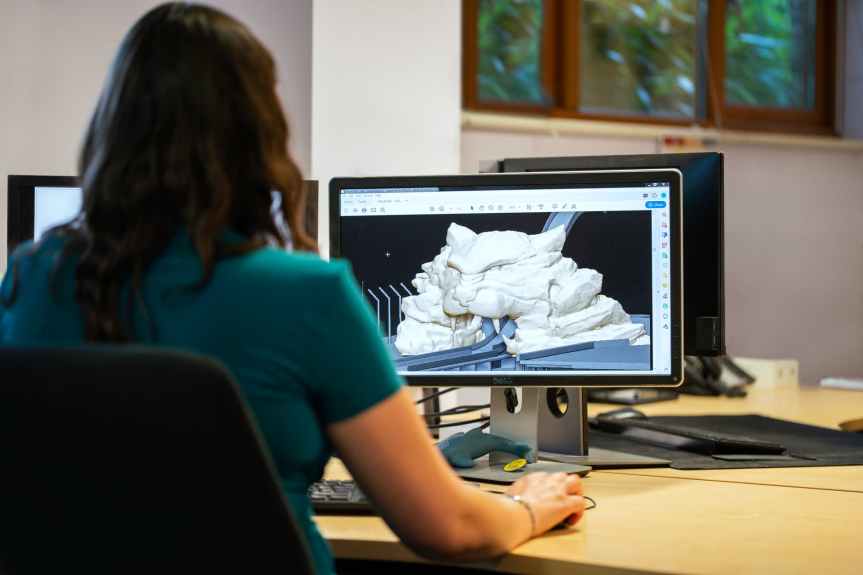
TYPES OF 3D PRINTING

3D PRINTING

3D printing is the process of producing a 3D object by the successive addition of layers one above the other. It is also called additive manufacturing. To know more about 3D printing, check out my article on 3D printing. There are seven different types and technologies involved in 3D printing. 

TYPES OF 3D PRINTING

  1. Sintering

Sintering is a technology where the material to be used for 3D printing is heated but not to the melting point. Metal powders are used for selective laser sintering whereas thermoplastic powders are used for direct laser metal sintering. Laser is used for fusing the layers of the final object. Each layer is formed and the laser traces the parts formed and fuses the next layer on the top until the complete object is made.

2. Melting Methods

The melting methods include

  • Power bed fusion – Uses a thermal source such as laser to melt the materials. The layers are fused and consolidated to form the object. It combines sintering and melting processes.
  • Electron beam melting – Uses a high-power electron beam that can generate heat to melt the material in the vacuum. It ensures no residue and a clean environment.
  • Direct energy deposition – Uses electric arcs or beams to melt the substrate material. It is used to add parts to the existing object.

3. Binder Jetting

Binder jetting is a method where the powdered material is deposited on the bed and adhesive is added to bind the particles to form one layer of the object. Sand, metals, and ceramics are the most commonly used materials. The process is repeated until the complete object is formed.

4. Fused Deposition Modeling

In this, the thermoplastic filament is heated to its melting point and shaped layer-by-layer to form a solid object. It is a cost-effective method where the material softens and sets in the shape and then becomes ready to add the next layer. It is also called material extrusion.

5. Material Jetting

It is similar to inkjet printing where the liquid material is jetted from the nozzle and a layer of the object is formed. After the layer solidifies, the next layer is added on the top. The layers are cured using UV rays for a smooth finish. It is the most expensive method in 3D printing.

6. Sheet Lamination

This process is made by superimposing the layers one above the other and then joining them using ultrasound for metals or adhesive for cardboards and plastic. Once the layers are combined, it is cut and refined to get the desired shape. This method is not widely used as the other methods. Ultrasonic Additive Manufacturing (UAM) and Laminated Object Manufacturing (LOM) are the two sub-types in this method.

7. VAT polymerization

It uses the method of photopolymerization where liquids are turned into solids by exposing UV light to them. It is one of the most commonly used 3D printing methods that include

  • Stereolithography – Stereolithography uses photopolymerization technique where a single point laser or UV beam is used to cure and solidify the object.
  • Digital light processing – It also creates objects from liquids like resin where the image of each layer is flashed onto the surface.

3D PRINTING – AN OVERVIEW

3D printing, also called Digital fabrication technology or Additive manufacturing is the process of making 3-dimensional solid structures or models from the geometric representation by successive addition of materials. The layers of the printed object are a thinly sliced cross-section of the object. 3D printing is an emerging technology that enables us to produce objects with fewer materials than traditional manufacturing methods. 

The process of 3D printing involves 3 major steps.

  • MODELING AND SLICING

It is the first step in the process of 3D printing. Here, even the tiniest detail of the objects is given. The geometric representation of the object is created using software tools called slicing software. The process of building the structure using this software is called slicing as it slices the object to create many layers. The work of this software is to convert the geometry of the object into instructions for the 3D printer. It will tell the printer how to create the layers of the object. In addition, the instructions can also be provided through STL files. STL is a simple, portable object file that is used for designing computer-aided design CAD systems to model the solid geometry of the objects. These STL files are used as the input information for the 3D printers to produce the object. The object is produced by forming layers of the printing material as per the geometric measurements provided. The materials used differ for different technologies.

  • PRINTING

When the modeling and slicing get over, the 3D printer starts its work. Assuming that there is no error in the model, the printer begins to print. It dispenses the material layer-by-layer waiting for one layer to get dried so that it could add the next layers. The bottom-most layer is formed first followed by the next highest layers. The model is printed by adding hundreds and thousands of 2D prints on top of one another to make a 3D model. Although many materials are used for 3D printing, thermoplastic is the most widely used one. 

  • FINISHING

This is the final and post-printing step in manufacturing a 3D object or model. Once the object is printed and dried completely, a finishing touch is given to remove small damages that occur during the printing and refine the parts. It is done to give a smooth surface finish to the object. Solvents are added to remove the superficial imperfections in the model. There are various methods followed in finishing such as polishing, sanding, etc.

The time taken to complete printing may depend on the size, details, and quality of the object created as higher quality objects take more time comparatively. 3D printing can take some minutes or hours or weeks or even more. For example, it takes almost a few hours to create a simple model like boxes and balls and takes weeks to produce more large and complex structures with more details like buildings and houses. The larger the size and geometry of the object, the longer will be the time spent to create the object. So, 3D printing is useful at the same time, it is a time-consuming process.