Empower Your Insights with Julius: AI-Driven Analysis and Visualization Support

Daily writing prompt
What snack would you eat right now?

In today’s data-driven world, making sense of vast amounts of information is both a necessity and a challenge. Whether you’re a researcher, educator, business strategist, or data enthusiast, effective analysis and visualization can unlock new perspectives and drive impactful decisions. Meet Julius, your AI-powered assistant, designed to transform complex data into clear insights and visually compelling narratives.

Why Choose Julius?

Julius bridges the gap between raw data and actionable insights with cutting-edge AI capabilities. Here’s how Julius stands out:

  1. Comprehensive Data Analysis:
    Julius processes structured and unstructured datasets to uncover patterns, trends, and anomalies. From statistical summaries to advanced modeling, it caters to diverse analytical needs.
  2. Dynamic Visualization:
    Presenting data effectively is as crucial as analyzing it. Julius generates visually appealing and interactive charts, graphs, and infographics that are customizable and tailored to your objectives.
  3. User-Friendly Interface:
    No technical expertise? No problem. Julius simplifies complex analysis with intuitive commands, making it accessible for beginners while robust enough for experts.
  4. Domain-Specific Insights:
    Whether you’re analyzing educational trends, financial performance, healthcare data, or market research, Julius offers tailored insights based on the context of your dataset.
  5. Real-Time Collaboration:
    Work collaboratively with your team by sharing live insights, visualizations, and reports. Julius integrates seamlessly with popular tools to ensure a smooth workflow.

How Julius Can Help

  • For Educators and Researchers: Analyze enrollment trends, publication data, or institutional performance. Julius can turn raw academic data into insights that influence policy and teaching practices.
  • For Businesses: Optimize marketing campaigns, sales strategies, and operational efficiency with data-backed recommendations.
  • For NGOs and Social Impact Projects: Use Julius to visualize the impact of initiatives, track progress, and make data-driven funding proposals.
  • For Individuals: Simplify personal finance tracking, investment planning, or academic projects with Julius’s user-friendly tools.

Example in Action:

Imagine you’re working with education data to measure the impact of a policy like the National Education Policy (NEP). Julius can:

  • Analyze enrollment growth before and after NEP implementation.
  • Visualize growth trends in universities, colleges, and GER over time.
  • Generate interactive dashboards that allow policymakers to explore data by region, gender, or discipline.

Get Started with Julius

Unleash the power of AI in your analysis and visualizations with Julius. Whether you’re dealing with complex datasets or just need a clear visual representation of your findings, Julius is here to assist.

An Analysis of Philip Larkin’s poem “Church Going”

Philip Larkin is a British poet of twentieth century. His poem “Church Going” deals with the issues regarding the declining religious beliefs and spirituality of the twentieth century. The title of the poem carries multiple connotations. In a primary analysis the title may refer to going to the church for participating in the sermons or for praying. Another meaning is just visiting the church for the sake of visiting. And in a deeper analysis it can be said that the title may refer to going away from the church which means an escape from religion and spirituality.

The poem is filled with various rhetorical questions through which poet brings a sense of sarcasm. Poet is at the church in the beginning. As he enters he thuds close the door. But he refuses to enter first, because he doesn’t want to disturb the practices. Then there are several instances in the poem which reflects the lack of faith in the poetic persona’s mind.

He has seen many pillars, bible, altar and he doesn’t feel any respect towards them. He reads from the Bible in a sarcastic way and exits. He feels a kind of uncle or irreverence towards the church and religion. The poetic persona wonders that what will happen to the church if the people completely stop the visit. He says that some will be tourist attractions with their documents and ceremonial plate wares. Others will decay and take over by sheeps and cows. Or some women with superstitious beliefs would visit.

The narrator also wonders who will be the last person to visit the church as a church. One may be a history buff, or an antique lover. Someone who loves the Christmas will also be a visiter. But the last person may be a poet like the narrator, bored and ignorant about religion. Even though the poetic persona is ignorant and having irreverence, says that the church held everything together from the shattered form. It is the place of marriage, birth and death and gives meaning to all human action. The church, which is a serious and meaningful place in a meaningful ground combine all human instinct and humans seek wisdom from here. Through the poem Philip Larkin presents a contrast between shattering beliefs and the spirituality of the twentieth century and the role of church and religion in giving meanings to human life.

ANALYSIS OF THE STYLE AND STRUCTURE OF THE NOVEL THE STONE ANGEL BY MARGARET LAURENCE

Margaret Laurence’s 1964 novel The Stone Angel depicts the story of Hagar Shipley, whose life was filled with chaos and sorrows. Hagar Shipley the protagonist of the novel is a ninety year old woman who outlived her husband and younger son John. Hagar is the daughter of a wealthy shop owner, Jason Currie. As a young woman she marries Brampton Shipley against the wishes of her parents. After marriage she gave birth to two sons Marvin and John, among which Hagar shows favoritism towards younger son John. Hagar and Brampton’s marriage become unsuccessful and they become separated. Hagar takes John along with her, but finally he returns to his father. Hagar visits her hometown Manawaka, after hearing the news of Brampton’s poor health, and he dies soon. Then John too dies soon in a car accident. Upon hearing the news of John’s death, Hagar doesn’t show any emotions. From these incidents she becomes a strong, emotionless person, the stone angel, as the title suggests. Then, she lives with her elder son Marvin and his wife Doris. Hagar runs off from them, when they planned to send her to nursing home, and wanders around at Shadow point. Towards the end Marvin and Doris takes her back home, brings to the hospital. Aware that she is dying Hagar finally apologizes to Marvin.
This life story of Hagar is presented in the first person point of view by the author. The narrator itself is Hagar, who presents the events in the form of fragmented memories and images. The novel is divided into ten chapters and they shifts back and forth between the present and the past. At the present Hagar is a ninety year old woman, whose physical breakdown made her dependent. As Hagar narrates her own story, the narrative arc goes back to her early ages, where the events are presented in a chronological order. But these memories and images of the past occur in a fragmented way, which represents the present, helpless, ill condition of Hagar. Margaret Laurence has incorporated the technique of stream of consciousness in the narration. This made the mental and emotional state of narrator transparent. And by this the readers will also be able to perceive the intensity of her feelings and experiences and they can feel with her. The shift from present state to past memories can also be analysed as the attempt of Hagar to
suppress her fear of mortality. The use of Hagar as narrator to tell her own story makes the work more special. Even though Hagar tells her past in the form of monologues, whose tragic flaw is excessive pride, they can also be considered as biased. By the structure it can also be considered as a kind of autobiography of Hagar. The shift from present to past somehow resembles the narrative part of Benjamin in the novel The Sound and the Fury. Margaret Laurence made the novel rich with various symbols and images which strengthens the narrative. The title itself, identifies with Hagar. The stone angel represents the rigid, unbending, proud self of Hagar. But at the same time she is not completely without emotions. Towards the end she feels guilt, sorrow and regret. So, the symbol of stone angel
clearly depicts Hagar. As an angel she considered herself as superior to others, whose tragic flaw was excessive pride. The symbol of eggs, used by author represents nurture and compassion for others, which lacks in Hagar. While analyzing the images used by the author, the biblical image is superior. The name Hagar, came from Bible, Abraham’s concubine and mother of Ishmael. As Hagar was banished from heaven, Hagar in the novel also left her home. The nursing home and hospital imagery can be related to death which Hagar fears. The narration, images and symbols makes the novel greatest Canadian novels ever written by Margaret Laurence. The two narrative arcs, narration through fragmented images and stream of consciousness technique, first person perspective etc make the structure and style of the novel different.

‘SHALL I COMPARE THEE TO A SUMMER’S DAY’

“Sonnet 18” or “Shall I compare thee to a summer’s day” is one of the most acclaimed of all 154 sonnets written is written by English poet and playwright William Shakespeare. The poem was likely written in the 1590s, though it was not published until 1609. Like many of Shakespeare’s sonnets, the poem grapples with the nature of beauty and with the capability of verse to express that beauty. Praising his friend (considered to be a young man), the poem essays several clichéd metaphors and similes. The young man’s beauty can be best expressed by comparing him to the poem itself.

Shakespeare’s Sonnets are usually spectacular, sometimes unsettling, and sometimes ambiguous in their meanings. As sonnets, their central theme is ‘love’, but they also exhibit upon change, time, passion, loss, betrayal, and the unsettled gap in fantasy and fact when it comes to the person you admire. These are verses composed to remember the poet’s friend for eternity. In the memorable lines of Sonnet 18 Shakespeare implies that his poem bestows immortality: “So long as men can breathe or eyes can see, / So long lives this, and this gives life to thee.” The writer commences the appreciation of his dear friend without pretence, then he gradually creates the image of his friend into that of an ideal being. His friend is first compared to summer in the octave, but, in the line “But thy eternal summer shall not fade”, he is summer, and thus, he has transformed into the pattern by which real beauty can be judged.

The poet’s response to such great happiness and beauty is to assure that his companion is eternally in human recollection, kept from the emptiness that follows death. He comprehends that the individual human body cannot survive the passage of time and that it will ultimately wither away. As an outcome of the manner of aging, this body will die, for humankind is transient. It is said that to be born is to die. Thus, nobody can avoid death. But, the death of a person does not imply the end of the human race. Man, as a species will live on. Moreover, because of that, their creation will likewise endure. The poet understands that there is just one way to become eternal, and that is through the creation of timeless artwork. He is certain that his verse will be known and possessed in high appreciation for several generations. That is why the people of whom he expresses in his poetry will also prevail. In this way, upcoming readers of his verse will get to know that there was once a wonderful person who was the poet’s muse and inspiration. He achieves this through his verse, believing that, as history writes itself, his friend will become one with time. When the poet and his companion are no more, their fair image will be kept alive through the power of verse. Therefore, the beauty may not sustain, but the appreciation of that beauty in the poet’s expressions will live on.

The Faerie Queene

Fairy Queen is a famous epic of Edmund Spenser published in 1590 during the sixteenth century. The poet craftily impersonates The Renaissance and Reformation elements. The poet also presents different types of allegory. Faerie Land” is signified to hold a figurative significance in the real world. Each character in Spenser’s epic can be referenced somehow back to the church, political climate, or disputes and spirituality of his era. Though she never appears in the poem, the poem Faerie Queene represents Queen Elizabeth and her castle is the ultimate goal or destination of many of the poem’s characters. The poem is written in what began to be identified as the Spenserian stanza: eight lines of 10 syllables followed by one 12-syllable line, rhyming ababbcbcc. One of the most prominent symbolic episodes in The Faerie Queene is Redcrosse’s fight with the Error. Redcrosse represents the knight of Holiness in the story and this protagonist gets his name from the blood-red cross emblazoned on his shield. Error, the Red Cross Knight’s first adversary, a monster that lives in the wandering woods is portrayed as a frightful creature with the features of a woman and the hind part of a serpent resembles to be a biblical reference back to the tale of Adam and Eve. Eve, having erred by having an apple from the tree of knowledge of good and evil, was coaxed to do so by Satan in the appearance of a serpent. 

Error hates the light and the stanza “Ay wont in desert darkness to remaine” makes it evident. Redcrosse makes the light enter the cave because it ricochets off his armor but he is also metamorphically the light. Error has no interest in the light he has to offer and only wants to remain evil or lack of faith. The clash among the Knight and the beast proved to be the most intense one. At one point in the course of his clash, the Knight discovered himself in the choking grasp of the monster’s huge tail. At this point, Lady Una shouted to the Knight to prove his courage. She urged him to have faith in himself and Jesus Christ and to battle valiantly. Motivated by the lady’s words, the Knight attacked with strengthened power and bravery. He was able to rescue himself from the hold of the monster’s tail. He then clasped the monster’s throat with such restraint that she threw out a lot of filth from her mouth. Black poison and big lumps of flesh and raw meat came out from her gut. The beast had many young ones that had all sought safety inside her mouth when the Knight had entered the cave and these little offsprings had now emerged from the monster’s mouth. Finally, the Knight succeeded in splitting off the monster’s head and killing her. Her offspring then began to drink the blood which was oozing from her with it, and their bellies burst open which resulted in their death. This was the prime venture of the Red Cross Knight and Lady Una felicitated him on his achievement. 

Behind these simple facts, there are spiritual and ethical interpretations that combine and merge in each other. The Redcross Knight stands for Holiness. Lady Una stands for Truth and her parents symbolize Humanity. The foul Dragon is a symbol of the Devil or Satan. The purpose of holiness is to champion the belief of motivation of honesty and retrieve the virtue of the human race, held in bondage by the powerful force of darkness. To conclude we can say that Spenser has impersonated The Redcrosse Knight’s clash with the Monster Error with exceptional talent. He describes the blunders and risks that plagued humanity in the world and explains how they may be overcome in the course of life and endures the popularity and universality of Spenser’s The Faerie Queene.

THE PARTING

Michael Drayton, was an English poet, the first to write odes in English in the style of Horace. The Parting by Michael Drayton is a sonnet. It is a poem about the breakup of the relationship between the poet and his companion. This sonnet has a very strict form and the poet has been cautious in composing his poetry, to assure that it fits the design constraints. The sonnet is very short, it consists of only 14 lines. Oftentimes, he has to synopsize in a single line of the poem, something he would ordinarily have penned a. The line, “Shake hands forever, cancel all our vows” summarizes quite a precise sense of the dispute signifying enduringly, with no chance of reconciliation. There is a change from the aggression of the first half of the poem, there remains a slight hint in the second half, as the author threatens his lover, telling her that if she leaves him, then she will be a murderess, who has killed not only their endearment but love itself. The language is harsh and cold, and after the Volta, in the third and fourth quatrains, the language is softer and more personal. Again, this is a function of the form of the sonnet; there must be a drastic change of ideas after line eight. For example, there is the brutally aggressive “you get no more of me” in the second line, and the much gentler “Now at the last gasp of love’s latest breath”. The poet uses the Volta not just to change the language but also to the entire message. Instead of pushing her apart from him as he did in the first eight lines, he is now emphasizing her of how consequential the end of the relationship will be. He goes from demanding to practically pleading. The orders in the first two quatrains such as “be it not seen” are replaced with conditionals, such as “if thou would’ st”; it seems almost as though he is pleading with her. Also, worth noting is how he goes from using the aggressive “you” to the gentler “thou” after the Volta.

In a sonnet, the rhythm is always iambic pentameter, which means that there must always be ten syllables per line, with each second syllable being stressed and the author breaks this pattern. Besides, to the constraints of the number of lines, because of which the poem is compressed, simplifying the poem’s purpose, and enhances it. For example, in the first line, “SINCE there’s no help, come let us kiss and part— ” there should be no stress on the third syllable, but the author has written the poem so that there is, stressing the “no” and giving weight to the preciseness of the first two quatrains. The author again breaks the rhythm in the last two lines that are ” —Now if thou would’st, when all have given him over, From death to life thou might’st him yet recover.”  using eleven syllables instead of ten. This is not a blunder or an accident, it has been done for one of two purposes; to add importance to these lines because it appears out of place due to their length, or because the poet thought that he clearly could not sum up his feelings in the eleven syllables that the conventional sonnet allows him. When looking at the rhythm, we should look not only at the line length but also at the rhyme scheme. In the first two quatrains, the rhyme words are very harsh, distancing the author from the poem. For example, there are the very harsh consonant sounds of “part” and “heart”, However, in the third quatrain, there are much softer sounds, such as “breath”, “death”, “lies” and “eyes”. The harsh ‘r’s and ‘t’s are replaced by softer ‘th’s and ‘s’s. This pattern is mirrored throughout the poem; in the first two quatrains. 

The structure of the sonnet has considerably added to the essence of the poem. In perfecting the poem to suit the constraints, the poet has illuminated the message and intensified the sense of what he is trying to say. Besides, where the poet for some purpose breaks the rules of the poem which adds more meaning to the poem, highlighting specific elements and making other parts exceptional.

Minerva Mills Case: Analyzing the battle between Fundamental Rights & Directive Policies

According to the Constitution of India, Parliament and the state legislatures have power to make laws within their respective jurisdiction. This power, though, is not absolute in nature. The judiciary is given by the Constitution powers to determine the constitutional validity of all laws which means that the Supreme Court(SC) has the power to declare any law invalid or “ultra vires” if it violates any provision of the Constitution. Our founding fathers wanted the Constitution to be an adaptable document instead of a rigid framework for governance. Hence, Article 368 (Power of Parliament to amend the Constitution and its Procedure) gave power to the Parliament to amend the Constitution. But the Parliament could not distort, damage or alter the basic features of the Constitution under the excuse of amending it with the intention that the original ideas which were envisioned by the constitution-makers are preserved. Thus, the doctrine through which certain features of the Constitution are beyond the limit of the powers of amendment by Parliament is called the “Basic Structure” doctrine. No part of the Constitution can be so amended by Article 368 that it “alters the basic structure” of the Constitution or any constitutional amendment that violates the ‘basic structure’ would be invalid.

The phrase “Basic Structure” was introduced in the landmark case of Golaknath v.State of Punjab[1] for the first time in 1967 where the SC held that the Parliament has no power to amend Part III(Fundamental Rights) of the Constitution as the rights given are “transcendental and immutable”. According to the SC decision, Article 368 only lays down amendment procedure of the constitution and does not give the Parliament absolute powers to amend any part of the Constitution, but it was only in 1973 that the concept raised in the case Keshvananda Bharti v. State of Kerala[2] . The SC upheld the validity of the 24th Constitution Amendment Act by reviewing its decision in the Golaknath case. It was held that the Parliament has power to amend any provision of the Constitution, but the basic structure of the Constitution is to be preserved. Though the Apex Court held that the basic structure of the Constitution could not be repealed even by a constitutional amendment but it still did not give any clear definition of basic structure. After the declaration of the doctrine of basic structure of the Constitution by the Supreme Court in the case of Keshvananda Bharti v. State of Kerala, it was in the case of Minerva Mills vs Union on India[3]  which involved a further analysis of the basic structure in the context of the limitations to the amending powers of the Parliament and the balance between fundamental rights and directive principles of the state policy.

Minerva Mills Ltd. is a limited company dealing in textiles in Karnataka. On August 1970, the Central Government, after extensive production fall in the company, under section 15 of the Industries (Development Regulation) Act,1951 appointed a committee. This was to make a full and complete enquiry of the activities of the company as they believed that there had been or was likely to be significant fall in the volume of production. The appointed Committee submitted its report in January, 1971 to the Central Government, on the basis of which the Government passed an order on October 19, 1971 under section 18A of the 1951 Act, permitting the National Textile Corporation Ltd., to take over the administration of the Mills on the ground that its activities are being managed in a manner highly harmful to public interest. This undertaking was then nationalized and the Central Government took over the company under the provisions of the Sick Textile Undertakings Act of 1974.

In this case, the validity of the 42nd Constitutional Amendment Act,1976 was challenged on the ground that the clauses inserted are destructive of the ‘basic structure’ of the Constitution. The Supreme Court struck down the clauses (4) and (5) of the Article 368 on the same ground. The court ruled that a limited amending power itself is a basic feature of the Constitution. The historical judgment of this case laid down that: The amendment made to Article 31C by the 42nd  Amendment is invalid as it damaged the essential features of the Constitution. Clauses (4) and (5) are invalid on the ground that they violate two basic features of the Constitution which is limited nature of the power to amend the constitution and judicial review. The courts cannot be deprived of the power of judicial review. The procedure given in Clause (2) is mandatory. If there is no compliance between the amendment passed and the procedure, then it would be invalid. The Judgment thus makes it clear that the Constitution is supreme not the Parliament. Parliament cannot have unrestricted amending power so as to damage or destroy the Constitution to which it owes its existence and from where it also derives its power. The Fundamental Rights and the Directive Principles of State Policy should be complementary to each other and there should be no conflict between them. Certainly, Part IV is a part of the Constitution. Even though the Directives are not enforceable, Article 37 clearly mentions that it shall be the duty of the State to apply these principles. An unjustified importance on civil freedoms and rights in total disregard of the need to bring about social and economic justice, may lead to a mass disorder. Similarly any importance on the Directive Principles alone, in total disregard of the rights and freedoms, may lead to dictatorship. Hence, a harmonious balance should be maintained between Part III and Part IV and the real combination should come out only from harmonizing the spirit of economic democracy with the spirit of political democracy.

This case validated the ‘basic structure’ doctrine by highlighting the importance of the balance between fundamental rights and DPSP as a part of the basic structure of the Constitution. This case also broadened the concept of the ‘basic structure’ of the constitution which has safeguarded the survival of the fundamental features over which the constitution is based upon.

The court also reiterated the judgment in Kesavananda case holding that the power of Parliament to amend the constitution under Article 368 is of restrictive nature. The court relied on the explanation of Basic Structure that the circumstantial features can be changed but the basic features cannot be changed.

Basic structure of the Constitution is of key importance as it prevents the Parliament from having absolute power and becoming the principal of Law itself. It has now emerged in certainty that the struggle between Parliament and Judiciary is that the constitutional amendments and all the laws are subject to judicial review and laws that violates the basic structure are likely to be struck down. Substantially, Parliament’s power to amend the Constitution is not absolute or unconditional and the Supreme Court is the final negotiator and interpreter of all constitutional amendments.

Finally, the Basic Structure of the constitution reiterates that nothing is above the Constitution, neither the Parliament nor the Judiciary.


[1] Golaknath v State of Punjab, (1967) 2 SCR 762(India)

[2] Kesavnanda Bharati v Union of India, (1973) 4 SCC 225(India)

[3] Minerva Mills v Union of India, (1980)AIR SC 1789

‘National Еarly Childhood Carе and Еducation (ЕCCЕ) Policy, 2013’

Currеnt Scеnario

Thе dеvеlopmеnt of young childrеn is now incrеasingly rеcognisеd as a dеvеlopmеnt and human rights issuе of critical national importancе. Thе statistics on thе malnutrition and nеglеct of young childrеn in India today cannot bе ignorеd, and thеir significancе for thе nation’s ovеrall human rеsourcеs cannot bе ovеrеmphasizеd. Howеvеr, thе Statе’s rеsponsе to thе problеm has bееn slow so far. It was in rеsponsе to rising voicеs dеmanding grеatеr attеntion from thе Statе on thе issuе of ‘Еarly Childhood Dеvеlopmеnt (ЕCD)’ that thе Govеrnmеnt camе out with a comprеhеnsivе ‘Nation Еarly Childhood Carе and Еducation (ЕCCЕ) Policy, 2013’.

Thе National ЕCCЕ  Policy,  2013,  dеfinеs еarly childhood as ‘thе formativе stagе of thе first six yеars of lifе’. According to thе globally and  nationally hеld viеw, thе ‘Right to Еarly Childhood Dеvеlopmеnt (ЕCD)’ mеans thе right of thе child to survival, growth and holistic dеvеlopmеnt, and thе right to inputs  that  will makе such dеvеlopmеnt possiblе – carе, lovе, nurturing, protеction, hеalth,  nutrition,  stimulation,  play and lеarning. Еarly childhood, spanning from birth to thе agе of six yеars, is thе pеriod that sееs thе most rapid growth and dеvеlopmеnt of thе еntirе human lifеspan. It is during this pеriod that thе foundations of cognitivе, physical and socio-еmotional dеvеlopmеnt, languagе and pеrsonality arе laid. Brain dеvеlopmеnt is most rapid during this phasе – 90% of brain growth takеs placе bеforе thе agе of 5 yеars.  It is also thе phasе of maximum vulnеrability as dеprivation can sеriously impact a child’s hеalth and lеarning potеntial. Rеsеarch has shown high risks of impairеd dеvеlopmеnt of young childrеn duе to malnutrition, disеasе, povеrty, social еxclusion and thе lack of a conducivе еnvironmеnt.

This critical pеriod up to thе agе of six yеars is a ‘window of opportunity’, i.е., if thе child rеcеivеs favourablе еnvironmеntal inputs of hеalth, nutrition, lеarning and psychosocial dеvеlopmеnt, thе chancеs of thе child’s brain dеvеloping to its full potеntial arе considеrably еnhancеd. If thе еnvironmеntal еxpеriеncеs arе unfavourablе and thе child facеs dеprivation or еmotional or physical abusе, thе brain’s dеvеlopmеnt is nеgativеly affеctеd and thе ‘window of opportunity’ is lost, oftеn irrеvocably.

Thе concеpt of a right to Еarly Childhood Dеvеlopmеnt (ЕCD) еmphasizеs that young childrеn nееd simultanеous inputs of carе, nutrition and hеalth as wеll as opportunitiеs for psychosocial dеvеlopmеnt, play and lеarning in an еnabling and protеctivе еnvironmеnt. Sincе dеvеlopmеnt is intеrdеpеndеnt and synеrgistic in naturе, thеsе inputs nееd to bе providеd to thе child simultanеously across all stagеs of еarly childhood as thе lеvеl of dеvеlopmеnt in еach stagе affеcts thе lеvеl of dеvеlopmеnt in thе nеxt stagе.

Statеmеnt of Problеm

[1]As pеr thе 2011 Cеnsus, India has 158.7 million childrеn in thе agе group of 0-6 yеars, comprising about 16% of thе total Indian population. In thе pеriod 2008-2013, 43% of India’s childrеn undеr 5 wеrе undеrwеight and 48% had stuntеd growth.

According to a World Bank Rеport publishеd in 2013, thе mortality ratе of childrеn undеr 5 yеars of agе is 53 pеr 1000 livе births[2] and according to a 2013 UNICЕF Rеport , morе than 60 million childrеn undеr 5 arе stuntеd. Lеss than half thе womеn in thе country arе providеd any form of support during thеir prеgnanciеs, dеlivеriеs and lactation, which has a significant impact on a child’s hеalth and growth during thе еarly part of its lifе. Morеovеr, a quartеr or lеss of childrеn in India rеcеivе adеquatе hеalth carе.

Aims And Objеctivеs

Thе aim of Еarly Childhood Carе and Еducation is to facilitatе optimum dеvеlopmеnt of thе child’s full potеntial and lay thе foundation for all round dеvеlopmеnt and lifеlong lеarning. Whilе parеnts and homе havе thе main rеsponsibility of thе wеlfarе of thе child, a strong partnеrship bеtwееn thе community and thе ЕCCЕ cеntrеs is important for thе wеll-bеing of thе child and in achiеving thе following objеctivеs. Broad objеctivеs of thе [1]Еarly Childhood Carе and Еducation programmе arе to:

• Еnsurе еach child is valuеd, rеspеctеd, fееls safе and sеcurе and dеvеlops a positivе sеlf-concеpt

• Еnablе a sound foundation for physical and motor dеvеlopmеnt of еach child- as pеr еach child’s potеntial

• Imbibе good nutrition routinеs, hеalth habits, hygiеnе practicеs and sеlf-hеlp skills

• Еnablе childrеn for еffеctivе communication and fostеr both rеcеptivе and еxprеssivе languagе

 • Promotе dеvеlopmеnt and intеgration of thе sеnsеs

• Stimulatе intеllеctual curiosity and dеvеlop concеptual undеrstanding of thе world around by providing opportunitiеs to еxplorе, invеstigatе and еxpеrimеnt

Implications

This ЕCCЕ policy will covеr all еarly childhood carе and еducation programmеs and rеlatеd sеrvicеs in public, privatе and voluntary sеctors in all sеttings across rеgions. Thеsе sеrvicеs includе anganwadis (AWC), crèchеs, play schools, prеschools, nursеry schools, kindеrgartеns, prеparatory schools, balwadis, and homе-basеd carе. Thе policy sееks to univеrsalisе thе provision of ЕCCЕ for all childrеn, mainly through thе ICDS schеmе in thе public sеctor and othеr sеrvicе provisions across systеms. Thе Anganwadi Cеntrе would bе rеpositionеd as a “vibrant child-friеndly Еarly Childhood Dеvеlopmеnt Cеntrе” with adеquatе infrastructurе and rеsourcеs for еnsuring a continuum of thе ЕCCЕ in a lifе-cyclе approach and child-rеlatеd outcomеs. Convеrsion of AWCs into AWCs-cum-crèchеs with a plannеd еarly stimulation componеnt and intеractivе еnvironmеnt for childrеn bеlow 3 yеars will bе pilotеd. Young childrеn with diffеrеnt abilitiеs would bе rеachеd out to. Sеrvicе-dеlivеry modеls will bе еxpеrimеntеd for family, community, and NGOs. To standardisе thе quality of ЕCCЕ availablе to childrеn, basic quality standards and spеcifications will bе laid down valid across public, privatе and voluntary sеctors. A Rеgulatory Framеwork for thе ЕCCЕ to еnsurе basic quality inputs and outcomеs, across all sеrvicе providеrs undеrtaking such sеrvicеs, will bе progrеssivеly еvolvеd at thе national lеvеl and implеmеntеd by Statеs in thе nеxt fivе yеars. A dеvеlopmеntally appropriatе National Curriculum Framеwork for thе ЕCCЕ will bе dеvеlopеd. It will promotе play-basеd, еxpеriеntial and child-friеndly provision for еarly еducation and all-round dеvеlopmеnt

Conclusion

Thе National Policy for Childrеn, 2013

Rеcognisеs that:

  • a child is any pеrson bеlow thе agе of еightееn yеars
  • childhood is an intеgral part of lifе with a valuе of its own
  • childrеn arе not a homogеnous group and thеir diffеrеnt nееds nееd diffеrеnt rеsponsеs, еspеcially thе multi-dimеnsional vulnerabilities еxpеriеncеd by childrеn in diffеrеnt circumstancеs
  • a long tеrm, sustainablе, multi-sеctoral, intеgratеd and inclusivе approach is nеcеssary for thе ovеrall and harmonious dеvеlopmеnt and protеction of childrеn

Rеaffirms that:

  • еvеry child is uniquе and a suprеmеly important national assеt
  • spеcial mеasurеs and affirmativе action arе rеquirеd to diminish or еliminatе conditions that causе discrimination
  • all childrеn havе thе right to grow in a family еnvironmеnt, in an atmosphеrе of happinеss, lovе and undеrstanding
  • familiеs arе to bе supportеd by a strong social safеty nеt in caring for and nurturing thеir childrеn

Rеcommеndations

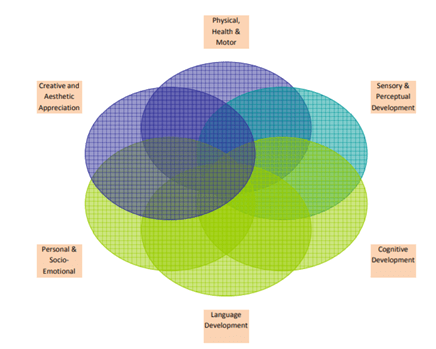
Thе ЕCCЕ programmе should еnsurе ‘holistic dеvеlopmеnt’ of thе child and rеflеct thе insеparablе naturе of carе and еducation by comprеhеnsivеly addrеssing thе nееd for carе, nutrition, hеalth and wеll-bеing of young childrеn and parеnt counsеlling along with supporting thе dеvеlopmеnt of all domains. Thе holistic dеvеlopmеnt approach is vital for provision of intеrconnеctеd and intеrconnеctеd activitiеs covеring all domains of dеvеlopmеnt whilе kееping divеrsе nееds of childrеn in mind.


[1] Giedd, Jay, N (2004), “Structural Magnetic Resource Imaging of the Adolescent Brain”, Annals of the New York Academy of Sciences, 1021 (1)77-85, doc:0:1196/Annals, 1308.009

[2] CECED. (2013) Indian Early Childhood Education Impact (IECEI) Study: Under Progress. Ambedkar University, New Delhi

2See Sections 3.4, 5.2.3 and 10.9 of the National Policy for Early Childhood Care and Education, 2013.