
Block chain Technology- Implementations

You must have heard a lot about the emergence of blockchain, isin’t? But here in this article, we will focus on the practical issues for blockchain implementation.

Introduction

In the tech world, blockchain technology is still the leading buzzword. Its ability to work in a distributed environment without getting tampered is the core source behind all the hypes.

As the technology is still in its developing phase, despite various possibilities in almost every sector, it will still take some course of time to get over all the challenges it is facing right now. Let’s explore what the practical blockchain implementation issues are.

As blockchain is revolutionizing rapidly, its scope and career opportunities are beyond imagination. If you are looking to start a profession in blockchain space and want to become a blockchain expert or a blockchain developer, favorable chances are on its way.

Practical Blockchain Implementation Issues

Blockchain technology is an algorithmic immutable ledger that presents a future-ready architecture for organizations to transact and exchange business-related information securely.

Does it mean it has no challenges? Of course not. There are various challenges associated when it comes to implementation. So let’s get started.

Lack of Internal Blockchain Knowledge

The first and foremost challenge while implementing blockchain is that most organizations have insufficient knowledge about technology. Companies do not have Blockchain experts and professionals who clearly understand the core concept of technology.

Thus organizations find it challenging to choose and adopt the best enterprise blockchain platform. Moreover, the companies are not aware of blockchain implementation steps that should guarantee the best outcome.

High Implementation Cost

Although popular enterprise blockchain platforms such as Hyperledger Fabric have made great strides in terms of the transaction speeds( just about twice the rate over VISA platform), most of the existing platforms such as Bitcoin(transacts 3 to 5 transactions per second ) and Ethereum (up to 15 transactions per second ) are inefficient in terms of speed of transactions and the energy consumption. Thus we can infer that the most convenient blockchain platforms come at a vast implementation and energy costs.

Backup and Recovery

Backup and recovery of data for blockchain networks are also one of the significant implementation issues. Although theoretically, creating a new node is easy, but it’s not practical spending several hours for a new node to sync with existing blockchain nodes and transfer configuration metadata. The recovery becomes even more critical when there is a requirement to migrate a node across datacenters.

Data privacy

Data privacy is a crucial bottleneck problem in blockchain as most enterprises do not appreciate the case where anyone can view their sensitive data, which might be delicate to their core business. Those who plan to share confidential business data are worried about confidentiality between several participants and shielding this data from access by other companions.

But, when blockchain nodes are run as a managed cloud service with users only able to access them through the APIs and event subscriptions, data privacy can be maintained to a great extend.

Blockchain Interoperability

Although they are various enterprise blockchain platforms, interoperability is a pertinent issue to which Blockchain developers are looking for mass adoption. The basic idea is to join one particular platform and to utilize the service on another enterprise platform if required without any severe compatibility problems.

Therefore, developers are finding a way through which users of different software can interact and conduct meaningful business.

Performance

In the blockchain network, the performance requirement is never the same. It varies from one scenario to the other. Like for example, the performance metrics include throughput and latency, and outcomes will vary in terms of network size and hardware configurations, and the tradeoffs between higher throughput versus lower latency.

Thus, based on the deep understanding of the business demands and platform architecture, a reasonable performance optimization solution needs to be adopted.

This is not the end of the list. Moreover, a lack of regulatory clarity is one of the significant implementation issues. Many governments are still unsure about how they consider this technology from a legal standpoint, and this leads to complexity.

Conclusion

Enterprise blockchain is gaining popularity and adoption in almost all sectors and for different use cases. Although blockchain might seem to be offering several advantages to the industries, it needs to be re-architected depending on various use cases for greater acceptance of enterprise blockchain in the mainstream.

The buzz around blockchain probably won’t subside, so hurry up and upgrade your skills now with the best online Blockchain certification courses.

To get instant updates about Blockchain Technology and to learn more about online blockchain certifications and become a blockchain expert, check the online opportunities which deals with all levels – beginner, intermediate and professional learning.
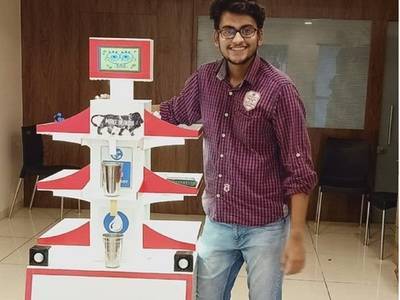
Worlds first “Internet controlled robot” By 23 year old Indian boy : Covid-19

A 23 year old Thane engineer has developed worlds first-of-its-kind internet controlled robot which can be used to treat covid patients in hospitals.

The robot delivers food, water, beverages, medicines and even some good advices to the patients without the help of any hospital nurses or staffs.

This aCoro-bot’ eliminates the need of physical presence or contact of nurses or ward boys with the patient. It can deliver food, water, medicines and interact with the patients through a camera. Through a speaker, it can also advise patients on various precautions like sanitizing their hands before picking up anything from the robotic tray,” Says Pratik tirodkar the creator and designer of this robot.

This smart boy is also the founder of a start up ‘PNT solutions’. Whatsmore this young lad had developed other unique creations when he had barely stepped to college. This include world’s first ‘Humanoid’ with 47 body (axis) movements, a robotic bird ornithopter for various outdoor applicationsapplications,  a mini packaging robot and several others.

This genius has even given over a 100 guest lectures to the brain students of IITs and NITs in the country.

This robot can be operated from any part of the world through internet. The robot comes with 3 trays with a carrying capacity of 10-15 kg each, plus a 30-kg storage at the bottom, enabling it to serve the supplies to over a dozen patients at a time in the COVID-19 ward.

There are separate dispensers for water, tea, coffee, besides sensors for sanitizers which flow out quickly when the patient holds his hand below it and cuts off the supply when the hand is removed. Thus there is minimum wastage,” Tirodkar explained.

“Not only the COVID-19 patients, Coro-bot can also take care of itself. It has three nozzles at the back to give itself a disinfectant bath regularly, it goes on spraying sanitisers on both sides of the path, plus disinfects the ground it moves on by using UV lights” Says the genius.

The Coro-bot also has LED lights illumination to make it convenient for night usage as well, timers for indicating lunch-dinner, emergency button, besides a small PC like screen on the top for basic computer work or entertainment, he said.

This is now successfully deployed at Holy Cross Hospital in kalyan. Impressed by this robot over a dozen of other hospitals have ordered coro-bot in Mumbai.

The Coro-bot costs between Rs 1.60-Rs.3.80 lakhs, depending on various specifications like the load-carrying capacity, etc, and the Ornithopter is around Rs 30,000. I have a small manufacturing unit at Dombivali, but if I can get a good investor, I can get into mass production,” he said.

Pratik tirodkar is currently doing his Btech in instrumentation engineering from Bharati  Vidyapeeth College of Engineering, Navi Mumbai.

“JEE-MAINS”- The first step to a new beginning

JEE-MAINS stands for JOINT ENTRANCE TEST-MAINS which was earlier called as All India Engineering Entrance Examination (AIEEE). This is an undergraduate entrance test for taking admissions in various engineering and architecture institutes, mainly in 31 National Institutes of Technology (NITs), 23 Indian Institutes of Information Technology (IITs), and Government Funded Technical Institutes (GFTIs). This test is organized every year by National Teaching Agency (NTA) in India. This test was introduced in the year 2002.


STRUCTURE OF THE EXAM –
Until 2018, it was held only once after the CBSE exams, nearly in first week of April by the NTA since 2019 has decided to take this entrance test twice a year. Earlier, it held either electronically or online but now it happens only in the online mode.
It is a computer based entrance exam which consists of 2 papers:

  1. Paper 1 is for B.E. / B.Tech courses which only occurs in online mode from 2019, earlier there was an option of OMR based exam also. The qualification required for this paper is Physics, Chemistry and Mathematics as main subjects in class 12th.
  2. Paper 2 is for BArch and BPlanning courses. The knowledge of Mathematics, Aptitude, Drawing and Planning is required for being a part of this paper.
    The duration of the exam is 3 hours and candidates can apply for 3 subsequent years. LANGUAGE OF THE ENTANCE TEST –
    The exam was offered in English, Hindi and Gujarati. From January 2021, It has been planned to take the exam in eleven different languages namely Assamese, Bengali, English, Hindi, Gujarati, Kannada, Marathi, Odiya, Tamil, Telugu, Urdu.
    MODE OF EXAMINATION –
    • B.E. /B. Tech. (Paper 1) Physics, Chemistry and Mathematics, part 1, 2 and 3 respectively will be conducted in Computer Based Test mode only.
    • B. Arch (Paper 2) Mathematics and Aptitude Test, part 1 and 2 respectively will be held in Computer Based Test mode only. While Drawing Test or part 3 will be in offline mode on drawing sheet.
    • B. Planning (Paper 3) Mathematics, Aptitude Test and Planning Based Questions, part 1, 2 and 3 respectively will be held in Computer Based Test mode only.

PARTICIPATING INSTITUTES –
Institutes participating in the 2017 centralized seat allocation process included:
• The 31 National Institutes of Technology,
• The 24 Indian Institutes of Information Technology,
• 19 other central government or state government funded institutions including the three Schools of Planning and Architecture.
• Several self-financed institutes (during the spot round).
• Many other institutes used JEE (Main) ranks to fill seats through their own seat allocation processes.

NUMBER OF APPLICANTS

There are lakhs of students who appear in the entrance exam every year. The number of applicants has varied over the years, with the peak of over 1.35 millions in 2014.

  1. Starting from 2012, there were 1,220,000 students who appeared in the exam.
  2. In the year 2013, 1,282,000 students appeared.
  3. In 2014, 1,356,805 students appeared.
  4. In 2015, 1,304,495 students appeared.
  5. In 2016, 1,194,938 students appeared.
  6. In 2017, 1,186,454 students appeared.
  7. In 2018, 1,259,000 students appeared.
  8. From 2019, exam was conducted in two different phases. So, in 2019 in the first phase 929,198 students gave the exam while in second phase 935,741 students appreared for the exam.
  9. In 2020, in the first phase of the exam 921,261 students appeared whereas the second phase is still to be held.