Tag: Budget
GOVERNMENT BUDGET
Government is required to undertake various economic, social, and other activities in every country. It is like to pursue various policies to achieve certain objectives like economic development, reduction of inequalities of income and wealth. The government has to incur expenditure in performing these activities and in pursuing its policies. For instance, the government has to incur expenditure in maintaining law and order and in undertaking various developmental activities. As such, government has to raise necessary revenue to finance these expenditures.
Accordingly, the government has to draw a financial plan corresponding to various activities it wants to undertake during the coming year . Such a financial plan is known as the budget of the government. “Budget of the government is an annual financial statement describing in detail the estimated receipts and proposed expenditures and disbursements of the government under various heads for the financial or fiscal year. The budget is the indicator of government functioning. It also gives the actual financial accounts for the previous year and the revised estimates for the current ye . In other democratic countries ,the government budget is a constitutional obligation in India. Under Article 112 of the constitution, a statement of estimated receipts and proposed expenditures of the Central Government has to be prepared for every financial or fiscal year and has to be placed before the parliament. It is titled Budget of the central government.
Government budget is a subject of immense importance for a variety of reasons.
- Planned approach to government’s activities: The importance of government budget arises because of the fact that the activities of the government have increased tremendously. This calls for mobilization of large resources to meet the expenditure required to undertake these activities. There has to be a definite planning with regard to the estimated revenue and proposed expenditure for the proper conduct of the government activities.
- Integrated Approach to Fiscal Operations: All these decisions and policies are interconnected and they must form a part of the overall set of objectives which the government wants to pursue. Government’s fiscal policy as reflected in the budget is an essential part of its overall economic and social policy.
- Public Accountability: Budget proposals are discussed in the parliament. A popular debate also takes place in the media about the budget proposals. Parliament also exercises control over the government expenditure through various committees – Public Accounts Committee, the Estimates Committee and the Committee on Public Undertakings. Thus, Budget serves as a powerful weapon of financial control in respect of both collection of revenues and their disbursement.
STRUCTURE OF THE GOVERNMENT BUDGET
Constitution of the country demands that the budget must distinguish expenditure on revenue account from the expenditure on capital account. Revenue account covers those items which are recurring nature, while capital account covers those items which are of the nature of creating or reducing the capital assets. Budget is necessarily presented in two parts:
- REVENUE BUDGET
- CAPITAL BUDGET
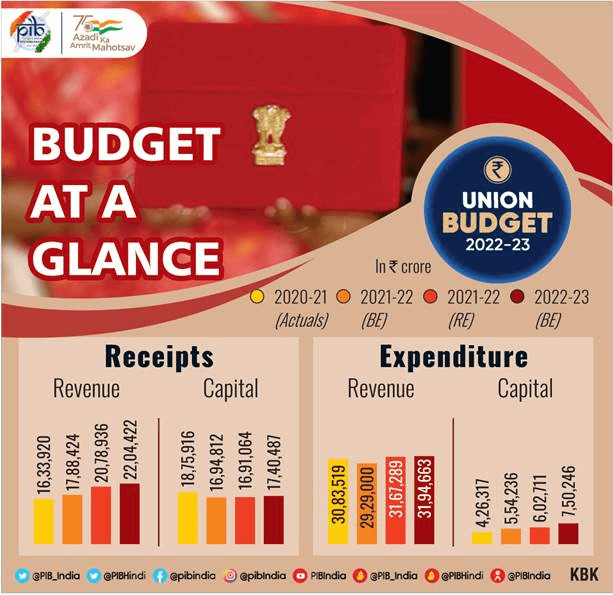
Revenue budget shows revenue receipts of the government and the expenditures met from these revenue receipts. It consists of revenue receipts and revenue expenditure. Revenue receipts of the government are all those receipts which are non-redeemable. They create no liabilities or involve no sale or reduction in the assets of the government. Revenue expenditures relate to expenditures incurred by the government on day to day normal functioning of the government and interest payment on government debts. These expenditures neither create any physical or financial assets nor reduce any liability of the government .
Capital Budget comprises capital receipts and capital expenditure of the government. It shows capital requirements of the government and financing of these expenditures. Capital receipts are the receipts of the government which create liabilities or reduce assets of the government. The main component is to borrowing of all kinds from the public, RBI and repayment of loans to the central government by state government and public sector enterprises. Capital expenditures are those expenditures of the government which lead to creation of physical and financial assets or reduction of financial liabilities.
BUDGET DEFICITS
An important issue which is raked up every year during the budget in India is the issue of budget deficit. In the past two to three decades, government spending has increased more than its receipts. As a result , budget deficits and the government borrowings have increased sharply. Although politicians regularly make fine speeches about the need to reduce deficit, cutting down spending or raising taxes so as to reduce deficit are not politically popular. In every budget , the government has been setting the target of reducing the budget deficit, but reaching the target of reducing budget deficit has been rather difficult.
Budget deficit is financed by increasing the money supply and by borrowing from public and from other countries. This involves burden both on present as well as the future generations. The present generation has to shoulder the burden of budget deficits in terms of inflationary rise in prices. Higher debt also means that interest payments eat away a large part of government expenditure, which could otherwise be used for providing various economic and social services to the public. This deficit is a liability for future generations as well. Taxes will have to be increased in future to pay interest on the debt and to repay the debt. This is the burden of the debt on future generations.
SOME FACTS ABOUT INDIAN BUDGET OVER THE YEARS
- The budget system was introduced in India on 7 April,1860.
- James Wilson, the first Indian Finance member, delivered the budget speech
- The first budget after independence was presented on 26 November, 1947 by R.K.S. Chetty.
- Yashwant Sinha, the then finance minister, moved the budget to 11a.m. in 1999, instead of 5 P.M. as was the practice till then.
- Arun Jaitley, the present Finance minister, has advanced the presentation of the budget to 1st February from the 2017-18 Budget. He has presented 4 regular budgets till date.
- 24 people have presented budget in independent India.
- Morarji Desai holds the record for the most budget presented in independent India with 8 full budgets and 2 interim budgets.
- P Chidambaram has matched Morarji Desai’s record of presenting 8 full budgets.
- All the three Prime Ministers from the Nehru family- Jawaharlal Nehru, Indira Gandhi and Rajiv Gandhi have presented one budget each.
Sources: Frank ISC Economics Class XII
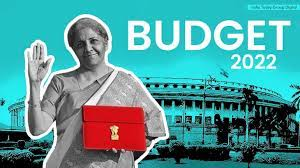
Budget 2022

A country’s financial budget is a systematic representation of how it operates and is a defining factor of its reputation. The Indian Constitution does not use the word budget, rather it is stated as the “Annual Financial Statement”. This first Union Budget of British India was presented on 7th April 1860 by Sir James Nilson, and that of independent India, on 26th November 1947 by R.K. Shanmukhan Chetty.
This year on 1st February, Finance Minister Nirmala Sitharaman delivered her 4th annual budget and the 10th under the Modi government. Before we get into the intrinsic details of this year’s budget, it is important to understand from where the Indian government attains most of its income.
35% of India’s reserves come from borrowing and other liabilities. GST, Income Tax, and Corporation Tax constitute 16%,15% and 15% respectively. 7% comes from Union excise duties and another 5% from Customs and Non-Tax Revenue. Thus a majority of India’s resources come from the taxpayers and loan lenders only.
One of the most important points mentioned was the prediction of the Indian economy’s estimated growth rate, set at 9.2%. This is the highest growth rate for any recovering economy, as confirmed by the International Monetary Fund(IMF). The backbone of this year’s budget was the auspiciousness of India entering Amrit Kaal, that is in 25 years, we will be celebrating 100 years of our Independence. With this in mind, the Finance Minister set out certain milestones we hope to achieve as a country before 2047.
The budget’s index is comprised of four important areas-PM GatisShakti, Inclusive Development, Productivity, and Financing of Investments.
On India’s 75th Independence Day, Prime Minister Narendra Modi announced that the Centre will launch ‘PM Gati Shakti Master Plan’, a Rs. 100 lakh-crore project for developing ‘holistic infrastructure’.PM Modi said that the Gati Shakti plan will help raise the global profile of local manufacturers and help them compete with their counterparts worldwide. It also raises possibilities of new future economic zones.
The prime minister also said that India needs to increase both manufacturing and exports. Every product that is sold globally from India is attached to India, which is why I am saying that every product of yours is a brand ambassador for India, he said.
A number of new schemes were also introduced, such as Kisan Drones, Ken Betwa Project, ECLGS, GTMSE, RAMP, DESH-Stake-Portal, DrAAS, “One Class One TV”, Saksham Anganwadi, Har Gar, Nal se Jal, etc.
But the most crucial part of a budget is its Fiscal Management. A few important pointers are as follows:
- Proposed fiscal deficit of 4.5% of GDP by 2025/26.
- Projected fiscal deficit of 6.4% of GDP in 2022/23.
- Revised fiscal deficit for 2021/22 at 6.9% of GDP.
- 50-year interest-free loans over and above normal borrowing allowed for states.

Overall, even though this year a lot of improvements were seen, including the exemplary step towards mental health advocation, the middle class was left unimpressed. With no reduction in taxes and an extra 30% tax on the new cryptocurrency policies, the average man was yet again disappointed.
Government Budgeting
Description of the budget
The word ‘budget’ is derived from the French word, Bougette, which means a leather wallet or purse.Therefore, the term modern budget refers to a document that contains estimates of revenue and expenditure of a country, usually for one year.
Types of Budget
Budgets can be categorized based on the following principles:
- Combined time.
- Number of budget’s tabled in the legislature.
- The overall finance budget’s position is presented in the budget.
- An approved policy on the takeover of revenue and expenditure in the budget.
Division of receipts and expenses in the budget.
Based on these principles budget’s can be:(Annual budget’s or long-term budget’s.
- One or more budget’s.
- Excess budget’s, deficits or estimates.
- Budget or revenue budget.
- Departmental budget or operating budget.
A brief description of the different types is as follows
1. ANNUAL or long-term budget’s
Generally, Government budget’s are for one year that is, for one year. In India, England and many other commonwealth countries the financial year, starts on April 1 and ends on March 31, but in the U.S.A., Australia, Sweden and Italy the dates are 1st July and 30th June. Some countries adopt a planned economic policy and meet the requirements for long-term planning, using a long-term budget, that is, preparing a budget for three years or more. Such a budget is a long-term plan rather than a long-term budget because what is offered is a financial plan over the years to fund the program.These countries spread the use of program costs over many years. The legislature approves the plan and estimates its costs, but that does not equal the actual voting of all-time shares. Every year, the national budget will include expenditure on a plan for that year, to be approved by the legislature.
2. One or more budget’s
When the estimates of all Government functions are allocated to a single budget, it is known as a single budget. The advantage of a single budget is that it reflects the financpractisetion of the Government as a whole.But if there are separate budget-related budget’s passed by the legislature, it is called a mass budget. In India, we have two budget’s — one for the railway line and one for the rest of the departments. The practice of having a separate train budget began in 1921. In England, there is one budget.
3. Extra income, deficit or limited budget
A budget is a surplus if the estimated income exceeds the estimated cost/expense But if the expected revenue falls below the expected cost, it becomes a budget deficit. According to economists, a deficit budget is a sign of global development. A limited budget is when the expected revenue is equal to the expected cost/expense. Budgets are often in short supply.
4. Income or budget of income
A budget is one in which the estimates of various items of income and expenditure include amounts to be acquired or used in one year,.In revenue and expenditure budget’s, accumulated in one financial year,, are planned for that financial year, regardless of whether the revenue is available or expenses incurred in that financial year,. In India, Britain and the U.S.A., counts are calculated, in France and other continents, counting income.
5. Departmental or operational budget
The current practice is to have a departmental budget, that is, the revenue and expenses of one department are organized under it. It does not provide any information about the work or activity that has been budgeted for. The operating budget is another where the total cost of a particular project is compiled under the head of a specific program.It is organized into activities, programs, activities and projects, for example, in the case of collaboration (employment), it will be divided into programs such as higher education, Secondary and Higher Education. Each program will be divided into activities, for example, teacher training is a task. The project is the final unit of division of labor.It symbolizes work as a major project, such as the construction of a school building. The A.R.C. proposed the adoption of a budget for all the departments and agencies of the Central and provincial governments that have managed development programs.
REFERENCE
Essay on Budget: Top 4 Essays | Government | Public Administration
5 best affordable headphone July 2021.
Are you a music lover too? Check out these five amazing budget headphones.
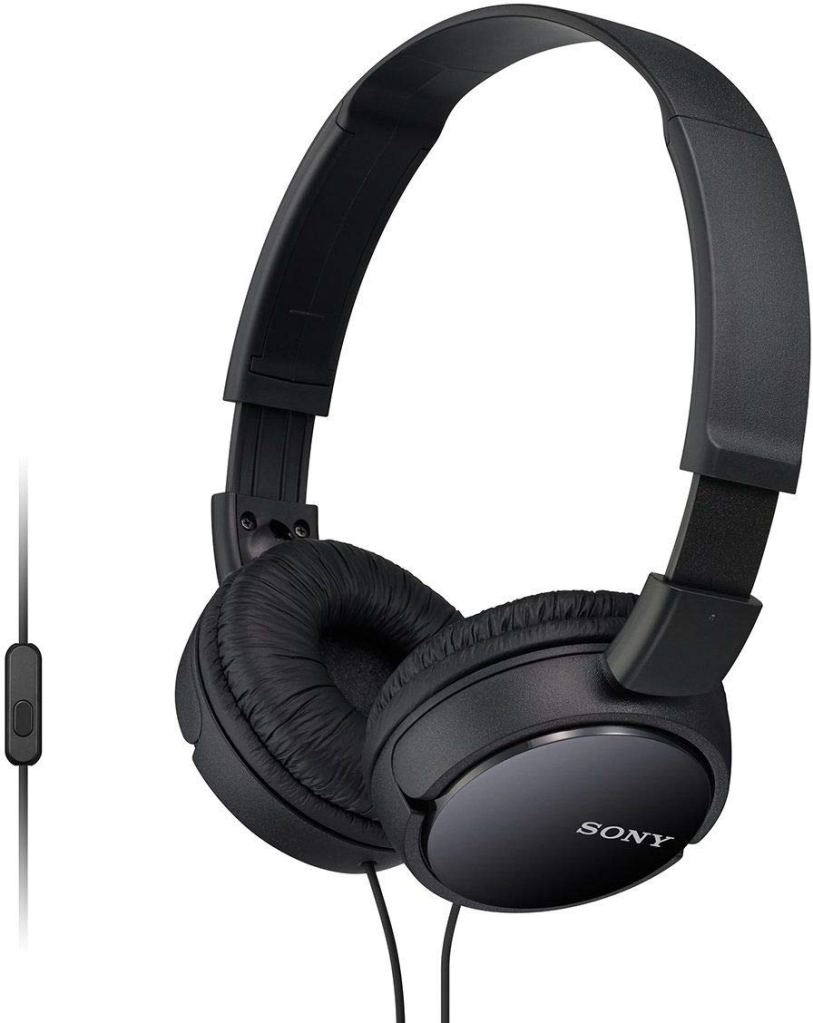
- Sony MDR-XB550AP Wired Extra Bass On-Ear Headphones.

Sony has been producing audio equipment for many years and is capable of producing high-quality portable headphones that seldom disappoint clients.
The Sony MDR-XB550AP is a small and light speaker that weighs only 190 grammes. Sharp colours were chosen by Sony to give these headphones an edgy look. When it comes to wired headphones, you won’t have to worry about audio compression or battery life.
Red, Black, and Blue are the three colours available for the headphones.
The headphones’ finer features will leave you speechless. You’ll note that the earcups have a rough surface and are somewhat marbled.
The wire on these headphones is quite durable. When you store it in your bag, it will retain its shape and will not tangle.
Key specification:
- In-line mic for hands-free calling
- Tangle-free flat serration cord
- Portable and revolving folding design
- Matte finish
- Cord-length – 1.2 meter.
- Sensitivity – 102dB, Frequency Response – 5Hz-22,000Hz, Impedance – 24 ohm.
- Cushioned ear pads
- 30mm dynamic driver unit
- 1-year warranty.
Pros
- The earcups are quite soft and plush and allow you to wear for a long duration sans any discomfort
- The headphones work in conjunction with all other sounds.
- Good Bass if you’re looking for extra bass.
- The headphones sound quite precise, controlled, and tight thus leaving you engaged and impressed
- You can also attend a call without any hassle
- Offers you an incredibly great value
- The headphones offer great durability
Cons
- Not extremely loud.
- Headphone foams can get soiled after a year or two (replaceable).
- Active noise cancellation is missing
2. JBL Tune 500 Powerful Bass On-Ear Headphones

If you’re looking for a pair of headphones that won’t break the bank, the JBL Tune 500 is a good option. Also, if you enjoy listening to contemporary music, you will be completely happy with these.
The JBL Tune 500 has a foldable and lightweight design. You’ll have the choice of purchasing the headphones in one of four beautiful hues. While travelling, the strong and flat cable can efficiently maintain the cable tangle-free.
The concept for travelling, listening to music, and playing games while on the go.
Key specification
- Quick launch access to Google Assistant and Siri
- 12 months manufacturing warranty
- Compatible with Android and IOS mobile, tablet, laptop, and audio player
- It weighs 150g
- One button remote/mic
- Tangle-free flat cable
- Requires a Li-ion battery
Pros
- You will get good cushioning on the headband and it sits quite firm against ears.
- The button lets you play/pause, skip tracks, and answer the phone calls
- The terminations of the headphones appear to be well-insulated
- The small yet foldable design of the on-ear cans make them quite portable
- The frequency range of the headphones is 20-20,000 Hz
Cons
- May not excite bass heads and audiophiles looking for studio-grade audio.
- Overall a good mix of sound and ergonomics – not excel in any field.
The headphones allow you to enjoy clear audio for music, calls, and games. When you buy the headphones, you are assured of a trustworthy headset for daily chores that may include video calls with family members and friends.
3. Boat BassHeads 900 Wired Headphone with Mic

The headphones’ super extra bass allows you to experience a shockingly strong and dramatic bass at an inexpensive price.
The sound stage will be more grounded, and the frequency response will range from 20 to 20,000 Hz. The headphones’ sleek and small form makes them extremely portable.
Furthermore, the on-ear headphones with rotating ear cups offer a flexible fit and a pleasant fit for all users.
Key specifications
- Designed for all 3.5mm supported device
- On the ear
- 12 months warranty
- In-line microphone
- Tangled-resistant cable
- 40mm Neodymium drivers
- Weighs 150 g
Pros
- Offers flexible wearing and comfortable fit for all users
- The headphones are available in sleek, compact, and lightweight design.
- The travel-friendly headphones are easy to store.
- The price is quite affordable.
- The padding in the device helps in blocking external noise.
Cons
Average comfort and they don’t sound very natural and miss on lows and highs.
4. Sony MDR-ZX110AP Wired On-Ear Headphones

The Sony MDR-ZX110 wired headphones have 30 mm dynamic drivers for incredible sound. The cushioned earpads provide a lengthy period of pleasant use.
Almost all soundtracks feel sharp and rhythmic through the headphones. These headphones have a well-balanced sound with no excessive bass or treble.
These also have a wide frequency range of 12Hz to 22KHz, allowing for a more immersive listening experience. On some of the most basic TWS headsets, you can hear the small beats that you might miss.
The enfolding shape prevents you from being distracted when listening to music or making phone calls.
Key specification:
- 30 mm dynamic driver unit
- On-ear headband
- Cushioned Earpads
- In-line microphone and controls
- Tangle-free cord
- Portable and Swivel folding design
- Weight – 120 grams
- Frequency Response – 12 Hz-22 kHz
- Impedance – 24 ohm
- 3.5 mm jack
Pros
- Good sound clarity
- Soft and comfortable cushions
- Handy and lightweight
- Durable
Cons
- Missing active noise cancellation
- Cable is fragile.
5. Sony MDR- XB 450AP (Bass King)

The headphones were created with electronic dance music fans in mind. Deep bass notes are made possible with Extra Bass technology.
Furthermore, it has the ability to efficiently enhance low-end frequencies, providing you with a memorable experience. The swivel design in the housing allows you to store your headphones flat, making them ideal for travel.
Key specifications
- Weighs 165 g
- Wired extra bass headphones
- Tangle-free wire
- Frequency response 5 -22000 Hz
- Available in 3 colors
- 30 mm powerful bass
- Wired 3.5 mm single pin
Pros
- The headphones are equipped with cushioned earpads for maximum comfort
- Strong sensitivity for clear and loud sound
- The headphones offer an in-line remote and mic for hands-free calls
- Neodymium dynamic driver help in providing top-quality sound
Cons
- Sound Stage is not as wide as on Sennheiser.
Solar air conditioning and efficient, low-consumption cooling systems work together.
Researchers from the Universitat Politècnica de València (UPVCMT-Motores )’s Térmicos (Thermal Engines) group are developing new, more efficient cooling systems that use solar air conditioning, which will assist in addressing the summer increase in electricity bills Their study results made an appearance in the International Journal of Refrigeration.
“In the last month, the ‘perfect storm’ has occurred in all aspects of the electricity bill. On the one hand, there is the so-called rate change, which is divided into three segments, and on the other, there are consumption peaks in the summer during the hottest days of the year. In these days of high temperatures, air conditioning units and cooling systems consume more electricity, raising the cost of electricity significantly—without going any further, the price of electricity surpassed its annual record last Saturday. Solar air conditioning, while an oxymoron, has the potential to be a solution to this perfect storm, says “José Ramón Serrano”, a CMT researcher.

Solar air conditioning equipment
Solar air conditioning is the equipment used to cool a space with solar energy. Two main groups are involved, as explained by Serrano: on the one hand, photovoltaic panels are used to produce traditional air conditioners. The problem with these solutions is their low efficiency: barely 10 percent, which means the nearly 1,000W per sqm that we get with the most solar radiation during the summertime, generates only 100W of electricity. “This represents about 300 W of cooling power in a traditional cold unit,” Serrano describes.
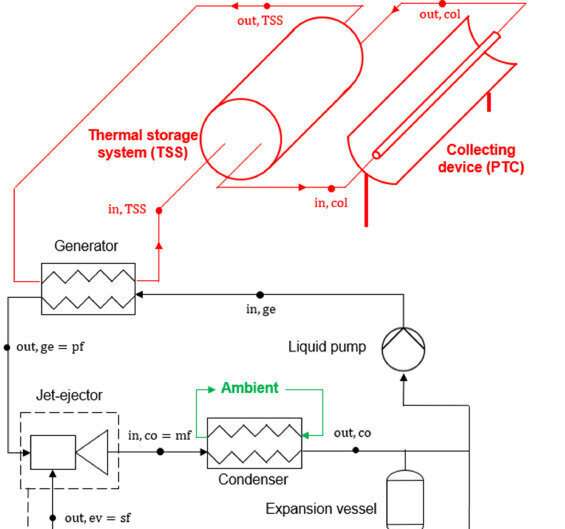
Solar thermal cooling systems, on the other hand, are more efficient and versatile. In this case, thermo-solar panels are used in place of photovoltaic panels that warm up a liquid by using surfaces that absorb or concentrate solar rays. These systems are used in the cold winter months in households to heat sanitary water and solar heating systems. The CMT-Motores Térmicos researchers concentrate their efforts on the latter to use them during the summer.
They propose coupling these panels to absorption or ejection cycles, which would allow them to cool the room using the sun’s heat as the source of energy. The 1,000 W per square meter received in these cases can be converted into 500 W of heating power using the thermal oil that flows through the thermo-solar panels. The 500 W can then be converted into 600 W of cooling power via high-efficiency absorption cycles.
“One advantage of using this equipment is that the cooling capability increases in tandem with the solar radiation, which coincides with periods of higher cooling demand,” says Vicente Dolz, UPV professor and CMT-Motores Térmicos researcher.
And how would this allow you to save money on electricity?
A typical household air conditioning unit in the living room has a cooling capacity of around 3,500 W. According to the UPV researchers, these values can be achieved with around 6 m2 of thermo-solar panels coupled to an absorption cycle during the hours of highest irradiation (midday in the summer) to completely replace the traditional air conditioning unit with the absorption cycle.
“A traditional air conditioning unit consumes approximately 1,170 W of electricity to achieve the 3,500 W of cooling power.” The technology that we propose would allow us to eliminate said consumption from our bills while enjoying the greatest level of comfort possible thanks to the combination of solar panels and absorption cycles.
CMT-Motores Térmicos proposed that solution can also be implemented as a hybrid system that provides part of the traditional system’s cooling capabilities or improves its efficiency while also reducing global electricity consumption by providing the solar air conditioning system.
Best budget gaming laptop July 2021.
Here’s our top 5 picks of gaming laptops that are affordable and powerful.

OS: WINDOWS 10
DISPLAY: 15.6″ (1920 X 1080)
PROCESSOR: 9TH GEN INTEL CORE I5 | 2.4 GHZ
MEMORY: 8 GBGB DDR4
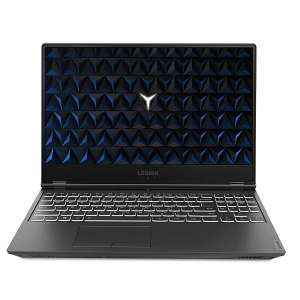
Legion by Lenovo is a dedicated gaming emblem from Lenovo with aesthetics and specifications tailored to game enthusiasts. Even though the specifications are broadly speaking similar to the other laptops on this list, we’ve got the extra storage as you get a 256GB SSD in addition to a 1 TB hard disc drive. Summary of specifications: Intel i5-9300H, GTX 1050, 8 GB, 256 SSD + 1 TB HDD, 15.6-inch 1080p.
| SPECIFICATION | ||
|---|---|---|
| OS | : | Windows 10 Home |
| Display | : | 15.6-inch screen with (1920X1080) full HD display | Anti Glare technology | 60Hz refresh rate | 250 Nits Brightness | IPS Display |
| Processor | : | Intel I5-9300H, 2.4 Ghz base speed, 4.1 Ghz max speed, 4 Cores, 8Mb Smart Cache |
| Memory | : | 8GB DDR4 |
| Weight | : | 2.3Kg |
| Storage | : | 1 TB HDD (5400rpm) + 256 GB SSD |
| Graphics Processor | : | NVIDIA GTX 1050 3GB Graphics |
2. ASUS TUF GAMING FX505DD-AL185T

OS: WINDOWS 10
DISPLAY: 15.6″ (1920 X 1080)
PROCESSOR: AMD Ryzen 5-3550H
MEMORY: 8 GBGB DDR4
The ASUS TUF Gaming series is all about making their hardware more accessible, and the FX505DD does just that by combining the Ryzen 5-3550H with the GTX 1050 and even having a high-refresh-rate panel. A recent drop has increased the value of this one-of-a-kind aggregate even further. Ryzen 5-3550H, GTX 1050, 8 GB RAM, 1 TB HDD, 15.6-inch 120 Hz 1080p display.
| SPECIFICATION | ||
|---|---|---|
| OS | : | Windows 10 Home |
| Display | : | Display: 15.6″ (16:9) LED-backlit FHD (1920×1080) 120Hz Anti-Glare IPS-level Panel with 45% NTSC |
| Processor | : | AMD Ryzen 5-3550H processor, 2.1GHz Base speed (6MB cache, up to 3.7GHz) |
| Memory | : | 8GB DDR4 2400MHz |
| Weight | : | 2.20kg |
| Storage | : | 1 TB HDD (5400 RPM) |
| Graphics Processor | : | NVIDIA GeForce GTX 1050 GDDR5 3GB VRAM Graphics |
3. HP PAVILION GAMING 15-EC0026AX

OS WINDOWS 10
DISPLAY 15.6″ (1920 X 1080)
PROCESSOR: AMD Ryzen 5-3550H
MEMORY: 8 GBGB DDR4
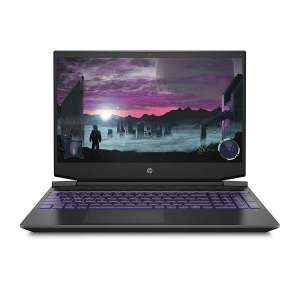
The HP Pavillion Gaming 15 series of laptops come in a wide range of configuration options. The only one we chose is powered by an AMD Ryzen 5-3550H processor and a GTX 1050 graphics card. This makes this one-of-a-kind SKU one of the best AMD-based configurations we could find. Summary specifications: Ryzen 5-3550H. GTX 1050, 8 GB RAM, 256 SSD + 1 TB HDD, 15.6-inch 1080p display.
| SPECIFICATION | ||
|---|---|---|
| OS | : | Windows 10 Home |
| Display | : | 15.6-inch Full HD (1920 x 1080) anti-glare IPS display | 60Hz refresh rate | 250 Nits Brightness |
| Processor | : | AMD Ryzen 5-3550H Quad-core processor (2.1 GHz base clock speed, up to 3.7 GHz max boost clock speed, 6 MB cache, 4 cores) |
| Memory | : | 8 GB DDR4 |
| Weight | : | 1.98 kg |
| Storage | : | 1 TB 7200 rpm SATA HDD + 256 GB PCIe NVMe M.2 SSD |
| Graphics Processor | : | NVIDIA GeForce GTX 1050 (3 GB GDDR5 dedicated) |
4. ASUS TUF GAMING FX505DY-BQ024T

OS: WINDOWS 10
DISPLAY: 15.6″ (1920 X 1080)
PROCESSOR: AMD RYZEN 5-3550H | 2.1GHZ
MEMORY: 8 GBGB DDR4
In terms of performance, the ASUS TUF Gaming FX505DY is quite close to the FX505DD. The Graphics card which is AMD RX 560X, and the display is a 60 Hz 1080p panel are the key differences between them. Specifications in summary: Ryzen 5-3550H, RX 560X, 8 GB RAM, 512 SSD, and a 15.6-inch 1080p display.
| SPECIFICATION | ||
|---|---|---|
| OS | : | Windows 10 Home |
| Display | : | 15.6″ (16:9) LED-backlit FHD (1920×1080) 60Hz Anti-Glare IPS-level Panel with 45% NTSC |
| Processor | : | AMD Ryzen 5-3550H processor 2.1GHz (6M cache, up to 3.7GHz, 4 Cores) |
| Memory | : | 8GB DDR4 2400MHz |
| Weight | : | 2.2 kg |
| Storage | : | PCIe NVMe 512GB M.2 SSD |
| Graphics Processor | : | Graphics: AMD Radeon RX 560X GDDR5 4GB VRAM |
5. MI NOTEBOOK HORIZON EDITION 14

OS: WINDOWS 10 HOME
DISPLAY: 14″ (1920 X 1080)
PROCESSOR: 10TH GENERATION INTEL® CORE™ I7 | 1.8GHZ
MEMORY: 512 GB SSD/8GB DDR4
Xiaomi is the most latest company to release a laptop in India that is powered by an Intel Core i5-10210U processor and an NVIDIA MX350 GPU. As long as you keep the game settings to low or medium, you can play a few games on the MX350. Both the CPU and the GPU are designed for power efficiency rather than long gaming sessions. Summary configuration: Core i5-10210U, MX350, 8 GB RAM, 512 SSD.
| SPECIFICATION | ||
|---|---|---|
| OS | : | Windows 10 Home |
| Display | : | Horizon Display|14-Inch (1920X 1080 )Full HD Anti-Glare Screen |
| Processor | : | Intel Core i7-10510U processor, 1.8 GHz base speed, 4.9 GHz max speed, 4 Cores, 8 threads |
| Memory | : | 8GB DDR4-2666MHz |
| Weight | : | 1.35 kg |
| Storage | : | 512 GB PCIE Gen 3×4 NVMe SSD |
| Graphics Processor | : | Nvidia MX350 2GB GDDR5 Graphics |


You must be logged in to post a comment.