Learn how the current digital transformation is creating unprecedented economic opportunity. Understand how the IoT is bridging the gap between operational and information technology systems. Discover how standard business processes are being transformed. The security concerns that must be considered when implementing IoT solutions.
2. Analytics
Course : Google Analytics for Beginners
From : Analytics Academy, Google.
Learn the basic features of Google Analytics including how to create an account, implement tracking code, analyze basic reports, and step-up goals and campaign tracking.
3. MS EXCEL
Course : Microsoft Excel – Excel from Beginner to Advanced
From : Udemy
Excel with this A-Z Microsoft Excel Course. Microsoft Excel 2010,2013, 2016, Excel 2019 and Office 365
4. Programming Language
Course : Python for Everybody
From : Coursera
Learn to Program and analyse Data with Python. Develop Programs to gather, clean, analyze and visualize data.
5. Digital Marketing
Course : The Ultimate Digital Marketing Course 2021 : 11 courses in 1
From : Udemy
Learn market research, website creation, copywriting, SEO, Google ads, Facebook ads, email marketing, Twitter ads and more.
6. UX Design
Course : Google UX Design Professional Certificate.
From : Coursera
This is your path to career in UX Design. In this program, you will learn in demand skills that will have you job ready in less than 6 months.
7. HTML and CSS
Course : HTML and CSS
From : Codecademy
Always wandered how those perfect websites were created? Join a community of millions of students in taking this free web development course. It’s beginner friendly and will ensure that you learn the basics in only around 12 lessons!!
8. Web Development and Marketing
Course : Diploma in Web Development and Marketing
From : Alison
Further, enhance engagement with your social media pages after taking this 15 – hour course! That’s not it! Also, learn to build a website from scratch and the most effective strategies to earn money by web marketing.
9. Writing
Couse : Secret Sauce of Great Writing
From : Udemy
Writing flawlessly can give just as much of a kick as some exquisitely made sauce. Learn to perfect all the ingredients which go into mastering perfect writing. Figure out areas for improvement and upgrade your writing skills to better than ever before!
10. SEO
Course : SEO for SEO Beginners
From : Udemy
You have been seeing this term everywhere, haven’t you? Well, learn all about it with this highly recommended course. Search Engine Optimization is a skill that is indispensable in today’s digital world. So, grow your niche and command it too!
Want to know more about them , then start some reading .
Introduction
A monk is a person who practices religious asceticism by monastic living, either alone or with any number of other monks . A monk may be a person who decides to dedicate his life to serving all other living beings, or to be an ascetic who voluntarily chooses to leave mainstream society and live his or her life in prayer and contemplation. The concept is ancient and can be seen in many religions and in philosophy.
In simple words , A monk is a man who devoted part or all of his life to a religion. The word comes from Ancient Greek, and can be translated as solitary. In Greek, the word can apply to women, but in modern English it is mainly used for men. The word nun is usually used for female monastics. Monks practice asceticism. They either live alone, or together with other monks who share the same ideals. Monks can be found in different religions, most often in Buddhism, Christianity, Hinduism, Jainism and Taoism.
There living
Monks usually follow rules and regulations for convenient life. As a monk you must obey these rules .
Poverty: the monk cannot own anything.
Chastity: the monk cannot have sex or a sexual relationship and cannot start a family or get married.
Solitude: the monk should always be alone. Some monks choose to not follow this law.
Silence: the monk shall not speak unless it is necessary.
Generosity: the monk should always help other people.
Stillness: the monk cannot travel far unless it is necessary. Sometimes this means that the monk must be cloistered which means that they must not leave their monastery (especially Warsa period). Sometimes they can be allowed to leave, but must not go very far.
Duty: The monk must do some things every day. For example, the monk must pray or meditate and must do some work.
Indian monks
One of the finest and versatile monk in India was Swami Vivekananda . Swami Vivekananda was greatly inspired by Ramakrishna. For Swami, Ramakrishna was just a plain and simple villager, who was a part of the Kali temple. However, his intense spiritual practices intrigued Swami.
For five years, Swami learnt everything from his master, Ramakrishna. After his master left the world, everyone looked up to Swami. He urged the followers of Ramakrishna to leave the worldly pleasures and look up to God.
“You cannot believe in God until you believe in yourself.”
His saying intrigued just not one nation but the whole world .
Life lessons
Being a monk , gives you a pleasure of being yourself . We live in the world where we get pleasure from materialistic things . We become selfish , ruthless, dull, lifeless and worthless. You have to believe in yourself in order to excel in life.
Start learning from lessons.
When you start to do meditation you recognize the egotistical mind.
Trying until you get it right.
The answer to your question is inside of you.
Real wisdom in life comes from doing something and failing.
We must be both compassionate and resilient.
Patience is a virtue.
Detach from your ego.
Happiness come from within, and also comes from outside.
Good communication is very important to convey what is there in the mind. Whatever language, communicating in a understandable way is very important. communication today is very important both in the business world and in private life.
Even though the person is good at skills and is capable of doing things better, lack of communication degrades the skills and brings a negative mark on the person which is a bad thing for the individual.
Top 5 communication skills and How to improve them
Developing strong communication skills is essential when it comes to building a successful careee. Communication skills play a key role in your private life too. These 5 skills are absolutely necessary for sucessful commuincation in the workplace or private life.
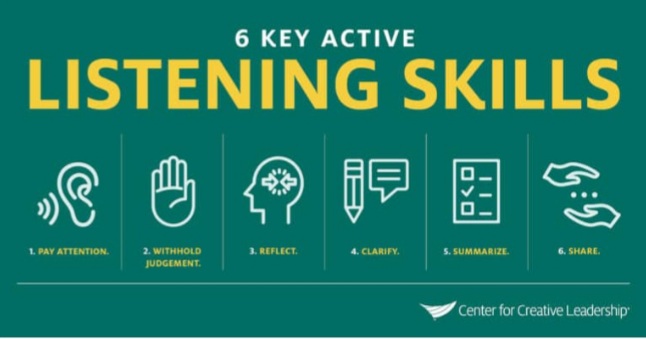
1. Listening :
Listening is one of the most important aspects of communication. Successful listening is not just and understanding of spoken or written information, but also an understanding of how the speaker feels during communication. If a speaker can see and feel that someone is listening and understanding that can help build a stronger, deeper realtionship between interlocutors.
Careful listening can also create an environment in which everyone feels safe to express ideas, opinions and feelings, or plan and solve problems in a creative way.
2. Straight talking :
Conversation is the basis of communication, and one must not neglect its importanc. Even a simple, friendly conversation with colleafues can build mutual trust and even detect problems before they become serious. A healthy does of chatting with and unknown person can lead to a business opportunity . Be accessible and friendly because then you will be able to talk to almost anymore.
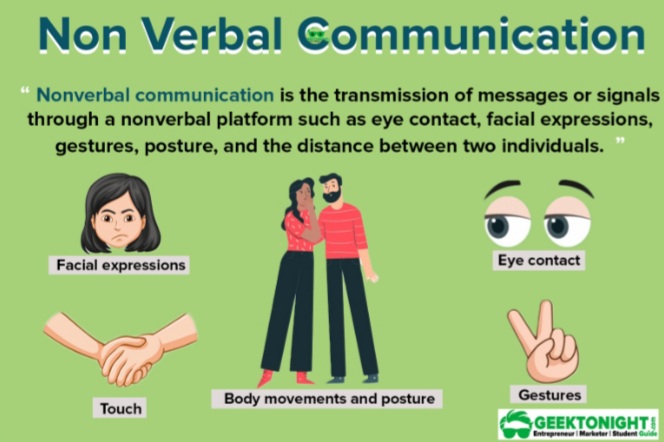
3. Non- verbal communication :
When we talk about things that matter to us then we send a lot of nonverbal messages. Non verbal signals are wordless communication, body position, facial experssion, hand movements, gestures, eye contact, attitude and tone of your voice, muscle tension and the way you breathe. The way you look, listen create, react, gesture , speaks far more about feelings than words will ever be able to.
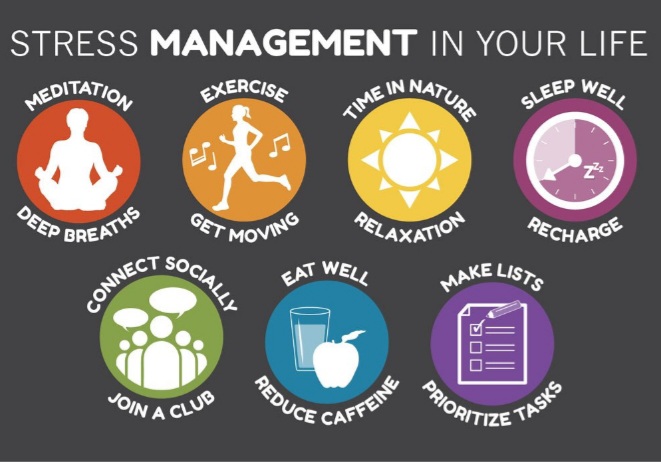
4. Stress Management :
In small quantities, stress can be very useful and encouraging for work . However, when the stress becomes constant and completely begins to take effect, it can affect communication, clarity of opinion and appropriate behavior and action. When you are under stress you may misunderstand other people, send confusing nonverbal signals, and use funny patterns of behavior.
5. Emotion control :
In communication, feelings play an important role. Making decisions more often affects the way you feel than the way you think. Gudided by emotions, your nonverbal behavior affects the understanding of other people and how others understand and perceive you. Control of emotions provides you with tools to understand others, yourself and the messages you send. Though recognizing feelings makes it simple, many people have strong feeling like anger, sorrow, or fear being pushed under the carpet.
Importance of communication :
Communication thus helps understand people better removing misunderstanding and creating clarity of thoughts and expression. The communication brings people together, closer to each other. The communication is an important management function closely associated with all other managerial functions.
Everybody has their own way of communicating. It is influenced by cultural background, the way someone was raised, their gender, their temperament, and much more. At that point true communication may become utterly impossible. Sometimes we may have a difficult time understanding anothers feelings , needs and habits.
* communication serves four major functions with a group of organization :
* control
* Motivational
* Emotional expression
* Information
* communication serves five major purposes :
* to inform
* to express feelings
* to imagine
* to influence and
* to meet social expectations
For example:
For instance, if an individual is going to an interview with great confidence. An individual who is good at different kinds of skills, and also good at executing them and he is lack of communication skills. As the person is not a good communicator, the person faces difficulty in explaining the things to the other person which is known to him. Instantly, this brings a bad impression on the person and a negative mark will be marked on him. The negative mark has a lot to do with. The negative mark can also lead to the rejection of the person in the interview.
Being knowledgeable is very important to achieve certain goals in life, attaining good communication skills and being a good communicator is also equally important to achieve high in the life. Being a good communicator is not A big deal. It is so easy as the lifestyle. Any individual can be good communicator if he communicates all the time with other people in the possible way.
Top Trending Online Courses in 2021 [For Both Students & Working Professionals]:-
Professional certifications provide excellent avenues for developing your knowledge and skills. They can help you demonstrate your interests and potential to prospective employers while building your profile for lucrative job positions. There are many trending courses lockdown has made prominent once again, to guide and prepare candidates for modern workplaces. We have detailed some of these programs for you below.
Professional courses and certifications have many advantages. They can help you in:
Demonstrating your skills and gaining credibility
Enhancing technical knowledge and upskilling
Qualifying for senior-level jobs
Staying abreast of the latest trends
Acquiring experience and hands-on training
Table of Contents
Top Trending Online Courses
1. Data Science
2. Artificial Intelligence and Machine Learning
3. Big Data
4. Business Intelligence
5. Cloud Computing
6. Project Management
7. Software Development
8. Full-stack development
9. Cybersecurity
10. Networking
11. DevOps
12. Digital Marketing
13. Blockchain
14. Internet of Things
15. Computer Science
Conclusion
Top Trending Online Courses
1. Data Science:-
Study programs in data science typically focus on big data analytics, data visualization, statistics, and predictive analytics. The curriculum is designed for individuals pursuing technical job positions, such as data scientists, data analysts, business analysts, and machine learning engineers.
Whether you are a fresher, a marketing professional, or a software engineer, data science knowledge can advance your career.
Usually, no prior coding experience is necessary for this course. If you have a bachelor level degree and a knack for numbers, you can enroll in a postgraduate level data science program. Many online options are also available, which provide accredited master degrees and diplomas in addition to placement support.
upGrad’s PG Certification in Data Science aims to equip working professionals with the following capabilities:
Python programming
Using Python and SQL for predictive analytics
Data visualization using Python, exploratory analytics, ML algorithms, and so on.
Upon completing the course, you earn a certificate from IIIT-Bangalore and get a chance to connect with a global community of data science professionals from diverse industries. The engaging pedagogy of upGrad courses includes case studies, projects, group coaching, and live sessions to provide personalized feedback and facilitate improvement.
2. Artificial Intelligence and Machine Learning:-
Artificial Intelligence (AI) and Machine Learning (ML) are the exciting technologies of the 21st century. AI and ML certifications can help boost the careers of IT professionals who have a background in mathematical or statistical fields.
Such programs cover various programming languages, tools, and libraries to equip students with the required competencies. Examples of the technologies taught include Python, MySQL, AWS, Docker, Kubernetes, Keras, REST-API, etc. Moreover, learning opportunities would expand when the syllabus is delivered via videos and real-life industry projects.
upGrad offers an online Master of Science in ML & AI for working professionals looking to jump-start their careers. The degree is recognized by Liverpool John Moores University, a prestigious educational institution in the UK, and comes with access to LJMU’s digital library.
And you can attain this qualification at a tenth of the cost of the offline program. Alternatively, you can go for advanced certifications that allow you to specialize in Big Data, Cloud, Deep Learning, and NLP. These upGrad courses arrange for resume feedback, interview preparation, career counseling, and job assistance.
The skills you learn prepare you for lucrative job opportunities like Big Data Analyst, Data Engineer, Machine learning engineer, etc. Hiring partners include Amazon, Flipkart, Myntra, PayTM, Make My Trip, American Express, Accenture, Standard Chartered, Adobe, Genpact, MobiKwik, and many other leading companies.
3. Big Data:-
Big data certifications can help you go after more diverse roles than specific data science jobs. You can opt for different specializations depending on your background and career aspirations. Generally, learning tracks of big data certifications include:
Business Analytics
Data Engineer
Natural Language Processing
Deep Learning
Business Intelligence
For example, the PG Diploma in Data Science from IIIT-B is certified by NASSCOM and delivered in partnership with industry leaders like Actify, Zee5, Uber AI Labs, AIQRATE, Genpact, Flipkart, Myntra, and Gramener.
The course follows an integrated approach to teach you about different programming languages and tools. These include Python, Tableau, MS Excel, Hadoop, PySpark, Power BI, MongoDB, Keras, TensorFlow, AirFlow, and many others.
4. Business Intelligence:-
BI professionals put their numerical ability to work and solve real-world business problems. Their insights can translate into actionable metrics, leading to changes in planning, operations, product development, and strategic management.
Therefore, their primary responsibility is to maximize the use of data in an organization to direct it on the path of successful performance. Training in business intelligence can help IT professionals build aptitude in:
Data mining and analytics
Data visualization
Management reporting
Using Excel, SQL, R, Python, Spark, Hadoop, etc.
The Business Analytics Certification is one of the trending courses 2020 has drawn attention to, especially for those competing for business analyst and managerial roles.
You can also check out upGrad’s Executive MBA program from NMIMS Global Access School. The degree is AICTE-approved and incorporates a three-month capstone project and one-on-one interaction with industry mentors.
The faculty includes subject experts in Analytics, Marketing, Human Resources, Economics, Finance, and Supply Chain, and Operations. The MBA(X) course offers a Business Analytics specialization that qualifies for better job prospects in management consulting, business leadership, and growth and strategy roles.
5. Cloud Computing:-
Cloud computing is one of the top IT fields that is experiencing an emerging trend in 2020. As organizations around the world go after dynamic and scalable applications, the demand for cloud services is only going to rise.
While making the shift, companies encounter many technical challenges. So, having qualified people with domain expertise would be necessary. It is already a top IT job globally. Software developers can go for specialized programs in cloud computing to learn the following things:
Understanding of cloud migration and multi-cloud environments
Knowledge of serverless architecture
Cloud security skills
Building cloud-native technologies, virtual machines, microservices, etc.
PG Diploma in Software Development (cloud computing specialization) is suitable for engineering graduates who want to occupy titles like Cloud Developer, Cloud Architect, Cloud Administrator, and other similar positions.
6. Project Management:-
Project management is one of the trending courses 2020 has generated interest in, for both employers and aspirants. Project managers ensure that work assignments are delivered within time and budget constraints. They assign tasks to the concerned members, set deadlines, and drive the project team to achieve the desired goals.
Those in core IT careers can gain knowledge in this discipline by earning a project management certification or take admission in an MBA program. Nowadays, top universities are offering online degrees in partnership with industry players. The syllabus has everything from core management concepts to business communication to strategy and leadership.
You can consider applying to the online PG Program in Management from IMT Ghaziabad, one of India’s leading business schools. The course is structured to acquaint students with Sales and Distribution, Marketing Management, Business Economics, Organizational Behavior, Accounting and Finance, and Decision Sciences.
These subjects allow candidates to develop their managerial acumen for senior positions. Moreover, the live projects help navigate the entry into work life as they are presented in collaboration with companies like Vodafone M-Pesa, LinkedIn, HP Enterprise, and ITC.
7. Software Development:-
The primary duties of a software development job include designing, managing, and testing software applications. Being successful in this field requires efficiency in writing and implementing code. To build the necessary proficiencies, you can undertake training in Java programming, C programming, automation testing, SQL database, among other topics. Here are some of the job titles associated with this IT career:
Computer systems analyst
IT Coordinator
Network administrator
Systems architect
Computer and information research scientist
Junior software engineer
Senior programmer
Web developer
Online postgraduate degrees in software and technology are among the trending courses lockdown has made feasible. The MSc. in Computer Science from UK’s Liverpool John Moores University can get you the same quality and exposure in 18 months as any on-campus degree.
Moreover, you can choose from seven different specializations, interact with experienced professionals, and network with your fellow LJMU and IIIT-Bangalore alumni.
8. Full-stack development:-
Full-stack development is concerned with both front-end and back-end technologies. A typical full-stack development course would familiarize you with programming languages and tools like Spring, Java, Typescript, Oracle, Git, Hibernate, React, AWS, Selenium WebDriver, and so on. The extensive program structure prepares you to work as:
Full-stack developer
Back-end developer
UI developer
Senior web developer
IT manager
Technical operations officer
After gaining relevant experience and spending several years in the industry, you can occupy senior-level positions like Director of Technology and Chief Technology Officer.
If you are searching for industry-oriented education programs that prepare you to work in a similar domain, upGrad’s PG Diploma in Software Development would be an excellent choice. The specialized learning track in full-stack development would teach you how to create robust and scalable applications, replete with back-end APIs and an interactive web UIs.
This 12-month program is delivered in an online format, dedicating sufficient time for introductory modules, experiential learning activities, and a capstone project.
9. Cybersecurity:-
In recent years, the instances of data breaches and cyber attacks faced by companies have increased. In the wake of rising cyber crimes, the demand for security experts has also picked up. Most software development courses provide a specialized learning path for those interested in cyber security careers. Here is a snapshot of the skills taught in a postgraduate-level cyber security program:
Application security
Network security
Data secrecy and cryptography
Training in Python, Java, git, AWS, etc.
With upGrad and IIIT-B’s advanced PG Diploma, you can study cyber security in a way that goes beyond the classroom. This online software development course packages more than 400 content hours, six programming languages, over seven projects, and more than ten live sessions. In 12 months, you would learn, apply your skills, get mentored, and move ahead in your chosen career path.
10. Networking:-
Hardware and networking professionals build and maintain computer networks and ensure their smooth functioning, thus contributing to organizational success. Their job is not restricted to working behind the scenes on IT infrastructure but also involves aspects of analytics, security, and automation.
A professional credential in networking can serve as a testimonial of your competencies to hiring managers and make a strong first impression. One of the accredited courses that can help you obtain and improve your computer programming skills is Master’s in Data Science.
11. DevOps
As the title suggests, DevOps combines the Development and Operations arms of software applications. In today’s fast-paced marketplace, tech companies need to stay ahead of their competitors. And DevOps enables agile methods in software development. A DevOps-oriented study program would emphasize the following things:
Agile methodologies for integration and deployment
Creation and management of software lifecycle
Continuous deployment through CI/CD practices and many more.
To gain an in-depth understanding of the mentioned concepts, you can enroll in the specialized DevOps course, earning a software development diploma from IIIT-B and a data science certification from upGrad.
12. Digital Marketing:-
Digital marketing is an exciting subject for professionals like brand managers, sales personnel, entrepreneurs, and marketers. With increasing internet penetration and online activity, the scope of traditional marketing has also expanded. Digital marketing encompasses topics like Search Engine Optimization (SEO), content marketing, social media, and marketing analytics.
Some popular examples include PG Certification in Digital Marketing and Communication on upGrad. This online course is offered by MICA, a leading higher education institution in India.
13. Blockchain:-
Blockchain is a rapidly growing discipline capable of bringing about significant transformations in the fields of real estate, healthcare, finance, insurance, among several others. The syllabus of blockchain development certifications comprises Ethereum, Smart Contracts, Hyperledger, Composer, Javascript, NodeJS, Solidity, etc. A background in engineering, mathematics, or computer science is a prerequisite for this stream.
Blockchain is touted to be the disruptive technology that will dominate industries beyond 2020. Having a working knowledge of blockchain can prepare you for software development jobs and assist you in getting an accelerated start in business development, engineering, and operations.
You can also complete an advanced course while working. For instance, IIIT-B & upGrad’s PG Diploma in Software Development (Specialization in BlockChain) requires you to dedicate 10-14 hours per week for 12 months. At the end of the program, you would have learned over ten software tools and worked on business problems for clients like Quora, Imgur, and DCB Bank. Additionally, you would receive comprehensive career support in the form of job fairs, mock interviews, and dedicated mentorship.
14. Internet of Things:-
IoT enables the exchange of information between people, things, and processes. Examples of “things” include wearable health monitors, smart home security systems, wireless inventory trackers, biometric scanners, and other connected appliances.
According to IDC, there would be 41.6 billion connected IoT devices by 2025. The IT research agency forecasts that these devices would experience a compound annual growth rate or CAGR of 28.7 percent from 2018 to 2025. With every new connection, there would be possibilities of new security vulnerabilities and privacy concerns. So, companies adopting IoT would also have to take care of data hazards to maximize customer benefit.
Enrolling in an online IoT course can support your quest for knowledge and keep you engaged during the coronavirus pandemic. You would learn how to develop IoT solutions with the aid of sensors and other functions. After completing the training, you can apply for jobs like IoT developer, IoT architect, IoT cloud engineer, etc.
15. Computer Science:-
The program design of MSc. Computer Science consists of software development, primarily using languages like Java and Python. Online MCS programs allow you to select any specialization from full-stack development to big data to DevOps to Blockchain and IoT. Whether you hold a technical undergraduate degree or already working in an IT company, getting an advanced degree can improve your earning capability.
Recent studies have highlighted that certifications can help candidates stand out in the job market. Having completed a technical course in a specific domain can improve your chances of landing work or scoring a promotion. However, a certificate may not be enough to make a difference.
You would also have to seek out opportunities to gain industry experience and hands-on practice. Here, mentorship and live projects can prove immensely helpful. It is thus best to opt for programs that include such components in the curriculum.
Conclusion:-
With this, we have put across the most relevant and trending courses lockdown has brought to the fore. We attempted to make you aware of the available options and make an informed choice about your career. So, pick a certification that matches your needs and start learning.
5 Free Online Courses that you can take up from Home:-
1. Graphic Designing:-
If the sight of blank papers and sketch pens have always excited you and you spend most of your free time drawing and doodling, then it’s time to take your hobby to another level and learn graphic designing online. If you have a creative bend of mind especially when it comes to express ideas through sketching and designing, try your hands at Photoshop and other popular graphic designing software and learn to build creative websites and much more.
2. Online MBA:-
Online MBA programs are very popular these days especially for working professionals who couldn’t afford to pursue full time MBA. Online MBA programs are offered by various prestigious institutes. They have identical syllabus like that of a full time MBA programs, the only difference being that online MBA course are shorter and have flexible timings for the ease of working professionals.
3. Social Media Marketing:-
If you own a business, you need to to tell the world about it and what could be the best way to disseminate the information other than through social media? The promotion of your business online through social media channels like Facebook, Twitter etc is social media marketing and since everyone is social these days, what could be the best way to attract target audience if not through social media marketing?
4. Programming:-
Programming is a vital part of setting up a website. There are various programming language to learn from. Programmers basically code algorithms in programming languages to run a program successfully. If you are interesting in solving complex algorithms, learn programming online and help solving complex codes on back-end to smoothly run programs on front-end of a website.
6. Foreign Language Courses:-
Learning foreign language can add brownie points to your CV. Additionally, it will help you to improve your vocabulary and interacting skills. With online courses on offer, learning any foreign language of your choice is no more a distant dream. So enroll yourself to your favorite foreign language courses soon. Leaning foreign language can also help you to bag the job of a translator.
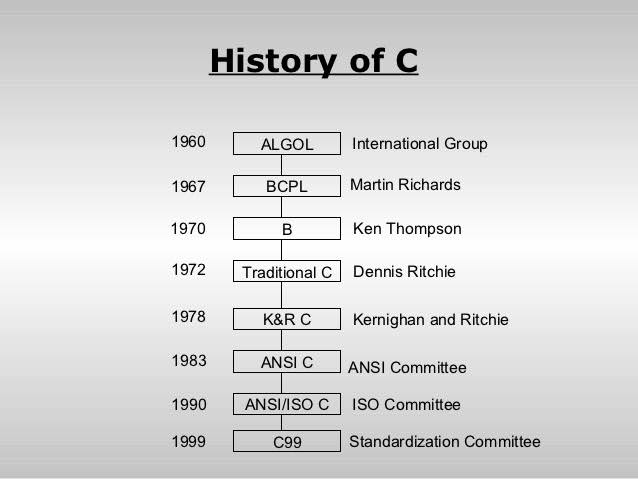
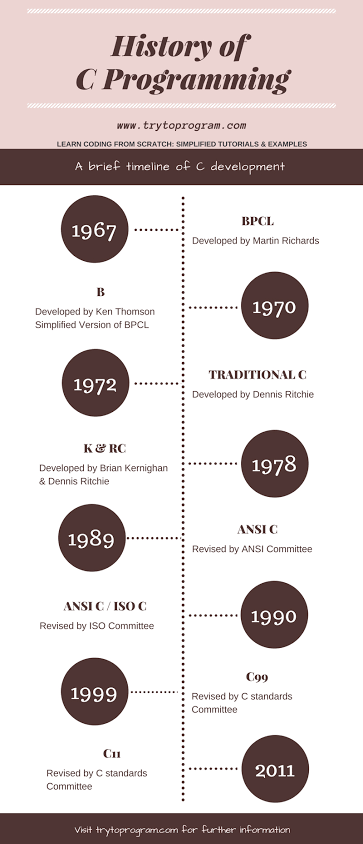
There are many programming languages in use today, one of which is C. There are many offshoots of the C programming language, including Objective-C, C++, and C#. None of these are the same language. THE BEGINNING: The C programming language came out of Bell Labs in the early 1970s. According to the Bell Labs paper The Development of the C Language by Dennis Ritchie, “The C programming language was devised in the early 1970s as a system implementation language for the nascent Unix operating system. Derived from the typeless language BCPL, it evolved a type structure; created on a tiny machine as a tool to improve a meager programming environment.” Originally, Ken Thompson, a Bell Labs employee, desired to make a programming language for the new Unix platform. Thompson modified the BCPL system language and created B. However, not many utilities were ever written in B due to its slow nature and inability to take advantage of PDP-11 features in the operating system. This led to Ritchie improving on B, and thus creating C.
The development of C was to become the basis for Unix. According to the Bell Labs paper, “By early 1973, the essentials of modern C were complete. The language and compiler were strong enough to permit us to rewrite the Unix kernel for the PDP-11 in C during the summer of the year.” This now meant that C was becoming a strong language that could, and would be, implemented across many systems. By the middle of the 1970s, the C-based Unix was used in many projects within the Bell System as well as “a small group of research-oriented industrial, academic, and government organizations outside [Bell Labs]”. In 1978, Brian Kernighan and Dennis Ritchie published The C Programming Language, which would serve as the language reference until a formal standard was adopted. Five years later, the American National Standard Institute (ANSI) formed the committee, X3J11, to establish the formal standard of C. The C standard was ratified as ANSI X3.159-1989 “Programming Language C”. This was the first formal standard of C. Currently, we are on the fourth standard of C, known as C18 as it was published in June of 2018
Over time, C began to be used in personal computers for developing software applications and other purposes. The first change (even if only a little) came when the American National Standards Institute (ANSI) formed a committee in 1983 to standardize C. After a review of the language, they modified it a little so that it was also compatible with other programs that preceded C. So the new ANSI standard came into being in 1989, and is known as ANSI C or C89. The International Organization for Standardization (ISO) has also contributed to the standardization of C. Over time, C has evolved as it has added some significant features like memory management, functions, classes and libraries to its rich feature set. C is being used in some of the biggest and most prominent projects and products in the world. C has also influenced the development of numerous languages such as AMPL, AWK, csh, C++, C–, C#, Objective-C, Bit C, D, Go, Java, JavaScript, Julia, Limbo, LPC, Perl, PHP, Pike, Processing, Python, Rust, Seed7, Vala and Verilog. USES TODAY : According to Toptal, UNIX operating systems are written in C and most of Linux is also in C. Also databases such as Oracle Database, MySQL, MS SQL Server, and PostgresSQL are at least partially written in C. C is the basis of many system kernels. Other programming languages, like Python and Perl, use compilers or interpreters that are written in C. C has changed over the years and is still a common language to use in lower level programs, like kernels. But it is also used for many applications ranging from device drivers to other programming languages’ compilers or interpreters. The language also made way for C++, Objective-C, C#, and many more C-based languages that each have their own speciality.













 Eduindex News
You must be logged in to post a comment.