
The joint family system of India

Photo by Yan Krukov on Pexels.com

The family is the most primary group in society. It is the most simplest and elementary form of society. A family usually consists of various combinations and permutations of two primary links of kinship- parenthood and siblings. The family as an institution is universal. It is the most permanent and the most pervasive of all social institutions. Family is the biological social unit composed of husband, wife and children.

The joint family is also known as ‘undivided family’ and sometimes as ‘extended family’. It normally consists of members who at least belong to three generations: husband and wife, their married and unmarried children; and their married as well as unmarried grandchildren.

Definitions of joint family:

  1. K. M. Kapadia defines joint family as a group formed not only of a couple and their children but also other relations either from father’s side or from mother’s side depending on whether the joint family is patrilineal or matrilineal.
  2. I. P. Desai holds, “We call that household joint family which has greater generation depth than the nuclear family and the members of which are related to one another by property, income and mutual rights and obligations.”
  3. According to Dr. Mamodia, “The fundamental principle of the Hindu joint family is the tie of sapinda without which it is impossible to form a joint family.”
  4. Dr. Chandrashekhar says that “joint family is simply the common ownership of the means of production and the common enjoyment of the fruits of labour.”

Characteristics of Joint family:

  1. Common Habitation: Members of the joint family normally reside together under the same household. This comprises of father, mother, son, son’s wife and children etc. Traditionally, a joint family comprised of some separate family units who had a common habitation.
  2. Joint kitchen: The food for all members of a joint family is cooked in common kitchen. The self of joint family begins with separation of the kitchen.
  3. Joint property: In a joint family the property is held in common in respect of the ownership, production and consumption of wealth. The head of the family acts like a trustee. He manages the joint property.
  4. Kindred relationship: The members of the joint family are bound together through kinship tie. Parents and grandchildren, who are all blood related persons, live together in one house. The joint family comprises of persons belonging to at least three generations. Many a time it may be supplements by other relatives.
  5. Common worship: The members of the joint family also cherish common faith, beliefs, and hence participate in common worship. The functions of the family were mostly religious even in the Vedic times.
  6. Ritual Bonds: The performance of ‘Shraddha’ ceremony and the offering of ‘Pinda’ are propriated by the senior male member of the joint family. He performs the function on behalf of all the members of the joint family.
  7. Mutual obligations: In the joint family the members are well aware of one another’s rights and duties. Each member of the family performs certain duties which benefits the other members as well as the family as a whole.
  8. Authority of the Head: The head of the family appears to have absolute authority and control over the family property and members. Since the Hindu family is a patrilocal, patrilineal and patriarchal type, the father exercises authority over all members and family property.

Merits of joint family:

  1. The common right on the joint property is productive from the point of view of agricultural productions.
  2. In the joint family system, all the earnings are pooled into a common fund.
  3. The joint family provides social security to all the members despite their inability to earn or to work to supplement the common fund.
  4. The offsprings undergo the process of socialization in a broader family setting.
  5. All the members of a joint family share joint responsibility.
  6. Work is divided among the members in a joint family.
  7. The joint family exercises an informal type of social control over the harmful tendencies of its young members in an effective manner.
  8. Family traditions and customs are maintained in the joint family system.

Demerits of joint family system:

  1. The joint family can be centred as a source of litigations, quarrels and conflicts due to many reasons.
  2. Since collective responsibility is bestowed on all the members of family the concept ‘everybody’s business, nobody business’ prevails. It makes some members lazy because they know it pretty well that their idleness will not debar them from consuming equal share.
  3. There is a absence of privacy for the married couples.
  4. Joint family hinders social mobility.
  5. The condition of women worsen I the joint family. The woman enjoys a lower status in the joint family.
  6. The incidence of child marriage is quite high in the joint family.

The traditional joint system of Hindi has undergone vast changes. These changes have not destroyed the system as such. They have definitely affected its structure and functions and also its stability. Some of the causative factors are: education, industrialization, urbanization, change in the institution of marriage, specially in the age of marriage and the legislative measures.


Community: meaning and characteristics

Photo by Keith Wako on Pexels.com

The term ‘community’ is given different interpretations and used in different ways to mean different things. People often use the term community to refer to a racial community, or a religious community, or a national community, etc. It is used in various contexts.

Some definitions of community:

1. Bogardus defined community as “a social group with some degree of ‘we-feeling’ and living in a given area”.

2. Talcott Parsons said “Community is the aspect of all social units.”

3. Lundberg defined community as “a human population living in a limited geographical area and carrying on a common interdependent life”.

4. MacIver said “Community is an area of social living marked by some degree of social coherence”.

5. According to Duncan Mitchell, “community denotes the collectivity of people who occupied a geographical area, are engaged in economic and political activities and constitute a self- governing social unit.

A community is essentially an area of social living. It is marked by some sorts of social coherence. ‘Community’ is an all-inclusive term. It includes all our social relationships. Elements of community: The main bases of community are: 1. Locality and 2. Community sentiment.

1. LOCALITY: A community is a territorial group. It always occupies some geographical area. Locality is the physical basis of community. In contrast to a society, a community is more or less locally limited. Even the wandering tribe or nomad community, for example, has a locality, though changing habitation. A group of people forms community only when it begins to reside definite locality. For example, caste is not a community since it is not necessary that all the members belonging to a certain cast live together in a definite location, whereas a village and a city can be called a community under certain conditions. Living together facilitates people to develop social contacts, gives protection, safety and security. It helps the members to promote and fulfil their common interests.

2. COMMUNITY SENTIMENT: Locality alone cannot make a group, a community. There are cases where people do live together but do not have any contacts or communications. These cannot be placed under community. For example, in a city there can be different localities. The members of these locality need not be sharing any common interests or may not have common outlook. A community is essentially an area of common living with a feeling of belonginess. ‘Community sentiment’ means a feeling of belonging together. The members must be aware of their staying together and sharing common interests. The members develop a sense of ‘we-feeling’. Without a sense of identification, a sense of awareness, a sense of living and sharing some common interests in life, there cannot be a community.

Other Aspects of Community:

1. Stability: A community is not a temporary group like a crowd or a mob. It is relatively stable. It includes a permanent group life in a definite place.

2. Naturalness: Communities are not created deliberately. They are not created by an act of will or by planned efforts. Individuals become its members by birth itself. Membership, hence, is not voluntary. This does not mean that caste is a community.

3. Size of the community: A community can be big or small. A small community can be included in a bigger community. For example, a city and a village may be included in a wider community called district. Thus, the term community is used in a relative sense.

4. Regulation of relations: System of traditions, customs, morals as well as set of rules and regulations are there to regulate the relation between its members.

The New Consumer Protection Act,2019 in India is an upper hand and an added advantage for the consumers in manifold ways

The Consumers can now cheer as the Consumer Protection Act, 2019 has recently replaced the three decade old Consumer Protection Act, 1986. The Consumer Protection Act, 2019 which came into effect on Monday (July 20) has replaced the earlier Consumer Protection Act, 1986.

The new Act as per the Experts say that “it gives more power to the consumers”. It seeks to revamp the process of administration and settlement of consumer disputes, with strict penalties, including jail term for adulteration and misleading ads by firms.

On July 20, 2020 certain provisions of the Consumer Protection Act, 2019 came into force as notified by the Central Government. Following the the key features of the relevant provisions:-

Key features of the Consumer Protection Act, 2019 which came into effect on July 20, 2020:-

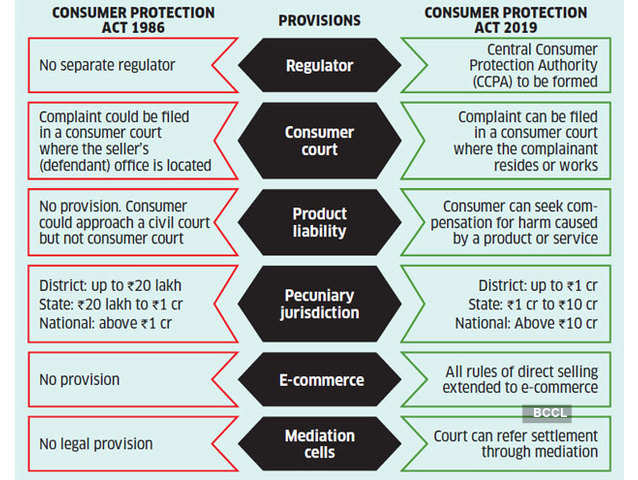
1) Consumers can now institute a complaint from where they reside or work for gain.

2) The original pecuniary jurisdiction of the District Commissions has increased upto ₹1 crore from ₹20 lakh earlier.

3) The Pecuniary jurisdiction of State Commissions has been increased from ₹1 crore to Rs. 10 crore.

4) The National Commission can hear cases above ₹10 crore when compared to above ₹1 crore earlier.

5) While the provisions relating to e-commerce are not yet notified, a section relating to electronic service provider (covering software services, electronic payments) is notified.

6) The opposite party needs to deposit 50% of the amount ordered by the District Commission before filing an appeal before the State Commission. Earlier, the ceiling was a maximum of ₹25,000, which has been removed.

7) The limitation period for filing of appeals to the State Commission has been increased from 30 days to 45 days.

8) The Parties can be allowed to settle the disputes through mediation.

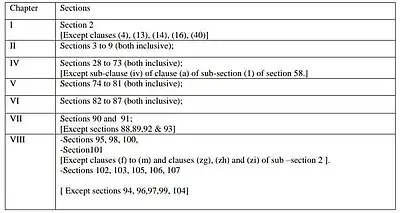
Following are the Sections which came into force:

Consumer Protection Act 2019- Sections to come into force from July 20,2020

Above mentioned provisions pertain to the Consumer Protection Councils, Consumer Disputes Redressal Forum, Mediation, Product Liability, punishment for manufacturing, selling, distributing etc spurious good or products which contain adulterant.

As per the rules, the e-commerce players will have to display the total ‘price’ of goods and services offered for sale along with break-up of other charges. Only a few certain miscellaneous provisions with regards and respect to the powers of the Central and State Government to make the rules and regulations have also been enforced.

On misleading advertisements there is provision for jail term and fine for manufacturers. There is no provision for jail for celebrities but they could be banned for endorsing products if it is found to be misleading.

For the first time there will be an exclusive law dealing with Product Liability. A manufacturer or product service provider or product seller will now be responsible to compensate for an injury or damage caused by the defective product or deficiency in services.

The Act has also defined an “e-commerce” as the buying or selling of goods or services including the digital products over digital or electronic networks. The existing definition of e-commerce has been adopted from India’s FDI Guidelines on e-commerce.

The definition of ‘e-commerce Entity’ as provided under the FDI Guidelines includes inventory and market place models.

There is also a provision for class action law suit for ensuring that rights of consumers are not infringed upon. The authority will have power to impose a penalty on a manufacturer or an endorser of up to 10 lakh rupees and imprisonment for up to two years for a false or misleading advertisement.

WEBSITES REFERRED

1)https://consumeraffairs.nic.in/acts-and-rules/consumer-protection

2)https://www.barandbench.com/news/law-policy/provisions-under-consumer-protection-act-2019-to-come-into-force-on-july-20-2020-centre-notifies

3)https://www.google.com/amp/s/www.thehindu.com/news/national/tamil-nadu/new-consumer-protection-act-gives-more-power-to-consumers-experts-say/article32135908.ece/amp/

4)https://www.google.com/amp/s/www.livemint.com/news/india/consumer-protection-act-rules-for-e-retailers-to-be-effective-by-this-weekend/amp-11595291549084.html

5)https://www.google.com/amp/s/zeenews.india.com/economy/new-consumer-protection-act-2019-comes-into-force-today-know-how-it-will-benefit-you-2297012.html/amp

6)https://www.google.com/amp/s/m.economictimes.com/wealth/spend/heres-how-consumers-will-benefit-under-the-new-consumer-protection-act/amp_articleshow/70711304.cms

7)https://www.google.com/search?q=consumer+protection+act%2C2019&tbm=isch&ved=2ahUKEwjOhv7-sN7qAhVIH3IKHTOCBfMQ2-cCegQIABAC&oq=Consumer&gs_lcp=ChJtb2JpbGUtZ3dzLXdpei1pbWcQARgAMgQIIxAnMgUIABCxAzIFCAAQsQMyBQgAELEDMgUIABCxAzoHCCMQ6gIQJzoCCAA6BwgAELEDEEM6BAgAEENQ0xRYzipg1jBoAnAAeACAAZABiAGHCJIBAzAuOJgBAKABAbABBcABAQ&sclient=mobile-gws-wiz-img&ei=e-QWX47dJsi-yAOzhJaYDw&bih=682&biw=393&prmd=ivn#imgrc=eILduqMFjleJaM

8)https://www.vecteezy.com/free-vector/consumer

9)https://www.google.com/amp/s/www.livelaw.in/amp/news-updates/most-provisions-of-consumer-protection-act-to-come-into-force-160003

MANAGEMENT

Management is not only a term but a whole process of getting things done more effectively. In managing things, we aim to achieve our goals more effectively and efficiently. Management is very essential for all the organizations, whether small or big, profit or non-profit. Every type of organization requires management in achieving their goals more successfully. Lack of management makes the things confusing and thus company may fall or lack as compared to other companies of their competition. Management is a group or team work and cannot be actually achieved by a single individual.
Management has several advantages and importance in an organization such as –
• It actually helps in achieving group or team goals.
• It helps in increasing efficiency of work.
• It actually creates a dynamic organization.
• Despite of group, it also helps in achieving the personal goals or it can be said that it develops the personality of the individual.
• It also helps in the development of the society by the interaction of different people.
The complete definition of the management contains 3 essential terms –

  1. PROCESS i.e. management is a process requiring planning, organizing, staffing, directing, and controlling.
  2. EFFECTIVELY i.e. managing the task helps us complete the task more effectively and better than before.
  3. EFFICIENCY i.e. management increases the benefits and profits by the tasks than before.

CHARACTERISTICS OF MANAGEMENT

  1. Management is a goal oriented process i.e. it does not go just like that. It is actually a goal oriented process. These goals are decided and stated before starting any project and there is no doubt in the fact that management helps us achieving our goals more efficiently and better than before.
  2. Management is all pervasive i.e. it has been observed and meant that management is a universal concept all types of organization, whether small or big, profit or non-profit has to apply some management rules to improve their organization’s standards.
  3. Management is multi-dimensional i.e. it is a kind of complex activity. It can be more understood by saying that a lot of things need to be managed in order to rum an organization. Management of work, people, and operations are the three main dimensions which need to be managed for effective working.
  4. Management is a continuous process i.e. it never stops. It is an ongoing process. It requires constantly solving the issues faced by the organization by managing its dimensions.
  5. Management is a group activity i.e. it is not the work of a single person rather it requires a group or team. Every member of the team has to work very effectively for the good results of the operation they are performing.
  6. Management is a dynamic function i.e. management allows the organization to better interact with the surrounding environment and to build better relations with other organizations so that they can help in need.
  7. Management is an intangible force i.e. it cannot be seen but its effect can be felt and seen in the betterment of the organization. The company works more happily, employees are more energetic when each and every work of the organization is managed properly.