



Introduction
The TruthTell Hackathon, part of the Create in India Challenge – Season 1, is designed to develop cutting-edge AI-powered tools for real-time fact-checking during live broadcasts. Supported by prominent organizations like the India Cellular & Electronics Association (ICEA), Ministry of Information & Broadcasting (MIB), Ministry of Electronics & Information Technology (MeitY), and IndiaAI Mission, the hackathon brings together key stakeholders to foster innovation in the media and technology sectors. This initiative is a crucial component of the inaugural WAVES (World Audio Visual & Entertainment Summit).
The World Audio Visual & Entertainment Summit (WAVES) in its first edition is a unique hub and spoke platform poised for the convergence of the entire Media and Entertainment (M&E) sector. The event is a premier global event that aims to bring the focus of the global M&E industry to India and connect it with the Indian M&E sector along with its talent.
The summit will take place from May 1-4, 2025 at the Jio World Convention Centre & Jio World Gardens in Mumbai. With a focus on four key pillars—Broadcasting & Infotainment, AVGC-XR, Digital Media & Innovation, and Films-WAVES will bring together leaders, creators and technologists to showcase the future of India’s entertainment industry.
The TruthTell Hackathon is a key component of Pillar One of WAVES, focusing on Broadcasting and Infotainment. To date, 5,650 participants have registered, including 186 international entries.
Registration Process and Timeline
The TruthTell Hackathon invites participants to develop an AI-powered solution to counter misinformation and promote ethical journalism. Participants can join individually or form teams of up to 5, including developers, data scientists and media professionals. Registrations are now closed, with the final date being 21st February 2025.
- Opening of Registrations: 1st October 2024
- Deadline for Submissions of Ideas and Prototypes: 21st February 2025
- Announcement of Top 25: 7th March 2025
- Mentoring & Tinkering: 8th – 18th March 2025
- Jury Presentation & Selection of Top 5 Winners: 24th – 28th March 2025
- WAVES Summit: 1st – 4th May 2025
Tasks Include:
- Dataset Preparation:
- Analyze data using external fact-checking APIs.
- Pre-process and clean text-based media content (tokenization, entity extraction).
- Developing a Real-time NLP Model:
- Train machine learning/deep learning models on misinformation datasets.
- Implement NLP techniques (text classification, sentiment analysis, entity recognition) for real-time text analysis.
- Fact-checking Integration:
- Integrate external fact-checking APIs to verify flagged content.
- Cross-reference live broadcasts with trusted knowledge databases.
- Real-time Data Processing:
- Set up streaming infrastructure for live broadcast feeds.
- Implement data pipelines to process new information as it arrives.
- Knowledge Graph for Fact-checking:
- Build and deploy a knowledge graph to track entities and their verified status.
- Use the graph to detect patterns of misinformation.
- Real-time Dashboard for Broadcasters:
- Create an interactive dashboard displaying real-time alerts, confidence scores, and verification info.
- Testing and Validation:
- Test with live or recorded broadcasts.
- Validate accuracy using ground-truth data from fact-checking organizations.
Project Submission Guidelines
- Written Proposal:
- Project Description: Provide a detailed explanation of your proposed tool and its intended functionality.
- Problem Statement: Clearly describe the specific problem your tool addresses.
- Target Audience: Identify the intended users or beneficiaries of your tool.
- Technical Approach: Outline the methods, algorithms, and technologies you will use, with a focus on APIs and datasets provided by the hackathon.
- Development Timeline: Provide a realistic timeline with key milestones and deadlines.
- Prototype:
Working Prototype: Demonstrate the core functionality of your tool. Ensure it is user-friendly, functional, and showcases the impact of your solution.
-
- Key Considerations:
- Functionality: Ensure it can perform the intended tasks effectively.
- User Experience: Design an intuitive and easy-to-navigate interface.
- Completeness: Include all essential features of your tool.
- Documentation: Provide clear instructions on using your prototype.
- Key Considerations:
- Additional Tips:
- Use clear, concise language.
- Support claims with evidence and examples.
- Ensure your proposal is visually appealing and well-formatted.
Access to Powerful Tools and Technologies
The TruthTell Hackathon offers a unique opportunity to develop innovative AI-driven solutions to combat misinformation. Participants will have access to powerful tools, mentorship and resources to build their projects. Here are some popular tools and technologies that can be used to develop AI-driven solutions for combating misinformation:
- Programming Languages:
- Python (with libraries like TensorFlow, PyTorch, NLTK, Scikit-learn)
- R, Java, javascript
- Natural Language Processing (NLP) Libraries:
- TensorFlow Text, Hugging Face Transformers, SpaCy, Gensim
- Machine Learning Frameworks:
- TensorFlow, PyTorch, Keras
Key Considerations for Development
-
- Functionality: Ensure your tool performs its intended tasks effectively.
- User Experience: Design an intuitive, user-friendly interface.
- Completeness: Include essential features and components of your tool.
- Documentation: Provide clear instructions for using your prototype.
Evaluation Criteria
The evaluation criteria for the TruthTell Hackathon are as follows:
- Innovation: The originality and creativity of the solution.
- Impact: The potential of the solution to make a significant impact on combating misinformation.
- Technical merit: The quality of the code, data analysis and AI implementation.
- Scalability: The ability of the solution to be applied at a larger scale.
- User experience: The ease of use and effectiveness of the user interface.
- Adherence to ethical guidelines: The compliance of the solution with ethical principles and standards.
- Presentation and communication: The clarity and persuasiveness of the project presentation.
- Proof of concept (PoC): The demonstration of the solution’s functionality and effectiveness.
Prizes
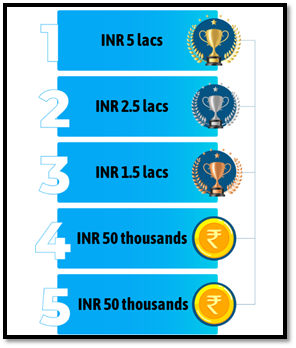
The top 5 winners will be recognized and awarded at the WAVES event, with cash prizes for the winners.
Conclusion
the TruthTell Hackathon offers a valuable platform for innovation, enabling participants to create AI-driven solutions that combat misinformation and promote ethical journalism. With access to powerful tools, expert mentorship, and a chance to showcase impactful solutions at the WAVES Summit, this event presents an exciting opportunity to make a real difference in the media landscape.
References
- https://wavesindia.org/challenges-2025
- http://119.82.68.149/cic-dashboard/
- https://icea.org.in/truthtell/
*****
Santosh Kumar/ Ritu Kataria/ Kamna Lakaria
About WAVES
The first World Audio Visual & Entertainment Summit (WAVES), a milestone event for the Media & Entertainment (M&E) sector, will be hosted by the Government of India in Mumbai, Maharashtra, from May 1 to 4, 2025.
Whether you’re an industry professional, investor, creator, or innovator, the Summit offers the ultimate global platform to connect, collaborate, innovate and contribute to the M&E landscape.
WAVES is set to magnify India’s creative strength, amplifying its position as a hub for content creation, intellectual property, and technological innovation. Industries and sectors in focus include Broadcasting, Print Media, Television, Radio, Films, Animation, Visual Effects, Gaming, Comics, Sound and Music, Advertising, Digital Media, Social Media Platforms, Generative AI, Augmented Reality (AR), Virtual Reality (VR), and Extended Reality (XR).
Have questions? Find answers here
Come, Sail with us! Register for WAVES now (Coming soon!).

 Eduindex
You must be logged in to post a comment.