Environmental laws in india

Either Stable burning in various states accrued the air pollution in Delhi and created a gas chamber around NCR ; SC came upon a committee to observe scenario , Or 4 industries inflicting stream pollution were shut down by Maharashtra pollution board . Everybody has responsive to environmental problems as higher than . The key solution for resilience to environmental issues are provided by government in various legislations , enactments and provisions on environment laws .


In republic of India environmental law is concern with the policy and law for protection of the environment . It aims for achieving carbon free economy through taking measures for reducing climate change. All the acts under this laws are safeguards in ensuring effective management of the environment and its multiple ecosystems . It provides for preventing environmental damage .


Natural resources in the earth were unscathed from millions of years. It were remain pure until the industrialized started . After the industrialization this resources have been exploited in Spain of 100 years only . From 19th century, the environment (air , water and land ) is directly exploited by rapidly growing population at alarming-rates.


environment includes water, air and land and the inter-relationship which exists among and between water, air and land, and human beings, other living creatures, plants, microorganisms and property , as mentioned in section 2 of environmental protection Act of 1986 . Environment is a wide sphere , it consists of social, economically , political , religious dimensions .


Addressed area of environmental laws in India :

1. Quality of water : For the prevention and control of water pollution and to maintain or restore wholesomeness of water in the country the water act of 1974 was enacted. It further provides for the establishment of Boards ( CPCB and SPCB ) for the prevention and control of water pollution with a view to carry out the aforesaid purposes. This act prohibits the discharge of pollutants into water bodies beyond a given standard, it also lays down fine and penalties for non-compliance.

2. Reduction of air pollution and maintaining air quality : The Air (Prevention and Control of Pollution) Act, 1981 (the “Air Act”) is an act to provide for the prevention , protection and abatement of air pollution .It provides for establishment of Boards at the Central and State levels with a view to carrying out the aforesaid purposes.

3. Hazardous Waste management : legislations that directly or indirectly deal with hazardous waste management are the Factories Act, 1948, the Public Liability Insurance Act, 1991, the National Environment Tribunal Act, 1995 and rules and notifications under the Environmental Act.

4. Containment cleanup, damage mitigation : preventing future damage to the environment is undeniably the primary objective of environmental law, mitigating and reducing existing damage is also important. This area most often deals with issues like toxic leaks and oil spills. The central objective of this branch of environmental law is deciding liability, planning an appropriate response, and also determining the best process of investigation and monitoring in the overall clean up process. This area also concerns itself with the study and assessment of risk in the long term, to better mitigate any future accidents and risks.

5. Sustainability of resources : United Nations has put great emphasis on ensuring the sustainability of resources. For this vision , it has advocated the formation of various legal principles and legislation. In this regards concept of environmental impact assessment introduced .

Noble legislations and enactments on environment law in India :


Laws on Forest and wild life protection:
• The Indian Forest Act, 1927 ; The Wildlife Protection Act, 1972; The Forest (Conservation) Act, 1980 ; The Environment (Protection) Act, 1986; The National Green Tribunal Act, 2010.


Laws on Water pollution :
• The Water (Prevention and Control of Pollution) Act, 1974.


Laws on air pollution :
• The Air (Prevention and Control of Pollution) Act, 1981 (the “Air Act”)


Laws on hazardous waste management :
• Biomedical Waste (Management and Handling) Rules, 1998 ; Municipal Solid Wastes (Management and Handling) Rules, 2000 ; Batteries (Management & Handling) Rules, 2001 ; Hazardous Wastes (Management, Handling and Transboundary) Rules, 2008 ; E – Waste (Management and Handling) Rules, 2011 .
Laws on wetlands


Ramsar convention (1971) : This convention was initiated to push for greater conservation and sustainable use of wetlands ; Wetlands (Conservation and Management) Rules, 2017.
Constitutional provisions on environment laws


Part IVA (Art 51A-Fundamental Duties) of the constitution casts a duty on every citizen of India to protect and improve the natural environment including forests, lakes, rivers and wildlife, and to have compassion for living creatures.


• the Constitution of India under Part IV (Art 48A-Directive Principles of State Policies) stipulates that the State shall endeavour to protect and improve the environment and to safeguard the forests and wildlife of the country.

environment makes human life possible, and our cultural environment helps define who we are. It is therefore essential that our population and economic growth are environmentally sustainable.
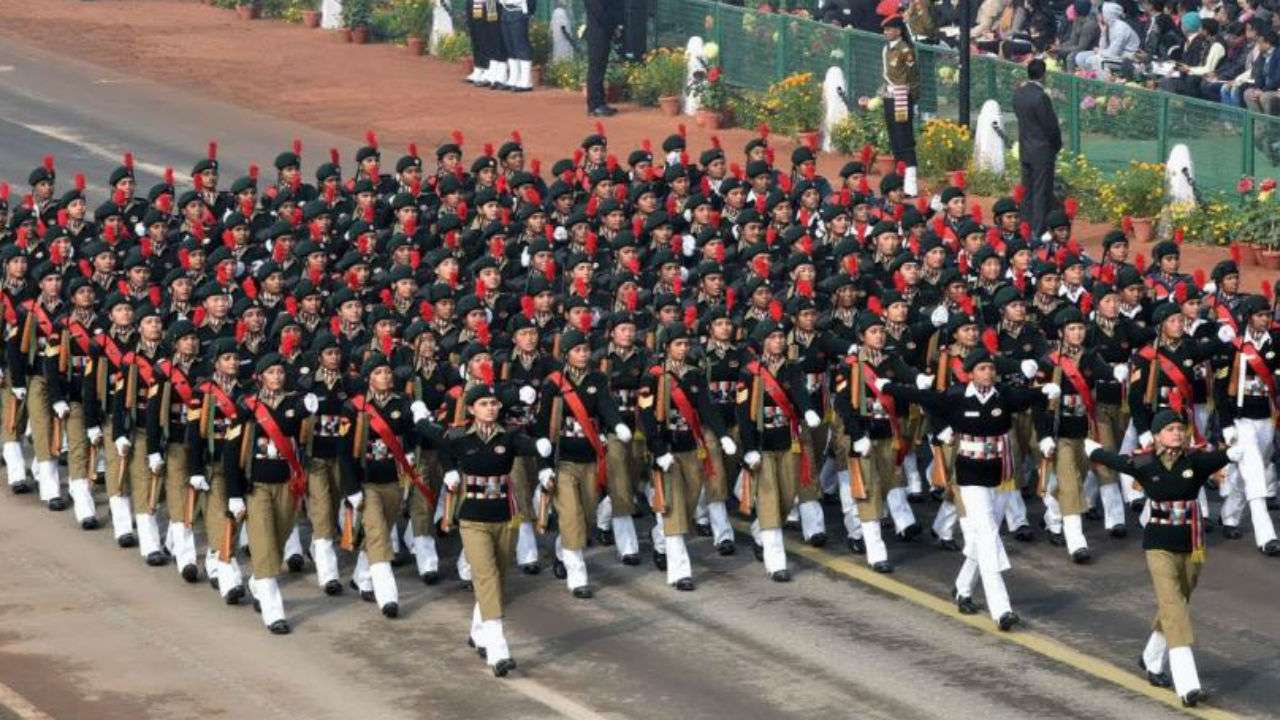

NCC

Introduction

The National Cadet Corps is the youth wing of the Indian Armed Forces with its headquarters in New Delhi, India. It is open to school and college students on voluntary basis as a Tri-Services Organization, comprising the Army, the Navy and the Air Wing, engaged in grooming the youth of the country into disciplined and patriotic citizens.

The soldier youth foundation in India is a voluntary organization which recruits cadets from high schools, higher secondary, colleges and universities all over India. The Cadets are given basic military training in small arms and drill. The officers and cadets have no liability for active military service once they complete their course.

Origin

In 1949, the Girls Division was raised in order to give equal opportunities to school and college going girls. The NCC was given an inter-service image in 1950 when the Air Wing was added, followed by the Naval Wing in 1952. In the same year, the NCC curriculum was extended to include community development/social service activities as a part of the NCC syllabus at the behest of Late Pandit Jawaharlal Nehru who took keen interest in the growth of the NCC. Following the 1962 Sino-Indian War, to meet the requirement of the Nation, the NCC training was made compulsory in 1963. In 1968, the Corps was again made voluntary.

Aim and Motto

The discussion for motto of NCC was started in 11th central advisory meeting (CAC) held on 11 August 1978. At that time there were many mottos in mind like “Duty and Discipline”; “Duty, Unity and Discipline”; “Duty and Unity”; “Unity and Discipline”. Later, at the 12th CAC meeting on 12 Oct 1980 they selected and declared “Unity and Discipline” as motto for the NCC. In living up to its motto, the NCC strives to be and is one of the greatest cohesive forces of the nation, bringing together the youth hailing from different parts of the country and molding them into united and disciplined citizens of the nation.

Skill development

The benefits of joining NCC include receiving basic military training. It develops the students’ interest in three forces – Air force, Army, and Navy. NCC is the first platform that provides opportunities to the cadets to check their efficiency to join the mainstream Indian Defence Services.

The cadets are imparted training in the use of arms, along with communication skills and personality development skills, he said. The NCC helps to develop leadership qualities in students. NCC cadets Indrajith and Yashaswi have been selected for Republic Day parade in New Delhi. The NCC helps to instil confidence.

NCC is an effective organization designed to mould the youth at their most impressionable age with the aims of developing qualities of character, courage, comradeship, discipline, leadership, secular outlook, spirit of adventure and sportsmanship and the ideals of selfless service among the youth to make them useful .

Learning

Discipline, basic arms training, team ethics, following orders, various kinds of physical activities, sports, tours to remote areas, etc. are some of the things you experience and learn in NCC. These lessons are invaluable and make the journey of learning beautiful.

Link

INSPIRATIONAL STORY OF J.K ROWLING

J.K Rowling’s story is one of the most famous insipirational failures to the success story of our time. She had failed in almost everything she attempted to do in her life and at one point she considers herself a major failure.


Most of the people only know her as a woman writer who created Harry Potter, but what people don’t know about the struggle she faces before reaching the stardom.


BIRTH AND CHILDHOOD :


Joanne Rowling was born on 31st July 1965 in yate, Gloucestershire, England to Peter James Rowling and Anne Rowling. Her father was a Rolls- Royce aircraft engineer and mother was a science technician
She had one little sister, Dianne, as a child Rowling loves to write fantasy stories and read them to her younger sister. When she was a teenager she got a chance to read Jessica Mitford ‘s autobiography, from then on Mitford become her heroine and after that, she read all her books.


BOOK INSPIRATION AND MOTHER ‘S DEATH :


After working for Amnesty International as a researcher and bilingual secretary in London, Rowling moved to Manchester with her then- boyfriend where she worked at chamber of commerce. In1990, Rowling first had the idea for Harry Potter, a story of a young boy who attends a school of wizards, while she was on a 4 hour delayed train trip from Manchester to London.
While travelling the idea fully formed in her mind and when she reached her flat she began writing furiously. However, in December 1990 her mother died after 10 years of complications from Mutiplr sclerosis Mother’s death heavily affects Rowling and leave her extremely distraught and upset. Later she channelled her own feelings of her loss by writing about Harry’s feelings in her first book.


MARRIAGE, DIVORCE AND SINGLE MOTHER:


After a few months of her mother’s death, she moved to Portugal to teach the English language. There she met a man, fall in love with him, got married and gave birth to her daughter. In 1993 her marriage ended in Divorce and she with her infant daughter moved to Edinburgh Scotland to be closer to her sister.
This is the most struggling time for Rowling and she saw herself as a complete failure. She was divorced, jobless, no money and a dependent child. Because of all this, she suffered bouts of depression and contemplated suicide. Eventually, she signed for Government-assisted welfare describing her economic status as poor. It was a really difficult time in her life but she kept going on and put all her energy on completing her novel.


HARRY POTTER :


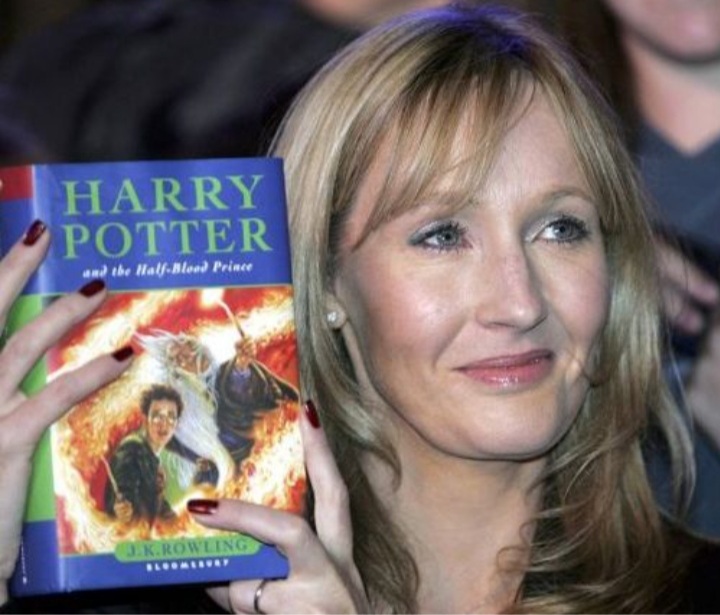
In 1995 Rowling completes her manuscript for Harry Potter and the philosopher’s stone on an old manual type writer. She was so poor at that time she could not afford a computer or even the cost of photocopying the novel, so she manually typed each copy and submitted to twelve publishing house in London.
The manuscript was rejected almost dozens time until she was finally given chance with £1,500 advance by a small London publisher, Bloomsbury after the company’s CEO little 8 years old daughter fell in love with it after reading the first chapter of the book.


In July 1997 Bloomsbury published first 1000 copies of Harry Potter series out of which 500 copies were distributed to libraries. Just five months later the book won Nestlé smarties Book prize it’s first award . In early 1998 an auction was held in America for the printing rights to publish the novel.
Scholastic INC won the auction for USB 105, 000, later Rowling said in a interview that she nearly died when she heard the news of this amount for printing her novel. Today Harry Potter is a global brand worth an estimated 15 billion dollars.
The last four Harry Potter books have set the records for the fastest selling books in history. The Harry Potter series to talking 4, 195 pages have been translated either in whole or in part into 65 languages. The Harry Potter books series have also gained recognition for creating an interest in reading among the children’s at a time when they were more inclined towards the Internet, computers and television.


FINANCIAL SUCCESS :


In 2001 J.K ROWLING purchased a 19th century killiechassie House, an estate house on the banks of the river tay in Perth. She also owns a £ 4.5 million Georgian house in West London. In 2004 , Forbes named Rowling as the first person to become a us dollar billionaire by only writing books.In 2017, according to Sunday times, Richard list Rowling net worth was approx. £ 650 million.


PERSONAL LIFE :


Rowling and her second husband Neil Murray were married on 26th December 2001. They live in Edinburgh with their 3 children. Rowling was a runner up in 2007. Time’s annual person of the year issue after Russia’s president Vladimir putin.


JK ROWLING’S RULES OF SUCCESS :

  • Failure helps you discovers yourself.
  • Take action on your ideas.
  • You will be criticised
  • Remember where you started
  • Truly Believe in yourself
  • learn from adversity.
    *Visualise to achieve
  • Persevere
  • Dreams can happen.
  • use your creativity.

Discipline

Discipline is very important in everyone’s life. It is so important to be disciplined in the life. Discipline is not acquired from a single day. It is a achieved by a continued process.parents are the important in every individual’s life. The are the main reason for the discipline of their children.

After the parents, teacher is the most important person in an individual’s life. Teacher is the one who moulds the individual from the initial stage of the life and makes the individual into and perfect one. Even though the teacher schools or beats sometimes it is all for the well-being of the student and for the bright future of the student.

The first teacher in everyone’s life is their mother. Beginning with the correct thing the first mistake of the child, mother plays a very important role in correcting many of the mistakes in an individual’s life. Also the father who corrects the mistakes and puts the children in a correct way. And the teacher, who is very important in our students life to achieve their desired goals.

Teachers play a very important role in making the student perfect and make them to understand the need of the situation. Teachers help the students to reach their desired goals and in any situation teacher motivates a student to get up and stand in all the ups and downs. Like that of the mother and the father, the teacher also feels equally happy when their student acheives high in their life and when they reach their desired goals.

IMPORTANCE OF DISCIPLINE IN LIFE :


TIME MANAGEMENT :


A disciplined person always has the time to complete all the tasks within given deadlines. This is because they are focused and they know how to schedule the time properly. They dont’t believe in wasting time on unnecessary things. They understand the value of time and they know that time once has gone never comes back.


LEADERSHIP :


All great leaders are not born. Most of them follow a very tight schedule and maintain discipline in their life to become good leaders. Good discipline generates a positive attitude towards society. It creates confidence and eagerness to do something great. It helps people to build an attitude that becomes the key to becoming successful. They are able to set a great examples for others in society.

DECISION MAKING :


It is because everything gets finished within the given deadlines, disciplined people always have time to revise their work and improve their decisions.
People who are disciplined are more focused both mentally and physically. They are better able to gain their body and mind with their ideas and goals. Finally, everything is regulated in order and increases their productivity in all the activites they undergo.


ACHIEVEMENTS :


Disciplined people are more motivated and concentrated. Therefore, they achieve more when compared to a person who is not disciplinef with the activites he/she undertakes. As per study, 92% of people are able to achieve their goals in life because of the reason of being disciplined.

STABILITY AND STRUCTURE :


With discipline, comes stability in all the tasks. It helps to schedule and organize the activites and tasks in a proper structure. If a person is focused and regularly follows this particular structure, he/she is sure to succeed in their life.

RESPONSIBILITY AND CONTROL :


With great discipline comes great responsibility. Only by making schedules and timetables a person cannot become successful. It is very important regularly follow and fulfill the responsibilites which are mentioned in the schedule. This will help them to develop self- control and also build good relations with others.

RESPECT :


A disciplined person always respected by society. He/she is lookef upon as role models and mentors. Through discipline, they worked hard and achieved their goals which made them a respectful figure in the eyes of others.

IMPROVES MENTAL HEALTH :


Modern society suffers alot from anxiety and depression. We cannot blame them for their condition. Just by maintaining a little discipline in their life, they can easily improve it. Discipline will help them to reduces stress and take control of their tasks. They would be able to overcome their fears and also control their emotions.

MAINTAIN PEACE IN SOCIETY :


Disciplined people are lie assets to society. If there is no law and order, there would bee too many activites. Discipline is required to prevent such things in society. By setting the requiref rules and regulationa, it becomes easier to live in a society that is full of peace and harmony.


STAY ACTIVE :


Disciplined people have time to do every activity in the schedule. They plan their schedule in such a way that improves both their academic/ instituational performance and also their physical health. They know what is good and bad for them and thereby have good eating habits, exercising habits, sleeping and waking up paterns, etc.


SELF DISCIPLINE self discipline means self control, the ability to avoid unhealthy excess of anything that could lead to negative consequenes.


• It is the ability to reject instant grafication and pleasure, in favor of some great grain, which requires spending effort and time to get it.
• It means perservetance and not giving up.
• It is the strength not to give in to negative feelings.
• It means overcoming one’s weakness.
• It is the ability to pursue one plan despite temptations to abandom them.
• Delayed gratification in favour of accomplishing long term goals.
Discipline is very important. It helps people to showcase their attitude and represent their character and thinking. Both the body and mind are honed by discipline. Descipline helps to address individual problems and develop a society that is both peaceful and respectful. Therefore, it would be right to say that without disciplinr there is no life at all.

Animals

Since the time Earth developed the quality of sustaining life, life has always gone under the process of evolution. Life started from single celled organisms and developed stage by stage. One organism extinct to develop into its better developed species or even at times it happens that some animals get erased from the surface of the earth due to extreme environmental condition.

EXTINCT ANIMALS: Species of animals which existed in the surface of the earth once upon a time but has no current existence, this may have been a result of extreme environmental condition or some other condition for existence. For example, we have dinosaurs, Dodo.

ENDANGERED ANIMALS: The species of animals which have only a few animals left on the surface of the earth and are in the mouth of being extinct are known as endangered, currently this is a result of poaching i.e., unethical killing of wild animals with purpose or change in the climate due to pollution and other factors. For example, we have the Royal Bengal Tiger.

We cannot do anything for the species which are extinct but we can definitely take steps and save our endangered species. Poaching laws should be made stricter and it should be taken care that people follow them.

Different types of animals :

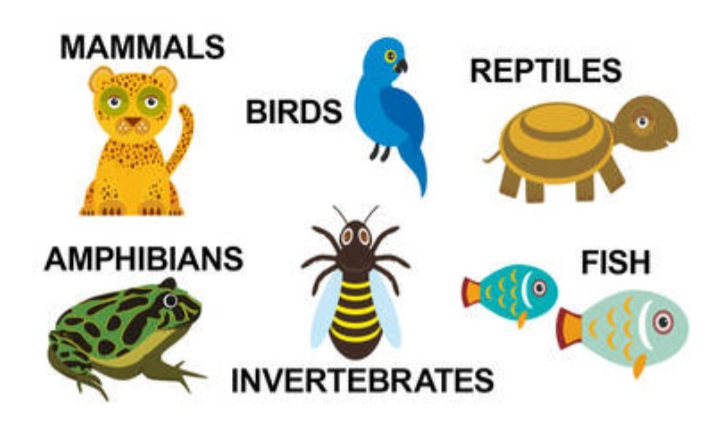
Scientists sort the different types of animals in the world into categories based on certain characteristics. Animals are generally grouped into six types of aninals. The system for animal classifications is called taxonomy.

The Animal Kingdom :

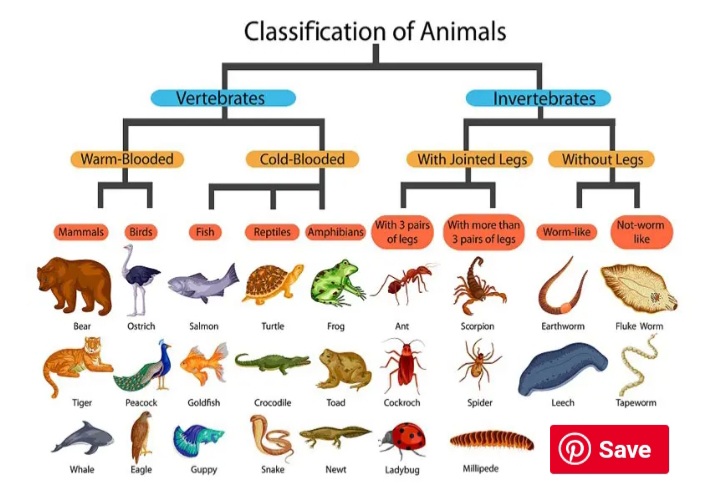
All animals belong to a biological kingdom called kingdom Animalia. This kingdom is then broken down into over 30 groups. About 75% of all species on earth are aninals. Animals are then broken down into two types : vertebrates and invertebrates.

* Animals with a backbone are vertebrates.

* vertebrates belong to the phylum called phylum chordata.

* vertebrates are classified into five classes. They are amphibians, birds, fish,mammals, and reptiles.

* Animals without a backbone are invertebrates.

* Most invertebrates are in the phylum Arthropoda.

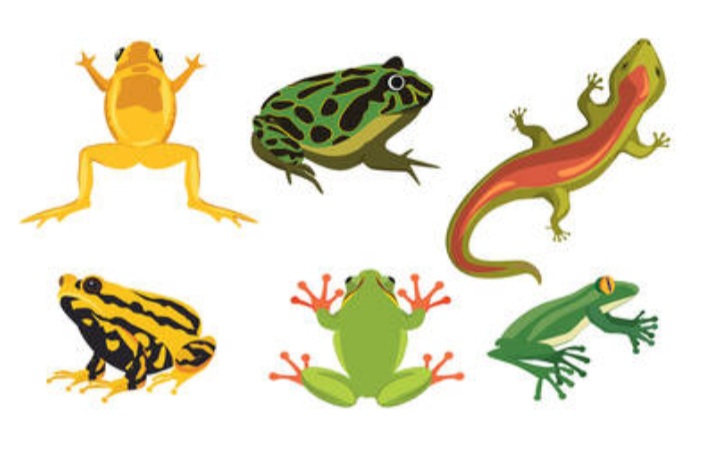
1. Amphibians :

All amphibians are vertebrates, and they need moist environment or water to survive.

* They are cold- blooded.

* They absorb water and breathe through their thin skin

* They have at least one special king gland used for defense.

* Most follow the life cycle of egg-larva- adult.

* examples : frog , newts, salamanders, toads.

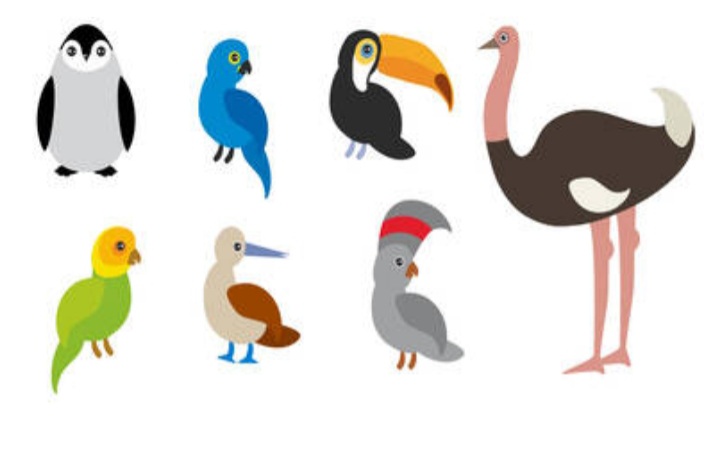
2. Birds

Birds are a type of warm- blooded vertebrate that are adapted to fly.

* Not all birds can fly, but they do all have wings.

* Birds have beaks that help them catch and swallow food.

* The digestive system of a bird allows it to eat whenever it can and digest that food later.

* Birds lay egg to reproduce.

* They are endothermic, mening they maintain their own constant body temperature.

* They are bipedal, which means they have two legs.

* They have hollow bones and their bodies are covered in feathers.

* Birds belong to the class called Aves.

* Examples : albatrosses, chickens, hummin birds, falcons, falmingoes, ostriches, owls, parrot, penguins, pigeons.

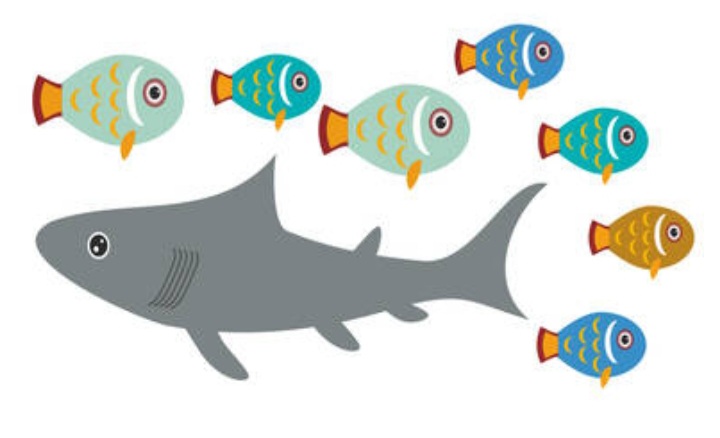
3. Fish :

Fish are also vertebrates, and they are considered the oldest-known vertebrates.

* They are ectothermic, or cold- blooded, which means they rely on their surroundings to regulate their body temperature.

* Fish have funs.

* Most, but not all, fish have bodies covered in scales and breathe through gills.

* Fish live under water.

* Examples : eels, hangfish, lampreys, minnows, rays, salmon, seahorses, sharks.

4. Mammals :

Mammals are another type of vertebrate that belongs to the class Mammalia.

* young mammals get nourishment from milk produced by their mothers.

* Most mammals have hair.

* Their jaw is hinged directly to their skull unlike all other vertebrates.

* Almost aĺl mammals give birth to live bsbies.

* They are endothermic, or warm- blooded.

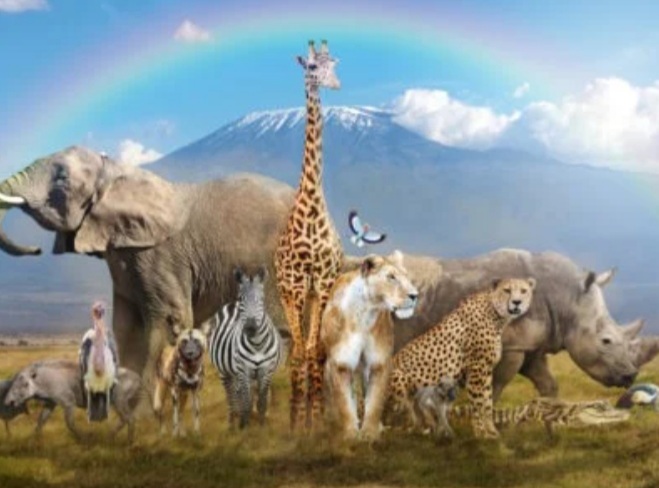
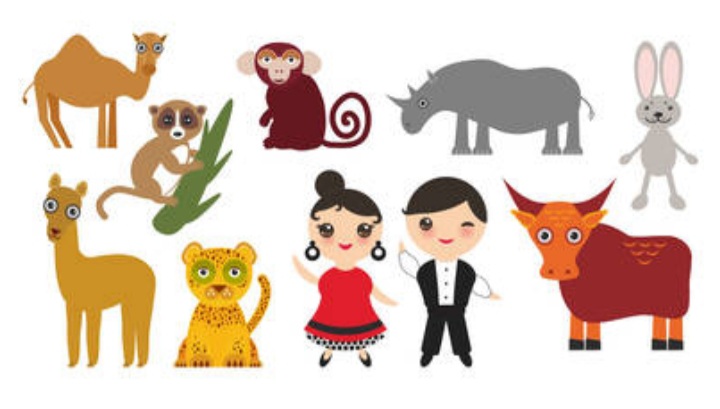
* Examples : there are over 5500 living species of mammals all over the world. Aardvarks, bats, elephants, hamsters, human, rabbits, rhinoceroses, whales.

5. Reptiles :

Reptiles are thought to be the first vertebrates to live completely on land. But, not all reptiles live only on land today.

* They are cold- blodded, or ectothermic

* They lay eggs to reproduce.

* They have four legs or descended from animals with four legs.

* They breathe through lungs

* Their bodies are covered in scales or scutes.

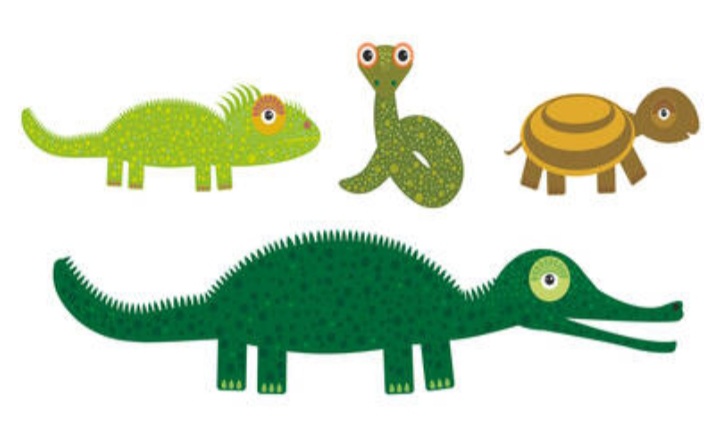
* Examples : crocodiles, geckos, lizards, sea turtles, snakes, tortoises.

Invertebrates :

Approximately 95% of all animals are invertebrates. Invertebrates do not have a backbone. There are different types of invertebrates, but they all share a few characteristics.

• They are made up of many cells that work together, or multicellular.

• Most, but not all have tissues, cells that work together in a more complex way.

• Most, but not all, can move.

• There are over 35 phyla of invertebrates.

• They generally have soft babies.

Types of Invertebrates :

There are eight phyla of invertebrayes that are alive today.

* Annelida – have a segmented body and primitive brain

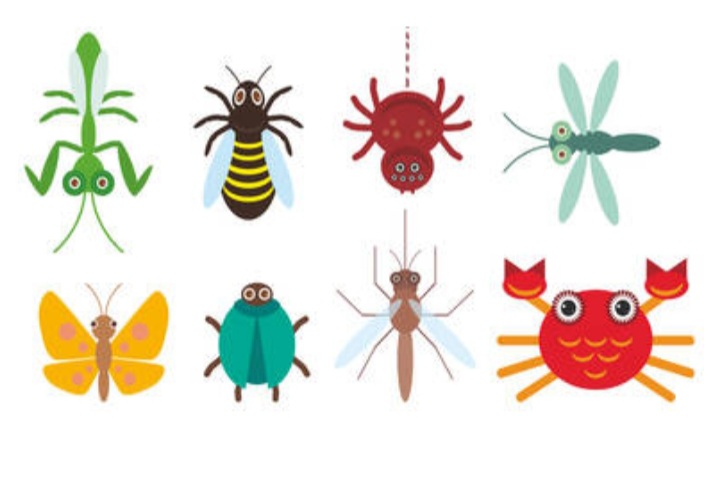
* Arthropoda – have jointed appendages and an exoskeleton.

* Cnidaria – have tissues and an incomplete digestive system

* echinodermata – have some type of spiny structure on their bodies

* Mollusca – generally have sofy bodies and a hard exoskeleton.

* Nematoda – unsegmented with worm- shaped bodies

* platyhelminthes – have soft, ribbon- like worms with no respiratory system.

* porifera – multicellular organisms living in water with no organs or tissues.

Examples : anemone( cnidaria) , clams ( mollusca), coral,

A God Who Hates Women : DR. MAJID RAFIZADEH

I had chosen to write about Dr. Majid Rafizadeh’s phenomenal novel  ‘  A God Who Hates Women’. It is a beautiful yet tragically moving story of a women caught in a patriarchal household. It takes us back to the times when women were seen as commodities sold off in markets. Choice was a word that women could not even imagine.

The story highlights the life of the authors mother, how she lived through oppression. This story forms around the background of a civil war. The novels throw light on the cruelties faced by  women in a patriarchal society. The story begins with a short background of how the authors grandmother was born. It later shows the birth of the authors mother which turned out to be a disgrace for her own mother, since she expected a baby boy. The story continues with the atrocities faced by his mother at her own home and how she was forcefully married to a man who abused her at all chances he got.  The story speaks mostly about the struggles faced by the authors mother in her journey. It shows the cruel side of patriarchy, how women carry it down more than men.

The book is set in the backdrop of a series of political tension in Syria and Iran. The author and his family have moved from Syria to Iran a couple of times and the book shows the difference in the culture in both the countries vividly. The book shows how much political leaders are influenced by religion and how they kill people cruelly who goes against them, the authors father was one such victim. Maybe the author might have also got the influence from his father, but in a much better way. The author was the founder of an organization on human rights which reported cases of human cruelty. The authors father has a very interesting character, he on one side focuses on how modern our thinking should be in various aspects of life except in the equal treatment of women. His character was rather paradoxical.

The name of the book also seems to bring out the story, about how the religion and its god were cruel to women. The people of the religion went to extreme ends to make sure that the rules of the religion are followed, sometimes inhumane practices were also used.

But one of the most important thing that the book has left out is that it hasn’t brought into consideration the larger issues faced by the people. The author has merely had an interview with the close members of his family and friends. And so we cannot really say that the book speaks about the whole of Syria. After certain parts of time in the book, it fails to show the feelings of Amira, the authors mother. How she felt about religion, her passion and how she lied to herself to live for her children. The authors life has been glossed over for most parts and it talks in the perspective of the author while the book was about his mother. More focus should have been given to her as well as the political conditions too.