
COLD WAR

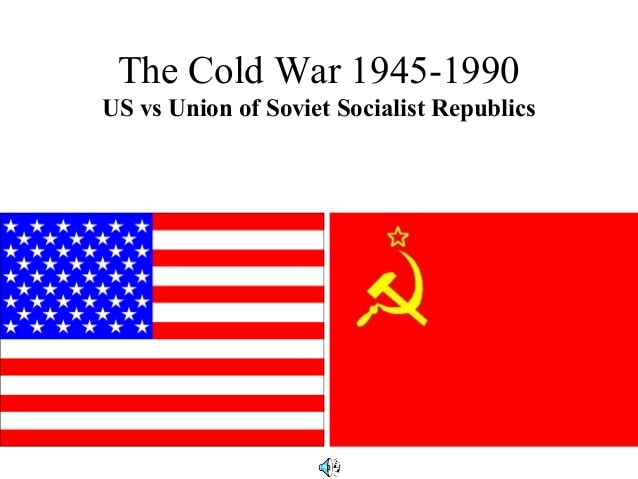
The Cold War is the term used to describe the extreme political and friendliness that existed from the end of world war II to the late eighties between groups of Communist and non communist countries. On one side with the USSR and its communist allies known as the Eastern bloc and walked and on the other side by the western powers of the USA and its allies.

There was mutual suspicion distressed and misunderstanding between two blocs. The USA and its allies felt that the USSR’s game of spreading communism throughout the world threatened their security. The soviets on the other hand accused the USA of practicing imperialism and after attempting to stop revolutionary activities in other Nations. Each bloc had its own political ideas which were diametrically opposed to the other.
THE BEGINNING OF COLD WAR:

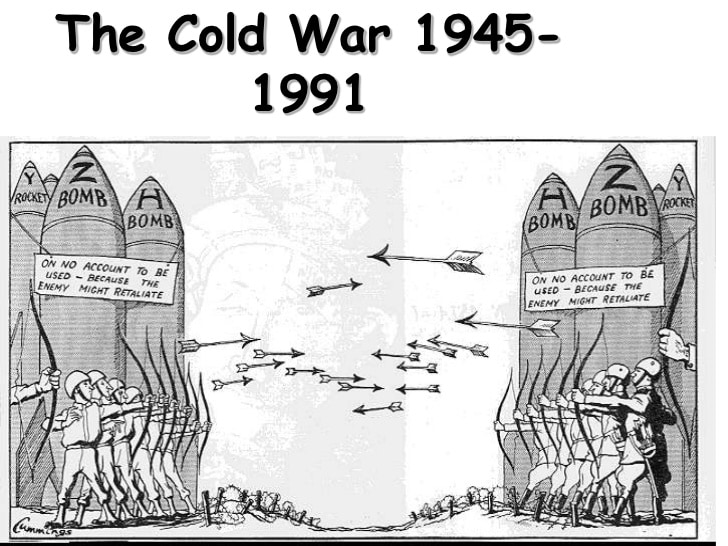
Soon after world War II the two great blocs were formed and the cold war began. It intensified during the 1940’s and 1950’s and reached its peak in the 1960’s. World peace was severely threatened the arms race begin a fresh with both sides experimenting with nuclear weapons at the same time there was a space race between the USA and USSR. The world was in astonishment as the Americans and the soviets try to outdo each other in conquering space. By the seventies both sides begin to realise the dangers involved in recklessly amazing powerful weapons that could wipe out large cities and populations in minutes. In the eighties many efforts were made to improve relations between the two superpowers.

HISTORIANS ABOUT THE COLD WAR:

Most historians agree that the cold war begin after the Yalta conference. The Big Three-President Franklin D Roosevelt of the USA, Premier Joseph Stalin of the USSR and the Prime Minister Winston Churchill of Great Britain met at the Yalta (Ukraine) in February in 1945 to plan for the peace that would follow the war. Stalin would not co-operate with the other leaders regarding the peacetime program. Great Britain join the USA in criticizing the USSR plan to spread communism in Eastern Europe.

IRON CURTAIN

During 1945 and 1946 the USSR broke off all contacts between west and the occupied territories of Eastern Europe in March 1946 Churchill want that an “Iron Curtain” had descended across the continent. The Berlin wall became a symbol of the confrontation between the two blocs.

NUCLEAR WEAPON:

In the 60 the world came dangerously close to a nuclear war. this time both block started to practice nuclear weapon and they started to treat each other with weapons many efforts made to improve relationship between both two superpowers. The cold war took a fresh turn in the eighties when Mikhail Gorbachev took over the leadership of the USSR. Glasnost ( openness) and Perestroika (reconstructio) were the terms which came to be associated with the campaign of Gobrachev to reform the economic and political missionary of the USSR.

GREAT BRITAIN:

Great Britain as one of the country’s belonging to The Western bloc, had to support the USA in any action that it took against the USSR. Britain had to pay a high price for the cold war she had to face every high military expenditure and there was uneasiness in the minds of the British that they were playing second fiddle to the USA. In the seventies Britain’s role as washington’s partner was reduced due to her economic deterioration.

MARGARET THATCHER:

Margaret Thatcher became the prime minister in 1979 and she paved the way for an economic revival and sought to avoid any public conflict with the USA. Through her personal friendship with President Reagan of the USA she was able to make Britain’s position more respectable. Up to 1982 to 83 Thatcher continue to repeat the anti-Soviet rhetoric of the Reagan administration. she was the “Iron Lady” in the USSR after she was re-elected in 1983 she changed her approach. The British government began to establish contact with the Warsaw pact countries. Thatcher paid a visit to Hungary and later she went to Moscow.

The Warsaw pact was a treaty signed by the communist nations of Europe that were under Soviet military command. They were Albania, Bulgaria, Czechoslovakia, East Germany, Hungary, Poland and Romania.

FRESH START BY THATCHER:

In 1984 she made a visit to the USA and the secured the Camp David pacts which said that the USA would not seek nuclear superiority over the Soviet member that played a major role in the negotiations leading to the signing of this treaty. President Reagan spoke of a fresh start in East West relationships.
BREAKING OF BERLIN WALL:

The breaking of the Berlin wall in 1989 was a symbolic act which site signalled the end of bitterness between the power blocs. The cold war become a thing of the past with the disintegration of the Soviet Union in 1991.
The War that divided the world

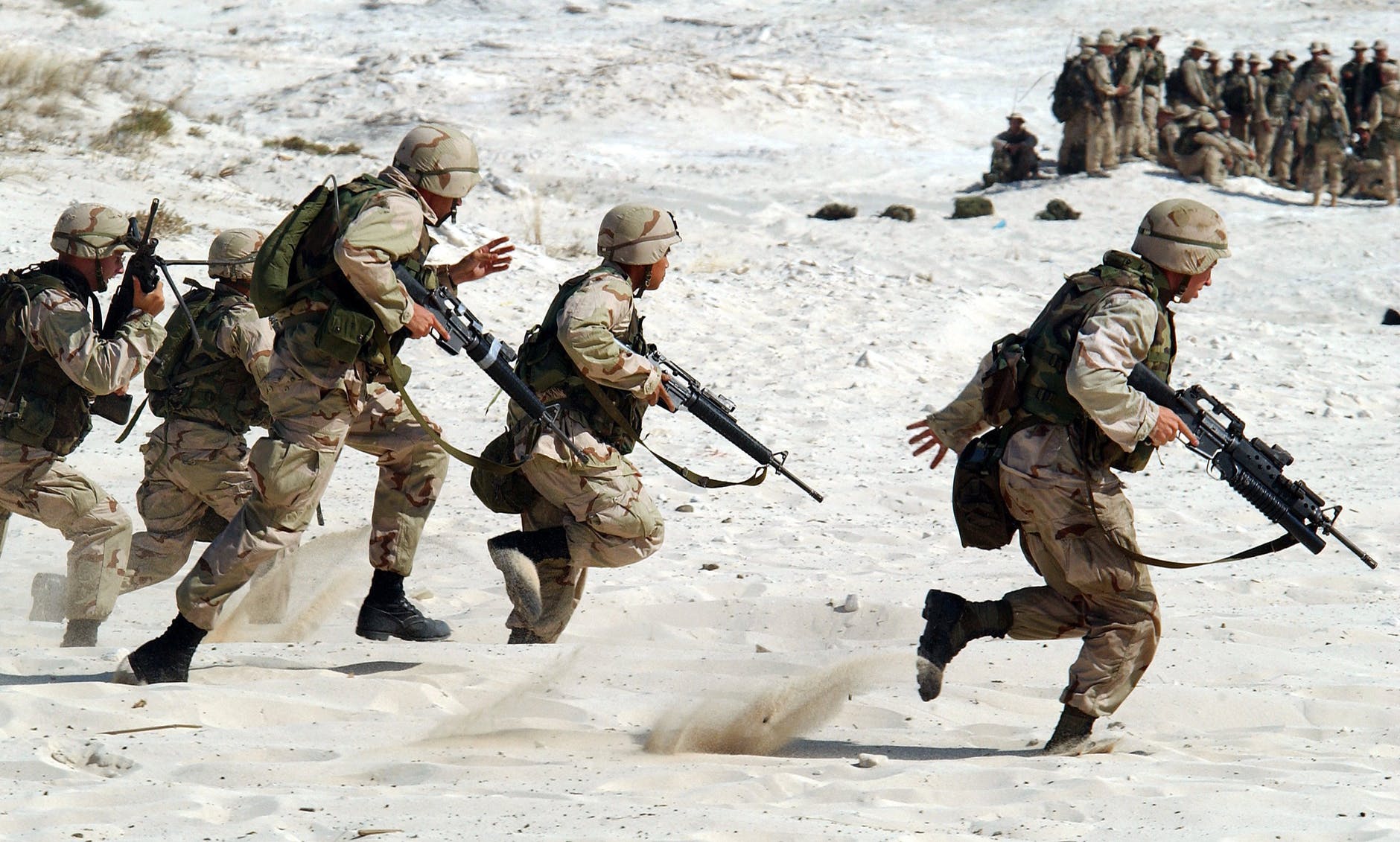
Photo by Pixabay on Pexels.com

No, I am not talking about the World Wars. I am talking about a war where actually no was ever fought, a bullet fired or a war bell rung. I am talking about the COLD WAR, a war that lasted more that the two world wars combined. This war was a period of geopolitical conflicts and ideological battles. It became as to who were more powerful militarily and economically. This war divides the world into two distinct blocs and there was a constant threat of war even after the horrors of the world war was over.

Basically, it was more of an ideological conflict. The Americans believed in FREE market system and capitalism. They allowed private ownership and accumulation of wealth and profit. There was always competition with the rich getting richer.

On the other hand, USSR or Union of Soviet Socialists Republics believed in Karl Marx’s theory of communism and collective ownership. All the wealth of the nation is to be collectively owned and shared. It even had the ideal of a stateless society where all are equal.

Clearly, both of these are extreme ideologies with little respect to be in the middle ground. And this became the cause of the war. Both of them viewed the other as an enemy and a threat to their state. They started expanding their influence to their neighboring states. They had almost fanatic ideas that the other will take over the world. So by hook or crook, they started defending their ideas and values.

But mostly, a was never fought between them. There was immense stockpiling of weapons as a precautionary move. USA and USSR started to influence the other countries by providing them with monetary aids. The Cold War even went to this extent where even the same country as divided up into two halves. For example, Korea, Vietnam and Germany. There was a display of stark contrast between these two halves.

But it does not mean that no life was killed. Extremely polarized wars took place at the battles of Korea an Vietnam. The worst policy to ever be criticized was that USA and USSR both purposely helped one half of the same country. While USA helped South Korea, USSR helped only North Korea. There was no effort from anyone to resolve the war but prove their superiority. Countless people have been killed in the wars.

Another horrific war that occurred was the Vietnam War. Almost a million of American soldiers were deployed in this war. Even the American public opinion were against the war but consecutive American Presidents were determined to win the war. Even the United Nations or the UN could not take any steps to promote world peace. The other newly independent states of Asia and Africa were cautious about engaging in such decisive politics.

Eventually, this war fizzled out in the 90’s when the state of USSR collapsed. After that the world witnessed the rise of unipolar USA practically taking the reins of the entire world. It severely dominated world affairs to look after its own interest, to what is referred to as Unilateralism.

The Cold War surely disturbed world harmony. This conflict showed that how even ideologies can become such rigid and intolerant. We must live together peacefully and support everyone to become the best version of oneself rather than being engaged in this ‘ego war.’

Contemporary International Relations

International relations have been a subject of fascination for most of us, the subject brings us into the different kinds of relations countries shared across the world. But have we ever stopped to think, why we should learn about international relations? Not really. International relations is a vast subjects, its main focus is on the relations shared between the different countries.

Its primary focus is to maintain peace and prosperity across the world. In international relations, peace is indivisible. The core objective of International Relation is to minimize the causes of war and create conditions for peace. We all are human beings, it is in the nature of human beings to share different and radical perspectives on the same thing, but what we should all focus is the need to eradicate a condition that can be a threat to our peace and prosperity.

An important objective introduced in the International Relations is the ‘Logic of Deterrence’. This logic was put into act during the cold war time. The time after World War II saw a lot of changes in the international system. There was an existence of two super powers, US and USSR.  There was tension between these countries and it has led to many proxy wars in other countries. But US and USSR never waged a war against each other, this was due to the logic of deterrence, both of the countries know that they have enough weapons to harm each other, and that there will no winner left standing. It could result in a lot of deaths without having a purpose and so they avoided a civil war at any cost, but it never stopped them from involving with other countries.

 The League of Nations was replaced by United Nations after 1945. This was because it couldn’t prevent the second world II. The UN was established with the motive of preventing any more world wars and in spreading conditions of peace and tranquility. The UN had five main members – US, USSR, France, UK and China. They were known as the big five and are the permanent members of the UN, while the others members of UN are temporary.  The landscape of International Relations has changed across the times, from the disintegration of Soviet Union to globalization paved its way.

Contemporary shape of the international relations has been a collective result of the following three factors. Firstly, with the disintegration of the soviet union, there was only one super power, it was the US. Times after was the US Hegemony, other countries and states were afraid of US. Countries who were not even part of the both the alliances were also very careful to keep themselves out of the way of US.

Second reason was the widespread ideology of liberalism. With communism out of the match, liberalism was seen as a better ideology across the world. Now countries were close to each other for economic reasons rather than political or cultural reasons. One of the example is the Look East Policy by the countries of South East Asia. Sometimes countries are forced into being slaves, not as colonies but in a new term called as neo-colonialism.

And finally, with an increase in the connections across the countries, it has put into effect a set of undesirable changes. Some countries had problems of their own and soon that become problems of other nations too, like terrorism, environmental issues etc. Globalization has set into motion a chain irreversible change. As globalization has set in, it gave a lot of opportunities as well as challenges too. It has become so much important to study about these in our day to day lives.