

Tag: Conference
ICMR-2023: International Conference on Multidisciplinary Research – 2023
Dear Sir/Madam,
Greetings from ICMR 2023

The International Conference on Multidisciplinary Research-2023 will be held on 22nd and 23rd April 2023 at Virtual Mode. This multi-disciplinary research conference aims to provide an opportunity for academicians, researchers, scientists, and industry experts to present the results, in theory, methodology, and applications of different areas of Engineering Sciences and Social Sciences under one roof. It is a good platform for researchers to share and discuss their ideas and views with peers. Authors are asked to contribute to the conference by submitting articles/papers that demonstrate their research results, projects, innovations, surveying works, and experiences of an industry that define significant advances in the areas of Engineering, Sciences, Business, Architecture, Commerce, Computer Applications, Humanities, and Social Sciences.
The ICMR – 2023 would offer several invited lectures from well-known speakers all over the world. We warmly welcome experts, academicians, scholars, and entrepreneurs to participate in this international academic exchange activity in the field of applied sciences. We hope that the ICMR-2023 outcome will lead to significant contributions to the knowledge base in these up-to-date scientific fields. All the accepted papers will be published in a special edition of Reputed Journals of UGC Care list/Scopus indexed/SCI indexed Journals.
Important Dates:
Paper Submission Deadline: 20 March 2023 (Extended)
Acceptance Notification: 10 April 2023 (Extended)
Last Date of Registration: 10 April 2023
For more details Visit Conference URL: https://icmr.edupub.org/
Submission Guidelines
Authors are invited to submit regular (full) papers for presentation at the conference, describing original, previously unpublished work, which is not currently under review by another conference, or journal. Regular papers should present novel perspectives within the general scope of the conference. Papers should not be more than 8 pages in length. Use ‘Times New Roman font, size 12, and single-column layout shall be uploaded via easy chair paper submission. Camera-ready papers can be submitted after acceptance using the guidelines given on the website.
Paper Submission Link: https://icmr.edupub.org/ or https://icmr.edupub.org/p/submission.html
Please encourage your peers, friends, researchers, seniors, subordinates, and students in your network to submit their quality submissions. All papers presented at the conference will be submitted for inclusion in the UGC Care/Scopus Indexed Journals and Conference Proceedings published as a book with ISBN.
Authors can also submit their papers through email at icmr2023@edupub.org
Paper Publication and Indexing
All submitted papers will be reviewed by technical committees of the conference (including a similarity plagiarism check). All the accepted and registered conference papers will be published in the Conference Proceedings with ISBNs and will be indexed by Google Scholar. All peer-reviewed and selected papers of the conference will be published in the following UGC Care / Scopus indexed / SCI indexed international journals with respect to their area of research.
- Advances and Applications in Mathematical Sciences
- International Journal of Mechanical Engineering
- International Journal of Special Education
- NeuroQuantology
- Seybold Report
- International Journal of Early Childhood Special Education
Award Winning Smart City of Bhuvneshwar
71 Town and Country Planning Conference 2023
Planning Thesis Awards for Students of Urban Planning in India
Recommedations fro Smart City Mission
7 Challenges of Urban Planning in India by Dr Ashok kumar
International Conference on Multidisciplinary Research (ICMR) 2023
International Conference on Multidisciplinary Research (ICMR) 2023
- Event Type: Conference
- Presentation: Digital
- Website URL: https://icmr.edupub.org
- Program URL: https://icmr.edupub.org
- Contact URL: https://icmr.edupub.org/p/contact.html
- Contact E-mail: icmr2023@edupub.org
- Location: New Delhi, India
- Venue: EDUPUB
- Date: April 20-22, 2023
- Final Submission: March 20, 2023
- Notification: March 30, 2023
- Organization: Track2Training
- Conference Tags: multidisciplinary science; education; scientific information ;
- science social science; sociology and social work; sustainability
Welcome all delegates to ICMR 2023. Organized by Track2Training, International Conference on Multidisciplinary Research (ICMR) 2023 aims to provide a platform for scholars, intellectuals and professionals to share and generate forum on the current local and global issues, address solutions to the problems and to provide opportunity for participants to exchange and share knowledge and information, establish business or research relationships and find global partners for future collaboration.
All prospective participants/authors are cordially invited to submit original and unpublished works for publication and presentation at the conference. All submissions are subjected to peer review before an acceptance decision is made. Our review committee will also select potential papers that have the merits for indexed publication and inform the corresponding authors for further decision. Papers may address, but not restricted to, the main theme from any of the sub-themes as mentioned in the conference website. Unlisted but related sub-topics are also acceptable.
The full manuscript must be submitted as an MS Word file in DOC or DOCX format (PDF format is not accepted). Please submit your full paper before the submission deadline and all manuscripts must be thoroughly checked for errors and formatted according to the Full Paper template that can be downloaded from the website. Manuscripts that are not properly prepared will be returned to the authors for revision and resubmission. Special discount will be given for group registration (3 participants or more). Please contact the Secretariat for further information.
The topics involve all research disciplines related (but not limited) to the scopes and sub-scopes as follows:
Medical and Life Sciences (LS)
Focus Areas: Medical Sciences, Health Sciences, Environmental Sciences, Biosciences, Pharmacy, Biochemistry, Earth sciences, Geology, Agriculture, Veterinary, Forestry, Anatomy, Genetics, Zoology, Welfare and related areas.
Science, Technology, Engineering and Construction (STEC)
Focus Areas: Civil Engineering, Mechanical Engineering, Chemical Engineering, Electrical Engineering, Energy, Marine Engineering, Architecture, Information technology and Computer science, Bioinformatics, Geoinformatics, Mathematics, Physics, Chemistry and related areas.
Social Sciences and Humanities (SSH)
Focused Areas: Psychology, Islamic Studies, Education, Linguistics, Civilization and Law, Anthropology, Art ,Services , Sport and related areas.
Economics, Business And Management (EBM)
Focus Areas: Economics, Business Management, Accounting and Finance, Management, Marketing, Technology Management, Human Resource Management, Operations Management, Tourism and related areas.
LANGUAGES
English
PUBLICATION
ALL ACCEPTED PAPERS will be published in conference e-proceeding (with ISBN) and SELECTED PAPERS will be published in one of the below international refereed journal indexed by MyJurnal (Malaysia Citation Centre), Google Scholar, Crossref (DOI).*Additional fee will be charge if required.

International Conference on Multidisciplinary Research (ICMR) 2023
by Shashikant Nishant Sharma
International Conference on Multidisciplinary Research (ICMR) 2023 aims to provide an opportunity to academics and practitioners around the world to discuss and share the contemporary issues of business and social science research. The proposed conference provides an outlet for high quality research in all areas of accounting, CSR, finance, economics, econometrics, education, information technology, Islamic finance and Sharia, law, management, marketing, social business and multidisciplinary. Aim of our peer-reviewed conference is to bring together the world’s leading scholars and opinion leaders and to increase our understanding of emerging scientific issues and research methodologies relating to business management, economic and social sciences. Please, engage freely in discussions, share your ideas and build relationships among the group of international researchers.

International Conference on Multidisciplinary Research (ICMR) 2023 will provide an excellent international forum for sharing knowledge and results in theory, methodology and applications of Different areas of Studies and Education. ICMR is a platform for researchers, scientists, scholars, students and industry professionals from around the world to present their current research, and foster alliances with peers. The goal of this Conference is to bring together researchers and practitioners from academia and industry to focus on understanding Modern engineering and applied sciences concepts and establishing new collaborations in these areas. Authors are solicited to contribute to the conference by submitting articles that illustrate research results, projects, surveying works and industrial experiences that describe significant advances in the areas of Studies and Education. The Conference will also have a space for companies or institutions to present their innovations and research results.
Multidisciplinary Research and Innovation and Collaboration
Social and Human Sciences
Arts and Humanities
Natural and Physical Sciences
Computer and Information sciences
Engineering and Technology
Medical and Health Sciences
Agricultural and Environmental Sciences
Social and Human Sciences
Psychology – Cognitive science, Applied psychology, Social psychology
Economics, Business and Financing – Economics, Econometrics, Business, International trade, Banking, Financing
Management and Marketing – Micro and Macroeconomics, HRM
Educational sciences – School education, ICT in education and learning, Formal and Non-formal education
Sociology, Demography, Anthropology, ethnology, Social issues, Family studies, Social work
Law – Human rights, History of law, Legal studies, constitutions, comparative law
Political science – Organisation theory, Public administration
Other social and human sciences
Arts and Humanities
History and Archaeology – Cultural heritage, cultural memory, Historical geography
Languages and Literature – Literary theory, Linguistics
Philosophy, Ethics and Religion – Theology, Philosophy, history of philosophy
Arts and Performance Studies
Other arts and humanities – Human rights, History of law, Legal studies, constitutions, comparative law
Natural and Physical Sciences
Mathematics – Pure mathematics, Applied mathematics, Statistics and probability
Physical sciences – Atomic, molecular and chemical physics, Nuclear physics, Optics, Acoustics, Astronomy
Chemical sciences – Applied and industrial chemistry, Organic and Inorganic chemistry
Earth and related Environmental sciences – Mineralogy, Palaeontology, Geology, Environmental sciences, Climatic research
Biological sciences – Cell biology, Microbiology, Biochemistry and molecular biology, Genetics
Other natural and physical sciences
Computer and Information sciences
Computer architecture – Hardware platforms, Parallelled computing, Cloud computing, HPC
Networking – Network design, Signal processing and transmission, Sensor networks, Ad-hoc networks
Software – Software design and development, Operating systems, Open source, Design patterns
Web development – Information systems, E-commerce, E-business
Intelligent systems – Artificial intelligence, Computer vision, Human Computer interaction, Image processing, Pattern recognition and classification
Databases – Data processing and management, Data storage
Other Computer and Information Sciences
Engineering and Technology
Civil engineering – Architecture, Construction, Transport engineering
Electrical and Electronic engineering – Robotics and automatic control, Automation and control systems, Computer hardware and architecture
Mechanical engineering – Applied mechanics, Thermodynamics
Chemical engineering
Materials engineering – Ceramics, Coating and films, Paper and wood
Medical engineering – Architecture, Construction, Transport engineering
Other engineering – Space, Aeronautics, Nano-technology
Medical and Health Sciences
Basic medicine – Toxicology, Anatomy and morphology, Immunology, Pharmacology and pharmacy
Clinical medicine – Paediatrics, Hematology, Surgery
Health sciences – Epidemiology, Nursing, Public and environmental health
Other medical and health sciences
Agricultural and Environmental Sciences
Agriculture, Forestry, and Fisheries
Animal and Dairy science
Ecology and Environment
Veterinary science
Other agricultural and environmental sciences
How to submit papers
Send your paper using the form given here
Cooperative Beneficiaries Conference in Bengaluru, Karnataka
by Shashikant Nishant Sharma
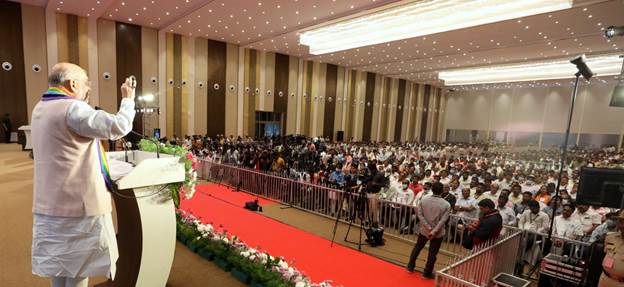
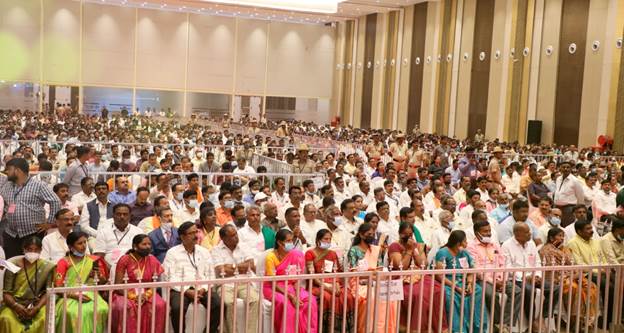
Union Minister of Home and Cooperation, Shri Amit Shah addressed the ‘Cooperative Beneficiaries Conference’ in Bengaluru, Karnataka today. Several dignitaries including Chief Minister of Karnataka Shri Basavaraj Bommai and Union Minister Shri Pralhad Joshi were present on the occasion.
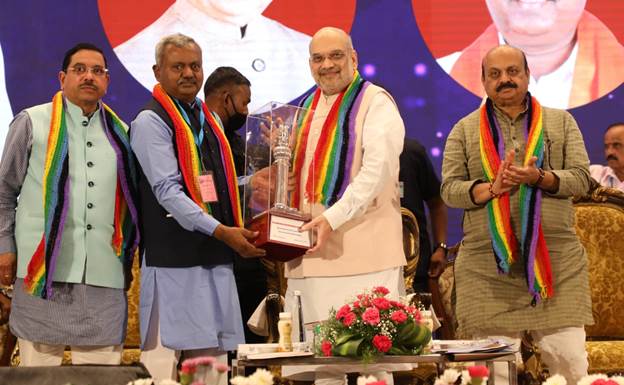
In his address, Shri Amit Shah said that the cooperative movement in Karnataka has been progressing at a good pace for more than 100 years. He said that the first cooperative society in the whole country was established in Gadag district of Karnataka in 1905. The cooperative movement that started from there, today stands as an example in front of the world with many successful models like Amul, KRIBHCO, IFFCO, Lijjat Papad.
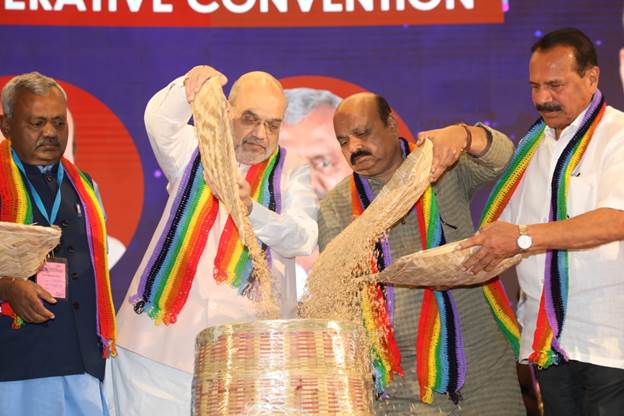
The Union Minister of Cooperation said that under the Nandini brand in Karnataka, about 23 lakh farmers, mostly women, are paid Rs 28 crore per day, which makes their lives more prosperous which is a huge achievement. He said that the beauty of the cooperatives is ‘Production for Masses, Production by Masses’.
Shri Amit Shah said that the Prime Minister Narendra Modi has given new momentum and long life to the cooperative movement by creating a separate ‘Ministry of Cooperation’ in the country. He said that out of 30 lakh cooperatives in the whole world, 9 lakh cooperatives are in India only. About 91 percent of India’s population is linked to a cooperative in one way or another, with cooperatives covering 70 percent of the country’s farmers through PACS. He said that there are 33 state level cooperative banks, 363 district level cooperative banks and 63,000 PACS in the country. Shri Shah said that today 19 percent of our agriculture finance is done through cooperative societies. 35 percent fertilizer distribution, 30 percent fertilizer production, 40 percent sugar production, 13 percent procurement of wheat and 20 percent of paddy procurement is done by cooperatives only.
The country’s first Minister of Cooperation said that since the government led by Prime Minister Narendra Modi came in the country many farmer-centric schemes has been made and accelerated further. He said that after the formation of the Ministry of Cooperation, many decisions were taken, such as to bring transparency in cooperatives, computerization of 63,000 PACS across the country has been done at a cost of Rs. 2,500 crores. Apart from this, one cooperative society will be formed in every panchayat of the country, which will be multi-purpose and NABARD, NDDB and the Ministry of Cooperation have prepared an action plan to form 2 lakh new such cooperative societies in three years. Shri Shah said that after this scheme, the coverage of cooperatives in the country, turnover and the number of its beneficiaries will increase more than three times.
Shri Amit Shah said that on the basis of Amul Model, a multistate cooperative Society is being established for the sale of organic products across the world, so that the profit goes directly to the farmers. A multistate cooperative society is also being formed for seed production and breed promotion of Indian seeds. He said that there is also a plan to set up a Cooperative University in the country, to create a national database of all cooperatives across the country work has started and formulation of a new cooperative policy has also begun. Shri Shah said that we are going to expand the role of NCDC along with NABARD so that cooperative societies can get finance in a better way. For conducting of transparent Elections a model act has also been prepared and sent to all the states. To bring transparency and fix accountability in the Multi-State Co-operative Societies Act, a bill has come which has been sent to the Standing Committee. He said that earlier more tax was being collected from the cooperative societies than the companies, but in the last budget Prime Minister Narendra Modi has brought the cooperatives at par with the companies by reducing the surcharge of the cooperative society from 12% to 7% by and reducing the alternative tax from 18% to 15%. Shri Shah said that the housing loan limit of Urban Cooperative Bank has been increased by 3 times by RBI, loan limit on commercial property has also been increased and door step banking has also been allowed.
The Union Home and Cooperation Minister said that it is not only the responsibility of Karnataka to strengthen the cooperative movement of Karnataka, some ideals have to be established so that the states across the country get the message and from here all the states can adopt the best practices and create a new model of cooperation in their respective states. He said that Prime Minister Narendra Modi’s decision to form the Ministry of Cooperation to speed up the cooperative movement will strengthen the efforts to fill the gaps in the cooperative movement across the country so that the cooperative movement progress uniformly across the country.
**************
International Workshop on Research Agenda, Social Needs and Open Science
by Shashikant Nishant Sharma
CSIR-NIScPR (National Institute of Science Communication & Policy Research) is involved in creating livelihood and foster skill development in rural areas through CSIR technologies. Recent cutting-edge fields are being worked on by various R&D divisions of the lab. Scientometric has been one of the institute’s strongest areas and CSIR-NISTADS (which was one of the laboratory which together with CSIR-NISCAIR merged to became NIScPR) was instrumental in bringing this area as a focus area of research and input to policy making in India. These were the words of Prof. Ranjana Aggarwal, Director, CSIR-NIScPR who was delivering a welcome address in an International Workshop on ‘Research agenda, Social needs and Open science’ organized by CSIR-NIScPR.
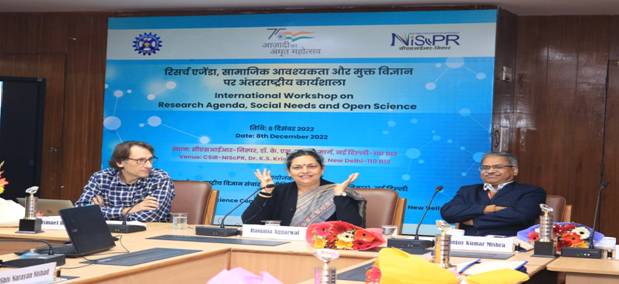
Prof. Ranjana Aggarwal, Director, CSIR-NIScPR addressing the workshop
Prof. Aggarwal highlighted that CSIR-NIScPR is the largest government organization in the nation that publishes more than 15 journals in a variety of research fields in an open access mode as there is no APC involved for publishing along with popular science magazines publications to bridge the gap between science and society. An online repository National Open Periodicals Repository (NOPR) of CSIR-NIScPR also provides to access of older papers from anywhere in the world. She concluded by emphasizing that CSIR-NIScPR is working towards solving problems under the motto “One Earth, One Family, and One Future.”
The global challenges have called for scientific research to increasingly reshape their agenda to focus more on societal problems. The reshaping can be seen prominently in the STI (Science-Technology-Innovation) policy framing of different countries and funding bodies. Responsible research and innovation, open science, open innovations are some of the key terms of new era that get space in policy articulations of different countries. Innovation System is also paying serious attention to informal, grass root and frugal innovations as they intervene to address unmet societal challenges. Cross-disciplinary interactions across different stakeholders have become important in this environment. The policy interactions need to be more evidence based to reshape the agenda and design pathways for implementation. In this context, an International Workshop on Research Agenda, Social needs and Open Science was organized on 8 December 2022 at CSIR-NIScPR. The conference was addressed by eminent scholars and policy makers from India and abroad.
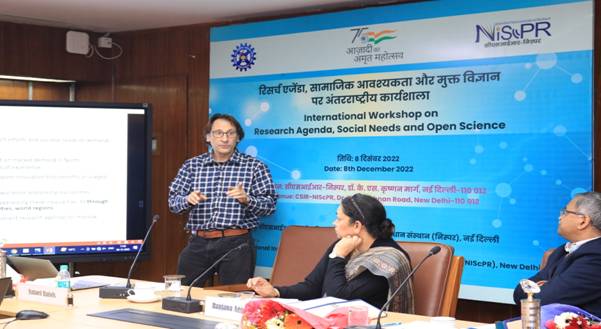
Dr. Ismael Rafols, UNESCO Chair, Leiden University, Netherlands delivering keynote address
Dr. Sanjay Kumar Mishra, Sr. Advisor, Department of Biotechnology, put forward his initial remark about the subject of workshop as putting three oceans of knowledge set into one go, namely bibliometrics, scientometrics and infometrics. Dr. Mishra urged to take into consideration social needs of societies, countries and on global level in research and research agenda to extract maximum benefit out of scientific research to mankind. He also opined that science advisory role is as important as research output. Usually science research is in general pro urban, pro affluent, there is need to be new focus on society oriented and need for synchronization of science and society. Bibliometrics and scientrometrics tool can be used to understand the gap in the research for society by scientific communities.
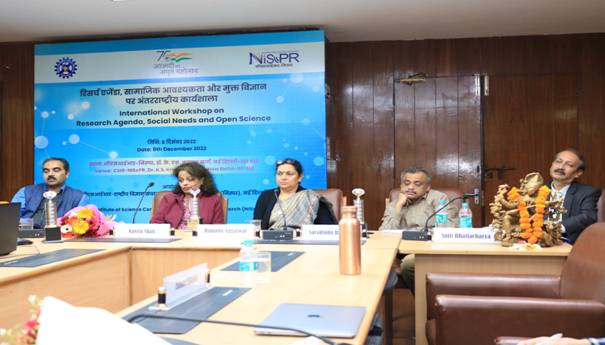
Speakers of the second session focused on ‘Frugal Innovations and Openness
Dr. Sujit Bhattacharya, Chief Scientist & Dean-Policy Research, CSIR-NIScPR and Coordinator of this Workshop began his talk by giving a brief overview of STS (Science, Technology and Society), innovation studies and Scientometrics research, drawing upon the strong linkages among these fields of research. He stressed that the contemporary global challenges have called for science-technology-innovation agenda be shaped by societal needs and user driven approach.
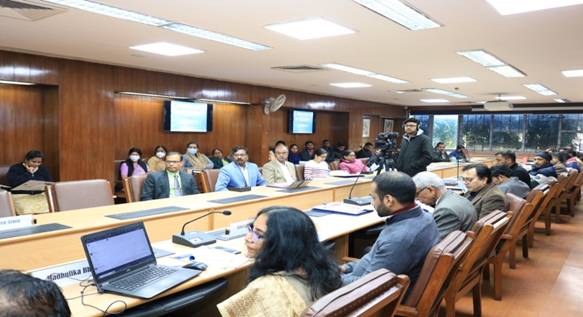
Scientists, staff members and audience of the workshop
Dr. Ismael Rafols, UNESCO Chair, Diversity and Inclusion in Global Science Centre for Science and Technology Strategies (CWTS), Leiden University, Netherlands delivered the keynote address. Dr. Rafols reinforced UNESCO recommendation of diverse and inclusive matter for research agenda for benefit of whole human kind. He brought forth the usual notion that research agenda tends to favour elite and rich though not universal but true to a greater extent. He justified his argument by describing concentration of research in global north, being driven by market demands and incentivized by few narrow academic goals and social groups. Dr. Rafols highlighted that research agendas are not in sync with SDG goals in higher and middle income countries. Evidence indicates better alignment in least developing countries of research with SDGs. He emphasized upon the need for more open access to science and having more open infrastructure so that maximum benefit can be achieved by mankind. He concluded by highlighting need for inclusion of citizen in sciences to lessen the misalignment.
Prof. Saradindu Bhaduri, Associate Professor, Centre for studies in Science Policy, Jawaharlal Nehru University, New Delhi and coordinator of the Trans-Disciplinary Research Centre on frugality studies (a joint initiative of JNU with Leiden University) gave his presentation on how research agenda, innovation, regulation, and user driven research conflict with each other. He highlighted some interesting engagements between policymakers and stakeholders. He highlighted how useful and widely used appliances such as stove suffer from agencies not giving standard certification.
Dr. Vivek Kumar Singh, Professor and Head of the Computer Science Department, Banaras Hindu University (BHU), Varanasi provided an overview of open access and its various forms, such as Gold, Platinum, and Diamond open access. He highlighted the open archive available at India such as the IndiaRxiv, eprints by the Indian Institute of Science, Krishikosh by the ICAR etc. Dr. Singh correctly emphasized the need for making research accessible to society because there is a gap in knowledge access in India, and we need to seek for effective policy implementation to address this.
Dr. Kavita Shah, Professor, Purdue University, USA gave a brief insight of the changing environment she has been observing in India now. The infrastructure, and support to research and many institutions now are in India which is bringing a positive change for doing high end research. She felt that this opportunity calls for students and researchers to make their research more aligned to the challenges faced by the society.
Dr. Madhulika Bhati, Principal Scientist, CSIR-NIScPR and Dr Anurag Kanojia, Policy Fellow, Department of Computer Science, BHU as discussant drew upon the important learning from this workshop. They stressed upon the important argument and key issues that linked the different presentations together.
Dr. Shiv Narayan Nishad, Scientist, CSIR-NIScPR gave a broad overview of the ongoing project on Social Network Analysis by CSIR-NIScPR. This study led by Dr. Sujit Bhattacharya and team in which he is the Co-Principal Investigator is exploring how social network analysis can be developed as a resource material for its application in different fields of studies. The project intends to impart training and provide the resources developed in open access.
The interactive session led to many questions and comments that enriched the workshop. The large number of young researchers who were among the attendee raised many important issues related to their research and how this workshop has benefitted them to think of Open access, aligning their research in proper direction, etc. At the end of the workshop, Dr. Sandhya Lakshmanan, Scientist CSIR-NIScPR proposed vote of thanks. Dr. Kasturi Mandal, Principal Scienctist, CSIR-NIScPR anchored the whole event and young researchers who acted as rapporteurs.
If Keyboards Could Talk.

The reasons for the design of these other keyboards and the subsequent impact they had on the world of keyboards are discussed. During this time, QWERTY has become a contentious issue, as many people believe that the market for serial keyboards is monopolized by sub-optimal layouts. All keyboards in history have always been the same, except for one case.
For example, the original name of this keyboard was “Moth” (I still use it in my head), and I now remember it came from that brain. When I found out that computers can do anything, remember this is one of those keyboards that still remembers what you typed. These were probably the most important things a keyboard player thought about at the time.
There was only the keyboard world, consisting of millions and millions. Once you learned to speak their language, all you had to worry about was their fingers, each with a number, on a keyboard that looked like a big metal claw. If keyboards could speak, they would tell you and hold you tighter as you typed all those vulnerable words in the world. If keyboards could speak, they would tell you how much the beauty of your soul fills the world with strength and how many souls, touching your words, can not wait to become like you, just like you.
I’m just guessing that if we could interview keyboardists, how much of a joke would that be. Well, we’ve interviewed some keyboardists and asked them if they’re happy, if they’re satisfied, if they feel abandoned, unhappy, or absolutely proud to serve you.
You have an idea xD I think my keyboard is fed up with the fact that I use it half the time and most likely it is plotting against me somehow. I better say goodbye before I start revealing secrets like how often I sit at my laptop. I have a feeling that if I could get into the habit of using it all the time instead of taking notes and lists on sheets of paper, I would be even more organized.
Imagine if the keyboards would talk and interview based on how fast he can type and what processor he has. Assuming that keyboards can talk, they explicitly tell us how much time we spend on them. Instead of feeling down and out of place and not telling others where they’re going, you might think about what the keyboard means, but not in a way that reminds you of the saying you shouldn’t pass; it is the most important of all the needs of the world. Use the keyboard to talk to you and he can turn around, talk to himself, and relax in peace.
My keyboard is essentially my confidant at work, not only listening but allowing me to do everything from dictation and typing, sitting quietly, and translating every keystroke without bias or judgment. Almost all keyboards share the process of searching and editing information with you, allowing you to do all your typing by silently transcribing every key pressed on its surface. Keyboards are probably the best secret keepers the world has to offer because you can express exactly what you think and feel, and if you don’t save the document, no one will know what you said. When I was angry, frustrated, elated, or even happy about the day, my keyboard could tell you exactly what mood I was in.
Imagine that you open your laptop to look for something, and as soon as you press a key on your keyboard, it starts yelling at you. However, in today’s world, it still doesn’t matter, but I’m sure one day it will. On the other hand, there are things that could be done without touching the keyboard and without shouting. That’s why keyboards would talk to you if they could talk or talk so they could rest and be quiet.
I think everyone is thanking GOD that the keyboard is an electronic device that has neither feelings nor a brain, otherwise, it would go wrong, there would be a huge fight between people, and maybe the war would break out between countries. If someone feels really jagged and empty and can’t share with others what they’re going through, do you think the keyboard really wants to express it without discerning the way I do here, I’m listening to what you’re slowly, you’re not in despair, you are irreplaceable and in demand in this world. Another thing our keyboards would say if they could speak is that some people really should be more open about what they think. Another thing that our keyboards can say is that they can talk to people and open their minds.
The popular saying is that actions speak louder than words, so you can imagine your strange dream of our lives turning into pure electronics when keyboards can speak. A very famous saying that actions speak louder than words, but have you ever wondered how magically our lives would be turned upside down if something as simple as a keyboard could talk? .Imagine today’s so-called lovebirds talking to each other using these keyboards via these social networking sites.
Since you don’t know what to type next, the keyboard might suggest you as your best friend: “Tell him he hasn’t forgotten what you did for him? I know it sounds selfish, but have you not thought about it? What are you fighting about?” If you can’t type on a keyboard, I suggest you and a good friend tell her, “Don’t forget, I know it sounds selfish, but you’re arguing right now, so think Think about what you’re talking about. Next time you go to write an article, send an email, or complete an online assignment, stop and think about what your keyboard will say to you. Give up motivational quotes just because you’re bored.
What you’re overlooking, however, is the feel of the keys we’re brutally and briskly wresting them back from… For that, it’s all killed off other questions like these that hum in focus every time we predict what will happen if a keyboard gets tangled. We spend as much time, if not more, at our keyboards and computers as they could see through who we make ourselves out to be. They can tell if we spend a lot of time studying or lying down all day watching Netflix. I’ve heard that some bloggers set their daily word or time goals and stick to the keyboard until their goals are met.
Styling And Beauty Tips

With expert advice and care tips from a couple of plant experts, we’ve identified 15 beautiful plants that will thrive in even the least plant-friendly places. Getty Images Shine up your look with these in-depth beauty tips drawn from over 75 years of Women’s Day magazines. If you’re out of eyeliner or don’t know how to wash your bathing suits, the following fashion and beauty tricks will make your life easier.
Rip your new shoes by putting on a pair of thick socks, then put on your shoes and blow dry your feet over medium heat for a few minutes. Also, apply a heat protectant setting spray to damp hair to protect the hair. Let your hair dry by sitting in the sun or use a hair dryer – the heat will lighten the strands.
If you often use straighteners and curling irons, spray a heat protectant spray on your hair before styling. Always start with a primer as it helps smooth the skin and creates the perfect base for the rest of your makeup. It will help to apply an even, smooth pencil to the mark the first time. Use a moisturizing body lotion every day and try applying it to damp skin (as this ensures maximum absorption).
The oil can prevent the penetration of surfactants (found in shampoos and other hair care products) that can damage the hair. Constant shampooing will make your hair dry and your scalp will produce more oil to compensate for the loss of moisture. Instead, use dry shampoo and tie your hair into a braid or ponytail when it gets a little thicker. Also, be sure to protect your hair from moisture (rain will definitely ruin your mane) and touch up your hair in the morning with a hairdryer and a round brush.
To keep your hair looking lively, use a sea salt spray or thickener before drying. For quick root coverage, use a dry shampoo spray to color your hair. If you don’t have this product on hand, use eyeshadow (the shade closest to your hair color) for a quick fix. Dip the angled makeup brush into the mascara brush and apply to the lids like a liquid eyeliner.
Blend with your finger or a cotton swab, then apply to the skin as a regular moisturizer. Do not apply moisturizer to your face, as it will take 10 minutes or more for it to absorb into the skin before your face is ready for makeup. Using too much of this product occasionally throughout the day will make your skin look chapped because you’re just layering your makeup on top of other makeup. Take good care of your hair after coloring and use color-protecting shampoos and conditioners to prevent further damage to your color-treated hair.
When your hair is 60%-70% dry, you can blow dry your hair from the roots with a blow dryer. For long-lasting curls, make sure your hair is completely dry before you start using the curling iron. Use a root makeup remover for quick styling, followed by hairspray.
So your jeans will last longer, and the color will not fade as quickly. Constant application of nail polish will make them brittle and brittle. For a perfect nail polish application, apply petroleum jelly to the nail cuticle with a Q-tip and your fingers won’t look dirty.
Getty Images Getty Images 7 of 75 Add shine to your hair Always rinse out conditioner (which should be applied to the ends) with cold water to seal cuticles and enhance shine. Jupiterimages Getty Images 3 of 75 Comb your hair from root to tip Comb your hair from root to tip every night.
It will also help prevent dandruff and other irritating conditions of the hair and scalp. The conditioner will soften the hair on your legs, making it easier to shave (and make your skin silkier). Rinsing your hair with beer helps restore moisture to the strands, while using vinegar will increase light levels.
When using shampoo, dilute it in half a cup of water and use it to wash your hair. Choose a sulfate-free shampoo, as sulfates can irritate and dry out the hair cuticle. Beauty Photo Studio Getty Images 13 of 75 Choose Your Shampoo Carefully If you dye your hair, look for shampoos and conditioners that are sulfate-free and free of harsh detergents.
Thinkstock 15 of 75 Beautiful Brows Soften skin before pinching by dabbing with a cotton swab dipped in warm water or cream. Westend61 Getty Images 16 of 75 Pluck in the direction of hair growth with tweezers. Lena Clara Getty Images 19 of 75 Straight Brow Hair To keep your brows unruly, apply hairspray to an old toothbrush, then comb your brows up and down.
Use tape under your eyes to catch any deposits and keep the color away from your cheeks. Also make sure to wear them correctly, with the waves facing down so your hair stays in place. “Be light on your bronzer and make sure your neck is the same color as your face.
You may like the warm, bronzed skin you get from sunburn, but this will lead to sun spots, wrinkles, and discoloration later on. Make sure the toner is alcohol-free so it doesn’t dry out your skin. To keep your hair color vibrant longer, use shampoos and conditioners designed for color-treated hair.
Coloring your hair in a salon has a number of advantages over having it done in the bath, as professional stylists usually do trials to make sure you get the exact color. Those suffering from sensitivity and hair damage should try a “scalp detox” to cleanse the skin without stripping it of its natural oils, according to Lin. Eugene Davis, celebrity hairdresser, suggests using an avocado oil hair mask. To make the perfume last longer, apply a small amount of Vaseline to the skin where you will be spraying the perfume.
For makeup that lasts all day and night, use a make-up fixer, such as a setting spray. According to makeup artist Kelly Bartlett, this will help the product fully absorb each wipe, starting with the one you use next. Just outline the lips as usual and then fill them in with color. Because exfoliating lips is the key to flawless lipstick application, you won’t want to skip this step of your beauty routine.
If you don’t give your body time to recover, your skin won’t look fresh and radiant. If left uncleaned, dead skin cells can make skin look dull, dark, bumpy, and dry.
You can get makeup brush cleaner from a pharmacy or beauty store, or just use shampoo and conditioner to clean your brushes like you would your own hair. To tame frizzy hair, spray a small amount of hairspray on your toothbrush and then use it to comb through frizzy strands.
Need To Inculcate Healthy Dietary Habits

At the family level, recommendations for feeding infants should include information about their nutritional needs and strategies to promote healthy eating behaviors, including recognizing hunger and satiety cues in children and using appropriate food interactions. by modeling and avoiding stress and conflict while eating. When children switch to a family diet, the recommendations are not only about food, but also about the nutritional context. Healthy eating is not only about including healthy food in children’s diets. Healthy eating is an important part of a healthy lifestyle and should be taught from an early age.
A healthy diet and proper eating habits for your children can help them become stronger, healthier and more immune. Following a weekly meal and snack plan can also instill disciplined eating habits from an early age. Eat with them. Eating healthy, nutritious food like a family with kids can really help instill healthy eating habits in them. In addition, family meals are an opportunity for parents to introduce their children to new foods and become role models for healthy eating.
Kids love the predictability of family meals, and parents have the opportunity to keep up with their kids. Family meals together are how children learn to choose healthy foods and learn table manners. If you insist that the children sit with you, even if they are not ready for solid food or refuse to eat, they will begin to learn the rules of the dinner.
Educate your little eaters about healthy eating and the different types of essential nutrients and let them enjoy their meal. Make it easy for kids to choose healthy snacks by keeping fruits and vegetables ready to eat.
Do not buy single servings of snacks, yogurt and other products that cost more. Instead, buy in bulk or more and divide into smaller portions as needed.
Stick to real foods like vegetables, fruits, nuts, lean meats, low-fat dairy and whole grain pasta, rice, and bread. Eat a diet that is 45% carbs, 30% protein, and 35% fat that is good for you: olive oil, fish, or nuts. While you want to eat 5 to 6 meals and snacks a day, don’t overeat at any of your meals and make sure you choose healthy, nutrient-dense foods. Pay attention to when and what you eat, and pay attention to your behavior and feelings associated with food.
That way, you’ll be more likely to eat healthier foods and less likely to eat unhealthy foods. Instead of focusing on what you shouldn’t eat, think about what you can add to your plate to improve your health, like walnuts for heart-healthy monounsaturated fatty acids or raspberries for fiber and antioxidants. By eating fruits and vegetables rather than overeating less nutritious things, you are sending the right message.
Eating healthy foods and staying physically active can help you achieve and maintain a healthy weight and feel better. You may also find that moving more and eating better can help you cope with the demands of your busy life and be around the people who depend on you. By making healthy lifestyle choices together, you may find it easier to move more and eat better.
You can go for a walk after dinner or play frisbee with your kids. Just 15 minutes of light physical activity within 30 minutes of eating can help you reach your calorie expenditure goal, curb late-night cravings that lead to snacking, and may even help you sleep better. Research shows that optimistic people are more successful at changing their behavior, including healthy eating and weight loss. Your family, friends, and colleagues can be a great source of support as you strive towards healthier habits. Not only can our physical health improve when we prioritize healthy eating. Healthy eating can stabilize children’s energy, sharpen their minds, and even out their moods.
It also helps children feel good, maintain a normal weight, and have enough energy to go to school and play. A balanced diet is the key to a healthy diet because it provides children with the nutrients they need to grow. Regular meals throughout the day are essential to keep your child active and help them focus while they study. Some kids in this age group are still fussy, so offer them a variety of regular foods, meals, and snacks, and let them eat according to their appetites, without forcing or arguing. If children are allowed to eat according to their appetite, they can decide how much food they need for activity and growth.
Meal sizes vary because the amount of food a child needs depends on what else they eat during the day. Children continue to learn new cooking techniques and ideas when dining out. They can participate in the preparation of packed lunches and help their caregivers prepare healthy meals. Their “job” is to ensure that children are served healthy meals on a predictable schedule in a pleasant environment. 39 By developing meal schedules, caregivers can help children learn to predict when they will eat. Babies need three healthy meals and two snacks for physical development and immunity.
However, many can testify that getting children to eat healthy food is not always easy. Parents who teach their children about healthy eating from an early age can have a positive impact on their children’s eating habits later in life. Over the years, researchers have found evidence that eating behaviors and eating habits in early childhood affect the food preferences and eating patterns of children in adulthood.
Healthy eating during adolescence is important because changes in the body during this period affect a person’s nutritional and dietary needs. Instilling good eating habits in children can be very easy for parents if they set the right example. In addition to the level of education, an important element in achieving a healthy diet is the internalization of eating habits that make it possible.
We have seen that these habits increase with the age of the respondents. First, we noticed that with age, the socio-economic and living situation of the respondents stabilizes, which contributes to their eating habits becoming more regular and healthy, and at the same time, the awareness of the respondents of the need to lead a more regulated and healthy lifestyle increases. Thus, as the study “The influence of age and gender identity on the health of university students in eating in Spain”, on which this article is based, shows, all respondents know what a healthy diet is due to their high educational level. In particular, students who are most interested in healthy eating are also most concerned about buying foods that they believe are healthy.
 Eduindex
You must be logged in to post a comment.