Instantly Answer Questions with Your Custom AI Chatbot

Daily writing prompt
What are your thoughts on the concept of living a very long life?

Chatwith.tools is a cutting-edge platform that enables businesses, educators, researchers, and individuals to build, deploy, and manage custom AI chatbots tailored to their specific needs. The platform leverages advanced AI technologies to deliver instant, accurate, and context-aware responses, enhancing user engagement, productivity, and overall experience.


Key Features

1. Customizable Chatbots

  • Design your chatbot to align with your specific domain or industry needs.
  • Integrate specialized knowledge bases or datasets to make the chatbot an expert in your chosen area.
  • Personalize chatbot behavior, tone, and branding to maintain consistency with your organizational identity.

2. Instant Answers

  • Provides instant, accurate responses to user queries.
  • Reduces the time spent on repetitive questions, allowing you to focus on more complex tasks.
  • Powered by advanced AI models for context-aware and natural language processing.

3. User-Friendly Interface

  • Easy-to-navigate dashboard for creating and managing chatbots.
  • No coding skills required – the platform offers a drag-and-drop or simple configuration setup.
  • Suitable for both beginners and advanced users.

4. Integration Capabilities

  • Seamless integration with popular platforms like websites, apps, and messaging services (e.g., WhatsApp, Messenger, Slack).
  • API support for custom integrations into existing software or systems.
  • Compatible with CRMs, eCommerce platforms, and learning management systems (LMS).

5. Advanced AI and Machine Learning

  • Built on state-of-the-art natural language understanding (NLU) technologies.
  • Learns and adapts over time to improve response accuracy.
  • Supports multiple languages, making it ideal for global applications.

6. Analytics and Reporting

  • Access detailed analytics on chatbot performance, user interactions, and frequently asked questions.
  • Insights help improve chatbot efficiency and user satisfaction.
  • Real-time feedback and monitoring to ensure optimal operation.

7. Affordable and Scalable

  • Flexible pricing plans to suit different needs – from startups to large enterprises.
  • Scalable architecture to handle growing user interactions without performance issues.

Use Cases

1. Customer Support

  • Automate responses to FAQs.
  • Provide 24/7 support, ensuring customer queries are resolved promptly.
  • Free up human agents for more complex or sensitive issues.

2. Education and E-Learning

  • Enable interactive learning experiences by answering student questions instantly.
  • Assist with course navigation, resource recommendations, and academic inquiries.
  • Support remote learning programs with multilingual chat capabilities.

3. E-Commerce

  • Improve user experience by guiding customers through product catalogs.
  • Handle queries about shipping, returns, and payments.
  • Recommend products based on user preferences and past behavior.

4. Healthcare

  • Provide preliminary medical advice or information on symptoms.
  • Guide patients to appropriate services or specialists.
  • Share appointment schedules or reminders.

5. Research and Academia

  • Help researchers navigate vast knowledge bases.
  • Answer specific technical or scholarly questions with precision.
  • Facilitate collaboration by summarizing complex topics in real-time.

How to Get Started

  1. Sign Up: Create an account on https://chatwith.tools/.
  2. Build Your Bot: Use the platform’s intuitive interface to design and train your chatbot.
  3. Integrate: Deploy the chatbot on your website, app, or preferred messaging platform.
  4. Optimize: Monitor performance using analytics and make iterative improvements.

Why Choose Chatwith.tools?

  • Time-Saving: Automates repetitive tasks and ensures instant responses.
  • Cost-Effective: Reduces operational costs by minimizing human intervention.
  • Enhanced Engagement: Creates personalized user experiences, increasing satisfaction.
  • Future-Ready: Keeps your organization ahead in the AI-driven digital landscape.

Experience the power of tailored AI solutions with Chatwith.tools. Build your custom chatbot today and transform how you interact with your audience.

The Rise of Crony Capitalism in India

Daily writing prompt
What are your thoughts on the concept of living a very long life?

By Shashikant Nishant Sharma

If democracy and economy is to flourish then there is a need to have a good mechanism to detect and prevent the rise of crony capitalism in India. This can be done only if multi pronged strategies are adopted for this. Our legal system should work in close collaboration with the academia to ensure that good practices are evolved and new policies are adopted to make our democracy and economy work independently yet in a holistic manner to enhance the quality of life of the millions of India who have faith in our constitution. 

Crony capitalism refers to a situation where businesses and individuals with close relationships to the government are given preferential treatment and advantages, often resulting in unfair competition and the misallocation of resources. India has faced several cases of crony capitalism over the years. The 2G spectrum scam, which came to light in 2010, involved the irregular allocation of 2G mobile spectrum licenses by the government. The scam resulted in a loss of billions of dollars to the exchequer. It was alleged that the licenses were sold at significantly undervalued prices to select companies with close ties to politicians and government officials. The coal scam, also known as “Coalgate,” involved the improper allocation of coal blocks by the government between 2004 and 2009. It was alleged that the coal blocks were allocated to private companies without following proper procedures, resulting in significant financial losses to the government. Many companies linked to politicians and influential individuals were accused of benefiting from the scam. The Commonwealth Games held in Delhi in 2010 were marred by allegations of corruption and mismanagement. It was alleged that contracts for various infrastructure projects related to the Games were awarded to companies close to influential politicians and government officials at inflated prices. The irregularities and misappropriation of funds led to public outrage and investigations. The Adarsh Housing Society scam, which surfaced in 2010, involved the illegal construction of a high-rise residential building in Mumbai. The building was initially intended to be a housing project for war veterans and widows, but it was alleged that influential individuals, including politicians and bureaucrats, obtained flats in the building through fraudulent means. The scam highlighted the nexus between politicians, bureaucrats, and real estate developers. Vijay Mallya, the former chairman of Kingfisher Airlines, faced allegations of crony capitalism and financial irregularities. It was alleged that he received preferential treatment from banks and politicians, including access to loans and financial assistance, despite the deteriorating financial health of his airline. Mallya left India in 2016 and is currently facing extradition from the United Kingdom.

These are just a few instances of alleged crony capitalism in India. It’s important to note that allegations are not proof of guilt, and legal proceedings and investigations are often ongoing in such cases. Curbing the rise of crony capitalism requires a comprehensive approach involving various stakeholders, including the government, regulatory bodies, and civil society. We need to enhance transparency in decision-making processes and public procurement. Government should implement measures such as e-auctions, online portals, and open bidding systems to ensure a level playing field for all businesses. There is a need to establish effective mechanisms to hold public officials and politicians accountable for any corrupt practices or undue favors. Time has come when a system of robust regulatory framework can be implemented and enforced strictly in conjunction with regulations and laws to prevent the abuse of power and manipulation of the system. While planning we must ensure that regulatory bodies have adequate resources and independence to perform their duties effectively. Regularly review and update regulations to address emerging challenges and loopholes. The competition commission of India should act in a progressive manner to foster a competitive market environment by breaking up monopolies and promoting fair competition. Encourage the entry of new players, both domestic and foreign, in various sectors. Empower competition commissions to monitor and take action against anti-competitive practices.  The dress of Anna Hazare can be realized only by implementing and enforcing strong anti-corruption laws. All government departments should try to establish specialized anti-corruption agencies with adequate resources and independence to investigate and prosecute corruption cases. Encourage whistleblowing and protect whistleblowers from retaliation. Promote a culture of integrity and ethics in both public and private sectors. As envisioned by the makers of the constitution of India, we should ensure judicial independence and expedite the resolution of commercial disputes. Establish specialized courts to handle cases related to corruption and economic offenses. Streamline legal procedures and reduce the backlog of cases to ensure timely justice. On the pattern of Atal Bihari Vajpayee Institute of Good Governance and Policy Analysis (AIGGPA) as set up by the government of Madhya Pradesh to strengthen institutions and promote good governance practices at all levels. Encourage transparency in political funding and electoral processes. Implement effective measures to prevent the misuse of public funds and resources. After the setting up of the AIGGPA, in Madhya Pradesh there has been enhancement in the efficiency and accountability of government institutions and bodies in the state of Madhya Pradesh.

We should encourage the active participation of civil society organizations, non-governmental organizations, and the media in monitoring and exposing instances of crony capitalism. All institutions must support investigative journalism and protect the freedom of the press. Foster a culture of public scrutiny and accountability in the youths so that they can be the next leaders and businessmen. Government must implement robust financial and corporate governance practices. Enhance disclosure requirements for companies, particularly those related to beneficial ownership and related-party transactions. We must encourage adoption of auditing and accounting standards to ensure accurate and reliable financial reporting. To ensure transparency and fair competition in PPP projects we must encourage close collaboration of the public and private sectors in delivery of services. We must develop clear guidelines and criteria for project selection and bidding processes. Implement effective monitoring and evaluation mechanisms to prevent favoritism and ensure accountability in PPP projects. Government should undertake structural economic reforms to reduce excessive government intervention and promote market competition. Simplify and streamline regulatory processes to facilitate ease of doing business. Government must encourage entrepreneurship, innovation, and investment in sectors that promote inclusive growth. It’s important to note that curbing crony capitalism is a complex and ongoing process that requires consistent efforts and the involvement of all stakeholders. It necessitates a commitment to integrity, transparency, and ethical governance from both the government and the private sector.

References

Khatri, N. (2016). Definitions of cronyism, corruption, and crony capitalism. Crony capitalism in India: Establishing robust counteractive institutional frameworks, 3-7.

Gandhi, A., & Walton, M. (2012). Where do India’s billionaires get their wealth?. Economic and Political Weekly, 10-14.

Gowda, M. R., & Sharalaya, N. (2016). Crony capitalism and India’s political system. Crony Capitalism in India: Establishing robust counteractive institutional frameworks, 131-158.

Gupta, V. (2016). Indian administrative service and crony capitalism. Crony Capitalism in India: Establishing Robust Counteractive Institutional Frameworks, 177-205.

Kapil S. K. (2023). The Anatomy of Crony Capitalism in India. Economic and Political Weekly, vol LVIII no 20, 23-27

Shah, M. (2021). Reading KN Raj in the Age of Free Market Fundamentalism. Economic & Political Weekly, 56(14), 33.

Varma, A., Hu, B., & Bloomquist, L. (2016). Family oligarchies and crony capitalism in india. Crony Capitalism in India: Establishing Robust Counteractive Institutional Frameworks, 159-176.

Role of India in Multipolar Global Political Economy

Daily writing prompt
What are your thoughts on the concept of living a very long life?

By Shashikant Nishant Sharma

India’s role in the multipolar global political economy is significant due to its economic and geopolitical importance. India is the world’s sixth-largest economy and has been experiencing steady economic growth in recent years. The country’s strategic location between East and West, coupled with its large population, make it an important player in the international arena. 

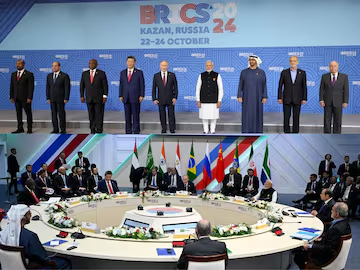
India’s economic policies and reforms have contributed to its rise as a major economic power. The country has implemented policies to attract foreign investment and has opened up various sectors for private participation. The government has also focused on improving infrastructure, developing a skilled workforce, and promoting entrepreneurship. In addition to its economic importance, India also plays a significant role in global politics. The country is a member of various international organizations, including the United Nations, World Trade Organization, and BRICS. India’s leadership has been instrumental in shaping the agenda of these organizations and in promoting the interests of developing countries. India’s strategic location also makes it an important player in regional geopolitics. The country has been involved in various peacekeeping missions, and its military capabilities have been growing in recent years. India has also been strengthening its relationships with other major powers, including the United States, Russia, and China. Overall, India’s role in the multipolar global political economy is likely to continue to grow in the coming years. The country’s economic and geopolitical importance, coupled with its strategic location, make it a key player in the international arena. Global trade is an essential aspect of the modern economy, and it relies heavily on trust and confidence between parties involved. A breach of confidence can have severe consequences for international trade and the global economy as a whole.

A breach of confidence in global trade can take many forms, including the failure to fulfill contractual obligations, misrepresentation of goods or services, or the theft of intellectual property. These breaches can result in legal disputes, loss of revenue, and damage to reputation, which can be costly for businesses and countries involved. When a breach of confidence occurs, it can lead to a breakdown in trust between parties involved, making it more challenging to engage in future trade deals. This can lead to increased transaction costs, reduced investment, and lower economic growth, ultimately impacting consumers. The World Trade Organization (WTO) and other international bodies play a crucial role in promoting fair trade practices and resolving disputes between countries. However, their effectiveness is limited when it comes to enforcing trade agreements and preventing breaches of confidence.

Dollar hegemony refers to the dominant position of the US dollar in the global economy as the primary reserve currency and medium of exchange. The term is used to describe the extensive use of the US dollar in international trade, finance, and investment, giving the United States significant economic and political power.

The dollar’s dominance dates back to the Bretton Woods agreement of 1944, where the US dollar was established as the international reserve currency, and other countries pegged their currencies to the dollar. This allowed the US to enjoy significant economic and political power and played a crucial role in the post-World War II economic order. Today, the dollar remains the dominant currency in international trade and finance, with over 60% of global foreign exchange reserves held in US dollars. Many countries continue to use the dollar as a medium of exchange, and international commodity prices are usually quoted in dollars. The dollar’s dominance has several implications for the global economy. First, it provides the United States with a unique advantage in international trade, as other countries are dependent on the US dollar to conduct transactions. Second, it allows the US to borrow at lower interest rates, as investors have a high level of confidence in the US dollar and the US economy. However, the dollar’s hegemony also comes with some challenges. The US’s monetary policy decisions can have significant impacts on the global economy, as changes in interest rates and other monetary policies can affect other countries’ economies. Additionally, the US’s high level of debt has raised concerns about the dollar’s stability as a reserve currency. In recent years, there have been calls for the diversification of international reserve currencies and the establishment of alternative payment systems. Some countries, including China and Russia, have been promoting the use of their currencies in international trade and finance to reduce their dependence on the US dollar.

Overall, dollar hegemony continues to shape the global economy, and it is an essential factor in international trade and finance. The ongoing debates around its stability and the need for diversification demonstrate the complex and ever-changing nature of the global economic order.

India plays a significant role in the multipolar global political economy due to its economic and geopolitical importance. The country’s economic policies and reforms have contributed to its rise as a major economic power, and its strategic location makes it a key player in regional geopolitics. India’s leadership has been instrumental in shaping the agenda of international organizations and promoting the interests of developing countries.

However, India also faces several challenges, including poverty, inequality, and infrastructure gaps. The country has been working towards addressing these challenges through various initiatives such as the Make in India campaign, Digital India, and Swachh Bharat Abhiyan. India’s role in the global economy and its rise as a major economic power can provide opportunities for businesses and investors to tap into its large market and skilled workforce. The country’s focus on innovation and entrepreneurship can also create opportunities for collaboration and partnership in various sectors. 

In conclusion, India’s position in the multipolar global political economy is significant, and its continued growth and development will have far-reaching implications for the global economy. However, the country faces several challenges that need to be addressed, and there is a need for continued investment and collaboration to unlock its full potential.

References

Bastos, M. (2014). The Indian Ocean and the rise of a multi-polar world order: The role of China and India. Policy Perspectives: The Journal of the Institute of Policy Studies11(2), 17-28.

Chakraborty, S. (2018). Significance of BRICS: Regional powers, global governance, and the roadmap for multipolar world. Emerging Economy Studies4(2), 182-191.

Cooper, A. F., & Flemes, D. (2013). Foreign policy strategies of emerging powers in a multipolar world: An introductory review. Third World Quarterly34(6), 943-962.

Kukreja, V. (2020). India in the emergent multipolar world order: Dynamics and strategic challenges. India Quarterly76(1), 8-23.

Peters, M. A. (2023). The emerging multipolar world order: A preliminary analysis. Educational Philosophy and Theory55(14), 1653-1663.

Sharma, S. N. (2017). Geopolitics and Terrorism in Asia-Pacific Region vis-a-vis India.