GPS-based Classification Algorithm for Employee Attendance System using Telegram API

Daily writing prompt
What do you enjoy doing most in your leisure time?

Citation

Taqi, M. K. (2026). GPS-based Classification Algorithm for Employee Attendance System using Telegram API. International Journal of Research, 13(1), 406–415. https://doi.org/10.26643/ijr/2026/14

Mustafa Kadhim Taqi
Technical College of Management – Kufa, Al-Furat Al-Awsat Technical University, Kufa, 54003, Iraq

Email: ktmustafa@atu.edu.iq

Abstract

The attendance system for employees, which is mostly used across the globe, is based on a fingerprint device. The drawbacks of this system are the presence of tool dependency, lower availability of fingerprint scanners, and the equipment being far away from the work premises. Due to the mentioned shortcomings, we propose an application system for presence built on the Telegram Bot using GPS. It will aid the employee in showing up in their work area. By installing the proposed system, numerous benefits will result. It will ease the overall presence system, and the processing of data on presence will be much more automated and easier. Due to the Telegram Bot method, the system can easily navigate the employee data, highlight daily attendance output, and efficiently store the presence results. It has a prediction accuracy of 87.5%, an acquired system sensitivity of 80%, and a shown specificity of about 91%.

Keywords: Attendance system, Telegram BOT, Classification, GPS.

  1.  Introduction

The dire duty of the employee is to be present in their workspace [1]. Employee discipline can be measured from the presence system by evaluating the presence data. The presence data approach is from marking attendance. Numerous ways are utilized in the procedure of obtaining presence data, i.e., fingerprint, signature, and scanned barcode [2]. Most organizations are using handprints or fingerprints as their standard presence method [3].

Fingerprints as a presence method is one of the most renowned ways of obtaining presence data [4]. This method reduces the fraud ratio as each individual has a unique fingerprint. The deployment of fingerprint sensors is mostly scarce and limited. The employee has to move to the specific space to mark their presence, where the equipment is installed [5]. Rather, the employee doesn’t need to be close to the area of the fingerprint attendance marking equipment. Though they are physically present in the organization when they are in their working area. It can be summed up that employees show presence at their workplace [6]. To aid the employees who work not so close to the presence marking equipment, an innovative presence system is required [7]. Through that unique presence system, presence data can be collected and obtained from any space of the actual work environment. The employee can record their presence from anywhere on the work premises. Such an employee attendance model can be developed through GPS-based using a Telegram Bot [8].

  • Methods and Materials

An attendance methodology is a way that is employed for storing, scrutinizing, and obtaining a screenshot of the attendance profile of each organizational member. The purpose of the attendance system is to store the presence of each person along with their time of arrival and departure. For conducting this research study, different research methodologies were used. These include:

  • Database design
  • Telegram BOT design
  • API design
  • System analysis and testing

            Generally, the application is developed to mark the presence of employees. In this application, each member verifies their presence via a Telegram BOT, which is present in a designated area in the organization. The data is then sent to the installed server. API receives the data, and then it is stored in the database. A Telegram BOT has been developed that can be accessed by the department admin. Through the application, they can preview data on presence that has been stored in the database. The process is illustrated in Figure 1.

Figure 1. Telegram BOT architecture for employee attendance systems using GPS

  • Entity-Relationship Diagrams (ERD)

The proposed database has been designed by employing ERD. ERD can classify the required needs for the database among constructing systems [9]. A detailed illustration can be viewed in the diagram below. The diagram depicts six tables termed userstb, rolestb, users_rolestb, attendances, locations, and shift tables. The primary-foreign relationship between the userstb and users_rolestb tables has been established based on the user identity number (user_id). On the other hand, the relationship between the userstb, attendance, and shift tables has been established based on the chat_id given by the Telegram BOT. locations and attendance tables were related to the location ID.

Figure 2. Database design using entity-relationship diagrams (ERD).

  • The Design of the Telegram BOT

It is composed of a thorough design pertinent to the involved users, flow, and roles of the entire system. It also includes the user interface design. Only the admin can access the Telegram BOT’s menu for controlling the attendance system. In that menu, the admin can view allowed attendance locations, delete locations, edit locations’ data, and even add new locations in the use case diagram. Figure 3 illustrates how the admin adds a new attendance registration location.

(a) System settings menu(b) Add a new attendance location
(c) Read GPS location command(d) Adding confimation message

Figure 3. Admin menu for the GPS-based employee attendance system

The employee menu comprises two items for attendance registration. The first menu item is for presence registration at the beginning of the shift. The second item is dedicated to dismissing registration. Figure 4 illustrates the employee menu items and the process of presence registration.

(a) Employee menu(b) Presence and dismiss menu
(c) Command for location registration(d) Share employee location (GPS)
(e) Accepting presence(f) Rejecting presence

Figure 4. Employee menu for GPS-based employee attendance system

The attendance system of employees has its basis in the GPS of the Telegram Bot, upon which the API (Application Programming Interface) is developed. API acts as an intermediary among systems of data communication that are present on the server. It has an application on Telegram Bot. The involvement of API speeds up the procedure of designing applications on the Telegram Bot as the API gives the needed features. Due to this feature of API, the developers do not have to add parallel features. Figure 5 shows the test location point.

Figure 5. Test points

  • Obtaining Data. The API design initiates when it obtains data in the format of the longitude and latitude of the device. The sequence is checked in as location and data completeness.
    • Developing API register. The development of REST API initiates after the API starts obtaining data in the pattern of birthplace and parent number. Then, checking in sequence, termed employment status data completeness, and employee data for more clarity.
    • Use Case Diagrams Design. Telegram Bot applications can be used by authorized users and employees. These features are available, i.e., attendance and register.
    • Designing the activity diagram. The Telegram BOT is developed with 2 core features, i.e., presence and registration. In the registration menu, the app instantly requests data from the IMEI device on the Telegram BOT. This data is sent to the server, which is tallied with the database.

The application attendance menu prompts for GPS data [7], and IMEI device data. If the GPS location is valid and a success then the collected data will be transferred to the server database. As result the server will transfer a failed or successful response to mark the presence and then it will preview it on the Telegram BOT application.

  •  Outcomes

While conducting the test prior, the user can state the place/location for system testing. The testing location points and figures are outlined below. Different testing points at various locations present outside and inside are employed. Figure 8 depicts the testing and the outcomes are recorded in Table 1. There are multiple provisions in the test outcomes termed as:

  • True positives: presence is classified as inside an area
  • True negatives: presence is classified as inside in the outside area.
  • False positives: area presence is termed outside.
  • False negatives: presence is termed as outside.

Table 1. Results of presence at several attendance registration points

PointLatitudeLongitudePresence (Inside/Outside)Provisions
132.0201944.24388OutsideTN
232.03390844.410864OutsideTN
332.03394744.410949OutsideTN
432.03356744.411552InsideFP
532.03361844.411373OutsideFN
632.03399744.411006OutsideTN
732.03390144.411042OutsideTN
832.03353644.411483InsideTP
932.03357644.411512InsideTP
1032.03395244.411119OutsideTN
1132.03379744.411142OutsideTN
1232.03377244.411258OutsideTN
1332.03361244.411482InsideTP
1432.03360544.411427InsideTP
1532.03373244.411262OutsideTN
1632.03374644.411178OutsideTN

From the table above it is found that the values of TP = 4, TN = 10, FP = 1, and FN = 1, the values of sensitivity, specificity, and accuracy of the system are as follows:

  • Conclusions

The outlined method developed for the employee presence system is composed of 11 functions that are operating smoothly. Registration REST API and REST API attendance developed for employee attendance systems can interact with systems on the Telegram BOT. The proposed system has a sensitivity of 80%, a specificity of 91%, and an accuracy rate of 87.5%, demonstrating that the system is successfully running.

However, it is worth mentioning that the system may not grasp the precise location inside the concrete buildings, which may explain the fourth test point where the system incorrectly predicts it. On the other hand, the presence points close to the desired registration points by the admin may also be incorrectly predicted. This case has been shown with the fifth test point.

Based on the obtained results, the author recommends using the proposed system in registering the presence of employees.

References

[1]        Setiowati, R., et al., Development of Employees Attendance Features of Human Resource Information System in A National Logistics Company. 2023: p. 136-140.

[2]        Nasution, T.H., et al., Design of Portable Fingerprint System Prototype for Student Presence Integrated with Academic Information System at the Universitas Sumatera Utara. 2019. 1(1): p. 47-54.

[3]        Ekowati, V.M., et al., An Empirical Approach to Evaluate Employee Performance Using Finger Print Attendance. 2024. 25(199): p. 57-64.

[4]        Rahkoyo, E., et al. IoT-Based Fingerprint Attendance System: Enhancing Efficiency and Security in Educational and Organizational Settings. in 2024 International Conference on Advances in Modern Age Technologies for Health and Engineering Science (AMATHE). 2024. IEEE.

[5]        Abbas, Z., et al., A Fingerprint based Students attendance System with SMS alert to Parents. 2023. 6(3).

[6]        El-Mawla, A., et al., Smart Attendance System Using QR-Code, Finger Print and Face Recognition. 2022. 2(1): p. 1-16.

[7]        Singh, R., et al. Fingerprint-based Portable Attendance Monitoring System using Raspberry Pi Pico. in 2024 11th International Conference on Computing for Sustainable Global Development (INDIACom). 2024. IEEE.

[8]        Dali, S.W., H. Hadiwiyatno, and D.W.J.J.o. T.N. Illahi, Design and development of a web-based compensation information and registration system using biometric fingerprint approval delivery using telegram bot digital: registration and submission of compensation using the fingerprint and telegram websites. 2023. 13(4): p. 385-394.

[9]        Pulungan, S.M., et al., Analisis Teknik Entity-Relationship Diagram Dalam Perancangan Database. 2023. 1(2): p. 143-147.
Design and Development of A 1.5 KVA Mobile Solar Power System as an Alternative Power Supply for Teaching and Learning

Daily writing prompt
What do you enjoy doing most in your leisure time?

Aimayo, J. V., Dibosa, P., & Olorunwaju, A. (2026). Design and Development of A 1.5 KVA Mobile Solar Power System as an Alternative Power Supply for Teaching and Learning. International Journal of Research, 13(1), 269–277. https://doi.org/10.26643/ijr/2026/5

Engr. J.V.  Aimayo (Phd)

Engr. P. Dibosa

Department of Electrical/ Electronic Technology Education

Mr. A. Olorunwaju

Department of Automobile Technology Education

Federal College of Education, Technical, Asaba

Abstract

This project involved designing and developing a 1.5 KVA solar power system as an alternative power source for teaching and learning. It was initiated to address the major challenge of inadequate and unreliable power supply at the Federal College of Education Technical Asaba. The study employed a design and development approach following standard engineering stages, including problem identification, system specification, design analysis, component selection, construction, and performance testing. Materials used included four 250W solar panels, 60 Amps, MPPT charge controller, a 240 Ah deep-cycle battery, and a 1.5 KVA inverter. These components were assembled into the system. The inverter’s performance was evaluated through various tests: a no-load test to verify output voltage and frequency, a load test using instructional equipment to assess stability, and a battery discharge test to determine backup duration. Additional tests on mobility and safety assessed ease of movement and compliance with electrical safety standards. Test results were compared with the design specifications to evaluate effectiveness for educational purposes. During the no-load test, the inverter produced approximately 230 V AC at 50 Hz, meeting standard utility requirements. At an estimated load of 484 W, about 80% of the inverter’s rated capacity, the output remained stable without shutdown or overheating, indicating suitability for continuous use in classrooms and labs. The battery discharge test showed an average backup of 3.5 to 4.1 hours under full instructional load, closely matching the estimated backup time during design.

Keywords:  MPPT, Load, Design, Test

Introduction

Electricity plays a vital role in modern society and has become an indispensable resource across virtually all aspects of human endeavor. Access to reliable electrical power enables educational, economic, industrial, and technological activities, thereby enhancing productivity and quality of life. Unfortunately, consistent access to electricity remains a major challenge in many developing countries, including Nigeria. Despite successive administrations investing substantial financial resources in electricity generation, transmission, and distribution projects, the supply of power in Nigeria continues to be inadequate in both quantity and quality.

As a result of frequent power outages and unreliable grid supply, many households and business owners have resorted to the use of diesel-powered generators as alternative sources of electricity. While generators provide temporary relief, their use is associated with several disadvantages, including high operating and maintenance costs, excessive noise pollution, and adverse environmental and health impacts due to exhaust emissions. These challenges underscore the urgent need for clean, sustainable, and cost-effective alternative energy sources.

Renewable energy, particularly solar photovoltaic (PV) technology, presents a viable solution to these challenges. Solar PV systems are renewable, environmentally friendly, silent in operation, and suitable for both grid-connected and off-grid applications. In recent years, the integration of solar PV systems into educational environments has gained increasing attention, especially in regions characterized by unstable or inadequate electricity supply. Solar PV systems are particularly attractive for educational institutions due to their scalability, declining installation costs, and long-term economic benefits.

Several studies have demonstrated the effectiveness of solar PV systems in meeting institutional energy needs. For instance, Okpeki et al. (2023) evaluated a 2.5 kVA solar power system and established its viability in supplying basic electrical loads through appropriate sizing of solar panels, charge controllers, batteries, and inverters. Extending these design principles to moderate-capacity systems, Mbaya et al. (2022) reported the design and implementation of a 5 kVA solar photovoltaic system for an electronics laboratory. Their study showed that the system was capable of delivering over 18 kWh of energy daily, ensuring uninterrupted laboratory activities and reliable power supply for critical teaching equipment during grid outages. Similarly, Yunisa et al. (2022) emphasized the importance of effective power electronics design in the construction of a 5 kVA solar power inverter system, highlighting the need for reliable DC–AC conversion and system protection to support sensitive educational equipment.

Beyond fixed installations, mobile solar power systems offer additional advantages, particularly in teaching and learning contexts that require flexibility and portability. Mobile systems introduce design considerations such as weight distribution, structural housing, ease of deployment, and maintenance, which are essential for practical educational use. Against this backdrop, the main purpose of this study is to design and develop a 1.5 kVA mobile solar power system as an alternative power supply for teaching and learning. The specific objectives include problem identification, system specification, design analysis, component selection, construction, and performance testing.

The scope of the study covers the design, construction, and testing of a 1.5 kVA mobile solar generator comprising solar panels, batteries, a charge controller, an inverter, a protective casing, and a mobile trolley. Upon completion, the system is expected to provide a clean, silent, and reliable source of electricity for academic activities, while also enhancing students’ acquisition of practical technical skills through hands-on engagement with renewable energy technologies.

MATERIALS AND METHOD

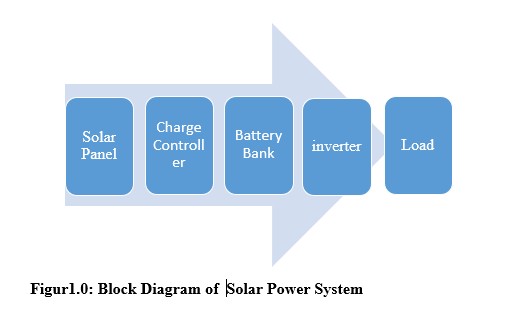
 Materials for the development of the mobile solar power system include solar panels, assorted cables   charge controller, a battery bank, an inverter unit, and   mobile mechanical enclosure. The quantities, ratings, dimensions, and capacities of these materials are determined by a simple engineering design procedure .Materials were acquired from local electrical/ electronic shops within the area of study. The block diagram of the system is shown in figure   1  .

   Figur1.0: Block Diagram of   Solar Power System

System Design Procedure

This study adopted a design-and-development research design. The methodology followed standard engineering design stages, including problem identification, system specification, design analysis, component selection, construction, and performance testing. Based on loads assessment, the system has the following specifications; 1.5KVA, 230V    output AC, 50Hz, with   minimum efficiency of 80%. In order   to determine ratings, capacity, dimensions and quantities of different sub-units, basic engineering design procedure were employed in designing different units as shown in the following section .

 Inverter Unit Design

The estimated total power demand was calculated, as shown in Table 1.

Table: Load and their ratings

AppliancesUnit Rating (W)QuantityTotal  Rating (W)
Desktop Computer254100
Lighting Point15575
Ceiling Fans702140
Phones & LaptopsAssorted10
Projector40150
Safety Margin30% 90

Total load was determined using Equation (1)

Total load   (TL)   =   (Total Rating)                                                                             (1)

TL    =   605W

The inverter’s apparent power rating was determined using Equation (2), assuming a power factor of 0.8:

KVA    =                                                                                                                        (2)   

             =   0.756KVA

 This value requires selecting a 1.5 kVA inverter to accommodate load fluctuations and ensure safe operation.

Battery Bank   Design

The battery capacity required to support the inverter system was calculated using Equation (3):or (4)

                                                                                                                         (3)

Wh    =                                                                                                              (4)

Where Ah and  Wh are the battery capacity, P is the load power, V is the battery Voltage,  η is the inverter efficiency, and DOD is debt of discharge.  Assuming a load of 605W, a backup time of 4 hours, a battery voltage of 12V, efficiency of 85%  and   DOD  is  50% for lead acid batteries.

 Battery capacity of approximately 237Ah was obtained.

Consequently, a 12 V, 250 Ah deep-cycle battery was selected.

 Charging System   Design

The battery charging current was selected based on 10–20% of the battery capacity, as expressed in Equation (5):

I charge   =    0.1 Ah

A charging current of approximately 25 A was obtained, leading to the selection of a  12 V, 30 A smart battery charger to ensure efficient and safe charging.

Solar Panel Array   Design

Solar panel power was determined based on total battery voltage, battery capacity, and peak sun -hour.

​ Solar Panel   Power (W)   =                                                                               (6)                                                                                 

Where V is the total battery voltage, 12V, Ah is the battery capacity, 250, η is the controller efficiency, 0.85, and PSH is the daily sun-hours, 5hrs.  Substituting values into (6) above,           
required panel capacity                                                                                  ≈      352 W

Selected panels:   250 W × 2                                                                          =     500 W

Charge Controller Design   

2 panels, each with Isc                                                                                    =    8.5A

Total I (2 parallel strings x 8.5 A) = 17A

Apply 25%   safety margin                                                                          =   17.5 x 1.25   (21.9A)

Icontroller                                                                                                          =      39.1A

Minimum   I controller                                                                                  =     45A Controller    

Cable Sizing   Design      

Different sizes of cables were used for the connections. Selection was based on current ratings of the system.  Cable carrying 40A current from solar panel array to charge controller according to IEEE   standard   is   6mm2.  25A Charging current from charge controller to battery bank is 2.5mm2. .

 MOBILE MECHANICAL   ENCLOSURE   CONSTRUCTION

The inverter system’s mechanical structure was designed for improved portability and safety. A steel enclosure was built to securely hold the inverter unit and battery. Ventilation slots and cooling fans were added to help manage heat during operation. Four durable caster wheels were attached to the base of the enclosure, allowing easy movement across classrooms, laboratories, workshops, and other settings.

 Dimension of Mechanical Enclosure

Parameter Specification
Height        635 mm
Width        420 mm
Depth       620 mm
Material         Mild steel
Sheet thickness         0.3 mm
Cooling fan         80 mm DC fan
Vent holes         Ø4 mm
Mounting         Wall-mounted
    

COMPONENT SELECTION AND DEVELOPMENT

  Having determined the ratings, capacity and quantities   of   different components of the power system A 1.5KVA Inverter   Module, 12V, 250 Ah   Deep cycle battery, Protective devices, cooling Fans and a ventilated steel casing with caster wheel were selected. The system was assembled   following standard electrical safety practices

TESTING AND PERFORMANCE EVALUATION

The performance of the developed inverter system was evaluated through a series of tests. These included a no-load test to verify output voltage and frequency, a load test using instructional equipment to assess system stability, and a battery discharge test to determine backup duration. Mobility and safety tests were also conducted to assess ease of movement and compliance with electrical safety requirements. See Table 2.

Table 2: Testing and Performance Evaluation

S/N Type of testTest ProcedureResult
1Visual TestChecked cable tightness and insulation Cable joints are firm and intact
2No load TestAll loads were disconnected from the inverter output. The output voltage and frequency were measured. 220 V AC and  50 Hz Respectively 
3Load TestApproximately 80% of the loads were connected to the inverter output. Output voltage and frequency values were measured230V , 50HZ
4Battery discharge test Approximately 80% of the loads were connected to the inverter output, and the DC voltage reading was taken  at intervalsIt took about 4.3 – 4-8 hours  to discharge –
4Insulation Resistance TestLive–Earth, Neutral–Earth≥1 MΩ
5Mobility and safety testsThe inverter system with rollers was pushed around  within the teaching locationThere was free movement across different floor structure

 ANALYSIS/ DISCUSSION.

The developed mobile 1.5 kVA inverter system was subjected to a series of performance tests, including no-load, load, battery-discharge, and mobility evaluations. The results were compared with the design specifications to assess the system’s effectiveness for teaching and learning applications.

During the no-load test, the inverter produced an output voltage of approximately 230 V AC at 50 Hz, which conforms to standard utility supply requirements. Voltage fluctuations were minimal and remained within the ±5 % tolerance range, indicating stable inverter operation under no-load conditions.

Under load conditions, the inverter system successfully powered instructional equipment, including desktop computers, a multimedia projector, LED lighting, and laboratory equipment. At an estimated load of 484   corresponding to 80% of the inverter’s rated capacity, the output voltage remained stable, with no observable system shutdown or overheating. This demonstrates the inverter’s suitability for continuous academic use in classrooms and laboratories.

The 12 V, 250 Ah deep-cycle battery’s discharge test demonstrated an average backup duration of approximately 3.5 -4.1 hours under full instructional load. This closely aligns with the theoretical backup time estimated during the design phase. Minor differences in backup time were caused by factors like internal battery resistance, ambient temperature, and load variations. The strong correlation between predicted and actual results validates the battery sizing method employed. The backup time achieved is sufficient for standard lecture periods, lab sessions, and practical demonstrations, thereby helping minimize instructional disruptions from power outages.

CONCLUSION

This study was designed to develop a 1.5 kVA mobile solar power system as an alternative power supply for teaching and learning, with application to the Federal College of Education (Technical), Asaba. System specification, design analysis, component selection, construction, and performance testing were carried out, and the measured results closely aligned with the design specifications. The strong agreement between predicted and actual performance confirms the system’s reliability and suitability for continuous academic use where load demand does not exceed 1.5 kVA.

 In addition to improving power availability for instructional activities, the project provides practical exposure for students to renewable energy system design and application, thereby supporting technical skill development in educational institutions.

References

Abubakar, I. N., Idoko, J. A., Dodo, U. A., Umar, A., Zarmai, J. T., Abubakar, M., &        Ndagi, U. (2023). Design and implementation of a 1.5 kVA solar powered mobile       inverter. ATBU Journal of Science, Technology and Education.

Ahmad, S., Hasan, S. M. N., Hossain, M. S., Uddin, R., Ahmed, T., Mustayen, A. G. M.   B., … Saha, A. A. (2024). A review of hybrid renewable and sustainable power           supply system:             Unit sizing, optimization, control, and management.        Energies, 17(23), 6027.

Bakri, J. A., Badmus, I., & Hammed, S. O. (2022). Comparative assessment of solar         photovoltaic system and diesel generating set for energy sustainability in            engineering     buildings of Yaba College of Technology. European Journal of       Energy Research.

Mbaya, E., Omiloli, K. A., Anagor, K., Ekong, K. K., Esisio, E., Obiazi, O., … Samuel, I.            A.             (2022). Design and implementation of a 5 kVA solar photovoltaic system               for the Electronics Laboratory in Covenant University (Conference Paper).

Mutalub, A., Ogunbiyi, O., & Makinde, K. (2023). Design, implementation and     performance    analysis of an off-grid solar powered system for a Nigerian       household. MethodsX.

Okpeki, U. K., Oyubu, O., Efenedo, G. I., Adegoke, A. S., & Aloamaka, A. C. (2023).      Design             and implementation of a 2.5 kVA solar power system. International        Journal of Recent        Engineering Science, 10(4), 48–57.

Yunisa, Y., Zhimwang, J. T., Ibrahim, A., Shaka, O. S., & Frank, L. M. (2022). Design     and      construction of 5 kVA solar power inverter system. International Journal of         Advances in    Engineering and Management, 4(2), 1355–1358

APAAR ID Card, The One Nation One Student ID 2025

Daily writing prompt
What do you enjoy doing most in your leisure time?

APAAR ID Card, the One Nation One Student ID: The Ministry of Education in conjunction with the Government of India has introduced the APAAR ID program, which stands for “One Nation One Student ID Card.” This initiative is set to greatly benefit students by digitally consolidating their complete academic records, including degrees, scholarships, rewards, and other credits into a unified APAAR ID. If you have enrolled in a school or college, you will need to complete the One Nation One ID Registration at abc.gov.in and then access your APAAR ID in PDF format from the official website. This program is open to all students, allowing them to participate and complete their ABC Bank Registration on the official website.

In this article, we provide comprehensive information about the advantages of the ABC Card and include  from abc.gov.in. It is important to obtain your One Nation One ID Card using this provided link, as it grants you access to a variety of benefits offered by the card. By pursuing different courses and developing skills, you can accumulate various rewards and credits through the ABC Card program.

The One Nation One Student ID, APAAR ID Card, is a significant step towards a more organized and accessible academic experience for students in India. By registering and downloading your APAAR ID Card, you can unlock various benefits and conveniently store your academic records. With thousands of institutes and millions of students already benefiting from this program, it’s a promising development in the education sector.

APAAR ID Card 2025: One Nation One Student ID Overview

SchemeAPAAR ID Card : One Nation One Student ID
Full form of APAAR IDAutomated Permanent Academic Account Registry
AuthorityMinistry of Education and Government of India
Portal NameABC Bank
BeneficiariesStudents in India
Purpose of the SchemeStudent Mobility, Academic Flexibility, Unified Student ID and Easy Transfers
Total Registered Students2 Crore + Students
How to RegisterUsing Mobile Number
Details RequiredAadhar Card Number, Mobile Number, University Name

Apaar Id Full Form

APAAR ID stands for Automated Permanent Academic Account Registry. This system aims to create a unique and permanent identification number for every student in India, storing their academic records securely and digitally. While online applications aren’t yet available, it’s important to be aware of the initiative and its future developments.

Use of APAAR ID for students, parents and schools

  1. APAAR ID will be unique nature and will work as One Nation, One Student ID giving identify to students across all use purpose and will be easy for transfer of students from one school to other school, state etc.
  2. It will empower students with their own ID.
  3. This unique ID will be lifelong and help in accessing the educational resources too.
  4. APAAR ID will be useful for tracking educational progress and achievement of students;
  5. APAAR ID will be useful for monitoring the dropout students and mainstreaming them.
  6. APAAR ID will be gateway for accessing Digilocker ecosystem which will store digitally all achievements of students like exam results, holistic report card, health card, learning outcomes besides other achievements of students be it OLYMPIAD, Sports, Skill training or any field.
  7. Students can use the credit score for their higher education or employment purpose in future.
  8. APAAR ID will also be used for multiple use cases e.g., Entrance tests conducted by NTA, admissions, Scholarship disbursement, transfer of government benefit, issue of awards, recognition etc for students, teachers and other users.

APAAR ID Card Key Features

  1. Preserving student achievements
  2. Streamlines credit recognition
  3. Enhance educational flexibility
  4. Credit transfer across institutions

APAAR ID Card Registration Form

  • Government Initiatives: Explore how the Government of India and the Ministry of Education continue to introduce initiatives that benefit citizens.
  • Registration Process: Understand the significance of completing the APAAR ID registration and how to download the APAAR ID card for use.

APAAR ID Card Apply Online

There are two main ways to apply for an APAAR ID Card online:

1. Through the Academic Bank of Credits (ABC) website:

Here’s the step-by-step process:

  • Visit the ABC website: https://www.abc.gov.in/
  • Choose “My Account” and then “Student.”
  • If you don’t have a DigiLocker account:
    • Click “Sign up” and enter your mobile number, address, and Aadhaar card details.
    • Agree to share your Aadhaar details with ABC for KYC verification.
  • If you have a DigiLocker account:
    • Log in using your credentials.
    • DigiLocker will ask for your consent to share your Aadhaar card details with ABC. Select “I agree.”
  • Enter your academic details: school/university name, class, course name, etc.
  • Submit the form.
  • Your APAAR ID card will be generated.

2. Through DigiLocker:

  • Open your DigiLocker account.
  • Search for “Education” in the categories.
  • Select “Academic Bank of Credits” service.
  • Choose “Create APAAR/ABC ID.”
  • Select your University and click “Generate APAAR/ABC ID.”
  • Your ID will be displayed. You can download it.

How to Download the ABC Card PDF

We have some exciting news to share with you! The Academic Bank of Credits, which was talked about in the National Education Policy (NEP), has been launched.

With this special portal, all students can sign up and enjoy the benefits of the ABC Card.

Here’s how to get your ABC Card PDF:

  1. Follow the steps outlined in the ABC Card PDF Download Process.
  2. After you’ve downloaded the APAAR Card PDF @ abc.gov.in, take a moment to check the details on it. Make sure your Name, APAAR ID, QR Code, and other information are correct.
  3. Right now, thousands of schools and two crore (20 million) students have already signed up online for the ABC Card or APAAR ID Card. It’s a big deal!

APAAR ID Card: One Nation One ID Card Registration

We want to let you know that the ABC Bank registration through Digilocker is currently open, and we encourage all students to complete it to enjoy the benefits.

Here’s how to do it:

  1. Use Digilocker to open an ABC Bank Account. You can then access your APAAR Card using your Mobile Number.
  2. Provide your University Name, Academic Qualifications, and other required details.
  3. Submit the form, and your APAAR Card will be generated.
  4. Your ABC Card will be available online for you to download. You can use it for various services.
  5. As an ABC Card Holder or APAAR Card user, you can also enjoy discounts and special offers available to students.

Instructions for Online APAAR ID Registration @ abc.gov.in

To complete your APAAR ID registration online at abc.gov.in, follow the steps below:

  1. Visit the website mentioned above and wait for the homepage to load.
  2. Click on the “Login” option and then select the “Signup” button.
  3. Provide your Mobile Number and Aadhar Card Number to complete the registration process.
  4. Next, choose your School or University and specify your Class or Course.
  5. Submit the registration form, and your APAAR ID Card will be generated.
  6. Download the card online and utilize it to access and manage your academic credits.

ABC ID Card Overview

The ABC ID Card, also known as APAAR ID, is a digital document issued by the Academic Bank of Credits (ABC) in India. It acts as a unique identifier for students, storing and managing their academic information in a central location. Here’s a quick overview:
Purpose:

  • Serves as a digital record for students’ academic achievements, including:
    • Degrees
    • Diplomas
    • Certificates
    • Training details
    • Co-curricular accomplishments
  • Functions as a link to DigiLocker, a secure online document storage platform.
  • Streamlines the verification process for admissions or job applications by providing easy access to academic credentials.

Benefits:

  • Enhances student mobility: Enables seamless transfer of credits between or within higher education institutions.
  • Promotes flexibility: Allows students to pursue courses from various institutions and build their qualifications at their own pace.
  • Simplifies record management: Eliminates the need for physical documents and ensures secure storage of academic records.

Key Points:

  • Each student receives a unique 12-digit ID.
  • Information is stored in digital format on the ABC platform.
  • Students can access and manage their records through the user-friendly interface.

APAAR ID Card: One Nation One Student ID FAQ

Automated Permanent Academic Account Registry (APAAR) ID has sparked significant interest and raised numerous questions. This FAQ aims to address common queries regarding the APAAR ID, also known as “One Nation, One Student ID,” and provide a clear understanding of its purpose and implementation.

Q1: What is the APAAR ID, and why is it significant?
A. The APAAR ID, or Automated Permanent Academic Account Registry ID, is a unique identification number assigned to students across India. It is part of the “One Nation, One Student ID” initiative under the National Education Policy (NEP) 2020. The APAAR ID is significant because it provides a lifelong identifier for students to track their educational journey and achievements, from pre-primary to higher education.

Q2: How does the APAAR ID work?
A. The APAAR ID is a unique alphanumeric code linked to an individual student. It will be used to centralize and maintain a record of the student’s academic achievements, certificates, and other educational data throughout their academic career.

Q3: Is the APAAR ID linked to Aadhaar?
A. Yes, the APAAR ID will be linked to the student’s Aadhaar ID, which is a unique identification number issued by the Indian government. However, it’s important to note that the APAAR ID does not replace the Aadhaar ID but complements it for educational tracking purposes.

Q4: Who will be assigned an APAAR ID, and what is the process for obtaining one?
A. All students in both private and government schools will be assigned an APAAR ID. The process for obtaining an APAAR ID involves consent from parents. Schools will seek consent from parents before creating an APAAR ID for their child. Parents can choose to withdraw their consent at any time.

Q5: What information will be included in the APAAR ID?
A. The APAAR ID will include a variety of academic data, including information about the student’s educational journey, achievements, certificates, and other relevant details. It may also include additional information such as the student’s blood group, height, and weight.

Q6: When will the APAAR ID be implemented, and is it mandatory for all students?
A. The implementation of the APAAR ID is an ongoing process. State education departments have directed educational institutions to conduct meetings between teachers and parents to discuss the importance and relevance of the APAAR ID. While it is being actively encouraged, participation is not always mandatory, and parents have the choice to provide consent for their child’s APAAR ID.

Q7: How can parents and students ensure the security of their data linked to the APAAR ID?
A. The government has assured that student data linked to the APAAR ID will remain confidential and will only be shared with government agencies when deemed necessary. Parents and students should be vigilant about how their data is handled and ensure it is used solely for educational purposes as intended.

Q8: Can students or parents access and update information linked to the APAAR ID?
A. Students and parents may have the option to access and update certain information linked to the APAAR ID, but this will depend on the specific policies and systems in place at the educational institutions and government agencies handling the APAAR ID.

Q9: How will the APAAR ID benefit students and the education system?
A. The APAAR ID is expected to benefit students by providing a unified record of their academic journey, making it easier to access and share educational credentials and achievements. For the education system, it streamlines the management of student data and can assist in assessing educational progress and needs more efficiently.

Q10: Are there any concerns or criticisms regarding the APAAR ID?
A. While the APAAR ID initiative has garnered support, it has also raised concerns about data privacy, consent, and the potential for misuse of student data. Some individuals and organizations have raised questions about the implementation and the need for clear policies to protect student information.

What is Personal Education Number (PEN)

Daily writing prompt
What do you enjoy doing most in your leisure time?

Personal Education Number

Pen-Title

A child starts its learning journey from a play school followed by primary, secondary, any other higher/professional or vocational education with multiple touch points involving many entities (schools, college, universities, education boards, sports academy, financial institutions etc.). In the current scenario, all these entities maintain their records in isolation, creating multiple and duplicate information for each student having its own way to become accessible to the individual. This leads to nothing but chaos, confusion, no way to track dropouts and increased efforts at every stage and for every stakeholder but most importantly for the student.

Public Digital Platform for Education could be envisaged as unifying isolated systems into a combined Platform with a unique number where all the entities through consent-based mechanism supported by new age technologies would interact with the data available across entities. Thus, helping the student with a consolidated view of their education journey foremost but also making it easier for other stakeholders involved within the education system and even outside it.

Image of Public Digital Platform for Education
What is Personal Education Number (PEN) ? :

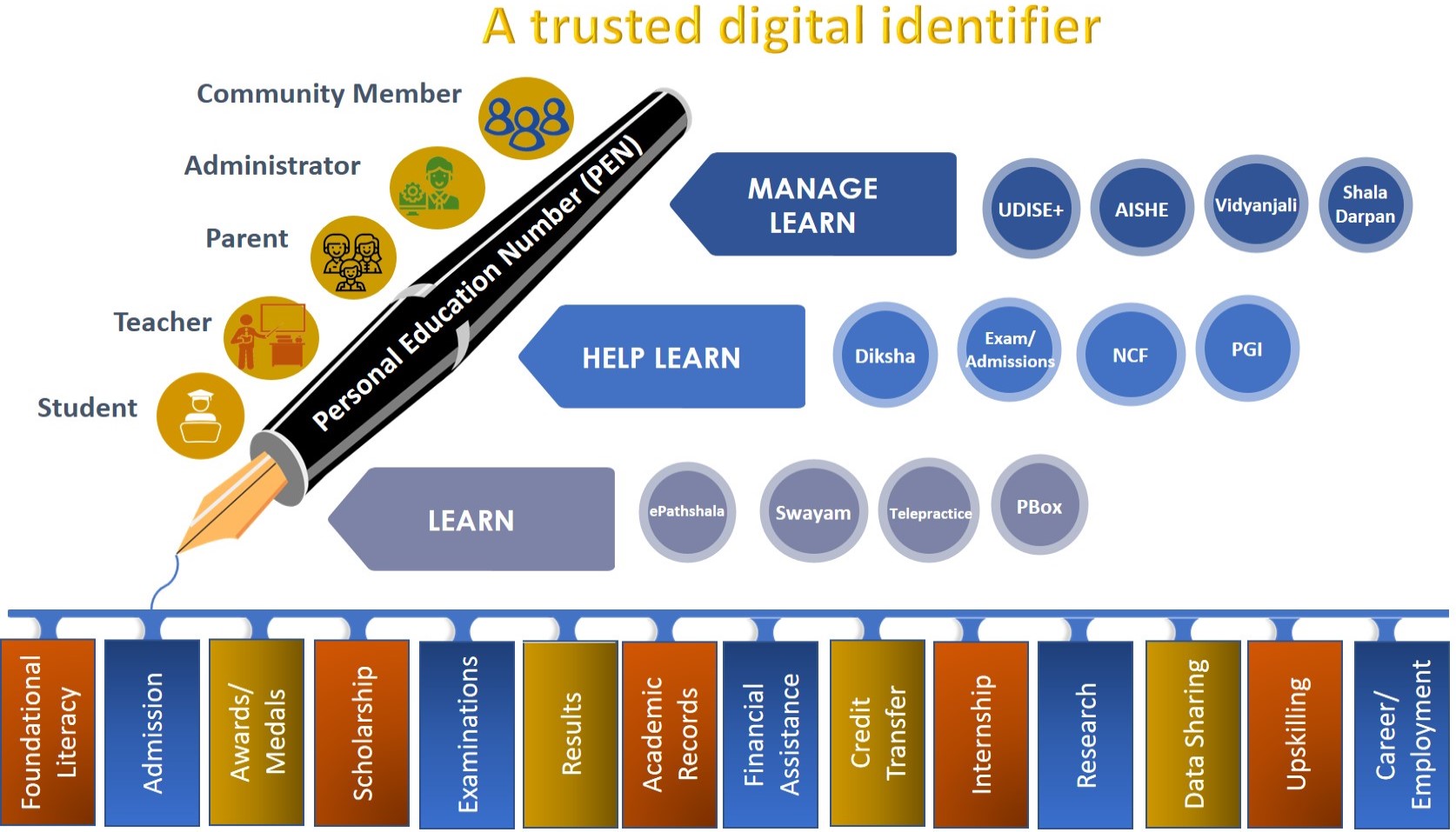
Personal Education Number or “PEN” is an initiative to create a unique identification number across all the Education platforms. PEN would be issued to 5 key personas (Learners, Parents, Teachers, Administrators and Community Members) interacting through 3 generalized scenarios: Learn, Help Learn and Manage Learn as defined in National Digital Enterprise Architecture (NDEAR).

  • PEN would contain minimum set of essential parameters (like name, date of birth, gender, email, phone etc.) validating the association of personas to the education sector to uniquely identify an academician or an entity.
  • PEN would facilitate unifying of existing digital assets and applications part of the federated system.
  • It would act as a permanent reference number in the entire persona lifecycle at different learning stages including pre-primary, primary, secondary, senior secondary, graduate, post-graduate, upskilling etc.
  • PEN can also facilitate building of national core registries such as student, teacher, counsellor, entities etc. as identified in NDEAR.
  • Most importantly, it would benefit the personas by providing a unified view of digital assets from diverse federated systems. Stakeholders would be able to share the digital academic assets like UPI model which uses mobile number linked to various kinds of financial accounts for making transaction. On the similar lines PEN linked with multiple registration numbers can be used for availing different services including employment, education, scholarship, credit transfer, loans, examinations, admissions, Passport/Visa etc.
Why Not Aadhaar and other Identifiers ? :

Aadhaar can be enlisted as an attribute for PEN rather than a unique identifier as it might not always be available for everyone part of the education system like NRIs, foreign nationals, organizations etc. Also, due to the legal frameworks associated with Aadhaar, it can’t be made a mandatory parameter for educational services. Similar is the case with other identifiers like Health ID, Passport, PAN etc.

Way Forward

Although generating identification numbers for such a huge population can be a daunting task, it can be implemented if done in a phased manner. In the initial phase, the focus can be on existing class 10th passed students and teachers for whom the database is readily available and slowly it can be cascaded down further for rest of the population. The new entrants can be easily considered by providing tools and creating policies & procedures.