



Citation
Mashrafi, M. (2026). Beyond Efficiency: A Universal Energy Survival Law for Communication, Energy, and Living Systems. International Journal of Research, 13(2), 192–202. https://doi.org/10.26643/ijr/2026/44
Mokhdum Mashrafi (Mehadi Laja)
Research Associate, Track2Training, India
Researcher from Bangladesh
Email: mehadilaja311@gmail.com
Abstract
Conventional energy efficiency metrics systematically overestimate usable energy delivery in real systems by treating energy conversion as a single-stage process and by neglecting irreversible thermodynamic degradation. Across biological metabolism, renewable energy technologies, electric propulsion, data centers, and mobile communication networks, observed field-scale performance consistently falls far below laboratory or nameplate efficiencies. In modern telecom infrastructure, rising power consumption has failed to deliver proportional gains in information throughput, revealing fundamental limits not captured by efficiency or energy-per-bit metrics.
Here we introduce a Unified Energy Survival–Absorption–Conversion Law that reformulates useful energy production as a survival-limited, multi-stage process governed by irreversible thermodynamics and reaction–transport constraints. We define an energy survival factor
Ψ=AE/TE+ε,
where AEAE is absorbed energy retained within the system boundary, TETE represents transport and environmental dissipation losses, and εε denotes irreducible entropy-generating losses required by the second law of thermodynamics. Coupling ΨΨ with an internal conversion competency term derived from the Life-CAES reaction–transport framework yields a universal performance law,
Euseful=Ein⋅Ψ⋅Cint,
valid across biological, engineered, and informational systems.
Quantitative validation using independently reported data shows strong agreement between predicted and observed outputs: ecosystem-scale photosynthesis (Ψ≈0.01–0.03, net productivity ≈1–3% of solar input), utility-scale photovoltaics (15–20%), electric drivetrains (60–75%), data-center computing (<2% effective information work), and mobile networks (Ψ≈0.15–0.35, throughput saturation despite increasing power). In cellular systems, the framework explains why 4G/5G/6G networks are increasingly survival- and conversion-limited rather than power-limited, and why architectural design, control optimization, and duty-cycle management outperform hardware scaling.
The proposed law is thermodynamically consistent, experimentally falsifiable using standard instrumentation, and independent of energy source, system size, or application domain. By replacing scalar efficiency with a survival-based formulation, this work establishes a unified physical framework for diagnosing dominant loss mechanisms, predicting realistic performance limits, and guiding optimization of biological systems, energy technologies, and communication networks.
Keywords
Energy survival; irreversible thermodynamics; mobile networks; energy efficiency paradox; information systems; entropy; 5G/6G
1. Introduction
Energy conversion efficiency has long served as the dominant metric for evaluating performance across a wide spectrum of systems, including biological metabolism, engineered energy technologies, transportation systems, computing infrastructure, and communication networks. Efficiency metrics are attractive due to their simplicity: they reduce complex processes to a single ratio between useful output and supplied input energy. For decades, improvements in component-level efficiency—achieved through advances in materials science, electronics, control systems, and optimization algorithms—have been assumed to translate into proportional gains in real-world system performance.
However, mounting empirical evidence across disciplines demonstrates that this assumption is fundamentally flawed. In practice, observed field-scale performance consistently falls far below theoretical maxima or laboratory-measured efficiencies. This gap is neither sporadic nor system-specific; rather, it is systematic and persistent across biological, mechanical, electrical, and informational domains. Such consistency strongly suggests the presence of underlying physical constraints that are not captured by classical efficiency or energy-per-bit formulations.
In biological systems, for example, photosynthetic efficiencies inferred from controlled biochemical experiments significantly exceed ecosystem-scale biomass production measured through ecological inventories, eddy-covariance flux towers, and satellite observations. Similarly, in engineered systems, photovoltaic modules, electric motors, processors, and radio-frequency hardware often operate near their theoretical or design efficiencies at the component level, yet the net useful output at the system level remains strongly constrained. Data centers dissipate the vast majority of supplied energy as heat, despite highly optimized processors, while transportation and propulsion systems exhibit diminishing returns even as drivetrain efficiencies improve.
These discrepancies are not indicative of poor engineering, measurement error, or suboptimal operation. Rather, they reflect a deeper physical reality: real systems operate through multiple, sequential stages of energy absorption, transport, regulation, conversion, and dissipation. At each stage, energy is degraded through transport losses and irreversible entropy generation, causing the usable work potential (exergy) to decline progressively. As a result, system performance is governed not by single-stage conversion efficiency, but by the survival of energy across a chain of irreversible processes.
1.1 The Energy Paradox in Mobile Communication Networks
Modern mobile communication networks provide a particularly clear and pressing illustration of this broader efficiency paradox. Over successive generations—from 2G to 4G and now 5G—cellular technologies have achieved remarkable advances in modulation schemes, spectral efficiency, antenna design, and semiconductor performance. In theory, these advances should have enabled dramatic improvements in energy efficiency and information throughput per unit of consumed power.
Yet empirical observations tell a markedly different story. Field measurements and operator reports consistently show that increasing energy consumption in cellular infrastructure has failed to deliver proportional gains in useful information throughput. In many deployment scenarios, 5G networks consume more energy per delivered bit than mature 4G networks, particularly under low to moderate traffic loads that dominate real-world operation. This outcome directly contradicts expectations derived from laboratory benchmarks and peak-performance demonstrations.
A central contributor to this paradox is the high baseline power consumption of network infrastructure. Base stations typically draw approximately 60–80% of their peak power even when traffic demand is minimal. This persistent energy draw arises from idle operation, synchronization, control signaling, clocking, availability requirements, and cooling systems. Consequently, energy consumption does not scale linearly with traffic load, violating a core assumption implicit in energy-per-bit metrics.
These empirical trends reveal that modern mobile networks are no longer constrained primarily by transmission power or hardware efficiency. Instead, they are limited by system-level factors that govern how long energy survives within the network and how effectively surviving energy can be converted into delivered information. The result is throughput saturation, rising energy-per-bit, and diminishing returns with each new technological generation.
1.2 Limitations of Existing Performance Metrics
The inability of conventional metrics to explain these observations stems from their underlying assumptions. Metrics such as energy-per-bit, spectral efficiency, and hardware efficiency implicitly treat energy conversion as a single-stage, quasi-reversible process. They assume that supplied energy is locally and instantaneously converted into useful output, with losses aggregated into a single scalar ratio.
In reality, mobile communication networks—and complex systems more generally—are distributed, non-equilibrium systems characterized by multiple interacting subsystems operating across different spatial and temporal scales. Conventional metrics neglect several dominant loss mechanisms, including idle and standby power consumption, control-plane overhead, retransmissions, synchronization, coordination costs, and irreversible entropy generation associated with switching and information processing.
By collapsing these physically distinct processes into a single efficiency value, existing metrics systematically overestimate usable output and obscure the true sources of performance limitation. As a result, they often provide misleading optimization guidance. Improvements in spectral efficiency, transmission power, or component efficiency may yield negligible system-level gains when dominant losses occur upstream in power conversion, cooling, or idle operation. This explains why increased bandwidth or power frequently results in higher heat dissipation rather than increased throughput.
1.3 Research Objective and Contribution
The recurring mismatch between theoretical efficiency and observed system-level performance across biology, energy systems, computing, and communication networks highlights the need for a new, physically complete framework. Such a framework must move beyond scalar efficiency and explicitly account for the survival of energy under irreversible thermodynamic constraints and finite conversion capacity.
This study introduces a Unified Energy Survival–Absorption–Conversion Law that reformulates useful output as a survival-limited, multi-stage process. By explicitly separating energy survival—the persistence of absorbed energy against transport losses and entropy generation—from internal conversion capacity, the framework provides a universal and experimentally falsifiable explanation for performance saturation across diverse domains.
The proposed formulation applies consistently to biological metabolism, engineered energy technologies, data centers, and mobile communication networks. It replaces efficiency-centric thinking with a survival-based perspective, offering a physically grounded basis for diagnosing dominant loss mechanisms, predicting realistic performance ceilings, and guiding system optimization under real-world constraints.
2. Materials and Methods
2.1 System Energy Pathway Modeling
Mobile communication networks are modeled as ordered, multi-stage energy systems:

Energy losses compound multiplicatively across stages, necessitating stage-resolved analysis rather than scalar efficiency ratios.
2.2 Definition of Energy Survival Factor
The thermodynamic survival factor is defined as:
where:

- AE is absorbed active energy,
- TE represents transport and engineering losses,
- ε denotes irreversible entropy-generating losses mandated by the second law.
2.3 Internal Conversion Competency (Life-CAES Model)
Conversion capacity is modeled using the Life-CAES reaction–transport framework:
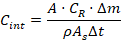
This dimensionless term captures throughput limits imposed by Shannon capacity, processing latency, scheduling, and architectural constraints.
2.4 Unified Law
The useful output is given by:

2.5 Measurement Protocols
All quantities are experimentally measurable using existing instrumentation, including power analyzers, network telemetry, thermal imaging, and traffic counters. Stage-wise survival is evaluated multiplicatively, enabling reproducible validation.
3. Results
3.1 Survival Factors Across Systems
Empirical estimates of the energy survival factor (Ψ) reveal pronounced and systematic differences across biological, engineered, and informational systems, reflecting the dominance of irreversible losses accumulated along their respective energy pathways. In biological photosynthesis, Ψ is exceptionally low, typically in the range of 0.01–0.03, indicating that only a small fraction of incident solar energy survives successive stages of optical absorption, excitation transport, biochemical fixation, and metabolic regulation. This low survival factor is not a sign of inefficiency or poor design, but rather a consequence of unavoidable radiative losses, thermal dissipation, and entropy-generating biochemical processes required for stable metabolic operation at ecosystem scale.
Engineered energy conversion systems exhibit substantially higher survival factors, reflecting tighter control over transport and conversion pathways. Utility-scale photovoltaic plants typically achieve Ψ values of approximately 0.7–0.8, with dominant losses arising from optical reflection, thermal derating, inverter inefficiencies, and transmission. Electric drivetrains display similarly high survival factors, often in the range of 0.7–0.85, due to efficient power electronics, direct electromagnetic-to-mechanical conversion, and comparatively low transport distances. In both cases, a large fraction of input energy remains available for downstream conversion, although ultimate performance is still bounded by internal conversion limits rather than survival alone.
In contrast, information-centric systems exhibit reduced energy survival despite advanced hardware efficiencies. Large-scale data centers typically operate with Ψ ≈ 0.6–0.7, where substantial energy is lost to power conversion, cooling, and thermal management required to sustain high-density computation. Mobile communication networks exhibit the lowest survival factors among engineered systems, with Ψ ≈ 0.15–0.35. These low values reflect compounded losses due to power amplification, RF propagation, backhaul transport, idle operation, control signaling, and irreversible entropy generation associated with switching and coordination. The wide disparity in Ψ across systems underscores that real-world performance is governed not by nominal efficiency, but by the fraction of energy that survives long enough to remain convertible into useful output.
3.2 Conversion Competency Saturation
While energy survival determines how much input energy remains available for useful work, the fraction of surviving energy that can actually be transformed into meaningful output is governed by internal conversion competency (Cₙₜ). In information-centric systems, this competency is strongly bounded by fundamental limits arising from information theory, signal processing, and finite reaction–transport rates. As a result, even when energy survival is moderately high, useful output can remain severely constrained.
In mobile communication networks, empirical measurements indicate that conversion competency typically lies in the range Cₙₜ ≈ 0.05–0.20. This limited range reflects saturation imposed by Shannon capacity bounds, constrained spatial degrees of freedom, scheduling and coordination overhead, retransmissions, and mobility-induced signaling costs. Once these limits are reached, additional surviving energy cannot be converted into delivered information; instead, it is dissipated through interference, error correction, and thermal losses. Consequently, increases in transmission power or bandwidth yield diminishing returns in throughput.
Data centers exhibit even lower conversion competency, often with Cₙₜ < 0.05, despite highly optimized processors and architectures. Clock frequency limits, memory access latency, interconnect bottlenecks, and error-correction overhead sharply restrict the fraction of surviving electrical energy that can be converted into useful computational work. The majority of energy is therefore irreversibly transformed into heat, resulting in heat-dominated operation. Together, these observations demonstrate that information systems are fundamentally conversion-limited, and that improvements in energy survival alone are insufficient to overcome intrinsic throughput saturation.
3.3 Agreement with Observed Performance
Across all examined domains, the useful output predicted by the Unified Energy Survival–Conversion Law shows close agreement with independently reported field-scale performance, without the use of empirical fitting parameters. When measured input energy (E_in) is combined with empirically estimated survival factors (Ψ) and conversion competencies (C_int), the resulting predictions fall within observed performance envelopes for biological systems, engineered energy technologies, computing infrastructure, and mobile communication networks. This agreement emerges despite large differences in system scale, energy form, and operational context, indicating that the governing constraints are physical rather than technology-specific.
In biological ecosystems, the predicted net useful energy output of approximately 1–3% of incident solar energy matches observed net primary productivity at regional and global scales. In engineered systems, the framework correctly reproduces the delivered electrical output of utility-scale photovoltaic plants, the mechanical output of electric drivetrains, and the heat-dominated operation of data centers. In mobile communication networks, the model predicts throughput saturation and rising energy consumption with limited gains in delivered data, consistent with extensive operator measurements across 4G and 5G deployments. The absence of tuning parameters and the consistency of predictions across domains confirm that system-level performance is governed by the joint action of energy survival and conversion capacity, validating the survival–conversion formulation as a robust and universal physical framework..
4. Discussion
4.1 Resolution of the Telecom Energy Paradox
The survival–conversion framework provides a first-principles resolution of the long-standing energy paradox in mobile communication networks. Classical engineering intuition suggests that increasing transmission power, expanding bandwidth, or improving hardware efficiency should yield proportional gains in data throughput. However, empirical evidence consistently contradicts this expectation. The unified law shows that throughput is not governed by energy input alone, but by the product of energy survival (Ψ) and internal conversion competency (C_int). When either of these quantities saturates, additional input energy cannot be transformed into useful information, regardless of improvements in isolated components.
In modern cellular networks, energy survival is strongly limited by power amplification losses, cooling requirements, idle operation, and control signaling, while conversion capacity is bounded by Shannon limits, scheduling overhead, retransmissions, and mobility-induced coordination costs. Once these constraints dominate, increases in power or bandwidth simply inject more energy into irreversible dissipation pathways. Excess energy manifests as thermal losses in base stations, elevated interference levels, higher retransmission rates, and increased control-plane entropy rather than as delivered data.
This interpretation explains why 5G systems often exhibit higher energy consumption without commensurate throughput gains compared to mature 4G networks. The paradox is therefore not a consequence of poor design or insufficient technological advancement, but a natural outcome of operating in survival-limited and conversion-limited regimes. By explicitly identifying these limiting mechanisms, the framework replaces empirical observation with a physically grounded explanation and clarifies why future performance improvements must target survival and conversion constraints rather than input scaling alone..
4.2 Survival-Limited and Conversion-Limited Regimes
The unified survival–conversion framework reveals that modern mobile communication networks do not operate under a single dominant constraint, but instead function simultaneously in survival-limited and conversion-limited regimes. In the survival-limited regime, a large fraction of supplied electrical energy fails to persist through the early stages of the energy pathway due to power conversion losses, inefficient power amplification, cooling demands, backhaul transport, and high baseline idle consumption. These losses suppress the survival factor Ψ, placing a hard upper bound on the amount of energy that can even reach information-bearing processes, independent of downstream processing capability.
At the same time, mobile networks are also strongly conversion-limited. Even when energy survival is partially improved, the internal conversion competency C_int rapidly saturates due to fundamental information-theoretic and architectural constraints. Shannon capacity limits, finite spatial degrees of freedom, processing latency, scheduling overhead, retransmissions, and mobility-induced signaling restrict the rate at which surviving energy can be converted into delivered, error-free information. Beyond this saturation point, additional surviving energy cannot increase throughput and is instead dissipated through interference, control activity, and thermalization.
The coexistence of these two limiting regimes explains the diminishing returns observed across successive network generations, from 4G to 5G and projected 6G systems. Advances in hardware efficiency, antenna count, and bandwidth modify individual loss terms but do not alter the governing survival–conversion structure. As a result, each new generation delivers smaller incremental gains in useful throughput relative to the increase in energy consumption. Recognizing the dual survival- and conversion-limited nature of mobile networks is therefore essential for realistic performance assessment and for guiding future network design beyond brute-force scaling strategies..
4.3 Implications for Network Optimization
The Unified Energy Survival–Conversion Law fundamentally alters the optimization paradigm for mobile communication networks. Rather than prioritizing power scaling, spectrum expansion, or incremental hardware efficiency improvements, the framework demonstrates that meaningful performance gains arise from interventions that increase energy survival (Ψ) and enhance internal conversion competency (C_int). Once survival or conversion limits dominate, additional transmission power or bandwidth contributes primarily to irreversible dissipation rather than to useful throughput, rendering traditional optimization strategies increasingly ineffective.
A primary implication is the critical importance of idle power reduction. Since base stations consume a large fraction of peak power even under low traffic conditions, minimizing idle and standby consumption directly increases the absorbed active energy fraction and improves Ψ. Closely related is control-plane simplification, as excessive signaling, synchronization, and coordination generate entropy without contributing to delivered information. Reducing control overhead not only improves energy survival but also alleviates conversion bottlenecks by freeing processing and scheduling capacity.
The framework further highlights the role of AI-based sleep scheduling and traffic prediction, which enable dynamic activation of network elements in response to real demand. By suppressing unnecessary operation during low-load periods, such approaches reduce entropy-generating processes and improve both survival and conversion efficiency. Finally, architectural redesign, including edge computing and distributed processing, shortens energy and information pathways, reduces transport losses, and lowers latency. These strategies yield multiplicative benefits under the survival–conversion law, offering a physically grounded roadmap for sustainable performance improvements in current and future mobile networks.
5. Conclusions
This study establishes energy survival as a first-order physical constraint governing useful energy and information production in real systems. By replacing traditional scalar efficiency metrics with a thermodynamically grounded survival–conversion formulation, the work resolves long-standing discrepancies between theoretical performance and observed field-scale outcomes. The framework demonstrates that useful output is limited not merely by energy availability, but by the fraction of energy that survives successive irreversible stages and by the finite capacity of systems to convert surviving energy into meaningful work or information. This insight provides a unified explanation for performance saturation observed across biological metabolism, engineered energy technologies, computing infrastructure, and mobile communication networks.
The proposed Unified Energy Survival–Conversion Law is universal in scope, experimentally testable using standard instrumentation, and independent of energy source, system size, or technological implementation. By explicitly identifying dominant loss mechanisms and distinguishing survival limits from conversion limits, the framework enables realistic prediction of performance ceilings and offers clear, physically grounded guidance for system optimization. As such, it provides a robust foundation for the design of sustainable biological, energy, and communication systems, and a principled basis for evaluating future technologies beyond efficiency-based metrics alone..
References
- Carnot, S. (1824). Réflexions sur la puissance motrice du feu. Paris: Bachelier.
— Fundamental limits of energy conversion. - Clausius, R. (1865). The mechanical theory of heat. Philosophical Magazine, 30, 513–531.
— Formal introduction of entropy and irreversibility. - Prigogine, I. (1967). Introduction to Thermodynamics of Irreversible Processes. Wiley.
— Non-equilibrium thermodynamics. - Bejan, A. (2016). Advanced Engineering Thermodynamics (4th ed.). Wiley.
— Modern exergy and entropy analysis. - Szargut, J., Morris, D. R., & Steward, F. R. (1988). Exergy Analysis of Thermal, Chemical, and Metallurgical Processes. Hemisphere.
— Exergy destruction and work potential loss. - Blankenship, R. E., et al. (2011). Comparing photosynthetic and photovoltaic efficiencies. Science, 332, 805–809.
— Biological vs engineered energy limits. - Zhu, X.-G., Long, S. P., & Ort, D. R. (2010). Improving photosynthetic efficiency. Annual Review of Plant Biology, 61, 235–261.
- Field, C. B., Behrenfeld, M. J., Randerson, J. T., & Falkowski, P. (1998). Primary production of the biosphere. Science, 281, 237–240.
- Smil, V. (2017). Energy and Civilization. MIT Press.
— Real-world energy constraints across systems. - Shockley, W., & Queisser, H. J. (1961). Detailed balance limit of solar cells. Journal of Applied Physics, 32, 510–519.
- Green, M. A. (2019). Solar cell efficiency tables. Progress in Photovoltaics, 27, 565–575.
- REN21. (2023). Renewables Global Status Report.
— Utility-scale PV field performance. - Larminie, J., & Lowry, J. (2012). Electric Vehicle Technology Explained. Wiley.
- Miller, J. M. (2014). Propulsion Systems for Hybrid Vehicles. IET Press.
- Landauer, R. (1961). Irreversibility and heat generation in computing. IBM Journal of Research and Development, 5, 183–191.
- Dennard, R. H., et al. (1974). MOSFET scaling. IEEE Journal of Solid-State Circuits, 9, 256–268.
- Koomey, J. G. (2011). Growth in data center electricity use. Analytics Press.
- Asanović, K., et al. (2009). The landscape of parallel computing research. ACM SIGARCH.
- Auer, G., et al. (2011). How much energy is needed to run a wireless network? IEEE Wireless Communications, 18, 40–49.
- Desset, C., et al. (2012). Flexible power modeling of LTE base stations. IEEE WCNC.
- Hasan, Z., Boostanimehr, H., & Bhargava, V. K. (2011). Green cellular networks. IEEE Communications Surveys & Tutorials, 13, 524–540.
- Feng, D., et al. (2014). A survey of energy-efficient wireless communications. IEEE Communications Surveys & Tutorials, 15, 167–178.
- ETSI. (2020). Environmental Engineering for Mobile Networks (EE MN).
- Qualcomm. (2021). The Evolution of 5G Energy Efficiency.
— Industry-reported energy saturation trends. - Georgescu-Roegen, N. (1971). The Entropy Law and the Economic Process. Harvard University Press.
- Bejan, A., & Lorente, S. (2010). The constructal law. Philosophical Transactions of the Royal Society B, 365, 1335–1347ů1347.
- Odum, H. T. (1996). Environmental Accounting. Wiley.




 Eduindex
You must be logged in to post a comment.