A young business often has a clear vision but a limited budget, which makes early branding decisions feel heavier than they should. New founders need practical ways to get their name in front of people without stretching their finances. One approach is to use useful everyday items as brand touchpoints, which is why many companies turn to wholesale promotional pens to start building recognition from day one. They’re simple, cost-efficient, and stay in circulation far longer than most print ads.
A strong brand presence isn’t built overnight, but with consistent messaging and smart choices, start-ups can create a professional identity that feels established even in the early stages.
Establish a Clear Identity Before Spending on Promotion
Branding works best when it grows from a stable foundation. Before investing in materials, founders should define what the brand stands for and how it should sound.
Focus on three essentials:
A short, clear statement of what the business does
A tone that reflects the company’s personality
Visual elements such as a color palette and a simple logo
When these pieces are defined, every marketing effort—even the smallest—will look deliberate. Without this structure, money tends to leak into mismatched promotions that don’t build recognition.
Choose Tools That Circulate Beyond the First Interaction
Start-ups often feel pressure to spend on ads, but ads disappear the moment the campaign ends. The early goal should be long-lasting visibility at a low cost.
Useful items tend to deliver this better than digital promotions alone. Pens, notepads, small desk items, calendars, and reusable bags often stay in someone’s reach for months. When chosen carefully, each one acts as a steady reminder of your brand without requiring ongoing spending.
In crowded markets, people rarely remember a logo from a social media ad they scrolled past, but they will repeatedly notice it on something they use daily.
Tell a Clear Story Through Everyday Details
Branding isn’t only about visuals; it’s also about the story your business represents. Every customer interaction, regardless of scale, should reflect what makes your brand different.
For start-ups, storytelling can show up through:
1. Packaging Even a simple kraft box with a clean label can create a thoughtful unboxing moment.
2. Customer communication A short, friendly thank-you message in every order adds personality at no cost.
3. Consistency Using the same typefaces, colors, and tone across all channels builds early trust.
These details gently reinforce your brand with each interaction—something large companies spend millions on, while small businesses can do it with mindful planning.
Strengthen Local Reach Through Small Physical Touchpoints
Although digital platforms dominate today’s business environment, physical visibility still matters, especially for start-ups looking to build local awareness.
You can do this through simple, budget-conscious methods such as:
Leaving branded stationery at co-working spaces
Participating in community events
Partnering with local shops for cross-promotion
Creating small, useful items to hand out at meetups or small fairs
People remember businesses that show up—and they remember them even more when there’s a small, practical item attached to that moment.
Build Recognition Through Consistent Use of Your Brand Elements
The value of consistent visuals cannot be overstated. Start-ups sometimes change designs too often, thinking they need to keep things fresh. In reality, repetition helps people recognize and trust your brand.
To maintain consistency:
Use the same version of your logo everywhere
Stick to a fixed color set
Apply your tone of voice across all communication
Keep your promotional materials aligned with the same look and style
When these elements stay steady, even small promotional products start contributing to brand memory.
Make Use of Low-Cost Digital Platforms with High Engagement
Brand building doesn’t mean spending heavily on advertising. Organic methods can generate steady visibility at no cost.
Some of the strongest free tools include:
Social media
Short, useful posts create traction when shared regularly. Photos of behind-the-scenes work, customer stories, or product tips help humanize the brand.
Email marketing
A monthly update with helpful insights—rather than sales pitches—keeps your audience engaged.
Community forums
Answering questions, sharing insights, or offering advice builds trust and positions your brand as a helpful resource.
These digital touchpoints, when combined with small physical items, make your brand appear active, accessible, and authentic.
Use Small Giveaways Strategically Instead of Randomly
Giveaways often work better when used with intention rather than volume. Instead of handing items to anyone passing by, start-ups should focus on the right audience.
For example:
At a workshop or talk, giving each participant a pen or notebook leaves a lasting reminder of your expertise.
At trade events, offering a practical item ensures it will be kept instead of tossed.
When meeting potential partners, a small branded item adds a professional finishing touch.
The goal isn’t to distribute widely—it’s to distribute purposefully.
Integrate Customer Feedback Into Your Branding Choices
Customers often see your brand differently from how you see it. Feedback, even early on, helps shape a clearer message.
Ask questions like:
What did they notice first about your brand?
What feeling did your product or service give them?
What colors or visuals do they associate with your business?
These insights help you refine your design, messaging, and promotional strategy without unnecessary spending.
Keep Branding Efforts Simple and Honest
Start-ups sometimes feel pressure to appear larger than they are. But authenticity attracts customers faster than exaggerated claims.
A simple, honest presentation often gives small businesses a stronger identity than overly polished messaging. People relate to real stories, handmade details, and genuine customer care.
Final Thoughts
A start-up doesn’t need a large budget to create a strong impression. With thoughtful messaging, consistent visuals, and useful everyday touchpoints, it’s possible to build recognition that feels steady and professional. Branding doesn’t depend on big campaigns—it grows from clear identity, repeat exposure, and small gestures that people remember.
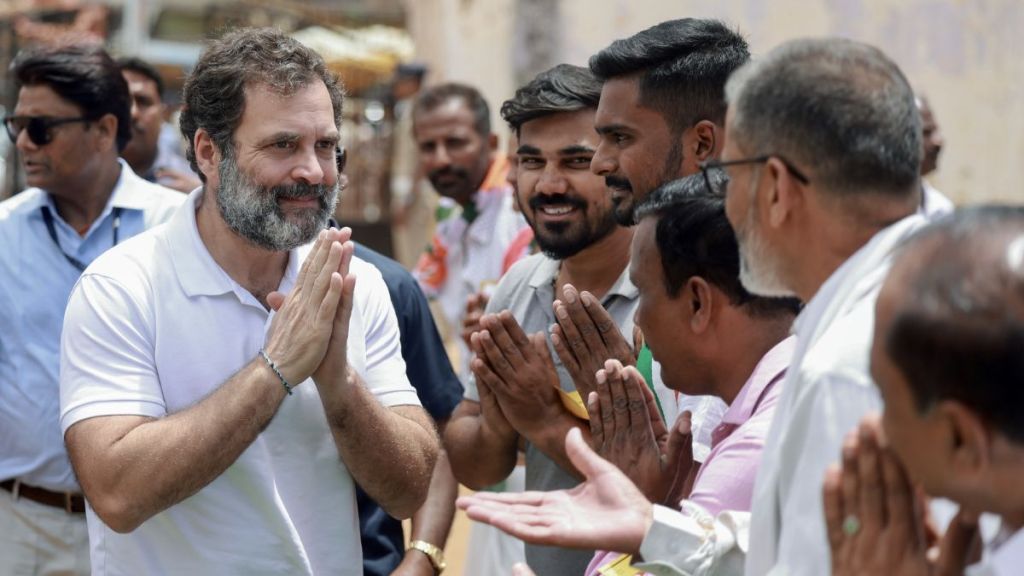
Demography, encompassing factors like age, caste, and religion, influences voting patterns in Karnataka state elections. Understanding the composition of the electorate helps analyze alliances and voting behavior. Rahul Gandhi, a prominent politician from the Indian National Congress, has campaigned in Karnataka and sought to mobilize support for his party. His effectiveness in connecting with voters and influencing the election outcome varies, as it depends on multiple factors beyond an individual’s influence. Other dynamics, such as party strategies, local issues, and the performance of rival parties, also play crucial roles in determining the results of Karnataka state elections.
Demography plays a significant role in elections as it involves the study of population characteristics and their influence on political outcomes. In the context of the Karnataka state election results, demography can provide insights into the composition of the electorate, such as age, gender, caste, and religion, which can shape voting patterns and alliances. Rahul Gandhi is a prominent Indian politician and a member of the Indian National Congress party. His role in the Karnataka state election results would depend on various factors, including his party’s performance, his campaign efforts, and his ability to connect with voters. While he may have campaigned in the state and tried to mobilize support for his party, the overall outcome of the election would depend on multiple factors beyond any individual’s influence.
Changing Demography of Karnataka
Karnataka has experienced significant demographic changes in recent years. The state’s population has been growing steadily, primarily due to natural increase and in-migration from other parts of India. According to the 2011 census, Karnataka had a population of approximately 61 million. Urbanization has been a prominent trend in the state, with cities like Bengaluru, Mysore, and Mangalore witnessing rapid growth. Bengaluru, in particular, has emerged as a major IT and technology hub, attracting professionals from different parts of the country. This influx of migrants has contributed to the cosmopolitan nature of the city. Karnataka is linguistically diverse, with Kannada being the primary language spoken by a majority of the population. However, there are also significant populations that speak other languages such as Tamil, Telugu, Urdu, and Konkani, among others. In terms of religious composition, Hinduism is the predominant religion in Karnataka, followed by Islam, Christianity, and Jainism. The state is also home to various religious sects and communities, contributing to its religious diversity. Caste continues to be a factor influencing Karnataka’s demography and politics. Historically influential communities, such as the Lingayats and Vokkaligas, have played significant roles in the state’s social and political landscape. However, other communities, including Scheduled Castes (Dalits) and Scheduled Tribes, have also gained political representation and influence.
It’s important to note that the demographic landscape of Karnataka may have evolved since my last update. For the most up-to-date and precise information, referring to recent studies and official data sources is recommended.
Emergence of Rahul Gandhi
Rahul Gandhi is a prominent Indian politician and a member of the Indian National Congress party. He is the son of former Indian Prime Minister Rajiv Gandhi and the grandson of former Prime Minister Indira Gandhi. Rahul Gandhi’s emergence as a political figure in India began with his active involvement in the Indian National Congress party and his eventual entry into electoral politics. Rahul Gandhi initially served as a general secretary of the Indian National Congress, working behind the scenes to strengthen the party’s organization and support its electoral campaigns. Over time, he took on a more prominent role within the party, becoming the vice president in 2013 and eventually the president of the Indian National Congress in 2017. Rahul Gandhi’s emergence as a political leader has been characterized by efforts to connect with the youth, marginalized communities, and rural populations. He has advocated for issues such as social justice, inclusivity, and economic development. Rahul Gandhi has campaigned extensively in various state elections, including Karnataka, and has sought to rally support for his party’s candidates. While Rahul Gandhi has garnered a considerable following and support within the Indian National Congress party, his political journey has seen ups and downs. He has faced criticism and scrutiny from political opponents and has been actively involved in debates and discussions on various national and regional issues. It is worth noting that political dynamics and individual influence can vary over time, and the specific impact and future trajectory of Rahul Gandhi’s emergence in Indian politics will continue to evolve as political landscapes change.
History of Karnataka Elections
The history of Karnataka elections dates back to the formation of the state in 1956. Since then, Karnataka has witnessed numerous state assembly elections as well as Lok Sabha (parliamentary) elections. Here is a brief overview of the history of Karnataka elections: Early Years: The first general elections in Karnataka took place in 1957. The Indian National Congress (INC) dominated the political landscape in the early years, winning the majority of seats in the state assembly. Coalition Politics: In the 1980s and 1990s, Karnataka witnessed the rise of coalition politics. The Janata Party, a coalition of various anti-Congress parties, came to power in 1983, marking a shift from single-party dominance. This period saw multiple governments being formed by different alliances, including the Janata Dal and Bharatiya Janata Party (BJP). Rise of the BJP: The Bharatiya Janata Party (BJP) gained prominence in Karnataka during the late 1990s and early 2000s. In 2004, the BJP formed its first government in the state, led by Chief Minister B.S. Yeddyurappa. However, the government faced internal issues, leading to its collapse. Congress Revival: The Indian National Congress made a comeback in Karnataka politics, winning the state assembly elections in 2013. Siddaramaiah became the Chief Minister, leading a Congress government. However, in the 2018 elections, the Congress was unable to secure a majority, leading to a coalition government with the Janata Dal (Secular) party.
Recent Elections: In the most recent state assembly elections held in 2018, the BJP emerged as the single largest party. After a period of political uncertainty, the BJP formed the government with B.S. Yeddyurappa as the Chief Minister. However, in subsequent by-elections, the BJP lost a few seats, resulting in a change of Chief Minister with B.S. Yediyurappa resigning and Basavaraj Bommai taking office in 2021. It’s important to note that the political landscape in Karnataka has been dynamic, with various parties and alliances vying for power. State elections in Karnataka have seen the emergence of regional parties, coalition governments, and shifts in power between the Indian National Congress and the Bharatiya Janata Party. The outcome of elections in Karnataka has had implications for state governance as well as national politics.
New Challenges for Congress Party
The Congress Party in India has faced several challenges in recent years. Here are some of the key challenges it has encountered:
Electoral Performance: The Congress Party has witnessed a decline in its electoral performance, especially in national elections. In the 2014 and 2019 Lok Sabha elections, the party faced significant setbacks, winning only a limited number of seats. This decline has impacted its overall political influence and ability to form a government at the national level.
Leadership Crisis: The party has grappled with a leadership crisis, with a lack of clear and dynamic leadership. This has resulted in a leadership vacuum and internal factionalism, which have weakened the party’s ability to present a united front and effectively communicate its message to the electorate.
Ideological Positioning: The Congress Party has faced challenges in clearly articulating its ideological positioning. In recent years, there has been a growing trend of political parties aligning themselves with specific ideologies or issues, while the Congress Party has struggled to define and communicate its distinct ideological stance.
Regional Strongholds: The Congress Party has lost ground in many states where it previously had strongholds. Regional parties have gained prominence and appeal, leading to a fragmentation of the political landscape. This has reduced the Congress Party’s ability to form alliances and consolidate its support base.
Youth Appeal: The Congress Party has faced difficulties in appealing to the aspirations and concerns of the younger generation. It has struggled to connect with the youth, who are increasingly looking for dynamic and transformative leadership and policies.
Communication Strategy: The Congress Party has faced challenges in effectively communicating its policies and achievements to the electorate. It has struggled to counter the narrative of its political opponents and has often been perceived as lacking a robust communication strategy.
Organizational Strength: The Congress Party has faced issues with its organizational strength and grassroots presence. It has struggled to rejuvenate its party structure and mobilize workers effectively, particularly at the local level.
To overcome these challenges, the Congress Party needs to undertake significant introspection, revitalize its leadership, redefine its ideological positioning, and strengthen its organizational structure. It must also focus on engaging with the aspirations of the youth and effectively communicate its policies and vision to regain public trust and support.
Concluding Remarks
The Congress Party’s performance in Karnataka elections has been subject to critical appraisal due to a mix of successes and failures. While the party has experienced some notable achievements, it has also encountered significant setbacks. Here is a critical appraisal of the Congress Party’s performance in Karnataka elections:
Mixed Electoral Performance: The Congress Party has had mixed electoral performances in Karnataka. It won the state assembly elections in 2013, forming the government under the leadership of Siddaramaiah. However, in the subsequent 2018 elections, the party failed to secure a majority and had to form a coalition government with the Janata Dal (Secular) party. This highlighted a lack of sustained popularity and the inability to secure a clear mandate.
Leadership Challenges: The Congress Party has struggled with leadership challenges in Karnataka. While Siddaramaiah played a significant role in the party’s victory in 2013, his tenure as Chief Minister was marked by controversies and internal rifts. Additionally, the absence of a strong and decisive leader at the state level has affected the party’s ability to effectively mobilize support and present a cohesive image.
Intra-party Factionalism: The Congress Party in Karnataka has been plagued by factionalism and infighting. Internal divisions and power struggles have hindered the party’s unity and cohesion, leading to weakened electoral campaigns and suboptimal coordination among party members.
Failure to Capitalize on Governance: The Congress Party’s tenure in Karnataka witnessed a mixed record in governance. While some initiatives were undertaken, such as social welfare programs and measures to address agrarian issues, the party failed to effectively communicate and capitalize on these achievements. Inadequate implementation and a lack of clear messaging hindered their ability to connect with voters and secure their trust.
Inability to Counter BJP’s Rise: The Congress Party has struggled to counter the Bharatiya Janata Party’s (BJP) rise in Karnataka. The BJP’s strong organizational structure, effective campaign strategies, and appeal to Hindutva ideology have posed significant challenges for the Congress Party. The party has been unable to effectively counter the BJP’s messaging and address the concerns of a changing electorate.
Failure to Strengthen Party Organization: The Congress Party has faced challenges in strengthening its party organization at the grassroots level in Karnataka. The absence of a robust and well-connected organizational structure has hindered their ability to mobilize support and build a strong voter base.
To improve their performance in national elections, the Congress Party needs to address these critical issues. They should focus on nurturing strong and decisive leadership, resolving internal factionalism, communicating their achievements effectively, countering the BJP’s rise, and revitalizing the party organization at all levels. Additionally, connecting with voters on issues that resonate with them and presenting a clear vision for the state’s development will be crucial in rebuilding public trust and support.
References
Antil, A., & Verma, H. V. (2021). Rahul Gandhi on Twitter: An analysis of brand building through Twitter by the leader of the main opposition party in India. Global Business Review, 22(5), 1258-1275.
Devi, B. U. (2013). Rahul Gandhi’s Immaturity. Economic and Political Weekly, 48(43), 5-5.
Gould, H. A. (1997). General Elections, 1996: Karnataka: Decline and Fall of the Congress Machine. Economic and Political Weekly, 2335-2349.
Manor, J. (2008). Letting a winnable election slip away: Congress in Karnataka. Economic and Political Weekly, 23-28.
Mahapatra, S., & Plagemann, J. (2019). Polarisation and politicisation: the social media strategies of Indian political parties.
Manor, J. (2013). Lucky in Its Adversaries: A Slipshod Congress Gains a Majority in the Karnataka Election. Economic and Political Weekly, 51-59.
Palshikar, S., & Suri, K. C. (2014). India’s 2014 Lok Sabha elections: Critical shifts in the long term, caution in the short term. Economic and Political Weekly, 39-49.
Pinto, A. (1994). Karnataka Assembly Elections: An Overview. Economic and Political Weekly, 3309-3311.
Shastri, S. (2009). Leadership at the state level mattered. Economic and Political Weekly, 88-91.
Shastri, S. (2013). The 2013 Karnataka Assembly Outcome: Government Performance and Party Organization Matters. Studies in Indian Politics, 1(2), 135-152.Simmons, C. (2019). Dynastic Continuity and Election in Contemporary Karnataka Politics. In South Asian Sovereignty (pp. 136-149). Routledge India.
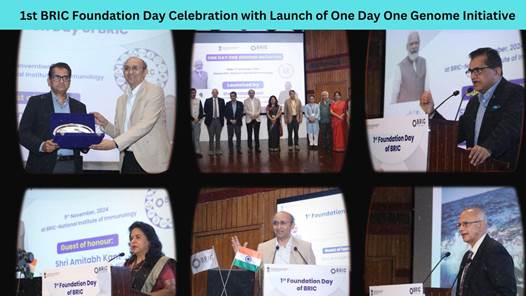
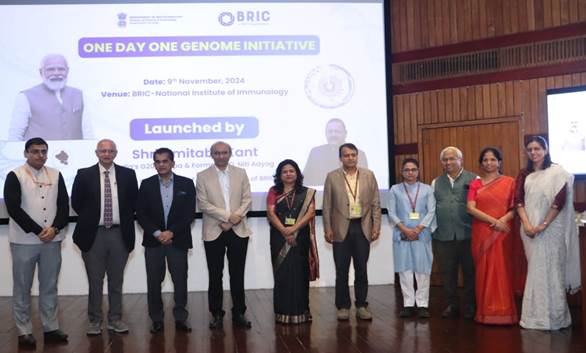
The Department of Biotechnology (DBT) and Biotechnology Research and Innovation Council (BRIC) introducesthe ‘One Day One Genome’ initiative to showcase the enormous microbial potentialof India. Shri.Amitabh Kant, India’s G-20 Sherpa and Former CEO NITI announced the launch of ‘One Day One Genome Initiative’ on the 1st foundation day of BRIC held in National Institute of Immunology (NII), New Delhi on 9th November 2024
‘One Day One Genome’ initiative will highlight the unique bacterial species found in our country and emphasize their critical roles in environment, agriculture and the human health.Microorganisms are crucial for our ecosystem. They play an important role in all biogeochemical cycles, soil formation, mineral purification, degradation of organic wastes and toxic pollutants along with methane production. Cumulatively they help to maintain the homeostasis in our planet. In agriculture, they help in nutrient cycling, nitrogen fixation, maintaining soil fertility, controlling pest and weeds and stress responses. Microorganisms symbiotically associate with plants and help them in nutrient and water uptake. They are indispensable part of human body. There are much more microbial cells than the number of human cells in a human body. They are essential for our digestion, immunity and even mental health. All infectious diseases are mainly caused by pathogenic microorganisms on the other hand non-pathogenic microorganisms are indispensable for our defense against infectious diseases.
Genome sequencing will allow the visualization of the hidden potential of the microbial world to the community at large. Sequencing data can be analyzed to identify the genome encoded capacities for various important enzymes, antimicrobial resistance, bio active compounds etc. Research in this field will lead to the benefit of better protection and management of our environment, development in agriculture and improvement in human health.
This initiative coordinated by Biotechnology Research and Innovation Council-National Institute of Biomedical Genomics (BRIC-NIBMG) an institute of the Department of Biotechnology.This initiative aims a release a fully annotated bacteriological genome isolated in the country freely available to the public. This will be complemented with a detailed graphical summary, infographics and genome assembly/annotation details. These documents will thus give an idea about the scientific and industrial use of these microbes. Consequently, microbial genomics data will become more accessible to the general public, scientific researchers and thereby stimulate discussions; innovations directly benefit the entire community and ecosystem.
Scientists have identified a novel gene that plays a crucial role in the development of stamens (male reproductive structure) including pollen grain and seed formation, in Arabidopsis flowering plants related to cabbage and mustard. The study opens up new possibilities for improving crop fertility and seed production.
Pollen formation represents a very important developmental stage in plant life cycle. It represents the male gametophyte and its role is to deliver the genetic material to the embryo sac. The production and transfer of viable pollen grains to the stigma, germination of the pollen grains, growth of the pollen tubes down the style, and effective fertilization are necessary for the formation of a successful seed set. Thus, understanding the pollen development process not only elucidate the basic mechanism of sexual reproduction of flowering plants but also add valuable information for subsequent manipulation in crop production.
“Pollen germination speed” and “pollen tube growth” are the two important characteristic features of healthy pollens that have evolved with the evolution in flowering plants (Angiosperms). The rapid growth of the pollen tube through the style to reach ovary, is a pre-requisite for fertilization in flowering plants. Since many pollen tubes grow through the style, the reproductive success of a pollen grain is determined by its rate of pollen tube elongation.
It has been shown that maturation of pollen grain with proper structure and composition of cell wall determines its interaction with the stigma as well as its germination ability for successful fertilization. Thus, it is important to understand the molecular mechanisms responsible for pollen development, pollen hydration and pollen germination- factors that are responsible for the formation of a mature viable pollen grains.
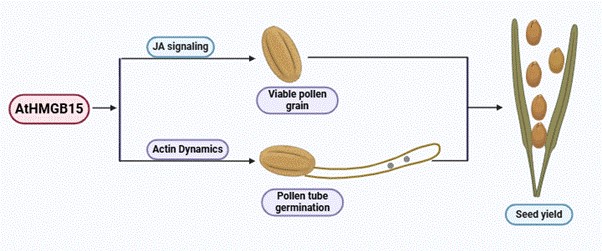
Recent investigations on pollen development by Prof. Shubho Chaudhuri’s lab at Bose Institute, Kolkata, an autonomous institution of Department of Science and Technology, identified a novel gene named HMGB15, a non-histone protein that restructures chromatin,plays a crucial role in the development of stamens (male reproductive structure) in Arabidopsis.
A mutation in this gene, causes partial male sterility in plants. The mutant plants exhibit low pollen grain viability, defective pollen wall patterning, retarded pollen tube germination rate, shorter filaments that are unable to reach the stigma resulting in reduced seed production. The abnormalities in the mutants are due to the disruption in gene regulatory networks important for pollen development, maturation and pollen tube germination.
Molecular analysis indicated that several developmental pathways like biosynthesis of phytohormone jasmonic acid (JA), apoptosis of tapetal cells and actin polymerization dynamics have been severely affected in the HMGB15 loss of function mutants.
Understanding this mechanism on a model organism used for studying plant biology, not only sheds light on the intricate biology of plants but also opens new possibilities for improving crop fertility and seed production. The studies have been published in reputed plant journals namely, Plant Physiology (Sachdev et al., 2024) and Plant Reproduction (Biswas et al., 2024). Financial support for this work was provided by SERB, India.





 Eduindex
You must be logged in to post a comment.