A review on synergistic effect on Cobalt Sulfide–based Nanomaterials electrode for Supercapacitor application

Daily writing prompt
Tell us about your favorite pair of shoes, and where they’ve taken you.

Hitesh N. Wankhedea, Harshal S. Gawaleb, Rajendra R. Ahirea, Anup J. Morea,*

aDepartment of Physics, VVM’s S.G.PatilArts,Science and Commerce College Sakri 424304 Dist. Dhule, KBC NMU Jalgaon, Maharashtra, India

bDepartment of Physics, JET’s Z.B.Patil college, Dhule 424002, KBC NMU Jalgaon, Maharashtra, India

Abstract

The growing global demand for energy has intensified the need for advanced and efficient energy storage technologies. Supercapacitors and batteries have gained considerable interest due to their essential role in modern energy storage systems. The effectiveness of these devices largely depends on the characteristics of the electrode materials, such as high specific capacitance, superior electrical conductivity, large surface area, abundant availability, and favorable electrochemical properties. While cobalt-based nanomaterials offer high conductivity, abundant resources, and strong capacitance performance for supercapacitor electrodes, limitations such as structural degradation and insufficient power density remain unresolved. This paper reviews on advances in cobalt Sulfide based nanomaterials electrode materials for supercapacitors, with a focus on their preparation methods, electrochemical performance and properties. It focuses on methods to enhance the electrochemical performance of these materials. It shows that synergistic effect can improve the morphology of nanomaterials can significantly boost their performance, with mesoporous structures. Key findings from the literature on batteries and supercapacitors are summarized, highlighting Cobalt sulfide-based materials integrated with carbon nanotubes, graphene, reduced graphene oxide, MAX phase (Class of 2D inorganic compounds comprising atomically thin layers of transition metal carbides, nitrides, or carbonitrides) shortly known as MXene, Metal Organic Framework(MOF), nickel foam and metal elements such as nickel, manganese, etc.

Keywords:Supercapacitor, cobalt composites, specific capacitance, energy density,nanomaterials, hydrothermal

1. Introduction

After the industrial revolution demand of energy completely rely on energy extracted from fossil fuel (oil, gas and coal) but it causes a severe effect on human health like cardiovascular disease, respiratory syndrome, cancer, reproductive effects, etc. and it can happen due to the evolution of carbon dioxide, carbon monoxide, CFC, and other toxic gases which may leads to greenhouse effect. To get ride from this problem we need to adopt renewable energy resources like hydroelectric energy, solar energy, wind energy, geothermal energy, tidal energy, and biomass energy.[1] There is a challenge in effectively storing energy extracted from these resources. To address this issue electrochemical energy storage system (EES), namely supercapacitors and batteries have become crucial technologies.[2] Energy density of batteries is higher than the supercapacitor but power density of batteries is lower than the supercapacitor so for rapid charging and discharging applications supercapacitor are more convenient. Continuous research progression in this area is due to wide range of applications such as industries, medical field, military, automobile sector, etc.

In recent days automobile sector mostly relies on lithium-ion batteries due to higher energy density and safe during handling.  Lithium is a key part of batteries that runs electric vehicles but due to limited availability of lithium it really hard to keep up with demand and supply. Researchers are continuously working on replacement of lithium to alkali metals like sodium cause abundant in nature and low cost but sodium ion batteries having poor cyclic performance.[3] In comparison to batteries supercapacitor having some positive features like fast charging- discharging cycles. Supercapacitor require 1-10 s and batteries require 0.5-5 hr. charging -discharging time. Power density defines how quickly energy can be delivered or receive per unit mass (W/kg): supercapacitor having higher power density 500-10000 W/kg and batteries having power density less than 1000 W/kg. Supercapacitor have longer lifetime more than 500,000 hrs. and batteries 500-1000 hrs. Energy density defines amount of energy stored per unit mass: energy of batteries 10-100 Wh/kg more than supercapacitors 1-10 Wh/kg.[4] The Ragone plot shown in graph 1. provide the information about behavior of electrochemical energy storage devices power density and energy density.[5]
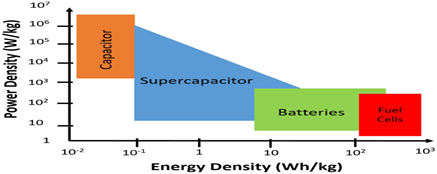
Graph 1. Ragone plot of different electrochemical energy conversion systems.[5]

Conventional capacitor having lowest energy density and higher power density in comparison to other electrochemical energy storage devices. Supercapacitor having lower energy density and higher power density also batteries having higher energy density and lower power density compared to other electrochemical devices.[6] To overcome the limitations of conventional batteries, supercapacitors have emerged as a promising electrochemical energy storage device. Unlike batteries, supercapacitors require electrode materials that exhibit high electrical conductivity, a large electrochemically active surface area, and well-tuned porosity to facilitate rapid ion transport. In addition, excellent thermal and chemical stability of the electrode material is essential to ensure long-term performance and safety. The development and fabrication of such advanced electrode materials play a crucial role in enhancing the energy density and overall efficiency of supercapacitor systems.

2. Synthesis Method

Cobalt sulfide (CoS) can be synthesized through several methods, depending on the desired properties and the form of the material. In this review article most of the materials are synthesize by hydrothermal method, solvothermal method, microwave induced synthesis, chemical bath deposition (CBD) etc.

2.1 Hydrothermal Method

This is a popular method for synthesizing CoS nanostructures, such as nanoparticles, nanowires, nanotubes etc. It involves a chemical reaction in an aqueous solution at elevated temperature and pressure. It involves crystalizing materials from aqueous solutions at high temperatures and pressures within a sealed and compact vessel. This method has some advantages facilitates the growth of nanostructured materials with controlled morphologies.
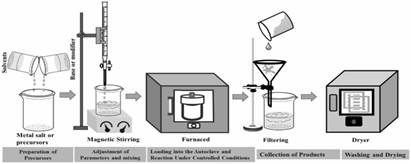
Fig. 1. Schematic representation of hydrothermal synthesis method[7]

 It provides precise control over particle size and morphology, form crystalline structures at relatively low temperatures and allows to enhance material properties. This method also has limitations, requires specialized equipment to withstand high pressures. Extended reaction times may be necessary to achieve desired crystallinity.[7]

2.2 Solvothermal Method

In this method chemical reaction carried out in an autoclave which sealed vessel using a different solvent at high temperature and controlled pressure. Due to this conditions nucleation and growth of materials of materials occurred in a controlled manner. This method having some advantages, it allows precise control over particle size, crystallinity, shape and growth of pure materials. It suitable for synthesis of wide range of nanostructure of metal sulfides, oxide and hydroxide.[8]This method has some limitations like the process is time consuming and it run with help of high pressure; scalability is also a problem.

2.3 Microwave-Assisted Synthesis Method

Microwave-assisted synthesis involves rapid heating of reactants using microwave radiation, enabling uniform nucleation and growth of nanomaterials. Heating occurs due to the interaction of 2.54 GHz microwave energy with polar molecules and ions via dipole polarization and ionic conduction mechanisms. This technique offers reduced reaction time, uniform heating, and high energy efficiency. However, limitations include restricted precursor selection and challenges in large-scale production.[9]The method has been effectively applied to synthesize metal sulfide nanoparticles, metal oxide nanoparticles etc. for high-performance supercapacitor electrodes.

2.4 Chemical Bath deposition (CBD) Method

The chemical bath deposition (CBD) technique is a low-cost and simple method used to deposit thin films of materials from a solution. In this method, the substrate is immersed in a chemical bath containing metal ions and a suitable complexing agent. Controlled chemical reactions in the solution lead to the slow and uniform deposition of the material onto the substrate surface. The deposition occurs due to the controlled release of ions and subsequent nucleation on the substrate. Parameters such as bath temperature, pH, concentration of reactants, and deposition time play an important role in determining the thickness, morphology, and quality of the deposited film. CBD has several advantages. It is simple, cost-effective, and does not require vacuum or high-temperature conditions. It allows large-area and uniform film deposition and is suitable for coating complex-shaped substrates.[10] However, the technique has some limitations, such as poor adhesion, lower crystallinity, and limited control over film thickness compared to advanced deposition methods.

3. Electrochemical performance analysis

In recent years metal sulfide and oxides-based electrodes materials are more prominent for supercapacitor applications due to their excellent redox reversibility, high electrical conductivity, excellent morphology, and high specific capacitance. This review article focuses on cobalt sulfide-based electrode materials for supercapacitor application.[11,12] Different techniques are used to tune the morphology of various materials including hydrothermal, solvothermal, supercritical fluid synthesis, CBD, microwave assisted synthesis technique. Morphology of materials can be responsible for effective energy storage and improve the electrochemical performance of electrode materials. In this article a few cobalt sulfide-based electrode materials, some remarkable morphologies like nanowires, nano-tubes, nano-sheets,flakes, and nano-flower-like structures have been reported. A silver fungus-like cobalt sulfide (CoS) nanostructure was successfully synthesized via solvothermal method and use as an electrode material for high-performance supercapacitors. The unique fungus-like morphology provides a large active surface area and abundant electroactive sites, which enhance electrolyte penetration and facilitate fast charge transport. As a result, the silver fungus-like CoS (SFC) electrode exhibits a high specific capacitance of 350.4 F g⁻¹ at a current density of 1 A g⁻¹. The device SFC//AC delivers an energy density of 45.2 Wh kg⁻¹ at a power density of 1500 W kg⁻¹, provides excellent energy storage capability.[13] A cobalt sulfide nanoparticles synthesize by hydrothermal route and calcinated at 200 0C for 1 hr. form a hexagonal phase of CoS. As a result, the CoS electrode delivers a high specific capacitance of 285.8 F g⁻¹ at a current density of 2 A g⁻¹. Furthermore, the electrode demonstrates excellent cycling stability, retaining 96% of its initial capacitance even after 5000 galvanostatic charge–discharge cycles, indicating strong structural integrity and reversibility. The device made up of CoS/CC//AC achieves an energy density of 25.8 Wh kg⁻¹ andhigh-power density of 14,800 W kg⁻¹, highlighting its capability to store substantial energy while delivering it rapidly.[14]Nickel cobalt sulfide is high promising material electrode for supercapacitor application good cycling stability. NCS-180 synthesize at 180oC display urchin like crystalline structure provide more electroactive sites and good electrochemical performance.Owing to these structural advantages, the NCS-180 electrode delivers a high specific charge capacity of 664.30 C g⁻¹ at a current density of 1 A g⁻¹, indicating better Faradaic charge-storage capability. The electrode demonstrates good long-term cycling stability, retaining 93.30% of its initial capacity after 6000 galvanostatic charge–discharge cycles, provides structural stability during repeated cycles. NCS-180//AC system achieves an energy density of 50.35 Wh kg⁻¹ with a corresponding power density of 750 W kg⁻¹.[15]Dumb-bell shaped 10-20 nm sized cobalt sulfide (CoS) particle prepared by solvothermal route exhibit specific capacitance of 310 F/g at current density of 5 A/g and 95% of capacitance retention after 5000 charge–discharge cycles. Device made up of Cos//AC provide specific capacitance of 5.3 Wh kg⁻¹ and a high-power density of 1800 W kg⁻¹ with an excellent electrochemical stability.[16] High-performance nickel–cobalt sulfide–terephthalic acid (NCS–BDC) composite electrode synthesized via a simple solvothermal route for energy storage devices like supercapacitor. Highly mesoporous structure creates more active site for reaction and provides more surface area for transmission of ions. NCS-BDS has good electrochemical properties. It has specific capacitance 1267.25 F g⁻¹ at a low current density of 0.5 A g⁻¹. Electrode shows good cycling stability, maintain 92% of its initial capacitance after 5000 charge–discharge cycles. NCS-BDC based device achieved high energy density 52.29 Wh kg⁻¹.[17] Hydrothermal route utilizes to synthesize cobalt sulfide/reduced graphene oxide (Co3S4/rGO) nanocomposite. As a result, the CoS/rGO nanocomposite provide an ultrahigh specific capacitance of 1560 F g⁻¹ at a current density of 1 A g⁻¹ and also the electrode exhibits good cycling stability, retaining 89% of its initial capacitance after 5000 charge–discharge cycles. Device achieves an energy density of 40.2 Wh kg⁻¹ and a power density of 804 W kg⁻¹.[18]

CoS nanosheet fabricated on metal organic framework on nickel foam (NF) by hydrothermal route. CoS/NF electrode display a high specific capacity 1359 C g−1 at the current density of 2 A g−1, and excellent cycling stability of 89.4% after 4000 cycles. A device fabricated by CoS/NF positive electrode and AC as a negative electrode shows high energy density of 57.4 W h kg−1 at a power density of 405.2 W kg−1.[19]CoS/MXene was synthesize by supercritical fluid synthesis method. Electrochemical performance of CoS/MXene,CoS/MXene/PANI and CoS/MXene/PEDOT was studied. CoS/MXene/PANI electrode delivered specific capacitance of 407 F g⁻¹ at current density of 2 A/g with cycling stability of 97% after 10000 cycles. Also, CoS/MXene/PANI electrode delivered specific capacitance of 630 F g⁻¹ at current density of 2 A/g with cycling stability of 96% after 10000 cycles useful for supercapacitor application.[20]Ni-based flower-like nitrogen-rich carbon (NCNi) synthesized on a carbon felt (CF) substrate through a hydrothermal route. EC-NiCoS@NCNi@CF electrode shows specific capacitance of 190.78 F g⁻¹ at current density of 0.5 A/g having cycling stability of 92.2% after 4000 cycles. Device delivered energy density of 64.77 W h kg−1 and power density of 420.13 Wkg−1.[21]Co-Ni-S composite electrode prepared through a two-step process involving electrodeposition followed by hydrothermal sulfurization which brings more cobalt active sites for redox reaction.The Co-Ni-S composite electrode delivers high specific capacitance of 3586 F g−1 at 1 A g−1 and 97% capacity retention over 5000 cycles.[22]The rGO/NCS/PANI electrode provide a high specific capacitance of 628 F g−1at a current density of 10 A g−1 and retentivity of 84 % after 5000 charge-discharge cycles showing excellent cycling stability.[23] Two-stage hydrothermal method used to synthesize nickel–cobalt sulfide nanostructures to enhance the electrochemical properties of materials. Electrode achieve specific capacitance of 8.1 F cm-2 at current density 5mA cm-2. Nickel–cobalt sulfide electrodes as the positive electrode and activated carbon as the negative electrode delivered high energy density of 51.2 Wh kg−1 at a power density of 262.5 W kg−1.[24] By utilizing different reaction conditions Nickel cobalt sulfide (NCS) microspheres are successfully synthesized by an easy one-step hydrothermal method . NCSW-200 electrode delivered a specific capacitance of 369 F g−1 at current density of 0.5 A g−1 having capacitive retention of 67% after 2000 cycles.[25] Two step facial hydrothermal method used to synthesize nickel cobalt sulfide nanoparticles (NCS) deposited on nitrogen and sulfur doped graphene which provides a synergistic effect and improve electrochemical parameters. Electrode delivered a specific capacitance of 630.6 F g−1 at 1 A g−1 current density with retention of 110 % after 10000 cycles. Also, energy density of 19.35 Wh kg−1 at a power density of 235.0 W kg−1 showing exceptional capacity for supercapacitor application.[26]

Ni-Co-S/Co(OH)2 electrode synthesize by two step facial method with synergistic effect provides excellent electrochemical performance shows a specific capacitance of 1560.8 F g−1 at 1 A g−1 current density with retention of 88% after 10000 cycles. A device shows high energy density of 48.8 W h kg−1 at a power density of 800 W kg−1 with excellent cycle stability.[27] Hydrothermal route employed for successfully synthesis of NiCo₂S₄ polyhedral structures for application to supercapacitor and lithium-ion battery. Electrode exhibit a specific capacitance of 1298 F g−1 at 1 A g−1. Capacity retention of 90.44% after 8000 cycles.[28] Etching/ ion exchange method used to synthesize Ni-Co-S nanosheets on activated carbon cloth for fabrication of supercapacitor application.The Ni-Co-S/ACC electrode can deliver a specific capacitance of 2392 F g−1 at the current density of 1 A g−1 and also have retentivity of 82 % after 10000 cycles. Device Ni-Co-S/ACC as positive electrode and activated carbon as negative electrode display high energy density of 30.1 Wh kg−1 at power density of 800.2 W kg−1.[29] Hierarchical NiCo2S4@Co(OH)2 nanotube structure on Nickel foam have been synthesized through a facial method. Synergistic effect of NiCo2S4 nanotubes and Co(OH)2 nanosheets delivered a superior electrochemical performance having specific capacity of 9.6 F cm-2 at current density of 2 mA cm-2 with capacitive retention of 70.01% after 5000 cycles.[30]One-step hydrothermal method utilize for the synthesis of the flaky attached hollow-sphere structure NiCo2S4 electrode materials.The NCS-10 electrode atPh 10 shows an excellent specific capacitance of 1366 F g−1 at the current density of 1 A g−1 at high retention of 89.8% after 2000 cycles.[31]The poor performance and cyclic stability of the materials have limit practical applications so need to improved quality of electrode by improving morphology. Carbon flakes with an ultrahigh surface area prepared from eggplant utilize as a substrates to enhance the electrical conductivity of NiCo2S4 nanosheets. Exhibit a specific capacitance of 1394.5 F g−1 at 1 A g−1 and cyclic stability of 124% after 10000 cycles. Delivered a high energy density of 46.5 Wh kg−1 at a power density of 801 W kg−1.[32]For high performance supercapacitor require high specific surface areas, high redox active sites, efficient electrons-ions migration channels. Facial two step hydrothermal route used to fabricate highly porous Co3S4@Ni3S4 heterostructure nanowire arrays prepared onto Ni foam.Delivered specific capacitance of 3.6 F cm-2 at energy density of 0.8 mA cm-2get 80% capacitive retention after 5000 charge-discharge cycles.[33]Hydrothermal method and potentiostatic deposition utilize to grow hierarchical polyaniline-coated NiCo2S4 nanowires on carbon fiber “NiCo2S4@PANI/CF”. NiCo2S4@PANI/CF material electrode have multiple electroactive sites so it enhances electrochemical performance of electrode as well as device. Electrode display high specific capacitance value 1823 F g−1 at 2 mA cm-2 and excellent cycling stability of 86.2% after 5000 cycles. Device NiCo2S4@PANI/CF delivers a high energy density of 64.92 Wh kg−1 at a power density of 276.23 W kg−1.[34]NiCo2S4, a spinel-structured has a high specific capacity, it has promising characteristic of electrode material for supercapacitors but due to poor electrical conductivity need to tune its morphology. In this work NiCo2S4 deposited on the surface of carbon nanotubes (CNTs) to enhance the electrical conductivity. CNTs@NiCo2S4 delivered specific capacitance of 216.4 mAh g−1 at 1 A g−1with cyclic retention of 75 % after 2000 cycles.[35]Microwave assisted technique is used to synthesize NCS/CNTs-H electrode followed by post annealing to anchor NCS nanoparticles on multiwall CNTs. This structure enhances electrochemical performance of electrode; it delivered high specific capacitance of 1261 F g-1 at 1 A g-1 with retention capability of 84.4%. Device NCS/CNTs-H//AC deliver a high energy density 58.4 Wh kg-1 at the power density of 400 W kg-1. NCS/CNTs-H offer good electrochemical performance so it stands high for supercapacitor electrode.[36]Microwave assisted technique utilizes to synthesis of honeycomb-like NCS/graphene composites which use as ultrahigh supercapacitor electrode. NCS/G-H exhibit high specific capacitance of 1186 F g-1 at 1 A g-1 and cyclic retention of 89.8% and delivered energy density of 46.4 Wh kg-1.[37]Sonochemical method used for synthesis of cobalt sulfide nanomaterial and cobalt phosphate nanoflakes and composite of both form a CoS/Co3(Po4)2 electrode. Composite consisting 75% of CoS and 25% of Co3(Po4)2 composition, shows a specific capacitance of 728.2 F g-1 at current density of 0.6 Ag-1 with capacitive retention of 95.10% after 5000 cycles. Device provides remarkable specific energy of 63.93 Wh kg-1 along with specific power of 850 W kg-1at 1 Ag-1.[38]MnCo2S4@CoNi LDH core shell heterostructure synthesis on nickel foam using hydrothermal reaction and electrodeposition technique. MnCo2S4 nanotubes provide excellent electrical conductivity whereas CoNi LDH nanosheets provide more electrochemical active sites for better supercapacitive performance. The electrode provides a specific capacitance of 1206 C g−1 at 1 A g-1 and excellent cycling performance with 92% retention after 10 000 cycles.[39]Cobalt sulfide nanostructure synthesizes by one step hydrothermal method for different temperature ranging from 160oC to 220oC. Sample get high crystallinity and hexagonal structure at 220oC.  A high specific capacitance deliver of 1583 F g-1 at a current density of 1 A g-1 with good cyclic performance for supercapacitor application.[40]

Sheet-like nickel cobalt sulfide nanoparticles synthesize by a two-step hydrothermaltechnique provide rich sulfur vacancies.NiCo2S4 nanosheets provide good specific capacitance of 971 Fg-1 at 2 A g-1 and an excellent cyclic stability of 88.7% after 3500 cycles.[41] By facial solvothermal method mixed nickel-cobalt sulfide (NCSs) prepared for supercapacitor application. The mixed NCS prepared at a nickel: cobalt molar ratio of 3:1 exhibited a specificcapacitance of1345 Fg-1 at a current density of 2 A g-1 with 95% of its initial capacitance after 3000 charge-discharge cycles.[42] Cobalt sulfide composes with different metals such as copper Cu and manganese Mn fabricated by hydrothermal method on nickel foam provide a unique morphology of nanoflakes of different texture. Mn-CoS-3/NF boost the specific capacitance of 2379 F g-1 at 1 A g-1 with capacitance retention about 65% after 5500 cycles comparing to 48% of CoS-3/NF and 55% Cu-CoS-3/NF. Mn-CoS-3/NF deliver high surface area, low internal resistance, flaky nanostructure. Mn-CoS-3/NF//AC/NF device deliver energy density of 17.94 Wh kg-1 and power density of 6405 W kg-1.[43] Twostep hydrothermal method used to synthesis of cobalt sulfide layered flower-like morphology binder-free Co9S8 electrodes deposited onto nickel foam with an enhanced specific capacity of 1611.87 F g-1at 1 mA cm2.[44]CoS/G nanocomposite successfully synthesize by one pot hydrothermal method. CoS nanosphere offers specific capacitance of 390 F g-1 and CoS on graphene shows excellent specific capacitance 739.83 F g-1 with capacitance retention of 91.2 % after 3000 cycles.[45] Dandelion likeNiCo2S4@PPy/NF microsphere synthesize by hydrothermal method. Electrode shows remarkable specific capacitance of 2554.9 F g−1 at 2.54 A g−1 with capacitive retention of 92% after 10000 cycles. Device delivered an energy density of 35.17 Wh kg−1 at a power density of 1472 W kg−1.[46]Electrochemical performance of MXene tune by CoS synthesize on Mxene by one step solvent thermal method. Delivered a specific capacitance of 1320 F g−1 at a current density of 1 A g−1 and it shows cyclic performance with 78.4% after 3000 cycles device delivered an energy density 28.8 Wh kg-1 and 800 W kg-1.[47] A simple two step hydrothermal process utilize to prepared a binder-free graphene-nanosheets wrapped Co3S4 hybrid electrode is prepared on conductive Ni-foam. structure of the Co3S4-rGO shows a specific capacitance of 2314 F g−1 with 92.6% cyclic stability after 1000 cycles. Device delivered energy density of 54.32 Wh kg-1and power density of 6250 W kg-1.[48]A two-step hydrothermal method uses to synthesize nickel and cobalt sulfide with different ratios of nickel and cobalt. NC24 sample with the Ni/Co ratio of 1:2 hollow nanotube arrays composed of NiCo2S4 provides nanorod array structure which gives excellent specific capacitance of 1527 C g−1 at 1 A g−1 with capacitive retention of 93.81% after 2000 cycles. Symmetrical supercapacitor from this electrode delivers high energy density of 67.5 Wh kg-1.[49]

A simple chemical bath synthesis methodutilizesto synthesize flaky nickel cobalt sulfides (NiCoxSy) materials display specific capacitance of 1196.1 F g−1 at 1 A g−1 with cyclic retention of 97.5% after 4000 cycles.[50] A novel urchin-like hollow nickel cobalt sulfide (NiCo2S4) fabricated by a facile template-free methodthis structure improves electrochemical performance of electrode as well as device. Electrode display a specific capacitance of 1398F g−1 at 1 A g−1 with excellent cyclic stability of 74.1% after 5000 cycles.[51]Flower like NiCo2S4 prepared by rapid chemical precipitation assisted annealing method deliver a specific capacitance of 2198.9 F g−1 at 1 A g−1. A device NiCo2S4//AC deliver a high energy density of 38.2 Wh kg−1 at power density of 400 W kg−1.[52] One step hydrothermal method used to fabricate reduced graphene oxide/nickel-cobalt sulfide (rGO/NiCo2S4). Needle like structure of NiCo2S4 have many nanoparticles very well adhered to reduce graphene oxide. Prepared electrode has porosity and it leads to excellent conductivity possess a specific capacitance of capacitance of 813 F g−1 at 1.5 A g−1 with good cyclic stability of 84.3% after 2000 cycles. Device shows a high energy density of 40.3 Wh kg−1 and power density of 375 W kg−1.[53] Hydrothermal method used to fabricate NiCo2S4 nanorodon nickel foam (NF). It shows excellent specific capacitance of 3093 F g−1 at 5 A g−1 with cyclic stability of 41.7% after 2000 cycles. Device shows a high energy density of 39.3 Wh kg−1 and power density of 800 W kg−1.[54] A facial two step chemical bath deposition technique used to synthesize a NiCo2S4 nanowire arrays grown on 3D graphene foams (3DGF) for supercapacitor application. It offers a high specific capacitance of 1454.6 F g−1 at 1.3 A g−1 with cycling stability of 96% after 3000 cycles.[55] Hydrothermally synthesize Cobalt sulfide Co3S4 nanosheet decorated with nitrogen doped carbon dots featuring rich sulfur vacancies and copper doping (V-Cu-Co3S4/NCDs). It delivered a specific capacitance of 619.2 C g−1 at 1 A g−1 with capacitive retention of 86.9% after 10000 cycles.[56] An electrodeposition hydrothermal techniqueuses to deposit NiCo2S4 nanoarrays on carbon nanofibers with different morphologies, carbon nanofibers have high surface-area-to-volume ratios, excellent mechanical strengths, and remarkable flexibilities so it provides anexcellent electrochemical property. NCS@C shows a specific capacitance of 334.7 mAh g−1 at current density of 2 A g−1 and the device exhibited high energy and power densities of 12.91 Wh kg−1 and 358 W kg−1.[57] Hydrothermal synthesis of cobalt sulfide nanoparticle on carbon cloth with varying precursor ratios, hydrothermal temperature and time. Structural analysis confirms the formation of hexagonal phase of CoS.Co:S ratio of 1:2 at 1600C for 15 h exhibited the highest specific capacitance of 424 F g-1 at 1 A g-1 with excellent cyclic stability of 90% after 1000 cycles.[58] Hydrothermal method uses to prepared NiCo2S4 flower-shaped crystal nickel–cobalt sulfide on nickel foam. It shows a specific capacitance of 3867.8 F g-1 at 1 A g-1 with cyclic retention of 90.57% after 2000 cycles.[59]

Table.1. Highlight electrochemical parameters of Cobalt sulfide-based electrodes.

Hydrothermal treatment utilizes to fabricate cobalt sulfide (Co3S4) from cobalt oxide as a precursor for 20 hr. duration and it’s a more suitable for super capacitor application as a cathode. It exhibits a specific capacitance of 480.40 F g-1 at 1 A g-1.[60]

Cobalt sulfide–based materials and their composites exhibit high specific capacitance values, making them promising candidates for super capacitor electrode applications. Graph 2. below illustrates the energy density achieved by various cobalt sulfide–based electrodes, the energy density indicates how much energy a super capacitor can stored per unit mass. Energy density of these materials can be effectively tuned by selecting suitable substrates and combining cobalt sulfide with other functional materials. Graph 3. Below illustrates the power density of cobalt sulfide-based electrodes, power density indicates how quickly stored energy can be delivered.
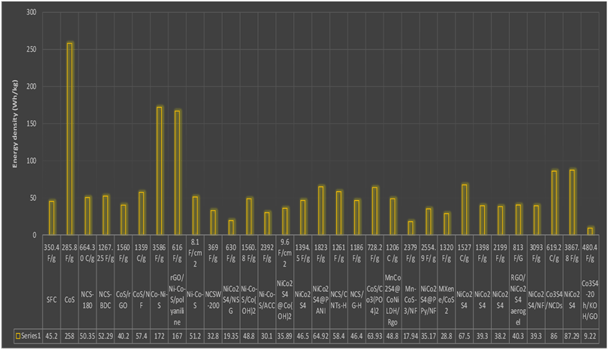
Graph 2. Represent energy density of Cobalt based electrodes.

Graph 3. Represent power density of Cobalt based electrodes.

4. Conclusion

   Cobalt sulfide- based nanomaterials are promising supercapacitor electrodes owing to their high redox activity, good conductivity, tunable nanostructures. Morphology control and synergistic engineering through composites and heterostructures significantly enhance electrochemical performance, while future efforts should focus on scalable synthesis and long-term device stability.

5. References

  1. J. A. Goudar, S. N. Thrinethra, S. Chapi, M. V. Murugendrappa, M. R. Saeb, M. S. Kalajahi, Adv. Energy Sustainability Res., 2025, 6, 2400271.
  2. F. Ali, X. Liu, D. Zhou, X. Yang, J. Xu, T. Schenk, J. Müller, U. Schroeder, F. Cao, X. Dong, J. Appl. Phys.,2017, 122, 144105-1-7.
  3. L. Yang, Q. Zhu, K. Yang, X. Xu, J. Huang, H. Chen, H. Wang, Nanomaterials, 2022, 12, 4065.
  4. W. Raza, F. Ali, N. Raza, Y. Luo, K. H. Kim, J. Yang, S. Kumar, A. Mehmood, E. E. Kwon, Nano Energy, 2018, 52, 441-473.
  5. I. S. Ismail, F. H. O. Muhamad, N. A. Rashidi, S. Yusup, Biomass Conversion and Biorefinery, 2023, 13, 14341-14357.
  6. G. Wang, Z. Lu, Y. Li, L. Li, H. Ji, A. Feteira, D. Zhou, D. Wang, S. Zhang, I. M. Reaney, Chem Rev., 2021,121, 6124–6172.
  7. T. Q. Tazim, Md. Kawsar, Md. S. Hossain, N. M. Bahadur, S. Ahmed, Next Nanotechnology, 2025, 7, 100167.
  8. Y. Huo, S. Xiu, L.Y. Meng , B. Quan, Chemical Engineering Journal, 2023, 451, 138572.
  9. S. Li, H. Ma, P.OuyangY. LiY. DuanY. ZhouW. OngF. Dong,Green Energy &Environment, 2025, 10, 1597-1623.
  10. V.S. Nalawade, R.S. Redekar, A.A. Bhoite, K.V. Patil, N.L. Tarwal, V.S. Kumbhar, S.M. Pawar,Inorganic Chemistry Communications, 2024, 170, 113281.
  11. K. Subramani, D. Jeyakumar and M. Sathish, Phys. Chem.Chem. Phys., 2014, 16, 4952–4961.
  12. K. Subramani, N. Lakshminarasimhan, P. Kamaraj, M. Sathish, RSC Adv., 2016, 6, 15941–15951.
  13. H. Wang, Journal of Energy Storage, 2021, 40, 102764.
  14. L. A Miya, S. K. Ghosh, P. Kumari, C. N. M. Morema, K. Mallick, Chemical Papers, 2025, 79, 7617–7631.
  15. Y. Lei, Q. Xu, Y. Miao, J. Shi, Mater. Adv., 2025, 6, 7427–743.
  16. K. Subramani, N. Sudhan, R. Divya, M. Sathish, RSC Adv., 2017, 7, 6648–6659.
  17. D. Loganathan, D. P. Nambia, ACS Appl. Electron. Mater, 2026, 8, 558–569.
  18. U. Bharathy R, G. Rajamanicham, M. Deshpande, Jothika B, International Journal of Hydrogen Energy, 2025,129, 38-50.
  19. F. Nasiri, L. Fotouhi, S. Shahrokhian, M. Zirak, Scientific Reports, 2024,14, 6045.
  20. Chetana S, S. Upadhyay, N.C.Joshi, N.Kumar, P. Choudhary, N. Sharma, V.N.Thakur,Chemistry of Flat Chemistry, 2023, 37, 100456.
  21. R. D. Abdoljabbar, H. Sharifpour, A. Kulkarni, S. Shahrokhian, D. P. Dubal, ACS Appl. Energy Mater. 2025, 8, 2779–2794.
  22. S. Prabu, S. MohanapriyaB.K. Chang,M. R. Pallavolu, K.Y. Chiang, J. Mater. Chem. A, 2025,13, 38065-38079.
  23. A. Barhoi, A. Chowdhury, C. Bora, S. Hussain, Journal of Energy Storage, 2025, 133, 118033.
  24. A. A. Markhabayeva, A. S. Anarova, K. A. Abdullin,Z. K. Kalkozova, A. T. Tulegenova, N. Nuraje, Phys. Status Solid RRL, 2023,18, 2300211-1-9.
  25. M. Shah, P. Kour, S. Kour, A.L. Sharma, Materials Chemistry and Physics, 2024, 325, 129797.
  26. N. Poompiew, P. Pattananuwat, P. Potiyaraj, RSC Adv., 2021, 11, 25057–25067.
  27. T. Xu, G. LiL Zhao, Chemical Engineering Journal, 2018, 336, 602-611.
  28. G. Xiang, Y. Meng, G. Qu, J. Yin, B. Teng, Q. Wei, X. Xu,Science Bulletin, 2020, 65, 443-451.
  29. W. Zhao , Y. Zheng , L. Cui, D. Jia,  D. Wei R. ZhengC. Barrow ,W. Yang J. Liu , Chemical Engineering Journal, 2019, 371, 461-469.
  30. R. Li, S. Wang, Z. Huang, F. Lu, T. He, Journal of Power Sources, 2016, 312, 156-164.
  31. C. Wei, Y. Huang , S. Xue, X. Zhang, X. Chen J. Yan , W. Yao, Chemical Engineering Journal, 2017, 317, 873-881.
  32. Y. Liu, Z. Li L. Yao , S. Chen, P. Zhang L. Deng,Chemical Engineering Journal, 2019, 366, 550-559.
  33. Z. Gao , C. Chen , J. Chang, L. Chen, P. Wang, D.WuF. XuK. Jiang , Chemical Engineering Journal, 2018, 343, 572-582.
  34. X. LiuZ. WuY. Yin, Chemical Engineering Journal, 2017, 323, 330-3339.
  35. R. BianD. SongW. SiT. ZhangY. ZhangP. LuF. HouDr. J. Liang, ChemElectroChem, 2020, 7, 3663-3669.
  36. J. ZouD. XieF. ZhaoH. WuY. NiuZ. LiQ. ZouF. DengQ. Zhang,  X. Zeng, Journal of Materials Science, 2021, 56, 1561-1576.
  37.  F. Zhao, D. Xie, W. Huang, X. Song, A.Z.G.Muhammad , H. Wu, F. Deng, Q. ZhangJ. ZouX. Zeng ,Journal of Colloid and Interface Science, 2020, 580, 160-170.
  38. Z. I. Muhammad, J. Khan, A. Muhammad Afzal S. Aftab , Electrochimica Acta, 2021, 384, 138358.
  39. H. Liang,T. Lin, S. Wang,H. Jia,C. LiJ. Cao,J. Feng,W. Fei, J. Qi, Dalton Trans., 2020,49, 196-202.
  40. A. Alshoaibi, Materials, 2023, 16, 4512.
  41. Y. A. Kumar, A. A. Yadav, B. Ali Al-Asbahi, S.W. Kang, Md. Moniruzzaman, Molecules 2022, 27, 7458.
  42. T.V.Nguyen, L.T. Son, P.M. Thao, L.T. Son, D.T. Phat, N.T. Lan, N.V. Nghia , T.V.Thu, Journal of Alloys and Compounds, 2020, 831, 154921.
  43. G. Surender, F.S. OmarS. Bashir, M. Pershaanaa, S. RameshK. Ramesh, Journal of Energy Storage, 2021, 39, 102599.
  44. A. Halder, M. Aman, Lichchhavi, S. K. Jha, Journal of Electroanalytical Chemistry, 2024, 972, 118631.
  45. R. Balu, A. Dakshanamoorthy, Mater Sci: Mater Electron, 2022, 33,10057–10071
  46. M. Barazandeh, S. H. Kazem, Scientific Reports, 2022,12, 4628.
  47. H.LiuR.HuJ.QiY.SuiY.HeQ.MengF.WeiY.RenY.ZhaoW.Wei,Advanced Material Interface, 2020, 7, 1901659.
  48. S.J. PatilJ.H. Kim D.W. Lee, Journal of Power Sources, 217, 342, 652-665.
  49. D.Shen,M.Y. Li,Y.Liu,X.Fu,H.Yu,W.Dong ,S.Yang, RSC Adv., 2023,13, 5557-5564.
  50. F. Zhao, W. Huang, D. Zhou, Journal of Alloys and Compounds, 2018, 755, 15-23.
  51. Z. Shi, X. Shen, Z. Zhang, X. Wang, N. Gao, Z. Xu, X. Chen, X. Liu,Journal of Colloid and Interface Science, 2021, 604, 292-300.
  52. J. Tang, W. Huang,X.Ly, Q.Shi, Nanotechnology, 2021, 32, 4817.
  53. N. V. Hoa,  P. A. Dat, N. V. Chi, L. H. Quan, Journal of Science: Advanced Materials and Devices, 2021, 6, 569-577.
  54. S. Wang, P. Zhang, C. Liu, Colloids and Surfaces A: Physicochemical and Engineering Aspects, 2021, 616, 126334.
  55. Z. KangY.LiY.YuQ. LiaoZ. ZhangH. GuoS. ZhangJ. WuH. SiX. Zhang, Y. Zhang, Journal of Materials Science, 2018, 53, 10292-10301. 
  56. Z. Ji, Z. Lin, J. Zhong, X. Gao, H. Li, G. Zhu, P. Song, X. Shen, Applied Surface Science, 2026, 718, 164902.
  57. X. Chen, M. Sun, F. JaberE. Z. NezhadK. S. HuiZ. LiS. Bae, M. Ding, Scientific Reports, 2023, 13, 15555.
  58. N. D. Hung, D. V. Cu, L.Q. Huy, L. T. T. Thuy, L. V. Khu, HNUE Journal of Science, 2025, 70, 88-100.
  59. H. Yu, D. Shen, R. Zhang, S. Zhao, Coatings, 2024, 14, 564.
  60. N. H. H. Yussuf, M. Z. Najihah, R. Hisam, H. J. Woo, M.F. Kasim, P. K. Singh, T. Winie, Research Square, 2025. doi.org/10.21203/rs.3.rs-7712061/v1.

A Comparison Between Personality & Sport Competitive Anxiety Among Basketball Players at Different Levels Achievement

Daily writing prompt
Write about your approach to budgeting.

A Comparison Between Personality & Sport Competitive Anxiety Among Basketball Players at Different Levels Achievement

Dr..Priyanka P.Sulakhe

J.K.Shah Adarsh Mahavidyalay

Nijmpur- Jaitane, Tal- Sakri, Dist- Dhule

Email-sulakhepriyanka@gmail.com

Introduction

                  Sport psychology is an interdisciplinary science that drawn on knowledge from  many  related fields including biomechanics, Physiology, Kinesiology, and Psychology. It involve that the study of how psychological factors affect performance and how participation in sport and exercise affect psychological and physical factors. In addition to instruction and training of psychology skills for performance improve, applied sport psychology may include work with athletes, coaches and parent regarding injury, rehabilitation, communication, team building and career transitions. Sport Psychology is a proficiency that uses psychological knowledge and skills to address optimal performance and well being of athletes, development and social aspects of sports participation, and systemic issue associated with sports setting and organizations.

Objectives

The objective of the study was to compare the personality and sport competitive Anxiety between the National and State Basketball players.

Methodology

For this study male Basketball players were selected. The subject ranging 18-25 years only. For this study National and State Basketball players were selected. For the collection of Data researcher employing a standardized questionnaire. Personality were measure by employing Eysenck personality Inventory and sport competitive Anxiety were measure by employing Martin’s sports competitive Anxiety test.

Result

Extrovert Personality trait

VariablesMeanS.D.Mean DifferencesS.Error‘T’ value
National Players12.21.190.930.462.022
State Players13.132.22

Neuroticism Personality trait

VariablesMeanS.D.Mean DifferencesS.Error‘T’ value
National Players141.941.000.492.04
State Players131.87

Sport Competitive Anxiety

VariablesMeanS.D.Mean DifferencesS.Error‘T’ value
National Players18.132.160.970.442.20
State Players17.161.17

Conclusion

 While comparing the Personality and Sport competitive Anxiety it was observed that the National Basketball players had shown significantly better in Personality and Sport Competitive Anxiety as compare to State Basketball Players.

References

Betty Toman,”Dance-Physical Educationist Art form.” Cited by Chartes A,Bucher, Dimensions of Physical education 2nd ed., (Saint Louis : The C.V. Mosby Co.,1974)p.p. 30

Horold M.Barrow, Man and Movement(Philadelphia: Lea and Febiger,1977) p.p.44

Biocontrol mechanism of fungal pathogen through P. fluorescens ATCC 9028

Daily writing prompt
What is your favorite drink?

Biocontrol mechanism of fungal pathogen through P. fluorescens ATCC 9028

Dr. Vishal Narayan Shinde*

Department of Botany, Late Annasaheb R D Deore Arts and Science college, Mhasadi,

Tal. Sakri, Dist:Dhule- 424304 (MS) India.

                       * Author for Correspondence: vishalshinde1001@gmail.com       

Abstract:

Biological control of plant pathogen by microorganism has been considered more natural and environmentally acceptable alternative to the existing chemical methods[1]. Biological control has been developed as an alternative to synthetic fungicide treatment and considerable success had been achieved upon utilizing antagonistic microorganism to control both pre harvested and post harvested diseases[2]. A variety of microbial antagonistic has ability to control several pathogens of various fruit and vegetables[3].

            Antifungal assay using bacterial isolates such as P. fluorescens ATCC 9028 was tested against ten fungal pathogens of leafy vegetables. P. fluorescens ATCC 9028 was most effective with 58.19% fungitoxic activity against all tested fungal pathogens. Among the tested pathogen, F. moniliforme was highly susceptible with 65.78% inhibition and P. pullulans was highly resistant with 44.02% inhibition against all three antagonistic bacteria.

Keywords: Biological control, antagonistic bacteria., P. fluorescens etc.

Introduction:

On an average each crop plant can be affected by hundred or more than hundred diseases. The development of new physiological race pathogens to many of the systemic fungicides is gradually becoming ineffective. The biological control agents have enormous antimicrobial potential. They are effective in treatment of infectious diseases, simultaneously mitigating many of the side effects which are associated with pesticides. Therefore, there is growing realization in the people that biological control can be successfully exploited as an agricultural method for soil borne pathogens[4].

            Beside this, Biological control of numerous crops by application of antagonistic bacterial isolates from suppressive soils has been accomplished during last two decades all over the world[5]. The bacterium has been reported to be effective in controlling Phytopthora and Pythium amongseveral soil borne plant pathogens[6]. Several studies have been demonstrated reduced incidence of disease in different crops after supplementing the soil with bacterial antagonists[7]. Rhizosphere bacteria are excellent agents to control soil borne plant pathogens. Bacterial species like Bacillus, Pseudomanas, Serratia and Anthrobacter have been proved in controlling the fungal diseases[14,15]. More recently an increasing number of reports have been focused on the potential of Bacillus subtilis as a biocontrol agent[8]. A successful biocontrol agent efficiently suppresses the pathogen and reduces disease incidence. Biocontrol agent acts against pathogens by antagonism- competition, antibiosis and parasitism therefore in recent years a new biocontrol agent, Pseudomans flouresence have drawn attention due to the ability to produce secondary metabolites such as siderophore, antibiotic, volatile metabolites, HCN, enzyme and phytochrome which were highly antagonistc component to various phytopathogens[9]. Pseudomonas flourescence is effective candidate for biological control of soil borne plant pathogens owing to their versatile nature, rhizophere competition and multiple mode of action[10,11,12].

Material and method:

            Biological control of numerous crop diseases by application of antagonistic bacterial isolates from the soil has been accomplished during last two decades all over the world[13,14,15]. Hence for the assessment of antifungal activity, the three bacterial isolates which has high antagonistic activity were procured from the Department of Microbiology, Government Institute of Science, Aurangabad as fallows,

            1)         Pseudomonas fluorescens ATCC 9028

            There after this bacterial cultures were transferred to fresh Nutrient agar slants in triplicates and were kept at 40C in refrigerator for further studies.

Antifungal activity by antagonistic bacteria:

            The antifungal activity of three bacterial isolates was tested against ten pathogenic fungi of leafy vegetable by dual culture method[16]. The antagonistic bacteria and targeted fungal pathogen were inoculated dually on PDA medium in sterile Petri dish 2-2.5 cm apart from each other. Whereas Petri plate without bacterial inoculation served as control and incubated at 37 ± 1 oC for 7 days. The inhibition of growing fungi by tested bacteria was quantified as distance of radial towards and away from bacteria in relation to control. The percent inhibition of mycelial growth of the fungi was calculated using formula,

                                             100 (R1-R2)

                               I  =

     R1  

                                    Where              I           =          Inhibition of mycelial growth.

                                                            R1        =          Mycelial growth in control

                                                            R2        =          Mycelial growth in treated.

Result:

            The antagonistic effect of bacterial isolates was screened by dual culture method[16]. The bacterial cultures, Pseudomonas fluorescens ATCC 9028 was tested against ten fungal pathogens of leafy vegetables. After a week of incubation, the growth of targeted fungal pathogens towards and away from the bacterial antagonistic isolate was recorded. The percent inhibition of mycelial growth over control was tabulated.

The bacterial antagonistic, P. fluorescens ATCC 9028 had significantly inhibited the radial growth of all tested fungal pathogen of leafy vegetables. Among tested pathogens, F.moniliforme and F. oxysporum were most sensitive and revealed 68.42% and 66.66% inhibition of mycelial over control (Table 1). On contrary, A. carthami and P. pullulans were most resistant and showed 50.90% and 49.18% inhibition respectively. While remaining pathogens namely C. lindemuthianum, F. roseum, A. brassicae, A. humicola, S. verruculosum and H. sativum showed 62.31%, 60%, 59.45%, 57.81%, 54.23% and 53.01% respectively inhibition (Table 1; fig. 1).

On average, F. moniliforme was found to be most sensitive with 65.78%  and P. pullulans as most resistant with 44.02% against all three bacterial antagonistic when compared to other tested fungal pathogens (Table 1).

Among the three tested antagonistic bacterial cultures, P. fluorescens ATCC 9028 was most effective and showed 58.19% fungitoxic activity (Fig 1).

Table No. 1: Antagonistic effect of P. fluorescens ATCC 9028 against ten fungal  pathogens of leafy vegetables.             

PathogenMycelial growth in control (mm)Mycelial growth of pathogen in presence P. fluorescens (mm)% inhibition of  mycelial growth over control
A. brassicae743059.45 + 1.88
A. carthami552750.90 + 1.33
A. humicola642757.81 + 1.24
C. lindemuthianum692662.31 + 0.47
F. moniliforme762468.42 + 1.41
F. oxysporum842866.66 + 0.94
F. roseum702860.00 + 1.41
H. sativum833953.01 + 0.81
P. pullulans613149.18 + 1.63
S. verruculosum592754.23 + 1.88
C.V.  7.96%

Values expressed in mean + S.E.M. of triplicates.

Fig 1. Antagonistic effect of bacteria against ten fungal pathogens of leafy vegetables.

Discussion :

Antifungal activity of three bacterial isolates namely Pseudomonas fluorescens ATCC 9028 was tested against ten fungal pathogens of leafy vegetables by dual culture method. Similar work previously carried out by many workers and reported that bacterial isolates like Bacillus sp., Pseudomonas sp., Serratia sp. and Anthrobacter sp. have been proved their efficacy against many fungal diseases[17,18]. In the present study among three tested antagonistic bacterial isolates, P.  fluorescens ATCC 9028 was most effective one and revealed 58.19% inhibition of mycelial growth all ten targeted fungal pathogens. Similar finding were reported by Moataza and Saad[19] and mentioned that five isolates P.  fluorescens were effective and showed 56% inhibition of Phythopthora capsici and 58.08% inhibition of Rhizoctonia solani.  

Among the tested pathogens, F. moniliforme was most susceptible with 65.78% inhibition on contrary P. pullulans was most resistant with 44.02% inhibition against all three bacterial isolates. Antagonistic activity may be due to the production of secondary metabolites such as siderophore, antibiotic, volatile compounds, HCN, enzymes or may be due to phytochromes which were inhibitors of various phytopathogens[18].

References:

  1. Baker, R. and T. C. Paulitz. 1996. Theoretical basis for microbial interaction leading to biological control of soil borne plant pathogen In : Hall R., (ed). Principles and practice of managing soil borne plant pathogen. Am. Phytopathol. Soc. St. Paul. MN. pp. 50-79.
  2. Janisiewicz, W. J. and L. Korsten. 2002. Biological control of post harvested diseases of fruits. Annu. Rev. Phytopathol. 40 : 411-441.
  3. Mari, M. and M. Guizzardi. 1998. The post harvested phase: emerging technology for fungal disease. Phytoparacitica. 23 : 97-127.
  4. Papavizas, G. C. and R. D. Lumsden. 1980. Biological control of soil borne fungal propogules. Annu. Rev. Phytopathol. 18 : 389-413.
  5. Park, C. S., T. C. Paulitz and R. Baker. 1988. Biocontrol of fusarium wilt of cucumber resulting from interaction between Pseudomonas putida and non pathogenic isolates, Fusarium oxysporum. Phytopathol. 78 : 190-194
  6. Shen, S. S., J. M. Kim and C. S. Park. 2002. Serratia plymuthica strain A21-4 : A potential biocontrol agent against phytopthora blight of pepper. Kor. J. Plant Pathol. 18 : 138-141.
  7. Mukhopadhyay, A. N. 1987. Biological control of soil borne plant pathogen by Trichoderma spp. and Bacterium isolates. Indian J. Mycol. Plant Pathol. 17 : 1-9.
  8. Weller, D. M., B. X. Zhang and R. J. Cook. 1985. Bacterial species and biopesticides in controlling fungal diseases. Plant Diseases. 69 : 710-713.
  9. Ferreira, J. H.S., F. N. Mathee and A. C. Thomas. 1991. Biological control of Eutypa lata on grapevine by antagonistic strain of Bacillus subtilis. Phytopathol. 81 : 283-287.
  10. Okigbo, R. N. and M. I. Osuinde. 2003. Fungal leaf spot disease of Mango (Mangifera indica L.) in Southeastern Nigeria and biological control with Bacillus subtilis. J. Plant Peotect. Sci. 39(2): 70-77.
  11. Gupta, C. D., R. C. Dubey, S. C. Kang and D. K. Maheshwari. 2001. Antibiotic mediated necrophic effect on Pseudomonas GRC2 against two fungal plants pathogens. Current Sci.  81 : 91-94.
  12. Kloepper, J. and M. Schroth. 1981. Relationship of in vitro antibiosis of plant growth promoting rhizobacteria and the displacement of root microflora. Phytopathol. 71 : 1020.
  13. Waller, D., W. Howie and R. Cook. 1988. Relationship between in vitro inhibition of Gaenmannomyces graminis var. tritici and suppression of take all of wheat by Fluorescent psudomonads. Phytopathol. 78 : 1100.
  14. Diby, P., K. Saju, Y. Jisha, A. Kumar, Y. Sharma and M. Anandaraj. 2005. Mycolytic enzyme produced by Pseudomonans fluorescens and Trichoderma spp. against Phytopthora capsici, (Pepper nigrum L.). Ind. Phytopathol. 58 : 10.
  15. Park, C. S., T. C. Paulitz and R. Baker. 1988. Biocontrol of fusarium wilt of cucumber resulting from interaction between Pseudomonas putida and non pathogenic isolates, Fusarium oxysporum. Phytopathol. 78 : 190-194.
  16. Leeman, M., F. M. De Quden, T. A. Van Pelt, C. Cornelissen, G. Matamala, P. A. H. M.  Bakker and B. Schippers. 1995. Suppersion of Fusarium wilt of raddish by co inoculation of Fluorescent pseudomonas spp. and root colonizing fungi. Eur. J. Plant Pathol. 102 : 21-31.
  17. Larkin, R. P., D. L. Hopkins and F. N. Martin . 1996. Suppression of Fusarium wilt of watermelon by non pathogenic F. oxysporum and other microorganism recovered from a disease suppressive soil. Phytopathol. 86 : 812-286.
  18. Skidmore, A. M. and C. H. Dickinson. 1976. Colony interaction of hypal interference between Septoria nodorum and Phylloplanefungi. Trans. Brit. Mycol. Soc. 66 : 57-64.
  19. Moataza and M. Saad. 2006. Destruction of Rhizoctonia solani and Phytopthora capsici causing tomato root rot by Pseudomonas fluorescens lytic enzyme. Res. J. Agri. Bio. Sci. 2(6) : 274-281.

**********

Analysis of the Cropping Pattern In Dhule District (M.S.).

Daily writing prompt
Share one of the best gifts you’ve ever received.

Analysis of the Cropping Pattern In Dhule District (M.S.).

Dr. Suresh Chintaman Ahire

Uttamrao PatilArts and Science College, Dahivel, Dist.-Dhule (M.S.),ahiresuresh9@gmail.com

Abstract:

New cropping patterns have been accepted by the farmers of the study region, due to climate change and uneven rainfall. Geographical and economical factors have boosted the cultivation and production of cereals crop. The Dhule district is drought prone district, soit is select for present study. Agriculture is the main occupation in the district, geographical phenomena is uneven. Annual rainfall is unsatisfied for agriculture. Therefore, the study of spatial distribution and temporal variability were vital in characterizing the geographic factor and nature of cereals crop cultivation.Therefore it is important to study the cropping pattern in this district. The aim of present paper is to examine the temporal changes and relation between rainfall and cropping pattern. Present study is based on secondary source of data year 2005 and 2015. Simple statistical technique is used to analyze the changing trend of cropping pattern. For calculating transformation the data 2005 and 2015 are compared. The data is representing with graph and map using GIS software and MS Excel is applies to analyze. In Dhule district area under cereals crops are changes in various tehasils. Cerealscrops cultivationhas occupied area 247051 Ha. (60.26% of NSA) in the year 2005 and occupied area decrease upto 145056 Ha.  (37.16 % of NSA) in the year 2009 due to the flexibility of the rainfall. Keyword: Crop, Cropping pattern, Drought prone, Plantation,Agriculture

Introduction:

India has a great diverse agricultural systems as well as it posses’ rich agricultural resources, different geographical, factors had resulted into agricultural typologies. Therefore, important agricultural facility is usefulprogramme to improved productivity and thereby achieving rural development. They may beachieved by technological intervention and by adopting strategic cropping pattern. This would reduce the water requirement of agricultural without comprising agricultural output.Maharashtra is leading state in area and production of cereals crops in the country. According to some expert and farmers there is a shift from cereals crops to other because of water requirement, low input and high profitability over these crops.  Drought is a major problem in Dhule district. They are natural hazards and are related with rainfall. Drought may be best benefited as persistent and abnormal moisture deficiency that has an adverse impact on agricultureAgriculture in this district is mostly of intensive subsistence type. There are two main crop growing seasons, its Kharif and Rabbi. Jawar crop is grown in both seasons.

Study area: The shape of the study area is triangular. It is located in the northern part of the Maharashtra State. It has occupied over an area of 8063.11 sq.km. It is extended from 20038 N to 21039 N latitudes and from 73050 E to 75013l E longitudes (Fig. No.1). Dhule district contributes 2.62 percent total geographical area of the Maharashtra State. As per the 2011 Census, the population of Dhule district is 2,048, 781. The density of population is 285 persons per sq. km.

Objectives:

            To study the temporal changing cropping pattern of Dhule district.

            To study the relation between rainfall and cropping pattern of Dhule district.

Hypothesis:

Cereals cropping pattern depend on rainy days and annual rainfall

Database and Methodology:

            In this study secondary data have been collected from various socio-economic reports of Dhule districts. Analysis the 2005 and 2015 is cropping pattern. Simple statistical techniques are used to analyze the changing trend in cropping pattern, for calculating transformation the data 2005 and 2009 are compared. The data have been summarized processed and representedwith graph and map using GIS software, MS Excel was applied to process and analysis the data.In the present paper out of all crops only cereal cropping pattern has been studded. Cereal crops like Bajara, Rice, Wheat, Maize, Jower, Nachani and Pulses are studded.

Results and Discussion:

Dhule district comes under drought prone area. Cereal crop is a major crop in this district. Tahsilwice rainfall is varied; hence cereals crop cultivation is also uneven. Annual rain fall is highest in Shirpur tahsil (above 700mm). Shirpur tahsil does not come under drought area. Therefore amount of cereal crop is 43% of NSA in 2005 and 15% of NSA in 2015. Shindkhed Dhule and eastern part of Sakri tahsilcome under drought prone area. Hence near about 70% of NSA fall under cultivation area of cereal crops. In 2015 due to rainfall is increase cereal crop cultivation area has been declined from 60% of NSA (2005) to 37% of NSA (2015). Sakri tahsil stood first in cereal crop cultivation in Dhule district (70% of NSA 2005 and 51% of NSA in 2015)Bajara crop cultivated all over the district, area under Bajara crop in 2005 was 60.26% of NSA and in 2015 it was 37.16v. In 2015 due to increase in rainfall (Annual average rainfall 673mm) instead of cereal cropping pattern other cash crop cultivated area has been increased.

The net sown area in the Dhue district was 409900ha. and 390458ha. year 2005 and 2015 respectively.  This year cereals have occupied 247051ha. (60.26% of NSA) and 145096ha. (37.16% of NSA) area in 2005 and 2015 respectively. The main cereals crops have been Bajara, Jawar and Wheat are the important food grain crop in the district. Maize is mostly grown in the irrigated areas. High proportion of cereals indicated that the tahasils has very low level of commercialization of agriculture. The field observation revealed that the tahsils dominated by cereals with slightly more than half the cultivated areas.

Bajara :

Bajara is the important food crop cultivated in the district. It is generally taken in kharif season and hence it must have replaced hybrid that was grown in the same season. It is usually grown on the light to medium soil. It requires dry climate and less rainfall bajara is grown everywhere in the district. The use of high yielding verities of seeds is increased in the district. The farmer mostly areas this crop when the amount of rainfall is less. Through bajara is the important kharif crop it is also grown in rabbi season Dhule and Shindkheda tahasils. Rabbi bajara is grown in the summer season in the villages having the irrigation facilities.Climate of the district is suitable for Bajara crop. This crop can be taken low amount of rainfall. Sakri tahsil stood first in the cultivation area of bajara 33.51 % of NSA, it is follow by Dhule (30.59% of NSA), Shindkheda (24.46% of NSA) and lowest area under cultivation is Shirpur tahsil which is 15.22% of NSA in 2005. In 2015, due to increase in rainfall, inspite of bajara, maize and other cash crops have been cultivated.

Jowar:

Jawar is also important food grain crop in the district. It is cultivated in kharif and rabbi crop season. The jowar cultivation is basically related to firstly low rainfall and secondly soil in the district. It is traditionally cultivated as a rain feed crop in the both seasons.Jowar is cultivated all over the district. Highest area under cultivation of jower is in dhule tahsil (19.68% of NSA), which is followed by Shindkheda (15.12% of NSA), Shirpur (10.55% of NSA)and lowest area under jower cultivation is in Sakri tahsil(1.26% of NSA)in 2005. But in 2015, due to increase in average rainfall, area under this crop has been declined.

Rice:

Rice crop is cultivated only in western part of Sakri tahsil and Shirpur tahsil in Dhule district. The average annual rainfall in this area is 650 to 750mm, which is higher and suitable for rice crop. The area under cultivation is increased Sakri tahsil 3.72% of NSA in 2005 to 10.54% of NSA in 2015.  Dhule tahsil this crop is rarely cultivation and in Shindkheda tahsil rice crop is not cultivated.

Table no. : Tahsil wise Cereals Crop Cultivation Area in Dhule district (2005 and 2015)
TehsilSr.    No.Crops20052015
Area in     Ha.% of     NSA% of      CerealsArea in    Ha.% of      NSA% of     Cereals
Shirpur1Bajara924215.2221.59834045.3516.52
2Jawar640810.5514.97521813.4310.59
3Rice200.030.047000
4Wheat6531.081.52614562.297.07
5Maize00.000.0001180.190.57
6Nachni00.000.00000.000.00
8Pulses1016516.7423.75562869.8930.51
Total2648843.6161.9011344521.1565.25
Shindkheda1Bajara2603824.4625.631928320.0728.82
2Jawar1609415.1215.8460586.309.06
3Rice00.000.0000.000
4Wheat8100.760.8013701.432.05
5Maize2770.260.275230.540.78
6Nachni00.000.0000.000.00
8Pulses1514514.2314.911343113.9820.08
Total5836454.8357.454066542.3260.79
Sakri1Bajara4866235.5127.2819421.651.09
2Jawar17311.260.9740.000.00
3Rice51033.722.861242210.5411.65
4Wheat34252.501.9261645.233.46
5Maize134639.827.552236918.9912.54
6Nachni43993.212.479210.780.52
8Pulses1900713.8710.661704914.479.56
Total9579069.8953.716087151.6738.82
Dhule1Bajara3231830.5925.9931122.765.07
2Jawar2079619.6816.721292611.4421.06
3Rice20.000.00140.010.02
4Wheat20521.941.6523322.063.80
5Maize27702.622.2332012.835.21
6Nachni00.000.0000.000.00
8Pulses84718.026.8185307.5513.90
Total6640962.8553.413011526.6649.06
Total24705160.26 14509637.16 
Source: Dhule district Socio-Economic Report, 2005 &2015 
Table no: Tehsil wise Annual rainfall, Raini days and Drought prone Villages in Dhule district. (2005 and 2009)
Sr. No.TehsilsAnnual Rainfall in mmTotal VillagesDroughtprone VillagesNSA in Ha.
2005Raini days2015Raini days20052009
1Shirpur603476872315206073263569
2Shindkheda388415842614314310644696100
3Sakri6874477432212110137056117804
4Dhule3184062328166166105666112985
Average/Total499172667109673419409900390458
Rainfall in %92110
Source: Agriculture Commissioner Office, Pune

Wheat:

Wheat is the third important food grain in the district. This crop is grown in the medium and black soil. It is cultivated in dry and cool month of rabbi season. The farmer has grown the crop on a very small scale in the district. The crop is taken as an irrigated crop. The agricultural land is prepared after the harvested season of bajara. Sowing is done in the month of Oct. / Nov. The crop date takes 110 to 140 days to mature from the date of sowing. Now, improved verities of seed are sown in the district. Wheat cultivation area increased the mainly because of increase in area under irrigation by Panzar, Kan and Kabryakhadak medium projects.This crop is cultivated very less (1 to 3.8% of NSA) Dhule district in 2015. Climate of the District is not suitable for this crop. Therefore, the average production of this crop is very less.

Maize:

Maize is important crop which is mostly usa as a fodder in the Sakri, Dhule and Shindakheda tahsils. The area under maize has increased for the year 2005 (4.23 of % NSA) to the year 2009 (5.63% of NSA). Maize crop gives a higher production and income of the farmer in Dhule district. The area under cultivation of this crop is increasing day by day. The climate of this District except Shirpur tahsil, is favorable for this crop. In 2005 higest area under cultivation of the crop is Sakri (9.82% of NSA) and it followed by Dhule (2.62% of NSA), Shindkheda (0.26% of NSA). The crop requires water in large amount. It needs irrigation facility.  In Sakri tahsil Panzara, Kan, Kamkheli and Kabryakhadak irrigation medium water tank. Whereas, in 2015, the area under cultivation of the crop is increased double higher due to hybrid seed and irrigation facilities.

Nachni:

Nachni is important kharif crop in only Sakri tahsil in Dhule district. The area under Nachani in year 2005 was 3.21 % of NSA and year 2015 was 0.75% of NSA in Sakri tahsil. The Nachani is grown on the light soil and heavy rainfall area.In high rainfall area, this crop is cultivation. In Dhule district, only in western part of Sakri tahsil Nachani crop is cultivated, which is due to the high rainfall in hilly area of Sayadri. The crop is cultivated in (3.21% of NSA) area as per 2005.

Pulses:

Pulses grown in all tahsils in Dhule district. It is dominant crop in shirpur tahsil. It is account 13.21% of NSA in year 2005 and 11.47% of NSA in year 2015. In the tahsil a variety of pulses area grown like Gram, Tur, Green gram, Mug, Chavali, Wal, Green peas etc. Almost all the pulses except Gram and Tur are cultivated in kharif season. Mostly varieties of pulses are cultivated in all tahsils in dhule district. The pulses are grown on light soil in the district.This crop can be cultivated in both less and high rainfall area. This crop is economically beneficial. The crop is cultivated in all tehsils of the district. In 2015 in Sakri tahsil, the crop is cultivated in 14.17% of NSA.

Generally, cereal crop is cultivated all over the district. If rainfall is increased, other crops like cotton, Sugarcane Vegetable can be cultivated in large amount. Dhule district is drought prone area, hence cereals cropping pattern analysis is essentional. Geographical and technological factors affect on the cereals cropping pattern.

Suggestions:

1. For cereals crop, instead of traditional cropping pattern, new technological cropping needs to be accepted for better results.

2. Newly developed hybrid seeds of cereals crop need to be used.

3. Where there is less rainfall, irrigation system based on new technology is to be used.

4. In less rainfall and less area, higher productivitycropping pattern to be accepted.

5. Fruit crop cultivated in less water area like Pomegranate, Crusted Apple, Ber etc. are to cultivated

6. Cereal crops should betaken for commercial purposes instead of traditional cropping pattern.

References:

  • Annonymous (1995): ‘Research report of AICRP on arid zone fruits’, MPKV, Rahuri, presented in research review ‘Committee meeting of Agricultural entomology Pp, 11-18.
  • Pawar C. T. and Phule B. R. (2000):  ‘Fruit Farming in Drought Prone Area of Maharashtra A Micro Level Analysis’, Indian Geographical Journal, Chennai, Vol. 74(2), Pp. 147-151
  • Phule Suresh (2009): ‘Krushi Bhugol’, Vdhya Bharti Prakashan, Nagpur, Patil V. B. (1991): ‘Kordvahu Phalzade’, Continantal prakashan, Pune, (Marathi)
  • Suryavanshi D. S. and Ahire S. C. (2012): ‘The Study Of Pomegranate Plantation Volume In Dhule District (M.S.)’, Interlink Research Journal, Latur
  • Suryavanshi D. S. and Ahire S. C. (2012): “Levels of sustainable development in kan basin of Dhule District,” Maharashtra Bhugolshastra Sanshodan Patrika- Pune, Pp 89-99
  • Bhagat Vijay (2002): “Agro-Based Model for Sustainable Development in the Purandar tahsilof Pune district,Maharashtra”  University of Pune, Ph.D. Thesis, 2002
  • Deostili Vrushali (1997): “Crop Planning for Ahemadnagr and Solapur District, Maharashtra”, The Indian Geographical Journarl, Pune, pp 20-26.
  • Shinde S. D. (1988): ‘Changing Landuse Pattern for Amanpur Village of Sangali District” Reding Irrigated Farming,Vishwnil Publication, Pune, pp. 204- 2001

“Hydrogel-Based Growth of Cobalt Tartrate Single Crystals and Their Morphological Study”

Daily writing prompt
What were your parents doing at your age?

“Hydrogel-Based Growth of Cobalt Tartrate Single Crystals and Their Morphological Study”

Sachin J Nandre,

Dept of Physics, Uttamrao Patil College, Dahiwel (Dhule)

Abstract

Single crystals of cobalt tartrate (CoC₄H₄O₆·xH₂O) were successfully grown using the hydro-silica gel technique, which allows controlled nucleation and slow diffusion of reactants in a three-dimensional porous medium. Cobalt tartrate is a transition metal-organic complex with potential applications in catalysis, magnetic materials, and electrochemical sensors. The growth process was optimized by adjusting gel concentration, reactant molarity, and pH, resulting in well-faceted, transparent to pale pink crystals. The study demonstrates the effectiveness of the hydro-silica gel method for producing high-quality cobalt tartrate crystals and provides insights into their growth mechanism and morphology control.

Keywords: Hydrosilica gel, catalysis, electrochemical sensors.

1. Introduction

Cobalt tartrate, a coordination complex of cobalt and tartaric acid, exhibits unique optical, magnetic, and structural properties due to the d-orbital interactions of cobalt ions and the chelating behavior of tartarate ions. The controlled growth of single crystals of cobalt tartrate is essential for materials characterization and applications in electronics, optics, and catalysis.The hydro-silica gel technique is a soft chemical crystal growth method where reactants slowly diffuse through a gel matrix, enabling controlled nucleation and growth at ambient temperature. This method offers advantages over conventional solution growth, including, low temperature growth, avoiding thermal decomposition, control over crystal size and morphology, reduction of spontaneous precipitation.

This work aims to grow cobalt tartrate crystals using the hydro-silica gel method and study the effect of gel concentration, reactant molarity, and growth time on crystal morphology and size. Growth of crystal ranges from a small inexpensive technique to a complex sophisticated expensive process and crystallization time ranges from minutes, hours, days and to months. The starting points are the historical works of the inventors of several important crystal growth techniques and their original aim. The methods of growing crystals are very wide and mainly dictated by the characteristics of the material and its size.

2. Experimental Technique

2.1 Materials

The materials were purached from Lobachempvt ltd. All the materials were AR grade and they are used without any further purification. Cobalt chloride hexahydrate (CoCl₂·6H₂O), Tartaric acid (C₄H₆O₆), Sodium metasilicate (Na₂SiO₃·5H₂O) for gel preparation, Distilled water,Glacial acetic acid (for pH adjustment).

2.2 Preparation of Hydro-Silica Gel

Sodium metasilicate solution was prepared by dissolving 50 g of Na₂SiO₃·5H₂O in 100 mL of distilled water.The solution was acidified slowly with 1 M acetic acid under constant stirring until gelation occurred (pH ~4–5). The gel was allowed to set in test tubes and aged for 24–48 hours to strengthen the matrix. The following table 1 shows the standard optimized parameters for the crystal growth development.

Sr.NoOptimum ConditionsCobalt Tartrate
1Density of Sodium Meta Silicate1.04gm/cm3
2Conc. of Tartaric acid0.5M
3Volume of Tartaric acid7ml
4Volume of Sodium Meta Silicate18ml
5Volume of Cobalt Cholride5ml
6pH of the gel4
7Ageing PeriodOne week

The crystals were extracted by carefully breaking the gel after two to three weeks depend on the growth parameters.  The extracted crystals were subjected to study their physical properties particularly crystal size, growth morphology, crystal structure, and optical behavior. Growth morphology was studied by using scanning electron microscope. Crystal structure was identified by using X-ray diffraction technique.

3. Results and discussion

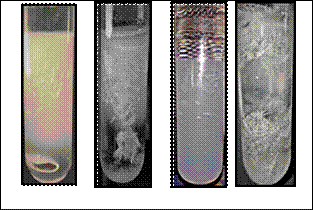
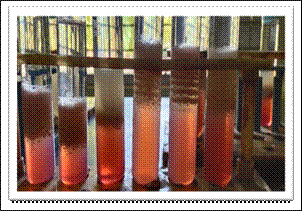
Crystal growth occurs via slow diffusion of Co²⁺ and tartrate ions through the hydro-silica gel.Gel acts as a porous medium, restricting rapid precipitation and promoting uniform nucleation.Chelation of cobalt ions by tartarate ions stabilizes the crystal lattice.Hydrogen bonding and van der Waals interactions within the gel network facilitate orderly crystal assembly. In the present experiment, a 0.1 M solution of cobalt chloride was carefully poured on top of the set silica gel and 0.1 M solution of tartaric acid was layered above the gel to allow slow diffusion. The test tubes were sealed to prevent evaporation and left undisturbed at room temperature (~25°C).Crystals started to appear after one week, and growth continued for up to three weeks in order to get full grown crystals with different facets.

It is observed that concentration of cobalt chloride and tartaric acid has significant effect on the growth of the crystals. It is found out that higher cobalt ion concentration increases the nucleation sites resulting smaller crystals and for lower concentration of cobalt ions slowed crystal growth, yielding larger but few crystals. However, the equimolar concentrations of cobalt chloride and tartaric acid resulted in optimal crystal quality.

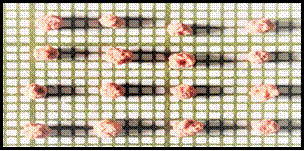
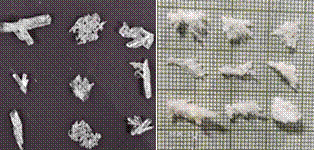
Fig 1. Photographic image of Cobalt tartrate crystal obtained after three weeks.

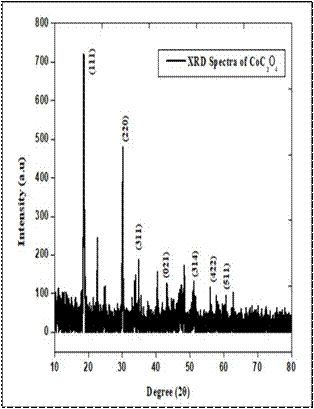
Figure 2 shows the X-ray diffraction pattern of Cobalt Tartrate Single Crystals.  The orientations of (111), (200), (220), and (311) planes are observed which reveals well-defined crystal structure of the grown materials.

Figure 2:  XRD of Gel grown Cobalt Tartrate Crystal

Figure 3 shows the microscopic SEM images of cobalt tartrate crystals. These crystals were pale pink to pink in color with transparent, and prismatic properties. The grown crystals shaped changed with respect to pH of the gel concentration. The shape of the crystals changed from spherical granule to crystal size ranged from 1–6 mm, depending on gel concentration and reactant molarity.Lower gel density led to faster diffusion, resulting in smaller but more numerous crystals.Higher gel density slowed ion diffusion, producing fewer but larger, well-faceted crystals.

Figure 3: Scanning electron microscopy images of  Cobalt Tartrate Crystal grown by gel-gel technique.

4. Conclusions

Cobalt tartrate crystals were successfully grown using the hydro-silica gel technique. The study shows that gel density, reactant molarity, and pH are critical parameters in controlling crystal size and morphology. The hydro-silica gel method is effective in producing high-quality, well-faceted cobalt tartrate crystals at ambient temperature. These crystals can be used for further studies in materials characterization, optical properties, and catalytic applications.

Acknowledgements

The authors would like to express their sincere gratitude to Principal Dr Suresh Ahire Sir  for their valuable guidance and support throughout this work. We also thank the Dept. of Physics Uttmrao Patil College, Dahiwel for providing the necessary facilities and resources for the preparation and characterization of strontium malonate crystals. Special thanks are extended to colleagues and staff who assisted in experimental setup, observations, and discussions that contributed to the success of this research.

References

  1. R. W. Cahn, P. Haasen, E. J. Kramer, Materials Science and Technology, 1995.
  2. S. K. Malik, A. Kumar, Journal of Crystal Growth, 2011, 318, 1012–1018.
  3. P. Kalainathan, R. Kumar, Materials Chemistry and Physics, 2009, 117, 498–502.
  4. R. N. Dave, Crystal Growth Techniques, Elsevier, 2002.
  5. Henisch,H.K.: “ Crystal Growth in Gels”, Pennsylvania Univ.Press,Pennsylvania,1970
  6. Henisch, H.K.: “ Crystals In Gels &Liesegang Rings”, Cambridge Univ. Press,Cambridge,1988.
  7. Hangloo,V.K.: “ Ph.D Thesis, Jammu Univ., Jammu,,2004.
  8. Arend,H.&Huber,W.: J.Cryst.Growth, 12 (1972).
  9. Want, B.A: “Ph.D. Thesis, Kashmir Univ. Srinagar,Kashmir,2007

Fluorescent Schiff Base Chemosensors for Selective Ion Detection: A Brief Review

Daily writing prompt
What bores you?

Dr Pritam D. Torawane a*

a Department of Chemistry, Vidya Vikas Mandals, Sitaram Govind Patil Arts, Science and Commerce College, Sakri 424304 (MS), India

*Corresponding author (Pritam Torawane): E-mail: pritamtorawane@gmail.com

Abstract

In the field of supramolecular chemistry, the detection of ions by using fluorescence and absorption techniques have gained significant importance due to their simplicity, high sensitivity and selectivity, low cost, detection limit, rapid response, and applicability to bioimaging. In recent years, Schiff-based receptors have been developed for the detection of various ions. This study mainly focuses on the fluorescent sensors which are based on Schiff base. 

Keywords: Chemosensor, Schiff base, Fluorescence, Molecular recognition. 

Introduction

In chemistry, environment, medicine and biology, cations play a vital role. In biological processes such as maintaining potentials across cell membranes, triggering muscle contraction, metal cations play an important role. On the other hand, some cations, such as lead and mercury, can cause harmful effects to the human body and the environment.In medical diagnostics, catalysis, environmental chemistry and physiology, several neutral and ionic species find extensive applications [1,2]. Excess accumulation of toxic ions may cause somesevere neurodegenerativediseases, such as Parkinson’s disease, Alzheimer’sdisease, amyotrophic lateral sclerosis (ALS), and Wilson’sdisease in the human body.

From above it is clear that detection of ions is necessary either they are useful or harmful. Fluorescent molecular sensors are used for detecting ions. Since fluorescent sensors are highly selective and easy to operate, they play an important role in many areas and disciplines.  The molecular recognition of cations and anions by using absorption and fluorescence technique are receiving great interest in the field of supramolecular chemistry [3-6]. Cation complexation chemistry has played a significant role in the origin of the field of molecular recognition, since in many areas,cations play an important role. For the detection of cations, anions and biomolecules wide range of highly selective and sensitive chemosensors have been developed [7, 8].

The present review highlights recent progress in Schiff base fluorescent probes used for sensing biologically and environmentally significant ions.

Sensors for Nickel

Liu et al. reported a highly selective colorimetric chemosensor (1) for detection of Ni2+ ions in aqueous system DMSO-H2O (v/v = 1:1, pH= 7.4). The addition of 10 equivalent of Ni2+ to the aqueous solution of probe (1) results into a dramatic colour change from yellow to red. Absorbance spectra of probe (1) showed a new peak at about 525 nm. Titration plots in UV-visible spectra revealed 1:1 stoichiometry between (1) and Ni2+. Interference study shows that no significant changes in the UV-visible spectra was found with and without the other competing metal ions. The detection limit was found to be 2.2×10⁻⁷M. [9].

Fegadeet al. reported a fluorescent receptor (2) for the determination of Ni2+ in semi-aqueous media DMSO-H2O (1:1, v/v) solvent system. Upon addition of Ni2+ ion solution prepared in distilled water to the aqueous solution of receptor (2) gave remarkable fluorescent enhancement. Also, addition of 10 equivalent of Ni2+ to the aqueous solution of probe (2) causes color change from colorless to yellow. Interference study showed that interference of other tested metal ion in the detection of Ni2+ was insignificant. Job’s plot experiment indicates the formation of 1:1 complex between probe (2) and Ni2+[10].

Sensors for Zinc

Khairnar et al. reported a highly selective fluorescent ‘turn on’ chemosensor (3) for the detection of Zn2+ in DMSO-H2O (90:10, v/v) solvent. The weak fluorescence of probe (3) was enhanced with red shift from 360 nm to 385nm (Δλ=25). The probe (3) was successfully applied for detection of Zn2+ in live HeLa cells. Interference study shows that probe (3) has high selectivity toward Zn2+even in the presence of same concentration of other metal ions. Job’s plot indicates 1:1 binding ratio between Zn2+ and probe (3). The detection limit was found to be 0.67 µM [11].

Tayade et al. reported a novel chemosensor (4) based on isonicotiamide for the detection of Zn2+. The probe (4) also shows selectivity towards HSO4. Weakly fluorescent probe (4) showed highly selective enhancement in the emission wavelength at 470 nm for Zn2+. Interference study showed that no significant variation was observed in the fluorescence of probe (4) with Zn2+in the presence and absence of other cations.  LOD of probe (4) as a fluorescent sensor for the analysis of Zn2+ was found to be 3.81 nM. The fluorescence properties of probe (4) were effectively clarified by two chemical input (Zn2+ and HSO4) OR INHIBIT type logic gates at molecular level [12].

Sensors for Copper

Yeh et al. reported a coumarin-based sensitive and selective fluorescent sensor (5) for the detection of Cu2+. In presence of Cu2+ probe (5) shows significant fluorescence quenching. Probe (5) upon addition of Cu2+ shows visible colour change from yellow to orange. Titration of Cu2+ with probe (5) shows that the absorbance at 487 nm decreased and new band at 440 nm was produced. Interference study shows that in presence of other competing metal ions no significant changes were observed in fluorescence spectra of probe (5) with Cu2+. Job’s plot revealed that 2:1 binding stoichiometry between Cu2+ and probe (5). The probe has limit of detection of 0.27µM. Moreover, probe (5) could be successfully used as a fluorescent probe for detection of Cu2+ in living cells [13].

Yang et al. reported a colorimetric and fluorescent sensor (6) for Cu2+ detection in methanol-water (3/7, v/v) solvent system. Upon addition of Cu2+ to the probe (6) results into enhancement of the absorbance with formation of new peak at 552 nm and the color of the solution changes from colorless to pink. When more than 1.0 equivalent of Cu2+ was added the enhancement was saturated indicating that the binding mode was probably of 1:1 stoichiometry. Same conclusion about binding mode was obtained from Job’s plot. The limit of detection for Cu2+ was found to be 0.096 µM. The competition experiments showed that no visible color change was observed and no change in the fluorescence spectra of probe (6) with Cu2+were observed in the presence of other competing metal ions. The probe (6) was successfully applied for the fluorescence imaging in living cells [14].

Sanmartin-Metalobos et al. Synthesized a fluorescent probe (7) for detection of Cu2+ in aqueous samples.  Spectroscopic studies show that probe (7) has higher affinity towards copper than other tested d-block metal ions. The detection limit of probe (7) for Cu2+ ion was found to be 8.7 nM [15].

Zhang et al. reported a novel chemosensor (8) for detection of Cu2+ ion in DMSO solution. Chemosensor (8) showed visible colour change from yellow to colorless on treatment with Cu2+ ion. The detection limit of chemosensor (8) forCu2+ ion was found to be 4.87 nM. The binding constant for chemosensor (8) and Cu2+ ion was determined as 6.15×10¹⁰ M-1. Job’s plot revealed that 1:2 binding stoichiometry of the complex between chemosensor (8) and Cu2+ ion [16].

Sensors for Magnesium

            Kao et al. synthesized a turn on Schiff base fluorescent sensor (9) for the detection of Mg2+. The probe (9) alone shows no significant emission after excitation at 353 nm but upon addition of Mg2+, the fluorescence intensity of probe (9) increases significantly at the wavelength of 487 nm. Also, the probe (9) shows weak fluorescence enhancement upon addition of Ca2+ and Cd2+. On the other hand, probe (9) shows very weak fluorescent band towards other metal ions. The probe (9) was successfully applied to detect Mg2+ in different sources of water such as lake, ground and tap water. Job’s plot clearly shows 1:1 binding stoichiometry between probe (9) and Mg2+.The detection limit for probe (9) for the analysis of magnesium was found to be 19.1 ppb. The association constant for probe (9) and Mg2+ was determined as 1.91×10⁷M-1 [17].

Wang et al. reported a turn on fluorescent sensor (10) based on Schiff base derivative for the detection of Mg2+. Fluorescence spectra show that upon addition of Mg2+ ion to the probe (10) displayed significant fluorescence enhancement with emission maximum at 547 nm due to the Photo-Induced Electron Transfer (PET) effect. No other metal ion except Mg2+shows change in the absorption and fluorescence spectra of probe (10). Interference study shows that even in presence of other competing metal ions probe (10) shows similar spectral changes that with Mg2+ion. Based on Benesi-Hildebrand the association constant for complex (10)-Mg2+ were determine as 3.33×10⁴ M-1. The detection limit was found to be 5.16×10⁻⁷M [18].

References

  1.  A. P.de Silva; B. O. F. Mc Caughan; M. Querol, Dalton T. 2003, 1902; Anslyn, E. V. Angew Chem. Int. Ed. Engl. 2001, 40, 3119; V. Amendola; L. Fabbrizzi; C. Mangano; P. Pallavicini,Acc. Chem. Res. 2001, 34, 488; L. Fabbrizzi.; M. Licchelli; P. Pallavicini, Acc. Chem. Res.,1999, 32, 846; A. W. Czarnik, Acc. Chem. Res.,1994, 27, 302.
  2. A. P.de Silva, D. B. Fox, A. J. M.Huxley,T. S. Moody,Coord. Chem. Rev., 2000, 205, 41; A. P.de Silva, H. Q. N.Gunaratne, T. Gunnlaugsson, A. J. M.Huxley, C. P.McCoy, J. T. Rademacher; T. E. Rice, Chem. Rev.,1997, 97, 1515.
  3. H. S. Jung, P. S. Kwon, J. W. Kwon, J. I. Kim, C. S. Hong, J. W. Kim, S. Yan, J. Y. Lee, J. H. Lee, T. Joo, J. S. Kim, J. Am. Chem. Soc.,2009, 131, 2008.
  4. Z.Q. Guo, W.Q. Chen, X.M. Duan, Org. Lett.,2010, 12, 2202.
  5. M. Royzen, A. Durandin, V.G. Young, N.E. Geacintov, J.W. Canary, J.Am. Chem. Soc.,2006, 128, 3854.
  6. C. Gou, S.H. Qin, H. Q. Wu, Y. Wang, J. Luo, X. Y. Liu, Inorg. Chem. Commun., 2011, 14, 1622.
  7. C. Lodeiro, J. L. Capelo, J. C. Mejuto, E. Oliveira, H. M. Santos, B. Pedras and C. Nuñez, Chem. Soc. Rev., 2010, 39, 2948.
  8. C. Lodeiro, F. Pina, Coord. Chem. Rev., 2009, 253, 1353.
  9. X. Liu, Q. Lin, T. B. Wei, Y. M. Zhang, New J. Chem., 2014, 38, 1418.
  10. U. Fegade, J. Marek, R. Patil, S. Attarde, A. Kuwar, J. Lumin., 2014, 146, 234.
  11. N. Khairnar, K. Tayade, S. K. Sahoo, B.Bondhopadhyay, A. Basu, J. Singh, N. Singh, V. Gite, A. Kuwar, Dalton T., 2015, 44, 2097.
  12. K. Tayade, B. Bondhopadhyay, K. Keshav, S. K. Sahoo, A. Basu, J. Singh, N. Singh, D. T. Nehete, A. Kuwar, Analyst, 2016, 141, 1814.
  13. J. T. Yeh, W. C. Chen, S. R. Liu, S. P. Wu, New J. Chem.,2014, 38, 4434
  14. M. Yang, W. Meng, X. Liu, N. Su, J. Zhou and B. Yang, RSC Adv., 2014, 4, 22288
  15. J. S. Matalobos, A. M. García-Deibe, M. Fondo, M. Z. Jevinani, M. R. Domínguez-Gonzálezc, P. B. Barrerac, Dalton T., 2017, DOI: 10.1039/c7dt02872e
  16. Y. M. Zhang, W. Zhu, W. J. Qu, H. L. Zhang, Q. Huang, H. Yao, T. B. Wei, Q. Lin, J. Lumin.,2018, 202, 225.
  17. M. H. Kao, T. Y. Chen, Y. R. Cai, C. H. Hu, Y. W. Liu, Y. Jhong, A. T. Wu, Journal of Lumin., 2016, 169, 156.
  18. G. Q. Wang, J. C. Quin, L. Fan, C. R. Li, Z. Y. Yang, J, PhotochPhotobio A, 2016, 314, 29.

Nature, Gender and Social Protest in the Poetry of Kamala Das

Daily writing prompt
What were your parents doing at your age?

Dr. Prashant Suresh Patil

B.P.Arts, S.M.A. Sci. and K.K.C. Com. College, Chalisgaon Maharashtra)

Email: ppswamiraj1@gmail.com

——————————————————————————————————————-Abstract

Kamala Das (1934–2009), a pioneering Indian English poet, is widely known for her confessional voice that merges the personal with the political. While criticism has largely emphasized her treatment of female desire, sexuality and identity, this paper argues that her poetry also forges a significant relationship between nature imagery, gendered experience and social protest. Through close readings of “An Introduction,” “The Old Playhouse”, “The Sunshine Cat” and “My Grandmother’s House”, the study examines how Das places the female subject within natural and domestic spaces shaped by patriarchal power. Nature in her poetry functions both as a metaphor for confinement and as a symbolic site of resistance, enables a critique of social expectations and gendered oppression. Using a feminist ecocritical framework and qualitative textual analysis, the paper explores images of birds, light, land, memory and domestic landscapes as expressions of women’s alienation and longing for autonomy. By foregrounding the ecological dimension of Das’s feminist poetics, the study demonstrates how nature intensifies her social protest and expands the scope of Indian English poetry as a medium of gendered resistance, ethical reflection and cultural critique. The paper contributes to existing scholarship by situating Kamala Das within a broader discourse of nature, gender and social justice.

Keywords: Nature, Gender, Kamala Das, Confessional voice, Indian English Poetry, Gender, Nature Imagery, Feminist Protest, Ecocriticism, Ethics, Cultural Critique

Introduction

Indian English poetry in the post-independence period reflects a sustained engagement with questions of identity, social change and cultural negotiation. Within this literary landscape, Kamala Das emerges as one of the most influential and controversial voices. Her poetry is marked by emotional candor, autobiographical intensity and an unapologetic interrogation of patriarchal norms governing women’s lives. While Das has often been discussed primarily as a confessional poet articulating female desire and sexual autonomy, such readings, though valuable, tend to overlook the complex symbolic structures through which her protest operates.

One such structure is nature imagery, which plays a crucial role in articulating emotional states, gendered experiences and social critique in her poetry. Nature in Kamala Das’s work is never a neutral or decorative presence. Instead, it is deeply implicated in the lived realities of women, functioning as a metaphorical extension of confinement, longing, resistance and memory. Through birds, sunlight, land, houses and landscapes, Das constructs a poetic vocabulary that critiques social institutions such as marriage, family and gender hierarchy.

This paper argues that Kamala Das uses nature imagery as a dialectical force -simultaneously reflecting women’s oppression and offering symbolic possibilities for resistance. Her engagement with nature enables her to articulate a form of social protest that is intimate rather than overtly political, grounded in everyday experiences rather than ideological slogans. By examining selected poems, this study seeks to demonstrate how nature, gender and social protest are intricately interwoven in Das’s poetic imagination.

Theoretical Framework and Methodology

This study employs a qualitative textual analysis grounded in feminist ecocriticism, an interdisciplinary approach that examines the intersections of gender, power and ecological representation in literature. Feminist criticism provides tools for understanding how patriarchal structures shape women’s experiences and voices, while ecocriticism foregrounds the symbolic and ethical dimensions of nature in literary texts. Together, these perspectives allow for a nuanced reading of Kamala Das’s poetry that moves beyond purely autobiographical or psychological interpretations.

The methodology involves close reading of selected poems, focusing on imagery, metaphor, tone and narrative voice. Attention is given to how natural elements function symbolically in relation to gendered confinement, emotional alienation and resistance. Secondary critical sources are used to contextualize the analysis within existing scholarship, while the interpretative emphasis remains on original textual engagement.

Nature is treated not merely as environment but as a cultural and emotional construct, shaped by social relations and power dynamics. Gender is approached as both a lived condition and a poetic articulation, while social protest is understood as resistance embedded in language, imagery and emotional truth rather than overt political rhetoric.

Nature and Gendered Identity in “An Introduction”

“An Introduction” is one of Kamala Das’s most anthologized poems and serves as a manifesto of self-assertion. The poem challenges linguistic, cultural and gendered expectations imposed upon women. While its feminist thrust is evident, the poem also relies on natural metaphors to articulate fluid identity and resistance to categorization.

The speaker’s refusal to conform –

“Dress in sarees, be girl / Be wife, they said…”

Here, it is noticed that or it signals a rejection of socially “naturalized” gender roles. The act of wearing her brother’s trousers and cutting her hair becomes symbolic of transformation, echoing natural processes of growth and change. Nature here signifies fluidity, opposing the rigidity of patriarchal norms.

The declaration –

“I am sinner, I am saint, I am the beloved and the betrayed”

This line reflects a multiplicity that mirrors the diversity of the natural world. Just as nature resists singular definition, the female self refuses confinement within fixed moral or social categories. Through this alignment, Das challenges the notion that gender roles are natural or inevitable, revealing them instead as social constructs.

Thus, nature imagery in “An Introduction” becomes a vehicle for social protest, enabling the poet to reclaim identity through metaphors of movement, plurality and transformation.

Marriage, Confinement and Nature in “The Old Playhouse”

In “The Old Playhouse,” Kamala Das offers a powerful critique of marriage as an institution that suppresses female individuality. Nature imagery plays a central role in exposing the emotional violence embedded within domestic life.

The metaphor of the swallow–

“You planned to tame a swallow, to hold her / In the long summer of your love…”

– this line captures the tension between freedom and possession. The bird, traditionally associated with flight and migration, symbolizes the woman’s natural desire for autonomy. The attempt to “tame” it reflects patriarchal control that seeks to domesticate female independence.

Nature here is not romanticized; instead, it underscores the unnaturalness of confinement. The woman’s shrinking sense of self contrasts is sharply with the expansiveness implied by flight and open sky. Das suggests that social institutions that restrict women operate against natural instincts for freedom and growth.

By employing nature imagery, Das critiques marriage not merely as a personal failure but as a social structure that systematically erodes women’s emotional and intellectual agency. The poem thus transforms intimate suffering into a broader social protest.

Domestic Space and Nature in “The Sunshine Cat”

“The Sunshine Cat” presents one of Kamala Das’s most haunting portrayals of marital alienation. The poem depicts a woman confined within a domestic space, deprived of emotional fulfillment and autonomy. Nature appears here in fragments, emphasizing both deprivation and resilience.

The image –

“A streak of sunshine lying near the door like / A yellow cat to keep her company”

– introduces nature into the oppressive domestic interior. The sunlight, compared to a cat, represents warmth, movement and life–elements largely absent from the woman’s existence. This small intrusion of nature highlights the contrast between vitality and stagnation.

Rather than offering escape, nature in this poem serves as a reminder of what is missing. The fleeting presence of sunlight underscores the transience of hope within patriarchal confinement. At the same time, it suggests the persistence of desire and imagination, even in restricted spaces.

Through such imagery, Das critiques gendered power relations without overt accusation. The poem’s protest lies in its exposure of emotional deprivation as a form of social injustice, with nature functioning as a silent witness to female suffering.

Memory, Landscape and Social Change in “My Grandmother’s House”

“My Grandmother’s House” shifts focus from marital relationships to memory and belonging. Nature here is closely associated with the ancestral home, representing emotional security and continuity. The poem reflects on loss – not only personal but cultural.

The house, surrounded by familiar landscapes, symbolizes a nurturing environment that contrasts with the alienation of adult life. Nature becomes a repository of memory, anchoring identity in a past marked by affection and acceptance. The loss of this space parallels the speaker’s emotional displacement in the present.

While the poem does not directly articulate feminist protest, it critiques social change that disrupts emotional and cultural continuity. The erosion of intimate spaces reflects broader transformations that leave individuals – especially women – isolated and rootless.

Nature, in this context, functions as a link between personal history and social evolution. It is reinforcing Das’s broader concern with belonging, lossand identity.

Nature as a Medium of Social Protest

Across Kamala Das’s poetry, nature serves multiple symbolic functions. It represents freedom, confinement, memory, and resistance, depending on context. What unites these representations is their role in articulating social protest.

Unlike overtly political poets, Das embeds resistance within emotional truth. Her protest is not shouted but felt, conveyed through images that resonate with lived experience. Nature provides a language through which private suffering is transformed into collective critique.

Birds signify thwarted or dissatisfied freedom, sunlight embodies fleeting hope, landscapes preserve memory and domestic spaces reveal systemic oppression. Together, these images construct a poetic world where gender injustice is exposed as both personal and social.

Nature, Gender and Sustainability: A Contemporary Reading

From a contemporary perspective, Kamala Das’s poetry can also be read as engaging with questions of sustainability and ethical coexistence. Her portrayal of nature emphasizes relationality rather than domination, aligning with ecofeminist critiques of hierarchical power structures.

By linking women’s oppression with the control of natural spaces, Das anticipates later ecofeminist thought that connects environmental exploitation with patriarchal ideology. Her poetry suggests that liberation – both human and ecological – requires dismantling systems based on possession and control.

Conclusion

Kamala Das’s poetry offers a profound exploration of nature, gender and social protest, revealing how intimate experience can serve as a powerful site of resistance. Through rich and nuanced imagery, she transforms nature into a symbolic medium that critiques patriarchal structures and articulates women’s longing for autonomy, dignity and belonging.

Nature in her poetry is never passive; it is charged with emotional, ethical and political significance. By foregrounding this dimension, the present study expands critical understanding of Kamala Das as a poet whose feminist vision is inseparable from her engagement with nature and society.

Her work affirms that social protest need not be loud to be effective. Through images of birds, sunlight, houses and memory, Das offers a deeply human critique of injustice, making her poetry enduringly relevant in discussions of gender, ecology and social transformation.

Works Cited

Barry, Peter. Beginning Theory: An Introduction to Literary and Cultural Theory. Manchester University Press, 2017.

Das, Kamala. Collected Poems. Penguin Books, 1992.

Das, Kamala. My Story. Sterling Publishers, 1976.

Dev, Anjana, editor. Indian Women Writers: Critical Perspectives. Prestige Books, 1991.

Ezekiel, Nissim, editor. Indian Writing in English: A Critical Survey. Asia Publishing House, 1978.

Gaard, Greta. “Ecofeminism Revisited.” Feminist Formations, vol. 23, no. 2, 2011, pp. 26–53.

Garrard, Greg. Ecocriticism. Routledge, 2012.

Gilbert, Sandra M., and Susan Gubar. The Madwoman in the Attic. Yale University Press, 1979.

Iyengar, K. R. Srinivasa. Indian Writing in English. Sterling Publishers, 2002.

Kolodny, Annette. “Unearthing Herstory: An Introduction.” Feminist Studies, vol. 3, no. 1, 1975, pp. 1–25.

Mehrotra, Arvind Krishna, editor. A Concise History of Indian Literature in English. Permanent Black, 2008.

Mishra, Vijay, and Bob Hodge. Dark Side of the Dream: Australian Literature and the Postcolonial Mind. Allen & Unwin, 1991.

Naidu, Shyamala A. Feminism and Indian English Poetry. Sarup & Sons, 2005.

Naik, M. K. A History of Indian English Literature. Sahitya Akademi, 2009.

Nabar, Vrinda. The Inner Landscape: Love Poems of Kamala Das. Sterling Publishers, 1989.

Plumwood, Val. Feminism and the Mastery of Nature. Routledge, 1993.

Raveendran, P. P. “Gender, Language, and Confession in Kamala Das’s Poetry.” Indian Literature, vol. 38, no. 2, 1995, pp. 78–89.

Riemenschneider, Dieter, editor. The Indian Novel in English. Groos, 1985.

Showalter, Elaine. A Literature of Their Own: British Women Novelists from Brontë to Lessing. Princeton University Press, 1977.

Tharu, Susie, and K. Lalita, editors. Women Writing in India: 600 B.C. to the Present. Vol. 2, Oxford University Press, 1993.

Walsh, William. Indian Literature in English. Longman, 1990.

Diversity And Distribution of Spiders (Thomisidae) From Sakri Forest Region of Sakri, Dhule District (M.S.), India

Daily writing prompt
Tell us about your favorite pair of shoes, and where they’ve taken you.

Rathod P.P.

Department of Zoology

VVMs Sitaram Govind Patil Arts, Science & Commerce College Sakri Di. Dhule

E mail- pradiprathod1309@gmail.com

Abstract

The distribution of spider’s diversity in Sakri forest region of Sakri, Dhule District has been studied. Sakri forest is located to the West of Dhule city. In this forest we are collecting and an identified different type of spiders belonging to family thomisidae. This study was tried to analyze distribution of spider’s diversity. In Sakri forest nine different species of spiders were identified namely Thomisus, Xysticus, Thomisus projectus, Philodromus Bhagriathai, Thomisus pooneus, Synaema decorate, Tmarus kotigeharus, Tbeilus Simon, Genus Synaema, were observed. Out of these Thomisus and Tmarus kotigeharus was most abundant in study region.

­­­­­­­­­­­­­­­­­­­­­­­­Key words: – Thomisidae, Tmarus kotigeharus, Sakri forest, spider diversity

Introduction: –

Spider taxonomy is the alpha taxonomy of the spiders, members of the Araneae order of the Arthropod class Arachnidae with about 40,000 describe species. However, there are likely many species that have escaped the human eye to this day and many. The current global list of spider fauna is approximately 42,055 families. The spider fauna of India is represented by 1520 spider species belonging to 377 genera and sixty families. (Chetia and Kalita 2012) describes the identification of the spider assemblages with respect to their diversity and distribution in the semi evergreen forest, Gibbon Wildlife Sanctuary, Assam, India. According to survey the first approach to prepare checklist of GWS. 120 species representing 49 genera under 16 families, 16 specimens were identified till genera. Families indicating excessive member of species are Thomisidae (24 species under 9 genus) followed by Araneidae (22 species under 8 genus), while family Gnaphosidae indicates highest number of genera (10 genera). (Kujur R. and Ekka A. 2016).

 (Gajbe 2016) The spider fauna of Karhandla is being reported for the first time. During some faunal surveys of invertebrates carried out in this region from November 2014 to October 2015, some species of spiders were observed and identified. These spiders are mainly of two types, hunting spiders and web-making spiders.

Family Thomisidae: –

This is large family with more than 3000 known species. 62 are found in this region. They are not active hunters and make more use of camouflage techniques than other spiders. Crab spiders can be found on flowers or leaves of plants. Because they sit on easily spotted places they are also easily to catch by the predator. There eye sight is excellent develop. They have normally to big front eye.

All spiders use their fangs to inject venom; the fangs of many more than 3,500 spider species in the United States are incapable of penetrating human skin. Spiders are rarely aggressive towards humans they bite only in self defense. Spider silk is the strongest fiber in nature, five times stronger than steel, yet so times thinner than human hair. A unique anatomical feature of spider is pedipalps. The two of these appendages positioned just outside the fangs. The male spiders use its pedipalps as miniature boxing gloves, in courtship dance.

Material and Methods: –

The following study of crab spider family Thomisidae is based on morphological characters of crab spider and also phylogenetic analysis of spiders. Through this project and attempt has been made to focus on study of crab spider in.

Study area: –

The Sakri forest is situated about 55Km West of Dhule city at a latitude of 20-59’-28”N and longitude 740-18’.36’’ E. Longitude and covers an area of the forest is fulfilling with diversity of different insects, animals and plant species. Sakri forest faces extreme variation in climatic condition with hot summer and very cold winter as well as average rainfall. The annual average rainfall in the forest ranges between 514.1mm to 525mm and temperature ranges between 160C to 310C.

Collection and identification of crab spider species of family Thomisidae: –

            A number of methods are available for collection of spiders from a wide variety of environments. The type of vegetation determines the kinds of spider crab spider (Thomisidae) were collected from the above gardens. The capture and collected spider species kept into dry container or directly transfer into absolute alcohol. Method suggested by Koh (1989) was namely referred for the collection and preservation of crab spider

Result and discussion: –

Thomisus species: –

            Reddish brown, as wide as long, lateral projection present at ocular region. Lateral side darker that median portion. Fumer, tibia and metatarsi of leg I and II darker, Patella lighter. Sternum heart shape, yellowish, anterior margin concave, widest at coxa II, is tapering towards III and IV. Maxillae longer than wide, brownish, outer margin concave slightly projected at the lower end. Labium brownish, longer and wide, reaching more than half the length of maxillae. Typical pentagonal shaped, yellowish brown, five spots present on dorsum. Behind posterior sigilla of blackish transverse patch. Anterior half is brownish, posterior half paler, bounded by darker lateral patch. Book lungs are darker, spinnerets are darker.

Xysticus minutes: –

Cephalothorax is light brown, legs greenish abdomen light brown. Total length 2.20 mm. Carapace 1.00mm long, 1.00mm wide; abdomen 1.30 mm. long 1.20mm wide. Eyes black round ring with dirty white tubercle; ocular quad slightly wider than long, space of the anterior median eyes a little wider than that of posterior; lateral eyes larger; posterior median eyes smaller than anterior median. Legs spined, with brown transverse bands, tibiae I and II with two pairs of ventral spines. Oval dorsum spine, slightly overlapping the posterior regain of cephalothoraxes, dorsal surface with dentate bands beautifully colored with admixture of white, dark brown and red.

Thomisus projectus: –

Nearly pentagonal in shape with a transverse yellow band on the ocular area; narrowing slightly in front, maximum width slightly less than length anterior median eyes slightly smaller than the anterior lateral eyes. Clypeus long, sub rectangular. Legs are long and stout, I and II longer than IV. I pair of legs with three spins above on femur, II legs with a small spot on patella and a black spot sub apically on tibia in front; metatarsi I and II with six pairs of ventral spines; III and IV pair without spot and spines. Pentagonal, slightly overlapping the posterior region in front, broadest at the middle this portion tuberculating laterally with a black spot on the top of tubercle and yellow spot just on inner side of black spot.  

Philodromus Bhagriathai: –

Depressed but cephalic region a little high, wider than long, narrow in front, lateral margins with faint pigmented patches, Clypeus narrow, margin provided with long spine like hairs. Eyes round and black provided with tubercles. Eyes are almost equal in size. Posterior medians separated from each other than from the adjacent laterals. Legs are relatively long, II leg slightly longer than I. Longer than wide, depressed, clothed with fine pubescence, irregular brown dots on the dorsum and lateral sides of the caudal end of the abdomen provided with long contiguous brown patches.

Thomisus pooneus: –

Antero-lateral sides with conspicuous longitudinal black bars. Eyes round, black, anterior row strongly re-curved, anterior median eye slightly larger than posterior medians; ocular area chalk-white. Clypeus long, sub rectangular, margin provided with spine like hairs. Legs are long and stout, I and II longer than III and IV legs, with black or dark brown spots apically bellow on femur and tibiae. Tibiae of I apically with two pairs and metatarsi with six pairs of ventral spines. Round, slightly overlapping the posterior region of cephalothoraxes in front, broadest just behind the middle, laterally n broadest position with muscular tubercles and from this region the posterior portion of abdomen abruptly bent down up the spinnerets. Dorsum on the base with a triangular deep brown marking and similar incomplete transverse bands present on the spinnerets.

Synaema decorata: – 

As long as wide, eyes four pairs, lateral eyes larger, posterior median eye smaller than the anterior median except the posterior median eyes all ringed with chalk-white. Clypeus narrow, margin of clypeus bearing slender spines legs I and II pairs longer than III and IV, tibiae of legs with four pairs of ventral spines, base black, the first pair of spines shortest. Four pairs of circular black spots on the dorsum near the lateral margin, the posterior pair largest.

Tmarus kotigeharus: –

Longer than wide, cephalic region high, clothed with spine; clypeus moderately high, its margin with seven spines directed forward but the middle one is directed upward; sides with broad longitudinal dark brown patches. Eyes round, black both rows re-curved but posterior row longer than anterior, the lateral eyes larger than the others and ringed with brown tubercles; anterior median eyes smaller than posterior medians. Leg I and II much longer than III and IV, clothed hairs and spines; tibiae I and II with three pairs of ventral spines. High and pointed behind, broadest behind the middle, clothed with spines. On the posterior half transversely banded by two dark, incomplete bands.

Tbeilus Simon: – 

Spider is appreciably longer than wide. The change in position of the eyes have gone further than in the genus Thanatus, and eyes of the anterior row, with the posterior median pair, from a small compact hexagonal group of which the posterior laterals conspicuously removed. Abdomen is long and cylindrical or cigar-shaped. Legs relatively long, bearing scapulae on both tarsi and metatarsi. These spiders are found in grass and on bushes; when at rest the legs are stretched out longitudinally, two pairs forward and two pairs backward.

Genus Synaema: –

Greenish in color, as long as wide, cephalic region high, lateral margin encircled by a deep brown line. Eyes black ringed with chalk white tubercles, lateral tubercles contiguous, ocular quad slightly longer than wide, space anterior median eye a little smaller than posterior medians; both rows strongly recurred. Legs are not very strong, I and II pair longer than III and IV, tibia I and II with two pairs of ventral spines. Abdomen light brown, oval, scattered chalk with patches on the dorsum, four pairs of or regular black patches on the posterior half of abdomen arrange in a longitudinal row, the anterior pair larger and posterior pairs smaller, the anterior half provided with black dots; lateral sides with the deep brown patches, ventral surface uniform pale.

Thomisus speciesXysticus minutes
 
Thomisus projectusPhilodromus Bhagriathai
  
Thomisus pooneusSynaema decorata
Tmarus kotigeharusTbeilus Simon
Genus Synaema

Conclusion: –

            Though good work has been done in India by Sudhirkumar 2005, a pioneering study was conducted to reveal the spider diversity in Mannavan shola Forest in Kerala state, India. Mannavan shola, the largest Shola patch in Asia, exists in “Western Ghats”, one of the biodiversity hot spots of the world. A total of 72 species of spiders belonging to 57 genera of 20 families were collected from this area during this five-day study. But majority of this work is focused traditional taxonomy of the spiders using morphological characters with little or no emphasis on evolutionary or phylogenetic perspectives. Apart from three volumes of ‘fauna of Indian spider’ and spider of India, no other authoritative books exist on Indian spider. The published literature on Indian spider is poor and not easily available in laboratories. Moreover, most of the literature available on internet does not have open access. Most of the keys for identification are poor and fails to identify immature spider. Hence, it is very much difficult to identify the correct spider species.

             The evolutionary study of the crab spider as not yet attempt in India. The modern trends in systematic such as DNA fingerprinting; sequencing has also not yet tested on the spider from India. The present focus of project on the genetic diversity and evolutionary relationship among intra and inter population of crab spider from Sakri region of Sakri, Dhule District.

References: –

  1. Ambalaparambil V. Sudhikumar, Mundackatharappel J. Mathew, Enathayil Sunish, Shourimuthu Murugesan, Pothalil A. Sebastian (2005): Preliminary studies on the spider fauna in Mannavan shoalforest, Kerala, India (Araneae)., Acta zoologica bulgarica, Suppl. No. 1: pp. 319-327.           
  2. Koh, L. P. and Wilcove, D. S. (2008): Is oil palm agriculture really destroying tropical

            biodiversity?’, Conservation Letters, 1. pp. 27-33

  1. Kujur R and Ekka A (2016): Exploring the Spider fauna of Gomarda Wildlife Sanctuary, Chhattisgarh, India., International Research Journal of Biological Sciences., Vol. 5(6), pp. 31-36.
  2. Pawan U. Gajbe (2016): Record of Some Spiders (Arachnida: Araneae) from Karhandla in Nagpur District, Maharashtra., Journal on New Biological Reports., 5(3),  pp.133 – 138.
  3. Phalgun Chetia and Dilip Kumar Kalita (2012): Diversity and distribution of spiders from Gibbon Wildlife Sanctuary, Assam, India., Asian Journal of Conservation Biology, Vol. 1 No. 1, pp.5-15.

“The AnalyticalImpact of the Indira MahilaYojana on the Socio-Economic Status of Women SHG’s in Maharashtra”

Daily writing prompt
Are you patriotic? What does being patriotic mean to you?

Citation

Gawai, D. G. S. (2026). “The AnalyticalImpact of the Indira MahilaYojana on the Socio-Economic Status of Women SHG’s in Maharashtra”. International Journal of Research, 13(13), 138–144. https://doi.org/10.26643/ijr/2026/s13/15

Dr.Gopal S. Gawai

Assistant Professor

PSGVPM’S, Arts, Science and Commerce College, Shahada, Dist. Nandurbar.

Mob. No. 7972220497, E-Mail: prof.gsgawai@gmail.com

Introduction:

The experiment of SHG was firstly started by Mysore Resettlement and Development Agency (MYRADA) in India on the basis of SHG development in Bangladesh and after that the movement of SHGs spared all over the India.

The self-help groups have ancient traditions in India historical as well as prehistoric era, there is evidence that such groups existed. Thousands of such groups are operating in rural and urban areas of India. The aim of self-help groups to eradicate poverty and unemployment, establishing such groups on the basis of self-reliance and mutual support rather than waiting for someone else. In India, job creation is a major problem and it is impossible for everyone to get permanent jobs in the organized sector. In India, there are two major types of self-help group’s i. e. Micro finance group and self-help groups.The micro finance groups work in savings and debt allocation while self-help groups do other programs to increase their incomes with regular savings. It mainly works for the production of garments, food processing, and production of products by using local technology. The role of non-governmental organizations or NGOs or similar mechanisms is very important in this type of entrepreneurship. In India, such organizations are doing well in various states.

Therefore, it is imperative to increase their income through self-help groups to increase their family income, increase their living of standards, self-esteem, self-reliance, decision making and fearlessness. Lastly it helps women to become economically, socially and politically empowered through SHGs.

Keywords:SHG’S, Entrepreneurship, Women Entrepreneurship, MAVIM and Economic Development.

Review of Related Literature:

A. Venkatachalam and A. Jeyapragash (2004) in their work, “Self Help Groups in Dindigul District,” found that the total savings of the SHG members in Dindigul District amount to Rs.622.99 lakhs. The Sangha Loan sanctioned to its members is in tune of 4.3 times of savings. In words, the total amount of Sangha loan sanctioned is Rs.27.20 lakhs. The SHGs in Dindigul District have made a silent revolution for the economic empowerment of poor rural women.

M. Soundarapandian (2006) in his study “Micro Finance for Rural Entrepreneurs Issues and Strategies” made an attempt to analyses the growth of the SHGs and the role of microfinance in developing the rural entrepreneurship. The study suggests that though there is a positive growth rate of the SHGs in states get in terms of growth of the SHGs there is wide variation among states. Linkages of banks with the SHGs are found impossible for this variation.

Ravindra C. Satpute (2012) in his research on“Micro-Finance: A Critical Study of Need, Practices and Future Trends (With Special Reference to Self Help Groups of Amravati District)”, he selected the sample of 400 SHGs in activities like Phenile making, Candle, Agarbatti making, Pickle and Papad making, etc. and found that the maximum number 273 (69.46%) of respondents joined the group for their overall economic development. he further stated that loan amount used by the respondents for domestic purpose, asset building and agriculture respectively. Only 63.07% of the total SHG’s get the benefits from various government schemes.

Objectives of the Study:

  1. To analyze the growth of Indira MahilaYojana andSwayamsidha scheme forwomen SHG’s in Maharashtra.
  2. To study the socio-economic status of women SHG’s under Swayamsidha scheme in Maharashtra
  3. To study the effective support of the government on women SHG’s.

Indira MahilaYojana:

According to the report of director of MAVIM “the Indira MahilaYojana was implemented by the Central Government from 1994 and the MahilaSamruddhi Programme was merged with it and a revised Swayamsiddha Programme was declared for implementation for 5 years from 2001 – 2002 onwards. MAVIM implements the Swayamsiddha Programme in 19 districts and 36 Blocks in Maharashtra. Out of 36 blocks, 21 blocks (old) of Indira MahilaYojana and 15 new blocks were selected. A target of forming 3,500 self-help groups was to be formed by the end of 2006, in 19 districts where the programme operated” and “sauchalayaswere to be constructed with 40% contribution by the members of the village and 60% contribution from Company’s own funds obtained from Government of Maharashtra under Swayamsidha scheme.”

At the end of “March 2005, 3797 SHG groups were formed and 47760women were organised. The women saved `2.42 crores and generated internal lending of `2.34 crores. They obtained bank loans of `87 lakhs. 2237 women started their own business.”

According to the report of MAVIM “at the end of March 2007, 3943 SHG groups were formed and 50,066 women were organised. The SHG members saved `5.70 crores and generated an internal lending of `10.31 crores. They obtained bank loans of `12.65 crores and 17,734 women started their own business.”

Year wise Growth of SHG under Swayamsidhha Scheme of MAVIM

According to the data table (4.7) growth of SHGs were ranged from76.69% to 0.00% during the years 2003 to 2017. The highest ratio of SHGsformed by MAVIM under Swayamsidhha scheme in Maharashtra was into the year of 2004 i.e. 76.69% whereas the negative growth was observed during 2007, 2008, 2010, 2011, 2012, 2014 and 2015 (i.e.-0.53%, -12.90%, -6.09%, -2.65%, -11.66%, -18.92% and -23.47%).

Table 4.7: Year wise Growth of SHG under Swayamsidhha Scheme of MAVIM

YearsSwayamsidhha
SHGCumulative Frequency Growth of SHG
OpeningBal.2,149
20041,648379776.69%
200512639233.32%
20062039430.51%
2007-213922-0.53%
2008-5063416-12.90%
2009034160.00%
2010-2083208-6.09%
2011-853123-2.65%
2012-3642759-11.66%
2013027590.00%
2014-5222,237-18.92%
2015-5251,712-23.47%
201601,7120.00%
201701,7120.00%

Source: 1.Report of The Comptroller and Auditor General of India, for the year ended 2009

2. Economic Survey of Maharashtra (2008-09 to 2013-14)

3. Reports of MAVIM (2014 to 2017)

Table no.1: Profile of Women’s Entrepreneurs in Aurangabad District

ManufacturingTradingServiceOverall
No.%No.%No.%No.%
Age group
Below 2517%00%00%12
25 – 30427%321%943%1733.3
31 – 40640%429%419%1427.5
41 – 50213%643%524%1325.5
51 and Above213%17%314%611.8
Community
SC17%17%15%36
ST213%17%629%918
OBC320%214%210%714
VJNT533%750%15%1326
Open427%321%1152%1836
General education
Not attended the school427%321%419%1122
Primary320%17%00%48
Secondary17%536%1467%2040
Higher secondary533%17%00%612
Graduation213%321%314%816
Post-Graduation00%17%00%12
Technical education of women entrepreneurs
Nil960%1179%1362%3366
Certificate533%321%733%1530
Diploma17%00%15%24
SHG members trained
Not Trained17%00%210%36
1 to 5427%643%210%1224
6 to 10853%750%1257%2754
Above 10213%17%524%816

Source: Field survey

The MAVIM implemented Swayamsiddha programme under the assistant of women and child development department ministry in Maharashtra. The manufacturing activities carried out by respondents had ratio of 2.0%, 8.0%, 18.0% and 2.0% related to the garments manufacturing, agriculture, livelihood and other manufacturing activities respectively. The trading related activities such as fancy and general stores, cloth and garments, ladies’ accessories and other trading activities had ratio of 6.0%, 8.0%, 10.0%, and 4.0%. The ratio of 14.0%, 4.0%, 20.0%, 2.0% and 2.0% respondents had into beauty parlors, caterings, tailoring and training institute, floriculture and other service activities related to the service sector.The age group of women in Swayamsidha had ratio of 2.0% (1), 33.3% (17), 27.5% (14), 25.5% (13) and 11.8% (6) respondents had into the age group of  below 25, 25 – 30, 31 – 40, 41 – 50 and 51 and above respectively.The category of women had ratio of 6.0% (3), 18.0% (9), 14.0% (7), 26.0% (13) and 36.0% (18) respondents into the category of SC, ST, OBC, NT and Open respectively.The respondents had ratio of 22.0%, 8.0%, 40.0%, 12.0%, 16.0% and 2.0% respondent’s illiterate, Primary, Secondary, Higher secondary, Graduation and Post-graduation education completed.

Table no.4: Amount of Sales,Capital Invested and Loan borrow

ManufacturingTradingServiceOverall
No.%No.%No.%No.%
Amount of Sales at the initial stage
0-`1000017%321%314%714
`10000-30000213%429%314%918
`30000-50000213%321%15%      612
`50000-70000747%214%943%1836
Above `70000320%214%524%1020
Amount of Capital Invested (Rs. in lakhs)
Upto 1213%536%210%918
1 to 200%00%15%12
2 to 317%17%210%48
3 to 5320%214%210%714
5 and above960%643%1467%2958

Source: Field survey

The Amount of Sales at the initial stage under Swayamsidha scheme ratio of 14.0% (7), 18.0% (9), 12.0% (6), 36.0% (18) and 20.0% (10) respondents had sale into the group of up to `10000, `10000-30000, `30000-50000, `50000-70000 and Above `70000 respectively.The Amount of Capital Invested (Rs. in lakhs) hadratio of 18.0% (9), 2.0% (1), 8.0% (4), 14.0% (7) and 58.0% (29)respondents invested amount of capital up to `20000, `20000-30000, `30000-40000, `40000-50000 and Above `50000 respectively.

Conclusion

According to the data table it is well seen that the participation of women in economic activities increased and also positively seen their entrepreneurial development in Maharashtra. The number of members does not increase under scheme due to norms of MAVIM. Lastly, we can conclude that MAVIM putting its effort at great extents to upliftment of women and bringing them into the main stream of economic development.

Bibliography:

  1. A. Venkatachalam and A. Jeyaprakash, (2004), “Self Help Groups in Dindigul District”, Kisan World, October Vol. 31, No. 10, pp. 29-30.
  2. Soundarapandian M. (2006), “Micro Finance for Rural Entrepreneurs Issues and Strategies”, Kurukshetra.
  3. Ravindra C. Satpute (2012), “Micro-Finance: A Critical Study Of Need, Practices And Future Trends (With Special Reference To Self Help Groups Of Amravati District)”, Thesis Submitted to Commerce, SantGadge Baba Amravati University, Amravati, Jan. – 2012.
  4. Director’s Report, MahilaArthikVikasMahamandal Ltd, 31st March 2005. (www.sansco.net)
  5. Report of The Comptroller and Auditor General of India, For the year ended 31 March 2009, Government of Maharashtra (www.cag.gov.in) pp-48
  6. Director’s Report, MahilaArthikVikasMahamandal Ltd, 31st March 2005. (www.sansco.net)
  7. Report of MAVIM (www.mavim.org)

An Influential Representation of Downtrodden Existence and Realities in Sharankumar Limbale’s “The Outcaste”

Daily writing prompt
If there were a biography about you, what would the title be?

Citation

Patil, D. D. P. (2026). An Influential Representation of Downtrodden Existence and Realities in Sharankumar Limbale’s “The Outcaste”. International Journal of Research, 13(13), 129–137. https://doi.org/10.26643/ijr/2026/s13/14

Dr. Dhananjay Pralhad Patil

Vidya Vikas Mandal’s S. G. Patil Arts, Science &     Commerce College, Sakri, Dhule (MS)

Email: dhananjaypatil983@gmail.com

Abstract:

The grief and suffering of those who have been downtrodden and who have become brutal victims of caste prejudice have been captured in works of writing known as downtrodden literature. It is also a potent vehicle for uprising and opposition to untouchability. Instilling a strong resolve to transform society by seizing these marginalized people’s hopes and aspirations, the exploitation of Downtrodden in all spheres of life gives them a strong motivation to do so. Through the analysis of Sharankumar Limbale’s well-known life story The Outcaste, this essay aims to illustrate the picture of suffering and resistance of the oppressed. This essay will also help readers to understand how a Dalit autobiography has developed into a crucial tool for expressing oneself and reclaiming a suppressed sense of selfhood in order to get over the inferiority complex associated with “being a Scheduled Caste.” Through the telling of their stories, downtrodden authors hope to forge a new sense of cultural identity and belonging as well as a place all their own. This literature also demonstrates Sharankumar’s autobiography, “The Outcaste,” as a historical and social narrative that illustrates caste prejudice in society, the deceit of higher caste Hindus, devastating poverty, downtrodden women’s exploitation, and the search for identity.

KeywordsCaste, Gender, Identity and Marginalization

Introduction:

India has advanced greatly in all spheres of life, but the caste system has persisted there for centuries despite this progress. Despite the fact that oppressed people have existed for generations, they continue to face hostility and are even forbidden from being near Hindus from higher castes. The oppressed are taken advantage of, butchered, kicked, raped, slain, denied minimum pay, and thought to be cursed. Gurram Jashuva accurately captures the plight of the oppressed in Indian culture in his poem “Gabbilam,” in which he expresses his outrage at the crimes committed against the untouchables. According to him, an owl is thought to bring bad luck. However, a downtrodden is not allowed entry inside a temple, while a stray dog can.        

The caste system, which is based on birth rather than ability in India, is totally to blame for the formation of the oppressed in this social arena. The Rigveda’s Purusukta, which explicitly mentions the caste system, is where the word “Dalit” originates. Hindu legend holds that Lord Brahma gave birth to the Brahmans from his mouth, the Kshatriyas from his shoulders, the Vaishyas from his thighs, and the Sudras from his feet. Therefore, Sudras are viewed as the lowest caste—a group of oppressed and marginalized people—while Brahmans are seen as the superior caste. Even Muslims and Christians in India could not avoid the effects of the caste system.

The Marathi dictionary defines the term “Dalit” as having a number of meanings. They are crushed, reduced to pieces, ground, etc. Different regions of India insult Dalits by calling them names like Dasa, Raksasa, Asura, Avarna, Chandala, and etc. The term “untouchable” for members of the lower caste was created by Dr. Babasaheb Ambedkar,. Hindus were referred as the dejected class by the British in 1909. In 1933–1934, Mahatma Gandhi gave them the new name “Harijan”means a child of God, whereas Rabindranath Tagore suggested Hindu upper caste people to call untouchable as an outcaste people. Dr. Babasaheb Ambedkar has given the term Scheduled caste to suppressed downtrodden (untouchable) in our constitution Therefore, entire underprivileged population has been referred as “Scheduled caste” since India became a republic. The oppressed majority often rebels against the rulers’ oppression. Similar to black literature, dalit writings emerged as a protest genre to call attention to all manners of inhumanity. To realize their ambitions and aspirations, to instill a new cultural and social consciousness, to overcome the treatment, humiliation, and caste prejudices in society, to create their own distinct identity.

With Mahatma Phule’s thought, Dr. Babasaheb Ambedkar called for a political movement to bring about balance and offered the untouchables all the rights they had been denied for so long. Writing is a powerful tool for protesting against all types of repression and tyranny. Veteran non-Dalit writers like Rabindranath Tagore, Sarat Chandra Chatterjee, Taru Dutt, Daya Pawar, and others grasp their pens with an egalitarian attitude to speak out against injustice within the servile caste and to raise societal consciousness. Many Dalit authors have written autobiographies to express their traumatic experiences of being oppressed as well as their damaged psyches, including Bama, Sharmila Rege, Narengra Kumar, Jagadhar, Namade Dhanshal, and Sharankumar Limbale. of the Dalit community. Sharankumar Limbale is a writer, editor, critic, Dalit activist, and the creator of 24 books. The essence of Dalit literature is shaped by the life story he tells in his groundbreaking work “Akkarmashi,” which was first published in Marathi in 1984.

In 2003, Santosh Bhoomkar translated his autobiography into English as “The Outcaste.” The fundamental theme of Sharankumar’s work is to establish his mother’s innocence, and he has expertly depicted the misery of his workplace’s irresponsibility. Sharankumar brings up a number of serious points in this book about the caste system and what it means to be a Dalit, but most of his concerns go unanswered.  

Sharankamar Limbale demonstrates in his memoirs how caste prejudice and the associated social stigmatization follow the oppressed everywhere. For them, the moniker “Dalit” turns into a curse. An oppressed person is unable to mingle with Hindu upper castes or move about freely. Sharankumar introduces his readers to the Wani and Brahmin students from the upper castes who used to play their sports apart from the untouchables. The boys from Mahar and Mang have their own games they play among themselves. Caste distinctions were made in the school’s seating layout. The Brahmin and Wani pupils had the front row to themselves in the temple. Seats were set aside lower down in the temple hall for the students from the cobbler community. Hindus from the castes have compassion for the downtrodden  students.

In addition to receiving an education, the downtrodden were assigned the task of collecting dung to cover the walls and floors. The irony is that while the upper castes avoided all contact with the oppressed, they continued to sit on the “baseborn soiled “‘ floor. A disadvantaged person was not allowed within the temple, and there were separate water reservoirs for the various communities. The privilege of using the upstream river to wash their clothes and fill their water containers was reserved for the upper caste. For residential use, the downtrodden gathered water from the river downstream. In the same reservoir, they also used to wash their animals, their clothes, and themselves.

“We are the garbage the village throws out. There were so many caste factions in our school. The umbilical cord between our locality and the village had snapped, as if the village, torn asunder, had thrown us out of it. We had grown up like aliens since our infancy. This sense of alienation increased over the years and to this day my awful childhood haunts me.”(05)

The above cited words suggest the smearing of the hall with dung paste, lighting of the village street lamps, sweeping of the village street, skinning of dead animals, and selling of dead skin are all low-level chores given to untouchables by higher authorities. The upper Caste Hindus in the community pay the Mahar a set amount of grain to carry the dead animal away after it dies. Even while it may seem ironic, it is true that the very animal these people love (in this case, a cow), they detest even touching it after it has passed away.

A person who is oppressed in all facets of life is freed by the caste system. Even the village barber who trims the buffaloes won’t shave a downtrodden head. To get his head shaved, a downtrodden must make a difficult decision. The strap of a Mahar cannot be fixed by the cobblers. The downtrodden have their own sets of cups and saucers that are stored in a tea shop. Latur is a large city in the state of Maharashtra with tall buildings and bungalows, but not a single room is available for rent to a Mahar or a Muslim. The idea of untouchability in Hindu society is contested by Limbale as given below. He says:

“I used clean clothes, bathed every day and washed myself clean with soap, and brushed my teeth with toothpaste. There was nothing unclean about me. Then in what sense was I untouchable? A high caste who is dirty was still considered touchable! This city was made of herds of castes. Even localities were identified by castes.”(107)

As per Limbale, caste prejudice and poverty coexist in a struggling household. Here, Sharankumar Limbale also illustrates two different types of hunger: the need for food and the want for passion. A dejected person typically has to choose between going without food and becoming underfed. A downtrodden is supposedly destined to starve, according to popular belief.

In his child hood Limbale could not control his appetite, so his grandmother ‘Santamai’ would go to the village to ask for some “bhakaris.” His sisters never complained about being hungry, and they go to bed without eating anything. Thus, poor downtrodden were compelled to steal food to fill “the cave of hunger” because they were starving; even they were subject to physical punishment if they caught stealing the food. Consequently, the following quote from Limbale about this topic perfectly sums up his outburst in following  given words, he says:

“Black-marketeers become leaders, whereas those who are driven to steal by hunger are considered criminals.” (Limbale, 21)

The upper castes provided leftover food for the downtrodden. Leftover food is like nectar to downtrodeen. (03) Sharankumar related the story of a school picnic where the Hindus were eating a wide range of dishes while the downtrodden were able to eat only a few dry “bhakaris.” Later, when the caste Hindus’ leftover food was distributed to the Mahar youngsters, they dove in like ravenous vultures. Due of starvation, they consumed rotting, old, and filthy food. Limbale’s grandmother created “bhakaris” out of the grains she salvaged from the animal excrement. These “bhakaris” were difficult to swallow and had an offensive manure odour. The stomach makes you clean crap, and it even makes you eat shit, Limbale declares with justification. (08)

Anyone would be moved to tears by the dreadful poverty in a depressed household. Absolute poverty forced Sharankumar’s family into the vile alcohol industry. Sharankumar and his grandparents used to reside under the bus stand’s squalid surroundings because the bus ridership was their only source of income. The way a prostitute waits for her clients is how they awaited the bus. Under the bus stand’s tin roof, they passed their days and nights. The difficulties they frequently encountered during the wet season are depicted by Sharankumar as given below the words. He claims:

“The village bus stand had large windows, the front almost open. Its roof was made of tin. The rain dripped in through the holes in the roof and drenched us. The chill wind made us shiver. The rain dripped on us throughout the night. Thunder roared and lightening flashed through the wet village…The water becomes streams. In the morning we saw water all over, our village looked as if it had had a bath. Whenever it rained I slept under the bench. Santamai sat shivering in a corner, wrapped in rags. She suffered from rigors. She felt something churn in her stomach.” (Limbale, 51)

Sharankumar Limbale suffers from two social disadvantages as a result of his identity: first, he was born into the Mahar community, and second, he was born out of wedlock. His second identity as an illegitimate kid isolates him from his own community while his Dalit identification distances him from the top classes of society. He is mistreated as a result of being a “keeper’s” child. He considers it inconvenient to enroll oneself in the

school. His illegitimate status prevented him from marrying the woman he loved. He eventually succeeds in marrying a girl, but only after great difficulty. A child inherits both the surname and the identity of his father in a patriarchal society like that of India and the subcontinent. However,  an unborn kid. He stated in given line:

“Why did my mother say yes to the rape which brought me into the world? Why did she put up with the fruit of this illegitimate intercourse for nine months and nine days and allow me to grow in the foetus? Why did she allow this bitter embryo to grow? How many eyes must have humiliated her because they considered her a whore? Did anyone distribute sweets to celebrate my birth? Did anyone admire me affectionately? Did anyone celebrate my naming ceremony? Which family would claim me as its descendant? Whose son am I, really?” (37)

The persona of Sharankumar Limabale is complicated. He criticizes the high caste individuals who cower at the least touch of the oppressed but continue to prey on Dalit women to sate their lustful appetites. Additionally, because of the “unbridgeable divide” between the father and the son, the child born from such an unlawful relationship is denied paternal affection and affiliation. For a parent to give his son his name and standing in this culture, his honor would be on the line.

 “My father lives in a mansion, my mother in a shack, and I on the street,” he says, feeling mentally agitated by his sense of estrangement and rootlessness. Where shall I perish? “Exactly where are my roots?” (62)

Limbale was only 25 years old when he penned this novel. His desire for Identity is stronger when he is younger. He forges a bond with Karna, the fabled son of Kunti. He understands that in this society, a guy can only be identified by his caste, religion, or parent.

He doesn’t really belong anywhere because he lacks both of them. Because his father was from another village, Balsegaon, other boys in Maharwada used to call him “akkarmashi,” which meaning an orphan or a pariah, and he was expelled from the community hall. He could only manage to have the identify of a “akkarmashi” (an unclean or an illegitimate child).

 Sharankumar portrays his grandmother, Santamai, as an elderly woman whose skin ages and becomes dry from exposure to the sun on a regular basis. Her teeth become darker as a result of the usage of herbal powder, and Santamai, who was perspiring, had a blacksmith’s appearance in the light of the stove’s fire. (11)

In their autobiographies, numerous oppressed women writers have expressed their deep emotions in literature. In his memoirs, Sharankumar Limbale conveys his sincere compassion for oppressed women. He also discusses how oppressed women are victimized and marginalized, citing his grandmother and mother as two egregious examples. His Masamai and Santamai are independent women who work outside the home to support themselves. Santamai gets up early in the morning to sweep the village street. And Masamai establishes a home-based liquor business and serves alcohol to the clients.

It’s a curse to be gorgeous in a community of Scheduled Cast people. The high caste Patils has a tradition of creating whores from the Dalit population and having children out of wedlock with oppressed women. He has been forced to choose between the lust and hunger games, and His Masamai is a victim of such persecution. Her home is destroyed by a Patil named Hanmanta Limbale, who also takes her away from her adoring husband and nursing children and keeps her as a “keep” in order to satiate his lust. Later, he abandons her after she gives birth to a child.

She later becomes the concubine of Yeshwantrao Sidramappa, a different Patil from a different village, with whom she had eight children not through marriage. Masamai degrades herself from the status of a wife to that of a whore after getting divorced in order to have a family and provide for them, as a divorced downtrodden

Woman is not permitted to remarry but her divorced husband is permitted to do so numerous times. Limbale very skillfully explains this gender politics in the lines that follow:

“A man can eat paan and spit as many times as he likes, but the same is not possible for a woman. It is considered wrong if a woman does that. Once her chastity is lost it can never be restored.” (36)

Hindus from the upper castes sexually objectify the body of oppressed women. In his writing, Limbale exposes the corruption and hypocrisy of the so-called high caste population as well as the lustful wrongdoings committed by landowners and clergy under the guise of caste and religion. Even to the point of offering his wife to the gloomy darkness of the Patil mansions, a downtrodden man will go. A few Dalit communities have a custom of dedicating a girl child to the gods. These young women spend a significant portion of their lives engaging in ritualistic worship. These women are referred to as “devadasis” (a dancer-prostitute dedicated to the deity and the patrons of a temple). The priest and the kids later have them inked on their thighs.

The downtrodden women frequently experience “rape,” whether the women are victimized by high caste landowners or by their own males. Sharankumar cites the case of Dhanavva, a destitute widow whose father raped her on purpose after her husband’s passing. This arrogant man proudly admits his deed rather than feeling any remorse:

“I have sown the seed from which she has grown as a plant.” Now why shouldn’t I eat the fruits of this plant? (67)

Black people experience the same cruel torture that Toni Morrison depicts in her well-known book “The Bluest Eye,” in which Pecola is sexually assaulted by her own father:

“We had dropped our seeds in our own little plot of black dirt just as Pecola’s father had dropped his seeds in his own plot of black dirt. Our innocence and faith were no more productive than his lust or despair” (5).

Conclusion

As per the above cited words of Author it concludes that the main goal of downtrodden literature is to raise social consciousness among the underprivileged in order to spark a revolution. In fact, Sharankumar Limbale’s autobiography serves as an outlet for his suppressed opposition to the caste system. He paints a negative image of caste prejudice in this book, including its impact on poverty, the search for identity, and the misery of oppressed women. In the same way that black literature addresses the agony and suffering of the Negros, Downtrodden writing carves out a distinct niche for itself by examining the issues and struggles of the oppressed people in their own native tongues.

Sharankumar is a symbol of the community’s overall resilience, which overcomes challenges head-on and emerges with grace at each step. His autobiography’s release has enabled him to successfully revolt against the debased Hindu establishment and its persistent caste stereotypes as well as to forge a depressed sense of self. The autobiography of Sharankumar Limbale is not just an honest account of a single person; it also serves as a narrative about the past and contemporary conditions of the underprivileged community. Consequently, Sharankumar Limbale’s autobiography is a burning explanation as well as a potent representation of an impoverished community in the modern setting.

Works Cited:

Bhaskar, Talluri Mathew. “Shrankumar Limbale’s The Outcaste (Akkarmashi): A Dalit Perspective.” Scholar Critic, vol.1,no. 3, December 2014. Accessed 15 February 2017.

Jamdhade, Dipak Shivaji. “The Subaltern Writing in India: An Overview of Dalit Literature.”The Criterion- An International Journal in English, vol 5, no.3, June 2014.Accessed 30 December2016.

Limbale, Sharankumar. The Outcaste: Akkarmashi. Translated by Santosh Bhoomkar, New Delhi: Oxford University Press, 2008.Print.

Morrison, Toni. The Bluest Eye, London: Vintage Books, 1999.Print.

Ramanathan. S. “Situating Dalit Literature in Indian Writing in English.” Language in India, vol. 14, no.12, December 2014. Accessed 21 January 2017.

Thomas, Ashly. “Interrogating Casteism: An Althusserian Reading of Sharankumar Limbale’s Akkarmashi The Outcaste.”Galaxy: International Multidisciplinary Research Journal, vol.7, no. 2. April 2016. Accessed 2 March 2017.

Integrating Sustainable Development Goals with Constitutional Values In India

Daily writing prompt
What were your parents doing at your age?

Citation

Kadhare, D. C. S., & Sardar, M. H. (2026). Integrating Sustainable Development Goals with Constitutional Values in India. International Journal of Research, 13(13), 122–128. https://doi.org/10.26643/ijr/2026/s13/13

1Dr. Chandrakant Siddhantha Kadhare and 2Milind Harsh Sardar

1VVM’s S.G. Patil Arts, Science and Commerce College, Sakri (Dist. Dhule)

E-mail-kchandu12@gmail.com

2Indira Gandhi National Open University, New Delhi.

Email- milindsardar100@gmail.com

Abstract

Sustainable development has become an important concern in governance, policy making and legal discussions across the world. The adoption of the Sustainable Development Goals by the United Nations in 2015 introduced a balanced approach to development. It linked economic growth with social justice and environmental protection. India, as a developing country, faces serious social, economic and environmental challenges and also has a major role in achieving these global goals. The Constitution of India reflects values such as justice, equality, liberty, dignity and responsibility towards the environment. These values support the objectives of sustainable development. This paper examines the integration of Sustainable Development Goals with constitutional values in India. It analyses relevant constitutional provisions, Directive Principles of State Policy and Fundamental Duties that promote sustainable development. The study traces the historical development of sustainable development in India. It also highlights how constitutional values provide a strong foundation for implementing the SDGs. Using a qualitative and analytical research methodology, the paper concludes that effective integration of SDGs with constitutional principles is necessary for achieving inclusive and sustainable development in India.

Introduction

Development is seen as an important part of building a nation. This is especially true for countries like India which emerged from colonial rule with poverty and economic weakness. After independence, India focused mainly on industrial growth, economic planning and infrastructure development. The purpose was to reduce poverty and create employment. These efforts did support economic growth. However, they also created serious problems. Environmental pollution increased. Natural resources were overused. Social and economic inequality also increased. Over time, it became clear that development cannot be judged only by economic growth. Growth without social and environmental concern is incomplete. It often benefits a few people and ignores the larger population. This led to the idea of sustainable development. Sustainable development stresses balance. It connects economic progress with social welfare and environmental protection. Its aim is to meet present needs without harming future generations.

At the global level, sustainable development gained recognition with the adoption of the Sustainable Development Goals in 2015 under the United Nations 2030 Agenda. The SDGs consist of seventeen goals. These goals deal with major issues such as poverty, environmental damage, inequality and weak institutions. They are universal in nature. They apply to both developed and developing countries. India is a signatory to the SDGs. It has taken several steps to achieve these goals through laws, policies and welfare programmes. An important point is that many of the ideas behind the SDGs already exist in the Constitution of India. The Constitution was framed to build a society based on justice, equality and dignity. It is not only a legal document. It also acts as a tool for social and economic change. This paper examines how the Sustainable Development Goals and constitutional values in India work together to support inclusive and sustainable development.

Objectives of the Study

The objectives of this research paper are as follows:

  1. To examine the concept of sustainable development and its significance in the Indian context.
  2. To analyse the constitutional values enshrined in the Constitution of India that are relevant to sustainable development.
  3. To study the Sustainable Development Goals from a constitutional perspective.
  4. To evaluate the integration of SDGs with Fundamental Rights, Directive Principles of State Policy and Fundamental Duties.
  5. To analyse the role of the State in promoting sustainable development in India.

Hypothesis

The hypothesis of this study is as follows:

  1. The constitutional values enshrined in the Constitution of India provide a strong foundation for the integration of Sustainable Development Goals.
  2. Fundamental Rights like Article 21 support the social and environmental dimensions of sustainable development.
  3. Directive Principles of State Policy significantly helps to achieving the objectives of the Sustainable Development Goals in India.
  4. Judicial interpretation of constitutional provisions has strengthened the implementation of sustainable development principles.
  5. Effective integration of Sustainable Development Goals with constitutional values promotes inclusive and environmentally sustainable development in India.

Research Methodology

This research uses a qualitative and analytical method. The purpose is to study how the Sustainable Development Goals are connected with constitutional values in India. The study is descriptive in nature. It explains the basic idea of sustainable development and important principles of the Indian Constitution. It is also analytical as it looks at how these values support the implementation of the SDGs.

A qualitative approach is used to understand constitutional provisions such as Fundamental Rights, Directive Principles of State Policy and Fundamental Duties. The role of constitutional governance in promoting sustainable development is also discussed. The study is limited to the Indian constitutional framework only. No fieldwork or empirical data has been used. This method helps in understanding the relationship between constitutional values and sustainable development in a clear manner.

Titles of the Sustainable Development Goals of United Nations

1. No Poverty

2. Zero Hunger

3. Good Health and Well-Being

4. Quality Education

5. Gender Equality

6. Clean Water and Sanitation

7. Affordable and Clean Energy

8. Decent Work and Economic Growth

9. Industry, Innovation and Infrastructure

10. Reduced Inequalities

11. Sustainable Cities and Communities

12. Responsible Consumption and Production

13. Climate Action

14. Life Below Water

15. Life on Land

16. Peace, Justice and Strong Institutions

17. Partnerships for the Goals

Constitutional Values Supporting Sustainable Development

The Constitution of India provides a strong base for sustainable development. The term sustainable development is not directly mentioned in the Constitution. But its ideas can be clearly seen in many constitutional provisions. These values guide the government in achieving development which is balanced in nature. They support economic growth along with social justice and environmental protection. The Preamble of the Constitution sets the main goals of the Indian State. It talks about justice, social, economic and political. It also speaks of equality, liberty, fraternity and dignity of the individual. These values are closely connected with the idea of sustainable development. Social justice aims to reduce inequality and support weaker sections of society. This is necessary for inclusive development. Economic justice focuses on fair distribution of resources and opportunities. Development should benefit everyone and not just a few. Political justice ensures participation of people and transparent governance. This is important for proper implementation of sustainable policies.

Equality is another important constitutional value. Articles 14 to 18 guarantee equality before law and prohibit discrimination. This ensures that people are not denied benefits of development on the basis of caste, gender, religion or economic status. Sustainable development cannot be achieved if inequality continues. Equal participation of all sections of society is necessary. Article 21 of the Constitution guarantees the right to life. The Supreme Court has given this right a wide meaning. It includes the right to live with dignity. It also covers the right to livelihood, health, clean drinking water and a pollution free environment. These interpretations strengthen the idea of sustainable development. They show that environmental protection and human well-being are part of the right to life.

The Directive Principles of State Policy also strongly support sustainable development. They guide the State in forming policies for public welfare. Articles 38 and 39 ask the State to promote social welfare and reduce inequalities. Article 41 talks about the right to work and public assistance. Articles 42 and 43 focus on humane working conditions and decent living standards. Article 47 places a duty on the State to improve public health and nutrition. Article 48A directs the State to protect and improve the environment and to safeguard forests and wildlife. The Constitution does not place responsibility only on the State. It also involves citizens. Under Fundamental Duties, Article 51A(g) makes it the duty of every citizen to protect and improve the natural environment. This includes forests, rivers, lakes and wildlife. This shows that sustainable development is a shared responsibility. Both the Government and the people have a role to play.

Integrating Sustainable Development Goals with Constitutional Values in India

The Sustainable Development Goals were adopted by the United Nations in 2015. They provide a broad framework for development. The goals focus on economic growth, social inclusion and protection of the environment. In India, these goals cannot be achieved in isolation. Their success depends on how well they are linked with the values of the Indian Constitution. The Constitution provides a strong base for this integration. It supports the idea of sustainable development and gives legal and moral support to the SDGs within the country. Many of the SDGs are closely related to the Directive Principles of State Policy. These principles guide the State in matters of social and economic welfare. Goals related to poverty removal, food security, health, education and social security match with Articles 38, 39, 41 and 47. These provisions ask the State to reduce inequality, ensure livelihood, improve public health and provide a decent standard of living. Government welfare schemes on poverty reduction, nutrition, healthcare and education show an effort to connect SDG targets with constitutional duties.

Fundamental Rights also play an important role in this integration. Article 21 which guarantees the right to life has been given a wide meaning by the courts. It includes the right to health, clean environment, safe drinking water and livelihood. These interpretations support several SDGs related to health, sanitation, clean water and environmental protection. By treating these aspects as fundamental rights, the Constitution ensures that development remains people focused and rights based. Environmental protection is an important part of many SDGs. The Indian Constitution strongly supports this goal. Article 48A directs the State to protect and improve the environment. Article 51A(g) places a duty on citizens to protect natural resources. The judiciary has also applied principles like sustainable development, precautionary principle and polluter pays principle. This helps in balancing economic growth with environmental safety. It also protects the interests of future generations.

SDGs related to gender equality and reduction of inequality are supported by constitutional provisions on equality. Articles 14 and 15 guarantee equality before law and prohibit discrimination. Laws and welfare measures for women and weaker sections show the link between constitutional values and SDG commitments. Similarly, SDG 16 focuses on peace, justice and strong institutions. This goal is supported by India’s democratic system, rule of law and independent judiciary. The integration of Sustainable Development Goals with constitutional values creates a complete framework for sustainable governance in India. The Constitution supports the goals of the SDGs and also guides their implementation. It ensures that development takes place with justice, dignity and concern for the environment. For effective integration, there must be proper policies, strong institutions and active participation of citizens. This will help India achieve sustainable development practically.

Challenges in Integration and Implementation

The Sustainable Development Goals are closely linked with the constitutional values of India. But many problems arise in their integration and implementation. One of the main challenges is social and economic inequality. Poverty, unemployment and unequal access to resources are still widespread. Because of this, inclusive and sustainable development becomes difficult. Many marginalised groups do not receive the benefits of development. This goes against the aims of both the SDGs and constitutional justice. Another major challenge is population growth and rapid urbanisation. India has a very large population which continues to increase. This puts heavy pressure on natural resources and basic services. Urban areas are expanding very fast. This has led to unplanned settlements, poor sanitation, pollution and environmental damage. As a result, it becomes difficult to achieve goals related to sustainable cities, clean water and climate action.

Environmental degradation is also a serious concern. Problems like industrial pollution, deforestation, water scarcity and loss of biodiversity still exist. This is so even after having constitutional provisions and environmental laws. In many cases, laws are not properly enforced. Regulatory authorities are often weak. Development projects sometimes move forward without giving enough importance to environmental protection. This affects long term sustainability. Governance issues also create obstacles. There is often a lack of coordination between different institutions. Policies are sometimes fragmented and not properly implemented. While policies may follow constitutional values at the national level, problems arise at the state and local levels. Administrative inefficiency and limited institutional capacity are common reasons for this gap.

There is also a clear gap between constitutional ideals and actual practice. The Constitution lays down strong values. However, turning these values into real outcomes needs political will and sufficient financial support. Public awareness also plays an important role. Many citizens are not fully aware of sustainable development or their constitutional duties. This weakens public participation in governance. To overcome these challenges, a combined effort is required. Policies need to be better coordinated. Institutions must be strengthened. Laws should be strictly enforced. Citizens should also take an active role. Addressing these issues is necessary for meaningful integration of the SDGs with constitutional values in India.

Conclusion

The integration of the Sustainable Development Goals with the constitutional values of India creates a balanced way of development. Both the SDGs and the Indian Constitution aim to create a society that is inclusive and sustainable. The SDGs provide a global direction for dealing with economic, social and environmental problems. The Constitution supports these goals by giving a strong legal and moral base for their implementation in India.

The Constitution of India reflects the idea of sustainable development in many ways. The Preamble, Fundamental Rights, Directive Principles of State Policy and Fundamental Duties promote values like justice, equality, dignity, welfare and protection of the environment. The role of the judiciary is also important. Through interpretation of Article 21, the right to life has been expanded to include health, livelihood and a clean environment. These interpretations strengthen the link between constitutional values and the objectives of the SDGs. They ensure that development remains focused on people and the environment.

Effective integration of the Sustainable Development Goals with constitutional values can help India achieve long term and meaningful development. When policies are framed in line with constitutional principles and people actively participate in governance, development becomes more balanced. It supports economic growth while ensuring social justice and environmental protection. Such an approach is important not only for present needs but also for protecting the rights of future generations.

References

  1. Government of India. 2023. The Constitution of India. New Delhi: Ministry of Law and Justice.
  2. Basu, D. D. Introduction to the Constitution of India. LexisNexis, New Delhi.
  3. Fadia, B. L., and Kuldeep Fadia. 2021. Indian Government and Politics. Agra: Sahitya Bhawan Publications.
  4. Laxmikanth, M. Indian Polity. McGraw Hill Education, New Delhi.
  5. United Nations. Transforming Our World: The 2030 Agenda for Sustainable Development. United Nations Publications.
  6. Mehra, Rahul. 2025. “India needs more focus to reach SDG 3, a crucial goal.” The Hindu, September 19. https://www.thehindu.com/opinion/op-ed/india-needs-more-focus-to-reach-sdg-3-a-crucial-goal/article70066830.ece
  7. Iyer, Kavitha. 2015. “UN Sustainable Development Goals: Here’s what you need to know.” Indian Express, September 25.https://indianexpress.com/article/world/world-news/un-sustainable-development-goals-everything-you-need-to-know/
  8. Ninan, KN. 2024. “Why the world will miss the 2030 deadline for Sustainable Development Goals.” The New Indian Express, January 27. https://www.newindianexpress.com/opinion/2024/Jan/26/why-the-world-will-miss-the-2030-deadline-for-sustainable-development-goals

Incorporation of Culture and Gender in Selected Novels of Chetan Bhagat

Daily writing prompt
Share one of the best gifts you’ve ever received.

Citation

Patil, A. U. (2026). Incorporation of Culture and Gender in Selected Novels of Chetan Bhagat. International Journal of Research, 13(13), 116–121. https://doi.org/10.26643/ijr/2026/s13/12Style

APA

Dr. Amol Uttamrao Patil

S.S.V.P’s Bhausaheb N. S. Patil Arts &

M.F.M.A. Commerce College, Deopur, Dhule.

Tal & Dist. Dhule (Maharashtra – India)

Abstract

Chetan Bhagat’s novels intricately explore the themes of culture and gender, which are essential for analyzing the behavior and relationships of his characters within the socio-political context of contemporary urban India. Culture encompasses the customs, beliefs, and values that shape societal identities, reflecting a historical evolution and guiding present-day social conduct. Bhagat’s work portrays the intersection of traditional values with modernity, highlighting issues such as inter-caste marriage and generational conflict. Gender, defined by social and cultural roles rather than biological differences, is also central to his narratives. While earlier works often depict women in traditional roles, later novels like One Indian Girl challenge patriarchal norms and reveal gender biases, showing the evolving consciousness around masculinity and femininity in Indian society. Together, these themes offer insights into how popular literature mirrors and influences societal values in modern India.

Keywords –

Culture,gender, masculinity, femininity, socio-political context,modernity, globalization.

Introduction –

             The terms “culture” and “gender” play a central role in understanding the thematic depth of Chetan Bhagat’s novels. Culture, in a broad sense, refers to the collective customs, beliefs, values, traditions, language, and social behaviors that define and shape the identity of a particular society or community. It is both a reflection of historical evolution and a guide to present-day social conduct. In literary studies, culture serves as a lens through which readers can analyze the behavior, choices, and relationships of characters within their socio-political context. In the case of Chetan Bhagat, culture is often portrayed through the lens of contemporary urban Indian society, where traditional values intersect with the pressures of modernity, globalization, and individual ambition. His characters navigate issues such as inter-caste marriage, family honor, generational conflict, educational aspirations, and regional diversity—elements that reveal the cultural fabric of 21st-century India. Through relatable characters and familiar settings, Bhagat captures the complexities of middle-class Indian life, offering insights into how culture informs personal and collective identities.

        Equally significant is the concept of gender, which refers not to biological differences but to the social and cultural constructions of roles, behaviors, and expectations associated with being male, female, or non-binary in a given society. Gender, unlike sex, is fluid and dynamic; it is shaped by societal norms, historical context, and power structures. In literary analysis, gender helps unpack the representation of masculinity, femininity, gender roles, and power dynamics within texts. Chetan Bhagat’s novels often present a nuanced exploration of gender, especially in terms of how societal expectations affect men and women differently. While some of his earlier works depict women in supportive or traditional roles, his later novels, such as One Indian Girl, provide a feminist narrative that challenges patriarchal norms and highlights issues like gender bias in professional spaces and personal relationships. His male protagonists, too, are often caught between traditional masculine ideals and modern emotional sensibilities, reflecting the evolving gender consciousness in Indian society. Thus, an examination of culture and gender in Bhagat’s work allows for a deeper understanding of how popular literature both reflects and shapes societal values in contemporary India.

Relevance of Literature in Reflecting Social Realities

            Literature has always been a powerful medium through which societies understand, critique, and reflect upon themselves. It acts as a mirror that captures the complexities of human experience and societal structures, providing insight into the prevailing ideologies, conflicts, customs, and transitions of a particular time and place. Writers often draw inspiration from real-life events, cultural practices, political movements, and social issues, thereby making literature a living document of its era. Whether through realism, satire, allegory, or fiction, literary works allow readers to engage with social realities such as poverty, gender inequality, caste discrimination, political corruption, and generational change. In the context of Indian English literature, authors like Chetan Bhagat bring to light the aspirations, struggles, and contradictions of modern Indian society, particularly among the youth and the urban middle class. Through relatable narratives and everyday characters, literature such as Bhagat’s not only entertains but also encourages critical reflection on cultural norms, gender dynamics, and the impact of globalization. Therefore, literature holds immense relevance in not just portraying social realities, but also in challenging them, inspiring change, and giving voice to the marginalized and the misunderstood.

The Growing Intersection of Literature, Culture, and Gender Studies

In recent decades, there has been a significant shift in literary studies towards interdisciplinary approaches, particularly the integration of cultural and gender studies into literary analysis. This intersection has broadened the scope of literature beyond aesthetic appreciation to include critical engagement with issues of identity, power, representation, and social justice. Literature is no longer viewed solely as a reflection of artistic expression but also as a cultural artifact that embodies and interrogates the norms and values of its time. Cultural studies examine how literature reflects and constructs ideologies, traditions, and collective experiences, while gender studies focus on the representation of gender identities, roles, and relations within texts. Together, these disciplines allow scholars to explore how literature both reflects and challenges societal expectations related to class, caste, religion, ethnicity, and gender. In the Indian context, where tradition and modernity often coexist in tension, this intersection becomes especially important. Authors like Chetan Bhagat use fiction as a platform to depict and question cultural conventions and gender norms, making their work rich material for such interdisciplinary study. Bhagat’s narratives, which often involve youth navigating social expectations, love, ambition, and identity, illustrate how literature can serve as a site for examining the evolving dynamics of gender and culture in contemporary India.

Literature as a Mirror of Evolving Cultural Values and Gender Roles in India

Literature has long served as a reflection of societal evolution, capturing the dynamic shifts in cultural values and gender roles over time. In the Indian context, where tradition and modernity often collide, literary narratives provide an important lens to observe these transitions. From the classical epics like the Mahabharata and Ramayana to modern Indian English fiction, literature has documented the changing ethos of Indian society. In recent decades, rapid urbanization, globalization, education, and the rise of digital media have contributed to significant transformations in how gender roles and cultural expectations are perceived and practiced. Contemporary literature, particularly popular fiction, engages with themes such as love across caste and religion, female autonomy, intergenerational conflict, and the redefining of masculinity. Authors like Chetan Bhagat portray protagonists who struggle between familial expectations and personal desires, reflecting the ongoing negotiation between traditional Indian values and emerging modern identities. His novels highlight the complexities of arranged marriages, gender-based discrimination, career aspirations, and emotional vulnerability, all within the framework of a culturally diverse yet changing India. Thus, literature becomes a vital medium not just for storytelling, but for documenting and questioning the shifting boundaries of gender and cultural norms in contemporary Indian society.

Importance of Analyzing Popular Fiction for Cultural and Gender Perspectives

         Popular fiction holds a unique position in contemporary society as both a reflection and a shaper of cultural values and social norms. Unlike academic or elite literature, popular fiction reaches a wide and diverse audience, influencing public perceptions and everyday attitudes, especially among youth and the middle class. Analyzing popular fiction through cultural and gender perspectives is crucial because it reveals how societal constructs like identity, tradition, and power dynamics are represented, challenged, or reinforced in mainstream narratives. Such an analysis helps uncover implicit biases, stereotypes, and the reinforcement of hegemonic ideologies related to culture and gender roles. Moreover, popular fiction often serves as a site where contested ideas about modernity, tradition, masculinity, femininity, and social change are negotiated. By critically examining works like those of Chetan Bhagat, scholars can better understand the role of literature in shaping collective consciousness, fostering social awareness, and potentially driving progressive change in cultural and gender relations.

Bhagat’s Accessibility and Its Influence Among Indian Youth

         One of the key factors behind Chetan Bhagat’s widespread influence among Indian youth is the remarkable accessibility of his writing style. Bhagat employs simple, conversational English, often infused with colloquial expressions and relatable cultural references, which makes his novels approachable even for readers who are not fluent in complex English. This linguistic accessibility breaks down barriers often associated with English literature in India, which is frequently viewed as elitist or inaccessible to the common reader. Moreover, Bhagat’s stories focus on the everyday lives, aspirations, and challenges faced by middle-class and aspiring young Indians, ranging from educational pressures to love and career dilemmas. By mirroring their lived experiences in an honest and engaging way, Bhagat resonates deeply with his audience. His ability to connect with young readers through familiar contexts and straightforward language has made his work not only popular but also culturally significant. This accessibility has contributed to rekindling interest in reading among the youth, while also fostering dialogues on issues such as cultural identity, gender roles, and social mobility.

The Role of Academic Inquiry in Evaluating Social Progressiveness in Bhagat’s Novels

          An academic inquiry into Chetan Bhagat’s novels is essential to critically assess the extent to which his works are socially progressive or regressive, especially regarding cultural and gender issues. While Bhagat’s popularity among Indian youth is undeniable, it is important to move beyond commercial success and popular appeal to examine the deeper social implications of his narratives. Such scholarly analysis can reveal whether his portrayal of characters, relationships, and social realities challenges prevailing stereotypes and promotes inclusive, egalitarian values, or whether it inadvertently reinforces traditional norms and biases. Academic scrutiny provides a structured and nuanced understanding of how Bhagat’s storytelling influences readers’ perceptions of gender roles, caste dynamics, and cultural identities. Furthermore, it enables a balanced evaluation that acknowledges both the empowering and problematic aspects of his work, thereby contributing to broader discussions on the role of popular literature in social transformation.

Scope to Understand Modern Indian Middle-Class Values Through Chetan Bhagat’s Writing

         Chetan Bhagat’s novels offer a valuable lens through which to explore and understand the evolving values, aspirations, and dilemmas of India’s modern middle class. His stories frequently center around young protagonists from middle-class backgrounds who grapple with issues such as education, career ambitions, romantic relationships, family expectations, and social mobility. By portraying the everyday struggles and triumphs of this demographic, Bhagat’s work reflects the changing cultural landscape shaped by globalization, economic liberalization, and technological advancements. His novels capture the tensions between tradition and modernity, highlighting how middle-class.

Conclusion-

         Indians negotiate identity, gender roles, and cultural norms in a rapidly transforming society. Therefore, studying Bhagat’s narratives provides important insights into the hopes, anxieties, and contradictions that define the contemporary Indian middle class, making his work a rich resource for understanding broader social and cultural trends.

References-

  1. Bhagat, C. (2004). “Five Point Someone: What Not To Do at IIT.” Rupa Publications.
  2. Bhagat, C. (2005). “One Night @ the Call Center.” Rupa Publications.
  3. Bhagat, C. (2006). “Three Mistakes of My Life: A Contemporary Indian Novel.” International Journal of Humanities and Social Science.
  4. Bhagat, C. (2008). “The 3 Mistakes of My Life.” Rupa Publications.
  5. Hemalatha.K, “Chetan Bhagat and Aravind Adiga: New voices of New India.” The Vedic Path 83.3 and 4 (July-Dec 2009).

English as a Global Language: Cultural Implications and Challenges

Daily writing prompt
What were your parents doing at your age?

Citation

Ingle, A. (2026). English as a Global Language: Cultural Implications and Challenges. International Journal of Research, 13(13), 108–115. https://doi.org/10.26643/ijr/2026/s13/11Style

APA

Dr. Ajabrao Ingle

Associate Professor and Head

 Departmentof English, Jagannath Kadwadas Shah Adarsh Mahavidyalay,Nijampur Jaitane, Tal.Sakri, Dist.Dhule (Maharashtra)

Abstract

English has become a global language used for communication in education, business, science, and international relations. It helps people from different countries to connect and share their ideas. However, the global spread of English also creates challenges for many reasons. Local languages and cultures may be weakened, and non-native speakers may face inequality or discrimination. While English promotes global understanding, it is important to protect linguistic diversity and respect cultural identities. The present research paper focuses on the cultural implications and challenges of English as a global language. It also tries highlighting the need to balance global communication with the protection of cultural diversity.

Key Words:   Cultural identity, Globalization, Linguistic diversity, Communication

Introduction

Language plays a central role in shaping human identity, culture, and social interaction. In the contemporary world, English has emerged as the most influential global language, functioning as a primary medium of communication across national, cultural, and linguistic boundaries. English is widely used in international business, diplomacy, science, technology, education, and popular culture. The global spread of English is largely the result of historical factors such as British colonial expansion and the political, economic, and technological dominance of the United States in the twentieth and twenty-first centuries. While English as a global language has facilitated cross-cultural communication and global connectivity, it has also raised significant cultural, social, and linguistic concerns. This paper examines the rise of English as a global language and explores its cultural implications and challenges. It argues that although English promotes international communication and access to global opportunities, it also contributes to cultural homogenization, linguistic inequality, and the marginalization of local languages. By analyzing both the advantages and drawbacks of the global dominance of English, this research paper highlights the need for a balanced approach that recognizes linguistic diversity while acknowledging the practical benefits of a shared global language.

The Rise of English as a Global Language

The rise of English as a global language is the result of historical, political, economic, and cultural factors rather than linguistic superiority. One of the earliest reasons for the spread of English was British colonial expansion during the 17th, 18th, and 19th centuries. English was introduced in many parts of Asia, Africa, and the Americas as the language of administration, education, and governance. As a result, English became firmly rooted in several regions of the world (Crystal, 2003).After the decline of the British Empire, the economic and political dominance of the United States played a major role in strengthening the global status of English. In the 20th century, the United States emerged as a world leader in science, technology, trade, and military power. English became the main language of international diplomacy, global business, and academic research (Graddol, 1997). Another important factor in the rise of English is globalization. The growth of international trade, multinational companies, and global media has increased the demand for a common language. English is widely used on the internet, in social media, and in digital communication, making it the dominant language of the modern globalized world (Crystal, 2003). Today, most scientific journals, international conferences, and higher education institutions use English as their primary language.

The global status of English did not emerge naturally but was shaped by political and economic forces. According to David Crystal, a global language is one that achieves a special role recognized in every country, either as an official language or as a widely studied foreign language (Crystal 3). English gained this status primarily through British colonialism, which spread the language to regions in Asia, Africa, and the Americas. Later, the economic and technological influence of the United States further strengthened the global presence of English. In the modern era, globalization has accelerated the spread of English. It is the dominant language of international organizations, academic publishing, the internet, and digital media. Phillipson notes that English has become deeply embedded in global power structures, often associated with economic progress and social mobility (Phillipson 47). As a result, proficiency in English is frequently viewed as a prerequisite for success in the globalized world.

Cultural Implications of English as a Global Language

English and Cultural Identity

The global spread of English has significant cultural implications across societies worldwide. As English functions as a common medium of communication, it facilitates cross-cultural interaction, knowledge exchange, and international cooperation. At the same time, its dominance raises concerns about cultural imbalance, identity loss, and linguistic inequality. One major cultural implication of English as a global language is cultural exchange and globalization. English enables people from different linguistic and cultural backgrounds to share ideas, traditions, and values. Through education, media, literature, and digital platforms, English promotes global awareness and intercultural understanding. It has become the primary language of international academia, popular culture, and global media, allowing cultures to interact more closely than ever before (Crystal). The global dominance of English has also led to cultural homogenization.

The widespread use of English often promotes Western cultural values, lifestyles, and ideologies, sometimes at the expense of local traditions. Global media content such as films, music, and advertising largely produced in English-speaking countries, can overshadow indigenous cultural expressions. This process may lead to the weakening of local customs and cultural practices (Graddol). Another important implication is the issue of linguistic imperialism. Phillipson argues that the global promotion of English is closely connected to historical and political power structures. English often enjoys higher prestige than local languages, which can result in unequal power relations between native and non-native speakers. In many post-colonial societies, English is associated with education, social status, and economic opportunity, while indigenous languages are marginalized (Phillipson). The spread of English also affects cultural and personal identity. Language is a key carrier of culture, history, and collective memory. When English replaces or dominates local languages, speakers may experience identity conflicts, especially among younger generations.

While English offers global mobility and access to opportunities, excessive dependence on it can weaken emotional and cultural ties to one’s mother tongue (Kachru). At the same time, English has adapted to local cultures, giving rise to World English. In many regions, English has been localized and blended with native languages and cultural norms. These new varieties reflect local identities and challenge the idea that English belongs only to native speakers. The cultural implications of English as a global language are complex and multidimensional. While English promotes global communication and cultural exchange, it also raises serious concerns about cultural dominance, identity loss, and linguistic inequality. A balanced approach that values multilingualism and cultural diversity is essential to ensure that the global use of English remains inclusive and culturally respectful. One of the most significant cultural implications of the global spread of English is its impact on cultural identity.  

Language is closely linked to traditions, values, and worldviews. When English becomes dominant, local languages and cultural expressions may be devalued. Speakers of minority languages may feel pressure to abandon their linguistic heritage in favor of English, leading to a gradual loss of cultural identity. Ngũgĩ wa Thiong’o argues that language carries culture and that the dominance of colonial languages can alienate individuals from their indigenous cultures (Thiong’o 16). In many postcolonial societies, English continues to hold prestige, while native languages are often confined to informal or domestic contexts. This imbalance reinforces cultural hierarchies and perpetuates colonial legacies.

Cultural Homogenization

The global dominance of English also contributes to cultural homogenization. English-language media, including films, music, and digital content, often promote Western values and lifestyles. As these cultural products circulate globally, they may overshadow local traditions and narratives. This process can result in a standardized global culture that prioritizes Western norms over diverse cultural practices. While cultural exchange can be enriching, the unequal power dynamics involved in the global spread of English raise concerns about cultural imperialism. Phillipson describes this phenomenon as “linguistic imperialism,” in which the dominance of English supports broader systems of cultural and economic control (Phillipson 52). English language become worldwide spread in different culture and location.

Challenges of English as a Global Language

Linguistic Inequality

One major challenge associated with English as a global language is linguistic inequality. Native speakers of English often have an advantage in international academic and professional settings, while non-native speakers must invest significant time and resources to achieve proficiency. This inequality can affect access to education, employment, and global participation. In academic contexts, English dominates scholarly publishing, making it difficult for researchers who are not fluent in English to share their work internationally. This situation limits the diversity of perspectives in global knowledge production and reinforces the dominance of English-speaking institutions.

Threat to Linguistic Diversity

The expansion of English poses a serious threat to linguistic diversity. UNESCO estimates that many of the world’s languages are endangered, with some disappearing entirely as younger generations shift to dominant global languages like English. When a language disappears, unique cultural knowledge, oral traditions, and ways of understanding the world are lost. Crystal emphasizes that linguistic diversity is as important as biological diversity, arguing that the loss of languages weakens humanity’s cultural richness (Crystal 14). The global preference for English often accelerates language shift, particularly in multilingual societies.

Educational Challenges

The role of English in education presents additional challenges. In many countries, English is used as the medium of instruction, even when it is not the students’ first language. While this approach may improve English proficiency, it can negatively affect comprehension and learning outcomes. Students may struggle to grasp complex concepts when taught in a second language, leading to educational inequality. Moreover, the emphasis on English can marginalize local languages within educational systems, reducing their status and limiting their development in academic and professional domains.

Another serious challenge is the decline and loss of indigenous languages. The increasing use of English in education, administration, and media can marginalize local languages. When younger generations prioritize English over their mother tongues, native languages may gradually lose speakers, leading to language endangerment or extinction. Since language is a carrier of culture, traditions, and history, the loss of a language also means the loss of cultural heritage (Crystal). Cultural dominance and linguistic imperialism also pose significant challenges. Phillipson argues that the global spread of English reinforces Western cultural and ideological dominance.

English is often associated with modernity, progress, and success, while local languages are viewed as less valuable. This perception can undermine cultural confidence and contribute to the erosion of local identities (Phillipson). Another challenge is the native versus non-native speaker divide. Native speakers of English often enjoy advantages in global communication, academia, and international employment. Non-native speakers may face discrimination based on accent, pronunciation, or grammatical variation, even when communication is effective. This creates unfair standards and reinforces linguistic hierarchies (Kachru).The dominance of English in education and academia presents additional difficulties. Most academic journals, textbooks, and research publications are in English, which can disadvantage scholars from non-English-speaking backgrounds.

Balancing Global Communication and Cultural Diversity

Although English functions as a powerful tool for international communication, its global dominance presents several social, cultural, educational, and linguistic challenges. These challenges affect individuals, communities, and nations, particularly in non-English-speaking and post-colonial contexts. One major challenge is language inequality. English often enjoys higher status than local languages, creating unequal power relationships between English speakers and non-English speakers. Access to quality education, employment, and global opportunities is frequently linked to English proficiency. As a result, individuals who lack access to English education may face social and economic disadvantages (Graddol). This inequality is especially visible in developing countries where English-medium education is limited to elite groups. The global use of English can lead to miscommunication and cultural misunderstanding. Language is closely connected to culture, and using English across diverse cultural contexts may result in misunderstandings, loss of meaning, or inappropriate communication. Without cultural awareness, English as a global language may fail to achieve effective intercultural communication..

Conclusion

English as a global language has transformed the way people communicate in an interconnected world. Its widespread use has facilitated international exchange, economic development, and access to global knowledge. However, the cultural implications and challenges associated with its dominance cannot be ignored. The global spread of English has contributed to linguistic inequality, cultural homogenization, and the erosion of linguistic diversity. A balanced and inclusive language policy can ensure that English functions as a bridge between cultures rather than a barrier. Only through such an approach can the benefits of English as a global language be fully realized without compromising linguistic and cultural heritage. Addressing these challenges requires promoting multilingualism, respecting linguistic diversity, and ensuring equitable access to language education. A more inclusive approach can help balance global communication with cultural preservation

Works Cited (MLA 9th Edition)

rystal, David. English as a  Global Language. 2nd ed.,  Cambridge University Press, 2003.

Graddol, David. The Future of English? British Council, 1997.

Kachru, Braj B. “Standards, Codification and Sociolinguistic Realism: The English Language in the Outer Circle.” English in the World: Teaching and Learning the Language and Literatures, edited by Randolph Quirk and H. G. Widdowson, Cambridge University Press, 1985

Ngũgĩ wa Thiong’o. Decolonizing the Mind:  The Politics of Language in African Literature. Heinemann, 1986.

Phillipson, Robert. Linguistic Imperialism.  Oxford University Press, 1992.

Comparison of Growth and Characteristic Properties of Barium Oxalate and Cobalt Oxalate Single Crystals

Daily writing prompt
Write about your approach to budgeting.

Citation

Pawar, H. S., & Nandre, S. J. (2026). Comparison of Growth and Characteristic Properties of Barium Oxalate and Cobalt Oxalate Single Crystals. International Journal of Research, 13(13), 101–107. https://doi.org/10.26643/ijr/2026/s13/10

Comparison of Growth and Characteristic Properties of Barium Oxalate and Cobalt Oxalate Single Crystals

H. S. Pawar1, S. J. Nandre2

1V.J.N.T. Late Dalpatbhau Rathod Arts and Science College, Mordadtanda (Dhule) M.S

Email ID: pawar.hs1188@gmail.com

2Department of Physics, Uttamrao Patil Arts and Science College, Dahiwel (Dhule) M.S

Abstract:

The barium oxalate and cobalt oxalate single crystals were grown in agar-agar using gel method. Then compared the growth parameters. The XRD, FTIR, TGA/DTA  analysis of the grown crystals confirmed the crystals crystalline. Morphology of the crystals studied from the photography while the structures of the crystals were studied from XRD. Thermal analysis reveals the decomposing temperature of the crystals.

Keywords: Barium oxalate, Crystal growth and Cobalt oxalate.

Introduction

Crystal growth is the basis of numerous technology improvements. The gel growth method is the most efficient and simple process of crystal growth. It is considered more useful at ambient temperature and has an inexpensive process. The contribution of gel method in crystallization has been significant. This method has been successfully developed as one promising way of growing single crystals and gives many interesting results, from simple metals salts to complex compounds. Single crystals are the backbone of the modern technology of logical revolution [1-3]. The impact of single crystal, is clearly visible in industries like semiconductors, optics etc. Growth and characterization of oxalate single crystals have attracted many researchers single crystals of oxalate single crystal have been grown and reported. Now a day great attention has been devoted on the growth and characterization of oxalate crystal with the aim of identifying new materials for practical purposes. It is well established that there are extensive study on oxalate based crystal grown by gel technique; however, we have found that there are few reports on the barium and cobalt oxalate based crystal because of their chemical properties. Therefore, in the present study, we have investigated the growth mechanism of barium oxalate and cobalt oxalate crystals. All both types of crystals were grown by gel method by using single diffusion techniques [4].

Experimental

In the present work, barium oxalate and cobalt oxalate single crystals were grown by single diffusion technique. The growth of barium oxalate crystals was carried out in agar-agar gel by adopting the similar technique as reported (Dalal and Saraf 2009) [6]. Barium chloride (BaCl2, 99.9%), Cobalt chloride (CoCl2, 99.9%) Oxalic acid (H2C2O4, 99%), Agar-Agar powder (C14 H24 O9) were used as the starting materials. All chemicals were AR grade. The borosilicate glass tube was used as crystallization apparatus. The glass tubes used for single diffusion were of 25cm length and 2.5cm outer diameter. The solution of different (0.5, 1.0, 1.2, 1.5, 2M) were prepared and store in clean glassware. Agar-Agar gel was prepared by mixing (0.5 to 2.0gm) of agar powder in 100ml double distilled water at boiling temperature. Barium chloride and Cobalt chloride of concentration 0.5 to 2 M and oxalic acid of concentration 0.5 to 2M were used as reactants [5]. The prepared solution of oxalic acid were then transfer into the test tube, after that appropriate volume of agar gel poured in this test tube and the mouth of test tube closed by the cotton plug and then kept undisturbed for aging period of few days. Usually with 24 to 36 hours the gel was found to set which depends on the environmental temperature. Room temperature and atmospheric effect also plays an important role on gelation, aging that is evaporation of water molecules from on surface of gel. It was observed that the mixture in glass tube was initially transparent and slowly turn milky white. After insuring firm gel setting it was kept for aging for 2 to 3 days. Aging makes the gel harder and reduces the diameter of capillaries present in the gel. After setting and aging over the set gel solution of second reactant (supernatants) of desire volume and molarity was poured gently along the wall and allowed to diffuse into the gel medium. The open end of test tube was closed with cotton plug to prevent evaporation and contamination of the exposed surface by dust particles and impurities of atmosphere and was kept undisturbed [6].The following chemical reactions were employed for the growth

                                    BaCl2 + H2C2O4                    BaC2O4 + 2HCl……(Barium Oxalate)

CoCl2 + H2C2O4                    CoC2O4 + 2HCl….(Cobalt Oxalate)

Results and Discussions

Fig.1 a) shows Lieseggang rings and the grown crystals, b) shows working reaction during crystal growth in test tube. c) shows Harvested crystals of cobalt oxalate and d) barium oxalate single crystals

Figure 1 a)                                                                              Figure 1 b)

Figure 1 c)                                                                              Figure 1 d)

   The characterization of the pure and doped crystals were carried using XRD, FTIR, thermal analysis, UV absorption spectrum and scanning electron micrographs and their characteristics are compared.

 X-Ray diffraction: The X-ray diffraction pattern of barium oxalate and cobalt oxalate crystals are shown in Fig. 2. The patterns of these two samples were taken at room temperature in order to study the structure of the materials. Both materials were found to be single crystalline. From the XRD pattern it is noticed that the peaks obtained at 23.83, 29.44, 39.37, 44.79, 46.71, and 59.020 are corresponds to the (002), (102), (301), (020), (120) and (-104) lattice planes of the barium oxalate crystals and for the cobalt oxalate the peaks are observed at 18.75, 30.23, 34.96, 43.28,51.19, 56.09 and 60.730 are corresponding to the (111), (220), (311), (021), (314), (422) and (511) lattice planes [3].The lattice parameters of barium oxalate a= 8.2425Å, b = 4.0457Å and c = 6.4707 Å, volume of unit cell, V = 215.61 Å3 and of cobalt oxalate a = 5.39820 Å, b = 5.03100 Å, c = 5.73590Å, volume of unit cell, V=155.77 Å3. From the calculated (hkl) and ‘d’ values, it is found that the both oxalate crystals crystalize in the monoclinic system. Table 1. Comparison of Lattice parameters.

FTIR: Thermo- Nicolet, Avatar 370 spectrophotometer is used for the study of FTIR spectrum of both samples. KBr is used as the beam splitter and also as detector. The peaks are identified in comparison with earlier reports. The broad peak at 3600-3400 cm-1 due to anti symmetric O-H

stretching suggest the presence of water of crystallization in both crystals. All the functional groups are observed in both types of crystals and obtained data is summarized in Table 2 [7].

Table 1. Comparison of Lattice parameters

MaterialChemical formulaSystemLattice parameters a, b, c, α, β, γVolume (Å)3
  Barium Oxalate  BaC2O4  Monoclinica = 8.2425Å b = 4.0457Å c = 6.4707 Å  215.61 Å3
  Cobalt Oxalate  CoC2O4  Monoclinica = 5.39820 Å b = 5.03100 Å c = 5.73590Å  155.77 Å3  

Table 2 Summary of vibrational infrared frequencies of different bonds found in the grown crystals

Fundamental frequenciesBarium oxalateCobalt oxalate
O-H  Stretching and water of crystallization35663366
Metal oxygen bonding590487
C = O stretching516521621
   

   Fig. 2 X-ray diffraction pattern of a) Cobalt oxalate b) barium Oxalate

Fig. 4.13 TGA of Barium oxalate crystal grown by agar-agar gel  

Fig. 3   TGA of Barium oxalate and cobalt oxalate crystal grown by agar-agar gel

Fig. 5.13 TGA of Cobalt oxalate crystal grown by agar-agar gel  

From the TG diagram, barium oxalate crystal showed four stages of weight loss. Thus the curve shows a gradual mass loss. From this graph, the weight loss starts at around 500C and steps at 172oC in which weight loss of 5.17%. It is observed that the material is stable up to 50oC. The second stage of decomposition is from 1720C to 277oC in which weight loss of 25.68%. In the third stage of decomposition is from 2770C to 4350C in which weight loss of 36.68%. In last stage of decomposition is from 4350C to 4780C in which weight loss 13.45%. The residue at the end is at 4780C. The TG thermo gram cobalt oxalate reveals that decomposition starts at 300C and steps at 1770C in which weight loss 17.46%. In the second stage of decomposition in the temperature range 2000C to 2470C, the total weight loss 3.411%. In the third stage of decomposition total weight loss 36.88% was observed in the temperature range 2470C to 2600C and last stage in the temperature range 8920C to 9300C total weight loss of 2.538% was obtained. The residue at the end is at 9300C. [8-11]

Acknowledgment

The author are grateful to research guide Dr. S. J. Nandre, Uttamro Patil Arts and Science college, Dahiwel (Dhule) M.S. also thankful to Prof. Mukesh Padvi, Department of Physics, Shivaji University, Kolhapur and Mr. Rushikesh P. Dhavale, Department of material Science and Engineering,Yensei University, Seoul Republic of Korea for providing characterization facilities.

References

  1. P. V. Dalal and K. B. Saraf, “Bulletin of Material Science”, vol-29, pp. 421-425, (2006).
  2. P. V. Dalal, “Indian Streams Research Journal”, vol-5, pp1-4, (2015).
  3. P. V. Dalal, K. B. Saraf and S. shah, “Crystal Research and Crystals Technology”, vol-44, pp36-42, (2009).
  4. M. R. Shedam, M. S. Rakesh and N. M. Shridhar, “Journal of Nano-Electron Phys.”, vol-8, pp-04075, (2016)
  5. P. V. Dalal, “Indian Streams Research Journal”, vol-5, pp1-4, (2015).
  6. P. V. Dalal, K. B. Saraf and S. shah, “Crystal Research and Crystals Technology”, vol-44, pp36-42, (2009).
  7. Dewei Wang et. al., “Inorganic chemistry”, vol-50, pp6482-6492, (2011).
  8. Anilkumar Kodge et. al., “International Jour. of Eng. Sci. and Tech.”, vol-3, pp6381-6390, (2011).
  9. E. Romero et. al., “Chines Science bulletin”, vol-48, pp1844-1852, (2003).
  10. S.J.Nandre, S.J.Shitole, S.S.Sonawane and R.R.Ahire, “International Journal of Basic and Applied Research”, vol-4,  pp125-128, (2012).
  11. G. A. Kumar, “J. Phys. Chem. Solids”, vol-62,pp-1327, (2001).

Preliminary Survey of Roadkill Cases of Some Animals in Buldhana District of Maharashtra, India

Daily writing prompt
What were your parents doing at your age?

Citation

Wankhade, A. M., & Kale, G. B. (2026). Preliminary Survey of Roadkill Cases of Some Animals in Buldhana District of Maharashtra, India. International Journal of Research, 13(13), 92–100. https://doi.org/10.26643/ijr/2026/s13/9

Aniket M. Wankhade¹*, G. B. Kale²
¹Research Student, ²Professor and Head, Department of Zoology,
G. S. Science, Arts and Commerce College, Khamgaon, District Buldhana Maharashtra, India
*Corresponding author: Aniket M. Wankhade (aniketw1095@gmail.com)

Abstract :

Roadkill is an increasing threat to wildlife due to expanding road networks and rising traffic intensity. The present study reviews and assesses roadkill incidents in Buldhana District of Maharashtra, India, an area that includes important wildlife habitats such as Lonar, Dnyanganga, and Amba Barwa Wildlife Sanctuaries. Roadkill surveys were conducted weekly over a three-month period from November 2025 to January 2026 along with 412 km of road network. Surveys were carried out during morning hours using field observations and photographic documentation. A total 42 road-killed animals belonging to 12 species and 12 families were recorded. The study highlights that roads significantly impact mammals, birds, and reptiles in the district. Species with ground-dwelling behaviour and frequent road crossings were found to be more vulnerable. The findings emphasize the need for basic mitigation measures such as speed regulation, warning signage, and road-planning strategies near forested areas to reduce wildlife mortality. This study provides baseline data that can support future conservation and road-safety planning in Buldhana District.

Keywords : Roadkill, wildlife mortality, biodiversity conservation, surveys, carrion, animals, Buldhana district, Maharashtra.

Introduction :

Road-kill animals are wild or domestic animals that are killed or injured due to collision with vehicles on roads and highways while crossing, feeding, or moving along road corridors, roads, power lines, and water channels are examples of linear infrastructures that shown to affect wildlife in a number of ways, including population decline, biodiversity loss and disturb wildlife habitat.  

As of March 31, 2025, India’s total road infrastructure spans an extensive network of approximately 6,345,462 kilometres, solidifying its position as the second-largest road network in the world. This vast infrastructure is composed of: National Highways: 1,46,204 km, serving as the primary arterial network and representing a growth of nearly 60% since 2014.State Highways: 1,79,535 km, which connect major industrial and district centres within individual states. Other Roads: 6,019,723 km, a broad category encompassing rural roads (primarily under the Pradhan Mantri Gram Sadak Yojana), district roads, and urban municipal corridors.

Recent studies on roadkill indicate it is a significant, growing threat to global biodiversity, with millions of vertebrates killed annually due to increasing traffic volumes and habitat fragmentation. A 2025 study in the Western Ghats (India) estimated 5,490 animal deaths along a 50 km stretch annually, while a global dataset published in 2025 compiles over 200,000 records across 54 countries, identifying 126 threatened species at risk (Mongabay India Simrin Sirur, 2025). Roadkill studies worldwide have demonstrated their importance in identifying ecological corridors, vulnerable species, and mitigation priorities (Grilo et al., 2020). Wildlife mortality along National Highway corridors has also been reported in transit ecosystems of Maharashtra (Tayade, 2022). Despite such findings, Buldhana district remains under-studied, prompting the present investigation.

To observe and record roadkill animals in Buldhana District over a three‑month period (November to January). The purpose of this study is to generate preliminary data that can assist in wildlife conservation and road safety planning in Buldhana district because  in Buldhana district have  forest like Amba Barwa Wildlife Sanctuary, Dnyanganga wildlife Sanctuary and Satpura Range link to road highways.

Study Area :

The Buldhana district, located in Maharashtra, India, is approximately positioned between 19.51° to 21.17° N latitude and 75.57° to 76.59° E longitude, in the Western Vidarbha area. This district is a major tourist attraction owing to the ancient Lonar crater (Third largest in the world), declared a world heritage. National Highway 53 (formerly NH-6) passes through Khamgaon, Nandura, and Malkapur towns in the district. The total road network of Buldhana district includes approximately 86 km of National Highways, about 1,351 km of State Highways, nearly 1,168 km of Main District Highways, and over 2,700 km of other district and rural roads.

In Buldhana district, Lonar, Dnyanganga, and Amba Barwa Wildlife Sanctuaries support rich Biodiversity forests like flora and fauna.

Fig.No.1. Geographical Map of Study area

Methodology :

 Roadkill surveys were carried out weekly over a three-month period from November 2025 to January 2026 using a motorcycle during morning hours (07:00–10:00 AM and  04:00 to 06:00 PM in the evening ).  This survey method was followed by various researchers and found satisfactory in evaluating the road kills. (Das 2007; Baskaran 2010; Selvan 2012; Betleja et al. 2020). All dead animals observed on road surfaces and along road edges were documented, identified, and classified, and their conservation status was assessed using the IUCN Red List.

 Photographs of road-killed animals were taken by mobile camera, and the specimens were identified and classified; however, some species could not be identified due to poor condition like- carrion. Field surveys, photographic collections, news paper documentation, and statistical methods were used during the assessment of roadkill animals.     

Observations :

Table No. 1. Preliminary  survey of roadkills in Buldhana District  Observed during November-2025 to January-2026.

Sr.No.Common NameScientific NameNo.of Animal killsLocation
Mammals
1Indian Golden Jackal Canis aureus8Akola Road
2Jungle catFelis chaus2Nandura Road
3Indian hareLepus nigricollis2Akola Road
4Deccani sheepOvis aries.2Akola Road
5Indian palm squirrelsFunambulus palmarum1Akola Road
6Brown ratRattus norvegicus1Khamgaon Bypass
7Indian grey mongooseUrva edwardsii3Akola Road
Birds
8Tawny-bellied Babbler Dumetia hyperythra2Botha Road
9Greater Coucal Centropus sinensis18Akola/Botha/ Nandura Road
10White-breasted waterhenAmaurornis phoenicurus1Akola Road
11Asian green bee-eaterMerops orientalis1Pipalgaon raja Road
Reptiles
12 Brown rat snake Coelognathus erythrurus manillensis1Botha Road

Table No.2. Family Wise Number of Species of Roadkills Observed during November-2025 to January-2026.

Sr.No.FamilyCommon NameNo.of Animal kills
1CanidaeIndian Golden Jackal 8
2FelidaeJungle cat2
3Leporidae Indian hare2
4BovidaeDeccani sheep2
5SciuridaeIndian palm squirrels1
6MuridaeBrown rat1
7Herpestidae  Indian grey mongoose 3
8TimaliidaeTawny-bellied Babbler 2
9Cuculidae Greater Coucal 18
10RallidaeWhite-breasted waterhen1
11MeropidaeAsian green bee-eater1
12ColubridaeBrown rat snake 1

Fig. No.1. Species Wise Distribution of Roadkills Animals Observed during November-2025 to January-2026.

Fig. No.2. Family Wise Distribution of Roadkills of different Animals Observed during November-2025 to January-2026.

Dumetia hyperythra  (Indian Golden Jackal )           Centropus sinensis (Greater Coucal)
Merops orientalis  (Asian green bee-eater)Amaurornis phoenicurus (White-breasted waterhen)
Ovis aries (Deccani sheep)Funambulus palmarum (Indian palm squirrels)
Urva edwardsii (Indian grey mongoose)Canis aureus (Indian Golden Jackal)

Plate No.2. Photograph Some Roadkills of Buldhana District During

 November-2025 to January-2026


Plate No.3. News Paper cutting related some  Roadkills in Buldhana District.

Results :

          A total of 42 road-killed animals belonging to 12 species and 12 families were recorded during the study period. Among mammals, the Indian golden jackal (Canis aureus) was the most frequently recorded species, with 8 road-killed individuals, followed by the Deccani sheep (Ovis aries), jungle cat (Felis chaus), and Indian hare (Lepus nigricollis), each represented by 2 individuals. The Indian grey mongoose (Urva edwardsii) was recorded with 3 individuals, while the Indian palm squirrel (Funambulus palmarum) and brown rat (Rattus norvegicus) were each represented by a single road-killed individual.

           Among birds, the greater coucal (Centropus sinensis) was the most affected species, with 18 individuals recorded across Akola, Botha, and Nandura roads. The tawny-bellied babbler (Dumetia hyperythra) was recorded with 2 individuals, whereas the white-breasted waterhen (Amaurornis phoenicurus) and Asian green bee-eater (Merops orientalis) were each represented by 1 individual.

           Reptiles were represented by a single species, the brown rat snake (Coelognathus erythrurus manillensis), with 1 road-killed individual recorded during the study period.

Discussion :

          The study shows that roads cause the death of different types of animals, including mammals, birds, and reptiles. The Greater Coucal had the highest number of roadkill cases, which may be because it spends a lot of time on the ground and flies slowly. The Indian Golden Jackal also showed higher road mortality, possibly due to frequent movement across roads in search of food.

        Most other species were recorded only once or twice, but their presence still shows that roads affect many kinds of wildlife. These results suggest that road traffic is a serious threat to animals in the study area, and simple measures such as reducing vehicle speed and placing warning signs could help in decreasing wildlife deaths.

Conclusion :

         The findings of this study demonstrate that road traffic has a significant impact on wildlife, affecting mammals, birds, and reptiles. The higher number of roadkill incidents involving the Greater Coucal and Indian Golden Jackal indicates that species with ground-dwelling habits and frequent road crossings are more vulnerable to vehicle collisions. Although most species were recorded in low numbers, their occurrence highlights the widespread effect of roads on wildlife diversity. The study emphasizes the need for effective mitigation measures, such as speed regulation and warning signage, to reduce wildlife mortality and promote conservation in the study area.

References :

Forman, R. T. T., & Alexander, L. E. (1998). Roads and their major ecological effects, Annual Review of Ecology and Systematics, 29, 207–231.

Grilo, C., Bissonette, J. A., and Santos-Reis, M. (2020). The value of monitoring wildlife Roadkill, European Journal of Wildlife Research.

  Hatti, S. S., & Mubeen, H. (2019). Roadkill of Animals on the road passing from Kalaburagi to Chincholi, Karnataka,India, Journal of Threatened Taxa, 11(7).

Pawgi, M., Joshi, Y., Deshmukh, S., Purohit, A., Pawgi, K., and Yosef, P. R. (2024). Monitoring Roadkill in Amravati, India: A citizen science project. European Journal of Ecology,10 (2).

Rawankar, A. S., and Wagh, G. A. (2022). Assessment of Avian Road kill Mortality in the state Highway Passing through Agricultural Landscape (Amravati–Paratwada, Maharashtra), Bioscience Biotechnology Research Communications, 15(2).

Simrin Sirur (2025) Mongabay India article.

Sushanth, S., Praphul, G., and Ganesh, S. R., (2025). Impact of Linear Infrastructure and Landscape Characteristics on Wildlife Roadkill in the Nelliyampathy Hills, Western Ghats, India, Scientific Reports, 15, 25333.

Tayade, S. N. (2022). Wildlife Mortalities on NH-161 Passing through Transit Ecosystem, International Journal of Ecology and Environmental Sciences, 4(2), 100–102.