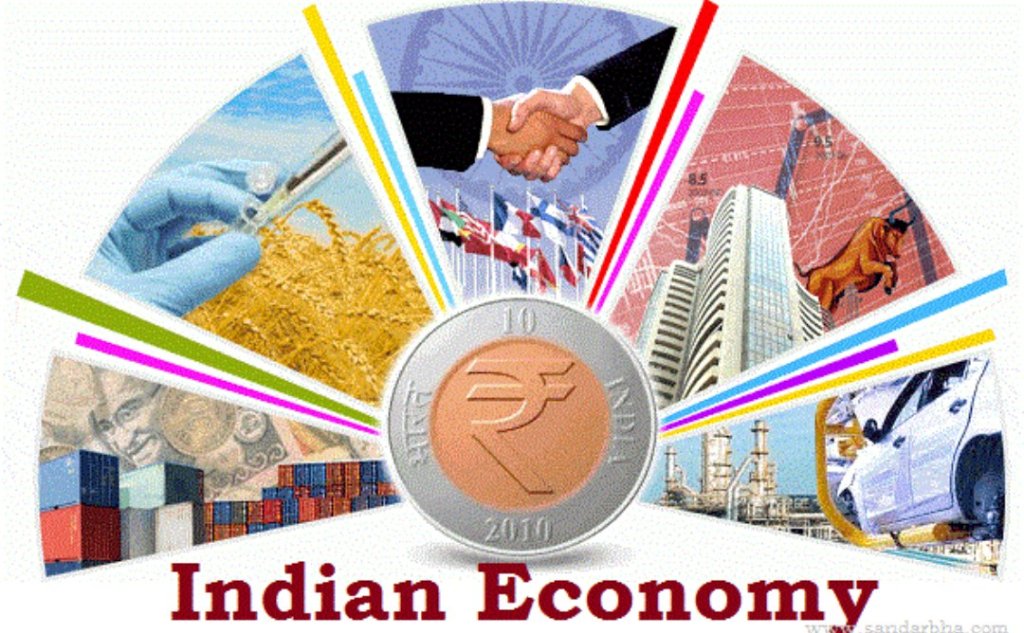
Indian Economy after independence

Source: jagranjosh

Indian economy at the time of Independence was in crucial state. This situation occurred due to the British Colonialism. After independence the Government changed plan for economic growth. The area of attention was shifted from agriculture to industry.

The growth of public enterprise generate employment and reduce poverty. In 1991, a revolution came into place in terms of liberalization, privatization and globalization that shaped the face of Indian economy. The Indian have the lowest per capital income and also the lowest consumption in the world.

The low income level consequent into low saving and thus small or no investment which end with low capital formation. Therefore, the dangerous cycle of poverty running in the country. The First Five Year Plan stated that the Indian economy remained more or less stagnant during colonial regime, because the basic conditions of economy was continuously remain the same.

The impact of modern industrialism in the later half of the 19th century was emerged through import of machine made goods from abroad that impact adversely on the traditional pattern of economic life, however unable to create the spark for Development. The conditioning of state led to decline of productivity especially those engaged in agriculture, the adverse effects. The consequence was a continuously increasing of employment. Hence, there could be no economic progress.

At the time of Independence 80% of population living in rural areas were engaged in agriculture for subsistence purposes; using traditional low productive technique for agriculture. The underdevelopment of Indian economy is reflected in it’s unbalanced occupational structure. Illiteracy was 84% , Communicable disease were widespread due to the absence of a good public health services, mortality rate was very high.

Agricultural activity contributed nearly 50% to Indian’s National Income. Mines, factories and small craftsmen work contributed only one – sixth, even lower than the numbers for trade, transport and communication. After independence, the government concern in the sphere of economic policy was to control persistent and severe inflationary pressure and to alleviate shortage of essential food items, which was increased by the partition of the country.

The industrial Policy Resolution of 1948 stamped as fundamental departure from earlier policy of laissez faire. Finally, the concept of planning Development programme under the auspices of the central government, was accepted and the planning commission was set up in March 1950 to make an assessment of the material capital and human resources of the country and to formulate a plan for the most effective and balanced utilisation of the countries resources.

India embarked upon the programme of planned economic development of the country with the formulation of first year plan that covered the period of 1951 – 1956. The second plan that followed was form 1956 – 1961 and third plan from 1961 to 1966. The other plans followed there after. The Eleventh Five Year Plan has been launched from 2007 – 2012; Twelfth Five year Plan was started from 2013 – 2014.
 

Source: Deccanherald

The first five year plan provided an inclusive general analysis the nature of the country’s Developmental problem and various options for mobilising resources and achieving Development with more equal distribution. There was special emphasis on the role of mass mobilization of idle rural labour and land reform. The plan optimistically project that saving and investment as a proportion of National Income would rise from an estimated 5 – 6% in the early 1950 to 20% by 1968 – 69.

S Chakravarti  had mentioned some shortcomings of Indian economy. Such as

• The basis cause of development was seen as being an acute deficiency of material capital, which prevented the introduction of more productive technologies.

• The limitation on the speed of capital accumulation was seen to lie in the low capacity to save.

• It was assumed that domestic capacity to save and raised by means of suitable fiscal and monetary policies. There were structural limitations preventing conversion of saving into productive investment.

• The inequality in income distribution was considered to a bad thing, a precipitate transformation of the ownership of productive assets was held to be detrimental to the maximization of production and savings.

• Agriculture was subject to secular diminishing returns, industrialization would allow surplus labour currently under employed in agriculture to be more productively employed in industry.
 

Magnitudes of Public Sector Enterprise for Policy making

Source: PSU.Watch

Government regulate the business activities of private enterprises for direct participation in business and set up public enterprises in areas like coal industry, oil industry, steel manufacturing, banking, insurance etc. These units are not owned by Central, State or local Government, managed and controlled by them and are termed as public sector enterprises.

Business activities were occupied to individual and organizations and the government was taking care of essential services such as railways, electricity supply, postal services etc. Private sector did not take interest in areas where investment is high and profit margin is low, such as machine building, infrastructure, oil exploration etc. Industries were also focus in some region that have natural advantages like availability of raw material, skilled labour.

Source: shutterstock

Public sector enterprises defined as any commercial or industrial undertaking owned and managed by the government with a view to maximize social welfare and upholds the Public interest. Public enterprises consist of nationalized private sector enterprises such as banks life insurance of India and enterprise set up by Hindustan, Gas Authority of India limited (GAIL) and State trading Corporation (STC).

During the colonial period, economic activities were limited to essential support facilitate for the maintenance and continued Growth of economy and defense such as railway transport, electricity project, ordinance factories, irrigation works, education and training Institutions.

The public sector to control certain key point in the economy such as the financial institutions for collecting saving of millions of individual and organizations making these available for investment.

By 1980s, besides traditional fields, the major banks and financial institutions, electricity undertakings, shipping, civil aviation, bus services and big enterprises in significance modern industries such as iron and steel, heavy machine building, light engineering, electronic, petroleum and Petro chemical, fertilizers, pharmaceuticals, cotton textiles and cement. The growth of investment in the central undertakings by way of contribution to share capital and long term loans. In addition, the central government had made large investment in departmentally run undertakings.

Characteristics of Public Enterprises

The public enterprises are owned and managed by the central or state Government or local authority. The government may either own the public enterprises or the ownership partly be with the government and with the private industrialists and the public. The control, management and ownership remain primarily with the government e.g, Oil and Natural Gas Corporation Limited (ONGC) and National Thermal Power Corporation (NTPC).

Public enterprises get their capital from government funds and the government has to make provision for their capital in it’s budget. Public enterprises are not move by profit motive. Their major focus on providing services or commodities at reasonable prices. GAIL Gas Authority of India and Indian Oil Corporation make available petroleum on subsidised price to the public.

Public sector enterprises concentrate on providing public utility services like transport, electricity, telecommunication etc. PE are governed by the government and are accountable to the legislature. The government rules and regulations force the Public enterprises to observe excessive formalities in their operations.

Role of Public Sector Undertaking in Public Policy

The public sector enterprises has been important role of achieving economic growth with social justice, generating larger social gains and strengthening country’s economy by removing regional disparities and promoting balanced development in different parts of the country. The impact of public sector undertaking on the regional development.

PSE through useful help and services in the development of human resources in underdeveloped areas. Investment in human capital is considered an essential ingredient of development planning. Such development is only possible if rural demographics ready to cope with modern knowledge and science & technology.

A large number of PSU have been set up in the regions or districts in order to capitalize the rural labour by equipping them with vocational education, technical training and managerial skills. The reason behind it is to transform the unemployed rural people to get self motivated and self inspired employment avenues in local areas economies.

PSU working as a vehicle of communication have taken the new learning to village and acted as agents for introducing changes in existing practices, initiating commercial use of appropriate village technologies in agriculture and allied activities, village artisan and handicrafts and local village industry by inducing use of productivity enhancing equipment and light machinery.

Improvement in economic infrastructure in the areas where policies cannot reach through PSU and active participation of PSU. Constructing and improving connection between village to make accessibility by modern means of transport, electricity for domestic use as well as for commercial and Industrial.

Budget as Powerful Instrument of government

The budget is a vital, principle tool of Financial administration and is most powerful instrument of legislative control. Budget has mentioned important aspects as larger number of Policy questions in the course of making fiscal outputs. The term budget refers to the Financial papers. It has develop in middle ages, which has a feature of Absolute English regime as well as Europe.

The budget was a statement of revenue and expenditure and regarded as business affairs of the king and the state. Revenue was derived from king’s domains. At this time, all governmental expenditure were not subjected to parliamentary control. Full legislative control of main string of the century. Thus, the conception of the budget as the central tool of financial direction and control on monetary standards.

The budget system is the basis of efficient fiscal management. According to W F Willoughby, the real significance of budget system lies in providing for the orderly administration of the Financial affairs of a government. Fiscal management consists continuous chain of operations such as estimates of revenue and expenditure, revenue and appropriation acts, accounts audit and report.

The Public Account Committee states the object of budgeting in the form of “The budgeting is designed to provide for parliamentary control, for Administrative account that the expenditure incurred by the government is in the specific manner by specific authority.

 Objectives of Budget

• To structure delegation of operations as well as financial authority and responsiblity, by providing the basis for central control

• To conduct regular periodic reconsideration or revaluation of government purpose and objectives.

• To provide the framework of public account and fiscal accountability.

• To provide the legal basis for the expenditure of Public funds.

• To facilitate a comparative evaluation of different purposes and programmers in relation to each other and their relative cost.

Functions of Budget

The function of government budgeting is to administer the National finance in organized manner. No haphazard and unplanned expenditure and revenue. Financial operations of the government are to be properly planned and implemented through budgeting.

Functions as instrument of execution of the economic Policy of the government. An approved budget gives the administrator, a zest of the financial environment within which has to work out. During budget, the budget supplies data for decision making and acts as a guide to various departments heads for what they have to do. Budget is an instrument to make elected legislators accountable to the people and to the democratic system. It also secure the economic, social and cultural rights of people.

The also Important as review of the past accomplishment contains the figures of the previous financial years. In order to manage or set budgetary expectations reviewed by previous budget. Budget helps in knowing where Public money has been spent in favour of law and how far objectives has achieved.

Fundamentals of Budget

  • Planning and programming
  • Research of statistics and global conditions
  • Control Supervision
  • Balance Budget
  • Estimation of one year expenditure
  • Executive Discretion
  • Combination of Revenue in one unit

Significance of Budget

The goal of Administration is to attain economy and efficiency and budget plays important role in financial administration. It promotes rational planning effective Policy making and sound Decision Making to give strong foundation for attaining political and social objectives. The budget can help to promote policies and help in redefining the policy structure. Financial allocation of budget identified in physical outputs. Good Budget consider all aspects for financial and economic policies.

Organising the staffing require for creation of budget, all financial department to be included in the budget. To make administration effective need to apply overlapping. Direction with several departments and linkage of communication can strengthen the system. Coordination ensure the avoid of duplication and wastage and increase the effectiveness of implementation of Financial policies.

Reporting budget on widely discussed newspapers and journals for the information to Public for constructing their own opinions. Budget can supplement the efforts of government in supporting the policies for all section of Society. Modern technology helps connect with innovative changes in the areas of leadership, communication, decision making, democratisation of the organization. Above it, it makes possible to introduce and expedite the use of information technology in Financial administration.

Public policy And Politics in India : How institution matterBy kuldeep Mathur, Oxford University Press 2013; ISBN -13: 978-0-19-9466054

Public policy is a new discourse that emerged in the early 1950s. Public policy is designed as goal oriented action to stimulate decision making. Policy mounted on law & regulations, funding management with the concern of governmental representation. It is a discipline to solve the Conflict by making policies such as education Policy, health Policy, employment policy, foreign policy, Agriculture Policy and labor policy.

Public policy developed in the context of the Indian governance scenario; is becoming more and more significant in today’s world. The importance of civil societies, non-profit organizations, and the media have a communicative role in producing policies. 

This book carved out a few questions that needed to be answered like what is the nature of this new style of governance ? How does it affect the role of the state in framing public policy? And this book also delve deep into the nature and role of these networking to determine public policy, promoting the sledgehammer research in this area of public policy.

Kuldeep Mathur, the author of this book put forward his own research essays that focus on an analysis of Indian public policies. The theme of the book also concerned the processes of policy making. Author explores the impoverished aspects of Policies in india; what was lost in the dominant theme pursued by most scholars was that policy was an arena of Contestation – of bargaining & Compromises of politics. 

Questioning the bureaucratic imperative of impersonality and neutrality inhibited an understanding of how policies were formulated and implemented.

Main Content

This book emphasizes on certain Sphere or excessive involvement of political executive, exclusiveness of politics in Policy Making. Discuss the Guidance of Governance in India, Research bases Policy Analysis and how policy research organized in the South Asian region provides the understanding for Supreme Court, Technocrats and populist Politics in india in the sphere of Policymaking, importance of policy evaluation for education Policy. 

The impact of privatization, Liberalization and public sector Enterprises in India, how governance is used as networks between state, Business, NGOs for enhancement of relationships. Development of cognitivism towards strengthening the Bureaucracy: state and  Development in India, enforces the Administrative reform in india as policy fixation and Consequences.

 Following tenets explained by author; Book explained the Policy mechanism of different Commissions, Active inputs of parliamentary Committees, Concentrate on political and Administrative Constraints. Introductory policy Analysis from planning to implementation failure.

Articulation of how formulation of policies differ in South Asia; social political environment and character of Social Science research context that shapes the characteristics of policy research organization, emergence of policy research organization in South Asia. However, South Asian Countries do not have Common model for the growth of such institutions. Below mentioned important outlining from the book.

“Initiative taken by the govt establishing research institution at the beginning of the planning period indicates recognition of the fact that research can contribute to policy making”. Policy failure were seen to be located in the bureaucratic/managerial process rather than in programme design & formulation of objectives.

“The dilemma of increased political participation within a system of limited economic benefit is the major Challenge for policymakers as india enters the second millennium”.Author underline the role of supreme Court in Policymaking; Political Contestation & govt reluctance in implementing what had already long been on the statute books and nature of environmentalist politics. 

Explored the role of various actors in shaping outcomes, the impact of education policy since independence. The significance of privatization emphasis on the virtue of the market is highlighting the weaknesses of the public sector hence the need of privatization political leadership 

promoting economic reform in india, prescribed few reforms and possible reasons for failure lead to desirability of wholesome privatization.

Consideration of the role of legislation in the making of Public Policy has been a relatively neglected area of Political environment. Articulation of Governance as networks with ngos, state & market ponderability of relationship of the state with the corporate sector is based on a transformed view of the role of the state in neo liberal economic framework.

 Also, In this book the author emphasizes strengthening of bureaucracy for ameliorate the Governance. All the following, explanatory principles in the book require the administrative Reforms; changing the intellectual climate that provides understanding of the role & scope of Public Administration propelled this discourse.

Conclusion

I highly recommend this book not only to those who are studying Public Policy but to all who desire to acquire knowledge regarding public policies mechanisms & approaches of Public Policy in India. The language of the book is moderate to understand, easy to absorb and grasp.

Also, This book clear the idea of policy making, social science, economic decision making, necessity of pivotal agencies gravitate our attention towards policy 

processes rather than focus on consequences. Dominant Strategy of development and the state determined development outcomes. Propounded economic reform was a response to the economic crisis and became an instrument of crisis management by the government.

Critical significant stream in the general area of policy studies which here attracted considerable attention of policy evaluation. Critical evaluations of various policies and programmes have sought to identify the factors responsible for policy failures and to suggest what the Government should have done to improve their chances of successful Policy structure. 

Policies could not achieve their objectives without bureaucratic and administrative adequate sophistication. Discussion on little attention was paid to the policies themselves and their appropriateness by Government, Policies began to be assessed in relation to plan models, sectoral relationships and the global economic context. Importance of public policies have primarily focused on the dimensions of efficiency and effectiveness. 

Policies are shaped and designed. Social scientists need to fill the gap in our comprehension of how state institutions function particularly when policy is a political statement and not a techno-rational output of State action. This book provide all kind of reasoning and perception to improve the Public Policy structure.

Economics

Introduction:- The term economic comes from the ancient Greek word oikonomia means ‘management of a household’. The term economic process refers to those activities, through which goods and services aimed at satisfying human needs, are produced distributed, and used. Economic includes the study of labor, land investment of capital, income, and production, and taxes and government expenditures. Adam Smith regarded as the Father of Economics, defines Economics as “the science relating to the laws of production, distribution, and exchange”.

Branches of Economics:- The two chief branches of economics are as follow:

Micro Economics – It examines the behavior of basic elements in the economy including individual agents, such as households and firms, or as buyers and sellers and market and their interactions.

Macro Economics – It studies the economy as a whole and its features like national income, unemployment, poverty, the balance of payments, and inflation. It deals with the formulation of models explaining the relationship between factors such as consumption, inflation, savings, investment, national income, and finance.

Economy:- It represents production, distribution, or trade and consumption of goods and services in a given geographical area by different agents which can be individuals, businesses, organizations, or governments. The study of the economy of any country helps us to find out the financial condition of the population as well as the different working sectors of the economy.

A modern economy is a complex machine. Its job is to allocate limited resources and distribute output among a large number of agents mainly individuals, firms, and governments allowing for the possibility that each agent’s action can directly or indirectly affect another agent’s actions. There are two major types of economies they are:

Open Economy: It belongs to a market economy, which is mainly free from trade obstructions and where exports and imports comprise a lush large percentage of the GDP. No economy is absolute whether open or closed in terms of trade restraints and all governments have fluctuating levels of control over the activities of capital and exchange.

The degree of the vulnerability of an economy determines a government’s freedom to pursue monetary policies of its choice and the exposure of the country to the international economic cycles.

Closed Economy- An economy in which no exercise is conducted with outside economies. A closed economy is self-sufficient, meaning that no imports are brought in and no exports are sent out. The goals of such an economy are to furnish consumers with everything that they need from within the economy’s perimeters.

The degree of exposure of an economy is decided by their respective governments by using policy controls like tariffs, import, and export quotas, and exchange rate limits. In india, since independence, the government has played a major role in planning economic activities.

Present status of the Indian economy: Indian economy is the world’s 6th largest economy or nominal GDP basis and the 3rd largest by Purchasing Power Party (PPP) in 2017. According to CSO, the growth in GDP during 2017-2018 is estimated at 6.5% as compared to the growth rate of 7.1% in 2016-17.