Serivce Sector Growth in India

 Discussing the sector wise performance of major services, the Economic Survey 2023-2024 tabled in Parliament today by the Union Minister for Finance and Corporate Affairs, Smt. Nirmala Sitharaman, highlighted“Two significant transformations are reshaping India’s services landscape: the rapid technology-driven transformation of domestic service delivery and the diversification of India’s services exports”.

India’s services sector encompasses a wide array of economic activities, which can be broadly classified into two categories:

  1. Contact-intensive (physical connectivity-based services): includes trade, hospitality, transport, real estate, social, community and personal services.
  2. Non-contact-intensive services (Information Technology services, tech start-ups and Global Capability Centres): comprises financial, information technology, professional, communication, broadcasting, and storage services. The sector also incorporates public administration and defence services.


Physical connectivity-based services

Myriad services are that are offered to ensure the seamless movement of goods, people, and information across diverse infrastructure networks encompass a broad spectrum, ranging from passenger transport via trains, buses, taxis, and airlines to freight transport facilitated by shipping companies, freight forwarders, and courier services.


  1. Roadways: A considerable portion of India’s cargo is transported via road. Accordingly, through various initiatives user convenience on National Highways (NH) has been enhanced:
    • Toll digitisation has drastically reduced waiting times at toll plazas, from 734 seconds in 2014 to 47 seconds in 2024.
    • Ministry of Road Transport and Highways (MoRTH) has devised a comprehensive ‘4E’ strategy – Engineering (roads and vehicles), Enforcement, Emergency Care, and Education – to elevate road safety standards on NHs.
    • The Government has utilised the PM Gati Shakti National Master Plan portal for network planning and congestion projections.


  1. Indian Railways: Indian Railways (IR) hosts many services to enhance user experience, efficiently manage the train system and build capacity for a Viksit Bharat.
    • Passenger traffic originating in IR was 673 crore in FY24 (provisional actuals), increasing by about 5.2 per cent compared to the previous year.
    • IR carried 158.8 crore tonnes of revenue-earning freight in FY24 (excluding Konkan Railway Corporation Limited), showing an increase of 5.3 per cent over the previous year.
    • To upgrade the passenger experience, railways have introduced Wi-Fi facilities at 6108 stations, bridging the digital divide between rural and urban citizens.


  1. Ports, Waterways and Shipping: The port sector is leveraging the Sagar Setu application to streamline daily vessel and cargo operations, aspiring to become a central hub for all maritime engagements.
    • Sagar Setu is also integrated with all the 13 major ports of India, along with 22 non-major ports and 28 private terminals.
    • There is a push for promoting river cruise tourism on national waterways. There has been a staggering 100 per cent surge in overnight cruise trips during FY24.


  1. Airways: India is the third-largest domestic aviation market and the aviation sector in India has shown substantial growth, with a 15 per cent YoY increase in total air passengers handled at Indian airports reaching 37.6 crore in FY24.
    • In FY24, the domestic air passenger traffic handled increased by 13 per cent YoY to 30.6 crore, and international air passenger traffic handled increased by 22 per cent YoY to 7 crore.
    • Air cargo handled at Indian airports increased by 7 per cent YoY to 33.7 lakh tonnes in FY24.
    • The Government has approved 21 greenfield airports nationwide and operationalised new terminal buildings to increase passenger handling capacity backed by a solid capex plan.
    • To promote regional equity, the ‘Ude Desh Ka Aam Nagrik’ (UDAN) scheme launched in 2016 facilitated the travel of over 141 lakh domestic passengers across various 579 Regional Connectivity Scheme routes connecting 85 unreserved and underserved airports since its inception.
    • Initiatives like Digi Yatra are enhancing efficiency through technology
    • Women constitute 15 per cent of the country’s pilots, which is almost three times higher than the global average, thus presenting greater opportunities for women in the sector. In the year 2023, a total of 1622 commercial pilot licenses were issued, of which 18 per cent were issued to women.


  1. Tourism: The tourism sector in India is rapidly expanding, with India being ranked at the 39th position in the World Economic Forum’s Travel and Tourism Development Index (TTDI) 2024.
    • Showing positive signs of revival post-pandemic, the tourism industry witnessed over 92 lakh foreign tourist arrivals in 2023, implying a YoY increase of 43.5 per cent.
    • India has significantly earned foreign exchange receipts amounting to over ₹2.3 lakh crore through tourism, indicating a 65.7 per cent YoY increase.
    • Swadesh Darshan 2.0, focuses on integrated tourism destination development, targeting 55 destinations across 32 states and Union Territories.


  1. Real Estate: Real estate and ownership of dwellings have accounted for over 7 per cent of the overall Gross Value Added (GVA) in the past decade, highlighting their integral role in the economy.
    • In 2023, residential real estate sales in India were at their highest since 2013, witnessing a 33 per cent YoY growth, with a total sale of 4.1 lakh units in the top eight cities.
    • The housing sector’s growth has been due to several key factors namely the Pradhan Mantri Awas Yojana-Urban (PMAY-U), policy reforms like the Goods and Services Tax, Real Estate (Regulation and Development) Act, and the Insolvency and Bankruptcy (SWAMIH), PMAY(U)-Credit Linked Subsidy Scheme interest subvention.
    • According to a report by CRISIL, the housing loan market in India grew at a CAGR of approximately 13 per cent from FY18 to FY23. The housing loan market in India is expected to continue growing at a CAGR of 13 to 15 per cent reaching ₹42 lakh crore to ₹44 lakh crore by FY26.


Information Technology Services, Tech start-ups and Global Capability centres

Over the past decade, information and computer-related services have become increasingly significant, with their share of total GVA rising from 3.2 per cent in FY13 to 5.9 per cent in FY23. Despite the pandemic-induced economic downturn, this sector achieved a real growth rate of 10.4 per cent in FY21. The flourishing growth of IT services has also supported the expansion of Global Capability Centers (GCCs) and the tech start-up ecosystem in India.

Global Capability Centres (GCCs) in India have grown significantly, from over 1,000 centres in FY15 to more than 2,740 units by FY23. These centres contribute to economic growth by providing high-quality employment. Revenue from India’s GCCs has increased from USD 19.4 billion in FY15 to USD 46 billion in FY23, growing at a compound annual growth rate (CAGR) of 11.4 per cent.

Technology start-ups in India have risen remarkably from around 2,000 in 2014 to approximately 31,000 in 2023. As per NASSCOM, the sector witnessed the inception of roughly 1000 new tech start-ups in 2023. Also, as per NASSCOM, India’s tech start-up ecosystem ranks third globally and has performed considerably better than the USA and the UK. The Start-up India Initiative and Start-up hubs across ministries and departments of the Government of India along with National Deep Tech Start-up Policy, the Drone Shakti Program and custom duty exemptions for EV-related capital goods and machinery have aided the growth of tech start-ups. Targeted efforts such as accelerating & strengthening the deep-tech ecosystem, strengthening domestic capital flow and leveraging initiatives such as Start-Up India have been undertaken to tap the potential of start-ups.


  1. Telecommunications: The overall tele density (number of telephones per 100 population) in India increased from 75.2 per cent in March 2014 to 85.7 per cent in March 2024.
    • Internet subscribers jumped from 25.1 crore in March 2014 to 95.4 crore in March 2024, of whom 91.4 crore are accessing the internet via wireless phones.
    • The internet density also increased to 68.2 per cent in March 2024.
    • The cost of data has declined substantially, vastly improving the average wireless data usage per subscriber.
    • India is amongst the fastest-growing 5G networks in the world. The Bharat 5G Portal propels India’s 5G capabilities and fosters innovation, collaboration, and knowledge-sharing within the telecom sector.


  1. E-Commerce: The Indian e-commerce industry is expected to cross USD 350 billion by 2030.

***
Service Sector in India

 Through the vicissitudes of the last three decades, the services sector stood as the bulwark of India’s economic growth. Aided by the focus on policy and procedural reforms, physical infrastructure and logistics, all significant business, personal, financial and infrastructure-based services have emerged strongly from the pandemic… However, the transformation lies in the fast-paced shift towards digital services like online payments, e-commerce, and entertainment platforms, as well as the increase in the demand for high-tech services as inputs in other productive activities.” This was highlighted in Economic Survey 2023-2024 tabled in Parliament by Union Minister for Finance and Corporate Affairs, Smt. Nirmala Sitharaman today.

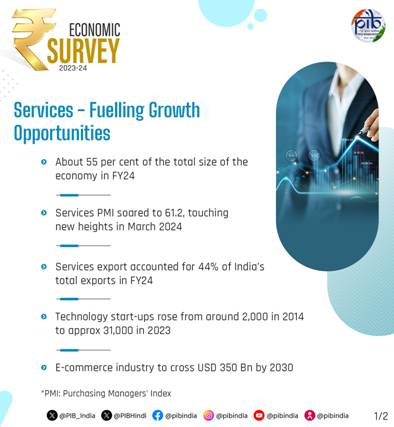
The services sector continues to be a significant contributor to India’s growth, accounting for about 55 per cent of the total size of the economy in FY24, states Economic Survey. The significant domestic demand, rapid urbanization, expansion of e-commerce platforms generated heightened requirements for logistics, digital related services are important factors which have determined the domestic demand of services. The Economic Survey further states that the Government has played a crucial role in fostering the growth and competitiveness of India’s services by creating an enabling environment, promoting investment, enhancing skills and facilitating market access.

Gross Value Added (GVA) in the services sector

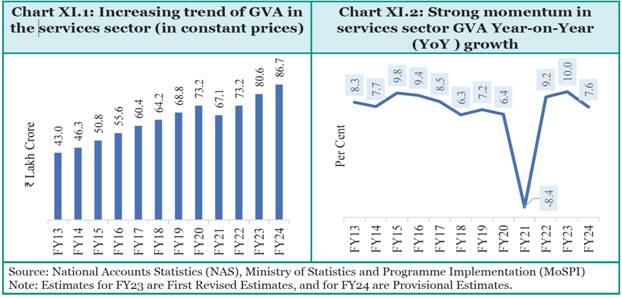
The contribution of the services sector to the overall GVA has increased significantly in the last decade. Globally, India’s services sector witnessed a real growth of more than 6 percent and the services exports constituted 4.4 per cent of the world’s commercial services exports in 2022.

For a decade before COVID, the services sector’s real growth rate consistently exceeded the overall economic growth. Post-COVID, the services sector’s growth, spurred by non-contact intensive services, primarily financial, information technology and professional services, outpaced overall GVA growth in FY23 and FY24, reclaiming its role in driving the economy’s upward trajectory.

The Survey further states that as per the Provisional Estimates, the services sector is estimated to have grown 7.6 percent in FY24. The gross GST collection reached ₹20.18 lakh crores in FY24, marking 11.7 per cent increase from the previous year, underscoring robust domestic trading activity.                                                                                                                                   

Purchasing Managers’ Index (PMI)- Services

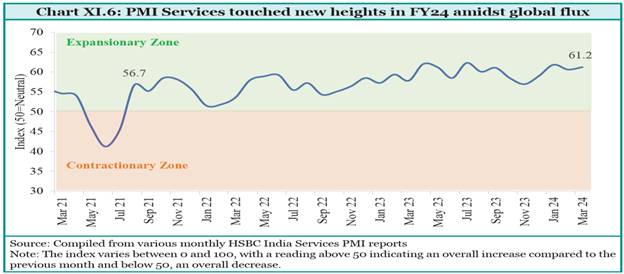
Business activity in the services sector in the country transcended the obstacles of the pandemic and other disruptions worldwide. In March 2024, services PMI soared to 61.2, marking one of the sector’s most significant sales and business activity expansions in nearly 14 years. As can be seen from Chart XI.6 (below), the services PMI has remained above 50 since August 2021, implying continuous expansion for the last 35 months.

Trade in the services sector

Post-pandemic, services exports have maintained a steady momentum and accounted for 44 per cent of India’s total exports in FY24 the survey notes. India ranked fifth in services exports, with other countries being the European Union (excluding intra-EU trade), the United States, the United Kingdom, and China.

India’s growing reputation as the preferred destination for Global Capability Centres (GCCs) by multinational corporations has significantly boosted software and business services exports.  India’s share in digitally delivered services exports globally increased to 6.0 per cent in 2023 from 4.4 per cent in 2019. This rise in services exports, coupled with a fall in imports, led to an increase in net services receipts on a YoY basis during FY24, which helped cushion India’s current account deficit.

Financing Sources for Services Sector Activity

The services sector fulfils its financing needs domestically through

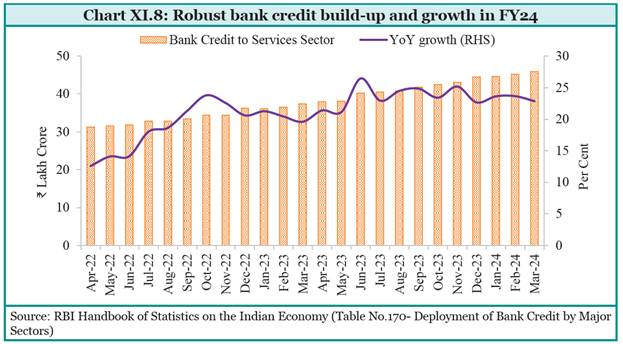
  1. Credit from domestic banks and capital markets: FY24 witnessed an upward trajectory of credit inflow in the services sector, with YoY growth rates surpassing the 20 per cent mark each month since April 2023.

  1. Internationally through Foreign Direct Investment (FDI) and External Commercial Borrowings (ECBs): The services sector accounted for 53 per cent share in total external commercial borrowing (ECB) inflows in FY24. The sector received inflows of USD 14.9 billion in FY24, thereby registering a YoY growth of 58.3 per cent.

***

MSME in India

 The Economic Survey tabled by the Union Minister of Finance and Corporate Affairs, Smt. Nirmala Sitharaman in Parliament today, highlights the importance of the MSME sector in the Indian economy with an all-India manufacturing output of 35.4 percent.

According to the survey, Gross Value Added (GVA) per worker increased from ₹1,38,207 to ₹1,41,769 and Gross Value of Output (GVO) per establishment increased from ₹3,98,304 to ₹4,63,389 showing  increased productivity and labour efficiency. The Survey highlights the success of the Udyam Registration portal that has received 4.69 Crore registrations as of 05 July 2024, playing an instrumental role in formalizing MSMEs by providing a simple, online, and free registration process based on self-declaration. The Survey notes that there has been significant growth between FY20 to FY24 in the amount and number of guarantees for MSMEs with Union Budget 2023-24 allocating ₹9,000 Crore to the Credit Guarantee Fund Trust, aiming to enable an additional ₹2 Lakh Crore in credit with reduced costs.

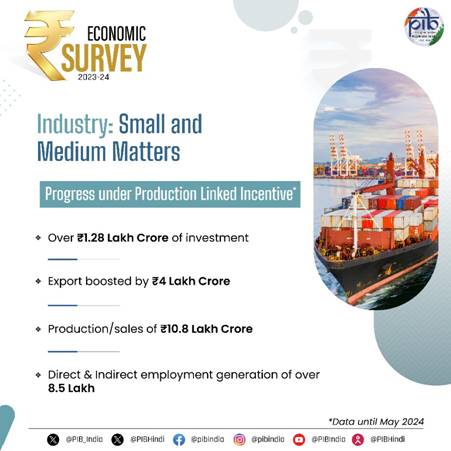
According to Survey, keeping in view India’s vision of becoming ‘Aatmanirbhar’, Production Linked Incentive (PLI) Schemes for 14 key sectors were announced with an outlay of ₹1.97 Lakh Crore to enhance India’s manufacturing capabilities and exports. Further survey states that over ₹1.28 Lakh Crore of investment was reported until May 2024, which has led to production/sales of ₹10.8 Lakh Crore and employment generation (direct & indirect) of over 8.5 Lakh. Survey states export boosted by ₹4 Lakh Crore, with significant contributions from sectors such as large-scale electronics manufacturing, pharmaceuticals, food processing, and telecom & networking products.

Survey highlights, to give an impetus to the One District One Product (ODOP) initiative, the Union Budget of FY24 announced that states would be encouraged to set up a “Unity Mall” in their capitals or most prominent tourism centre or the financial capital for the promotion and sale of their ODOPs. Survey also states that “PM-Ekta Malls” aims to link the artisans of ODOP and consumers. Survey  states that these malls are creating a vibrant marketplace for the nation’s unique products, aiming at both domestic and foreign markets. In addition to this survey ‘ODOP Sampark’ workshops were conducted in 15 States to facilitate collaboration between the Centre and local sellers and revive indigenous industries. According to the survey, ODOP showcased India to the world at the G20 events organised across the country during India’s G20 Presidency, where the artisans, sellers and weavers got visibility on the global stage.

*****

Gross Capital Formation

 Economic Survey 2023-24 was presented in the Parliament today by Union Finance and Corporate Affairs Minister Smt. Nirmala Sitharaman. The Economic Survey states that the Gross Capital Formation (GCF) of the agriculture sector and the share of GCF in the agriculture and allied sectors as a percentage of Gross Value Added (GVA) has been growing steadily, mainly due to increased public investment. The GCF of the agriculture sector grew at the rate of 19.04 per cent in 2022-23, and the GCF as a percentage of GVA rose from 17.7 per cent in 2021-22 to 19.9 per cent in 2022-23, suggesting an increase in investment in agriculture. The average annual growth in GCF from 2016-17 to 2022-23 was 9.70 percent. The Survey states that despite the increasing trend in GCF, there is a need to further boost agriculture investment, especially in the context of doubling farmers’ income. The DFI 2016 report indicated that to double farmers’ income over the period of 2016-17 to 2022-23, income would need to grow at an annual rate of 10.4 per cent in the farm sector, which in turn would require an annual growth rate in agriculture investment of 12.5 percent.

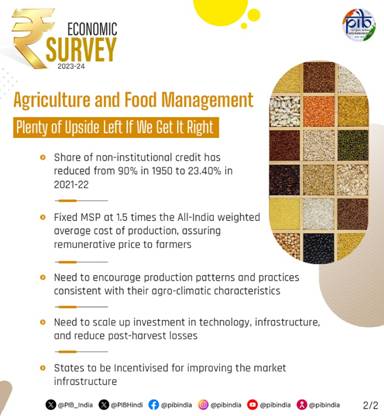
The government’s priority has been to provide timely, cost-effective, and adequate credit that reduces the dependence on non-institutional credit and increases investment. The measures have reduced the share of non-institutional credit from 90 per cent in 1950 to 23.40 per cent in 2021-22. As of 31 January 2024, the total credit disbursed to agriculture amounted to ₹ 22.84 lakh Crore, with ₹13.67 lakh Crore allocated to crop loans (short term) and ₹ 9.17 lakh Crore to term loans.

Kisan Credit Card(KCC):

The Economic Survey states that the Kisan Credit Card (KCC) has streamlined agricultural credit accessibility and as of January 31, 2024, banks issued 7.5 crores KCC with a limit of ₹9.4 lakh crores. As a further measure, the KCC was extended to meet the working capital needs of fisheries and animal husbandry activities in 2018-19, along with the enhancement of the limit for collateral-free loans to ₹1.6 lakh. In the case of a Tri-Partite Agreement (TPA) among borrowers, milk unions, & banks, the collateral-free loan can go up to ₹3 lakh As of March 31, 2024, 3.49 lakh KCC and 34.5 lakh KCC were issued to fisheries and animal husbandry activities, respectively. Economic Survey states that  Joint Liability Groups (JLGs) have emerged as an essential source of credit for tenant farmers. JLG accounts have grown at a compound annual growth rate (CAGR) of 43.76 per cent over the past five years, emerging as a vital source in meeting the credit needs of tenant farmers and  marginalised segments.

Agriculture Infrastructure:

Economic Survey shows that as of 30th April 2024, 48357 projects were sanctioned for storage infrastructure with ₹4570 Crore released as subsidy, and 20878 other projects are also under progress with ₹2084 Crore released as subsidy. To give further fillip to farm gate infrastructure and also involve the private sector more actively, the Agriculture Infrastructure Fund (AIF) was launched with a financing facility of ₹1 lakh Crore to be disbursed between FY 2020-21 to FY 2025-26 with support extending till FY 2032-33.

The Economic Survey states that the Agriculture Infrastructure Fund(AIF)  provides medium-term debt financing for post-harvest management and community farming projects, offering interest subvention and credit guarantee support. As of 5th July 2024, AIF mobilised an investment of ₹73194 Crore, supporting 17196 custom hiring centres, 14868 primary processing units, 13165 warehouses, 2942 sorting and grading units,1792 cold storage projects, and 18981 other projects. In addition, the Pradhan Mantri Kisan SAMPADA Yojana (PMKSY) introduced credit-linked financial assistance through grants-in-aid to build efficient supply chain management from farm to retail to reduce the wastage of perishable produce and extend food shelf life. Under PMKSY 1044 projects were completed till end March 2024. A total of 1685 projects with project cost ₹ 32.78 thousand crore and approved subsidy of ₹ 9.3 thousand crore have been approved till end March 2024.

***

Foreign Trade in India

 India’s external sector remained strong amidst ongoing geopolitical headwinds with services exports continuing to perform well. The overall trade deficit reduced from USD 121.6 billion in FY23 to USD 78.1 billion in FY24. This is stated in the Economic Survey 2023-24 tabled by the Union Minister for Finance and Corporate Affairs Smt. Nirmala Sitharaman in the Parliament today.

SERVICES TRADE

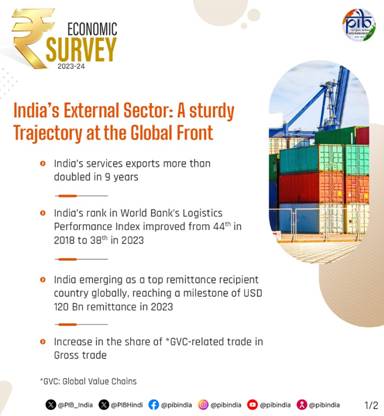
The Economic Survey highlights that the share of India’s services exports in world services exports has risen remarkably from 0.5 per cent in 1993 to 4.3 per cent in 2022. India is now the seventh-largest services exporting country globally rising phenomenally from its 24th position in 2001.

Amongst services exports, software/IT services and business services exports have increased. This was supported by India emerging as a hub for Global Capability Centres (GCCs). India ranks 2nd in the world in telecommunication, computer, and information services exports, 6th in personal, cultural and recreational services exports and 8th in other business services exports. 

The growth in Global Capability Centres (GCCs) is reflected in the services BoP, with ‘Other Business Services’ being the second-largest contributor in services exports in FY24 with a share of 26%. In 2012, about 760 GCCs were operating out of India and as of March 2023, India houses over 1,600 GCCs.

MERCHANDISE TRADE

India performed well in merchandise trade despite lowering in global demand with exports crossing USD 776 billion and imports reaching USD 898 billion in FY23. With this, merchandise trade deficit narrowed to USD 238.3 billion in FY24 compared to USD 264.9 billion in the previous year.

There was a slowdown in India’s major exporting partners (especially the EU, whose real GDP grew barely by 0.6 per cent in 2023, compared to 3.6 per cent growth in 2024), along with the lagged impact of monetary tightening carried out by many countries to control rising inflation.

The Survey notes that adverse trade environment in 2023 is expected to ease somewhat this year and next, boosting goods trade in 2024 and 2025. World merchandise trade volume is expected to grow at 2.6 per cent and 3.3 per cent in 2024 and 2025, respectively, as demand for traded goods rebounds.

India’s exports of engineering goods, electronic goods and drugs & pharmaceuticals increased in FY24 on a YoY basis. India’s share in world electronics exports also improved. India maintained a strong foothold in the drugs and pharmaceuticals sector.

Despite high domestic demand due to the relatively strong growth of India’s economy, merchandise imports contracted by 5.7 per cent in FY24, from USD 716 billion in FY23 to USD 675.4 billion in FY24. Imports of capital goods saw an increase, which is welcome as it indicates a heightened demand for machinery, equipment, and other durable goods used in production processes, suggesting potential investments in industrial infrastructure or technological upgrades. A marginal uptick in the share of consumer goods in merchandise imports reflects a stable but limited increase in the importation of finished products for direct consumption.

A targeted focus and a series of measures undertaken by the Government has shown robust growth in product-specific exports in sectors such as – Defence, Toys, Footwear and Smartphones. The share of electronics goods in merchandise exports of India rose from 2.7 per cent in FY19 to 6.7 per cent in FY24, taking India from 28th position in 2018 to 24th in 2022 in global electronics exports.


MEASURES TO EXPAND EXPORTS

The Government has undertaken various measures to promote exports and reduce logistics costs involved in international trade which include setting export targets and their monitoring, provision of export credit insurance services and encouraging banks to provide affordable and adequate export credit to micro, small and medium enterprises (MSME) exporters, enabling them to explore new markets and diversify their existing products competitively.

To boost efficiency and lower logistics costs, the Government launched the PM GatiShakti National Master Plan and the National Logistics Policy (NLP) in October 2021 and September 2022, respectively. Digital reforms, such as the Unified Logistics Interface Platform (ULIP) and the Logistics Data Bank, are additional measures taken towards improving logistics.

Initiatives, such as railway track electrification, reduced release times by the Land Ports Authority of India (LPAI), and the launch of NLP Marine for port-related logistics were also undertaken. Since the launch of the NLP, over 614 industry players have registered on ULIP, 106 private companies have signed Non-Disclosure Agreements (NDAs), 142 companies have submitted 382 use cases to be hosted on ULIP and 57 applications have been made live as of September 2023.

The Survey notes that India stands for an open, inclusive, predictable, non-discriminatory, and mutually beneficial international trade as it can provide an impetus to economic growth. India advocates for a rule-based international trading system with these attributes with WTO at its core. In this spirit, India considers Free Trade Agreements (FTAs) an instrument of trade liberalisation and a complement to the multilateral trading system under WTO. Accordingly, the country is engaged with all its trading partners/blocs to expand its export markets while ensuring better terms for essential imports to meet domestic demand in a cost competitive manner.

The Economic Survey highlighted that India is moving up the global value chains (GVCs), with the share of GVC-related trade in gross trade rising to 40.3 per cent in 2022 from 35.1 per cent in 2019. The improvement in GVC participation is also reflected in increased pure backward GVC participation.

The Survey added that India’s GVC participation has begun to rev up again on the back of incentives provided through schemes such as the PLI and Districts as Exports Hub (DEH) initiative, after the lull seen in the years succeeding the global financial crisis. Survey says that the evidence of India’s enhanced global supply chain participation is reflected in increased investment by foreign firms in electronics, apparel and toys, automobiles and components, capital goods and semiconductor manufacturing in India.

CURRENT ACCOUNT BALANCE

The Economic Survey highlighted that India’s Current Account Deficit (CAD) narrowed to USD 23.2 billion (0.7 per cent of GDP) in FY24 from USD 67 billion (2 per cent of GDP) during the previous year due to a decline in merchandise trade deficit, rising net services exports and increasing remittances.

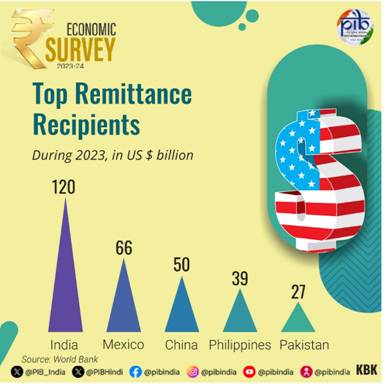
The Net services receipts increased from USD 143.3 billion during FY23 to USD 162.8 billion in FY24, primarily on account of rising exports of software, travel and business services. The remittances by Indians employed overseas, was USD 106.6 billion in FY24, against USD 101.8 billion during the previous year.

Remittances to India are forecasted to grow at 3.7 per cent to USD 124 billion in 2024 and at 4 per cent to reach USD 129 billion in 2025, emphasized the Survey.

CAPITAL ACCOUNT BALANCE

Emphasizing about the stable capital inflows which continue to finance the CAD, the Survey mentioned that during FY24, net capital flows stood at USD 86.3 billion against USD 58.9 billion during the previous year, primarily driven by FPI flows and net inflows of banking capital.

The Survey emphasized that India witnessed positive net foreign portfolio investment (FPI) inflows in FY24 of USD 44.1 billion, supported by strong economic growth, a stable business environment, and increased investor confidence.

Highlighting that India received the highest equity inflows among emerging market peers during FY24, the Survey listed financial services, automobile and auto components, healthcare, and capital goods were the significant sectors attracting equity inflows during FY24.

The Survey noted that the Net FDI inflows to India declined from USD 42.0 billion during FY23 to USD 26.5 billion in FY24 as an impact of decline in global FDI flows. It further added that the gross FDI inflows moderated only by 0.6 per cent from USD 71.4 billion in FY23 to just under USD 71 billion in FY24.

Highlighting that India has a well-established infrastructure to attract FDI in select sectors, i.e., Greenfield projects such as renewables, digital services such as telecommunications, software and hardware, and consultancy services, the Economic Survey suggested that where investment intentions are high, the sectors must be made more accessible for investments. It further added that the focus must remain on improving the ease of doing business across sectors and extend beyond sectors attractive to FDI alone by working out the details across all levels of government – national, state and local – and across regulators.

The Survey listed that educated labour and a skilled workforce coupled with a vibrant R&D culture are important magnets to enhance sustained investor interest, apart from political stability, policy predictability and stability, reasonable duties and taxes, dispute resolution mechanisms and ease of repatriation.

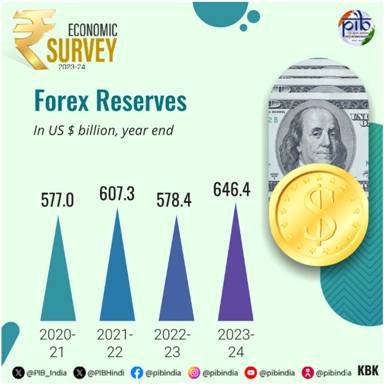
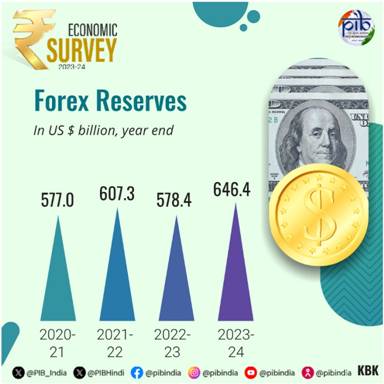
The Survey highlighted that during FY24, India’s Foreign Exchange Reserve (FER) increased by USD 68 billion, the highest increase among major foreign exchange reserves-holding countries.


The Survey notes that the Rupee emerged as the least volatile currency among its emerging market peers and a few advanced economies in FY24. It further stated that Rising FPI inflows kept the Indian Rupee in a manageable range of ₹82 to ₹83.5/USD in FY24.

The Economic Survey says that Indian residents’ overseas financial assets, by end of March 2024, was at USD 1,028.3 billion were higher by USD 109.7 billion or 11.9 per cent compared to the level as of March 2023. The factors attributed were mainly due to a rise in reserve assets, currency and deposits, overseas direct investment, trade credit and advances and loans.


EXTERNAL DEBT

The External debt to GDP ratio declined to 18.7 per cent at the end of March 2024 from 19.0 per cent at the end of March 2023. Survey added that comparing various debt vulnerability indicators of India with peer countries for 2022 indicates that India is in a better position with relatively low levels of total debt as a percentage of Gross National Income (GNI) and short-term external debt as a percentage of total external debt.

The Economy survey noted that India’s trade deficit is expected to decline further as the PLI scheme is expanded and India creates a globally competitive manufacturing base in several product categories. It added that the recently signed FTAs are expected to increase the global market share of the country’s exports. The Survey mentioned that various international agencies and RBI expect the CAD to GDP to moderate to below one per cent for FY24, driven by growing merchandise and services exports and resilient remittances.

The Survey listed the fall in demand from major trading partners, Rise in trade cost, Commodity price volatility, Trade policy changes as some of the major challenges to India’s balance of trade. The Survey suggested that the changing composition of India’s export basket, enhancement in trade-related infrastructure, enhanced quality consciousness and product safety considerations in the private sector and stable policy environment are expected to play a significant role in driving India’s rise as a global supplier of goods and services.

***

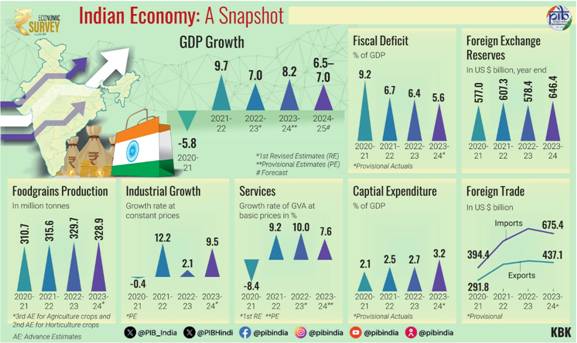
India’s real GDP is projected to grow between 6.5–7 per cent in 2024-25

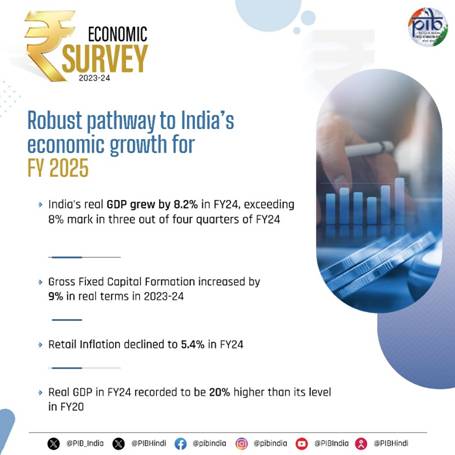
 India’s real GDP is projected to grow between 6.5–7 per cent in 2024-25. The Indian economy recovered swiftly from the pandemic, with its real GDP in FY24 being 20 per cent higher than the pre-COVID, FY20 levels. This was stated by the Economic Survey 2023-24 presented in Parliament today by the Union Minister of Finance and Corporate Affairs Smt Nirmala Sitharaman.

The Survey points out that the domestic growth drivers have supported economic growth in FY24 despite uncertain global economic performance. It also adds that during the decade ending FY20, India grew at an average annual rate of 6.6 per cent, more or less reflecting the long-run growth prospects of the economy.

The Survey, however cautions that any escalation of geopolitical conflicts in 2024 may lead to supply dislocations, higher commodity prices, reviving inflationary pressures and stalling monetary policy easing with potential repercussions for capital flows. This can also influence RBI’s monetary policy stance. The global trade outlook for 2024 remains positive, with merchandise trade expected to pick up after registering a contraction in volumes in 2023.

The Survey highlights that leveraging the initiatives taken by the government and capturing the untapped potential in emerging markets; exports of business, consultancy and IT-enabled services can expand. Despite the core inflation rate being around 3 per cent, the RBI, with one eye on the withdrawal of accommodation and another on the US Fed, has kept interest rates unchanged for quite some time, and the anticipated easing has been delayed.

The Economic Survey says that India’s economy showed resilience to a gamut of global and external challenges as real GDP grew by 8.2 percent in FY 24, exceeding 8 percent mark in three out of four quarters of FY 24, driven by stable consumption demand and steadily improving investment demand.

The Survey underlines that the shares of the agriculture, industry and services sectors in overall GVA at current prices were 17.7 per cent, 27.6 per cent and 54.7 per cent respectively in FY24. GVA in the agriculture sector continued to grow, albeit at a slower pace, as the erratic weather patterns during the year and an uneven spatial distribution of the monsoon in 2023 impacted overall output.

Within the industrial sector, manufacturing GVA shrugged off a disappointing FY23 and grew by 9.9 per cent in FY24, as manufacturing activities benefitted from reduced input prices while catering to stable domestic demand. Similarly, construction activities displayed increased momentum and registered a growth of 9.9 per cent in FY24 due to the infrastructure build out and buoyant commercial and residential real estate demand.

Various high-frequency indicators reflect the growth in the services sector. Both Goods and Services Tax (GST) collections and the issuance of e-way bills, reflecting wholesale and retail trade, demonstrated double-digit growth in FY24. Financial and professional services have been a major driver of growth post the pandemic, the survey added.

Gross Fixed Capital Formation (GFCF) continues to emerge as an important driver of growth. GFCF by private non-financial corporations increased by 19.8 per cent in FY23. There are early signs that the momentum in private capital formation has been sustained in FY24. As per data provided by Axis Bank Research, private investment across a consistent set of over 3,200 listed and unlisted non-financial firms has grown by 19.8 per cent in FY24.

Apart from private corporations, households have also been at the forefront of the capital formation process. In 2023, residential real estate sales in India were at their highest since 2013, witnessing a 33 per cent YoY growth, with a total sale of 4.1 lakh units in the top eight cities.

With cleaner balance sheets and adequate capital buffers, the banking and financial sector is well-positioned to cater to the growing financing needs of investment demand. Credit disbursal by scheduled commercial banks (SCBs) to industrial micro, small and medium enterprises (MSMEs) and services continues to grow in double digits despite a higher base. Similarly, personal loans for housing have surged, corresponding to the increase in housing demand.

The Survey states that despite global supply chain disruptions and adverse weather conditions, domestic inflationary pressures moderated in FY24. After averaging 6.7 per cent in FY23, retail inflation declined to 5.4 per cent in FY24. This has been due to the combination of measures undertaken by the Government and the RBI. The Union Government undertook prompt measures such as open market sales, retailing in specified outlets, timely imports, reduced the prices of Liquified Petroleum Gas (LPG) cylinders and implemented a cut in petrol and diesel prices. The RBI raised policy rates by a cumulative 250 bps between May 2022 and February 2023.

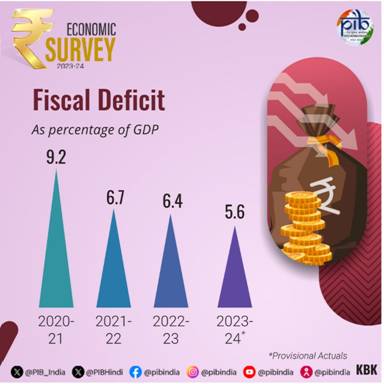
The Survey says, against the global trend of widening fiscal deficit and increasing debt burden, India has remained on the course of fiscal consolidation. The fiscal deficit of the Union Government has been brought down from 6.4 per cent of GDP in FY23 to 5.6 per cent of GDP in FY24, according to provisional actuals (PA) data released by the Office of Controller General of Accounts (CGA).

The growth in gross tax revenue (GTR) was estimated to be 13.4 per cent in FY24, translating into tax revenue buoyancy of 1.4. The growth was led by a 15.8 per cent growth in direct taxes and a 10.6 per cent increase in indirect taxes over FY23.

The Survey adds that broadly, 55 per cent of GTR accrued from direct taxes and the remaining 45 per cent from indirect taxes. The increase in indirect taxes in FY24 was mainly driven by a 12.7 per cent growth in GST collection. The increase in GST collection and E-way bill generation reflects increased compliance over time.

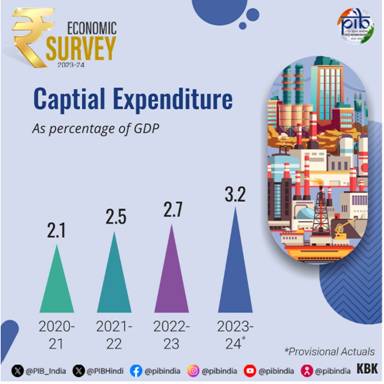
The capital expenditure for FY24 stood at ₹9.5 lakh crore, an increase of 28.2 per cent on a YoY basis, and was 2.8 times the level of FY20. The Government’s thrust on capex has been a critical driver of economic growth amidst an uncertain and challenging global environment. Spending in sectors such as road transport and highways, railways, defence services, and telecommunications delivers higher and longer impetuses to growth by addressing logistical bottlenecks and expanding productive capacities.

The Survey says, it is also incumbent upon the private sector to take forward the momentum in capital formation on its own and in partnership with the Government. Their share in addition to the capital stock in terms of machinery and equipment, started growing robustly only since FY22, a trend that needs to be sustained on the strength of their improving bottom-line and balance sheets in order to generate high-quality jobs.

The Survey points out that the State governments continued to improve their finances in FY24. Preliminary unaudited estimates of finances for a set of 23 states, published by the Comptroller and Auditor General of India, suggest that the gross fiscal deficit of these 23 states was 8.6 per cent lower than the budgeted figure of ₹9.1 lakh crore. This implies that fiscal deficit as a per cent of GDP for these states came in at 2.8 per cent as against a budgeted 3.1 per cent. The quality of spending by state governments improved, too, with state governments focusing on Capex as well.

The Union Government’s transfers to the states are highly progressive, with states with lower Gross State Domestic Product (GSDP) per capita receiving higher transfers relative to their GSDP.

The Survey highlights that the RBI’s vigil over the banking and financial system and its prompt regulatory actions ensure that the system can withstand any macroeconomic or systemic shock. Data from the RBI’s Financial Stability Report of June 2024 show that the asset quality of Scheduled commercials banks has improved, with the Gross Non-Performing Assets (GNPA) ratio declining to 2.8 per cent in March 2024, a 12-year low.

 The profitability of SCBs remained steady, with the return on equity and return on assets ratios at 13.8 per cent and 1.3 per cent, respectively, as of March 2024. Macro stress tests also reveal that SCBs would be able to comply with minimum capital requirements even under severe stress scenarios. The soundness of the banking system will facilitate the financing of productive opportunities and lengthen the financial cycle, both of which are necessary to sustain economic growth.

The Survey highlights that on the external front, moderation in merchandise exports continued during FY24, mainly on account of weaker global demand and persistent geopolitical tensions. Despite that India’s service exports have remained robust, reaching a new high of USD 341.1 billion in FY24. The exports (merchandise and services) in FY24 grew by 0.15 per cent, while the total imports declined by 4.9 per cent stated the survey.

Net private transfers, mostly comprising remittances from abroad, grew to USD 106.6 billion in FY24. As a result, the Current Account Deficit (CAD) stood at 0.7 per cent of the GDP during the year, an improvement from the deficit of 2.0 per cent of GDP in FY23. The net FPI inflows stood at USD 44.1 billion during FY24 against net outflows in the preceding two years.

Overall, India’s external sector is being deftly managed with comfortable foreign exchange reserves and a stable exchange rate. Forex reserves as of the end of March 2024 were sufficient to cover 11 months of projected imports.

The Survey underscores that the Indian Rupee has also been one of the least volatile currencies among its emerging market peers in FY24. India’s external debt vulnerability indicators also continued to be benign. External debt as a ratio to GDP stood at a low level of 18.7 per cent as of end-March 2024. The ratio of foreign exchange reserves to total debt stood at 97.4 per cent as of March 2024 as per the Economic Survey 2023- 24.

The Survey points out that India’s social welfare approach has undergone a shift from an input-based approach to outcome-based empowerment. Government initiatives like providing free-of-cost gas connections under PM Ujjwala Yojana, building toilets under the Swacch Bharat Mission, opening bank accounts under Jan Dhan Yojana, building pucca houses under PM-AWAS Yojana have improved capabilities and enhanced opportunities for the underprivileged sections. The approach also involves the targeted implementation of reforms for last-mile service delivery to truly realise the maxim of “no person left behind”, the Survey added.

The Direct Benefit Transfer (DBT) scheme and Jan Dhan Yojana-Aadhaar-Mobile trinity have been boosters of fiscal efficiency and minimization of leakages, with ₹36.9 lakh crore having been transferred via DBT since its inception in 2013.

The Survey says, the all-India annual unemployment rate (persons aged 15 years and above, as per usual status) has been declining since the pandemic and this has been accompanied by a rise in the labour force participation rate and worker-to-population ratio. From the gender perspective, the female labour force participation rate has been rising for six years, i.e., from 23.3 per cent in 2017-18 to 37 per cent in 2022-23, driven mainly by the rising participation of rural women.

On the global economic scenario the Survey says that after a year marked by global uncertainties and volatilities, the economy achieved greater stability in 2023. While uncertainty stemming from adverse geopolitical developments remained elevated, global economic growth was surprisingly robust.

The Survey states as per the World Economic Outlook (WEO), April 2024 of the International Monetary Fund (IMF) , the global economy registered a growth of 3.2 per cent in 2023.

*****

Floral Waste is boosting circularity in economy

 As India moves towards sustainability and a circular economy, the focus on waste to wealth is the way to be. Implementing composting pits in temples and involving Temple trusts and SHGs in recycling efforts can create significant employment opportunities. Outreach programs to educate priests and devotees about not dumping floral waste in rivers can help encourage waste reduction. The “Green Temples” concept can be integrated into policies to transform temples into eco-friendly spaces. Promoting digital offerings or biodegradable materials instead of traditional flowers can also help reduce floral waste.  The National Horticulture Board can be involved in tracking and managing floral waste in green spaces like parks etc.

The floral waste sector in India is experiencing new growth, marked by its multifaceted benefits. Not only is it providing meaningful employment opportunities for women, but is also effectively diverting waste from dumpsites, contributing to environmental preservation.

Floral waste, collected from the spiritual sites mostly biodegradable, often ends up in landfills or water bodies, causing health hazards and harming aquatic life. According to a UN Climate Change report, the river Ganga alone absorbs over 8 million MT of flower waste annually. Under the Swachh Bharat Mission-Urban 2.0, several Indian cities are bringing innovative solutions to the table. Social entrepreneurs are stepping in to recycle flowers into valuable products like organic compost, soaps, candles, and incense sticks.

The Swachh Bharat Mission is spearheading a transformative journey towards sustainability, where the ethos of circular economy and waste-to-wealth reign supreme. Amidst this paradigm shift, floral waste emerges as one of the significant contributors to carbon footprints, prompting collaborative efforts among cities and startups to tackle this challenge head-on.

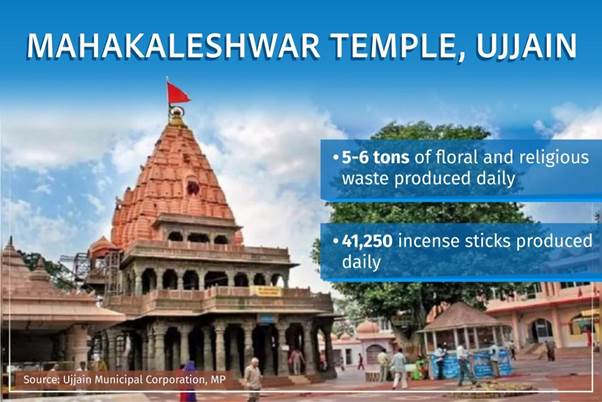
With 75,000 to 100,000 daily visitors at the Ujjain’s Mahalakaleshwar Temple, around 5-6 tonnes of floral and other waste are produced daily. Specialized ‘Pushpanjali Econirmit’ vehicles collect this waste and then it is processed at a 3TPD plant, turning it into eco-friendly products. 16 women from the Shiv Arpan Self-Help Group create various high-quality items from the floral waste and have been employed for the same. Additionally, the waste is converted into briquettes and compost, for the local farmers and as also works as biofuel. According to the Ujjain Smart City 2022 report, 2,200 tons of floral waste has been treated to date, and a total of 30,250,000 sticks produced so far.

Siddhivinayak Temple sees nearly 40,000 -50,000 devotees daily peaking 1,00,000 devotees on some given days, offering 120 to 200kgs of floral. Mumbai-based designer house ‘Adiv Pure Nature’ has initiated a sustainable venture, turning the temple’s discarded blooms into natural dyes to create different textiles in the form of fabric yardage, garments, scarves, table linens and tote bags. They collect floral waste thrice in a week which accounts to 1000-1500 kg /week. After segregation, a team of artisans transform the dried flowers into natural dyes. Beyond the commonly used marigold, rose, and hibiscus, the team also utilizes coconut husks to create natural dyes and produce textured prints through steam.

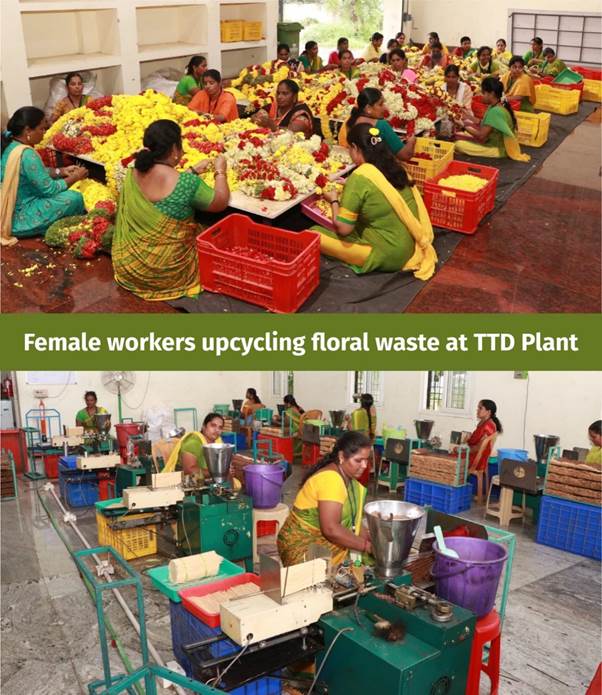
Tirupati Municipal Corporation handles over 6 tons of floral waste daily from temples every day. The city collects and upcycles floral waste into valuable & reusable products. 150 women from self-help groups have been employed through this. The recycling is done at the Tirumala Tirupati Devasthanam Aggarbatti 15-ton capacity manufacturing plant. The products are packaged with recycled paper and plantable paper embedded with Tulsi seeds for a zero-carbon footprint.

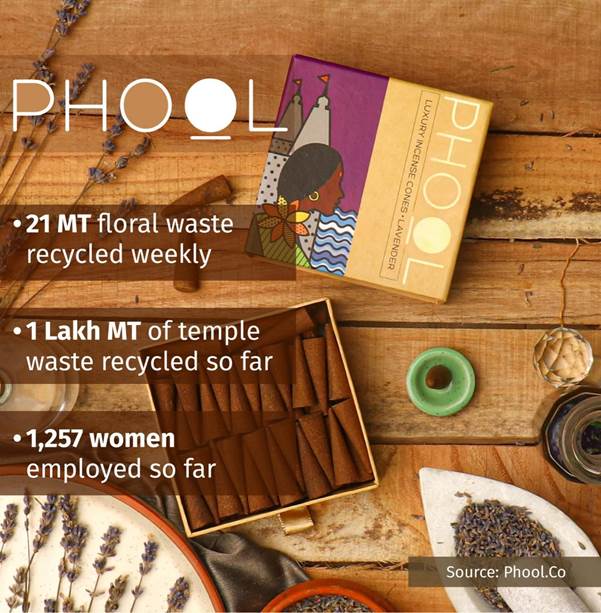
Kanpur based Phool, the floral waste recyclers have been tackling the massive temple-waste problem by collecting floral-waste from temples from various cities on a daily basis. Phool collects nearly 21 MT of floral-waste weekly (3 TPD) across the five prominent temple towns of India including Ayodhya, Varanasi, Bodh Gaya, Kanpur and Badrinath. This waste is upcycled into items such as incense sticks, incense cones, Bamboo-less incense, havan cup etc. The women employed by Phool enjoy a safe working space, fixed salaries, and benefits like provident fund, transportation, and healthcare. With deep-tech research, the startup has developed ‘Fleather’, which is a viable alternative to Animal leather and it was recently awarded PETA’s best innovation the Vegan World.

Hyderabad-based startup, ‘HolyWaste’ has revitalized floral waste through a unique process called ‘Florjuvination. Founded in 2018, the company’s founders Maya Vivek and Manu Dalmia partnered with vendors, temples, event organizers, decorators, and flower waste generators. They collect floral waste from 40 temples, 2 flower vendors, and a market area to create eco-friendly products like fertilizers, incense sticks, scented cones, and soaps. Currently, Holy waste is preventing a humble quantity of 1,000 kgs/week from clogging the water bodies or rotting in the landfills.

Poonam Sehrawat’s startup, ‘Aaruhi’, collects floral waste from over 15 temples in Delhi-NCR, recycling 1,000 kg of waste and earning over Rs 2 lakh monthly. Sehrawat has trained more than 3,000 women to create products from floral waste.

*****

Demographic dividend and labour reforms will drive future growth

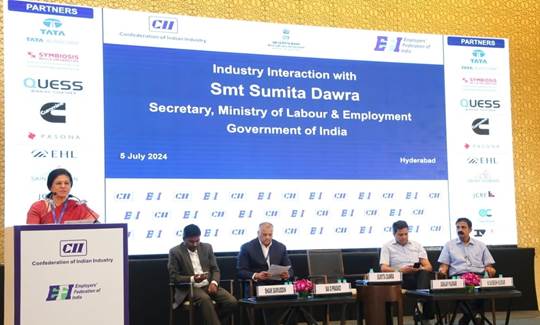
 Smt. Sumita Dawra, Secretary, Ministry of Labour & Employment, Government of India participated in an industry interaction organised by Confederation of Indian Industry (CII) and the Employers’ Federation of India (EFI) on 5th July 2024 at Hyderabad.

In her inaugural address, Smt. Sumita Dawra, Secretary, Ministry of Labour and Employment, highlighted India’s fast growth rates, and emphasized that India’s demographic dividend and labour reforms are pivotal to driving future growth, alongside other growth engines of manufacturing, expansion of service sector, infrastructure, etc.

Citing the RBI’s KLEMS data, she conveyed that about 8 crore new employment opportunities were created in India during past five years [ending 2021-22], largely driven by various government initiatives aimed at incentivising and promoting manufacturing ( such as PLI, Make in India), expansion of services sector, access to micro credit, investments, emergence of new areas such as Gig and Platform workers, Global Capability Centres (GCCs) and Startups, etc. She further highlighted the growing gig economy, which is estimated to employ about 2.3 crore people by 2030.

Smt. Dawra discussed the consolidation of 29 labour laws into four comprehensive codes aimed at simplifying regulations and administrative processes, including the decriminalization of labour laws, thereby enhancing ease of doing business and reduction in compliance burden. This will in turn be attractive for enhanced domestic and foreign investment flows, and in bringing supply chains and global value chains to India, she added. She further said that the reforms will stimulate the economy, enhancing employment opportunities, increasing female workforce participation, and improvements in social security and labour welfare, all of which are expected to drive inclusive growth in India. Currently, India’s GDP is more than USD 3 trillion and is expected to reach USD 33 trillion by 2047 riding on various initiatives, including labour reforms, she added.

Smt Dawra underscored the importance of expanding social security coverage for the unorganized and informal sectors while recognizing the need for governance reforms in the Employees’ State Insurance Corporation (ESIC) and the Employees’ Provident Fund Organisation (EPFO). She also highlighted various systemic reforms initiated in ESIC and EPFO such as auto settlement of claims, reduction in rejections, and improving the pace of claims settlement in EPFO, as well as enhancing the coverage and quality of services in ESIC.

During the interaction, presentations on various systemic reforms in ESIC and EPFO were made, outlining topics such as digitization, e-governance, and compliance simplification, with discussions aimed at gathering suggestions from participants to further improve these systems.

The National Career Service (NCS) portal of Ministry of Labour and Employment was also showcased as a comprehensive solution for career counselling and employment networking. It was highlighted that more than 1 crore vacancies were mobilised on NCS portal during 2023-24. The portal is also integrating SIDH database from the Ministry of Skill Development and Entrepreneurship to ensure availability of rich pool of skilled jobseekers on the portal to reduce skill gap in labour market. The ongoing integration of databases of the two Ministries will effectively link the youth to both skills and employment, resulting in aligning the demand-supply gap in the labour market, it was informed.

The session highlighted the collaborative efforts between the government and industry to create a positive environment for economic development and employment growth. Such interactions are crucial for creating awareness and implementing effective reforms, besides getting feedback from industry and other stakeholders.

The session witnessed participation from over 300 industry representatives keen to engage in discussions on critical labour and employment reforms shaping India’s economic landscape. Senior officials from the Ministry of Labour and Employment, EPFO, ESIC and State Government of Telangana also attended the session.

The event aimed to foster dialogue between government officials and industry stakeholders, focusing on employment generation, labour reforms, and ease of doing business in India.

****

Rising economic growth and strengthening partnership

 Union Minister of Commerce & Industry, Consumer Affairs, Food & Public Distribution and Textiles, Shri Piyush Goyal expressed confidence in strengthening UAE-India Partnership. While addressing at a meeting with top Business Leaders from India & UAE hosted by Abu Dhabi Chamber, the Minister said that rising economic growth of the two countries and strengthening partnership offers opportunities for businesses on both sides to tap into for faster growth.

Shri Goyal emphasized the UAE’s pivotal role in this partnership, citing it as India’s second-largest export destination, third-largest trade partner, and the largest investor in terms of foreign direct investment. The Comprehensive Economic Partnership between the two countries forms a strong foundation for collaboration, he said. Both nations share a rich history, culture, and tradition, combined with present-day capabilities and future possibilities, which the Minister believes will provide the impetus for this partnership to thrive.

Shri Piyush Goyal said that the crucial areas of collaboration between India and UAE range from food security, education, energy security, climate change mitigation to space technologies. The promotion of each other’s cultures and initiatives like the Startup20, B20, the UAE-India Business Council and Bharat Bazaar were also highlighted by the Minister. 

The Minister stated India’s role as a large market with 1.4 billion aspirational citizens, presenting a significant opportunity for businesses in the UAE. He outlined the “30 by 30 by 30” opportunity, with India’s average age being under 30 for the next 30 years and a goal to add $30 trillion to its GDP by 2047. He encouraged businesses to seize these opportunities and collaborate in the spirit of cooperation and competition.

Shri Goyal emphasized the warmth of the welcome he received and the infectious enthusiasm to bolster the UAE-India partnership. The Minister said that the incredible love and affection that the people of India and the people of the UAE have for each other, along with the immense contribution that businesses are making to strengthen this geopolitical strategic partnership, is set to make this the defining partnership and brotherhood of the 21st century.

He said that India has witnessed remarkable economic growth over the last nine years  under the leadership of the Prime Minister Shri Narendra Modi, transforming from one of the fragile five economies globally to now being the world’s fifth-largest economy. Shri Goyal highlighted this impressive journey and the ambitious goal of becoming the world’s third-largest economy within the next four years. He termed the next 25 years as the golden period for India’s development.

In his closing remarks, Shri Piyush Goyal compared the UAE-India partnership to a rising tide lifting all boats and expressed his belief that the growing friendship and cooperation between the two nations will offer tremendous opportunities for businesses on both sides.

***

Woman disrupts American airlines

A Dallas lady started off an American Carriers departure from Texas to Orlando in the wake of going ballistic on video had the option to get back to the solid side of the air terminal after various endeavors to go through a Transportation Security Organization designated spot, police records uncover.

Tiffany Gomas, a 38-year-old promoting leader, was accused of intruding after the viral implosion before departure from Dallas-Post Worth Worldwide Air terminal July 2.

She deliberately got off the plane and left the terminal, however at that point supposedly attempted on numerous occasions to help back through air terminal security.

In spite of the fact that her ticket had been repudiated, evidently it was as yet dynamic in the TSA framework, as per a police report.

Tiffany gomes

India's Creative Economy showcased at the Annecy International Animation Festival in France

 Annecy, June 14, 2023: India is participating at the The Annecy International Animation Festival (AIAF) for the first time this year. An Indian delegation led by the Secretary, Information and Broadcasting, Shri. Apurva Chandra with eminent personalities of the animation industry have been showcasing India’s prowess in creating animation and VFX content for global audiences at the AIAF. 

India has lately emerged as a preferred destination of VFX and animation content for global production houses. The animation and VFX market in India was pegged to be valued at Rs 109 billion in 2021, with the VFX business alone amounting to Rs 50 billion. This figure is expected to grow to Rs 180 billion by 2024 according to a E&Y report. India’s participation at Annecy therefore assumes greater importance as the country showcases its abilities in the sector to international buyers. 

Speaking about India’s participation, Shri. Chandra said, “The Animation, Gaming, Visual Effects and Comics (AVGC) Sector in India is making progress with the adoption of world-class techniques and innovative technologies, coupled with a pool of immensely talented professionals. India is one of the few countries providing cash incentive to foreign companies for making AVGC content in India. The incentives are the same as for shooting films in India. This is a huge opportunity for companies to benefit from this. As a country, we are committed to providing incentives to the industry, as well as supporting pre and post-production activities in India.” 

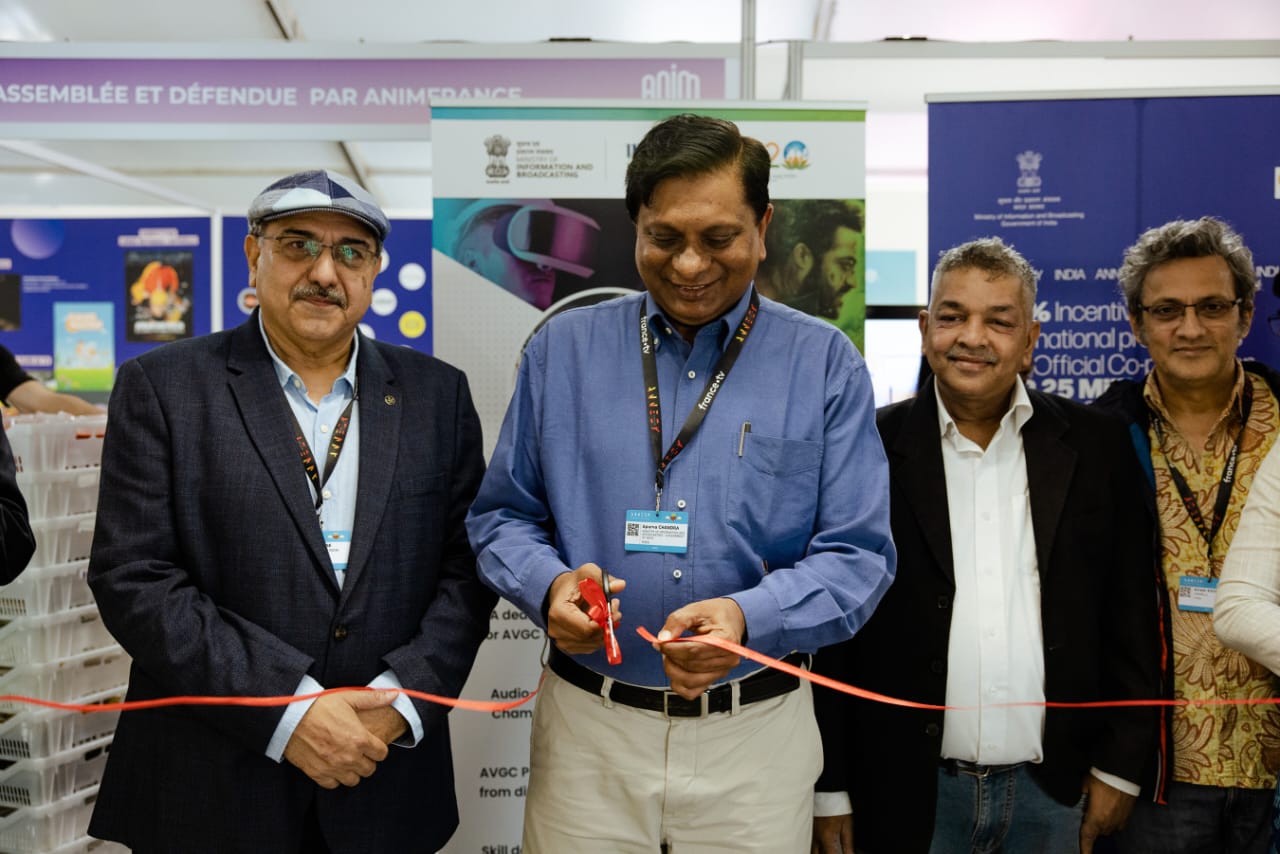
At the festival, Shri. Chandra met Michael Marin, director of AIAF and discussed the possibilities of strengthening India’s engagement at Annecy and the potential of collaboration between India and France to host an animation film festival in India. Shri. Chandra inaugurated the India Pavilion, which has been designed on the theme of the Saraswati Yantra and also interacted with the Indian creative community who have won entries in the prestigious Annecy festival competition in 2023. Young creators Arvind Jeena, Nikita Prabhudesai Jeena, Upamanyu Bhattacharyya, Kalp Sanghvi along with industry seniors such as Saraswati Vani Balgum, Kireet Khurana, Biren Ghosh, Anil Wanvari and Anne Doshi, among others, were present at the festival. 

Besides, Shri. Chandra interacted with delegates from other countries and the discussions centred around the various initiatives of the Ministry with regards to the AVGC sector, the incentives given by the Indian Government for ease of business in the sector. 

Media and entertainment industry to make a matchless mark

 Union Minister of Commerce and Industry, Textiles and Consumer Affairs, Food and Public Distribution, Shri Piyush Goyal said that the media and entertainment industry will make a mark that will be matchless in the Amrit Kaal poised to be the defining moments for India. During his address at the FICCI Frames 2023, the Minister lauded the industry for its commitment to take Indian cinema on the global map.

The Minister said that the government under the visionary leadership of the Prime Minister, Shri Narendra Modi is supportive to all the efforts by the media and entertainment industry to expand the frontiers of the sector globally and reach the remotest corners of the world. Shri Goyal said that the media and entertainment industry can disseminate the message to the world that India is on the pathway to become a developed nation by 2047. He also said that India as the fastest growing economy of the world along with an unparalleled talent and skill base at a very competitive price offers unmatched opportunities for economic development and business growth to the world.

The Minister appreciated the industry for efficiently adopting modern technologies and cited the example of widespread use of smartphones as cameras. Shri Goyal said that the media and entertainment industry will grow by leaps and bounds with the emergence of digital platforms. Shri Piyush Goyal lauded the Indian VFX companies involved in Hollywood movies like Avatar. He said that startups are contributing to the growth of this sector significantly.

The Minister noted that the media and entertainment industry can showcase to the world, the New India of today and boost the economy, helping the country reach a new audience, influencing opinions, and spreading positivity. He said that this positivity encourages people, government and businesses to be more aspirational and look at the future with greater hope demanding better lifestyles and better business opportunities.

Shri Goyal said that the media and entertainment industry are the cultural ambassadors of India and have given a unique identity to India. He highlighted that the media and entertainment industry has a huge potential to connect people, businesses and nations leading to a better understanding and appreciation of different cultures and conditions across the world.

The Minister said that the world is also appreciating Indian art and culture and the recent Oscar Awards for the ‘Naatu-Naatu’ song and the ‘Elephant Whisperers’ showcase this global appreciation. Shri Goyal said that these Awards helped India convey a social message that sustainability is at the core of Indian culture and tradition. He said that the message of Naari Shakti was also effectively conveyed as the Awards highlighted that Indian women of substance are defining the New India. Shri Goyal said that these achievements are boosting the morale of billions of people.

Shri Piyush Goyal noted that the theme ‘inspire, innovate and immerse’, is relevant to the current times as it reflects the vibrancy demonstrated by the media and entertainment industry. He said that the theme also resonates with the belief that creativity can indeed enhance commerce. He said that the industry acts as a key pillar of India’s cultural identity and cultural heritage. The Minister noted that FICCI Frames has now become an established platform in the media and entertainment sector showcasing to the world what India truly represents.

The Minister said that every artist can dream and every dreamer can succeed in New India and urged the media and entertainment industry to build an industry which entertains, empowers, enlightens and inspires the whole nation, in this journey of progress and prosperity.

***

India emerge among the top three economies in the world

 Union Minister for Commerce and Industry, Consumer Affairs, Food and Public Distribution and Textiles, Shri Piyush Goyal today expressed confidence that the structural reforms taken by the Government in last 8 years will help India emerge among the top three developed economies in the world. He was interacting on the occasion of 27th edition of Wharton India Economic Forum via VC. The theme of today’s event was India leading innovation in the age of uncertainty.

Speaking on the most impactful economic reforms that will pave the way for India’s growth story in coming years,  Shri Goyal said a lot of structural changes that have taken place in the last eight years have had a significant impact on the way the Indian economy is poised to take off. He spoke of GST as one of the important reforms and highlighted that despite the challenging global scenario recent GST collections have been very robust.  He also mentioned that India is now a more honest, transparent economy and people are now getting used to paying their taxes. He said Insolvency and Bankruptcy Code (IBC) is also an important reform measure that has resulted in robust banking systems in India. These banks have been able to provide the resources for industry to grow. He also mentioned reforms such as privatisation,  digitization of the economy, particularly the financial sector, decriminalisation of laws, simplification of compliances to enable ease of doing business.

Responding to a question of which sectors are strategic priorities for the government, Shri Goyal said that infrastructure, Semiconductor, Domestic manufacturing are some of the priority sectors. He also pointed out that Prime Minister Narendra Modi’s focus is on building a robust infrastructure in India. Private sector is also contributing in this endeavour. Shri Goyal said Semiconductor is another critical sector for the Indian economy. Another important area is domestic manufacturing, and the government has introduced PLI schemes to kickstart Indian manufacturing in over 14 sectors. The Minister mentioned the Government is also encouraging the Private sector/ industry associations to determine themselves what support in what areas it needs from the Government.

Sharing his views on the current geopolitical environment in relation to tensions between Russia and the West, Shri Goyal reiterated Prime Minister Narendra Modi’s belief that today’s era must not be an era of war. He further said India believes that dialogue and diplomacy is the only way forward to resolve the crisis and called for quickly resolving the conflict.  He also highlighted that Prime Minister Modi has had several conversations with world leaders on this issue. India played a critical role in trying to get consensus at the G 20 meeting in Bali. Minister said due to Prime Minister Modi’s intervention, world economies were able to come to an outcome at G 20 and hoped that it would set the path forward to finding solutions to the Russia Ukraine war. Shri Goyal said, in India, the Government has been focussed on meeting the needs of the common man, ensuring availability of sufficient foodstocks, energy needs, adequate seeds, adequate fertilisers.

Speaking on India’s renewed focus in signing free trade agreements in the past five years, Shri Goyal emphasised that India today has emerged out of the shadows of the past. India has recognized that multilateral engagements often lead to economic partnerships which may not be in the best interests of all the stakeholders. He cited the example of India walking out of Regional Comprehensive Economic Partnership (RCEP) bcos it was a very unfair, unbalanced agreement. He said India’s interest is to enter into bilateral free trade agreements that are balanced, in the best interests of both countries. We are engaging with like minded countries particularly countries with a rules based order, transparent economic systems and entering into agreements which are a win win for both sides.

Speaking on lessons learnt from the covid pandemic, Shri Goyal said  upgradation and expansion of our health infrastructure is the topmost priority. He highlighted that the Government has improved the quality of hospital infrastructure, expanded ICU beds and oxygen capacity many fold, almost doubled the number of medical colleges in the country. He also mentioned that focus is on skill development training of healthcare workers. He also spoke of India’s free health care program, world’s largest, wherein 500 million people are eligible for free health care in India through a government sponsored program.

He said another learning has been recognizing the importance of resilient supply chains. He recalled the nation’s struggle for critical equipment like PPEs during covid pandemic despite the best efforts. He said that the Government is now focusing on strengthening India’s capabilities in all these areas. He highlighted that these challenges were converted into opportunities for India’s future India’s growth story. Our Indian industry truly rose to the occasion, and India is now the manufacturer of personal protective equipment. He said that in the last few years, India has been focused on building enabling infrastructure, environment, to attract investors who believe in  a robust, rules based system. He said focus is on structural reforms, massive infrastructure development, digitization, and the huge talent that India is offering to the world, which is helping rewrite India’s future. 

Speaking on challenges and opportunities for the next 25 years, Shri Goyal said one of the biggest challenges is going to be changing the mindset of the nation to recognize and value the importance of quality. He termed this as the defining factor for the future of India. He said the Government will continue to support manufacturing to create jobs for a large number of people, focusing on digitization, making India a knowledge based economy.  He mentioned that India did over 74 billion financial transactions digitally, which is more than Europe, US and China combined. He said the challenge is to get the mindset of the nation to work towards being a high quality, high technology, high service oriented, which can meet the needs of the rest of the world.

*****

Indian rupees was worst performing asian currencies in 2022.

The Indian rupee ended 2022 as the worst-performing Asian currency with a fall of 10.14%, its biggest annual decline since 2013, as the dollar rocketed on the U.S. Federal Reserve’s aggressive monetary policy stance to tame inflation.

The rupee finished the year at 82.72 to the U.S. currency, down from 74.33 at the end of 2021, while the dollar index was headed for its biggest yearly gain since 2015.

A rise in oil prices brought on by the crisis between Russia and Ukraine also hurt the rupee and resulted in India’s current account deficit reaching an absolute record high in the third quarter of that year.

Market participants anticipate that the rupee will trade with an appreciation bias in 2023.finding comfort in declining commodity prices and holding out hope that foreign investors will continue to purchase Indian stocks.

Heading into 2023, market participants believe the rupee would trade with an appreciation bias, finding relief from easing commodity prices and hopeful of foreign investors continuing to buy Indian equities.

Amid covid concerns, chinese are turning to black market India made meds.

Residents in China have been scouring the market for generic COVID-19 drugs and India seems to be the answer to their problem. In the recent past, the Chinese authorities have approved two Covid antivirals – Pfizer’s Paxlovid and Azvudine – for the treatment. While China has ran out of the medicine, the Indian market is filled with it and is slowly becoming the next favourite destination.

In the past few months, topics like “anti-Covid Indian generic drugs sold at 1,000 yuan (US$144) per box” has been making the rounds of the Chinese social media. Platforms like Weibo and WeChat are filled with such queries and experts believe that black market deals are being conducted on them.

While the distribution of drugs which are not approved in China is not illegal, there can be penalties imposed on the illegal imports. Even the doctors in China have warned the public against buying drugs on the black market with several patients displaying massive side effects to the medicines.