Public Policy relevancy with Social welfare Programmes

Source: Shutterstock

Public Policy is new tool of Government to solve socio economic problems through several policies such as Agriculture Policy, Labour Policy, Health Policy, Education Policy, Wage Policy, Industrial Policy and Foreign Policy etc. Government view public policy as a dependent variable and study as to how society is evolving and Political system shaping the nation.

The field of public policy has emerged comparatively in beginning as traced in early 1950s. The concept of public policy was originated in 1951 from the publication of Harold Lasswell. According to Thomas R Dye, Public Policy is what Government will choose to do or not to do. In indian context, public policy could be government rules and Programmes in the form of political system of laws, ordinance, court decision, executive orders, decisions or even unspoken understanding  of what is to be done.

Paul Appleby, the essence of public administrative decision policy defined as a purposed course of action of an individual a group, an Institution or government to realize a specific objective or purpose, within a given environment. The process of public policy flows both top to bottom and bottom to top or even simultaneously. The policy process is viewed from higher level as execution of Policy and viewing meta Policy meaning  progressive.

After independence, India did not carry a specific structural path for economic development. It was decided that economic development must be based on social, political growth that transmutes human advancements. India adopted the Socio – economic development model in which major areas were industries and agriculture. Planning commission (now NITI Aayog) for the purpose of development initiatives adopted in a five year plan as a major development plan. structure policies Public policy developed as academic pursuit in the 1950s. However, Public Policy was very much evident in 1940, stimulating Government activities and academic organizations. Study of government, policy, Social Science involves political Science, public administration, economics and management.

Dimock stated public policy as “deciding at any time or place what objectives and substantive measures should be chosen in order to deal with particular problems”. Public Policy process structure to maximize and utilize all resources to overcome the catastrophic events. Public Policy is a continuous process, furiously working towards  acquiring best outcomes. Righteous and accurate conditioning helps to bring desired aims. The process requires transparency, decentralization, and effective policy implementation. Public Policy Process is significant to change nation economic, social, and political representation especially in the Case of developing nations.

According to Chandler and Plano, treated public Policy as ” the strategic use of resources to alleviate national problems  or governmental concerns”. Freeman and Sherwoods stated that it is the Public answer to the interest in refining the circumstances. Robert linebewy  emphasized on “it is what governments do and fail to do for their citizens”. Anderson expresses it,” policy is being made as it is being administered as it is being made”.

 Understanding of Public Policy

Source: iass.potsdam.de

 The Public Policy process is a kind of Physics  equation that if finding a small error will cost the huge problem, also diffuses the whole processing mechanism. Public policy processes require pointed manifestation at each level. Hogwood and Gunn (Policy Analysis for the Real World, 1984) concluded nine vital Stages in the policy process: Agenda Setting, object screening issue defining , forecasting alternatives, objectives & priorities, policy implementation, monitoring and control, policy maintenance, succession and termination, these all required for successful policy. As we are aware, policy making is a complex and dynamic strategy, it requires certain tools to resolve the real world problem of economic, financial, economic, social problems. Public Policy enacted by the government or its executives with the help of civil Societies, media, and pressure groups.

 In the Context of public policy process Lindblom stressed on a highly relative and plasticity decision making system characterised by compromise, incrementalism and continual adjustment. Public policy process is conceptualized as in sequence or stages ( Benson, Jordan, 2015). There are (1) sequence follows as – i) Problem emergence 2) agenda setting 13) Consideration of policy options, &) Decision making 5) implementation 6) evaluation (Jordan and Adelle, 2012).

A policy can be simple or complex, explicit or implicit, discretionary or detailed, private or public qualitative and quantitative. Government does not set advisory principles;  it is the Supreme Court who decides and provides new interpretations of the articles of constitution to curve out the new Policy.

Nature of public policy covering wide portion of its activities such as socio- economic development, women empowerment, child labour, equality, education and so on. Nature of Public policy foremost needs Policy making closely related to decision-making. Decision making includes an identification of a problem, sharp analysis, and the ability to see alternatives. Policies have specific goals, It is absolute to expect a policy to indicate the direction towards. where actions are required. The choices of policies or its objectives are frequently mesmerized. Thus, goals and objectives depend on the values of the policy makers. Planning or formulation is a key component to move forward in the public policy process. Administrators must maintain a planner to know the portion of resources, investments because goals cannot be achieved without having proper planning. Policy Analysis is most significant to rectify any problem in process; it is a technique to use in Policy Process. Basically used for problem assessment and monitoring. Before the decisions, Similarly, Policy Management is also familiar with implementation. It deals with policy making and policy preparation process, it ensures it is producing good quality policies.

 Thus, goals and objectives depend on the values of the policy makers. Planning or formulation is a key component to move forward in the public policy process. Administrators must maintain a planner to know the portion of resources, investments because goals cannot be achieved without having proper planning. Policy Analysis is most significant to rectify any problem in process; it is a technique to use in Policy Process. Basically used for problem assessment and monitoring. Before the decisions, Similarly, Policy Management is also familiar with implementation. It deals with policy making and policy preparation process, it ensures it is producing good quality policies.

 Policy management should be considered as a loose point or giving no importance, it is an Icebreaker of Public Process, if you assess anything wrong at this stage, there will be high chance to “trash in” the policy. That is why policy analysis and policy management is interdependent. 

 

Bailment

Section 148 defines the terms ‘bailment’, ‘bailor’ and ‘bailee’.

A bailment is the delivery of goods by one person to another for some purpose upon a contract that they shall when the purpose is accomplished be returned or otherwise disposed of according to directions of the person delivering them. The person delivering the goods is called the bailor and the person to whom the goods are delivered is called the bailee.

Essentials of Bailment

1.Delivery of the goods for some purpose

2.Return of the goods after the purpose is achieved, or their disposal according to the bailor’s directions.

Kinds of Bailment

  1. Gratuitous Bailment: In gratuitous bailment it is without any consideration for benefit of bailor or bailee.
  2. Non-Gratuitous Bailment: Benefit for both bailor and bailee. Also known as bailment for reward.
  3. Bailment for benefit of bailor: Bailor delivers his goods to bailee for safe custody without any benefit or reward.
  4. Bailment for benefit of bailee: Bailor delivers his goods to a bailee without any benefit for his own use.
  5. Bailment for benefit of bailor and bailee: It is beneficial for both i.e. bailor and bailee.

Duty of Bailor

Section 150 mentions the following duty of bailor in respect of the goods bailed by him:

  1. The bailor is bound to disclose the faults to the bailee in the goods bailed, of which the bailor is aware and materially interfere with the use of them, or expose the bailee to extraordinary risks; and if he does not make such disclosure, he is responsible for the damage arising to bailee directly from such faults.
  2. If the goods are bailed for hire, the bailor is responsible for such damage, whether he was or was not aware of the existence of such fault in the goods bailed.

Duties of Bailee

  1. Duty to take reasonable care of the goods bailed (Section 151 and 152).
  2. Duty not to make unauthorised use of the goods bailed (Section 153 and 154).
  3. Duty not to mix the bailor’s goods with his own goods ( Section 155,156,157).
  4. Duty to return the goods on fulfillment of the purpose (Section 160,161 and 165,166,167).
  5. Duty to deliver to the bailor increase or profit on the goods bailed (Section 163).

Nature of Partnership

When two or more persons join hands to set up a business and share its profits and losses it is called Partnership. Section 4 of the Indian Partnership Act 1932 defines partnership as the ‘relation between persons who have agreed to share the profits of a business carried on by all or any of them acting for all’.

Partners are the persons who have entered into partnership individually with one another. Partners collectively are called ‘firm’. The essential features of the partnership are as follows:

Two or More Persons:
There should be at least two persons coming together to form the partnership for a common goal. In other words, the minimum number of partners in a partnership firm can be two.
Indian Partnership Act, 1932 has put no limitations on maximum numbers of partners in a firm. But however, Indian Companies Act, 2013 puts a limit on a number of the partners in a firm as follow:
1.For Banking Business, Partners must be less than or equal to 10.
2.For Any Other Business, Partners must be less than or equal to 20.
3.If the number of partners exceeds the limits, the partnership becomes illegal.

Agreement
The partnership is an agreement between two or more persons who decided to do business and share its profits and losses. To have a legal relationship between the partners, the partnership agreement becomes the basis. The agreement can be in written form or oral form. An oral agreement is equally valid. But, preferably the partners should have a written agreement, in order to avoid disputes in future.

Business
To carry on some business there should be an agreement. Mere co-ownership of a property does not amount to the partnership. The business must also be legal in nature, a partnership to carry out illegal business is not valid.

Mutual Agency
The business of a partnership firm may be carried on by all the partners or any of them acting for all. This statement has two important implications. First, to participate in the conduct of the affairs of its business, every partner is entitled. Second that a relationship of mutual agency between all the partners exists.
For all the other partners, each partner carrying on the business is the principal as well as the agent. He can bind other partners by his acts. And also is bound by the acts of other partners with regard to the business of the firm.

Sharing of Profit
The agreement between partners must be to share profits and losses of a business. Sharing of profits and losses is important. The partnership is not for the purpose of some charitable activity.

Liability of Partnership
Each partner is liable jointly with all the other partners. And also when is a partner, severally liable to the third party for all the acts done by the firm. Liability of the partner is not limited. This implies that for paying off the firm’s debts, his private assets can also be used.

Partnership Deed
Agreement to carry on a business between the partners, partnership comes into existence. The partnership agreement can be either oral or written. The Partnership Act does not require that the agreement must be in writing. But when the agreement is in written form, it is called ‘Partnership Deed’. Partnership deed should be duly signed by the partners, stamped & registered.

Partnership deed generally contains the following details:
1)Names and Addresses of the firm and its main business;
2)Names and Addresses of all partners;
3)A contribution of the amount of capital by each partner;
4)The accounting period of the firm;
5)The date of commencement of partnership;
6)Rules regarding an operation of Bank Accounts;
7)Profit and loss sharing ratio;
8)The rate of interest on capital, loan, drawings, etc;
9)Mode of auditor’s appointment, if any;
10)Salaries, commission, etc, if payable to any partner;
11)The rights, duties, and liabilities of each partner;
12)Treatment of loss arising out of insolvency of one or more partners;
13)Settlement of accounts on the dissolution of the firm;
14)Method of a settlement of disputes among the partners;
15)Rules to be followed in case of admission, retirement, a death of a partner; and
16)Any other matter relating to the conduct of business. Normally, all the matters affecting the relationship of partners amongst themselves are covered in partnership deed.

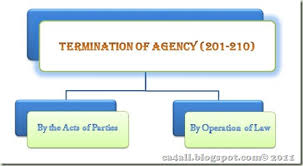
Termination Of Agency

Introduction

In a contract of agency, a person appoints another to act on his behalf with the third party it is called ‘Agency’. According to Section 183 of the said Act, Principal must be competent to contract. Any person may be an agent (Section 184). According to Section 185, in the contract of agency, consideration is not necessary. Termination of agency means putting an end to the legal relationship between principal and agent. Section 201 to 210 of the Indian Contract Act 1872 lay down the provision relating to the termination of Agency.

As above said termination of agency means putting end to the legal relationship between principal and agent. Section 201 to 210 of the Indian Contract Act 1872 lay down the provision relating to the termination of Agency.

Section 201, Indian Contract Act 1872 provides for termination of an agency –

An agency is terminated by the principal revoking his authority, or by the agent renouncing the business of the agency; or by the business of the agency being completed; or by either the principal or agent dying or becoming of unsound mind; or by the principal being adjudicated an insolvent under the provisions of any Act for the time being in force for the relief of insolvent debtors.

Agency may be terminated two ways –
1) By the Act of the Parties
2) By Operation of Law

1) By the act of the parties
i) By agreement – The Contract of Agency can be terminated at any time by mutual agreement between the principal and agent.
ii) By revocation of the principal – The Principal revoke agency at any time by giving notice to the agent.
iii) By Renunciation of an agent – Renunciation which means withdrawing from responsibility as Agent. Like Principal, Agent can also renounce the agency. According to Section 206 of the Indian Contract Act 1872, the agent must give to his Principal reasonable notice of renunciation. Otherwise, he will be liable to make good for the damage caused to the principal for want of such notice.

2) By operation of law
Agency can be terminated by operation of law-
i) By the completion of agency – Agency can become to an end after the completion of work for which the agency is created.
ii) By expiry of the time – Agency can also be terminated by the expiry of time. if the agency is created for the specific period, it is terminated after the expiry of the time.
iii) Death or insanity of principal or agent – Section 209 of the Indian Contract Act 1872 imposes an agent, duty to terminate the contract of agency on the death of the principal. In other words, Agency comes to an end on the death or insanity of the principal or agent.
iv) Insolvency of principal – According to Section 201 of the Indian Contract Act 1872, an insolvent or bankrupt is a person who is unable to run the business due to Excess of liabilities over assets. In this way, if the principal becomes an insolvent agency can be terminated.
v) Destruction of the subject matter – If this subject matter of the agency is destroyed agency comes to an end.
For example – Any agency is created for sale of an Airplane if the Airplane caught fire before the sale the agency comes to an end. In this contract Airplane is the subject matter.
vi) Principal becoming an alien enemy – If the Principal becomes an alien enemy the contract of agency comes to an end. vii) Dissolution of company or firm – A Firm or company may be regarded as a Principal in the contract of Agency. If the company or firm is dissolved the agency comes to an end.

Relationship between Principal agent and sub agent

Relationship between principal agent and sub-agent depends on the question whether the agent has an authority to appoint sub-agent and whether the sub-agent is properly appointed.
If then sub-agent is properly appointed:
1) The principal is bound by and responsible for the acts of a sub agent;
2) the agent is responsible to the principal for the acts of the sub-agent;
3) the sub agent is responsible for his acts to the agent, but not to the principal except in case of fraud or willful wrong.

It is of interest to observe clause (3) above. Sub-agent is responsible and accountable to the agent and not to the principal by clause (1). Principal is liable for acts of the sub-agent if he is properly appointed. Sub-agent is not responsible to the principal because there is no privity of contract between the principal and sub agent. It is case of fraud or willful wrong that the principal can proceed against the sub-agent. Principal can, however, against the agent for acts of a sub-agent. As far as the rights of a third party are concerned, he can enforce the wrongs of a sub-agent on the principal if the sub-agent is properly appointed. Principal is therefore liable for acts of the sub-agents if he is properly appointed.

If the sub-agent is not properly appointed: Where an agent has appointed a person to act as sub agent without having authority to do so, the principal shall not be deemed to be represented or responsible for the acts of the sub-agent so employed, nor is such a sub-agent responsible to the principal. The agent is responsible for the acts of such a sub- agent both to the principal and to third persons.

Sub-agent is said to be improperly appointed where agent delegates his powers without authority from the principal or where none of the circumstances stated above exist which necessitate appointment of a sub agent.

It will be observed that where a sub-agent is not properly appointed, the liability of agent is also towards third parties. As a rule, we have seen that an agent is responsible to the principal and it is the principal who is responsible for the acts of his agent to the third party. However, the section throws additional liability on the agent where he has improperly appointed a sub-agent. Agent stands liable to the third party for the acts of a sub-agent.

Termination of sub-agent’s authority: (Sec 210) Lastly it must be noted that the termination of the authority of an agent causes the termination of the authority of all sub-agents appointed by him

Liabilities of principal, agent and sub-agent: The agent is responsible to the principal for the acts of a sub-agent and the sub-agent is responsible for his acts to the agent but not the principal, except in cases of fraud and willful wrong.

Where an agent improperly appoints a sub-agent, the agent is responsible for his acts both to the principal and to third parties. The principal in such cases is not responsible for the acts of the sub-agent nor is the sub-agent responsible to the principal. But where a sub-agent is properly appointed, the principal as regards third person, is represented by the sub-agent, and is bound by and responsible for his acts, as if he were an agent originally appointed by the principal.

Where an agent under an express or implied authority has named another person to act for the principal, such a person is not a sub-agent, but an agent of the principal. There is no liability on the agent appointing him provided the agent so appointing exercises discretion as a man of ordinary prudence would exercise is his own case (Sec 194 & 195). Such an agent is called a substitute agent.


Safety Of Women In Public Transport

Have you ever travelled in a public transport or in any bus, train, or metro train? Do you think public transports are safe for women? Being a women do you feel safe while travelling in any mode of public transport? Public transport is on essential service that provides individuals with access to work, to an education and to all of life’s opportunities. And yet, the access of many women and girls to safe public transport options is threatend by the potential of being assaulted or victimised. The findings revealed that 59% of women use public transport like buses, trains and on demand taxis as it is affordable but only 9% of women feel public transport is completely safe, while 3% claim it is completely unsafe and rest 47% claiming that they felt somewhat safe using it during the day, but not at night. The fear of molestation, assault, eve-teasing and male-gaze makes women feel unsafe in modes of public transport. Everyday 7 out of 10 women face some kind of bad behaviour, molestation, male-gaze while travelling in a public transport. Travelling late at night alone in train, bus, on demand taxis is a topic of concern for women. As you remember the Nirbhaya case happened in 2012, a 23 year old girl was beaten, gang raped and tortured in a bus in which she was travelling. Lack of road lighting is a key factor behind feeling unsafe, with 40% women stating only major roads were well lit. Sanitisation is also a problem for women in public transport/bus. Train stations and trains are vulnerable spaces for women due to crowded space or, due to isolated areas where there is no one available to intervene and help in case of emergency. Sexual assault, molestation and even rape are reported on trains and have been on the rise. Not reporting sexual harassment is also a common occurence. Only 30% women report the case of molestation as the women fears that reporting the case will degrade her family’s reputation. More than 50% of the cases remain upreported and the culprit live freely in the society.

The cases against women in public transport are on a rise but the following written measures can be taken to stop the increasing and high pace of these evil acts. Improving the lighting on the roads and on railways; bus and metro stations will have a direct influence over the perception of safety. Having more entry and exit prints to ease congestion. Improving infrastructure including toilets; staircase and pedestrain bridges; publicising helpline numbers; having functional and visible helpdesks where women can get immediate assistance; Making reporting incidents simple and easy so that more women do it- this can help show the patterns and trends and lead to pre-emptive solutions.

In conclusion, i would like to say that the world is changing at a rapid pace and we are living in the 21st century in a technological world but still the women in our society doesn’t feel safe while travelling in a public transport. Women fear molestation, rape, assault and male-gaze in public transport. Measures should be taken to safeguard women as women are the important pillar of our society and safeguarding them is the need of the hour. Men and boys should also be taught to respect women instead of disrespecting them and seeing them as a sex object. Both women and men are equal in society and should be treated equally and respected to make the society a better place for living.

Internet and Mobile Association of India v. Reserve Bank of India

Statement of Facts

  1. On 5th April,2018 Reserve Bank of India issued a press release raising the concern about the consumer protection from trade of virtual currencies. They were of the view that trading in virtual currency also referred as crypto currency are prone to hacking and therefore would lead to money laundering, terrorist activities, etc. In this view RBI asked the banks to not to deal with the transactions related to the trading of virtual currency.
  2. The services which RBI directed the bank not to deal with were – maintaining the accounts, registering, trading, settling, clearing, giving loans against virtual currencies, accepting virtual currency as collateral, opening accounts of exchanges dealing with them and transfer of sale/purchase of virtual currencies.
  3. The matter was challenged by Internet and Mobile Association of India. The Supreme Court of India allowed the petition on the ground of proportionality. Earlier in 2013 the Reserve Bank of India do issued a public caution to the traders and holders of virtual currency in context with the legal and security related risks associated with it.

Issues Raised

  1. Whether the Reserve Bank of India had the jurisdiction to disallow the trade of virtual currency?
  2. Whether the Respondent had the powers to regulate virtual currency as they were not equivalent to money or legal tender?
  3. Whether the circular which was issued by the RBI was proportional?

Critical Analysis of the Case

A step in the right direction was taken by the Supreme Court of India, in the judgment of Internet and Mobile Association v. RBI. The court quashed the circular of the RBI that directed financial agencies to disocciate themselves from entities involved in virtual trading or transactions relating to VC’s. Some of the concerns that led to the issuance of circular include the anonymity of the transactions and the protection of investors when dealing in cryptocurrency. The major apprehension of the RBI was the inherent difficulty in tracking the source of money which has led to an increase in the number of cryptocurrency scams in the country. Still a very volatile technology, we have not had enough discussion around its shortcomings, leading to an adverse preference of this technology in the monetary circuit.

The Petitioner relied on the case of MS Gill v. Chief Election Commissioner, which led that there was an express prohibition of any authority to do anything which may improve its case. The contention of the petitioners rested on the premise that denial of banking services to those activities of trade recognized by law, would be extremely disproportionate, leading to the violation of extremely disproportionate, leading to a violation of Article 19(1)(g) of the Constitution. Therefore, an understanding of whether there was an infringement of this constitutional right was necessary and to this end, the court relied on the case of Md. Yasin v. Town Area Committee, which makes it amply clear that the right under article 19(1)(g) would be affecyted “In effect and in substance” when there is a complete stoppage of a particular business activity, owing to a certain measure that was undertaken. In Keshavlal Khemchand and Sons Pvt. Ltd. v. Union of India, the court pointed out that “Reserve Bank of India is an expert body to which the responsibility of monitoring the economic system of the contry is entrusted, under various enactments like the RBI Act, 1934, the Banking Regulation Act, 1949.”

The judgement of the court has started an effective discussion on lines that were never traversed before, and while that is indeed commendable, we need to look ahead and anticipate the potential risks on the economy. With that in mind, VC’s promise a more feasible future, especially in this era where people are connected through technology in ways previously unimaginable. Various stakeholders have posted many suggestions, particularly with regarding to creating a model that can monitor and regulate crypto currency, without bringing a blanket ban of the same, which ought to be considered by the government in the light of pending bill. What we need to do is find a balance and not discourage startups from adopting this technology, and if this is ignored, India could be handicapped from exploring opportunities that crypto currencies have to offer. Instead of shying away from addressing these concerns, we need to be proactive and have a structured policy in pace to assuage any potential concerns in the future.

CIVIC SENSE

However, humans are born with 6 sense but none are born with civic sense. Callousness and irresponsibility seem to be the order of the day. Its high time that we inculcate strong civic sense in your young generation.

CIVIC simply means social ethics. It reflects personality and responsibility of an individual and shows who the real person is. It is consideration by the people for the unspoken norms of society. Its not only about keeping roads or streets clean. Its more than that. It is abiding with the laws, respecting fellow human being and also maintaining a sort of decorum in the public.

But unfortunately, these days we lack basic civic sense. Modern lifestyle has given birth to different and uncivilized individuals who lack the basic moral behavior. The society is no longer etched with the goodness of people instead people are driven with their own selfishness and individual needs.

WHY CIVIC SENSE IS IMPORTANT?

If basic civic sense is absent in the society it leads to a lot of problems and to avoid these problems civic sense is necessary. It is important because people with high civic sense does not resort to unethical tactics and shortcuts. Civic sense leads to a more cleaner and fresh environment and also results in a high hygienic society. Civic sense leads you to be more social, mature and unbiased when it comes to situations in public.

LACK OF CIVIC SENSE LEADS TO?

Why is there a sense of detachment from the society? Why a person is always self centered? What are the factors that causes Separatism, vandalism, intolerance and racism? Why are people less tolerant now a days? The answer to all these questions are simple and its due to LACK OF CIVIC SENSE.

INCULCATE CIVIC SENSE:

Its high time that we inculcate civic sense. We can do so by inculcating young minds about the importance of civil sense at a very young age. Civic education should be made mandatory in school. One can also spread awareness about civic sense through rallies, educational programs, medias etc. Strict laws must be enforced. Penalties and stricter punishment’s should be considered if violated.

All these adds up to the society. If all these are followed properly and if people get to know the importance of civic sense then society will be a better place to live.