Prime Minister reiterates his commitment for qualitative changes in the education sector

 The Prime Minister, Shri Narendra Modi has reiterated his commitment for qualitative changes in the education sector. He has also expressed his happiness over improvement in performance of Indian universities in QS World University Rankings.

Responding to the CEO and Managing Director of QS Quacquarelli Symonds Ltd, Mr. Nunzio Quacquarelli about continued improvement in performance of Indian universities in QS World University Rankings, the Prime Minister posted on X;

“Over the last decade, we have focused on qualitative changes in the education sector. This is reflected in the QS World University Rankings. Compliments to the students, faculty and institutions for their hard work and dedication. In this term, we want to do even more to boost research and innovation.”


***

DS/ST


Major boost to education sector

 Union Education Minister Shri Ramesh Pokhriyal ‘Nishank’ lauded the Union Budget 2021-22 and expressed his gratitude to Finance Minister Smt Nirmala Sitharaman for giving a major boost to education.

ShriPokhriyal highlighted that the Budget allocation for the National Apprenticeship Training Scheme (NATS), has been substantially increased from Rs. 175 Cr to Rs. 500 Cr in next FY 2021-22 for providing post-education apprenticeship, training of graduates and diploma holders in Engineering.He also said that an outlay of Rs. 50,000 Cr over next 5 years for National Research Foundation (NRF) will give a major boost to Innovation and R&D.

The Minister said in a big boost to education sector allocation of KVS has increased by Rs 362.32 crore and allocation of NVS increased to Rs. 320 crore w.r.t. RE 2020-21. The budget allocation of NCERT increased to Rs.110.08 crore from RE 2020-21.
I202102011110.jpg


Highlights of Budget 2021-22 –Department of Higher Education


1.   In this FY 2020-21, the BE was Rs. 39466.52 Cr, which has been rationalised to  Rs. 32900 Cr, due to Covid-19. BE for the next year 2021-22 has been kept at  Rs.  38350.65 Cr, which is more than 5450.65 Cr more than the current year RE.


2.   Out of the Total BE of Rs. 38350.65 Cr, Provisions for Establishment, Autonomous Bodies(ABs), and Schemes are as below:

(i)Establishment: Rs. 247.44 Cr

(ii)Autonomous Bodies(ABs): 29023.78 Cr

(iii)       Schemes Total: Rs. 9069.43 Cr

(a)Centrally Sponsored Schemes: Rs. 3000 Cr [RUSA]

(b)Central Sector Schemes: Rs. 6069.43 Cr


3.   In our flagship scheme RashtriyaUchchatarShikshaAbhiyan (RUSA), a budget provision of Rs. 3000 Cr has been kept for the next FY 2021-22, in comparison to   Rs. 300 Cr in current year.


4.   Budget allocation for the National Apprenticeship Training Scheme (NATS), has been substantially increased from Rs. 175 Cr to Rs. 500 Cr in next FY 2021-22 for providing post-education apprenticeship, training of graduates and diploma holders in Engineering.


5.   Some New Initiatives like- Opening of BhartiyaBhasa University & Institute of Translation, Indian Knowledge System, Academic Bank of Credit, PM e-Vidya, Multidisciplinary Education and Research Improvement in Technical Education (MERITE) shall be implemented in line with the NEP recommendations, after approval of the competent authority. At present a Token Provision has been kept in the BE of FY 2021-22 for all the above initiatives.


Budget Announcements:


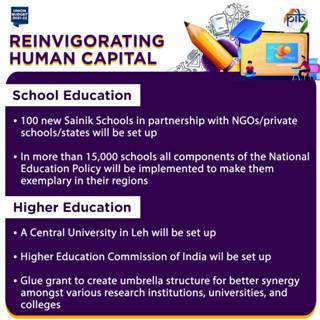
1.   Higher Education Commission of India (HECI) -an Umbrella Body, which will have 4 verticals- Accreditation, Standard Setting, Regulation, and Funding. Legislation for HECI will be introduced this year.


2.   In 9 cities where there are number of institutions supported by the GoI (like- Hyderabad etc.) we will create a formal umbrella structure– for better synergy, while retaining their internal autonomy.


3.   A new Central University(CU) will be set up in Leh.


4.   We will realign the existing scheme of National Apprenticeship Training Scheme (NATS) for providing post-education apprenticeship, training of graduates and diploma holders in Engineering. Over Rs. 3,000 crores will be provided for this in next 5 years.


5.   For promotion of Innovation and R&D, an outlay of Rs. 50,000 Cr over next 5 years has been kept for National Research Foundation (NRF). Its major beneficiaries will be Higher Education Institutions including CFTIs like- IITs/IISc/IISERs/NITs etc.

Highlights of Budget 2021-22 – Department of School Education & Literacy

 1.        Budget allocation for BE 2020-21 was Rs 59845 crore which was rationalized to Rs 52189.07 crore in RE 2020-21 post covid-19 situation. This has now increased to Rs 54873 crore in BE2021-22.

 2.        There has been an overall increase of Rs. 2684.59 crore (5.14%) in Budget allocation of Department of School Education & Literacy in BE 2021-22 from RE 2020-21.

 3.        The overall Budget allocation in BE 2021-22 is Rs. 54873.66 crore out of which scheme allocation is 43648.66 crore and non-scheme allocation is Rs. 11225.00 crore. The scheme allocation has been increased by Rs 1895.08 crore and non-scheme allocation by Rs. 789.51 crore as compared to RE 2020-21.

 4.        Budget allocation in the Flagship scheme of SamagraShikhsa has been increased to Rs. 31050.16 crore in BE 2021-22 from Rs. 27957.32 crore in RE 2020-21 by Rs. 3092.84 crore i.e. increased by 11.06% in comparison to RE 2020-21).

 5.        The budget allocation in PadhnaLikhnaAbhiyan (PLA) is also increased from Rs. 95.25 crore (RE 2020-21) to Rs. 250 crore in BE 2021-22 (an increase of Rs. 154.75 crore) i.e. by 162.47%.

 6.        Rs. 485 crore is also provisioned in the new created Centrally Sponsored Scheme of STARS.

 7.        Allocation of KVS is increased by Rs 362.32 crore and allocation of NVS increased to Rs. 320 crore w.r.t. RE 2020-21. Budget allocation of NCERT was also increase to Rs. 110.08 crore from RE 2020-21.

Initiatives on Education as part of NEP

·     Standards will be developed for all school teachers in the form of National Professional Standards for Teachers- NPST.  This will enhance the capabilities of teachers and will be followed by all 92 lakh teachers of public and private school system in the country.

·     Toys are both an expression of entertainment and learning.  A unique indigenous toy-based learning – pedagogy for all levels of school education will be developed.  This will transform classroom transactions from mundane and rote learning to an engaging and joyful experience.

·     A National Digital Educational Architecture (NDEAR) will be set up within the context of a Digital First Mindset where the Digital Architecture will not only support teaching and learning activities but also educational planning, governance and administrative activities of the Centre and the States/ Union Territories.  It will provide a diverse education eco-system architecture for development of digital infrastructure, a federated but inter operable system that will ensure autonomy of all stakeholders, specially States and UTs.

·     For children with hearing impairments, the Government will work on standardization of Indian Sign language across the country, and develop National and State Curriculum materials for use by them.

·     There are a number of senior and retired teachers.  They will be used for individual mentoring of school teachers and educators through constant online/offline support on subjects, themes and pedagogy.

·     Students have so far been evaluated on uni-dimensional parameters.  There will be a complete shift from using assessments to not only judge the cognitive levels of the learner but also using it as an opportunity to identify the unique strengths and the potential of the child. To this effect, a holistic progress card is envisaged to provide students with valuable information on their strengths, areas of interest, needed areas of focus and thereby helping them in making optimal career choices. 

·     To enable increased access of resources, online modules covering the entire gamut of adult education will be introduced.

·     During the year, despite the COVID-19 pandemic, we have trained more than 30 lakh elementary school teachers digitally, covering the whole gamut of education.   Taking this further, in 2021-22, we will enable the training of 56 lakh school teachers through the National Initiative for School Heads and Teachers for Holistic Advancement (NISTHA).

·     For the past few years our Prime Minister has been engaging with students every year before their Board Exams to help them overcome anxiety and stress.  In this direction, we will introduce CBSE Board Exam reforms in a phased manner to be effective from the 2022-23 academic session.  Exams will move away from rote-learning and students shall be tested on their conceptual clarity, analytical skills and application of knowledge to real life situations.

·     To promote enhanced academic collaboration with foreign higher educational institutions, it is proposed to put in place a regulatory mechanism to permit dual degrees, joint degrees, twinning arrangements and other such mechanisms.

*****

NEP to revolutionize the educational sector in India

 Union Minister of Education Shri Dharmendra Pradhan conferred AICTE- Visvesvaraya Best Teacher Award to 17 faculty members in Engineering and Technology whereas 3 faculty members were awarded the AICTE-Dr. Pritam Singh Best Teacher Award in Management Education. He also conferred Chhatra Vishwakarma Award Clean and Smart Campus Award, 2020 to the winners today.


Minister of State for Education, Dr. Rajkumar Ranjan Singh also graced the occasion. Secretary, Higher Education Shri Amit Khare; Chairman, AICTE, Prof. Anil D Sahasrabudhe, Vice Chairman, AICTE, Prof. MP Poonia and Member Secretary, AICTE Prof. Rajive Kumar also complimented the awardees during the event and highlighted the importance of teachers in nation building.

Speaking on the occasion, Union Minister said that as we complete 75 Years of Independence, the citizens finally have the will to shape India. He stated that the new National Education Policy is expected to revolutionize the educational sector in India and lay the path for the next 25 years as per the Vision 2047 of Prime Minister Shri Narendra Modi. He stressed that the education has to make each one of us more responsible and become Global Citizen. The Minister congratulated AICTE for instituting these 4 awards. Apart from recognizing the efforts of the Teachers, these awards have also brought the spark for innovation, he said.

Shri Pradhan said that the aim of AICTE Visvesvaraya awards is to honour meritorious faculties and encourage them to update themselves to the ever changing needs of higher education at global level and thereby becoming an effective contributor to the knowledge society. Dr. Pritam Singh Best Teacher Award introduced this year only and is conferred on the faculty members for demonstrating teaching excellence and institutional leadership in management education, he added.

Shri Pradhan highlighted that Chhatra Vishwakarma Award provides a platform for our students to look at the societal challenges, with an aim to provide innovative and low-cost solutions. This year again, the council announced the Chhatra Vishwakarma Award 2020, with the theme of “INDIA’S ECONOMIC RECOVERY POST COVID: Reverse migration and rehabilitation plan to support “Atmanirbhar Bharat”. The Minister informed that 24 teams of students who developed very useful and creative solutions for various socio-economic issues have been awarded. The zeal, enthusiasm, innovativeness and hard work of these students will make India a focal point to generate innovative ideas in the near future, he added.

The Minister interacted with all the awardees and appreciated their contribution to the society. While visiting the displayed projects of students, he admired the innovativeness and efforts of winning teams of Chhatra Vishwakarma Award and expressed confidence in India’s bright future. 

Minister of State for Education, Dr. Rajkumar Ranjan Singh motivated the students & all other stakeholders. He encouraged them to enhance their respective activities so that tangible social outcomes are achieved.

Clean and Smart Campus Award, 2020 has also been conferred to selected technical institutes. The award aims to seek engagement with all stakeholders, primarily the student community, to draw their attention towards the immense scope and potential that the technology offers on abstract objectives such as cleanliness, sustainability and environment etc. in line with Swachh Bharat Abhiyan. Winning institutions have displayed great concern and commitment for the environment. All institutions must align their activities with sustainable, clean, and green environmental Policy.

How artificial intelligence is transforming the future of digital marketing

From smart search options and personalized messaging to being used in campaigns and marketing, AI and machine learning are increasingly being used in digital marketing.

Digital marketing relies on leveraging insights from the copious amounts of data that gets created every time a customer interacts with a digital asset. Algorithms optimize various factors and data points that influence digital marketing success.
In 2020, we anticipate a significant uptick in the mainstreaming of AI and machine learning use cases in digital marketing across several areas. 

Search will get very smart

In the past year, online search has had several AI and machine learning developments. Google is leading the pack with exciting applications in information retrieval. For example, Google’s BERT technology can process a word in the context of all the other terms in a sentence, rather than one-by-one in order. BERT also enables anyone to train their own state-of-the-art question answering system.  

Customization of search results and the results page based on learning from past interactions and preferences of a user is another application of machine learning used in search.

AI-driven personalization of messaging 

Several attach companies have been focusing on using AI and machine learning to find the right audience to write better ads than humans, and to increase conversion rates and engagement with the target audience. There are also several AI-led developments in the area of creating dynamic ads and landing pages to personalize marketing messages on the fly. 

AI has an application in content creation in terms of determining the logic of personalization as also crating content specific to an individual, using techniques such as natural language generation (NLG).

Use of machine learning in campaign operations 

Platforms such as Google and Face book have been at the forefront of AI/ML applications in marketing. Starting from smart bidding and smart campaigns to auto-generated ads, Google is making it easy for advertisers.

Smart bidding options such as TROAS, TCPA, and others use advanced machine learning algorithms to train on data at a vast scale to make accurate predictions about how different bid amounts might impact conversion or conversion value and assist advertisers in optimizing without getting into too many details. 

Google factors in a wide range of contextual signals (through search data) to predict user behavior and to influence auction time bidding as per the goal set by advertisers. Facebook has also incorporated machine learning across campaign planning and execution, as also in ad placements and ad delivery.

Similarly, on the organic search side, machine learning-based product ALPS reverse engineers Google’s ranking algorithm, and is able to accurately quantify ranking drivers, provide precise recommendations for changes, and predicts the impact of SEO actions before they are implemented.

Similar technology to drive improved ad copy testing in digital marketing exists. These help in evaluating ad copies and landing pages on various parameters like relevancy, use of action promoters/inhibitors, urgency inducers, page layout, load times, etc., to gauge the impact on ad relevance, expected CTR, and landing page experience. 

Future trends 

AI will also have additional application in digital marketing with the uptick in the adoption of technologies such as VR and AR, as commercial use cases of these technologies find wider adoption in retail and other sectors.

Many retailers are also testing AI and VR/AR technologies together to make the user experience personalized to an individual.

Other areas of impact include voice search. We will increasingly see ads about things which we just said or talked about, but haven’t searched for yet. Similarly, image search is also being used by many brands for their consumers to match patterns and identify products using image search. 

The coming years will continue to unfold newer potential uses of AI in digital marketing.

NEED OF FINANCIAL SUPPORT OF GOVERNMENT TO EDUCATION SECTOR

COVID-19 has halted all the productive sectors of economy resulting in financial imbalance. However, a unique sector that has emotions of our kids attached to it is their school, where they prepare themselves for the future. The teachers too have been forced to stay away from the school due to COVID-19 outbreak.

We have been hearing that government is providing some financial relief to certain sector. However, there is a necessity to provide some relief to the education sector too. Many educational institutes have taken loan to cater for variety of courses of instructions. The teachers of private and public educational institutes require support of the government, so that they can survive this tough phase. All the educational institutes and the staff working there needs to be supported financially for the time being.

We should ensure a respectful and dignified life for the teachers and support them to be stable and stay cheerful so that they develop the patience required to conduct the online classes for a longer period. A committee of educationist can be set up to look in to the concept of providing insurance cover against the Coronavirus to the school staff and the students. The government can include the public and private education sector in the list of sectors requiring economical support. Education sector has suffered financially and emotionally too.

A minimum financial help can be provided to all the teachers belonging to private sector on priority as it is a fact that they have not received their salaries since lock down was imposed from the month of March 2020.The plight of private school teachers has increased as these schools are totally dependent on fees from the parents.The management running the schools can support the teachers and hold their hands during this period of financial and health related crisis caused due to spread of Coronavirus.

The policies to hire and retain the teachers needs to be strengthened and redefined in the light of certain evil practices of hiring that are in vogue and have been in practiced. Such practices go unchecked specifically in the private hiring of the teachers. Hiring agencies are providing teachers to educational institutes at times overlooking all the laid down rules by the government. Though the efforts of private schools is commendable in contributing positively towards the growth of the students and in turn that of the society, certain scope of improvement in terms of treating teachers with respect exists. As a onetime special case some financial support can definitely be extended to the teachers so that they can support themselves during this uncertain lock downs due to COVID-19 spread.

A complete redefining of education sector can be done and many issues or evil practices that have intruded the system can be resolved and a new energy can be given to education sector for its revival. All the stakeholders need to accept the change for the betterment of students. The government has a greater role to play in this scenario and should come up with flexible policies for the revival of the education industry that can include granting subsidy to the educational institutes and extending some financial help to the teachers. The risk of COVID-19 is still there in the environment. We all have to treat this situation as an opportunity to learn.
