Top Universities in Madhya Pradesh

 Madhya Pradesh is home to several esteemed universities known for their academic excellence, research contributions, and diverse range of programs. Here are some of the top universities in the state:

  1. Indian Institute of Technology (IIT) Indore: A premier engineering and technology institute known for its research-oriented approach and strong academic programs in engineering, sciences, and humanities.

  2. Maulana Azad National Institute of Technology (MANIT), Bhopal: A top engineering institute offering undergraduate, postgraduate, and doctoral programs in engineering, technology, and management.

  3. Rajiv Gandhi Proudyogiki Vishwavidyalaya (RGPV), Bhopal: A leading technical university in Madhya Pradesh, affiliating many engineering colleges and offering programs in engineering, technology, and applied sciences.

  4. Devi Ahilya Vishwavidyalaya (DAVV), Indore: One of the oldest and most respected universities in the state, offering a wide range of programs in arts, science, commerce, law, and management.

  5. Barkatullah University, Bhopal: A well-known university offering diverse programs in arts, science, commerce, law, and management, with a strong focus on research and development.

  6. Jiwaji University, Gwalior: Offers a variety of undergraduate, postgraduate, and doctoral programs in arts, science, commerce, and social sciences, and is known for its academic and research contributions.

  7. Madhya Pradesh Bhoj Open University, Bhopal: Specializes in distance education, providing flexible learning opportunities across various disciplines.

  8. Atal Bihari Vajpayee Indian Institute of Information Technology and Management (ABV-IIITM), Gwalior: A premier institute focusing on information technology and management education, with a strong emphasis on research and innovation.

  9. Makhanlal Chaturvedi National University of Journalism and Communication, Bhopal: A specialized university offering programs in journalism, mass communication, and media studies.

  10. Dr. Harisingh Gour University, Sagar: One of the oldest universities in Madhya Pradesh, known for its comprehensive programs in arts, science, commerce, law, and education.

These universities are well-regarded for their academic programs, research output, and contributions to higher education in Madhya Pradesh.

Top Universities in Karnataka

 Karnataka is home to some of India’s most prestigious universities, known for their academic excellence, research output, and innovative programs. Here are the top universities in Karnataka:

  1. Indian Institute of Science (IISc), Bangalore: One of India’s premier research institutions, renowned globally for its contributions to science, engineering, and research.

  2. National Institute of Technology Karnataka (NITK), Surathkal: A top engineering institute known for its strong academic programs and research in engineering, technology, and sciences.

  3. University of Mysore, Mysore: One of the oldest universities in India, offering a wide range of undergraduate, postgraduate, and doctoral programs in arts, sciences, commerce, and social sciences.

  4. Visvesvaraya Technological University (VTU), Belgaum: A leading technical university that affiliates engineering colleges across Karnataka and offers programs in engineering, technology, and management.

  5. Manipal Academy of Higher Education (MAHE), Manipal: A prominent private university known for its programs in medicine, engineering, management, and humanities, with a strong focus on research and international collaborations.

  6. Christ University, Bangalore: A well-regarded private university offering diverse programs in arts, science, commerce, law, and management, known for its holistic approach to education.

  7. Bangalore University, Bangalore: A major public university offering a wide range of programs in arts, science, commerce, law, and management, with a strong emphasis on research and community engagement.

  8. Jain University, Bangalore: A leading private university known for its programs in engineering, management, humanities, and sports, with a focus on entrepreneurship and innovation.

  9. Karnataka State Law University (KSLU), Hubli: A specialized university focused on legal education, offering undergraduate and postgraduate law programs.

  10. Jawaharlal Nehru Centre for Advanced Scientific Research (JNCASR), Bangalore: A multidisciplinary research institution known for its advanced research in science and engineering.

These universities are recognized for their academic rigor, research contributions, and strong industry connections, making them top choices for students in Karnataka and beyond.

Top Universities in Tamil Nadu

 Tamil Nadu is home to several prestigious universities known for their quality education and research. Here are some of the top universities in the state:

  1. Indian Institute of Technology Madras (IIT Madras), Chennai: One of the premier engineering institutions in India, known for its cutting-edge research and top-ranked programs in engineering, technology, and sciences.

  2. Anna University, Chennai: A renowned technical university that offers a wide range of undergraduate and postgraduate programs, particularly in engineering, technology, and applied sciences.

  3. University of Madras, Chennai: One of the oldest universities in India, offering diverse programs in arts, sciences, commerce, and management.

  4. Vellore Institute of Technology (VIT), Vellore: A highly reputed private university known for its engineering, technology, and management programs, with a strong emphasis on research and innovation.

  5. Amrita Vishwa Vidyapeetham, Coimbatore: A top-ranked private university with campuses across India, offering programs in engineering, medicine, arts, sciences, and social sciences.

  6. Tamil Nadu Agricultural University (TNAU), Coimbatore: A premier university focused on agricultural education, research, and extension services.

  7. SRM Institute of Science and Technology (SRMIST), Chennai: A leading private university offering a wide range of programs in engineering, medicine, management, and humanities.

  8. Bharathiar University, Coimbatore: Known for its programs in arts, science, commerce, management, and social sciences, with a focus on research and innovation.

  9. Sastra University, Thanjavur: A well-regarded private university offering programs in engineering, management, law, and humanities.

  10. Annamalai University, Chidambaram: A public university offering a wide array of programs in arts, science, engineering, agriculture, and medicine.

These universities are known for their academic excellence, research contributions, and strong alumni networks.

Unlocking Potential: The Power of Education

Education is the cornerstone of personal, social, and economic development. It empowers individuals, fosters growth, and transforms lives. In today’s rapidly changing world, the importance of education cannot be overstated.
Benefits of Education:
1. _Personal Growth_: Education helps individuals develop critical thinking, problem-solving, and communication skills, leading to increased confidence and self-awareness.
2. _Economic Opportunities_: Education opens doors to better job prospects, higher earning potential, and economic mobility.
3. _Social Mobility_: Education bridges the gap between social classes, promoting equality and social justice.
4. _Innovation and Progress_: Education drives innovation, creativity, and technological advancements, propelling societies forward.
5. _Improved Health and Well-being_: Education leads to better health outcomes, reduced poverty, and increased life expectancy.
6. _Empowerment and Autonomy_: Education enables individuals to make informed decisions, take control of their lives, and participate in their communities.
7. _Social Cohesion and Understanding_: Education promotes tolerance, empathy, and global citizenship, fostering a more harmonious and interconnected world.
Investing in Education:
1. _Individual Investment_: Prioritize education for personal growth and development.
2. _Societal Investment_: Governments and organizations must allocate resources to support education infrastructure, teachers, and programs.
3. _Global Investment_: International cooperation and funding can bridge educational gaps and promote global progress.
Conclusion:
Education is the key to unlocking human potential, driving progress, and creating a better world. By recognizing its importance and investing in education, we can empower individuals, transform communities, and shape a brighter future for all.

Excellence in Education: Top Universities in Africa

Africa is home to some of the world’s most prestigious and renowned universities, offering high-quality education and research opportunities. Here are some of the top universities in Africa:
1. University of Cape Town (South Africa) – Ranked in Africa, known for its academic excellence and research output.
2. University of the Witwatersrand (South Africa) – A leading research university, recognized for its contributions to science, technology, and the humanities.
3. University of Pretoria (South Africa) – A top-ranked university, offering a wide range of academic programs and research opportunities.
4. University of Nairobi (Kenya) – A premier institution in East Africa, known for its strong programs in technology, engineering, and agriculture.
5. University of Ghana (Ghana) – A leading university in West Africa, recognized for its academic excellence and research output.
6. Cairo University (Egypt) – A prestigious institution in North Africa, offering a wide range of academic programs and research opportunities.
7. University of Dar es Salaam (Tanzania) – A top-ranked university in East Africa, known for its strong programs in science, technology, and the humanities.
8. Stellenbosch University (South Africa) – A leading research university, recognized for its contributions to science, technology, and the humanities.
9. University of Ibadan (Nigeria) – A premier institution in West Africa, known for its academic excellence and research output.
10. Addis Ababa University (Ethiopia) – A leading university in East Africa, recognized for its strong programs in science, technology, and the humanities.
These top universities in Africa offer world-class education, cutting-edge research opportunities, and a platform for students to excel and make a positive impact on the continent and globally.

Empowering African Learners: 10 Popular Online Education Sites

Introduction
Africa’s education landscape is transforming, and online learning is at the forefront. With the continent’s growing internet penetration and mobile adoption, online education platforms are bridging the knowledge gap and expanding access to quality learning resources. Here are 10 popular online education sites in Africa:
1. _Coursera_: Partners with top universities to offer courses and degree programs.
2. _edX_: Provides massive open online courses (MOOCs) from leading institutions.
3. _Udemy_: Offers a vast array of courses on various subjects, including business, tech, and creative skills.
4. _Khan Academy_: Free online resources for subjects like math, science, and programming.
5. _OpenLearn_: The Open University’s platform for free online courses and degree programs.
6. _FutureLearn_: UK-based platform offering courses from top universities worldwide.
7. _Eneza Education_: Kenyan-based platform providing interactive learning materials and assessments.
8. _Andela Learning_: Nigerian-based platform offering courses and mentorship in tech skills.
9. _Tuteria_: Nigerian-based platform connecting learners with qualified tutors for online lessons.
10. _Varsity Tutor_: South African-based platform providing online tutoring and academic support.
Conclusion
These online education sites are revolutionizing learning in Africa, providing accessible, affordable, and quality educational resources. As internet access continues to grow, online education will play an increasingly vital role in empowering African learners and bridging the skills gap.

Overview of the National Education Policy 2020

The National Education Policy 2020 (NEP 2020) is a comprehensive framework for transforming India’s education system by 2030 ¹. It replaces the previous National Policy on Education, 1986, and aims to increase state expenditure on education from around 3% to 6% of the GDP ¹.
*Key Features of the National Education Policy 2020*
– *Language Policy*: The policy emphasizes the use of the mother tongue as the medium of instruction till Class 5, with the option to continue till Class 8 and beyond ¹. It also recommends the study of three languages, with at least two being native to India ¹.
– *School Education*: The policy focuses on achieving universal foundational literacy and numeracy by 2025 ¹. It proposes a new structure of 5+3+3+4, replacing the existing 10+2 structure ¹. Board exams will be re-designed, and students will have the option to take exams twice a year ¹.
– *Higher Education*: The policy proposes a 4-year multi-disciplinary bachelor’s degree with multiple exit options ¹. It also aims to increase the gross enrollment ratio and proposes the establishment of a Higher Education Commission of India (HECI) ¹.
– *Internationalization*: The policy allows foreign universities to set up campuses in India and proposes the internationalization of education ¹.
– *Teachers*: The policy emphasizes the importance of teachers and proposes a 4-year Bachelor of Education as the minimum requirement to become a teacher by 2030 ¹.
– *EdTech*: The policy provides guidelines and support for EdTech companies and startups to develop learning management systems and other educational technologies ¹.
*Reception of the National Education Policy 2020*
The policy has received both praise and criticism from various stakeholders ¹. Some have appreciated the policy’s focus on foundational literacy and numeracy, while others have raised concerns about the implementation and potential commercialization of education ¹.

4th anniversary of National Education Policy 2020 with Akhil Bhartiya Shiksha Samagam 2024

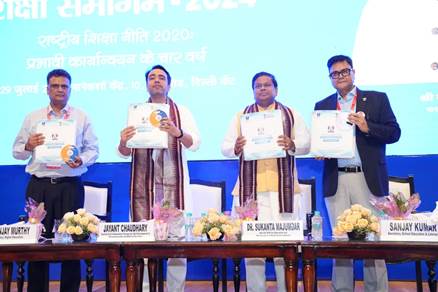
 The Ministry of Education celebrated the 4th anniversary of the implementation of the National Education Policy 2020 with Akhil Bhartiya Shiksha Samagam 2024 in New Delhi’s Manekshaw Centre Auditorium today. Minister of State for Education & Minister of State (IC), Ministry of Skill Development & Entrepreneurship Shri Jayant Chaudhary and Minister of State for Education & Development of North Eastern Region, Dr. Sukanta Majumdar were present at the event. Shri K. Sanjay Murthy, Secretary, Department of Higher Education; Shri Sanjay Kumar, Secretary, Department of School Education & Literacy; academicians, Vice Chancellors of the universities, officials, and students, also attended the event.
Image

The Ministers launched several significant NEP 2020 initiatives of the Ministry of Education, such as Dedicated TV Channels to facilitate learning of various Indian languages, a Tamil Channel; Primers for early graders in 25 Indian languages in pursuance to 54 already done; 10 Bagless days Guidelines aimed to transform learning into a fun, stress-free experience in schools; Career Guidance Guidelines, a massive library of over 500 job cards; NMM (National Mission for Mentoring) and National Professional Standards for Teachers (NPST) in Braille and Audio Books; School Innovation Marathon by AICTE, NITI Aayog, and AIM; and a book on Graduation Attributes and Professional Competencies. They also unveiled four books and lecture notes aimed at promoting the Indian Knowledge Systems (IKS) among students and teachers.

Shri Dharmendra Pradhan, in his message, said that the four-year journey of NEP 2020 has been about bringing in transformative change in the country’s education system for nurturing a new generation of learners. NEP 2020 stands as a symbol of hope for transforming the learning landscape, harnessing the country’s demographic dividend, empowering the population and driving socio-economic development, he also mentioned. He said the implementation of NEP has made learning more vibrant and guided in making the country’s education more futuristic, rooted, global and outcome-oriented. Expressing his gratitude to Prime Minister Shri Narendra Modi, he reiterated his commitment to implement NEP in letter and spirit to make the country a 21st-century knowledge economy.

He also appreciated the musical performance of ‘Panch Pran’ by the students of Kendriya Vidyalaya Sangathan at the function, which was inspired by the vision of Prime Minister Shri Narendra Modi.

While addressing the audience Shri Jayant Chaudhary highlighted the immense impact of the teachers and the values and contributions they make in shaping the lives of their students. Reigns of the country truly lies in the hands of the teachers, he added. Farmers, scientists, and teachers are the three pillars of society who envision the nation’s future, he said. Shri Chaudhary also mentioned how, following the recommendations of the stakeholders of the education ecosystem, the forward-looking policy in the shape of the NEP 2020 was formulated. Breaking away from the legacy of the old system, it revolutionised the educational landscape and aligned it with the needs of the 21st century, he added.

Shri Chaudhary emphasised the importance of States as they are the important stakeholders .He appealed to them to be a partner in the journey with a collective effort and strategy that will benefit the entire education ecosystem involving students, teachers, administrators, and more. He also expressed his gratitude to Shri Dharmendra Pradhan for emphasising the future challenges and how they are to be mitigated. The benefit of the progressive, forward-looking and expansive NEP 2020 can be achieved only with its collective implementation, Shri Chaudhary added. Shri Chaudhary specifically mentioned the presentation on APAAR, which he termed as practical for highlighting not only the positive points but the challenges as well.

Dr. Sukanta Majumdar in his address expressed gratitude to Prime Minister Shri Narendra Modi for his farsighted and progressive ideas that shaped the NEP 2020 which embraces the ideal of education as a transformative journey for personal development, beyond making it just a means to obtain certificates. NEP 2020 includes India’s rich heritage, the synthesis of traditional knowledge with modern advancements, and the integration of value education with nation-building at its core, Dr. Majumdar said. He also said that the Akhil Bhartiya Shiksha Samagam, embodying the essence of “Vikas bhi Virasat bhi,” represents a unique participatory dialogue steered by stakeholders from every corner of the education sector. Dr. Majumdar also expressed his gratitude to Shri Dharmendra Pradhan for successfully spearheading the NEP 2020 for the last three years.

Commending the reformist agenda of the NEP 2020, Shri K. Sanjay Murthy highlighted on seamless integration of school and higher education through the APAAR platform. Presenting a vote of thanks Shri Sanjay Kumar informed how Prime Minister Shri Narendra Modi has mentioned NEP 2020 as the basis for radical change and urged everyone to take the recommendation of the Policy to the grassroots level. He also informed about the week-long campaign, “Shiksha Saptah” that was celebrated in schools all over the country.

Shri Govind Jaiswal, Joint Secretary, Ministry of Education, made a presentation on Credit accumulation and seamless creditization of all types of learning including skilling by using the Platform of APAAR ID.

Akhil Bharatiya Siksha Samagam (ABSS) has been conceptualized as an event to celebrate the adoption of National Education Policy 2020 to reinvigorate the commitment of various stakeholders for its effective implementation and to realize the collective strength for achievement of shared goals through collaborative efforts.

ABSS 2024 witnessed six thematic sessions on different themes & initiatives of NEP 2020 related to Schools and Higher Education. These are:


  1.  Importance of Sustainability in Education Curriculum, Job Prospects, Industry-Academia Collaboration

(ii) PM SHRI (School Education & Skilling)

  1.  Role of HEIs in promoting STEM & enhancing GER through Vidyashakti

(iv) Equivalence of Curriculum and Assessment across all School Boards

(v) Role of Ranking and Accreditation in Enhancing Quality

(vi) NCF-FS and NCF-SE Salient Features and Implementation Roadmap


The event was attended by State Education Secretaries, State Project Directors of Samagra Shiksha, SCERT Directors, State Directors of Primary Education and Secondary Education, Chairperson, State School Boards including CBSE, Head of Autonomous Bodies of DoSEL, Regional Officers of CBSE, KVS, NVS, Principals of DIETs and Schools, Students from KV, JNV, CBSE schools, VCs / Directors / Heads of HEIs – 80 from CFIs and 100 from State Universities, State Project Directors of RUSA, Officials of DoSEL, DoHE, MSDE, UGC, AICTE, NETF, NCVET, NIEPA, ICSSR, ICHR, Officials from other Ministries, Heads of CSO, Panelists for the Breakaway sessions etc.

******

States to work together for building a collaborative education system

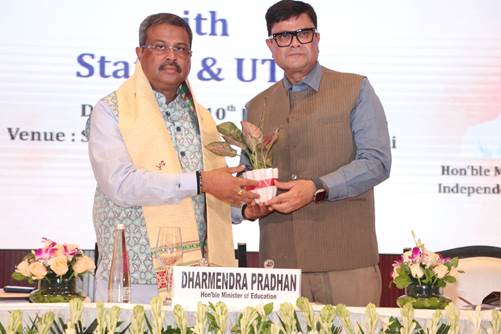
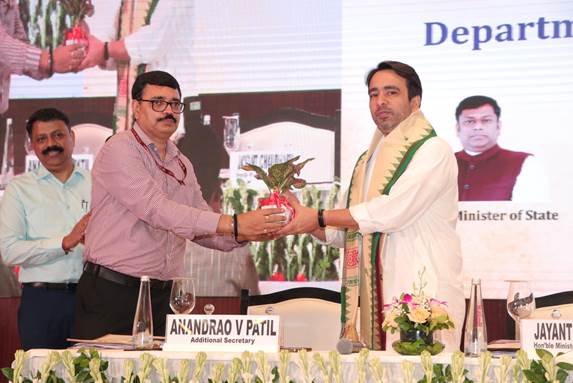
 Union Education Minister Shri Dharmendra Pradhan today addressed the inaugural session of review meeting of Department of School Education and Literacy with States and Union Territories. Minister of State for Education, Shri Jayant Chaudhary also addressed the gathering. Secretary, DoSE&L, Shri Sanjay Kumar; Additional Secretaries, Shri Vipin Kumar and Shri Anandrao V. Patil; other officials of the Ministry, Principal Secretary/Secretary and SPD/Directors of several States/UTs, heads and representatives of the NCERT, SCERTs, Kendriya Vidyalaya, Navodaya Vidyalaya, CBSE, etc. were also present at the meeting.

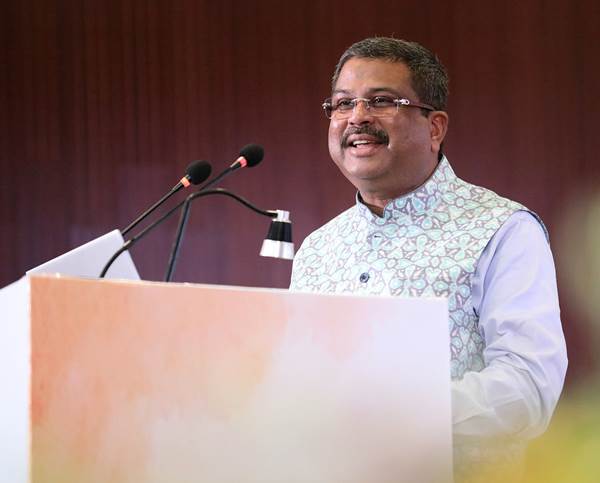
Speaking on the occasion, Shri Pradhan shared his thoughts on the roadmap for the next five years for the holistic development of school education across India. He said that education is a key pillar of the Prime Minister Shri Narendra Modi’s vision of Viksit Bharat and called upon States & UTs to work together to achieve this goal. In almost four years of National Education Policy, the education ecosystem in the country has made tremendous progress and implementation of NEP is key to transforming Bharat into a knowledge superpower and enabling equitable and inclusive access to quality education, he added.

Speaking about education in Indian languages, he said that the National Education Policy 2020 stresses upon the importance of education in mother tongue and all Indian languages. He called upon carrying forward the basic spirit of NEP i.e. ensuring Access, Equity, Quality, Affordability and Accountability in education.

He said that India is a young country and our challenge is to make global citizens for the 21st century world which is rapidly changing and being driven by technology. Ensuring an education system which is both rooted and futuristic  is our collective responsibility, he further added. He also stressed upon the importance of building technology readiness in schools with a holistic approach and ensuring critical thinking among students.

He urged that both States and Centre have to work as a team to strengthen the education ecosystem as well as to replicate and amplify best-practices from across all States/UTs. He called upon all stakeholders in States/UTs to work cohesively for strengthening capacities, building a collaborative education system and leveraging education as the key pillar of Viksit Bharat.

He also spoke about the emotional connect one shares with their school teachers and the importance of teachers’ capacity building in making our educational ecosystem more vibrant. Speaking about competency-based education, he said that we must also augment our skilling capacities to increase employability.

Speaking at the event Shri Jayant Chaudhary said that NEP 2020 is the most ambitious and progressive policy document. He also highlighted how improving GER and taking it to 100% is extremely important and students from the economically and socially backward, tribal communities must be included in the formal educational system. He also spoke about other ambitious programmes of the Ministry such as PM SHRI and invited states to be a part of the programme.

Shri Sanjay Kumar, in his address, mentioned that the main aim of the review meeting will be reviewing NEP 2020 and its implementation in the states and alignment of the flagship schemes of the Ministry such as the Samagra Siksha, PM SHRI, PM Poshan, ULLAS, etc. with the Policy, he added. He also said that the meeting will also help in developing the roadmap for the coming five years.

During the meeting, discussion will be held on the five-year action plan; 100 days action plan; on status of the progress of infrastructure and civil works, ICT and Smart classrooms under Samagra Shiksha for all States/UTs; discussion on the status/setting up of VSK & 200 channels; finalization of UDISE+ for 2023-24; Best Practices; discussion on DIET: upgradation as Centers of Excellence; and need for Tobacco Control and implantation of TOFEI guidelines in Schools.

******

Shri Jayant Chaudhary assumes charge as Minister of State for Ministry of Education

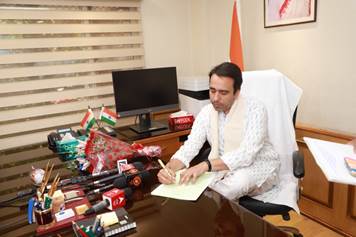
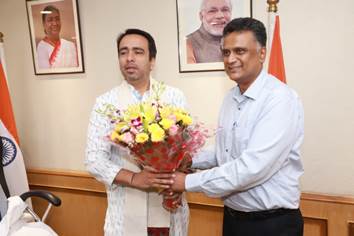
 Shri Jayant Chaudhary assumed charge as Minister of State for Education at Shastri Bhawan, New Delhi, today. On his arrival at the Ministry of Education, Shri Chaudhary was welcomed by the senior officials of the Ministry.


He expressed his gratitude to the Prime Minister Shri Narendra Modi for the trust placed in him and pledged his commitment to working diligently towards enhancing the education sector. Shri Chaudhary said that the government is committed to empower future generations. He also said that he was honored to have a role in the Ministry, which is driving the development and reforms of the key education sector.

Shri Jayant Chaudhary is an advocate for implementing programs and launches that integrate the deprived into the mainstream of development to ensure continued growth and development across sectors and the country at large.

He also brings with him a wealth of experience and a deep commitment to the welfare of the people. He was a member of the Standing Committee on Commerce, the Consultative Committee on Finance, the Indian Council of Agricultural Research (ICAR), and the Committee on Government Assurances. He has served previously on the Standing Committees on Agriculture and Finance as well as the Committee on Ethics.

Shri Jayant Chaudhary did his undergraduate studies at Shri Venkateswara College, Delhi University, and an M.Sc in Accounting and Finance from the London School of Economics and Political Science in 2002.

******

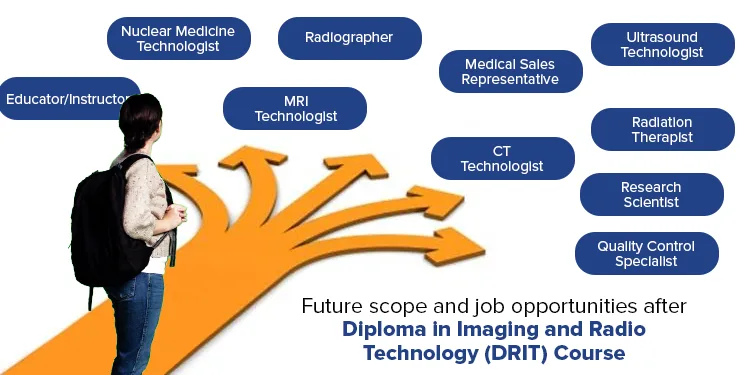
Future scope and job opportunities after Diploma in Imaging and Radio Technology (DRIT) course

Diploma in Imaging and Radio Technology (DRIT) course

Choosing a fascinating  career in Imaging and Radio Technology can open up so many opportunities in various fields of the healthcare sector. After this course you can also join as well as in research, academic, and various corporate industries.There are various Best paramedical colleges which provide best placement opportunities after the Diploma in Imaging and Radio Technology (DRIT) course.

After this diploma there are also job opportunities in the government sector too. You can join AIIMS, PGI, and other government hospitals and healthcare centres. You can also serve in various community centres and other district hospitals on attractive salary packages.

1.Radiographer: Radiographer famously known as radio technologists. After the DRIT course you can also become a Radiographer and it is one of the most demanding paramedical jobs in the medical sector. They are experts in handling various instruments in Radiology centres. They take out clear images of the patient’s body. They also control and ensure safety of patients while taking out images with dangerous rays coming out from machines which are very dangerous to the human body. They minimise the exposure of dangerous rays and patient body contact.

2. MRI Technologist: MRI technologists are the experts of operating magnetic resonance imaging (MRI) scanners. They create clear images of patients’ different body parts so the abnormalities inside the patient’s body could be identified and diagnosed with the proper medical treatment. MRI Technicians produce detailed images of mainly every internal structure in the human body like the organs, bones, muscles and blood vessels. With the help of these images Medical consultants identify the abnormality in the patient body to provide treatment. MRI technicians play a very important role in diagnosing various medical conditions of the patients.

3. CT Technologist: A CT technologist is mindful of helping patients and working hardware to perform radiologic exams. They plan and calibrate the CT filtering hardware. The technologist clarifies the preparation to the understanding, positions them for the check and makes a difference so they stay calm amid the method. After the strategy, the technologist assesses the picture closely to make beyond any doubt it’s clear.

In expansion to CT and CAT filters, a technologist may moreover perform ultrasounds, X-rays or mammograms, and they can run extra symptomatic tests.

4. Ultrasound Technologist: 

Ultrasound professionals are trained in creating images mainly called ultrasounds or sonograms. Sonography is done with the help of  high-frequency sound waves to create pictures of the human body’s organs and tissues. A sonographer is responsible for checking parts of your body with various equipment and  tries to create a clear image. In this process high sound waves are sent in the body and on behalf of their echoes the image formation is done by the Sonographer experts. The echoes shape a picture of the interior of your body on the sonographer’s computer screen.

5. Nuclear Medicine Technologist: A nuclear medicine technologist conducts nuclear imaging tests.He also assists doctors with making medical diagnoses of the patient. Under the supervision of physicians, they provide radioactive drugs, known as radiopharmaceuticals, to the patients. They also use imaging equipment to identify how radioactive elements respond and react with a patient’s organs and tissues. Physicians use the results of those tests to diagnose the disease and treat disease such as cancer.

6. Radiation Therapist: Radiation therapists provide radiation treatment to patients who are facing life-threatening conditions like cancer and other serious diseases. Providing medical knowledge with deep understanding of the equipment that are used to provide balanced radiation treatment, radiation therapists play a very important role in the treatment and supporting patients. They also provide mental support to the patient’s as they face a diagnosis that will likely be one of the most important events of their lives.

7. Research Scientist: DRIT graduates can pursue careers in medical research. Research scientists are one of the most responsible  and reputed job designations in the medical field. Research scientists are responsible for the investigation of various projects and identify the errors or other issues. They research, formulate, and at last execute the research that they have done. They are responsible and they conduct in-house research and presentations. Research scientists also perform laboratory-based experiments and trials and work in many fields of medical science. They plan and conduct various different experiments that become topics of research papers and reports. They collect samples and work out other types of field research and monitor their experiments by recording and analysing the data. 

8. Educator/Instructor: After completing you can study further and also become a teacher. By becoming a teacher you have a good opportunity to share your knowledge and experience with other aspiring candidates who are new in this field. Your experience and knowledge can embark on their future.

9. Medical Sales Representative: After the DRIT course you can work as a medical representative at any pharma company or medical instrument manufacturing company and promote the products.

10. Quality Control Specialist: Quality control specialists are the ones who work with various government and private imaging centres.  Quality control specialists confirm that imaging objects meet regulatory standards and perform well. Quality control specialists work for healthcare facilities, equipment manufacturers, diagnostic and imaging centres etc.

Responsibilities of Radiographers.

  • Has Clinical, Ethical, and legal responsibility, Performs Procedure in event of accident, radiographer and Patient.

  • Performs General Preliminaries to examination , patient on stretcher , Anaesthetizes Patient

  • Maintains Hygiene in X-Ray department 

  • Maintains Drugs in X-Ray department, Preparation of Patient Purgatives, Prevention of Intestine gas.

  • Checks Diabetic Patient, Infant, Mobile X-Ray set , Precaution in Patient.

This course provides you better knowledge and skills to work in all of the fields given above. There are various job opportunities in the government and private sector. These courses are available in various best paramedical colleges in delhi.  You can join this course and embark your career and secure your future.

Vice-President highlights India's historical eminence as the epicentre of knowledge and education

 The Vice-President, Shri Jagdeep Dhankhar today underscored India’s historical eminence as the epicentre of knowledge and education, and asserted that the country is firmly on its way to regain its past glory. Mentioning the illustrious legacy of institutions like Nalanda and Takshashila, Vice-President highlighted the paradigm shift & resurgence in India’s educational landscape in contemporary times.

Addressing the gathering at the 62nd Foundation Day Celebration of the School of Open Learning (SOL), University of Delhi, Vice-President applauded SOL for providing a transformative platform for diverse range of learners, from varied walks of life including working professionals, homemakers and students.

He further emphasized that SOL has opened doors for those previously handicapped by circumstances, enabling them to pursue education without disrupting their routine.  Shri Dhankhar commended SOL for offering a second chance to those who missed formal education earlier, empowering marginalized communities through knowledge and skills, thereby fostering an environment of true inclusivity. Shri Dhankhar further emphasized the pivotal role of faculty over infrastructure in shaping the essence and quality of educational institutions.

Highlighting Education as the most impactful transformational mechanism for change, Shri Dhankhar asserted that education is not merely a means to acquire knowledge; rather, it is the cornerstone of progress, empowerment, and social transformation. It is the key that unlocks the door to progress, prosperity, and empowerment. “Education is the greatest right and donation. There can be no fundamental right greater than education and no donation can be greater than education”, he added.

Drawing inspiration from the Chandrayaan journey where after initial setback it made a smooth landing on the south pole of the moon, Shri Dhankhar urged students to consider failure as a key to success. He underscored the need for a resilient mindset in navigating the complexities of the modern world.

Highlighting the pivotal role of The New Education Policy (NEP) in Indian Educational Landscape, Shri Dhankhar Stated that NEP heralds a transformative change, charting a roadmap for holistic learner development and creating a knowledgeable society equipped for the 21st century challenges. He underscored the emphasis of NEP on flexible learning pathways, technology integration, recognizing diverse needs and aspirations

He further expressed confidence that institutions like the School of Open Learning will play a pivotal role in expanding access to quality education and bridging long-standing gaps, as envisioned by NEP.

Prof. Yogesh Singh, Vice Chancellor, University of Delhi, Prof. Payal Mago, Director, Campus of Open learning, University of Delhi, faculty members, students and other dignitaries were present on the occasion.

*****

Value of ISBN for Conference Proceedings

Daily writing prompt
What are your favorite emojis?

The International Standard Book Number (ISBN) is a unique identifier for books, allowing for more efficient marketing and distribution. ISBNs are pivotal in the publishing world, extending their utility to the realm of academic and professional conferences. This article explores the significance of ISBNs for conference proceedings, emphasizing their role in cataloging, credibility, and accessibility.

Photo by Angelika Siafa on Pexels.com

What is an ISBN?

An ISBN is a numeric identifier that is unique to each edition and variation (except reprints) of a book or book-like resource. The ISBN system was developed to provide a universal, standardized method to identify and track books in the international marketplace (International ISBN Agency, 2017).

ISBN for Conference Proceedings

Conference proceedings compile the contributions of participants at conferences, workshops, and symposia, often serving as a detailed record of the presented work. The assignment of an ISBN to these proceedings consolidates several benefits:

  1. Standardization and Cataloging
    • ISBNs facilitate the standardization and systematic cataloging of conference proceedings in bookstores, libraries, and databases. This standardization ensures that each entry is recognized globally and can be accessed through international library systems.
    • As explained by the U.S. ISBN Agency (n.d.), each ISBN corresponds to a specific publisher, title, edition, and format, aiding in efficient data management and retrieval.
  2. Accessibility and Distribution
    • With an ISBN, conference proceedings can be distributed more broadly, reaching a global audience. This distribution is not limited to physical copies; digital versions also benefit from ISBNs, making them readily available through e-book retailers and digital libraries (Smith, 2015).
    • The ease of access provided by ISBNs helps in disseminating knowledge shared during conferences, thus extending the educational impact and fostering further academic and professional collaboration.
  3. Credibility and Recognition
    • Assigning an ISBN to conference proceedings lends credibility and a sense of legitimacy to the published work (Thompson, 2019). It signals that the content has passed certain publishing standards and is worthy of public and academic recognition.
    • This credibility is crucial for researchers and professionals who cite these proceedings in further studies or use them as references, ensuring that their sources are reliable.
  4. Archival Value
    • ISBNs help in the archival process of conference proceedings, making them easier to catalog and store in academic archives and libraries. This archival is essential for historical documentation and longitudinal studies, providing a traceable record of academic progress and discourse over time (Johnson & Wilmington, 2018).
  5. Ease of Citation
    • For academic work, ease of citation is imperative. ISBNs provide a straightforward way to reference conference proceedings, which is essential for authors who need to cite these sources in subsequent publications (Davis, 2021).
    • Standard bibliographic details associated with ISBNs facilitate correct and consistent citations across various fields and publications.

Conclusion

The use of ISBNs for conference proceedings is more than a mere administrative formality; it is a strategic approach to enhancing the visibility, accessibility, and impact of scholarly work. By providing a standardized system for identification, ISBNs not only aid in the effective distribution and cataloging of academic materials but also enhance their credibility and archival quality. As the academic community continues to globalize, the importance of such standardization only grows, underlining the critical role of ISBNs in scholarly communication.

References

  • International ISBN Agency. (2017). ISBN Users’ Manual – International edition (7th ed.). Retrieved from [https://www.isbn-international.org/content/isbn-users-manual]
  • U.S. ISBN Agency. (n.d.). What is an ISBN? Retrieved from [https://www.isbn.org/what-is-an-isbn]
  • Smith, J. (2015). Digital distribution of academic journals and its impact on scholarly communication. Journal of Academic Publishing, 6(3), 95-112.
  • Thompson, R. (2019). The role of ISBNs in the promotion of academic knowledge. University of California Press.
  • Johnson, L., & Wilmington, S. (2018). Archiving and academic success: The role of digital repositories in preserving conference proceedings. Journal of Library Science, 44(2), 158-174.
  • Davis, M. (2021). Effective referencing of conference proceedings in academic papers. Journal of Academic Research, 11(1), 134-150.

Importance of Girl Education

Title: The Power of Guest Posting: Unlocking Benefits for Your Online Presence

Are you looking to expand your online reach, build credibility, and drive traffic to your website? Guest posting is a proven strategy that can help you achieve these goals and more. In this article, we’ll explore the benefits of guest posting and how it can elevate your online presence.
1. *Increased Exposure*: Guest posting allows you to tap into new audiences and expand your online footprint. By publishing your content on other reputable websites, you can reach a broader audience and gain visibility for your brand.
2. *Backlinks and SEO*: Guest posting provides high-quality backlinks to your website, which are essential for search engine optimization (SEO). This helps improve your website’s ranking and increases your online credibility.
3. *Establish Authority and Credibility*: Guest posting enables you to demonstrate your expertise and showcase your knowledge in your industry. This helps establish you as an authority and builds trust with potential customers.
4. *Networking Opportunities*: Guest posting opens doors to new relationships and networking opportunities. You can connect with influencers, industry leaders, and like-minded individuals, potentially leading to collaborations and new business opportunities.
5. *Content Diversity and Fresh Perspectives*: Guest posting allows you to share your unique voice and perspective on various platforms, adding diversity to your content and keeping your audience engaged.
6. *Referral Traffic*: Guest posting can drive targeted referral traffic to your website, increasing the chances of converting visitors into customers.
7. *Brand Awareness*: By consistently guest posting, you can reinforce your brand message and values, solidifying your online identity.
8. *Improved Writing Skills*: Guest posting challenges you to adapt to different writing styles and formats, honing your writing skills and versatility.
9. *Access to New Resources*: Guest posting can grant you access to exclusive resources, such as research data or expert insights, that can enhance your content and knowledge.
10. *Long-Term Results*: The benefits of guest posting can persist long after publication, as your content remains visible and continues to drive traffic and credibility to your brand.
In conclusion, guest posting is a powerful strategy for expanding your online presence, building credibility, and driving traffic to your website. By leveraging these benefits, you can elevate your brand and establish yourself as an authority in your industry. Start exploring guest posting opportunities today and watch your online presence thrive!

Nurturing Bonds: Exploring Family and Social Structures

Daily writing prompt
Describe a positive thing a family member has done for you.

Family and social structures serve as the cornerstone of human society, providing support, guidance, and a sense of belonging. These intricate webs of relationships shape our identities, influence our behaviors, and contribute significantly to our overall well-being. Understanding the dynamics of family and social structures offers insights into the fabric of society and the mechanisms through which individuals interact and thrive.

Photo by Emma Bauso on Pexels.com

The Importance of Family: Family, in its various forms, plays a pivotal role in shaping individuals from early childhood through adulthood. The nuclear family, consisting of parents and their children, forms the basic unit of society. Within this unit, familial bonds are nurtured, values are transmitted, and emotional support is provided. Beyond the nuclear family, extended families, comprising relatives such as grandparents, aunts, uncles, and cousins, offer additional layers of support and interconnectedness.

The family serves as a primary agent of socialization, imparting cultural norms, values, and traditions to its members. Through interactions within the family unit, individuals learn essential life skills, develop their identities, and acquire social roles. Moreover, the family provides emotional security and serves as a buffer against the stresses of life, fostering resilience and cohesion.

Variations in family structures exist across cultures and societies, reflecting diverse norms, beliefs, and practices. While some societies emphasize extended family networks and communal living arrangements, others prioritize nuclear family units and individual autonomy. These variations underscore the adaptive nature of family structures in response to socio-cultural contexts and economic realities.

Challenges and Transformations: Despite its significance, the traditional notion of the family has undergone considerable transformation in recent decades. Socioeconomic changes, such as urbanization, globalization, and economic disparities, have reshaped family dynamics and roles. Factors such as increased mobility, dual-career households, and shifting gender norms have altered traditional family patterns, leading to greater diversity in family structures and functions.

Challenges such as family breakdown, divorce, and single-parent households highlight the complexities inherent in contemporary family life. While these changes may pose challenges, they also offer opportunities for redefining family roles, fostering inclusivity, and promoting resilience. Moreover, alternative family arrangements, including blended families, same-sex partnerships, and chosen families, challenge conventional norms and expand the notion of kinship and support networks.

Social Structures and Community: Beyond the family unit, social structures encompass broader networks of relationships and affiliations within society. These structures include friendships, community organizations, religious institutions, and professional networks, among others. Social structures provide avenues for social interaction, cooperation, and collective action, contributing to social cohesion and mutual support.

Communities serve as essential extensions of the family, offering additional layers of social support and belonging. Within communities, individuals forge connections, share resources, and collaborate on shared goals and interests. Moreover, communities play a vital role in fostering social capital, promoting civic engagement, and addressing collective challenges such as poverty, inequality, and social injustice.

Conclusion: Family and social structures form the scaffolding of human society, shaping our identities, relationships, and experiences. From the intimate bonds of the family unit to the broader networks of community and society, these structures provide the foundation for individual growth, collective well-being, and societal resilience. As society continues to evolve, understanding and nurturing these bonds are essential for fostering inclusive, thriving communities where all individuals can flourish.