To_The Second-Person-You

To

 The Second-Person

  You

For you; Always be you!

                And if I say,

                I’m there for you;

                Indefinitely,

               it is an add-on to be more you.

               You check,you rely,you observe 

               and you test me too; 

              That is all I allow only for you!..

For you;I’m being for real as always I amuse to be!

              I trust, i tease,

              I tweet on your treat;

              Infinitely it gonna be, 

             Hence,

           you mean a lot to me since you met!…

       From   

                                                                                        Yours you

Note: Written and expressed by Ghufrana but neither only by her and nor only for specific one.

Rights that Indian women should be aware of:

  Regarding rights in the modern era, every Indian woman needs to be aware of a few legal rights. There are plenty of laws protecting women in India. For the protection and advancement of women, our constitution grants them exclusive rights.

Indian women rights history:

During the early Vedic era, women and men were treated equally in all aspects of their lives. Women may have received an education during the early Vedic era, according to the writings of ancient Indian grammarians like Patanjali and Katyayana. In a practise known as swayamvar or a live-in relationship known as Gandharva marriage, Rigvedic verses imply that women married at an advanced age and were likely free to choose their own husbands.

The modern laws to look in today’s world are:

Right to maintenance

As long as she doesn’t remarry, a married woman is entitled to get maintenance from her ex-husband, which includes the necessities of life like food, clothing, shelter, and access to healthcare. Except when the wife is living in adultery or refuses to live with her husband without a good reason, Section 125 of the Code of Criminal Procedure, 1973, requires the husband to support his divorced wife.

Right to equal pay

Our laws are now gender-neutral. Equal remuneration for equal work is due to both men and women. The same is provided for by the Equal Remuneration Act. It guarantees equal pay for equal work for both male and female employees. There won’t be any gender discrimination in the context of hiring practises or working conditions.

Right to dignity and decency

Women’s rights include decency and dignity. Anyone who tries to harm her modestly is regarded as a sinner, and the law very good mandates punishment for such behaviour. Each and every woman has the right to live in dignity, free from intimidation, compulsion, violence, and prejudice. The criminal code outlines the penalties for offences against women such as sexual harassment (Section 354), assault with the intent to strip her naked or violate her sense of modesty (Section 354), voyeurism (Section 354), stalking (354D), etc.

Rights at workplace

You have a right to have a female restroom where you work. At places, with more than 30 female workers, providing facilities for care and feeding of children is mandatory. Further, the Supreme Court and the Govt. had put in to ensure the safety of women at workplaces. The Hon’ble Supreme Court in Vaisakha v. State of Rajasthan, had laid down exclusive guidelines for protection of women from Sexual Harassment at workplace, following which, the Govt. in 2013, has enacted an exclusive legislation- The Sexual Harassment of Women at Workplace (PREVENTION, PROHIBITION and REDRESSAL) Act, 2013 for that end. So, if any person at your workplace, asks you for sexual favours, or makes sexually coloured remarks and whistles looking at you or sings obscene songs looking at you, touches you inappropriately, or shows pornography, then all that will constitute Sexual Harassment and you may complain to the Internal complaints committee which is required to be constituted by the employer at each office or branch with 10 or more employees. The District Officer is also required to constitute a Local Complaints Committee at each district, and if required at the block level. Apart from this, IPC also, penalizes Sexual Harassment under 354A by providing an imprisonment of 1-3 years.

.

Right of private defence/ self-defence

It is a right of defence. When defending your body or the body of another person from the attacker, you run the risk of causing serious harm, severe harm, or even death. However, you can only kill the attacker without drawing liability or punishment if certain conditions are met. For example, if you believe the attacker is about to rape, kill, or kidnap you, lock you in a room, or throw or attempt to throw acid at you, you can kill that person and the law will protect you.

Tips to Design a Perfect Card

Wondering how to design a perfect card. Here are the tips – 
Basic design principles
It might seem obvious but it is worth reiterating that a card is a piece of printed design material like any other. This means the basic principles of paper-based design apply when it comes to designing cards. 
Get creative
You can get very creative with cards. A card needs to be easy to stow in a pocket, or wallet, and cards designed in very different sizes or formats may be more likely to get lost or thrown out. 
Make it tactile
Quality support and special finishes can allow you to design a more tactile card through embossing or debossing text or designs. 
Make your card useful
You have to be careful when you consider how to design a card with a function since it should be something that is relevant to your business and to your clients, and if making something useful means straying too far from the usual business card shape and size, your card might not be kept.

Why should you be hired for this role?

 I should be hired for this role because since childhood I love to work for others. During my school time, I have done social work along with my friends by helping in studies and by providing books to the needy students. In my opinion, by investing little time from our daily routine can make a big difference in someone’s life. I always feel fulfill when I am able to help others. Making a difference in my community is something that drives me every day. Also, working for needy people have always brought happiness to me that I am being able to make a difference in the life of a person. We often feel that if we haven’t done a thousand good deeds it is not worth it but in reality, every small action that makes even one person’s life better is commendable. When you are working with an NGO or any social organization, you are helping multiple people in different ways. Apart from this, you can learn a lot while doing social work, it enhances your perception of the world, and you understand the sociological aspects necessary to create an impact. You can interact with like-minded individuals that can help in your growth and development. It has a lot of benefits for you as well as the people you are helping. In addition to this, I have an advanced level proficiency in English langauge as recently I have given a TOEFL exam (Total scores – 96).

Samagra Shiksha Scheme has been aligned with the recommendations of the National Education Policy

 Samagra Shiksha

The Centrally sponsored scheme of Samagra Shiksha of the Department of School Education and Literacy is an overarching programme for the school education sector extending from pre-school to class XII. The scheme treats school education as a continuum and is in accordance with Sustainable Development Goal for Education (SDG-4). The Samagra Shiksha Scheme has been aligned with the recommendations of the National Education Policy: 2020 (NEP: 2020) and extended from 2021-22 to 2025-26. 


Cabinet Committee on Economic Affairs has approved continuation of Samagra Shiksha Scheme for a period of five years i.e., from 2021-22 to 2025-26 with a total financial outlay of Rs 2,94,283.04 crores which includes Central share of Rs 1,85,398.32 crores, as per EFC recommendations and approval of revised programmatic and financial norms.


ICT and smart class approvals: Under the Information & Communication Technology (ICT) component of the Samagra Shiksha Scheme, there is a provision to impart computer literacy and computer-enabled learning to children, by developing and deploying curriculum-based interactive multimedia, digital books, virtual labs etc. across the country. It supports the establishment of smart classrooms, and ICT labs in schools, including support for hardware, educational software and e-content for teaching. It envisages covering all Government/Government-aided schools with classes VI to XII. Till November 2022 (since inception), ICT Labs have been approved in 1,20,614 schools and Smart classrooms in 82,120 schools across the country.


Brief of activities undertaken from 1st January, 2022 to 31st December, 2022 is as under:

  1. Shiksha Shabdkosh – Department of School Education & Literacy has brought out Shiksha Shabdkosh, a document on glossary of various terminologies in School Education and a compilation of all the terms which have been used in the context of school education.
  2. Samagra Shiksha Framework for Implementation – Department of School Education & Literacy has issued a Samagra Shiksha Framework, which gives the Key Performance Indicators (KPI) for each component and physical and financial details of implementation of each component of Samagra Shiksha.
  3. 444531 Schools have awarded Fit India Flag, and 43074 Schools have applied for 3 Stars Rating and 13008 Schools have applied for 5 Stars rating.
  4. 4th FIT India School Week is being celebrated from 15th November 2022 till 15th January 2023. Till 19th December 2022, total 1,17,844 students participated in various activities.
  5. FIT INDIA Quiz 2022 for schools has been launched by FIT India Team. In this 1,74,473 students registered from 42,490 schools across 36 States/UTs in 2022.
  6. A Virtual event on Assistive Technology Innovations for Inclusive Education as a part of Azadi Ka Amrit Mahotsav (AKAM): As a part of Azadi Ka Amrit Mahotsav (AKAM), Department of School Education & Literacy, Ministry of Education, in collaboration with Atal Innovation Mission, NITI Aayog organized a virtual event on Assistive Technology startups for Inclusive Education showcasing innovations and startup solutions on January 17, 2022. The virtual event on ‘Assistive Technology Innovations for Inclusive Education’ focused on start-ups and their innovations that enhance or aid the learning of children with special needs.
  7. Fifth edition of Pariksha Pe Charcha, the unique interactive program of Hon’ble Prime Minister, Shri Narendra Modi with students, teachers and parents was held successfully on 1st April 2022 at Talkatora Stadium. Selection for this program was carried out through a creative writing competition for the students of classes 9 to 12, teachers and parents on MyGov.in portal from 28th December, 2021 to 3rd February, 2022.


PRASHAST Mobile App – “Pre Assessment Holistic Screening Tool”:


Department of School Education & Literacy has launched a Disabilities Screening Checklist for Schools and an Android Mobile App titled as PRASHAST Mobile App – “Pre Assessment Holistic Screening Tool” for schools during Shikshak Parv, 2022. PRASHAST App will help in screening 21 disability conditions recognized in RPwD Act, 2016, at the school level and will generate the school-wise report, for further sharing with the authorities for initiating the certification process, as per guidelines of Samagra Shiksha. PRASHAST Mobile App has been developed by CIET, NCERT.


Amendment in RTE Act, 2009 w.r.t. pupil teacher ratio for special educators in general schools:


The schedule to RTE Act, 2009 has been amended regarding pupil teacher ratio for special educators in general schools i.e. one special education teacher for every ten pupils with disabilities enrolled at primary level and one special education teacher for every fifteen pupils with disabilities enrolled at upper primary level and a notification has been published in Gazette of India vide Notification No. S.O. 4586 (E) dated 21.09.2022 (published on 29.09.2022).


Exam Accommodations to CwSN in Board Exams:

Virtual Inclusive Education Meets were organized by DoSEL on 31.01.2022 and 09.06.2022 with the IE coordinators of all states and UTs to review the status of Board Accommodations offered to CwSN. As information received from States/UTs, 32 out of 36 States/UTs have notified the exam accommodations provided to CWSN to be availed in Board Exams, 20 out of 36 States/UTs prepared Audio/ Video films on Exam Accommodations provided to CWSN in Board Exams and 27 out of 36 States/UTs conducted webinars to sensitize teachers/ principals on Exam Accommodations.


Up-gradation of Kasturba Gandhi Balika Vidvalavas (KGBVs):


KGBVs are residential schools under Samagra Shiksha, for girls from class VI to XII belonging to disadvantaged groups such as SC, ST, OBC, Minority and Below Poverty Line (BPL). Under Samagra Shiksha, provision has been made to upgrade/converge the existing KGBVs at upper primary level and Girls’ Hostels at secondary/senior secondary level, as feasible, up to Senior Secondary Level. The task of up-gradation of the KGBVs was started in the year 2018-19 and till the year 2022-23,a total of 357 KGBVs have been approved for up-gradation to Type-II (class 6-10) and 2010 KGBVs have been approved for up-gradation to Type-III (class 6-12).


PARAKH


NEP 2020 envisages a shift from summative assessment to regular and formative assessment, which is more competency-based, promotes learning and development, and tests higher-order skills, such as analysis, critical thinking, and conceptual clarity. In view of implementation of NEP 2020, a new National Assessment Centre, PARAKH (Performance Assessment, Review, and Analysis of Knowledge for Holistic Development) will be setup as a standard-setting body under Ministry of Education in NCERT. This centre will work for setting norms, standards, and guidelines for student assessment and evaluation for all recognized school boards of India, hand holding the States and undertaking the National Achievement Survey (NAS). This Centre will also advise school boards regarding new assessment patterns and latest researches, promoting collaborations between school boards. It will encourage and assist school boards to shift their assessment patterns towards meeting the skill requirements of the 21st century. PARAKH will be established as a technical organisation with knowledge of assessment standards and skills, as well as a robust understanding of policymaking and implementation.


National Achievement Survey (NAS) 2021:


The Government of India has been implementing a programme of sample based National Achievement Survey (NAS) aimed at classes III, V, VIII and X with a cycle period of three years. The NAS 2021 was held on 12.11.2021 and has covered (a) Government Schools (Central Government and State Government); (b) Government Aided Schools; and (c) Private Unaided Schools. Subjects covered are Language, Mathematics & EVS for class 3 & 5; Language, Mathematics, Science & Social Science for class 8 and Language, Mathematics, Science, Social Science and English for class 10. 


About 34,01,158 students of 1.18 lakh schools from both rural and urban areas, have appeared in NAS 2021 which was held on 12th  November, 2021. National, State/UT and District Reports for NAS 2021 have been released on 25.5.2022 and are available at http://nas.gov.in. The learning gaps identified at the district level will be used to provide feedback to the districts.


Further, a national level workshop on Post-NAS 21 interventions was organised on 28/07/2022 by Ministry of Education with representatives of all States/UTs, SCERTs, DIETS and NCERT. The purpose is to support State/UT governments in developing long term, mid-term and short-term interventions to improve learning levels and orient on differential planning based on NAS 2021 data. In addition, NCERT has conducted Post-NAS 21 regional workshops at many locations across the country. The purpose is to disseminate the findings of reports and assist states/UTs in planning strategies to bridge identified learning gaps as per NAS 21 data.


Actions initiated by the Department for implementation of NATIONAL EDUCATION POLICY (NEP):


  • NEP Implementation Plan ‘SARTHAQ’ (Students’ and Teachers’ Holistic Advancement through Quality Education) has been released on 8th April, 2021.
  • A National Foundational Literacy and Numeracy Mission named as ‘National Initiative for Proficiency in Reading with Understanding and Numeracy – (NIPUN BHARAT) was launched on 5th July 2021, for ensuring that every child in the country necessarily attains foundational literacy and numeracy in Grade 3 by 2026-27.
  • NCERT has developed a 3 Months Play Based ‘School Preparation Module’ named ‘Vidya Pravesh’ which was launched on 29thJuly 2021.
  • Foundational Learning Study (FLS) to assess the learning level of Class 3 students in Foundational Literacy and Numeracy was administered by MoE and NCERT in collaboration with States/UTs from 23rd to 26th March and 4th  to 6th  April, 2022 across all Indian States and Union Territories under the NIPUN-BHARAT Mission. The results for FLS were published on 06th September 2022 in the form of national, state and district reports. The reports can be accessed at: https://dsel.education.gov.in/fls_2022 .
  • To connect the Government and Government aided schools through a community/volunteer management program, the Department has revamped the Vidyanjali web portal. The newly introduced portal – Vidyanjali 2.0 aims to help the community/volunteers interact and connect directly with schools of their choice to share their knowledge and skills as well as contribute in the form of assets/material/equipment. 
  • The department has aligned our existing schemes i.e, Samagra Shiksha and Mid Day Meal with the recommendation of NEP 2020.
  • NISHTHA 4.0 (ECCE) – Online: Teacher training programme for Early Childhood Care and Education has been launched on 06th September, 2022 with 6 modules. Initiated in 36 States/UTs in 2 languages, and in 5 Autonomous Organisation under MoE, MOD &MOTA. It targets to train 25 Lakh teachers and school heads at pre-primary and primary level.


PM Schools for Rising India (PM SHRI) :


The Cabinet has been approved a newly central sponsored scheme called PM SHRI on 7 September, 2022. These schools will showcase the implementation of the National Education Policy 2020 and emerge as exemplar schools over a period of time, and also offer leadership to other schools in the neighborhood. They will provide leadership in their respective regions in providing high-quality education in an equitable, inclusive and joyful school environment that takes care of the diverse background, multilingual needs, and different academic abilities of children and makes them active participants in their own learning process as per the vision of NEP 2020.


Under the scheme there is provision of setting up of More than 14500 PM SHRI Schools (PM ScHools for Rising India) by strengthening the existing schools from amongst schools managed by Central government/State/UT Government/local bodies.


The duration of scheme is proposed to be from 2022-23 to 2026-27; after which it shall be the responsibility of the States/UTs to continue to maintain the benchmarks achieved by these schools. More than 20 lakh students are expected to be direct beneficiaries of the scheme. The total cost of the project will be Rs.27360 crore spread over a period of 5 years which includes central share of Rs.18128 crore.

PM POSHAN Scheme

The Cabinet Committee on Economic Affairs (CCEA) has approved the continuation of PM POSHAN Scheme in Schools for the five-year period 2021-22 to 2025-26 with the financial outlay of central share of Rs.54,061.73 crore for five years from 2021-22 to 2025-26. During 2022-23 the scheme covers more than 12 crore children studying in Bal Vatika and classes I-VIII in Govt. and Govt. Aided Schools.

During 2022-23 (upto December 2022), Rs 6758.84 crore had been released to States and UTs as central assistance and 29.68 lakh MT foodgrains had been allocated to them. 

PM POSHAN Scheme Guidelines have been comprehensively revised and several focus areas such as Public Financial Management System, Quality and Safety Aspects, Social Audit, Joint Review Mission, School Nutrition Gardens, Cooking Competitions, TithiBhojan, Supplementary Nutrition in Aspirational districts and districts having high burden of malnutrition, Information, Education and Communication (IEC) etc.

Material cost (earlier known as cooking cost), which includes cost of procurement of pulses, vegetables, oil, condiments and fuel has been enhanced to Rs 5.45 per child per day in primary and Rs 8.17 per child per day in upper primary w.e.f. 1st October, 2022. 

DoSE&L has decided to set up School Nutrition (Kitchen) Gardens (SNGs) and planting in an immense way. School Nutrition (kitchen) Gardens (SNGs) utilizes the schoolyard to reconnect the students to a natural world and make them aware about the true source of their food and teach them valuable gardening, agriculture concepts and skills that integrate with several subjects such as math, science, art, health and physical education and social studies etc. The vegetables and fruits grown in these kitchen gardens are being used in the preparation of hot cooked meals. This offers an opportunity for students to eat freshly grown vegetables loaded with vitamins and minerals which are essential source of their physical and mental growth & development.


Adult Education


New India Literacy Programme (NILP): Keeping in view the recommendations of NEP, 2020 and UNESCO Sustainable Development Goal (SDG) 4.6, a centrally sponsored scheme“New India Literacy Programme”(NILP)has been approved by the Government of India in this year with financial outlay of Rs.1037.90 crore (central share: Rs.700.00crore and state share: Rs.337.90 crore) for the financial years 2022-23 to 2026-27. A D.O. letter dated 21.02.2022 from Secretary (SE&L) was issued to all Chief Secretaries of all States/UTs in respect of launching NILP. The scheme has five components: (i) Foundational Literacy and Numeracy, (ii) Critical Life Skills, (iii) Vocational Skills Development, (iv) Basic Education and (v) Continuing Education. The target for Foundational Literacy and Numeracy for FYs 2022-27 is 5.00 crore learners @ 1.00 crore per year by using “Online Teaching, Learning and Assessment System (OTLAS)” in which a learner may register him/herself with essential information.


The NILP provides for (i) involvement of school students, pre-service students of Higher Education Institutions (HEIs), school teachers, Aganwadi and ASHA workers, NYKS, NSS, NCC volunteers, (ii) school to be unit for implementation of the scheme (iii) The age cohorts of 15-35 will be saturated first, followed by ages 35 and above.priority will be given to girls and women, SC/ST/OBC/Minorities, Persons with Special Needs/Divyangjans (Disabled persons), marginalized/nomadics/construction workers/labourers, etc. (iv) use of ICT and online implementation of the scheme through ‘Online Teaching Learning and Assessment System’ (OTLAS) (v) material and resources through digital modes, viz, TV, radio, cell phone-based free/open-source Apps/portals, etc. (vi) Assessment tests to be conducted in schools; Assessment on demand through OTLAS and generation of e-certificates, (vii) Sample achievement survey: Sample achievement survey will be held every year for 500-1000 randomly selected learners from each State/UT.(viii) Online MIS: Online MIS will be in place to track the progress. Monitoring of progress shall be undertaken at national, state, district and school levels through online mode.


Other Initiatives

Vidyanjali:

Vidyanjali-the school volunteer initiative is an online portal that acts as a facilitator by connecting volunteers directly to the schools.  The effort is to bridge the knowledge / skill / human resource and infrastructure gap in the schools by tapping the potential available in the civil society. This is not to substitute the government responsibility, but to compliment, supplement and strengthen government efforts to reach the last mile in the best possible way. The government has been trying to mobilise the contribution of assets or services from all segments of the society comprising of alumni of educational institutions, serving and retired teachers, scientists, government/semi-government officials, retired armed forces personnel, self-employed and salaried professionals etc. During the year upto 22nd December, 2022 3,92,488 schools have onboarded and 1,10,874 volunteers have registered on the Vidyanjali portal.  Volunteers have expressed their interest in several areas such as subject assistance, mentoring of gifted children, teaching vocational skills, sponsoring projector, ceiling fans, laptop and library for schools etc. With volunteers’ active participation, the program has successfully managed to impact 1085648 students across the country.


Ek Bharat Shreshtha Bharat Campaign (2021-22) :

  • In celebration of Rashtriya Ekta Diwas or National Unity Day-2022 over 86 lakh students participated in several suggested activities by the Dept of School Education. 
  • Bhasha Sangam programme has been held on 1st November, 2021, through launch of a mobile app and 22 booklets (QR coded with audio and Indian Sign Language) with the aim of learning of 100 sentences in the 22 scheduled Indian languages to facilitate listening, comprehension and practice speaking of these languages. Around 6 Lakh Students of KVS and JNV took Sankalp to learn 100 sentences in the 22 scheduled Indian languages
  • The international mother tongue day-2022 was celebrated in all the schools virtually. Students from across the country participated in the celebration of MatribhashaDiwas. 
  • 3.8 Lakh EBSB Clubs formed in schools in J&K, Andhra Pradesh, Goa, Uttarakhand, Tripura, Nagaland, Himachal Pradesh, Rajasthan, Odisha, Gujarat, Telangana, KendriyaVidyalayas and CBSE etc.
  • Altogether 2.5 Crore school students from across the country have participated in regular EBSB activities (suggested under guidelines) during the year 2022.
  • Over 8 crore students in Kala Utsav Programme, Band Competition, National Integration Day, “Ek Bharat Shreshtha Bharat Parv”, Mother Tongue Day, Bhasha Sangam etc.
  • All States and Union Territories have been culturally mapped under EBSB.
  • 240,73,728 students from class I to X participated in the Mandatory Art-Integrated Project”– CBSE program by submitting their reports.
  • 431503 students from 1843 schools participated in Expression Series on Art and Culture-CBSE and 4315 entries have been received by the Board
  • Student visits to the paired State/UT Programme under Azadi ka Amrit Mahotsav is going on across the country. Total 432 school students from different States/UTs have visited to their paired State/UT under the program.


Aspirational Districts:

The officials of the Ministry visited the only one aspirational district Mewat in Haryana, Jaisalmer in Rajasthan and Nabarangpur in Odisha during the year 2022. An interactive session was organized with the DEO, BRCs and CRCs implementing Aspirational District Program and on Vidyanjali the school volunteer initiative. The status of ADP implementation was also assessed through field visits to the Primary, Upper Primary, Secondary and Senior Secondary Government schools, Navodaya Vidyalaya, Kasturba Gandhi Balika Vidyalayas and Netaji Subhas Chander Bose Residential hostels in the districts.


National Informatics Centre (NIC):

  1. The achievements of NIC under UDISE+ :
  • Emerged as the One-stop shop for general citizens of the country to acquire an overview of the school education system with contemporary and credible facts
  • Drastically improving the quality and credibility of the data provided by the schools
  • Accuracy and reliability of information has helped to draw more precise inferences.
  • Enabled the States/UTs to undertake evidence-based planning and design appropriate interventions to improve the system.
  • The following Awards won by NIC for UDISE


Project Name

Award Name

Category

Position

Year

UDISE+ Ecosystem

National Award for e-Governance 2020-21

Universalizing Access including e-Services

Silver

2020-21

19th CSI SIG e-Governance awards 2021

Central Government


2021


  1. The achievements of NIC under NAS- 2021:
  • NAS is envisaged for formulating policies, planning, and pedagogical interventions to improve student learning. It is not designed to assess the individual student performance.
  • NIC has successfully designed an application platform pre-examination, core examination and developing various national, state and district level reports along with analytical dashboard.
  • Coordination with various stakeholders Ministry of Education (MoE), Central Board of Secondary Education (CBSE), National Council of Educational Research and Training (NCERT), NITI Aayog, UNICEF.
  • Sampling to select school was developed based on the Circular Systematic Sampling algorithm along with American Institute of Research (AIR) along with all the stakeholders.
  1. PM SHRI School: The Tech platform developed by NIC provides facility – PM SHRI School Selection at District/State and National Level, Monitoring & Assessment of the selected PM SHRI Schools.


Statistical Profile of School Education in India


1.         UDISE PLUS

DoSE&L collects annual data on important parameters relating to school education from all recognized schools through Unified District Information System for Education Plus (UDISE+) through online mode. UDISE+ has inbuilt validation checks and subsequent data verification at the Block, District and State level before being finalized at National level. Due to COVID-19 pandemic schools were closed during April 2020 to January 2022 in most of the States. Immediately after re-opening of schools, UDISE+ 2020-21data have been collected on a war footing and final report for 2020-21 was released on 26.4.2022. Subsequently, the data collection for UDISE+ 2021-22 was also completed in a record time and released 3.11.2022. The UDISE+ reports can be assessed online at https://dashboard.udiseplus.gov.in/#/home.   From 2022-23, UDISE+ system will capture Student wise data from all the recognised schools for which data compilation is presently underway at State/UT level.


2.         Performance Grading Index (PGI)-State :  

The Performance Grading Index (PGI) developed by Department of School Education & Literacy (DoSE&L) aims to assess the relative performance of the all the States/UTs in a uniform scale to encourage States/UTs to perform better. The PGI-State has been conceptualized as a tool to catalyze transformational change in the field of school education and introduced from 2018-19.   The PGI – State motivate States and UTs to adopt best practices followed by the top performing State and it has five domains with seventy (70) indicators carrying a score of 1000.  The PGI-State report for the year 2020-21 was released on 3.11.2022. The PGI report from 2017-18 to 2020-21 can be accessed at https://pgi.udiseplus.gov.in/#/home  To align with National Education Policy 2020 initiatives and to replace existing indicators which have achieved optimal target, the PGI – State structure for 2021-22 has been revised and renamed as PGI 2.0. The new PGI structure covers 73 indicators, focused more towards qualitative assessment besides including digital initiatives and teacher education.    The PGI report for 2021-22 is presently under advanced stage of completion by States/ UTs and will be released soon.


3. Performance Grading Index District  (PGI-D) : 

Based on the success of State PGI and to provide district level measures for effective assessments of educational attainment, DoSE&L decided to extend PGI exercise to District level by creating a new Performance Grading Index for Districts (PGI-D) for the first time ever.  The PGI-D is crafted with more focused objective of assessing districts on a common parameter with attention now shifting towards outcome measurement of educational policies. The PGI-D structure comprises of total weight age of 600 points across 83 indicators, which are grouped under 6 categories viz., Outcomes, Effective Classroom Transaction, Infrastructure Facilities & Student’s Entitlements, School Safety & Child Protection, Digital Learning and Governance Process. PGI-D grades the districts into ten grades  viz.,  highest achievable Grade is  called Daksh, which is for Districts scoring more than 90% of the total points in that category or overall. The lowest   grade in PGI-D is called Akanshi-3 which is for scores upto10% of the total points. Ultimate objective of PGI-D is to help the Districts to priorities areas for intervention in school education and thus improve to reach the highest grade. PGI-D is the tool to get insight into intra State comparison of progress of School education.


PGI-D report for 2018-19 and 2019-20 has been released on 27.06.2022 and can be accessed at https://pgi.udiseplus.gov.in/#/home. PGI-D report for 2020-21 has been finalised and will be released soon.


4. Data Governance Quality Index (DGQI):  The NITI Aayog has developed DGQI platform in 2020 for assessing the data preparedness of the Ministries/ Departments in respect of Central Sector/Centrally Sponsored Schemes. For this, 74 Ministries/ Departments for 630 plus Central Sector Schemes/ Centrally Sponsored Schemes/ Non-Schematic Interventions have been selected to assess the evidence based planning and use of technology by the Ministries. The DGQI assess the Ministries/ Departments of Government of India on a uniform scale of 0 to 5. The DoSE&L score in DGQI 1.0 (2020) was 2.95 out of 5 which was further improved in DGQI 2.0 (2021) to 4.28 and was remarkably improved to 4.62 making it fifth best performer among all Ministries/ Departments.


5. Timely submission of data for Global Indices – Being nodal department, DoSE&L has compiled upto date  enrolment data for 2021-22 from all the stakeholder viz., M/o Women & Child Development, M/o Skill Development & Entrepreneurship, D/o Higher Education and other enrolment data from UDISE+ ,  NIOS  and provided to UNESCO Institute of Statistics (UIS) on 10th November, 2022 much before the cut of date of 31st March, 2023.The latest enrolment data is expected show improvement in Country’s performance in various Global Indices.


*******

Center to introduce Bhagavad Gita in NCERT syllabus.

On Monday, 19 December, the Centre informed the Lok Sabha that the National Council of Education Research and Training (NCERT) should include Shlokas from Shrimad Bhagavad Gita and knowledge from Vedas in textbooks in Sanskrit from classes 11th to 12th. Besides, references from Bhagavadgita should be incorporated in NCERT textbooks of classes 6th to 7th. 

Annapurna Devi, Minister of State for Education, stated in a written response that the ministry formed the Indian Knowledge System (IKS) Division in the All India Council for Technical Education (AICTE) in 2020 with the goal of promoting interdisciplinary and trans-disciplinary research on all facets of Indian Knowledge Systems (IKS), preserving and disseminating IKS knowledge for further research and societal applications.

Minister Devi stated that NCERT has begun the development of National Curriculum Frameworks (NCF) where inputs from various ministries, departments, states, and union territories are invited from grass root levels. 

She added that the National Education Policy (NEP) 2022, paragraph 4.27, refers to Indian traditional knowledge that is both sustainable and strives for the welfare of all. She also laid emphasis on teaching the world the “Indian way of doing things.”

Outstanding Achievement for NIT Calicut in NBA Accreditation

 Five Major B.Tech Programmes of NITC receives NBA Accreditation for 6 Years Five major B.Tech programmes offered by National Institute of Technology Calicut namely B.Tech in Civil Engineering, Mechanical Engineering, Electrical & Electronics Engineering., Electronics & Communication Engineering., and Computer Science & Engineering have been accorded with the highest accreditation status of 6 years (2022-2028) by the National Board of Accreditation (NBA), New Delhi. 6 years is the maximum possible duration of accreditation where “Not Accredited” or “Accredited for 3 years” being the other two possible status. 

The present result of NIT Calicut is based on the inspection visit of an expert committee composed of 11 senior professors from top Institutions in the country during 11-13 November 2022. The committee evaluated all aspects of these 5 programmes with a special emphasis on the data during the period 2019-22 during which all academic institutions in the country experienced several challenges due to Covid pandemic. While the programmes offered by colleges affiliated to other universities in the country come under Tier-II accreditation process, all NITs and other Deemed Universities come under the TierI scheme, which is known to be much more stringent in terms of most of the quality assessment parameters. Moreover, the current evaluation was done based on the new format introduced by the NBA in the year 2021 which is tough to achieve as compared to previous formats in practice. NIT Calicut is one of the very few institutions in the country to achieve this feat. 

On this occasion, Director Prof.Prasad Krishna told, “This reiterates the outstanding quality that NIT Calicut ensures for the teaching and research. Over the last few years, we have conducted a few faculty recruitments which also have helped us to achieve this laurel. I congratulate all my faculty members, students, alumni and employers for their consistent efforts and exemplary contributions. As India is a full signatory in washington accord now, this achievement will help our students to secure admissions in top universities of the world for higher studies as well as employment all over the world- particularly in US, Europe and Middle-East” Prof. P. S. Sathidevi, Deputy Director and Chairperson, Centre for Quality Assurance & Enhancement said “The Centre for Quality Assurance and Enhancement at NITC and Office of Dean (Academic) are taking concerted efforts to ensure the academic quality of the programmes offered in the Institute. Regular Academic Audit is conducted to ensure that the highest levels of academic and research quality are maintained in the Institute. 

The remarkable achievement of six year accreditation for the five UG programmes by the NBA is indeed a pointer to the quality conscious academic environment in the Institute”. “In Tier-I format, NBA considers the performance of the programmes on multiple aspects such as Course Outcomes and Program Outcomes, Program Curriculum and Teaching-Learning Processes, Students’ Performance, Faculty Contributions, Institute Resources, Governance and Continuous Improvement. Outstanding achievement in almost all these criteria is required in order to get 6 years accreditation. This shows the non-compromising attitude of students and faculty members in the teaching-learning process even during the challenging time of Covid and ensures the global competencies of our graduates”, Prof. Sameer S. M., Dean (Academic) said. 

NBA came into existence as an independent autonomous body with effect from January 2010 with the objectives of assurance of quality and relevance to technical education, especially of the programs in professional and technical disciplines, i.e., Engineering and Technology, Management, Architecture, Pharmacy and Hotel Management and Catering Technology, through the mechanism of accreditation of programs offered by technical institutions. The NBA conducts evaluation of programs of technical institutes on the basis of laid down norms as prescribed by the Washington accord, a global consortium of accreditation bodies of 22 countries including USA, UK, Canada, Australia and India. 

One need to spend 4 years instead of 3, to graduate in honours degree.

Students looking to earn an honours degree in undergraduate courses will have to pursue four-year programmes under new regulations likely to be announced by the University Grants Commission this week,  PTI reported.

“Students will be able to get a UG [undergraduate] degree in three years on completion of 120 credits (measured through the number of academic hours) and a UG honours degree in four years on completion of 160 credits,” the news agency quoted from the draft Curriculum and Credit Framework of the University Grants Commission.

At present, students get an honours degree after completing three years of undergraduate programmes. Under the National Education Policy (NEP) 2020, universities and colleges will offer four-year undergraduate degrees with multiple exit and entry options. Several universities, including DU, and Jawaharlal Nehru University (JNU), have already adopted the programme.

A senior UGC official, requesting anonymity, said, “There will be only one honours degree, that is four-year UG with honours or honours with research. The regulations will be applicable for students who will be enrolled under the new norms from this year onwards.”

A film review

 The Sleepover (2020)

       Director- TRISH SIE

       Genre– Exciting,Action, Adventure,Family features.

   A very simple family of Modern era living with their life old fashioned limitations like not allowing the phone to their children even if they jumped in higher class, they do not have permitted to attend any party with their friends,Not allowed to go out in late night.Their mother a housewife made these rules But we all know that there is always reasons of restrictions, the same are here with those two siblings of this exciting family.Both are studying in a same school and everyday their father use to receive and drop them,eating foodings made by dad bakery, play video games and sometimes spend times in sleepover.Cavin the little boy has sharp mind and he enjoy the imaginary world more than real. 

   One day a neighbour’s parents come with his child to leave him for the night. That boy also has some list by his mother about what to do or what to don’t.But as he is in another house with another rule and restrictions nothing from the list could be done right from his list.In loan area Cavin’s dad fixed a tent for their sleepover and left them to sleep. And in the same night her daughter tries to escape from home with her friend for one night to attend the party invited by her senior.

At late night tiem to sleep ,Ninjas enter in the house and attack on her housewife mother to take her with themselves for a mission.They took up both husband and wife with them for a robbery. After knowing their mother’s real identification that her mother was the head robber many years before her marriage in the bachelors age;their children decided to find their parents and went out for an overnight adventure. 

Their mother was a witness protection lady who was caught by the police but allowed to be free with a new identification by letting no one know her real identity.

Following the signs Including their dog’s neck belt left by her mother at every steps they followed and in not finally but at end of getting signs they met her mother’s younger sister who is also a robber; she gave them the direction to reach their mother and they followed.Finally they reached the destination and saw their simple housewife mother extraordinary actions and looks that were never been seen before.And also they saw her mother’s fiance who was a robber man,charm and dashing.

But there and then her mother become with a new identification and living her life as a normal person with family this mission was not her choice.They escape brilliantly from this leaving behind all this stuff if past and came back to home safely creating this adventurous night.And the boy who has very quite talent to make stories of imagination,he does the same in front of police too,reached all back to home safely.

Next morning, the neighbour came to take their child who was left for a sleepover and found the child safe and that child went home too.

Everything happened, the restrictions,the limitations came across with a very valid reason why kids of this family faced too many rules and regulations other than others.Now they understand and respect the situations and their family especially her mother.

So,The conclusion comes here with a brief mentality of parents and children.

Parents never want to grab or tie their own children with restrictions. If they do there must be the reason for their safety that’s important more than anything for any parents.

Children like that boy who live in his imagination are brilliant so to make success and happiness in their life it’s necessary to promote and support your child according to their way of interests.

And the last but not least ,the priority matter a lot for a family person no matter who you are,mother or father or sister or you are a brother,if you are in a family you must put your priorities first for them other than anyone no matter how complications has  started ,how it is difficult to deal or to resolve it but things will become smoother as soon as one put family on prior.Stay tied to the family is one of the best weapon to fight against any circumstances, situations,or any difficulty.

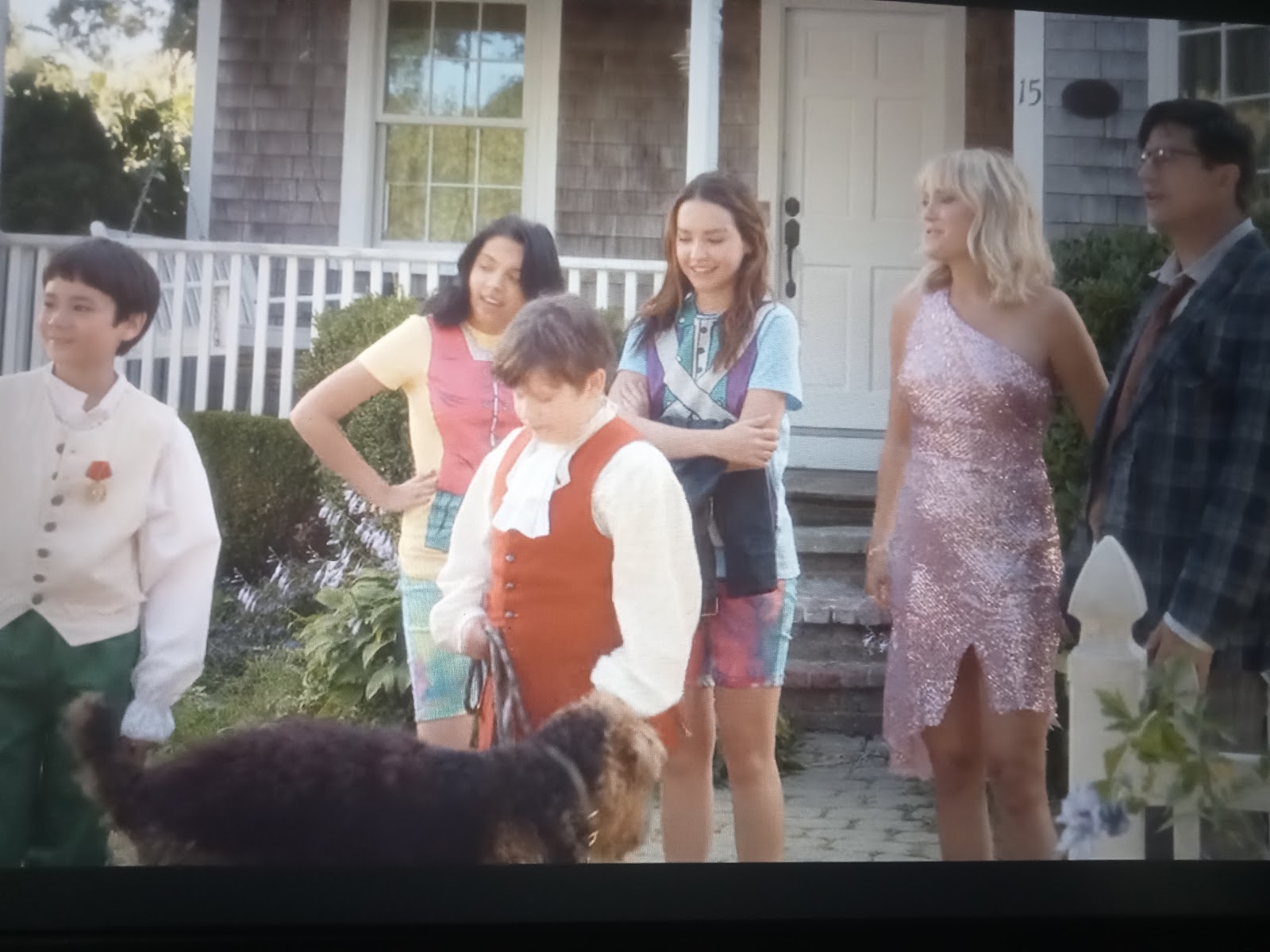
Snapshot taken from the movie “THE SLEEPOVER”.

A film review

 The Sleepover (2020)

       Director- TRISH SIE

       Genre– Exciting,Action, Adventure,Family features.

   A very simple family of Modern era living with their life old fashioned limitations like not allowing the phone to their children even if they jumped in higher class, they do not have permitted to attend any party with their friends,Not allowed to go out in late night.Their mother a housewife made these rules But we all know that there is always reasons of restrictions, the same are here with those two siblings of this exciting family.Both are studying in a same school and everyday their father use to receive and drop them,eating foodings made by dad bakery, play video games and sometimes spend times in sleepover.Cavin the little boy has sharp mind and he enjoy the imaginary world more than real. 

   One day a neighbour’s parents come with his child to leave him for the night. That boy also has some list by his mother about what to do or what to don’t.But as he is in another house with another rule and restrictions nothing from the list could be done right from his list.In loan area Cavin’s dad fixed a tent for their sleepover and left them to sleep. And in the same night her daughter tries to escape from home with her friend for one night to attend the party invited by her senior.

At late night tiem to sleep ,Ninjas enter in the house and attack on her housewife mother to take her with themselves for a mission.They took up both husband and wife with them for a robbery. After knowing their mother’s real identification that her mother was the head robber many years before her marriage in the bachelors age;their children decided to find their parents and went out for an overnight adventure. 

Their mother was a witness protection lady who was caught by the police but allowed to be free with a new identification by letting no one know her real identity.

Following the signs Including their dog’s neck belt left by her mother at every steps they followed and in not finally but at end of getting signs they met her mother’s younger sister who is also a robber; she gave them the direction to reach their mother and they followed.Finally they reached the destination and saw their simple housewife mother extraordinary actions and looks that were never been seen before.And also they saw her mother’s fiance who was a robber man,charm and dashing.

But there and then her mother become with a new identification and living her life as a normal person with family this mission was not her choice.They escape brilliantly from this leaving behind all this stuff if past and came back to home safely creating this adventurous night.And the boy who has very quite talent to make stories of imagination,he does the same in front of police too,reached all back to home safely.

Next morning, the neighbour came to take their child who was left for a sleepover and found the child safe and that child went home too.

Everything happened, the restrictions,the limitations came across with a very valid reason why kids of this family faced too many rules and regulations other than others.Now they understand and respect the situations and their family especially her mother.

So,The conclusion comes here with a brief mentality of parents and children.

Parents never want to grab or tie their own children with restrictions. If they do there must be the reason for their safety that’s important more than anything for any parents.

Children like that boy who live in his imagination are brilliant so to make success and happiness in their life it’s necessary to promote and support your child according to their way of interests.

And the last but not least ,the priority matter a lot for a family person no matter who you are,mother or father or sister or you are a brother,if you are in a family you must put your priorities first for them other than anyone no matter how complications has  started ,how it is difficult to deal or to resolve it but things will become smoother as soon as one put family on prior.Stay tied to the family is one of the best weapon to fight against any circumstances, situations,or any difficulty.

Snapshot taken from the movie “THE SLEEPOVER”.

Okay??

Basically everyone expects the normal student lifestyle with proper and regular routine or schedule to follow for a student even that student too.But Eventually mine is bit different.Different lifestyle is not a decision of mine but the wise decision is something that to accept this difference.
  Like all other students I’m also a student of a regular class of academic course at a high named Central University.But the thing is I’m not capable of interacting with people or Hodge podge anymore,The reason behind is something I’m not blaming but before Corona pandemic i was not that what I’m now.I feel anxious and low from deep down to be in gathering,it’s became tough to hear more than one sound hitting my ears,even sunrays and a close conference room makes me uncomfortable.
But taking these all wisely i chose to work from my room ,even class work , activities, projects and all doing individually that makes me feel really good.My elders and professors are understandable enough.I order food or cook sometimes,i ate,i do work like personal stuffs too,I enjoy myself ,watch movies,series etcetera it’s also appreciable for me to write about my lifestyle cause I’m living my own way with no glitches or now atleast and it’s working literally,every well wishers hoping to see me out or be social like before i was,but here I’m not only hoping but working on it too.
    What do you think,does it sound like a normal lifestyle?If I’m the only one who is facing this? The answer is Big Noo…
    As of now things are getting recovered after the pandemic, One after one has faced different phases but the outcome is the same It is Anxiety, depression or phobea and many health issues as well as mental issues. They try to be social,to be active and involved like they were before Pandemic.But there and then remember one thing that things will get worse when we push it to show surroundings that we are okay and internally we continuously go deep down by doing this.


    So just let it be,
    If you don’t want to be in gather just make a space where you can feel atleast not bad than to be in gathering.
   If you don’t wanna hear something/someone just listen to you for yourself to make Comfortable atleast.
   Don’t wanna go out or see something just feel for yourself and work yourself to do productice that can be seen for a single time atleast.
   Atleast eat a bite and drink a drop to immune your brain that is continuously running without break.
   Don’t wanna describe yourself to anyone,just don’t do but focus on yourself to make your personality and let it describe your victory.
   Not feeling okay is too short to say,just don’t say… but i have one oath to say that is;It’s totally okay to not be Okay. Okayy?


Okay??

Basically everyone expects the normal student lifestyle with proper and regular routine or schedule to follow for a student even that student too.But Eventually mine is bit different.Different lifestyle is not a decision of mine but the wise decision is something that to accept this difference.
  Like all other students I’m also a student of a regular class of academic course at a high named Central University.But the thing is I’m not capable of interacting with people or Hodge podge anymore,The reason behind is something I’m not blaming but before Corona pandemic i was not that what I’m now.I feel anxious and low from deep down to be in gathering,it’s became tough to hear more than one sound hitting my ears,even sunrays and a close conference room makes me uncomfortable.
But taking these all wisely i chose to work from my room ,even class work , activities, projects and all doing individually that makes me feel really good.My elders and professors are understandable enough.I order food or cook sometimes,i ate,i do work like personal stuffs too,I enjoy myself ,watch movies,series etcetera it’s also appreciable for me to write about my lifestyle cause I’m living my own way with no glitches or now atleast and it’s working literally,every well wishers hoping to see me out or be social like before i was,but here I’m not only hoping but working on it too.
    What do you think,does it sound like a normal lifestyle?If I’m the only one who is facing this? The answer is Big Noo…
    As of now things are getting recovered after the pandemic, One after one has faced different phases but the outcome is the same It is Anxiety, depression or phobea and many health issues as well as mental issues. They try to be social,to be active and involved like they were before Pandemic.But there and then remember one thing that things will get worse when we push it to show surroundings that we are okay and internally we continuously go deep down by doing this.

    So just let it be,
    If you don’t want to be in gather just make a space where you can feel atleast not bad than to be in gathering.
   If you don’t wanna hear something/someone just listen to you for yourself to make Comfortable atleast.
   Don’t wanna go out or see something just feel for yourself and work yourself to do productice that can be seen for a single time atleast.
   Atleast eat a bite and drink a drop to immune your brain that is continuously running without break.
   Don’t wanna describe yourself to anyone,just don’t do but focus on yourself to make your personality and let it describe your victory.
   Not feeling okay is too short to say,just don’t say… but i have one oath to say that is;It’s totally okay to not be Okay. Okayy?


Eklavya Model Residential Schools

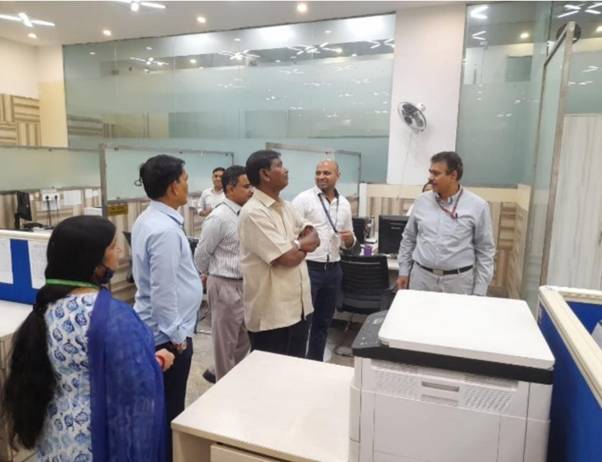
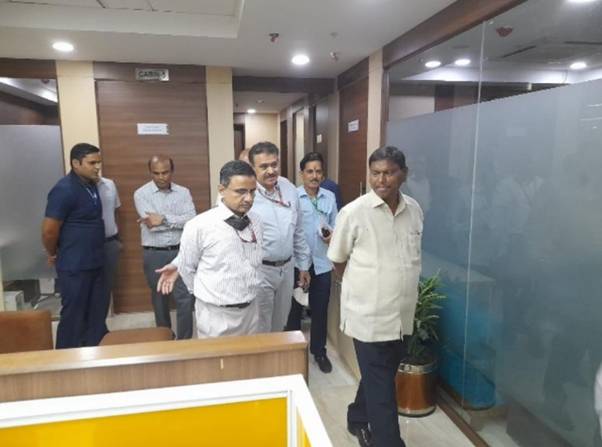
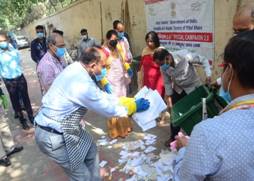
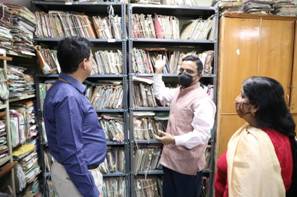
 The  Union Minister of Tribal Affairs, Shri Arjun Munda, inspected several of the Ministry of Tribal Affairs’ offices and divisions in the Jeewan Tara Building on Parliament Street in New Delhi and in National Tribal Research Institute as part of the special campaign 2.0 launched by Government of India from 2nd October to 31st October, 2022 in outstation offices, attached/subordinate offices.

Union  Minister of Tribal Affairs ShriArjun Munda  also reviewed the various activities taken up under the campaign during his visit to various offices of the Ministry. 


The Secretary Ministry of Tribal Affairs, Shri Anil Kumar Jha and the officers and staff of Ministry of Tribal Affairs also actively participated in the campaign.

The Secretary, Ministry of Tribal Affairs, visited the subordinate divisional offices of the Ministry at the Jeewan Tara Building and National Tribal Research Institute. 

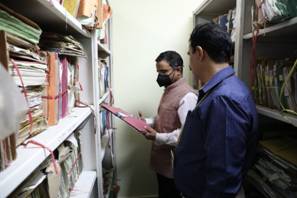
The  Secretary  reviewed the process of weeding  out old of old records and digitisation exercise being done by the Ministry.   He inspected record room and examined files and records being weeded out  as per the official procedures.

The campaign aims  at cleanliness in the offices and reducing pendency of grievances, VIP reference and parliamentary issues. 


The campaign  was  taken up in more than 300 premises which included the attached offices, Eklavya Model Residential Schools spread across country.  

Tribal students from  Eklavya Model Residential Schools actively participated in the  cleaning initiatives.


The Ministry of Tribal Affairs has always emphasised on providing clean and hygenic working environment for the officials and staff. The awareness drive aimed at cleanliness in government departments and sensitising government officials about cleanliness.

******

National Holistic Education

National Holistic Education refers to an educational approach that aims to develop individuals in a comprehensive manner, nurturing their intellectual, emotional, social, physical, artistic, and moral capacities. It focuses on the holistic development of students rather than solely emphasizing academic achievement. Here are some key aspects of a holistic education system:

  1. Academic Excellence and Beyond: While academic achievement is important, holistic education goes beyond traditional subjects. It emphasizes critical thinking, creativity, problem-solving, and lifelong learning skills.

  2. Social and Emotional Learning: It includes programs that promote emotional intelligence, empathy, teamwork, communication, and conflict resolution, fostering well-rounded individuals capable of healthy relationships and social contributions.

  3. Physical Development: Holistic education emphasizes the importance of physical health and well-being. It includes physical education, sports, and activities that promote a healthy lifestyle and overall physical development.

  4. Cultural and Artistic Development: Recognizing the importance of arts, culture, and creativity, holistic education incorporates programs in music, visual arts, literature, drama, and other creative expressions to foster imagination and cultural appreciation.

  5. Ethical and Moral Education: It includes teachings on ethics, values, character development, and moral reasoning, aiming to instill a sense of responsibility, integrity, and ethical behavior in students.

  6. Environmental Education: Holistic education often integrates environmental awareness, sustainability practices, and education on ecological systems to nurture environmental consciousness and responsible citizenship.

  7. Personalized Learning: Recognizing that each student is unique, holistic education often advocates for personalized learning approaches that cater to individual learning styles, interests, and strengths.

  8. Experiential and Hands-On Learning: Emphasizing practical, experiential learning experiences, including internships, field trips, projects, and real-world applications, to complement theoretical knowledge.

  9. Community Engagement: Encouraging students to actively engage with their communities through service-learning projects, volunteer work, and community service to develop a sense of social responsibility and empathy.

  10. Teacher Development: Holistic education also involves investing in teacher training and professional development to equip educators with the skills and mindset needed to implement holistic teaching approaches effectively.

Implementing a national holistic education framework requires collaboration among policymakers, educators, parents, and the community to design a curriculum that addresses various dimensions of learning, fosters a supportive learning environment, and prepares students to thrive in a diverse and rapidly changing world.

students to give back to the society and explore finding solutions to global challenges

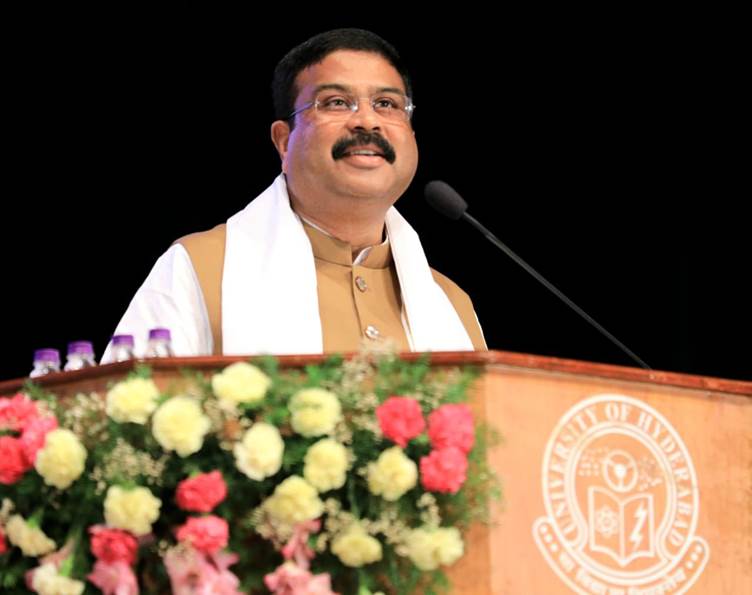
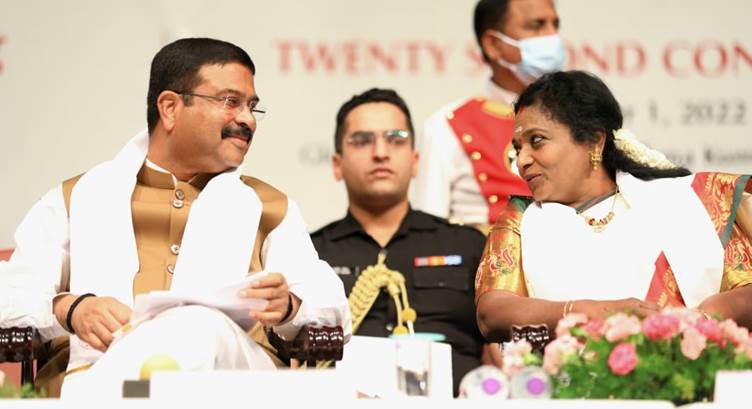
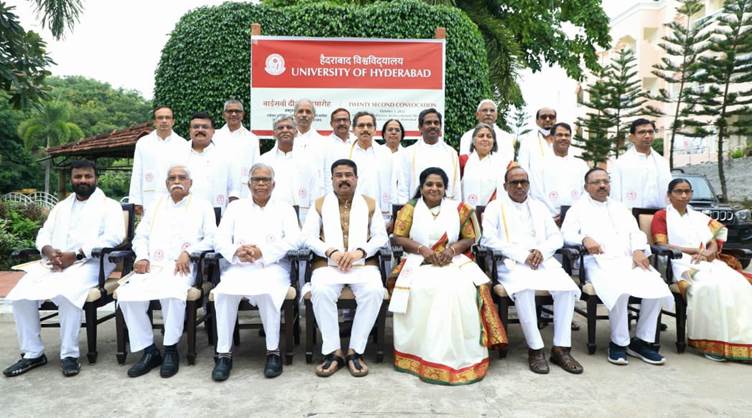
 Union Education and Skill Development and Entrepreneurship Minister Shri Dharmendra Pradhan addresses 22nd Convocation of University of Hyderabad today.  Dr. Tamilisai Soundararajan, Governor of the State of Telangana and Chief Rector, University of Hyderabad graced the occasion.

While addressing the gathering he said that Hyderabad is known as the city of decorative pearls. It is also a city that is generating intellectual pearls. He further added that Hyderabad is known for its IT prowess. It is also emerging as a leading medical technology hub of the country. University of Hyderabad is emerging as a centre-of-excellence and expressed his confidence that the University will be a torchbearer of knowledge-based economy in the 21st century, he added

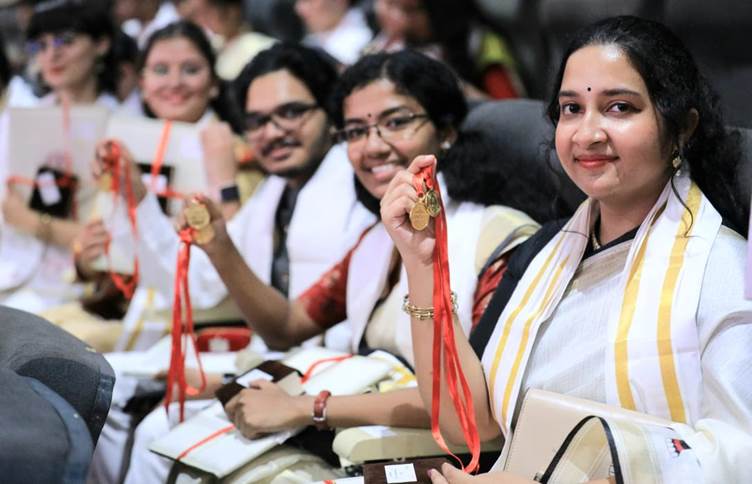
Shri Pradhan shared that a lot of girl students being honored at the University of Hyderabad Convocation. Our NariShakti will play a major role in the economic well-being of our country.

Shri Pradhan said that today, climate change, changing agricultural patterns, new diseases are a concern for everybody. Society is looking towards knowledgeable people for providing solutions to these pressing challenges and University of Hyderabad is capable of providing solutions to these challenges. He stated that India is aspiring to become a leading economic superpower and a knowledge-based economy. Innovation and entrepreneurship will take us forward. We must create more wealth-creators and job-creators for our society to grow, he added.

Shri Pradhan also said that India is a very old civilization with strong linkages with science and technology. The Covid19 pandemic has shown that Indian Knowledge Systems and the Indian way of life have much to offer to the world. We have to promote IKS with a modern context.

Shri Pradhan asserted that world is looking towards India with great hope. The next 25 years are important for all of us. As we enter the AmritKaal, NEP 2020 remains a guiding philosophy for the welfare of humanity.  India’s responsibility is to take care of the planet.

He further said that India is going to be the benchmark for the world in fighting climate change, food scarcity, in paving the way for peace and harmony and in providing healthcare and economic models. India will emerge as a leading light of humanity based on the philosophy of NEP 2020, he added.

Later, Shri Pradhan added that when India will be celebrating 100 years of independence, Hyderabad University will be one of the major epicentre of our knowledge-based society. He urged students to give back to society to make their education more meaningful and purposeful.

The University of Hyderabad gave away the coveted degrees to 4800 students enrolled in various programs, with 1631 receiving their degrees in person and remaining in absentia; 573 are Ph.D. Scholars and multiple students were felicitated with awards and medals for their extraordinary performances.

****