participation of MGIEP in the Implementation of National Educational Policy -2020

 Union Education Minister Shri Ramesh Pokhriyal ‘Nishank’ chaired a meeting on participation of Mahatma Gandhi Institute of Education for Peace and Sustainable Development (MGIEP) in the implementation of National Educational Policy -2020. Secretary, Higher Education, Shri Amit Khare; Secretary, School Education & Literacy , Smt Anita Karwal; Director, UNESCO, New Delhi, Mr. Eric Falt ; Chairman, MGIEP, Prof. J.S. Rajput; Director, MGIEP, Dr. Anantha Duraiappah and senior officials of the Ministry attended the meeting.

Speaking on the National Education Policy 2020, Minister said the policy is in line with the SDGs of UNESCO. It will develop Indian citizens on the lines of a global citizen, and help spread the ideas of empathy, compassion and rational thinking among the citizens. Shri Pokhriyal said that both MGIEP and UNESCO will play a major role in the implementation of this New Education policy. He sought their suggestions and cooperation on implementation of New Education Policy 2020 to make India a global knowledge superpower.

Emphasizing that Government of India is fully committed to achieving the 2030 Sustainable Development Goals, Shri Pokhriyal spoke about several initiatives such as NISHTHA- the world’s largest teacher training capacity building program, digital learning through DIKSHA, Samagra Shiksha Abhiyan among others that have been taken to improve access, equity and quality of education.  

*****

A GOD WHO HATES WOMEN

I had chosen to write about Dr. Majid Rafizadeh’s phenomenal novel ‘  A God Who Hates Women’. It is a beautiful yet tragically moving story of a women caught in a patriarchal household. It takes us back to the times when women were seen as commodities sold off in markets. Choice was a word that women could not even imagine. The story highlights the life of the authors mother, how she lived through oppression. This story forms around the background of a civil war. The novels throw light on the cruelties faced by women in a patriarchal society. The story begins with a short background of how the authors grandmother was born. It later shows the birth of the authors mother which turned out to be a disgrace for her own mother, since she expected a baby boy. The story continues with the atrocities faced by his mother at her own home and how she was forcefully married to a man who abused her at all chances he got. The irony of which the book talks about is the cruel side of patriarchy, how women carry it down more than men. 

Photo by Dennis Magati on Pexels.com

The name of the book also seems to bring out the story, about how the religion and its god were cruel to women. The people of the religion went to extreme ends to make sure that the rules of the religion are followed, sometimes inhumane practices were also used.

Religion and politics were not treated as two different entities by the people of Syria, Iran and Iraq. They had held religion so much close to their heart, that it was even involved in their politics. Political decisions were made in the name of god. People were abused in inhumane ways in the name of religion. It shows quite a different side of how far our modernity and education has not evolved in countries like these. Citizens of the nations could never really trust one leader to be liberated from his religious entity, each leader had their own approach to religion and people were forced to select someone who was less cruel than the other. The question of a good and humane leader was out of choice. 

The book is set in the backdrop of a series of political tension in Syria and Iran. The author and his family have moved from Syria to Iran a couple of times and the book shows the difference in the culture in both the countries vividly. The book shows how much political leaders are influenced by religion and how they kill people cruelly who goes against them, the authors father was one such victim. Maybe the author might have also got the influence from his father, but in a much better way. The author was the founder of an organization on human rights which reported cases of human cruelty. The authors father has a very interesting character, he on one side focuses on how modern our thinking should be in various aspects of life except in the equal treatment of womenas he had always abused his wife. His character was rather paradoxical. 

But one of the most important things that the book has left out is that it hasn’t brought into consideration the larger issues faced by the people. The author has merely had an interview with the close members of his family and friends. And so, we cannot really say that the book speaks about the whole of Syria. After certain parts of time in the book, it fails to show the feelings of Amira, the authors mother. How she felt about religion, her passion and how she lied to herself to live for her children. The authors life has been glossed over for most parts and it talks in the perspective of the author while the book was about his mother. 

The major concept the book focuses is on the patriarchy and how it has broken down the women of the household. Book spoke about how women were cut off from the world of pleasure and desire, forced into submission. Another novel aspect of the book is that it also talks about men abusing younger boys. Young boys were raped by elderly men in the remote areas of Iran

The book is set in a time when abuse was seen very common. People dominated over the weaker ones and religion was to be respected and those who don’t respect religion were also abused too. It is set in a completely different timeline with reference to religion or equality between men and women. But we cannot completely say that patriarchy has been wiped out from our modern-day world. Across the timelines we had only grown one step closer to lower its impact on the people. 

We might live in a secular world today but that does not mean that each and everyone among us are cosmopolitans in nature. But one thing that has drastically changed is the number of people who believes that women are to be respected and given equal rights as men. They believe that Women must not only be seen as homemakers but also as potential doctors, engineers, civil servants and all the more. This change in perspective had given rise to many feminist movements across the world. There are almost 3 waves of feminism, where each wave concentrated on the various aspects of a women’s lifestyle.  The world we live in as become so much more complicated with the passage of time; one person is not solely now identified with his/her religious aspects but with things they would want to relate too. Identities matter a lot in the world we live in, these identities connect us with similar people so to share the same feelings and aspirations. 

Something that we can always find common in all the stories we hear are the sufferings of women and not men, why was women just seen as fragile and homemakers? The ones that needed to stay at home and look after the children? Weren’t we equal beings with different biological systems? Why wasn’t marital rape unlawful in countries across the world? Why were people so focused on their religious identities? Why didn’t time make a difference in the modernization of the Asian countries? These were a few of the questions which kept disturbing my mind. I hope one day comes where women will be as free as men. A world where we all are equals. 


National Education Policy (NEP) 2020: Implementation Plan for School Education


  1. The National Education Policy, 2020 is the third in the series of National Education Policies (1968 and 1986 modified in 1992) in India and is the first education policy of the 21st century. NEP 2020 covers wider spectrum of school education from pre-primary to senior secondary.
  2. The recommendations given have varied timelines as the policy is made for next 20 years. Therefore, the implementation of NEP is being carried out in a phased manner.
  3. ShikshakParv was organised from 8th to 25th September 2020 for discussing various recommendations of NEP 2020 and its implementation strategies. Around 15 lakh suggestions were received from the stakeholders, which are being examined.
  4. To achieve the goals and objectives of NEP 2020, DoSEL has prepared a draft implementation plan with Task lists linking each recommendation with tasks, responsible agencies to carry out the task, timelines and outputs. This task list was shared with the States/UTs/Autonomous Bodies on 10th September, 2020, to provide their feedback/suggestions till 12th October, 2020. Autonomous Bodies of this Department and 31 States and UTs provided 7177 suggestions/ feedback on the task list. These have been analysed by expert groups and important suggestions have been incorporated in the final version of implementation planIn addition to above, a series of national workshops on Implementation of NEP 2020 and revision of Samagra Shiksha was held under the chairpersonship of Secretary (SE&L) on 10th November, 27th November and 2nd December, 2020 covering all States and UTs. The document is being finalised and will be released shortly.
  5. Appropriate care is being taken to make this implementation plan realistic, flexible and collaborative by inviting suggestions from all corners of the society. It is hoped that this implementation plan so finalised with the inputs of all associates will be able to translate the vision of the policy in the field and will reach to grass root level creating adequate awareness and motivation and competencies among concerned stakeholders, thereby transforming the school education in the country.  
  6. The major portions of NEP will be covered under the new National Curriculum Framework (NCF) and centrally sponsored schemes. Groundwork for NCF is initiated and it is likely to be developed in the next academic session, that is 2021-22.
  7. The department has initiated implementation of NEP by undertaking following activities in accordance with the recommendations of the policy :
  1. To undertake 50 hours of mandatory Continuous Professional development of teachers, 18 modules of 4-5 hours each comprehensively covering all aspects of elementary education have been launched under NISHTHA on 6.10.20 for in service teacher training (CPD) in the online mode on DIKSHA platform. This has so far seen more than 3.4 cr course wise registrations and 2.8 cr completions from more than 23 lakh teachers.
  2. In-principle approval has been given for setting up the National Mission on Foundational Literacy and Numeracy Mission. A Committee has been formed for preparing framework on FL&N, codification of learning outcomes etc.
  3. E-learning has been expanded through DIKSHA. DIKSHA provides access to a large number of curriculum linked e-content through several solutions such as QR coded Energized Textbooks (ETBs), courses for teachers, quizzes etc. Till date DIKSHA houses over 3600 QR coded textbooks (tagged with e-content) from 29 states, 1.44 lakh e Contents and more than 300 courses.
  4. The department has launched an initiative called ‘Manodarpan’ for mental health and wellbeing of students. It aims to provide emotional support and counselling to the students under distress. Issuance of advisory guidelines, web page and national toll-free number, interactive online chat options and, national-level database and directory of counsellorsare part of the initiative. 
  5. MoU has been signed between Indian Sign Language Research and Training Centre (ISLRTC) and NCERT to develop Indian Sign Language dictionary for school education.
  6. CBSE exam reforms have been initiated; CBSE will introduce improvement examination from the year 2021 and will introduce English and Sanskrit in 2 levels from the session 2021-22 (already offers Mathematics and Hindi at two levels). Competency based questions have been introduced in the Board exams for class X and XII in a phased manner, increasing by 10% every year.
  7. Learning Outcomes upto Secondary level have been notified and draft of learning outcomes for senior secondary level have been released for inviting suggestions.
  8. The department is also aligning its existing schemes i.e, Samagra Shiksha, Mid Day Meal and Padhna Likhna Abhiyan with the recommendations of NEP 2020. 86 paras of NEP have been proposed to be covered/integrated under the revised scheme of Samagra Shiksha which includes phased introduction of:  1 year of Balvatika and TLMs to all children, Launch of National Mission of Foundational Literacy and Numeracy, upgradation of schools upto senior secondary level including residential schools and KGBVs, Holistic Progress Card (HPC) and tracking of learning outcomes as well as transition of children, appointment of Hindi and Urdu Language Teachers, Capacity building of teachers (50 Hrs CPD), Bagless days and internships, Support for OOSC, Activities of PARAKH, Separate stipend for CWSN girl child; provision for identification of CWSN and Resource Centre at block level, Provision for Hub and Spoke model in vocational education, Provision for Smart classroom and DIKSHA, Support for Assessment Cells in SCERT etc., etc.
  9. States and UTs are also constituting their own Task Force to steer implementation of the NEP provisions in their respective jurisdiction.

******


Use of Electronic Media for Educating Farmers

 The Department of Agriculture & Farmers Welfare (DA&FW), Ministry of Agriculture & Farmers Welfare is educating farmers through use of following electronic media to upgrade their knowledge on modern agriculture technologies:

  1. The scheme ‘Mass Media Support to Agriculture Extension of ‘Sub-Mission on Agriculture Extension’ is under implementation to create awareness among the farming community and educate the farmers on improved agriculture technologies. The programmes are telecast through DD Kisan, DD Regional Kendras (18) and broadcast through 96 FM Stations of All India Radio. The ‘Focused Publicity & Awareness Campaign’ is also being undertaken through electronic and print media for creating awareness among the farmers and other stakeholders on technological aspects of agriculture.
  2. Social media platforms like Twitter, Facebook, Instagram and YouTube are being used to educate farmers.
  3. The ICAR institutes and KVKs have developed 283 mobile apps on different agriculture commodities for providing advisory to the farmers. ICAR has also created an electronic platform ‘Kisan Sarathi’ for supporting agriculture at local niche with national perspective to provide a seamless, multimedia, multi-ways connectivity to the farmers with the latest agricultural technologies, knowledge base and the pool of large number of Subject Matter Specialists.

The Government is implementing following schemes and activities to impart training and educate the farmers to adopt modern agriculture techniques:

  1. A Centrally Sponsored Scheme on ‘Support to State Extension Programmes for Extension Reforms’ popularly known as ‘Agriculture Technology Management Agency (ATMA)‘ is under implementation in 691 districts of 28 States & 5 UTs of the country. The extension activities under ATMA, inter-alia, include Farmers’ Training to upgrade their knowledge and technical skills on modern and innovative agricultural technologies.
  2. The ‘Mission for Integrated Development of Horticulture (MIDH)’, a Centrally Sponsored Scheme is under implementation in all States/UTs for holistic growth of the horticulture sector covering fruits, vegetables, root and tuber crops, mushrooms, spices, flowers, aromatic plants, coconut, cashew, cocoa and bamboo.
  3. The ‘National Food Security Mission (NFSM)’ is under implementation in identified districts of 28 States and 2 UTs viz. Ladakh and J&K of the country to increase the production and productivity of rice, wheat, pulses, coarse cereals and nutri- cereals (millets) through area expansion and productivity enhancement.
  4. Under ‘Sub-Mission on Plan Protection & Plant Quarantine’ the ‘Farmer Field Schools (FFSs)’ are conducted to educate farmers on various aspects of Integrated Pest Management.
  5. Four Farm Machinery Training & Testing Institutes (FMTTIs) located at Budni (Madhya Pradesh), Hisar (Haryana), Anantapur (Andhra Pradesh) and Biswanath Chariali (Assam) are engaged in imparting training to various categories of trainees including farmers, in the field of Farm Mechanization in agriculture sector.
  6. Indian Council of Agricultural Research (ICAR) has established a network of 729 Krishi Vigyan Kendras (KVKs) in the country mandated with Technology Assessment and Demonstration for its Application and Capacity Development. KVKs organize demonstrations, training programms and skill development programs for the benefit of farmers and farm women, rural youth and in-service extension personnel.

Students of Kendriya Vidyalaya across the country

 Union Minister for Education and Chairman, Kendriya Vidyalaya Sangathan Shri Ramesh Pokhriyal ‘Nishank’ virtually interacted with the students of KendriyaVidyalayas across the Country. The Minister attended the programme from KV Andrewsganj, New Delhi and answered the queries of the students.

During the interaction program, the students asked questions related to various fields and subjects. Replying to the query by a student of KV Gurugram, Shri Pokhriyal informed that as the curriculum was cut by 30 percent this year due to Covid-19, therefore in the upcoming competitive examinations like JEE and NEET this year the candidates will have more options to answer the questions.

In response to another query asked by a student from Varanasi, Shri Pokhriyal said that the facilities of online education will continue even after the school reopens. For some time, a mixed format of online and offline will be available for the students.

In response to a question asked by the student of Kendriya Vidyalaya Andrewsganj about the New Education Policy- 2020, the Minister said “New Education Policy has been prepared keeping in mind the India of future. A lot of emphasis has been laid on practical knowledge rather than just bookish knowledge. Vocational training facility will be provided for students from class 6 onwards, in which internship is also associated. Artificial intelligence will also be taught from the school level itself. At the same time, Indian values ​​and culture will also be promoted. This policy is capable of realizing the dream of AatmaNirbhar Bharat”.

Minister also recited his favourite poems on a question related to his literary skills.

Earlier, Shri Pokhriyal also planted a sapling in KV Andrewsganj premises. Giving momentum to the Fit India campaign, he also inaugurated an ‘Open Gym’ in the KV. Apart from this, a Musical Garden was also inaugurated by the Minister in the school premises.

Commissioner, KVS Ms. Nidhi Pandey gave the Welcome Address, while Addl Commissioner, KVS Ms. V. Vijayalakshmi presented the vote of thanks. Senior officials of the Ministry were present on the occasion

******


Implementation of National Education Policy-2020

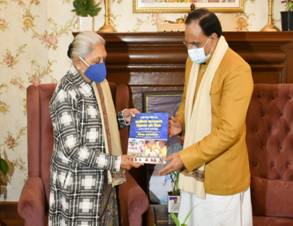
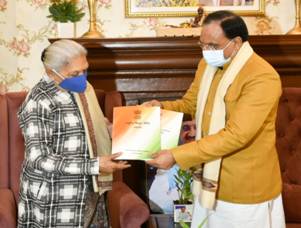
 The Governor of Uttar Pradesh Smt. Anandiben Patel called on Union Education Minister Shri Ramesh Pokhriyal ‘Nishank’ here today. Implementation of National Education Policy-2020 and other issues relating to Education sector were discussed during the meeting. Senior officials of the Ministry also attended the meeting.


During the meeting Smt. Anandiben Patel highlighted the initiatives taken by the State Education Department, Uttar Pradesh such as providing training to Anganwadi workers, teachers training, etc to ensure the academic welfare of the students. She also presented a copy of the book ‘Teacher’s guide’ for students of Pre-primary level and Primary level, to the Union Minister. The guide will help teachers to develop a better understanding of student centric teaching practices covering various subjects of environment, value education, etc in a joyful manner.

Shri Pokhriyal informed that as outlined in New Education policy, the foundation literacy and numeracy mission will be extended to Early Childhood Care Education for which a framework will be prepared on learning outcomes, teachers training, etc. He also informed that NCERT is developing a new National Curriculum Framework (NCF). He added that the suggestions given in the Teacher’s Guide will be examined and suitably incorporated in the NCF.

*****

Guidelines for identification, admission and continued education of migrant children

 In order to mitigate the impact of challenges thrown by the COVID-19 pandemic for out of school children, it was felt necessary for every State/UT to devise a proper strategy for preventing increased drop outs, lower enrolments, loss of learning and deterioration in the gains made in providing universal access, quality and equity in the recent years.

Thus the Ministry of Education had issued guidelines for identification, admission and continued education of migrant children.

In order to ensure that school going children have access to education with quality and equity and to minimize the impact of the pandemic on school education across the country, the Ministry of Education has prepared and issued detailed guidelines on steps to be taken by the States and UTs during school closure and when the school re-open.

The main features of the Guidelines are :      

A.        Continued Education for Out of School Children (OoSC) and Children with Special Needs (CWSN)


  • Continuation of non-residential training for identified Out of School children through volunteers, local teachers and community participation.  
  • Continuation of home based education for CWSN children through Volunteers/ Special Educators.


B.        Identifying Out of School Children


  • States and UTs to carry out proper identification of OoSC for 6 to 18 years age group through a comprehensive door to door survey and prepare action plan for their enrolment


C.        Enrolment Drives and Awareness Generation


  • Enrolment drives may be undertaken at the beginning of academic year such as Praveshotsav, School Chalo Abhiyan etc.
  • Undertake awareness generation among parents and community for enrolling and attendance of children
  • Create awareness on practicing 3 Corona appropriate behaviors – wear mask, six-feet distance and washing hands with soap for which IEC material shared on 06.11.2020 with the States & UTs.


D.        Student Support while Schools are closed


  • Students to be provided support including counseling, large scale awareness & targeted home visits
  • Using Manodarpan web portal and tele-counseling number for counseling services and psycho-social support.
  • Distribution of educational material and resources, supplementary graded material, workshops, worksheets etc to support home-based education
  • Exploring option of classroom on wheels and classes in small groups at village level
  • Increasing the access of children to online/digital resources, TV Radio etc. to reduce learning loss
  • Ensuring easy and timely access to the provisions of uniforms, textbooks and MDM
  • Timely disbursement  of stipend to enrolled CWSN girls through DBT
  • Strengthening of Child protection mechanism at local level


E.        Student Support on School Reopening


  • Preparation and running of School readiness modules/Bridge course for initial period when the schools re-open so that they can adjust to the school environment and do not feel stressed or left-out.
  • Identification of students across different grades based on their learning levels
  • Relaxing detention norms to prevent drop out this year.
  • Ensuring reading with comprehension and numeracy skills by encouraging children to  read books beyond syllabus and creative writing & problem solving.
  • Large-scale remedial programmes/Learning Enhancement programmes to mitigate learning loss and inequality.


F.         Teacher Capacity Building


  • Effective utilization of the online NISHTHA training modules and online training module for Corona responsive behavior to be launched on DIKSHA portal soon.
  • Use of alternative Academic Calendar prepared by NCERT for joyful engagement of children in learning.

*****


After We Collided by Anna Todd

After finishing the first book in the ‘After’ series, I immediately jumped into this second book. There was no way that I was going to quit this series with the way things ended at the end of ‘After’–absolutely, no way! I had to know how things were going to play out for this disastrous couple. They are like crack! It might kill me. I know it’s really not healthy…but I just can’t seem to pull myself away from it!

If I thought that Hardin and Tessa were going to grow up and start treating each other better, I would’ve been sorely disappointed. These two are every bit as toxic as they were the first time around. The back and forth, break-up and make-up, abusive cycle continues, strong as ever. Of course, I’m such a glutton for punishment that I had to have a front row seat for all of it!

Picking up right where the first book ended, Tessa does her best to try and piece her life back together. She has been betrayed by everyone that she thought were her friends — most of all, Hardin. Unfortunately, the manipulative jackass succeeded in tying her to him when he tricked her into moving into an apartment with him and away from the dorms. This will make distancing herself from him more difficult than she had hoped.

While Tessa makes a weak attempt at moving on, Hardin sets out to prove that his feelings for her are genuine. Of course, every time he starts to make any progress in that regard he does something that sabotages all of his efforts. They truly are their own worst enemies.

For what it’s worth, Hardin does seem to show some actual emotions in this book. Mainly, his regret and heartache shines through. It’s hard to feel sorry for him though, since all of his pain is entirely the result of his own cruel actions. To make matters worse, every time he starts to gain a little “nice guy” stock, he goes and does something abhorrent again, reminding me of what a despicable asshat he is. Some big revelations about his past only further prove that he is not to be trusted. He really is deplorable…but I love to hate him!

I also found myself feeling a little more irritated with Tessa’s weakness this time around. Can you say “doormat”? How many times is this girl going to fall for his crap? She also played the same childish games over and over, using other guys to make Hardin jealous, only to play the victim when she got the reaction she was looking for all along.

I felt sorry for Tessa at first. By the end of this book, I was marveling at the fact that she hadn’t been weeded out as part of the process of natural selection. Surely, this girl is too stupid to live!

That being said, I still can’t pull myself away from this angsty, infuriating story. It is like watching a trashy talk show or soap opera. It’s unrealistic. The relationships are toxic. It probably kills off brain cells. However, I can’t get enough of it. It is my latest guilty pleasure. I’m kind of ashamed to admit it, but I’m completely hooked on this series.

Like the first book, ‘After We Collided’ ends with a huge cliffhanger. Anna Todd certainly knows how to pull me back in. At this point, I think my relationship with this series is much like the relationship between Hardin and Tessa. I should probably cut all ties and get out while I can, but I just can’t seem to resist the pull. I’m on to the third book in this addictive, dysfunctional romance. 

After by Anna Todd

I know I’m late to the After party. But hey, better late than never! I started After by Anna Todd in the evening, then stayed up all night because I had to finish it. And then, I begged my teen sister for the second book. She kindly agreed to give the book to me. I hope she doesn’t change her mind just to torture me. We’ll have to see how this unravels. 

Synopsis:

Tessa is just starting college, and she’s got everything planned. In one year, her boyfriend Noah will join her as well. But then she meets her wild roommate Steph as well as the incredibly rude guy with a British accent, Hardin. And everything changes!

My Thoughts:

Tessa is a good girl and she doesn’t do parties and short dresses. And she goes to a party with Steph and something changes. She can’t look away. Harding is doing something to her and she can barely resist. But she has a boyfriend. And also, everything she has a good moment with Hardin, two bad ones follow. Hardin is toxic, and Tessa hurts him in return as well. Also, their communication has to improve. Not the mention how the whole boyfriend situation was handled. 

Honestly, I thought my opinions would be conflicting. But they’re not. I really enjoyed the book and I’m looking forward to the second one. Also, I know Hardin is based on Harry Styles, but while I was reading the book, he didn’t once cross my mind. I also often have fantasies about celebrities, I just don’t happen to write them. Honestly, it’s not a big deal. 

My only worry was that teens might see Hardin’s toxic side and think that’s how a girl should be treated. But that would mean underestimating the girls out there. Even in the book, Tessa was aware Hardin’s behaviour was not okay, which is why she reacted the way she did. The facts she would return only meant that she had feelings for him. Their relationship has more issues than good parts, but in all honesty, when I think about my high school days, it was that way for me too. I didn’t handle things well. Sometimes I didn’t communicate well. I trusted people I shouldn’t have trusted. And that’s the beauty of this book. 

After by Anna Todd is the perfect teenage book.

It reminded me of my days of high school and uni. Attending parties I shouldn’t have and trusting people that didn’t deserve my trust. Handling relationships badly and having terrible ability to communicate. And this book brought all the excitement back and more. Fond and not so fond memories that reminded me that I have lived at the fullest. 

In the next book, I do hope that their relationship improves. I hope Hardin grows up and Tessa communicates to him, instead of hurting him back. Also, I hope Tessa fixes her relationship with her mother as well, even though her mother needs to work on her own biases as well. I also hope that the dramas continue as well – I really love them. 

Schemes for Upliftment of Minorities

 The Government has implemented various schemes for the welfare and upliftment of every section of the society including minorities especially the economically weaker and deprived sections of the society with schemes like Pradhan Mantri Jan Arogya Yojana (PMJAY), Pradhan Mantri Mudra Yojana (PMMY), Pradhan Mantri Kisan Samman Nidhi (PM KISAN), Pradhan Mantri Ujjwala Yojana (PMUY), Pradhan Mantri Awas Yojana (PMAY), Beti Bachao Beti Padhao Yojana, etc. Ministry of Minority Affairs also implements programmes/ schemes for socio-economic and educational empowerment of the six (6) centrally notified minority communities namely Christians, Sikhs, Buddhists, Muslims, Parsis and Jains. The schemes/programmes implemented by the Ministry in brief are as under:


(A): Educational Empowerment Schemes:


(1) Pre-Matric Scholarship Scheme- Scholarship is provided to minority students from Class I to X, out of which 30% scholarship are earmarked for girls.


Post-Matric Scholarship Scheme- Scholarship is provided to minority students from Class XI to PhD., out of which 30% scholarship are earmarked for girls.


Merit-cum-Means based Scholarship Scheme- Scholarship is provided to minority students for Professional and Technical courses, at Under Graduate and Post Graduate level, out of which 30% scholarship are earmarked for girls.


All the three Scholarship schemes are on boarded on the National Scholarship Portal (NSP) and the scholarship amount is disbursed through Direct Benefit Transfer (DBT) mode.


(2) Maulana Azad National Fellowship Scheme – Under the scheme fellowship in the form of financial assistance is provided to minority candidates who clear the UGC-NET or Joint CSIRUGC-NET examination.


(3) Naya Savera – Free Coaching and Allied Scheme – The Scheme aims to provide free coaching to students/candidates belonging to minority communities for qualifying in entrance examinations of technical/ medical professional courses and various Competitive examinations.


(4) Padho Pardesh – Under the scheme interest subsidy is provided to students of minority communities on educational loans, for overseas higher studies.


(5) Nai Udaan – Support is provided to minority candidates clearing Preliminary examination conducted by Union Public Service Commission (UPSC), State Public Service Commission (PSC), Staff Selection Commission (SSC) etc.


(B): Employment Oriented Schemes:


(6) Seekho Aur Kamao – Skill development scheme for youth of 14 – 35 years age group and aiming at providing employment and employment opportunities, improving the employability of existing workers, school dropouts etc.


(7) USTTAD (Upgrading the Skills and Training in Traditional Arts/Crafts for Development) – An effective platform to provide self-employment, market and opportunity to traditional artisans and craft persons from the minority communities. Hunar Haats are being organised across the country to provide employment opportunities and markets to artisans/craftsmen.


(8) Nai Manzil – A scheme for formal school education & skilling of school dropouts or educated in community educational institutions like Madrasas.


(9) Nai Roshni – Leadership development of women belonging to minority communities and non-minority communities (not exceeding 25% of each batch).


(C): Special Schemes


(10) Jiyo Parsi – Scheme for containing population decline of Parsis in India.


(11) Hamari Dharohar- A scheme to preserve rich heritage of minority communities of India under the overall concept of Indian culture.


(D): Infrastructure Development Programme:


(12) Pradhan Mantri Jan Vikas Karyakram (PMJVK) – The scheme aims to provide basic infrastructure such as Schools, Colleges, ITIs, Polytechnics, Hostels, Sadbhav Mandap, Skill Development Centres, Drinking water and Sanitation facilities, Health Projects including hospitals, Sport facilities, Smart classrooms, Aanganwadi Centers etc. in deprived areas of the country. The scheme is implemented in the identified areas having minimum of 25% minority population and backwardness parameters below the national average in respect of socio economic or basic amenities or both.


(13) Also, Maulana  Azad  Education  Foundation  (MAEF)  implements  education  and  skill related  schemes  as  follows:-  (a)  Begum  Hazrat Mahal  National  Scholarship  for Meritorious  Girls  belonging  to  the  economically  weaker  sections  of  Minorities  (b)  Gharib Nawaz  Employment  Scheme  started  in  2017-18  for  providing  short  term  job  oriented skill development training  to youth (c) Grant-in-aid  to NGOs for infrastructure development of educational institutions.


(14) Equity to National Minorities Development and Finance Corporation (NMDFC) for providing concessional loans to minorities for self-employment and income generating ventures. 

The details of the schemes mentioned at S. No.(1) to (12) are available on the website of this Ministry  (www.minorityaffairs.gov.in) and those at serial No.(13) and (14) are available on the website of MAEF (www.maef.nic.in) and NMDFC (www.nmdfc.org) respectively. 


During the last three financial years w.e.f 2018-19 to 2020-21 an amount of Rs. 13113.47 Crore (Revised Estimate) has been allocated for implementation of various schemes of the Ministry.


During last three financial years an amount of Rs. 6547.88 Crore has been sanctioned for providing scholarship to more than 1.96 Crore Minority students under Pre-Matric, Post-Matric, Merit-cum-means and Begum Hazrat Mahal scholarship schemes.


There is no State-wise fund allocation under above mentioned schemes. However, an amount of Rs. 13113.47 Crore (Revised Estimate) has been allocated during the last three financial years i.e 2018-19 to 2020-21 out of which an amount of Rs. 12083.76 Crore has been utilised for the above mentioned schemes etc, benefitting  more than 2 Crore beneficiaries from various states  including the states of Karnataka and  Maharashtra.


The Budget Estimates (BE) of the Ministry for financial year 2022-23 is Rs.5020.50 Crore against BE of Rs. 4810.77 crore for the current financial year i.e 2021-22.


Top 10 Urban planning tools

As an urban planner, you know the importance of legibility and comprehensibility in communicating plans for the built environment. Developing an understanding of the tools and techniques of urban design is a crucial benefit to the implementation of effective plans.
Urban Planners are often required use urban planning software which bridges the various disciplines involved in city planning. While not always the case, the softwares and tools used within the urban planning can be quite expensive. Especially when you are self employed. Fortunately, there are free urban planning software alternatives available, which does well in completing the necessary tasks. However, unfortunately some of the paid software do not have alternative free and open source software.
We have attempted to summarise the key urban planning software and tools used today, both free and paid. This list has been made in an effort to make it easy to understand the software that exists and is used today. Although, the list is currently not fully comprehensive it gives an overview. The list will moreover be updated once in a while to reflect software not listed here. 
We hope this list is useful and provides some help in finding urban planning software and tools that can support your work. \
Whether you’re a professional in the urban planning field or an urban planning student, learning basic design principles doesn’t require a graphic design degree. Thankfully, there are a number of free software tools available to take your plans to the next level, here are some of the urban planning tools that every planners need to know:

1. GIMP
GNU Image Manipulation Program, commonly known as GIMP, is a raster-based image manipulation software. If you’re familiar with Adobe Photoshop, you will find GIMP to be an effective (and free!) alternative with similar capabilities. In the context of urban design, GIMP is used to edit images, add text to images, and overlay graphic content on maps. Additionally, GIMP offers some great free educational resources and tutorials.
SketchUp is an indispensable tool to urban planners and urban designers alike. Unique in its ability to quickly and accurately render 3-dimensional forms, Sketchup provides users with an effective tool to visualize buildings, neighborhoods, and even cities. There are some limitations to the freeware version as opposed to SketchUp Pro, but there are workarounds you can learn in the Urban Design for Planners: Software Tools. What’s more, SketchUp integrates easily with Google Earth (read on to learn more!).
Inkscape is vector-based, open graphic manipulation tool often used as a counterpart to GIMP. For the urban designer, Inkscape is used to draw and manipulate shapes and lines on maps. Comparable to Adobe Illustrator, Inkscape offers a user-friendly alternative for planners and designers.
4. QGIS
QGIS is a free, open source Geographic Information System with powerful capabilities. Compatible with Esri (the industry standard maker of ArcGIS), QGIS is perfect for the planner looking to expand their design capabilities. Use QGIS to view multiple layers of mapped data relative to one another, group locations or elements with sets of criteria, determine distance calculations, examine proximities, and quickly create figure ground maps. QGIS makes it simple to quickly get up to speed with the program with an extremely active support community.
Google Earth is a crucial tool that lends itself to a variety of professional applications. Particularly useful to urban planners and urban designers alike is the ability to explore cities from an axonometric view (from the perspective of a low flying plane). Other settings provide the ability to experience a 3D perspective, accurately measure distance, and integrate with GIMP and SketchUp. Beyond these practical aspects, the potential to explore cities and landscapes around the world makes Google Earth a ground-breaking resource.
6. ESRI ArcGIS is the most widely used GIS software in the world. It allows 
The ArcGIS software have allowed planning agencies to carry out both traditional and previously impossible tasks more efficiently and easier. With the various functions the GIS programs offer, urban planners can create and assess different development scenarios and test the potential impacts they will have on future land use, demographics and employment options. Consequently, ArcGIS has created a spatial tool that provides more informed planning decisions.
7. ArcGIS CityEngine is another 3D modelling software. It is used by urban planners, urban designers and architects to create a large city without the need to model each building separately. The software allows you to measure areas, distances and paths, and compare various development proposals and analyse design solutions.
8. ArcGIS Urban is another ESRI application focused on the urban planning and design professions. The ArcGIS Urban software provides an 3D experience allowing for better understanding of potential land use and development. Thereby decision-making is better formed by visualising and understanding how development projects will fit into the local surroundings.
9. Modelur is a simple and inexpensive SketchUp extension that is somewhat similar to CityEngine. While Modelur is lacking rendering options and extensive functionality as included in CityEngine, it provides a powerful 3D tool to quickly create conceptual urban massing. It calculates your design’s urban planning parameters in realtime, such as Floor Area Ratio (FAR), Gross Floor Area (GFA), Built-up Area (BUA), Site Coverage, recommended parking lots and green area. Therefore you can easily adjust your design to be aligned with the requirements for the site in question. Furthermore, the software tool provides well informed decisions.
Modelur offers free student licenses, but you need to provide proof of university enrollment.
10. Streetmix is an online open source street design tool. It provides a user-friendly and fun way to create fast proposals for street and public space improvements. The tool was created for city planners, public and private companies, pedestrian and bike advocates to make street-making accessible for everyone.

16th FICCI Higher Education Summit 2021

 Union Education Minister Shri Ramesh Pokhriyal ‘Nishank’ delivered the inaugural address at the 16th FICCI Higher Education Summit 2021 today. The 16th edition of FICCI higher Education Summit is being organised virtually by Federation of Indian Chambers of Commerce and Industry in collaboration with Ministry of Education and Ministry of Commerce and Industry. The theme of the summit is ‘‘Higher Education @ 2030: R.I.S.E. – Resilience. Innovation. Sustainability. Enterprise.’

Addressing on the occasion, Shri Pokhriyal said that National Education Policy 2020 lays out the path for transforming Indian education landscape suited to 21st century needs. He further said while the government has formulated the policy, private sector participation will play a key role in implementing the same.

Shri Pokhriyal said, “Built on the foundational pillars of access, equity, quality, affordability and accountability, NEP 2020 is aligned to the 2030 Agenda for Sustainable Development and aims to transform India into a vibrant knowledge society and a global knowledge superpower”.

The Minister remarked that in the next 20-30 years, the energy and talent of young India will be used in advancing the world as 21st century belongs to Young India. India is poised to become the R & D capital of the world not because of the cost advantage but due to the rich and intelligent human capital that the country is bestowed with.

Lauding the FICCI Higher Education Summit, Shri Pokhriyal said that over the years, the Summit has evolved into a thought leadership forum and brings together key stakeholders including, policymakers, academicians, industry and students for deliberations and knowledge sharing at both national and international levels.

The Inaugural session also witnessed the release of FICCI- EY report ‘Higher Education in India: Vision 2040. The report, while defining Education 4.0 in the current context, has highlighted the significant emerging trends within the higher education sector and drawn learnings and highlighted global best practices. 

Dr R A Mashelkar, National Research Professor and Chancellor of Institute of Chemical Technology, Dr Vidya Yeravdekar, Chair-FICCI Higher Education Committee Mr Uday Shankar, President, FICCI and Mr Dilip Chenoy, Secretary General, FICCI and other dignitaries graced the occasion.

****


The change in current of philosophy

  • Introduction
  • Early references
  • The conditions to mastery
  • conclusion

Many question the relevance of philosophy in current times. Every other subject or field of study is given due importance- physics, chemistry, mathematics, astronomy, geology, psychology, you name it! then why has philosophy dropped to simply graduate academics which very few people choose that too while being concerned about its scope and relevance in career and life. It is a matter of fact that all fields, if not all then majority have evolved from philosophy. The theories that have been expanded were once mere philosophical thought. For instance, the Archimedes principle.

This is where we need a change in perspective and practice.

Philosophy is to be studied, not for the sake of any definite answers to its questions, since no definite answers can, as a rule, be known to be true, but rather for the sake of the questions themselves.

Bertrand Russell, Problem of Philosophy

Philosophy, from Greek translates to love of wisdom. it involves rational, abstract and methodical consideration of reality as a whole, viewing it from multiple dimensions. Curiosity, rationality and abstractive are salient characteristics of philosophical thought. Philosophy, in primeval civilizations was considered to be art of living and not a subject of arts. Choosing a school, in that time, meant adopting their view of life and abiding by their ideals and practices. The school designed its students like an artist would design his piece of art. The schools of thought facilitated transformation of being and search for the eternal truth that would set human free from bondages and discover the intangible with its gifted intellect. Abilities were developed and put to test in these schools. The students were deeply engrossed in enquiry of reality both natural and abstract and its exportation to practice.

See the source image
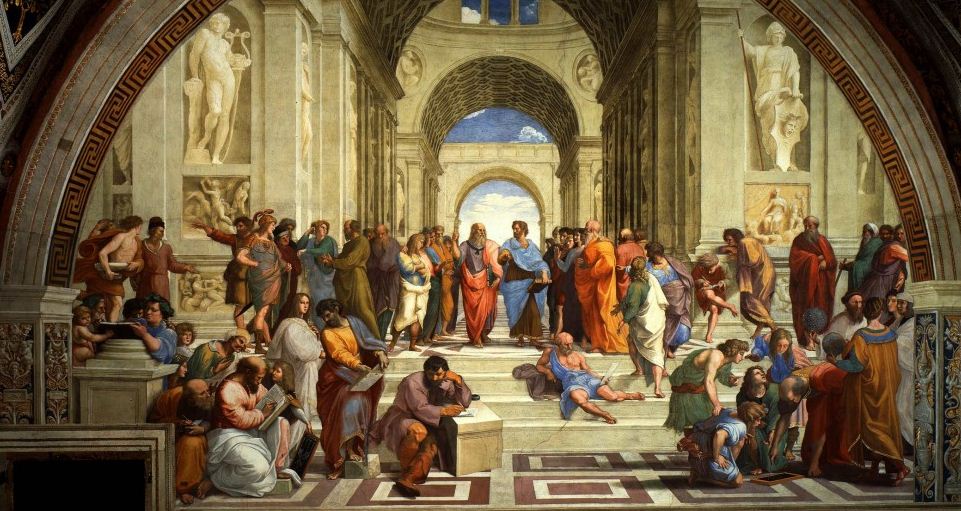
The greek school of thought

Early references suggest that philosophy then was more intuitional, though it indicates a thought system acquired by intuitive experience and sustained by logical argument. Just like the Greeks term philos as love for wisdom; Indians call philosophy as Darshana and the field as darshan shastra. The word darshan in itself is vague but philosophically it means putting intuition to proof and propagating logically. A darshan is a spiritual perception, a whole view revealed to the soul sense. This soul sight, which is possible only when and where philosophy is lived, is distinguishing mark of a true philosopher. Only purity of soul can make a triumphant philosophy and an awakened philosopher. This purity is based on profound acceptance of experience, realized only when some point of hidden strength within man, from which he can not only inspect but comprehend life, is found. Philosophies arise from experiences of senses and soul and involves adroit introspection.

Philosophy seeks truth and the one in practice is a philosopher. The seeker after truth must satisfy certain essential conditions before he sets out on his quest. Samkara, in his commentary on first sutra of the Vedanta Sutras, makes out the four conditions essential for any student of philosophy.

Sri Samkara was a marvelous genius. He was a master of logic. Samkara’s philosophical conquests are unique in the world.  He expounded the doctrine of Advaita Vedanta.

The first condition is knowledge of the distinction between the eternal and the non-eternal.This means having a metaphysical bent that will not accept all it sees to be absolutely real and justified. There must be a questioning tendency in the inquirer and the spirit to probe all things, a burning imagination which could extract truth from mass of apparently disconnected data. The student must have a habit of meditation which allows him remain focussed.

The second condition is the subjugation of the desire for the fruits of action either in present life or a future one. It demands renunciation of all petty desires, personal motive and practical interests. The philosopher is a naturalist who should follow the movement of things without exaggerating the good and belittling the evil based on his prejudices. So, it is said that he must have no love of present or the future. Clear thinking and honest judgement must be developed.

To achieve a modest temper, he must suffer a change in heart, where a student is meant to acquire tranquillity, self-restraint, renunciation, patience, peace of mind and faith. This counts the third condition which asserts that only a trained mind which utterly controls the body can inquire and meditate endlessly till the end of life, never losing sight of the object and not for a moment letting it obscured by any terrestrial temptation. Such a courage to lose all for his highest end has to be developed. Physical and mental difficulties are to occur and in the midst of all suffering, he must build discipline. A spiritual discipline which includes pitiless self-examination will enable the seeker to reach his end of freedom.

The fourth condition is the desire for moksha or release. The one who has renounced all his material desires and is metaphysically minded has only one devouring desire to achieve the end or reach the eternal.

CONCLUSION

 Men have become so sceptical to trust their own decisions and judgements of life that they take refuge in scriptures, authority and tradition. Little do we create our own for ourselves and mankind.  The early geniuses – the philosophers, comprehended experiences on behalf of mankind, so the latter are eternally grateful to them. So, Question yourself and introspect how am I a philosopher? beacuse –

“The unexamined life is not worth living”

– Socrates

Sources

  • Indian Philosophy by S. Radhakrishnan

Implementation of New Education Policy

 A number of action points/activities for implementation in school education as well as higher education are mentioned in the National Education Policy 2020 which inter-alia include following:-

  1. Ensuring Universal Access at All Levels of schooling from pre-primary school to Grade 12;
  2. Ensuring quality early childhood care and education for all children between 3-6 years;
  3. Introducing New Curricular and Pedagogical Structure (5+3+3+4);
  4. Ensuring no hard separations between arts and sciences, between curricular and extra-curricular activities, between vocational and academic streams;
  5. Establishing National Mission on Foundational Literacy and Numeracy;
  6. Emphasis on promoting multilingualism and Indian languages; The medium of instruction until at least Grade 5, but preferably till Grade 8 and beyond, will be the home language/mother tongue/local language/regional language.
  7. Assessment reforms – Introducing Board Exams on up to two occasions during any given school year, one main examination and one for improvement, if desired;
  8. Setting up of a new National Assessment Centre, PARAKH (Performance Assessment, Review, and Analysis of Knowledge for Holistic Development);
  9. Equitable and inclusive education – Ensuring special emphasis to be given on Socially and Economically Disadvantaged Groups(SEDGs);
  10. Establishing a separate Gender Inclusion fund and Special Education Zones for disadvantaged regions and groups;
  11. Robust and transparent processes for recruitment of teachers and merit based performance;
  12. Ensuring availability of all resources through school complexes and clusters;
  13. Setting up of State School Standards Authority (SSSA);
  14. Providing Exposure of vocational education  in school and higher education system;
  15. Increasing GER in higher education to 50%;
  16. Introducing Holistic Multidisciplinary Education with multiple entry/exit options;
  17. Introducing Common Entrance Exam for Admission to HEIs to be offered by NTA;
  18. Establishment of Academic Bank of Credit;
  19. Setting up of Multidisciplinary Education and Research Universities(MERUs);
  20. Setting up of National Research Foundation(NRF);
  21. Framing ‘Light but Tight’ regulation;
  22. Setting up of single overarching umbrella body for promotion of higher education sector including teacher education and excluding medical and legal education- the Higher Education Commission of India (HECI)-with independent bodies for standard setting- the General Education Council; funding-Higher Education Grants Council (HEGC); accreditation- National Accreditation Council (NAC); and regulation- National Higher Education Regulatory Council (NHERC);
  23. Expansion of open and distance learning to increase GER.
  24. Internationalization of Education.
  25. Professional Education will be an integral part of the higher education system. Stand-alone technical universities, health science universities, legal and agricultural universities, or institutions in these or other fields, will aim to become multi-disciplinary institutions.
  26. Teacher Education – Introduction of 4-year integrated stage-specific, subject- specific Bachelor of Education.
  27. Establishing a National Mission for Mentoring.
  28.  Creation of an autonomous body, the National Educational Technology Forum (NETF) to provide a platform for the free exchange of ideas on the use of technology to enhance learning, assessment, planning, administration. Appropriate integration of technology into all levels of education.
  29. Achieving 100% youth and adult literacy.
  30. Introducing multiple mechanisms with checks and balances to combat and stop the commercialization of higher education.
  31. All education institutions will be held to similar standards of audit and disclosure as a ‘not for profit’ entity.
  32. The Centre and the States will work together to increase the public investment in Education sector to reach 6% of GDP at the earliest.
  33.  Strengthening of the Central Advisory Board of Education to ensure coordination to bring overall focus on quality education.
  34.  Ministry of Education: In order to bring the focus back on education and learning, it may be desirable to re-designate MHRD as the Ministry of Education (MoE).

A detailed consultation process with various stakeholders including educationists have been held before and after announcement of National Education Policy 2020. Suggestions have been invited from States / UTs Government and also from other stakeholders through MyGov platform. Department of School Education & Literacy has constituted subject-wise/theme-wise implementation committees of experts for implementation of National Education Policy 2020. Similarly, UGC and AICTE have also constituted Expert Groups on various themes of higher education sector for formulation of Implementation Plan of National Education Policy.

As per National Education Policy 2020, implementation of the Policy requires multiple initiatives and actions, which will have to be taken by multiple bodies in a synchronized and systematic manner. Therefore, the implementation of this Policy will be led by various bodies including Ministry of Education, CABE, Union and State Governments, education-related Ministries, State Departments of Education, Boards, NTA, the regulatory bodies of school and higher education, NCERT, SCERTs, schools, and HEIs. Since Education is in the concurrent list of Constitution of India, hence, State/UT Government will play a vital role in the implementation of the National Education Policy. Ministry of Education has communicated to all States/UT Governments for taking steps for implementation of NEP 2020. In this direction, Ministry of Education had organised ‘Shikshak Parv’ from 8th September to 25th September, 2020 to deliberate on various themes and implementation of NEP 2020 aimed at eliciting suggestions. Ministry had also organised a Conference of Governors on “Role of National Education Policy in Transforming Higher Education”. In the conference, Governors and Lt. Governors of State and Union Territories, Education Minister of State and UTs, Vice Chancellors of State Universities and other dignitaries participated. Majority of states have taken steps toward implementation of NEP 2020. Further, Ministry and other implementing agencies under its purview have started taking initiatives towards implementation of NEP 2020.

Initiatives by Navodaya Vidyalaya Samiti to ensure continuity of education

 Navodaya Vidyalaya Samiti (NVS) with the support of Ministry of Education, MHA and state administration ensured safe return of 3173 migrated students of Class-IX during COVID pandemic period. By imparting online training to teachers and conducting online classes, NVS made all efforts to ensure no academic loss to students. For students without proper devices, proper education is being ensured by providing study materials, AAC and printed assignments.  The following activities in academics and capacity building were undertaken:  

  1. Academics
  • Opening of JNVs: NVS developed SOP for opening of JNVs on the basis of SOP issued by MOE, MHA & MoHFW by incorporating the salient features of state administration guidelines.  Accordingly, Students of classes X and XII have reported in JNVs for physical classes with their parents’ consent. 406 JNVs have been reopened in states/UTs where permission to open residential schools have been given. Bridge courses and special classes are being carried out for the students to fill up the learning gaps.  National Pre board Exams have been completed for classes X and XII. 
  • Launch of Vigyan Jyoti Phase-2: Vigyan Jyoti Project is an ambitious collaborative initiative between Dept. of Science & Technology and Navodaya Vidyalaya Samiti for promotion of Girls Students in JNVs. Vigyan Jyoti Project (Phase I) is going successfully in 58 JNVs since December 2019.  The same is extended to 42 more JNVs in Phase-II.
  • Fulbright Teacher Exchange Program:  Mr Vivekananda Gosh, JNV Kolar Karnataka & Mr Amit Kumar, JNV Shimla Himachal Pradesh have been selected for the Fulbright Teaching Excellence Achievement (FTEA) & The Fulbright Distinguished Awards in Teaching Program for International Teachers (FDAI) for 2020-21.

B.    Capacity building  Programmes in collaboration with other organizations

  1. Six Days’ Training Programme for Regional Language Teachers in collaboration with CIIL, Mysore in light of NEP-2020

Keeping in view the importance of Regional languages as per NEP-2020, 45 Malayalam, 106 Marathi, 94 Kannada & 69 Telugu language teachers of NVS have been trained.

  1. Five Days’ Online Training Programme on Pedagogical Leadership for NVS Principals in collaboration with NIEPA New Delhi

NEP-2020 has outlined the Role of Principals focussing on preparing & implementing Pedagogical Plans based on Competency based Education. NVS in collaboration with NIEPA, New Delhi is organizing Five Days’ Online Training for preparing Principals as Master Trainers to impart further training to their fellow Principals on Pedagogical Leadership in two batches of 50 Participants in each batch. The training programme for the first batch is scheduled from 22nd February, 2021 and second programme is scheduled in the month of April, 2021.

C. Kala Utsav 2020- NVS Performance

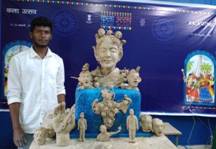
In Kala Utsav-2020, RUPESH DEBBARMA from JNV Gomti, Tripura won first prize in Folk Music and D VENKAT RAO from JNV East Godavari, AP won first prize in 3D Sculpture. 


D VENKAT RAO from JNV East Godavari, AP who won first in 3D Sculpture


RUPESH DEBBARMA from JNV Gomati, Tripura who won first in Folk Music

*****