Synergy between education and skills for making a future-ready workforce

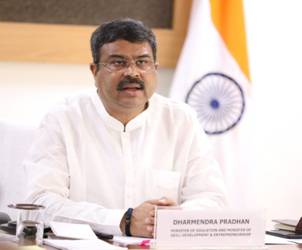
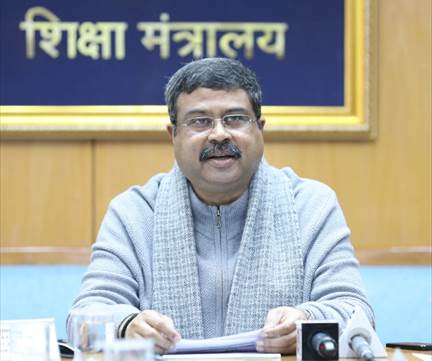
 Addressing the CII’s virtual special plenary session on ‘Job Creation & Entrepreneurship – Way Ahead for Livelihood Generation’, Union Education and Skill Development Minister Shri Dharmendra Pradhan said that under the leadership of Prime Minister Shri Narendra Modi, the economy is growing at a rapid pace and the future of India is looking very promising. He added that building skill capacity is a key to enhance productivity and drive the economy ahead. 

Shri Pradhan highlighted that continuous efforts are being made to equip our youth with the 21st Century Skills. He said that as envisioned in the National Education Policy (NEP) -2020, the Government is working to create greater synergy between education and skills for making a future-ready workforce. NEP will contribute in creating a robust education ecosystem and eventually facilitating economic growth, he added.

The Minister informed that Educational institutions and skill development centers have been affected during the pandemic but Government ensured continuity of education by developing digital content at a large scale. He further informed that in the near future every village will be connected with high-speed Internet and these mass-scale digitization efforts are creating new education, skilling, and entrepreneurial ecosystems. 

Shri Pradhan stressed that teachers play an important role in building society and technology is reshaping society. With the greater advent of technology and changing society, our teachers need to be re-skilled and up-skilled, he added. 

Shri Pradhan urged that as we celebrate “Azaadi ka Amrut Mahotsav”, we must work together to make our youth future-ready who will lead India towards the goal of an Aatmanirbhar Bharat. He stated that with this goal, India is going to witness rapid economic growth and will become the engine of global growth. The Minister called upon the industry to contribute to this mission.

Shri Ajay Shriram, Chairman and Senior MD, DCM Shriram Ltd, Shri Chandrajit Banerjee, Director General, CII , Dr. Gayathri Vasudevan , Pratham Education Foundation and other industry experts attended the session.

*****

Shikshak Parv 2021 to commence from 5th September

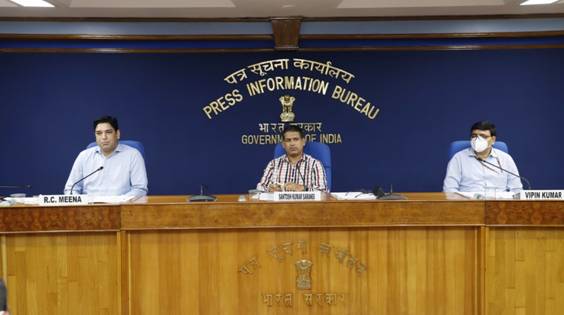
 Shri Santosh Kumar Sarangi, Additional Secretary, School Education, Shri R.C.Meena, Joint Secretary and Shri Vipin Kumar, Joint Secretary held a press conference on the upcoming National Award to Teachers and Shikshak Parv here today.

Shri Sarangi informed that in recognition of valuable contributions of our teachers and to take New Education Policy (NEP) 2020 a step forward, like the previous year this year too, the Department of School Education & Literacy has decided to celebrate Shikshak Parv-2021. Shikshak Parv 2021 will commence from 5th September, 2021 till 17th September through virtual mode, he said.

On vaccination drive to vaccinate more than 2 crore teachers, Shri Sarangi said that the vaccination progress in the states is being monitored by the Department of School Education and Literacy. This will also contribute to decisions pertaining to school reopening.

Shri Meena informed that President Shri Ram Nath Kovind will confer the awards to 44 Awardees through virtual mode on 5th September, 2021. A documentary film on each of the 44 Awardee Teachers will also be shown. He further informed that the National Awards to Teachers were first instituted in 1958 to recognize excellence and commitment of teachers in shaping the minds as well as future of the youth. The award was to accord public recognition to meritorious teachers working in elementary and secondary schools, he added.   

Shri Vipin Kumar informed that Prime Minister Shri Narendra Modi will be addressing the teachers, students, parents and stakeholders associated with education on 7th September, 2021 at 11 AM.  He also informed that Prime Minister will be launching five initiatives of the Department, that is, Indian Sign Language dictionary of 10,000 words, Talking Books (audio books for visually impaired), School Quality Assessment and Accreditation Framework (SQAAF) of CBSE, NISTHA teachers’ training programme for NIPUN Bharat, and Vidyanjali Portal (for facilitating education volunteers/donors/CSR contributors for school development). The conclave will be attended by Shri Dharmendra Pradhan, Union Minister for Education; Smt. Annpurna Devi, Minister of State for Education; Dr.Subhas Sarkar, Minister of State for Education and Dr.Rajkumar Ranjan Singh, Minister of State for Education along with senior officials of the Ministry.

Shri Vipin Kumar said that the inaugural conclave will be followed by webinars, discussions, presentations etc. upto 17th September, 2021 in which the educational practitioners from various schools of the country have been invited to share their experience, learnings and the roadmap ahead. It is noteworthy that teachers and practitioners from even remote schools will be speaking on issues relating quality and innovation in schools. The SCERT and DIETs in respective states will also be deliberating further on each of the webinars and suggesting the roadmap which will be consolidated by State SCERT. These will be shared with NCERT and provide inputs for curricular framework and teacher training modules, he said.

He highlighted that the theme of Webinars has been further segregated into nine sub-themes in the subsequent webinars such as Technology in Education: NDEAR, Foundational Literacy and Numeracy: A Pre-requisite to Learning and ECCE, Nurturing Inclusive Classrooms etc.  to highlight the best practices and initiatives which can be adopted by schools of India.

*****

NEP to revolutionize the educational sector in India

 Union Minister of Education Shri Dharmendra Pradhan conferred AICTE- Visvesvaraya Best Teacher Award to 17 faculty members in Engineering and Technology whereas 3 faculty members were awarded the AICTE-Dr. Pritam Singh Best Teacher Award in Management Education. He also conferred Chhatra Vishwakarma Award Clean and Smart Campus Award, 2020 to the winners today.


Minister of State for Education, Dr. Rajkumar Ranjan Singh also graced the occasion. Secretary, Higher Education Shri Amit Khare; Chairman, AICTE, Prof. Anil D Sahasrabudhe, Vice Chairman, AICTE, Prof. MP Poonia and Member Secretary, AICTE Prof. Rajive Kumar also complimented the awardees during the event and highlighted the importance of teachers in nation building.

Speaking on the occasion, Union Minister said that as we complete 75 Years of Independence, the citizens finally have the will to shape India. He stated that the new National Education Policy is expected to revolutionize the educational sector in India and lay the path for the next 25 years as per the Vision 2047 of Prime Minister Shri Narendra Modi. He stressed that the education has to make each one of us more responsible and become Global Citizen. The Minister congratulated AICTE for instituting these 4 awards. Apart from recognizing the efforts of the Teachers, these awards have also brought the spark for innovation, he said.

Shri Pradhan said that the aim of AICTE Visvesvaraya awards is to honour meritorious faculties and encourage them to update themselves to the ever changing needs of higher education at global level and thereby becoming an effective contributor to the knowledge society. Dr. Pritam Singh Best Teacher Award introduced this year only and is conferred on the faculty members for demonstrating teaching excellence and institutional leadership in management education, he added.

Shri Pradhan highlighted that Chhatra Vishwakarma Award provides a platform for our students to look at the societal challenges, with an aim to provide innovative and low-cost solutions. This year again, the council announced the Chhatra Vishwakarma Award 2020, with the theme of “INDIA’S ECONOMIC RECOVERY POST COVID: Reverse migration and rehabilitation plan to support “Atmanirbhar Bharat”. The Minister informed that 24 teams of students who developed very useful and creative solutions for various socio-economic issues have been awarded. The zeal, enthusiasm, innovativeness and hard work of these students will make India a focal point to generate innovative ideas in the near future, he added.

The Minister interacted with all the awardees and appreciated their contribution to the society. While visiting the displayed projects of students, he admired the innovativeness and efforts of winning teams of Chhatra Vishwakarma Award and expressed confidence in India’s bright future. 

Minister of State for Education, Dr. Rajkumar Ranjan Singh motivated the students & all other stakeholders. He encouraged them to enhance their respective activities so that tangible social outcomes are achieved.

Clean and Smart Campus Award, 2020 has also been conferred to selected technical institutes. The award aims to seek engagement with all stakeholders, primarily the student community, to draw their attention towards the immense scope and potential that the technology offers on abstract objectives such as cleanliness, sustainability and environment etc. in line with Swachh Bharat Abhiyan. Winning institutions have displayed great concern and commitment for the environment. All institutions must align their activities with sustainable, clean, and green environmental Policy.

Structuralism

The advent of critical theory in the post-war period, which comprised various complex disciplines like linguistics, literary criticism, Psychoanalytic Criticism, Structuralism, Postcolonialism etc., proved hostile to the liberal consensus which reigned the realm of criticism between the 1930s and `50s. Among these overarching discourses, the most controversial were the two intellectual movements, Structuralism and Poststructuralism originated in France in the 1950s and the impact of which created a crisis in English studies in the late 1970s and early 1980s. Language and philosophy are the major concerns of these two approaches, rather than history or author.

Structuralism which emerged as a trend in the 1950s challenged New Criticism and rejected Sartre‘s existentialism and its notion of radical human freedom; it focused instead how human behaviour is determined by cultural, social and psychological structures. It tended to offer a single unified approach to human life that would embrace all disciplines. Roland Barthes and Jacques Derrida explored the possibilities of applying structuralist principles to literature. Jacques Lacan studied psychology in the light of structuralism, blending Freud and Saussure. Michel Foucault‘s The Order of Things examined the history of science to study the structures of epistemology (though he later denied affiliation with the structuralist movement). Louis Althusser combined Marxism and Structuralism to create his own brand of social analysis.

Structuralism, in a broader sense, is a way of perceiving the world in terms of structures. First seen in the work of the anthropologist Claude Levi-Strauss and the literary critic Roland Barthes, the essence of Structuralism is the belief that “things cannot be understood in isolation, they have to be seen in the context of larger structures they are part of”, The contexts of larger structures do not exist by themselves, but are formed by our way of perceiving the world. In structuralist criticism, consequently, there is a constant movement away from the interpretation of the individual literary work towards understanding the larger structures which contain them. For example, the structuralist analysis of Donne‘s poem Good Morrow demands more focus on the relevant genre (alba or dawn song), the concept of courtly love, etc., rather than on the close reading of the formal elements of the text.

With its penchant for scientific categorization, Structuralism suggests the interrelationship between “units” (surface phenomena) and “rules” (the ways in which units can be put together). In language, units are words and rules are the forms of grammar which order words.

Structuralists believe that the underlying structures which organize rules and units into meaningful systems are generated by the human mind itself and not by sense perception. Structuralism tries to reduce the complexity of human experiences to certain underlying structures which are universal, an idea which has its roots in the classicists like Aristotle who identified simple structures as forming the basis of life. A structure can be defined as any conceptual system that has three properties: “wholeness” (the system should function as a whole), “transformation” (system should not be static), and “self-regulation (the basic structure should not be changed).

Structuralism in its inchoate form can be found in the theories of the early twentieth century Swiss linguist, Ferdinand de Saussure (Course in General Linguistics, 1916), who moved away from the then prevalent historical and philological study of language (diachronic) to the study of the structures, patterns and functions of language at a particular time (synchronic). Saussure’s idea of the linguistic sign is a seminal concept in all structuralist and poststructuralist discourses. According to him, language is not a naming process by which things get associated with a word or name. The linguistic sign is made of the union of “signifier” (sound image, or “psychological imprint of sound”) and “signified” (concept). In this triadic view, words are “unmotivated signs,” as there is no inherent connection between a name (signifier) and what it designates .

The painting This is Not a Pipe by the Belgian Surrealist artist Rene Magritte explicates the treachery of signs and can be considered a founding stone of Structuralism. Foucault‘s book with the same title comments on the painting and stresses the incompatibility of visual representation and reality.

Saussure’s theory of language emphasizes that meanings are arbitrary and relational (illustrated by the reference to 8.25 Geneva to Paris Express in Course in General Linguistics; the paradigmatic chain hovel-shed-hut-house-mansion-palace, where the meaning of each is dependent upon its position in the chain; and the dyads male-female, day-night etc. where each unit can be defined only in terms of its opposite). Saussurean theory establishes that human being or reality is not central; it is language that constitutes the world. Saussure employed a number of binary oppositions in his lectures, an important one being speech/writing. Saussure gives primacy to speech, as it guarantees subjectivity and presence, whereas writing, he asserted, denotes absence, of the speaker as well as the signified. Derrida critiqued this as phonocentrism that unduly privileges presence over absence, which led him to question the validity of all centres.

Saussure’s use of the terms Langue (language as a system) and Parole an individual. utterance in that language, which is inferior to Langue) gave structuralists a way of thinking about the larger structures which were relevant to literature. Structuralist narratology, a form of Structuralism espoused by Vladimir Propp, Tzvetan Todorov, Roland Barthes and Gerard Genette illustrates how a story’s meaning develops from its overall structure, (langue) rather than from each individual story’s isolated theme (parole). To ascertain a text’s meaning, narratologists emphasize grammatical elements such as verb tenses and the relationships and configurations of figures of speech within the story. This demonstrates the structuralist shift from authorial intention to broader impersonal Iinguistic structures in which the author’s text (a term preferred over “work”) participates.

Structuralist critics analyse literature on the explicit model of structuralist linguistics. In their analysis they use the linguistic theory of Saussure as well as the semiotic theory developed by Saussure and the American philosopher Charles Sanders Peirce. According to the semiotic theory, language must be studied in itself, and Saussure suggests that the study of language must be situated within the larger province of Semiology, the science of signs.

Semiology understands that a word’s meaning derives entirely from its difference from other words in the sign system of language (eg: rain not brain or sprain or rail or roam or reign). All signs are cultural constructs that have taken on their meaning through repeated, learned, collective use. The process of communication is an unending chain of sign production which Peirce dubbed “unlimited semiosis”. The distinctions of symbolic, iconic and indexical signs, introduced by the literary theorist Charles Sande  Peirce is also a significant idea in Semiology. The other major concepts associated with semiotics are “denotation” (first order signification) and “connotation” (second order signification).

Structuralism was anticipated by the Myth Criticism of Northrop Frye, Richard Chase, Leslie Fiedler, Daniel Hoffman, Philip Wheelwright and others which drew upon anthropological and physiological bases of myths, rituals and folk tales to restore spiritual content to the alienated fragmented world ruled by scientism, empiricism and technology. Myth criticism sees literature as a system based or recurrent patterns.

The French social anthropologist Claude Levi-Strauss applied the structuralist outlook to cultural phenomena like mythology, kinship relations and food preparation. He applied the principles of langue and parole in his search for the fundamental mental structures of the human mind. Myths seem fantastic and arbitrary yet myths from different cultures are similar. Hence he concluded there must be universal laws that govern myths (and all human thought). Myths consist of 1) elements that oppose or contradict each other and 2) other elements that “mediate” or resolve those oppositions (such as trickster / Raven/ Coyote, uniting herbivores and carnivores). He breaks myths into smallest meaningful units called mythemes. According to Levi-Strauss, every culture can be understood, in terms of the binary oppositions like high/low, inside/outside, life/death etc., an idea which he drew from the philosophy of Hegel who explains that in every situation there are two opposing things and their resolution, which he called “thesis, antithesis and synthesis”. Levi-Strauss showed how opposing ideas would fight and also be resolved in the rules of marriage, in mythology, and in ritual.

In interpreting the Oedipus myth he placed the individual story of Oedipus within the context of the whole cycle of tales connected with the city of Thebes. He then identifies repeated motifs and contrasts, which he used as the basis of his interpretation. In this method, the story and the cycle part are reconstituted in terms of binary oppositions like animal/ human, relation/stranger, husband/son and so on.

Concrete details from the story are seen in the context of a larger structure and the larger structure is then seen as an overall network of basic dyadic pairs which have obvious symbolic, thematic and archetypal resonance. This is the typical structuralist process of moving from the particular to the general placing the individual work within a wider structural content.

A very complex binary opposition introduced by Levi-Strauss is that of bricoleur (savage mind) and an engineer (true craft man with a scientific mind). According to him, mythology functions more like a bricoleur, whereas modern western science works more like an engineer (the status of modem science is ambivalent in his writings). In Levi-Strauss’s concept of bricolage, what is important is that the signs already in existence are used for purposes that they were not originally meant for. When a faucet breaks, the bricoleur stops the leak using a cloth, which is not actually meant for it. On the other hand the engineer foresees the eventuality and he would have either a spare faucet or all the spanners and bolts necessary to repair the tap.

Derrida, the poststructuralist, opposes Levi-Strauss‘s concept of bricolage in his Structure, Sign and Play, saying that the opposition of bricolage to engineering is far more troublesome that Levi-Strauss admits and also the control of theory and method, which Levi-Strauss attributes to the engineer would seem a very strange attribution for a structuralist to make.

In Mythologies he examines modern France from the standpoint of a cultural theorist. It is an ideological critique of products of mass bourgeois culture, like soaps, advertisements, images of Rome etc., which are explained using the concept of ‘myth’. According to Barthes, myth is a language, a mode of signification. He reiterates Saussure’s view that semiology comprises three terms: signifier, signified and sign, in which sign is a relation between the signifier and signified. The structure of myth repeats this tri-dimensional pattern. Myth is a second order signifying system illustrated by the image of the young Negro in a French uniform saluting the french flag, published as the cover page of the Parisian magazine, Paris Match, which reveals the myth of French imperialism at the connotative level.

The complexity and heterogeneity of structuralism, which is reflected even in the architecture of this period (eg., structuralist artefacts like Berlin Holocaust Memorial, Bank of China Tower, etc) paved the way to poststructuralism which attacked the essentialist premises of structuralism. Poststructuralism argues that in the very examination of underlying structures, a series of biases are involved. Structuralism has often been criticized for being ahistorical and for favouring deterministic structural forces over the ability of people to act. As the political turbulence of the 1960s and 1970s (especially the student uprising of May 1968) began affecting the academy, issues of power and political struggle moved to the centre of people’s attention. In the 1980s deconstruction and its emphasis on the fundamental ambiguity of language—rather than its crystalline logical structure—became popular, which proved fatal to structuralism.


Conclave of Shikshak Parv

 Prime Minister Shri Narendra Modi addressed the inaugural conclave of Shikshak Parv today via video conferencing. He also launched Indian Sign Language Dictionary (audio and text embedded sign language video for the hearing impaired, in conformity with Universal Design of Learning), Talking Books (audiobooks for the visually impaired), School Quality Assurance and Assessment Framework of CBSE, NISHTHA teachers’ training programme for NIPUN Bharat and Vidyanjali portal (for facilitating education volunteers/ donors/ CSR contributors for school development). The conclave was attended by Shri Dharmendra Pradhan, Union Minister for Education, Smt. Annpurna Devi, Minister of State for Education, Dr. Subhas Sarkar, Minister of State for Education, Dr. Rajkumar Ranjan Singh, Minister of State for Education and senior officials of the Ministry of Education.

Addressing the gathering, the Prime Minister congratulated the teachers who have received the National Award. He commended the contribution the teachers have made for the future of students in the country in difficult times. He said that today, on the occasion of Shikshak Parv, many new schemes have been started which are also important because the country is currently celebrating the Azadi ka Amrit Mahotsav. Taking new resolutions for how India will be after 100 years of independence. The Prime Minister praised students, teachers and the entire academic community for rising up to the challenge of pandemic and asked them to take forward the capabilities developed to deal with that difficult time. “If we are in the midst of a transformation period, fortunately, we also have modern and futuristic new National Education Policy”, he said.

The Prime Minister praised the contribution of academicians, experts, teachers, at every level of the formulation of the National Education Policy and its implementation. He urged everyone to take this participation to a new level and also to involve society in it. These transformations in the education sector are not just policy-based but also participation -based, he added.

The Prime Minister said ‘Vidyanjali 2.0’ is like a platform for the country’s resolve of ‘Sabka Prayas’ with ‘Sabka Saath, Sabka Vikas, Sabka Vishwas’. In this society, our private sector has to come forward and contribute to increasing the quality of education in government schools.

The Prime Minister said that in the last few years, public participation is again becoming the national character of India. In the last 6-7 years, due to the power of public participation, many things have been done in India, which were difficult to imagine earlier. When society does something together, then the desired results are assured, he said. The Prime Minister said that everyone, in whichever sphere of life, has a role in shaping the future of the youth. He recalled the stellar performance of our athletes in the recently concluded olympics paralympics. He expressed happiness that athletes have accepted his request that every player visit at least 75 schools during Azadi Ka Amrit mahotsav. This will inspire the students and many talented students will get encouragement to go forward in the field of sports, he said.

The Prime Minister said that for the progress of any country, education should not only be inclusive but should also be equitable. He added that National Digital Architecture i.e. N-DEAR is likely to play a major role in eradicating inequality in education and its modernization. N-DEAR will act as a ‘super-connect’ between various academic activities in the same way as UPI interface revolutionized the banking sector.  The country is making technology like Talking Books and Audiobooks a part of education. He said

School Quality Assessment and Assurance Framework (S.Q.A.A.F), which was operationalized today, would address the deficiency of the absence of a common scientific framework for dimensions like curricula, pedagogy, assessment, infrastructure, inclusive practices and governance process. SQAAF will help in bridging this inequality.

He added that in this rapidly changing era, our teachers also have to learn about new systems and techniques rapidly. He informed that the country is preparing its teachers for these changes through ‘Nishtha’ training programs.

The Prime Minister said Teachers of India not only meet any global standard, but they also have their special capital. This special capital, this special strength is the Indian culture within them. He said our teachers do not consider their work as a mere profession, teaching for them is marked by human empathy, a sacred moral duty. That is why we do not have a mere professional relationship between the teacher and the children, but a family relationship. And this relationship is for life, the Prime Minister added.

Speaking on the occasion Union Minister Shri Dharmendra Pradhan expressed his gratitude to the Prime Minister Shri Narendra Modi for sharing his vision and thoughts on New Education Policy 2020 and on India’s journey towards becoming a world leader in education. The Prime Minister himself launching multiple initiatives in the education sector and his regular interaction with the stakeholders reflect his commitment to foster an education system aligned with the aspirations of a 21st-century India, he added. Shri Pradhan said that the celebration of Shikshak Parv will encourage innovative practices to ensure not only spread of education at all levels but also to improve quality, institutionalise inclusive practices and enhance sustainability in the schools.

The theme of Shikshak Parv has been identified keeping in view three of the five pillars of Azadi Ka Amrit Mahotsav celebrations – Ideas@75, Actions@75 and Achievements@75 and looks at the practitioners of school education like Teachers, Principals, etc. to share their experiences on webinars based on the current year’s theme: “Quality and Sustainable Schools: Learnings from Schools in India”.

The inaugural conclave was followed by a technical session on the current year’s theme: “Quality and Sustainable Schools: Learnings from Schools in India” chaired by Dr. K. Kasturirangan, Chairman, National Education Policy Committee and Prof. J.S. Rajput Former Director, NCERT and other educationists. They shared their experiences during the conclave.

Till 17th September, webinars, discussions, presentations have been scheduled in which the educational practitioners from various schools of the country have been invited to share their experience, learnings and the roadmap ahead. It is noteworthy that teachers and practitioners from even remote schools will be speaking on issues relating quality and innovation in schools. The SCERT and DIETs in respective states will also be deliberating further on each of the webinars and suggesting the roadmap which will be consolidated by State SCERT.  

A large number of teachers, principals, students, parents and stakeholders attended the Shikshak Parv inaugural conclave and subsequent webinars from across the country.

*****

Education is an important tool for national character building

Prime Minister Shri Narendra Modi addressed the inaugural conclave of Shikshak Parv on 7 September, 2021 via video conferencing. The inaugural conclave was followed by a technical session on the current year’s theme: “Quality and Sustainable Schools: Learnings from Schools in India”. Smt. Annapurna Devi, Minister of State for Education was the chief guest on the occasion. The session was chaired by Dr. K. Kasturirangan, Chairman, National Education Policy Committee. Prof. J.S. Rajput Former Director, NCERT and senior officials of the Ministry were present on the occasion.

Speaking on the occasion Smt Annapurna Devi stated that the development of a nation is dependent on education as education is an important tool for national character building.  Therefore capacity building of children is essential. Follow the website to ensure better capacity for your child.  She stressed that it is important that both teachers ad children learn together, they must also learn the local skills and acquire experience based learning to make education more relevant in present times. She also mentioned that quality and sustainability are two sides of the same coin. Smt Annapurna Devi hoped that the discussions and ideas that emerge out of this conclave will help in realising the vision of our Prime Minister of strengthening the education system of our country.

Sh. Kasturiangan appreciated the efforts of the Ministry of Education in organising this important conclave with the Prime Minister setting the tone of the deliberations for the forthcoming sessions and also lauded the initiatives that have been taken to realised the vision of NEP 2020. He also appreciated the efforts taken by Sh. Dharmendra Pradhan, Minister of Education for the steps taken by him to realise the goals of NEP in such a short span of time. He pointed out that owing to the outbreak of Covid 19 there were some disruptions as well as learning loss among children and hopes that many of these issues and challenges will be addressed during the conclave.  He emphasised on focusing on four issues in this regard: Firstly, the Foundational Literacy and Numeracy is an important aspect mentioned in NEP 2020. Secondly, community engagement and support is also required to ensure that all children are retained in school. The thirds point is curricular transformation with regard to which the NEP focuses on lessening the burden so that there is more scope for other forms of learning. The fourth issue relates to the teachers who are central to the education system and have an important role to play in bridging the gap of learning loss.   Thus restoring quality education and maintaining sustainability are the two major challenges, beside the challenges posed by the pandemic. 

Prof. J.S. Rajput said there is a need to restore respect for teachers. He further said that, teachers must also remember that they must first know the child, understand the mind of the child and remember that nothing can be taught but learnt. Learning is the treasure within, teachers can only   inspire the learners to realise the treasure from within, he added.

Prof. Rajput highlighted that there is a social responsibility of parents, principals, teachers and community to feel a sense of belonging towards the school. The pandemic has given us a chance to improve the environment of government schools in terms of access, security and quality of teaching, teacher student ratio, etc., he added. He concluded by saying that three things are very important to re- establish the glory of rich educational heritage of India in the world:   Lifelong Learning, Learning to Learn and Learning to Live Together.

Prof. Sridhar Srivastava, Director, NCERT, welcomed the participants to the concluding session of the Conclave. He highlighted the active role played by NCERT during the pandemic situation by supporting the education in the online mode, developing teaching-learning resources such as the Alternative Academic Calendar, PRAGYATA Guidelines and NISHTHA 2.0 online training modules for supporting teachers. He further said that this year’s Shikshak Parv adopts a “whole-school” approach; one that extends beyond the curriculum and addresses the entire planning, operation and management of the school facility. He informed that the upcoming nine National Webinars during Shikshak Parv will focus on various themes that will help all those connected to the Parv learn from schools and teachers. NCERT will incorporate the learnings from schools into the National Curriculum Framework (NCF), which is under development at present, he added.

Smt. Anita Karwal thanked Smt Annapurna Devi, Dr. K. Kasturirangan, Prof. J.S. Rajput and all the speakers. She stated some of the initiatives taken by teachers are eye openers such as starting entrepreneurship for grade I, exposure of nature these are excellent examples of connecting learning to real life. There is need to build capacity of school, society and of parents to participate hand in hand to bring sustainability, she added.

*****

Universalisation of Quality Education through Digital Education

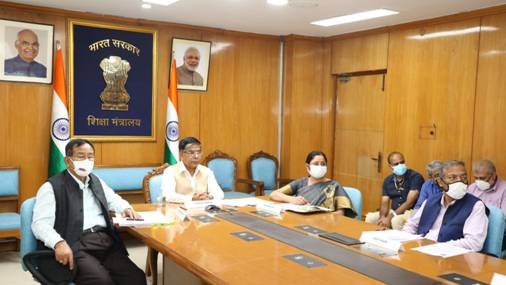
 Union Education Minister Shri Dharmendra Pradhan held a meeting on universalisation of quality education through digital education. Minister of State for Education Smt. Annapurna Devi, Smt Anita Karwal, Secretary, DoSE&L, Dr. T.P. Singh, DG, BISAG-N, Shri Shashi S. Vempati, CEO, Prasar Bharati and other officials from the Ministry of Education were also present in the meeting.

Discussion centred on leveraging satellite technology and internet to develop an integrated digital ecosystem. The Minister called for an innovative approach to leverage technology to further expand the existing platforms to cover all spectrums of School Education, Higher Education, Skill Development and Teachers training. He called for strengthening and expanding the existing Swayam Prabha Initiative and synergize initiatives like National Digital Education Architecture (NDEAR) and National Educational Technology Forum (NETF). Shri Pradhan stressed on the need to bridge digital divide and reach the unreached to bring greater inclusion in education.

The Minister said that a committee may be formed under Chairpersonship of Secretary, DoSE&L with senior officials from School Education, Higher Education, Ministry of Skill Development, Ministry of Electronics and Information Technology, Dept of Telecommunication, Prasar Bharti, Ministry of I&B, BISAG-N and Department of Space.


*****

National webinar on Strengthening Indian Languages for Holistic Educational Attainment

 Ministry of Education and University Grants Commission organised a national webinar on Strengthening Indian Languages for Holistic Educational Attainment today, as part of the webinar series on Good Governance being held from 17th September, 2021 to 7th October, 2021. Minister of State for Education Smt. Annapurna Devi was the Chief Guest for the webinar.

Addressing the inaugural session, Smt. Annapurna Devi talked about the vision of Prime Minister towards Atmanirbhar Bharat. She stressed that preservation and promotion of Indian languages is crucial for the unity and integrity of nation. She highlighted that Indian languages have not received their due attention and care, with the country losing over 220 languages in last 50 years alone. The Minister said that teaching and learning of Indian languages need to be integrated with school and higher education at every level.

Smt Annapurna Devi stated that the National Education Policy will act as a medium of connectivity between local to global by creating an opportunity for teaching-learning in regional dialects and Indian languages. Further, she mentioned that the nation’s development is possible only by strengthening and preserving our Indian languages. Smt Devi emphasised the importance to extend academic and social support to strengthen Indian languages for holistic development of the education sector including learners and teachers.

Shri Amit Khare, Secretary, Higher Education while addressing the webinar touched upon the benefits of learning in our own mother languages such as developing critical thinking, building better understanding of knowledge system, etc. Shri Khare elaborated the role of NEP to revive Indian languages that are being extinct..

The Webinar Strengthening Indian Languages for Holistic Educational Attainment provided a platform for eminent academicians, educationalists, administrators to explore future ways of providing deserving attention and efforts to Indian languages, dialects to holistic development of the learners.

Prof. Sachhidananda Joshi, Member Secretary, Indian Gandhi national Centre for the Arts in his keynote address urged upon changing our perception of Indian languages. Majority of the knowledge is conceived from the age of 0-6 years and this is a crucial period of educating the young minds in their mother languages, he added. He talked about the linkages between culture and education as the two being inseparable yet independent. He urged to accommodate different words from different languages to enrich our dictionaries and vocabularies.

Secretary (HE), Shri Amit Khare, Chairman, UGC Prof. D.P. Singh, senior officials from Ministry of Education and University Grants Commission attended the webinar.

The technical session was chaired by Prof. Balwant Jani, Chancellor, Dr. Hari Singh Gour University, Sagar. Prof. Sanjay Dwivedi, Director General, Indian Institute of Mass Communication, New Delhi; Prof. Hanuman Prasad Shukla, Pro-Vice Chancellor, Mahatma Gandhi Antarrashtriya Hindi Vishwavidyalaya, Wardha and Prof. R K.Pandey, Vice-Chancellor, Shri Lal Bahadur Shastri National Sanskrit University addressed various aspects of Indian languages at the session as experts.

*****

India is building global competencies to fulfill 21st century aspirations

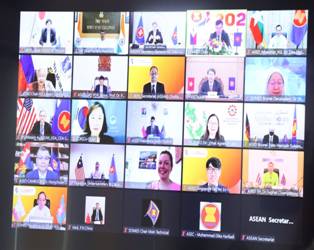
 ‘India is building global competencies to fulfill 21st century aspirations’, said Shri Dharmendra Pradhan, Union Minister for Education and Skill Development at 5th East Asia Summit (EAS) Education Ministers Meeting. Shri Rajkumar Ranjan Singh, Minister of State for Education and senior officials of the Ministry also attended the meeting.   

Speaking on the occasion, Shri Pradhan reaffirmed India’s commitment foster long-term and mutually beneficial educational cooperation in sync with the complementarities outlined in the Manila Action Plan.


The Minister shared the objectives of India’s National Education Policy, including universalisation of education, ensuring equity, quality, affordability & flexibility, technology-based learning and several others which uphold the principles of the Manila Action Plan on Education.

Shri Pradhan spoke about the multi-modal digital interventions, like PM-eVidya, Swayam, Diksha, etc which ensured continuity of learning during the pandemic and also on the continuous efforts to ramp up the digital infrastructure to facilitate on demand learning and bridge the digital divide.

The Minister said that in line with the vision of Prime Minister Shri Narendra Modi, India remains committed to forge meaningful partnerships in making education and skills more inclusive, affordable, equitable, vibrant and aspirational.

Shri Pradhan also reaffirmed India’s support to strengthening research and academic collaborations, including in TVET, promoting student & academic exchanges for fulfilling aspirations of the students.

*****

Samagra Shiksha Abhiyan

 The aim of the redesigned Samagra Shiksha Scheme is to universalize access to school education; to promote equity through the inclusion of disadvantaged groups and weaker sections, and to improve the quality of education across all levels of school education from pre-primary to class XII.

The major objectives of the Scheme are: (i) Support States and UTs in implementing the recommendations of the National Education Policy 2020 (NEP 2020); (ii) Support States in implementation of Right of Children to Free and Compulsory Education (RTE) Act, 2009; (iii) Focus on Early Childhood Care and  Education; (iv) Emphasis on Foundational Literacy and Numeracy; (v) Thrust on Holistic, Integrated, Inclusive and activity based Curriculum and Pedagogy to impart 21st century skills among the students; (vi) Provision of quality education and enhancing learning outcomes of students; (vii) Bridging Social and Gender Gaps in School Education; (viii) Ensuring equity and inclusion at all levels of school education; (ix) Strengthening and up-gradation of State Councils for Educational Research and Training (SCERTs)/State Institutes of Education and District Institutes for Education and Training (DIET) as nodal agency for teacher training; (x) Ensuring safe, secure and conducive learning environment and maintenance of standards in schooling provisions and (xi) Promoting vocational  education.

The major interventions, across all levels of school education, proposed under the scheme are: (i) Universal Access including Infrastructure Development and Retention; (ii) Foundational Literacy and Numeracy, (iii) Gender and Equity; (iv) Inclusive Education; (v) Quality and Innovation; (vi) Financial support for Teacher Salary; (vii) Digital initiatives; (viii) RTE Entitlements including uniforms, textbooks etc.; (ix) Support for ECCE; (x) Vocational Education; (xi) Sports and Physical Education; (xii) Strengthening of Teacher Education and Training; (xiii) Monitoring; (xiv) Programme Management; and (xv) National Component.

The redesigned Samagra Shiksha recommends to enhance the direct outreach of the scheme by providing child centric interventions directly to the students through DBT mode.

Under Samagra Shiksha financial assistance is provided to States/ UTs for various ICT and Digital initiatives for setting up of ICT labs, smart classrooms including support for digital boards, virtual classrooms and DTH channels.  States have an option to avail non-recurring grant for setting up of ICT labs in schools having classes 6 to 12 up to Rs. 6.40 lakh per school and recurring grant of up to Rs. 2.40 lakh per school per annum for a period of 5 years OR non-recurring grant of Rs. 2.40 lakh for Smart Class rooms (Maximum 2 smart classrooms per school) and recurring grant of Rs. 0.38 lakh. The recurring cost includes support for instructor, E Content and Digital Resources, Charges for Electricity and Internet connectivity, etc.

G20 Research Ministers’ Meeting virtually

 The Minister of State for Education Shri Subhas Sarkar participated in the G20 Research Ministers’ meeting today. The meeting was hosted in blended mode by Italy. G20 Education Ministers exchanged views on enhancing research collaborations and sharing digital space among G20 Countries for a strong, sustainable, resilient and inclusive recovery. MoS, Education, Smt. Annpurna Devi; MoS, Education, Dr. Rajkumar Ranjan Singh, Secretary Higher Education Shri Amit Khare and senior officials of the Ministry were also present during the meeting..

Representing India, Shri Subhas Sarkar reiterated the country’s commitment to promote research and to skill, reskill and upskill the youth and collaborating with other G-20 countries to achieve this objective. He said that India attaches great importance to work with G20 partners and find evidence-based solutions to common problems.

Speaking on National Education Policy, 2020, the Minister said India’s National Education Policy launched in 2020 under the guidance of Prime Minister Shri Narendra Modi, seeks to strengthen the research ecosystem of the country by establishing a National Research Foundation.

The Minister informed that India has introduced AI in the school curriculum from grade 6 onwards and also started engineering courses in regional languages to ensure that language does not pose a hurdle to higher learning and research. The Minister further informed that the Government of India supports diverse schemes like SPARC and GIAN to promote academic and research collaboration between India and other countries. Indian institutions are entering into twinning arrangements with foreign universities. We have set up an Academic Bank of Credit that will facilitate such arrangements, he added.

He highlighted that during the pandemic, Indian Higher Educational institutions worked on research projects and developed vaccines against Covid 19, low-cost ventilators and many other medical equipments.

The Minister stated that India emphasizes leveraging relevant technologies for maximum gain in the education sector, for which a National Education Technology Forum as an umbrella body is launched.

India acknowledges the concerted efforts being made by countries to mitigate the effects of the pandemic and build back a more resilient education system.

Regarding ensuring educational continuity during the pandemic, the Minister shared that India has promoted blended learning extensively.  India launched PM eVidya programme under which we ensured continuity of education across the country with a mix of online, television and radio modes, through our initiatives SWAYAM, DIKSHA, SWAYAM PRABHA and many more. 

The Minister reaffirmed the support of the Government of India to the collective efforts of the G-20 countries in building a resilient education system and said he look forward to work with partner countries to fulfill the shared priorities in this area. 

Later, a Declaration of G20 Ministers on Leveraging Research, Higher Education and Digitalisation for a Strong, Sustainable, Resilient and Inclusive Recovery was adopted at the end of the meeting.

WHAT IS A SONNET?

The sonnet is a popular classical form that has compelled poets for centuries. Traditionally, the Sonnet is a lyric in fourteen lines in iambic pentameter governed by certain prescribed rules in general and in the arrangement of the rhymes. It aims at concentrated expression, but fairly complex development of a single theme also is possible. It derives its name from the Italian ‘sonnetto’ which means ‘a little song’ or sound sung to the strain of music. It has only one leading thought or emotion as in Milton’s ‘On His Blindness’ or Keats’s ‘On first looking into Chapman’s homer.

Primary Types of Sonnets:

In English literature, there are two basic sonnet patterns:

Petrarchan Sonnet:

The first and most common sonnet is the Petrarchan, or Italian. Named after one of its greatest practitioners, the Italian poet Petrarch, the Petrarchan sonnet is divided into two stanzas, the octave has two rhymes ‘a’ and ‘b’ arranged in ab ab, ab ab scheme. The sestet has three rhymes arranged in various forms as abba, abba, cdecde or cdcdcd is suited for the rhyme-rich Italian language, though there are many fine examples in English. The octave may be divided into two stanzas of four lines each called tercets. Since the Petrarchan presents an argument, observation, question, or some other answerable charge in the octave, a turn, or volta, occurs between the eighth and ninth lines. This turn marks a shift in the direction of the foregoing argument or narrative, turning the sestet into the vehicle for the counterargument, clarification, or whatever answer the octave demands.

Sir Thomas Wyatt introduced the Petrarchan sonnet to England in the early sixteenth century. His famed translations of Petrarch’s sonnets, as well as his own sonnets, drew fast attention to the form. Henry Howard, Earl of Surrey, a contemporary of Wyatt’s, whose own translations of Petrarch are considered more faithful to the original though less fine to the ear, modified the Petrarchan, thus establishing the structure that became known as the Shakespearean sonnet. This structure has been noted to lend itself much better to the comparatively rhyme-poor English language.

Shakespearean Sonnet:

The second major type of sonnet, the Shakespearean, or English sonnet, follows a different set of rules. Here, three quatrains and a couplet follow this rhyme scheme: abab, cdcd, efef, gg. The couplet plays a pivotal role, usually arriving in the form of a conclusion, amplification, or even refutation of the previous three stanzas, often creating an epiphanic quality to the end. In sonnet 130 of William Shakespeare’s epic sonnet cycle, the first twelve lines compare the speaker’s mistress unfavorably with nature’s beauties, but the concluding couplet swerves in a surprising direction.
 

Shakespeare Sonnet 130: My Mistress’ eyes

Variations on the Sonnet Form

John Milton’s Italian-patterned sonnets (later known as “Miltonic” sonnets) added several important refinements to the form. Milton freed the sonnet from its typical incarnation in a sequence of sonnets, writing the occasional sonnet that often expressed interior, self-directed concerns. He also took liberties with the turn, allowing the octave to run into the sestet as needed. Both of these qualities can be seen in “When I Consider How My Ligth is Spent”.

The Spenserian sonnet, invented by sixteenth-century English poet Edmund Spenser, cribs its structure from the Shakespearean—three quatrains and a couplet—but employs a series of “couplet links” between quatrains, as revealed in the rhyme scheme: abab, bcbc, cdcd, ee. The Spenserian sonnet, through the interweaving of the quatrains, implicitly reorganized the Shakespearean sonnet into couplets, reminiscent of the Petrarchan. One reason was to reduce the often excessive final couplet of the Shakespearean sonnet, putting less pressure on it to resolve the foregoing argument, observation, or question.

THe Theme:

The common theme of a sonnet is love as in the sonnets of Shakespeare, Philip Sidney, and Elizabeth Barrett Browning. However several poets have used other themes also in their sonnets. Milton’s sonnet ‘On His Blindness ‘,Wordsworth’s sonnet addressed to Milton, Keat’s sonnet ‘On First Looking into Chapman’s Homer and Arnold’s sonnet on Shakespeare are examples.

Examples of Famous Fisrt Lines in Shakespeare’s Sonnet:

William Shakespeare is credited with writing 154 sonnets, collected and published a few years after his death. Shakespeare featured many themes and subjects in his sonnets, and his works in this poetic form are arguably the most famous in English literature. Most of Shakespeare’s sonnets are known by their first-line rather than their number. Here are some examples of famous first lines in Shakespeare’s sonnets:

  • Mine eye and heart are at a mortal war
  • Those lines that I before have writ do lie
  • To me, fair friend, you never can be old
  • My love is as a fever longing still
  • Shall I compare thee to a summer’s day?
  • So are you to my thoughts as food to life
  • My mistress’ eyes are nothing like the sun
  • No longer mourn for me when I am dead
  • Love is too young to know what conscience is
  • Then let not winter’s ragged hand deface

Sonnet Sequences:

There are several types of sonnet groupings, including the sonnet sequence, which is a series of linked sonnets dealing with a unified subject. Examples include Elizabeth Barrett Brownings’s Sonnet from the Portuguese and Lady Mary Wroth’s The Countess of Montgomery’s Urania, published in 1621, the first sonnet sequence by an English woman.

Within the sonnet sequence, several formal constraints have been employed by various poets, including the corona (crown) and sonnet redoublé. In the corona, the last line of the initial sonnet acts as the first line of the next, and the ultimate sonnet’s final line repeats the first line of the initial sonnet. La Corona by John Donne  is comprised of seven sonnets structured this way. The sonnet redoublé is formed of 15 sonnets, the first 14 forming a perfect corona, followed by the final sonnet, which is comprised of the 14 linking lines in order.

NEAT 3.0 and AICTE prescribed technical books in regional languages

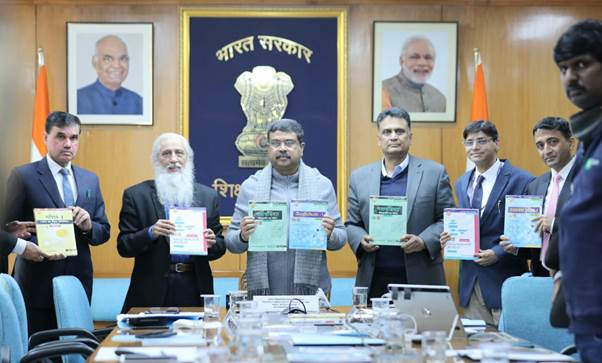
 Union Education Minister and Skill Development Minister Shri Dharmendra Pradhan launched NEAT 3.0, a single platform to provide the best-developed ed-tech solutions and courses to students of the country. The Minister also launched AICTE prescribed technical books in regional languages.

11c4c756-47a6-4f6a-8ee7-efa1bf06f7ee.jpg

c487de0f-7471-481c-ae1a-8ff5030aeafe.jpg

Speaking on the occasion Shri Pradhan said that NEAT will be a game-changer in bridging the digital divide, especially among the economically disadvantaged students and also in fulfilling the knowledge-based requirement of India and the world. The Minister informed that 58 global and Indian start-up ed-tech companies are onboard NEAT and are offering 100 courses & e-resources for bettering learning outcomes, developing employable skills and overcoming learning loss. He hoped that the e-content & resources and Digital frameworks like NEAT are a step in the right direction in minimising learning loss.

The Minister encouraged AICTE to integrate courses in NEAT with skill India to tap the opportunities in emerging areas of skill to boost employability and prepare our youth for the future. He urged that AICTE and ed-tech companies to offer e-resources in the least possible cost. Shri Pradhan complimented the global ed-tech companies and Indian start-ups who are a part of NEAT 3.0. He said that all ed-techs are welcome to work with a collaborative approach for making education accessible & affordable. But, ed-techs must remember that there is no place for monopoly and exploitation, he added.

The Minister expressed his happiness that today, more than 12 lakh socially and economically disadvantaged students have received free ed-tech course coupons worth over ₹253 crore under NEAT 3.0. This is one of the biggest gift to the student community from Prime Minister Shri Narendra Modi in the new year 2022, he added. He stated that India will lead the global economy in the 21st century and will be the most preferred market for trade & economy.

On technical books in regional languages, Shri Pradhan said that our diverse languages are our strength and harnessing them key to building an innovative society. He further said that learning in regional languages will further develop the critical thinking capacity & enable our youth to become global citizens.

NEAT:

National Educational Alliance for Technology (NEAT) is an initiative to provide the use of best-developed technological solutions in the education sector to enhance the employability of the youth on a single platform for learners’ convenience. These solutions use Artificial Intelligence for a personalized and customized learning experience for better learning outcomes and skill development in the niche areas. AICTE, MoE is acting as the facilitator in the process while ensuring that the solutions are freely available to a large number of socially and economically backward students. NEAT has 58 Education Technology Companies with 100 products that help to develop employable skills, capacity building, and bridge learning gaps.

Secretary, Higher Education Shri Sanjay Murthy; Chairman, AICTE Prof. Anil Sahasrabudhe; Vice Chairman, AICTE, Prof. M P Poonia, Prof. Rajiv Kumar, Member Secretary, AICTE and senior officials of the Ministry were present on the occasion.

*****

100 days Reading Campaign 'PADHE BHARAT'

 Union Education and Skill Development Minister Shri Dharmendra Pradhan  will be launching a 100 days Reading Campaign ‘Padhe Bharat’ on 1st January, 2022. 100 Days Reading Campaign marks an important step to improve learning levels of students as it develops creativity, critical thinking, vocabulary and the ability to express both verbally and in writing. It helps children to relate to their surroundings and real life situation. 

Children studying in Balvatika to grade VIII will be part of this campaign. The reading campaign will be organised for 100 days (14 weeks) starting from 1st January 2022 to 10th April 2022. The reading campaign aims to have participation of all stakeholders at national and state level including children, teachers, parents, community, educational administrators etc. The 100 days campaign will be continued for fourteen weeks and one activity per week per group has been designed with the focus on making reading enjoyable and build lifelong association with the joy of reading.

A comprehensive guideline on Reading Campaign with age appropriate weekly calendar of activities has been prepared and shared with States and UTs. The activities can be done by children with the help of teachers, parents, peers, siblings or other family members. In order to make the campaign effective, the activities designed have been kept simple and enjoyable so that these can also be easily conducted with the materials/resources available at home and with the help of parents, peers and siblings, in case the schools are closed.

IMPORTANCE OF EDUCATION:-

Education is one of the important thing in this world.Without education we cannot lead a good life.Education is the key to success in life.

Education plays the significant role in the human race.Educated people are responsible for the better future for Society and country.An educated person has the ability to decision making.Education teaches us writing and reading.Reading and writing is the first step in education.Education improves the person mentally to handle the difficult situation.

Education improve the humans personality.Educated person is brave, confident to face any situation.Most of the well known persons are educated.Education helps in the development and innovation of technology.

The technology,science, millitary all are improved because of the education.Without education nothing happened in this world.Education help us to acquire knowledge.knowledge can be used to make better living.Education is the weapon which cannot be break by anyone.

Education teaches us to be honest and polite.Educated peoples are always respected in the society.

Education teaches us to be civilized. Education helps us to understand the feelings.It provides the manpower like police, doctor and millitary.Education improves us mentally strong to face the hard situation in both outer and inner life.Education brings peace in the world.