A film review

 The Sleepover (2020)

       Director- TRISH SIE

       Genre– Exciting,Action, Adventure,Family features.

   A very simple family of Modern era living with their life old fashioned limitations like not allowing the phone to their children even if they jumped in higher class, they do not have permitted to attend any party with their friends,Not allowed to go out in late night.Their mother a housewife made these rules But we all know that there is always reasons of restrictions, the same are here with those two siblings of this exciting family.Both are studying in a same school and everyday their father use to receive and drop them,eating foodings made by dad bakery, play video games and sometimes spend times in sleepover.Cavin the little boy has sharp mind and he enjoy the imaginary world more than real. 

   One day a neighbour’s parents come with his child to leave him for the night. That boy also has some list by his mother about what to do or what to don’t.But as he is in another house with another rule and restrictions nothing from the list could be done right from his list.In loan area Cavin’s dad fixed a tent for their sleepover and left them to sleep. And in the same night her daughter tries to escape from home with her friend for one night to attend the party invited by her senior.

At late night tiem to sleep ,Ninjas enter in the house and attack on her housewife mother to take her with themselves for a mission.They took up both husband and wife with them for a robbery. After knowing their mother’s real identification that her mother was the head robber many years before her marriage in the bachelors age;their children decided to find their parents and went out for an overnight adventure. 

Their mother was a witness protection lady who was caught by the police but allowed to be free with a new identification by letting no one know her real identity.

Following the signs Including their dog’s neck belt left by her mother at every steps they followed and in not finally but at end of getting signs they met her mother’s younger sister who is also a robber; she gave them the direction to reach their mother and they followed.Finally they reached the destination and saw their simple housewife mother extraordinary actions and looks that were never been seen before.And also they saw her mother’s fiance who was a robber man,charm and dashing.

But there and then her mother become with a new identification and living her life as a normal person with family this mission was not her choice.They escape brilliantly from this leaving behind all this stuff if past and came back to home safely creating this adventurous night.And the boy who has very quite talent to make stories of imagination,he does the same in front of police too,reached all back to home safely.

Next morning, the neighbour came to take their child who was left for a sleepover and found the child safe and that child went home too.

Everything happened, the restrictions,the limitations came across with a very valid reason why kids of this family faced too many rules and regulations other than others.Now they understand and respect the situations and their family especially her mother.

So,The conclusion comes here with a brief mentality of parents and children.

Parents never want to grab or tie their own children with restrictions. If they do there must be the reason for their safety that’s important more than anything for any parents.

Children like that boy who live in his imagination are brilliant so to make success and happiness in their life it’s necessary to promote and support your child according to their way of interests.

And the last but not least ,the priority matter a lot for a family person no matter who you are,mother or father or sister or you are a brother,if you are in a family you must put your priorities first for them other than anyone no matter how complications has  started ,how it is difficult to deal or to resolve it but things will become smoother as soon as one put family on prior.Stay tied to the family is one of the best weapon to fight against any circumstances, situations,or any difficulty.

Snapshot taken from the movie “THE SLEEPOVER”.


A film review

 The Sleepover (2020)

       Director- TRISH SIE

       Genre– Exciting,Action, Adventure,Family features.

   A very simple family of Modern era living with their life old fashioned limitations like not allowing the phone to their children even if they jumped in higher class, they do not have permitted to attend any party with their friends,Not allowed to go out in late night.Their mother a housewife made these rules But we all know that there is always reasons of restrictions, the same are here with those two siblings of this exciting family.Both are studying in a same school and everyday their father use to receive and drop them,eating foodings made by dad bakery, play video games and sometimes spend times in sleepover.Cavin the little boy has sharp mind and he enjoy the imaginary world more than real. 

   One day a neighbour’s parents come with his child to leave him for the night. That boy also has some list by his mother about what to do or what to don’t.But as he is in another house with another rule and restrictions nothing from the list could be done right from his list.In loan area Cavin’s dad fixed a tent for their sleepover and left them to sleep. And in the same night her daughter tries to escape from home with her friend for one night to attend the party invited by her senior.

At late night tiem to sleep ,Ninjas enter in the house and attack on her housewife mother to take her with themselves for a mission.They took up both husband and wife with them for a robbery. After knowing their mother’s real identification that her mother was the head robber many years before her marriage in the bachelors age;their children decided to find their parents and went out for an overnight adventure. 

Their mother was a witness protection lady who was caught by the police but allowed to be free with a new identification by letting no one know her real identity.

Following the signs Including their dog’s neck belt left by her mother at every steps they followed and in not finally but at end of getting signs they met her mother’s younger sister who is also a robber; she gave them the direction to reach their mother and they followed.Finally they reached the destination and saw their simple housewife mother extraordinary actions and looks that were never been seen before.And also they saw her mother’s fiance who was a robber man,charm and dashing.

But there and then her mother become with a new identification and living her life as a normal person with family this mission was not her choice.They escape brilliantly from this leaving behind all this stuff if past and came back to home safely creating this adventurous night.And the boy who has very quite talent to make stories of imagination,he does the same in front of police too,reached all back to home safely.

Next morning, the neighbour came to take their child who was left for a sleepover and found the child safe and that child went home too.

Everything happened, the restrictions,the limitations came across with a very valid reason why kids of this family faced too many rules and regulations other than others.Now they understand and respect the situations and their family especially her mother.

So,The conclusion comes here with a brief mentality of parents and children.

Parents never want to grab or tie their own children with restrictions. If they do there must be the reason for their safety that’s important more than anything for any parents.

Children like that boy who live in his imagination are brilliant so to make success and happiness in their life it’s necessary to promote and support your child according to their way of interests.

And the last but not least ,the priority matter a lot for a family person no matter who you are,mother or father or sister or you are a brother,if you are in a family you must put your priorities first for them other than anyone no matter how complications has  started ,how it is difficult to deal or to resolve it but things will become smoother as soon as one put family on prior.Stay tied to the family is one of the best weapon to fight against any circumstances, situations,or any difficulty.

Snapshot taken from the movie “THE SLEEPOVER”.
Web Series

Web series

Introduction

The rise of Web series,episodic video entertainment produced for the internet and mobile devices and look into the motivations of their creators which first emerged in the late 1990s and became more prominent in the early 2000s.

Definition:Web SeriesAlso called Web Shows,A series of scripted or non scripted online videos that are available in the form of episodes and seasons uploaded on Websites.Web Shows,A series of scripted or non scripted online videos that are available in the form of episodes and seasons uploaded on Websites.

  In early days Individuals had to watch their favourite shows on Television with time barriers and even with a trauma of missing shows because there were no any features that can recap or replay the missed episodes.But Nowadays it’s became easy to resume or play any show anywhere that are broadcasting on websites.An individual can access for their entertainment ,interest and for their spending time.Individuals make up over 70% of the population of India,and the majority of them use the Internet.The new generation’s tendency is now using the internet.Due to the tendency of young people to become addicted to social Media,web series are easily produced and are becoming more and more popular in India.

Types of Web Series 

It is based on genre are given below:

  • Action/Thriller/crime 
  • Fantasy/Romantic
  • Comedy/Drama
  • Documentary
  • Anime
  • Horror
  • Sci-fi
  • For Children
  • Anthology
  • Sports
  • Award-Winning
  • Bollywood/Hollywood
  • Hindi/English/Bengali/ Malayalam/Telugu/Tamil/Marathi 
  • Stand-up Comedy 

 Providers of Web Series

      Websites called Providers on which all series are available to watch anytime anywhere.Out of them, there are many series available free to watch but for more to watch one have to subscribe or can say have to take subscription (Amount are different for different websites).

Here are those website:

  • Netflix 
  • Amazon Prime Video 
  • Hotstar
  • Jio Cinema 
  • MX Player 
  • Voot
  • Zee5 and more.

   On these platforms individuals can watch their favourite and interest based series, movies and episodes that inspires one whether they want to watch episode to episode or binge-watching.

Binge-watch– The practice of watching content like streaming services for a long time span, usually a single series or show.

In India it’s going fastest in this field of watching Web Series/Shows. In this context Hum log, India’s first series, debuted in 1984-1985 and ran for 154 episodes,making it the longest series in India history at the time of its finale. A 60 million strong audience watched it. The last episode lasted approximately for 55 minutes,while each episode lasted around 25 minutes.

And now web series have become more popular as it provides all types of entertainment and the majority of the series at the end leave some moral for the viewers. It has the chance to “go viral” by being viewed online and by people all over the world. It also has the potential to be “picked up,” or given a distribution deal, by well-known TV and film studios. There have been numerous web series awarded their own television shows.

All about James Webb Space Telescope

History

The success of Hubble Space Telescope after its repair mission in 1993 motivated the organizations to make a larger infrared light telescope that could see the past better. Hubble telescope system’s temperature interfered with the infrared radiation it received from the outer space. A new innovative next generation telescope was needed which was faster , better and cheaper. In 2003, NASA’s initial contract for James Webb Space Telescope(JWST) was $824.8 million collaborating with European Space Agency (ESA) , Canadian Space Agency(CSA). in 2005 after major redesign and re-planning , the mission cost reached a hefty amount of $4.5 billion. The telescope has a history of major cost overruns and delays due to backlashes from people and lack of funds.

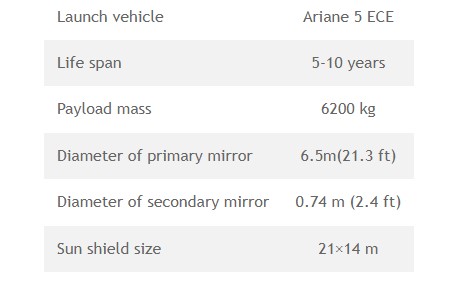
Nevertheless, JWST launched on December 25, 2021 in Ariane 5 rocket from NASA Goddard Space Flight Centre, French Guiana. this orbiting infrared observatory will complement and extend the discoveries of the Hubble space telescope.

The telescope will cover a wavelength of 0.6 – 28.5 microns for the light falling from red till mid infrared wave spectrum .

Location

JWST will not orbit earth but will be move in a orbit of second Lagrange point(L2 point) which is about 1.5 million km away from the earth. The L2 point is sufficiently near to the earth allowing proper signal communication and the sun shield will prevent any infrared radiation coming from the Sun.

Sun-shield protection

For it to make observation in the infrared spectrum , it must be kept under 50K (−223.2 °C) otherwise the infrared radiation from its system , the earth , moon and sun will interfere with the data. It uses a large 5 layered tennis court sized sun-shield to block that radiation and maintains its surface temperature. the single layer is as thin as a human hair and made with polyamide films . the membranes are coated with aluminium from both sides and a silicon doped layer facing the sun. the shield can be folded 12 times to fit in the Ariane rocket .

The Honeycomb mirrors

The primary optical mirror is beryllium reflector with area 25.4 m2 . gold is used to coat all the 18 mirror segments because it is a highly reflective material for infrared wavelength. The honeycomb pattern utilizes the best use of space available and are also deployable .

Mission goals

  1. Search for galaxies formed after the big bang . It can look 13.5 billion years into the past , about 400 million years after the big bang.
  2. How galaxies evolve.
  3. Observe the formation of stars.
  4. Measure physical and chemical properties of the planetary systems including the Solar System.

This mission will take the Space Science to the next level, thanks to our Scientists……

Common Mistakes to Avoid on Your Resume


Saying YES to the mess

An unprofessional resume screams SKIP! Remember to keep it sleek and professional with proper highlighting, bullets, and minimal colours. Don’t make it fancy or too simple, don’t use any kind of word or sentence, which will look like a command or too unprofessional, make it professional.
Ensure that it isn’t too busy, too colourful or has illegible fancy font styles.

Check out my posts, ‘Tools to enhance your resume’ for more on this.

Not linking your portfolios, and recommendation

One of the most common mistakes that are made while creating a holistic resume is not providing links to these. Ensure you add a hyperlink to your port folio and recommendation. Also, ensure it is accessible to the employer to view!
Recommendations are like a golden star on your resume. Keep it short, but do provide a contact that they can reach out to, for verification.
Never forgot to add this!!

Not highlighting well enough

Sure, we did tell you what to highlight. But what do you not highlight? Unnecessary minor details, especially in a stretched – out manner. Just add what is important, that will make it look good but if you add small things, it will make your resume look bad. So just remember that you have added things which are important and don’t make it too long.
Use action verbs to describe your daily responsibilities and experience.

Sorry, they can’t come to the phone right now

Why? Because they listed an incorrect contact details on their resume or didn’t list one at all.
So many times we never check our personal information and because of this even if you got the job you will miss it.
Be careful to double and triple check your contact information. E-mail addresses and phone numbers should be highlighted for easier identification.

Too long to read

Keep it short. Your ideal resume should not exceed 2 pages. Employers usually have to go through several resumes in a single day. A super lengthy resume, just make it easier for them to glance and skip.
Make it effective and short.

Grammatical or spelling error

Not only is it extremely unprofessional, but it also implies to the employer that you are not very interested in the position. Use tools like Grammarly to run spelling and grammar checks. Additionally, you could also run it by a friend, just in case you missed something. It’s that easy!

Bailment

Section 148 defines the terms ‘bailment’, ‘bailor’ and ‘bailee’.

A bailment is the delivery of goods by one person to another for some purpose upon a contract that they shall when the purpose is accomplished be returned or otherwise disposed of according to directions of the person delivering them. The person delivering the goods is called the bailor and the person to whom the goods are delivered is called the bailee.

Essentials of Bailment

1.Delivery of the goods for some purpose

2.Return of the goods after the purpose is achieved, or their disposal according to the bailor’s directions.

Kinds of Bailment

  1. Gratuitous Bailment: In gratuitous bailment it is without any consideration for benefit of bailor or bailee.
  2. Non-Gratuitous Bailment: Benefit for both bailor and bailee. Also known as bailment for reward.
  3. Bailment for benefit of bailor: Bailor delivers his goods to bailee for safe custody without any benefit or reward.
  4. Bailment for benefit of bailee: Bailor delivers his goods to a bailee without any benefit for his own use.
  5. Bailment for benefit of bailor and bailee: It is beneficial for both i.e. bailor and bailee.

Duty of Bailor

Section 150 mentions the following duty of bailor in respect of the goods bailed by him:

  1. The bailor is bound to disclose the faults to the bailee in the goods bailed, of which the bailor is aware and materially interfere with the use of them, or expose the bailee to extraordinary risks; and if he does not make such disclosure, he is responsible for the damage arising to bailee directly from such faults.
  2. If the goods are bailed for hire, the bailor is responsible for such damage, whether he was or was not aware of the existence of such fault in the goods bailed.

Duties of Bailee

  1. Duty to take reasonable care of the goods bailed (Section 151 and 152).
  2. Duty not to make unauthorised use of the goods bailed (Section 153 and 154).
  3. Duty not to mix the bailor’s goods with his own goods ( Section 155,156,157).
  4. Duty to return the goods on fulfillment of the purpose (Section 160,161 and 165,166,167).
  5. Duty to deliver to the bailor increase or profit on the goods bailed (Section 163).

Nature of Partnership

When two or more persons join hands to set up a business and share its profits and losses it is called Partnership. Section 4 of the Indian Partnership Act 1932 defines partnership as the ‘relation between persons who have agreed to share the profits of a business carried on by all or any of them acting for all’.

Partners are the persons who have entered into partnership individually with one another. Partners collectively are called ‘firm’. The essential features of the partnership are as follows:

Two or More Persons:
There should be at least two persons coming together to form the partnership for a common goal. In other words, the minimum number of partners in a partnership firm can be two.
Indian Partnership Act, 1932 has put no limitations on maximum numbers of partners in a firm. But however, Indian Companies Act, 2013 puts a limit on a number of the partners in a firm as follow:
1.For Banking Business, Partners must be less than or equal to 10.
2.For Any Other Business, Partners must be less than or equal to 20.
3.If the number of partners exceeds the limits, the partnership becomes illegal.

Agreement
The partnership is an agreement between two or more persons who decided to do business and share its profits and losses. To have a legal relationship between the partners, the partnership agreement becomes the basis. The agreement can be in written form or oral form. An oral agreement is equally valid. But, preferably the partners should have a written agreement, in order to avoid disputes in future.

Business
To carry on some business there should be an agreement. Mere co-ownership of a property does not amount to the partnership. The business must also be legal in nature, a partnership to carry out illegal business is not valid.

Mutual Agency
The business of a partnership firm may be carried on by all the partners or any of them acting for all. This statement has two important implications. First, to participate in the conduct of the affairs of its business, every partner is entitled. Second that a relationship of mutual agency between all the partners exists.
For all the other partners, each partner carrying on the business is the principal as well as the agent. He can bind other partners by his acts. And also is bound by the acts of other partners with regard to the business of the firm.

Sharing of Profit
The agreement between partners must be to share profits and losses of a business. Sharing of profits and losses is important. The partnership is not for the purpose of some charitable activity.

Liability of Partnership
Each partner is liable jointly with all the other partners. And also when is a partner, severally liable to the third party for all the acts done by the firm. Liability of the partner is not limited. This implies that for paying off the firm’s debts, his private assets can also be used.

Partnership Deed
Agreement to carry on a business between the partners, partnership comes into existence. The partnership agreement can be either oral or written. The Partnership Act does not require that the agreement must be in writing. But when the agreement is in written form, it is called ‘Partnership Deed’. Partnership deed should be duly signed by the partners, stamped & registered.

Partnership deed generally contains the following details:
1)Names and Addresses of the firm and its main business;
2)Names and Addresses of all partners;
3)A contribution of the amount of capital by each partner;
4)The accounting period of the firm;
5)The date of commencement of partnership;
6)Rules regarding an operation of Bank Accounts;
7)Profit and loss sharing ratio;
8)The rate of interest on capital, loan, drawings, etc;
9)Mode of auditor’s appointment, if any;
10)Salaries, commission, etc, if payable to any partner;
11)The rights, duties, and liabilities of each partner;
12)Treatment of loss arising out of insolvency of one or more partners;
13)Settlement of accounts on the dissolution of the firm;
14)Method of a settlement of disputes among the partners;
15)Rules to be followed in case of admission, retirement, a death of a partner; and
16)Any other matter relating to the conduct of business. Normally, all the matters affecting the relationship of partners amongst themselves are covered in partnership deed.

Termination Of Agency

Introduction

In a contract of agency, a person appoints another to act on his behalf with the third party it is called ‘Agency’. According to Section 183 of the said Act, Principal must be competent to contract. Any person may be an agent (Section 184). According to Section 185, in the contract of agency, consideration is not necessary. Termination of agency means putting an end to the legal relationship between principal and agent. Section 201 to 210 of the Indian Contract Act 1872 lay down the provision relating to the termination of Agency.

As above said termination of agency means putting end to the legal relationship between principal and agent. Section 201 to 210 of the Indian Contract Act 1872 lay down the provision relating to the termination of Agency.

Section 201, Indian Contract Act 1872 provides for termination of an agency –

An agency is terminated by the principal revoking his authority, or by the agent renouncing the business of the agency; or by the business of the agency being completed; or by either the principal or agent dying or becoming of unsound mind; or by the principal being adjudicated an insolvent under the provisions of any Act for the time being in force for the relief of insolvent debtors.

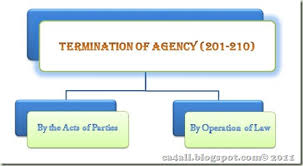
Agency may be terminated two ways –
1) By the Act of the Parties
2) By Operation of Law

1) By the act of the parties
i) By agreement – The Contract of Agency can be terminated at any time by mutual agreement between the principal and agent.
ii) By revocation of the principal – The Principal revoke agency at any time by giving notice to the agent.
iii) By Renunciation of an agent – Renunciation which means withdrawing from responsibility as Agent. Like Principal, Agent can also renounce the agency. According to Section 206 of the Indian Contract Act 1872, the agent must give to his Principal reasonable notice of renunciation. Otherwise, he will be liable to make good for the damage caused to the principal for want of such notice.

2) By operation of law
Agency can be terminated by operation of law-
i) By the completion of agency – Agency can become to an end after the completion of work for which the agency is created.
ii) By expiry of the time – Agency can also be terminated by the expiry of time. if the agency is created for the specific period, it is terminated after the expiry of the time.
iii) Death or insanity of principal or agent – Section 209 of the Indian Contract Act 1872 imposes an agent, duty to terminate the contract of agency on the death of the principal. In other words, Agency comes to an end on the death or insanity of the principal or agent.
iv) Insolvency of principal – According to Section 201 of the Indian Contract Act 1872, an insolvent or bankrupt is a person who is unable to run the business due to Excess of liabilities over assets. In this way, if the principal becomes an insolvent agency can be terminated.
v) Destruction of the subject matter – If this subject matter of the agency is destroyed agency comes to an end.
For example – Any agency is created for sale of an Airplane if the Airplane caught fire before the sale the agency comes to an end. In this contract Airplane is the subject matter.
vi) Principal becoming an alien enemy – If the Principal becomes an alien enemy the contract of agency comes to an end. vii) Dissolution of company or firm – A Firm or company may be regarded as a Principal in the contract of Agency. If the company or firm is dissolved the agency comes to an end.

Relationship between Principal agent and sub agent

Relationship between principal agent and sub-agent depends on the question whether the agent has an authority to appoint sub-agent and whether the sub-agent is properly appointed.
If then sub-agent is properly appointed:
1) The principal is bound by and responsible for the acts of a sub agent;
2) the agent is responsible to the principal for the acts of the sub-agent;
3) the sub agent is responsible for his acts to the agent, but not to the principal except in case of fraud or willful wrong.

It is of interest to observe clause (3) above. Sub-agent is responsible and accountable to the agent and not to the principal by clause (1). Principal is liable for acts of the sub-agent if he is properly appointed. Sub-agent is not responsible to the principal because there is no privity of contract between the principal and sub agent. It is case of fraud or willful wrong that the principal can proceed against the sub-agent. Principal can, however, against the agent for acts of a sub-agent. As far as the rights of a third party are concerned, he can enforce the wrongs of a sub-agent on the principal if the sub-agent is properly appointed. Principal is therefore liable for acts of the sub-agents if he is properly appointed.

If the sub-agent is not properly appointed: Where an agent has appointed a person to act as sub agent without having authority to do so, the principal shall not be deemed to be represented or responsible for the acts of the sub-agent so employed, nor is such a sub-agent responsible to the principal. The agent is responsible for the acts of such a sub- agent both to the principal and to third persons.

Sub-agent is said to be improperly appointed where agent delegates his powers without authority from the principal or where none of the circumstances stated above exist which necessitate appointment of a sub agent.

It will be observed that where a sub-agent is not properly appointed, the liability of agent is also towards third parties. As a rule, we have seen that an agent is responsible to the principal and it is the principal who is responsible for the acts of his agent to the third party. However, the section throws additional liability on the agent where he has improperly appointed a sub-agent. Agent stands liable to the third party for the acts of a sub-agent.

Termination of sub-agent’s authority: (Sec 210) Lastly it must be noted that the termination of the authority of an agent causes the termination of the authority of all sub-agents appointed by him

Liabilities of principal, agent and sub-agent: The agent is responsible to the principal for the acts of a sub-agent and the sub-agent is responsible for his acts to the agent but not the principal, except in cases of fraud and willful wrong.

Where an agent improperly appoints a sub-agent, the agent is responsible for his acts both to the principal and to third parties. The principal in such cases is not responsible for the acts of the sub-agent nor is the sub-agent responsible to the principal. But where a sub-agent is properly appointed, the principal as regards third person, is represented by the sub-agent, and is bound by and responsible for his acts, as if he were an agent originally appointed by the principal.

Where an agent under an express or implied authority has named another person to act for the principal, such a person is not a sub-agent, but an agent of the principal. There is no liability on the agent appointing him provided the agent so appointing exercises discretion as a man of ordinary prudence would exercise is his own case (Sec 194 & 195). Such an agent is called a substitute agent.


4 Most Sought After Fields in Germany

German education standards are pretty high. Germany is known for the quality of education it provides as well as its globally recognized qualifications. German universities are highly regarded worldwide, besides being among the highest-ranked in the world.

Planning to study in Germany? Here are the four most popular courses to study there!

Engineering

Every student in the world who wants to do Engineering, for them Germany is like a dream country, all of them wants to complete their Engineering in Germany.

Of course you saw this coming, didn’t you? if you didn’t, where do you think most of your luxury cars are made? Comprising nearly 25% of international students, it is one of most popular courses in Germany. Specializations include – Automobile, mechanical and electrical engineering amongst others. Technical University of Munich, RWTH Aachen University, Karlsruhe Institute of Technology, and the Technical University of Berlin are some of the most renowned universities for this course. 

It takes more or less than 4.5 or 5.5 years to complete your Engineering program in Germany including the time required for learning German and the foundation courses. According to recent statistics, Germany has the second highest number of Engineering workers among all employees in the EU. German Universities offers numerous scholarship opportunities for Engineering students, while studying Engineering in Germany you can research and collaborate with the Engineering Industry. If the student manages to secure a position in any of the public university, study in Germany is free for Indian students, just like students from other part of the world. Students just have to pay a nominal semester fee (around 250 to 500 Euros) per semester        

Humanities

Surprised to see this on the list? Well, Germany offers around 6000 courses in the field of humanities. With some of the best- ranked universities in the world for courses in the Humanities. more than 11,000 international students in Germany were seeking a degree in the humanities, in 2019 only.

A majority of the humanities degree programmes in Germany offer integrated modules which give students the opportunity to obtain the necessary practical skills, besides the theoretical ones. German universities make sure to provide students with both, theoretical and practical skills, in order to ensure that once these students graduate, they will be fully equipped to enter the job market with confidence. Humanities programmes will comprise of professionally related events, study semesters abroad, as well as research projects or internships so students understand exactly what they will encounter in the future, in their professions. Students can also choose from a variety of combinations, which further enhances the experience.  There are many best universities where you can purse your love for languages and the social sciences in Germany. Studying the humanities in Germany, in comparison to other countries, slightly more affordable.

Business and Finance

Boasting of one of the best economies in Europe, Germany is one of the best countries to earn a degree in Business and finance and gain practical knowledge. The strong German economy means a constant influx of educated workers – including many English speakers, who are highly sought in Frankfurt’s finance and business communities. The nation’s GDP has continued to grow in recent years. Economic freedom is partly responsible for why the city has become a seedbed for innovation and entrepreneurial initiative. According to Eurostat, amongst the 28 countries in the European Union more than 40% of all patents are held by Germany. Half of the cities in top-30 metropolitan areas for patents are in Germany.

Germany also has one of the lowest unemployment rates at just over 5%. Germany is a global leader in R & D investment that further assures access to top – notch training and resources.

Computer sciences and Mathematics

Due to Germany’s extremely advanced technology, disciplines intertwined with it are always in demand. Germany is an excellent place to work as a computer engineer, as it’s companies invest heavily in development and research, maintaining the country’s results as the biggest economy in Europe and the third in the world. In a 2015 OECD/PISA study, Germany ranked 16th in mathematics as well as in science.

In turn, the employability rate for careers related to these degrees is also extremely high. Once again, these aren’t restricted to these, one can explore course like Scientific computing, knowledge – Based Systems and robotics among other!

Duties Of An Agent

Agent and Principal

An “agent” is a person employed to do any act for another, or to represent another in dealing with third person. The person for whom such an act is done, or who is so represented, is called the “principal”. The contract between Principal and Agent is called ‘Contract of Agency’. Section 182 of the act defines the terms “Agent” and “Principal”.

Types of an Agent

  1. Brokers
  2. Factors
  3. Del Ceredere Agents
  4. Auctioneers

Duties Of An Agent

  1. Agent’s duty in conducting principal’s business (Section 211): An agent is bound to conduct the business of his principal according to the directions given by the principal, or, in the absence of any such directions, according to the custom which prevails in doing business of the same kind at the place where the agent conducts such business. When the agent acts otherwise, if any loss be sustained, he must make it good to his principal, and, if any profit accrues, he must account for it. Illustration: B, a broker in whose business it is not the custom to sell on credit, sells goods of A on credit to C, whose credit at the time was very high. C, before payment, becomes insolvent. B must make goods the loss to A.
  2. Skill and diligence required from an agent (Section 212): An agent is bound to conduct the business of the agency with as much skill as is generally possessed by persons engaged in similar business, unless the principal has notice of his want of skill. The agent is always bound to act with reasonable diligence, and to use such skill as he possesses; and to make compensation to his principal in respect of the direct consequences of his own neglect, want of skill or misconduct, but not in respect of loss or damage which are indirectly or remotely caused by such neglect, want of skill or misconduct.
  3. Duty to render proper accounts (Section 213): According to Section 213 of the Indian Contract Act 1872, an agent is bound to render proper accounts to his principal on demand.
  4. Duty to communicate with principal (Section 214): It is the duty of an agent, in cases of difficulty, to use all reasonable diligence in communicating with his principal, and in seeking to obtain his instructions.
  5. Not to deal on his own account: Section 215 of the Indian Contract Act 1872 deals with rights of principal when the agent deals, on his own account, in the business of agency without principal’s consent. Section 215 runs as follows- If an agent deals on his own account in the business of the agency, without first obtaining the consent of his principal and acquainting him with all material circumstances which have come to his own knowledge on the subject, the principal may repudiate the transaction, if the case shows either that any material fact has been dishonestly concealed from him by the agent, or that the dealings of the agent have been disadvantageous to him.
  6. Not to make Secret Profits: Section 216 of the Indian Contract Act, deals with Principal’s right to benefit gained by the agent dealing on his own account in the business of agency. An agent, without the knowledge of his principal, should not deal in the business of agency on his own to make secret profit. Illustrations: A directs B, his agent, to buy a certain house for him. B tells A it cannot be bought, and buys the house for himself. A may, on discovering that B has bought the house, compel him to sell it to A at the price he gave for it.
  7. Duty to pay sums received for principal: According to Section 218 of the said act, an agent is bound to pay to his principal all sums received on his account. It is the duty of an agent to maintain secrecy of the business of agency and should not reveal the confidential matters.
  8. Duty not to delegate his duties (Section 190): When an agent has undertaken to perform certain duties personally, he is not allowed to delegate his duties to another person.

Rights Of An Agent

An “agent” is a person employed to do any act for another, or to represent another in dealing with third persons. The person for whom such an act is done, or who is so represented, is called the “principal”. Section 182 of the act defines the terms “Agent” and “Principal”.

Rights of an Agent

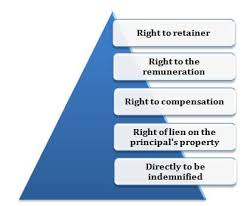
  1. Right to Receive Remuneration: According to Section 219 of the Indian Contract Act, an agent is entitle to his remuneration. But Section 220 of the said act says that, an agent who is guilty of misconduct in the business of an agency is not entitled to any remuneration in respect of that part of the business which he has misconducted.
  2. Right of Lien (Section 221): Agent’s lien on principal’s property- In the absence of any contract to the contrary, an agent is entitled to retain goods, papers and other property, whether movable or immovable, of the principal received by him, until the amount due to himself for commission, disbursements and services in respect of the same has been paid or accounted for to him.
  3. Right to Indemnity: Agent to be indemnified against consequences of lawful acts. Indemnity means promise make good the loss. According to Section 222 of the Indian Contract Act, 1872 “The employer of an agent is bound to indemnify him against the consequences of all lawful acts done by such agent in exercise of the authority conferred upon him. Illustrations: B, at Singapore, under instructions from A of Calcutta, contracts with C to deliver certain goods to him. A does not send the goods to B, and C sues B for breach of contract. B informs A of the suit, and A authorities him to defend the suit. B defends the suit and is compelled to pay damages and costs and incurs expenses. A is liable to B for such damages, costs and expenses.
  4. Right to Compensation: According to Section 225 of the said act, an agent is entitled to claim compensation for the injuries suffered as a consequence or want of skill of the principal. Section 225 reads as follows- “The principal must make compensation to his agent in respect of injury caused to such agent by the principal’s neglect or want of skill. Illustration: A employs B as a bricklayer in building a house, and puts up the scaffholding himself. The scaffholding is unskillfully put up, and B is in consequence hurt. A must make compensation to B.
  5. Right to Retain Sums (Section 217 and 218): The agent has a duty to pay to his principal all sums received on principal’s account. But he also has a right to retain, out of any sums received on account of principal in the business of agency, all money due to himself in respect of advances made or expenses properly incurred by him in conducting such business and also such remuneration as may be payable to him for acting as agent. Similarly, when an agent sells his principal’s goods, he may detain the money received, for his remuneration on account of the goods sold by him. Such right can be exercised by an advocate also but lien must be confined to the costs incurred in that particular case.

Indian Education System

Education plays an important role in the development of an individual and making him a knowledgeable citizen. It is the education that makes an individual self-reliant, helps to suppress the social evils and contribute towards the development of the society and nation as a whole. Education helps in unravelling the mystery of nature. It enables us to understand and improve the working of our society. It creates conditions for a better life. Education brings out the capabilities to fight injustice happening in society. Every individual has the right to education. 

Indian Education is one of the largest and complex education systems in the world along with China. India is committed to providing basic education to its citizens, the framework of which is defined in the National Policy of Education. Elementary education is now compulsory in India. At the time of Independence, only 14% of India’s population was literate. Now after so many decades since Independence, the number of literates has increased by fivefold.

History of Education System

The history of Indian education system comes from the times of Ramayana and Mahabharata. The historic Indian education system is also called the Gurukula system. There were gurus then who are now known as teachers and shishyas who are called students now. The gurus and the shishyas lived together under one roof in Gurukula until the completion of their education. The shishyas were expected to help the guru in all the daily chores as part of their learning. The children belonging to higher strata of the society were taught all the subjects from Sanskrit to Holy Scriptures and mathematics to metaphysics by the gurus. The Gurukulas during those times focused on the practical aspects of life. The students were taught in the open classroom in the surrounding area of nature. This early system of education in India continued for many years until the modern education system came into the picture in the nineteenth century.

In the early 19th century, during the British period, the modern education system was brought into our country by Lord Thomas Babington Macaulay. The basic strength of this modernized education system was the examinations and a well-defined curriculum, which gave importance to subjects like science and mathematics and subjects like philosophy, metaphysics were given a back seat. The brick and mortar classrooms replaced the open classrooms in the Gurukulas. The essence of the guru shishya bond was taken over by a more formal relationship between the teacher and the student. To understand the progress of any student, examinations were conducted at frequent intervals. The focus of the education system shifted from learning to memorizing of the concepts to score good marks in the examinations.

Problems of Indian Education System

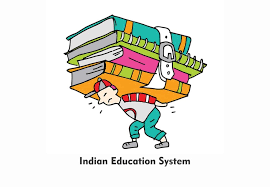
Over a period of time, it has been observed that there are many loopholes in the system of education in India. Instead of understanding the concepts, students started cramming and memorizing the lessons. Knowledge is given a backseat and scoring in high rankings takes importance. The modern parents have tuned their mindsets accordingly and their goal is to ensure that their children score good marks instead of acquiring knowledge right from the primary level. 

Private schools and colleges have been rapidly increasing in the country but the results produced by them are far beyond satisfactory. It has also been observed that the quality of teachers deteriorated with the passing of time. Our examination system is responsible for the wide skill gap. India is producing lakhs of engineers and professionals every year but only a fraction of this number is actually getting employed. This is because the Indian examination system focuses more on scoring good percentages rather than the actual continuous comprehensive evaluation. 

Research and development, which should be the cornerstone of our system, are given the least importance. The private schools and colleges focus on the admission of more students and are least interested in the quality of their education. This is the major reason why the faculties and the teachers lack skills and specialization. This is quite evident from the fact that a single professor is assigned to teach multiple subjects. 

How Can We Improve the Indian Education System?

First and most importantly we should improve the grading system. Rote learning should be discouraged completely. Teachers and faculties should focus more on the analytical skills of the students and grade them accordingly. There should be more focus on comprehensive evaluation instead of scoring only good marks. Workshops must be organized for teachers on a regular basis to keep them updated about the latest developments in the sector of education. At the same time, the curriculum should be reframed according to the present needs of education in India. 

The payroll structure of the teachers and the faculties especially in the government institutions should be improved. This step will help in motivating the teachers to develop their skills and they will take a keen interest in grooming or shaping up a student’s life and career. The government and other entities who are associated with the education sector, need to understand the importance of quality of education. Education should be a holistic process that must focus on the overall development of the physical, emotional, social and cognitive skills of a child. It needs to be a slow and cyclic process and must take place gradually to help the child develop into an autonomous, independent and knowledgeable individual.

Conclusion

An educated individual is an individual who should be able to contribute towards the betterment of the economic and social development of the society as well as the country. The true goal of education must exceed awarding the degrees and certificates to the students. Education is not a tool to earn livelihood but it is a way to liberate the mind and soul of an individual. 

Role Of Todays Youth In Building A Self Reliant India

“Self-reliance is the key to a vigorous life.”

Self-reliant India is the vision of the Prime Minister of India Narendra Modi of making India a self-reliant nation. The first mention of this came in the form of the ‘Self-Reliant India Mission’ during the announcement of the coronavirus pandemic related economic package on 12 May 2020. This self-reliant policy does not aim to be protectionist on nature and as the Finance Minister clarified, ” Self-reliant India does not mean cutting off from rest of the world”. The largest fund in the country worth Rs. 21,000 crore was setup by the IIT Alumni Council with the aim of supporting the mission towards self-reliance.

Everybody knows, that the youth are the future of any country. But India can take lead over many other nations because about 65 percent of the country’s population is below 35 years and 50 percent is below 25 years. With huge, educated young population, India is very uniquely poised to realise the demographic potential amd reap the advantage of this vast powerhouse of human resource talent. The need of the hour is to upgrade the skill or upskill the youth to meet the emloyment needs of technology driven 21st century and accelerate the pace of self-reliance.

The uncertainity created by the pandemic is being seen by many as an opportunity to upgrade knowledge and acquire new skills that will cater to the post-corona virus job scenario. The skills required for tomorrow’s jobs will be completely different from the skill-sets youth possess today.

So, its high time now, we have to make India self-reliant and youth plays the most important role in this mission.

International Workers Day

“Without labour nothing prospers.”

Labour Day or International Workers Day is celebrated annually on 1 May to celebrate the working class and labourers across the world. Socialist and labour unions celebrate this day by organising programmes to improve wages and working conditions of the workforce. In more than 80 countries Labour Day is a national holiday.

Before a formal Labour Day came into place, deaths, injuries and dangerous working conditions were very common among the working class globally. During the rise of industrialisation, the U.S. exploited the working class during the nineteenth century and made them work upto 15 hours a day under rigorous conditions. The rising death of the workforce in industries forced the working class to raise their voices for their safety. After efforts made by the workers and socialists, eight hours was declared as the legal time for the workers in the late nineteenth century by the American Federation of Labour.

The origin of Labour Day goes back to an incident in Chicago on May 4, 1886 known as the Haymarket Affair. On this day workers assembled as part of a peaceful rally in a strike demanding an eight hour work day. An unknown person threw a dynamite bomb at the police as they acted to disperse the meeting, and the bomb blast and ensuing gunfire resulted in the deaths of seven police officers and atleast four civilians; dozens of others were wounded. The Chicago protests led to many countries and at last they got the proper labour rights.

So, they had a long repression from the society. So, now the time has come to live respectfully and safe. Without labour no country can prosper. They are the ones who make a way towards country’s development. Their hardwork, dedication cherishes the path of development of country. So, respect them and provide safe working conditions to them. The below mentioned lives are aptly quoted;” A worker is a creator and a great asset to every nation”.

Theories of Punishment in Indian Penal Code,1860

Introduction

Punishment is the sanction imposed on an accused for the infringement of the established rules and norms of the society.

Objective

The object of punishment is to protect society from mischievous and undesirable elements by deterring potential offenders, by preventing the actual offenders from committing further offences and by reforming and turning them into law abiding citizens.

Types of Theories

  1. Deterrent Theory
  2. Preventive Theory
  3. Retributive Theory
  4. Reformative Theory
  5. Multi Approach Theory

a) Deterrent Theory: According to this theory, the object of punishment is not only to prevent the wrong-doer from doing a wrong second time, but also to make him an example to others who have criminal tendencies. Salmond considers deterrent aspects of criminal justice to be most important for control of crime. Deterrent punishment is likely to harden the criminal instead of creating in his mind a fear of law. Hardened criminals are not afraid of imprisonment.

b) Preventive Theory: According to Paton:’The theory concentrates on the prisoner and seeks to prevent him from offending again in the future. The death penalty and exile serve the same purpose of disabling the offender’. Critics point out that preventive punishment has the undesirable effect of hardening first offenders, or juvenile offenders, when imprisonment is the punishment, by putting them in association of hardened criminals.

c) Retributive Theory: In primitive society punishment was mainly retributive. The person wronged was allowed to have revenge against the wrong-doer. The principle of ‘an eye for an eye’, ‘a tooth for tooth’, was the basis of criminal administration. According to Justice Holmes: ‘It is commonly known that the early forms of legal procedure were grounded in vengeance’. The advocates of this theory plead that the criminal deserves to suffer.

d) Reformative Theory: According to this theory, the object of punishment is reformation of criminals. The object of the punishment should be to reform the offender. The criminal must be educated and taught some art and craft or industry during his term of imprisonment, so that he may be able to lead a good life and become a responsible and respectable citizen after release from jail.

e) Multi Approach Theory: In fact, a perfect system of criminal justice could never be based on any single theory of justice. Every theory has its own merits and every effort should be made to extract the good points of each and integrate it so that best of all could be achieved. Punishment should be proportionate to the nature and gravity of the crime. The object of any concession given to an offender should be to convince him that normal and free life is better than life in jail.