NEW EDUCATION POLICY TO BRING EVOLUTION IN THE EDUCATION SYSTEM.

NEW EDUCATION POLICY:
° Students are currently undergoing school exams conducted by responsible authorities in grades 3, 5, and 8.
° 10th and 12th grade board exams will continue, but will be redesigned for overall development.
° Mathematical reasoning and scientific temperament coding begins in 6th grade .Vocational training begins at school in sixth grade and includes internships.
° The 10 + 2 structure is replaced by 5 + 3 + 3 + 4. The new system consists of grades 12 and 3 years preschool / Anganwadi.
° Until 5th grade, this policy emphasizes the local / regional / native language as the teaching language.
° In schools and universities, Sanskrit is also included as a student option at all levels and consists of three language formulas.
° Under Graduate is now 3 or 4 years, with multiple degree options eligible for this period, such as a 1 year certificate, 2 years diploma, 3 years degree, 4 years bachelor’s degree in research, etc.
° An Academic Credit Bank (ABC) is created to store, transfer, and award bachelor’s degrees from digital learning achievements earned by students from various universities.
° The curriculum has been reduced to essentials for all subjects. They focus on critical thinking, discovery, inquiry, debate, and education based on analytical and holistic learning methods for education.
° Focus on e-learning so you can reduce your reliance on textbooks
Under the new policy, education will receive 6% of GDP, up from 1.7%. This definitely boosts the education system.
° By the end of 2040, all universities should be interdisciplinary institutions with more than 3000 students each. University affiliation will be phased out over the next 15 years.
Foucus on Regional /Mother Tongue Language:
As you know, young children learn new things as soon as they teach in their own language, not in another language they are unfamiliar with. This policy is aware of it, so children will be taught in their native language until the age of 5, but it can change to 8th grade .
NEW CURRICULUM STRUCTURE:
•) Rebuild the school curriculum and teaching methods into new 5 = 3 + 3 + 4 patterns.
•) The new curriculum structure is designed to attract the attention of learners at various developmental stages, such as 3-8 years old, 8-11 years old, 11-14 years old, 14-18 years old.
•) Elementary level lasts 5 years:
3 years before school, 1st and 2nd grade.
The preparatory stage lasts for 3 years: 3rd, 4th and 5th grade.
Middle school or high school lasts 3 years: 6th, 7th and 8th grade.
High school or junior high school lasts four years: 9th, 10th, 11th, 12th grade.
All of the above levels include Indian and regional traditions, ethical thinking, socio-emotional learning, quantitative and logical thinking, digital literacy, computational thinking, scientific manipulation, language and communication skills.

“Learning starts with failure; the first failure is the beginning of education.”

– John Hersey

Bengal Colleges to reopen in Nov, govt may ask UGC to delay academic year

West Bengal schools, West Bengal schools open, West Bengal colleges, West Bengal colleges open, India news, Indian Express
Partha Chatterjee: West Bengal Education Minister

The new academic session of both undergraduate (UG) and postgraduate (PG) colleges and universities in West Bengal will begin from December 1. The decision came after a meeting between Vice-Chancellors of state universities and West Bengal Higher Education Minister Partha Chatterjee on Sunday.

Education Minister Partha Chatterjee said that the reason they are planning to start the new academic session in December is because host of festivals that are lined up in November including Lakshmi puja, Kali puja/Diwali, Chhat puja, Jagaddhatri puja etc. 

Chatterjee said, “As we need to sanitise the institution premises before starting the academic session in full course, we have to take into account the four-five festive days when no work will be possible. So it will be in the fitness of things to start the new sessions from December.”

He said since most universities have already adopted online teaching for the mid semester courses and providing course materials to students who don’t have online facilities, starting the new session won’t be hopefully of much problem.

“Still whether the classes will be entirely online or there will also be offline mode of teaching will depend on the situation at that time,” the minister added.

While admissions to UG courses will be over by October 31, the admission procedure in PG courses will be completed only by the end of November.

The education minister said his department would write to the University Grants Commission (UGC), asking it to allow the state to start the new academic year from December.

In a notice on September 22, the UGC said the admission process for UG first-year students would have to be completed by October 31, and classes should resume on November 1.

Meanwhile, sources said the universities decided to reserve 80 per cent of seats in PG courses for students who completed their graduation in an affiliated college, or in the institute itself. The decision was taken because of the Covid-19 pandemic, and curbs in transport. As a result, many graduates may find it difficult to pursue higher studies in institutions outside the state.

Education minister wishes goodluck to students appearing for JEE MAINS today

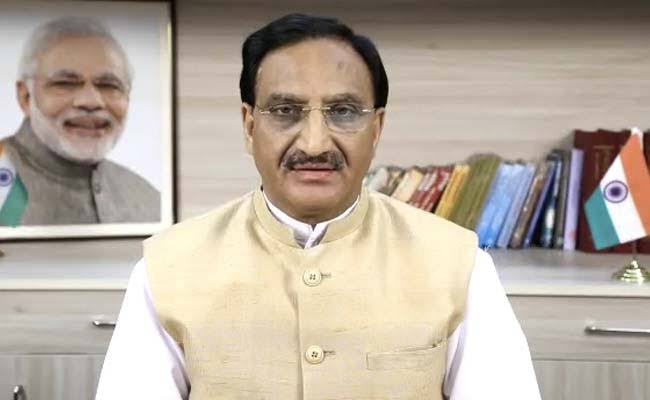
Education Minister Ramesh Pokhriyal ‘Nishank’

Union Education Minister Ramesh Pokhriyal ‘Nishank’ on August 31 via Twitter wished good luck to students preparing for JEE examinations which are going to commence from September 01.

“I wish best of luck to all students who are going to appear for the JEE tomorrow. I am also glad that over 7,77,465 have downloaded their admit cards. I have spoken to the CMs of most states to ensure that students don’t face problems,” Ramesh Pokhriyal said in a tweet.

“I have spoken and appealed to the Chief Ministers of most states to help students in their states and I am sure that the SOPs issued by the Health, Education and Home Ministries will be followed,” Mr Pokhriyal said in a video he tweeted last night. He also added “JEE and NEET had to be postponed several times due to the coronavirus pandemic. JEE and NEET exams are being held to ensure that students don’t lost a year. I am happy that nearly all students have downloaded their admit cards and there is enthusiasm among students.”

Meanwhile, Union Railway Minister Piyush Goyal has said that the Indian Railways has allowed students and their guardians to travel by special suburban services in Mumbai on exam days.

“Supporting students appearing for NEET and JEE exams, Railways has permitted them, and their guardians to travel by special suburban services in Mumbai on exam days. General passengers are requested not to commute,” Goyal said.

Following steps will be taken at all exam centers so as to not put a students life in danger:

1) As per the COVID guidelines, the seating area will be sanitised before each shift starts. And the gap between 2 seats will be maintained.

2) The NTA has already said that the hand sanitisers will be available at entry points for candidates and centre staff.

3) For social distance, students need to maintain a space of at least 6 feet from each other at all the time.

4) Candidate will be offered a fresh 3 Ply mask before their entry into the exam hall.

Guidelines that Candidates need to follow:

1) Students need to reach the exam centres at least 30 minutes before the reporting time.

2) Students need to carry all the important documents to the exam hall. They also need to make sure that they carry JEE Main 2020 hall ticket.

3) And lastly to stay calm and confidently write the examinations.

The National Testing Agency (NTA)has scheduled JEE Main to be held from September 1 to 6 while NEET to be held on September 13. The JEE Advanced on September 27. These exams were postponed twice this year due to the coronavirus pandemic.