The Shift to Electric automobiles

We all know that the transition to electric automobiles is near, leading manufacturers have now taken drastic steps towards making this shift possible soon. Leading automakers have signaled their intention to scrap internal combustion engines by 2030 or cut back sharply on their production as the sector turns towards electric vehicles. Let’s take a look at what some of the leading automobile manufacturers have to say about this.

Firstly, let’s see BMW; this German luxury brand is intending sales of over 10 million electric vehicles within the next decade, a steep jump from its initial target of just four million vehicles. Although they already sell the i3 model it has lost market share to Tesla. Next, let’s take a look at Volvo, owned by a Chinese group. Volvo along with Bentley and Ford intends to no longer offer internal combustion models, including hybrids, by 2030. Volvo chief Hakan Samuelsson stated in March that by 2025, “half of our cars will be electric.”

Now let’s see what Renault and Toyota have to say in this regard; Renault expects EVs to account for more than 65 percent of its vehicles by 2025. Plans call for 10 new electric models by that date, including a new and affordable version of its classic compact, the Renault 5. Whereas Toyota is a hybrid pioneer and stuck to its guns for a long time before deciding to launch seven fully electric models by 2025. It expects 10 percent of European sales to be vehicles powered by electricity or hydrogen by then, along with 70 percent hybrids, 10 percent rechargeable hybrids, and 10 percent petrol.

Now Jaguar and Land Rover, iconic brands owned by the Indian group Tata, plans to devote a large part of its annual investment budget of £2.5 billion to electric vehicles. Jaguar expects to be completely electric by 2025.

Volkswagen, the German giant wants to be the global leader in electric vehicles. Its ID3 model, which was launched in late 2020, is battling Tesla for the top spot in the European electricity market. The company expects electric vehicles to represent half of all sales by 2030 and “almost 100 percent” by 2040 in its main markets. It has earmarked 73 billion euros in investments and, like Tesla, plans to create a global network of charging stations.

This was a brief idea on how leading automobile makers, want to shift to the electric era; reducing the burden on our environment.
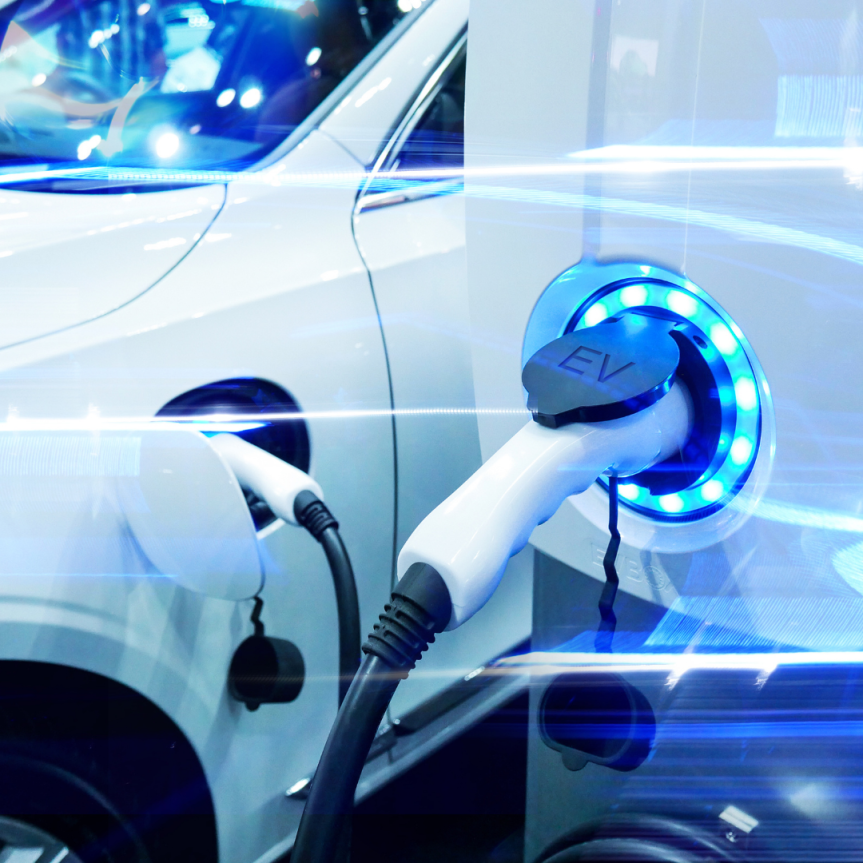
Will the transition to electric automobiles have a positive impact on our environment?

In the present scenario, the mightiest contributor to air pollution is the transport industry. Today we have automobiles zooming past us at an alarming rate. In our country, the previous year i.e., 2020 we saw the sales of passenger cars almost hit 3 million. If this trend continues how it is growing, we might not have a future to live. The possible solution to reduce the emissions from an automobile is to either shift to a Hybrid vehicle or an all-electric one. Let’s see what’s going to happen if we could successfully undergo this transition.

Firstly, let’s take a look at why the people in our country aren’t open to electric vehicles. The major issue is the easiness of refueling the vehicle. Currently, it is very easy to do so with fuel-run vehicles; but if forced to shift to an electric vehicle causes a major drawback in the time taken to refuel the vehicle. Next, we have the affordability; the current average price of a regular automobile ranges from 7.5 lakhs to 8.5 lakhs. The average cost of a hybrid or electric vehicle is approximately situated at 20 lakhs, which makes a major financial hindrance to the con-man of our country.

Although during a drive an electric vehicle produces almost no harmful emissions directly to the environment some indirect emissions cause harm to the environment. To charge an electric vehicle the need for electricity is very essential. Presently, in our country around 60% of the electricity produced comes from burning coal. Burning up fossil fuels results in enormous amounts of carbon emissions into the atmosphere. Here we are trying to reduce the effect of pollution on our environment by just finding new methods to harm our environment.

On the contrary, the emission produced by an electric vehicle is just half of that produced by a fuel-run car annually. This provides a huge amount of relief and satisfaction that we might able to reduce our carbon footprint. But questions arise whether it is possible to make one’s transport almost completely green and harmless to the environment. Possibly, there might be a way to do so. To reduce the amount of electricity generated by incinerating fossil fuels, we must explore other greener sources of energy. One might consider these to be energy produced from solar, wind, geothermal, hydel and many more., these sources might help us in building a better environment.

It is not a feasible approach to drastically switch to an electric approach; it will take immense time to completely switch. Although it seems to be nearly impossible, but with right investment and policies from the government we can ensure a smooth transition. By supporting this transition, we can reduce the emissions from our conventional automobiles. It is clear that the cost of electric automobiles is currently rocket high, but when manufacturing companies see the trend for EV’s they will consider mass production a large scale and then prices will gradually reduce.  

To conclude, EV’s are the future and will surely help reduce the effects of global warming, ozone depletion and many other environmental issues. Currently, a conventional gasoline run automobile can only provide an efficiency of 60-70%. Whereas an electric powered vehicle has an efficiency in the range of 80-90%. Hence the shift to electric powered vehicles, will not only reduce the harm on our environment, but also will be lighter on the pocket.

Rachid Yazami, a Moroccan innovator, breaks the world record for charging EV batteries in under 10 minutes.

Electric vehicles are sweeping our cities, and an overwhelming number of individuals are choosing to commute in electric vehicles. Electric mobility is unquestionably the way of the future, given the environmental advantages offered by these vehicles and the commitment of both manufacturers and drivers.

Rachid Yazami, a Moroccan innovator, revealed a few weeks ago:

We broke a new world record a few weeks ago by charging an electric car battery in just 10 minutes. I hope that morocco will succeed in developing and marketing ultra-rapid chargers.

Statement by Rachid El Yazami

Dr. Rachid Yazami, the inventor of one of the most important components of lithium-ion batteries, is working on a method to charge an electric vehicle in less than 10 minutes.

Given the recent technological advancements, electric vehicles still face obstacles in becoming the preferred mode of transportation and replacing combustion engine vehicles. One of the most significant concerns is slow battery charging, however, it appears that this impediment is coming to an end.

Dr. Rachid Yazami, the inventor of the graphite anode, a critical lithium-ion battery component, is working on a method that will allow the electric car to be charged in as little as 10 minutes. A breakthrough in these aspects will be a watershed moment in electric transportation, virtually equating the time spent charging the vehicle’s battery to just the time spent replenishing traditional fuel.

According to The Register, Dr. Rachid Yazami is working on a new quick charging system for electric automobiles that beats any other technology now available. Your technology, according to current testing, can charge a high-density battery in under 10 minutes, which itself is seven times faster than Tesla.

To attain this goal, Dr. Rachid Yazami uses a different loading method than the usual one. Instead of utilizing constant current, they utilize non-linear voltammetry, which adjusts voltage instead of current.

Voltage, according to the expert, should be seen as a sequence of steps on a ladder. Every one of those rungs’ voltage must remain constant until the conditions are met and that the next rung can be advanced. During the charging process, this charging mechanism gives the batteries a break, helping them to last longer.

“Fast-charging technology improves battery life by decreasing stress”, according to Dr. Rachid Yazami. “We can preserve the battery for 10 years instead of five because we charge it in such a way that it is not subjected to high temperatures or current stress. The optimal charging situation for the battery would be 10 minutes of charging time for an 800 km range.

Wireless Energy Transfer-Tesla’s Dream

WPT- Wireless Power Transmission
Wireless Power Transfer holds the promise of freeing us from the tyranny of power cords. This technology is being incorporated into all kinds of devices and systems.

Wireless Power Transfer holds the promise of freeing us from the tyranny of power cords. This technology is being incorporated into all kinds of devices and systems. Let’s take a look!
The Wired Way
The majority of today’s residences and commercial buildings are powered by alternating current (AC) from the power grid. Electrical stations generate AC electricity that is delivered to homes and businesses via high-voltage transmission lines and step-down transformers.
Electricity enters at the breaker box, and then electrical wiring delivers current to the AC equipment and devices that we use every day—lights, kitchen appliances, chargers, and so forth.
All components are standardized and in agreement with the electrical code. Any device rated for standard current and voltage will work in any of the millions of outlets throughout the country. While standards differ between countries and continents, within a given electrical system, any appropriately rated device will work.
Here a cord, there a cord. . . . Most of our electrical devices have AC power cords.


Wireless Power Technology
Wireless Power Transfer (WPT) makes it possible to supply power through an air gap, without the need for current-carrying wires. WPT can provide power from an AC source to compatible batteries or devices without physical connectors or wires. WPT can recharge mobile phones and tablets, drones, cars, even transportation equipment. It may even be possible to wirelessly transmit power gathered by solar-panel arrays in space.
WPT has been an exciting development in consumer electronics, replacing wired chargers. The 2017 Consumer Electronics Show will have many devices offering WPT.
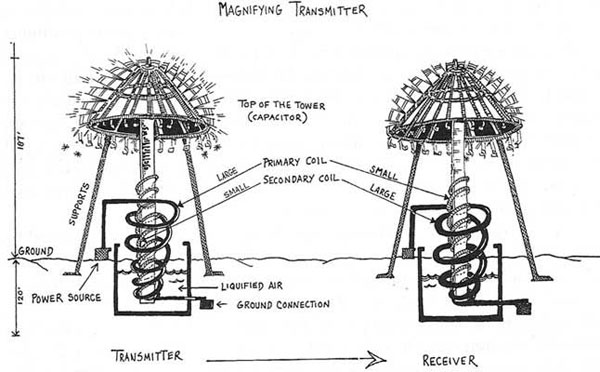
The concept of transferring power without wires, however, has been around since the late 1890s. Nikola Tesla was able to light electric bulbs wirelessly at his Colorado Springs Lab using electrodynamic induction (aka resonant inductive coupling).
 

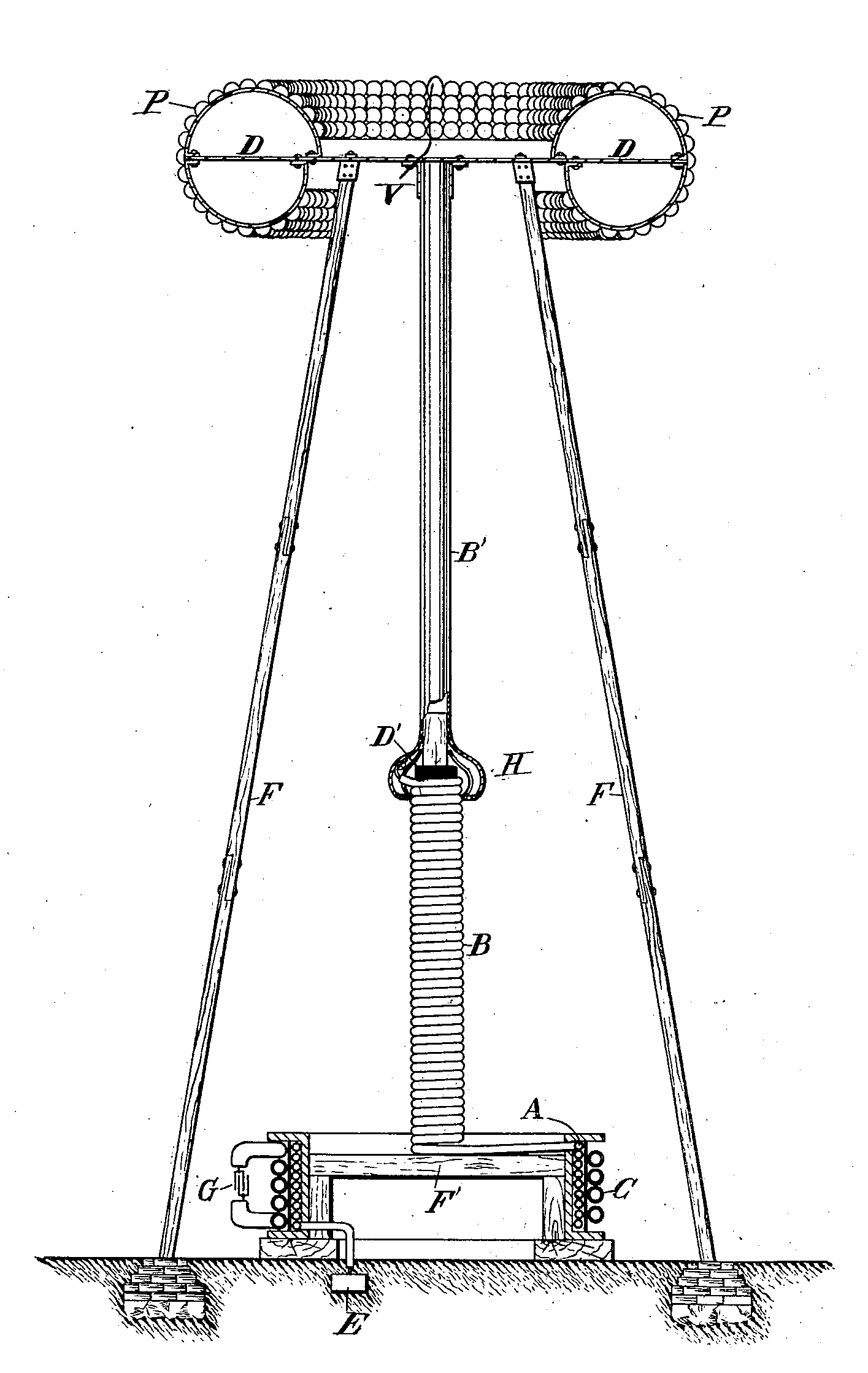
An image from Tesla’s patent for an “apparatus for transmitting electrical energy,” 1907.
 
Three light bulbs placed 60 feet (18m) from the power source were lit, and the demonstration was documented. Tesla had big plans and hoped that his Long Island-based Wardenclyffe Tower would transmit electrical energy wirelessly across the Atlantic Ocean. That never happened owing to various difficulties, including funding and timing.
WPT uses fields created by charged particles to carry energy between transmitters and receivers over an air gap. The air gap is bridged by converting the energy into a form that can travel through the air. The energy is converted to an oscillating field, transmitted over the air, and then converted into usable electrical current by a receiver. Depending on the power and distance, energy can be effectively transferred via an electric field, a magnetic field, or electromagnetic (EM) waves such as radio waves, microwaves, or even light.

 
Qi Charging, an Open Standard for Wireless Charging
While some of the companies promising WPT are still working to deliver products, Qi (pronounced “chee”) charging is standardized, and devices are currently available. The Wireless Power Consortium (WPC), established in 2008, developed the Qi standard for battery charging. The standard supports both inductive and resonant charging technologies.
Inductive charging has the energy passing between a transmitter and receiver coil at close range. Inductive systems require the coils to be in close proximity and in alignment with each other; usually the devices are in direct contact with the charging pad. Resonant charging does not require careful alignment, and chargers can detect and charge a device at distances up to 45mm; thus, resonant chargers can be embedded in furniture or mounted in shelving.
 

The Qi logo displayed on the Qimini wireless charging plate. Image courtesy of Tektos.
 
The presence of a Qi logo means the device is registered and certified by the Wireless Power Consortium.
When first introduced, Qi charging was low power, about 5W. The first smartphones using Qi charging were introduced in 2011. In 2015, Qi was expanded to include 15W, which allows for quick charging.
Only devices listed in the Qi Registration Database are guaranteed to provide Qi compatibility. There are currently over 700 products listed. It is important to recognize that products with the Qi logo have been tested and certified; the magnetic fields they use will not cause problems for sensitive devices such as mobile phones or electronic passports. Registered devices are guaranteed to work with all registered chargers.  
For more information on Qi wireless charging, check out this article, and for an introduction to and technical evaluation of Qi-compatible transmitter/receiver WPT evaluation boards, click here and here.
 
The Physics of WPT
WPT for consumer devices is an emerging technology, but the underlying principles and components are not new. Maxwell’s Equations still rule wherever electricity and magnetism are involved, and transmitters send energy to receivers just as in other forms of wireless communication. WPT is different, though, in that the primary goal is transferring the energy itself, rather than information encoded in the energy.


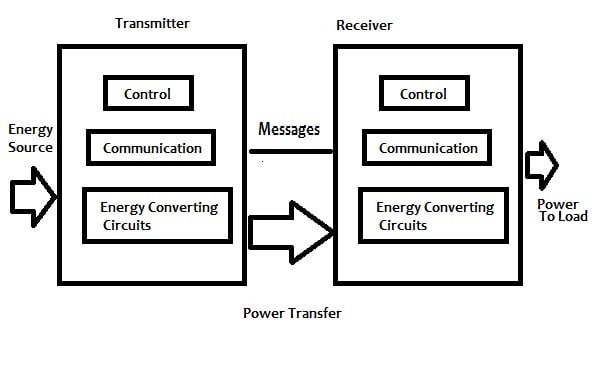
WPT transmitter/receiver block diagram.
The electromagnetic fields involved in WPT can be quite strong, and human safety has to be taken into account. Exposure to electromagnetic radiation can be a concern, and there is also the possibility that the fields generated by WPT transmitters could interfere with wearable or implanted medical devices.
The transmitters and receivers are embedded within WPT devices, as are the batteries to be charged. The actual conversion circuitry will depend on the technology used. In addition to the actual transfer of energy, the WPT system must allow the transmitter and receiver to communicate. This ensures that a receiver can notify the charging device when a battery is fully charged. Communication also allows a transmitter to detect and identify a receiver, to adjust the amount of power transmitted to the load, and to monitor conditions such as battery temperature.
The concept of near-field vs. far-field radiation is relevant to WPT. Transmission techniques, the amount of power that can be transferred, and proximity requirements are influenced by whether the system is utilizing near-field or far-field radiation.
Locations for which the distance from the antenna is much less than one wavelength are in the near field. The energy in the near field is nonradiative, and the oscillating magnetic and electric fields are independent of each other. Capacitive (electric) and inductive (magnetic) coupling can be used to transfer power to a receiver located in the transmitter’s near field.
Locations for which the distance from the antenna is greater than approximately two wavelengths are in the far field. (A transition region exists between the near field and far field.) Energy in the far field is in the form of typical electromagnetic radiation. Far-field power transfer is also referred to as power beaming. Examples of far-field transfer are systems that use high-power lasers or microwave radiation to transfer energy over long distances.
 
Where WPT Works
All WPT technologies are currently under active research, much of it focused on maximizing power transfer efficiency (PDF) and investigating techniques for magnetic resonant coupling (PDF). In addition to the idea of walking into a room equipped for WPT and having your devices charge automatically, much more ambitious projects are in place.
Across the globe, electric buses are becoming the norm; London’s iconic double-decker buses are planning for wireless charging, as are bus systems in South KoreaUtah, and Germany.
Using WiTricity, invented by MIT scientists, electric cars can be charged wirelessly, and those cars can wirelessly charge your mobiles! (Using Qi charging, of course!) This wireless technology is convenient, to be sure, but it may also charge cars faster than plug-in charging can.
 

Graphic of a wireless parking charge setup built into a parking space. Image courtesy of Toyota.
 
An experimental system for wirelessly powering drones has already been demonstrated. And as mentioned above, ongoing research and development is focused on the prospect of supplying some of Earth’s energy needs using WPT in conjunction with space-based solar panels.
WPT works everywhere!
 
Conclusion
While Tesla’s dream of having power delivered wirelessly for everyone’s use is still far from feasible, many devices and systems are using some form of wireless power transfer right now. From toothbrushes to mobile phones, from cars to public transportation, there are many applications for wireless power transfer.

The issue of Electric Vehicles and their sustainability

Tesla launched the Model-S in 2012, the luxury car was one of the more mainstream vehicles that accelerated the growth of electric vehicles. Some traditional cars manufacturers also followed the suit to compete with Tesla. Fast forward to a decade later, electric cars have become even more relevant and every major internal combustion engine manufacturer has an electric car model in their portfolio.

The rise of electric cars has been commendable with 75% growth rate and current sales north of 3 million units. But we have to look at the sustainability of electric vehicles realistically. Internal Combustion Engines cars have come a long way from 20 years back. Conventional cars are significantly more fuel-efficient and release less harmful gases to the environment. But still, they are incomparable to electric vehicle zero fuel emissions.

When we talk about electric vehicles, we also have to consider the whole infrastructure that is required to sustain that. The elephant in the room is the batteries. Battery technology has progressed a lot in the past decade but still, there are lots of limitations that have hindered the adaptability of EVs. One of the biggest issues that EVs face is the limited lifespan of batteries. The average lifespan of a typical EV battery is approximately 10 years depending upon the usage. In many EVs, the replacement of batteries is very difficult or almost impossible. Another problem is the case of recycling batteries. It’s not easy to recycle batteries and currently, electric vehicles have a very small percentage of market share. But as more and more people adopt EVs, there will be more EVs that will have to be scrapped and the proper disposal of batteries will be required. This can be a cause of environmental concerns as batteries will accumulate with no proper arrangement for its recycling.

Issues that will have to be addressed

The problem is much more than just battery technology. The power delivery and infrastructure also need to be developed to support the EVs. It’s going to be easier in urbanized areas with a small population, for instance Norway has been moderately successful in adopting EVs as a standard with plans to totally cease the sales of internal combustion engine vehicles by 2025. This target is going to be much more difficult in large countries with large populations and rural populations where distances between cities are larger. It also requires a considerable amount of capital resources to make the transition possible. Currently, traditional gas vehicles are still more viable, practical, and cheaper than EVs. This tells us that EV manufacturers and the government will require much more than subsidies to convince people to convert. EV manufacturers will also need to control the amount of energy that is required to produce a single EV, which is much more than a gas vehicle.

The extraction of lithium is also a contested issue and just as fossil fuels, the elements that are required to make batteries are non-renewable. Lithium can be extracted in a limited capacity and with more demand, it will become even more challenging to supply the raw materials required to build a battery. Building new battery production factories will also require a considerable amount of time and money. Until battery production facilities are not increased, supplying batteries will be a challenge and mass adoption will not be as fast as we would like it to be.

In conclusion, EVs are certainly the future, they are cheaper to operate and have zero emissions. But there are many other issues like infrastructure, battery supply, and proper disposal that would have to be addressed.

References: