
Schemes for accelerating the adoption of electric vehicles

 Ministry of Heavy Industries is currently implementing the following schemes for accelerating the adoption of electric vehicles in the country:


  1. Electric Mobility Promotion Scheme 2024 (EMPS) with an outlay of  ₹ 778 Crore for a period 6 months, w.e.f. 1st April 2024 till 30th September 2024, which provides incentives to buyers of e-2W and e-3W.
  2. Production Linked Incentive Scheme for Automobile and Auto Component Industry (PLI-AAT) with a budgetary outlay of  ₹ 25,938 Crore. The scheme incentivises various categories of electric vehicles including e-2W, e-3W, e-4W, e-buses & e-trucks also.
  3. Production Linked Incentive Scheme for manufacturing of Advanced Chemistry Cell (PLI-ACC) in the country with a budgetary outlay of ₹18,100 Crore.
  4. Scheme to Promote Manufacturing of Electric Passenger Cars to attract investments from global EV manufacturers and promote India as a manufacturing destination for e-vehicles.


The Ministry of Heavy Industries (MHI) formulated a Scheme namely; Faster Adoption and Manufacturing of (Hybrid &) Electric Vehicles in India (FAME India) Scheme in 2015 to promote adoption of electric/ hybrid vehicles (xEVs) in India. The Phase-I of the scheme was available up to 31st March, 2019 with budget outlay of Rs. 895 Crore. This phase of FAME India Scheme had four focus areas i.e. technological development, demand generation, pilot project and charging infrastructure components.


In the 1st phase of the scheme, about 2.8 lakh xEVs were supported with total demand incentives of Rs. 359 Crore (Approx). In addition, 425 electric and hybrid buses, as sanctioned under first phase of the scheme were deployed across various cities in the country with Government Incentive of about Rs. 280 Crore. The Ministry of Heavy Industries had also sanctioned about 520 Charging Stations/ Infrastructure for Rs. 43 Crore (approx.) under Phase-I of FAME India Scheme.


Projects worth about Rs. 158 Crore were sanctioned for the technology development projects like establishment of testing Infrastructure, setting up of ‘Centre of Excellence’ for Advanced Research in Electrified Transportation, Battery Engineering, etc. to various organisations / institutions like Automotive Research Association of India (ARAI), IIT Madras, IIT Kanpur, Non Ferrous Material Technology Development Centre (NFTDC), Aligarh Muslim University (AMU), etc.


Based on outcome and experience gained during Phase-I of FAME India Scheme and after having consultations with all stakeholders, including Industry and Industry Associations, the Government notified Phase-II of FAME India Scheme for a period of five years commencing from 1st Apri1, 2019 with a total budgetary support of Rs. 11,500 crore.


This phase-II mainly focused on supporting electrification of public & shared transportation, and aimed to support through demand incentive 7,262 e-Buses, 1,55,536 e-3 Wheelers, 30,461 e-4 Wheeler Passenger Cars and 15,50,225 e-2 Wheelers. In addition, creation of charging infrastructure is also supported under the Scheme.


Under Phase-II of FAME India Scheme, as on 31/07/2024, claims of 16,71,606 electric vehicles for Rs. 6,825 crore have been submitted for reimbursement of subsidy by the OEMs (EV manufacturers) as per http://fame2.heavyindustries.gov.in/dashboard. aspx. Category-wise details of claims submitted are as under:


Sl. No.

Wheeler Type

Total No. of Vehicle

1.

2 wheeler

14,69,343

2.

3 wheeler

1,78,952

3.

4 wheeler

23,311


Total

16,71,606


Further, 6862 electric buses were sanctioned to various cities/STUs/State Govt. entities for intra-city operations under the FAME-II Scheme. Out of 6,862 e-buses, 4,853 e-buses have been supplied till 31st July, 2024.


MHI has also sanctioned Rs. 800 Crore as capital subsidy to the three Oil Marketing Companies (OMCs) of the Ministry of Petroleum and Natural Gas (MoPNG) for establishment of 7,432 electric vehicle public charging stations. Subsidy of Rs.560 crore has already been released to OMCs. Further, in March 2024, MHI sanctioned additional Rs.73.50 Crore under FAME II to OMCs for set up/upgradation 980 public fast charging stations by installing new chargers across the country. Subsidy of Rs.51.45 crore has already been released to OMCs.
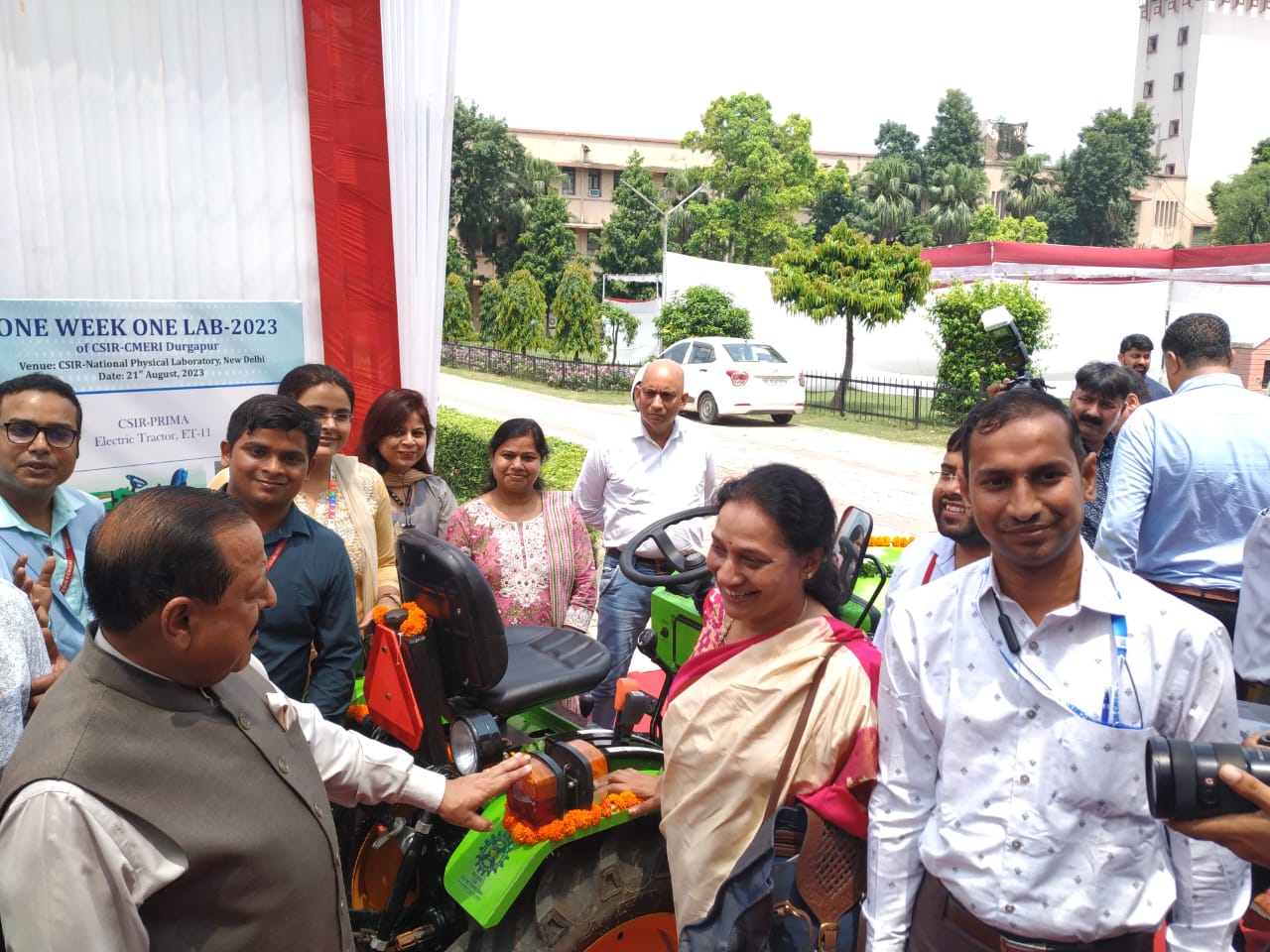
 

CSIR-CMERI Developed Compact Electric Tractor- CSIR PRIMA ET11

 In India, agriculture is the primary source of livelihood for nearly 55% of Indian population, feeding 1.3 billion people and contributing significantly to the country GDP. Tractors play a crucial role in increasing agricultural productivity by mechanization. Indian tractor industry has come a long way in terms of production capacity and technology in last few decades.

CSIR CMERI is having the long history in Design and development tractors of various ranges and capacities. Its journey starts with the very first indigenously developed SWARAJ Tractor in 1965, followed by 35hp sonalika tractor in 2000 and then Small diesel tractor of 12hp Krishishakti  in 2009 for small and marginal farmers demand. To take the legacy to the next level CMERI started working with the advance technology in the tractor, in result this e-tractor has been developed.
Traditionally tractors use diesel, thus contributing significantly to the environmental pollution. According to an estimate they consume about 7.4% of our country’s annual diesel usage and account for 60% of total agricultural fuel usage. Also their PM2.5 and NOx emissions are likely to increase 4-5 times the current level in next two decades.
Global carbon foot print reduction strategy necessitates rapid transition of this sector towards electrification. In COP26 summit held at Glasgow in the year 2021, India announced to work towards reducing the total projected carbon emissions by one billion tones by the year 2030. Also target was kept to achieve Net Zero carbon emission by the year 2070. Therefore, electrification of tractors is a necessary step that aids our country in achieving these targets.
Considering the need to further reduces the greenhouse gas emissions and the eventual scarce availability of fossil fuels shortly, electric tractors have been identified as a possible solution in the context of more sustainable farming. However, most of the commercial equipment consists of high-power machines, which are only feasible to large area Farming and poses a challenge for Indian marginal farmers having around 2 hectare of farming land or less and this small & marginal farmer consist of more than 80% of farmer community.

Addressing to this, CSIR-CMERI has indigenously designed and developed compact 100% Pure Electric Tractor named CSIR PRIMA ET11 mainly to cater small and marginal farmers of India.

Salient features of the developed CSIR PRIMA ET11 are as follows:
1) The first very important point that entire tractor has been designed and manufactured with indigenous components and technologies.
2) Since the main purpose of the tractor is to cater the demand of agriculture field application, it has been designed in such a way that its dynamics, weight distribution, transmission engagements, then lever and pedal position everything has been well designed and considered.
3) Another USP of the developed technology is that it Women friendly. For this we have given special attention in the ergonomics, for eg: All the lever, switches etc has been placed for easy approach to the women. Further to minimize the effort many mechanical system is being replaced with electronic switches for easy operations.
4) The farmers can charge the tractor using conventional home charging socket in 7 to 8 hours and operate the tractor for more than 4 hours at field. Otherwise, tractor can run more than 6 hours in case of normal Haulage operation. We have seen that the usual practice of farmer in India that they start their work from morning and at noon they usually take the rest and during this time they can charge their tractor so that theyr can again use it for their work in the afternoon.
5) Coming to Transmission: The tractor is being designed with the robust and efficient transmission system by using the semi Synchronized type gearing system. The design helps to achieve the desired efficiency in min cost.
6) The tractor is equipped with best in class hydraulic with lifting capacity of 500 kg or more. It implies that tractor can lift implement required not only for field operation but also hauling operation. It is also to be mentioned that the tractor can tow 1.8-ton capacity trolley with a max speed of 25 kmph.
7) Its robust designed along with necessary covers and guards protects it from mud and waters.
8) Coming to electric aspects the battery we have chosen as the state of art Lithium ion battery with Prismatic cell confirmation. It has deep discharge capability for farming application and having a life of more than 3000 cycle.
9) The controller and the instrument cluster has been modified to suit the agriculture needs.
10) Another distinct feature, we have provided that there is a port called V2L i.e. vehicle to load, This means when the tractor is not in operation, it battery power can be utilized for other secondary application like pump and irrigation etc.

This first of it’s kind electric tractor has been launced by Union Minister for Science and technology Dr. Jitendra Singh in our One Week One lab curtain raiser ceremony held at New Delhi in the presence of, Secretary, DSIR Dr. N Kalaiselvi and many other dignitaries.

Also this impactful technology has been licensed to K N bioscience, Hyderabad based Company famous for its Kushal Tractor brand and many bioscience related development/product for take it to the ground level and mass production; we are hoping for its grand success.

It is expected that this tractor CSIR PRIMA ET11 will create a breakthrough in sustainable agriculture while meeting ch the demands of small and marginal farmers in India. And thereby this development will trigger to lead India in the global tractor industry with revolutionary vision of “Make for the World”

****

Things To Do Before Purchasing An EV

  Electric vehicles (EVs) have become an increasingly popular option for consumers. For starters, they’re better for the environment. However, other advantages like government incentives, tax credits, and reduced fuel costs make it an option many find hard to turn down. Although these are excellent advantages, there are things to consider before driving off the car lot. Continue reading to learn more.

Shop Around For Affordable Insurance

When purchasing an electric car, most consumers don’t realize that they’re more expensive to insure. That’s because the cost to repair or replace an electric vehicle is higher than a gas-fueled car. Insurance companies will have to shell out thousands of dollars if you get in an accident. Ultimately, they try to offset those costs by increasing premiums.

That doesn’t mean you can’t find affordable insurance for your EV; you’ll just have to do your homework. Start with the vehicle type. The make and model of your vehicle can make a significant difference in insurance costs. For instance, Teslas are the most expensive to insure, while a Honda CRV-FHEV is among the cheapest.

As with any auto insurance, do some comparison pricing and consider discounts like bundling, good student, safe driver, defensive driving, and low mileage to keep the costs reasonable.

Selecting And Installing An EV Charging Station

People who have EV charging stations in their homes can make sure their car is always ready to go when needed. Of course, you’ll want to select the correct charger for your vehicle. While most EVs come with options to plug straight into an outlet, the charge time is slow. However, level 2 stations (which charge faster and have many features like wi-fi access) may require professional installation.

Shop around for the most affordable and convenient EV charging station that’s compatible with your vehicle’s battery needs. If an installation is necessary, you’ll want to find a service provider that can safely add the unit to your home. It’s essential to include the cost of installation into your budget. You may also notice a spike in your utility bill, which is an ongoing expense you’ll need to cover.

Evaluate Repair Costs

Electric vehicles might be cheaper to maintain over their lifespan, but that doesn’t include repairs and replacements. As EVs are still relatively new to the auto industry, it often costs more to repair them. Not to mention, parts tend to be more expensive to replace. Before deciding which electric car is right for you, research common repairs and their expenses. Include your findings in your budget, so you don’t get caught off guard.

Find A Mechanic

When a fuel-powered vehicle breaks down, owners have multiple options of where they can go for service. The same isn’t true for EV owners. Believe it or not, most mechanics aren’t well-versed in repairing electric cars. It often requires that they get additional training and certification before working on EVs. Therefore, you want to choose your mechanic wisely.

If your vehicle is still under warranty, you could always take it to the manufacturer or dealership service station for adequate repairs. However, those without a warranty may find that these options are expensive. The next option would be to complete an online search to locate EV mechanics near you.

As you begin your search, look for mechanics specializing in repairing your vehicle’s make and model. Don’t be afraid to call and ask about their certifications and years of experience. The last thing you want is to send your car to an inexperienced technician as more problems could arise. You should also compare hourly rates to find the most affordable mechanic in your area. As gas prices soar and climate change wreaks havoc on the planet, electric cars are an efficient option for drivers who want to help the environment save money. With more automakers getting into the EV field, buyers have multiple choices that make it easier to find a suitable car for their lifestyles. To get the most out of your eco-friendly ride, ensure that you’ve considered the above advice.

Investment in manufacturing of EVs, batteries and high technology automotive components in India

 The Ministry of Heavy Industries (MHI) has been continuously working towards making the auto sector in India ‘Aatmanirbhar’ by augmenting ’Make in India’ efforts of the Government and to position India as an alternative manufacturing hub for automobiles and its components. The key initiatives of Ministry of Heavy Industries during the year are as under:

  1. Faster Adoption and Manufacturing of Electric Vehicles in India Phase II (FAME India II) Scheme has been launched with an outlay of Rs 10,000 crore to incentivize demand for Electric Vehicles (EVs) by providing upfront subsidies and creating EV charging infrastructure. 1 million Electric 2 Wheelers, 5 lakh Electric 3 Wheelers, 55,000 Electric Cars and 7,090 Electric Buses are to be supported under FAME II through subsidies. Allocation of Rs 1000 crore has also been made under FAME II for provision of EV charging stations.
  • FAME India II Scheme was redesigned in June 2021 based on experience particularly during Covid-19 pandemic and feedback from industry and users. The redesigned scheme aims at faster proliferation of Electric Vehicles by lowering the upfront costs. Following amendments have been made in the scheme:
  • Demand incentive for Electric 2 Wheelers has been increased from Rs 10,000/KWh to Rs 15,000/KWh with maximum cap increased from 20% to 40% of the cost of vehicles. 
  • For Electric 3 Wheelers, aggregation will be the key method to bring the upfront cost at an affordable level and at par with ICE-3 Wheelers. Energy Efficiency Services Limited (EESL) will aggregate demand for 3 lakh Electric 3 Wheelers for multiple user segments.
  • For Electric Buses, 9 cities with over 4 million population (Mumbai, Delhi, Bangalore, Hyderabad, Ahmedabad, Chennai, Kolkata, Surat and Pune) will be targeted. EESL will aggregate the demand in these 9 cities for remaining Electric Buses under the scheme on OPEX basis.
  • Further the scheme has been extended for further period of 2 years i.e. upto March 31, 2024 

After remodeling of FAME II in June 2021 sale of electric two wheelers has increased to over 5000 per week from 700 per week before remodeling.

Achievements under FAME India II scheme in this year

    • In calendar year 2021, total 1.4 lakh Electric vehicles (1.19 Lakh electric two wheelers, 20.42 K electric three wheelers and 580 electric four wheelers) have been incentivized upto 16 December 2021 amounting to incentive of about Rs 500 Crore under Phase-11 of FAME. Total 1.85 lakh Electric Vehicles have been incentivized under FAME II till now.
    • 835 Electric buses have been deployed (314 in Mumbai, 150 in Navi Mumbai, 90 in Ahmadabad, 105 in UP, 30 in Goa, 25 in Patna, 49 in Surat, 16 in Rajkot, 25 in Delhi, 11 in Chandigarh, 10 in silvassa and 10 in Dehradun), in this year till 16 December 2021. Total 861 Electric buses have been deployed under FAME II.
    • 50 Electric Buses have been sanctioned to GSRTC for deployment in Kewadia a place of national importance.
    • City/State Transport undertakings have issued supply order for 1040 Electric buses in this year till 16 December 2021 (100 in Goa, 100 for intercity bus operation by MS RTC, 40 in the city of Chandigarh, 300 in Delhi by DTC, 300 in Bangalore, 50 for intracity and 50 for intercity bus operation in the city of Tirupati, 100 for intercity bus operation by GSRTC). Total supply orders have been issued for 3428 Electric Buses under FAME
    • Timeline extension has been granted to STUs/CTUs undertakings as per their request to issue Supply Order/Letter of award by STUs/CTUs for 1040 electric buses in this year (100 in Goa, 100 for intercity bus operation by MSRTC, 40 in the city of Chandigarh, 300 in Bangalore, 50 for intra-city and 50 for intercity bus operation in the city of Tirupati, 100 in Rajkot, 150 in Surat, 50 each to KSRTC & NWKSRTC, 50 to Navi Mumbai).
    • 1576 EV charging stations have been sanctioned and Letters of Award have been issued across 9 Expressways and 16 Highways in this year till 1 6 Dec 2021.
    • Letters of Award (LOA) issued for 35 Charging stations have been issued till 1 6 Dec 2021 (25 in the city of Coimbatore and 10 in Erode). Total LOA have been issued for 1797 Charging stations in cities under FAME II.
    • Total 104 EV charging stations have been commissioned in this year till 1 6 December 2021 [91 under FAME I (9 on Delhi – Chandigarh, 3 on Mumbai-Pune Expressways, 12 in Bangalore, 4 in Ranchi, 10 in Goa, 45 in Hyderabad, 6 in Agra and 2 in Shimla) and 13 under FAME —II (4 in the city of Chennai, 3 in Delhi 4 in Nagpur and 2 in Ahmedabad)]
  1. Union Cabinet on May 12, 2021 approved the National Programme on Advanced Chemistry Cell (ACC) with an outlay of Rs 18,100 crore to incentivize setting up of manufacturing facilities in the country for 50 Giga Watt Hour of ACC and 5 GWh of “Niche” ACC. As of now ACC are imported in the country. The scheme was notified on June 9, 2021
  • Through this Scheme, the Government intends to optimally incentivize potential investors, both domestic and overseas, to set- up Giga-scale ACC manufacturing facilities with emphasis on maximum value addition and quality output and achieving pre-committed capacity level within a pre-defined time-period.
  • Total investment of Rs 45,000 crore is envisaged under this scheme. The scheme will reduce the import bills of ACC by Rs 1,50,000 crore.
  • Request for Proposal (RFP) has been issued on October 22, 202 I for inviting proposals from domestic and international manufactures for setting up manufacturing facilities for ACC Battery Storage in India. Pre-Proposal Conference was held on Nov 12, 2021 which was attended by over 100 participants representing over 20 domestic and international manufactures.
  1. Union Cabinet on Sep’ 15, 2021 approved the Productivity Linked Incentive (PLI) scheme for Automobile and Auto Components with an outlay of Rs 25,938 crore to incentivize manufacturing of Advanced Automotive Technology products and attract investments in the Automotive Manufacturing value chain. Its prime objectives include overcoming cost disabilities, creating economies of scale and building a robust supply chain in areas of Advanced Automotive Technology products.
  • It is estimated that over a period of five years, the PLI Scheme for Automobile and Auto Components Industry will attract fresh investment of over 142,500 crore, incremental production of over 12.3 lakh crore and will create additional employment opportunities of over 7.5 lakh jobs.
  • This scheme will facilitate the Automobile Industry to move up the value chain into higher value added products and increase India’s share in global automotive trade.
  • The PLI Scheme is open to existing automotive companies as well as new investors who are currently not in automobile or auto component manufacturing business.
  • The scheme has two components viz Champion OEM Incentive Scheme and Component Champion Incentive Scheme. The Champion OEM Incentive scheme is a ‘sales value linked’ scheme, applicable on Battery Electric Vehicles and Hydrogen Fuel Cell Vehicles of all segments and any other advanced automotive technology as specified by Ministry of Heavy Industries. The Component Champion Incentive scheme is a ‘sales value linked’ scheme, applicable on Advanced Automotive Technology components of vehicles, Completely Knocked Down (CKD)/ Semi Knocked Down (SKD) kits, Vehicle aggregates of 2-Wheelers, 3-Wheelers, passenger vehicles, commercial vehicles and tractors etc. Incentives are applicable both on domestic sales as well as on exports of the eligible products.
  • The scheme provides incentive of 13- 18% on Electric Vehicles, Hydrogen Fuel Cell Vehicles and their components and incentive of 8-13% on Advanced Automotive Technology products related to safety, emission control, shared, convenience, efficiency etc. The incentives will be available for five-year period from FY 2022-23 to FY 2026-27.
  • The PLI scheme for Automobile and Auto components and the Guidelines have been notified on Sep 23, 2021. Application Form for PLI Scheme, List of Advanced Automotive Technology Products and Window for Notice Inviting Applications has been notified on Nov 9, 2021. Window for Notice Inviting Applications is open for 60 days from Nov 11, 2021 to Jan 9, 2022.
  1. Ministry of Heavy Industries organized Round Table on December 4, 2021 in Goa under chairmanship of Dr Mahendra Nath Pandey, Minister for Heavy Industries with all stake holders from Central Government, State Governments & UTs, leaders of Auto OEMs & Automotive Component Manufacturers, Start Ups and Technical Experts to work out strategies to promote adoption of Electric Vehicles in India and attract investment in manufacturing of EVs, batteries and high technology automotive components in India.

Other Initiatives

A 11 .3 km long, Asia’s longest high-speed track (HST) was inaugurated at NATRAX, Indore, Madhya Pradesh by Hon’ble Minister (HI&PE) on June 29, 2021. This will be a one stop solution for all sorts of high speed performance tests for automobiles within the country. Availability of NATRAX HST will encourage indigenous development of wide variety of automobiles.

  1. NATRIP is one of the most significant initiatives of the Govt of India for the growth of Automobile sector in India and includes setting up of “State of the Art” automotive Homogenization, Testing, Certification and R&D infrastructure at three new centers at GARC, Chennai, NATRAX Indore, NIAIMT Silchar and upgradation of three existing centers at ARAI Pune, VRDE Ahmadnagar and ICAT Manesar (Gurugram). This project has been completed on Mar’3l 2021 and subsequently taken over by National Automotive Board (NAB).

In compliance of directives of Cabinet Secretariat for digitization of official records, the work of digitization of more than 15 Lakh pages (accumulated since inception of the project) were completed in Nov 2021 for NAB (NATRIP)/HQ. This is a major work accomplished by NAB (NATRIP) organization in time bound manner.

  1. Issue of GST Concession Certificate to orthopedic disabled persons is one of the important services provided by MHI under its Citizen’s Charter. As a step towards Digital India, an online portal for issuing Aadhar Authenticated GST concession certificate was launched by MHI in Nov 2020. The development of online portal has improved the quality of service rendered by this Ministry. This IT enabled initiative has helped streamlining the process and facilitated issue of 1942 GST Concession Certificate in 10 months period from Jan’21 to Dec’21 (highest ever in the last five year period). This portal has helped the beneficiaries to avail benefits even during Covid- 19 pandemic scenario in 2021.
  1. In order to address the skill gaps and infrastructure development and technology needs for the Capital Goods Sector, Phase I of the Capital Goods scheme was rolled out by the Department in 2014. Phase I of the scheme fostered partnerships between Academia and Industry for engendering technology development with Government support.
    • The outcomes of the Scheme have proved the efficacy of the strategies deployed for technology and industrial infrastructure development.
    • Fifteen Common Engineering Facility Centres(CEFCs) including four Industry 4.0 SAMARTH centres and 6 Technology Innovation Platforms, Eight Centres of Excellence (COEs) for Technology Development, A 500 acres world class Machine Tool Park in Tuiuakuru, Karnataka in partnership with the Government of Karnataka has been established under the scheme. 25 new technologies in the field of machine tools, textile machinery, earth moving machinery, nano and sensor technologies, are being developed at national research institutes of eminence such as IITs, IISc, CMTI, etc. and some of these technologies are undergoing commercialization.
    • 74 workshops, webinars, awareness sessions etc have been organized under the theme Azadi Ka Amrit Mahotsav by SAMARTH Centers, Technology Innovation Platforms, CoEs, and Capital Goods Industry Association in this year.
  1. Development of web based open manufacturing technology innovation platforms: The Ministry of Heavy Industries has developed web based open manufacturing technology innovation platforms under the ongoing Capital Goods Scheme. These platforms wilt help in bringing all India’s technical resources and the concerned Industry on to one platform to kick start and facilitate identification of technology problems faced by Indian Industry and crowd source solutions for the same in a systematic manner so as to facilitate start-ups and angel funding of India innovations. This includes the development of the key ‘mother’ manufacturing technologies’ indigenously through ‘Grand Challenges’ on the Platforms to help achieve the vision of an Aatmanirbhar Bharat and a globally competitive manufacturing sector in India. Hon’ble Minister of Heavy I ndustr les inaugurated the Technology Innovation Platforms on July 2, 2021 (through virtual mode). Details are as below:
    • Six Technology Platforms have been developed by IIT Madras, Central Manufacturing Technology Institute (CMTI), International Centre for Automotive Technology (ICAT), Automotive Research Association of India(ARAI), BHEL and HMT in association with IISc Bangalore. These platforms will focus on development of technologies for the globally competitive manufacturing in India. These platforms will facilitate industry (including OEMs, Tier 1 Tier 2 & Tier companies & Raw Material Manufacturers), start-ups, domain experts/professionals, R&D institutions and academia (colleges & universities), to provide technology solutions, suggestions, expert opinions etc. on issues involving manufacturing technologies. Further, it will facilitate exchange of knowledge with respect to research & development and other technological aspects.
    • Online registration on the Technology Platforms can be done at following url: https://aspire.icat.inhttps://sanrachna.bhe1.in/https://technovuus.araiindia.coin/https://techport.hmtmachinetoo1s.comhttps://kite.iitm.ac.in/, htrps://drishti.cmti.res.in/. Over 60,000 Students, Experts, Institutes, Industries and labs have already registered on these platforms.
  1. MHI is in the process of launching the Phase 2 of the ‘Enhancement of Competitiveness in the Indian Capital Goods Sector’ which will further lead to indigenization of products and technology. The Scheme proposal with total financial outlay of Rs. 1207 cr including Government Budgetary support of Rs. 975 crore is under approval.


****