Comprehending CHESS through ‘Through the Looking Glass’

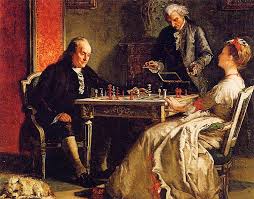
Chess was the most important indoor game of the nineteenth century in England. It enjoyed centuries-old privileged status. It was considered as a ‘rational recreation’. Chess, unlike any other game, deals more with logic and rationality rather than fun, as we know, Rationalism had taken over the Victorian era abundantly.

Alice, at once, recognizes the chess board stretched on the vast land in the Looking Glass World. It shows that although she is just seven and a half years, still familiar to the this game, which signifies the popularity of Chess in England in Victorian Era, especially among the bourgeois class(as it is also called ‘game of royals’) and Alice belonged to the same.

In life we make ‘choices’, in chess we make ‘moves’. In order to attain something valuable in life as to capture the opponent’s castle in chess, initiative has to be taken. Nobody can make decisions for me, I’ll have to play myself, it’s just suggestions that our people may put before us. Here, Alice makes a choice to participate in the game ‘imagining’ her goal where she wants to be in the end. Well, talking about imagination with reference to Victorian era, it significantly brought out a drastic change in society, though previously children along with adults were forced into realism. ‘Imagination’ is quite efficient to presume one’s position in the coming years and then working out to get there can be useful, because life makes it hard to calculate the further possibilities due to lack of information. Alice restrained herself asking the Queens about their arrival, thinking it would be obtrusive, which keeps her away from the information, also we see Alice not able to distinguish between Red Knight and White Knight and actually who’s there to save her declares her ignorance towards information.

Chess is symbolic to attributes of life, we see, there are (apparently) three stages in chess, that is, opening, middle game and the end game, similarly we have childhood, youth and adulthood in life. Alice joins the giant Chess game of life as a white pawn, that is, she holds very limited power and can move once at a time. We always need to start from the beginning, that is, from the very first ladder in order to earn it step by step. Alice has the freedom to setup her ‘goal’ to be a Queen, but she has no power over her inevitable maturation that’s leading her to womanhood. Within the framework of the chess game, Alice has almost no control over her path and she, with certain implied rules of the game, is driven by the corresponding characters in the book, as in chess, every piece moves in answer to the move of the other one. She is pushed towards her goal by the various situations occurring before her in every square, such as, the train ride, no-name forest, Humpty Dumpty and the White Knight. Thus, it can be traced from the narrative that in life, there is some invisible force that’s propelling every individual in the direction of set goal. It can be comprehended that collaboration is the biggest instrument to victory, for example, White Knight saved Alice from the attack of Red Knight without which it had been a Herculean task for her to reach to final square. We will have to rely on our people somehow, otherwise we can’t achieve our dreams just by our own self. In chess, one can take full credit for one’s victories, but in life it would be naive to say that what I achieved is all because of my sole efforts.
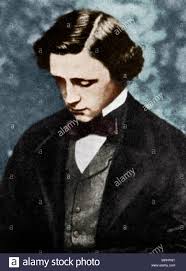
The game of Chess in Through The Looking Glass represents the interest of Carroll in logics and mathematics, and the agent is ‘Alice’. This game is not about luck unlike other indoor/board games, rather brainy. In the same way, Life is more about randomness, it’s not alone in the hands of fate, though life is much more unpredictable. We need statistics as well as probability in both chess and life. Also, chess possesses two different colors, that is, one is light and the other one is dark, where I suppose, they stand for logic and nonsense respectively. Based on this idea, Alice often proves to be smarter, more prudent than the so-called adults she confronts in the Looking Glass world. This might also be a reverse-reflection of actual world, I guess, where we see adults inclined towards logic and children uttering stuff and nonsense and vice-versa, here, in the world of mirror.
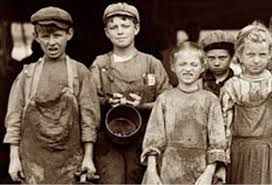
Life of the children in Victorian period was totally opposite to that of present-day children. They were considered as miniature adults and were expected to be highly sophisticated, more in the case of rich class children. Children were not allowed to shout, complain, interrupt or disagree with anyone. The children of rich parents were usually looked after by governesses, no matter humble or strict, and they only used to teach them manners and the way of living. Here, in Looking Glass world, Red Queen, the first character to guide Alice in the reverse world,
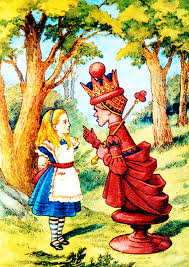
resembles very much like a governess of Alice when she teaches her how to not tweedle her fingers while speaking, how to behave, and to curtsey, and how Alice couldn’t go against her. She says, “when you’ve once said a thing, that fixes it, and you must take the consequences.”, because Alice is a Pawn and a Pawn cannot move backward, it is also allusion to the fact that once you have made the decision/choice, you can’t step back and stay committed bearing with it’s outcome, and she also asks Alice only to speak when she was asked to. Even we see TweedleDum-TweedleDee not ready to converse with Alice before she greets them. When Alice thinks that asking the Queens how they arrived would be impertinent, it shows again the social structure built for children in the real Victorian world.

When we are in a state of childhood, we want to turn into an adult soon. Similarly, Alice is excited about her lone-tour of adulthood through the Looking Glass world as she thinks she will be free of all the scolding, she says, “….no one here to scold me away from the fire….and can’t get me!” In the beginning, Alice was thrilled about her journey but as she is heading forward, she encounters the sense of loneliness in her journey to become a Queen(apparently) and acts adult herself. Though she is surrounded by different creatures many a times, but she feels alienated to their foreign ways. Hence, here Chess is a symbol of journey advancing from childhood to adulthood. She undergoes many crucial experiences, putting forward the idea of challenges one has to face in this journey of adulthood in one’s life. In the beginning, we see Alice being rude to Gnat about his jokes and later we see her kindness with White Knight that declares the change in her attitude as moving towards adulthood. When the Queen gives Alice directions as how to be a proper queen, it indicates that Alice wasn’t actually prepared to become a queen, just as it’s hard to prepare to be an adult in real world. Every square leads her to different characters and every character teaches Alice something significant, as we know, advice can come from the most unexpected places. For example, revelation of identity imposed by the situation in the woods of forgetfulness, the White Queen teaches her to believe in impossible, the fall of Humpty Dumpty symbolizes ‘the fall of man for pride’ and also ‘the fall of innocence’ proceeding towards maturity, and likewise all the other characters. These teachings help Alice to inherent the characteristics of adulthood within her. The crown here, symbolizes the transformation of Alice from childhood to adulthood.

The Red King and the White King are almost doing nothing throughout the game as compared to their Queens. The Red King, as first encountered by Alice, is sleeping and his other pieces are performing their tasks to save him, whereas, the White King seems to be nervous not able to catch up with her Queen.
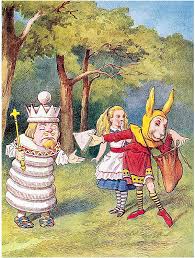
Now these characters resemble in moves of both as that of the White and Red King in the real chess board. These actions of Queens and Kings in the world behind the mirror, may portray the position of women in the Victorian era. Women, at that time, used to engage themselves working for their husband and family, and also middle class and the working class women were employed to earn bread for their family, in support of their husbands. Red Queen saying to Alice, “…if you want to get somewhere else, you must run at least twice as fast as that!” may ascertain the idea that in a male-dominated society, women need to work double/toil harder in comparison to men in order to attain recognition. Women in the nineteenth century were not given much of the rights and privileges. This period is named after Queen Victoria, who was in the place of power. It is strange to encounter such a frivolous situation of women at the time when a lady herself was reigning over the society. When we behold Alice as a little woman moving from actual world to Looking Glass world, it may seem as she is struggling to change her confided world. She starts her journey all by herself which reflects the essence of independence in her. The characters like Live flowers resemble the social class structure that pushes Alice to follow their rules. When she chooses to be a Queen, she establishes the path for women/girls to upgrade their status because Alice learns that she must have a powerful authority to control Looking Glass world when one of the servants at once answers her after she turns into a Queen, so is the case for women in Victorian era, for example, Queen Victoria.

We need not be afraid of our high-rated opponents and feel incapable before them and it is then only that Alice is able to shake Red Queen in frustration and raises her voice against her rather than stitching her lips out of fear as evident in the beginning, that is, crown here, symbolizes her transformation from childhood to womanhood, gives her voice and finally renovates her status from a pawn to a queen. All the exclusive pieces are placed right behind the pawns. And a Pawn in comparison to them is just an ordinary, common piece that can slowly and gradually become a Queen. Even a pawn can cut down a King, pertaining to life, a single human being, regardless of his status, is enough to bring about revolution in the society, and win the castle of life. Alice suffering through all the odds, obstructions eventually made it, checkmated the Red King and turned into a Queen.

As a Queen in the game, the Red Queen and the White Queen are able to move swiftly and effortlessly. The White Queen, as she says, “jam-tomorrow and jam-yesterday, but never jam-today.”, and screams before pricking her thumb, travels in past and future which is true for the Queen,
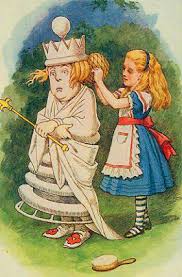
in general, in chess that she can freely move in every direction possible, but she is seen nervous and messy all the time here, and ultimately at two points passes up a chance to checkmate and on another occasion she missed the opportunity to capture the Red Knight. Similarly, the Red Queen said to Alice, “Speak when you’re spoken to!”, and having supporting her words, she doesn’t announce it after putting White King on the check, hence, the check is ignored. Their individual character traits restrained them from performing their duties. This also discovers their absent-mindedness and reverse effect of the mirror world.

The Knight in the chess moves very distinctively and is allowed to jump over any other pieces. Riding and falling of the White Knight in looking glass world is signifying it’s unique L-shape movement. The inventions of White Knight are here to present his powerful character trait, like in chess board Knight is an only piece imbibed with many powers, unlike other pieces, not even a Queen can move in same way as Knight, though his inventions are unprofitable disclosing the touch of the illusionary world, still it is pointing to the fact that precaution is must, so his horse wears spikes on it’s ankles to protect it from shark bites and he collects things that might be useful in the difficult situation. The White Knight is the only character that is benevolent with Alice and saves Alice from the attack of Red Knight (stopping her to be a Queen/upgrade the position of women in society), but it can be an example of gender-biased society where a man is shown as a powerful figure and woman belongs to a weaker section. Alice, here, is represented as a weak girl and this action of White Knight throws light on the concept of feminism, and make Alice learn that a woman must stand for herself and must discover her own capabilities.

Chess wasn’t just one of the themes in Carroll’s story, indeed, it was the ground for the novel’s structure. The game of chess in real world is ‘logical’ while in looking glass world it can be called as ‘maddening game of chess’. Also as an inverted image created by the mirror, this indoor game is displayed as an outer giant field of chess. The pieces are definitely running and moving under the implied rules, but the pattern is not applied evenly. This game sets the deterministic way of life. Both life and chess are, more or less, synonymous in almost every aspect.

Citation: https://www.smithsonianmag.com/arts-culture/the-64-square-grid-design-of-through-the-looking-glass-24546391/

ENRICHMENT AND REFINEMENT THROUGH LITERATURE

“That is part of the beauty of all literature. You discover that your longings are universal longings, that you’re not lonely and isolated from anyone. You belong.”
― F. Scott Fitzgerald

In today’s world of cut-throat competition and skills-based learning, parents, particularly in India, encourage their children to pursue higher education in the sciences, especially in engineering and medicine as the number of job opportunities in these fields are far more than in any other field. Consequently, there is a predominant idea among large sections of the society in India that those who pursue subjects related to Humanities and Social Sciences are less intelligent and that these subjects are only of academic importance, having no real value in the practical world as they offer limited employment opportunities.

However, such people are mostly ignorant or not highly educated as they tend to make injudicious comparisons between fields of studies, most of them do not realize that the Arts and the Sciences are interconnected. As there have been scientific movements in the course of history, whereby earlier pseudo-scientific notions were replaced with modern inventions and discoveries, so there also have been artistic and literary movements that have displaced the age-old concepts in a similar manner, transposing them with newer approaches. Accordingly, even the study of literature has become more practical in approach and has adopted the experiential method of learning. Few people are aware of the fact that the inspiration behind Einstein’s theory of Relativity was the writings of the sixteenth century philosopher and visionary, Giordano Bruno.

The study of literature has actually had a humanizing effect on people. It has opened the eyes of people to the problems of the world and has enabled them to empathize with the victims of an unequal social order. Knowledge of these has induced many industrialists and business people to involve themselves in philanthropic activities. Also, literature has provided us insights into the cultures and practices of different countries across time Through the study of literature, we have come to know about the social orders of ancient Greece, India and Mesopotamia as well as of Medieval Europe and Early Modern America and Europe.

A Literature also provides us with a welcome respite from the hectic day-to-day lives because it is also a source of entertainment in the form of theatrical productions and films. Good films and plays provide families the opportunity to be together, even if for a short while. This is important in maintaining the familial bond because every individual is always busy in chasing his or her dreams.

Lastly, one cannot help but admit that good stories are always welcomed and they are an integral part of human existence, and all good stories are nothing but literature. Thus, we cannot deny the fact that literature helps in enhancing the whole personality of a reason. It has the power to lead the whole society towards the right path.

WHAT IS PHONOLOGY AND PHONEME?

Our speech sounds can produce a wide variety of speech sounds. However , each language makes use of only a selected group of sounds .These selected sounds are organized in different ways in different languages .This selection and organization of speech sounds in an individual language is called Phonology .

PHONEMES

Every language has a definite number of distinctive sound units .These sound units constitute the phonemes of that language .They are the most basic and smallest elements in the expression system of a language .A phoneme may be defined as the minimal ,distinctive sound unit of a language .By minimal we mean that it cannot be sub-divide ; by distinctive we mean that , when one phoneme is substituted by another it produces a meaning change .Thus the phoneme is the smallest unit of sound that forms the basis of distinction between words in a language .The two words , for example , bat and cat are distinguished and differentiated by the initial phonemes of these two words , /b/ and /k/ .

When /p/ is substituted by /b/ in the word pit it becomes bit . With substitution , a different word with a different meaning is formed . Thus /p/ and /b/ are contrastive in English and hence they are two phonemes in English. Phonemic symbols are enclosed with in slant lines ; phonetic symbols within square brackets indicate the precise phonetic qualities of sounds represented by the symbols . It is also to be noted that phonemes refers to sounds and never to spellings .

The English RP has a system of forty four phonemes .Hindi has forty six phonemes and Malayalam has fifty two .All these languages have their own language specific phonemes .As phonemes are contrastive units of sound in the sound system of a particular language , they have validity only in that language.

How I Spend An Evening?

“Evening time” is the end of the day, And at this time we try to relax our body and mind, and every individual has a different way of relaxing oneself. Every person has a different way of greeting others. The Internet and mobile phones change our life completely. In the past few months, we have spent most of our time with friends and families more, but Today we use mobile phones all day and night. In other words, Today we can not live without a mobile phone; not only that, since social media has come, every person likes chatting in social media instead of talking to each other.

It’s impossible to even imagine how our life would be if there were no various tasty snacks. Most of us get back home, or complete our work by evening and relax with a cup of tea or coffee with something to munch on. The time where you have the deepest conversation or maybe end up overthinking. Snack is loved by people of all ages because it brings us a good taste, good mood and helps us heal from harms. Good food always brings good mood.

We face hard times! I am an optimistic and happy-go-lucky student of Class VIII who has firm faith in the good life, but my parents want me to stay ahead of everybody in this competitive world. There was a time when coming back after school meant joy to me. Four- thirty in the afternoon was good food, and seven in the evening meant time for studies. There was the beautiful period from four- thirty to seven in the evening when it was either cricket or football for me! How times have changed!

Ever since I reached high school, tuitions have been encroaching on my life like a desert encroaches upon a green pasture to destroy it. Well, it is not that tuitions are not important. Nor can I complain of a lack of dedication in my tuition teachers, but what I fail to comprehend is my parents’ obsession to ensure that this giant python called tuitions should develop a crush for me (pun intended!).

If I tell my dad that I am being made to take tuitions when I am quite comfortable with the subject, he gives a mature smile which betrays his being intrigued at my attempts to reason. He is perhaps under the impression that evolution is yet to catch with me. The final result is that he ensures that I meekly visit the concerned tutorial. up Thus my first tuition begins at 5 o’clock. From then to 6.30, I cram the concepts of organic and inorganic Chemistry. I leave this coaching sharp at 6.35 pm to reach another tutorial located 2 kilometres away before 7 pm. There begins my struggle with Shakespeare. It is not that I do not enjoy Shakespeare, but I do not have much stamina left by the time I reach the English tuition.

Image Source – google

My parents fail to recognise that the best part of a student’s waking hours is spent in school. And after that if I am sent to continuous tuition classes, when do I study myself? Moreover, we are taught to play for good health. If a boy does his schooling from ten to four and then does his tuitions from five to nine, when does he play to maintain good health? Yes, one may definitely expect destiny to play with my health. Thus, till 9 pm I struggle to stay awake in my English tuition and then I complete my projects, courtesy the Internet, for an hour after I reach home at about nine-thirty in the night!

I have dinner at ten-thirty which is when I also surf the television channels to locate some interesting entertainment. When I finally go to sleep at about eleven, I browse through some interesting book. My teachers always stress that reading builds character. I agree! But I can’t read for long! Although my school begins at ten am although I have Geography tuitions from 7.30 am to 9.00 am. Ah! So much for the sweet happiness of childhood!

A Memorable Spooky Experience.

Image Source- google.

Ok, i will narrate my experience you can decide whether it was paranormal or not. Sorry some of you may find it lengthy. I am a big believer of paranormal, and may be this is the reason that i have had a couple of paranormal experiences.

Who Knocks?’ ‘I who was beautiful Beyond all dreams to restore, I from the roots of the dark thorn am hither And knock on the door.’

Lines from Walter De La Mare’s The Ghost haunt my memory as I take a walk back to the past. People usually refer to the past as dead and buried. Is it really so?

It was a cold night in Deogarh, Jharkhand. I was in Class V then. We were supposed to go to a party at a friend’s house about one-and-a-half kilometres away. My mother was working in the local school. Mum and Dad were supposed to reach the house of Barry Uncle, our host while I was to be accompanied by our caretaker, Ramu.

It was a moonlit night. Deogarh is surrounded by lovely hills and trees. The silhouette of trees in the moonlight is one combination I love. Ramu had an upset stomach after eating thirty-seven pakoras the day before. So I was going alone but I did not feel lonely. The moon was travelling with me. I could see it moving across the branches as I walked. The gentle laughter of a lady suddenly pierced the charming silence of the night air.

Image Source- google.

A girl in bright red appeared suddenly, ‘Why do you keep looking up to your left while you walk?

I was looking at the moon,’ I answered, rather embarrassed at having my romance with the moon noticed.

The girl asked, You are going to the party, right?”

“How do you know?

“It is a small place. People know each other. I will give you company.”

“So kind of you.

So we talked, laughed and joked for the next twenty minutes. 1 noticed her carefully. Red blouse, red and white skirt, light make up, bright red shoes. A small red bag. The lipstick was a bit too bright. She had amazing grace in the way she walked. Her lively but gentle laughter had the freshness of a mountain spring. We were discussing hobbies. She said she liked collecting old photographs. Why old?’ I asked.

She looked at me queerly and answered, ‘Old photographs have lots of hidden and forgotten stories.

“All right, I said.

Barry Uncle’s house was decorated beautifully. Music and lights welcomed us. Suddenly, the girl stopped smiling. She turned around. ‘What is wrong?’ I asked her.

I prefer the moonlight. I will not go in,’ she said and started walking away.

At least take this jacket,’ I offered her. She was my height and I knew about chivalry. She gave me a mysterious smile, wore the jacket, and walked into the darkness.

In the party, I grooved to the music for some time. I needed to have a wash. While moving towards the washroom, I suddenly came across a photograph of Barry Uncle with the stranger I had just met. “That’s my niece, Mary. She died two years ago in a tragic accident,’ Barry Uncle said, with a note of sadness in his voice. She is buried in the graveyard behind St Michael’s Church,’ he added.

This is indeed an experience that I would not dare to forget……………….

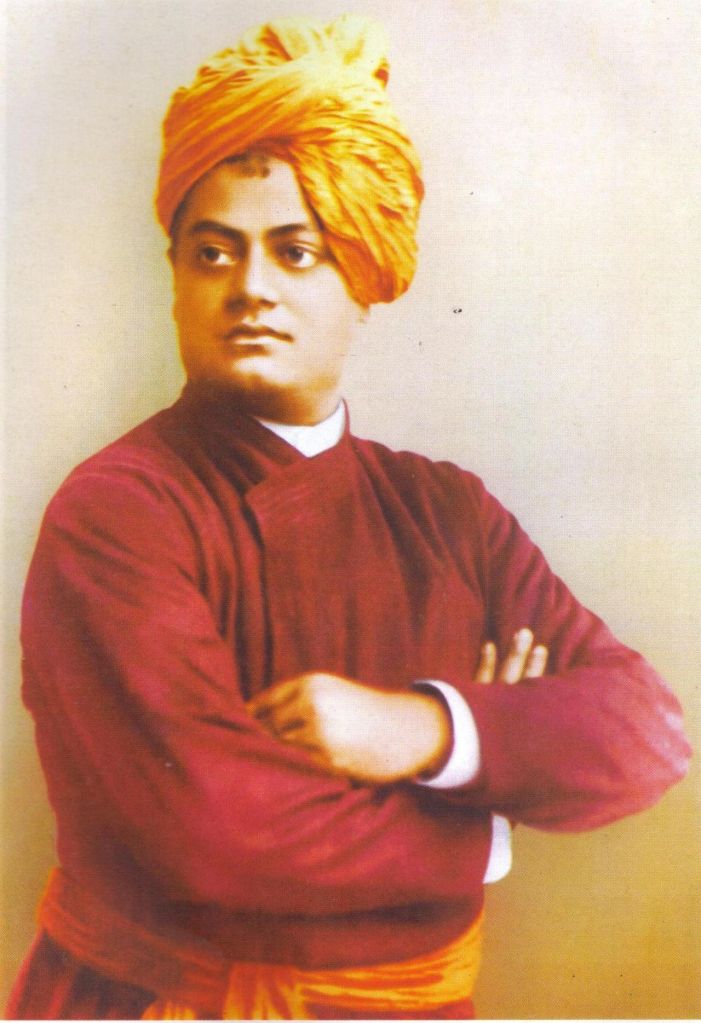
BIOGRAPHY of ‘Swami Vivekanand’

Born: 12 January, 1863

Place of Birth: Kolkata, India

Childhood Name: Narendranath Dutta

Father: Vishwanath Dutta

Mother: Bhuvaneshwari Devi

Education: Calcutta Metropolitan School; Presidency College, calcutta

Religion: Hinduism

Guru: Ramakrishna

Founder of: Ramakrishna Mission (1897), Ramakrishna Math, Vedanta Society of New York

Philosophy: Advaita Vedanta

Literary works: Raja Yoga (1896), Karma Yoga (1896), Bhakti Yoga (1896), Jnana Yoga, My Master (1901), Lectures from Colombo to Almora (1897)
Death: 4 July, 1902

Place of Death: Belur Math, Belur, Bengal

Memorial: Belur math, west bengal

About Swami Vivekanand:-

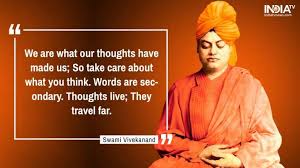
There are some rare men who leave their footprints on the sands of time, becoming a source of motivation for thousands of lost wanderers in the battlefield of life. Swami Vivekananda is one such example. “Come up, o lions and shake off the delusion that you are sheep; you are souls immortal, spirits free, blest and eternal….’ These words of stunning optimism proclaimed the arrival of a prophet- philosopher no less than Swami Vivekananda on the stage of the world. Such were his words that shook the world in the Chicago address on 19 September 1893. A young, educated man, Narendranath Dutta once walked the path of scepticism and even cynicism when it came to religion.

All the powers in the universe are already our. It is we who have put our hands before our eyes and cry that it is dark.”- –Swami Vivekananda

A visit to Ramakrishna Paramahansa changed his life. He challenged Ramakrishna’s claims of having seen God. Ramakrishna put his fingers on Naren’s heart, and in a moment of overwhelmingly powerful spiritual vision, Naren discovered God everywhere- from the rich man in his mansion to the poor rickshaw puller on the streets of Kolkata. God was no more a wishful thinking confined to the Kali temple at Ramakrishna’s Dakshineshwar. He was a living entity beyond all limitations of caste, creed, religion, language, time and space. Thus Narendranath Dutta metamorphosed into Swami Vivekananda, a disciple of Ramakrishna. This, however, was merely the beginning. The master, Ramakrishna, had told him before his passing away that he, Naren, would have to do ‘Mother’s work’, to teach mankind and be like a banyan tree, giving shelter to the tired and weary. In January 1891, he left the company of his brother monks and traversed the country from the North to the South alone with God. He wept to see the suffering and ignorance of the poor, and was disturbed at the material complacency of the affluent classes. The picture of ancient India appeared vividly before his eyes in all its grandeur and glory, and the contrast was unbearable. Swamiji set upon himself the task of rebuilding a new and rejuvenated India.

Learn everything that is good from others but bring it in, and in your own way absorb it; do not become others.” –Swami Vivekanand‘.

Be it his journey to America or the lecture at Chicago or the setting up of the Ramakrishna Mission in 1897, his main aim was service to mankind and the rebuilding of a young, vibrant and educated India. · Ramakrishna Mission today is a giant organisation which dedicates itself to the execution of extensive educational and philanthropic work in India and abroad, and expounds the profound Vedantic philosophy preached by Swamiji. The impact Swamiji had on India and across the world can be best understood by the comment made by The New York Herald about his speech at Chicago; ‘He (Swamiji) is undoubtedly the greatest figure in the Parliament of Religions. After hearing him, we see how foolish it is to send missionaries to this learned nation.

“Take up one idea. Make that one idea your life; dream of it; think of it; live on that idea. Let the brain, the body, muscles, nerves, every part of your body be full of that idea, and just leave every other idea alone. This is the way to success, and this is the way great spiritual giants are produced.”

― Swami Vivekananda

Narendranath Dutta was born on 12 January 1863, and Swam Vivekananda passed away on July 4, 1902. But the lionheart with his piercing eyes, mobile lips, swift movements, clad in yellow and orange, shining like the sun of India in the heavy atmosphere of Chicago, lives on in the memory of millions. He inspires every ma in the world to ‘arise, awake, and stop not till the goal is reached.

You have to grow from the inside out. None can teach you, none can make you spiritual. There is no other teacher but your own soul.”
― Swami Vivekananda

If anyone wants to study the origin of the Vedanta movement in America then study Swami Vivekananda travels across the US. He was a great thinker, great orator, and passionate patriot. It is not wrong to say that he was more than just a spiritual mind.

“Be the servant while leading. Be unselfish. Have infinite patience, and success is yours.”
― Swami Vivekananda

What ‘Pride and Prejudice’ tells about life of women in early nineteenth century ?

Pride and Prejudice is a romantic novel by Jane Austen, was first published in 1813. It is a classic of English literature which centres on the relationship between Elizabeth Bennet, the daughter of a country gentleman and Fitzwilliam Darcy, a rich aristocratic landowner. The novel throws light on role of women in early nineteenth century Britain. The importance of marriage in the lives of Elizabeth Bennet and her sisters have been revealed which reflects on how hard it is to be in a unmarried state, where one needs to depend on others to support themselves financially.

Those days it was believed that marriage as a vital part in a women’s life who needed support inorder to lead their life. The men were allowed to pursue higher education, then job and were let to live independently whereas women were denied education and as a result only few of them got employed. This situation of women are represented through the story of Elizabeth Bennet and her sisters. The women of those period weren’t given choice of independent life and were left to relay on someone else. Although the daughters of the middle and upper class were sent to school still their education was in a restricted form. It created lesser academic knowledge in them and restricted them from pursuing in various fields. Education for women of that time was only gained through private tutors or private institutes thus higher education got restricted and even those who were able to complete their studies successfully were not able to choose the job of their choice. As these cases can be seen through the novel where Elizabeth Bennet being lively and inquisitive mind was able to further her education independently whereas her sisters needed a more elaborate and structured one. Another major cause for denial of women’s formal education was the less job opportunities. In turn these less job availability paved way for marriage as a unavoidable part of their life. The novel also clearly states how the inheritance of property moves only to the male heirs. In case of unmarried state they remained dependent upon their relatives, receiving small incomes. At the end women were left to depend on men to support themself financially. In order to live a independent life and to ensure it for everyone there was a need for structured form of education. The novel thus clearly portrays the life of women of early nineteenth century and also stands as a record which shows the changes the life of women had been through.

The Classical Age

Introduction

Following the Restoration, in 1660, of the King Charles the second, to the throne of England the manners of the seventeenth century became quite coarse, politics scandalously corrupt and the general tone of the society brutal. But people soon grew sick of this and therefore the 18th century witnessed a resolute attempt in the direction of moral regeneration.

This desire for improvement, was feature of the literature of this age, and particularly of the literature that was created by the middle class writers who were most strongly influenced by the moral considerations. But the people of this age were quite as hostile and thus, though England began to regain lost ground morally, she did not recover the high passion or the spiritual fervour of the Elizabethan age. ‘Good sense’ became the idol of the time, and by ‘good sense’ was meant a love of the reasonable and useful and a hatred of the extravagant, the mystical and the visionary.

In this literature, spontaneity and simplicity are sacrificed to the dominant for elegance and correctness. This is true even of poetry, which seldom travelled beyond the interests of that narrow world of the ‘Town’ by which men’s outlook was commonly circumscribed and finding it’s publicity in the coffee houses and the drawing rooms, drew for its substance upon the politics and the discussion of the hour; and the couplet was its accepted mode. Such poetry however clever, was necessarily fugitive, it lacked the depth and grasp of essential things in literature. And the quest for refinement in style resulted too often in stilted affections.

The Classical Age Or The Augustan Age

The period covering the age of Dryden as well as that of Pope is sometimes called the Classical or the Augustan Age of English literature. The poets and critics of this age believed that the work of the writers of classical antiquity, especially those of the Latin writers presented the best models and the ultimate standards of literary taste. Secondly, in a more general way, like the Latin writers, they had little or no faith in the guidance of individual genius, but they had much faith in laws and rules imposed by the authorities of the past.

“The best of the modern poets in all languages are those that have nearest copied the ancients.”

By Walsh, In 1706


This expressed concisely the principles of classicism. Pope also reiterated this principle in the lines of his ‘Essay on Criticism’

“Tis more to guide … To copy Nature is to copy them.”

Lines from the Essay on Criticism

In imitating the models set by the ancients in the following the rules and laws laid by them, the poets of this period thought that they themselves were producing work which would be called classic or first rate. But the fact is that they only followed their rules mechanically and imitated the ancient classic writers so far as the form or technique of their work goes; otherwise they lacked their genius. For this reason, this age is also called the age of false or pseudo-classicism.

The Age of Prose and Satire

The 18th century, Classical Age was the Age of Reasons and Satire. The writers of the age laid down the foundation of real prose style in English literature. They tried to prevent the absurd extravagances of metaphysical poetry of comparing two lovers to a the two legs of a compass. They brought order and harmony both in poetry and prose. Their poetry devoid as it was of imaginative quality, the prose of Steele and Addison, the novels of Defoe and the work of Swift are things of which every age will be proud of.

This was also the Age of Satire as the social and political conditions of the time were just suitable for the development of satire. The fashionable society of the time was immoral and corrupt and was infested with numerous vices and follies. Pope could not fail to see the emptiness of life around him and by nature being a satirist, he didn’t fail to ridicule it.

The literature of this period, therefore became mostly of satires as almost all the works of Pope are satires. The heroic couplet was the chief medium for poetry that time and suited the best for Satires. We can surely say that this Age created a lot of masterpieces, though not much in poetry but in prose. This age made a direct contribution to English literature rather than merely repeating the tendencies of the preceding ages.

Day Out With Chip- The Robot!

There is no rule on how to write. Sometimes, it comes easily and perfectly; sometimes it’s like drilling rock and then blasting it out with charges.”

  • Ernest Hemingway

Today’s article discusses all about writing with Chip – The Robot. I had officially booked a day out with him and he seemed welcoming. We had a long conversation which I will try to compress in this article. So, let us begin.

Hello Chip. So, My Very First Question For You Is That What Do You Think About Writing?

Writing is an art which only a few are blessed with. Certain talented people around the globe are able to compose creative and fictitious worlds and make people visualize them through their amazing description. That is exactly what writing is all about. You make people reflect through your writing. Thus, it becomes an art and can’t be learnt. The creative and imaginative aspects sprout from within.

Totally! I Agree To This. However, What Do You Think Makes Writing An Entertaining Task?

This totally depends on the interest levels of the individual. Writing is fun for people who are completely inclined towards it while those who hesitate to read even a page, aren’t going to like it. So, the thing is that you need complete love for the process before initiating it. The second stage could be that you are interested in the process but aren’t able to concentrate and come up with certain new ideas and topics to write on. In such cases, you could take inspiration from the pettiest things around you. You just need to open your inner eye to notice that. And that, I tell you honestly, is an amazing job. Sitting and pondering over the petty objects and coming up with some imaginative character or story of your own, in itself is so entertaining. Another reason maybe that you aren’t able to concentrate could be that your mind is disturbed and aren’t focused. Thus, all you could do is practice meditation or do tasks that would soothe your senses. In short, I would state that indulging into the process of imagination is one of the best experiences when it comes to writing which is enough to make writing an entertaining task.

That Was So Helpful! Which Is Your Favourite Genre When It Comes To Writing?

My favourite genre shall always be fiction because it makes writing all the more interesting. You get to weave your own imagination and there aren’t any limits in the framing of thoughts onto that sheet of paper. Fiction introduces a new world, not only to the readers but also to the writers.

True That! So, What Are The Effective Ways Of Writing Fiction?

Fiction as a genre needs extremely insightful and creative people to frame a good story. You need to think outside the box when it comes to fiction. People don’t admire the same boring mythological concepts. Instead, when added a spice of an entirely new world of fictitious characters and incidents, the story begins to gain certain amount of popularity. The effective way of writing fiction is to never force on writing it. Sit and ponder over the outline of your story. Don’t try to be creative when your brain is stressed. Don’t set a deadline to writing a story when working on fiction. Just be cool, calm and devoted to your manuscript. Don’t give up easily on manuscript. You could always give some time to thinking effectively. However, if you wish to launch your book at a specific date then it is advisable to start as early as possible so that you don’t have to overdo on the last minute and can work with peace.

So, Important! Would You Like To Speak About Some Other Favourite Genre Of Yours?

Certainly! Mystery catches my attention every single time. It is because of the intense suspense factor that makes reading such a fun task. Here too, you need to have the creativity to frame the suspense appropriately. A single mistake can disclose the entire sequence and thereby disrupt your attempt of maintaining suspense. So, this is another genre, you need to be careful with. Give proper amount of time to thinking and don’t rush. Your manuscript isn’t yelling at you to finish it as soon as possible, nor is anybody else urging you to be prompt. Unlike writing prompts which don’t stress on the topic, other types of write ups don’t require you to be prompt. So, work with peace and eliminate all the pessimistic thoughts before you choose to begin with these genres.

That Was So Helpful! Lastly, Would You Like To Conclude On A Good Note?

Certainly! I would like to thank you for choosing to go out with me. I request each and every reader of this article to definitely write and not hesitate in the process. The more you write, the more efficient you shall be. You just need to be faithful and devoted to the process. Your thoughts need to be refined, in order to make writing a fun task. Maintaining effective sanity is quintessential for writers who must hibernate from chaos. So, go surrender yourself to the lap of mother nature and write for hours together, trusting that one fine day a highly creative idea would grace you with its presence on that blank sheet of paper!

Thank You So Much Chip!

Book Review Sample :- ” The Alchemist ” by Paul Coehlo.


Book information :-

English Title :- The Alchemist
Original Title :- O Alquimista
Author :- Paul Coehlo, Brazilian author.
Genre :- Quest , Adventure , fantasy.
Language:- Portuguese
English translation by :- Margaret Jull Costa
Publisher ( English Translation ) :- Harper Torch , 1993.
Pages:- 208 pages ( 1st English translation )


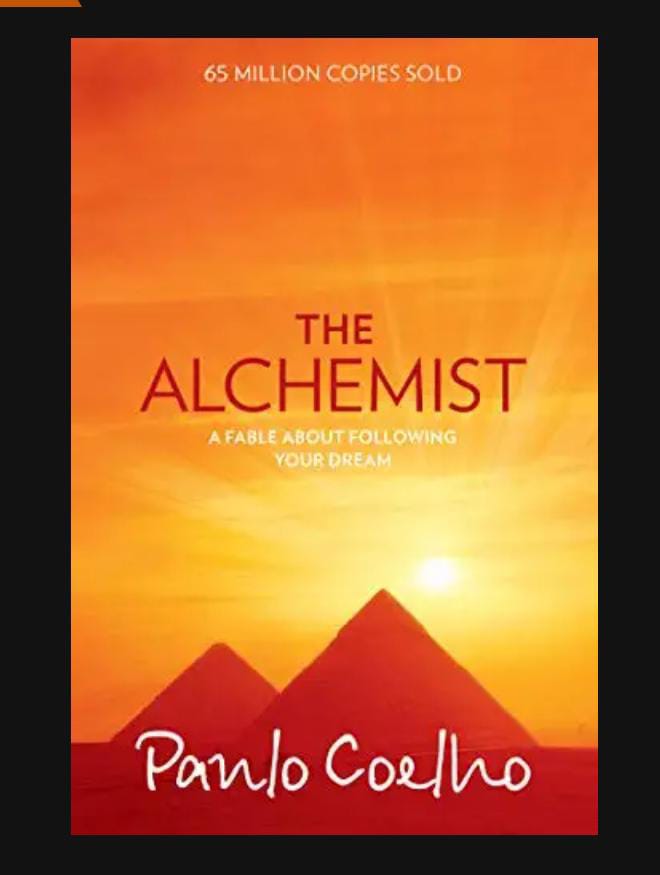
Book Cover :-
The cover has a very enchanting and beautifully designed which attracts reader on the first basis.


When you want something all the universe conspires in helping you to achieve it “


About author :-

Paul Coehlo is a Brazilian lyricist and novelist .He belongs to a middle-class family in Rio de Janeiro, Brazil.


He is best known for his novel The Alchemist, which holds the Guinness World Record for most translated book by an author, and selling more than 65 millions copies in more than 150 countries as one of the best-selling books in history.

Paul Coehlo is considered as the world’s most popular spiritual writer. His books including -, The Alchemist, The Devils and Miss Prym , The fifth mountain, Manual of Warrior of light , Veronica Decides to Die , , covers various serious topic such as love , magic , dreams , spirit , suicide , real meaning of life etc.

He wrote The Alchemist only in 2 weeks . He explained that he was able to write at this pace because ” the story was already written within his soul “.
He described the book as a film that takes place in the mind of the reader , an allegorical novel about a young shepherd’s journey of finding his dreams .

Summary :-

The Alchemist is about the journey of a boy Santiago of Andalusia who is a shepherd . His parents have continually struggled for basic necessities of life and have smothered their own ambition accordingly . Santiago on the other hand can read and wants to travel .
One day Santiago retires for the night in an abandoned church with his flock of sheep. An enormous sycamore tree has grown in the place where the sacristy used to be. This is where Santiago falls asleep and dreams a recurring dream of a child who tells him that he will find a hidden treasure if he travels to the Egyptian pyramids.


Santiago visits the village of Tarifa. There he meets an old woman who interprets dreams, which she says are the language of God.
The old woman tells Santiago that this dream is prophetic , in what she calls “the language of the world,” and that Santiago needs to travel to the pyramids, where he will find a treasure that will make him rich. Santiago is uncertain, however, since he enjoys the life of a shepherd.

Santiago meets a mysterious old man who introduces himself as Melchizedek, or the King of Salem. He tells Santiago about good and bad omens .
Santiago started traveling after selling his flock and purchasing a ticket to Tangier in Northern Africa . He was unfortunately robbed which made him look for a way to make enough money to return home. He finds work in the shop of a crystal merchant.


After eleven months of working in the shop,he meets an Englishman who wants to learn the secret of alchemy, or turning any metal into gold, from a famous alchemist who lives at an oasis on the way to the pyramid.


While traveling, Santiago begins listening to the desert and discovering ” The Soul of the World “. The caravan eventually reaches the oasis, and there Santiago meets an Arab girl named Fatima and falls in love with her instantly but had to leave eventually with a promise to return again , in search of his treasure


Santiago wanders from the oasis into the desert and, seeing two hawks fighting in the sky, has a vision of an army entering the oasis and gets into trouble because of the tribal wear .

He meets an Alchemist who offers to cross the desert with Santiago.
Soon the two men enter into an area of intense tribal warfare. Warriors hold the two men captive, but eventually allow them to continue their journey

. The alchemist tells Santiago that he needs to return to the oasis, and that the rest of the trip is Santiago’s to make alone so that he can claim his treasure whom he referred as “Personal Legend”.

Santiago arrives at the Egyptian pyramids and begins to dig. He finds nothing buried in the ground. Thieves beat Santiago and rob him of his money. After he tells them of his dream, though, one of the thieves recounts his own dream about a buried treasure in the sacristy of an abandoned church.

Returning to Andalusia, Santiago goes back to the church where he dreamed of the treasure near the pyramids. He digs where he slept, beneath a sycamore tree, and there he finds his treasure Santiago’s treasure.


Analysis of the book :-

The Alchemist is a fable about following your dreams .

“My heart is afraid that it will have to suffer , the boy said ‘

“Tell your heart that the fear of suffering is worse than suffering itself and that no heart has ever suffered when it goes in search of its dream , because every second the search is a seconds encounter with God and with eternity .”

The Alchemist is a diversified allegorical story about a shepherd who cross boundaries just to follow his recurring dream which was entitled as “the language of the heart “ by the gypsy woman and a man whose encounter made him ” follow his omens “

Paul Coehlo in his interview stated that “omens are individual languages in which God talks to you . They are this strange ,but very individual language that guides you towards your own destiny . They are not logical ,but talk to your heart directly .”


The writing style in the book is simple yet contains powerful emotions, interesting and deep characters, plots twists and inspiring wisdom.


Santiago journey is a spiritual quest ,where he travels through the desert ,speaks to the wind and ‘Soul of the world’ which is connected by everyone’s heart desires or as the Alchemist said ” Personal Legend “

The novel is figurative and metaphorical in style . The omens , Personal Legend , Soul of the world , the talk with the wind , holds symbolic meaning which may seem as fantasies fantasized by us somewhere some day .

The story not only aids one to follow his dream but connects it with the Soul of the world ,the universe where everyone is bonded with an invisible wire and makes us one .

The story is like living in a magical realism , getting enchanted by the omens , talking with winds being a part of the universe that we all are but tend to forget and finally following our dream despite the hurdles because following our heart desire means encountering eternity .

when you really want something, the whole universe conspires in helping you to achieve it”

The book explains the major purpose of people living , that’s finding one’s treasure i.e Personal Legend and traveling to find it because following the personal legend is like connecting to something deeper of the universe ,to the threat that connects universe and our hearts , something that makes us follow our heart and reach our dreams which fear paralyse for us .

The fear of suffering is the mammoth hurdle one faces while taking the first step towards their dream .
The Alchemist , mystically addresses the fear of suffering as worse than fear itself .

Paul Coehlo in his interview said ” the only way that you can learn the language of the soul is by making mistakes . I made my mistakes but then I started to connect with the signs that guide me “

Making mistakes is the key to finding one’s Personal Legend . But fear of taking risks only lets one suffer with regret of not trying to reach out for their dreams .

The world is conspiring for us ” , it symbolizes the determination one has for his dreams. Without hope and determination one can never know about the universe doing it all to make the dream come true .


Conclusion :-


Santiago struggles with what he is told versus what is real , between reality and the spiritual. He moves from hopeless to hopeful .


The book , with the magical realism genre leaves the reader with many questions.
The questions are left to the reader’s imagination .

But Paul Coehlo said “there are some questions in life that we don’t know . We can’t have answers for everything . But we try to find good questions and not good answers “

Santiago represents the transforming power of our dreams, whether real or imagined and the importance of listening to our hearts.


The book is for one’s who want not only to escape reality but also to understand reality . The Alchemist can offer the best of both worlds.
Each person has a destiny that exists independently of others. Only through devotion to the dream is the ‘soul of the world’ revealed to us, the knowledge that destroys fear of suffering and gives power.
The Alchemist tells us that dreams have a price but, as Coelho has said in interviews, not living your dreams also has a price.


The book shares the Magic with the world , and affects so many lives.
The Alchemist is an unforgettable story about the wisdom of listening to our heart and following our dreams .

Dreams are made to be followed
Life is meant to be loved
Some books are meant to be read ,
Loved and passed on
The Alchemist is one of those books “