
World Environment Day

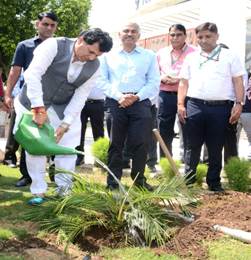
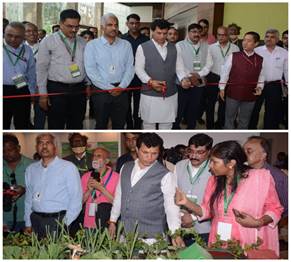
 Ministry of Agriculture and Farmers Welfare organized Mega Event on Mission LiFE on the occasion of “World Environment Day” today at Dr. C. Subramaniam Auditorium, NASC Pusa, New Delhi.  The program began with tree plantation activity in the premises of the venue by Shri Kailash Choudhary, Minister of State for Agriculture and Farmers’ Welfare, with other dignitaries. Shri  Manoj Ahuja, Secretary DA&FW, Additional Secretaries and Joint Secretaries of Ministry of Agriculture & Farmers Welfare were present in the event along with staff of ICAR and DA&FW, FPOs, Agri-start-ups, Students, Scientists, Officers and Farmers from various States. This was followed by inauguration of exhibition on Natural and Organic Farming showcasing and creating awareness on the sustainable agricultural practices symbolizing Mission LiFE.
WhatsApp Image 2023-06-05 at 5.17.41 PM.jpeg WhatsApp Image 2023-06-05 at 5.17.39 PM.jpeg

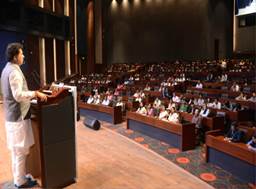
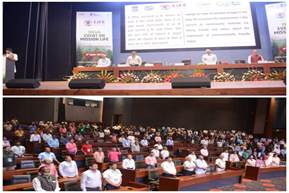
The program was inaugurated by Shri Kailash Choudhary, Minister of State for Agriculture and Farmers Welfare, by lighting the lamp.  In his remarks, he highlighted the importance of Life Style for Environment and stressed upon chemical free farming as one important options for sustaining the resources for future generations. He emphasized the adoption of Mission LiFE in agriculture to address the adverse impact of climate change. Quoting the example of Rajasthan, he mentioned that the state is having pre-monsoon showers more frequently than earlier years. Untimely and heavy rains are causing distress to the farming community. Farmers are highly vulnerable to climate change. Keeping this in mind ICAR developed 1750 climate resilient varieties after 2016 and these have potential to give normal yields under adverse conditions in vulnerable areas. He also stressed upon recycling of wastes in agriculture as it is best example for circular economy. He emphasized that we should all take care in day to day life to save the resources. Then, he administered the pledge on Mission LiFE with all the audiences present in the event.
WhatsApp Image 2023-06-05 at 5.17.40 PM (1).jpeg WhatsApp Image 2023-06-05 at 5.17.40 PM.jpeg

In his address, Shri Manoj Ahuja, Secretary, DA&FW briefed on the global temperatures rise from pre-industrial era and its direct and indirect impacts on agriculture and allied sectors. Maintenance of soil health through natural and organic practices having beneficial effect on soil flora and fauna is leading to better availability of nutrients in the soil. He also mentioned on the saving of water through adoption of Per Drop More Crop as India consumes more water for irrigation compared to other countries. There is a need to adopt all the 7 principles of MissionLiFE in day to day agricultural practices besides making policy towards sustainable agriculture.

Shri Faiz Ahmed Kidwai, Additional Secretary, DA&FW in his welcome address highlighted the importance of Mission LiFE and mentioned about the background of the launching of Mission LiFE by Prime Minister during CoP-26. He further gave the details of 7 principles underlying the Mission LiFE for adopting. A detailed presentation on Adopting Mission LiFE was given by Joint Secretary, Shri Samuel Praveen Kumar. He expressed that promotion of environment sustainability through agriculture is crucial for Nation’s well being, preserving biodiversity and mitigating the impact of climate change. The programme ended with vote of thanks by Shri Franklin L. Khobung, Joint Secretary (NRM) and Nodal Officer (Mission LiFE). Two champion farmers who are practicing Natural Farming were honored with a certificate of appreciation.  

The inaugural was followed by panel discussion on linking Mission LiFE to organic and natural farming chaired by Shri Faiz Ahmed Kidwai, Additional Secretary (NRM) and moderated by Dr. Yogita Rana, Joint Secretary (INM). Panelist Shri T. Vijaya Kumar shared the success stories of natural farming in Andhra Pradesh. Padam Shri Bharat Bhushan Tyagi stressed on crop diversification and nutritional management through organic and natural means for achieving the goals of Mission LiFE. He also called for strengthening of FPOs for higher returns to the farmers. Ms. Kashika Malhotra, M/s Invest India threw light on the potentials and ways of adopting circular economy in agriculture. Two champion farmers, Shri Shalender Sharma from Himachal Pradesh and Shri Lal from Bhuj, Gujarat shared their experiences on adoption of Natural Framing. The panelists were thanked by Ms. Rachna, Deputy Secretary, INM Division. A total of 713 awareness events and 709 action events have been organized with 52346 no. of participants and total 49028 people took pledge under Mission LiFE so far.

*******
World Environment Day

 Addressing the gathering, the Prime Minister conveyed his best wishes to every country in the world on World Environment Day. Underlining the theme of this year’s Environment Day – the campaign to get rid of single-use plastic, the Prime Minister expressed happiness that India has been working continuously in this direction for the past 4-5 years. Shri Modi informed that India started working on two levels to get rid of single-use plastic in 2018. “On the one hand, we have banned single-use plastic while on the other hand, plastic waste processing has been made mandatory”, he said. Due to this, the Prime Minister said that there has been a compulsory recycling of about 30 lakh tonnes of plastic packaging in India which is 75 percent of the total annual plastic waste produced in India, and around 10 thousand producers, importers and brands have come under its ambit today.

The Prime Minister highlighted that India of the 21st century is moving forward with a very clear roadmap for climate change and environmental protection. Underlining that India has created a balance of Present Requirements and Future Vision, the Prime Minister stated that necessary help has been provided to the poorest of the poor while huge steps have been taken keeping in mind the energy needs of the future. “During the last 9 years, India has made an unprecedented focus on green and clean energy”, the Prime Minister said as he gave examples of solar power and LED bulbs that have helped in saving people’s money as well as contributing towards protecting the environment. Throwing light on India’s leadership during the global pandemic, the Prime Minister informed that India started Mission Green Hydrogen and took major steps towards natural farming to save soil and water from chemical fertilizers.

“In the last 9 years, the number of wetlands and Ramsar sites in India has increased almost 3 times as compared to earlier”, the Prime Minister said, as he informed that two more schemes have been launched today that further the campaign of Green Future, Green Economy. The Prime Minister noted that the ‘Amrit Dharohar Yojana’ has started today which will ensure the conservation of these Ramsar sites through public participation. In future, the Prime Minister elaborated, these Ramsar sites will become the center of eco-tourism and will become a source of green jobs for thousands of people. He further added that the second scheme is the ‘Mishti Yojana’which will help in reviving as well as protecting the mangrove ecosystem of the country. With this, the Prime Minister explained that the mangrove cover will be restored in 9 states of the country and help in mitigating the threat to lives and livelihoods in coastal areas from rising sea levels and disasters like cyclones.

The Prime Minister emphasized that every country in the world should think above the vested interests for the protection of the world climate. Pointing out that the model of development where the thought of developing one’s country and then worrying about the environment has been prevalent for a long time among big and modern countries of the world, the Prime Minister underlined that even though such countries achieved the goals of development, it was the environment of the whole world that paid the price. Even today, the Prime Minister continued, the developing and underdeveloped countries of the world are suffering from the flawed policies of a few developed countries. “For decades, there was no country to stop this attitude of some developed countries”, the Prime Minister said as he expressed delight that India has raised the issue of Climate Justice in front of every such country.

“In the thousands of years old culture of India, there is nature as well as progress”, the Prime Minister remarked as he credited its inspiration to India’s attention to ecology and economy. The Prime Minister said that as India is investing unprecedentedly in its infrastructure, it is focussing equally on the environment. Drawing comparisons of boost in economy and ecology, the Prime Minister gave examples of the expansion of 4G and 5G connectivity on one hand whereas the country’s increased forest cover on the other hand. He further added that while India built 4 crore houses for the poor, there has been a record increase in the number of Wildlife Sanctuaries as well as wildlife in India. Shri Modi also touched upon Jal Jeevan Mission and the construction of 50,000 Amrit Sarovars for water security, India becoming the 5th largest economy in the world and also joining the top 5 countries in renewable energy, increasing agricultural exports and also running a campaign for blending 20 percent ethanol in petrol. He also stated that India has become the base of organizations like Coalition for Disaster Resilient Infrastructure – CDRI, and the International Big Cat Alliance. 

Speaking about mission LiFE i.e. Lifestyle for Environment becoming a public movement, the Prime Minister highlighted that the mission is spreading a new consciousness about lifestyle changes to combat climate change. He mentioned that there was curiosity among the people when the mission was launched last year in Kevadia-Ekta Nagar, Gujarat but a month ago, a campaign was started regarding Mission LiFE where 2 crore people became a part of it in less than 30 days. He also informed about the organization of rallies and quiz competitions in the spirit of ‘Giving Life to My City’. “Lakhs of colleagues have adopted the mantra of Reduce, Reuse, Recycle in their everyday life”, the Prime Minister stated as he underlined that the basic principle of Mission LiFE is changing one’s nature to change the world. “Mission LiFE is equally important for the bright future of the entire humanity, for our future generations”, Shri Modi added. 

“This consciousness towards climate change is not limited to India only, the global support for the initiative is increasing all over the world”, the Prime Minister said. He recalled making a request to the world community on Environment Day last year where he had asked to share innovative solutions to bring climate-friendly behavioral change in individuals and communities. The Prime Minister expressed happiness that thousands of colleagues including students, researchers, experts from different domains, professionals, NGOs and common citizens from around 70 countries shared their views and solutions that are measurable and scalable. He also congratulated those who were awarded for their ideas.

Concluding the address, the Prime Minister said that every step taken towards Mission LiFE will become a strong shield for the environment in the times to come. He also mentioned that a collection of Thought Leadership for LiFE has also been released today. Shri Modi expressed confidence that such efforts will further strengthen the resolve for green growth.

*****

Environment Protection Act -1986

The constitution of India clearly states that it is the duty of the state to “protect & improve the environment and to safeguard the forests & wildlife of the country”. The department of environment was established in India in 1980. this later became the Ministry of environment & forests in 1985. The EPA (Environment Protection Act), 1986 came into force soon after the Bhopal gas tragedy & is considered an umbrella legislation as it fills many gaps in the existing laws. Thereafter a large number of laws came into existence as the problems began arising, or example, handling and management of hazardous waste rule in 1989.

An Act to provide for the protection and improvement of Environment. Whereas the decisions were taken at the United Nations Conference on the Human Environment held at Stockholm in June, 1972, in which India participated, to take appropriate steps for the protection & improvement of human environment.

Objective

  • Providing for the protection & improvement of the environment.
  • Preventing environmental pollution in all its forms.
  • To tackle specific environmental problems that are peculiar to different parts of the country.
  • To co- ordinate the activities of the various regulatory agencies already in existence.
  • To appoint environment officers to check environmental pollution.
  • To improve the quality of life by protection of environment.
  • Establishing environmental laboratories. To protect the forests & wildlife in the country.

SCHEME OF THE ACT

The Environment (Protection) Act, 1986 has 26 Sections & it has been divided into four chapters relating to, 1.Preliminary 2.General Powers of the central Government. 3.Prevention, Control, & Abatement of Environmental Pollution. 4.Miscellaneous.

PRELIMINARY : •Short Title, Extended & Commencement. •Definitions

Short Title, Extended & Commencement

The environmental protection act (1986) enacted under article 253 of the Indian constitution. To protect & improve environmental quality, control & reduce pollution from all sources. 1.This act may be called the Environmental (Protection) Act, 1986. 2.It extends to the whole of India.

IMPORTATNT DEFINATIONS

  1. Environment
  2. Environmental Pollutant
  3. Environmental Pollution
  4. Handling
  5. Hazardous Substance
  6. Occupier

GENERAL POWERS OF THE CENTRAL GOVERNMENT

  • Planning and execution of a nation-wide program for the prevention, control and abatement of environmental pollution.
  • Restriction of areas in which any industries, operations or processes or class of industries, operations or processes shall not be carried out or shall be carried out subject to certain safeguards.
  • Laying down procedures and safeguards for the handling of hazardous substances
  • Examination of such manufacturing processes, materials and substances as are likely to cause environmental pollution.
  • Carrying out and sponsoring investigations and research relating to problems of environmental pollution.
  • Establishment or recognition of environmental laboratories and institutes to carry out the functions entrusted to such environmental laboratories and institutes under this Act.

RULES TO REGULATE ENVIRONMENTAL POLLUTION

  1. The standards of quality of air, water or soil for various areas and purposes
  2. The maximum allowable limits of concentration of various environmental pollutants (including noise) for different areas
  3. The procedures and safeguards for the handling of hazardous substances
  4. The prohibition and restrictions on the handling of hazardous substances in different areas
  5. The prohibition and restriction on the location of industries and the carrying on process and operations in different areas
  6. The procedures and safeguards for the prevention of accidents which may •cause environmental pollution and for providing for remedial measures for •such accidents.

PREVENTION, CONTROL, AND ABATEMENT OF ENVIRONMENTAL POLLUTION

  • Persons carrying on industry operation, etc., not to allow emission or discharge of environmental pollutants in excess of the standards.
  • Persons handling hazardous substances to comply with procedural safeguards
  • Furnishing of information to authorities and agencies in certain cases
  • Powers of entry and inspection
  • Power to take sample and procedure

PUNISHMENTS

One of the objective of EPA is provide for deterrent punishment to those who endanger human environment safety & health. Section 15 of EPA provides that any person who fails to comply or contrivance any provision or rule or act he shall be punishable. With a fine  of 1 lakh. with imprisonment for term for 5 years. or both

ENVIRONMENTAL PROTECTION LAWS – Wildlife Act

Environment protection is practice of protecting the environment, on individual, organizational or governmental & (or) humans. Protection of the environment is needed due to various human activities.

Why laws are implemented?

  • Protect and preserve the environment.
  • The law  prescribes Responsibilities of the State for protecting the national environment.
  • Determine who can use natural resources and on what terms.
  • Create rules for how people can use natural resources.
  • Governments have determined to strengthen their judicial capacity to enforce environmental laws.

Wildlife Act (1972)

The wild life protection Act, 1972 is an Act of the Parliament of India enacted on 9 Sept 1972. It provides for protection of wild animals, birds, plants and for matters connected therewith. It extends to whole India, except Jammu and Kashmir. It has six schedules which give varying degrees of protection.

Definitions

  1. Animal- Amphibians, birds, mammals
  2. Animal Article- Articles made from wild animal
  3. Hunting- Capturing, Killing, poisoning, trapping, injuring animals etc
  4. Trophy- Whole or part of animal which been preserved.
  5. Wildlife- Any animal, bees, butterflies, crustacean, fish & moths;

Authorities appointed

Central government may appoint A Director of wild life preservation, Assistant Directors of wild life preservation, Other officers & employees as may be necessary.

State government may appoint A chief wild life warden, Wild life wardens, One Honorary wild life warden in each district, Other officers & employees as may be necessary.

Wild life Advisory Board

  • The Act enforces & enables the state governments & the administrators of the union Territories to constitute a wildlife Advisory Board in each state & Union Territory.
  • Areas to be declared as sanctuaries, national parks, or closed areas & their administration.
  • Formulation of policy for protection & conservation of wildlife.
  • Amendment of any schedule.
  • Any other matter referred by State government.

Hunting of wildlife animals

Hunting of wild animals is permitted in certain cases – If the animal has become dangerous to human life or beyond recovery. Killing or wounding in good faith in defense of oneself or any other person.

Grant of permit for special purpose like Education, Scientific research, Scientific management, Collection of specimen for zoos, museums & similar institute, Derivation, collection or preparation of snake- venom for manufacture of life saving drugs.

Protection of specified plants

No person shall Willfully pick, uproot, damage, destroy, acquire, or collect any specified plant from any land & any specified area by Central government. Possess, sell, offer for sale, or transfer by way to gift or otherwise, or transport any specified plant whether alive or dead.

Penalties

Imprisonment varying from six months up to seven years and/ or ranging from rs. 500 upto not less than rs. 10000 depending upon on the nature or seriousness of the offence committed regarding the specified wildlife.