Self-shocks turn crystal to glass at ultralow power density

Daily writing prompt
Who are your current most favorite people?

Researchers have shown that utilizing shallow power, a crystalline material called indium selenide can “shock” itself to a glassy phase. This transformation lies at the heart of memory storage in devices like CDs and computer RAMs. It uses a billion times less electricity than the traditional melt-quench process for converting crystal to glass, and the discovery might revolutionise data storage in gadgets ranging from cell phones to computers. 

Glasses function similarly to solids but lack the regular periodic arrangement of atoms. To avoid the glass from getting too organized, a crystal is liquefied (melted) and then rapidly chilled (quenched) during the manufacturing process. This melt-quench technique is also employed in CDs, DVDs, and Blu-ray discs, where laser pulses are used to rapidly heat and quench a crystalline material to the glassy phase in order to write data; reversing the process erases data. Computers use similar materials known as phase-change RAMs, in which information is stored depending on the high versus low resistance provided by the glassy and crystalline phases.

The difficulty is that these devices consume more power, particularly during the writing process. The crystals must be heated to temperatures exceeding 800oC and then rapidly cooled. If it is possible to convert the crystal directly to glass without using the intermediate liquid phase, the amount of power required for memory storage can be greatly reduced. 

 A team of researchers from the Indian Institute of Science (IISc), Bangalore, University of Pennsylvania School of Engineering and Applied Science (Penn Engineering), Pennsylvania and Massachusetts Institute of Technology (MIT), Harvard, USA discovered that when electric current was passed through wires made of indium selenide, a 2D ferroelectric material, long stretches of the material transformed into glass. These breakthrough findings were published in the journal Nature. The research was supported by ANRF (erstwhile SERB) established through an Act of Parliament: ANRF, Act 2023.

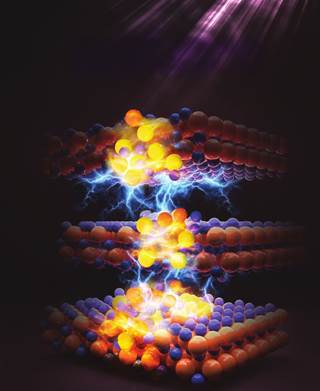
The scientists unearthed that when a continuous current is passed parallel to the material’s 2D layers, they slide against each other in various directions. This results in the formation of many domains – tiny pockets with a specific dipole moment enclosed by defective regions that separate the domains. When multiple defects intersect in a small nanoscopic region, like too many holes punched in a wall, the structural integrity of the crystal collapses to form glass locally. 

These domain boundaries are like tectonic plates. They move with the electric field, and when they collide against each other, mechanical (and electrical) shocks are generated akin to an earthquake. This earthquake triggers an avalanche effect, causing disturbances far away from the epicentre, creating more domain boundaries and resulting glassy regions, which in turn spawns more earthquakes. The avalanche stops when the entire material turns into glass (long-range amorphisation). 

Prof. Nukala points out that multiple unique properties of indium selenide – its 2D structure, ferro electricity and piezoelectricity – all come together to allow this ultralow energy pathway for amorphisation through shocks. He further emphasized that the current findings will unlock a wider range of phase-change memory (PCM) applications.
Glass InSe PR2_Akanksha Jain

***

All India Institute of Ayurveda (AIIA) organises orientation Program ‘Samskara 2024’ for freshly inducted Post Graduates

Daily writing prompt
Who are your current most favorite people?

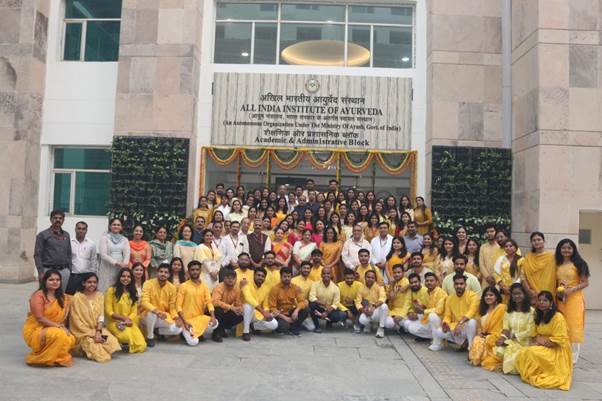
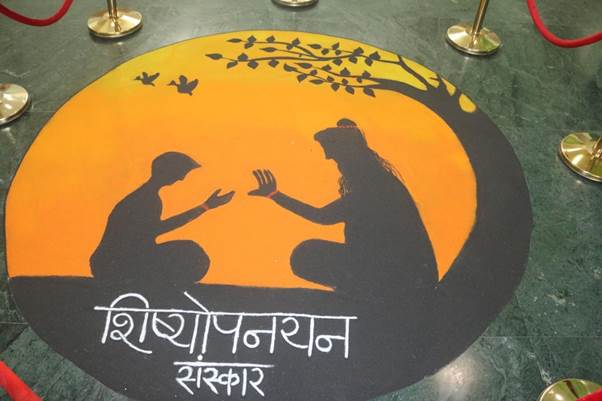
All India Institute of Ayurveda (AIIA) welcomed its 9th batch of postgraduate scholars with a traditional orientation program, ‘Samskara 2024’. The 15-day program commenced with a swearing-in ceremony, where 85 newly admitted students took the Shishyopanayan Pledge.

Prof. (Dr.) Tanuja Manoj Nesari, former Director of AIIA, was the chief guest, while Prof. (Dr.) Sujata Kadam, Director (I/C), AIIA, presided over the event. Other dignitaries who graced the occasion  included Dean PhD Prof. (Dr.) Mahesh Vyas, Dean PG Prof. (Dr.) Yogesh Badwe, Advisor Academic Activities Prof. (Dr.) Anand More, and other faculty members.

Addressing the gathering, Chief Guest Prof. (Dr.) Tanuja Manoj Nesari extended her best wishes to the new students, saying, “I expect this batch to create history in the future.” She emphasised AIIA’s unique selling proposition (USP)—valuing exceptional education and transformative journeys.

AIIA Director (I/C) Prof. (Dr.) Sujata Kadam encouraged students, saying, “Just as gold is refined through numerous tests, these three years will transform you into refined gold, making your journey extraordinary. I expect you to emerge as the best students from this institution.”

The 9th batch consists of 85 students selected from across India who cleared the All India AYUSH Postgraduate Entrance Test (AIAPGET) conducted by the National Commission for Indian System of Medicine (NCISM) under the Ministry of Ayush, Government of India.

Established in 2017, AIIA has treated over 27 lakh patients and attends to more than 2000 patients daily.

****

Sustainable Development

One fact which no person or group can not deny is that resources are limited on this planet. All these resources have got unlimited uses.
 In simple words resources are scars. So it has to be used to satisfy the unlimited wants and desires of human beings. 
There is an utmost need to divide the system so Earth resources can grow in the best possible way for using present resources. Humans need a system that ensures the usage of resources without depletion. 
Certain strategies like
The balance between conservation and development- 
Development should not be at the cost of the environment we should have a mutual Outlook for both.
Satisfaction of basic human needs-
Sources unlimited but wants are unlimited people have Max with them for newborns but not for the greed Mahatma Gandhi
Social justice-
Sources should be allocated not according to the financial status of a country but according to the needs and requirements of each nation.
Maintenance of ecological integrity-
Human intervention should be sustained so the ecosystem can maintain itself naturally.
These things can play important role in the development of a system, certainly, if human beings get success in building such a system this will get sustainable development.
Sustainable Development refers to development that meets the requirements of the present generation without compromising the ability to fulfill the requirements of the future generations.
Principles of the development
Optimum utilization of natural resources-
There are 195 countries in the world and resources are unevenly divided between them. So the use of resources to their full is important.
Effective water management
70% of the earth is covered with water but only 2.5% of water is fresh. That is the reason why world Bank estimate 21% of disease in India are linked to unsafe water.
Intergenerational equity –
There is a generation to come in the future which serves a share in the offerings of mother earth. So there should be a just between them.
Holistic Approach
It means it takes different objects as a whole, not in isolation.
Sadly this Subject of sustainable development have several issues like in India there are some key issues to reach to a state of a full sustain economy Few such issues are:-
Climate change
Week laws
Globalization limitations
Human Greed
Deforestation
Lack of knowledge
Acid rain
Etc.
In a nutshell sustainable development is certainly not an easy goal to achieve.
It’s a long process that can be fulfilled if we as a society give more importance to the user than to meet self-greed. The world can be better placed if most intelligent species i.e humans take charge and work together in its direction.
So basic principle to be learned is the usage of resources should be strictly for the betterment of all life on earth and for generations to come.

THE UNION GOVERNMENT

 THE UNION  GOVERNMENT

Know the powers and responsibilities of the Government, as one should know the system of governance both at the Union and state level.

The constitution of India provides for a parliamentary form of the Government under an elected President. it has three wings,

THE LEGISLATURE

THE EXECUTIVE

THE JUDICIARY

UNION LEGISLATURE

The parliament represents the union legislature which consists of the Upper houses called a council of states or Rajya Sabha and the lower house called  of people or Lok Sabha.

LOK SABHA

The Lok Sabha is the important house of the Inidan Parliament and contains elected representatives of the people. There are about 543 elected members out of which 530 are elected from the states and 13 members from the Union territories. The President generally nominates 2 members from the Union Territories. At total 545 members.

The Lok Sabha enjoys a term of five years from the date of its date session. Universal Adult Franchise is followed while electing the members of Lok Sabha. All Indian citizens above 18 years of age who are registered as voters will vote for their representatives. Money bills can be introduced only in Lok Sabha. It is processed over the speaker in case of absence of the speaker, the deputy speaker elected by the members of the house presides over the session.

RAJYA SABHA

The council of states or Rajya Sabha consists of 250 members out of which 238 represent states and the Union territories, elected by the method of indirect election. 12 members are chosen by the President by the special knowledge of the practical experiences in the field of literature, science, art or social science.

the members are elected for 6 years and one third of the members of Rajya Sabha are elected atleast for every two years. The Vice President of India is the EX- OFFICIO Chairperson of the Rajya Sabha. 

PRESIDENT OF INDIA

According to the Indian Constitution, the President of India is the head of the Indian Republic or the state. The President is also the Constitutional head of the Union Legislature and the Union Executive. According to the Article 53 of the constitution the executive power of the Union shall be exercised by him directly or through the officers subordinates to him in accordance with the Constitution.

VICE PRESIDENT OF INDIA

Article 63of the Constitution provides flr Vice Presidnt. This office has been created to maintai political continuty to the state. He exercises the executive power of the Union as of when the President is unable due to some reasons.

PRIME MINISTER OF INDIA

The post of Prime Minister first originated in England and borrowed from there by makers of our constitution. The Prime Minister allocates port folios to other ministers and monitors their functions. He/she is the chairperson of all highest central commisions like the Planning commission the finance commission and national Integration Council.

THE JUDICIARY

our Constituion provides for the establishment of an independent and integrated judiciary with the Supreme court as it is the highest court in the coutry. the Chief Justice is appointed by the President of India. Age limit is upto 65 years. To be a judege in Supreme cout he/she should have worked as a advocate of a high court for atleast 10 years. 

CONCLUSION

Even though all the three wings are independent organs, they cannot beyond ther wings of limit in the administration. The Constiution safegaurds each and evey citizen by the powers they have  and its our duty to know the powers of the Government.