South Asia’s Largest Maritime Thought Leadership Summit Begins, aims to foster Global Maritime Cooperation

Daily writing prompt
Do you or your family make any special dishes for the holidays?

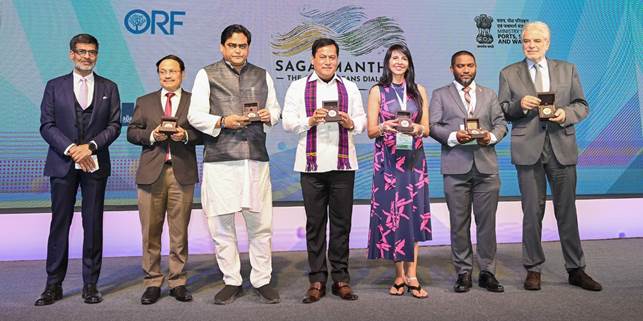
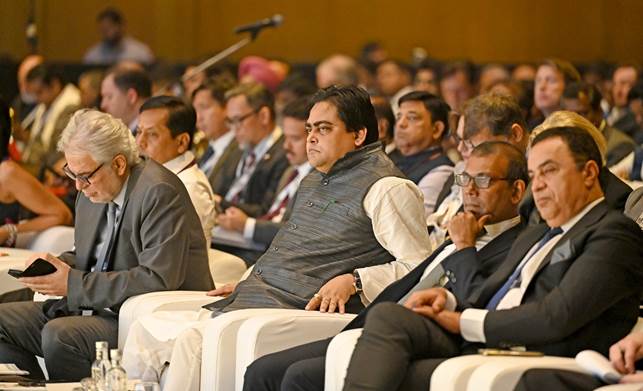
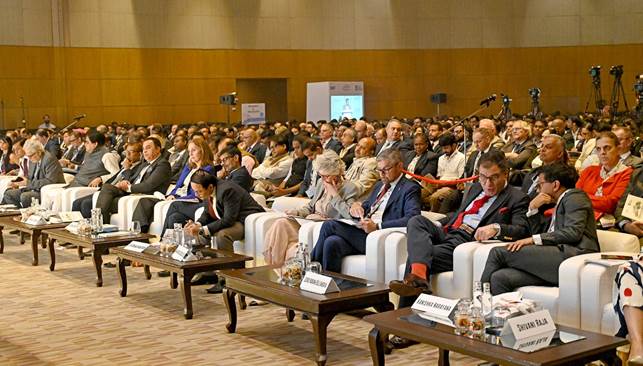
Sagarmanthan – The Great Oceans Dialogue, the South Asia’s largest Maritime Thought Leadership summit, began here today. The inaugural session was addressed by the Union Minister of Ports, Shipping & Waterways (MoPSW), Sarbananda Sonowal; the Minister of Maritime Affairs and Insular Policy, Greece, Christos Stylianides; the Minister of State for Fisheries and Ocean Resources, Maldives, Dr Amzath Ahmed; the National Representative for the Province of Rio Negro, Argentina, Ms Maria Lorena Villaverde; the Secretary of MoPSW, TK Ramachandran along with the President, Observer Research Foundation (ORF), Samir Saran in the presence of representatives from 61 countries along with hundreds of delegates from maritime sector.
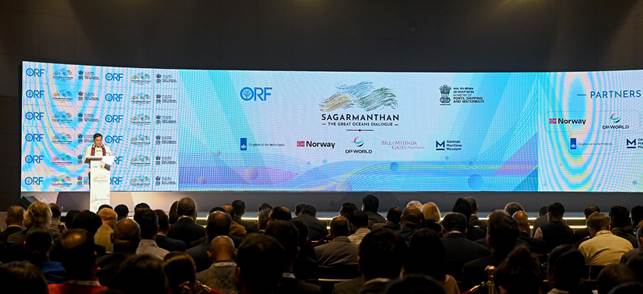
The Ministry of Ports, Shipping, and Waterways (MoPSW) of the Government of India, in collaboration with the Observer Research Foundation, is organising the two-day event, Sagar Manthan: The Great Oceans Dialogue. The initiative brings together global policymakers, maritime experts, industry leaders, and scholars to deliberate on advancing sustainable and innovative maritime practices.
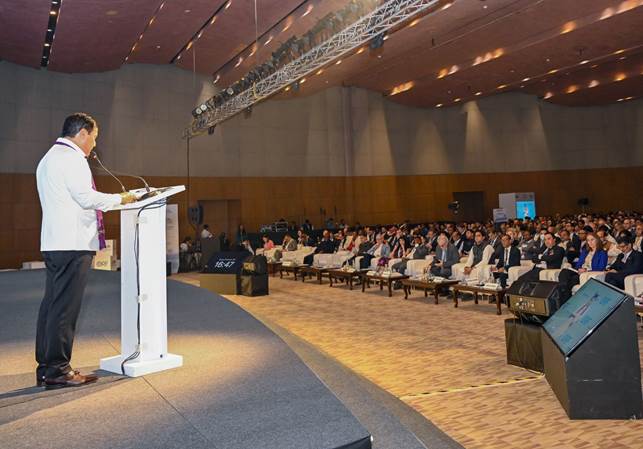
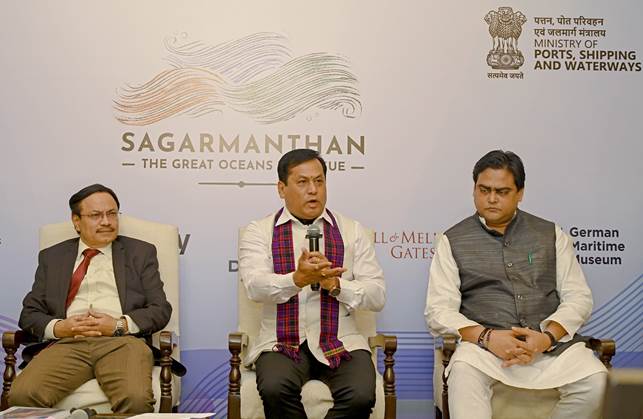
Speaking at the inaugural session, the Union Minister, Sarbananda Sonowal said, “India’s Maritime Vision 2047 is a roadmap to transform the maritime sector by fostering sustainability, enhancing connectivity, and leveraging technology. Under the visionary leadership of Prime Minister Narendra Modi ji, our ministry through initiatives like Sagarmala and the Maritime Amrit Kaal Vision is aiming at making India a leader in global maritime trade, achieving our goal of Viksit Bharat by 2047. Our vision aims to revolutionise India’s maritime sector with an investment of ₹80 lakh crores to enhance port capacity, shipping, ship building inland waterways. Key projects include the Vizhinjam International Seaport in Kerala, new mega ports at Vadhavan in Maharashtra, and Galathea Bay in Nicobar. By 2047, India targets a port handling capacity of 10,000 million metric tons per annum, leveraging strategic trade routes through initiatives like the India-Middle East-Europe Economic Corridor (IMEEC) and the International North-South Transport Corridor. Reviving its shipbuilding legacy, India is constructing the National Maritime Heritage Complex at Lothal while advancing clean-fuel shipbuilding to meet future sustainability goals.”
The dialogue underscores India’s strategic role in global trade, with a 7,500 kilometers coastline and strategic islands that bolster its maritime potential. The event also highlights the nation’s commitment to the decarbonisation of the maritime sector through green initiatives such as the Harit Sagar Guidelines and the National Green Hydrogen Mission. 
Setting the context for the mega deliberations and discussion, Sarbananda Sonowal further added, “Recognising India’s maritime potential and its significance for economic growth, our government has implemented crucial policy measures for the ‘Blue and Ocean-based Economy’ over the last decade. Our participation in initiatives like the India-Middle East-Europe Economic Corridor (IMEEC) and the International North-South Transport Corridor underscores our commitment to strengthening global trade partnerships. We are also preparing to build future ships that run on clean fuels like ammonia, hydrogen, and electric, capable of traversing brown, green, and blue waters. Our Amrit Kaal Maritime Vision 2047 has placed great emphasis on climate action and environmental sustainability.”
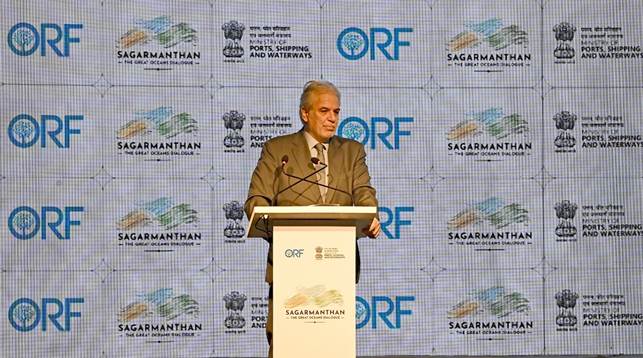
The Minister of Maritime Affairs and Insular Policy, Greece, Christos Stylianides, said, “For us policy makers, it is crucial to ensure a stable regulatory framework and a global level playing field for the industry. It is now time to set the foundations for forward-looking and realistic policies which will the current maritime challenges into opportunities. International transport systems with shipping at its core as an integral part, should serve the three pillars of sustainability: the environmental, the social and the economic one. This will be done by optimising efficiency in connectivity, minimising pollution and ensuring resilience across the entire maritime chain. What we need now is collaboration and the ‘Sagarmanthan: The Great Oceans Dialogue’ is a great example in this direction. It is in our hands, in a spirit of partnership, to make this happen.”
The Minister of State, MoPSW, Shantanu Thakur highlighted the socio-economic potential of coastal communities and the need for global partnerships. The Minister stated, “India’s economic growth is guided by the principle of Vasudhaiva Kutumbakam—‘The World is One Family.’ Our ports and shipping corridors are not just about commerce but about connectivity, collaboration, and care for coastal communities and the environment. The oceans must be a global priority, not just for economic development but for ecological preservation and energy innovation.”

Speaking about this maiden initiative – Sagarmanthan, the Member, Prime Minister’s Economic Advisory Council (PM-EAC), Sanjeev Sanyal said, “This should serve as a guiding principle for all of us to strengthen and grow our maritime cluster. Our goal is to position ourselves at the forefront of the maritime sector, and to achieve this, we must draw on the expertise of industry leaders who set benchmarks across various verticals. The seas and oceans, gifts of nature, are abundant with resources, energy, and potential. It is our responsibility to harness them wisely, combining knowledge and skill to achieve sustainable growth. Our commitment must ensure that both the economy and ecology thrive in harmony, fostering progress without compromise. We have the technology, the young workers, the trade volume, the steel and the coastline – all the ingredients. So we should aspire in 10 years to build 10-12 per cent of the world’s ships and own/flag 8 per cent.”

On the sidelines of Sagarmanthan, the Union Minister of Ports, Shipping & Waterways, Shri Sarbananda Sonowal participated in a bilateral meeting with the Minister of Maritime Affairs and Insular Policy go Greece, Christos Stylianides here today. The two leaders discussed an array of topics and agreed to deepen the maritime relationship between the two countries. Both the leaders agreed to expand trade from the existing US$ 1.94 billion to doubling it by focussing on broadening, increasing, and balancing by 2030.

Speaking after the meeting, the Union Minister, Shri Sarbananda Sonowal said, “It was a good meeting that we had here on the sidelines of Sagarmanthan here today. We discussed on collaboration and cooperation in multiple areas of maritime sector between the two countries. Under the dynamic leadership of Prime Minister Shri Narendra Modi ji, India further deepened its bilateral relationship into strategic relationship with Greece. With this platform, India is working with Greece to expand economic cooperation with the European Union market. Given the economic potential in the Indian market, I am also reaching out shipping industries of Greece to consider setting their operations here through His Excellency the Minister of Maritime Affairs and Insular Policy of Greece.”
The two maritime ministers also discussed underscored the importance of the Joint Working Group (JWG) on maritime and shipping issues as important bilateral institutional mechanisms for consolidating sector specific cooperation. Both the  leaders agreed to optimally use strategic maritime assets towards sustainable development. Given the rich heritage of both the nations, the ministers agreed to collaborate at the ongoing development of National Maritime Heritage Complex at Lothal, Gujarat by the Ministry of Ports, Shipping & Waterways, and Government of India. The talks also touched important subjects like renewable energy, cultural and educational cooperation in maritime studies and explore multiple areas of maritime infrastructure development and its potential.

The two day forum’s agenda includes sessions on maritime connectivity, sustainable development, technological innovation, and global maritime governance. The Ministry also showcased India’s advancements in port digitisation, renewable energy integration, and decarbonised shipping, reflecting the nation’s vision of becoming a global maritime hub. The Dialogue featured participants from 60 countries across the globe with more than 1700 participants including ministers, former heads of state and government, journalists, and experts.

*****
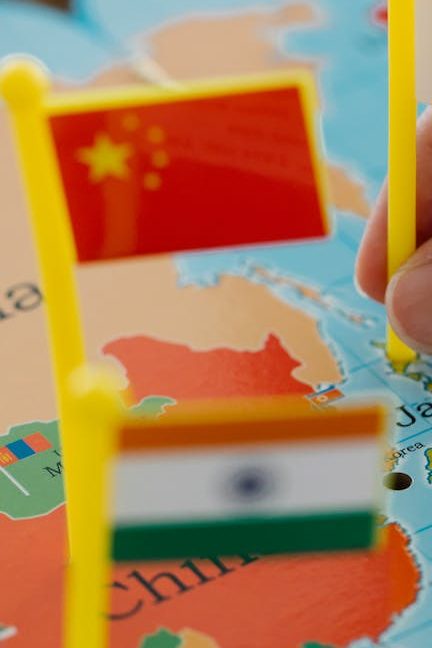
India abstained to vote against China at UNHRC.

During this week UN Human Rights Council was holding a debate on the human rights situation in China’s restive Xinjiang region. Human rights groups have been sounding the alarm over what is happening in the resource-rich north-western Chinese province for years, alleging that more than one million Uyghurs had been detained against their will in a large network of what Beijing calls “re-education camps”.

The efforts of the US and Western countries to bring a resolution against China on the situation of Uighur Muslims in the United Nations Human Rights Council (UNHRC) suffered a setback when 11 countries, including India and Ukraine, indirectly helped China by abstaining to vote at the time of voting.

This is only the second time in the UNHRC’s 16-year history that a US resolution has been rejected. It also explains the changing global equations. Most of the discussion after the UNHRC vote is about India’s stand. Given the current state of relations with China, the US expected support from India. However, India said that it has stuck to its policy of not voting against any country in institutions like the UNHRC.

However, it is believed that India has taken this step due to the apprehension of a UN vote on Jammu and Kashmir in future.

Brazilian economy is in a “jobless recovery” following a spike in inflation

According to a Reuters poll, the Brazilian economy will continue to experience a so-called “jobless recovery” following this year’s inflation spike, while forecasts for recovery in Mexico appear stronger amid concerns about a possibly tougher monetary policy in the United States.

On the outside, Brazil’s macroeconomic picture appears to have improved as consumers shake off the COVID-19 epidemic, firms experience a resurgence of M&A activity, and the agriculture industry flourishes on huge international demand. Recent increases in GDP estimates, however, are at conflict with a number of issues. Rising inflation, which is presently the major topic, is expected to be followed by consistently high levels of joblessness into next year’s national elections in Brazil.

Because the economy will need some more time to reabsorb people and restore jobs, average unemployment is estimated to stay in the double digits this year, reaching around 13.6 percent. The rising unemployment rate will restrain services inflation, which accounts for nearly 40% of the headline figure.

According to the median estimate of 20 economists surveyed between July 5 and July 13, Brazil’s average jobless rate for 2021 was projected at a record 14.2 percent in the Reuters survey. This is in contrast to a large increase in GDP estimates.

According to a larger group of 40 respondents, Latin America’s No. 1 economy is expected to grow 5.1 percent in 2021, considerably above the relatively moderate 3.2 percent growth rate recorded in April’s survey. Inflation forecasts have also risen, reaching 6.5 percent from 5.1 percent in the previous quarter.

Many Brazilians have lost their livelihoods as a result of the virus. Many also point the finger to President Jair Bolsonaro’s pro-business stance. Other figures suggest robust employment creation, according to the government.

Bolsonaro and his expected opponent, former center-left President Luiz Inacio Lula da Silva, have not formally announced their candidacies yet, despite the fact that the 2022 presidential election remains just a year away.

President Andres Manuel Lopez Obrador of Mexico, however, looks to be on a more solid foundation than his Brazilian counterpart. Although both are embroiled in corruption allegations, Lopez Obrador is under far less scrutiny. Similarly, Mexico’s economy is getting better, with stronger growth and relatively low inflation than that of Brazil. Mexico’s GDP and consumer pricing are anticipated to grow 5.9 percent and 5.1 percent this year, respectfully, compared to 4.7 percent and 3.9 percent in the April survey.

Mexicans are keeping a very close eye on the Federal Reserve of the United States’ intention to gradually phase off its massive assistance. Thus far, this has been welcomed positively from across the border, instead of as a hindrance to financial movements.

In contrast to a drop in Brazil’s anticipated growth in 2022 to 2.2 percent from 2.3 percent, the study predicts Mexico’s GDP would increase 2.9 percent next year, up from 2.5 percent in April.

Analysts at BBVA Mexico said in a statement that they have raised their 2022 GDP projection to 3.0 percent from 2.8 percent due to a better investment picture. This increase will most probably encourage formal private employment to return to pre-pandemic levels in 1Q22.”

East Timor: Brief analysis of its history & independence.

East Timor or Timor-Leste is a tiny island country in Southeast Asia nestled between Australia and Indonesia.

For more than 300 years the territory of East Timor was ruled by Colonial Portugal (Portuguese Timor). They set up both commercial outposts and catholic missions. On 28 November 1975, Portugal withdrew from the island territory when the Revolutionary Front for an Independent East Timor had declared the territory’s independence. But this exit from East Timor was not at all smooth and this enraged bitter rivalry between various local groups. Just nine days later in December 1975 East Timor was invaded and occupied by the Indonesian military. Suharto, the Indonesian president at that time didn’t receive much resistance from the western countries due to the left-leaning stance of East Timor at that time (Cold war).  The Indonesian occupation was a brutal and violent period in East Timor’s history with various suppression tactics many people lost their lives during that period.

The following decades were highly violent with many conflicts between the separatist groups known as Fretilin and the Indonesian military. The military fought a continuous guerilla war with the rebels in the island’s interior mountains. There were numerous rights violations and over 100,000 people died under the occupations of Indonesia.

One of the most defining instances happened on November 12, 1991, when the Indonesian military shot and killed over 250 people who had come for the memorial procession in honor of Sebastio Gomez, a pro-independence supporter killed by the Indonesian military. The events occurred in the Santa Cruz Cemetery in Dili, East Timor’s capital. This tragedy is known as the Santa Cruz Massacre. The event gained international media attention. Although the Indonesian occupation did not cede until eight years later in 1999, the Santa Cruz massacre was a defining moment in the island nation’s quest for independence.

In 1998 president Suharto resigned from his position after more than 30 years in power due to growing pressure and protests against him from within the country. His replacement was open towards more open towards the autonomy of East Timor. International pressure for East Timor grew in 1998. During the downfall of the New Order government, as part of Reformasi, a referendum was held in East Timor to ask whether they wished to remain in Indonesia with increased autonomy or become independent. On August 30, 1999, about 78% of the population of East Timorese chose to remain independent.

Following the referendum, violence again erupted in East Timor as Indonesian-backed militias increased their activities across the country. In September UN peacekeeping let by Australia force took control of the situation but a lot of damage was already done. In 2002 Xanana Gusmão was elected as the first president after three years of transitional governance by the UN.

As of today, the country has been relatively stable but the economic conditions have not been improved. Indonesia’s Timor has fared comparatively better than East Timor. It was also discovered that Australia, a country that East Timor considered as their ally had spied on East Timor to gain leverage over negotiations on the exploitation of natural resources in the Timor Sea. On a positive note, the country has comparatively good relations with Indonesia now.

References:

India’s Afghanistan Challenge

As the United States of America continues to pull out its troops out of Afghanistan, there has been wide discussions as to who would fill that vacuum

Biden’s decision to remove all US soldiers from Afghanistan has fueled domestic unrest in the nation, where violence is on the rise as the Taliban scores more combat successes against the Afghan government and foreign forces disengage. However, Washington’s decision to withdraw has prompted a regional struggle for power, with many parties ranging from China to Turkey, Russia to India, trying to capitalise on the diplomatic power vacuum in Afghanistan.

India, which has long provided diplomatic and financial assistance to the Afghan government, has allegedly altered its long-held policy of not interacting with the Taliban and is now engaging in direct discussions with the rebel group’s leadership. However, India’s presence in Afghanistan has long been balanced by the presence of the one nation that, whether it wants to or not, will have to pick up the majority of the pieces America leaves behind: Pakistan. 

India is engaging with the Taliban because the Taliban are winning. Conservative, largely rural, and illiterate Afghans defeated the Soviet Union at its peak as the Mujahideen. They achieved it with enormous support from the United States, Pakistan, Saudi Arabia, China, and others. The same group has now vanquished the world’s sole superpower. They’ve done it with only Pakistan’s aid. 

Before delving into the risks and advantages of dealing with the Taliban, it is important to reaffirm the primary objective of India’s Afghanistan policy, which is to maintain a strategic balance between Kabul and Islamabad. Despite the disparity of strength between two nations, India wants to guarantee that nationalist Afghan thought, which is critical of Pakistan’s interventionism, stays active and aggressive. This is why New Delhi has maintained its support for a “Afghan-owned, Afghan-led” peace process. Engaging with the Taliban is an exercise in averting harm to India’s interests as it is in determining the extent of the group’s nationalism.

The advantages of this successful outreach are obvious. The Taliban recognises India’s beneficial role in Afghanistan and does not want its diplomatic presence to be reduced.The outreach in Doha has given Indian authorities cautious hope that the Taliban will not be openly antagonistic and may even want deeper ties in the medium term. 

However, the outreach is not without danger. One possibility is that the Taliban would break its pledges and, with a shove from Pakistan, will strike Indian interests. If this does not happen, the Taliban interlocutors with whom India is negotiating may be marginalised, or worse, replaced by pro-Pakistan supporters such as the Haqqanis. Second, reaching out to the Taliban might hasten the fall of Kabul while complicating India’s ties with existing allies.

Despite these concerns, India has solid reasons to engage the Taliban. For one thing, these worries would persist regardless of India’s approach. If nothing else, undoubtedly India’s absence from the Taliban’s calculus makes it much more vulnerable if the Islamic republic falls apart. For India, the only way to achieve long-term peace in Afghanistan is for there to be peace within Afghanistan and peace around Afghanistan, which will need aligning the interests of everybody, both inside and outside that country.