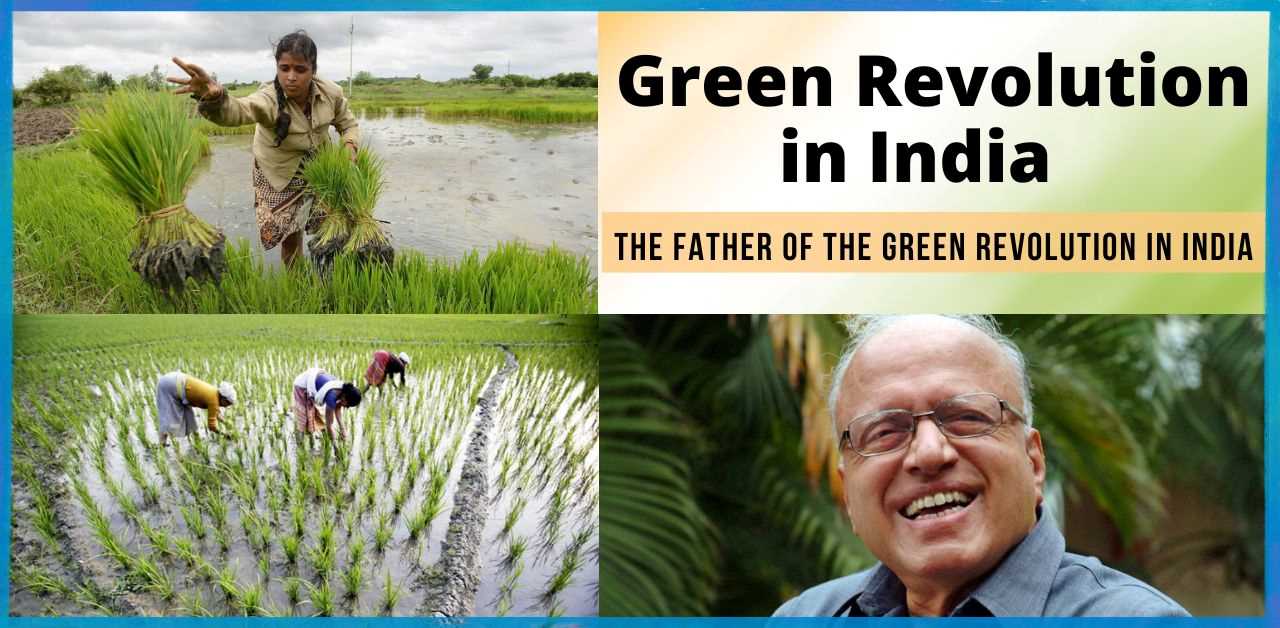
Green Revolution

Green revolution, great increase in production of food grains (especially wheat and rice) that resulted in large part from the introduction into developing countries of new, high-yielding varieties, beginning in the mid-20th century. Its early dramatic successes were in Mexico and the Indian subcontinent.


part of a larger initiative by Norman Borlaug, Green Revolution in India was founded by M S Swaminathan. The aim was to increase agricultural productivity in the developing world with use of technology and agricultural research.

The Green Revolution was initiated in the 1960’s to address the issue of malnutrition in the developing world. The technology of the Green Revolution involved bio-engineered seeds that worked in conjunction with chemical fertilizers and heavy irrigation to increase crop yields.

The amount of greenhouse gas emissions will help to reduce this. It allows us to create more food than conventional methods of growing. In uncooperative conditions, it offers us with predictable yields. It allows a decline in food costs for the world economy.

it was beneficial because it helped produce more food and prevented the starvation of many people. It also resulted in lower production costs and sale prices of produce. Although it had several benefits, the Green Revolution also had some negative effects on the environment and society.

The Green Revolution was a significant period of agricultural innovation and development that began in the mid-20th century, aiming to increase agricultural productivity worldwide, particularly in developing countries.

Key elements of the Green Revolution included:

  1. High-Yielding Varieties (HYVs): Scientists developed new varieties of seeds, particularly for staple crops like wheat, rice, and maize, which had higher yields and were more resistant to diseases and pests.

  2. Intensive Use of Chemical Fertilizers and Pesticides: To support the growth of these high-yielding crops, farmers began using synthetic fertilizers and pesticides on a larger scale.

  3. Irrigation Techniques: Implementation of improved irrigation systems, like drip irrigation, helped provide water to crops more efficiently.

  4. Mechanization: Introduction of machinery and technologies into agriculture, such as tractors and combine harvesters, to streamline farming processes.

The Green Revolution had several positive impacts:

  • Increased Agricultural Productivity: Crop yields soared, leading to more food being produced on existing farmland.
  • Food Security: It helped alleviate hunger in many parts of the world by increasing food availability.
  • Economic Growth: Improved agricultural productivity contributed to economic growth in many developing countries.

However, there were also concerns and criticisms associated with the Green Revolution:

  • Environmental Impact: Excessive use of chemical fertilizers and pesticides led to soil degradation, water pollution, and loss of biodiversity.
  • Social Disparities: The benefits of the Green Revolution were not equally distributed, leading to socioeconomic disparities between wealthy and poor farmers.
  • Sustainability Concerns: Reliance on high inputs of water, chemicals, and specific seed varieties raised concerns about the long-term sustainability of this agricultural model.

Efforts have been made to address these issues through sustainable agricultural practices, emphasizing environmentally friendly approaches and technologies while aiming for increased productivity and food security without compromising the environment or social equity.

Major Train Accidents in India

India has unfortunately witnessed several major train accidents since gaining independence in 1947. These accidents have caused significant loss of life and infrastructure damage. While the list provided here highlights some notable incidents, it may not include all accidents, and it’s important to refer to reliable sources and official reports for comprehensive and up-to-date information. Here are some major train accidents that occurred in India after independence:

Peruman Train Accident (1956): On November 5, 1956, near Peruman, Kerala, the Bangalore Mail derailed, resulting in a tragic collision with an oncoming passenger train. This accident claimed the lives of 144 people and injured many others.

Ariyalur Train Accident (1956): On December 15, 1956, near Ariyalur, Tamil Nadu, two trains, the Sabari Express and the Bangalore Express, collided head-on due to a signal failure. The accident resulted in the deaths of over 140 passengers.

Midnapore Train Accident (2010): On May 28, 2010, the Howrah-Kurla Lokmanya Tilak Gyaneshwari Express derailed near Midnapore, West Bengal. Sabotage was identified as the cause of the derailment, leading to the deaths of 148 passengers and injuries to numerous others.

Kanpur Train Derailment (2016): On November 20, 2016, the Indore-Patna Express derailed near Kanpur, Uttar Pradesh. The accident caused the deaths of 150 passengers and injured many others. The exact cause of the derailment was under investigation.

Pukhrayan Train Derailment (2016): On the same day as the Kanpur derailment, near Pukhrayan, Uttar Pradesh, the Indore-Patna Express derailed, resulting in one of the deadliest train accidents in recent times. This accident claimed the lives of 152 passengers and caused injuries to numerous individuals.

Amritsar Train Accident (2018): On October 19, 2018, during a Dussehra festival celebration near Amritsar, Punjab, a speeding train struck a crowd that was standing on railway tracks, leading to a tragic incident. The accident resulted in the deaths of around 60 people and injured many others.

Raebareli Train Accident (2010): On October 10, 2010, near Raebareli, Uttar Pradesh, the Goa Express collided with a stationary Mewar Express due to signal failure. The accident caused the deaths of 22 people and injured several others.

Jagdalpur-Bhubaneswar Hirakhand Express Derailment (2017): On January 21, 2017, the Jagdalpur-Bhubaneswar Hirakhand Express derailed near Kuneru, Andhra Pradesh. The accident led to the deaths of 41 passengers and caused injuries to numerous individuals.

Guwahati-Puri Express Derailment (1999): On September 13, 1999, the Guwahati-Puri Express derailed near Gaisal, Assam, resulting in a collision with an incoming freight train. This accident claimed the lives of 285 people and injured more than 300.

Khanna Rail Accident (1998): On November 26, 1998, near Khanna, Punjab, the Jammu Tawi-Sealdah Express collided with two derailed wagons, causing a massive fire. The accident resulted in the loss of 212 lives and injuries to several others.

These accidents underscore the importance of continuous efforts to improve railway safety, infrastructure maintenance, and the implementation of advanced technologies to prevent such incidents

Knowing the Atlantic

Continuing from the last article on Pacific, let’s move on to the next ocean- the Atlantic.

Photo by Roberto Nickson on Pexels.com

Hope you remember the acronym- PAISA

  1. Pacific
  2. Atlantic
  3. Indian
  4. Southern
  5. Antarctic

These oceans are arranged in the decreasing order of their sizes.

The Atlantic is the second largest ocean in the whole world with an area of about 106,460,000 km2(source: Wikipedia). It lies between the Americas in the west and Europe and Africa in the east. The equatorial counter current divides the ocean into two equal parts latitudinally and the Mid Atlantic Ridge divides the ocean into two parts longitudinally(It is how the Mid Oceanic Ridge gets its name). The ocean has very few trenches and it is why the ocean is expanding(at a rate of 2-5 cm/year). Continental shelves are found in the areas of Newfoundland, southernmost South America, and north-eastern Europe. Though continental shelves are, in themselves, wonderful fishing grounds and petroleum and gas reserves, the coast off Newfoundland and Bahia Blanca(off the coast of Southern America- Brazil) are meeting points of warm and cold currents. It makes them even better fishing grounds as the amount of Phytoplankton increases in the ocean. It also leads to the formation of fog in the area that makes navigation difficult.

The Atlantic ocean is the saltiest major ocean with a salinity of 33-37 parts per million. Maximum salinity occurs in the subtropical regions. Though the heavy rainfall makes the salinity of the region around the equator lowest, in general salinity decreases as one moves to the poles. The poles also experience higher salinity though, because of the fresh water being occupied in the form of glaciers, decreasing the overall amount of fresh water. The Northern Atlantic clockwise ocean circle and the counter-clockwise South Atlantic ocean circle are the two gyres in the ocean. The flow of ocean currents in the northern hemisphere form Sargasso sea(the world’s only sea without any continental coast). The sea is surrounded by Gulf Stream, North Atlantic drift (and by extension the Canaries Current) and North Equatorial currents. Earthquakes and a few active volcanoes are found along the Mid Atlantic Ridge. The temperature decreases as we move towards the poles (generally) but is influenced by warm ocean currents in some places. Eg. The Norwegian sea ports are functional throughout the whole year as the ocean doesn’t freeze (the warm ocean current – The North Atlantic drift).

This is all about the Atlantic Ocean. I have included all that I label off as important for our general knowledge. But do let me know in the comments if I missed something. Next in the series, as you can all guess, is our Indian ocean-the only ocean to be named after a country.

India's long road: Rural development


“The village is the cell of the national body and the cell-life must be healthy and developed for the national body to be healthy and developed.” – well alluded by SRI AUROBINDO.

India as it is said is the “land of villages.” The heart of our nation resides in the rural areas. As quoted by the father of our nation, Mahatma Gandhi, “India lives in her seven hundred thousand villages.” Although the term “Rural development” has been widely used, what constitutes it seems to have changed significantly. So, the question is what exactly is rural development. Rural development means improving the living conditions of the people living in rural areas. There are many definitions to it. The fact is that today more than half of the Indian population lives in rural areas and most of them depends upon agriculture as their primary source of income. Agriculture is an integral part of many world economies, especially the developing ones, and hence plays a significant role in the rural development. The strength and prosperity of our nation depends upon the strength and prosperity of rural areas. Therefore, it is important to free the rural India from poverty.

Our government is trying its best to bring rapid growth and development in the villages. We derive major contributions to GDP from rural workers. Upwelling schemes for rural electrification, open defecation free villages, skill development, Prime Minister rural housing mission, Prime Minister Gram Sadak Yojana, Deen Dayal Upadhyaya Grameen Kaushalya Yojana, National Rural Livelihood Mission, National Rural Employment Guarantee Act, Sampoorna Grameen Rozgar Yojana, Sarv Siksha Abhiyan, Sansad Adarsh Gram Yojana, National Social Assistance Programme etc., has modified the doddering face of Indian villages.

Empowering rural economy through digitalization schemes, regeneration of traditional industries schemes, entrepreneurship schemes, water conservation schemes, MGNREGS, has further added to the rural development and has brought direct benefit transfer. Achieving hygiene and sanitation through government initiatives like SWACHH BHARAT MISSION has further added to the list.

According to the World Bank, “Rural development as a strategy designed to improve the economic and social life of a specific group of people – The rural (people) poor. It involves extending the benefits of development to the poorer among those who seek a livelihood in rural areas. The group includes small-scale farmers, tenants and the landless.” Rural development is a strategy that encompasses all the aspects and factors to achieve an overall spectrum of development and growth. This development is needed to benefit the poor and weaker sections of the society. Rural development seeks to transform all the sectors of rural economy – the primary sector, the secondary sector and the tertiary sector. It is concerned with the improvement of the standard of living of the rural people through the provision of health and medical facilities, employment opportunities including vocational training, educational facilities, etc. It brings about significant improvement in the socio-economic conditions of the scheduled castes, scheduled tribes, the landless agricultural labourers and the marginal and small farmers.

The village land of India is adorned with lush green land, protected livestock and unexplored pool of species which needs special attention of the government. The recent extent of India from the Regional Comprehensive Economic Partnership (RCEP) did mark the promise of self-sustained indigenous production of India. The decision was to safeguard the interests of industries like agriculture and dairy.

Rural development should include social, economic and overall development of a rural area. It should be an all- round project. Employment creation is the main component of rural development. Therefore, to generate employment opportunities in villages, there is a need to strengthen agriculture sector and also set up other industries. A digital platform should be built for active labourers to check the process of employment generation. Integrated and organic farming methods should be promoted. Economic models like Gig’s – economy must be brought in action to counter seasonal as well as disguised unemployment from rural economy. Better planning must be done by the government, to boost up local economy of a village. Better roads connectivity should be put in the major plan of action. Basic amenities should be made available.

“Education is the most powerful weapon which you can use to change the world”, well said by Nelson Mandela. Six Indian states account for about 70per cent of all illiterates in India. India currently has the largest population of illiterate adults in the world with 287 million people, with major proportion in the rural India. While India’s literacy rate rose from 48 per cent in 1991 to 63 per cent in 2006, “population growth cancelled the gains so there was no change in the number of illiterate adults”, says the UNESCO report.

Thus, education is the most important tool which can pave the way for the development of every other factors. The government has been trying to come up with schemes to strengthen education and integrated skill development of youth of rural India. Primary education has been made free and compulsory for the rural people so that the maximum number of the villages may be literate. Schemes like Beti Bachao Beti Padhao, has been proved effective. Women in rural India are still devoid of their ‘fare-share’ in the field of agriculture and labour. Strengthening of service sector has emerged as a boon for women. The problem of the ownership of the land should be resolved. The cottage industries should be established to further accelerate the growth. The villages should be in sync with the urban areas.

Another matter of concern is the crime rate which has increased in rural areas and specially against the marginalized sections of society. The death rates in rural areas due to domestic violence has also not seen any change. Banning of liquor consumption in states like Bihar has provided to be an effective step. People should be made aware and educated about the rights and wrongs. Proper healthcare facilities should also be provided with adequate number of doctors and nurses. Other robust steps should be adopted towards rural development.

It is often felt that the migration of people from rural to urban, in search of employment or better lifestyle, is putting severe pressure on urban amenities. The low wage migrants are thus left with no other option than to live in unhygienic condition. There is a need to make rural economy stronger and create employment opportunities in rural India. This will help in reducing the disparity in per capita income of rural and urban which has always remained high.  A significant growth is required in rural area. Non farming activities should also be encouraged.

The development of rural India is of utmost importance for the development of the country. If India needs to become the next superpower in the world, it needs to tap into the potential of rural India. Given its size and population, no business house can afford to neglect the consumer spending power of rural India. India has many heroes that rural population should look up, like M.S. Swaminathan, the father of the green revolution in India, Varghese Kurien, the father of the white revolution in India. The progress of a nation depends upon the progress of its villages. We can say that the rural areas are the backbone of a nation.

Our rural areas have undergone major changes since independence. We should try to keep in mind the Sustainable Development Goals (SDGs) while trying to achieve the rural development goal. We need to join our hands with the government in embellishing its goal of the development of rural India.