Tool-kits and machineries to artisans under 'Gramodyog Vikas Yojna'

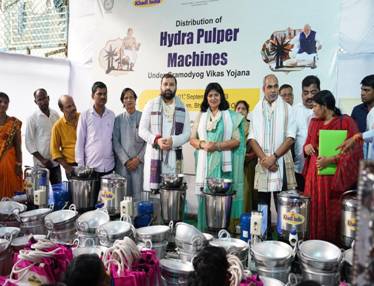
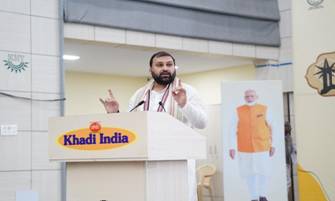
 The Chairman of the Khadi and Village Industries Commission (KVIC), Ministry of Micro, Small and Medium Enterprises, Shri Manoj Kumar distributed tool-kits and machineries to artisans in a distribution ceremony in Bhubaneshwar (Odisha) on September 01, 2023. During this event, Electric Wheels were distributed to 100 potters, Footwear Toolkits were provided to 75 Leather Artisans and Paper Massey Machines were given to 60 artisans as a part of the Gramodyog Vikas Yojana. The Member of Parliament from the Bhubaneswar Lok-Sabha Constituency, Smt. Aparajita Sarangi and Shri Manoj Kumar Singh, Member East Zone KVIC were also present on the occasion.

An Artisan Sammelan and a Pottery-Expo organized under the Gramodyog Vikas Yojana was organised at the Kalinga Institute of Industrial Technology campus in Bhubaneshwar. Smt. Aparajita Sarangi highlighted the commendable achievements of KVIC in the last 9 years under the leadership of the Prime Minister Shri Narendra Modi. She emphasized that KVIC is actively contributing to the realization of the “Atmanirbhar Bharat” vision and playing a vital role in generating employment opportunities in rural India.
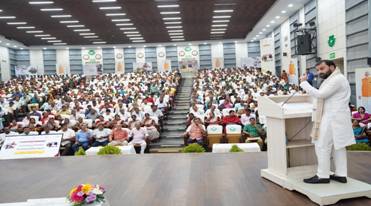
Addressing at the event, Shri Manoj Kumar said that over the course of the past 9 years, the Prime Minister Shri Narendra Modi has actively elevated India’s cherished national heritage called “Khadi,” to various international platforms. Through his dedicated endeavours, Khadi has now evolved into a prominent global brand. Shri Manoj Kumar further articulated that during India’s struggle for independence, Khadi was embraced as the central tool in the Swadeshi movement by the father of the nation Mahatma Gandhi. Remarkably, in the contemporary context, Prime Minister Shri Narendra Modi has now effectively positioned ‘Khadi’ as a potent and successful instrument for alleviating poverty, empowering artisans, ensuring food security, promoting women’s empowerment, and addressing unemployment. Under his capable leadership, KVIC’s products achieved an unprecedented turnover of over Rs.1.34 lakh crores in the previous fiscal year, marking a historic milestone.
Citing data from NITI Aayog, the Chairman of KVIC highlighted that over the past 5 years, a remarkable 13.5 crore individuals have successfully transcended the poverty line in India. Notably, Khadi, under the visionary guidance of the Prime Minister Shri Narendra Modi, has played a substantial role in uplifting people from poverty in rural areas throughout the nation.During the fiscal year 2022-23, KVIC has contributed significantly to employment generation, by providing impressive total of 9,54,899 new job opportunities.

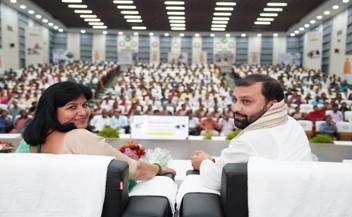
During the inauguration of the three-day Pottery Expo at the Kalinga Institute of Industrial Technology campus, Shri Manoj Kumar further emphasized that, under the insightful guidance of the Prime Minister, KVIC is dedicatedly equipping artisans engaged in traditional Indian village industries with essential tools and machinery through the Gramodyog Vikas Yojana. This strategic initiative is significantly enhancing the quality of life for these artisans by augmenting their income levels. Up to this point, as part of the ‘Kumhar Sashaktikaran’ initiative, over 25,000 electric-driven pottery wheels have been disbursed to potters nationwide. In Odisha, the Gramodyog Vikas Yojana has facilitated the distribution of more than 900 electric-driven pottery wheels, with a cumulative value of approximately Rs. 2 crores. This concerted effort has notably propelled the income of Odisha’s potters to increase three to four folds. Shri Manoj Kumar further stressed the importance of embracing the dual approach of ‘Make in India’ and ‘Make for World’ to realize the the Prime Minister’s vision of local-to-global initiative. Under the ‘Kumhar Sashaktikaran Yojana’, a hundred potters from diverse districts in Odisha have received electric pottery wheels, accompanied by a comprehensive ten-day training program. As a result of these interventions, these skilled artisans are now capable of generating a monthly livelihood ranging from 25,000 to 35,000 rupees.
Shri Manoj Kumar articulated that the state has a robust network of 62 Khadi institutions, which are effectively providing employment opportunities to over 4000 individuals. A noteworthy initiative, the Prime Minister Employment Generation Programme (PMEGP), has witnessed the establishment of 11,352 PMEGP units within Odisha, over the past three years. These units have received margin money subsidies exceeding Rs.308 crores from the Government of India, thereby fostering employment for more than 90,000 people. Number of officers and staff of Government of Odisha and KVIC were present in the above distribution programme.

****

Startup India initiative – Startup Seed Funding

The Startup India initiative was launched on 16th January 2016, by the Hon’ble Prime Minister. The Prime Minister also unveiled an Action Plan consisting of 19 Action Points that act as a guiding document for the startup initiative. Since the inception of the initiative:
There are over 99000+ startups recognized by the government of India as of May 2023

49% of them having a base in Tier 2 – Tier 3 cities
These startups are spread over 669 districts from 36 States and Union Territories of India
As of 31st March 2023, India is home to 108 unicorns with a total valuation of $ 340.80 Bn. Out of the total number of unicorns, 44 unicorns with a total valuation of $ 93.00 Bn were born in 2021 and 21 unicorns with a total valuation of $ 26.99 Bn were born in 2022

VISIT STARTUP INDIA PORTAL

Startup India
Seed Fund Scheme

Financial assistance to startups for proof of concept, prototype development, product trials, market entry, and commercialization

APPLY NOW

Startup India Seed Fund Scheme Launch

An Initiative To Spur Entrepreneurship Across India

The Need For Startup India Seed Fund Scheme

Easy availability of capital is essential for entrepreneurs at the early stages of growth of an enterprise.

Funding from angel investors and venture capital firms becomes available to startups only after the proof of concept has been provided. Similarly, banks provide loans only to asset-backed applicants.

It is essential to provide seed funding to startups with an innovative idea to conduct proof of concept trials.

Objective Of The Scheme

Startup India Seed Fund Scheme (SISFS) aims to provide financial assistance to startups for proof of concept, prototype development, product trials, market entry and commercialization.

This would enable these startups to graduate to a level where they will be able to raise investments from angel investors or venture capitalists or seek loans from commercial banks or financial institutions.
KNOW MORE ABOUT THE SCHEME

How Startup India Seed Fund Will Operate

The Seed Fund will be disbursed to eligible startups through eligible incubators across India
DPIIT

Department for Promotion of Industry and Internal Trade

Nodal Department
EAC

Experts Advisory Committee

Government Representatives & Industry Experts
Incubators

Govt assisted/Not-Govt assisted Incubators

Operational for atleast 2-3 years
Startups

DPIIT-recognised Startups

Incorporated less than 2 years ago

Features Of Startup India Seed Fund Scheme


Year-round ‘Call for Applications’ for Incubators and Startups
Sector-agnostic
No mandatory physical incubation
PAN-India startup programme
Startups can apply to 3 incubators simultaneously

Eligibility Criteria

For Startups
A startup, recognized by DPIIT, incorporated not more than 2 years ago at the time of application.
The startup must have a business idea to develop a product or a service with a market fit, viable commercialization, and scope of scaling.
The startup must have a business idea
MORE DETAILS

For Incubators
Incubator should be operational for at least two years on the date of application to the scheme.
Incubator must have facilities to seat at least 25 individuals.
Incubator must have at least 5 startups undergoing incubation physically on the date of application
MORE DETAILS

Startup India Seed Fund Scheme Launch

The Startup India Seed Fund Scheme was launched by
Honourable Shri Piyush Goyal on 19th April 2021

Scale Up Your Startup With
Startup India Seed Fund Scheme

Your journey of seed fund starts here.
Complete the application to initiate the journey
APPLY NOW

OUR FIVE PILLARS


POLICY


PARTNERSHIP AND PROGRAMS


GRASS ROOTS INITIATIVE & OUTREACH


VIRTUAL INCUBATORS


FACILITATION

PM Vishwakarma Yojana

 The Prime Minister, Shri Narendra Modi addressed the Madhya Pradesh Rozgar Mela via video link today.

Addressing the gathering, the Prime Minister said that those getting their appointment letters today are joining the important responsibility of teaching in this historical period. Throwing light on his address from the Red Fort detailing the critical role of national character in the development of the nation, the Prime Minister underlined that all those getting jobs today will hold the responsibility of molding the future generations of India, modernizing them and giving them a new direction. He extended his best wishes to the more than five and a half thousand teachers appointed in the primary schools of Madhya Pradesh today during this Rozgar Mela. The Prime Minister also informed that about 50 thousand teachers have been recruited in the state of Madhya Pradesh in the last 3 years and congratulated the state government for this feat.

Noting that the new recruits will play a key role in the implementation of the National Education Policy which has a huge contribution in proving the resolve of a developed India, the Prime Minister emphasized that equal importance has been given to traditional knowledge as well as future technology. He mentioned that a new curriculum has also been prepared in the field of primary education, while progress has been made regarding education in the mother tongue. Highlighting the great injustice caused by not imparting education in the mother tongue to students who did not know English, the Prime Minister informed that the present government is now giving emphasis on books in regional languages in the syllabus which will become the basis of a big change in the education system of the country.

“When decisions are made with positive thinking, right intention, and full integrity, the whole environment gets filled with positivity”, the Prime Minister remarked as he highlighted two positive news that has come in the first year of Amrit kaal namely decreasing poverty and increasing prosperity in the country. Firstly, the Prime Minister said, it has come in the report of NITI Aayog that within just 5 years, 13.5 crore Indians in India have come above the poverty line. Secondly, the Prime Minister threw light on another report about the number of income tax returns filed this year which indicates a huge increase in the average income of the people in the last 9 years. According to ITR data, the Prime Minister said that the average income which was around Rs 4 lakhs in 2014 has increased to Rs 13 lakhs in 2023. He stated that the number of people moving from the lower-income group to the upper-income group has also increased. The Prime Minister asserted that these figures assure increasing employment opportunities and strengthening of every sector of the country along with increasing enthusiasm.

Referring to the new figures of income tax returns, the Prime Minister noted the continuously increasing trust of the citizens of the country in their government. Due to this, the Prime Minister said, the citizens are coming forward in large numbers to pay their taxes honestly as they know that every penny of their tax is being spent for the development of the country, and it is evident to them that the economy which was at number 10 before 2014 has reached number 5. The Prime Minister also pointed out that the citizens of the country cannot forget the era before 2014 which was marred by scams and corruption where the rights of the poor were robbed even before reaching them. “Today, all the money entitled to the poor is directly reaching their account”, the Prime Minister added.

The Prime Minister noted that the result of stopping the leakage from the system enabled the government to increase spending on the welfare of the poor. He also underlined that the investment made on such a large scale has created employment in every nook and corner of the country and gave the example of the Common Service Center. He informed that 5 lakh new common service centers have been set up in the villages since 2014, and every such center is providing employment to many people today. “This means welfare of the poor and the villages as well as creation of employment opportunities”, he added.

The Prime Minister emphasized that work is being done today in the field of education, skill development and employment with far-reaching policies and decisions. Mentioning the announcement of the PM Vishwakarma Yojana from Red Fort during his address on Independence Day, the Prime Minister said that the scheme is a reflection of this vision. He stated that the PM Vishwakarma Yojana has been formulated to adapt the traditional skills of the Vishwakarmas to the needs of the 21st century. Shri Modi informed that about 13 thousand crore rupees will be spent on this and it will benefit those associated with 18 different types of skills. The Prime Minister underlined that the scheme will benefit the section of society whose importance was discussed but no concerted effort was ever made to improve their condition. Under the Vishwakarma scheme, the Prime Minister said that vouchers will also be given to the beneficiaries to buy modern tools along with training. “The youth will get more opportunities to enhance their skills through PM Vishwakarma”, the Prime Minister added.

Concluding the address, the Prime Minister said that those becoming teachers today have reached here through hard work and urged them to continue the learning process. He highlighted the online learning platform – IGoT Karmayogi prepared by the government and urged the recruits to try and take maximum advantage of this facility.


***

Unified Registration Portal For GOBARdhan

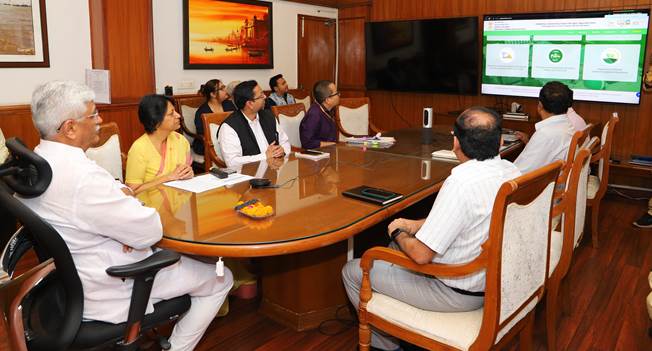
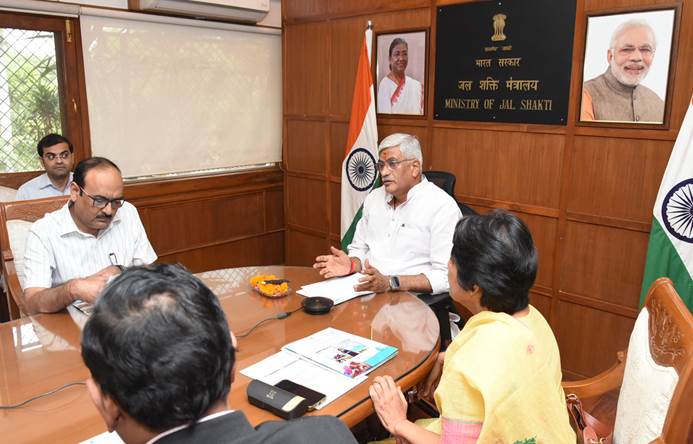
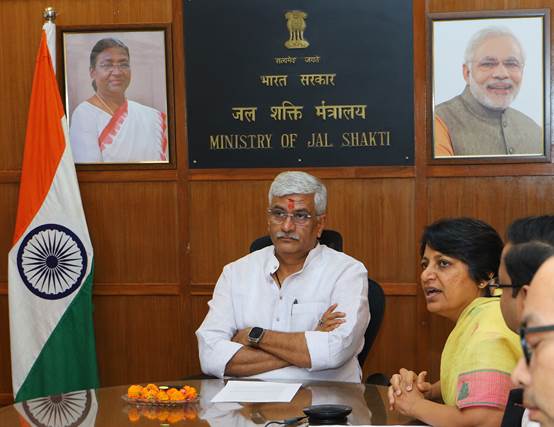
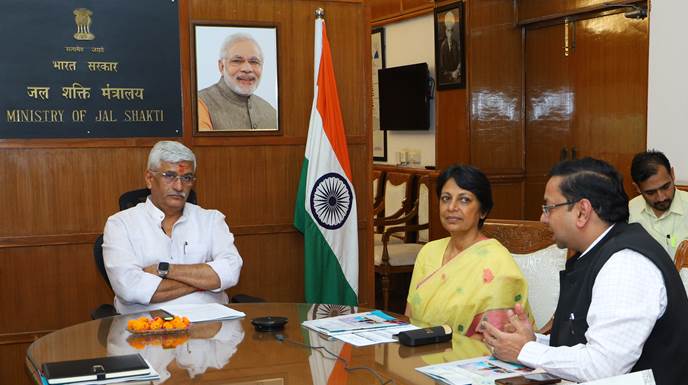
The Union Minister for Jal Shakti, Shri Gajendra Singh Shekhawat launched the Unified Registration Portal for GOBARdhan which will act as a one stop repository to assess investment and participation in Biogas/CBG sector at pan India level and more importantly streamline the process of setting up CBG/Biogas plants in India. Any government, cooperative or private entity operating or intending to setup a Biogas/CBG/Bio CNG plant in India can obtain a registration number by enrolling in this unified registration portal launched today. The registration number will enable availing of multitude of benefits and support from the Ministries & Departments of Government of India. States have been advised to get their CBG/Biogas plant operators registered on the portal on priority to avail existing and upcoming support from the Union Government.

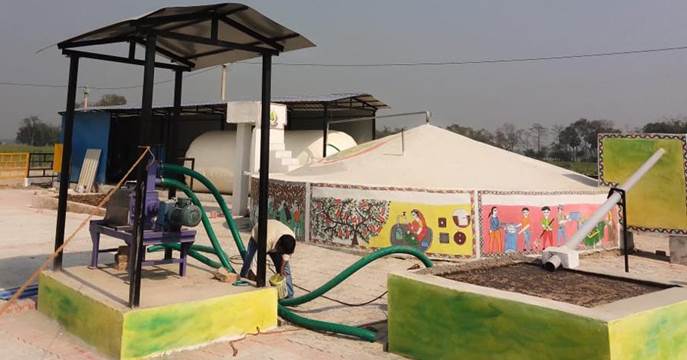
Galvanizing Organic Bio-Agro Resources Dhan (GOBARdhan) is a vital umbrella initiative of Government of India, based on the whole of Government approach and aims to convert waste to wealth towards promoting circular economy. Government of India intends to build a robust ecosystem for setting up Biogas/Compressed Biogas (CBG)/ Bio-Compressed Natural Gas (CNG) plants to drive sustainable economic growth and promote a circular economy. As the nodal department for GOBARdhan, Department of Drinking Water and Sanitation (DDWS), Ministry of Jal Shakti has developed this portal, which can be accessed at https://gobardhan.co.in. The launch was attended, in virtual mode, by Additional Chief Secretaries/Principal Secretaries (In charge of rural sanitation) of all States/UTs and representation of various central Ministries and Departments.

Addressing the gathering, the Union Minister for Jal Shakti, Shri. Gajendra Singh Shekhawat said that this Unified Registration Portal of GOBARdhan is a perfect example of Cooperative Federalism as the stakeholder Central Ministries, all line departments of Centre and States have come together in development and deployment of the portal. He stated, “Our visionary Prime Minister gave us the responsibility of ensuring ‘waste to wealth’ to which effect we launched the GOBARdhan initiative. With more than 650 GOBARdhan plants and this portal, we have made significant achievement in our waste to wealth generation journey”. The Union Minister further said that the portal will not only ensure Ease of Doing Business (EODB) but with aggregated data from all Ministries & Departments across Centre and States, the initiative will also attract greater investment from the private players. “I hope and urge everyone present here today that we must continue our concreted efforts to ensure faster pace and progress of outcomes – ‘gati aur pragati’ of the GOBARdhan initiative”, he added. Sh. Shekhawat highlighted that registering of new projects on the portal is a pre-requisite to avail any benefit/support of GoI schemes and programs (GOBARdhan related) and in that context he urged all private operators as well as Government stakeholders to register at the earliest on this Unified Registration Portal.Sh. Shekhawat concluded his address by congratulating all the Officers and stakeholders for all their efforts towards developing the portal.

Speaking on the occasion, Secretary, Department of Drinking Water and Sanitation, Ms. Vini Mahajan said that the Portal was the result of extensive consultative process among all stakeholder Ministries. She informed that the Portal was made live to all States, Ministries and Line Departments for dry run, to sort all technical issues. The CBG Producers Association was also made to test and explore the functioning of the portal. Ms. Mahajan added that the Portal displays information on both existing as well as proposed GOBARdhan projects and will be a valuable tool for investors as well as entrepreneurs of the sector.

Sh. Jitendra Srivastava, JS&MD, SBM(G) & GOBARdhan informed that as on date, more than 650 GOBARdhan plants have been reported by different stakeholders. He added that the portal is available in the public domain to ensure transparency as well as making data available for research and related purposes.

The objective of GOBARdhan is to generate wealth and energy by converting cattle dung, agri residue and other organic waste into Biogas, CBG and bio fertilizers. This initiative comprises the entire gamut of schemes, programmes, policies promoting the conversion of organic waste like cattle dung, agri-residue etc. to biogas/CBG/Bio CNG. It encompasses schemes/programmes under various Ministries & Departments viz. Waste to Energy Scheme of M/o New and Renewable Energy, SATAT (Sustainable Alternative Towards Affordable Transportation) scheme of M/o Petroleum and Natural Gas, SBM(G) Phase II of DDWS, Agri Infrastructure Fund (AIF) of Dept. of Agriculture Cooperation & Farmers Welfare and Animal Husbandry Infrastructure Development Fund (AHIDF) of Dept. of Animal Husbandry & Dairy. GOBARdhan is being implemented in partnership with State Governments and Private Sector including entrepreneurs, societies etc. Any plant/project producing CBG/Biogas (more than 10 cuM/day) and bio slurry as principal outputs is eligible to be under the ambit of GOBARdhan.

GOBARdhan initiative is envisioned to contribute significantly towards reaching India’s climate action goals particularly achieving net-zero emissions by 2070. With the highest livestock population in the world, India produces vast amounts of animal waste. CBG/Biogas sector can play a crucial role in India’s energy transition, ensuring energy security and affordability, enhancing entrepreneurship, providing rural employment, and boosting local economies. Transitioning to CBG/Biogas can contribute to job creation for semi-skilled and skilled labor in multiple areas viz. waste collection, operations, construction etc. It will benefit rural people in general and women in particular from the use of clean fuel, improved cleanliness in villages and consequent improvement in health outcomes (through decreased incidence of vector borne and respiratory diseases). Initiative will also augment nation’s efforts toward achieving the Sustainable Development Goals (SDGs) viz. SDG 3: Good Health and Wellbeing, SDG 6: Clean Water & Sanitation, SDG 7: Affordable & Clean energy, SDG 13: Climate Action; amongst others. Further, the initiative contributes significantly towards circular economy, and Govt.  of India’s Mission LiFE.

It encompasses schemes/programmes under various Ministries & Departments viz. Waste to Energy Scheme of M/o New and Renewable Energy, SATAT (Sustainable Alternative Towards Affordable Transportation) scheme of M/o Petroleum and Natural Gas, SBM(G) Phase II of DDWS, Agri Infrastructure Fund (AIF) of Dept. of Agriculture Cooperation & Farmers Welfare and Animal Husbandry Infrastructure Development Fund (AHIDF) of Dept. of Animal Husbandry & Dairy. Other stakeholder Ministries are M/o Housing and Urban Affairs, D/o Agriculture Research and Education, D/o Rural Development, D/o Fertilizers, M/o Environment Forest and Climate Change, D/o Science and Technology, M/o Skill Development and Entrepreneurship.

The Union Government is firmly committed in its endeavor to build a robust CBG/Biogas policy ecosystem in India. Few initiatives which are in the pipeline, aim to strengthen CBG/Biogas supply chain with special thrust on aggregation of biomass, grid pipeline connectivity, enabling organic farming practices, supporting Research & Development and constant engagement across CBG/Biogas stakeholders.

*****

Unified Registration Portal For GOBARdhan

The Union Minister for Jal Shakti, Shri Gajendra Singh Shekhawat launched the Unified Registration Portal for GOBARdhan which will act as a one stop repository to assess investment and participation in Biogas/CBG sector at pan India level and more importantly streamline the process of setting up CBG/Biogas plants in India. Any government, cooperative or private entity operating or intending to setup a Biogas/CBG/Bio CNG plant in India can obtain a registration number by enrolling in this unified registration portal launched today. The registration number will enable availing of multitude of benefits and support from the Ministries & Departments of Government of India. States have been advised to get their CBG/Biogas plant operators registered on the portal on priority to avail existing and upcoming support from the Union Government.

Galvanizing Organic Bio-Agro Resources Dhan (GOBARdhan) is a vital umbrella initiative of Government of India, based on the whole of Government approach and aims to convert waste to wealth towards promoting circular economy. Government of India intends to build a robust ecosystem for setting up Biogas/Compressed Biogas (CBG)/ Bio-Compressed Natural Gas (CNG) plants to drive sustainable economic growth and promote a circular economy. As the nodal department for GOBARdhan, Department of Drinking Water and Sanitation (DDWS), Ministry of Jal Shakti has developed this portal, which can be accessed at https://gobardhan.co.in. The launch was attended, in virtual mode, by Additional Chief Secretaries/Principal Secretaries (In charge of rural sanitation) of all States/UTs and representation of various central Ministries and Departments.

Addressing the gathering, the Union Minister for Jal Shakti, Shri. Gajendra Singh Shekhawat said that this Unified Registration Portal of GOBARdhan is a perfect example of Cooperative Federalism as the stakeholder Central Ministries, all line departments of Centre and States have come together in development and deployment of the portal. He stated, “Our visionary Prime Minister gave us the responsibility of ensuring ‘waste to wealth’ to which effect we launched the GOBARdhan initiative. With more than 650 GOBARdhan plants and this portal, we have made significant achievement in our waste to wealth generation journey”. The Union Minister further said that the portal will not only ensure Ease of Doing Business (EODB) but with aggregated data from all Ministries & Departments across Centre and States, the initiative will also attract greater investment from the private players. “I hope and urge everyone present here today that we must continue our concreted efforts to ensure faster pace and progress of outcomes – ‘gati aur pragati’ of the GOBARdhan initiative”, he added. Sh. Shekhawat highlighted that registering of new projects on the portal is a pre-requisite to avail any benefit/support of GoI schemes and programs (GOBARdhan related) and in that context he urged all private operators as well as Government stakeholders to register at the earliest on this Unified Registration Portal.Sh. Shekhawat concluded his address by congratulating all the Officers and stakeholders for all their efforts towards developing the portal.

Speaking on the occasion, Secretary, Department of Drinking Water and Sanitation, Ms. Vini Mahajan said that the Portal was the result of extensive consultative process among all stakeholder Ministries. She informed that the Portal was made live to all States, Ministries and Line Departments for dry run, to sort all technical issues. The CBG Producers Association was also made to test and explore the functioning of the portal. Ms. Mahajan added that the Portal displays information on both existing as well as proposed GOBARdhan projects and will be a valuable tool for investors as well as entrepreneurs of the sector.

Sh. Jitendra Srivastava, JS&MD, SBM(G) & GOBARdhan informed that as on date, more than 650 GOBARdhan plants have been reported by different stakeholders. He added that the portal is available in the public domain to ensure transparency as well as making data available for research and related purposes.

The objective of GOBARdhan is to generate wealth and energy by converting cattle dung, agri residue and other organic waste into Biogas, CBG and bio fertilizers. This initiative comprises the entire gamut of schemes, programmes, policies promoting the conversion of organic waste like cattle dung, agri-residue etc. to biogas/CBG/Bio CNG. It encompasses schemes/programmes under various Ministries & Departments viz. Waste to Energy Scheme of M/o New and Renewable Energy, SATAT (Sustainable Alternative Towards Affordable Transportation) scheme of M/o Petroleum and Natural Gas, SBM(G) Phase II of DDWS, Agri Infrastructure Fund (AIF) of Dept. of Agriculture Cooperation & Farmers Welfare and Animal Husbandry Infrastructure Development Fund (AHIDF) of Dept. of Animal Husbandry & Dairy. GOBARdhan is being implemented in partnership with State Governments and Private Sector including entrepreneurs, societies etc. Any plant/project producing CBG/Biogas (more than 10 cuM/day) and bio slurry as principal outputs is eligible to be under the ambit of GOBARdhan.

GOBARdhan initiative is envisioned to contribute significantly towards reaching India’s climate action goals particularly achieving net-zero emissions by 2070. With the highest livestock population in the world, India produces vast amounts of animal waste. CBG/Biogas sector can play a crucial role in India’s energy transition, ensuring energy security and affordability, enhancing entrepreneurship, providing rural employment, and boosting local economies. Transitioning to CBG/Biogas can contribute to job creation for semi-skilled and skilled labor in multiple areas viz. waste collection, operations, construction etc. It will benefit rural people in general and women in particular from the use of clean fuel, improved cleanliness in villages and consequent improvement in health outcomes (through decreased incidence of vector borne and respiratory diseases). Initiative will also augment nation’s efforts toward achieving the Sustainable Development Goals (SDGs) viz. SDG 3: Good Health and Wellbeing, SDG 6: Clean Water & Sanitation, SDG 7: Affordable & Clean energy, SDG 13: Climate Action; amongst others. Further, the initiative contributes significantly towards circular economy, and Govt.  of India’s Mission LiFE.

It encompasses schemes/programmes under various Ministries & Departments viz. Waste to Energy Scheme of M/o New and Renewable Energy, SATAT (Sustainable Alternative Towards Affordable Transportation) scheme of M/o Petroleum and Natural Gas, SBM(G) Phase II of DDWS, Agri Infrastructure Fund (AIF) of Dept. of Agriculture Cooperation & Farmers Welfare and Animal Husbandry Infrastructure Development Fund (AHIDF) of Dept. of Animal Husbandry & Dairy. Other stakeholder Ministries are M/o Housing and Urban Affairs, D/o Agriculture Research and Education, D/o Rural Development, D/o Fertilizers, M/o Environment Forest and Climate Change, D/o Science and Technology, M/o Skill Development and Entrepreneurship.

The Union Government is firmly committed in its endeavor to build a robust CBG/Biogas policy ecosystem in India. Few initiatives which are in the pipeline, aim to strengthen CBG/Biogas supply chain with special thrust on aggregation of biomass, grid pipeline connectivity, enabling organic farming practices, supporting Research & Development and constant engagement across CBG/Biogas stakeholders.

*****

Women Empowerment

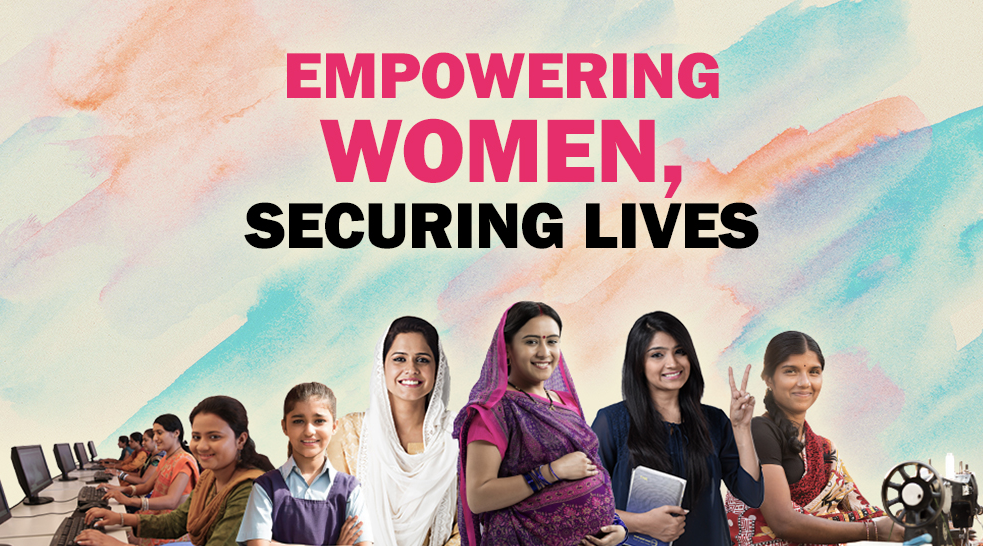
 The concept of women empowerment has become a very significant topic of discussion in development and economies. Women empowerment is empowering women to take their own decisions for personal as well as social development. Empowering women is to make them independent in all aspects and to set them free from all social and family limitations.

Gender equality is, first and foremost, a human right. It implies a society in which women and men enjoy the same opportunities, outcomes, rights and obligations in all spheres of life. Equality between men and women exists when both of them are able to share equal distribution of power and influence; have equal opportunities financially through work and through setting up businesses; enjoy equal access to education and opportunity to fulfill personal ambitions. Yet there is discrimination against women and girls – including gender based violence, economic discrimination, sexual coercion, reproductive health inequalities, and harmful traditional practices. Women usually have less access than men to training and employment, medical care, property ownership, etc. They are less likely than men to be politically active and more likely to be victims of domestic violence. The ability of women to control their own fertility is absolutely fundamental. And when these reproductive rights – including the right to decide the number, timing and spacing of her children are free of discrimination, coercion and violence, she would have the freedom to participate more fully and equally in the society because when she would be healthy, she would be more productive. The roles of men and women are not biologically determined – they are socially determined and changeable.

India is a country where all the women are been honoured as goddesses since ancient times. However, when it approaches to providing them with correspondent rights the same people abandon its major importance and swallow that the main purpose of women is to take care of the family and kids firstly. Whereas, there have been various organizations and institutions advocating for women, supporting various projects that provides women basic education and health care requirements. Apart from these there are many welfare schemes for women – Beti Bachao Beti Padhao, Ujwalla, ICDS, Kishori Shakti Yojana, etc. implemented by the Indian government. According to me every women should be given equal opportunities to education and employment without any gender bias. Now, we know that women empowerment is a minute key to economic growth and social transformation. 

 Benefits of Empowering Women in India

Women, as the majority of India’s population, represent a sizable portion of the country’s untapped economic potential. As a result, providing equal opportunities for women in India would enable them to contribute to the economy as productive citizens. Women can thrive economically and rise out of poverty with higher literacy rates and equal pay for equal work.

Protecting women and girls from violence and abuse, as well as challenging the stigmas associated with reporting crimes, would result in a much safer society. Improving female political representation would allow more women to serve as role models for young girls and provide a platform to raise awareness about women’s issues in India. Overall, gender equality enables women to have a higher quality of life, allowing them to determine their futures beyond traditional expectations.

As an African proverb says,

“If you educate a man, you educate an individual but if you educate a women, you educate a nation”

What are Government Schemes for Financial Freedom

Governments often implement various schemes aimed at enhancing financial freedom and security for their citizens. These schemes can vary significantly based on the country, its economic policies, and the specific needs of its population. Here are some common types of government schemes that promote financial freedom:

  1. Pension and Retirement Plans: Governments may offer pension schemes or retirement plans that provide income for retirees. These schemes often involve contributions from both employees and employers, ensuring financial security during retirement.

  2. Social Security Programs: These encompass various initiatives aimed at providing financial aid to specific demographics, such as the elderly, disabled, or unemployed. These programs offer benefits, including healthcare, income support, and disability assistance.

  3. Financial Literacy Programs: Governments may run educational initiatives to improve financial literacy among citizens. These programs offer information and resources on budgeting, saving, investing, and managing debt to empower individuals to make sound financial decisions.

  4. Subsidies and Grants: Governments might offer subsidies or grants to specific groups or industries to promote economic stability and growth. These can include subsidies for housing, education, healthcare, or agriculture.

  5. Microfinance and Small Business Support: Some governments provide support for small businesses and entrepreneurs through microfinance programs or small business grants. These initiatives aim to foster economic development and empower individuals to start or expand their businesses.

  6. Tax Incentives and Credits: Governments often use tax incentives and credits to encourage certain behaviors, such as investing in education, buying homes, or contributing to retirement funds. These incentives can help individuals save money and plan for the future.

  7. Employment Support and Job Training: Job training programs and employment support initiatives help individuals gain skills that improve their employability, thus enhancing their financial prospects.

  8. Housing Schemes: Governments may offer housing schemes or subsidies to make housing more affordable for low-income individuals or first-time homebuyers.

  9. Health Insurance Programs: Access to affordable healthcare is crucial for financial stability. Governments may provide health insurance programs or subsidies to ensure citizens have access to medical care without significant financial strain.

These schemes collectively aim to enhance financial stability, promote economic growth, and ensure a certain level of economic security for the population. The specific schemes and their effectiveness can vary widely based on the policies, priorities, and economic conditions of each country.

600 Pradhan Mantri Kisan Sammrudhi Kendras to provide more facilities to farmers

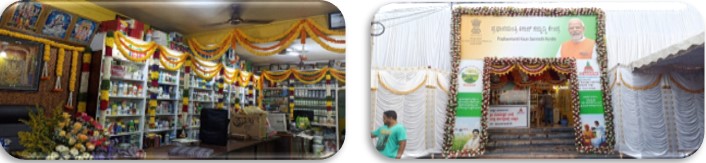
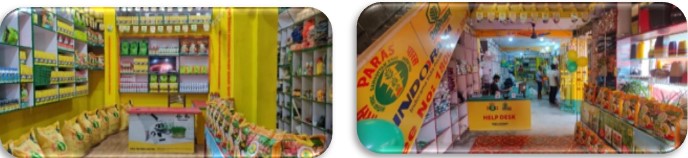
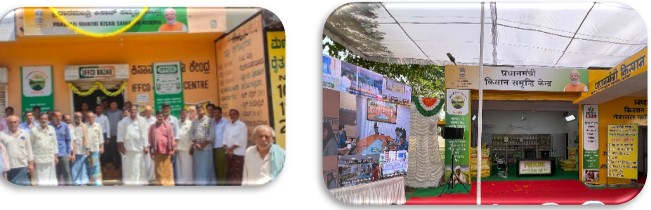
 Under Pradhan Mantri Kisan Sammrudhi Kendras (PMKSK), 600 existing district level retail shops are remodelled and provided more facilities to the farmers in terms of agri inputs and services. These kendras were inaugurated by Prime Minister on the occasion of PM Kisan Sammelan. All these centres have become excellent examples of swachhata Campaign 2 initiatives with clean premise and enhanced facilities for farmers. The launch of the 600 Pradan Mantri Kisan Samruddhi Kendras (PMKSK) across the country is one of the best practices adopted as part of the Special Campaign 2.0 initiatives by the Department of Fertilizers.


.


This is in addition to the other initiatives undertaken on Special Campaign 2.0  by the Department of Fertilizers that includes identification of 13 Sites from its Headquarter and its PSUs which are under the administrative control of the Department of Fertilizers to carry out weeding out of old files both physical and e files as per the Record Retention Schedule, digitization of records, reduce paper work, disposal of the e waste, scrap material etc so that they can improve efficiency and space. The updated information is also uploaded in the SCDPM portal on a regular basis.


*************

Online Courses by SWAYAM


Online Courses by SWAYAM

SWAYAM is a programme initiated by Government of India and designed to achieve the three cardinal principles of Education Policy viz., access, equity and quality. The objective of this effort is to take the best teaching learning resources to all, including the most disadvantaged. SWAYAM seeks to bridge the digital divide for students who have hitherto remained untouched by the digital revolution and have not been able to join the mainstream of the knowledge economy.

This is done through a platform that facilitates hosting of all the courses, taught in classrooms from Class 9 till post-graduation to be accessed by anyone, anywhere at any time. All the courses are interactive, prepared by the best teachers in the country and are available, free of cost to any learner. More than 1,000 specially chosen faculty and teachers from across the country have participated in preparing these courses.

The courses hosted on SWAYAM are in 4 quadrants – (1) video lecture, (2) specially prepared reading material that can be downloaded/printed (3) self-assessment tests through tests and quizzes and (4) an online discussion forum for clearing the doubts. Steps have been taken to enrich the learning experience by using audio-video and multi-media and state of the art pedagogy / technology.

 In order to ensure that best quality content is produced and delivered, nine National Coordinators have been appointed. They are:


  AICTE (All India Council for Technical Education) for self-paced and international courses

  NPTEL (National Programme on Technology Enhanced Learning) for Engineering

  UGC (University Grants Commission) for non-technical post-graduation education

  CEC (Consortium for Educational Communication) for under-graduate education

  NCERT (National Council of Educational Research and Training) for school education

  NIOS (National Institute of Open Schooling) for school education

  IGNOU (Indira Gandhi National Open University) for out-of-school students

  IIMB (Indian Institute of Management, Bangalore) for management studies

  NITTTR (National Institute of Technical Teachers Training and Research) for Teacher Training programme

Courses delivered through SWAYAM are available free of cost to the learners, however learners wanting a SWAYAM certificate should register for the final proctored exams that come at a fee and attend in-person at designated centres on specified dates. Eligibility for the certificate will be announced on the course page and learners will get certificates only if this criteria is matched. Universities/colleges approving credit transfer for these courses can use the marks/certificate obtained in these courses for the same.

How to apply for the SWAYAM Courses?

1.    Step 1Search for the SWAYAM website or you can click on https://swayam.gov.in/ to go directly to                  the website.

2.   Step  2The webpage will open and you can register on the website by clicking on SIGN-           IN/REGISTER button.

3.   Step 3After registering on the website click on All Courses at the top of the page to find the relevant course. The page will appear which shows all the courses.

4.   Step 4You can find the course of your choice by searching in the Course Catalog option or by scrolling down. You can also apply a filter (shown on the left of the above image) to search for the course according to your convenience.

5.  Step 5After choosing your favorite course click on it. This will direct you to the page showing all the information about that particular course. You can get every information about that course and can join the course by clicking on the JOIN button.


I hope, the information is helpful for you to find free courses by the government of India. Enroll yourself now and get started with government authorize short-term courses.

 Source– https://swayam.gov.in/ 


What is Ayushman Bharat Scheme and how to see Ayushman Bharat List

Today we are going to tell you about what is Ayushman bharat yojana and how to do ayushman Bharat registration and how to see its list, through this article we are going to tell you very special information related to Pradhan Mantri ayushman Bharat yojana.

As you know that every day some useful scheme keeps coming in our country, out of which Ayushman bharat scheme is also one, this scheme is very useful for all the people but many people do not know about it, then this article In this we are going to tell you complete information about ayushman Bharat yojana.

What is Ayushman Bharat Yojana Scheme

Ayushman Bharat Scheme


Pradhan Mantri Ayushman Yojana has been started for the people who come below the poverty line, under this it has been started for the people who come below the poverty line for their good hospital treatment, in these poor people also without spending any money. You can get yourself treated in a good hospital.

Those people who come below the poverty line can take advantage of this scheme. Any member of the family of any person doing this is treated free of cost.

Benefits of the Ayushman bharat Scheme


The way the government has started this scheme shows how many benefits it has, first of all, we are going to tell you about the benefits of this scheme so that you can be aware of its benefits.

  • You do not have to do any separate application or registration to apply for this.
  • You can take advantage of this plan for free
  • Under this scheme, treatment of 5 lakhs is done for free.
  • A poor person can get treatment in a big hospital under this scheme
  • Under this scheme, 24 government hospitals and medical colleges will be built.
  • Under this scheme, hospital expenses up to 5 lakh will be given to each essential family.
  • Ayushman Bharat Health Insurance. is cashless
  • Patients suffering from serious diseases like heart, kidney, sugar etc. can take advantage of this scheme.


How to see the Ayushman Bharat Yojana List


To take advantage of this scheme, it is necessary to have your name on the list, but many people do not know how they can see their name on the list, so for this, you should follow the steps given by us.

  1. First, you click on PMJAY
  2. Now you will get the option of mobile number and captcha code, in that you solve the captcha by entering your mobile number
  3. Now click on OTP Generate and a number will come on your phone, enter it
  4. Now you have to select your state
  5. Now you will get the option to select the category, in that you select the category as per your wish.
  6. Now fill in the requested information related to the category you will select.
  7. Now click on search
  8. Now the complete list of this scheme will come in front of you, in that you have to find your name and if you want, you can also download it, if you have a name in this list then you can take advantage of this scheme.

How to see Ayushman Bharat Eligibility


If you have not applied in it and now you want to apply in it, then for this you should first check the ayushman Bharat eligibility once whether you can apply in it or not, then follow this process to see the eligibility in it.

  • First of all, you have to go to the official website of Ayushman Bharat
  • Now you will see the option of “AM I Eligible”, you have to click on it
  • Now a new page will open in front of you, in which you will be asked to log in, and enter your mobile number and OTP and log in.
  • Now you will get two options to get family eligibility information, out of which you have to choose your state and choose a mobile number or ration card.
  • Now you have to fill in the requested information
  • Now you have to click on the search or search option
  • In this way, you can very easily see the eligibility in Ayushman Bharat and if you are found applying for it then you can also apply for it later.

Documents to apply for Ayushman Bharat


If you want to apply for this, then you must have some important documents for this, only then you will be able to apply for it.

  • Aadhar card
  • of all family members
  • Ration card
  • mobile number
  • address proof

After having all these documents, you can apply online very easily in this, to apply this, you follow the process given by us.

How to do Ayushman Bharat Registration


Now we will talk about how you can apply for this scheme or how to register for it, for this, you should follow our given method so that you can easily apply for it.

  • first of all you go to the service centre, after that you have to submit a copy of all the documents
  • Now they verify your documents and after that, you register yourself in it.
  • After applying for this, you will get the golden card of Ayushman Bharat in 10 to 15 days.
  • In this way, you can also apply online for Pradhan Mantri ayushman Bharat yojana very easily and when you apply in it, then after that you are in any hospital by this you are working under this scheme there You can get free treatment up to Rs 5 lakh
Conclusion – In this article, we have given you information about the ayushman Bharat Yojana and what is this scheme and how to apply it, we hope that you must have liked the information given by us, if you like the information then Do share this with your friends through social media and if you want to ask any question related to it, then you can also tell us by commenting.

Analyzing Mid-day Meal: India’s School Lunch System

Official Logo of Mid-day Meal Scheme

Introduction

Food is a basic need of life.  And Education is important to make the life affluent. A hungry stomach cannot grasp the teachings of Education at school, there to provide better Education, schools all around the world, offer lunch to the students. In India, the system of school lunch is referred to as Mid-day Meal. In today’s editorial, we’re going to share insights about the system of Mid-day Meal in India.

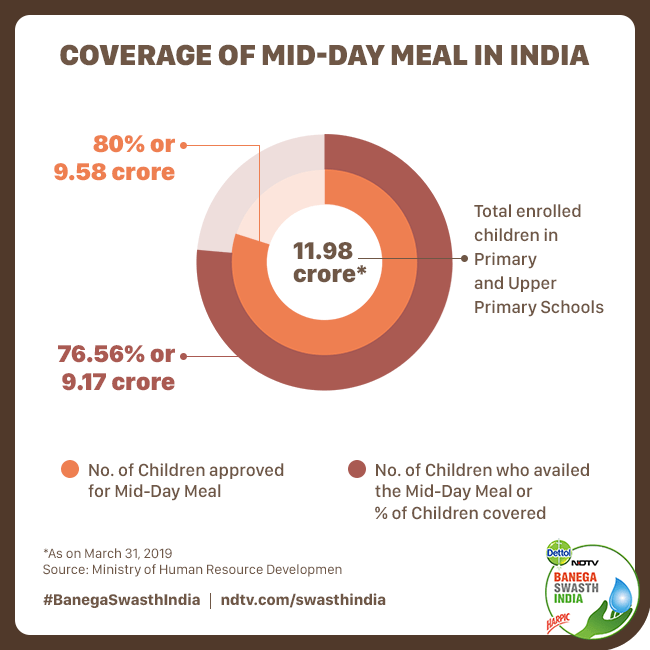
Coverage of Mid-day Meal Scheme in India

Brief Idea of What Mid-day Meal Is

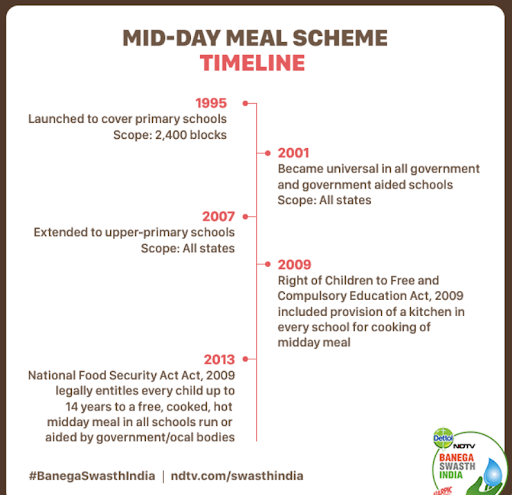
The Midday Meal Scheme, launched in 1995  by former Prime Minister of India, P.V. Narsimha Rao, under the Ministry of Education, is a school meal programme in India designed to better the nutritional  standing of school-age children nationwide. The programme supplies free lunches on working days for children in primary and upper primary classes in government, government aided, local body, Education Guarantee Scheme, and alternate innovative education centres, Madarsa  and Maqtabs  supported under Sarva Shiksha Abhiyan , and National Child Labour Project schools run by the Ministry of Labour. Serving 120 million children in over 1.27 million schools and Education Guarantee Scheme centres, the Midday Meal Scheme is the largest of its kind in the world.

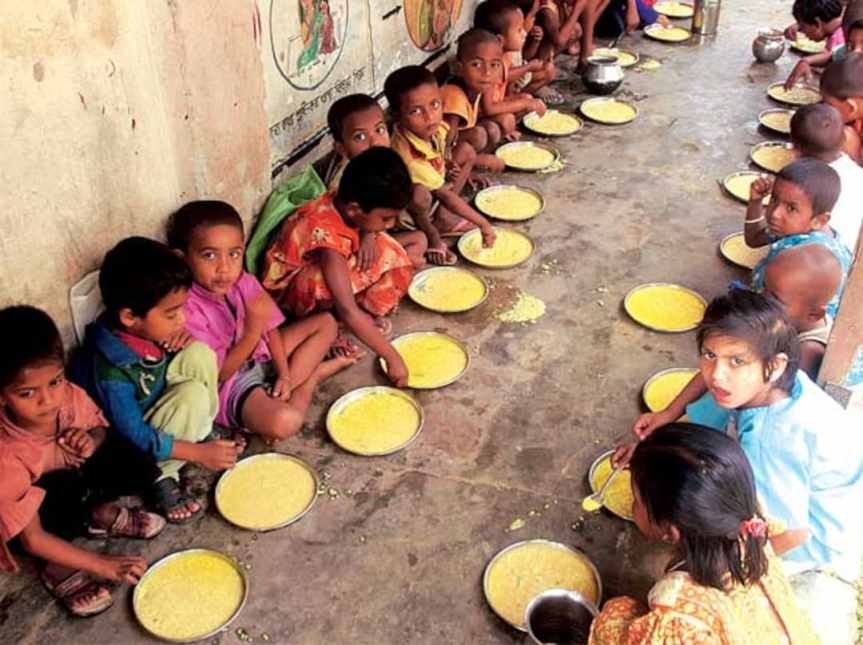
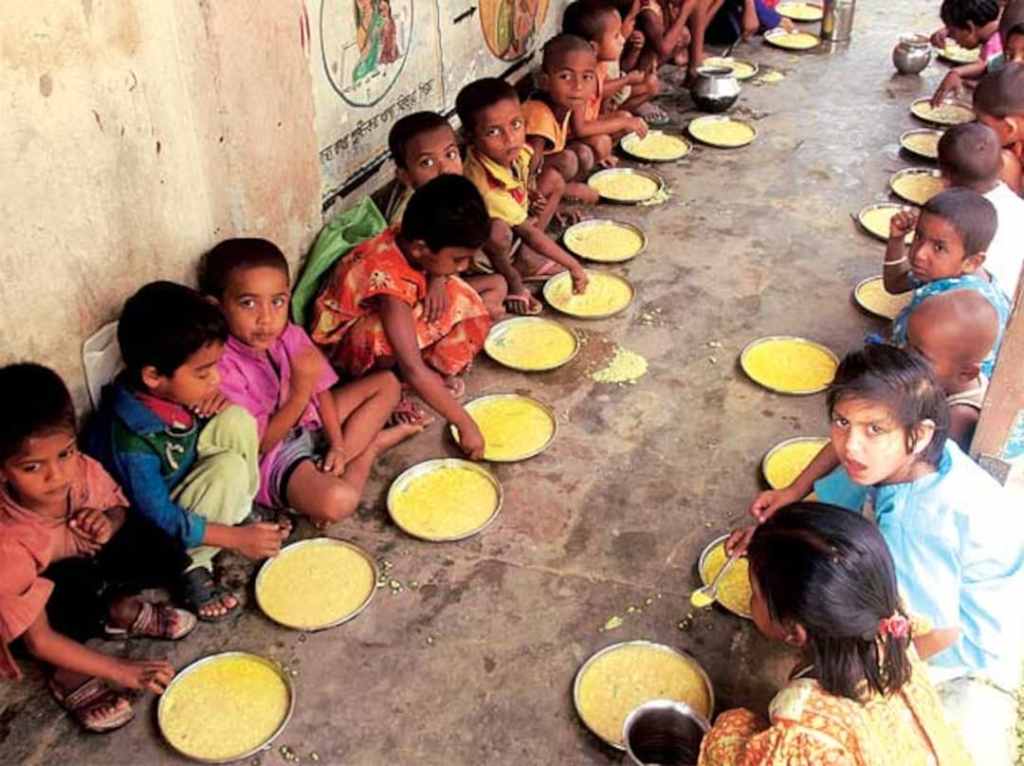
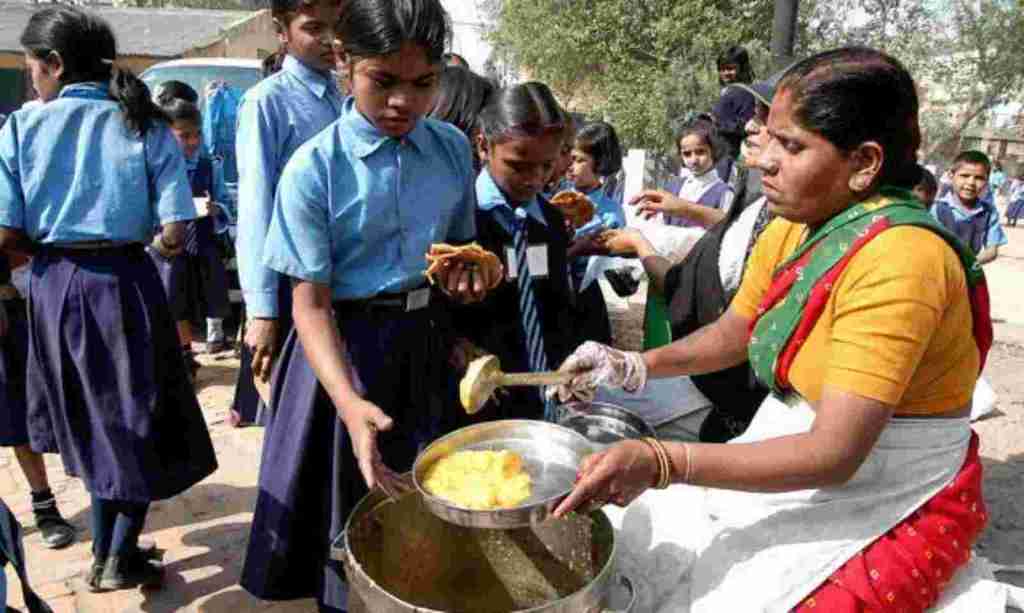
Students having Mid-day Meal at a School in India

Objectives of Mid-day Meal Scheme

  • To increase the enrolment in the schools of children who belong to disadvantaged sections of the society .
  • To increase attendance of students in Government and Government aided schools.
  • To retain the children studying in class I to VIII.
  • To give nutritional support to the children studying in the elementary level, specially in drought-prone areas.
  • To address hunger and malnutrition and increase socialization among the castes.
Mid-day Meal Scheme Timeline in India

Features of Mid-day Meal Scheme

  • It is one of the world’s largest school meal programs intended to achieve the goal of universalization of primary education.
  • For the implementation of the scheme, the Ministry of Human Resources and Development is the authorized body to implement the scheme.
  • It is a centre-sponsored scheme, so, the cost is shared between the states and the centre. Where the share of the centre is 60 percent.
  • The first state to implement the midday meal scheme was Kerala in 1984.
  • Till 2002, the scheme is designed especially for the government, government-aided and local body schools. But later on, the benefit of the mid-day meal scheme is extended to those children who were studying in educational guaranteed scheme centres or Alternative & Educational Centres.
  • In 2004, the scheme is again revised, and central assistance is offered for the cooking cost.  Apart from that, the transport subsidy included for all states, maximum of Rs 100 per quintal is provided to the special category states and Rs 75 per quintal for other states.
  • The provision of serving mid-day meals during summer vacation to the children in drought-affected areas was also added.
  • In 2006, the cooking cost was enhanced to Rs 1.80 per child/ school day for states in North Eastern Region and Rs 1.50 per child/ school day for other states and UTs.
  • In 2007, the scheme benefit is also extended to the children studying in the educationally Backwards Blocks.
  • Apart from the calories and food intake, for micronutrients (tablets and deworming medicines), each child is entitled to receive the amount provided for in the school health program of the National Rural Health Mission.
  • Meals provided under the Mid-day Meal Scheme
Food Norms under Mid-day Meal Scheme
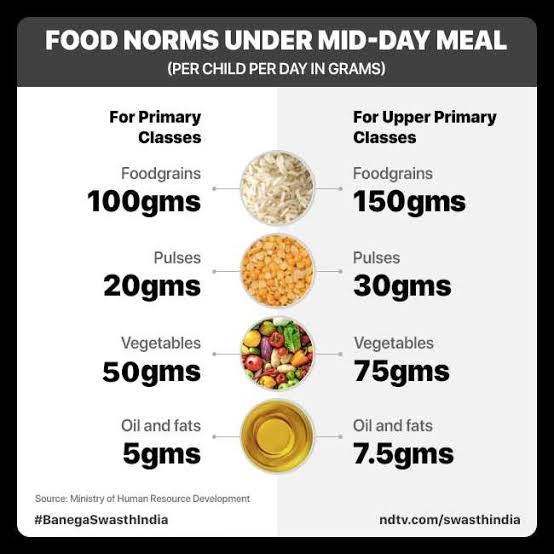
  • The quantity of food items provided under this scheme per child per school day is as follows:
Food itemsPrimary level (Class I-V)Upper level (Class VI-VIII)
Food Grains100 gms150 gms
Pulses20 gms30 gms
Vegetables (leafy also)50 gms75 gms
Oil & fat5 gms7.5 gms
Salt & condimentsAs per needAs per need
Calories IntakePrimaryUpper Primary
Energy450 calories700 calories
Protein12 grams20 grams
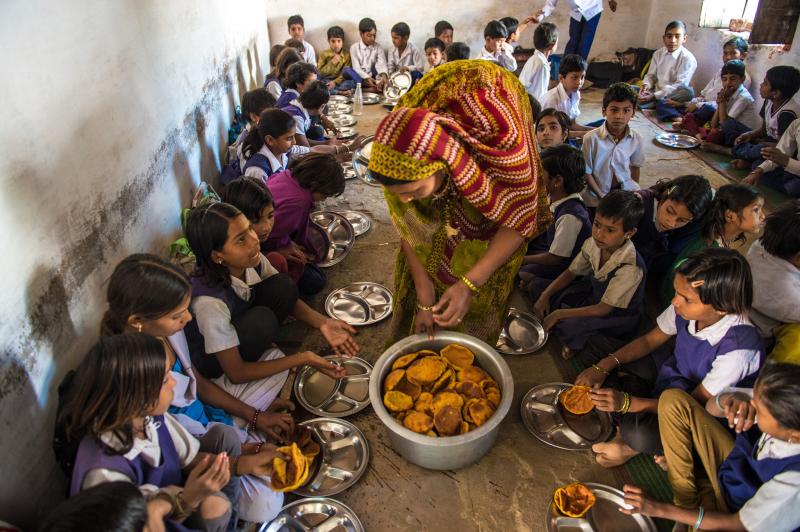
Serving of Mid-day Meal

Advantages of Mid-day Meal

  • It satisfies the hunger of many children.
  • Supplying nutrition to children of the poor section helps them in concentrating on their studies better.
  • Students come to government schools daily and won’t be asked to do labour work.
  • Addresses the issue of malnutrition.
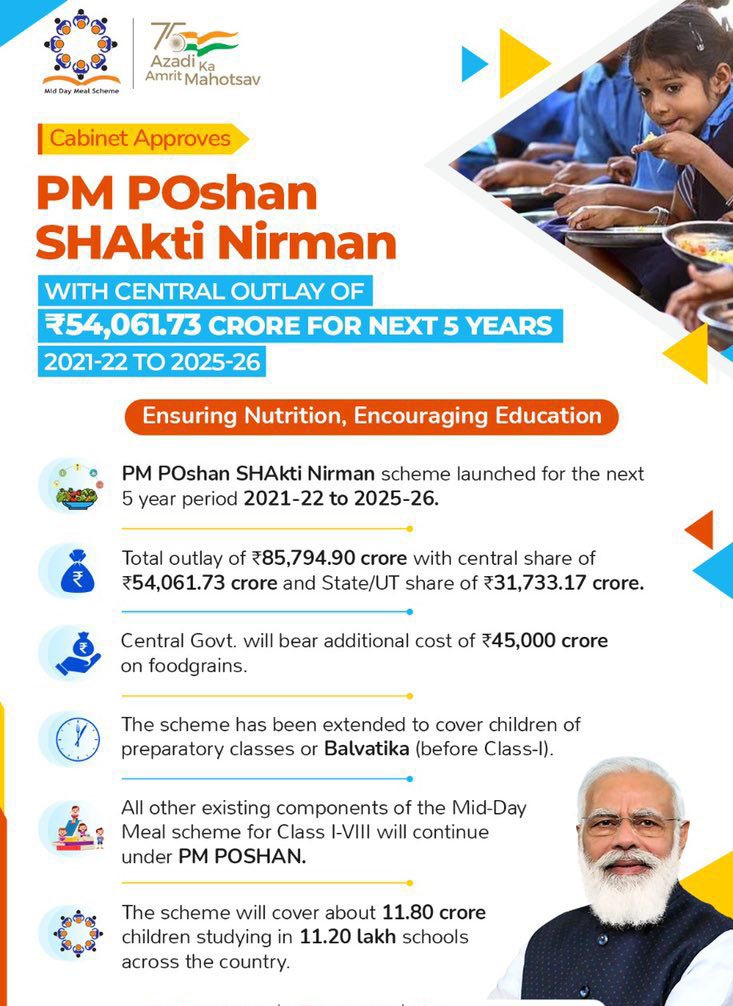
PM POSHAN SHAKTI NIRMAN

Recent Improvisation of Mid-day Meal Scheme

During the celebration of India’s 75th Independence Day as Azadi Ka Amrit Mahotsav, the Cabinet approved for the implementation of PM POSHAN SHAKTI NIRMAN for next 5 years i.e. 2021-22 to 2025-26.

Conclusion

There is no doubt that school is the only place that contributes to the socio-economic development of society. Here children from various backgrounds come together for promoting the culture of unity and brotherhood. The education they receive at school prepares them to achieve their goals and lead a successful life. When we talk about government schools, here children mostly come from economically challenged backgrounds. So, even though education schemes like Sarva Shiksha Abhiyaan are being implemented, the difficult financial conditions force these children to skip school and go on work. In such kind of circumstances,  the real potential of mid-day meal surfaces. Mid-day meal acts as an attractive incentive for parents to send their children to school with the sole hope that the young ones will receive at least one plate full of the meal for the day. 

Farm Bill 2020

In India, agriculture is regarded as a dominant sector in the country. More than 70% of the population in India is involved in the agricultural activities either directly or indirectly. We are able to eat peacefully only due to the hard work of the farmers. Though the farmers work hard in the field day and night in order to feed the country yet they are compelled to live a life of indigence and starvation. Recently in 2020, new bills for the welfare and comfort of the farmers and the agricultural sector was introduced by the Central government. However, these bills were greatly opposed by the farmers and the government of the State. There were protests against the bills on roads and streets by the farmers across the nation. A resolution was also passed by the Punjab Assembly rejecting the ordinances of Central government on 28th August 2020.

A combination of three bills together constitute the Agriculture Bill 2020 or Farm Bill 2020. These three bills were recently passed by the Parliament. These bills are: Farmers Produce and Commerce (Promotion and Facilitation) Bill 2020, Farmers Agreement (Empowerment and Protection) on Price Assurance and Farm Services Bill 2020 and Essential Commodities (Amendment) Bill 2020. These bill make huge changes in the agricultural sector structurally. These bills also seemed to encourage corporate investments in the ecosystem of agriculture in order to make agriculture more benefitable to the farmers.

The Farm Bill 2020 contemplates an alternative possible way to the farmers to sell their produce in open market, providing them an opportunity to sell their products anywhere and to anyone and even get high price for it. In such areas of trade, neither agriculture produce market committee (APMC) fees nor tax by the government on transactions will be charged. The APMC would require to compete with these alternate platforms and now the farmers would have the choice to sell their produces of the farm. The farmers have the authority to sell their farm’s produce directly to the corporate or exporter purchasing in bulk from the farm. The current procurement of food grains based on minimum support price (MSP) is not obliterated by the Farm Bill 2020. The system of procurement based on MSP continues and the farmers can also sell their farm produces at Mandis on the existing MSP.

A number of schemes for the well being of the farmers as well as agricultural sector is launched every now and then by the government. The main aim behind introducing the Farm Bills was to boost the agriculture sector and double the income of farmers by 2022. It was believed that freeing the agriculture sector will consequently help in better pricing due to vast competition in the market. The corporate sector would be induced to invest in the ecosystem of agriculture as the farmers would have the choice to sell their crop products directly to the corporates and the exporters.

As the New Farm Bill 2020 provides great measures for the welfare of the farmers by giving them opportunity to sell their farm products in open market and also allowing them to fix the price according to themselves on mutual understanding of both the farmer and the corporates. Farmers are apprehensive of getting the MSP for their produce. However, the farmers do fear the domination on the agricultural sector with the power of money by the larger corporates and retailers, they also fear that the Mandies would become inessential like BSNL and MTNL future days and they also doubt that if in near future the trade shifts substantially to alternative platforms, the APMCs may become unavailable and have to shut down. No mechanism for fixation of price was prescribed under the Price Assurance Bill. The farmers were anxious about their exploitation as free hand was given to corporate houses. The Bill seemingly deregulated the movement, production, storage and distribution of essential food commodities such as edible oils, pulses, oil seeds, potatoes and onion which are removed from the Essential Commodities (Amendment) Ordinance.

Women Entrepreneurship in India

Confucius once said ‘Choose a job you like , and you will never have to work a single day in your life’, and this stands true for all the entrepreneurs out there, who are following their passion, and dedicating their time, sweat and blood for the creation of their product or service. Entrepreneurship is a field which requires the individual to accept ambiguity and challenge despite being exposed to uncertainties and criticisms.

We all have heard and know of male entrepreneurs who envision their dreams into reality. However, this is not the case for the female counterpart. Female entrepreneurs have to break through centuries old conventions and take a stand for themselves to venture into the business world.

According to Forbes India, Women make up to 13.76 percent of entrepreneurs in India, this is fairly less than its male counterpart. However, it can be seen that the numbers are accelerating at an impressive rate.

Need of the Hour

According to an article by Times of India, Women owned business in India are likely to rise 90 percent in the next five years, as compared to the US (50%) and UK (24%). Such statistics are clearly impressive as it not only established the potential Indian women entrepreneur possess, but also encourages the younger generation to propagate venture on their own and not just depend on employers.  

The urge to have women entrepreneurs onboard will not only benefit to boast the economy of the country but also help to manifest the socio-political and economic development of women.

Government schemes for women entrepreneurs

The Government of India has launched substantial number of programs and schemes, that would benefit women entrepreneurs in India. According to an article by Indifi, GOI launches 9 such schemes that empowers women entrepreneurs. Few of the schemes are:

  1. Annapurna Scheme- this scheme provides loans to women in food catering industries who are still establishing their small scale business.  
  2. Dena Sakti Scheme- this scheme is for women entrepreneurs in the field of agriculture, retail, manufacturing or micro-credit business.
  3. Mudra Yojana Scheme- this scheme tries to improve the status of women by providing them loans to make them self-reliant and financially independent.

There are more such schemes that are especially catered to help empower women entrepreneurs coming from all walk of lives.

Pandemic and women entrepreneurs

The pandemic has affected employment all over the world, and women employees are no exception to it. With the on-going lockdowns many lot their jobs, and thus in order to make their living we could see a number of small women entrepreneurs trying to make their living by selling handmade masks, jewellery, embroidery, selling home cooked food on the streets and much more. This provided them the opportunity to be financially independent and make a living for themselves in their own terms. Although the sales and profit are not guaranteed, it at least helps them feed themselves, which is a better alternative to unemployment.

The pandemic also saw the rise of small urban-women owned businesses such as selling handmade crochets, macramé, resin products and much more, whose primary medium of marketing are through social networking sites. These are mainly owned by the young women who are treating it as a side hustle, along with focusing on their respective careers and educations. Thus, being self-reliant along with having a career alternative.

                   Being an entrepreneur requires a vision and dedication to achieve this goal. Falguni Nayyar started her entrepreneurship journey with Nykaa at the age of 50 and now she is one of the first two women self-made billionaires in India. Its never too late to start a venture of your own.

Scheme for Minority People of North Eastern States

 The Government has implemented various schemes for the welfare and upliftment of every section of the society including minorities especially the economically weaker & lesser privileged sections of the society with schemes like Pradhan Mantri Jan Arogya Yojana (PMJAY), Pradhan Mantri Mudra Yojana (PMMY), Pradhan Mantri Kisan Samman Nidhi (PM KISAN), Pradhan Mantri Ujjwala Yojana (PMUY), Pradhan Mantri Awas Yojana (PMAY), Beti Bachao Beti Padhao Yojana, etc. Ministry of Minority Affairs also implements programmes/ schemes across the country including North Eastern States for socio-economic and educational empowerment of the six (6) centrally notified minority communities namely Christians, Sikhs, Buddhists, Muslims, Parsis and Jains. The schemes/programmes implemented by the Ministry in brief are as under: –


(A): Educational Empowerment Schemes:            


(1) Pre-Matric Scholarship Scheme- Scholarship is provided to minority students from Class I to X, out of which 30% scholarship are earmarked for girls.


Post-Matric Scholarship Scheme- Scholarship is provided to minority students from Class XI to PhD., out of which 30% scholarship are earmarked for girls.


Merit-cum-Means based Scholarship Scheme- Scholarship is provided to minority students for Professional and Technical courses, at Under Graduate and Post Graduate level, out of which 30% scholarship are earmarked for girls.


All the three Scholarship schemes are on boarded on the National Scholarship Portal (NSP) and the scholarship amount is disbursed through Direct Benefit Transfer (DBT) mode.


 (2) Maulana Azad National Fellowship Scheme – Under the scheme fellowship in the form of financial assistance is provided to minority candidates who clear the UGC-NET or Joint CSIR UGCNET examination.


 (3) Naya Savera – Free Coaching and Allied Scheme – The Scheme aims to provide free coaching to students/candidates belonging to minority communities for qualifying in entrance examinations of technical/ medical professional courses and various Competitive examinations.


 (4) Padho Pardesh – Under the scheme interest subsidy is provided to students of minority communities on educational loans, for overseas higher studies.


(5) Nai Udaan – Support is provided to minority candidates clearing Preliminary examination conducted by Union Public Service Commission (UPSC), State Public Service Commission (PSC), Staff Selection Commission (SSC) etc.


(B): Employment Oriented Schemes:

(6) Seekho Aur Kamao – Skill development scheme for youth of 14 – 35 years age group and aiming at providing employment and employment opportunities, improving the employability of existing workers, school dropouts etc.


(7) USTTAD (Upgrading the Skills and Training in Traditional Arts/Crafts for Development)- An effective platform to provide self-employment, market and opportunity to traditional artisans and craft persons from the minority communities. Hunar Haats are being organised across the country to provide employment opportunities and markets to artisans/craftsmen.


 (8) Nai Manzil – A scheme for formal school education & skilling of school dropouts or educated in community educational institutions like Madrasas.


(9) Nai Roshni – Leadership development of women belonging to minority communities and non-minority communities (not exceeding 25% of each batch).


(C): Special Schemes

 (10) Jiyo Parsi – Scheme for containing population decline of Parsis in India.


 (11) Hamari Dharohar- A scheme to preserve rich heritage of minority communities of India under the overall concept of Indian culture.


(D): Infrastructure Development Programme:


 (12) Pradhan Mantri Jan Vikas Karyakram (PMJVK) – The scheme aims to provide basic infrastructure such as Schools, Colleges, ITIs, Polytechnics, Hostels, Sadbhav Mandap, Skill Development Centres, Drinking water and Sanitation facilities, Health Projects including hospitals, Sport facilities, Smart classrooms, Aanganwadi Centers etc. in deprived areas of the country. The scheme is implemented in the identified areas having minimum of 25% minority population and backwardness parameters below the national average in respect of socio economic or basic amenities or both.


(13) Also, Maulana  Azad  Education  Foundation  (MAEF)  implements  education  and  skill related  schemes  as  follows:-  (a)  Begum  Hazrat Mahal  National  Scholarship  for Meritorious  Girls  belonging  to  the  economically  weaker  sections  of  Minorities  (b)  Gharib Nawaz  Employment  Scheme  started  in  2017-18  for  providing  short  term  job  oriented skill development training  to youth (c) Grant-in-aid  to NGOs for infrastructure development of educational institutions.


(14) Equity to National Minorities Development and Finance Corporation (NMDFC) for providing concessional loans to minorities for self-employment and income generating ventures. 

The details of the schemes mentioned at S. No.(1) to (12) are available on the website of this Ministry  (www.minorityaffairs.gov.in) and those at serial No.(13) and (14) are available on the website of MAEF (www.maef.nic.in) and NMDFC (www.nmdfc.org) respectively. 


As per Section 2 (c) of the National Commission for Minorities (NCM) Act, 1992, six communities namely Christians, Sikhs, Muslims, Buddhists, Jains and Parsis have been notified as minority communities.  As per Census 2011, population of minority communities in the country are:- Muslims – 17,22,45,158, Christians – 2,78,19,588,  Sikhs –  2,08,33,116,  Buddhists – 84,42,972,  Jains  – 44,51,753   and   Parsis – 57,264.


No State-wise allocation of funds is made in the budget of this Ministry. However, during last five years an amount of Rs. 21,934.38 Crores had been allocated for schemes being implemented by this Ministry.

Steps taken by the Government for Differently abled Children

 3% seats of total available seats for fresh admissions in Kendriya Vidyalayas (KVs) and Jawahar Navodaya Vidyalayas (JNVs) are horizontally reserved for Differently Abled children. The following measures have been implemented for differently abled children in KVs& JNVs:-

i)          Barrier free access for differently abled students is integral part of Vidyalaya building design. Ramps and special toilets are constructed in schools as well as hostel buildings.

ii)         Teachers are trained to help the students.

iii)        Engaging the services of Special Educators to facilitate the teaching learning process among differently abled children 

iv)        Need based procurement of assistive augmented devices. 

v)         Exemptions from payment of VVN and Tuition Fees.

vi)        The facility of compensation of time in examination, seating arrangement on the ground floor and providing facility of scribe/writer in all examinations for all students with benchmark disability studying in different classes are extended as per CBSE guidelines.

The Government has enacted the Rights of Persons with Disabilities (RPwD) Act, 2016 and the said Act mandates the Government and local authorities to take measures for providing inclusive education to Children with Disabilities (CwDs). Further, the Act also mandates appropriate Government and local authorities to ensure that every child with benchmark disabilities (disability of 40% or more) has access to free education in an appropriate environment till he attains the age of 18 years. 

The Centrally sponsored Samagra Shiksha – is an integrated scheme for School Education of the Department of School Education & Literacy, Ministry of Education, covering children from pre-primary to senior secondary. Under Samagra Shiksha, there is a dedicated component for Inclusive Education for Children with Special Needs (CwSN) through which various provisions are made available for the educational needs such as, identification & assessment camps, provision of aids, appliances, assistive devices, teaching learning materials (TLMs) etc. 

The National Education Policy (NEP), 2020 advocates full equity and inclusion as the cornerstone of education to ensure that all students are able to thrive in the education system. It also underscores within its framework, education of CwSN in order to ensure equitable quality schooling. The Samagra Shiksha scheme has also been aligned with the recommendations of NEP 2020 to ensure that all children have access to quality education with an equitable and inclusive classroom environment.