PM-Vidyalaxmi scheme to provide financial support to meritorious students so that financial constraints

The Union Cabinet, chaired by Prime Minister Shri Narendra Modi, has approved PM Vidyalaxmi, a new Central Sector scheme that seeks to provide financial support to meritorious students so that financial constraints do not prevent anyone from pursuing higher studies. PM Vidyalaxmi is another key initiative stemming out of the National Education Policy, 2020, which had recommended that financial assistance should be made available to meritorious students through various measures in both public and private HEIs. Under the PM Vidyalaxmi scheme, any student who gets admission in quality Higher Education Institution (QHEIs) will be eligible to get collateral free, guarantor free loan from banks and financial institutions to cover full amount of tuition fees and other expenses related to the course. The scheme will be administered through a simple, transparent and student-friendly system that will be inter-operable and entirely digital.

The scheme will be applicable to the top quality higher educational institutions of the nation, as determined by the NIRF rankings – including all HEIs, government and private, that are ranked within the top 100 in NIRF in overall, category-specific and domain specific rankings; state government HEIs ranked in 101-200 in NIRF and all central government governed institutions. This list will be updated every year using the latest NIRF ranking, and to begin starts with 860 qualifying QHEIs, covering more than 22 lakh students to be able to potentially avail benefits of PM-Vidyalaxmi; if they so desire.

For loan amount up to ₹ 7.5 lakhs, the student will also be eligible for a credit guarantee of 75% of outstanding default. This will give support to banks in making education loans available to students under the scheme.

In addition to the above, for students having an annual family income of up to ₹ 8 lakhs, and not eligible for benefits under any other government scholarship or interest subvention schemes, 3 percent interest subvention for loan up to ₹ 10 lakhs will also be provided during moratorium period. The interest subvention support will be given to one lakh students every year. Preference will be given to students who are from government institutions and have opted for technical/ professional courses. An outlay of ₹ 3,600 Crore has been made during 2024-25 to 2030-31, and 7 lakh fresh students are expected to get the benefit of this interest subvention during the period.

The Department of Higher Education will have a unified portal “PM-Vidyalaxmi” on which students will be able to apply for the education loan as well as interest subvention, through a simplified application process to be used by all banks. Payment of interest subvention will be made through E-voucher and Central Bank Digital Currency (CBDC) wallets.

PM Vidyalaxmi will build on and further enhance the scope and reach of the range of initiatives undertaken by the Government of India over the past decade in the domains of education and financial inclusion, for maximizing access to quality higher education for the youth of IndiaThis will supplement the Central Sector Interest Subsidy (CSIS) and Credit Guarantee Fund Scheme for Education Loans (CGFSEL), the two component schemes of PM-USP, being implemented by the Department of Higher Education. Under the PM-USP CSIS, students with annual family income up to ₹ 4.5 lakhs and pursuing technical/ professional courses from approved institutions get full interest subvention during moratorium period for education loans up to ₹ 10 lakhs. Thus, PM Vidyalaxmi and PM-USP will together provide holistic support to all deserving students to pursue higher education in quality HEIs and technical/ professional education in approved HEIs.

*****

India Shines in QS World University Rankings: Asia (2025)

The QS World University Rankings: Asia 2025 reflect the dynamic landscape of higher education across the continent, spotlighting the top institutions excelling in academic and research excellence, innovation, and internationalization. This year’s rankings emphasize the growing competition among Asian universities and showcase the region’s commitment to advancing global educational standards.

This edition highlights India’s impressive upward trajectory in higher education across the continent. India boasts two institutions within the top 50 and seven in the top 100 of the QS Asia Rankings 2025, with the Indian Institute of Technology Delhi (IITD) leading at 44th place. The University of Petroleum and Energy Studies (UPES) achieved the most significant improvement among Indian institutions, climbing 70 spots to 148th, driven by notable advancements in nine of the 11 ranking metrics, especially in International Research Network, Citations per Paper, and Papers per Faculty. India’s strongest average indicator scores are in Papers per Faculty and Staff with PhD.

Key Insights from QS World University Ranking: Asia 2025

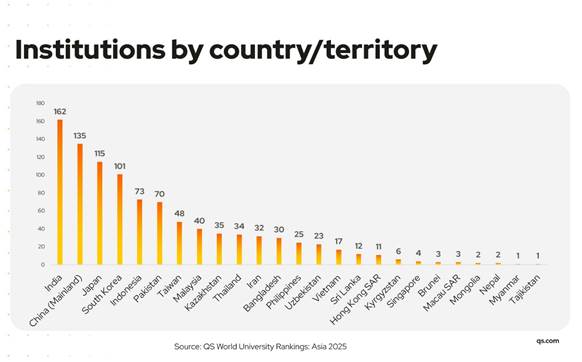
This ranking assesses 984 institutions covering 25 countries in Eastern, Southern, South-Eastern and Central Asia. The QS World University Rankings: Asia 2025 allows institutions and students to make direct comparisons on institutional performance within their region, with a more granular approach to metrics. Ranng

  1. India stands out with the highest number of institutes in the latest rankings, showcasing a diverse array of both emerging and well-established universities.
  2. The country dominates the top ten universities in Southern Asia, with seven institutions making the list.
  3. Top 50: India features two institutions — IIT Delhi (44th) and IIT Bombay (48th).
  4. Top 100: Five institutions, including IIT Madras (56), IIT Kharagpur (60), Indian Institute of Science (62), IIT Kanpur (67), and University of Delhi (81), showcase India’s robust academic standing.
  5. Top 150: Institutions such as IIT Guwahati, IIT Roorkee, Jawaharlal Nehru University, Chandigarh University (120), UPES (148), and Vellore Institute of Technology (150) highlight the depth of quality education.
  6. Indian Institute of Technology Delhi (IITD) has achieved the highest ranking for India, moving up to 44th place from 46th last year, with an impressive employer reputation score of 99%.
  7. Indian Institute of Technology Bombay (IITB) follows closely at 48th and boasts an employer reputation score of 99.5% and an academic reputation score of 96.6%.
  8. The University of Delhi has improved its ranking, moving up from 94th to 81st, achieving a high score of 96.4% in the International Research Network.
  9. Anna University achieved a perfect score of 100 in the Papers Per Faculty indicator, emphasizing high research output.
  10. 15 universities scored above 99% in the staff with PhD indicator, underscoring the high standard of education and teaching.
  11. North Eastern Hill University and University of Agricultural Sciences, Bangalore attained a perfect score of 100 in faculty-student indicator, demonstrating top-tier academic credibility.

The Indian education sector has made impressive strides, both globally and within Asia, as evidenced by the QS World University Rankings 2025. India earlier saw the inclusion of 46 institutions in the 2025 edition compared to just 11 in 2015 edition showcasing a 318 per cent increase in last 10 years among G20 nations. This growth underscores India’s commitment to fostering academic excellence and enhancing global competitiveness. India’s educational landscape shines as a model of growth and resilience at Asia level also with two institutions in the top 50 and seven in the top 100 in Southern Asia region. Led by the Indian Institute of Technology Delhi (IITD), ranked 44th, India showcases strengths in key areas such as “Papers per Faculty” and “Staff with PhD,” underlining its dedication to quality education and impactful research. This achievement emphasizes India’s ability to balance research productivity with high-caliber teaching, establishing it as a formidable competitor among global education powerhouses and solidifying its reputation as an emerging hub for higher learning in Asia.

For more detailed information on the QS World University Rankings, please visit:

References

Excel Table: https://www.topuniversities.com/asia-university-rankings?countries=in

Click here to download PDF

******

National Education Day 2024

National Education Day is celebrated on November 11 every year in honor of Maulana Abul Kalam Azad, the first Education Minister of independent India and a prominent educationist. This day highlights the importance of education in shaping India’s future. With 65% of the nation’s population under the age of 35, it is crucial to provide them with opportunities for quality education and skills development. The Government of India is dedicated to building strong education infrastructure that fosters the holistic development of students and empowers the youth to drive the nation towards progress.

Transforming India through Education

The Government of India has taken significant strides to promote access to education through various initiatives and constitutional provisions. The introduction of free primary education, reinforced by the 86th Amendment of the Constitution through Article 21-A, guarantees free and compulsory education for children aged six to fourteen as a Fundamental Right. The Rights to Education (RTE) Act, 2009, which came into effect on April 1, 2010, further supports this by ensuring that every child receives quality elementary education in a formal school that meets prescribed norms. These legal frameworks, backed by government schemes and initiatives, reflect India’s commitment to building an inclusive and equitable educational system for all.

NEP 2020: Under the dynamic leadership of Prime Minister Narendra Modi, the Union Cabinet of India approved the National Education Policy (NEP) 2020 on July 29, 2020. The NEP seeks to overhaul India’s education system to better align with the needs of the 21st century, fostering a more inclusive and forward-thinking approach.[3]

PM SHRI: Prime Minister Shri Narendra Modi approved the PM SHRI Schools (PM Schools for Rising India) scheme on 7th September 2022. The initiative aims to strengthen over 14,500 schools across India, showcasing the components of the National Education Policy 2020. The scheme will foster quality education, cognitive development, and 21st-century skills in students. With a total project cost of ₹27,360 crore, it will be implemented over five years (2022-2027), with a central share of ₹18,128 crore.[4]

Samagra Shiksha: Aligned with the NEP 2020 recommendations, Samagra Shiksha aims to provide quality education with an inclusive and equitable classroom environment for all children, addressing their diverse backgrounds and needs. The scheme, launched on April 1, 2021, will continue for five years, ending on March 31, 2026. It focuses on fostering active participation and enhancing academic abilities across various student groups.[5]

PRERNA: Launched its pilot phase from January 15, 2024, to February 17, 2024, at a vernacular school in Vadnagar, Gujarat. The initiative is a week-long residential program designed for selected students from class IX to XII. It aims to offer an experiential and inspirational learning experience, blending heritage with innovation through state-of-the-art technology. Each week, a batch of 20 students (10 boys and 10 girls) from across the country will participate in the program.[6]

ULLAS: Also known as Nav Bharat Saaksharta Karyakram (New India Literacy Programme – NILP), ULLAS was launched by the Government of India for the period FY 2022-2027. This centrally sponsored initiative aligns with the National Education Policy (NEP) 2020 and aims to empower adults aged 15 and above, especially those who missed out on formal schooling. The program seeks to enhance their literacy, enabling them to better integrate into society and actively contribute to the nation’s development.[7]

NIPUN Bharat: The National Initiative for Proficiency in Reading with Understanding and Numeracy (NIPUN Bharat) was launched by the Department of School Education & Literacy on 5th July 2021. The mission aims to ensure that every child in the country achieves foundational literacy and numeracy by the end of Grade 3, with a target completion by 2026-27.[8]

Vidya Pravesh: The VIDYA PRAVESH guidelines for the Three-month Play-based School Preparation Module for Grade-I children were released on 29th July 2021. The initiative aims to provide a warm and welcoming environment for children entering Grade-I, ensuring a smooth transition and fostering a positive learning experience.[9]

Vidyanjali: The School Volunteer Management Program, launched by Prime Minister Shri Narendra Modi on 7th September 2021, aims to enhance the quality of education in schools by fostering community involvement, and encouraging contributions from corporate social responsibility (CSR) initiatives and the private sector across the country.[10]

DIKSHA: It was launched on 5th September 2017 by Hon’ble Vice President of India, Shri M. Venkaiah Naidu. The platform aims to enhance teacher training and professional development by accelerating innovative solutions and experiments in education. DIKSHA empowers states and Teacher Education Institutes (TEIs) with the flexibility to customize the platform to meet their specific needs, benefiting teachers, teacher educators, and student teachers across the country.[11]

SWAYAM Plus: SWAYAM Plus, which was officially launched on 27th February 2024 by Shri Dharmendra Pradhan, Hon’ble Minister of Education. The initiative seeks to revolutionize higher education and improve employability by implementing an innovative credit recognition system for industry-relevant courses, emphasizing skill development, employability, and forging stronger industry partnerships.[12]

NISHTHA: The NISHTHA (National Initiative for School Heads’ and Teachers’ Holistic Advancement), launched by the Ministry of Education on 21st August 2019, aims to enhance the professional development of 42 lakh elementary teachers and school heads. In response to the COVID-19 pandemic, the program was transitioned to NISHTHA-Online on 6th October 2020, delivered through the DIKSHA platform. Building on this success, in 2021-22, NISHTHA 2.0 was launched for secondary school teachers, while NISHTHA 3.0, focusing on Foundational Literacy and Numeracy, was introduced on 7th September 2021.[13]

NIRF Ranking: The National Institutional Ranking Framework (NIRF), launched by the Ministry of Education on 29th September 2015, marked a pivotal step toward enhancing the quality and accessibility of higher education in India. NIRF introduced a structured and transparent system for assessing and ranking universities, colleges, and other institutions, fostering healthy competition and encouraging improvements in education and infrastructure.[14]

PM-Vidyalaxmi schemeThe Union Cabinet, led by Hon’ble PM Shri Narendra Modi, has approved the PM-Vidyalaxmi scheme to support meritorious students by providing financial assistance for quality higher education. This scheme offers education loans for students admitted to the top 860 institutions across India, benefiting over 22 lakh students each year. With a budget allocation of Rs. 3,600 crore from 2024-25 to 2030-31, the scheme aims to assist an additional 7 lakh students. Implemented through a fully digital, transparent, and student-centric platform, PM-Vidyalaxmi ensures easy access and smooth interoperability for students nationwide.[15]

Investing in Education for a Brighter Future[16]

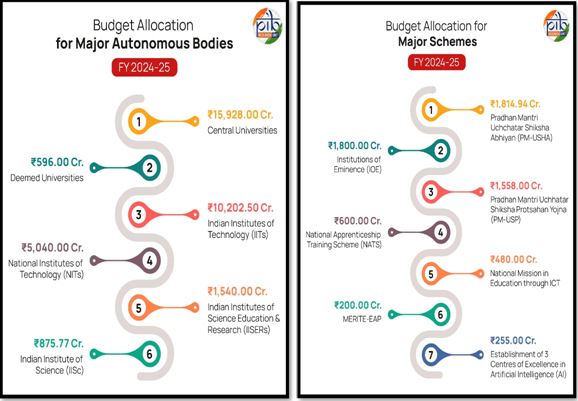
India’s path to global leadership is closely linked to the strength of its education system. To expand access to quality education and build a resilient learning environment, the Department of School Education & Literacy has been allocated a record ₹73,498 crore in the FY 2024-25 budget. This represents a substantial increase of ₹12,024 crore (19.56%) over the Revised Estimate for FY 2023-24, highlighting the government’s commitment to bolstering the education sector.

Notably, the highest-ever allocations have been made to key autonomous bodies, with ₹ 9,302 crore allocated to Kendriya Vidyalayas (KVS) and ₹ 5,800 crore to Navodaya Vidyalayas (NVS). This substantial investment reflects a clear intent to further elevate India’s education system.

For FY 2024-25, the Department of Higher Education’s budget allocation is set at Rs. 47,619.77 crore, with Rs. 7,487.87 crore dedicated to schemes and Rs. 40,131.90 crore for non-scheme expenses. This reflects a significant increase of Rs. 3,525.15 crore, or 7.99%, over the previous fiscal year. Notably, the allocation for specific schemes has risen by Rs. 1,139.99 crore, underscoring a strengthened focus on targeted initiatives within higher education.

image7.png

Increase in Enrolment in Higher Education Institutions: AISHE Report 2021-22[17]

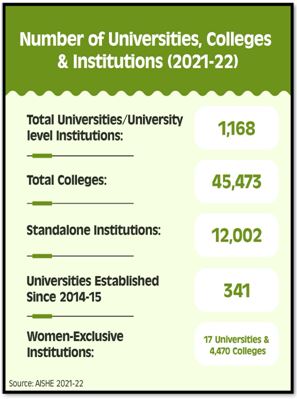
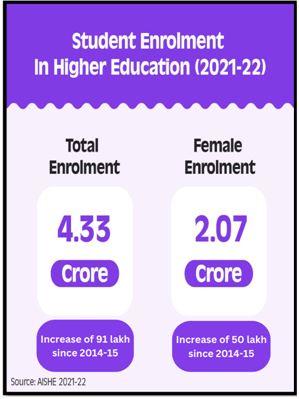
The Ministry of Education, Government of India, released the All India Survey on Higher Education (AISHE) 2021-2022 in January 2024. Since its inception in 2011, AISHE has been collecting comprehensive data from all registered Higher Educational Institutions (HEIs) across the country, covering key parameters such as student enrolment, faculty, and infrastructure. The survey highlights significant improvements over the years, reflecting the positive advancements in India’s education sector, with increased enrolment, enhanced inclusivity, and stronger infrastructure, contributing to a more robust and dynamic higher education system.

Female enrolment has also shown remarkable growth, rising from 1.57 crore in 2014-15 to 2.07 crore in 2021-22, an increase of 32%. The enrolment of students from disadvantaged groups, including SC, ST, OBC, and minorities, has grown significantly, with notable increases in female enrolment across all categories. In 2021-22, the Gender Parity Index (GPI) reached 1.01, reflecting a consistent trend of more female students enroling in higher education than males.

imagea.png

In terms of fields of study, enrolment in STEM disciplines has seen a steady rise, with 98.5 lakh students enroled in UG, PG, and Ph.D. levels in 2021-22. Despite challenges, women are leading in disciplines such as Medical Science, Social Science, and Arts. The dropout rate at the secondary level has also decreased significantly from 21% in 2013-14 to 13% in 2021-22.

In FY 2024-25, the Department of Higher Education saw a budget increase of ₹3,525.15 crore (7.99%) compared to FY 2023-24, underlining the government’s commitment to further strengthening the higher education sector and supporting inclusive growth.

Conclusion

Education holds the power to break barriers, open doors of opportunity, and empower individuals to contribute meaningfully to society. India’s educational landscape has evolved significantly, building a robust system through continuous innovation and comprehensive reforms. By embracing a holistic, 360-degree approach that integrates new ideas, technologies, and teaching methods, India is creating an environment where youth can thrive, transforming them into key assets for the nation’s growth. As we honor the legacy of Maulana Abul Kalam Azad, let us reaffirm our commitment to education as the cornerstone of a brighter, more inclusive future for all.

Reference

Click here to see in PDF:

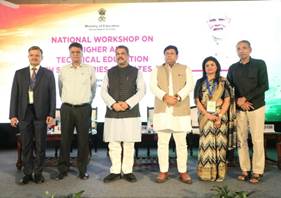
National Workshop on Higher and Technical Education with Secretaries of States/UTs

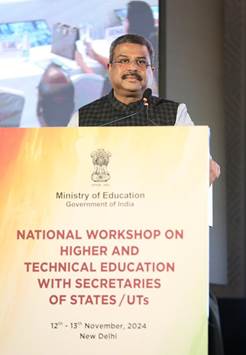
Union Minister for Education, Shri Dharmendra Pradhan, inaugurated a two-day National Workshop on Higher and Technical Education with Secretaries of States/UTs in New Delhi today. Minister of State for Education and the Development of North Eastern Region, Dr. Sukanta Majumdar, was also present at the event. Secretary, Department of Higher Education, Shri K. Sanjay Murthy; Additional Secretary, Department of Higher Education, Shri Sunil Kumar Barnwal; Chairman, UGC, Prof. M. Jagadesh Kumar; Joint Secretary, Department of Higher Education, Smt. Manmohan Kaur; Secretaries of States/UTs, academicians, Head of the Institutes, and officials of the Ministry were also present.

Image

While addressing the event Shri Pradhan said that the workshop will serve as a platform for rigorous academic brainstorming, particularly how education can bring substantive improvements in furthering ease of living, enhancing per capita income and achieving national priorities set by Prime Minister Shri Narendra Modi. He also said that the country has to become a producing economy by utilising the opportunities presented by Industry 4.0 and leapfrog and develop the education infrastructure that surpasses global standards. Education infrastructure is a multi-dimensional concept and beyond just developing brick-and-mortar structures, he added.

Image

The Minister suggested five key areas for the academic leaders and administrators to focus on. These were strengthening public universities through innovative modes of funding; setting up think tanks for aligning and tailoring curriculum as per the demand of industry and also as per the needs and aspirations of states/UTs; adopting a multidisciplinary approach to research and innovation for assuming leadership in solving global problems; promoting Academic Leadership Development Programmes in each state/UT through collaborations with eminent central/state institutions; and reviving vibrancy of campus life through sports, debate, poetry, drama, performing arts (already creditized through NEP) and giving primacy to these non-scholastic areas.

Shri Pradhan also emphasised the importance of teaching in Indian languages. Stressing the accountability towards the students of the country, he said everyone will have to work together to establish India’s global leadership in education.

Dr. Sukanta Majumdar, in his address, expressed his gratitude to Prime Minister Shri Narendra Modi for his vision to reshape India’s educational landscape through the National Education Policy (NEP) 2020. NEP is not just a policy; it is a roadmap to make India a global knowledge superpower, he added. Highlighting the five pillars of NEP 2020, which are access, equity, quality, affordability, and accountability, Dr. Majumdar said that these are the foundation for a modern, inclusive, and globally competitive education system. He urged the states and UTs to adopt NEP 2020 in both its letter and spirit. By implementing the policy, states can foster economic growth, build a skilled workforce, and enhance innovation and technological advancement, he said.

Shri K. Sanjay Murthy, in his address, set the context for the workshop. He briefly described the 14 technical sessions that would be held during the event. He also highlighted the key factors that emerged from serious deliberations over the past three years and mentioned that twenty guidelines have been developed, providing a framework for the universities. Additionally, he expressed his gratitude to Shri Dharmendra Pradhan for spearheading the implementation of NEP 2020 and for offering valuable guidance through his insights.

The objective of this workshop is to disseminate various approaches and methodologies to implement NEP 2020; effectively articulate the roadmap and implementation strategies, fostering knowledge exchange; provide a common platform for all stakeholders to come together and network for effective and smooth implementation of the NEP 2020 and encourage its adoption in state institutions, paving the way for a more robust, inclusive, and globally competitive education system across India.

Adopting NEP 2020 offers numerous benefits for states’ higher education systems. It can drive economic growth by creating a more skilled workforce, attracting investments, and boosting development. By aligning higher education with international standards, it enhances the global competitiveness of states’ education systems, potentially attracting more international students and collaborations. The policy’s emphasis on research and a multidisciplinary approach fosters innovation ecosystems within states, leading to technological advancements and economic benefits.

Successful implementation of NEP 2020 in higher education requires active participation and commitment from state governments. By leveraging central government schemes and aligning state policies with NEP 2020, states have the opportunity to transform their education systems to meet the challenges of the 21st century while preserving their unique cultural identities.

During this two-day workshop, 14 technical sessions on the themes of NEP 2020 Implementation – Challenges and Roadmap; Technology in Education; Collaboration in Education; Digital Governance; Capacity Building & Leadership; and Financing of Higher Education are going to be held by eminent panellists.

*****

Johns Hopkins University and Gupta-Klinsky India Institute

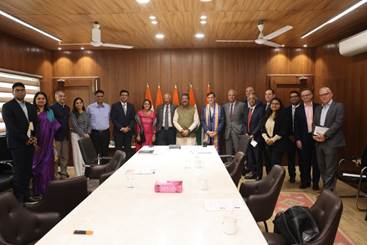
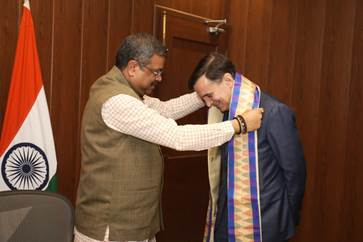
Union Minister for Education Shri Dharmendra Pradhan today met with a high-level delegation led by Mr. Ronald J. Daniels, President, Johns Hopkins University (JHU), Baltimore, Maryland, USA. The delegation also included officials from Gupta Klinsky India Institute (GKII), an internal unit of JHU with a mandate to bring the JHU community with Indian partners through research, education, policy and practice.

Secretary, Higher Education, Shri K. Sanjay Murthy; senior officials of the Department of Higher Education, Ministry of Education and Ministry of External Affairs attended the meeting.

Image

Shri Pradhan highlighted the transformative opportunities enabled by the National Education Policy 2020 (NEP 2020), which has paved the way for academic collaborations and advancing India’s education sector. Shri Pradhan appreciated the university’s commitment towards building robust partnerships with Indian HEIs, contributing to the global exchange of knowledge, particularly in the areas of dual and joint degree programmes, two-way mobility of students and faculty, and research partnerships in emerging fields like data science, artificial intelligence, and futuristic technologies. He emphasised the potential for these collaborations to foster innovation and entrepreneurship among students in both nations.

The discussion centred on strengthening academic and research collaborations between JHU and premier Indian Higher Education Institutions (HEIs). The delegation actively discussed establishing an offshore JHU campus in India.

Image

The visit by Mr. Daniels and the delegation highlights the growing significance of India-US educational cooperation. As part of their multi-city tour of India, the delegation will visit various Indian university campuses and engage with key government officials, academic leaders, and embassy representatives to strengthen JHU’s operations in India and advance the internationalisation efforts.

The 12-member delegation included distinguished academicians and administrators such as Fritz W. Schroeder, Senior Vice President for Development and Alumni Relations; Alexander Triantis, Dean of the Carey Business School; Judd Walson, Chair of the Department of International Health at the Bloomberg School; Sridevi Sarma, Vice Dean of Graduate Education at the Whiting School of Engineering; Jon Goldstein, Senior Associate Director of Development for International Programs; and Amita Gupta, Director of the Division of Infectious Diseases at Johns Hopkins University and Co-Founder of the Gupta-Klinsky India Institute (GKII).

Prominent Indian-origin faculty from JHU, such as Mathuram Santosham, Professor of Paediatrics and International Health, and Chirag Parikh, Professor of Medicine and Director of the Division of Nephrology, also participated. The delegation further included GKII officials and members of its advisory board, including Raj and Kamla Gupta, Deepak Raj, Kunal Pal, and Neetisha Besra.

*****

All India Institute of Ayurveda (AIIA) organises orientation Program ‘Samskara 2024’ for freshly inducted Post Graduates

Daily writing prompt
Who are your current most favorite people?

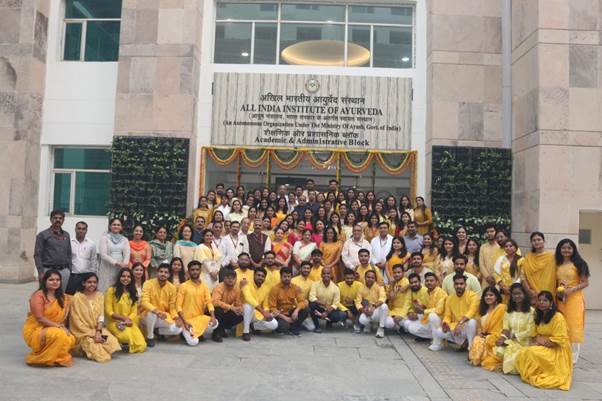
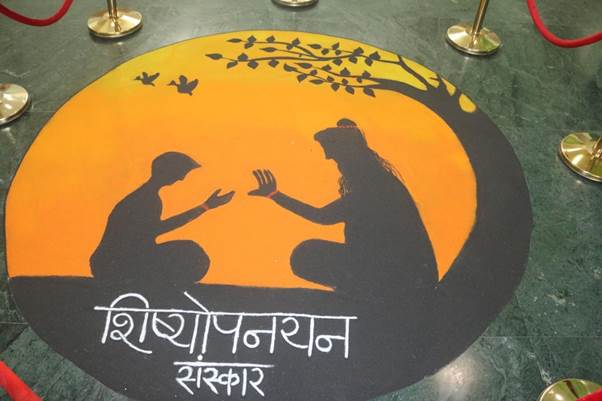
All India Institute of Ayurveda (AIIA) welcomed its 9th batch of postgraduate scholars with a traditional orientation program, ‘Samskara 2024’. The 15-day program commenced with a swearing-in ceremony, where 85 newly admitted students took the Shishyopanayan Pledge.

Prof. (Dr.) Tanuja Manoj Nesari, former Director of AIIA, was the chief guest, while Prof. (Dr.) Sujata Kadam, Director (I/C), AIIA, presided over the event. Other dignitaries who graced the occasion  included Dean PhD Prof. (Dr.) Mahesh Vyas, Dean PG Prof. (Dr.) Yogesh Badwe, Advisor Academic Activities Prof. (Dr.) Anand More, and other faculty members.

Addressing the gathering, Chief Guest Prof. (Dr.) Tanuja Manoj Nesari extended her best wishes to the new students, saying, “I expect this batch to create history in the future.” She emphasised AIIA’s unique selling proposition (USP)—valuing exceptional education and transformative journeys.

AIIA Director (I/C) Prof. (Dr.) Sujata Kadam encouraged students, saying, “Just as gold is refined through numerous tests, these three years will transform you into refined gold, making your journey extraordinary. I expect you to emerge as the best students from this institution.”

The 9th batch consists of 85 students selected from across India who cleared the All India AYUSH Postgraduate Entrance Test (AIAPGET) conducted by the National Commission for Indian System of Medicine (NCISM) under the Ministry of Ayush, Government of India.

Established in 2017, AIIA has treated over 27 lakh patients and attends to more than 2000 patients daily.

****

IIT Ropar’s Role in Shaping a Self-Reliant Bharat Highlighted at VIVIBHA 2024

Daily writing prompt
Do you or your family make any special dishes for the holidays?

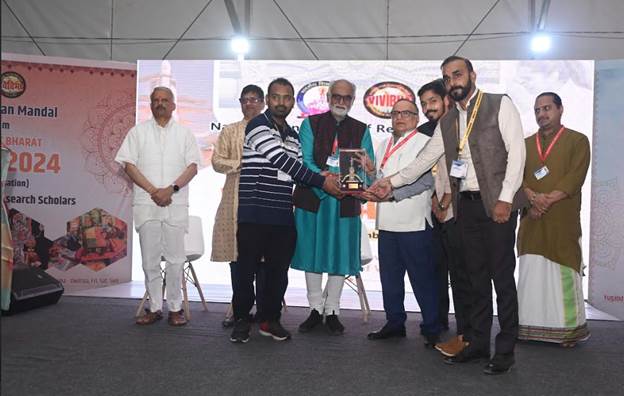
IIT Ropar proudly participated in VIVIBHA 2024, a distinguished three-day national conference organized by Bharatiya Shikshan Mandal (BSM) at SGT University, Gurugram. Themed “Vision for Viksit Bharat,” the event celebrated India’s rich cultural legacy while highlighting pioneering research and innovations that are shaping a self-sustaining nation.

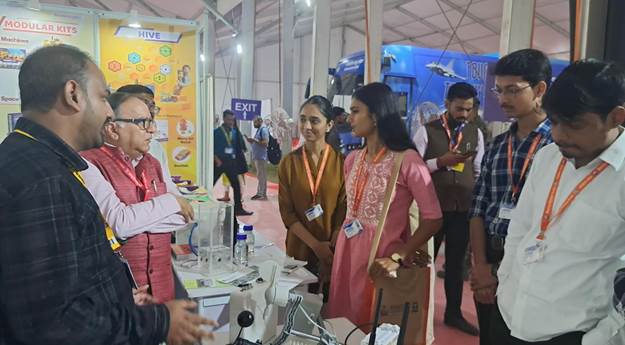
The IIT Ropar TIF – AWaDH stall garnered considerable attention, particularly from Shri Dharmendra Pradhan, Union Minister of Education, who interacted with the team to explore the showcased innovations. Prof. Rajeev Ahuja, Director of IIT Ropar, also extended his support. In a significant achievement, AWaDH was awarded the Best Stall in the Academia category, recognizing the excellence and societal impact of its presented research.

As part of the “Research to Realisation” exhibition, the IIT Ropar Technology and Innovation Foundation – AWaDH Agriculture and Water Technology Development Hub showcased its transformative technologies that promote sustainable solutions in agriculture, water management, and environmental conservation. Key innovations on display included Moohsense: An AI-driven livestock management system; Digital Entomologist: A biodiversity monitoring tool; Nanobubble Technology for Water Purification; Air Sense: Advanced air quality sensors, and Soil Health Monitoring System: Precision farming tools for improved productivity.

VIVIBHA 2024’s focus on integrating Bharat-centric research with India’s vibrant cultural heritage closely aligns with AWaDH’s mission. The event reaffirmed the commitment to bridging tradition with cutting-edge technologies for a sustainable and prosperous future.

***

Top Ten Exams after 10th Passing

Daily writing prompt
Your life without a computer: what does it look like?

After completing 10th grade, students have a variety of options to consider for further education and career paths. Here are the top ten exams and streams that students can pursue after 10th:

Photo by George Dolgikh on Pexels.com

1. Class 11 Board Exams (Science, Commerce, Arts)

  • Overview: Students can choose to enroll in Science, Commerce, or Arts streams. The choice largely depends on their interests and career aspirations.
  • Key Focus: Subjects vary by stream, with Science focusing on Physics, Chemistry, and Mathematics, Commerce on Business Studies and Accountancy, and Arts on subjects like History and Psychology.

2. National Institute of Open Schooling (NIOS)

  • Overview: NIOS offers a flexible education system where students can complete their secondary education through open schooling.
  • Key Focus: It is suitable for students who prefer self-paced learning or need to balance other commitments.

3. Diploma Courses

  • Overview: Various technical and vocational diploma courses are available, including Engineering, Hotel Management, and Nursing.
  • Key Focus: These courses provide practical knowledge and skills for specific industries, often requiring an entrance exam.

4. ITI (Industrial Training Institute)

  • Overview: ITI courses focus on technical skills in fields such as electrician, plumbing, and welding.
  • Key Focus: Students learn specific trades, enhancing employability in skilled labor sectors.

5. Joint Entrance Examination (JEE)

  • Overview: JEE is a national-level exam for admission into engineering programs in prestigious institutions like IITs and NITs.
  • Key Focus: It tests students on Physics, Chemistry, and Mathematics.

6. National Eligibility cum Entrance Test (NEET)

  • Overview: NEET is the entrance exam for students aiming to pursue undergraduate medical courses (MBBS, BDS).
  • Key Focus: The exam assesses knowledge in Biology, Chemistry, and Physics.

7. Common Entrance Test (CET)

  • Overview: Various states in India conduct CETs for admission into professional courses, including engineering and medical programs.
  • Key Focus: Depending on the state, the CET may cover subjects like Mathematics and Science.

8. Commerce Stream Entrance Exams

  • Overview: For students interested in pursuing Commerce, exams for BBA (Bachelor of Business Administration) programs are available.
  • Key Focus: These exams often assess aptitude in Mathematics, English, and Logical Reasoning.

9. Creative Arts Entrance Exams

  • Overview: Students interested in pursuing Fine Arts, Design, or Performing Arts can take entrance exams specific to these fields.
  • Key Focus: Exams may include practical assessments, portfolios, and interviews.

10. Foreign Language and Vocational Courses

  • Overview: Students can opt for foreign language courses or vocational training that offer specialized skills.
  • Key Focus: These courses enhance language proficiency or provide practical skills for various careers.

Conclusion

Choosing the right path after 10th grade is crucial for a student’s future. It’s important to assess personal interests, strengths, and career goals when considering these options. Each of these exams and courses opens different avenues for higher education and career opportunities.

Workshop on Institutional Development Plan for Higher Education Institutes and releases UGC Compendium of Regulations (1957-2023)

Daily writing prompt
What details of your life could you pay more attention to?

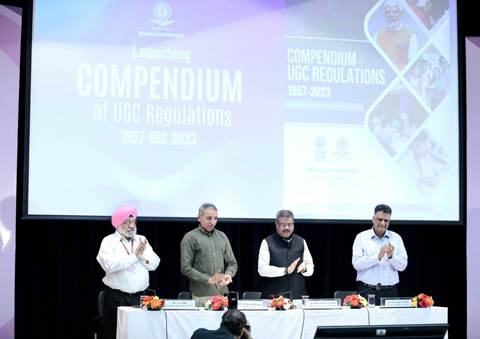
Union Minister for Education, Shri Dharmendra Pradhan, inaugurated a one-day workshop on the Institutional Development Plan for Higher Education Institutes. He also released the UGC Compendium of Regulations (1957-2023) as a single, accessible & reliable source of all UGC rules. Shri Sanjay Murthy, Secretary, Department of Higher Education, Ministry of Education; Dr. N.S. Kalsi, Former Chairman, NCVET and Chairman of the Committee working on formulating the IDP Guidelines; Shri M. Jagadesh Kumar, Chairman, UGC; Vice-Chancellors, Nodal Officers, and other dignitaries were also present at the event.

Shri Dharmendra Pradhan, while addressing the audience said the Higher education Institutes of the country will play a crucial role in realising the vision of Prime Minister Shri Narendra Modi of Viksit Bharat by embracing the core values and spirit of NEP 2020.

Image

He also talked about the role of the HEIs in redefining the purpose and structure of education, empowering youth and making them future-ready, doubling the gross enrolment ratio, bringing a vast majority of the population under the higher education net, effectively utilising demographic advantage, achieving academic, research & innovation excellence and also the way forward for transforming 5000 HEIs into centres-of-excellence through holistic and inclusive approaches.

Shri Pradhan also said that education will propel India from being a consuming economy to becoming a producing economy. The institutional development plan should focus on enhancing the competencies of our vast demography, facilitating learner-centric and multidisciplinary education, integrating Bharatiya Bhasha in higher learning, prioritising innovation, entrepreneurship and job-creation as an outcome, capacity building of teachers and achieving the global standard of research & development, he added.

He also said that education must address 21st-century aspirations and create solutions for local and global challenges. The world looks at India’s talent pool for new models and solutions to challenges of our age, he stated He exhorted the academic fraternity to work in a focused and time-bound manner to reinvent their institutions, transforming the higher educational landscape and achieving national priorities.

Speaking on the relevance and importance of the workshop Shri K. Sanjay Murthy elaborated on the ambitious plan the Ministry of Education had presented to the Prime Minister as part of the social group with the vision for the next twenty-five years. Talent and competency would be needed to back up the tremendous work that would take place and the institutions must rise to the demand to meet the talent requirements, he added. He also emphasized the Future of Work and that the IDP must focus on enhancing the quality of the institutes. Introduction of the IDP will also help the institutes to be at par with the universities of the world, he said.

About the Workshop:

The workshop on Institutional Development Plan (IDP) brings together higher education institutions to discuss strategies for institutional growth and development. The compendium will serve as a valuable resource for institutions as they develop and implement their IDP. Over 170 representatives from HEIs across India are participating in this workshop. Aligning with the National Education Policy (NEP) 2020, the IDP provides institutions with a clear roadmap to develop their vision, mission and goals for a future-ready education system.

Through the two thematic sessions, the participants will have the opportunity to learn about governance enablers, financial planning and management, human resources and supportive-facilitative enablers, networking and collaboration enablers, physical enablers, digital enablers, and research and intellectual property enablers, innovative funding models, and curriculum development. Renowned experts from industry, academia, and government will share their insights and experiences on these critical areas.

In each session, different universities will share their best practices for creating their IDP. In a separate Q&A session, Chairman UGC, Former Chairman, NCVET and the speakers from the Panels will address the queries of the participants.

About UGC Compendium:

To provide a single source of reference to all the stakeholders, UGC has prepared a Compendium of all UGC Regulations, Rules and Notifications from 1957-2023. The compendium includes 15 Rules, 87 Regulations, and 28 Notifications covering a wide range of topics, including inspection, the fitness of institutions for grants, return of information, budget and accounts, establishments, affiliation, autonomy, accreditation, admission & fees, specification of degrees, and other miscellaneous matters. The compendium provides a one-stop reference for all regulatory requirements, ensuring that institutions can easily access and comply with UGC guidelines. This is expected to streamline operations and support informed decision-making, creating an environment of compliance and best practices. This compendium having more than 1100 pages, is available in the form of a PDF and e-book on the UGC website.

About IDP:

Institutional Development Plan (IDP) Guidelines were launched by UGC on 6th February 2024. The IDP Guidelines will help institutions make a strategic Institutional Development Plan with the joint participation of Board members, institutional leaders, faculty, students and staff based on which institutions will develop initiatives, assess their progress, and reach the goals set therein.

Visit: https://www.ugc.gov.in/pdfnews/1713699_IDP-Guidelines.pdf

*****

Samagra Shiksha Scheme has been aligned with the recommendations of the National Education Policy

 Samagra Shiksha

The Centrally sponsored scheme of Samagra Shiksha of the Department of School Education and Literacy is an overarching programme for the school education sector extending from pre-school to class XII. The scheme treats school education as a continuum and is in accordance with Sustainable Development Goal for Education (SDG-4). The Samagra Shiksha Scheme has been aligned with the recommendations of the National Education Policy: 2020 (NEP: 2020) and extended from 2021-22 to 2025-26. 


Cabinet Committee on Economic Affairs has approved continuation of Samagra Shiksha Scheme for a period of five years i.e., from 2021-22 to 2025-26 with a total financial outlay of Rs 2,94,283.04 crores which includes Central share of Rs 1,85,398.32 crores, as per EFC recommendations and approval of revised programmatic and financial norms.


ICT and smart class approvals: Under the Information & Communication Technology (ICT) component of the Samagra Shiksha Scheme, there is a provision to impart computer literacy and computer-enabled learning to children, by developing and deploying curriculum-based interactive multimedia, digital books, virtual labs etc. across the country. It supports the establishment of smart classrooms, and ICT labs in schools, including support for hardware, educational software and e-content for teaching. It envisages covering all Government/Government-aided schools with classes VI to XII. Till November 2022 (since inception), ICT Labs have been approved in 1,20,614 schools and Smart classrooms in 82,120 schools across the country.


Brief of activities undertaken from 1st January, 2022 to 31st December, 2022 is as under:

  1. Shiksha Shabdkosh – Department of School Education & Literacy has brought out Shiksha Shabdkosh, a document on glossary of various terminologies in School Education and a compilation of all the terms which have been used in the context of school education.
  2. Samagra Shiksha Framework for Implementation – Department of School Education & Literacy has issued a Samagra Shiksha Framework, which gives the Key Performance Indicators (KPI) for each component and physical and financial details of implementation of each component of Samagra Shiksha.
  3. 444531 Schools have awarded Fit India Flag, and 43074 Schools have applied for 3 Stars Rating and 13008 Schools have applied for 5 Stars rating.
  4. 4th FIT India School Week is being celebrated from 15th November 2022 till 15th January 2023. Till 19th December 2022, total 1,17,844 students participated in various activities.
  5. FIT INDIA Quiz 2022 for schools has been launched by FIT India Team. In this 1,74,473 students registered from 42,490 schools across 36 States/UTs in 2022.
  6. A Virtual event on Assistive Technology Innovations for Inclusive Education as a part of Azadi Ka Amrit Mahotsav (AKAM): As a part of Azadi Ka Amrit Mahotsav (AKAM), Department of School Education & Literacy, Ministry of Education, in collaboration with Atal Innovation Mission, NITI Aayog organized a virtual event on Assistive Technology startups for Inclusive Education showcasing innovations and startup solutions on January 17, 2022. The virtual event on ‘Assistive Technology Innovations for Inclusive Education’ focused on start-ups and their innovations that enhance or aid the learning of children with special needs.
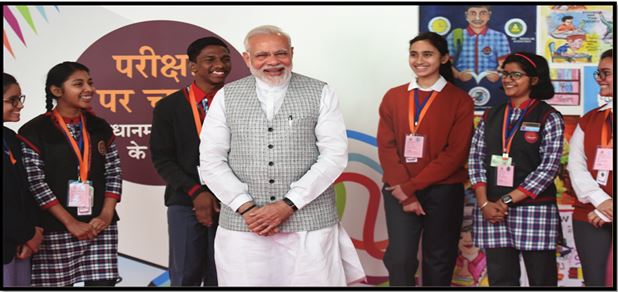
  7. Fifth edition of Pariksha Pe Charcha, the unique interactive program of Hon’ble Prime Minister, Shri Narendra Modi with students, teachers and parents was held successfully on 1st April 2022 at Talkatora Stadium. Selection for this program was carried out through a creative writing competition for the students of classes 9 to 12, teachers and parents on MyGov.in portal from 28th December, 2021 to 3rd February, 2022.


PRASHAST Mobile App – “Pre Assessment Holistic Screening Tool”:


Department of School Education & Literacy has launched a Disabilities Screening Checklist for Schools and an Android Mobile App titled as PRASHAST Mobile App – “Pre Assessment Holistic Screening Tool” for schools during Shikshak Parv, 2022. PRASHAST App will help in screening 21 disability conditions recognized in RPwD Act, 2016, at the school level and will generate the school-wise report, for further sharing with the authorities for initiating the certification process, as per guidelines of Samagra Shiksha. PRASHAST Mobile App has been developed by CIET, NCERT.


Amendment in RTE Act, 2009 w.r.t. pupil teacher ratio for special educators in general schools:


The schedule to RTE Act, 2009 has been amended regarding pupil teacher ratio for special educators in general schools i.e. one special education teacher for every ten pupils with disabilities enrolled at primary level and one special education teacher for every fifteen pupils with disabilities enrolled at upper primary level and a notification has been published in Gazette of India vide Notification No. S.O. 4586 (E) dated 21.09.2022 (published on 29.09.2022).


Exam Accommodations to CwSN in Board Exams:

Virtual Inclusive Education Meets were organized by DoSEL on 31.01.2022 and 09.06.2022 with the IE coordinators of all states and UTs to review the status of Board Accommodations offered to CwSN. As information received from States/UTs, 32 out of 36 States/UTs have notified the exam accommodations provided to CWSN to be availed in Board Exams, 20 out of 36 States/UTs prepared Audio/ Video films on Exam Accommodations provided to CWSN in Board Exams and 27 out of 36 States/UTs conducted webinars to sensitize teachers/ principals on Exam Accommodations.


Up-gradation of Kasturba Gandhi Balika Vidvalavas (KGBVs):


KGBVs are residential schools under Samagra Shiksha, for girls from class VI to XII belonging to disadvantaged groups such as SC, ST, OBC, Minority and Below Poverty Line (BPL). Under Samagra Shiksha, provision has been made to upgrade/converge the existing KGBVs at upper primary level and Girls’ Hostels at secondary/senior secondary level, as feasible, up to Senior Secondary Level. The task of up-gradation of the KGBVs was started in the year 2018-19 and till the year 2022-23,a total of 357 KGBVs have been approved for up-gradation to Type-II (class 6-10) and 2010 KGBVs have been approved for up-gradation to Type-III (class 6-12).


PARAKH


NEP 2020 envisages a shift from summative assessment to regular and formative assessment, which is more competency-based, promotes learning and development, and tests higher-order skills, such as analysis, critical thinking, and conceptual clarity. In view of implementation of NEP 2020, a new National Assessment Centre, PARAKH (Performance Assessment, Review, and Analysis of Knowledge for Holistic Development) will be setup as a standard-setting body under Ministry of Education in NCERT. This centre will work for setting norms, standards, and guidelines for student assessment and evaluation for all recognized school boards of India, hand holding the States and undertaking the National Achievement Survey (NAS). This Centre will also advise school boards regarding new assessment patterns and latest researches, promoting collaborations between school boards. It will encourage and assist school boards to shift their assessment patterns towards meeting the skill requirements of the 21st century. PARAKH will be established as a technical organisation with knowledge of assessment standards and skills, as well as a robust understanding of policymaking and implementation.


National Achievement Survey (NAS) 2021:


The Government of India has been implementing a programme of sample based National Achievement Survey (NAS) aimed at classes III, V, VIII and X with a cycle period of three years. The NAS 2021 was held on 12.11.2021 and has covered (a) Government Schools (Central Government and State Government); (b) Government Aided Schools; and (c) Private Unaided Schools. Subjects covered are Language, Mathematics & EVS for class 3 & 5; Language, Mathematics, Science & Social Science for class 8 and Language, Mathematics, Science, Social Science and English for class 10. 


About 34,01,158 students of 1.18 lakh schools from both rural and urban areas, have appeared in NAS 2021 which was held on 12th  November, 2021. National, State/UT and District Reports for NAS 2021 have been released on 25.5.2022 and are available at http://nas.gov.in. The learning gaps identified at the district level will be used to provide feedback to the districts.


Further, a national level workshop on Post-NAS 21 interventions was organised on 28/07/2022 by Ministry of Education with representatives of all States/UTs, SCERTs, DIETS and NCERT. The purpose is to support State/UT governments in developing long term, mid-term and short-term interventions to improve learning levels and orient on differential planning based on NAS 2021 data. In addition, NCERT has conducted Post-NAS 21 regional workshops at many locations across the country. The purpose is to disseminate the findings of reports and assist states/UTs in planning strategies to bridge identified learning gaps as per NAS 21 data.


Actions initiated by the Department for implementation of NATIONAL EDUCATION POLICY (NEP):


  • NEP Implementation Plan ‘SARTHAQ’ (Students’ and Teachers’ Holistic Advancement through Quality Education) has been released on 8th April, 2021.
  • A National Foundational Literacy and Numeracy Mission named as ‘National Initiative for Proficiency in Reading with Understanding and Numeracy – (NIPUN BHARAT) was launched on 5th July 2021, for ensuring that every child in the country necessarily attains foundational literacy and numeracy in Grade 3 by 2026-27.
  • NCERT has developed a 3 Months Play Based ‘School Preparation Module’ named ‘Vidya Pravesh’ which was launched on 29thJuly 2021.
  • Foundational Learning Study (FLS) to assess the learning level of Class 3 students in Foundational Literacy and Numeracy was administered by MoE and NCERT in collaboration with States/UTs from 23rd to 26th March and 4th  to 6th  April, 2022 across all Indian States and Union Territories under the NIPUN-BHARAT Mission. The results for FLS were published on 06th September 2022 in the form of national, state and district reports. The reports can be accessed at: https://dsel.education.gov.in/fls_2022 .
  • To connect the Government and Government aided schools through a community/volunteer management program, the Department has revamped the Vidyanjali web portal. The newly introduced portal – Vidyanjali 2.0 aims to help the community/volunteers interact and connect directly with schools of their choice to share their knowledge and skills as well as contribute in the form of assets/material/equipment. 
  • The department has aligned our existing schemes i.e, Samagra Shiksha and Mid Day Meal with the recommendation of NEP 2020.
  • NISHTHA 4.0 (ECCE) – Online: Teacher training programme for Early Childhood Care and Education has been launched on 06th September, 2022 with 6 modules. Initiated in 36 States/UTs in 2 languages, and in 5 Autonomous Organisation under MoE, MOD &MOTA. It targets to train 25 Lakh teachers and school heads at pre-primary and primary level.


PM Schools for Rising India (PM SHRI) :


The Cabinet has been approved a newly central sponsored scheme called PM SHRI on 7 September, 2022. These schools will showcase the implementation of the National Education Policy 2020 and emerge as exemplar schools over a period of time, and also offer leadership to other schools in the neighborhood. They will provide leadership in their respective regions in providing high-quality education in an equitable, inclusive and joyful school environment that takes care of the diverse background, multilingual needs, and different academic abilities of children and makes them active participants in their own learning process as per the vision of NEP 2020.


Under the scheme there is provision of setting up of More than 14500 PM SHRI Schools (PM ScHools for Rising India) by strengthening the existing schools from amongst schools managed by Central government/State/UT Government/local bodies.


The duration of scheme is proposed to be from 2022-23 to 2026-27; after which it shall be the responsibility of the States/UTs to continue to maintain the benchmarks achieved by these schools. More than 20 lakh students are expected to be direct beneficiaries of the scheme. The total cost of the project will be Rs.27360 crore spread over a period of 5 years which includes central share of Rs.18128 crore.

PM POSHAN Scheme

The Cabinet Committee on Economic Affairs (CCEA) has approved the continuation of PM POSHAN Scheme in Schools for the five-year period 2021-22 to 2025-26 with the financial outlay of central share of Rs.54,061.73 crore for five years from 2021-22 to 2025-26. During 2022-23 the scheme covers more than 12 crore children studying in Bal Vatika and classes I-VIII in Govt. and Govt. Aided Schools.

During 2022-23 (upto December 2022), Rs 6758.84 crore had been released to States and UTs as central assistance and 29.68 lakh MT foodgrains had been allocated to them. 

PM POSHAN Scheme Guidelines have been comprehensively revised and several focus areas such as Public Financial Management System, Quality and Safety Aspects, Social Audit, Joint Review Mission, School Nutrition Gardens, Cooking Competitions, TithiBhojan, Supplementary Nutrition in Aspirational districts and districts having high burden of malnutrition, Information, Education and Communication (IEC) etc.

Material cost (earlier known as cooking cost), which includes cost of procurement of pulses, vegetables, oil, condiments and fuel has been enhanced to Rs 5.45 per child per day in primary and Rs 8.17 per child per day in upper primary w.e.f. 1st October, 2022. 

DoSE&L has decided to set up School Nutrition (Kitchen) Gardens (SNGs) and planting in an immense way. School Nutrition (kitchen) Gardens (SNGs) utilizes the schoolyard to reconnect the students to a natural world and make them aware about the true source of their food and teach them valuable gardening, agriculture concepts and skills that integrate with several subjects such as math, science, art, health and physical education and social studies etc. The vegetables and fruits grown in these kitchen gardens are being used in the preparation of hot cooked meals. This offers an opportunity for students to eat freshly grown vegetables loaded with vitamins and minerals which are essential source of their physical and mental growth & development.


Adult Education


New India Literacy Programme (NILP): Keeping in view the recommendations of NEP, 2020 and UNESCO Sustainable Development Goal (SDG) 4.6, a centrally sponsored scheme“New India Literacy Programme”(NILP)has been approved by the Government of India in this year with financial outlay of Rs.1037.90 crore (central share: Rs.700.00crore and state share: Rs.337.90 crore) for the financial years 2022-23 to 2026-27. A D.O. letter dated 21.02.2022 from Secretary (SE&L) was issued to all Chief Secretaries of all States/UTs in respect of launching NILP. The scheme has five components: (i) Foundational Literacy and Numeracy, (ii) Critical Life Skills, (iii) Vocational Skills Development, (iv) Basic Education and (v) Continuing Education. The target for Foundational Literacy and Numeracy for FYs 2022-27 is 5.00 crore learners @ 1.00 crore per year by using “Online Teaching, Learning and Assessment System (OTLAS)” in which a learner may register him/herself with essential information.


The NILP provides for (i) involvement of school students, pre-service students of Higher Education Institutions (HEIs), school teachers, Aganwadi and ASHA workers, NYKS, NSS, NCC volunteers, (ii) school to be unit for implementation of the scheme (iii) The age cohorts of 15-35 will be saturated first, followed by ages 35 and above.priority will be given to girls and women, SC/ST/OBC/Minorities, Persons with Special Needs/Divyangjans (Disabled persons), marginalized/nomadics/construction workers/labourers, etc. (iv) use of ICT and online implementation of the scheme through ‘Online Teaching Learning and Assessment System’ (OTLAS) (v) material and resources through digital modes, viz, TV, radio, cell phone-based free/open-source Apps/portals, etc. (vi) Assessment tests to be conducted in schools; Assessment on demand through OTLAS and generation of e-certificates, (vii) Sample achievement survey: Sample achievement survey will be held every year for 500-1000 randomly selected learners from each State/UT.(viii) Online MIS: Online MIS will be in place to track the progress. Monitoring of progress shall be undertaken at national, state, district and school levels through online mode.


Other Initiatives

Vidyanjali:

Vidyanjali-the school volunteer initiative is an online portal that acts as a facilitator by connecting volunteers directly to the schools.  The effort is to bridge the knowledge / skill / human resource and infrastructure gap in the schools by tapping the potential available in the civil society. This is not to substitute the government responsibility, but to compliment, supplement and strengthen government efforts to reach the last mile in the best possible way. The government has been trying to mobilise the contribution of assets or services from all segments of the society comprising of alumni of educational institutions, serving and retired teachers, scientists, government/semi-government officials, retired armed forces personnel, self-employed and salaried professionals etc. During the year upto 22nd December, 2022 3,92,488 schools have onboarded and 1,10,874 volunteers have registered on the Vidyanjali portal.  Volunteers have expressed their interest in several areas such as subject assistance, mentoring of gifted children, teaching vocational skills, sponsoring projector, ceiling fans, laptop and library for schools etc. With volunteers’ active participation, the program has successfully managed to impact 1085648 students across the country.


Ek Bharat Shreshtha Bharat Campaign (2021-22) :

  • In celebration of Rashtriya Ekta Diwas or National Unity Day-2022 over 86 lakh students participated in several suggested activities by the Dept of School Education. 
  • Bhasha Sangam programme has been held on 1st November, 2021, through launch of a mobile app and 22 booklets (QR coded with audio and Indian Sign Language) with the aim of learning of 100 sentences in the 22 scheduled Indian languages to facilitate listening, comprehension and practice speaking of these languages. Around 6 Lakh Students of KVS and JNV took Sankalp to learn 100 sentences in the 22 scheduled Indian languages
  • The international mother tongue day-2022 was celebrated in all the schools virtually. Students from across the country participated in the celebration of MatribhashaDiwas. 
  • 3.8 Lakh EBSB Clubs formed in schools in J&K, Andhra Pradesh, Goa, Uttarakhand, Tripura, Nagaland, Himachal Pradesh, Rajasthan, Odisha, Gujarat, Telangana, KendriyaVidyalayas and CBSE etc.
  • Altogether 2.5 Crore school students from across the country have participated in regular EBSB activities (suggested under guidelines) during the year 2022.
  • Over 8 crore students in Kala Utsav Programme, Band Competition, National Integration Day, “Ek Bharat Shreshtha Bharat Parv”, Mother Tongue Day, Bhasha Sangam etc.
  • All States and Union Territories have been culturally mapped under EBSB.
  • 240,73,728 students from class I to X participated in the Mandatory Art-Integrated Project”– CBSE program by submitting their reports.
  • 431503 students from 1843 schools participated in Expression Series on Art and Culture-CBSE and 4315 entries have been received by the Board
  • Student visits to the paired State/UT Programme under Azadi ka Amrit Mahotsav is going on across the country. Total 432 school students from different States/UTs have visited to their paired State/UT under the program.


Aspirational Districts:

The officials of the Ministry visited the only one aspirational district Mewat in Haryana, Jaisalmer in Rajasthan and Nabarangpur in Odisha during the year 2022. An interactive session was organized with the DEO, BRCs and CRCs implementing Aspirational District Program and on Vidyanjali the school volunteer initiative. The status of ADP implementation was also assessed through field visits to the Primary, Upper Primary, Secondary and Senior Secondary Government schools, Navodaya Vidyalaya, Kasturba Gandhi Balika Vidyalayas and Netaji Subhas Chander Bose Residential hostels in the districts.


National Informatics Centre (NIC):

  1. The achievements of NIC under UDISE+ :
  • Emerged as the One-stop shop for general citizens of the country to acquire an overview of the school education system with contemporary and credible facts
  • Drastically improving the quality and credibility of the data provided by the schools
  • Accuracy and reliability of information has helped to draw more precise inferences.
  • Enabled the States/UTs to undertake evidence-based planning and design appropriate interventions to improve the system.
  • The following Awards won by NIC for UDISE


Project Name

Award Name

Category

Position

Year

UDISE+ Ecosystem

National Award for e-Governance 2020-21

Universalizing Access including e-Services

Silver

2020-21

19th CSI SIG e-Governance awards 2021

Central Government


2021


  1. The achievements of NIC under NAS- 2021:
  • NAS is envisaged for formulating policies, planning, and pedagogical interventions to improve student learning. It is not designed to assess the individual student performance.
  • NIC has successfully designed an application platform pre-examination, core examination and developing various national, state and district level reports along with analytical dashboard.
  • Coordination with various stakeholders Ministry of Education (MoE), Central Board of Secondary Education (CBSE), National Council of Educational Research and Training (NCERT), NITI Aayog, UNICEF.
  • Sampling to select school was developed based on the Circular Systematic Sampling algorithm along with American Institute of Research (AIR) along with all the stakeholders.
  1. PM SHRI School: The Tech platform developed by NIC provides facility – PM SHRI School Selection at District/State and National Level, Monitoring & Assessment of the selected PM SHRI Schools.


Statistical Profile of School Education in India


1.         UDISE PLUS

DoSE&L collects annual data on important parameters relating to school education from all recognized schools through Unified District Information System for Education Plus (UDISE+) through online mode. UDISE+ has inbuilt validation checks and subsequent data verification at the Block, District and State level before being finalized at National level. Due to COVID-19 pandemic schools were closed during April 2020 to January 2022 in most of the States. Immediately after re-opening of schools, UDISE+ 2020-21data have been collected on a war footing and final report for 2020-21 was released on 26.4.2022. Subsequently, the data collection for UDISE+ 2021-22 was also completed in a record time and released 3.11.2022. The UDISE+ reports can be assessed online at https://dashboard.udiseplus.gov.in/#/home.   From 2022-23, UDISE+ system will capture Student wise data from all the recognised schools for which data compilation is presently underway at State/UT level.


2.         Performance Grading Index (PGI)-State :  

The Performance Grading Index (PGI) developed by Department of School Education & Literacy (DoSE&L) aims to assess the relative performance of the all the States/UTs in a uniform scale to encourage States/UTs to perform better. The PGI-State has been conceptualized as a tool to catalyze transformational change in the field of school education and introduced from 2018-19.   The PGI – State motivate States and UTs to adopt best practices followed by the top performing State and it has five domains with seventy (70) indicators carrying a score of 1000.  The PGI-State report for the year 2020-21 was released on 3.11.2022. The PGI report from 2017-18 to 2020-21 can be accessed at https://pgi.udiseplus.gov.in/#/home  To align with National Education Policy 2020 initiatives and to replace existing indicators which have achieved optimal target, the PGI – State structure for 2021-22 has been revised and renamed as PGI 2.0. The new PGI structure covers 73 indicators, focused more towards qualitative assessment besides including digital initiatives and teacher education.    The PGI report for 2021-22 is presently under advanced stage of completion by States/ UTs and will be released soon.


3. Performance Grading Index District  (PGI-D) : 

Based on the success of State PGI and to provide district level measures for effective assessments of educational attainment, DoSE&L decided to extend PGI exercise to District level by creating a new Performance Grading Index for Districts (PGI-D) for the first time ever.  The PGI-D is crafted with more focused objective of assessing districts on a common parameter with attention now shifting towards outcome measurement of educational policies. The PGI-D structure comprises of total weight age of 600 points across 83 indicators, which are grouped under 6 categories viz., Outcomes, Effective Classroom Transaction, Infrastructure Facilities & Student’s Entitlements, School Safety & Child Protection, Digital Learning and Governance Process. PGI-D grades the districts into ten grades  viz.,  highest achievable Grade is  called Daksh, which is for Districts scoring more than 90% of the total points in that category or overall. The lowest   grade in PGI-D is called Akanshi-3 which is for scores upto10% of the total points. Ultimate objective of PGI-D is to help the Districts to priorities areas for intervention in school education and thus improve to reach the highest grade. PGI-D is the tool to get insight into intra State comparison of progress of School education.


PGI-D report for 2018-19 and 2019-20 has been released on 27.06.2022 and can be accessed at https://pgi.udiseplus.gov.in/#/home. PGI-D report for 2020-21 has been finalised and will be released soon.


4. Data Governance Quality Index (DGQI):  The NITI Aayog has developed DGQI platform in 2020 for assessing the data preparedness of the Ministries/ Departments in respect of Central Sector/Centrally Sponsored Schemes. For this, 74 Ministries/ Departments for 630 plus Central Sector Schemes/ Centrally Sponsored Schemes/ Non-Schematic Interventions have been selected to assess the evidence based planning and use of technology by the Ministries. The DGQI assess the Ministries/ Departments of Government of India on a uniform scale of 0 to 5. The DoSE&L score in DGQI 1.0 (2020) was 2.95 out of 5 which was further improved in DGQI 2.0 (2021) to 4.28 and was remarkably improved to 4.62 making it fifth best performer among all Ministries/ Departments.


5. Timely submission of data for Global Indices – Being nodal department, DoSE&L has compiled upto date  enrolment data for 2021-22 from all the stakeholder viz., M/o Women & Child Development, M/o Skill Development & Entrepreneurship, D/o Higher Education and other enrolment data from UDISE+ ,  NIOS  and provided to UNESCO Institute of Statistics (UIS) on 10th November, 2022 much before the cut of date of 31st March, 2023.The latest enrolment data is expected show improvement in Country’s performance in various Global Indices.


*******

India-Norway Joint Working Group on Higher Education

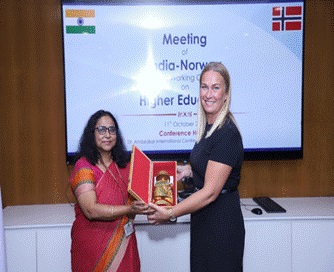
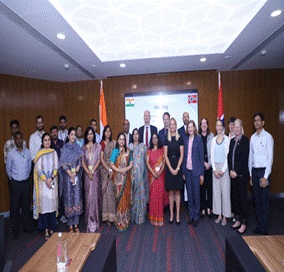
 India hosted the 6th meeting of the India-Norway Joint Working Group on Higher Education on 11th October 2022 in New Delhi.

2022-10-11 17:04:55.1930002022-10-11 17:04:55.274000

The meeting was chaired by Ms. Neeta Prasad, Joint Secretary, International Cooperation, Ministry of Education from Indian side and by Ms. Anne Line Wold, Director General, Ministry of Education and Research from Norwegian side. The Ambassador of Norway to India also participated in the meeting.

The Joint Working Group was established to monitor and oversee the implementation of the MoU on Cooperation in the field of Higher Education signed between India and Norway on 25th April 2022.

The two sides reviewed the progress made under the Indo-Norwegian Cooperation Programme developed under the ambit of the previous India-Norway MoU signed in 2014 and deliberated upon overall higher education policy and priorities, student/faculty mobility and cooperation in the field of skill development.

*****
Draft UGC (Academic Collaboration between Indian and Foreign Higher Education Institutions to offer Joint Degree, Dual Degree and Twinning Programmes) Regulations, 2021

 Union Minister of Education Shri Ramesh Pokhriyal ‘Nishank’ today informed that the UGC has placed the draft Regulations on Academic Collaboration between Indian and Foreign Higher Education Institutions to offer Joint Degree, Dual Degree and Twinning Programmes, in the public domain and invited suggestions from all the stakeholders. The Minister sought insights and feedback from the public including the academia and all other stakeholders to enable the Ministry of Education to bring about effective implementation of this aspect of NEP. The Minister also informed that the last date of receiving suggestions/feedback has now been extended to 15th March. Feedback may be sent to ugcforeigncollaboration@gmail.com.

The Government of India is taking a number of initiatives for the implementation of the National Education Policy-2020. The NEP-2020 calls for permitting credits acquired in foreign countries to be counted for the award of a degree. Furthermore, the budget announcement of 2021 proposed regulatory mechanism to permit dual degrees, joint degrees and twinning arrangements. Accordingly, UGC has framed the draft UGC (Academic collaboration between Indian and foreign Higher Education Institutions to offer Joint Degree, Dual Degree and Twinning Programme) Regulations, 2O21.

These Regulations shall apply to Indian Higher Education Institutions intending to collaborate with Foreign Higher Education Institutions leading to award of diploma(s) and degree(s) including Post Graduate and Doctoral programmes, and Foreign Higher Education Institution intending to collaborate with Indian Higher Education Institutions. Academic Collaboration between Indian and foreign higher education institutions under these Regulations shall facilitate Credit Recognition and Transfer, Twinning Arrangement, Joint Degree Programme and Dual Degree Programme.

Under “Twinning Arrangement”, students enrolled with an Indian higher education institution shall be able to undertake their programme of study partly in India, complying with relevant UGC regulations, and partly in the foreign higher education institution. Moreover, credits earned by the students at a foreign education institution shall be counted towards the degree/diploma awarded by the Indian higher education institution. In case of “Joint Degree programme”, the curriculum shall be designed jointly by the collaborating Indian and foreign higher educational institutions and the degree shall be awarded by both the collaborating institutions with a single Certificate bearing the crests and logo of both collaborating institutions, upon completion of the programme. “Dual Degree Programme” under these Regulations shall be conferred by the Indian and foreign higher education institutions, separately and simultaneously, upon completion of degree requirements of both the institutions.

Promotion of foreign academic collaboration shall be strengthened through the introduction of the provisions of joint degree, dual degree and twinning arrangement. This initiative will provide global exposure to the students, multidisciplinary and interdisciplinary education with internationally relevant curriculum, improve employability, attract foreign students to study in India and improve the standing of the Indian universities in international rankings as internationalization is an important parameter.

Click below to see Draft UGC (Academic Collaboration between Indian and Foreign Higher Education Institutions to offer Joint Degree, Dual Degree and Twinning Programmes) Regulations, 2021:

ugc.ac.in/pdfnews/4258186_Draft-UGC-Academic-Collaboration-with-Foreign-HEIs-Regulations-2021.pdf

*****
All India Survey on Higher Education (AISHE) 2019-20

 Union Education Minister Shri Ramesh Pokhriyal ‘Nishank’ today announced the release of the report of All India Survey on Higher Education 2019-20. This Report provides key performance indicators on the current status of Higher education in the country.

Shri Pokhriyal noted that in the last five years from 2015-16 to 2019-20, there has been a growth of 11.4% in the student enrolment. The rise in female enrolment in higher education during the period is 18.2%. He emphasized that the continuous focus given by the government under the leadership of Prime Minister Shri Narendra Modi on education of girls, women empowerment and empowerment of socially backward classes are well reflected by the increased participation of women, SCs and STs population in Higher Education as shown by the Report.

Minister of State Shri Sanjay Dhotre said, “The results published in this report are indicators of the success of the policies adopted by Prime Minister Shri Narendra Modi in the higher education sector of the Country. I hope this report will help our policy makers to further improve the higher education scenario of the country.”

Secretary, Higher Education Shri Amit Khare said that this report is the 10th in the series of All India Survey on Higher Education (AISHE) annually released by D/o Higher Education. The continuous rise in the enrolment, number of institutions, gender parity is a part of our country’s major move towards improving access, equity and quality in light of National Education Policy 2020, he added.

 Key features of All India Survey on Higher Education Report 2019-20

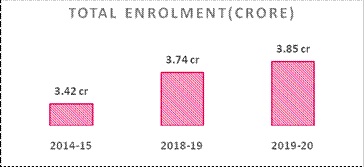
1. Total Enrolment in Higher Education stands at 3.85 crorein 2019-20 as compared to 3.74 crore in 2018-19, registering a growth of 11.36 lakh (3.04 %). Total enrolment was 3.42 crore in 2014-15.


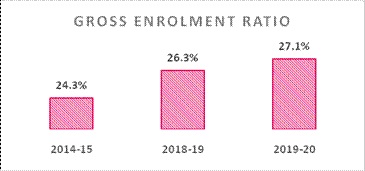
2. Gross Enrolment Ratio (GER), the percentage of students belonging to the eligible age group enrolled in Higher Education, in 2019-20 is 27.1% against 26.3% in 2018-19 and 24.3% in 2014-2015.

3. Gender Parity Index (GPI) in Higher Education in 2019-20 is 1.01 against 1.00 in 2018-19 indicating an improvement in the relative access to higher education for females of eligible age group compared to males.

4. Pupil Teacher Ratio in Higher Education in 2019-20 is 26.

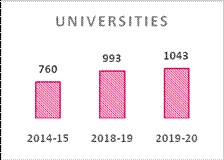
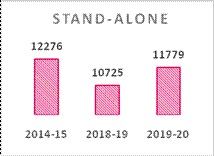
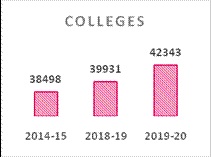
In 2019-20: Universities: 1,043(2%); Colleges: 42,343(77%) and stand-alone institutions: 11,779(21%).


6. 3.38 crore Students enrolled in programmes at under-graduate and post-graduate level.  Out of these, nearly 85% of the students (2.85 crore) were enrolled in the six major disciplines such as Humanities, Science, Commerce, Engineering & Technology, Medical Science and IT & Computer.

7. The number of students pursuing PhD in 2019-20 is 2.03 lakh against 1.17 lakh in 2014-15.

8. The Total Number of Teachers stands at 15,03,156 comprising of 57.5% male and 42.5% female.

Click below to see the report:

*****

Integrate vocational education into Higher Education system

 National Education Policy 2020


National Education Policy 2020 was launched by the Prime Minister in July 2020. In the year following that, a number of initiatives have been taken by the DoHE-

  1. For integration of Vocational education into the higher education system (a) UGC(Institutions Deemed to be University) Regulation 2019 has been amended; and (b) guidelines have been Issued by UGC and AICTE to enable Higher Education Institutions( HEIs) offer Apprenticeship/Internship embedded degree programme.
  2. National Apprenticeship Training Scheme has been extended for the next five years with an outlay of Rs. 3054 crore which will make, through apprenticeship, around 9 lakh students employable. Under the scheme students will be given apprenticeship in the emerging and frontier technology such as Artificial Intelligence, drone technology, new evolving and emergent areas including expertise required for Production Linked Incentive Scheme, and PM Gati Shakti Programme of the Government.
  3. Apprenticeship Scheme and Internship Embedded course will create a sustainable skilling eco-system. The scope of the National Apprenticeship Training Scheme has been broadened to give apprentices to students from humanities, commerce and science besides engineering stream.
  4. In order to enable students avail internship, an Internship Portal has been launched by the AICTE. The portal currently has 12.35 lakh internships, 73 lakh students and 38,650 employers registered on it.
  5. Graduate-level, master’s and doctoral education in large multidisciplinary universities, while providing rigorous research-based specialization, would also provide opportunities for multidisciplinary work, including in academia, government, and industry. Accordingly, the Academic Bank of Credit was launched on 29.07.2021 by  Prime Minister. This academic bank would digitally store the academic credits earned from various recognized HEIs so that the degrees from an HEI can be awarded taking into account credits earned. The UGC has provided necessary enabling mechanism to the HEIs by way of regulations.
  6. For enabling multiple entry and exit points, thus, removing currently prevalent rigid boundaries and creating new possibilities for life-long learning, guidelines on Multiple Entry /Exit in Academic Programme in Higher Education Institutions have been issued by the UGC.
  7. vii. To enhance Gross Enrolment Ratio (GER), online teaching and learning is one of the options. Accordingly, UGC has notified Open Distance Learning (ODL) and Online Programmes Regulations, 2020 ; and UGC (Credit Framework for online Course through SWAYAM) Regulation 2021 which has broad-based the eligibility of HEIs to offer Online Courses, as well as enhanced the percentage of courses permitted towards credit from 20 % to 40% by using MOOCs SWAYAM.
  8. To enable Institute of Eminence (IOEs) offer offshore courses (for globalization of education), UGC has amended UGC (Institution of Eminence Deemed to be Universities) Regulation.
  9. For promotion of Indian Knowledge System, arts and culture a knowledge Cell has been set up in the Ministry of Education and in All India Council for Technical Education(AICTE).
  10. To achieve the goal of using the mother tongue/local language as a medium of instruction, and/or offer programmes bilingually, in order to increase access and GER and also to promote the strength, usage, and vibrancy of all Indian languages, JEE (Main) and NEET (UG), the all India exams for entry in Engineering and Medical colleges, have been conducted in 12 languages in addition to English. Furthermore, the All India Council for Technical Education (AICTE) has given approval to nineteen engineering colleges to impart engineering courses in six Indian languages across ten states from the Academic year 2021-22.
  11. AICTE has also developed a tool called “AICTE Translation Automation Al Tool” with a vision to translate English language online courses into eleven different Indian languages for access to a more significant number of students in the rural areas.

 SWAYAM

  1. One hundred and fifty four (154) Universities have come on board for accepting credit transfer for courses offered through SWAYAM platform till now.
  2. From the academic year 2022-23 onwards the first year courses in Arts, Commerce, and Science & Engineering are planned to be made available on SWAYAM platform in 12 languages in addition to English to help students from vernacular medium to study well and excel. Al and ML shall be used for this purpose.

 e-PGPathshala: Online Gateway of PG Courses

  1. The National Mission on Education through information Communication Technology (NME-ICT) is envisaged as a Centrally Sponsored Scheme to leverage the potential of ICT, in teaching and learning process for the benefit of all the learners in Higher Education institutions at any-time anywhere mode.
  2. It is one of the largest OER repositories in India having content of PG courses.
  3. It provides high quality e-content for PG programmes for the benefit of the teachers and students. 
  4. It also Address disparities of various kinds such as rich/poor, urban/rural, cast and religion based disparities, geographical disparities, regional disparities etc. 
  5. 778 papers, with 23000 plus e- modules in 67 Subjects have been developed, out of 23 subjects covers the entire syllabus/curriculum. 
  6. About 1.3 crore plus visitors including international visitors have visited the e-PG Pathshala site. The details of international visitors are: USA :- 11843, UK : – 7190, Australia:- 8615, Russia : – 13579, Pakistan : – 7215, UAE : -3924, China :- 28745, New Zealand:- 366, Japan :- 6722, Germany : 23592.
  7. vii. Total YouTube subscriber on Vidya-Mitra Channel is 5,57,000 with a 63,864,531 video views. 
  8. e-PGPathshala content is being used by universities for blended learning.
  9. Content of the e-PG Pathshala has been distributed through I-LMS to several universities for their learning Management System. 
  10. Two by-product viz. e-Pathya (Offline Access to all e-PG Videos) and e-Adhyayan (e-Books): has been developed.
  11. Recently, due to COVID-19 Lockdown the ePGPathshala website has been used widely across all Universities and several Universities have used ePGPathshala content as a flip class room. 
  12. xii. UGC constituted an appraisal/outcome review Committee for review of e-PG Pathshala Project in 2020. And The Committee felt that e-PG Pathshala, has proved to be very useful to faculty as well as the students as an open education resource and strongly recommended to continue this scheme and recommended that Efforts should be made to translate the courses uploaded on e-PG Pathshala Portal initially in eight regional languages viz. Hindi, Marathi, Telugu, Tamil, Malayalam, Kannada, Bangla, and Gujarati.

 Azadi Ka Amrit Mahotsav(AKAM)

Indian Council of Historical Research is organizing countrywide seminars to identify lesser known 75 heroes, incidents, places, organizations and literature associated with national struggle for  independence for publication later on. National Book Trust is publishing 75 books covering the unknown and unsung heroes/ personalities, forgotten places and events associated with the national struggle for freedom. Besides this National Book Trust is also bringing out 75 books on the unknown personalities who have contributed shaping the country after independence. January 2022 has been assigned for celebrating Innovation Ecosystem. During this month the Innovation Cell of the Ministry will organize special programmes to showcase student innovators, providing funding and incubation support to 75 Innovative Technologies developed by students and faculty, launching ‘KAPILA Campaign’ for promoting Intellectual Property awareness.

 Common University Entrance Test (CUET)

The National Education Policy, 2020 recommended that the NTA will serve as a premier, expert, autonomous testing organization to conduct entrance examinations for undergraduate and graduate admissions and fellowships in higher education institutions. Accordingly, it has been decided that there will be a common entrance examination in all Central Universities, Common University Entrance Test (CUET), to be conducted by National Testing Agency (NTA) for admission into all Central Universities from the year 2022-23. This exam shall test conceptual understanding and the ability to apply knowledge and shall aim to eliminate the need for taking coaching for these exams. The process will reduce the burden on students, universities and colleges, and the entire education system.

State Eligibility Test (SET)

During the year 2021, UGC has granted accreditation to following State Nodal SET Agencies for conducting SET:-

  1. Tamil Nadu-SET (Nodal Agency- Annamalai University, Annamalai Nagar, Tamil Nadu).
  2. West Bengal-SET (Nodal Agency- West Bengal College Service Commission)
  3. Jammu Kashmir and Ladakh-SET (Nodal Agency- University of Jammu, Jammu)

Ek Bharat Shreshtha Bharat

Under Ek Bharat Shreshtha Bharat the Ministry has launched two Mobile Apps. The first Bhasha Sangam has a collection of 100 sentences of daily conversation in 22 Indian languages and aims to teach the same to at least 75 lakh people during the AKAM period. The other Mobile App is a fun quiz game on different states of India. Both Apps allow for self testing and certificate generation.

 Unnat Bharat Abhiyan

  1. To promote the higher education in the rural districts, the scheme Unnat Bharat Abhiyan has been launched to cater the rural local needs. The objective of the scheme is to engage reputed higher educational institutions (central and state; public and private) to understand and work in rural areas.
  2. With the intention of enriching rural India, the Higher Educational Institutes are expected to adopt at least 5 villages and customize the available technologies as per the local needs and also to improve the implementation of existing government programs. Therefore, it may be mentioned that program focuses on enrichment of rural India through technological interventions. As of now 2897 (~2900) institutions are participating and ~ 14500 villages have been adopted by them under the scheme.
  3. The Scheme has been extended for a further period of 5 years i.e. up to March 2026 at a financial outlay of Rs 48.53 Cr.

 Scholarship Schemes

The Central Sector Scheme of Scholarship for College and University Students:-

  1. The EFC in its meeting held on 06-07-2021, recommended continuation of the CS
    Scheme “Scholarship for College and University Students” for next five years from 2021-22 to 2025-26 at a total cost of Rs. 1325.00 Crores.
  2. For academic year 2021-22, National Scholarship Portal has been opened on 18th
    August, 2021 to receive Fresh and Renewal online application form. So far 99957 fresh and 115582 renewal number of applications has received on NSP.
  3. This year (Upto November) a total 157528 number of scholarships have been disbursed to the tune of Rs 166.78 cr.

Central Sector Interest Subsidy Scheme (CSIS) & Credit  Guarantee Fund Scheme for Education Loan (CGFSEL):-

  1. The EFC in its meeting held on 06-07-2021, recommended continuation of the CSIS & CGFSEL for next five years from 2021-22 to 2025-26 at a total cost of Rs. 7721.19 crore.
  2. PFMS Integration of Canara Bank web portal with PFMS successfully done. Payment files being moved through the new PFMS Interface.
  3. Web Portal for Claim Year 2020-21 under CSIS Scheme opened on 01.11.2021 upto31.12.2021.
  4. Total Expenditure under CSIS & CGFSEL- Rs. 1623.52 crore in r/o 794694 no. of claims.

Special Scholarship Scheme for J&K

  1. The EFC in its meeting held on 06-07-2021, recommended continuation of the Special Scholarship Scheme for Jammu & Kashmir and Ladakh during FY 2021-22 to 2025-26 at a total cost of Rs. 1111.81 Crores.
  2. This year (Upto November) a total 14665 number of scholarships have been disbursed to the tune of Rs 144 cr.

 Sindhu Central University

For establishment of Central University of UT of Ladakh an act has been passed by the Parliament in the Monsoon Session and has been notified on 13.08.2021.

 Higher Education Financing Agency

  1. HEFA finances for HEIs, KVs, NVs, AIIMS and other educational institutions of the Ministry of Health.
  2. To fund projects to the tune of Rs. 100,000 crores by 2022.
  3. As on 30th November 2021, projects worth Rs. 43115.00 crores have been approved.
  4. A loan amount of Rs. 32807.06 crores has been sanctioned and Rs. 12892.98 crores has actually been disbursed.
  5. The number of educational institutions that have funding through HEFA stands at 97.

 IISER

Permanent campuses of IISER, Tirupati & IISER Berhampur will be setup with capital cost of Rs. 1137.16 crores and Rs. 1129.32 crores respectively. IISER Tirupati and Berhampur have planned to shift in permanent campuses from next year.

DEEMED TO BE UNIVERSITIES

  1. During the year 2021, Morarji Desai National Institute of Yoga, 68, Ashok Road, New Delhi-110001 has been declared as Deemed to be University. Eleven proposals are under consideration.
  2. Following Deemed to be Universities have been included under Section 12-B of UGC Act, 1956:
  1. Sri Balaji Vidyapeeth, Mahatma Gandhi Medical College, Puducherry.
  2. Vels Institute of Science, Technology & Advanced Studies (VISTAS), Pallavaram, Chennai, Tamilnadu.
  3. Bharat Institute of Higher Education & Research, Chennai, Tamilnadu
  1. Off-campus centre of following Deemed to be Universities have been approved.
  1. S.R.M Institute of Science and Technology, Chennai, Tamilnadu.
  2. ICFAI Foundation for Higher Education, Hyderabad, Telangana.

 WOMEN’S STUDIES/GENDER SENSITIZATION SECTION 

  1. At present, 159 Women’s Studies Centres have been established in various Universities and Colleges under this scheme. 
  2. UGC has also initiated the process for creation of excusive/independent online portal for Women’s Studies Centres. 
  3. UGC has issued an advisory on 07-12-2021 for one day awareness programmes on Sexual Harassment in the Work place (Prevention, Prohibition and Redressal of Sexual Harassment of Women Employees and Students in Higher Educational Institutions) Regulations, 2015, in the Universities/affiliated colleges.
  4. Annual return on cases of Sexual harassment: UGC sends advisory once in a year to the Vice-Chancellors of all the Universities with the request to send the information regarding Annual Return on cases of Sexual Harassment yearly and to constitute an Internal Complaint Committee and also inform the same to their affiliated colleges with request to fill an online compliance of Gender Audit at SAKSHAM web portal. Latest advisory has been uploaded on 10-06-2021. 
  5. To implement the guidelines of Gender Champions: UGC sends advisory once in a year to the Vice-Chancellors of all the Universities with the request to implement the guidelines of Gender Champions and also inform the same to their affiliated colleges with request to fill an online compliance of Gender Champion at SAKSHAM web portal. Latest advisory has been uploaded on 13-07-2021. All advisories available on UGC website, i.e. www.ugc.ac.in and saksham.ugc.ac.in.

INTERNATIONAL COOPERATION 

  1. Under the Stipendium Hungaricum Programme 173 Indian students awarded in 2021.
  2. Under the Indo-Israel Joint Research Programme, third party evaluation of the programme has been conducted and the report has been prepared.
  3. In line with the NEP in 2021, guidelines for Internationalization of Higher Education were issued on 29.07.2021, 164 Office for International Affairs were established in Universities, whereas 156 Universities have established Alumni Connect Cell. 

*********