From Uncertainty to Security


How PMAY-G Transformed Nondo’s Life!

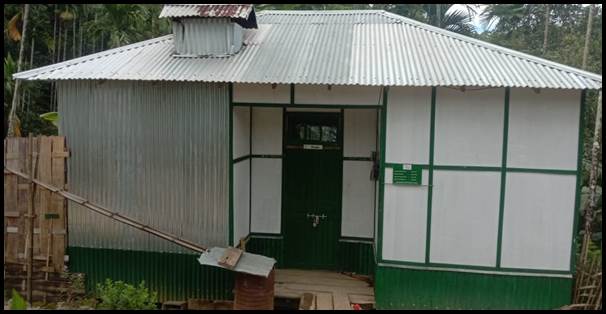
In the small village of ‘Rotlang W’ in Mizoram,’ Nondo’s family faced a constant battle for survival. As a daily wage laborer, Nondo worked tirelessly to feed his wife and five children. Yet, no amount of effort could change the harsh reality of their living conditions. Their dilapidated kutcha house, with its leaky roof and crumbling walls, offered little protection against the elements. 

During the monsoons, water seeped through the roof, soaking their clothes and bedding. Winters were unbearably cold, with biting winds finding their way through the fragile structure. The family’s health and peace of mind suffered with every cold night made us worry if our house would hold up.

Relief came in 2017 when Nondo’s name appeared on the beneficiary list of the Pradhan Mantri Awaas Yojana – Grameen (PMAY-G). The scheme, designed to provide pucca houses for vulnerable rural families, offered Nondo the opportunity to build a secure home. With financial assistance and support from local officials, construction of his house began. 

rotlanf w.jpeg

Lunglei District, Mizoram

By the end of the year, the family moved into their new home. It was a simple and sturdy structure, built to withstand harsh weather and provide a safe haven for the family. The new house brought a profound sense of security to Nondo’s family. No longer did they worry about rainwater flooding their home or chilly winds making their children sick. Their pucca house stood firm against the elements, offering warmth and stability. The newfound security also gave Nondo a sense of pride and belonging. For the first time, his family could welcome guests into their home without embarrassment or fear of judgment. 

Nondo’s story is a testament to the transformative power of PMAY-G, launched in 2016 by the Government of India to fulfil the vision of “Housing for All.” The scheme focuses on providing pucca houses with essential amenities to rural families living in kutcha houses or without a home. The key features of PMAY-G include providing financial assistance for constructing houses with a minimum size of 25 square meters. The scheme prioritizes vulnerable groups such as houseless families, households without literate adults, and those reliant on casual labour for income. Special emphasis is placed on supporting marginalized communities, including Scheduled Castes, Scheduled Tribes, and other disadvantaged sections of society.

Through such targeted measures, the program ensures that the most deserving households, like Nondo’s, benefit first.

Today, Nondo and his family live with peace of mind, no longer burdened by the fear of homelessness or the harshness of nature. Their pucca house is more than a shelter; it is a symbol of hope, resilience, and progress. 

References

PMAY Success stories

*******

Housing and road development to every poor in Chhattisgarh

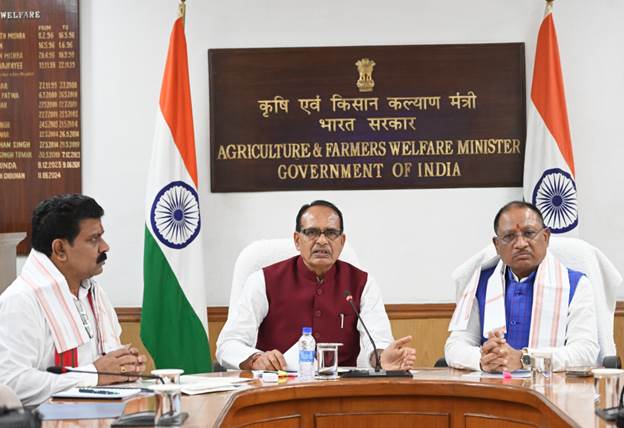
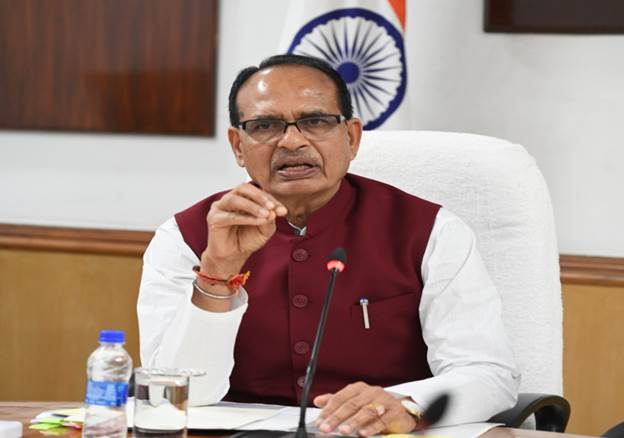
 Union Minister of Agriculture and Farmers’ Welfare and Rural Development Shri Shivraj Singh Chouhan held a meeting with Chhattisgarh Chief Minister Shri Vishnudev Sai and Deputy Chief Minister Shri Vijay Sharma at Krishi Bhavan in New Delhi today.

In the meeting, positive discussions were held on various topics including Pradhan Mantri Gram Sadak Yojana, Pradhan Mantri Awas Yojana (Rural), Mahatma Gandhi National Rural Employment Guarantee Scheme.

Union Minister said that the Central Government under the leadership of Prime Minister Shri Narendra Modi is committed to the development of housing and roads for every poor in Chhattisgarh. The Central and State Governments will jointly complete the public welfare works of the state. Union Minister Shri Chouhan said that houses of all the poor in the state will definitely be built; no poor brother or sister will be deprived of housing under Pradhan Mantri Awas Yojana (Rural). The Central Government is already giving adequate funds to the State Government under public welfare schemes; the present State Government will work seriously in this regard and make good use of the funds.

Shri Chouhan said that the Central Government is also working promptly to build roads under Pradhan Mantri Gram Sadak Yojana in the remote areas of Chhattisgarh. The Central Government is committed to work speedily on the proposals of rural roads in collaboration with the State Government.

Senior central and state officials including Secretary, Rural Development Ministry, Shri Shailesh Kumar Singh were also present in the meeting.

*****

PROVIDING PUCCA HOUSES TO ALL IN URBAN AREAS

 ‘Land’ and ‘Colonization’ are State subjects. Therefore, schemes related to housing for their citizens are implemented by States/Union Territories (UTs). However, Ministry of Housing and Urban Affairs supplements the efforts of States/UTs by providing Central assistance under Pradhan Mantri Awas Yojana- Urban (PMAY-U) since 25.06.2015 to provide pucca houses with basic civic amenities to all eligible urban beneficiaries across the country. The scheme has four verticals namely, Beneficiary-led individual house construction/enhancements (BLC), Affordable Housing in Partnership (AHP), “In-Situ” Slum Redevelopment (ISSR) and Credit Linked Subsidy Scheme (CLSS).

PMAY-U is a demand driven scheme and Government of India has not fixed any target for construction of houses. Based on the demand for housing in the urban areas, States/UTs prepare project proposals and after approval of State Level Sanctioning & Monitoring Committee (SLSMC), these are submitted to this Ministry for sanctioning of admissible Central assistance by Central Sanctioning & Monitoring Committee (CSMC). Government of India is providing its fixed share as Central assistance of ₹1.0 lakh per house under ISSR, ₹1.5 lakh per house for AHP and BLC verticals of PMAY-U. Under CLSS vertical of PMAY-U, an interest subsidy at the rate of 6.5% which amounts upto ₹2.67 lakh per house was provided for beneficiaries of Economically Weaker Sections (EWS) and Lower Income Group (LIG) category. The remaining cost of the house as per Detailed Project Report (DPR) is shared by States/UTs/Urban Local Bodies (ULBs)/Beneficiaries.

Central assistance under PMAY-U is released to States/UTs in three installments of 40%, 40% and 20%. The release of Central assistance is incumbent upon fulfillment of mandatory compliances by the concerned States/UTs as per operational guidelines and other instructions issued by Ministry of Finance. Due installment of Central assistance is released as soon as requisite compliances are achieved in sanctioned projects.

Based on the proposals submitted by States/UTs, a total of 118.64 lakh houses have been sanctioned under PMAY-U by the Ministry as on 15.07.2024. Of the sanctioned houses, 114.33 lakh have been grounded for construction; of which 85.04 lakh have been completed/delivered. State/UT-wise details of number of houses sanctioned, grounded, completed/delivered along with Central assistance sanctioned and released under PMAY-U is given at Annexure.

The timeline for completion of projects varies from State to State and generally it takes 12-36 months in different verticals of the scheme and as per DPRs of respective projects. The completion timeline for houses depends on various factors like availability of encumbrance free land, statutory compliances for start of construction, arrangement of funds by beneficiaries etc. States/UTs have been advised to expedite the construction of sanctioned houses so that all houses are completed within the stipulated timeline. The scheme period, which was earlier upto 31.03.2022, has been extended upto 31.12.2024, except for Credit Linked Subsidy Scheme (CLSS) vertical, to complete all the houses sanctioned without changing the funding pattern and implementation methodology.

This information was given by the Minister of State for Housing & Urban Affairs, Shri Tokhan Sahu, in a written reply in the Rajya Sabha today.

Annexure 

States/UTs-wise details of number of houses sanctioned, grounded for construction and completed/delivered along with Central assistance sanctioned and released so far under PMAY-U

Sr. No.


Name of the
State/ UT

Physical Progress of Houses (Nos)

Financial Progress in respect of Central Assistance (in Crore)


Sanctioned

Grounded

Completed/ Delivered


 Sanctioned

 Released


1

States

Andhra Pradesh

21,37,028

19,90,937

9,73,837

32,568.27

23,800.26


2

Bihar

3,14,477

3,05,811

1,47,979

4,950.45

3,368.00


3

Chhattisgarh

3,02,663

2,89,128

2,38,894

4,810.98

4,088.81


4

Goa

3,146

3,146

3,145

74.76

75.04


5

Gujarat

10,05,204

9,83,778

9,18,185

21,064.34

19,805.76


6

Haryana

1,15,034

93,153

68,114

2,171.64

1,673.50


7

Himachal Pradesh

12,758

12,668

10,705

215.95

202.02


8

Jharkhand

2,29,156

2,13,534

1,42,810

3,603.31

2,987.87


9

Karnataka

6,38,121

5,73,160

3,69,449

10,614.43

7,168.29


10

Kerala

1,67,322

1,47,721

1,23,453

2,781.18

2,293.45


11

Madhya Pradesh

9,61,147

9,49,265

8,01,068

15,930.45

15,284.69


12

Maharashtra

13,64,923

11,16,949

8,55,339

25,548.21

19,323.37


13

Odisha

2,03,380

1,80,647

1,47,148

3,176.98

2,479.75


14

Punjab

1,32,235

1,16,264

83,894

2,342.54

1,825.79


15

Rajasthan

3,19,863

2,64,357

1,91,971

5,891.46

4,693.97


16

Tamil Nadu

6,80,347

6,63,430

5,70,294

11,185.30

10,135.67


17

Telangana

2,50,084

2,44,219

2,24,659

4,475.66

3,718.27


18

Uttar Pradesh

17,76,823

17,33,051

15,47,101

27,962.68

26,065.17


19

Uttarakhand

64,391

60,160

34,504

1,176.51

940.86


20

West Bengal

6,68,953

6,12,998

4,00,257

10,773.50

7,675.93


Sub- total (States) :-

1,13,47,055

1,05,54,376

78,52,806

1,91,318.59

1,57,606.50


21

North East States

Arunachal Pradesh

8,499

8,070

7,753

182.38

161.18


22

Assam

1,76,643

1,60,473

1,02,712

2,674.26

2,065.73


23

Manipur

56,037

48,657

14,699

841.39

471.91


24

Meghalaya

4,758

3,793

1,632

72.35

43.31


25

Mizoram

39,605

39,215

11,069

607.80

447.22


26

Nagaland

31,860

31,841

22,850

503.91

393.41


27

Sikkim

316

316

202

6.13

7.09


28

Tripura

92,854

84,751

74,049

1,494.35

1,273.47


Sub- total (N.E. States) :-

4,10,572

3,77,116

2,34,966

6,382.57

4,863.31


29

Union Territories

A&N Island

376

376

47

5.84

2.93


30

Chandigarh

1,256

1,256

1,256

28.78

28.78


31

DNH & DD

9,947

9,947

9,230

214.40

200.27


32

Delhi

29,976

29,976

29,976

692.53

692.53


33

J&K

47,040

42,894

24,244

724.94

483.48


34

Ladakh

1,307

1,014

843

30.22

24.05


35

Lakshadweep


36

Puducherry

15,995

15,271

9,994

254.12

223.19


Sub- total (UT) :-

1,05,897

1,00,734

75,590

1,950.84

1,655.23


Grand Total  :-

118.64 Lakh

114.33 Lakh*

85.04 Lakh*

2.00 Lakh Cr.

1.64 Lakh Cr.


Includes completed (3.41 lakh)/ grounded (4.01 lakh) houses of JnNURM during mission period.

MoHUA Schemes and Missions help boost the Make in India and AtamNirbhar Bharat Initiatives

 Various schemes and Missions run by the Ministry of Housing and Urban Affairs during 2021 have helped boost the Make in India and AtamNirbharBharat initiatives in many ways. The schemes and Missions have directly influenced the AtamNirbhar Bharat and Make in India initiatives directly or indirectly. 

Under the Pradhan Mantri Awas Yojana-Urban (PMAY-U), launched to address urban housing shortage including the slum dwellers by ensuring a pucca house to eligible urban households by the year 2022, the technology used to build the houses at faster speed was innovative, specially the Light House projects as part of Global Housing Technology Challenge – India (GHTC -India) initiative, in six States .The initiative led to a new era in the construction technology in India, thus giving impetus to Make in India initiative.  Bringing people and technology together, LHPs will pave the way for a new eco- system where globally proven technologies will be adopted for cost-effective, environment friendly and speedier construction. Advantages of these LHPs are many, the primary ones being durability, climate-resilient, affordability, safety and speed.

MoHUA also launched the Enrolment Module for TECHNOGRAHIS including students from IITs, NITs, engineering, planning and architecture colleges, faculty members, academicians, and stakeholders for registering themselves to visit Live Laboratories at six LHP sites for learning, consultation, generation of ideas and solutions, experimentation, innovation, and technical awareness. This helped them in getting a first-hand account of the technologies being used and in turn, they can adapt and adopt them as per their requirements in the construction sector for a ‘Make in India’ approach.

A Technology Sub-Mission (TSM) was set up to facilitate the adoption of innovative, sustainable, eco-friendly and disaster-resilient technologies and building materials for low-cost, speedier and quality construction of houses. TSM not only aims to ensure speedier and safer delivery under PMAY-U but also has the potential to bring a paradigm shift in the overall housing construction sector in the country.

Affordable Rental Housing Complexes (ARHC) Scheme under Atmanirbhar Bharat Package addresses the vision of ‘AtmaNirbhar Bharat Abhiyan’ significantly by creating a sustainable ecosystem of affordable rental housing solutions and to achieve overall objective of “Housing for All” encompassing the need of affordable rental housing for urban migrants/poor. ARHCs will provide them dignified living with necessary civic amenities near their place of work.

Under Smart Cities Mission(SCM), the City Innovation Exchange (CiX) platform was launched for   innovative practices in cities. The platform was a significant addition to the growing innovation ecosystem of India and focuses on fostering innovative practices in cities. CiX, through an ‘open innovation’ process, engages with innovators to design-test-deliver on solutions to pressing urban challenges. This initiative is among the ongoing efforts of the Government to realise Prime Minister’s vision of New and AtmaNirbhar Bharat, by making cities more self-reliant and enabled to meet the needs of and provide services to their citizens. Another step towards making the SCM targets easier, a SmartCode is a platform was launched by MoHUA that enables all ecosystem stakeholders to contribute to a repository of open-source code for various solutions and applications for urban governance. It is designed to address the challenges that ULBs face in the development and deployment of digital applications to address urban challenges, by enabling cities to take advantage of existing codes and customising them to suit local needs, rather than having to develop new solutions from scratch. The India Urban Data Exchange has been developed in partnership between the Smart Cities Mission and the Indian Institute of Science (IISc), Bengaluru. A New smart cities website & Geospatial management information system GMIS for project monitoring was also developed to implement and proper scrutiny of the projects under SCM. 

Ministry of Housing and Urban Affairs launched the Transport4All, aiming to bring together cities, citizen groups, and start-ups to develop solutions that improve public transport to better serve the needs of all citizens. It also started the EatSmart Cities Challenge which aimed to motivate Smart Cities to develop a plan that supports a healthy, safe and sustainable food environment supported by institutional, physical, social, and economic infrastructure along with the application of ‘smart’ solutions to combat food related issues.

National Urban Digital Mission will create the ideal space to harness immense synergies from the domain of urban and technology towards creating a citizen-centric governance that reflects Prime Minister Shri Narendra Modi’s vision of ‘minimum government and maximum governance’. The National Urban Digital Mission (NUDM) will create a shared digital infrastructure for urban India, working across the three pillars of people, process, and platform to provide holistic support to cities and towns. It will institutionalise a citizen-centric and ecosystem-driven approach to urban governance and service delivery in 2022 cities by 2022, and across all cities and towns in India by 2024.

For making the street vendors AtmaNirbhar, Prime Minister Street Vendor’s AtmaNibhar Nidhi (PM SVANidhi) Scheme, MoHUA has entered into MoU with Zomato, one of the largest online platforms for ordering and delivery of food in India, to onboard street food vendors on its food-tech platform. It has given street food vendors online access to thousands of consumers and help these vendors grow their businesses. Further, MoHUA launched the Mobile Application for PM SVANidhi se Samriddhi- Socio-economic profiling of PM SVANidhi beneficiaries and their families to link them to various Central Government Schemes

Under AtmaNibhar Bharat initiative, DAY-NULM scheme has focussed on equipping the urban poor women with adequate skills and opportunities, and to enable them to promote sustainable micro enterprises. It mobilises women from urban poor households into SHGs and their federations to create a support system for these women. Over 5.7 lakh SHGs have been formed across various States/ UTs, with almost 60 lakh members. Many of these SHGs are engaged in livelihood activities, producing goods such as handicrafts, textiles, toys, eatables and so on. These were being sold primarily in local neighbourhood markets and often faced barriers in achieving visibility and wide market access.

Under Urban Transport Mission, the metro coaches which were earlier imported from Spain, South Korea, and China, are now being manufactured within the country. Their quality is at par with international standards and also being exported to Australia and Canada. 

Under the Central Vista project, the new Parliament Building is an intrinsic part of the vision for Azadi@75 and symbolises our commitment and efforts towards building AatmaNirbhar Bharat. The new Parliament has been designed and is being built by Indians using Indian materials. It will be the first Indian Parliament built by the people, of the people, and for the people.

To enable the vision of Hon’ble Prime Minister for New Urban India, the Ministry of Housing and Urban Affairs organised Azadi@75 Conference-cum-Expo in Lucknow, Uttar Pradesh along with an exhibition themed on transforming urban landscape across the country.


Achievements and initiatives 

Pradhan Mantri Awas Yojana-Urban (PMAY-U)

Pradhan Mantri Awas Yojana-Urban (PMAY-U) was launched on 25th June, 2015 to address urban housing shortage among the EWS/ LIG and MIG category, including the slum dwellers by ensuring a pucca house to eligible urban households by the year 2022. 

  • Against the total assessed demand of 1.12 Cr houses, 1.14 Cr houses have been sanctioned. Of these, total of 91.5 lakh houses were grounded for construction and 53 lakhs houses were completed / delivered, as on 12th Dec’ 2021.
  •  A total of 17.35 Lakh beneficiaries have availed subsidy on housing loans through Credit Linked Subsidy Scheme (CLSS), out of which 6.15 Lakh beneficiaries are from Middle Income Group. 
  • A total of 6,368 houses in Light House Projects are being constructed involving project cost of ₹790.57 crore.


Atal Mission for Rejuvenation & Urban Transformation (AMRUT)

  • Against total SAAP size of ₹77,640 crore, 5818 projects worth ₹80,713 crore have been grounded. Of the grounded projects, works worth ₹57,414 cr. have been physically completed (inclusive of completed projects worth ₹22,756 cr.) and expenditure of ₹50,118 cr. has been incurred so far.
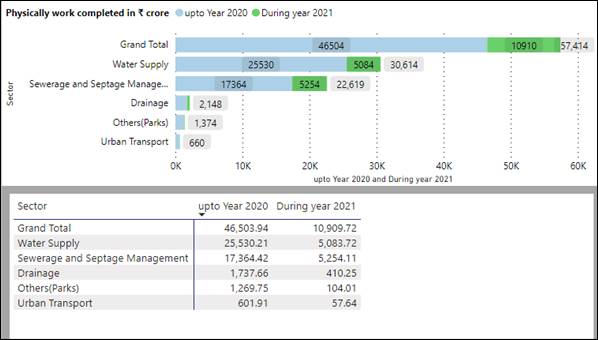
  • Sector-wise progress of AMRUT projects is as below:

Sector

Projects completed

Projects ongoing

Total Projects Grounded

No.

Amount

No.

Amount

No.

Amount

Water Supply

740

11,530

586

30,320

1,326

41,850

Sewerage &Septage

370

8,259

483

25,074

853

33,332

Storm Water Drainage

612

1,114

187

1,829

799

2,943

Non-motorised urban transport

218

397

131

626

349

1,023

Parks & Green spaces

1,943

1,130

548

435

2,491

1,565

Total

3,883

22,430

1,935

58,284

5,818

80,713


  • AMRUT 2.0 was launched by the Hon’ble Prime Minister on 1st October 2021 with the aim of making the cities ‘water secure’ and providing functional water tap connections to all households. The total indicative outlay for AMRUT 2.0 is ₹2,77,000 Cr including central share of ₹ 76,760 Cr for the period from 2021-22 to 2025-26.In the water supply sector, contracts for 1,326 projects worth ₹41,850 crore have been awarded of which 740 projects worth ₹11,530 crore have been completed. In addition, 18 projects worth ₹358 crore are at various stages of tendering.  The target is to provide 139 lakh water tap connections to achieve universal coverage. So far 118 lakh water tap connections have been provided through AMRUT and in convergence with schemes.


Swachh Bharat Mission- Urban (SBM-U)

            Swachh Bharat Mission (Urban) was launched on 2nd October 2014, with the vision to make India open defecation free. Under the mission, 31 cities have been self-declared as ODF and 58 have been certified as ODF since 1st January 2021. ODF+ certified cities increased by 1,828 and ODF++ certified cities increased by 472 since 1st January 2021. Number of Individual Household toilets constructed increased by 20,892 and Community/ Public Toilets constructed increased by 17,866 till date. Under solid waste management, 100% Door to door collection has increased to 86,403 wards and 100% Source Segregation has increased to 77,415 wards resulting in increase of the total waste processing to 70% as against 68% till 1st January 2021.

Swachh Bharat Mission-Urban 2.0: Hon’ble Prime Minister launched the second phase of Swachh Bharat Mission-Urban 2.0 on 1st October, 2021 with an outlay of about ₹ 4.4 Lakh Crore to adopt ‘Universal Approach’ and make a move towards ‘Saturation’ in sanitation and water availability in all Urban Local Bodies (ULBs). 


Deendayal Antyodaya Yojana –National Urban Livelihoods Mission (DAY-NULM)


The DAY-NULM is a flagship scheme which aims towards alleviating urban poverty through building strong community institutions, providing skill training, access to affordable credit for self-employment, support for street vendors and shelters for the urban homeless. Since inception, it has covered 28 states, 7 UTs and 3,806 Towns creating 25.60 livelihoods. Under the scheme, 1.30 lakhs shelter spaces were created for urban homeless and 66.70 lakhs women members were mobilised into 6.4 lakh Self Help Groups (SHGs). 


Memorandum of Understandings (MoUs) were implemented with e-commerce giants like Amazon & Flipkart for selling over 2,000 products made by 5,000 SHG members on e-commerce portals across 25 States/ UT.‘SonChiraiya’ brand was launched with the aim to provide increased visibility and wider market access to the local ethnic products viz. handicrafts, food, apparel, decorative, etc.The Mission has provided 26.50 lakh Certificate of Vending (CoV) to urban street vendors to safeguard their rights. Mission has streamlined the process for payments of training fees to skill training providers through PAiSA Portal, which is centralized electronic platform for processing payments to the beneficiaries under the Mission. 


AZADI KA AMRUT MAHOTSAV: As a part of the ongoing “AzadikaAmritMahotsav”  of MoHUA, Revolving Fund (RF) support to Area Level Federation (ALF) i.e. federation of Self Help Groups through PAiSA Portal was operationalised on 30.09.2021.


PM Street Vendor’s AtmaNirbhar Nidhi (PM SVANidhi)

            The PM SVANidhi was launched to empower street vendors, making them independent and self-sustainable. Under “SwadishtVyanjankiAadhunikDukaan (SVAD)”, MoHUA has signed MOU with Swiggy and Zomato providing a digital platform for Street Food Vendors (SFVs). Presently, over 8,486 SFVs have been onboarded and have generated sales of over ₹4.9 Crores.

            Tie up with Digital Payment Aggregators (DPAs) like BharatPe, Mswipe, PhonePe, Paytm, Aceware were done to issue UPI ids, QR codes and digital training to the beneficiaries. Around 24.5 Lakh Street Vendors (SVs) have been onboarded digitally out of which 9.8 lakh vendors are Digitally active who have conducted 10.9 Crore Digital Transactions till date.


More than 42 Lakhs Eligible Loan Application under 1st Tranche and 773,986 Eligible Loan Application under 2nd Tranche were submitted. Out of these, more than 30 Lakhs loans under 1st Tranche and 46,931 loans under 2nd Tranche were sanctioned and more than 27 Lakhs loans under 1st Tranche and 33,471 loans under 2nd Tranche were disbursed. The loan total amount disbursed under 1st Tranche is ₹2656.97Crores and under 2nd Tranche is ₹66.62 Crores.

Urban Transport 

            One metro project i.e. Bangalore Metro Rail Project Phase 2A & 2B of length 58.19 kms at the completion cost of ₹14,788 Cr has been sanctioned in June, 2021. 31 kms of metro rail lines have been commissioned in the cities of Delhi, Bangalore, Chennai, Kolkata and Nagpur.Under Make-in-India initiatives, the Ministry, in January, 2021, has issued a list of items where public procurement shall be done only from local suppliers. With driverless train operation on 94 km on Delhi Metro’s network, India is at 4th position in the elite league of world’s metro systems which operate drives less trains. 

************

Meeting of the Consultative Committee of Ministry of Housing and Urban Affairs held

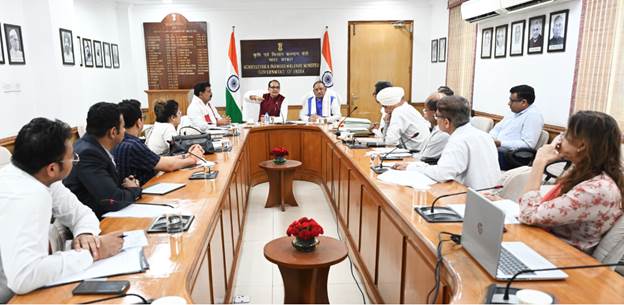
 The meeting of the Consultative Committee of Ministry of Housing and Urban Affairs was held today in the Parliament House Annexe, New Delhi.  The Agenda item of the meeting was “Smart Cities Mission”. Minister of Housing and Urban Affairs, Shri HardeepPuri chaired the meeting.

Briefing about the Smart Cities Mission, Shri Puri said that the main objective of the Mission, launched on 25th June, 2021, is to promote cities that provide core infrastructure, clean and sustainable environment and give a decent quality of life to their citizens through the application of ‘Smart Solutions”.  The Mission aims to drive economic growth and improve the quality of life through comprehensive work on social, economic, physical and institutional pillars of the city.  100 cities have been selected to be developed as smart cities through a two-stage National competition.

Smart Cities Mission is a centrally sponsoredscheme under which the Central Government will provide financial support to the extent of 48000 crores over 5 years i.e. on anaverage 100 crores per city per year and an equal amount of matching basis is to be provided by the State/ULB.  Emphasis has been given on the participation of private sector through public private partnerships.  Aggregating at national level, these proposals contained more than 5000 projects worth over 2,00,000 crores.  Mission has a two-pronged strategy consisting of Pan-city and Area-Based development project. Implementation at the city level is being done by Special Purpose Vehicle(SPV) created for the purpose.  There is no template or universally accepted definition of the Smart City.  Therefore conceptualization of Smart City depends on the level of development,willingness to change and reform resources and aspirations of the city  residents. 

The overall progress of the Mission as on 12 November, 2021 shows great momentum in execution.  Over 6452 projects worth 184,998 crores have been tendered.  Of this, work orders have been issued for close to 5809 projects worth 156571 crores of which 3131 projects worth around 53,175

crore have been completed. Since the launch of the Mission, a total of . 27,234 crores have been released by the Government of India to 100 cities under the Mission. The progress of the Mission inthese cities is done on a regular basis by State level High Powered Steering Committee.

The Mission has launched several initiatives that will not only ensure integrated development across variousaspects of urban development but also help lay long-term foundationfor good quality urbanization in the country.  Some of the initiatives are:

  1. Ease of the Living Index
  2. Municipal Performance Index
  3. City GDP Framework
  4. Climate Smart Cities Assessment Framework
  5. Data Maturity  Assessment Framework
  6. ICCC Maturity Assessment Framework
  7. Data City Strategy
  8. India Urban Observatory
  9. India Urban Data Exchange
  10. Smart Cities Open Data Initiative
  11. National Urban Innovation Stack
  12. National Urban Digital Mission
  13. ICT standards
  14. India Cycles4Change (IC4C) Challenge
  15. Streets4people Challenge
  16. Nurturing Neighbourhoods Challenge
  17. Transport 4 all (T4All) Challenge
  18. EatSmart Cities  Challenge
  19. City Investments to Innovate, Integrate and Sustain (CITIIS) Challenge
  20. Climate Centre for Cities
  21. Climate Smart Cities Alliance
  22. India Smart Cities Fellowship Program
  23. The urban Learning Internship Program

The Minister also informed that smart cities have played important role in managing the crises during Covid-19. With Integrated Command and Control Centres being usedas Covid-19 War Room, they have helped in the area of information, communication, management and preparedness.

Hon’ble MPs made many valuable suggestions during the meeting.


*******

MoHUA opens ‘Urban Geospatial Data Stories Challenge-2022’

 Ministry of Housing and Urban Affairs (MoHUA)  announced the opening of  Urban Geospatial Data Stories Challenge to foster adoption of geospatial technologies & to promote innovation in India’s urban ecosystem. The challenge has been organized with select Smart Cities that will be publishing high quality GIS datasets. More than 1000 geospatial datasets have been made available to the registered participants from national geospatial agencies, private sector enterprises, scientific and academic institutions, businesses, consumer services & start-ups to analyse this data and create insightful data stories. 

Leading up to the ‘Azadi Ka Amrit Mahotsav- Smart Cities: Smart Urbanization’ conference scheduled to be held in Surat, during February 2022, the Urban Geospatial Data Stories Challenge is part of a series of pre-event initiatives being undertaken by MoHUA to foster adoption of geospatial technologies & to promote innovation in India’s urban ecosystem. The challenge will commence for the registered participants on 1st January, 2022 and conclude by end of January 2022.

The Challenge has been designed to promote Geospatial Policy and to make India a Geospatial enabled nation. Sharing and integration of wide range of data will empower citizens and enterprises to create, assess, and use geospatial data and information for empowering people and making urban services and applications more effective. Built on the concept of ‘open innovation’ & ‘open data sharing’, the hackathon is likely to benefit stakeholders across all cities in India. Assimilation of innovative ideas & solutions from a wide array of geo spatial experts covering academia, private sector, emerging technologies, and government would help in solving some of the most common problems faced by the citizens of any city and replicating the successful ideas in other cities.

800 participants have registered till date and more than 10 Agencies have partnered for mentoring and evaluation, making this challenge a collaborative effort towards making India a Geospatial enabled nation. The Challenge details, including datasets and guidelines for participation are available online at https://urbanhack.niua.org/

Azadi Ka Amrit Mahotsav

Azadi Ka Amrit Mahotsav is an initiative of the Government of India to celebrate and commemorate 75 years of progressive India and the glorious history of its people, culture and achievements. This Mahotsav is dedicated to the people of India who have not only been instrumental in bringing India thus far in its evolutionary journey, but also hold within them the power and potential to enable Prime Minister Modi’s vision of activating India 2.0, fuelled by the spirit of Atmanirbhar Bharat.

Azadi ka Amrit Mahotsav is an embodiment of all that is progressive about India’s socio-cultural, political, and economic identity. The official journey of “Azadi ka Amrit Mahotsav” commenced on 12th March 2021 which starts a 75-week countdown to our 75th anniversary of Independence.

***

PREFABRICATION

What is prefabrication?

Prefabrication is the process of fabricating components of a structure in a factory or other manufacturing facility and shipping entire assemblies or sub-assemblies to the location where the structure will be installed. The term prefabrication also refers to the production of things other than construction in a fixed location. and the section is delivered assembled and ready for assembly. It generally does not refer to electrical or electronic components of a machine or mechanical parts such as pumps, gears, and compressors, which are usually supplied as separate items, but rather refers to the machine body that was used for parts in the past. . Mac premade parts This body can be called “sub-assemblies” and can be separated from other components.

Since when it is used

Prefabrication has been used since ancient times; For example, it is said to be the oldest dam in the world, Sweet Track, dating from around 3800 BC. Ancient Sri Lanka, particularly the Kingdom of Anuradhapura and the Kingdom of Polonnaruwa, used ready-made technology to erect huge structures, which are 2000 years old and some sections have been prepared separately and then assembled. In 1755 the Portuguese capital, especially the Baixa district, is popularly known as the Marqués de Pombal, the most powerful royal minister of D. The leadership of Sebastião José Von Carvalho e Melo, the most powerful royal minister of D. José IA, arose from Pombal a new architectural and urban planning style that introduced early anti-seismic design features and innovative prefabricated buildings. The buildings were manufactured entirely outside of the city, transported in pieces, and then assembled on-site, a process that lasted into the 19th century and provided city dwellers with unprecedented levels of safety before the earthquake. In the 19th century, Australia was importing large numbers of prefabricated houses from the United Kingdom. The method was widely used in prefabricated houses in the 20th century, for example in the UK as temporary living space. Space for thousands of townspeople. Families were “bombed out” during World War II. The assembly of profiles in factories saved time on site and the lightness of the panels reduced the cost of foundation and assembly on site. Gray concrete with flat roofs, prefabricated houses were uninsulated and cold, and prefabricated houses took on some stigma, but some London prefabricated houses have been occupied for much longer than the expected 10 years. The Crystal Palace, built in London in 1851, was a widely visible example of prefabricated iron and glass. Structures; Oxford Rewley Road station followed on a smaller scale.

Current uses

The most widespread form of prefabricated parts in civil engineering is the use of precast concrete parts and prefabricated steel parts in structures in which a certain part of a certain shape is repeated many times. It can be difficult to make the formwork required for pouring concrete structures on site. and delivering wet concrete to the site before it sets requires careful time management. Pouring concrete profiles in a factory brings the benefits of reusing molds and concrete can be mixed on-site without having to be transported and pumped wet into a crowded construction site. The parts reduce the cost of cutting and welding on-site, as well as the associated costs. The quality of the residential units produced had risen to such an extent that their residents could not distinguish them from traditionally built units. The technology is also used in office buildings, warehouses, and factories. Prefabricated parts made of glass and steel are widespread. Use for the exterior of large buildings: single-family houses, cottages, log houses, saunas, etc. They are also sold with prefabricated elements. Thanks to the modular prefabrication of wall panels, complex thermal insulation, window frame components, etc. can be produced on the assembly line, which tends to improve the construction quality of every wall or frame on-site prefer manual construction and the image of the prefabricated house as a “cheap” method only slows its acceptance. However, today’s practice already allows the system to be modified depending on the customer’s requirements and the choice of coating material. All clinker facades can be bricked, even if the load-bearing elements are made of wood Civil engineering work This can be decisive for the success of projects such as bridges and avalanche galleries, where the weather conditions only allow a short construction period. The systems and prefabricated bridge components offer bridge planners and construction workers considerable advantages over the construction time. e, safety, environmental sustainability, feasibility, and cost. Prefabrication can also help minimize the impact of bridge building on traffic. Small and frequently used structures such as concrete towers are also prefabricated in most cases. Radio towers for cell phones and other services often consist of several prefabricated parts. The masts are also often assembled from prefabricated parts. Prefabrication is widespread in the assembly of aircraft and spacecraft, and components such as wings and fuselage sections are often manufactured at the final assembly site in different countries or state Airbus.

Advantages

Moving sub-components out of the factory is generally cheaper than moving pre-production resources to each location.

Placing resources on the site increases costs; precast concrete components reduce costs by reducing the workload on the construction site.

The precision tools of the factory can help control the flow of heat and air in the building, reduce energy consumption and improve the health of the building.

The machine movement of the parts and the absence of wind and rain can improve the safety of the structure.

Uniform indoor factory environments eliminate most of the climate impacts on production

Advertisements