NATIONAL mean a person owing allegiance to and entitled to the protection of a sovereign state. CITIZEN is preferred for one owing allegiance to a state in which sovereign power is retained by the people and sharing in the political rights of those people. the rights of a free citizen SUBJECT implies allegiance to a personal sovereign such as a monarch. the king’s subjects NATIONAL designates one who may claim the protection of a state and applies especially to one living or traveling outside that state.
The caste system in India has been a defining feature of its society for centuries. Rooted in ancient traditions, the caste system categorizes individuals into distinct social groups based on their birth, determining their occupation, social status, and even personal relationships. While some proponents argue that it provides a sense of identity and order, a critical examination of the caste system reveals its inherent flaws, perpetuation of discrimination, and hindrance to social progress.
Social Inequality and Discrimination:
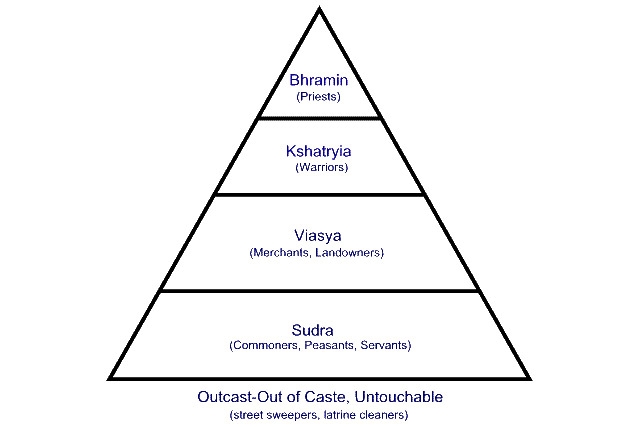
The caste system reinforces a rigid social hierarchy that categorizes individuals into four main varnas (castes) – Brahmins (priests), Kshatriyas (warriors and rulers), Vaishyas (merchants and farmers), and Shudras (laborers). Additionally, there are numerous subcastes and Dalits (formerly known as untouchables) who are marginalized and subjected to severe discrimination. This system institutionalizes inequality and denies equal opportunities, social mobility, and basic human rights to those born into lower castes.
Occupational Limitations:
One of the key features of the caste system is the hereditary nature of occupations. Individuals are expected to follow the occupation associated with their caste, regardless of their interests, skills, or aspirations. This restricts social and economic progress, preventing individuals from pursuing professions of their choice and contributing to a lack of innovation and entrepreneurship within society.
Discrimination against Dalits:
The Dalits, historically regarded as the lowest caste, face extreme social exclusion, violence, and economic marginalization. They are subjected to inhumane treatment, denied access to public spaces, and suffer from limited opportunities for education and employment. Despite legal protections and affirmative action policies, discrimination against Dalits continues to persist, perpetuating a cycle of oppression and injustice.
Inter-caste Marriages and Social Stigma:
The caste system maintains a strong influence on personal relationships, particularly marriage. Inter-caste marriages are often met with opposition, leading to social stigma, ostracization, and sometimes even violence. This rigid enforcement of caste boundaries hampers the development of a cohesive and inclusive society and curtails the freedom of individuals to choose their life partners based on love and compatibility.
Impediment to National Unity and Progress:
The caste system fragments Indian society along caste lines, leading to division and social unrest. The caste-based politics that emerge from this system further exacerbate these divisions, hindering collective progress. Instead of focusing on issues such as poverty, education, and healthcare, political leaders often exploit caste-based identities for electoral gains, impeding the nation’s overall development.
The caste system in India, while deeply ingrained in the country’s social fabric, poses significant challenges to equality, justice, and progress. Its perpetuation leads to social inequality, discrimination, and the denial of basic human rights. Addressing the caste system’s deep-rooted issues requires concerted efforts from society, policymakers, and educational institutions to promote inclusivity, eradicate discrimination, and create a more equitable and just society for all. Only by challenging and dismantling the caste system can India realize its full potential as a diverse and united nation.
References
Bidner, C., & Eswaran, M. (2015). A gender-based theory of the origin of the caste system of India. Journal of Development Economics, 114, 142-158.
Dehalwar, K., & Sharma, S. N. (2024). Politics in the Name of Women’s Reservation. Contemporary Voice of Dalit, 2455328X241262562.
Dehalwar, K., & Sharma, S. N. (2024). Social Injustice Inflicted by Spatial Changes in Vernacular Settings: An Analysis of Published Literature.
Ogbu, J. U. (2020). The consequences of the American caste system. The school achievement of minority children, 19-56.
Olcott, M. (1944). The caste system of India. American Sociological Review, 648-657.
Srinivas, M. N. (2017). Mobility in the caste system. In Structure and change in Indian society (pp. 189-200). Routledge.
Stevenson, H. N. C. (1954). Status evaluation in the Hindu caste system. The Journal of the Royal Anthropological Institute of Great Britain and Ireland, 84(1/2), 45-65.
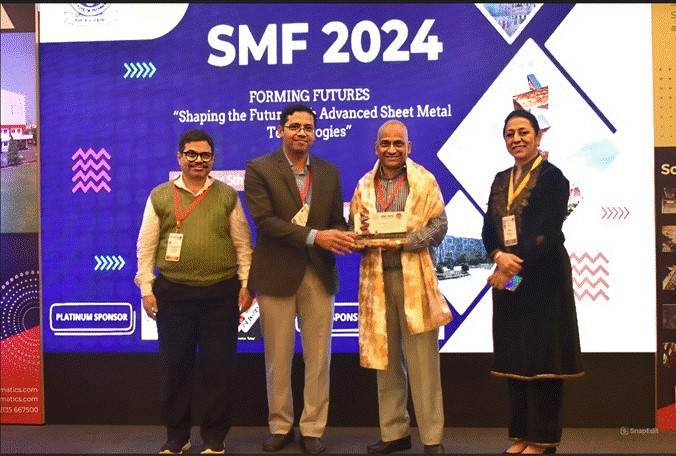
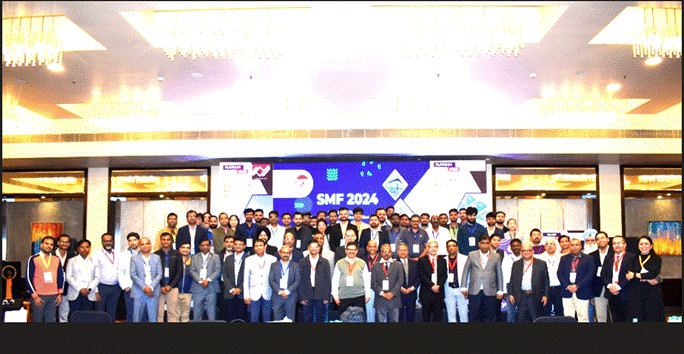
Rupnagar, 9th December 2024: IIT Ropar successfully hosted the Sheet Metal Forming (SMF) 2024 conference, attracting a large gathering of national and international delegates. The event featured eminent speakers from IITs and prominent industry partners, including Auto form, Electropneumatics & Hydraulics, Altair, Tata Steel, Tata Technologies Ltd., Ford India, Felss System GmbH, and JBM Auto Ltd. SMF 2024, the flagship conference of the Sheet Metal Forming Research Association (SMFRA), provided a platform for researchers and developers from India and abroad to present and exchange ideas on metal forming technologies.
The conference commenced on December 5th with an inaugural ceremony. Prof. Anupam Agrawal, from the Department of Mechanical Engineering at IIT Ropar and Organizing Secretary of SMF 2024, welcomed the attendees, including speakers, SMFRA members, scholars, and industry guests. Prof. Rajeev Ahuja, Director of IIT Ropar, conveyed his best wishes for the success of the conference. This was followed by an address by Dr. Prabhat K. Agnihotri, Head of the Department of Mechanical Engineering and Chairman of the conference. Chief Guest Dr. Santosh Kumar, Vice President, Jindal Stainless Ltd., delivered the Rasquinha Memorial Lecture, sharing insights on the latest advancements and challenges in the field of sheet metal forming. Prof. K. Narasimhan, Secretary of SMFRA and Professor at IIT Bombay, highlighted the key challenges in metal forming for academia and underscored the importance of the SMF conference series in bridging academia and industry. The ceremony concluded with a vote of thanks by Prof. Navin Kumar, Department of Mechanical Engineering, IIT Ropar, and Co-Organizing Secretary of SMF 2024.
The event was supported by Platinum Sponsors Auto Formand Electropneumatic & Hydraulics (I) Pvt. Ltd., along with Silver Sponsor Altair Engineering India Pvt. Ltd.
Day 1 of the conference showcased presentations by leading researchers, professors, and industry leaders on the latest advancements in sheet metal forming. Day 2 included technical sessions on diverse topics, such as lightweight metal forming, hot forming for lightweight construction, and challenges in skin panel forming. Attendees had the opportunity to engage with experts and exchange ideas on cutting-edge research in sheet metal forming.
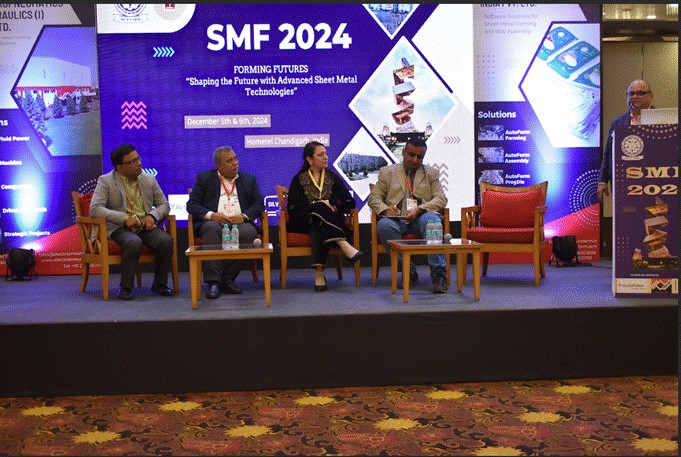
SMF 2024 featured a panel discussion on day 2, moderated by Mr. Avinash Khare, Consultant at Tool Maker’s Facility, India. The panel included distinguished experts such as Prof. Hariharan K. (Associate Professor, IIT Madras), Mr. Prashant Kulkarni (Regional Manager, Altair Engineering India Pvt. Ltd.), Dr. Rahul Kumar (Tata Steel), and Prof. Ekta Singla(Associate Professor, IIT Ropar).
SMF 2024 aimed to provide insights into the future of metal forming research and promote knowledge-sharing among experts. The biennial event concluded successfully, with SMF 2024 Organizing Secretary Prof. Anupam Agrawal and Co-Organizing Secretaries Prof. Navin Kumar and Prof. Ekta Singla—receiving widespread appreciation for their efforts. The conference ended on Day 2 with a valedictory address by Prof. Anupam Agrawal.
The Department of School Education and Literacy, Ministry of Education, Government of India has been implementing a rolling programme of sample based National Achievement Survey (NAS) aimed at classes III, V, VIII and X with a cycle period of three years. The last National Achievement Survey (NAS) was held on 12th November, 2021.
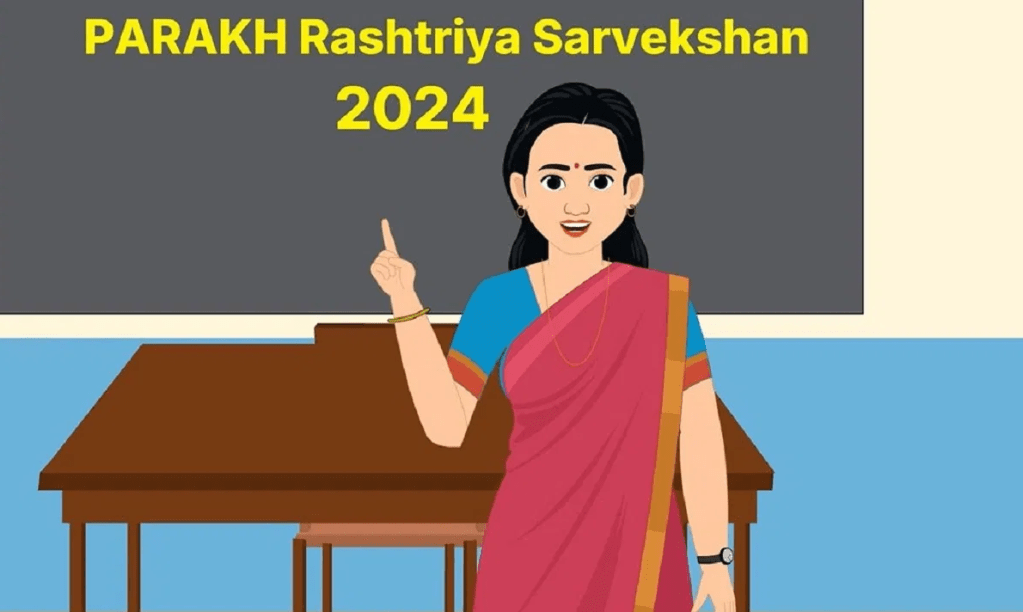
In pursuance of the recommendations of the National Education Policy (NEP) 2020, National Assessment Centre, PARAKH (Performance Assessment, Review, and Analysis of Knowledge for Holistic Development) has been setup by the Ministry of Education under the National Council of Educational Research and Training (NCERT) and has been entrusted with the responsibility of carrying out the next round of NAS, hereafter referred to as PARAKH Rashtriya Sarvekshan 2024. The survey will be held on 4th December, 2024 across the country and will help to assess the competencies developed by students at the end of foundational, preparatory and middle stages (i.e., Students currently in 3rd, 6th and 9th Grades) and help to take remedial measures. The instrument development, testing, finalization of the test items and survey tools have been developed by PARAKH, NCERT. However, the administration of the test in the sampled schools will be done by CBSE in collaboration with the respective States/UTs.
The PARAKH Rashtriya Sarvekshan is a baseline study to understand the achievement of the stage specific competencies at the end of foundation, preparatory and middle stages as per NEP 2020. It will cover the entire spectrum of schools i.e., Government Schools (Central Government and State Government), Government Aided Schools and Private schools across the country. It is expected that around 23 lakh students of approximately88 thousand schools spread out in 782 districts across 36 States and UTs will be covered in the PARAKH Rashtriya Sarvekshan 2024. Students of Grades 3, 6, and 9 will be assessed in the subjects, Language, Mathematics, the World Around Us, Science and Social Science. The Test would be conducted in 23 mediums of instructions covering Assamese, Bengali, Gujarati, Hindi, Kannada, Konkani, Malayalam, Manipuri, Marathi, Nepali, Oriya, Punjabi, Sanskrit, Santhali, Sindhi, Tamil, Telugu, Urdu, Bodo, English, Mizo, Garo & Khasi.
For smooth and fair conduct of the survey 94878 Field Investigators, 75,565 Observers, 3128 District Level Officers and 180 State Nodal Officers from 36 States and Union Territories have been appointed. Also, 782 Board Representatives along with 38 National Level Observers have been appointed in the districts for monitoring the overall functioning and ensuring fair conduct of the Survey. All the personnel have been provided extensive training regarding their roles and responsibilities.
A National Steering Committee has been constituted for conduct of PARAKH Rashtriya 2024 headed by Secretary, Department of School Education and Literacy, Ministry of Education. A Portal https://ncert.nic.in/parakh/rashtriyasarvekshan.php has been launched to enable coordination with various key functionaries for smooth conduct of PARAKH Rashtriya 2024. National, State and District Report cards for all Stages covered under the survey will be released and placed in public domain.
India International Science Festival (IISF) is going to be celebrated at Indian Institute of Technology Guwahati during 30 Nov. to 3 Dec. 2024. The Council of Scientific and Industrial Research (CSIR) is the nodal department for this year IISF and a constituent laboratory of CSIR namely National Institute for Interdisciplinary Science and Technology (CSIR-NIIST, Thiruvananthapuram) is coordinating the whole festival. IISF is a unique festival of science society engagement which was initiated in the year 2015 and the very first IISF was organised at IIT Delhi. Vijnana Bharati, a science movement of India conceptualized this science festival. North East India will witness this festival for the first time. To date, India International Science Festival has been the largest science event in the country with a participation of thousands of people who come together annually to foster scientific collaboration, inspire young minds and propel economic growth through scientific approaches.
“IISF is not only meant for the people who do science. The key philosophy of IISF is the celebration of science by all, and thus it also engages common people in a joyful and entertaining manner”.
This year in 2024, IISF is being organized at IIT Guwahati, Assam from November 30th – December 4th, 2024. The theme of this 10th edition of IISF is “Transforming India into an S&T driven Global Manufacturing Hub”. It reflects the government’s aim to merge science and technology with industrial growth, making India global leader in manufacturing.
IISF Organizers and Organizing Partners
The Ministry of Science and Technology (MoS&T), through their departments viz. Department of Science & Technology (DST), Council of Scientific & Industrial Research (CSIR), Department of Biotechnology (DBT) and Ministry of Earth Science (MoES) is responsible for conducting this mega annual event. Along with government organizations Vijnana Bharati has been a consistent organizing partner of IISF since the inception of this event.
The other organizations that took active part in IISF are office of Principal Scientific Advisor (PSA) to Govt. of India, Department of Space (DoS), Department of Atomic Energy (DAE), Directorate of Defence Research & Development (DDR&D), Ministry of New And Renewable Energy (MNRE), Ministry of Health & Family Welfare (MoH&FW), Department of Agricultural Research and Education (DARE), Ministry of Environment, Forest and Climate Change (MoEFCC), Ministry of Ayush, Ministry of Electronics and Information Technology (MeitY), Ministry of Rural Development (MoRD), and many other concerned ministries, their departments, councils and organizations.
The IISF-2024 is being coordinated by the CSIR, convened by CSIR-NIIST and partnered by all the major ministries and scientific departments of the Government of India in collaboration with Vijnana Bharati.
Thematic Events of IISF-2024
IISF has various themes that aim to indulge scientific and common people for diverse scientific discussions and activities. Here, everyone gets a chance to engage and learn scientific approaches due to the themes that have been planned after keeping in mind the needs of various stakeholders. For IISF some new themes have been added as per the need of North East India and here a little information is been given about all themes.
To begin with, IISF 2024 has one special event “Chandrayaan – The Museum of the Moon” where an artistic model by British artist Dr. Luke Jerram will be placed among the attendees to showcase and celebrate India’s success of Chandrayaan Mission. The model is a replica of the moon that measures about seven meters in diameter and will showcase the real like imagery of lunar surface where Chandrayaan was landed on August 23, 2023.
Mega Science and Technology Exhibition will showcase accomplishments and success stories of India in the field of Science, Technology, Engineering, and Mathematics (STEM). In the expo various technologies developed by Indian Scientific and R&D Institutions across the country kept on display for all four days of the festival to show and educate students, scientists, and the general public.
Make in India, Make for theWorld event aims to attract national as well as international organizations involved in manufacturing, technology, and logistics to discuss about things required to make India a global manufacturing hub.
The New Nalanda known earlier as Student Science Village will enable interaction of students and teachers. The event aims to ignite students’ interest in STEM through interactive exhibits, demonstrations, educational games and challenges.
Pragya Bharat event will discuss New Frontiers in S&T that are needed to make India Viksit Bharat by 2047. The event aims at promoting cutting edge research across various scientific disciplines like AI, Biotechnology, Cybersecurity, Robotics, Quantum Computing etc. which can make India developed and self-reliant.
Nari Shakti – Women’s Development to Women-led Development in S&T event will focus on active participation of women in STEM and Entrepreneurship and discuss about various schemes provided by Government of India to empower women in S&T.
S&T Hackathon – Ideas for Viksit Bharat event is designed to encourage school and college students to develop innovative solutions related to science and technology, focusing on Viksit Bharat Sankalp. Teams comprising of students and mentors will be allowed to participate in the competition and winners will get attractive prizes whereas final participants will get special benefits like internships, project positions etc.
Young Scientists Conclave intends to bring together young researchers, scientists and innovators below the age of 45 years belonging to academia, research and industry fraternities. It enables young researchers to be aware of the scientific policies of India and the recent developments in science and technology of India including infrastructure development, funding opportunities etc.
Thought Leaders Round Table – Minister – Secretary – Councils – CEO Conclave will bring the leaders and policy makers like Central and State Government Ministers, Departmental Secretaries, S&T Councils and CEOs of Industries on one platform. The event will have discussions on important issues and establish collaborations for making big changes in public and private sectors that can align with the goal of Viksit Bharat.
The Gurukula – Aspiring Educators and Teachers Workshop earlier known as The National Science Teachers Workshop aiming at the professional development of science teachers by equipping them with innovative teaching methodologies, modern tools and strategies to effectively impart scientific knowledge to students.
Mission Start-up eventoffers the opportunity to Start-ups and supporting enablers like incubation centres. Start-ups in this event can showcase their products and services to the investors and associates which in turn help them grab the further opportunities under Start-up India mission and other initiatives available in the country.
Reimagining Bharat Exhibition – Transformation through New Age Technologies aims to showcase emerging technologies and prototypes/models developed by Governmental Agencies and Departments. The S&T areas targeted for this event are not limited to fundamental and applied sciences, agriculture, healthcare, space, education, strategic sectors, robotics, etc.
Sagarika – The Tale of Earth Sciences event as name suggest aims to engage and educate people on different areas of earth science such asmeteorology, oceanography, ecology etc. Through this event, IISF desires to raise public awareness on environmental issues.
Science beyond Borders event is aimed at fostering international collaboration, partnerships and exchange of dialogues among scientists, researchers and institutions to address global challenges in S&T.
Vigyanika event celebrates Science Literature Festival which aims to promote science literacy and effective science communication strategies in Indian languages. The interactions done through keynote lectures, panel discussions and scientific sessions among S&T authors, Vigyan Kavi Sammelan, Science Drama and arts, and related competitions.
Fusion Forum – The Atomic Assembly event will discuss the current perspectives, future benefits, and pressing challenges in implementing nuclear energy in India for various sectors like Generation of power, nuclear medicine, agriculture, Additive manufacturing etc.
Student – Scientist Interaction Program – Face to Face with New Frontiers in Science mediates interaction and short discussion based sessions of students/researchers with experts of various disciplines of S&T to inspire students to pursue science and research career.
National Social Organizations and Institutions Meet (NSOIM), well understand the role of social organizations promotion of S&T and thus provides them platform to discuss scientific interventions and sustainable models for societal development and nation-building.
Vision Sansad aims at bringing together key leaders like Directors, Vice Chancellors, Presidents and Senior Leaders from every possible science institution of the country where discussions can take place strategies for advancing scientific research, collaboration and policy development to address current challenges and shaping the future of Indian science in an inclusive manner.
Science Safari Science through Games and Adventures provides a platform to display science-based toys and games and also workshops are being organized to let the teachers learn the ways these toys used for teaching purposes.
S&T Media Conclave will bring media personnel, journalists, communicators and general public on a platform where they can discuss the challenges and opportunities of communicating science to a wide audience, best ways of science communication and preventing misinformation, and strategies to enhance collaboration between scientific community and media.
Saga of Science Chronicles is an evening event that will tell the history and recent developments of Indian science and scientists through LED light show that will happen during 7:30 pm – 9:30 pm during each day of IISF 2024.
Science Odyssey of the North East will address the challenges that hinders the growth of science and technology in North East and discuss the ways of promotion of science and technology of North East.
The Taste of the Hills- North East Food Street will showcase the food heritage of North East and let the people eat and enjoy their traditional food items. The Food Street will remain open throughout IISF 2024.
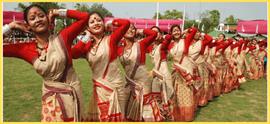
North East Symphony- North East Cultural Fest will portray North East India’s diverse traditions, customs, and arts through experience of music, dance, crafts, and traditional practices. The fest is staged during the whole duration of IISF 2024.
IISF 2024, promises to be a landmark event in promoting science and technology. With the current theme it seeks to celebrate India’s scientific achievements and foster collaboration across various sectors. The event will feature diverse activities, engaging both scientific professionals and the general public. It is open for all and free so one has to attend the event to see India’s scientific achievements.
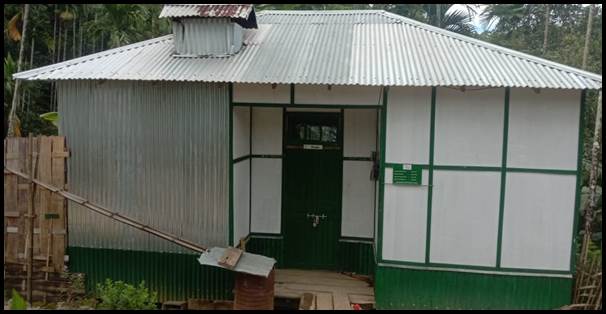
In the small village of ‘Rotlang W’ in Mizoram,’ Nondo’s family faced a constant battle for survival. As a daily wage laborer, Nondo worked tirelessly to feed his wife and five children. Yet, no amount of effort could change the harsh reality of their living conditions. Their dilapidated kutcha house, with its leaky roof and crumbling walls, offered little protection against the elements.
During the monsoons, water seeped through the roof, soaking their clothes and bedding. Winters were unbearably cold, with biting winds finding their way through the fragile structure. The family’s health and peace of mind suffered with every cold night made us worry if our house would hold up.
Relief came in 2017 when Nondo’s name appeared on the beneficiary list of the Pradhan Mantri Awaas Yojana – Grameen (PMAY-G). The scheme, designed to provide pucca houses for vulnerable rural families, offered Nondo the opportunity to build a secure home. With financial assistance and support from local officials, construction of his house began.
Lunglei District, Mizoram
By the end of the year, the family moved into their new home. It was a simple and sturdy structure, built to withstand harsh weather and provide a safe haven for the family. The new house brought a profound sense of security to Nondo’s family. No longer did they worry about rainwater flooding their home or chilly winds making their children sick. Their pucca house stood firm against the elements, offering warmth and stability. The newfound security also gave Nondo a sense of pride and belonging. For the first time, his family could welcome guests into their home without embarrassment or fear of judgment.
Nondo’s story is a testament to the transformative power of PMAY-G, launched in 2016 by the Government of India to fulfil the vision of “Housing for All.” The scheme focuses on providing pucca houses with essential amenities to rural families living in kutcha houses or without a home. The key features of PMAY-G include providing financial assistance for constructing houses with a minimum size of 25 square meters. The scheme prioritizes vulnerable groups such as houseless families, households without literate adults, and those reliant on casual labour for income. Special emphasis is placed on supporting marginalized communities, including Scheduled Castes, Scheduled Tribes, and other disadvantaged sections of society.
Through such targeted measures, the program ensures that the most deserving households, like Nondo’s, benefit first.
Today, Nondo and his family live with peace of mind, no longer burdened by the fear of homelessness or the harshness of nature. Their pucca house is more than a shelter; it is a symbol of hope, resilience, and progress.
Ministry of Food Processing Industries (MoFPI) is implementing a Centrally Sponsored- “Pradhan Mantri Formalisation of Micro Food Processing Enterprises (PMFME) Scheme” for providing financial, technical and business support for upgradation of micro food processing enterprises in the country. The scheme is operational for a period of five years from 2020-21 to 2025-26 with an outlay of Rs. 10,000 Crore. The scheme aims to enhance the competitiveness of existing individual micro-enterprises in the unorganized segment of the food processing industry and promote formalization of the sector. The Scheme primarily adopts One District One Product (ODOP) approach to reap the benefit of scale in terms of procurement of inputs, availing common services and marketing of products. It provides the framework for value chain development and alignment of support infrastructure. The ODOP are identified by States / UTs based on the agriculture production, raw material availability, perishability of the product etc. The details of financial assistance offered to the prospective entrepreneurs under PMFME Scheme to promote ODOP are at Annexure.
Ministry of Food Processing Industries (MoFPI) extends financial assistance as grant-in-aid to various institutions/ universities, Public funded organizations and recognized R&D laboratories both in public and private sector, to promote and undertake demand driven R&D work in the Food Processing Sector for product and process development, design and development of equipment, improved storage, shelf-life, packaging etc.
Under the scheme, financial assistance as grant-in-aid is given to Private organizations/ Universities/institutions/R&D laboratories and Council of Scientific & Industrial Research (CSIR) recognized R&D units in private sector to the tune of 50% of equipment cost in general areas and 70% in difficult areas and to various Universities, Indian Institute of Technology(IITs), Central/ State Government Institutions, Government funded organizations to promote and undertake demand driven R&D work in food processing sector for product & process development, design and development of equipment, improved storage, shelf-life, packaging etc. R&D projects of Government organizations/ Institutions are eligible for 100% grant-in-aid for the cost of equipment, consumables and expenditure related to Research Fellows, etc. R&D portal had been developed through the National Institute of Food Technology, Entrepreneurship & Management (NIFTEM), Kundli, Sonepat, Haryana to disseminate information relating to research & development work supported by MoFPI scheme, including outcomes, technologies developed, etc. The portal will also be a repository of R&D work by other Ministries/Institutions in the food processing sector.
This information was given by Union Minister of Food Processing Industries Shri Chirag Paswan in a written reply in Lok Sabha today.
ANNEXURE
The details of financial assistance offered to the enterprises under Pradhan Mantri Formalisation of Micro Food Processing Enterprises (PMFME) Scheme are as under:
(i). Support to Individual / Group Category Micro Enterprises: Credit-linked capital subsidy @35% of the eligible project cost, maximum ceiling Rs.10 lakh per unit;
(ii). Support to SHGs for seed capital: Seed capital @ Rs. 40,000/- per member of SHG engaged in food processing for working capital and purchase of small tools subject to maximum of Rs. 4 lakh per SHG Federation.
(iii). Support for Common Infrastructure: Credit linked capital subsidy @35% subject to maximum of Rs. 3 crore to support FPOs, SHGs, Cooperatives and any Government agency for setting up of common infrastructure. The common infrastructure will also be available for other units and public to utilize on hiring basis for substantial part of the capacity.
(iv). Branding and Marketing Support: Grant upto 50% for Branding and Marketing to groups of FPOs/ SHGs/ Cooperatives or an SPV of micro food processing enterprises.
(v). Capacity Building: The scheme envisages training for Entrepreneurship Development Skilling (EDP+): program modified to meet the requirement of food processing industry and product specific skilling.
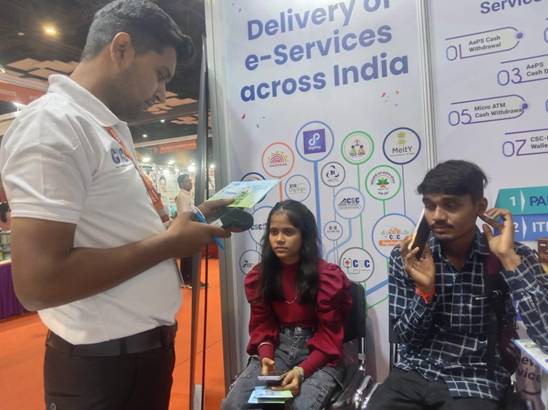
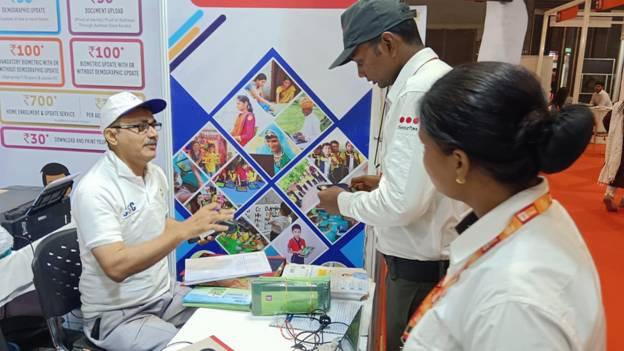
The Ministry of Electronics and Information Technology has set up a vibrant stall at the India International Trade Fair (IITF) in Hall No. 14. Hosted by Common Service Centers (CSC), the stall showcases a wide range of digital and community services, including the Grameen eStore, CSC Academy, DigiPay, Aadhaar-related services, and other key initiatives. The primary aim of this exhibit is to spread awareness about the facilities provided by CSC and encourage more people to leverage these services for their empowerment.
The Dynamic Leaders Behind the Stall
This CSC stall is led by two dedicated and inspiring Village Level Entrepreneurs (VLEs) from Delhi, Siddharth and Vikas. Their dedication and commitment reflect the transformative power of digital services, as they serve their communities while setting examples for others.
Siddharth: A 22-Year-Old Visionary
Siddharth, a 22-year-old entrepreneur, started his CSC center in 2020. Operating from Mandawali, Delhi, he faced the responsibility of supporting his family right after completing his 12th-grade education. Despite the challenges, he turned his situation around by utilizing the income generated through CSC services. Today, Siddharth manages services such as Aadhaar registration, DigiPay, and Grameen eStore with great efficiency. His journey is a testament to how young individuals can transform their lives by seizing the right opportunities.
Vikas: A Story of Resilience and Success
50-year-old Vikas has overcome significant challenges in his life. Stricken by polio in childhood, he experiences difficulty walking. However, his determination never wavered, and he established his CSC center in the Rohini area of Delhi. Vikas’s story serves as a powerful reminder that physical limitations cannot hinder one’s drive and potential for success. Through his center, he provides vital services like Aadhaar enrollment, seamless transactions via DigiPay, and other government schemes.
The CSC Stall: A Symbol of Digital Empowerment
Visitors to the CSC stall at IITF can explore opportunities like the Grameen eStore, which facilitates easy buying and selling of products, DigiPay for cashless transactions, and CSC Academy’s programs to enhance digital literacy. The efforts of VLEs like Siddharth and Vikas underscore how digital services can bridge gaps and empower individuals, even in the face of adversity.
Role Models for Society
The inspiring journeys of Siddharth and Vikas illustrate that digital services are not just tools for livelihood but also a means to uplift every segment of society. Their hard work and dedication have made them role models for countless others aspiring to achieve financial independence and social impact.
The CSC stall at the India International Trade Fair exemplifies the success of the Digital India initiative, reaching even the remotest corners of the country. Siddharth and Vikas, with their resilience and determination, stand as shining examples of this transformation. Their stories teach us that success is achievable despite challenges if one has perseverance and the right opportunities. CSC’s initiative not only promotes digital inclusion but also inspires individuals across the nation to become self-reliant and empowered.
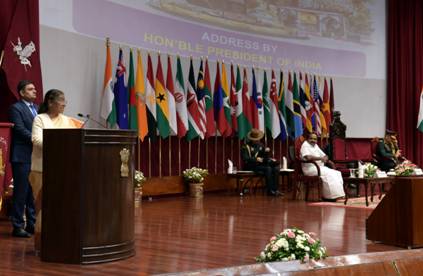
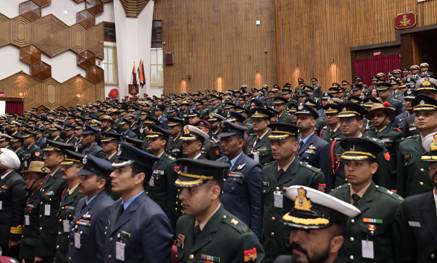
President Smt Droupadi Murmu visited the Defence Services Staff College (DSSC), Wellington in The Nilgiris District, Tamil Nadu on November 28, 2024. Addressing the student officers and faculty, the President said the DSSC has made commendable contribution to training & educating the potential leaders of the Armed Forces of India and friendly countries & selected civilian officers. Over the past seven decades, it has played a major role in professionally grooming the middle level officers. It has the unique distinction of having a composite multi-service and multi-national group of student officers and a professionally enriched faculty.
The President was happy to note that women officers are now commanding various units in all the three services. She said that the increasing strength and role of women in all spheres is encouraging and inspiring for all, especially young girls. She expressed hope for witnessing more and more women joining the Armed Forces, where they can demonstrate exceptional capabilities and break new ground in uncharted territories.
The President said that India is rising and the world is acknowledging the growth in various sectors, including defence. India is moving towards indigenisation and self-reliance to keep the Armed Forces ready to meet the future challenges. The country is being developed as a major defence manufacturing hub, and is moving towards becoming a reliable defence partner & big defence exporter.
The President said: “In the fast-changing geopolitical environment, we need to be well-prepared to tackle any situation. We not only have to secure our national interests, but also prepare for new national security challenges like cyber warfare and terrorism. Updated knowledge and cutting-edge technologies based on intensive research are required to be applied.” She expressed confidence that this course will prepare student officers all for higher responsibilities and as strategists who can deal with complex situations in an effective manner.
The President appreciated the unique role of the institution in nurturing the future senior leadership of the Armed Forces. She appreciated the creativity, dedication and the focus with which training is being conducted at the College. She also complimented the student officers for having being selected for the prestigious Staff Course at DSSC, and their rigourous efforts while undertaking this course.
The President also interacted with the Student Officers, including 38 from friendly countries, attending the course at the DSSC. She hailed the role of the International Student Officers in strengthening the mutual cooperation and relationship of their countries with India, and wished them a fruitful and successful stay at DSSC.
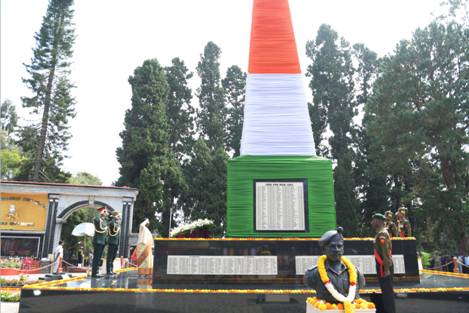
The President also laid a wreath at the War Memorial, and interacted with Ex-servicemen & Veer Naris.
The President felicitated the Veer Naris acknowledging the supreme sacrifice of their loved ones in the service to the Nation. She was accompanied by Minister of Backward Classes (Minister-in-Waiting) of Tamil Nadu Government Shri Siva V Meyyanathan and Commandant DSSC Lt Gen Virendra Vats.
Established in 1948, DSSC is a premier Tri-services institute with a mandate to train and hone their skills of selected middle-level officers of the Armed Forces of India and friendly countries. Since its inception, the College has trained more than 2,000 International Officers, and 24,000 Indian Officers have passed through its portals. The College alumni, over the years, have risen to become heads of States and Militaries across the world. The President appreciated the training activities being conducted at the College with special emphasis on initiatives undertaken on enhancing jointmanship amongst the officers of the Indian Armed Forces.
To protect, promote & preserve various forms of folk art and culture throughout the country, the Government of India has set up seven Zonal Cultural Centres (ZCCs) with headquarters at Patiala, Nagpur, Udaipur, Prayagraj, Kolkata, Dimapur and Thanjavur. Annual grant-in-aid is released to these seven ZCCs for organizing various cultural activities and programmes on regular basis in their member States.
To promote the tribal culture, various festivals like Hornbill Festival, Octave, Tribal Dance Festival, Adi Bimb, Adi Sapta Pallav, Adi Lok Rang, Adiwasi Mahotsav etc. are organized through Zonal Cultural Centres (ZCCs) of Ministry of Culture to showcase unique forms of folk dances, songs, cuisine, exhibitions and demonstration of traditional skill in painting, art & craft etc. Artists are engaged by ZCCs from tribal areas to showcase their talents in various cultural programmes/ activities organized by them for which they are paid honorarium, DA/TA, boarding & lodging etc. The annual grant-in-aid released to the seven ZCCs for organizing various cultural activities and programmes during the last three year is as under:
(Rs. in lakh)
Sl. No.
Year
Amount released
1.
2021-22
6798.08
2.
2022-23
6572.06
3.
2023-24
11967.57(as on 31st March, 2024)
Ministry of Tribal Affairs is implementing the schemes of “Support to Tribal Research Institutes and Tribal Research, Information, Education, Communication and Events” under which various activities are undertaken to conserve and promote tribal culture, archives, artefacts, customs and traditions of the tribal communities.
Under the Scheme of “Tribal Research, Information, Education, Communication and Events (TRI-ECE)”, reputed research Institutes/ Organizations/ Universities have undertaken various research studies/ publication of books/ documentation including audio visual documentaries etc.
Kerala is a member State of South Zone Cultural Centre (SZCC), Thanjavur (an autonomous organization under Ministry of Culture) which regularly organizes cultural activities/ programmes in the State of Kerala, Andhra Pradesh, Telangana, Karnataka, Tamil Nadu, Union Territories of Andaman & Nicobar Islands, Lakshadweep and Puducherry. During the last three (03) years, funds released to SZCC, Thanjavur for organizing cultural activities/ programmes in its member States are as under:
(Rs. in lakh)
Sl. No.
Year
Amount released
1.
2021-22
1640.48
2.
2022-23
994.87
3.
2023-24
2135.39
A list of programmes organized by SZCC, Thanjavur in the State of Kerala during the last three (03) years is as under
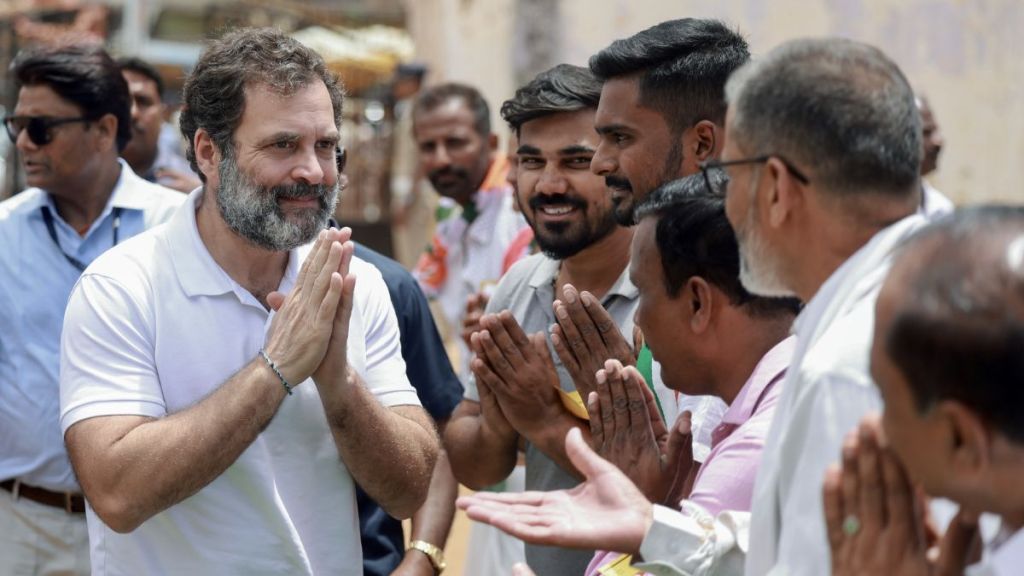
Demography, encompassing factors like age, caste, and religion, influences voting patterns in Karnataka state elections. Understanding the composition of the electorate helps analyze alliances and voting behavior. Rahul Gandhi, a prominent politician from the Indian National Congress, has campaigned in Karnataka and sought to mobilize support for his party. His effectiveness in connecting with voters and influencing the election outcome varies, as it depends on multiple factors beyond an individual’s influence. Other dynamics, such as party strategies, local issues, and the performance of rival parties, also play crucial roles in determining the results of Karnataka state elections.
Demography plays a significant role in elections as it involves the study of population characteristics and their influence on political outcomes. In the context of the Karnataka state election results, demography can provide insights into the composition of the electorate, such as age, gender, caste, and religion, which can shape voting patterns and alliances. Rahul Gandhi is a prominent Indian politician and a member of the Indian National Congress party. His role in the Karnataka state election results would depend on various factors, including his party’s performance, his campaign efforts, and his ability to connect with voters. While he may have campaigned in the state and tried to mobilize support for his party, the overall outcome of the election would depend on multiple factors beyond any individual’s influence.
Changing Demography of Karnataka
Karnataka has experienced significant demographic changes in recent years. The state’s population has been growing steadily, primarily due to natural increase and in-migration from other parts of India. According to the 2011 census, Karnataka had a population of approximately 61 million. Urbanization has been a prominent trend in the state, with cities like Bengaluru, Mysore, and Mangalore witnessing rapid growth. Bengaluru, in particular, has emerged as a major IT and technology hub, attracting professionals from different parts of the country. This influx of migrants has contributed to the cosmopolitan nature of the city. Karnataka is linguistically diverse, with Kannada being the primary language spoken by a majority of the population. However, there are also significant populations that speak other languages such as Tamil, Telugu, Urdu, and Konkani, among others. In terms of religious composition, Hinduism is the predominant religion in Karnataka, followed by Islam, Christianity, and Jainism. The state is also home to various religious sects and communities, contributing to its religious diversity. Caste continues to be a factor influencing Karnataka’s demography and politics. Historically influential communities, such as the Lingayats and Vokkaligas, have played significant roles in the state’s social and political landscape. However, other communities, including Scheduled Castes (Dalits) and Scheduled Tribes, have also gained political representation and influence.
It’s important to note that the demographic landscape of Karnataka may have evolved since my last update. For the most up-to-date and precise information, referring to recent studies and official data sources is recommended.
Emergence of Rahul Gandhi
Rahul Gandhi is a prominent Indian politician and a member of the Indian National Congress party. He is the son of former Indian Prime Minister Rajiv Gandhi and the grandson of former Prime Minister Indira Gandhi. Rahul Gandhi’s emergence as a political figure in India began with his active involvement in the Indian National Congress party and his eventual entry into electoral politics. Rahul Gandhi initially served as a general secretary of the Indian National Congress, working behind the scenes to strengthen the party’s organization and support its electoral campaigns. Over time, he took on a more prominent role within the party, becoming the vice president in 2013 and eventually the president of the Indian National Congress in 2017. Rahul Gandhi’s emergence as a political leader has been characterized by efforts to connect with the youth, marginalized communities, and rural populations. He has advocated for issues such as social justice, inclusivity, and economic development. Rahul Gandhi has campaigned extensively in various state elections, including Karnataka, and has sought to rally support for his party’s candidates. While Rahul Gandhi has garnered a considerable following and support within the Indian National Congress party, his political journey has seen ups and downs. He has faced criticism and scrutiny from political opponents and has been actively involved in debates and discussions on various national and regional issues. It is worth noting that political dynamics and individual influence can vary over time, and the specific impact and future trajectory of Rahul Gandhi’s emergence in Indian politics will continue to evolve as political landscapes change.
History of Karnataka Elections
The history of Karnataka elections dates back to the formation of the state in 1956. Since then, Karnataka has witnessed numerous state assembly elections as well as Lok Sabha (parliamentary) elections. Here is a brief overview of the history of Karnataka elections: Early Years: The first general elections in Karnataka took place in 1957. The Indian National Congress (INC) dominated the political landscape in the early years, winning the majority of seats in the state assembly. Coalition Politics: In the 1980s and 1990s, Karnataka witnessed the rise of coalition politics. The Janata Party, a coalition of various anti-Congress parties, came to power in 1983, marking a shift from single-party dominance. This period saw multiple governments being formed by different alliances, including the Janata Dal and Bharatiya Janata Party (BJP). Rise of the BJP: The Bharatiya Janata Party (BJP) gained prominence in Karnataka during the late 1990s and early 2000s. In 2004, the BJP formed its first government in the state, led by Chief Minister B.S. Yeddyurappa. However, the government faced internal issues, leading to its collapse. Congress Revival: The Indian National Congress made a comeback in Karnataka politics, winning the state assembly elections in 2013. Siddaramaiah became the Chief Minister, leading a Congress government. However, in the 2018 elections, the Congress was unable to secure a majority, leading to a coalition government with the Janata Dal (Secular) party.
Recent Elections: In the most recent state assembly elections held in 2018, the BJP emerged as the single largest party. After a period of political uncertainty, the BJP formed the government with B.S. Yeddyurappa as the Chief Minister. However, in subsequent by-elections, the BJP lost a few seats, resulting in a change of Chief Minister with B.S. Yediyurappa resigning and Basavaraj Bommai taking office in 2021. It’s important to note that the political landscape in Karnataka has been dynamic, with various parties and alliances vying for power. State elections in Karnataka have seen the emergence of regional parties, coalition governments, and shifts in power between the Indian National Congress and the Bharatiya Janata Party. The outcome of elections in Karnataka has had implications for state governance as well as national politics.
New Challenges for Congress Party
The Congress Party in India has faced several challenges in recent years. Here are some of the key challenges it has encountered:
Electoral Performance: The Congress Party has witnessed a decline in its electoral performance, especially in national elections. In the 2014 and 2019 Lok Sabha elections, the party faced significant setbacks, winning only a limited number of seats. This decline has impacted its overall political influence and ability to form a government at the national level.
Leadership Crisis: The party has grappled with a leadership crisis, with a lack of clear and dynamic leadership. This has resulted in a leadership vacuum and internal factionalism, which have weakened the party’s ability to present a united front and effectively communicate its message to the electorate.
Ideological Positioning: The Congress Party has faced challenges in clearly articulating its ideological positioning. In recent years, there has been a growing trend of political parties aligning themselves with specific ideologies or issues, while the Congress Party has struggled to define and communicate its distinct ideological stance.
Regional Strongholds: The Congress Party has lost ground in many states where it previously had strongholds. Regional parties have gained prominence and appeal, leading to a fragmentation of the political landscape. This has reduced the Congress Party’s ability to form alliances and consolidate its support base.
Youth Appeal: The Congress Party has faced difficulties in appealing to the aspirations and concerns of the younger generation. It has struggled to connect with the youth, who are increasingly looking for dynamic and transformative leadership and policies.
Communication Strategy: The Congress Party has faced challenges in effectively communicating its policies and achievements to the electorate. It has struggled to counter the narrative of its political opponents and has often been perceived as lacking a robust communication strategy.
Organizational Strength: The Congress Party has faced issues with its organizational strength and grassroots presence. It has struggled to rejuvenate its party structure and mobilize workers effectively, particularly at the local level.
To overcome these challenges, the Congress Party needs to undertake significant introspection, revitalize its leadership, redefine its ideological positioning, and strengthen its organizational structure. It must also focus on engaging with the aspirations of the youth and effectively communicate its policies and vision to regain public trust and support.
Concluding Remarks
The Congress Party’s performance in Karnataka elections has been subject to critical appraisal due to a mix of successes and failures. While the party has experienced some notable achievements, it has also encountered significant setbacks. Here is a critical appraisal of the Congress Party’s performance in Karnataka elections:
Mixed Electoral Performance: The Congress Party has had mixed electoral performances in Karnataka. It won the state assembly elections in 2013, forming the government under the leadership of Siddaramaiah. However, in the subsequent 2018 elections, the party failed to secure a majority and had to form a coalition government with the Janata Dal (Secular) party. This highlighted a lack of sustained popularity and the inability to secure a clear mandate.
Leadership Challenges: The Congress Party has struggled with leadership challenges in Karnataka. While Siddaramaiah played a significant role in the party’s victory in 2013, his tenure as Chief Minister was marked by controversies and internal rifts. Additionally, the absence of a strong and decisive leader at the state level has affected the party’s ability to effectively mobilize support and present a cohesive image.
Intra-party Factionalism: The Congress Party in Karnataka has been plagued by factionalism and infighting. Internal divisions and power struggles have hindered the party’s unity and cohesion, leading to weakened electoral campaigns and suboptimal coordination among party members.
Failure to Capitalize on Governance: The Congress Party’s tenure in Karnataka witnessed a mixed record in governance. While some initiatives were undertaken, such as social welfare programs and measures to address agrarian issues, the party failed to effectively communicate and capitalize on these achievements. Inadequate implementation and a lack of clear messaging hindered their ability to connect with voters and secure their trust.
Inability to Counter BJP’s Rise: The Congress Party has struggled to counter the Bharatiya Janata Party’s (BJP) rise in Karnataka. The BJP’s strong organizational structure, effective campaign strategies, and appeal to Hindutva ideology have posed significant challenges for the Congress Party. The party has been unable to effectively counter the BJP’s messaging and address the concerns of a changing electorate.
Failure to Strengthen Party Organization: The Congress Party has faced challenges in strengthening its party organization at the grassroots level in Karnataka. The absence of a robust and well-connected organizational structure has hindered their ability to mobilize support and build a strong voter base.
To improve their performance in national elections, the Congress Party needs to address these critical issues. They should focus on nurturing strong and decisive leadership, resolving internal factionalism, communicating their achievements effectively, countering the BJP’s rise, and revitalizing the party organization at all levels. Additionally, connecting with voters on issues that resonate with them and presenting a clear vision for the state’s development will be crucial in rebuilding public trust and support.
References
Antil, A., & Verma, H. V. (2021). Rahul Gandhi on Twitter: An analysis of brand building through Twitter by the leader of the main opposition party in India. Global Business Review, 22(5), 1258-1275.
Devi, B. U. (2013). Rahul Gandhi’s Immaturity. Economic and Political Weekly, 48(43), 5-5.
Gould, H. A. (1997). General Elections, 1996: Karnataka: Decline and Fall of the Congress Machine. Economic and Political Weekly, 2335-2349.
Manor, J. (2008). Letting a winnable election slip away: Congress in Karnataka. Economic and Political Weekly, 23-28.
Mahapatra, S., & Plagemann, J. (2019). Polarisation and politicisation: the social media strategies of Indian political parties.
Manor, J. (2013). Lucky in Its Adversaries: A Slipshod Congress Gains a Majority in the Karnataka Election. Economic and Political Weekly, 51-59.
Palshikar, S., & Suri, K. C. (2014). India’s 2014 Lok Sabha elections: Critical shifts in the long term, caution in the short term. Economic and Political Weekly, 39-49.
Pinto, A. (1994). Karnataka Assembly Elections: An Overview. Economic and Political Weekly, 3309-3311.
Shastri, S. (2009). Leadership at the state level mattered. Economic and Political Weekly, 88-91.
Shastri, S. (2013). The 2013 Karnataka Assembly Outcome: Government Performance and Party Organization Matters. Studies in Indian Politics, 1(2), 135-152.Simmons, C. (2019). Dynastic Continuity and Election in Contemporary Karnataka Politics. In South Asian Sovereignty (pp. 136-149). Routledge India.
The Ministry of Tourism undertakes various promotional activities in important and potential tourist generating markets with the objective of showcasing India’s tourism potential and promoting tourism to the country, including the state of Himachal Pradesh. Details of promotional activities are as follows:
i. Participation in international travel fairs and exhibitions such as World Travel Market (WTM) London, Feria Internacional de Turismo (FITUR) Madrid, International Travel & Hospitality Show (MITT) Moscow, Asia-Pacific Incentives and Meetings Event (AIME) Sydney, Internationale Tourismusbörse (ITB) Berlin, Arabian Travel Market (ATM) Dubai, International Meeting Exchange (IMEX) Frankfurt, International & French Travel Market (IFTM) Top Resa Paris, Japan Expo, Internationale Tourismusbörse Asia (ITB Asia), Singapore etc.
ii. The Chalo India initiative has been launched by the Ministry to encourage the huge Indian diaspora to become Incredible India ambassadors and encourage their five non-Indian friends to visit India, every year.
iii. A Chalo India portal has also been developed for registration of the Indian diaspora. Further gratis e visa to one lakh foreign tourists, visiting India under the referral program was announced.
iv. Ministry of Tourism has launched the Incredible India Content Hub on the revamped Incredible India digital portal (www.incredibleindia.gov.in) on 27th September, 2024. The Incredible India Content Hub is a comprehensive digital repository of high-quality images, films, brochures and newsletters which can be easily accessed by the industry stakeholders (travel media, tour operators, travel agents) across the globe required to amplify Incredible India in all their marketing and promotional efforts. The revamped Incredible India Digital Portal is a tourist-centric, one-stop digital solution designed to enhance the travel experience for visitors to India.
v. Inviting media personalities, tour operators and opinion makers to visit the country under the Hospitality Programme of the Ministry.
vi. The promotions are being carried out in association with the State Governments and the Overseas Indian Missions including the 20 identified Indian Missions.
Ministry of Tourism, Government of India is not the regulatory authority for deciding the rate structure charged by Tourism Stakeholders.
In order to boost tourism sector in the country during Amrit Kaal, the Ministry of Tourism has taken the following initiatives: –
The Ministry of Tourism undertakes several promotional activities in potential international & domestic markets to promote various tourism destinations and products of the country in holistic manner. This includes release of media campaigns, social media promotions, webinars, participation & support to promotional events, dissemination of information and engagement through website etc. In addition, Indian Missions overseas also undertake various promotional activities to attract more global travellers to various tourist destinations of the country.
Ministry of Tourism launched the Incredible India Content Hub on the revamped Incredible India digital portal which is a comprehensive digital repository, featuring a rich collection of high-quality images, films, brochures and newsletters related to tourism in India. This repository is intended for the use of a diverse range of stakeholders, including tour operators, journalists, students, researchers, film makers, authors, influencers, content creators, government officials and ambassadors.
The Ministry of Tourism under the schemes of ‘Swadesh Darshan’, National Mission on Pilgrimage Rejuvenation and Spiritual Heritage Augmentation Drive (PRASHAD)’ and ‘Assistance to Central Agencies for Tourism Infrastructure Development’ provides financial assistance to State Governments/ Union Territory Administrations/ Central Agencies for the development of tourism related infrastructure and facilities at various tourism destinations in the country.
Ministry has revamped Swadesh Darshan Scheme as Swadesh Darshan 2.0 (SD2.0) with the objective to develop sustainable and responsible destinations following a destination centric approach.
Ministry of Tourism has been providing financial assistance to State Governments/ UT Administrations for organising fairs/festivals and tourism related events.
Ministry is conducting Programmes under the ‘Capacity Building for Service Providers’ (CBSP) Scheme to train and upgrade manpower to provide better service standards.
To enhance the overall experience of tourists by making available a pool of local, trained professionals at tourist sites across the country, Ministry launched the Incredible India Tourist Facilitator (IITF) Certification Programme – a Pan-India online learning program.
Indian Railways have taken various steps to improve the railway network and other infrastructures, which are outlined below:
i) Railway Infrastructure Projects are taken up on the basis of remunerativeness, last mile connectivity, missing links and alternate routes, augmentation of congested/saturated lines, socio-economic considerations, enhancing connectivity to tourist and cultural places etc. depending upon liabilities of ongoing projects, overall availability of funds and competing demands. As on 01.04.2024, out of 488 Railway Infrastructure projects (187 New Line, 40 Gauge Conversion and 261 Doubling) of total length 44,488 Km costing approx. Rs. 7.44 lakh crore, 12,045 Km length has been commissioned across Indian Railways with an expenditure of Rs. 2.92 lakh crore. Augmenting railway infrastructures across Indian Railways is an ongoing and continuous process.
ii) The Ministry of Railways has recently launched the Amrit Bharat Station Scheme for development of Railway stations on Indian Railways. The Scheme envisages development of stations on a continuous basis with a long-term approach. It involves preparation of Master Plans and their implementation in phases to improve amenities at stations, like improvement of station access, circulating areas, waiting halls, toilets, lift/escalators as necessary, platform surfacing and cover over platform, cleanliness, free Wi-Fi, kiosks for local products through schemes like ‘One Station One Product’, better passenger information systems, Executive Lounges, nominated spaces for business meetings, landscaping etc. keeping in view the necessity at each station. So far, 1337 stations have been identified under the Amrit Bharat Station Scheme over Indian Railways.
iii) Under the National Rail Plan (NRP), around 243 tourist destinations in India were identified. Out of these, 111 places are already connected with the existing rail network, 30 tourist places are within a distance of 10 kms from the nearest railway station and 30 are within a distance of 15 kms from the nearest railway station. The remaining 72 locations are primarily wildlife sanctuaries, beaches and areas located in hilly and mountainous terrain where providing rail connectivity is either not advisable or difficult.
Further, with a view to provide enhanced amenities and facilities for tourists, projects for joint development of tourist amenities at 22 railway stations by the Ministry of Railways (MoR) and Ministry of Tourism were sanctioned on cost sharing basis.
Details of month-wise Foreign Tourist arrivals (FTAs) in the country during 2023 and 2024 (till August) are given below:
Ministry of Tourism under its ‘Pilgrimage Rejuvenation and Spiritual Heritage Augmentation Drive’ (PRASHAD) Scheme provides Financial Assistance to the State Governments and Union Territories Administration for development of Tourism Infrastructure at the Pre-Identified Pilgrimage destinations/Heritage Cities. Under this Scheme, infrastructure interventions are carried out in consultation with the State Governments/UTs.
Ministry of Tourism, from time to time receives proposals from various sources regarding development of infrastructure under PRASHAD Scheme and these proposals are evaluated as per scheme guidelines and established procedures.
Ministry of Tourism has sanctioned 46 projects under its PRASHAD Scheme including 3 projects in Andhra Pradesh. A total of 29 sites are identified for development under the PRASHAD Scheme including 2 sites in Andhra Pradesh. The details of the projects sanctioned and sites identified are Annexed.
This information was given by Union Minister for Tourism and Culture Shri Gajendra Singh Shekhawat in a written reply in Lok Sabha today.
Annexure
List of projects sanctioned under PRASHAD Scheme of Ministry of Tourism given below:
(Rs. in Crore)
State/UT
S.No.
Project Name
Sanction Year
Approved Cost
Amount Released
Physical Progress%
Financial Progress%
Andhra Pradesh
Development of Pilgrim Amenities at Amaravati
2015-16
27.77
27.77
100
100
Development of Srisailam Temple
2017-18
43.08
43.08
100
100
Development of Pilgrimage Amenities at Sri Varaha Lakshmi Narsimha Swami Vari Devasthanam at Simhachalam
2022-23
54.04
13.69
28
25
Arunachal Pradesh
Development of Parshuram Kund
2020-21
37.88
21.95
86
58
Assam
Development of Pilgrimage amenities at Kamakhya Temple
2015-16
29.80
29.80
100
100
Bihar
Development at Patna Sahib
2015-16
29.62
29.62
100
100
Development of basic facilities at Vishnupad temple
2014-15
3.63
3.63
100
100
Chhattisgarh
Development of Pilgrimage amenities at Maa Bamleshwari Devi Temple
2020-21
48 .44
32.13
84
66
Gujarat
Development of Dwarka
2016-17
13.08
10.46
100
80
Development of Pilgrimage Amenities at Somnath
2016-17
45.36
45.36
100
100
Development of Promenade at Somnath
2018-19
47.12
47.12
100
100
Development of Pilgrim Plaza with Queue management complex at Somnath Gujarat
2021-22
49.97
0.00
0
0
Development of Pilgrimage Facilities at Ambaji Temple
2022-23
50.00
10.54
30
21
Haryana
Development of Mata Mansa Devi Temple and Nada Saheb Gurudwara
2019-20
48.53
34.68
74
71
Jammu and Kashmir
Development at Hazratbal Shrine
2016-17
40.46
34.30
90
85
Jharkhand
Development of Baba Baidya Nath Dham
2018-19
36.79
34.95
100
89
Karnataka
Development of Pilgrimage Amenities at Sri Chamundeshwari Devi Temple
2023-24
45.71
0.00
0
0
Kerala
Development at Guruvayur Temple
2016-17
45.19
45.19
100
100
Madhya Pradesh
Development of Amarkantak
2020-21
49.99
34.73
68
69
Development of Omkareshwar
2017-18
43.93
43.93
100
100
Maharashtra
Development of Trimbakeshwar
2017-18
42.18
29.93
93
57
Meghalaya
Development of Pilgrimage Facilitation at Nongswalia Church, Nartiang Shakti Peeth, Aitnar Pool and Charantala Kali Temple
2020-21
29.29
24.92
100
100
Mizoram
Development of Infrastructure for Pilgrimage and Heritage Tourism at Chite Vang, Zuangtai, Reiek and Aizawl
2022-23
44.89
13.18
22
29
Nagaland
Development of Pilgrimage Infrastructure at Molungkimong, Noksen Church, Aizuto, Wokha and Kohima
2018-19
25.20
21.33
100
84
Development of Pilgrimage Tourism Infrastructure at Zunheboto
2022-23
18.18
10.90
62
60
Odisha
Infrastructure Development at Puri
2014-15
50.00
10.00
–
20
Punjab
Development of Karuna Sagar Valmiki Sthal at Amritsar
2015-16
6.40
6.40
100
100
Development of Chamkaur Sahib
2021-22
31.57
17.49
79
55
Rajasthan
Integrated Development of Pushkar/Ajmer
2015-16
32.64
26.11
92
80
Sikkim
Development of Pilgrimage Facilitation at Four Patron Saints, Yuksom
2020-21
33.32
28.31
87
85
Tamil Nadu
Development of Kanchipuram
2016-17
13.99
13.99
100
100
Development of Velankanni
2016-17
4.86
4.86
100
100
Telangana
Development of Jogulamba Devi Temple
2020-21
38.90
33.07
72
85
Development of Pilgrimage and Heritage Tourism Infrastructure at Rudreshwara (Ramappa) Temple
2022-23
62.00
12.82
37
21
Development of Pilgrimage Infrastructure at Bhadrachalam
2022-23
41.38
8.43
15
20
Tripura
Development of Tripura Sundari Temple
2020-21
34.43
25.62
63
68
Uttar Pradesh
Development of Varanasi –Phase –I
2015-16
18.73
18.73
100
100
Development of Mathura-Vrindavan as Mega Tourist Circuit (Ph-II)
2014-15
10.98
10.98
100
100
Development of River Cruise Tourism at Varanasi
2017-18
9.02
9.02
100
100
Construction of Tourist Facilitation Centre at Vrindavan
2014-15
9.36
9.36
100
100
Development of Varanasi – Phase II
2017-18
44.60
31.77
100
71
Development of Infrastructure facilities at Govardhan
2018-19
37.59
30.97
99
78
Uttarakhand
Integrated Development of Kedarnath
2015-16
34.77
34.77
100
100
Development of Infrastructure for Pilgrimage Facilitation in Badrinath Ji Dham
2018-19
56.15
27.43
62
49
Augmentation of Pilgrimage Infrastructure Facilities at Gangotri and Yamunotri Dham
2021-22
54.36
10.22
100
18
West Bengal
Development of Belur Math
2016-17
30.03
23.39
92
78
Total
1605.20
1036.96
List of Identified sites under PRASHAD Scheme
S.No.
State/UT
Project / Subject
1
Andhra Pradesh
Annavaram, Kakinada District
2
Andhra Pradesh
Vedagiri Lakshmi Narasimhawamy Temple, Nellore District
3
Bihar
Simariya Ghat, Begusarai District
4
Bihar
Aami Mandir, Saran District
5
Chhattisgarh
Kudargarh Temple, Surajpur District
6
Goa
Bom Jesus, Old Goa District
7
Gujarat
Shri Nilkanth Mahadev Temple, Sunak, Mahesana District
8
Himachal Pradesh
Maa Chintpurni Temple, Una District
9
Jammu & Kashmir
Utterbehni and Purmandal, Samba District
10
Karnataka
Sri Renuka Yallamma Temple, Saudatti, Belagavi District
11
Karnataka
Papnash Temple, Bidar District
12
Madhya Pradesh
Shri Peetmbra Peetha, Datia District
13
Madhya Pradesh
Shanidev Temple, Morena District
14
Maharashtra
Shri Ghrushneshwar Shivalaya, Chhatrapati Sambhaji Nagar District
15
Maharashtra
Tuljapur, Dharashiv District District
16
Maharashtra
Shre Kshetra Rajur, Ganpati Temple, Jalna District
17
Mizoram
Vangchhia, Champhai District
18
Odisha
Chausath Yogini Temple, Ranipur, Jharial, Balangir District
19
Odisha
Maa Kichakeswari Temple in Kiching, Mayurbhanj District
20
Puducherry
Navagriha Temple- Sri Dharbaranyeswarar Temple & Spiritual Park, Karaikal District
21
Punjab
Durgyana Temple, Amritsar District
22
Rajasthan
Shri Karni Mata Mandir, Bikaner District
23
Rajasthan
Sun Temple, Budhahita, Kota District
24
Rajasthan
Malaseri Dungri
25
Tamil Nadu
Navagriha Temple at 8 places in Tamil NaduSri Kailasanathar Temple, Thingalur, Thanjavur DistrictGuru Bhagvan Temple, Alangudi, Thanjavur DistrictSri Naaganathar Temple, Thirunageshwaram, Thanjavur DistrictSri Suryanaar Temple, Thiruvidaimaruthur, Suriyanar Kovil, Thanjavur DistrictSri Agneeswarar Temple, Kanjanur, Thanjavur DistrictSri Vaitheeshwaran Temple, Vaitheeswaran Kovil, Mayiladuthurai District Sri Naganatha Swamy Temple, Keelaperumpallam, Mayiladuthurai District Suweathaaranyshwarar Temple, Thiruvenkadu, Mayiladuthurai District
26
Telangana
Goddess Yellamma Temple at Balkampet, Hyderabad District
27
Uttar Pradesh
Shri Kali Mandir established by Adiguru Shankaracharya, Chowk, Lucknow District
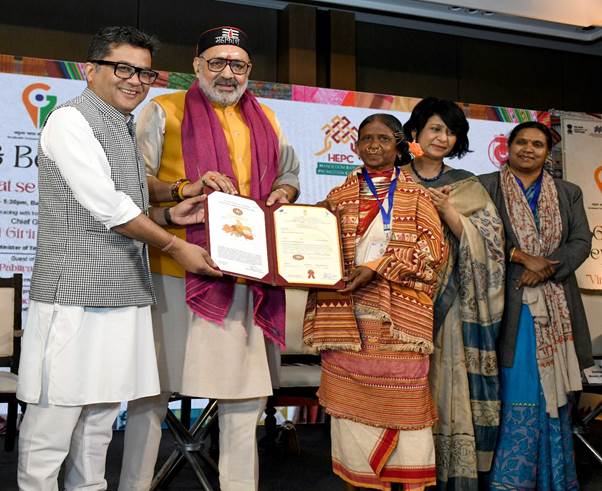
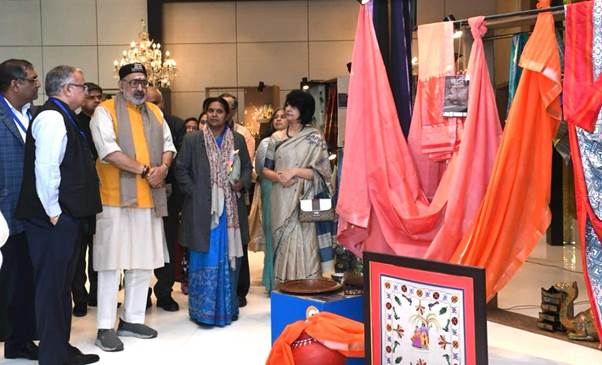
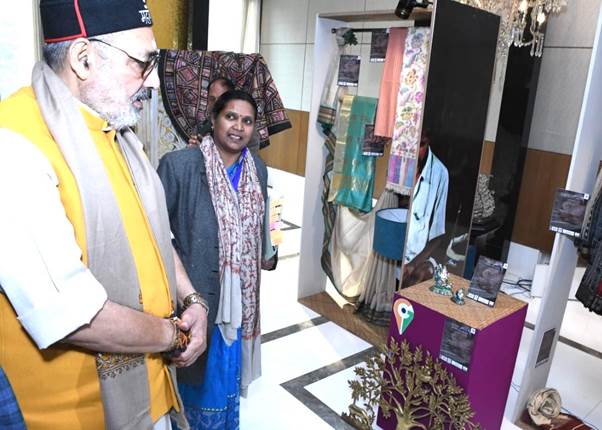
The “GI & Beyond 2024” Summit, organized by the Office of the Development Commissioner for Handlooms, Ministry of Textiles, in collaboration with the Handloom Export Promotion Council (HEPC), successfully concluded on 25.11.2024 at New Delhi. The event highlighted the exceptional skills of artisans who manufactured India’s Geographical Indication (GI) tagged handloom and handicraft products and their global significance.
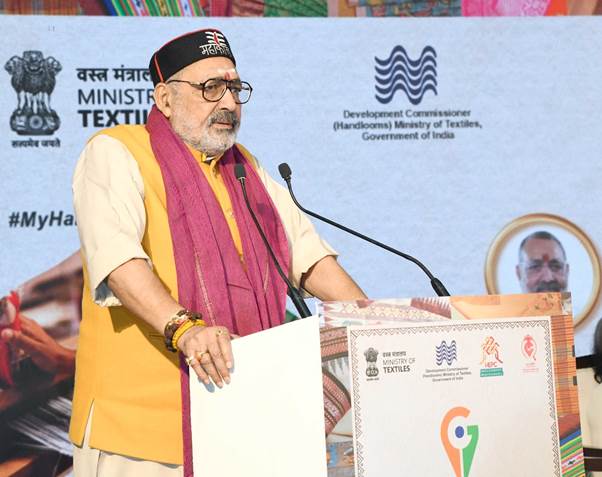
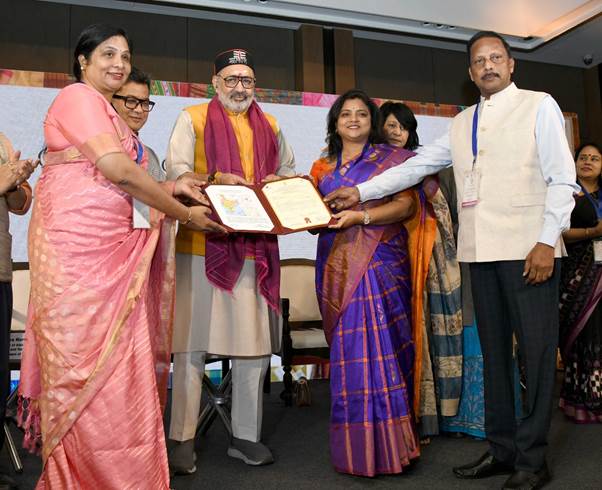
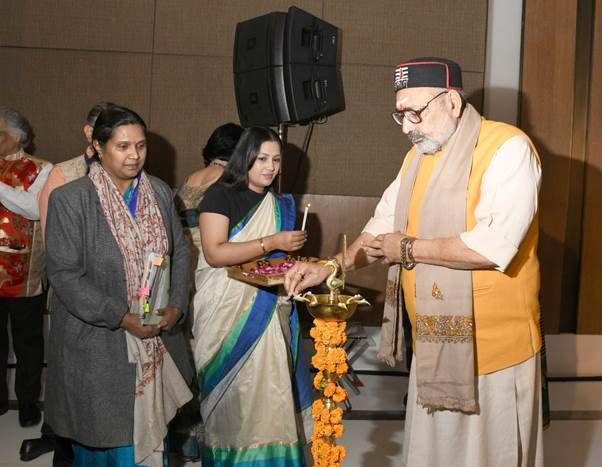
The event was inaugurated by Shri Giriraj Singh, Hon’ble Union Minister of Textiles as chief guest who highlighted the importance of GI products in promoting India’s rich cultural heritage and invited attention of the gathering on the attractive tourism concepts like heritage and cultural tourism for marketing GI goods. HMOT distributed GI certificates to 10 artisans from various parts of the country. Speaking on the occasion, Shri Giriraj Singh said that India received its 1st GI certification in 2004 and now our focus is to increase the income of artisans and how to make GI tagged products go global. The Minister exhorted that we should progress the GI tagged products from “Gaon to Global”. HMOT emphasised the importance of marketing and telling the world about the creativity of our artisans for the promotion of GI products and incorporate the GI tagged products as part of religious and cultural tourism. The Minister appealed the states having GI tagged products to collaborate with Textile Ministry to organize trade festivals exclusively for the promotion and marketing of the products, in the lines of Kutch festival. HMOT highlighted honourable Prime Minister’s vision of Atmanirbhar Bharat and emphasized that along with Vikas we need our Virasat as well. GI tag represents our heritage and as we heading towards Vikasit Bharat, our heritage is our capital, the Minister added.
Shri Pabitra Margherita, Hon’ble Minister of state for Textiles, Government of India graced the occasion as guest of Honour. Speaking at the occasion the MoS pointed out that handloom and handicrafts sector are not just industries, and they are the testament of our country’s diversity, creativity and legacy. Each craft and each artisan tell us a story of its people and its traditions.GI is a tool for empowerment and a shield of our heritage and a bridge to the global market., MOS added.
Smt.Rachana Shah, Secretary Textiles and Dr.M.Beena,Development Commissioner for Handlooms ,Ms. Amrit Raj,Development Commissioner for Handicraft, Ms.Roop Rashi, Textile Commissioner and Shri Unnat Pandit, Controller General of Patents, Trademark & GI also graced the occasion.
The event had representation from 13 countries spread across 4 continents and witnessed around 20 overseas buyers, 50 exporters & MNCs, 70 GI authorised users and 40 officials from various departments including state governments. The diverse representation from various stakeholder of the industry fostered meaningful discussions and collaborations to expand the market potential for GI-tagged products
The technical session on various domains of the trade emphasized the integration of traditional handwoven and handcrafted skill with modern business practices to enhance the global appeal of India’s traditional textiles and craft.
During the event, overseas buyers and domestic exporters interacted with the authorized users of Geographical Indications (GI). The overseas buyer applauded this event which beautifully narrated the tale of ethnic handwoven and handcrafted tradition of India. The domestic exporters stated that the products displayed are quite impressive and captivating. The exporters and overseas buyers expressed their willingness to extend possible support in promoting and to enhance the global presence of GI products.
A special thematic display showcased an array of GI-tagged handloom and handicraft products across India, with participation from GI holders and authorized users. The display highlighted the regional uniqueness and cultural value of these artisanal products, attracting significant interest from attendees.
The summit concluded with a collective commitment to continue supporting India’s handloom and handicraft sector, ensuring that the legacy of GI products thrives both nationally and internationally.
Ministry of Statistics & Programme Implementation is releasing the employment related statistics in the formal sector covering the period September 2017 onwards, using information on the number of subscribers who have subscribed under three major schemes, namely the Employees’ Provident Fund (EPF) Scheme, the Employees’ State Insurance (ESI) Scheme and the National Pension Scheme (NPS).
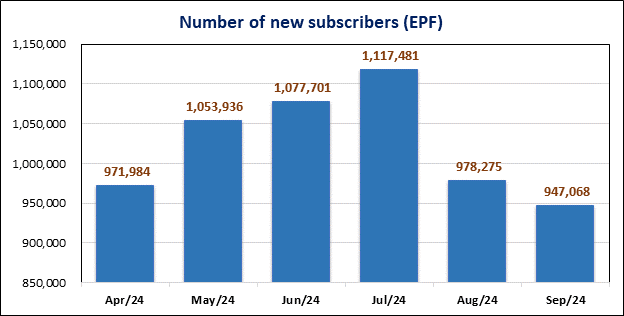
The total number of new EPF subscribers during the month of September, 2024 is9,47,068, which was 9,78,275during the month of August, 2024. The highest number of EPF subscribers 1,117,481 were added during July, 2024.
2.Employees’ State Insurance Scheme:
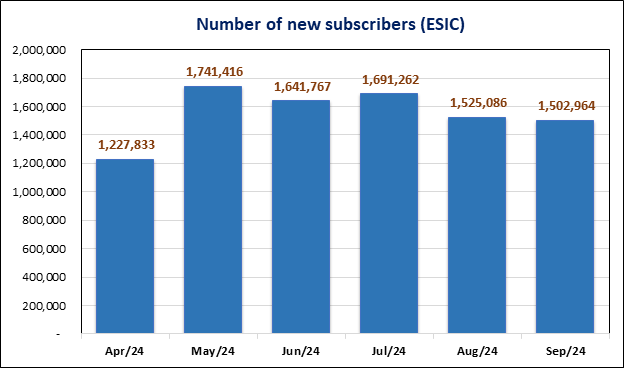
The newly registered employees and paying contribution under the ESI scheme during the month of September,2024 is 15,02,964which was 15,25,086 during the month of August, 2024.
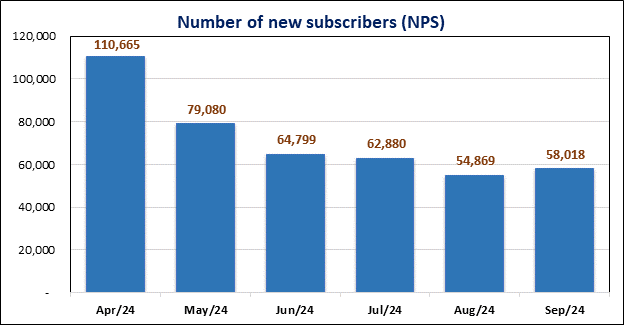
3.National Pension Scheme (NPS):
During September 2024, the NPS recorded a total of 58,018new contributing subscribers which was54,869 duringthe month of August, 2024.












 Eduindex
You must be logged in to post a comment.