Mega Dairy at Mandya, Karnataka

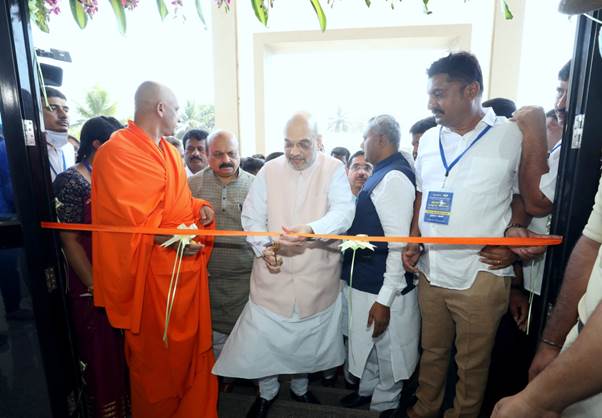
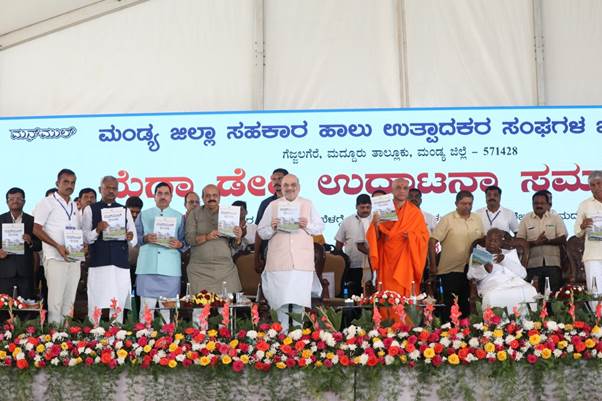
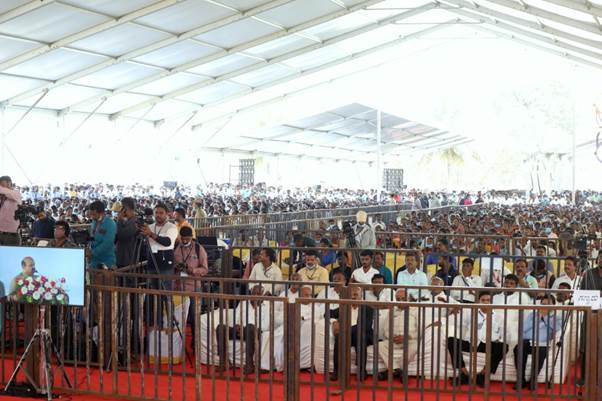
 Union Home and Cooperation Minister Shri Amit Shah inaugurated Mega Dairy at Mandya in Karnataka today. Several dignitaries including Nirmalanandanatha Mahaswamiji, the 72nd Pontiff of Sri Adichunchanagiri Mahasamsthana Math, Mandya, Chief Minister of Karnataka, Shri Basavaraj Bommai, former Prime Minister Shri HD Deve Gowda and Union Minister of Parliamentary Affairs and Coal and Mines Shri Pralhad Joshi were present on the occasion.
Condoling the demise of Prime Minister Narendra Modi’s mother, Shri Amit Shah paid tributes to her and said that the whole country is standing with the Prime Minister in this hour of grief. The Union Home and Cooperation Minister said that since independence, the farmers of the country had demanded a Ministry of Cooperation separate from the Ministry of Agriculture. He said that he would like to thank Prime Minister Narendra Modi for paving the way for the development of farmers by forming a separate Ministry of Cooperation. Shri Shah said that from the inaugural platform of Mandya Mega Dairy, he wants to tell the cooperative workers across the country that it is the decision of the Government of India that there will be no injustice to the cooperatives.
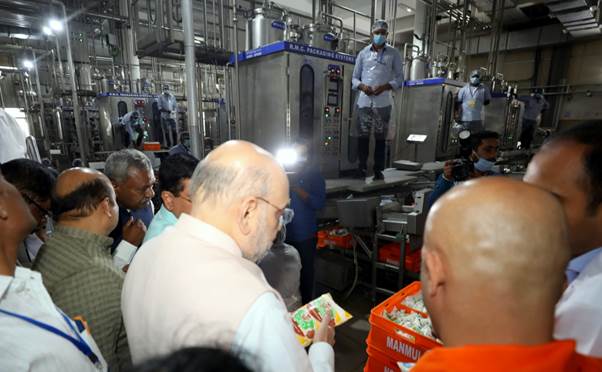
The Union Cooperation Minister said that the mega dairy inaugurated today at a cost of Rs 260 crore would process 10 lakh liters of milk per day and the will have the capacity to increase it upto 14 lakh liters per day. He said that when 10 lakh liters of milk is processed, prosperity reaches the homes of lakhs of farmers. Shri Shah said that in Karnataka, the cooperative dairy is working very well. Today, there are 15,210 village level cooperative dairies in Karnataka, in which about 26.22 lakh farmers deliver their milk daily and through 16 district level dairies, Rs 28 crore is deposited into the accounts of 26 lakh farmers every day.
Shri Amit Shah said that around 66,000 kg milk used to be processed daily in Karnataka in 1975 while today over 82 lakh kg milk is processed daily and 80% of the total turnover goes to the farmer. The Union Cooperation Minister said that the White Revolution in Gujarat has changed the fortunes of the farmers and through Amul, 60,000 crore rupees is deposited into the bank accounts of about 36 lakh women annually. He said that he would like to assure all the farmer brothers and sisters of Karnataka that Amul and Nandini will work together towards establishing primary dairies in every village of Karnataka and in next three years there will not be a single village in Karnataka where primary dairy has not been established. Shri Amit Shah said that the government has decided that the National Dairy Development Board (NDDB) and the Ministry of Cooperation will establish a primary dairy in every panchayat of the country in the next three years and a complete action plan has been prepared in this regard. He said that with this, two lakh primary dairies will be established at the village level across the country in three years, through which India will emerge as a big exporter in the milk sector by connecting the farmers of the country with the White Revolution.
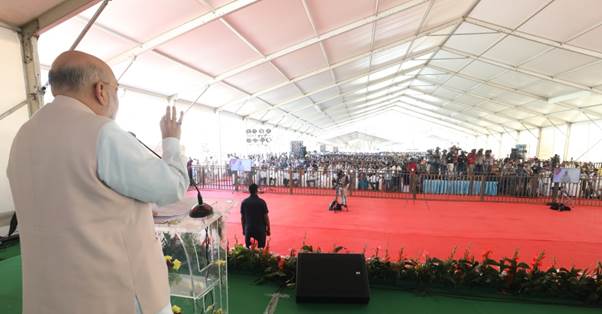
The Union Home and Cooperation Minister said that Karnataka Milk Federation will be provided with technical support, cooperative sector support and overall functioning support from Amul and all its requirements will be addressed  by the Ministry of Cooperation. He said that Gujarat and Karnataka together can work for the welfare of the milk producing farmers of the whole country. Union Cooperation Minister appreciated the Government of Karnataka under the leadership of Chief Minister Basavaraj Bommai for ensuring depositing Rs 1,250 crore directly to bank accounts of milk producing farmers through DBT at the rate of Rs 5 per liter during the year. Shri Amit Shah said that Government led by Shri Bommai is crediting Rs. 1,250 crore annually through DBT to the accounts of milk producing farmers and also to remove malnutrition among children through the Ksheer Bhagya scheme, milk is being provided to 65 lakh children in 51,000 government schools and 39 lakh children in 64,000 Anganwadis .Shri Amit Shah congratulated the Chairman of Mandya Milk Producers Committee for his efforts to increase the income of all the farmers of Mandya district through dairy.
****
Stagflation: a serious economic issue

Photo by Reynaldo #brigworkz Brigantty on Pexels.com

Stagflation is a situation wherein there persists both inflation(consistent rise in the prices of all the goods and services available in a country) as well as stagnation(lack of any economic development). Since 1970, there have been paradoxical developments in most developed nations of the world. There has been a considerable fall in the level of production and employment on one hand, and rise in the general price level on the other. That is nothing but inflation and stagnation coexisting. Inflation and unemployment are mutually exclusive economic phenomena. There has always been an trade off between these two in an economy. Thus, when both of this coexist, it leads to the rise of a paradoxical situation called Stagflation.

The features on stagflation include:

  • Rise in general prices.
  • Rise in the wage rate.
  • Reduction in the level of demand for goods and services.
  • Reduction in the level of production.
  • Emergence of excess capacity.
  • Increase in involuntary unemployment (a situation wherein people are willing to work at the prevailing wage rate but do not get any work).

Causes of stagflation:

  • Increase in the supply of money.
  • Rise in wage rates under pressures from trade unions.
  • Consistent rise in agricultural prices, owing to the government policy.
  • Rise in administered prices.
  • Credit expansion by the banks.
  • Increase in saving and investment.
  • Reduced demand for labor resulting in unemployment.
  • Rise in prices of petroleum and coal.
  • Increase in industrial capacity.

Stagflation is certainly a more difficult proposition than inflation. In the words of Haberler, “The combination of unemployment and inflation is a very delicate matter, if we fight recession, we stimulate inflation and if we fight inflation, we stimulate recession.

Some measures to control stagflation:

  • Creation of bank credit and supply of money must be checked.
  • Excise duty and other indirect taxes need to be reduced to stimulate production.
  • Consumption level is to be very carefully encouraged.
  • Labour intensive enterprises are to be encouraged to stimulate employment.
  • Appropriate income policy needs to be pursued to strike against the problem of inflation.
  • Wage rate must be suitably regulated.

Stagflation not only causes economic unrest but also leads to social instability. There are many instances where the rich gets richer and the poor gets poorer. There seems a moral dispute within the people resulting in hoarding, black marketing ,etc. Thus, stagflation is an serious economic hindrance which needs to be kept in check.

KVIC’s “Charkha Kranti” Created a Buzz on Gandhian Values

 Khadi’s exponential growth, as mentioned by President in his address to the Parliament ahead of the Budget Session, is a result of the “Charkha Kranti” initiated by Khadi and Village Industries Commission (KVIC) in the last 7 years. KVIC built several monumental Charkhas to propagate Gandhian thoughts and symbolism of Charkha in India and abroad which further popularized Khadi and played a key role in its massive growth. Khadi’s success was acknowledged by the President in his address to the Parliament on 31st January and by Home Minister Shri Amit Shah, a day before at Sabarmati Riverfront in Ahmadabad, while unveiling Mahatma Gandhi’s 100 sq meter wall mural on his 74th Martyr’s Day.

Interestingly, KVIC was formed in the year 1956 but it made no effort in the next 58 years; i.e. till 2014, to popularize Khadi, Charkha or any other symbol associated with Mahatma Gandhi. “Khadi” and “Gandhi” were only used for political gains. It was only after the year 2014, that concrete efforts were made by the Narendra Modi government to popularize Khadi and spread the thoughts of Mahatma Gandhi and the symbolism of Charkha across the globe. Be it the birth anniversary or the martyrdom of Mahatma Gandhi, KVIC organized unique programs to celebrate Gandhian thoughts.

During the last 7 years, KVIC built monuments like world’s biggest wooden and steel charkhas, world’s smallest charkha on wrist watches, Gandhi ji’s world’s largest wall mural made of clay Kulhads, world’s largest national flag made of Khadi fabric, heritage Charkha museum and many more. Charkha, which was Gandhi ji’s tool in the fight against the British Rule, made its way to a foreign country, for the first time in 2017. Since then, Bapu’s Charkha has reached 60 countries of the world.

“It is with the inspiration of Prime Minister, Shri Narendra Modi that concrete steps were taken to popularize Khadi and Charkha not only in India but across the world. This played a major role in increasing the production and sale of Khadi and, thereby, contributed to realizing Bapu’s dream of Gramoday. The Charkha Kranti also saw distribution of a record 55,000 advanced charkhas to the Khadi artisans across the country that provided them with self-employment,” Chairman KVIC, Shri Vinai Kumar Saxena said.

1956 to 2014 – No significant activity/event

July 5, 2016 – World’s largest wooden Charkha installed at IGI Airport, New Delhi, by Shri Amit Shah, the then BJP President and  Member of Parliament.

October 18, 2016 – Biggest Ever Charkha distribution in Independent India at Ludhiana by  Prime Minister Shri Narendra Modi.

May 21, 2017 – World’s largest Stainless Steel Charkha installed at Connaught Place, New Delhi by Shri Amit Shah, the then BJP President and  Member of Parliament.

May 21, 2017 – Heritage Charkha Museum Inaugurated at Connaught Place, New Delhi, by Shri Amit Shah, the then BJP President and Member of Parliament.

October 2, 2017 – A big wooden Charkha unveiled in Uganda, for the first time on foreign soil.

April 15, 2018 – Stainless Steel Charkha unveiled by former Agriculture Minister Shri Radha Mohan Singh at Motihari in Bihar to commemorate Champaran Satyagrah centenary celebrations.

June 7, 2018 – Pietermaritzburg station in South Africa sported a Khadi look and trains draped in Khadi fabric. This Railway Station is the place where Gandhi ji was thrown off a train for refusing to give up his seat in a first class, “whites-only” compartment, 125 years ago in 1893. It was the first such program sponsored by KVIC on foreign soil.

June 26, 2018 – Grand Stainless Steel Charkha installed at Sabarmati Riverfront, Ahmadabad. The Charkha was unveiled by Shri Amit Shah, the then BJP President and  Member of Parliament.

January 31, 2019 – World’s Largest Wall Mural of Mahatma Gandhi Made of terracotta Kulhads unveiled at NDMC building in New Delhi by Vice President Shri M. Venkaiah Naidu.

January 30, 2020 – World’s Smallest Charkha used in Unique Khadi Wrist Watches that were launched by the then  Minister of MSME, Shri Nitin Gadkari.

Charkha was sent to 60 countries during Khadi exhibitions in 2017 and 2018.

October 2, 2021 – World’s largest Monumental National Flag made of Khadi Fabric and weighing 1400 KG, unveiled in Leh by the  Lieutenant Governor of Ladakh, Shri RK Mathur.

30 January 2022 – A grand wall mural of Mahatma Gandhi made of clay Kulhads installed at Sabarmati Riverfront in Ahmadabad. This is India’s 2nd and Gujarat’s first wall mural of this kind that was unveiled by Minister of Home Affairs and Co-operation, Shri Amit Shah.

2014-15 to 2020-21 – 55,000 New Model Charkhas and 9000 modern looms distributed to Khadi artisans across the country to increase the production of Khadi.


****

Porter’s Five Forces Model

Porter’s 5 Forces Model is a business model and a tool which helps in identifying main competitive forces of an industry or a sector. The 5 Forces Model is mainly used to create a corporate strategy which will help a company to enhance its long- term profitability.

Understanding Porter’s Five Forces Model

The 5 Forces Model was created by Harvard Business School’s Professor Michael E. Porter and was published in his book “Competitive Strategy: Techniques for Analyzing Industries and Competitors” in 1980. The model was created to explain why various industries are able to maintain varying level of profitability. Porter’s 5 Forces helps in analyzing the industry of the company so that a company can adjust their corporate strategy, boost their profitability and beat their competition.

What are the five forces of the Porter’s Model?

  • Competition in the industry
  • Potential of new entrants into the industry
  • Power of Suppliers
  • Power of Customers
  • Threat of substitute products

Competition in the Industry

For most industry, the level of competition in the industry determines the positioning of the product in the market. The intense the competition in the market, the more the company has to focus on innovation, marketing, price, etc. of the product. When the competition is less, a company has more authority to charge higher prices and establish the terms of deals in order to increase sales and profits.

Potential of New Entrants into the Industry

A company’s positioning is also affected by the new entrants in the market.  This in turn puts pressure on prices, costs, and the rate of investment needed to sustain a business within the industry. The less the time, money and effort it takes for a competitor to enter the market, more is the threat for a company to lose its market share. On the contrary, if there are strong barriers to entry in the industry, companies more secure about their market share.

Power of Suppliers

Power of suppliers in a market means how easily suppliers can increase the cost of the inputs. The suppliers’ power in the market is determined by the factors like number of suppliers in the market, uniqueness of the inputs they provide, cost of switching a supplier for a company. If the number of suppliers in an industry is less, a company would depend more on its current supplier, thus giving more power to supplier in terms of cost of inputs and other advantages in trade. However, if the suppliers are more in the market, then company has the advantage of switching the supplier in case the supplier increases the price or if a company finds a cheap supplier, thus keeping their input costs low and increasing their profitability.

Power of Customers

Customers are more powerful in an industry when there are less number of customers in an industry and more number of suppliers. Because the client base for a company is smaller and more strong, each customer has greater negotiating leverage to get better rates and deals. A company with a large number of smaller, independent consumers will find it easier to raise prices and increase profits.

Threat of Substitute Products

A substitute is a product or service that can be easily replaced with another by consumers. In economics, products are often substitutes if the demand for one product increases when the price of the other goes up. When there are no close substitutes in the market, a company can take advantage of charging higher prices. However, if there is availability of close substitutes, customers will switch to substitutes in case of increase of the prices of the products of a company.

Understanding Porter’s Five Forces and how they apply to a particular industry can help a company change its business plan to make better use of its resources and generate more profits for its shareholders.

Indian Footwear and Leather Development Programme (IFLDP)

 Indian Footwear and Leather Development Programme (IFLDP) (erstwhile IFLADP) has been approved for continuation from 2021-22 with an approved financial outlay of Rs. 1700 crore. IFLDP has been approved by the Union Cabinet on 19.01.2022 as continuation of the erstwhile IFLADP till 31.03.2026 or till further review, whichever is earlier.

Indian Footwear and Leather Development Programme(IFLDP) aims at development of infrastructure for the leather sector, address environmental concerns specific to the leather sector, facilitate additional investments, employment generation and increase in production.

1. The following sub-schemes have been approved under IFLDP during 2021-26:-

(i) Sustainable Technology and Environmental Promotion (proposed outlay Rs.500 crore):- Special Purpose Vehicle constituted for each CETP would be provided assistance @ 80% of the total project cost for Northeastern Areas with industry’s/beneficiary share to be 20% of the project cost and @ 70%  of the total project cost for other areas with industry’s/beneficiary share to be 30% of the project cost with a limit of Rs.200 crore.

(ii) Integrated Development of Leather Sector (IDLS) sub-scheme (proposed outlay Rs.500 crore):- Assistance would be provided to the sectoral units for their modernization/capacity expansion/technology up-gradation on or after 01.01.2020 @30% to MSME units and 20% to other units. Financial assistance is being proposed to North Eastern Areas also @40% of cost of plant & machinery to MSME units and 30% of the same to other units with additional 5% financial assistance for the domestically manufactured plant and machinery. Maximum assistance will be provided upto Rs.15 crore per product line keeping in view 5 times increase in upper limit of investment in Plant and Machinery by MSME 

(iii) Establishment of Institutional Facilities (proposed outlay Rs.200 crore):- Setting up of International Testing Centre, Sports Complex, replacement of conventional light fixtures with LED lights and construction of girls hostel in FDDI campuses are planned.   

(iv) Mega Leather Footwear and Accessories Cluster Development (MLFACD) sub-scheme (proposed outlay Rs.300 crore):- The sub-scheme aims at world-class infrastructure and to integrate the production chain in a manner that caters to the business needs of the leather and footwear industry so as to cater to the domestic market and exports. 

Graded assistance is proposed to be provided @50% of the project cost or @70% of the project cost in Northeastern areas, for land development, core infrastructure, HRD and social infrastructure, production facilities including ready to use sheds with plug and play facility, R&D support and export services  excluding cost of land with maximum Government assistance being limited to Rs. 125 crore.

(v) Brand Promotion of Indian Brands in Leather and Footwear Sector (proposed outlay Rs.100 crore):- The GoI assistance is proposed to be 50% of total project cost subject to limit of Rs 10 crore for each brand in next three year to promote 10 Indian brands in the International Market in 3 years. The designated agency to implement the sub-scheme is being proposed to be selected amongst institutes like NID, NIFT, IBEF, IIFT or Institutes of similar standing.

(vi) Development of Design Studios (proposed outlay Rs.100 crore):- This is a new sub-scheme. Assistance would be provided to develop 10 Indian design studio. The studios will promote marketing/export linkages, facilitates buyer- seller meets, display designs to international buyers and work as interface for the trade fairs.  Design Studios will be kind of ‘one-stop- shop’ providing a wide range of services: design, technical support, quality control etc. Institutes like FDDI, CLRI, NID, NIFT, IBEF, IIFT or institutes of similar standing or any large units of the industry or group of industry would be the implementing agencies.

2. Total approved outlay (Component –wise and Year-wise)

(Rs. In crore)

Sl. No. Name of Sub-scheme 2021-22 2022-23 2023-24 2024-25

2025-26 Total (upto 2021-26)

1 Mega Leather Footwear and Accessories Cluster Development(MLFACD) 50.00 50.00 50.00 50.00 100.00 300.00

2. Integrated Development of Leather Sector (IDLS) 100.00 100.00 100.00 100.00 100.00 500.00

3. Sustainable Technologyand Environmental Promotion (STEP) 140.00 100.00 100.00 100.00 60.00 500.00

4. Promotion of Indian Brands in Leather and Footwear Sector 16.00 24.00 33.00 18.00 9.00 100.00

5. Development of Design Studios 16.00 24.00 33.00 18.00 9.00 100.00

6. Establishment of Institutional Facilities 90.00 25.00 25.00 30.00 30.00 200.00

  Total 412.00 323.00 341.00 316.00 308.00 1700.00

4. Achievements of erstwhile IFLADP 2017-21 

The sub-scheme wise details of activities undertaken under erstwhile IFLADP (as on date) is summarized as below:-

(a) Human Resource Development sub-scheme-During the period 2017-18 to 2019-20, primary skill development training has been provided to 3,24,722 unemployed persons and 2,60,880 trainees provided placement in leather & footwear sector. 12947 workers were provided skill upgradation training in 2019-20.No training could be conducted during 2020-21 due to COVID-19 Pandemic.

(b) Integrated Development of Leather Sector-During the period 2017-18 to 2020-21, financial assistance amounting to Rs. 307.84 crore provided for modernization and technology up-gradation of 714 units in leather & footwear sector. 

(C ) Mega Leather Footwear and Accessories Clusters sub-scheme-The Department has approved the project for setting up of MLFAC at Calcutta Leather Complex, Bantala, Kolkata with project cost of Rs. 178.84 crore and GoI assistance of Rs. 89.42 crore. ‘In-principle’ approval has been accorded for the proposal for setting up of MLFAC at Ramaipur, Kanpur Nagar, Uttar Pradesh with tentative proposed cost of Rs. 451 crore.

(d) Leather Technology Innovation and Environmental Issues sub-scheme- Approval has been accorded for upgradation of twelve Common Effluent Treatment Plants (CETPs) at Dindigul, Ranipet, Ambur, Vaniyambadi, Vellore, Pallavaram, Trichy, Erode districts of Tamil Nadu, Jalandhar (Punjab) and Bantala (Kolkata). As on date, financial assistance amounting to Rs. 132 crore has been released in respect of ten CETP projects with total GOI assistance of Rs.284 crore. Rs.152 crore is the committed liability which would be released in the coming years. 

(e) Establishment of Institutional Facilities sub-scheme- Approval has been granted for up-gradation of seven Footwear Design and Development Institute (FDDI) campuses located at Noida, Chennai, Hyderabad, Jodhpur, Patna, Kolkata and Rohtak into Centres for Excellence (CoEs) with total project cost of Rs. 129.62 crore. First installment of funds amounting to Rs 38.88 crore (30% of total project cost) has been released to Footwear Design and Development Institute. Rs.90.76 crore is the committed liability which would be released in the coming years. 

(f) Promotion of Indian Brands in Leather and Footwear Sector- Five applications for financial assistance were received by the Department. The ‘Designated Agency’ for evaluation of proposals could not be appointed as no specific criteria were mentioned in the guidelines and hence the scheme could not take off.

(g) Additional Employment Incentive in Leather, Footwear and Accessories sector

An online portal has been implemented for receiving applications. Total 48 applications have been received under the sub-scheme by the implementing agency i.e. Footwear Design and Development Institute (FDDI). After physical inspection and financial vetting, reimbursement of Rs. 92,27,971/- in respect of eligible 48 units/applications has been released to FDDI.

5.  Impact of erstwhile IFLADP 

The programme has a direct benefit towards quality employment generation especially for women, skill development, decent work, making the industry more environment friendly and prompting sustainable production system. The leather clusters located in different parts of the country have accrued benefit in terms of reduction of poverty, gender equality, sector specific skill/education, etc., thus touching many of the Sustainable Development Goals (SDGs). Most of the National Development Plans (NDP) also align with the SDGs. NDPs such as economic growth, reduction in poverty, generation of employment, quality education/skills, gender equality, good health and well-being, infrastructure development, affordable and clean energy and other environmental benefits are well-served by the IFLAD Programme.


*******

SHARE OF EXPORTS IN GDP

 Government has been facilitating, monitoring, assisting and channelizing efforts to increase the exports and thereby its share in GDP through a target-driven approach by engaging all stakeholders, across states and districts. Despite the pandemic, the share of India’s total exports (Good & Services) to GDP was 18.7% in 2020-21, which is already above 15 percent. Exports have performed remarkably well in the current financial year with the share of exports to GDP at 21.7 percent in the first half (April to September) of 2021-22. 

The following are some of the steps taken by Department of Commerce to increase exports and thereby its share in GDP:

  1. ‘Districts as Export Hubs’(DEH) Initiative under which products and services with export potential have been identified in all districts of the country. An institutional mechanism has been set up in each District in the form of District Export Promotion Committees (DEPCs). The primary function of the DEPC is to prepare and act on District Specific Export Action Plans in collaboration with all the relevant stakeholders from the Centre, State and District levels.
  2. A Central Sector Scheme ‘Transport and Marketing Assistance (TMA) for Specified Agriculture Products’ for providing assistance for the international component of freight, to mitigate the freight disadvantage for the export of agriculture products, and marketing of agricultural products, is under implementation.
  3. Market Access Initiative (MAI) Scheme is an Export Promotion Scheme envisaged to act as a catalyst to promote India’s exports on a sustained basis. The scheme is formulated on focus product-focus country approach to evolve specific market and specific product through market studies/survey. Assistance would be provided to Export Promotion Organizations/Trade Promotion Organizations/National Level Institutions/ Research Institutions/Universities/Laboratories, Exporters etc., for enhancement of exports through accessing new markets or through increasing the share in the existing markets.
  4. In addition, assistance to the exporters of agricultural products is also available under the Export Promotion Schemes of Agricultural & Processed Food Products Export Development Authority (APEDA), Marine Products Export Development Authority (MPEDA), Tobacco Board, Tea Board, Coffee Board, Rubber Board and Spices Board.
  5. Trade Infrastructure for Export Scheme (TIES) is operational from FY 2017-18 with the objective of assisting Central and State Government agencies for creation of appropriate infrastructure for growth of exports.
  6. The Government has introduced the Remission of Duties and Taxes on Exported Products (RoDTEP). This scheme seeks remission of Central, State and Local duties/taxes/levies at different stages at the Central, State and local level, which are incurred in the process of manufacture and distribution of exported products, but are currently not being refunded under any other duty remission scheme. 
  7. Common Digital Platform for Certificate of Origin to facilitate trade and increase FTA utilization by exporters. 
  8. EPCs, Commodity Boards and India’s mission abroad are actively promoting India’s trade, tourism, technology and investment goals.

MAKING INDIA A PRODUCTION HUB

 Various initiatives/schemes have been launched by Government for promoting growth and attracting investment in India. The Make in India programme was launched on 25th September, 2014 with aim of facilitating enhanced investment, foster innovation, build best in class infrastructure, and make India a hub for manufacturing, design, and innovation. Continuous efforts are made under Investment Facilitation and Outreach for implementation of Make in India action plans to identify potential investors, support Indian Missions abroad and State Governments for organizing events, summits, road-shows and other promotional activities to attract investments in the country.

Measures have been taken to improve the country’s investment climate, as a result of which India jumped to 63rd place in World Bank’s Ease of Doing Business [EODB] ranking as per World Bank’s Doing Business Report (DBR) 2020 from a rank of 142 in 2014. Department for Promotion of Industry and Internal Trade (DPIIT), in consultation with the State Governments, has also started a comprehensive reform exercise in States and UTs in December 2014. Under Business Reforms Action Plan(BRAP), all States/UTs in the country are ranked on the basis of reforms implemented by them on designated parameters. This exercise has helped in improving business environment across States.

An Empowered Group of Secretaries has been constituted to fast track investments in the country. Similarly Project Development Cells (PDCs) have been set up across Central Government Ministries / Departments to handhold investors and spur sectoral and economic growth. Further, a GIS-enabled India Industrial Land Bank has been launched to help investors identify their preferred location for investment. National Single Widow System (NSWS) has also been soft launched in September, 2021 to facilitate clearances for investors.

Keeping in view India’s vision of becoming ‘Atmanirbhar’ and to enhance India’s manufacturing capabilities and exports, an outlay of INR 1.97 lakh crore (over US$ 26 billion) has been announced in Union Budget 2021-22 for Production Linked Incentives (PLI) schemes for 14 key sectors of manufacturing starting from fiscal year (FY) 2021-22. With the announcement of PLI Schemes, significant creation of production, employment, and economic growth is expected over the next 5 years and more.

Measures taken by the Government including on FDI Policy reforms have resulted in increased FDI inflows in the country year after year. India registered its highest ever annual FDI inflow of US$ 81.97 billion (provisional figures) in the financial year 2020-21 despite the COVID related disruptions. These trends in India’s FDI are an endorsement of its status as a preferred investment destination amongst global investors. In the last seven financial years (2014-21), India has received FDI inflow worth US$ 440.27 billion which is nearly 58 percent of the FDI reported in the last 21 years (US$ 763.83 billion). This indicates increasing inclination of global companies to set up their business in India.

Government has taken various other steps in addition to ongoing schemes to boost domestic and foreign investments in India. These include measures to reduce compliance burden for industry, National Infrastructure Pipeline, Reduction in Corporate Tax, Easing liquidity problems of NBFCs and Banks, Policy measures to boost domestic manufacturing through Public Procurement Orders, Phased Manufacturing Programme (PMP), and Schemes for Production Linked Incentives (PLI) of various Ministries, India Industrial Land Bank, Industrial Park Rating System etc. With the announcement of PLI Schemes, significant creation of production, employment, and economic growth is expected over the next 5 years and more.

Besides the above, activities are also undertaken through schemes/ programmes, by several Central Government Ministries / Departments and various State Governments from time to time. The details of these measures are not centrally maintained by Department for Promotion of Industry and Internal Trade.

IMPACT OF COVID-19 ON EXPORTS

 India’s merchandise exports in April-November 2021 was USD 263.78 billion which is 65.95% of export target of USD 400 billion for 2021-22, while till October 2021, merchandise exports was USD 233.90 billion.

Government has increased the present period of realization and repatriation of the amount representing the full export value of goods or software or services exported from nine months to fifteen months from the date of export, for the exports made up to or on July 31, 2020. In addition, the Government has taken the following measures to boost exports throughout the country, including Gujarat:

  1. The mid-term review (2017) of the Foreign Trade Policy (2015-20) was carried out and corrective measures were undertaken.
  2. Foreign Trade Policy (2015-20) extended by one year i.e. upto 31-3-2022 due to the COVID-19 pandemic situation.
  3. Assistance provided through several schemes to promote exports, namely, Trade Infrastructure for Export Scheme (TIES) and Market Access Initiatives (MAI) Scheme.  
  4. A Central Sector Scheme –‘Transport and Marketing Assistance for Specified Agriculture Products’–for providing assistance for the international component of freight to mitigate the freight disadvantage for the export of agriculture products.
  5. Remission of Duties and Taxes on Exported Products (RoDTEP) scheme and Rebate of State and Central Levies and Taxes (RoSCTL) Scheme have been launched with effect from 01.01.2021.
  6. Common Digital Platform for Certificate of Origin has been launched to facilitate trade and increase Free Trade Agreement (FTA) utilization by exporters. 
  7. Promoting and diversifying services exports by pursuing specific action plans for the 12 Champion Services Sectors.
  8. Promoting districts as export hubs by identifying products with export potential in each district, addressing bottlenecks for exporting these products and supporting local exporters/manufacturers to generate employment in the district.
  9. Active role of Indian missions abroad towards promoting India’s trade, tourism, technology and investment goals has been enhanced.
  10. Package announced in light of the COVID pandemic to support domestic industry through various banking and financial sector relief measures, especially for MSMEs, which constitute a major share in exports.

PRIVATE INVESTMENT IN INDUSTRY

 Investment Promotion activities are carried out by Government to attract more investments in the country. As a part of steps being taken to improve private interest and investment, ‘Make in India’ initiative was launched on September 25, 2014, to facilitate investment, foster innovation, building best in class infrastructure, and making India a hub for manufacturing, design, and innovation. Investment outreach is being done through Ministries, State Governments and Indian Missions abroad for enhancing international cooperation for promoting Domestic and Foreign Direct Investment (FDI) in the country.

In addition to ongoing schemes of various Departments and Ministries, Government has taken various other steps to boost domestic and foreign investments in India. These include reduction in Corporate Tax Rates, easing liquidity problems of NBFCs and Banks, improving Ease of Doing Business, FDI Policy reforms, Reduction in Compliance Burden, policy measures to boost domestic manufacturing through Public Procurement Orders, Phased Manufacturing Programme (PMP), Schemes for Production Linked Incentives (PLI) of various Ministries. To facilitate investments, measures such as India Industrial Land Bank (IILB), Industrial Park Rating System (IPRS), soft launch of the National Single Window System (NSWS), National Infrastructure Pipeline (NIP), National Monetisation Pipeline (NMP), etc, have also been put in place.

India registered its highest ever annual FDI inflow of US$ 81.97 billion (provisional figures) in the financial year 2020-21 despite the COVID related disruptions. In the last seven financial years (2014-21), India has received FDI inflow worth US$ 440.27 billion which is nearly 58 percent of the FDI reported in the last 21 years (US$ 763.83 billion). These trends in India’s FDI are an endorsement of the country’s status as a preferred investment destination amongst global investors.

National Single Window System (NSWS) – a one-stop for regulatory approvals

 I.          Introduction

  • The year 2020 witnessed turmoil due to COVID-19 pandemic which emerged as the biggest threat to economic growth. Indian economy has witnessed a sharp contraction of 24.4 per cent in Q1 and 7.3 per cent in Q2 of FY 2020-21.
  • To convert COVID pandemic related challenges into opportunity, a series of measures have been taken by the Government to improve the economic situation including inter-alia announcement of the Atmanirbhar package amounting to Rs.29.87 Lakh Crore. Targeted interventions were made to support the economy and livelihood. Moreover, the pace of structural reforms was expedited. 
  • The major reforms undertaken under Atmanirbhar package include Credit guarantee for MSME loans, sectoral structural reforms, policy on strategic disinvestment of CPSEs, reforms in public procurement, setting up of Empowered Group of Secretaries and Project Development Cells for facilitating investment, reduction in compliance burden and single window system for clearances. 
  • These measures, in addition to structural reforms taken up, have assisted the economy in its early revival. India, which was not producing N-95, PPE Kits, ventilators, etc. prior to Corona pandemic has started producing the same and even catering to world markets and became self-reliant. Government has started vaccination drive in January, 2021 and indigenously developed Covaxin vaccine in its fight against Covid pandemic. As on date more than 143 crore Covid doses have already been administered in India. This has not only saved the lives of people but also set momentum for early recovery of the economy.
  • Economy has started showing sign of recovery with GDP growth rebounding to 20.1 per cent in Q1 and 8.4 percent in Q2 of 2021-22. Several high frequency indicators like E-way bills, rail freight, port traffic, GST collections and power consumption have demonstrated a V-shaped recovery in the economy. 

II.        Industrial Performance

  • Industrial sector performance during 2020-21 declined considerably, by -8.4%, mainly due to nationwide closure of industries by the Government to limit the impact caused by Covid-19 pandemic on public health from March 2020 onwards. The Mining & Manufacturing sectors were majorly impacted as they declined by -7.8% & -9.6% respectively, whereas Electricity generation sector declined by -0.5%. 
  • The cumulative Index of Industrial Production for April-October, 2020 declined by 17.3 percent. However, various measures undertaken by the Government including vaccination & the structural reforms and resilience of the Indian industry have helped early revival of the economy, which led to surge in IIP for same period in 2021 by 20.0 per cent. Similarly, the Mining, Manufacturing, and Electricity sector have registered growth of 20.4 percent, 21.2 percent, and 11.4 percent respectively during the same period.

III.       Trends in Growth of Eight Core Industries

  • The Index of Eight Core Industries (ICI) measures the performance of eight core industries i.e. Coal, Crude Oil, Natural Gas, Petroleum Refinery Products, Fertilizers, Steel, Cement and Electricity. The industries included in the ICI comprise 40.27 per cent weight in the Index of Industrial Production (IIP).


  • During 2020-21, the ICI growth rate was -6.4 per cent compared to average growth rate of 3.0 per cent during last 3 years i.e. 2017-18 to 2019-20. The rate of growth has been robust during the current financial year (April to October, 2021-22) i.e. 15.1%. Out of Eight Core sectors, six of them have shown double digit growth with Cement and Steel sectors leading the pack with growth rates of 33.6% & 28.6% respectively. Whereas, Crude Oil & Fertilizers sector growth remain muted in the same period i.e. (April to October, 2021-22). These shows the revival of core industries.


IV.       DPIIT has been spearheading a number of initiatives in this area, ‘To Make in India for the World’. The key steps taken in this regard are as follows: 

1.         Production Linked Incentive Scheme:  

  • Keeping in view India’s vision of becoming ‘Atmanirbhar’ and to enhance India’s Manufacturing capabilities and Exports, an outlay of INR 1.97 lakh crore (US$ 26 billion) has been announced in Union Budget 2021-22 for PLI schemes for 14 key sectors of manufacturing starting from fiscal year (FY) 2021-22. These 14 sectors are namely:  (i) Automobiles and Auto Components, (ii) Pharmaceuticals Drugs, (iii) Specialty Steel, (iv) Telecom & Networking Products, (v) Electronic/Technology Products, (vi) White Goods (ACs and LED Lights), (vii) Food Products, (viii) Textile Products: MMF segment and technical textiles, (ix) High efficiency solar PV modules, and (x) Advanced Chemistry Cell (ACC) Battery (xi) Medical devices (xii) Large scale electronics manufacturing  including mobile phones (xiii)  Critical Key Starting materials /Drug intermediaries and API; and (xiv) Drones and Drone Components.
  • The guidelines for all PLI schemes have already been issued and applications have also been received under a majority of the schemes.
  • While DPIIT is doing the overall coordination for PLI Schemes, it is the nodal Department for PLI scheme for White Goods (Air Conditioners and LED lights), which has an outlay of an outlay of Rs. 6238 Crore. The Scheme Guidelines was published on 4th June 2021. 42 applicants with committed investment of Rs 4,614 crore have been provisionally selected as beneficiaries under this PLI scheme. The selected applicants include 26 for Air Conditioner manufacturing with committed investments of Rs. 3,898 crore and 16 for LED Lights manufacturing with committed investments of Rs. 716 crore.

2.         PM GatiShakti National Master Plan (NMP):

  • The Prime Minister launched Gati Shakti, a National Master Plan for Infrastructure Development, on 13th October, 2021. Gati Shakti is a digital platform which will bring 16 Ministries including Railways and Roadways together for integrated planning and coordinated implementation of infrastructure connectivity projects.
  • PM Gati Shakti aims to address the past issues through institutionalizing holistic planning for stakeholders for major infrastructure projects. Instead of planning & designing separately in silos, the projects will be designed and executed with a common vision. It will incorporate the infrastructure schemes of various Ministries and State Governments like Bharatmala, Sagarmala, inland waterways, dry/land ports, UDAN etc. Economic Zones like textile clusters, pharmaceutical clusters, defence corridors, electronic parks, industrial corridors, fishing clusters, agri zones will be covered to improve connectivity & make Indian businesses more competitive. It will also leverage technology extensively including spatial planning tools with ISRO imagery developed by BiSAG-N (Bhaskaracharya National Institute for Space Applications and Geoinformatics).

3.         Start-up India Programme: 

· The Start-up India initiative was launched by the Prime Minister on 16th January 2016 as a flagship initiative of Government of India. The initiative was intended to build a stronger ecosystem for nurturing India’s start-up culture that would further drive our economic growth, support entrepreneurship, and enable large-scale employment opportunities. With over 60,000 recognized start-ups, India has transformed into the third largest start-up ecosystemsupplementing employability as well as enhancing our self-reliance. Start-up India’s role has been vital in nurturing entrepreneurship beyond Tier 1 cities. The regional growth through the efforts of States and Union Territories (UTs) has created a national ecosystem to thrust our economic goals. While 55% of the recognised start-ups are from Tier-1 cities and 45% of the start-ups are from Tier-2 and Tier-3 cities respectively, 45% of start-ups are represented by women entrepreneurs. This shows the roots of startups have grown deep in the country.

· Recognized start-ups have made deep inroads into Tier-II and Tier-III cities. Startups are now spread across 633 districts with a total of 30 States and UTs with Startup Policies in place. DPIIT recognised start-ups have reported creation of close to 2 lakh jobs in 2021, the highest in four years. Cumulatively, more than 6.5 lakhs jobs have been generated since the launch of Start-up India initiative.

· Under the Fund of Funds for Start-ups (FFS), Rs. 6,495 crore has been committed to 80 Alternative Investment Funds (AIFs) and Rs. 8,085 crore have been invested by supported AIFs in 540 startups. For Start-up India Seed Fund Scheme (SISFS), 58 incubators have been selected and Rs. 232.75 crore have been approved as grant under the Scheme

4.         Investment Promotion 

  1. Investment Clearance Cell

While presenting Budget 2020-21, Union Finance Minister announced plans to set up an Investment Clearance Cell (ICC) that will provide “end to end” facilitation and support to investors, including pre-investment advisory, provide information related to land banks and facilitate clearances at Centre and State level. The cell was proposed to operate through an online digital portal.

Subsequently, DPIIT along with Invest India initiated the process of developing the portal as a National Single Window System (NSWS). Envisioned as a one-stop for taking all the regulatory approvals and services in the country, NSWS [www.nsws.gov.in], was soft-launched on 22nd September 2021 by the Commerce & Industries Minister, Shri Piyush Goyal.

This national portal integrates the existing clearance systems of the various Ministries/ Departments of Govt. of India and State Governments without disruption to the existing IT portals of Ministries/ Departments. Approvals of 18 Ministries/ Departments and 10 States Single Window Systems have been on-boarded in Phase I. Complete on-boarding of 32 Central Departments and 14 States would be in next phases, all remaining States will be on-boarded in a phase manner.

  1. Ease of Doing Business:

DPIIT is continuously making efforts to improve ease of doing business in the country through the three major initiatives being pursued, focusing on – World Bank’s Ease of Doing Business, State & District Reform Action Plan and systematic approach to reduce regulatory compliance burden on businesses. As a result, India’s rank as per World Bank’s EoDB Report improved from 142 in 2014 to 63 in 2020. 

In order to monitor large database of compliances across Central Ministries/Departments and States/UTs, DPIIT has launched the Regulatory Compliance Portal on 1st January, 2021 (https://eodbrcp.dpiit.gov.in/). Based on data uploaded on Regulatory Compliance Portal, more than 25,000 compliances have been reduced by Central Ministries/Departments and States/UTs combined. 

DPIIT had identified 194 compliances for reductions pertaining to PESO, Boiler, IPR, NEIDS, Industrial Licensing. Out of these, 134 compliances have been ‘Reduced”, 31 are ‘under review’ and 29 have been ‘Retained’.  Types of compliance reduced are: (i) Certificate, License and Permission (ii) Filings (iii) Inspection, Examination and Audits (iv) Registers and Records, (v) Display Requirements, (vi) Redundancy (vii) Decriminalization (viii) Technology and (ix) others.

  1. Project Development Cells: 

Project Development Cells (PDCs) have been set up in 29 Ministries/Departments to fast track investment in coordination between the Central Government and State Governments and thereby enhance the pipeline of investible projects in India and in turn increase domestic investment and FDI inflows.

  1. India Industrial Land Bank (IILB)

The IILB is a GIS based portal developed by DPIIT as a one stop repository of all industrial infrastructure related information – connectivity, infra, natural resources & terrain, plot level information on vacant plots, line of activity and contact details. Currently, the IILB has approximately 4500 industrial parks mapped across an area of 5.11 lakh hectare of land serving as a decision support system for investors scouting for land remotely. The system has been integrated with industry-based GIS systems of 24 States/UTs namely Andhra Pradesh, Assam, Bihar, Chhattisgarh, Dadar & Nagar Haveli and Daman & Diu, Goa, Gujarat, Haryana, Himachal Pradesh, Jharkhand, Karnataka, Kerala, Maharashtra, Madhya Pradesh, Odisha, Punjab, Puducherry, Sikkim, Tamil Nadu, Tripura, Telangana, Uttarakhand, UP and have details of 2113 GIS enabled parks on a real-time basis. A mobile application (wherein login is not required) of IILB is also available on Android and iOS stores for the ease of investor.

6.         Foreign Direct Investment

  • FDI policy provisions have been progressively liberalized and simplified across various sectors in the recent past to make India an attractive investment destination. Measures taken by the Government on FDI Policy reforms have resulted in increased FDI inflows in the country, which year after year is setting up new records. FDI inflows in India stood at US $ 45.15 billion in 2014-2015 and have continuously increased since then. FDI inflows increased to US $ 55.56 billion in 2015-2016, US $ 60.22 billion in 2016-2017, US $ 60.97 billion in 2017-2018, US $ 62.00 billion in the year 2018-19, US$ 74.39 billion in the year 2019-20 and India registered its highest ever annual FDI inflow of US$ 81.97 billion (provisional figures) in the financial year 2020-21. These trends in India’s FDI are an endorsement of its status as a preferred investment destination amongst global investors. 

FDI policy reforms during 2021:

  • Insurance Sector: Government issued Press Note 2(2021) dated 14.06.2021 to raise the permissible FDI limit from 49% to 74% in Insurance Companies under the automatic route and allow foreign ownership and control with safeguards. This will facilitate an increased flow of long-term capital, global technology, processes and international best practices, which will support the growth of India’s insurance sector.
  • Petroleum & Natural Gas sector: Press Note 3 (2021) dated 29.07.2021 has been issued to permit foreign investment up to 100% under the automatic route in cases where the Government has accorded an ‘in-principle’ approval for strategic disinvestment of a Public Sector Undertaking (PSU) engaged in the Petroleum and Natural Gas Sector.
  • Telecom sector: Press Note 4 (2021) dated 06.10.2021 has been issued to permit foreign investment up to 100% under automatic route in Telecom services sector.

7.         Intellectual Property Rights (IPR): Framework to attract foreign investors, disseminate creativity and encourage local innovators

  • An effective IPR framework is indispensable to attract foreign investors, disseminate creativity and encourage local innovators to invest in their own ideas. In this context, DPIIT is committed towards strengthening of the IP ecosystem in India. Major initiatives and steps taken during 2021 in this regard are given below:
  • Design (Amendment) Rules, 2021 notified in the Gazette of India on 25.01.2021 incentivize start-ups and small entities to seek protection of their designs and promote design filings, fees have been reduced on similar lines as under Patent and Trademark Rules.
  • Copyright (Amendment) Rules, 2021 notified on 30.03.2021, with the objective of bringing the existing rules in parity with other relevant legislations. It introduces a mandatory annual transparency report to be issued by Copyright Societies. It aims to ensure smooth and flawless compliance in the light of the technological advancement in digital era by adopting electronic means as primary mode of communication and working in the Copyright Office.
  • Patent (Amendment) Rules, 2021: Patent fees for educational institutions have been reduced by 80 percent by way of the Patents (Amendment) Rules, 2021, which came into effect on 21st September 2021. The amendment will provide the same level of support to educational institutions as MSMEs and start-ups and further ensure greater participation of the education institutions in IP ecosystem.

Since the adoption of the National IPR Policy, IP filing in India has witnessed a considerable amount of increase in filing. Despite the adverse Covid situation in India, no negative impact has been seen in the filing of the IPs. Further, the filing of application of Trademark and GI have drastically increased over the years.

8.         One District One Product (ODOP)

  • Government of India is working on a transformational initiative to foster balanced regional development across all districts of the country. This is called the One District One Product (ODOP) initiative, with the objective of identifying and promoting the production of unique products in each district in India that can be globally marketed. This will help realise the true potential of a district, fueling economic growth, generating employment and rural entrepreneurship. ODOP initiative is operationally merged with the ‘Districts as Export Hub’ initiative being implemented by DGFT, Department of Commerce with DPIIT as a major stakeholder to synergize the work undertaken by DGFT. The major activities that are being facilitated by DPIIT with Invest India under ODOP initiative are manufacturing, marketing, branding, internal trade and e-commerce.
  • Ongoing expansion exercise entailing expansion of list from Phase-1 that consisted of 106 products from 103 districts to current Phase-2 that would consist of 739+ products covering 739 districts. Considerable success has been achieved for boosting exports under ODOP initiative.

11.       Swachhata Campaign

  • During this special campaign, 49,686 files have been reviewed in DPIIT and its sub-organizations. Out of the reviewed files, 49,449 files have been weeded outDue to weeding of files, 2222 sq ft area has been vacated/freed in DPIIT and its sub organizations. Due to disposal of redundant/obsolete items, 3277 sq feet of area has been vacated, which has improved cleanliness and hygiene conditions. Besides, revenue of Rs 5,60,000 has been generated.
  • The Department achieved 100% target in respect of public grievances by disposing of all 31 public grievances and 3 public grievances appeals. Further, out of 48 VIP reference, 29 cases have been disposed off. The Department had identified 194 rules/regulation for simplification under “Ease of Doing Business”. Out of these, 134 rules have been simplified.
  • Digitization of old files/records: Even before the special campaign, as per directions of the CIM digitization of old files/ records was undertaken on a priority basis. During the period, scanning/digitization of 12,387 files containing 19,53,666 pages have been completed and all the scanned files have been migrated to e-office for future reference. 
  • Increasing Efficiency decision making in the Government on direction of Cabinet Secretary and advice of DARPG, with the approval of the Competent Authority, DPIIT has revised the Channel of Submission & Level of disposal, for increasing efficiency in decision making and reducing the level up to 4 (maximum).  This will speed up the disposal of cases and improve decision making. 
  • Review by CIM: CIM has reviewed the special drive continuously during the campaign period. After completion of the Special Drive on 31.10.2021, CIM is reviewing progress of the Cleanliness Campaign on weekly basis. CIM is also undertaking frequent rounds of Udyog Bhawan to review the cleanliness of the premises. 

12.       Events organised by DPIIT during India’s presidency of BRICS in 2021:

  • The 13th BRICS Summit was held under India’s Chairship in 2021. It was the third time that India hosted the BRICS Summit after 2012 and 2016. The theme for India’s Chairship was ‘BRICS @ 15: Intra-BRICS Cooperation for Continuity, Consolidation and Consensus’. During India’s presidency of BRICS, 4 events were organized by DPIIT on industry related issues namely- Industry Ministers Meeting, PartNIR Meeting (Partnership on New Industrial Revolution) to promote investment, industrialization, innovation, inclusiveness and digitization, 13th HIPO (Head of Intellectual Property Offices) meeting and Round Table of an interaction among the Trade and Investment agencies of BRICS. 

13        DPIIT has organised following events under Azadi ka Amrit Mahotsav (AKAM):   

  • Ministry of Commerce and Industry was allocated the week from 20.09.2021 to 26.09.2021. Accordingly, DPIIT has held various events during the ‘Udyog Saptah’ i.e. from 20th -26th September, 2021which was widely published by different platforms. Some of the events organized by DPIIT were: 
  1. Press Briefing addressed by Additional Secretary, DPIIT held on 21st September, 2021 on measures to ensure industrial safety in petroleum and explosives Sector as well as reducing cost of doing business and creating an enabling ecosystem for domestic as well as international investors.
  2. Soft launch of National Single Window System on 22nd September, 2021 by Shri Piyush Goyal, for providing end-to-end facilitation, support, including pre-investment advisory, information related to land banks and facilitating clearances at Central and State levels and bring Transparency, Accountability & Responsiveness in the ecosystem and all information will be available on a single dashboard. 
  3. Startup India had coordinated with various States/UTs to organize/participate in startup events consisting of diverse programs, launch of key initiatives, inaugural of startup summits, and launch of startup policies, etc during 21.09.2021 to 26.09.2021 with the aim to foster entrepreneurship on the ground. 
  1. Northeast Business Roundtable held on 23th September, 2021 in the presence of Minister of State Shri Som Parkash to showcase the business and investment opportunities and deliberations on the reforms implemented in the region. 
  1. National Workshop on Reducing Compliance Burden held on 28th September, 2021 in the presence of Hon’ble Union Minister Shri Piyush Goyal, Minister of State Shri Som Parkash and Smt. Anupriya Patel. More than 25,000 compliances have been reduced by Union Ministries, States & UTs so far. 
  1. Industrial Park Rating System Report 2.0 was launched by MoS (Commerce and Industry), Shri Som Parkash on 5th October, 2021. 
  1. PM Gati Shaki launched by Prime Minister Shri Narendra Modi on 13th October, 2021 for multi-modal connectivity.
  • Good Governance Week during 20-25th December, 2021: DPIIT has organized a National Workshop on the “Next Phase of Reforms for Reducing Compliance Burden” on 22nd December, 2021 to realize the nation’s goals of improving “Ease of living” and “Ease of doing business”. Hon’ble Commerce and Industry Minister Shri Piyush Goyal addressed the workshop. 
  • DPIIT will also be organising Innovation Ecosystem week (10th – 16th January, 2022): In the proposed event DPIIT will showcase efforts taken up for promotion of Unicorns and Start-ups. Event will be led by M/o Education.


*****

Council raises GST on low-cost footwear, garments to 12%

In its first physical meeting in two years, the GST Council on Friday effected several long-pending tweaks in tax rates including an increase in the GST levied on footwear costing less than ₹1,000 as well as readymade garments and fabrics to 12% from 5%.

The new rates on these products, a decision on which had been deferred by the Council over the past year owing to the pandemic’s impact on households, will come into effect from January 1, Finance Minister Nirmala Sitharaman said.

The Council approved a special composition scheme for brick kilns with a turnover threshold of ₹20 lakh, from April 1, 2022. Bricks would attract GST at the rate of 6% without input tax credits under the scheme, or 12% with input credits.

While this will please States like Uttar Pradesh that had sought a special scheme for brick kilns, a decision on extending such a scheme for other evasion-prone sectors like pan masala, gutkha and sand mining was put off.


The Council also decided to extend the concessional tax rates granted for COVID-19 medicines like Amphotericin B and Remdesivir till December 31, but similar sops offered by the Council at its last meeting in June for equipment like oxygen concentrators will expire on September 30.

The GST rate on seven more drugs useful for COVID-19 patients has been slashed till December 31 to 5% from 12%, including Itolizumab, Posaconazole and Favipiravir. The GST rate on Keytruda medicine for treatment of cancer has been reduced from 12% to 5%.

Life-saving drugs Zolgensma and Viltepso used in the treatment of spinal muscular atrophy, particularly for children, has been exempted from GST when imported for personal use. These medicines cost about ₹16 crore, Ms. Sitharaman said.

Food delivery tax shift
The Council also decided to make food delivery apps like Swiggy and Zomato liable to collect and remit the taxes on food orders, as opposed to the current system where restaurants providing the food remit the tax.

Revenue Secretary Tarun Bajaj stressed this did not constitute a new or extra tax, just the tax that was payable by restaurants would now be paid by aggregators. Some restaurants were avoiding paying the GST even though it was billed to customers.

“The decision to make food aggregators pay tax on supplies made by restaurants from January 1, 2022, seems to have been done based on empirical data of under reporting by restaurants, despite having collected tax on supplies of food to customers,” said Mahesh Jaising, Partner, Deloitte India.

“The impact on the end consumer is expected to be neutral where the restaurant is a registered one. For those supplies from unregistered, there could be a 5% GST going forward,” he added.

Aircraft on lease
The GST Council has exempted Integrated GST levied on import of aircraft on lease basis. This will help the aviation industry avoid double taxation, the Finance Minister said, and will also be granted for aircraft lessors who are located in Special Economic Zones.

Goods supplied at Indo-Bangladesh border haats have also been exempted from GST.

Written by: Ananya Kaushal

The Rise of Gaming Scene

 THE RISE OF GAMING INDUSTRY IN INDIA

The Past 5-10yrs. has been revolutionary for gaming scene in India. Thanks to low cost internet large amount of youngsters in India and cheap phones. Large companies like Microsoft,Sony,Nintendo are placing bets for their position and market share in India.

But how it all started? let’s start from the beginning 

India is a large country with large amount of population with includes most of the youngsters but in early stages internet and computers were expensive. At that time cybercafé’s comes to game people started spending their in cafe’s because they were extremely cheap at that time merely 20-30 rupees for hour and facebook was thing at that time and small games like GTA,IGI Were the main game for public people invest most of their time in cafe playing those games, but after internet price reduction and smartphone revolution companies saw the potential to grow

Companies like Rockstar games,valve invested amount in india which became extremely successful, people started to get competitive in games like counterstrike and this is the part where gaming scene blew up-

At this time more than 500 million people are invested in gaming which leads to 40% growth in year(2016-2020) after launch of jio and pubg in mobiles it is expected to grow more. Venture capital funding for the Indian gaming startups stood at $350 mn between 2014-2020 and it is growing at a CAGR of 22%. The high internet penetration rate and low cost of internet play a major role in driving the online gaming sector in India.
Market share of consoles in India


Segments of digital games and sports in India are:

  • Casual Games: Casual game market represents 14.87% of total Indian gaming market
  • Other e-competitions (using real money): Online card games industry annually growing at 35-40%
  • Fantasy Sports: Over 90 million fantasy sports users at the end of 2019
  • E-sports: Currently, India estimated to have over 17 million esports user
  Alone Krafton Gaming  generated total operating revenues of $1.5 billion in 2020, or over Rs 11,000 crore. Out of this net turnover, PUBG Mobile alone accounted for 82 percent of the revenues due to this more companies like Activision(makers of COD mobile) also invested in India from launching their games to arranging gaming competition. And large companies like-oneplus,Acer started giving sponsorship to people and building high performance device at low cost for gamers which was extremely successful.
But the Question arises is there any career in gaming or should we take gaming as career or streamer?
the answer is it’ll take some time in india as it is in it’s budding stage but after 5-10 years career in gaming will be a thing in India as it is in other countries as it has potential and money in it.

Positive and Negative Impacts of Industrialization

How Can Industrialization Affect National Economies of Less Developed  Countries (LDCs)?

IMPACT OF THE INDUSTRIAL REVOLUTION

The Industrial Revolution started in the 18th century in the United Kingdom and later spread too many other parts of the world, during which the agrarian and handicraft economies changed rapidly to industrial and machine-manufacturing-dominated ones. Not only did this economic change alter how work was done and goods were produced, but it also altered how individuals related to each other and to the world as a whole. Today, this wholesale shift in social organization continues and has created many impacts that have rippled through the political, ecological, and cultural spheres of the World.

POSITIVE IMPACTS OF INDUSTRIALIZATION

Goods became cheaper and more affordable:

The factories and equipment they housed started making goods faster and cheaper than they could make by hand. As the availability of different goods increased, their cost to the customer declined (see supply and demand). Shoes, clothes, household goods, equipment, and other products have become more common and less costly to improve people’s quality of life. For these products, international markets were also established, and the balance of trade changed in favor of the consumer, bringing increased prosperity to the businesses that manufactured these products and adding tax revenue to government coffers. It has, however, also led to the disparity in income between countries producing products and consuming goods.

Manual labour was replaced by machine work:

The rapid manufacture of hand tools and other useful objects has led to the development of new types of instruments and vehicles for moving goods and people from one location to another. The development of road and rail transport and the formation of the telegraph (and its related telegraph infrastructure and later telephone and fiber optic lines) meant that progress in manufacturing, agricultural harvesting, energy production, and medical techniques could be easily communicated between stakeholders. Also well-known products of the Industrial Revolution are labor-saving machines such as the spinning jenny (a multi-spindle machine for spinning wool or cotton) and other inventions, particularly those driven by electricity (such as home appliances and refrigeration) and fossil fuels (such as cars and other fuel-powered vehicles).

Evolution in the field of medicine:

The Industrial Revolution was the catalyst behind numerous medical advancements. Industrialization has made it possible to manufacture medical instruments more rapidly (such as scalpels, microscope lenses, test tubes, and other equipment). Using machine production, refinements to these tools could be more effective for the doctors who wanted them to roll out. When contact between doctors in various fields increased, it was possible to easily spread the information behind new cures and disease treatments, resulting in better care.

Increased standard of living:

Mass production reduced the cost to the common (i.e. non-aristocratic) people of much-needed tools, clothing, and other household goods, which allowed them to save money for other things and create personal wealth. Furthermore, new job opportunities emerged as new manufacturing devices were developed and new factories were established. The average citizen was no longer so tightly tied to land-related issues (such as being dependent upon the wages farm labor could provide or the plant and animal products farms could produce). The emphasis on land ownership as the chief source of personal wealth was diminished by industrialization. The increasing demand for manufactured goods meant that as factory workers and as employees of companies that sponsored the factories, average individuals could make their fortunes in towns, paying better salaries than farm-related positions.

Rise of Professional jobs:

As industrialization advanced, in search of better pay in the factories, more and more rural folk flocked to the towns. To improve the overall productivity of the factories and to take advantage of new business opportunities, factory employees have been qualified to perform specific tasks. The owners of the factory divided their employees into numerous groups, each group concentrating on a particular mission.

Some groups secured and transported the raw materials used in the mass production of goods (namely iron, coal and steel) to factories, while other groups worked different machines. When they broke down, some groups of workers repaired equipment, while others were tasked with making changes to them and the overall operation of the plant.

Additional teachers and trainers were required to pass on advanced skills as the factories expanded and employees became more specialized. Furthermore, factory workers’ lodging, transportation, and leisure needs contributed to the rapid growth of cities and towns. To support these, governmental bureaucracies expanded, and new specialized departments were formed to manage traffic, sanitation, taxation, and other services. As more builders, doctors, attorneys, and other staff were added to handle the diverse needs of the new inhabitants, other industries inside the cities also became more skilled.

NEGATIVE IMPACTS OF INDUSTRIALIZATION

Over crowded cities:

The prospect of better pay attracted refugees, who were ill-prepared to manage them, to cities and manufacturing cities. Although initial housing shortages ultimately gave way to construction booms and the development of new buildings in many areas, first existed crowded shantytowns made up of shacks and other types of poor-quality housing. The sudden influx of people overwhelmed local sewerage and sanitation schemes, and drinking water was frequently polluted. Ideal conditions for outbreaks of typhus, cholera, smallpox, tuberculosis, and other infectious diseases were provided by people living in such close proximity, fatigued by bad working conditions, and consuming contaminated water.

Environmental degradation:

In India two centuries ago, factories emitted toxins such as carbon di oxide, carbon monoxide, and other harmful gases that caused air pollution along with vehicular exhausts that were not heard or seen before. Because of Greedy Indians and their Expansionist conquests, India lost many of its forests and natural ecosystems and botanical and zoological species became Endangered or Extinct overnight. Water contamination is caused by heavy metals, arsenic, lead; hard water and industrial hazardous waste are released into lakes, rivers and other water bodies. Aquatic and aquatic animals are dying as a result of water bodies being polluted. As the human population of the planet continues to rise and more and more people are chasing the material benefits promised by the Industrial Revolution, more and more of the resources of the Earth are appropriated for human use, leaving a diminishing stock of plants and animals on which ecological services the biosphere depends (clean air, clean water, etc.).

Moreover, more than 40 percent of the Earth’s land-based net primary production is used by human beings, a measure of the rate at which plants transform solar energy into food and development. Coal, which had to be extracted or obtained after wood burning, was used by most factories, creating smoke and photo chemical smog in North Indian cities such as New Delhi, where visibility and breathing was difficult. Fossil fuels had to be imported from foreign countries and would again produce smoke, Green House Effect, Global Warming by using them for industrial purposes.

Poor working conditions:

Their owners valued production and profit above all else as factories appeared in the cities and industrial towns. Security and salaries of employees were less important. Compared with farm workers, factory workers received higher wages, but this also came at the cost of time and less than desirable working conditions. Factory staff frequently work six days a week for 14-16 hours a day. Human beings (employees) have become more vulnerable to exploitation, violence at work, more working hours and fewer fixed payments, job instability, and after retirement or termination of their employment, a bleak future. Also, finished Indian products were not on par with global standards and labels, but were more costly than comparatively cheaper imports from countries such as China, Hong Kong, Japan, etc.

Other problems

Nuclear plants are a threat to health and different forms of diseases can be caused by human beings living in close proximity. Farmers, who were in heavy debt to pay their dues to industrialists and real estate sharks, sold agricultural land with fertile and cultivable soil, and these lands have now become less yielding as factories or buildings have been constructed upon them. Inflation in India has always been increasing due to scarce natural resources or lack of availability.

Exhibition Industry

For many of us the word ‘Exhibition’ is merely limited to visiting a modern art gallery, raving at a collection of paintings by a renowned artist or getting awed by the international auto expo held every year. Surprisingly for some people it is the exhibition at school or college that restricts their thinking to idea of an ‘Exhibition.’

It may be startling to know that the exhibition industry is one of the most booming industries in India and has been contributing significantly to the GDP of the country for the past four years. In the globalised world of the 21st century which has been shrinked by communication, exhibitions and trade fairs underline the importance of face-to-face interaction among the different countries on a common platform.

Fairs and melas in every nook and corner of the country have been prevalent since the ancient times and even now. India being the second largest country in terms of population with 1.5 billion people and fourth largest GDP in terms of purchasing power parity (PPP) has emerged as the favourite regional market for exhibition and trade show organizers. It has behind it a rich heritage of Trade fairs – the Pushkar and the Kumbh Mela respectively for just not being trade fairs, but business generation too.
 
Main sectors like handicrafts, food, electrical, automation etc. are growing tremendously and thereby needs focused attention. Due to this business growth requires a platform where interactions can happen and growth prospects can multiply. Trade shows and exhibitions are apt for this and play a vital role in today’s business world.

Every year over 2,000 exhibitions are held in India with on an average, 100 exhibitors each. Of these between 10 to 15 percent are from overseas, bringing with them on an average 5 personnel per exhibitor. This makes between 100,000 to 150,000 international visitors coming to India every year through the exhibitions which results in huge spending on hotels, airlines, restaurants, entertainment, ground transportation, sightseeing etc. impacting the economy of the region in a very significant way.

In the list of countries offering indoor exhibition space, India ranks 16th offering a total of 2,60,000 sqm with USA and Germany topping the list. In the Asian scenario India is being surpassed by China which gives 66 percent of exhibition space.

Our country reflects buoyant growth and this in turn has driven demand for international trade shows as well. But the limited convention space and lack of infrastructure facilities are some of the bottlenecks we need to tackle to make this sector a booming industry. Growth in this sector depends upon new and modern venues. There is a need to find a quick-fix solution as exhibitions and trade shows highlight the social and economic prospects of the industry. Thus, the exhibition industry needs to promote the key role it can play in the development of city, region or industry far better.

India has ventured into the arena of exhibition industry very late. In 2006 the India Exhibition Industry Association (IEIA) was formed that represents the entire country and all segments related to the exhibition industry. It brings together all the exhibition organizers, managers, designers and stand contractors, freight forwarders, services and facilities providers, venue owners etc., so that there is a common platform available to the entire industry to consider ways and means for the sound and scientific development of various facets of the industry.

Thus, IEIA acts a one stop window where all the information pertaining to various exhibitions, trade shows, industry news, various agencies, private and public organizations operating in the exhibition industry can be accumulated.

For an exhibition to be successfully executed the 5P’s that come to fore are : Purpose, planning, passion, patience and persistence-but it is the passion that helps Indian exhibition organizers and service providers to open shows successfully.

The top 10 of B2B Fairs organized in India are : Aahar, ACETECH, Automation, bc India, Elecrama, IIJS, International Horti Expo, IITF, Kisan and Plast.

With growth prospects immense the exhibitions and trade shows in India have a huge potential which needs to be tapped in the right way, and helped to grow with best global practices. There needs to be a harmonious blend of global practices which is in sync with local business interests. Festivals like Diwali serve as the perfect launch pad to introduce ones product and build the brand in the market. As a result the marketing and the sales department benefit a lot.
 
Having said so it is important to know the importance of Trade fairs and Exhibitions :

  • Trade fairs and exhibitions contribute to intensification of competition as well as to an increase in growth and employment. They are the intermediary between producers and buyers
  • It improves the company’s image and increase brand awareness as well as the introduction of new products
  • They attract new customers and cultivate contacts with regular customers
  • Trade fairs serve the development and cultivation of customer relations, the search for partners and personnel as well as the positioning of the entire company
  • They work as test markets for new products and also market research instruments
  • They help to increase the level of awareness of the own company, to analyze the competitive situation and to prepare the sale of product and services.
  • For young companies in particular, exhibitions play a vital role to have an opportunity to gain an overview of the competition, their presentation and their products
  • Exhibitions are proven to generate more sales prospects than almost any other form of marketing or promotional activity.
  • They create a value proposition in a conducive business environment where customers are able to do generate business leads and network – under single roof
  • The knowledge shared and the people interacted with over 3-4days of an exhibition is immeasurable in its value as compared to other marketing tools.

To make India as an attractive destination with a promising market its high time that the exhibition sector should get the much needed industry recognition. The government needs to incentivize the sector the way it is done in China or Germany. Also the exhibition industry needs to be more of a government-funded model with the authorities providing finance for construction of trade fair venues as contrast to infrastructure in India which is being solely done by the private sector. The need of a public-private partnership model, where the government acts as a facilitator and is more actively involved in infrastructure development is the much required agenda.

But there are few bottlenecks and challenges that the Indian exhibition industry has to overcome to become a full-fledged emerging sector :

  • Problem of paucity of space and venue
  • Abysmal quality and high prices
  • Mind boggling array of NOCs and permissions
  • Application of multiplicity of taxes as there is no exemption from taxation and fees and subsidies for trade shows and venue creation
  • Non-uniform policies of the state governments
  • Unfair competition from state-owned venue owners
  • Narrow vision of the private sector

Despite the challenges, the Indian exhibition industry is one of the most exciting in the region. According to research the Indian exhibition industry now generates over 700,000 square meters in net space sales each year- making it the fifth largest in the Asia and clearly one with the potential for substantially more growth. Even in the new age of technology led communication, social media and the mobile internet, face to face interactions are still key to fostering profitable business relationships and that comes with exhibitions and trade fairs.

Thus, we need to grow at a faster rate and post higher returns. It has to be a consistent growth as regards the top-line and also the bottom-line. However, the question is not to realize the potential but how soon we can do it.

Sports shoe industry in India

Indians are becoming health conscious, and this is evident in the number of gymnasiums and sports centres that have mushroomed in the last one decade. The media is partly responsible for spreading the fever of health consciousness, and it has benefitted the Indian society. One sector that has benefitted the most from the growing health consciousness of Indians is the sports shoe industry. One cannot take part in sports related activities without proper footwear and this has pulled up the revenue of sports shoe companies greatly.   

The sportswear industry in India is valued at between Rs 3,500 crores and Rs 5,000 crores. And the unchallenged market leader in sports shoes is Reebok. In fact, Reebok holds a 46% market share in India and India is the only country in which Reebok’s brand value has surpassed that of both Nike and Adidas. In fact, Nike has a mere 11% market share.   The top four sporting brands in India are Reebok, Adidas, Nike, and Puma. There are other brands that manufacture sports shoes such as Bata, Liberty, Woodland, Fila, and Lotto, but their brand value is not as strong as the four leading brands mentioned earlier. India’s footwear segment in general caters to men, women and kids, and men’s footwear comprises 55% of the entire industry, followed by women’s footwear at 30% and kids’ footwear at 15%.   

Studies have shown that there is not much brand dilution in the sports shoe industry but there is brand confusion among consumers. The average consumer, who is not extremely knowledgeable about shoe technology, finds it difficult to distinguish between shoes produced by Nike, Adidas and Reebok. In fact, Puma is the only brand that has managed to carve out a space for itself as a fashion brand too. In fact, the design of Puma shoes is slightly different from the rest – Puma shoes are sleek. In India, people do not just wear sports shoes while taking part in sporting activities; they wear them with casual attire too, which is why Reebok has managed to garner a huge market share. Reebok shoes are designed in such a way that they can be worn with casual attire too – the designs and colors are not as flashy as other brands.     

Another reason why Reebok has made its way into so many Indian households is because Reebok shoes are relatively more affordable than the other reputed brands. Indians, especially those in the middle class, are conscious about the price. Given such market conditions, Reebok has an advantage over other brands because it has a wide price range for shoes, from Rs 1,200 to Rs 7,000. This way, consumers have more options while choosing Reebok shoes as opposed to Nike, Puma or Adidas shoes, whose prices start at a much higher level.  

The sports shoe industry in India is definitely going to grow, given people’s awareness and how conscious they are about their health. One of the selling propositions of sports shoe brands in most parts of the world is the technology behind the shoe. At present, the average Indian consumer is not as aware of these technologies as he should be, which is why brands such as Nike, which develops shoes with unique technologies, are not very popular in India. However, this will soon change with greater publicity and awareness.

The footwear industry is one of the most rapidly expanding industries globally. Increasing demand for new and innovative footwear and the emergence of various global as well as regional brands across segments in the category is primarily driving the market. Innovative and trendy footwear is being consistently manufactured by leading market players due to advancement in the footwear manufacturing process, technological innovations, and development of new material.

India is globally the second largest footwear producer after China. India’s footwear production accounts for approximately 9% of the global annual production of 22 billion pair as compared to China which produces over 60%. Key production centres in the country include Kanpur and Agra in Uttar Pradesh, Ranipet, Vaniyambadi and Ambur in Tamil Nadu. The sector is fragmented and close to 75% production comes from the unorganised sector including very small, small and medium enterprises

With the expanding market, the needs of the consumers are also fast changing. Rapid urbanization, higher disposable incomes and greater penetration of media have led to changing fashion needs of the consumers. The footwear industry in India is highly labour intensive and currently employs close to three million people. Out of this, almost 30% are women. Kanpur, Agra, Ranipet, Vaniyambadi, and Ambur are the top footwear production hubs in the country. Today, urbanisation, higher disposable incomes and media influence are changing the needs of consumers and dictating the types of footwear these hubs produce for brands.

Dominant players in the organised market include international brands Bata, Nike, Adidas, Nike, Puma, etc. But customers’ tastes are changing so rapidly that scores of Indian footwear brands, both old and new, are innovating their products and trying to capture the unorganised market.

Woodland, a highly sought-after brand for a lot of millennials, has Indian roots. Aero Group, the parent company of Woodland, was founded by Avatar Singh in Quebec, Canada, in the 1980s. At the time, the company manufactured winter boots for Canada and Russia. Aero Group’s business was at its peak until the 1990s when the Russian market went down with the disintegration of the Soviet Union. In 1992, Aero Group decided to enter India after seeing the developing market conditions and the opening up of exclusive retail outlets and mall culture. Woodland was thus launched under Aero Group.

The raw materials used for shoes, including soles, are manufactured in-house. Italian machinery is used for tanning and finishing the hand-picked Italian hides. German technology is used to manufacture tough rubber soles. Woodland has over 600 EBOs across the country along with shelf space in 5,500 multi-brand outlets (MBOs). The company now clocks a turnover of Rs 1,250 crore.