Periodic Labour Force Survey (PLFS) – Quarterly Bulletin [July – September 2024]

Daily writing prompt
Name your top three pet peeves.

Key findings

  • Labour Force Participation Rate (LFPR) in urban areas among persons of age 15 years and above has increased from 49.3% during July – September, 2023 to 50.4% in July – September, 2024.
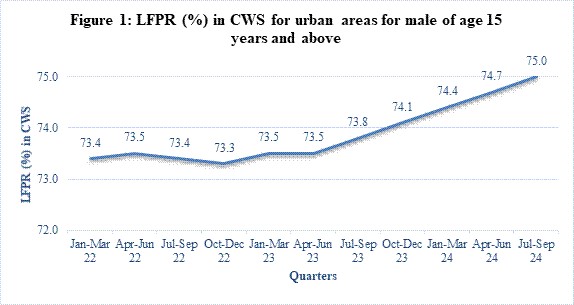
  • LFPR for male of age 15 years and above in urban areas increased from 73.8% during July – September, 2023 to 75.0% during July – September, 2024 reflecting overall increasing trend in male LFPR.
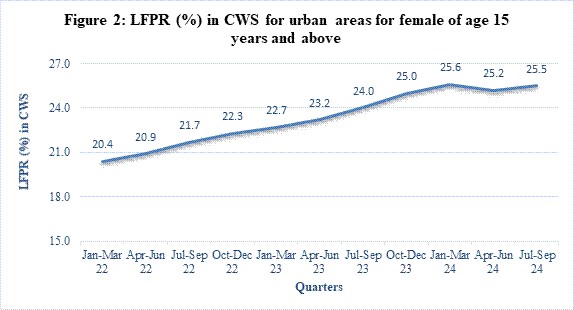
  • LFPR among female of age 15 years and above for urban areas increased from 24.0% during July – September, 2023 to 25.5% during July – September, 2024.
  • Worker Population Ratio (WPR) in urban areas among persons of age 15 years and above has increased from 46.0% during July – September, 2023 to 47.2% in July – September, 2024.
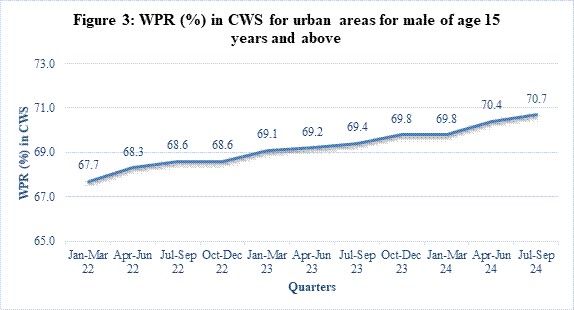
  • WPR for male of age 15 years and above for urban areas increased from 69.4% in July – September, 2023 to 70.7% during July – September, 2024 reflecting overall increasing trend in male WPR.
  • Unemployment Rate (UR) in urban areas among persons of age 15 years and above decreased from 6.6% during July – September, 2023 to 6.4% during July – September, 2024.
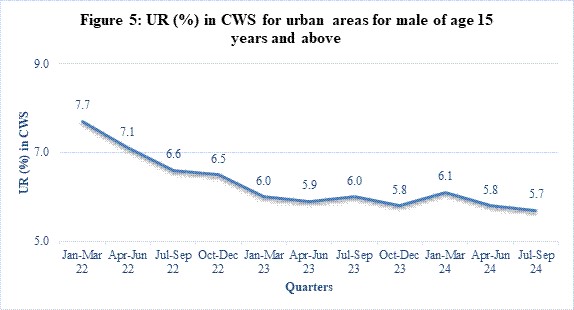
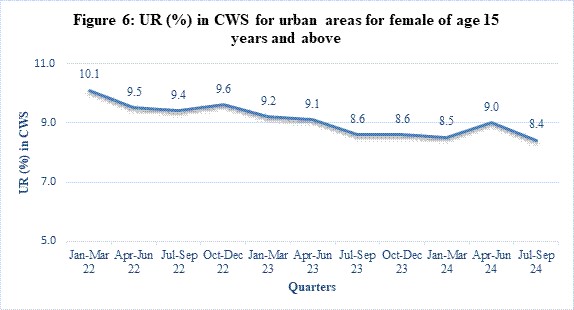
  • UR among males of age 15 years and above decreased from 6.0% during July – September, 2023 to 5.7% in July – September, 2024. UR among female of age 15 years and above decreased from 8.6% in July – September, 2023 to 8.4% in July – September, 2024.

A.         Introduction

Considering the importance of availability of labour force data at more frequent time intervals, National Statistics Office (NSO) launched Periodic Labour Force Survey (PLFS) in April 2017.

The objective of PLFS is primarily twofold:

  • to estimate the key employment and unemployment indicators (viz. Worker Population Ratio, Labour Force Participation Rate, Unemployment Rate) in the short time interval of three months for the urban areas only in the ‘Current Weekly Status’ (CWS).
  • to estimate employment and unemployment indicators in both ‘Usual Status’ (ps+ss) and CWS in both rural and urban areas annually.

Twenty-three Quarterly Bulletins of PLFS corresponding to the quarter ending December 2018 to quarter ending June 2024 have already been released. In these quarterly bulletins estimates of labour force indicators, viz., Labour Force Participation Rate (LFPR), Worker Population Ratio (WPR), Unemployment Rate (UR), distribution of workers by broad status in employment and industry of work in the Current Weekly Status (CWS) for urban areas have been presented.

The present Quarterly Bulletin is the twenty-fourth in the series for the quarter July – September, 2024.

PLFS fieldwork during the quarter July – September 2024

The fieldwork for collection of information in respect of all the samples allotted for the period July-September, 2024, were completed timely for the first visit as well as revisit samples, except for 15 first visit FSU[1]s (4 in Maharashtra, 3 each in Manipur and Madhya Pradesh, 2 in Kerala, 1 each in Odisha, Assam and Andaman and Nicobar Islands) and 5 revisit FSUs (2 in Maharashtra and 1 each in Gujarat, Meghalaya and Uttar Pradesh) which were treated as casualty.

These aspects may be kept in mind while using the estimates of PLFS for the concerned quarter.

B.         Sample Design of PLFS

A rotational panel sampling design has been used in urban areas. In this rotational panel scheme, each selected household in urban areas is visited four times, in the beginning with ‘First Visit Schedule’ and thrice periodically later with a ‘Revisit Schedule’. The scheme of rotation ensures that 75% of the first-stage sampling units (FSUs) are matched between two consecutive visits.

C.         Sample Size

At the all-India level, in the urban areas, a total number of 5,739 FSUs (urban sampling unit curved out from Urban Frame Survey) have been surveyed during the quarter July – September 2024. The number of urban households surveyed was 45,005 and number of persons surveyed was 1,70,598 in urban areas.

  1. Conceptual Framework of Key Employment and Unemployment Indicators for the Quarterly Bulletin: The Periodic Labour Force Survey (PLFS) gives estimates of key employment and unemployment Indicators like the Labour Force Participation Rate (LFPR), Worker Population Ratio (WPR), Unemployment Rate (UR), etc. These indicators, and ‘Current Weekly Status’ are defined as follows:
  1. Labour Force Participation Rate (LFPR): LFPR is defined as the percentage of persons in labour force (i.e. working or seeking or available for work) in the population.
  1. Worker Population Ratio (WPR): WPR is defined as the percentage of employed persons in the population.
  1. Unemployment Rate (UR): UR is defined as the percentage of persons unemployed among the persons in the labour force.
  1. Current Weekly Status (CWS): The activity status determined on the basis of a reference period of last 7 days preceding the date of survey is known as the current weekly status (CWS) of the person.
  1. The Quarterly Bulletin for the quarter July – September 2024 is available at the website of the Ministry (https://mospi.gov.in). The key results are given in the statements annexed.

Annexure

Key Findings of PLFS, Quarterly Bulletin (July – September 2024)

  1. Labour Force Participation Rate (LFPR) for persons of age 15 years and above

LFPR in urban areas was 50.4% in July – September 2024 for persons of age 15 years in above. While for male LFPR was 75.0% in July – September 2024, for female, LFPR was 25.5% during this period.

Statement 1:  LFPR (in per cent) in CWS in urban areas for persons of age 15 years and aboveall‑India
survey periodMaleFemalePerson
(1)(2)(3)(4)
July – September 202373.824.049.3
October – December 202374.125.049.9
January – March 202474.425.650.2
April – June 202474.725.250.1
July – September 202475.025.550.4
  1. Worker Population Ratio (WPR) for persons of age 15 years and above

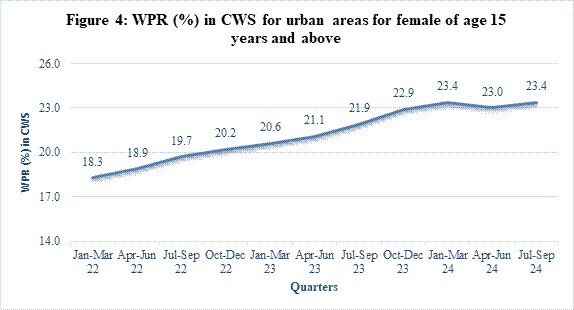
WPR in urban areas was 47.2% in July – September 2024 for persons of age 15 years in above. For male, it was 70.7% in July – September 2024, for female, it was 23.4% during this period.

Statement 2:  WPR (in per cent) in CWS in urban areas for persons of age 15 years and aboveall‑India
survey periodMaleFemalePerson
(1)(2)(3)(4)
July – September 202369.421.946.0
October – December 202369.822.946.6
January – March 202469.823.446.9
April – June 202470.423.046.8
July – September 202470.723.447.2
  1. Unemployment Rate (UR) for persons of age 15 years and above

Unemployment Rate in urban areas was 6.4% in July – September 2024 for persons of age 15 years in above. For male, Unemployment Rate was 5.7% in July – September 2024 and for female, UR was 8.4% during the same period.

Statement 3:  UR (in per cent) in CWS in urban areas for persons of age 15 years and aboveall‑India
survey periodMaleFemalePerson
(1)(2)(3)(4)
July – September 20236.08.66.6
October – December 20235.88.66.5
January – March 20246.18.56.7
April – June 20245.89.06.6
July – September 20245.78.46.4

E. Highlights of the Quarterly estimates of key Labour Market indicators

  1. Trend in Labour Force Participation Rate (LFPR) for persons of age 15 years and above since 2022

The trend in LFPR in urban areas since the quarter January – March, 2022 for male and female are presented in figure 1 and 2.
  1. Trend in Worker Population Ratio (WPR) for persons of age 15 years and above since 2022

The trend in WPR in urban areas since the quarter January – March, 2022 for male and female are presented in figure 3 and 4.
  1. Trend in Unemployment Rate (UR) for persons of age 15 years and above since 2022

The trend in UR in urban areas since the quarter January – March, 2022 for male and female are presented in figure 5 and 6.
*****

How US is exporting Inflation to rest of the world.

The Federal Reserve is laser-focused on stemming price increases in the United States, but countries thousands of miles away are reeling from its hardball campaign to strangle inflation, as their central banks are forced to hike interest rates faster and higher and a runaway dollar pushes down the value of their currencies, reported CNN this month.

The Fed’s decision to raise rates by three-quarters of a percentage point at three consecutive meetings, while signalling more large hikes are on the way, has pushed its counterparts around the world to get tougher, too, according to the report.

The dollar is up 18% this year and last month hit a 20-year high, according to the benchmark ICE U.S. Dollar Index, which measures the dollar against a basket of key currencies.

The reasons for the dollar’s rise are no mystery. To combat soaring U.S. inflation, the Federal Reserve has raised its benchmark short-term interest rate five times this year and is signalling more hikes are likely. That has led to higher rates on a wide range of U.S. government and corporate bonds, luring investors and driving up the U.S. currency.

In effect, the US has been exporting inflation during its pandemic rebound. That underscores a profound change in the global economy. In the pre-Covid world, goods were abundant and the challenge was finding buyers.  

In the new age of scarcity, that story has been flipped on its head.  

Now there are signs that American consumers are dialing it back as the Federal Reserve ratchets up interest rates to cool the economy and combat inflation.  

For the rest of the world, that may just create a different headache as the US switches to exporting inflation through another channel: the super-strong dollar.  

With rates in the US rising much faster than in the euro zone and Japan, the dollar is soaring.   

To be sure, consumer demand is just one cause of the worldwide spike in inflation—arguably not the main one even in the US, where Covid stimulus was largest.

How US is exporting Inflation to rest of the world.

The Federal Reserve is laser-focused on stemming price increases in the United States, but countries thousands of miles away are reeling from its hardball campaign to strangle inflation, as their central banks are forced to hike interest rates faster and higher and a runaway dollar pushes down the value of their currencies, reported CNN this month.

The Fed’s decision to raise rates by three-quarters of a percentage point at three consecutive meetings, while signalling more large hikes are on the way, has pushed its counterparts around the world to get tougher, too, according to the report.

The dollar is up 18% this year and last month hit a 20-year high, according to the benchmark ICE U.S. Dollar Index, which measures the dollar against a basket of key currencies.

The reasons for the dollar’s rise are no mystery. To combat soaring U.S. inflation, the Federal Reserve has raised its benchmark short-term interest rate five times this year and is signalling more hikes are likely. That has led to higher rates on a wide range of U.S. government and corporate bonds, luring investors and driving up the U.S. currency.

In effect, the US has been exporting inflation during its pandemic rebound. That underscores a profound change in the global economy. In the pre-Covid world, goods were abundant and the challenge was finding buyers.  

In the new age of scarcity, that story has been flipped on its head.  

Now there are signs that American consumers are dialing it back as the Federal Reserve ratchets up interest rates to cool the economy and combat inflation.  

For the rest of the world, that may just create a different headache as the US switches to exporting inflation through another channel: the super-strong dollar.  

With rates in the US rising much faster than in the euro zone and Japan, the dollar is soaring.   

To be sure, consumer demand is just one cause of the worldwide spike in inflation—arguably not the main one even in the US, where Covid stimulus was largest.

Inflation not yet in control.

In twin blows to Indian economic revival, higher food prices drove retail inflation to a five-month high of 7.4 per cent while factory output fell for the first time in 18 months. This relates to data of september month.

The second consecutive month of rise in consumer price index (CPI)-based inflation will add to the pressure on the Reserve Bank of India (RBI) to again raise interest rates to tame high prices.

Inflation has been above the targeted zone for the ninth month in a row and as per statute, the RBI will now have to explain to the government in writing why it failed to keep prices below 6 per cent.

This is the ninth consecutive month where the inflation print has remained above the upper band of 6 per cent and the second successive quarter where the average is higher than 7 per cent.

Irregular rainfall is said to be the primary reason behind higher inflation in vegetable and fruits. While inflation in cereals has also inched up, the steps taken by the government and a reasonably healthy Kharif output are expected to address the concerns behind the further hike in prices.

Inflation not yet in control.

In twin blows to Indian economic revival, higher food prices drove retail inflation to a five-month high of 7.4 per cent while factory output fell for the first time in 18 months. This relates to data of september month.

The second consecutive month of rise in consumer price index (CPI)-based inflation will add to the pressure on the Reserve Bank of India (RBI) to again raise interest rates to tame high prices.

Inflation has been above the targeted zone for the ninth month in a row and as per statute, the RBI will now have to explain to the government in writing why it failed to keep prices below 6 per cent.

This is the ninth consecutive month where the inflation print has remained above the upper band of 6 per cent and the second successive quarter where the average is higher than 7 per cent.

Irregular rainfall is said to be the primary reason behind higher inflation in vegetable and fruits. While inflation in cereals has also inched up, the steps taken by the government and a reasonably healthy Kharif output are expected to address the concerns behind the further hike in prices.

Inflation and its types.

Inflation is a general progressive elevation in the prices of services and goods within the economy. It denotes the rate of prices’ elevation within a specific duration. Inflation reduces the purchasing power of money since every unit of currency buys lesser services and goods. Generally, when inflation occurs, the income usually stays the same; however, the level of spending increases. The definition of inflation is the reduction of the purchasing power of a particular currency over a specific timeframe. Inflation is quantitatively estimated by reflecting the elevated average level of prices of selected services and goods within an economy over a given duration. Inflation in economics refers to the collective elevation in money supply, in prices or money incomes. Thus, inflation is an excessive increase in the general level of prices. The inflation concept in common parlance outlines inflation as a quantifier of the elevating rates of services and goods within the economy. In this light, inflation is deemed to occur due to an increase in prices when there is an elevation in the cost of production. However, inflation can occur when there is a demand for particular services and products because the buyers are willing to purchase the product at higher prices. Inflation also declines the value of money.

Types of Inflation.

Demand-Pull Inflation 

Demand-pull Inflation emerges when the total demand for goods and supply is higher than the capacity of production in the market. An increase in demand with constant rate production creates a demand-supply gap. In this type of Inflation, demand is much higher than the production, which in turn increases the prices of goods and services.

Cost-Push Inflation 

Sudden shortfall of supply leads to a surge in the cost of production, which increases the rate of Inflation. For example, soap and shampoo prices may rise if the chemicals used in making these become costlier. This is known as cost – pull Inflation. 

Built-in Inflation

When the cost of wages of the workers increases, to keep up with their demand, the firm increases the cost of production, which leads to the rise in the cost of goods.

Inflation in India:

In India, the ministry of statistics and program implementation measures Inflation. India’s central bank i.e., The Reserve Bank of India (RBI), limits the inflation rate through its monetary policy by using tools such as repo rate, the reverse repo rate, CRR, etc. Inflation is measured by two indices in India, which is the Consumer Price Index (CPI) and Wholesale Price index (WPI). CPI and WPI measure retail and wholesale level price changes, respectively. CPI measures the rise in prices of commodities and services such as medical care, food, education, etc. WPI captures goods or services sold by a business to smaller businesses for selling further.

Inflation and its types.

Inflation is a general progressive elevation in the prices of services and goods within the economy. It denotes the rate of prices’ elevation within a specific duration. Inflation reduces the purchasing power of money since every unit of currency buys lesser services and goods. Generally, when inflation occurs, the income usually stays the same; however, the level of spending increases. The definition of inflation is the reduction of the purchasing power of a particular currency over a specific timeframe. Inflation is quantitatively estimated by reflecting the elevated average level of prices of selected services and goods within an economy over a given duration. Inflation in economics refers to the collective elevation in money supply, in prices or money incomes. Thus, inflation is an excessive increase in the general level of prices. The inflation concept in common parlance outlines inflation as a quantifier of the elevating rates of services and goods within the economy. In this light, inflation is deemed to occur due to an increase in prices when there is an elevation in the cost of production. However, inflation can occur when there is a demand for particular services and products because the buyers are willing to purchase the product at higher prices. Inflation also declines the value of money.

Types of Inflation.

Demand-Pull Inflation 

Demand-pull Inflation emerges when the total demand for goods and supply is higher than the capacity of production in the market. An increase in demand with constant rate production creates a demand-supply gap. In this type of Inflation, demand is much higher than the production, which in turn increases the prices of goods and services.

Cost-Push Inflation 

Sudden shortfall of supply leads to a surge in the cost of production, which increases the rate of Inflation. For example, soap and shampoo prices may rise if the chemicals used in making these become costlier. This is known as cost – pull Inflation. 

Built-in Inflation

When the cost of wages of the workers increases, to keep up with their demand, the firm increases the cost of production, which leads to the rise in the cost of goods.

Inflation in India:

In India, the ministry of statistics and program implementation measures Inflation. India’s central bank i.e., The Reserve Bank of India (RBI), limits the inflation rate through its monetary policy by using tools such as repo rate, the reverse repo rate, CRR, etc. Inflation is measured by two indices in India, which is the Consumer Price Index (CPI) and Wholesale Price index (WPI). CPI and WPI measure retail and wholesale level price changes, respectively. CPI measures the rise in prices of commodities and services such as medical care, food, education, etc. WPI captures goods or services sold by a business to smaller businesses for selling further.

RBI heading to curb prevailing inflation.

In the august meeting of the committee of the apex bank, the Reserve Bank of India (RBI) hiked the repo rate by 50 basis points to 5.4 per cent, its third hike in the current financial year continuing its fight to tame stubbornly high inflation.

The decision of the six-member Monetary Policy Committee (MPC) of the RBI, which met on August 3 to Aug 5, 2022 was largely in line with expectations. Financial markets were largely unchanged at mid day as the hike was on expected lines. The central bank said it would continue its stance of withdrawal of accommodation to ensure that inflation moves close to the target of 4 per cent over the medium term, while supporting growth.

RBI has been increasing policy rates since May, with a cumulative rate hike of 140 basis points being done so far, India’s retail inflation for June inched down in June to 7.01% from 7.04% in the previous month, but it remained above the 7% mark for the third successive month and above RBI’s 2-6% tolerance level for a sixth straight month.

But the estimates for July show that India’s inflation problem seems to have bottomed out sooner than the MPC thought. At its latest meeting earlier this month, RBI retained inflation projections for FY23 at 6.7% and estimated inflation to average 7.1% in the September quarter. There is more evidence that inflation in India has peaked for now, and it is likely to slow faster than RBI’s published trajectory, coming into the target band by October, according to our latest tracking estimates. The Central government working with RBI target to curb inflation from the economy in all possible way, the objective of these steps as expected by the committee is to lower the prices of basic commodity and works toward appreciation of the rupee against dollar.

RBI heading to curb prevailing inflation.

In the august meeting of the committee of the apex bank, the Reserve Bank of India (RBI) hiked the repo rate by 50 basis points to 5.4 per cent, its third hike in the current financial year continuing its fight to tame stubbornly high inflation.

The decision of the six-member Monetary Policy Committee (MPC) of the RBI, which met on August 3 to Aug 5, 2022 was largely in line with expectations. Financial markets were largely unchanged at mid day as the hike was on expected lines. The central bank said it would continue its stance of withdrawal of accommodation to ensure that inflation moves close to the target of 4 per cent over the medium term, while supporting growth.

RBI has been increasing policy rates since May, with a cumulative rate hike of 140 basis points being done so far, India’s retail inflation for June inched down in June to 7.01% from 7.04% in the previous month, but it remained above the 7% mark for the third successive month and above RBI’s 2-6% tolerance level for a sixth straight month.

But the estimates for July show that India’s inflation problem seems to have bottomed out sooner than the MPC thought. At its latest meeting earlier this month, RBI retained inflation projections for FY23 at 6.7% and estimated inflation to average 7.1% in the September quarter. There is more evidence that inflation in India has peaked for now, and it is likely to slow faster than RBI’s published trajectory, coming into the target band by October, according to our latest tracking estimates. The Central government working with RBI target to curb inflation from the economy in all possible way, the objective of these steps as expected by the committee is to lower the prices of basic commodity and works toward appreciation of the rupee against dollar.

Does printing more money solve the economic problems?

It is not a new thing for any economy to go through phases of economic problems and in certain cases falling short of actually putting those problems under control. These economic problems include inflation, unemployment, deflation and so on. No matter if it is a developing country or a developed one, both are equally subject to fall prey to such problems. While the economy goes through this period of uncertainty many people think that it is feasible to print more money to tackle the economic issues such as inflation, etc. But this is not a very feasible option in the reality.

The monetary decisions of any country is taken by the government of the respective country i.e., the government decides which denominations are printed and the design of bank notes and other security measures. It is the responsibility of the head bank of the country to follow the protocols while printing the money. There is always a limit that is set with respect to the printing of money. No country can singlehandedly print money in an unlimited manner whatsoever maybe the reason as more money leads to more economic issues.

Reasons why printing more money leads to more problems:

Whenever there is an increase in the supply of a certain good or commodity in the market with respect to its demand, the price of the commodity falls. This is also true in case of money. When there an uncalculated, increased production or printing of money, the money output gets divided within the entire population accordingly. Now each member of the society owns a greater amount of money. This leads to a fall in the value of money since everyone now has more money irrespective of the actual amount that they are supposed to have/ own. As the value of money falls, there is a rapid increase in the prices of the goods and commodities present in the market resulting in inflation i.e., an increase in the overall level of prices in the economy. For example, in January 1921, a daily newspaper in Germany cost 0.30 marks. Less than two years later, in November 1922, the same newspaper cost 70,000,000 marks. All other prices in the economy rose by similar amounts. This inflation was a result of a three times rise in the quantity of money present in the economy which further led to fall in the value of money. This example clearly shows inflation not only depends on the production of goods and services but also depends on the value and quantity of money present in an economy. Inflation further gives rise to another economic problem i.e., unemployment. As the prices of the goods and commodities rise, people, especially the firms in certain cases fall short of adequate resources to continue with the production activities. This further leads to the decision of reducing the number of workers working at the firm or leads to the termination of the working periods of workers in the firm. When this occurs at an widespread and increased basis, it leads to unemployment on a mass scale and causes widespread economic disruption and gives rise to a state of unrest in the society.

To conclude the answer of the question asked, “does printing more money solve all the economic issues?” The answer is “NO”. Rather it leads to further disruption in the economy and gives rise to unprecedented social unrest. Thus the government puts a limit on the production of Money in each year and makes its decision after analyzing the every single data so that there is no place of such economic disruption in near future due to hasty and uncalculated decisions.

Inflation

Inflation refers to the rise in the prices of goods and services like food, clothing, petrol, housing, transport, etc. over a period of time. When there is rise in Inflation rate, purchasing power of money decreases,i.e. same amount of goods will be purchased in higher prices. When there is fall in the price index of the items, the purchasing power of the money increases this is called deflation. A certain level of inflation is required in the economy to promote expenditure and to demotivate hoarding money through savings. The optimum level of inflation will nurture economic growth.

Types of Inflation :

1.Demand Pull Inflation : An increase in the supply of money and credits stimulates the overall demand for goods and services. The demand increases more rapidly than the economic’s production capacity. This increasing demand creates demand-supply gap as there is not the supply of products as per demand, leading increase in prices.
2.Cost Push Inflation : Demands of the  goods and services remains constant but there is increase in their prices. There are several factors affecting this pricing of goods like depletion of resources,  monopoly over market , government taxation, change in exchange rate,etc. For example, sudden increase in prices of tomatoes, onions etc. due to poor harvest, crude oil fluctuations,etc.
3.Built-in Inflation : It evolves from the past events and continues to affect the economy of the country. We often get to see blue collar worker’s protest for higher pay scales.

Causes of Inflation :

• Increase in supply of money in the market beyond a certain limit reduces the value of currency.
• Increase in prices of imported products.
• High demand and low supply of products leads to hike in price.
• People with more money tends to spend more causing increase in demands.
• Low growth of agricultural products leads to decrease in agricultural prices causes rise in price of goods through reduced supply.

Impact of Inflation :

• It causes loss of purchasing power of the money. It impacts the general cost of living as now people have the constant wages but have to buy less amount of daily products due to hike in price which ultimately leads to deceleration of economic growth.
• It reduces savings as substantial amount of income is spent on daily consumables due to increased costs.
• It also leads to consumers hoarding goods in fear of further increase in prices leading more shortage of supply and exponential increase in price.

What Is Inflation – The Truth behind Inflation | Real Burglar Of Money

Hello friends! If I gave you a hundred rupee note in the year 1958 and you kept it hidden under your bed for 60 years And if you took out that note today and used it in the market, then the value of that note would have reduced to a mere 1 rupee 20 paise in comparison to 1958 Let me explain it to you from another angle, if you did not understand If you buy something worth 100 rupees today, it would have cost 1 Rupee 20 paise back in 1958 That is 100 rupees of today is equal to 1 rupee 20 paise of 1958 This is because of inflation Inflation means dearness of things that makes things costlier for all of us every year Why does inflation occur and what are the reasons behind this? Is it really a bad thing? And how is inflation related to unemployment and other economic factors? We will talk about all of this in today’s video where I will explain this “ghastly” inflation to you Come, let us see First of all, a very important question- Why does inflation happen and who is causing it to happen? Are some government officials increasing the prices of things arbitrarily? It is not so .

There are several reasons for inflation but I’d like to discuss 4 main reasons for inflation in this article The first reason is very simple- An economic boom That is, a good economic growth When the economic growth is good, then there’s more money in the hands of the people who can spend it on different items When there’s more money in the hands of the people, they can spend it on different items That is, the demand for everything would go up in the economy When demand goes up, the businesses and companies that manufacture these products seek to increase the prices in a bid to earn more profit since so many people are willing to buy So they increase the price of the goods which will then lead to inflation Explaining this with an example- Imagine an aeroplane with 100 seats and 100 passengers have to board that plane But there are only 10 first class seats and 90 economy class seats Now if the passengers are given more money If they’re all given enough money to be able to afford a first class seat, they’ll all want to book a first class seat. But the number of seats are only 10 Not all of them can have a first class seat So what would happen as a response? In response, the airline would hike the prices of its first class seats so that only those who have more money can afford to book a first class seat So basically there is an inflation This type of inflation is called a “demand pull inflation”.

 A demand pull inflation is when the inflation rises with the rise in demand The second reason is the increase in the prices of the raw materials due to different reasons For example, if the prices of wheat and rice rise due to a bad monsoon season, the prices of oil rise or a new tax imposed by the government lead to a rise in the price of one of the raw materials then the companies that manufacture products using these raw materials they’d have to hike the prices of the products to make profits since manufacturing them would become costlier which would ultimately lead to inflation This inflation is called “cost push inflation” The third reason is increase in the salaries No, I’m not joking: When the companies or governments raise the salaries of their employees, then they have to increase the price of their products as well to be able to still make profits .This inflation is called “wage push inflation”.

 There could be other reasons for this as well If unemployment levels are at very low levels in a country, then it is extremely difficult for the companies to replace their employees and if they aren’t replaced, their salaries would have to be raised and this again, triggers inflation And finally, the fourth reason is currency depreciation This can happen due to several different reasons, out of which one of the most important reasons is printing of more notes by the government which leads to the currency losing its value And this is a very dicey reason This could also potentially trigger hyper inflation which is happening in Venezuela today and happened in Zimbabwe in 2008 If the inflation rate touches even 10% in our country, then it would cause the people to comment that things are becoming extremely dear very fast But in Venezuela, between 2016- 2019, the inflation rate was more than 5 crore percent!

 Taking the example of Zimbabwe, Around 2008, the currency of Zimbabwe was losing its value at such a rapid pace that the government began printing 1 million dollar and 1 billion dollar notes! And there existed even a 1 trillion dollar note in Zimbabwean dollars And do you know what the value of that 1 trillion Zimbabwean dollar note was? Just 1 US dollar! This is the extent to which money can lose its value in a case of hyper inflation But this is a very long topic on its own and I will make a video on it in the future because there are several political reasons behind it, apart from the economic ones Talking about the present, the inflation rate in most of the countries today is going down Think about why this is happening It is because of the shrinking demand in the wake of the lockdowns that have been imposed around the world People are buying fewer things and travelling less .

The people do not have money to spend because their businesses have shut down And so, there has been a decline in overall demand And the opposite of the “demand pull”(which I told you about as the first reason) is happening Since the demand is going down, so is the inflation As a response to this, some countries have decided to transfer cash to the people- distribute it for free Now, some people state that doing this would cause the inflation to increase What do you think will happen? I discussed the same logic in this video on Universal Basic Income that the biggest criticism of the Universal Basic Income and the free distribution of money is that it will cause the inflation to spike What do you think? Write down your explanations in the comments below And I will give the answer to this question later in the video I’d like to pose another interesting question before you Is inflation necessary? 

What if there was 0% inflation? Observing superficially, you could think that this would be great as things would stop becoming costlier and that it is good for you as you will be able to afford it for cheap You would be able to save up more and overtime, the value of money would not depreciate either So this would be another great thing! Analyzing deeply upon the reasons that lead to inflation then you would understand that 0% inflation is actually not a good thing This would mean that companies would not raise your salaries Your salary would remain constant And since salaries never go down, therefore, in general, inflation always stays in the positive .

And there is a third reason as well If there is deflation, that is, the prices of things keep decreasing every year, then the people would not want to spend money. They would want to save up First of all, the value of money is increasing, If deflation continues to happen, then five years on, the item that one wishes to buy would come for cheaper So they would want to buy it five years later instead of buying it now This would cut down the overall public expenditure Lesser expenditure would mean that the businesses would start incurring losses The businesses incurring losses would translate to people losing their jobs which would then cause the unemployment to rise I’ve told you about a very long and convoluted connection- You might wonder if it actually happens so Yes it does There is a very interesting relation between unemployment and inflation .

This shows us the inverse relation between unemployment and inflation If there’s economic growth, there will be an increase in inflation and unemployment would go down and unemployment will rise if inflation goes down And this is a very interesting explanation because one would not expect this to happen, but it does in reality But as obvious, there are some extreme limits where this graph is not valid For example, in the case of hyperinflation It isn’t that Venezuela today has 100% employment and 0% unemployment Some other factors come into play there. For instance, political factors which cause inflation to spike But generally, this graph is valid A question arises- Excessive inflation is bad because it would cause hyperinflation and increase dearness Nominal inflation is also bad because it would cause unemployment to rise So, what is the optimum level of inflation that a country should maintain? What could it be? This figure is 2% for the developed countries .

The central banks and the governments of the developed nations have decided that they should maintain an inflation rate of about 2% If it is more, then they would try and reduce it And if it is less, they would try and increase it For India, this rate is 4% with a margin of ±2% So the ideal inflation rate in India should be around 2-6% This keeps the prices stable and keeps the levels of unemployment at their lowest It ensures maximum employment So, if a government wants to control inflation, how can it do that? There can be several ways to do this Generally, the central bank of a country is responsible for controlling the inflation rate and normally, the central bank- RBI, in the case of India- controls the inflation rates by increasing/decreasing its interest rates If RBI increases it interest rates (which are called repo rates) which is charged on loans given to other banks.

 Then fewer banks would want to take loans And these banks in turn, would increase their interest rates as well which would reduce the number of people wanting to take loans This would result in lesser money being circulated in the economy And if this happens so, then inflation would go down And if RBI slashes its interest rates, then indirectly, through other banks, more people would want to take loans and this would push the inflation up So inflation rate can mainly be controlled by increasing or decreasing the interest rates But there are other ways as well- Inflation can also be controlled by printing of more notes Printing of more notes would obviously cause inflation to rise.

 The government can control inflation by imposing more taxes as I had explained in the reasons earlier in this video The government can also control inflation by spending more or by spending less, if there is a recession in a country and there’s no economic growth, then inflation would also decline This happens on a general basis, but not always Sometimes, it also happens that a country’s economic growth is going down and the country is going into recession but inflation is going up This situation is called “Stagflation”. This is a disastrous thing indeed. 

Why does this happen? The reason for this is- Assume that there is a recession within a country, but the cost push factors- the second reason for the rise of inflation that we talked about- The cost of the raw materials is rising For example, the rise of oil prices all across the world so the oil imported would then cost more so the inflation would rise because of cost push factors but there is recession within the country There is another exception from the other side- If there is deflation in a country, but simultaneously, there is economic growth in the country This happened in the USA between 1870-1890 This period is referred to as “The Great Deflation”.

 The cost of the goods were falling by around 2% every year and there was deflation, but there was also an economic boom Both the people and the businesses were making more money and employment was on the rise The reason behind this attributed to the rise in productivity This was a time when there was technological progress at such a rapid pace and new technologies were being developed that it compensated for the deflation Reverting to our original question- if people are given money for free in today’s times during this recession then would it lead to a rise in inflation? In my opinion, the answer of this is no. Inflation would not rise because handing out money wouldn’t amount to such a huge increase in wealth that people become capable to buy things that are not being supplied It would not be so. Because it would push up the demand very slightly.

And demand has fallen so low that giving out paltry sums of money would not alter the demand drastically So I do not think that the distribution of money for free would trigger any sort of inflation No matter how much importance inflation holds for the entire economy, but if we come down to personal consequences and how it personally affects you, then you could say that it has a negative consequence The money that you save up would lose value over time the prices of the things keep going up and dearness would always be on the rise .

This is why people invest their money in different things rather than stashing it under their bed For example, they buy gold with it. Because the price of gold rises overtime The value of money keeps diminishing due to inflation but the value of gold keeps rising Similarly, some people buy real estate/ Property to avoid this And some people invest in cryptocurrencies like Bitcoin , Ethereum ,etc.

Basics of inflation accounting

Inflation accounting is an improvisation of cost accounting in presence of a considerable rate of inflation or deflation.Historical information on financial statements is no longer applicable when a business operates in a country where there is a significant amount of market inflation or deflation. In some cases, companies are allowed to use inflation-adjusted figures to counter this issue, restating the numbers to reflect current economic values.

Advantages of Inflation Accounting

The following are the advantage of Inflation Accounting

  • It reflects the current( market value) and not the historical cost of the balance sheet.
  • It is highly effective in times of general inflation or hyperinflation.
  • Depreciation of the business is valued and cost on the current price and not on the historical or the carrying value of the asset which is the correct method.
  • Profit and loss will be more reliable and true.
  • Financial ratios based on figures, adjusted to the current value, are a good reflection of reliable integrity of the company.

Disadvantages of Inflation Accounting

The following are the disadvantage of Inflation Accounting

  • Changing in price is a never-ending process hence it becomes difficult every time to reinstate the figures of the company and present the financial statements.
  • Inflation accounting is a complicated process and it involves long calculation and the data gathering process thus increased cost incurred

Rising prices of essential commodities in India

In India, inflation or price rise is not just an economic concept but they are also a political tool, often used by the opposition parties to launch attack on the ruling government. But in case of price rise of essential commodities, price rise is more political than economic factor. Very often, there is uproar in Parliament as political parties jostle to grab as much mileage as possible from the government’s apparent failure to curb inflation, as they try to sidle up to the aam aadmi who has been worst hit by skyrocketing prices. It is because the people of lower strata are most severely affected by the rising prices, and if the price rise is in essential commodities, damage is more severe.    

Commodities classified as essential under the Essential Commodities Act 1955 includes cattle fodder, oil-cakes and other concentrates, coal, including coke and other derivatives, component parts and accessories of automobiles, cotton and woolen textiles, few drugs, foodstuffs, including edible oil-seeds and oils, iron and steel, including manufactured products of iron and steel; paper, including newsprint, paperboard -and straw board; petroleum and petroleum products; raw cotton, food crops etc.   

In the last five years, the prices of eight essential commodities have gone up by nearly 72 percent and on the contrary the per capita income have gone up by 38 percent of average Indian in metros, according to the latest study undertaken by apex chamber ASSOCHAM.  

While prices of condiments & spices, eggs, fish and meat, milk, pulses witnessed a sharp increase, ranging between 158.07 percent, 78.88 percent, 74.12 percent and 73.69 percent respectively, other essentials like coffee, tea, wheat and fruits and vegetables saw upward moment in the range of 70.75 percent, 66.89 percent, 63.25 percent and 59.31 percent respectively during the corresponding period.   ​​​​​​​  

Demand as well as supply, both factors are responsible for rise in prices of essential commodities. Apart from increasing population which itself is a major cause of rising demand, changing food habits are also giving push to demand pull inflation. Growing demand for pizzas is one big example where large quantities of cheese and butter are used. The price of milk and milk-based products in India is set to surge on the back of a variety of natural and human factors, including a shortage during monsoon months. Prices will be further impacted by the upcoming festival season which sees a spike in consumption of milk-based products, especially sweets.  

On the supply side, unfavorable weather conditions also resulted in the short supply of commodities and consequently pushed their prices up. Lack of warehousing facilities, cold storages also results in the post harvest losses which are estimated to the tune of one-third of the total produce. An abnormally high percentage of fruits and vegetables goes wasted because of lack of cold-storage facilities. Thus post harvest losses also contribute to the short supply of food crops.    

The sharp increase in prices of wheat and rice will have an inflationary impact on essential commodities as open market prices of both commodities were ruling slightly higher than the above the poverty line prices. Many essential commodities like petroleum products, pulses, fertilizers are either imported or are produced with imported intermediate goods. Price of such commodities depends on the international prices and as over all global prices of these commodities is increasing, pressure on domestic prices is bound to happen. Even in the case of export based goods produced in the country, if international prices of such commodities are soaring, there is an upward pressure on domestic prices as well because the producers will tend to sell these products in foreign markets where they are likely to fetch better prices. It may also create an scarcity in domestic market.  

Moreover, market is also dominated by manipulators, fixers, fly by operators, corporate gamblers. Many allege that prime reason behind the rising essential commodities is that we created a commodity exchange like Multi Commodity Exchange (MCX) and other like commodity exchanges where market can be manipulate within hours according to one’s own wish. Moreover, it has nothing to do with our production, distribution, monsoon and other factors; still it effects the commodity prices. The argument is true to some extent but, such exchanges have their own benefits too.  

The inflation can be controlled to the large extent if the government gives full freedom for farmers to sell their agricultural produce anywhere in India without any restriction and ensure free movement without taxing the same. All the agricultural produce is controlled by market forces which include arhatiyas, hoarders, black marketers and other rich and traditional traders. The prices of goods are decided by these individuals. They create the artificial shortage and price rise. The farmers cannot sell their agriculture produce directly due to different reasons. The real farmers are getting 1/3rd of the price. Rest of the profit is swallowed by the middleman and traders only.  

Thus, the price rise is caused by several factors like hording, population explosion, low productivity, natural calamities, wars, backwardness of communication, evil motives of dishonest businessmen, smuggling, black marketing etc. Many suggest deregulation of prices of essential commodities as market forces are supposed to efficiently allocate the resources. However, it is also necessary to provide affordable prices to the vulnerable sections of the society. But indeed, comprehensive reforms, development of agriculture infrastructure, elimination of hoarders and black marketers etc is necessary to eliminate the artificial scarcity plaguing the economy.