Indian Coast Guard signs MoU with Philippines Coast Guard

 In a significant step towards bolstering the bilateral cooperation between India and Philippines, Indian Coast Guard has signed a Memorandum of Understanding (MoU) with Philippine Coast Guard (PCG) on enhanced maritime cooperation. The MoU was signed by DG Rakesh Pal, Director General Indian Coast Guard and CG Admiral Artemio M Abu, Commandant, PCG at the Coast Guard Headquarters, New Delhi on 22 August 2023. Both the sides held their first bilateral meeting on a range of maritime issues.

The MoU inked today seeks to enhance the professional linkage between the two Coast Guards in the domain of Maritime Law Enforcement (MLE), Maritime Search & Rescue (M-SAR) and Marine Pollution Response (MPR). The implementation of this MoU will enhance bilateral maritime cooperation between the two nations for ensuring safe, secure and clean seas in the region.The first ever bilateral meeting between both the maritime agencies signifies the dedication in strengthening the professional bonds by sharing best practices, conducting joint exercises and enhancing training collaborations.

A five member delegation of PCG is on an official tour of India from 20-24 August 2023.  Earlier, the delegation visited Goa on 21 August, where they witnessed the operational capabilities of the Indian Coast Guard ships and aircraft under ‘Atmanirbhar Bharat’. During the visit, the delegation was also provided with a customer demonstration flight on the Indian Coast Guard Advance Light Helicopter MK-III. The delegates also visited Indian Coast Guard Ship Sujeet built by Goa Shipyard Limited.

*****

76th Session of the World Health Assembly in Geneva, Switzerland

 The Prime Minister, Shri Narendra Modi addressed the 76th Session of the World Health Assembly in Geneva, Switzerland today via video message today.

Addressing the gathering, the Prime Minister extended warm greetings to everyone present and congratulated the World Health Organization on completing the historic milestone of serving the world for 75 years. He expressed confidence that WHO would be setting goals for the next 25 years when it reaches 100 years of service.

Stressing for greater collaboration in healthcare, the Prime Minister highlighted the gaps in the global health architecture which were exposed during the COVID-19 pandemic and emphasized the need for a collective effort in building resilient global systems and boosting global health equity. Shri Modi highlighted India’s commitment to international cooperation and informed that the country shipped almost 300 million doses of COVID-19 vaccines to over 100 countries including many countries from the Global South. The Prime Minister expressed confidence that supporting equal access to resources will be a top priority for the WHO in the coming years.

“India’s traditional wisdom says that the absence of illness is not the same as good health”, the Prime Minister said as he noted that one must not only be free from ailments but also take a step towards wellness. Highlighting the benefits of traditional systems such as Yoga, Ayurveda and meditation, the Prime Minister explained that it addresses physical, mental and social aspects of health and expressed delight that WHO’s first Global Centre for Traditional Medicine is being established in India. He also expressed happiness that the International Year of Millets is playing a crucial role in creating awareness about the importance of millets.

“Vasudhaiva Kutumbakam”, the Prime Minister said as he mentioned the ancient scriptures from India that teach us to see the world as one family. He touched upon the G20 theme of ‘One Earth, One Family, One Future’ and said that India’s vision for good health is ‘One Earth One Health’. Shri Modi emphasized that India’s vision is not restricted to just humans, but extends to the entire ecosystem including animals, plants and the environment. He said that We can be healthy only when our whole ecosystem is healthy.

Highlighting India’s achievements in the last few years regarding the availability, accessibility & affordability of healthcare, the Prime Minister gave examples of the world’s largest health insurance scheme – Ayushman Bharat, the massive ramping up of health infrastructure, and the drive to provide sanitation and drinking water to millions of families in the country. Underlining that many of India’s efforts are aimed at boosting health at the last mile in the country, the Prime Minister suggested that an approach which works with the scale of India’s diversity can also become a framework for other nations. Shri Modi expressed keenness in supporting the WHO for similar efforts in low and middle-income countries.

Concluding the address, the Prime Minister commended the WHO on 75 years of efforts in advancing Health for All. He remarked that the role of global institutions like the WHO will be even more important for the challenges that lie ahead in the future. “India is committed to helping every effort to build a healthier world”, the Prime Minister concluded.

*****

DS/TS

JNPA posts an impressive turnaround time (TAT)

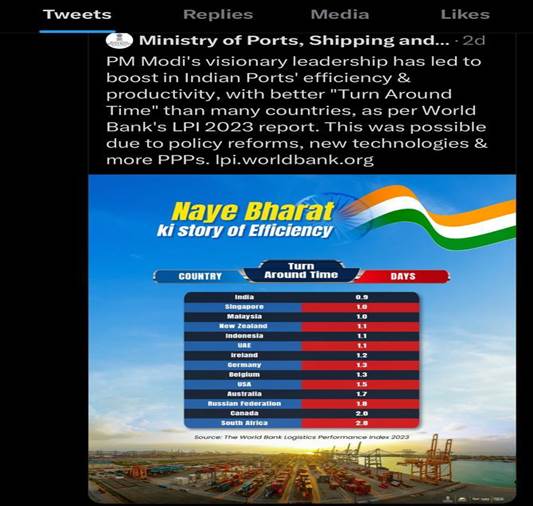
 A month after the record handling performance for the last FY, Jawaharlal Nehru Port Authority (JNPA), India’s premier container port, has achieved another feat when it set a global benchmark in container cargo handling. According to the Logistics Performance Index (LPI) Report, 2023, published by the World Bank, JNPA has an impressive turnaround time (TAT) of just 22 hours (equal to 0.9 days), putting India amongst the top performers.


JNPA was able to achieve the feat due to various measures taken in reducing the dwell time. Most importantly the operational efficiency of the terminal operators has been the biggest contributor along with the better landside- rail and road connectivity, introduction of Centralised Parking Plaza (CPP), Digitization of the processes; streamlining berthing and unberthing of vessels; deploying more tugs for smooth transition of the vessel etc. are some of the other initiatives that JNPA has undertaken to facilitate efficient functioning of the port.

Shri Sanjay Sethi, Chairman of JNPA said, “This is exciting news for all of us at JNPA. Just last month, we achieved a record of handling 6.05 million TEUs in 2022-23, the World Bank data reiterates that our efficiency parameters are better than many countries as per LPI 2023 report and we as a team are committed to further reduce the logistics cost and time for the EXIM trade.”

 Chairman of JNPA and Deputy Chairman, JNPA  congratulated the team for this remarkable achievement.

*****

India-Israel Friendship – Beginning of a New Era of Industrial Research and Development Cooperation

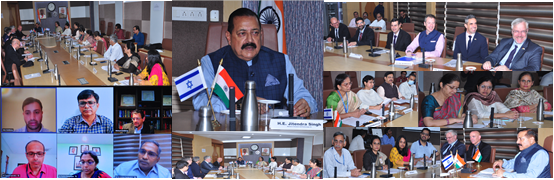
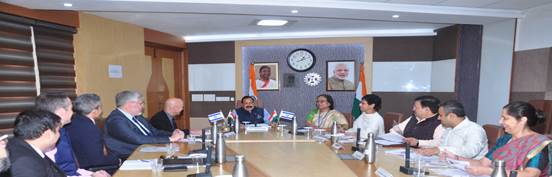
 In a momentous milestone in S&T cooperation between India and Israel, a Memorandum of Understanding (MoU) on Industrial Research and Development Cooperation was signed between the Council of Scientific and Industrial Research (CSIR) under the Ministry of Science and Technology (MoST) of the Republic of India and the Directorate of Defense Research and Development (DDR&D), under the Ministry of Defense of the State of Israel.

Dr N Kalaiselvi, DG, CSIR and Secretary, DSIR thanked the Hon’ble Minister of State(IC), Ministry of Science and Technology and Earth Sciences, GoI and Vice President, CSIR Society for gracing the meeting and his continued support to CSIR. She welcomed the dignitaries and gave an overview of CSIR, showcasing its technological and research prowess as also the ongoing collaboration discussions with DDR&D, Israel in Aerospace, Healthcare, Energy. Sharing CSIR’s priority topics she concurred to the interest of DDR&D for furthering collaboration with Israel in high technology areas such as Artificial Intelligence, Quantum and semiconductors, synthetic biology etc.

Acknowledging the ongoing cooperation efforts of CSIR and his team, Dr. Daniel Gold, Head, DDR&D envisioned that the CSIR-DDR&D cooperation would be beneficial for the welfare of both the countries. He added that DDR&D welcomes collaboration not only with R&D organizations but also with start-ups and companies, venture capitals on both sides. He apprised that AI and photonics are strengths of Israel and welcomed cooperation with CSIR in High Technology sectors which would pave the way for building a better future.

Stressing the successful completion of three decades of India-Israel successful diplomatic relations, Mr. Naor Gilon, Ambassador of Israel to India emphasised the close friendly relations between Israel and India, which have culminated into a strategic partnership after the complimentary visits of Prime Ministers of both the countries in 2018. The present CSIR-DDR&D cooperation would add another feather and be a milestone for India-Israel relations.

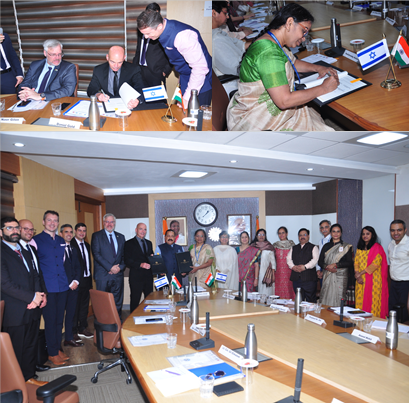
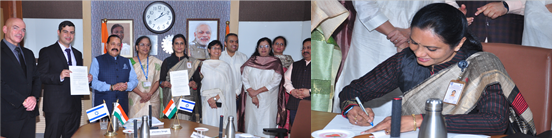
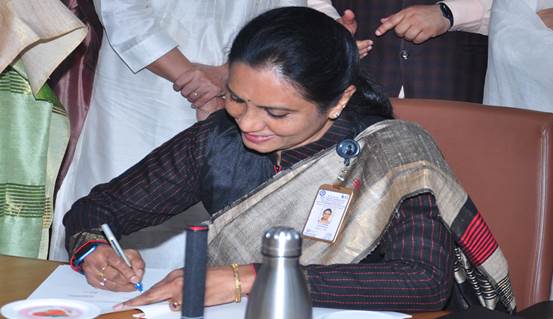
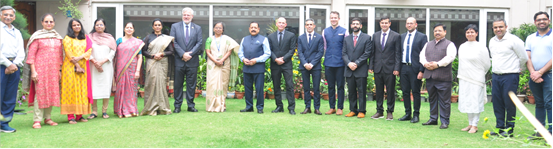
Dr N Kalaiselvi and Dr. Daniel Gold signed the CSIR-DDR&D MoU in the august presence of Hon’ble Minister of S&T, Government of India and Vice President, CSIR Society, Dr Jitendra Singh.

The MoU shall enable cooperation in the industrial R&D programs in mutually agreeable industrial technology fields through implementation of specific projects. The collaboration would encompass some of the key industrial sectors including Healthcare; Aerospace & Electronics Instrumentation; Civil, Infrastructure & Engineering; Chemicals and Petrochemicals, Sustainable Energy including Energy Devices; Ecology, Environment, Earth & Ocean Sciences and Water; Mining, Minerals, Metals & Materials; Agriculture, Nutrition & Biotechnology. The collaboration through the MoU would be steered and the execution monitored by a Joint Steering Committee led by the heads of the CSIR and DDR&D for taking forward mutually benefiting Industrial and technology cooperation.

Specific collaboration on Hydrogen and Aerospace currently under discussed between CSIR and DDR&D were briefed by Dr Abhay Pashilkar, Director, CSIR-National Aerospace Laboratories (CSIR-NAL), and Dr Ashish Lele, Director, CSIR-National Chemical Laboratory (CSIR-NCL); they welcomed collaboration on futuristic technologies in these domains, including in High Altitude Platform, Hydrogen Valley programs of CSIR, respectively.

Specific collaboration on Therapeutics between CSIR-Indian Institute of Chemical Technology (CSIR-IICT) and M/s 101 Therapeutics for conducting clinical trials of a COVID-19 drug having enormous therapeutic potential was briefed; if successful this would prove to be highly appropriate and effective for preparation of future pandemics. The cooperation MoU between CSIR-IICT and M/s 101 Therapeutics was also signed during the meeting.


In his remarks, Dr Jitendra Singh said that it is a very important year in the S&T sphere of India under the leadership of  PM of India as India is holding G20 presidency, celebrating the International year of Millets, as also India and Israel completed 30 years of successful diplomatic relations.

He apprised that CSIR has specialized laboratories in almost all the identified priority sectors therefore assured appropriate competence for this cooperation. For e.g. indigenous Hydrogen Fuel Cell bus by CSIR-NCL, purple revolution (Lavender cultivation) by CSIR-IIIM. He welcomed technology partnership with Israel and congratulated both sides for for their efforts to strengthen the India-Israel relationship.

Dr. Rama Swami Bansal, Head, International S&T Affaris Directorate (ISTAD), CSIR thanked the Hon’ble Minister for his continued support to CSIR, the team from Israel for building and formalizing the cooperation and her colleagues from CSIR and MEA for their kind and gracious presence during the MoU signing meeting today.

**************************

UWI Discrimination: Why no Hindu or Islamic BA Theology degree?

 By Dr. Kumar Mahabir


It sits innocently in the Undergraduate Humanities Programmes list, alphabetically bookended by Theatre Arts and Visual Arts. Yet the University of the West Indies (UWI) Bachelor of Arts BA Theology degree is a jarring testament to the religious and ethnic discrimination that still exists in the highest institution of education in our nation, paying lip service to diversity, equity and inclusion as core values. 


Taught every year at the St Augustine (Trinidad) campus by members of the Seminary of St John Vianney and the Ugandan Martyrs since 1970, UWI’s Theology degree is unapologetically Christian and Catholic in content. The syllabus comprises courses in Biblical and Pastoral Studies, History of the Christian Church in the Caribbean, Perspectives in Christology, and Principles of Christian Ethics.


But Trinidad and Tobago is an ethnically diverse society. While the largest segment of the population is Christian, a significant portion – almost 20% – is Hindu, 5.7% is Spiritual Baptist /Shouter, 5% is Muslim, and a small proportion is Rastafarian, Orishan and other denominations. Moreover, a growing percentage considers itself non-religious (2.2%) or does not choose to state its religion (11.1%).  Ideally, the theology programme at the nation’s prime tertiary institution should reflect this diversity. But this is not the case, despite it not even being the first time that this concern has been raised. 


Almost 20 years ago, Parshuram Maharaj, an executive member of the Sanatan Dharma Maha Sabha, wrote a well-reasoned letter, published in the Newsday on October 7, 2003. He pointed out that while the meaning of theology has traditionally been restricted to a narrow understanding due to its Greek and Christian origin, in the broadest sense, it is widely accepted as meaning “the science of God or of religion; the science which teaches of the existence, character and attributes of God, his laws and government, the doctrines we are to believe, and the duties we are to practice; divinity”. He called on UWI to offer a Theology degree that reflected and represented the entire religious spectrum, as many of the leading universities of the world now do.


The University of Oxford, for example, which has a long history of preparing young men for the church, now offers Sanskrit, Pali and Qur’anic Arabic with New Testament Greek, Biblical Hebrew and Church Latin, and includes courses on Buddhism, Hinduism, Islam and Judaism. Harvard University provides courses in African and Afro-Atlantic Religions, Ancient Near Eastern / Israelite religions, Buddhism, Christianity, East Asian religions, Greek-Hellenistic-Roman religions, Hinduism, Islam, Judaism, Religion in the Modern West / Religions of the Americas, and South Asian religions. 


While no one is expecting UWI to provide so many alternatives, what it offers now fails the needs of this nation’s diverse population. There are private universities in Trinidad and Tobago that offer exclusively Christian theology programmes, as is their right to do so. But UWI is a not a private university. It is a public institution funded by taxpayers – Christian, Hindu, Muslim, Spiritual Baptist /Shouter, Orishan, Rastafarian, atheist, etc. – all taxpayers.


Since Maharaj’s impassioned plea 20 years ago, nothing has changed. Is it any wonder, though, for according to UWI’s most recent prospectus, the Theology Department comprises 2 bishops, 2 monseigneurs, 5 nuns and 16 reverends among its 27 academic staff? Not a lot of religious diversity there. In UWI’s Theology degree, Hinduism, Islam and “Afro-Caribbean Expressions” are mentioned in just one course – Comparative Religion – out of a total of 38. 

But this must change, even it has to be taken to the Privy Council by my eminent attorney, Anand Ramlogan, SC. 


In her induction speech on January 22, 2023, the new Principal of the St Augustine Campus of UWI, Professor Rose-Marie Belle Antoine, spoke compellingly of the need for UWI to be more inclusive and to play a key role in healing wounds in our society. An excellent starting point for this, if such encouraging words are to be taken seriously. The new Principal should now remove religious bias from the Theology Department and provide complementary Hindu and Islamic programmes, while a certificate or diploma programme can be introduced for smaller religious groups.


Why not allow non-Christian religious denominations to design and deliver their own programmes with university funding, support, cooperation and supervision, as the Catholic seminary has been doing since 1970? There could at least be a Centre for Hindu Studies similar to the Oxford Centre for Hindu Studies. Muslims and others could also create their own syllabi. The sooner this happens the better. In 2019, UWI registered only 11 new admissions to, and 4 graduates from, the Theology Department, suggesting that a serious overhaul is needed in order to create dynamic programmes relevant to our whole society. This will be a vital step on the path to making Trinidad and Tobago a nation where “every creed and race” can truly “find an equal place”.


Dr. Kumar Mahabir is an anthropologist, university lecturer, and the Executive Director of the weekly Indo-Caribbean Cultural Centre ZOOM programme. dmahabir@gmail.com WhatsApp +1 868 756 4961


International news flow after the end of colonialism


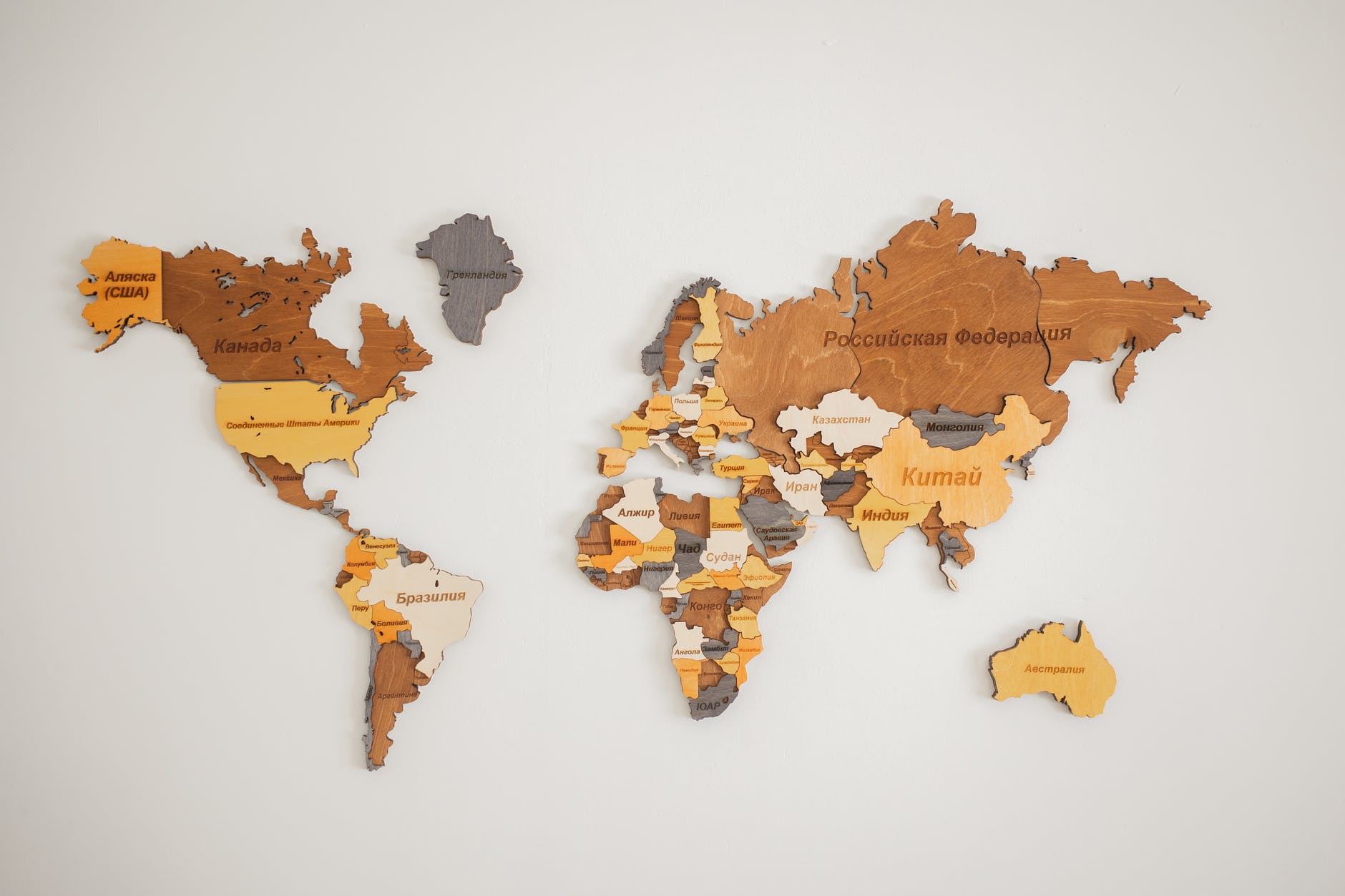
The mass media are seen today as playing a key role in enhancing globalization, facilitating culture exchange and multiple flows of information and image between countries through international news broadcasts, television programming, new technologies, film and music. If before the 1990’s mainstream media systems in most countries of the world were relatively national in scope, since then most communication media have become increasingly global, extending their reach beyond the nation-state to conquer audiences worldwide.

International flows of information have been largely
assisted by the development of global capitalism, new technologies and the increasing commercialisation of global television, which has occurred as a consequence of the deregulation policies adopted by various countries in Europe and the US in order to permit the proliferation of cable and satellite channels. Globalization theorists have discussed how the cultural dimension of globalization has exercised a profound impact on the whole globalization process.

The rapid expansion of global communications in the 21st century can be traced back to the mechanical advancements of technologies during the course of the 18th and 19th centuries, which started mainly with the invention of the telegraph in 1837, and included the growth in postal services, cross-border telephone and radio communications and the creation of a modern mass circulation press in Europe. It was however the evolution of technologies capable of transmitting messages via electromagnetic waves that marked a turning point in advancing the globalization of
communications.

The emergence of international news agencies in the 19th century, such as Reuters, paved the way for the beginnings of a global system of codification. Nonetheless, it was not until the 1960’s, with the launch of the first geo-stationary communication satellites, that communication by electromagnetic transmission became fully global, thus
making the globalization of communications a distinctive phenomena of the 20th century.

Key theories in international communications grew out of international relation studies. The “modernization” or development” theory in the area of communication research
emerged in the Cold War context and were largely preoccupied with the ways in which the media could help transform traditional societies to include them into the capitalism orbit. Among the key theorists in this tradition was Wilbur Schramm with his sponsored UNESCO work, Mass Media and national development – the role of information in the developing countries.

The idea was that international communication media could be used
as a tool to transfer the political-economic model of the West to the growing independent societies of the South. Schramm’s views was that the mass media could be used by elites to
raise the ambitions of the populations in developing countries, who would cease to be narrow-minded and conformist and would be active in their own self-development. The dependency theories the 1960’s and 1970’s were perceived as an alternative approach grounded in neo-Marxism, and which adopted a theoretical framework that saw
capitalism and inequality as a key perspective in understanding the impact of power relations on global communications. According to the argument, transnational corporations based in the North engaged in a web of interdependency with the economies of the South, setting the terms of global trade, dominating markets, production and labour.

Dependency theorists and Latin American scholars argued that these economic relations worked within an exploitative dependency model that promoted American capitalist mentality in developing countries (Mattelart, 1979). Development was thus shaped in a way that benefitted largely the developed nations, maintaining the peripheral countries in a continuous position of dependence. Latin American scholars stressed that it was Western
media companies that were reaping the rewards of the modernization programmes, and that they were actually reaching out to the South in order to conquer new markets for their
products.

Globalization is thus seen as having consequences for the distribution of power and wealth both within and between countries. Cultural imperialism theories of the 1970’s and 1980’s highlighted how the media in developing countries imported foreign news, cultural and television genre formats (i.e. talk-shows, sitcoms) and also values of capitalist consumerism and individualism. The core critique of the imperialism thesis was that the
developing countries had established a relationship of subordination.

Written by : Ananya Kaushal

Black Man Shot by Police in Wisconsin, Protests Follow

Jacob Blake, a 29-year-old Black man was shot in the back by the Wisconsin police in the city of Kenosha. The incident happened on Sunday, while he was walking towards his car and was shot several times in the back. His three young sons witnessed the shooting from the car and were screaming after seeing their father being shot. Video footage of the shooting was shared on social media, which was taken from across the street, it shows the father-of-three leaning into the car. An officer is seen grabbing his shirt after which seven shots were heard. It is unclear what had happened before the video recording begun. He survived the shooting and had a surgery. His father had told the newspapers that his son is paralyzed but the doctors do not know whether its permanent.

At night, groups of protesters defying a dusk-to-dawn curfew gathered outside the courthouse. They confronted law enforcement officers in riot gear outside the county courthouse which was blocks away from where Jacob Blake was shot. They were shouting and tossing water bottles after which they were responded with tear gas and pepper balls.

Despite the curfew, demonstrations erupted on Sunday night, which lead the authorities to close public buildings. Governor Tony Evers have ordered National Guard troops to be deployed in the city to maintain order. He has condemned the incident and “the excessive use of force” and called for a special legislative session next week in order to reconsider police reforms. Protestors marched on the streets from Monday night into Tuesday morning. Many commercial and government buildings and vehicles were set ablaze. The disturbances and protests had slowed down by early morning. According to a protestor, the police used tear gas, rubber bullets and smoke bombs to disperse the crowd. Protestors were marching peacefully but a small group suddenly got violent and started setting fires and breaking glass. The instigators who were seen were reported to be white. After the demonstrations ended, the police and demonstrators had worked together to clean the debris.

The incident occurred three months after the death of George Floyd on May 25. The Black man was pinned to the street under the knee of a white police officer in Minneapolis. The incident sparked protests, against police brutality and racism within the U.S. criminal justice system, across the country and abroad.

Black Lives Matter activists have demanded the arrest of the officers involved in it. Attorney Crump, who also has also represented Floyd’s family, said in a statement, “Blake had been trying to de-escalate a domestic incident when the officers first shot him with a stun gun. As he was walking away to check on his children, police fired their weapons several times into his back at point-blank range.”

Sunday’s shooting had been termed a “domestic incident’ which the police responded to. According to a police statement, they had immediately taken him to the hospital. Authorities have given no further explanation of the details of the incident or what had led to the shooting. The officers who were involved in the shooting have been placed on administrative leave. The Wisconsin Department of Justice said on Monday that the investigation is underway.

Non Personal data faces pushback from US giants

Vaishali Singh

Government’s plan to regulate “non-personal” data has jolted US tech giants Amazon, Facebook, and Google, and a group representing them is preparing to push back against the proposals, according to sources and a letter seen by Reuters. A government-appointed panel in July recommended setting up a regulator for information that is anonymised or devoid of personal details but critical for companies to build their businesses.

The panel proposed a mechanism for firms to share data with other entities – even competitors – saying this would spur the digital ecosystem. The report, if adopted by the government, will form the basis of a new law to regulate such data.

But the US-India Business Council (USIBC), part of the US Chamber of Commerce, calls imposed data sharing “anathema” to promoting competition and says this undermines investments made by companies to process and collect such information, according to a draft letter for the government.

“USIBC and the US Chamber of Commerce are categorically opposed to mandates that require the sharing of proprietary data,” says the USIBC’s previously unreported letter, which is likely to be completed and submitted in coming weeks to India’s information-technology ministry.

“It will also be tantamount to confiscation of investors’ assets and undermine intellectual property protections.”

A USIBC spokeswoman had no comment on the draft letter. The US Chamber of Commerce didn’t respond to Reuters queries.

The head of the panel, Kris Gopalakrishnan, a founder of technology giant Infosys, said the group will work with the government to review input from the industry.

Ministry of Electronics and Information Technology, Amazon, Facebook, and Alphabet’s Google  did not respond to requests for comment. The report is open for public comments until September 13.