20 students from India to participate in Sakura Programme 2024

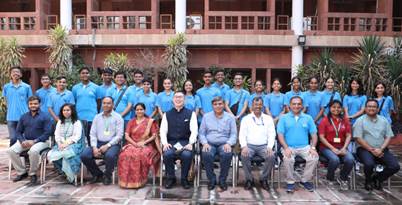
The Department of School Education & Literacy, Ministry of Education (DoSEL), is sending 20 school students and 2 supervisors to Japan to participate in the Sakura Programme 2024 along with 5 other countries from 20-26 October 2024. The enthusiastic and excited children were flagged off by Shri Charanjt Taneja, Deputy Secretary, DoSEL; Dr. Amarendra Prasad Behera, Joint Director, CIET-NCERT; and Ms. Kirti Panwar, Deputy Commissioner, Navodaya Vidyalaya in a ceremony at CIET-NCERT organised by DoSEL. The event was also attended by Mr. Kemmochi Yukio, Manager of the Japan Science and Technology Agency, and officials from DoSEL-MoE. These 20 students (10 boys and 10 girls) are from Navodaya Vidyalayas and alumni of the PRERANA program from across the country.

To develop the intellectual horizon and scientific exploration among young learners, the Japan Science and Technology Agency (JST) has been implementing the “Japan-Asia Youth Exchange Program in Science” also known as the “Sakura Science Programme” since 2014. India was added to the Sakura Program in 2015. The students are invited under the programme for short-term visits to Japan, giving them the opportunity to experience Japan’s cutting-edge science and technology as well as its culture.

The National Education Policy (NEP) 2020, while emphasizing the importance of curriculum and pedagogy in schools, endorses that “Learning should be Holistic, Integrated, Enjoyable and Engaging in itself. Also, NEP-2020 states that in all stages, experiential learning will be adopted as standard pedagogy within each subject, and with explorations of relations among different subjects. It is in this context that educational trips and excursions to various places of importance in terms of historical, cultural, social and technological development are of paramount importance. Japan as a developed nation, a friendly country, along with technological advancements, is also a favourite destination for educational exposure. Therefore, visiting a country like Japan is always enriching and provides an opportunity for the exploration of innovative practices.

India participated in the program for the first time in April 2016. So far, 553 students and 85 supervisors have visited Japan under this programme. The last batch visited Japan in June 2024.

DoSEL flags off 47 students from India for Sakura Science High School Programme 2024

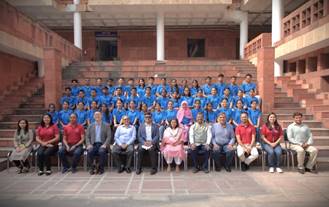
Shri Sanjay Kumar, Secretary, (DoSEL), Ministry of Education, flagged off a group of 47 enthusiastic and excited school children, who have been invited to participate in Sakura Programme 2024 from India along with 5 countries (Indonesia, Marshall Islands, Micronesia, Palau and Peru) from 10th-16th November 2024. The ceremony at CIET-NCERT, New Delhi, was organised by DoSEL and was attended by Prof. Dinesh Prasad Saklani, Director, NCERT; Smt. Archana Sharma Awasthi, Joint Secretary, DoSEL; Mr. Kemmochi Yukio, Manager, Japan Science and Technology Agency, Japan; Dr. Amarendra Prasad Behera, Joint Director, CIET-NCERT; and officials from DoSEL.

In this group, Japan Science and Technology Agency (JST) has invited 47 school students and 4 supervisors. These 47 students (18 boys and 29 girls) are from Kasturba Gandhi Balika Vidyalaya and Government Schools of Telangana, Jharkhand, Sikkim, Chandigarh, Kerala, Manipur, Meghalaya, Haryana, Arunachal Pradesh, Jammu & Kashmir, Uttar Pradesh and Maharashtra and Kendriya Vidyalayas.

To develop the intellectual horizon and scientific exploration among young learners, the JST has been implementing the “Japan-Asia Youth Exchange Program in Science” also known as the “Sakura Science Programme” since 2014. India was added to the Sakura Program in 2015. The students are invited under the programme for short-term visits to Japan, giving them the opportunity to experience Japan’s cutting-edge science and technology as well as its culture.

The National Education Policy (NEP) 2020, while emphasizing the importance of curriculum and pedagogy in schools, endorses that “Learning should be Holistic, Integrated, Enjoyable and Engaging in itself. Also, NEP-2020 states that in all stages, experiential learning will be adopted as standard pedagogy within each subject and with explorations of relations among different subjects. It is in this context that educational trips and excursions to various places of importance in terms of historical, cultural, social and technological development are of paramount importance. Japan, as a developed nation, a friendly country, along with technological advancements, is also a favourite destination for educational exposure. Therefore, visiting a country like Japan is always enriching and provides an opportunity to explore innovative practices.

India participated in the program for the first time in April 2016. So far, 572 students along with 87 supervisors have visited Japan under this programme. The last batch visited Japan in October 2024.

*****

G7 Trade Ministers’ Meeting in Osaka, Japan

 Union Minister of Commerce and Industry, Consumer Affairs, Food and Public Distribution, and Textiles, Shri Piyush Goyal will attend the Group of Seven (G7) Trade Ministers’ Meeting in Osaka, Japan from 28-29 October, 2023. The Minister will also have bilateral meetings with a few G7 countries, invitee countries and a few International organisations such as WTO, on the sidelines of the outreach programs.

Trade Ministers of G7 Member States hold an annual meeting with the aim to meet the current global challenges related to Trade and Investment and to set the course for a better future. Under its Presidency this year for the G7 Trade Ministers meeting to be held during 28-29 October 2023, Japan has invited India along with a very few other invitee countries (Australia, Chile, Indonesia, and Kenya) to participate in the outreach program to be held on 28 October. Apart from them, International organisations such as WTO, ERIA and OECD have also been invited.

This year, Japan has selected contemporary topics for the outreach program namely, “How to enhance Supply Chain Resilience” and “Promote Trade and Sustainability- environment, Development and digital, including prospects for WTO MC13”.

The G7 is an intergovernmental political forum consisting of the United States, the United Kingdom, Japan, Italy, France, Canada and Germany. Additionally, the European Union (EU) is a “non-enumerated member”. G7 meetings are organized around shared values of pluralism, liberal democracy, and representative governments. G7 Members constitute 10% of the world’s population but cater to around 40% of World GDP.


Controversy of 'comfort women' in japan

During World War II, the Imperial Japanese Army forced thousands of women and girls into sexual slavery, known as comfort women. The majority of these women were from Korea, but also from other countries such as China, Taiwan, the Philippines, and Indonesia.

The Japanese military established comfort stations or brothels to provide sexual services to their soldiers. The women who were taken as comfort women were often kidnapped or coerced into working at these stations. They were subjected to horrific sexual abuse and violence, and many did not survive.

The exact number of women who were forced into sexual slavery is not known, but estimates range from tens of thousands to as many as 200,000. Many of these women were teenagers, and some were as young as 12 years old.

The issue of comfort women has been a controversial and sensitive topic, and Japan has faced criticism from other countries, particularly South Korea, for its handling of the issue. In recent years, Japan has issued official apologies and compensation to some of the surviving comfort women, but many feel that these actions have not gone far enough in acknowledging the atrocities that were committed.

One of the reasons that the issue of comfort women has been so contentious is that the Japanese government has been slow to acknowledge its role in the abuse. For decades, Japanese officials denied that comfort women existed or claimed that they were volunteers. It was not until the 1990s that the Japanese government began to acknowledge the reality of the situation and issue apologies.

Another reason for the controversy is that many surviving comfort women have demanded a formal apology and compensation from the Japanese government. While some women have received compensation, others have not, and there is still a sense among many that Japan has not fully taken responsibility for its actions.

The issue of comfort women has also caused tension between Japan and other countries, particularly South Korea. Many Koreans feel that Japan has not done enough to make amends for its actions, and the issue has strained relations between the two countries. In recent years, there have been some efforts to address the issue of comfort women. In 2015, Japan and South Korea reached an agreement in which Japan apologized and provided compensation to surviving comfort women. However, the agreement was controversial and criticized by many, including some of the surviving comfort women themselves.

Despite these efforts, the issue of comfort women remains unresolved. Many people continue to demand a formal apology and total compensation from the Japanese government, and the issue remains a contentious one between Japan and its neighbors.

ROLE OF QUAD IN SOUTH CHINA SEA

BY DAKSHITA NAITHANI

The Quadrilateral Dialogue was established in 2007 when four countries—the United States, India, Japan, and Australia—joined forces. However, it did not take off at first due to a variety of factors, and it was resurrected in 2017 after almost a decade due to factors such as growing country convergence, the expanding importance of the Indo-Pacific area, and rising threat sentiments toward China, amongst many others.

The origins of QUAD may be traced back to the Malabar Exercise. Malabar began as a modest Passage Exercise named PASSEX between the Indian and US Navies in 1992, but was halted after India’s nuclear testing in Pokhran in 1998. It was later restarted in 2002. Since its inception in 2002, QUAD has become an annual event. With the addition of Japan in 2015, it has become a trilateral practice.

The Quad’s goal remains intact: to promote the economic and security objectives of those nations with genuine and essential interests, to devise a new approach for keeping the Indo-key Pacific’s maritime lanes free of foreign influence. It has become necessary in view of the increased need for information exchange in the maritime sector. With the growing presence of the Chinese Navy in the Indian Ocean, awareness is a key subject for the Navy. After 2008, China increased its presence in the Region under the pretext of anti-piracy operations, even deploying submarines for the objective. In 2017, China formally established its first overseas facility near Djibouti, in the Horn of Africa.

What are the underlying challenges?

The environment in which QUAD has been resurrected, as well as subsequent engagements like as Malabar Exercise 2020, are regarded as governed by a counter-China narrative. There are several features that may not constitute sites of convergence, despite how they appear.

China’s influence: China has significant economic links with Quad partners, particularly Australia, which is what it may use to compel or sway nations to its side. This might prove to be an issue for India.

Maritime orientation: Quad is a marine rather than a land-based organisation because of its strong concentration on the Indo-Pacific. This raises some important concerns about the basis of collaboration with Asia-Pacific and Eurasian countries.

Differing perspectives. There are conflicting viewpoints on certain situations, such as the Myanmar crisis as seen through the eyes of the United States and India. India has remained silent in the face of Japan’s expressed worry that China is attempting to alter the status quo in the East and South China Seas.

Advantages in Space- When QUAD representatives join forces in space, they have significant benefits and are able to fight China. This includes (a) lowering the extremely high expenses of building a dock in order to promote the development of interplanetary vehicles (IPVs). (b) One member state has benefits that will compliment each other and will lead to a successful Mars exploration and the construction of support facilities that will be necessary for effective asteroid belt mining. (c) All member countries bring a high degree of convergence in space applications, for example, the United States has the advanced technological base required for advanced avionics, which will form the backbone for both the construction of a space dock and the construction of IPVs; India has a highly educated and inexpensive working population, which will lower the cost of space; and Australia has the natural resources required for exploration.

The Quad met in Tokyo on October 6, 2020, for the second time since the organisation revived in November 2017. It was the second such gathering, following the inaugural virtual meeting in June, and the first high-level Quad meeting since the 2019 foreign ministers’ meeting in New York on the margins of the UN General Assembly meeting. Furthermore, given mounting worries about Beijing’s hostile conduct and growing suspicions about China’s management of the COVID-19 outbreak in Wuhan, the meeting’s timing and circumstances added to its relevance.

China’s ‘incremental encroachment strategy’ in the South China Sea (SCS) is a source of worry not only for the countries currently affected by the loss of influence over the Exclusive Economic Zone (EEZ), but also for the rest of the world, as China may be able to exercise a monopoly over SCS Sea Lines of Communication (SLOC). Affected nations lack the necessary power to stand up to China, and so will be forced to accept a one-sided agreement such as the China-driven “Code of Conduct” (COC).

As a result, Chinese adventurism must be restrained by other major maritime countries in the global interest. The fact that China could establish a military facility in the SCS despite the existence of the US Navy shows that worldwide criticism and more effort are required to prevent the SCS from becoming “China’s lake.”

Quad may not have the fangs it needs right now, but there is no other option than to establish a prospective structure like this involving likeminded maritime countries with shared strategic objectives in the Indo-Pacific. Various perspectives on the Quad’s role, viability, and prospects have been expressed on several occasions. Because Quad is a security conversation platform rather than a military alliance, aspirations from it must be suitably limited for the time being. 

In the Indo-Pacific, each Quad member sees a distinct threat. While three of the Quad’s warships (Australia, the United States, and Japan) operate under the NATO military alliance structure, India is not a member of any military alliance, while being a reliable ally of two of them. Without India, the trilateral conversation between the three NATO partners has been since 2002. Because India is the only Quad member with an unresolved land boundary with China, it will take a different strategy to dealing with China.

The Quad has emphasised the importance of ASEAN in the Indo-Pacific; nevertheless, their membership in it is a contentious topic owing to Chinese influence. In reaction to China’s claim to the nine-dash line in the SCS, there are divisions within the ASEAN grouping. Some of the ASEAN nations that have been harmed had previously raised a faint voice opposing Chinese aggressiveness, expecting international powers to rein in China’s antics.

Quad’s shared goal of putting its vision of a free and open Indo-Pacific on a “rules-based” legal framework to ensure freedom of passage in the global SLOC requires some reflection and strengthening. The United Nations Convention on the Law of the Sea (UNCLOS III) has been ratified by Australia, India, and Japan, but the United States has yet to do so. This ratification will be required in order to maintain a high moral ground when implementing the agreement.

China is relatively certain that the US and any other country would not employ military action against it, given the current world geopolitical situation. Beijing is also beefing up its naval capabilities. Quad aims to upgrade beyond its Malabar workouts in this situation.

In the Indo-Pacific, Quad members must maintain freedom of navigation exercises and military posture as China continues to do so. Chinese expansion must continue to be condemned by the international community. Quad may not be powerful enough to stop Chinese adventurism in its current form, but it has the potential to become one of the most effective instruments if the afflicted nations and the international community band together to address their mutual concerns.

The navies of Australia, India, Japan, and the United States conducted their largest naval drills this month, sending warships, submarines, and aircraft to the Indian Ocean, signalling the four countries’ seriousness in countering China’s military and political influence in the Indo-Pacific region, according to analysts. Officials in Beijing were silent, but Chinese state media denounced the Malabar naval manoeuvres, calling them a threat to regional stability, according to the Global Times newspaper.

Conclusion

The Quad is developing as one of the major multilateral which is committed to increased security collaboration in the post–COVID-19 international order, given the rising pace and scope of the group’s work. Furthermore, having an active Quad dispels the long-held belief that the Indo-Pacific is mainly inert. With the stakes higher than ever, each of the Quad’s four members must play a larger role in balancing the Indo-threats Pacific’s and power moves. Every step made by the Quad will make it more difficult for Beijing to realise its great-power goals. As a result, China will be unnerved by the Quad’s emergence as a united front championing a free and open Indo-Pacific. Furthermore, if China continues to push the security boundaries and put the Quad members to the test, the organisation will morph into the anti-China squad Beijing fears.


Japan to Counter china

Japan is stressed that US plans to pour billions of dollars into chip fabricating to battle off China might wrap up off what’s cleared out of a Japanese semiconductor industry that once overwhelmed the world.

After “three misplaced decades”, concurring to Japan’s industry service, the country’s share of worldwide chip fabricating has fallen from a half to a tenth because it spilled clients to cheaper rivals and fizzled to preserve a lead in cutting edge production.

As China and the Joined together States, driven by a exchange war and security concerns, incline up back for the fabricating of chips that run everything from smartphones to rockets, authorities stress Japan will be pressed out altogether. “We can’t just continue what we have been doing, we have to be do something on a totally distinctive level,” previous Prime Serve Shinzo Abe told individual administering LDP party individuals in May at a to begin with party assembly to examine how the nation can be a driving advanced economy.

Authorities fear that by attracting Asian chip foundry monsters such as Taiwan’s Semiconductor Fabricating Co (TSMC) to its soil, the Joined together States might entice these firms to follow.

“It’s conceivable for companies to construct in Japan and send out, but the closer you’ll be as a provider the superior, it’s simpler to trade data,” said Kazumi Nishikawa, executive of the IT industry at METI. While the move may not come instantly, “it seem happen over the long term,” he said.

The companies Nishikawa stresses almost incorporate wafer producers Shin-Etsu Chemical and Sumco photoresist provider JSR Corp and generation apparatus builders Screen Property and Tokyo Electron. “We are continuously arranged to reply to arrangement changes in each nation,” said a representative for JSR, which makes light delicate photoresist coatings utilized for etching chips in Japan, Belgium and the Joined together States. When inquired by Reuters, none of the companies said they right now arrange to move generation to the Joined together States.

To hold them, Japan needs chip foundries that will purchase their wafers, apparatus, and chemicals, and will moreover guarantee steady supplies of semiconductors for the country’s car companies and electronic gadget makers.

TSMC, which is looking to extend abroad in the midst of concern around the potential powerlessness of its Taiwan operations to terrain China’s regional aspirations, has set up a investigate and improvement middle close Tokyo. It is additionally looking into a arrange to construct a manufacture plant in Japan.

However, its greatest foreign venture by distant could be a $12 billion (roughly Rs. 89,140 crores) plant it is developing in Arizona within the Joined together States. In a offered to keep up within the innovation race, Prime Serve Yoshihide Suga’s government in June endorsed a procedure concocted by Nishikawa’s group at METI to guarantee Japan has sufficient chips to compete in advances that will drive future financial development, counting fake insights, high-speed 5G network, and self driving vehicles. One init

Things to learn from the Japanese

Photo by Engin Akyurt on Pexels.com

Japanese people have a unique way of living that provides many lessons for people willing to open their minds and understand their incredible culture. Japan boasts a nation of people who are incredibly kind, good-natured and polite.

The few things I learnt from them are :

REVERENCE TO PEOPLE

Japanese are masters of showing respect. Whether it’s the way they greet people they don’t know or their incredible attention to detail when it comes to developing relationships. The Japanese are mindful of respect at all times.

HARDWORK TO ACHIEVE GOALS

They work extremely hard to achieve their goals. Its for this reason that they’re one of the most pioneering, forward thinking nations on the planet! They work really hard in their careers, so they can support their families and work on self-growth.

VISIONARIES

Japan has some of the most pioneering technology companies on the planet, including Toyota, Nippon and Honda. The country has propelled its technological advancements to the forefront of human history. We must learn to believe in our vision, even if no one has achieved that.

DISCIPLINED LIFE

Discipline is akin to respect in Japan. To be disciplined is not to give in to your urges but to live a life that is respectable and based on profound will to do good for people.

CLEALINESS

In Japan, there is a general obsessiveness with cleanliness that starts in the home and extends to public spaces like parks and schools. It certainly makes the country an extremely pleasant place to be.

Short Anime series to binge watch

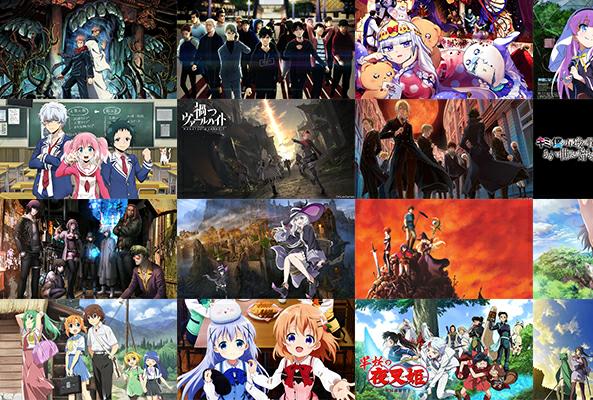
Most of the popular anime series like Naruto, dragon ball z, one piece etc. have more than 200 episodes. They are all great shows off course but watching them requires a lot of time. Due to this reason some people refrain from getting into these series. There are however, many series out there which are very good too and very short indeed.
Here are some of the short but great anime series. Each of these series have utmost 13 episodes which can be watched in a day or two.

• Erased (2016):
Episodes: 12
Genre: Mystery, sci-fi, thriller

Erased is one of the best short anime series out there. It is a bliss for thrill seekers and for people who like the idea of time travel. The story revolves around a 29 year old man who is sent back in time to erase the events which lead to his mother’s death, which began with a series of kidnappings. The anime has very nice soundtrack and beautiful animation and the plot is very interesting. The characters are well written and overall the series is a must watch.

• Blue Spring Ride (2014) :
Episodes: 12
Genre: coming-of-age, drama, romance

Blue spring ride or more popularly known as ao haru ride, is a very decent slice of life romance anime. It is a coming of age drama and shows how the characters grow and change over time. It depicts very well the internal conflicts characters have and is very relatable to watch. The music in this anime is used very well to emphasise the scenes. Overall it is a must watch for those who are into romance genre.

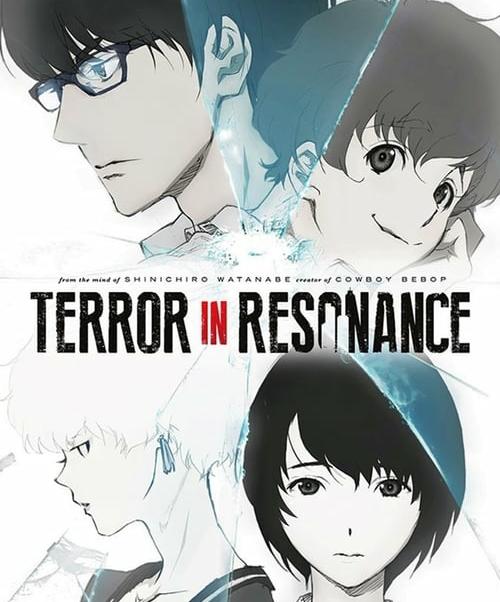
• Terror in Resonance (2014) :
Episodes: 11
Genre: psychological, thriller

This is anime is rather underrated but nevertheless it is one of the best short anime thrillers out there. This anime serves everything in just 11 episodes. Excellent storyline, great music, top notch animation etc. It depicts terrorism very differently and deals with many of the contemporary issues. This is a must watch for everyone.

• Angel Beats! (2010) :
Episodes: 13
Genre: fantasy

This anime is set in a realm of afterlife where a band of teens fight from being taken to the next level. This is a very nice series and worth your time. It has action, drama, fight sequences, tragedies, music, romance and what not. The concept of this anime is very different and it deals with overcoming the regrets of life. It is an epic journey showcased in just 13 episodes!

• Violet Evergarden (2018) :
Episodes: 13
Genre: coming-of-age

This is a more recent anime series. The story revolves around the post war life of an emotionally detached soldier who begins to reconnect with her feelings while searching for the meaning behind her commander’s final words. This anime is a masterpiece. The animation, music, pacing, character designs, backstories etc. all are done very well. It is very empathetic and sentimental anime. This anime is a must watch for anyone!!

Anime movies to watch


Anime refers to the animation works produced in Japan. There are many famous anime series like death note, dragon ball z, Naruto, one piece etc. which have successfully captured the hearts of people all around the globe. Similarly, there are a many anime films which are very good to watch.
Here are some of the greatest anime films which are worth checking out:


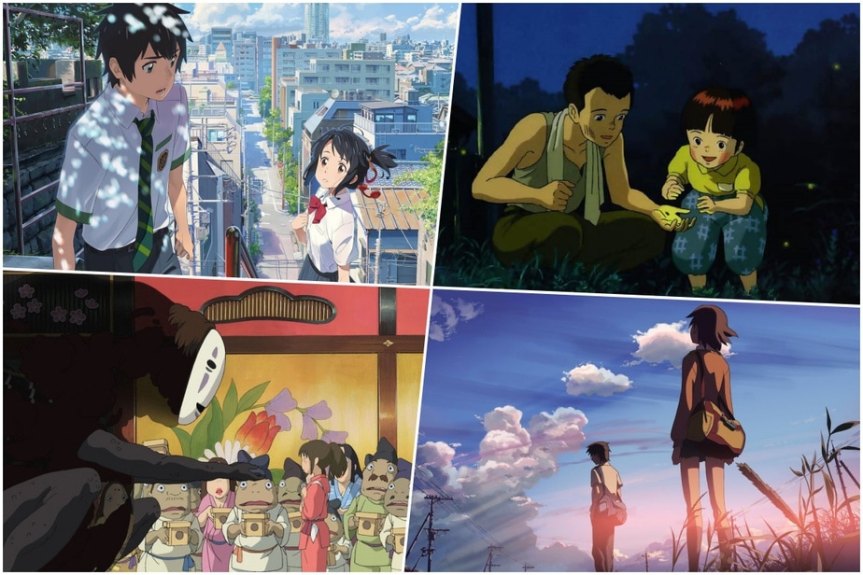
• Your Name ( 2016):

The first thing that comes to mind about this film is it’s extraordinarily breath taking animation. It is directed by Makoto Shinkai and has a 98% Rotten tomatoes rating. It is a one of a kind romantic fantasy film. It is a timeless tale of love of two teenagers who share a magical connection of switching bodies but things get very complicated when they decide to meet in person. This film has a very different take on love. It also depicts the power time has on us and how it changes everything. The music in this film is very stunning and makes the experience even better.

• The Garden of Words (2013) :

This is another Makoto Shinkai’s film. It is rather a mini movie with a runtime of 45 minutes. The animation in this film is very realistic. This film is very soothing to watch. The music and the scenes of rain are very relaxing. T story revolves around a teenager who skips school and meets a mysterious older women who shares his feelings of alienation. This film depicts loneliness and the need of companionship very well. It shows how insecurities can be both cause and result of loneliness. It showcases very relatable thoughts and feelings. Not being able to let go of past, inability to move forward in life, fear of failure, fear of being judged etc. are very aptly portrayed.

• A Silent Voice (2016) :

This is a very emotional film. It is directed by Naoko Yamada. This film depicts the effects bullying has both on the victim and the bully. The story revolves around a boy who bullied a deaf girl to the point where she has to transfer to another school. Years later, he sets out to make amends. It is a very powerful story of redemption of a sinful past. It deals with issues like sucide, self loathe, guilt, bullying, disability etc. This film depicts how self acceptance leads towards healing and how strong karma is. Self love, self forgiveness etc. are portrayed very well. Over all , this film is a roller coaster of emotions.

• Spirited Away (2001) :

This is an all time classic. It has a 97% Rotten tomatoes rating and is the winner of 2003 Best Animated Feature in Academy Awards. It is a Studio Ghibli film and is directed by Hayao Miyazaki. It is one of the best film studio Ghibli has produced. The story revolves around a girl whose parents get cursed when they go to a strange amusement park. Then then meets a boy who tells her about that park and how he has to work there to free her self and her parents. Just like any other ghibli film, it is very detailed when it comes to animation, the pacing is not fast which makes it very relaxing to watch and world exploration is done neatly. There are a lot of mythological referencing in the film and is perfect for both children and adults.

Anime

Anime refers to the animation work produced in Japan. Over the years, anime industry has grown significantly and anime has made it’s way all across the globe. With fans all around the world, anime is one of the greatest achievements of Japan.
Anime uses traditional style of animation. It is basically like a flipbook animation where each frame is drawn by hand. Even after the rise of computer generated animation, the anime industry still sticks to the traditional method of animation. Although CGI is used for special effects but the vast majority of animation is done traditionally. Because of this, anime has a distinct animation style, it somehow looks different, far more detailed and feels like an artwork.
The stories they animate are generally taken from the Japanese comics called ‘manga’. Usually a manga is released first after which it is adapted as an anime but this is not always the case. Some anime are original i.e. without any manga source material while others are released prior to their respective mangas.
Anime originally has Japanese audio. It can be watched with subtitles. Anime is often dubbed in different countries in the language they prefer, mostly it dubbed in English.
Another great feature of anime is the variety of genres and content it offers. Since anime is an animation, most people confuse it as ‘children’s cartoon’ or a ‘kids show’ but this is a very wrong belief as it undermines the content that anime offers. It is true that anime has content for children too but it’s not entirely that. It offers content for teens, young adults and adults. In fact the mainstream anime is targeted for an older audience. Taking about the genres, it has a lot to offer. Action, adventure, thriller, fantasy, sci-fi, romance, slice of life and what not. Each single genera offers a ton of different animes to watch.
The music in the anime is also very appealing. The opening an ending songs are usually taken from the j-rock or j-pop bands. The soundtracks used in the episodes can generate hype real quick and makes the overall experience fun.
Anime is a great source of entertainment and can teach valuable life lessons as well. One can learn a lot about the Japanese culture through anime. Here are some of the greatest anime out there which are worth checking out:
• Death Note:
Genre: mystery, thriller, supernatural
The story revolves around a boy named Light who finds a book which has the ability to kill the person whose name is written in it. Using that book he starts killing criminals to build a better world. This is however considered as serial killing and the investigators with the assistance of a detective named L try to apprehend the culprit.
This anime is a delight for thrill seekers and mystry lovers. It questions what true justice is and presents different perspectives of it.
•Naruto series:
Genre: adventure, fantasy
The series tells the story of an orphaned ninja named Naruto who has a demon sealed inside him. He seeks acknowledgement from his peers and dreams of becoming the leader of his village.
This anime is a classic and teaches many life lessons the most important being never giving up.
• Your Name
Genre: romance, fantasy, drama
This movie revolves around two teenagers who share a magical connection of switching bodies. Things get complicated when they decide to meet in person.
This anime has a breath-taking animation and has a very different take on love.

Fugu: The forbidden fish

Everyone knows that its human nature to want a thing that is forbidden to them. This is what drives many people in Japan and even foreigners who visit Japan, to try the infamous fugu fish. Found in the Pacific Ocean, this fish is a pufferfish and looks rather innocuous, in terms of being poisonous. However, it’s the perfect example of the phase, “looks can be deceiving” as the fish is said to be 1,200 times more poisonous than cyanide. The fish is so poisonous that a slight error in its preparation can cause instant fatality. However, its still one of the most expensive and revered delicacies of Japan.

Described as a fish whose taste is “indescribable”, Fugu is only affordable to the high-end part of our society. The taste of this fish is said to be like no other food anyone would have ever tasted, so utterly delicious that people are willing to risk their lives for it. The liver is famously known as the tastiest part of the fish, but its also the most deadliest part, along with the ovaries, and the eyes. Fugu is deadly because of the poison tetrodotoxin. The poison, a blocker of sodium channels, paralyses the muscles while the victim is completely aware, then the poisoned person cannot respire and dies from suffocation. This takes roughly about 10 mins. Now, with so much advancement in science, there has got to be an antidote to this poison which has been killing people for more than 2,300 years, which is the time during which fugu consumption dates back to. Unfortunately and surprisingly, there is no cure once you ingest this toxin. The normal therapy is to help the respiration and circulation of the person until the toxin is digested and removed through the victim’s body. Researchers found that a fugu’s tetrodotoxin arises from eating other tetrodotoxin-loaded animals that the fish develop insensitivity to over time. So, an effort has been made to cultivate these fishes in toxin free environment.

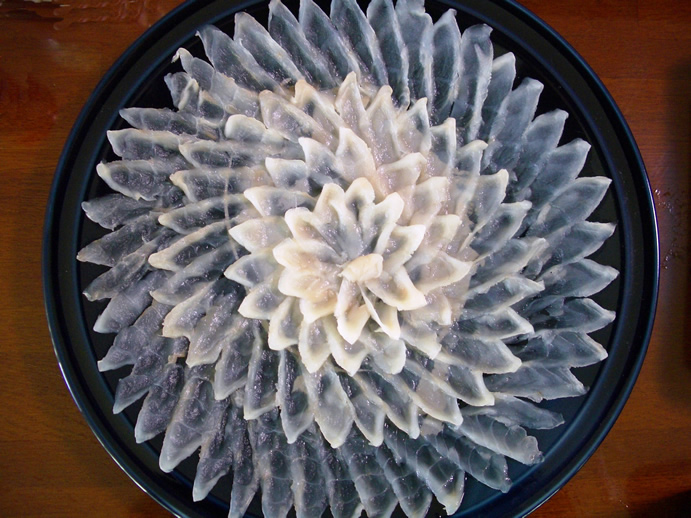
Now the question looms that if the fish is so poisonous, how are people consuming it? Well, no one is consuming it with a 100% surety that they wont die. However, due to its popularity, high demand and income, there are specialized chefs who prepare fugu. These chefs train in fugu preparation from anywhere between 4-10 years. A license is then assigned to them, specifically for the preparation of fugu. Only then, under controlled restaurant conditions, can they prepare fugu. The fugu is then served in an arrangement representing chrysanthemum petals.

A paradox has appeared in Japan where some activists are proposing a ban on the selling and consumption of fugu, while some are even requesting the government to legalise the consumption of the liver of fugu. Fugu has been the leading cause of food poisoning in Japan and most of the people who have died from it were fishermen who tried to cook fugu domestically. There is no doubt that fugu is highly lethal, however consumption of this delicious delicacy in restaurants with controlled environment and skilled chefs is reasonable. What do you think? Given a chance, would you ever try out this dangerous but indescribably tasty delicacy?