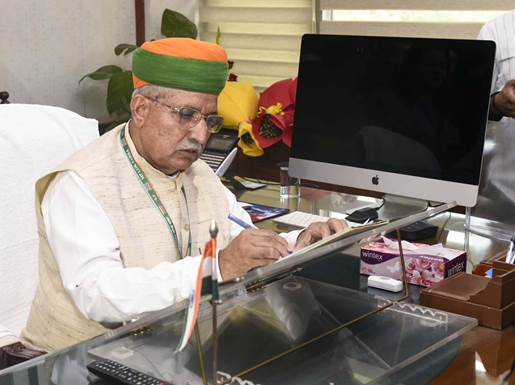
Union Minister of State (Independent Charge) Shri Arjun Ram Meghwal takes charge at the Ministry of Law and Justice

 The Union Minister of State (Independent Charge) Shri Arjun Ram Meghwal took charge of the Ministry of Law and Justice today in New Delhi. Addressing the office bearers as well as the staff, Shri Arjun Ram Meghwal said, “Guided by the Hon’ble Prime Minister Shri Narendra Modi ji, I am committed to serving the people with dedication & integrity and the Ministry of  Law & Justice will contribute in realizing the dream of Viksit Bharat”.

He said that “it is our priority to generate awareness among people for the 3 new criminal laws which are going to be implemented soon”. He further added that “it is our priority that the people get speedy justice in the courts”.

Shri Meghwal, born on 20th December, 1953, is a Post-Graduate in Political Science. He is a Law Graduate and has also done MBA from University of Philippines. Shri Meghwal is  a retired IAS Officer from Rajasthan and fourth time Member of Parliament representing Bikaner constituency in Lok Sabha since 2009 onwards. Prior to the present charge Shri Arjun Ram Meghwal has served as  Union Minister of State for Finance and Corporate affairs (2016-2017), Union Minister of State for Water Resources , River Development & Ganga Rejuvenation and Parliamentary Affairs (2017-19), Union Minister of State for Heavy Industries & Public Enterprises and Parliamentary Affairs (2019-21), Union Minister of State for Culture & Parliamentary Affairs  (2021-2023), Union Minister of State (I/C) for law and justice MoS for culture and parliamentary affairs (2023-24). Shri Meghwal is famous as a bicycle rider for commuting to Parliament and has been awarded Sansad Ratna (3 times) and Sansad Maharatna award.

******

IGNORANTIA JURIS NON EXCUSAT

Ignorantia juris non excusat is maxim of law which in Latin term means ignorance of the law is no excuse. In terms of law, ignorance of fact can be excused but ignorance of law can never be excused. The main motive behind the maxim is that if any accusation of offence is made against an individual, then the person cannot avoid the accountability by claiming that he was not familiar with the law.

In accordance to the maxim, if the law is ignored, it cannot be considered as an excuse to not comply it. If there is lack of facts in a case, one can ignore it but in case of ignorance of law. Every individual must be well acquainted by the laws of the particular inhabitant country and if the individual is unknown to the laws then it cannot be regarded as a cause to not follow it. If an individual is living in a different country, not his inhabitant one, then he is also required to be familiar with the country laws in which he is temporarily living and obey them accordingly. In criminal law, this maxim is often in use. As a warning, this maxim states that if the law is violated by any person then that particular person is liable to be punished irrespective of the fact of whether he knew or was unaware of the particular law and this would be considered as a criminal offence.

In order to avoid the consequences of unlawful actions, ignorance of law cannot be put into application as a protection. The basis logic behind the doctrine of ignorance was that if it was to be considered as an excuse, then a person charged under any criminal offence or issue related to civil suit of law would have successfully been able to escape the liability claiming that he was not aware of the law. If ignorance of law would have been used as defence, then the individual though being completely familiar to the law and its consequences yet could use the maxim effortlessly. The machinery of the enforcement of law would have been immobilized. As the maxim lacks many properties, it is thus a negative fact and evidences cannot be appealed by the court. In such case, a rigorous evaluation of the state of mind of the wrongdoer is required, which in itself is a challenging task to perform. If there is relaxation of the maxim, then it would be pleaded on the part of every accused that the law was unknown to him. Thus, taking into consideration the stated reasons, the claims under the ignorance of law is rejected by the legal authorities.

In India, we have a variety of laws such as contract, family, civil, criminal etc. If any individual ignores any of the following laws, he is held responsible under the law. For example, a wild buffalo is shot by a man in India. The man assumed it to be a domestic buffalo and was unaware of the law of wild protection which states that hunting of wild buffalo is considered illegal in India. Thus, the man is said to be portraying in ignorance of law. Thus, the claim under the ignorance of law is rejected by the legal authorities. Ignorance of law simply means lack of understanding of the general laws which are supposed to be known to everyone not taking into account whether the whole fact is known to him or not. Every individual must be well acquainted by the laws of the particular inhabitant country and if the individual is unknown to the laws than it cannot be regarded as a cause to not follow it. The main motive behind the maxim is that if any accusation of offence is made against an individual, then the person cannot avoid the accountability by claiming that he was not familiar with the law.

For example, a rifle is owned by a woman without license. She is caught by the police as possession of any weapon without license is illegal. She claims her defence by stating that she was unaware of the law. However, she was held liable for the same because it is assumed that every individual of a particular country should be acquainted by the rules of its nation.

Therefore, it can be inferred that from the maxim “ignorantia juris non excusat’ that an individual who disobeys the law shall be held liable irrespective of whether they are familiar to the laws or not. The people are also warned by this maxim. The main principle is the effective judicial administration that is enable by the good in common.

Should writers and artists have an unrestricted right to expression?

Freedom of expression means the right to express one’s own conviction and opinions freely by word of mouth, by writing, through painting or any other mode. In modern times it is widely accepted that the right to freedom of expression is necessary in a democratic society and this right must be safeguarded at all times. Liberty to express opinions and ideas without hindrance and especially without fear of punishment plays a significant role in the development of society. It is one of the most important fundamental liberties guaranteed against state suppression or regulation. However, this freedom needs to be tempered so that it does not hurt the sentiments of others.

• ‘Freedom of expression’ originally guaranteed by the Indian constitution Prior to 1972, Article 19 (1) of the Indian constitution guaranteed this freedom of expression. However, after 1972, Indian politicians felt this should be restricted as they feared that they will be ridiculed or otherwise harmed politically if it remained unrestricted. So, they enacted laws to limit the freedom of expression on various grounds under the garb of law and order, national security and other noble objectives.

• Restriction to freedom of speech causes suffering Many writers, speakers, cartoonists etc. belonging to different castes, creeds and social positions have suffered and are suffering due to the restrictions imposed by law. On most occasions they have been charged and arrested, causing them mental anguish and physical/financial suffering.

• Freedom of expression should be protected Important justifications for freedom of expression and speech are that they assist in the discovery of truth, help an individual to attain self fulfilment etc. ultimately results in the welfare of society and state and strengthen the capacity of an individual in participating in decision making in a democracy.

However, no freedom is absolute and unrestricted. It is necessary to exercise freedoms in order to have a democratic society, but their limitations are also needed for the maintenance of the democratic society. So, the freedom has to have suitable restrictions.

Thank you for reading. Have a nice day!

Supreme Court And Covid19 – A Forgotten Responsibility?

The Supreme Court in june said it will investigate the practicality of physical appearances of lawyers in the court while sticking to physical distancing standards in the midst of the COVID-19 pandemic. The court has been hearing pressing cases through videoconference all through the time of the lockdown. The Benches hearing these cases sit in the courts while legal advisors, who are provided with video joins, make their entries from their homes or workplaces. The court had named this component as the ‘virtual court’ system. However, the Supreme Court Advocates-on Record Association (SCAORA) has been making portrayals to the top court that a greater part of the legal counselors find that they can’t adequately introduce their contentions during virtual court hearings. SCAORA had as of late kept in touch with the court to start physical court hearings from July to serve the legal advisors.

The Bar Council of India (BCI) had recently asked the Chief Justice of India Sharad A. Bobde to continue physical court hearings from June 1. BCI chairperson and senior advocate Manan Kumar Mishra had written in a portrayal to the CJI that solitary a “handful of privileged class of advocates are beneficiaries of the virtual court system”. In its short roundabout, the court showed that it was available to the chance of physical court hearings, gave supporters and gatherings who come face to face to introduce their cases give a joint agree with respect to their “eagerness for genuinely showing up and contending in court”. The court said it would think about how conceivable it is dependent upon the accessibility of Benches, requests of the skilled position and physical removing standards.

Since March, 2020 an enormous number of people and associations have moved toward the Supreme Court concerning the effect of Covid-19. A large number of the Petitions, for example, the supplication to pronounce monetary crisis, are trivial. Some others have petitions requiring significant levels of clinical or other mastery, which the Supreme Court doesn’t have, can’t be gone into. Then again, various issues have been brought up in the Supreme Court which it could have and ought to have engaged however neglected to do as such. The essential methodology of the Supreme Court has been to either say that the Government is accomplishing awesome work and in this way the Court ought not meddle or to say that these are matters concerning strategy which can’t be meddled with. Basically the Supreme Court has been profoundly respectful towards whatever the Central Government says, particularly through the Solicitor General; and when pushed, the court will at the most solicitation the Central Government to consider the issue brought up in a Petition. No course of events is given nor any direction with regards to what are the elements to be taken into account while thinking about the issue. No inquiries are posed and no worries communicated; the Petition passes on a characteristic demise. Let us presently take a gander at a portion of the significant issues managed by the Supreme Court concerning Covid-19.

undoubtedly, this was uncommon in which the Government must be permitted a specific opportunity to go about as it saw fit. In any case, to totally abandon its duties towards the poor was something shocking. Possibly, be that as it may, Covid-19 is the darkest stage throughout the entire existence of the Supreme Court when it renounced its obligation at one go towards a huge number of penniless and underestimated individuals and this record will take some beating in the decades to come.

Weakening Labour Laws

The Covid-19 pandemic has influenced the economy harshly, bringing about development stoppage in significant segments. The horticulture, vehicle, lodging, travel and the travel industry, assembling and administrations segments are completely hit. The suspension of monetary exercises during the national lockdown time frame in India has cost the economy $235 billion, Barclays Company evaluated. As per the Chicago Booth’s Rustandy Centre for Social Sector Innovation, which broke down information from the Centre for Monitoring Indian Economy (CMIE), has seen that over 84% of family units in India lost salary during the lockdown time frame.

In this time, some state governments have passed statutes and new guidelines influencing the work laws and their application. Nearly 10 states have achieved changes in the labour laws, for the most part in The Factories Act, 1948, The Industrial Disputes Act, 1947, and The Labour Laws (Exemption from Furnishing Returns and Maintaining Registers by Certain Establishments) Act, 1988. The state governments have asserted that these measures are important (I) to launch financial exercises (ii) to draw in outside speculation and (iii) to support development possibilities.

Not long after proclamation of these statutes, worker’s guilds the nation over, rights activists, work specialists and even industrialists censured these measures as being in opposition to laborers’ privileges. These measures disregard the set up guidelines of International Labor Organization (ILO) and the Fundamental Rights and Directive Principles of State Policy of the Indian Constitution. Numerous PILs (Public Interest Litigation) were documented in the separate state high courts and in the Supreme Court. The Allahabad High Court sent notification to the Uttar Pradesh government, following which the UP government pulled back one request, that on the 12-hour work move.

Labour is a subject in the Concurrent List and subsequently both Union and state governments are equipped to authorize enactments relating to work government assistance. Thing 24 on the Concurrent List explicitly makes reference to arrangements for the “government assistance of work, including states of work, fortunate assets, bosses’ obligation, laborers’ pay, shortcoming and mature age annuities and maternity benefits” of Article 246 of the Constitution. Any adjustments in the laws identified with the subjects recorded in the Concurrent List must be made in counsel with the Union government. Something else, the law passed by the Union government stands substantial according to Article 254(1). The state governments appear to have disregarded this while giving their laws. The debilitating of work laws have seriously obliged the government assistance and equity plan inserted in the Constitution.

The utilization of the law to suitable the privileges of average workers individuals is the plan of neoliberal administration systems. In the period of contractualisation of work, laborers’ privileges are seriously undermined as the administering power has moved from State to the private division. The withdrawal of the State from government assistance is in progress, as is obvious from these laws. These measures will remove the respect of work and its related rights. In “A Tale of Three States: Labour Reforms in the States of Gujarat, Madhya Pradesh and West Bengal,” Kingshuk Sarkar says that consideration was given to “guaranteeing simplicity of working together instead of securing laborers’ privileges and qualifications.”

The genuine issue lies not with the labour laws yet with the idea of the State. With these mandates, the state governments have disintegrated the standards of ‘helpful federalism’. With regards to the Covid-19 emergency, it would be judicious for the for the Indian State to maintain laborers’ privileges and poise to upgrade its own social authenticity and open trust.

Justice for Jayraj and Fenix – The Need To Stop Custodial Deaths

More than 1,000 people of Sathankulam town in Tamil Nadu’s Thoothukudi district staged a dharna Tuesday after two persons were allegedly killed in police custody here. In a chilling case of police torture, a father and son died in a span of 10 hours, in judicial custody in Thoothukudi, a coastal town in south Tamil Nadu, allegedly after being subjected to third-degree tre­at­ment by the police. The incident triggered widespread political and societal outrage.

The deceased have been identified as Jayaraj (59) and his son Fenix Emmanuel (31).  Two sub-inspectors have been suspended. According to the protesters and other local residents, Jayaraj along with Fenix ran a mobile shop named APJ in the town. On Friday, he closed his shop around 8:15 pm. Personnel from the Sathankulam police station, who was on patrol duty, reportedly pulled him up for running the store beyond the permitted time, and an argument took place.

On Saturday evening, the police personnel visited the shop again and had an altercation with Jayaraj.  When Fenix intervened, both father and son were taken to the police station and booked under several sections of the IPC, including Section 188 (disobedience to order duly promulgated by public servant) and 353 (use of force to deter public servant from duty).

On Sunday, after a medical check-up, the duo was lodged in the Kovilpatti sub-jail. That evening, local residents alleged, Fenix complained of chest pain and Jayaraj had a high fever. Both were taken to the Kovilpatti government hospital, where Fenix died on Monday evening and Jayaraj succumbed to respiratory illness Tuesday morning.

Jayaraj’s wife Selvarani has lodged a complaint, alleging that police brutality led to the death of her husband and son. In her complaint letter to the district criminal court and Assistant Commissioner, she said the police brutally attacked her husband and son, used curse words, and threatened to kill them. She urged them to book the police officers responsible under section 302 of the IPC and suspend them from duty.Condemning the killing, all trader union bodies, various political outfits, activists, and the local public staged protests in various parts of the town. Kanniyakumari MP Vasanthakumar, former AIADMK MP Sasikala Pushpa, and other party functionaries participated in the protest. Their demands include the arrest and suspension of the police officers responsible for the incident, compensation of Rs 50 lakh to the family members of the deceased, a doctor from the protesters’ side to be allowed during the autopsy, and a government job to one member of the deceased’s family.

The series of violations in the case mock our procedures. Whenever there is a death in police custody, the concerned police officers are duty-bound to bring it to the notice of senior officers expeditiously.

In view of the perception that custodial deaths take place because of reckless incidents of arrest, amendments have been effected to the Criminal Procedure Code, stating arrests be made only in offences which attract punishment of more than seven years or in those offences where there is apprehension that the accused may commit similar offences or assist other accused to escape. As soon as the accused is arrested, he should be medically examined by competent government medical officers and necessary medical assistance should be provided as per the requirement. Information about the arrest should be communicated to his advocate and relatives/family members. Details of his arrest need to be conveyed to the police control room and displayed on the unit website. In addition, following directives from the Supreme Court, a State Police Complaints Authority has been formulated under the chairmanship of a retired High Court judge to look into grievances in this regard. All complaints about custodial death are also looked into minutely by NHRC and SHRC from time to time.

Even though all these directives are being underlined and well-published from time to time, it is a matter of concern why these are not implemented at the ground level. Once one gets a job in the police department and wears the police uniform, there is a misconception that this is a blanket approval to arrest anyone and obtain a confession by indulging in physical harassment. Several times, suspecting someone for petty theft or because of personal rivalry, complaints are registered by people of means, and this is followed by arrest and physical torture.

If the police officer does not do so, he is declared a good-for-nothing. Many a time, a police officer who indulges in beating a citizen in public and violates all norms is appreciated by people and he is considered a hero.  Kamte was working as officer-in-charge of detecting crimes in Sangli police station for the last three years, and had reportedly detected several offences using high handed tactics and was applauded by the public from time to time. This must-have led him to believe he is beyond any law.

NHRC, as well as SHRC, have clarified more than once that unless a person has gone to a police station to lodge a complaint, whether he is in the lock-up or outside, he would be treated as under arrest and it is the responsibility of the police officer in charge of the police station to take care of his health. The study of custodial deaths reveals that more than 65 per cent are attributed to suicide, about 25 per cent to mental shock and less than five per cent to police harassment. These are official statistics and they tell us that we need a whole range of steps – from safety measures to psychological inputs and an array of methods and systems to keep a check on these violations and create a culture of fair and proper investigations.

Acting with impunity

These incidents have brought into sharp focus the way Indian policemen torture and interrogate suspects in their custody leading to death in several cases. As a result, policemen all over the country have been severely criticised and condemned. Strictures passed against policemen from time to time by learned judges of various courts notwithstanding, the police continue to brazenly torture suspects in their custody.

The Central Bureau of Investigation too uses torture as a method of investigation. In September 2016, B.K. Bansal, Director General of Corporate Affairs, and his son Yogesh committed suicide. In their suicide note, the two men listed the names of officers who had tortured their family in connection with a case of disproportionate assets. Bansal’s wife and daughter too had committed suicide two months earlier. On the directions of the National Human Rights Commission, an inquiry was held by the CBI. Expectedly, the agency exonerated all the accused. Taking cognisance of the matter, the Central Vigilance Commission published a standard operating procedure laying down guidelines for interrogation of accused officials.

Custodial deaths have been on the increase in recent years. They increased by 9% from 92 in 2016 to 100 in 2017, according to the National Crime Records Bureau. Since policemen responsible for custodial deaths rarely get punished, they feel emboldened to continue using torture as the tool to get to the truth. In 2015, for instance, the police registered cases against fellow police officers in only 33 of the 97 custodial deaths.

A historic order

The Supreme Court delivered a historic order in 2006 on police reforms. It stated, among other things, that every State should have a Police Complaints Authority where any citizen can lodge a complaint against policemen for any act of misdemeanour. However, only a few states such as Kerala, Jharkhand, Haryana, Punjab and Maharashtra have implemented the order. Others have not taken the matter seriously.

Until exemplary punishment is meted out to policemen who are responsible for custodial deaths after proper judicial inquiry, not much can be expected to ameliorate the situation. Proper interrogation techniques coupled with the use of scientific methods to extract the truth from suspects can go a long way in reducing custodial deaths.

Therfore, It should be mandatory for every officer in charge of the unit to visit immediately all incidents of escape of prisoners or deaths in custody. If the unit in charge does not reach the spot of the incident promptly, she or he should be held accountable. Otherwise, such serious incidents would continue to recur. The time is now ripe for the Indian government to consider ratifying the international treaty against torture and declare her commitment to human dignity.


Current Gaps In Access To Justice In India

INTRODUCTION

The Constitution of India mandates equality before law, yet informal practices of exclusion and inequality continue to plague our legal systems. Lack of legal awareness, affordable legal aid, delays and inefficiencies in court, and corruption within law enforcement are all impediments on the road to justice. šInternational human rights standards and modern legal systems unanimously affirm that equitable treatment under law is a fundamental component of democracy. Yet in practice, injustice is rampant across the world, with its largest democracy, India, proving to be no exception. Across the world, socially and economically vulnerable groups bear the brunt of these abuses. “The United Nations has learned that the rule of law is not a luxury and that justice is not a side issue. We have seen people lose faith in a peace process when they do not feel safe from crime. We have seen that without a credible machinery to enforce the law and resolve disputes, people resorted to violence and illegal means.”

– Kofi Annan, Secretary General, UN (1997 – 2006)

Standing in the way of India’s growth story

• India ranks 76 / 176 on Transparency International’s Corruption Perceptions Index

• India ranks 77 / 113 for ‘Regulatory Enforcement’ on the World Justice Project’s Rule of Law Index, 2016

• Wages and business lost annually due to time spent in court hearings amounts to 0.48% of India’s GDP

Access to justice: Building blocks and gaps

Historically, the State’s obligation to ensure access to justice was restricted to:

1.Creation of laws that protected all citizens equally, and

2.Entitlement of every person to defend claims in courts.

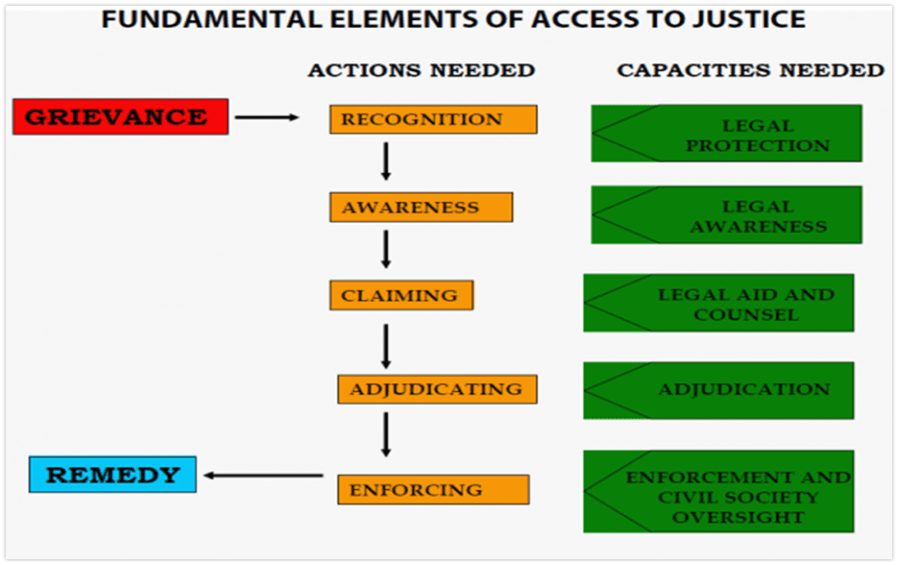
For decades after Independence, the Indian government made no efforts to facilitate a population-wide understanding of the law or to encourage use of judicial systems. In 1976, however, India introduced Article 39A to the Constitution, which recognized the right of economically disadvantaged individuals to free legal aid. While this amendment was a step towards bridging the gap between having a justice system and enabling its use, it has had limited success in truly reducing this gap on the ground. In order to address inherent power imbalances in India today and ensure universal access to justice, it is essential to widen the discourse from merely strengthening legal institutions to also increasing citizens’ legal empowerment (i.e. the ability to understand, use and shape the law to secure justice). Access to justice needs to be extended to include all the elements needed to help citizens and individuals seek redressal for grievances (against individuals or the State) and to demand that their rights be upheld.

4 Step Framework To Improve Access To Justice

“Sometimes even highly educated people have a problem understanding, and therefore interpreting, the correct meaning of some of our laws… an attempt should be made to simplify the language of the law so that anyone who reads judgments and laws can easily understand their true meaning.”

 – Manmohan Singh, former Prime Minister of India Make laws accessible and comprehensible for legal empowerment

šMake laws accessible and comprehensible for legal empowerment

 This will enable each citizen to know of and take legal recourse when his/her rights are violated.

š Streamline case management processes in courts

This will reduce the period of time for which litigants are embroiled in the system, as well as build greater trust in the system.

š Drive accountability and support police and prison systems

This will help these agencies operate more sensitively and effectively to uphold the rights of all citizens including victims, accused, undertrials and the most marginalized

šEnsure high quality, affordable legal aid

If one should choose to access courts, guarantees every individual a chance at a fair trial, regardless of economic and social background

All you need to know about Cyberbullying ( and how to prevent it)

Cyberbullying, also known as cyberharassment, which happens using electronic means. It is also known as online bullying. It has become increasingly prevalent nowadays, especially among adolescents, as technology had advanced and the digital sphere has broadened. Cyber bullying occur on platforms like social media, chat rooms, and gaming sites where people can see and participate in sharing of content.

Cyber bullying is said to be happen, when someone bullies or harasses others on the internet and other digital spaces, usually on social media sites.

Cyber bullying behaviour involves posting threats, rumors, hateful comments on online platforms/apps, or via SMS or messaging in order to cause humiliation to other users. It includes posting, sending or sharing negative, Unpleasant or false information about an individual for causing humiliation and character assassination. It also involves posting threats, a victim’s personal information, hate speech or sexual remarks to someone on the internet.

Types of Cyber Bullying

An awareness of the different types of Cyberbullying is important. This helps parents and young adults to report cyber bullying and adopt various measures for the same. Following are some of the common types of cyber harassment:

• Trolling has become increasingly prevalent in these days and is the most common form of bullying that happens in an online community. This is done to evoke a reaction or disruption, or sometimes, even for personal amusement.

Cyberstalking is another type of bullying or harassment which involves electronic communications to stalk a victim; this may tend to be threatening to the victim.

• posting an embarrassing or unpleasant photo/video.

• faking identity online

• issuing online threats to hurt or provoke someone.

• posting hate comments or content triggering religious, racial, ethnic or political malice.

• Also Doxing, it is a practice common on the internet where personal information about an individual is reasearched and published. One finds out information from the person’s social media and other online platforms. It is then used for online defamation, harassment or other forms of cyber bullying.

Cyber Bullying in India 

Cyber bullying in India had increased prominently since availability of affordable data services and social media presence has increased. According to a research by Symantec, almost 8 out of 10 individuals are exposed to different types of internet bullying in India. Most of the victims are generally women and teenagers.

The same study categorises India as the country facing the highest cyber bullying in the Asia Pacific region, more than Australia and Japan.

Special Concerns

with the widespread presence of digital forums, social media websites, posts, comments, content shared by individual can be seen by strangers as well as acquaintances. Whatever content the individual shares online, be it personal or public, creates a kind of public record of their activities, views and behaviour. this can basically represents their personality, which may be accessible to schools, employers, college, clubs, and other institutions who may be researching an individual now or in the future. Cyberbullying can tamper the reputation of everyone involved, not just the the person being bullied but also those who are participating in the bullying. 

What can you do?

Ask for help: if you are experiencing any distress related to online bullying, reach out to someone for help. It maybe your friend, relative, colleague or someone you trust.

Use the technology to cut off the Bully: almost every social media site allows you to report or block someone. They also enable you to report inappropriate content or behaviour. 

Protect your Accounts: passwords are your private information. never share your passwords with anyone no matter who the person might be. Password protect your phone so that no one can use it for impersonation. 

Report Cyber Bullying: The Ministry of Women and Child Development launched a helpline to report cyber bullying/harassment, cyber defamation, especially for women and children as they are subject to cyberbullying the most. most institutions also have special faculty of development whom you may report to, about the bullying.

Helpline – complaint-mwcd@gov.in

EVOLUTION VS CIVILIZATION

Humans are gradually developing themselves since the very beginning of the creation. They are continuously evolving. What is most important while evolving is to maintain the civilization, so that the society in which a person lives, does not get harmed or affected. Today, we have come a long way in terms of evolution but the question is, would we be able to protect the civilization?


Animal abuse by humans is not a new thing. Though cruelty to animals is a punishable offence, we, the so-called civilized humans cannot resist ourselves from tormenting those helpless and innocent creatures, just for mere entertainment. Our planet is blessed with diverse species, but because of the cruelties caused upon them some of the very beautiful species are on the verge of extinction. The humans have threatened their existence to such an extent that the Earth is no more a safe place for the animals to live. Being the strongest species in the entire eco system, humans are going beyond their limits to commit brutality on the pure and beautiful animals.


Recently, in a small village called Malappuram, in Kerala an extremely heinous crime was attempted by some of the villagers on a 15 years old pregnant elephant, who came into the village in search of food. The innocent elephant was fed a pineapple loaded with firecrackers by some of the villagers. The crackers exploded in her mouth causing severe injury to her tongue and jaws. To get some relief and to save her unborn child the elephant ran to a river nearby and stood in the water for a long time, but inspite of her brave attempts, she could not save herself and her child. These people do not deserve to be called civilized. How much regression is needed to commit such an atrocious crime to a guiltless, pure animal, is really not known. Since the humans have been thinking from a very long time now that they are the superior species amongst all, so, they can do anything they want and most of the times they even do not get punished for these mischievous acts. Being the superior creature, humans should be venerated for what facilities they have got. Instead, some of them are acting as demons by misusing those advantages and heading towards destruction.


Though it is not proved yet, if anyone deliberately fed the crackers stuffed pineapple to the pregnant elephant, they are still at fault. Even if the pineapple was lying on the road and the elephant ate it accidentally, how could anyone keep fruits stuffed with firecrackers on the roads knowing that animals can eat them? Human behavior will always remain an enigma. Elephants are the most expressive animals. There are conjectures that elephants’ mind react to humans the same way humans’ mind reacts to puppies. If the humans do not cause discomfort to them or torment them, they do not harm anyone. The innocent elephant trusted humankind and delightfully ate the food she got at the vicinity. As a result, she got deceived. Even in writhing pain, while running towards the river, she did not harm a single human. She knew the value of lives more than any human out there. May be because, she herself was creating a life inside her.


What happened with the innocent and voiceless elephant in Kerala, was really shameful as well as reprehensible. Yet the enlightened humans across the world are politicizing this incident and also quoting Kerala’s literacy rate since it has the highest literacy rate in India. What they have forgotten is literacy rate has nothing to do with animal maltreatment. Humanistic values do not come entirely from formal education. Humanity and literacy do not go in hand in hand. Many illiterate people may have more humanistic values than some highly educated people. More than being empathetic to the poor animal, some so-called educated people of our society are showing their hypocrisy by targeting and taunting Kerala for its highest literacy rate.


These incidents point out how we are evolving. From throwing stones or water to the stray dogs to feeding fruits loaded with explosives to a pregnant elephant, humans have shown how they have retained their civilization. May be, the animals have not evolved much, that is why corruption could not enter into their world. The speechless, innocent animals are already suffering a lot for the humans’ unending experiments and adventures. Our planet is as much theirs’ as ours’. Together we have to make the Earth a safe place for the animals to live on. Only then we will be able to evolve with the civilization in right means.

Distinction between the Writ of Prohibition and the Writ of Certiorari

The writ of Prohibition is issued to prevent the decision or administration action in the process, so that it cannot proceed further, while the Writ of Certiorari is issued to quash the decision already given.

Both the Writs are similar in many aspects. Both are issued by the superior court to the inferior court or Tribunal or body exercising judicial or quasi- judicial functions on similar grounds.

However, the main difference between the writs are as follows:

Writ of ProhibitionWrit of Certiorari
When an inferior court takes up for hearing a matter over which it has no jurisdiction, the person against whom the proceedings are taken can move the supreme court for a Writ of Prohibition and on that an order will be issued forbidding the inferior court from continuing the proceedings.When the inferior court hears the cause or matter and gives a decision on a case over which it has no jurisdiction over, the party aggrieved shall have to move to the Supreme court for a Writ of Certiorari on which an order will be made quashing the decision of the inferior court., 
It is issued before the proceedings are completed.2.  It is issued after decision is given         by an inferior court or Tribunal or any body exercising judicial and quasi-judicial functions, exceeding its jurisdiction.
The object of the Writ of Prohibition is prevention rather than cure.      3.  The Writ of Certiorari is rather used as a cure by quashing a decision already given by the inferior court.
Prohibition lies only against judicial or quasi- judicial bodies.4. while Certiorari lies against a public authority which acts purely in an executive or administrative capacity or to a legislative body along with judicial and quasi- judicial bodies.

Case law –

1.Hari Vishnu Kamath v Ahmad Ishaque

In the above case supreme court held that in cases where there is a requirement for prayer of certiorari as well as prohibition and the in the application not prayer of certiorari has been made then it would be open to the court to issue the writ and stop further proceedings which are affecting the decision. But in this case the proceedings have ended then seeking for prohibition will be too late and writ of certiorari must be a proper remedy for quashing. Clearing on the point it was also held that writ of prohibition will lie when the proceeding is pending to a large extent and writ of certiorari will be issued when then case has been terminated in a final decision.

2.  Bengal Immunity Co. v State of Bihar

 It was observed by the Supreme Court that the existence of an alternative remedy, that is adequate and equally effective remedy may be a matter that can be taken into consideration by the High Court in granting the writ. It is a writ of right not a discretionary writ and nature of writ of prohibition is much of corrective one rather than preventive. Presence of an alternate remedy does not impose an absolute bar on issuing writ of prohibition. But presence of an alternate remedy will be more relevant in context of certiorari.

   CONCLUSION:

The procedure ordinarily followed by the Supreme court or  High Court while exercising the certiorari jurisdiction is to command the inferior court or tribunal to certify its record or proceedings to the High Court for its inspection so as to enable the High Court to determine whether on the face of the record the inferior court has committed any of the preceding errors occasioning failure of justice. After adjudging the case in refer­ence to the objection raised the court may pass an appropriate order which may include quashing of proceed­ings at subordinate court or tribunal, as the case may be.

Often a writ of certiorari is sought along with a writ of prohibition, so as to ensure that the invalid act is not only reviewed by a superior court, but its operation is restrained as well.  

IT Minister Launches National AI Portal of India- www.ai.gov.in

On the occasion of the first anniversary of the second tenure of the government, the Union Minister for Electronics and IT, Law and Justice and Communications Ravi Shankar Prasad launched India’s national Artificial Intelligence Portal called www.ai.gov.in

This portal has been jointly developed by the Ministry of Electronics and IT and IT Industry. National e-Governance Division of Ministry of Electronics and IT and NASSCOM from the IT industry will jointly run this portal. This portal shall work as a one stop digital platform for AI related developments in India, sharing of resources such as articles, startups, investment funds in AI, resources, companies and educational institutions related to AI in India. The portal will also share documents, case studies, research reports etc. It has section about learning and new job roles related to AI.

On this occasion, the Minister for Electronics & Information Technology, Communications and Law & Justice, Ravi Shankar Prasad, also launched a National Program for the youth, Responsible AI for Youth”. The aim of this Program is to give the young students of our country a platform and empower them with appropriate new age tech mind-set, relevant AI skill-sets and access to required AI tool-sets to make them digitally ready for the future. The Program has been created and launched by the National e-Governance Division, Ministry of Electronics & IT in collaboration with Intel India, with support from Department of School Education and Literacy (DoSE&L), Ministry of Human Resource Development. DoSE&L will help reach-out to State Education Departments to nominate teachers as per eligibility criteria.

“Responsible AI for Youth” will empower the youth to become AI ready and help reduce the skill gap, while enabling youth to create meaningful social impact solutions. The Program is designed to reach out to students from Government schools pan India and provide them with an opportunity to become part of the skilled workforce in an inclusive manner.

Addressing the media at the launch event, the Minister for Electronics & IT, Law & Justice, Shri Ravi Shankar Prasad said “India must be a leading country in the development of Artificial Intelligence in the world, leveraging upon its vast Internet savvy population and data it is creating. India’s AI approach should be of inclusion and empowerment of human being by supplementing growth and development rather than making human beings less relevant”.

MoS for E&IT, Communications, and HRD, Shri Sanjay Dhotre, while emphasising the role of digital technologies with special reference to pandemic-afflicted world, said that such technologies have proved to be our saviours during the difficult times. These have been of very crucial help especially in the field of education, agriculture, healthcare, e-commerce, finance, telecommunications, etc. He further added that the digital technologies have been great equalisers despite several odds. Highlighting the importance of the AI Portal, Shri Dhotre said that such national portal will lead to democratization of artificial intelligence in the country.

Details of Responsible AI for Youth Programme:

The National Programme is open to students of classes 8 – 12 from Central and State government-run schools (including KVS, NVS, JNV) from across the country – all 28States and 8Union Territories and aims to bring about a change in the thought process and create a bridge for the digital divide. The Program will be implemented in a phase-wise manner and in its first phase, each of the State Education Department will nominate 10 teachers as per the eligibility criteria. Teachers may also self nominate themselves by fulfilling the eligibility criteria. These teachers will be provided orientation sessions aimed to help them understand the premise and identify 25-50 potential students for the Program. The identified students will attend online training sessions on AI and understand how to identify social impact ideas/projects that may be created using AI and submit their ideas through a 60 seconds video explaining a proposed AI enabled solution.

From the submitted ideas in the form of videos, top 100 ideas will be shortlisted and these students will be invited to attend residential boot camps or online sessions (subject to COVID-19 situation); to take them through a deep dive AI journey. Post the boot-camps/ online sessions, these students will be asked to create real time projects and submit their final project in a video format on the website.

Adequate handholding will be provided by Intel certified AI coaches and mentors throughout to ensure that ideas mature as prototypes. The experts will shortlist top 50 project ideas and students will be invited to showcase their projects either face to face or in an online format. Further, top 20 innovative projects will be selected by an independent committee of experts and provided opportunities to showcase at relevant platform.