Motivational Literature

Introduction:

The motivational genre is concentrated on motivating the readers to achieve their goals. It focuses on problems and helps to solve the puzzle. It also helps to improve the character and the personality of the readers.

Motivation:

The term motivation is derived from the Latin word, ‘Movere’ meaning ‘To Move’. Motivation can be referred to as a combination of motive and action. Motivation is an action word that influences every aspect of our daily lives. Motivation is fundamental in the level of success and individual attains.

Characteristic of motivational literature:

In Literature, “Motivation” is defined as a reason behind a character-specific action or behavior. This type of behavior is characterized by the characters on consent and willingness to do something. Characters have some motivation for every action, as do people in real life. Therefore, The implicit or explicit reference to a motivation of a character makes the piece of literature seems closer to life and reality.

Indian motivational literature:

The God of Small Things by Arundhati Roy

Arundhati Roy is one of the prominent writers in India. Her famous works are “The God of Small Things” and “The mystery of utmost happiness”. The God of Small Things is an inspirational encounter with two twin sisters who go through a series of unfortunate events in life. This work is a big booster of inspiration that helps us to boost up our self moral self-esteem and inspiration to embark upon a new beginning full stop the book will make you realize that need for change on the futility to become rigid in life.

If you are happy in a dream, does that count?

African literature:

I know why the caged bird sings by Maya Angelou

I know why the caged bird sings is a 1969 autobiography describing the early years of American writer and poet Maya Angelou. It shows how the strength of character and the love of literature can help overcome racism and trauma. This autobiography touches on themes such as race, sexuality, love, and identity. Struggles to separate sexuality and love in two separate category due to the lack of love from her family and on account of being sexually abused.

Hoping for the best, prepared for the worst, and unsurprised by anything in between.

Austrian literature:

Man’s search for meaning by Viktor E Frankl

Viktor E Frankl is an Austrian doctor, a writer, and a Holocaust from the Nazi concentration camp. This book is about how he lived inside the camp and how he managed to survive. And to stand for the title he talks about logotherapy that is a person needs a reason to survive. This book is full of meaning and hope.

Those who have a “why” to live, can bear with almost any “how”.

Lebanese literature:

The Prophet by Kahlil Gibran

The Prophet is a short book with enormous wisdom within the pages. The Prophet provides timeless spiritual wisdom on a range of subjects including giving, eating and drinking, clothes, buying and selling, crime and punishment, laws, teaching, time, pleasure, religion, death, beauty, and friendship. It is not a religious book but it is spiritual. In this book every word is like a poem, it has its rhythm and rhyme schemes.

“Your children are not your children you may give them your love but not your thoughts for they have their own thoughts.”
The Ode

Two must-read books by Paulo Coelho part 2

The ode

Introduction:

The Ode may be defined as a ‘rhymed lyric often in the form of an address, generally dignified or exalted in the subject, feeling and style’. It is also defined as any ‘strain of enthusiastic or exalted lyrical verse directed to fixed purpose and dealing progressively with a dignified theme’. An ode is noted for its logical evolution of thoughts and it has a certain amount of complexity and elaboration, unlike a simple lyric.

An ode usually begins with an address to somebody or something. Sometimes the opening line or lines may contain an apostrophe as in the case of Shelley’s ‘Ode to the west wind’ or Tennyson’s ‘To Virgil’s. An ode may be written on an important public event or the death of a distinguished person. Marvell’s ‘Ode upon Cromwell’s Return from Ireland’ belongs to the first category and Tennyson’s ‘Ode on the Death of Duke of Wellington’ belongs to the second category.

Origin of Ode:

The ode is of Greek origin. There were two traditions of odes in Greece. The first type of the Dorian mode was so called from the district and dialect in which it arose. It is also called the Pindaric ode because Pindar, the ancient Greek poet, was its greatest exponent. The second type of ode is the lesbian old so-called because it flourished at first on the island of lesbos. It is also called the horatian ode because the great Latin poet Horace was its best practitioner. Thomas Gray’s odes ‘The progress of Poesy” and “The Bard” belong to the Dorian or Pindaric school. Marvell’s ‘Ode upon Cromwell’s Return from Ireland’ is the best example of a Horatian ode in English.

A pindaric or Dorian ade consists of three parts:

The strophe, the anti-strophe, and the epode. they correspond to the three stages of the recital of an ode during a dance. The Horatian ode consists of several short stanzas similar in length and arrangement.

In the early stages, the English ode was influenced by the two Greek models. But gradually the English ode begins to pursue a course of its own. There are two types of odes in English, the regular and the regular.

Regular odes:

The regular odes have a series of exactly similar stanzas as in the odes of Keats. Other examples of regular verbs are Collin’s ‘ode to evening’ and Shelley’s ‘ode to the west wind’.

Irregular odes:

Irregular odes have tons of different lengths and arrangements. There are sudden changes in versification, meter, and mood. Wordsworth’s Ode on Intimations of Immortality from recollections of early childhood and Coleridge’s ‘Dejection: An Ode’ are good examples of irregular odes.

Some famous odes:

  • Ode To A Nightingale John Keats. My heart aches, and a drowsy numbness pains.
  • Ode On A Grecian Urn John Keats.
  • Ode To Autumn John Keats.
  • Ode To The West Wind Percy Bysshe Shelley.
  • Ode To Wine Pablo Neruda.
  • Ode To Sadness Pablo Neruda.
  • Ode On Solitude Alexander Pope.
  • Ode To The Book Pablo Neruda.

Conclusion:

In English Ben Jonson, Milton and Gray wrote Pindaric Odes. Marvell road Horatian odes. Other important poets who wrote odes were Spenser, Collins, Keats, Shelley, and Tennyson. Perhaps the ode is the most popular lyrics form except the Sonnet.

The Lyric

The Science Fiction

THE LYRIC

Introduction:

The Lyric is the most delightful and pleasing form of poetry. It is generally subjective. Lyric poetry, in its original meaning, was poetry composed to be sung to the accompaniment of a lyre. The lyre was a simple Greek musical instrument. The Greek idea of the lyric suggests its intimate connection with music.

A lyric is defined as a poem that Expresses a single emotion. Over elaboration of emotion results in the loss of effectiveness. So a lyric is generally short. In a lyric the quality of emotion is important. It must embody emotion and it must impress us by the sincerity of its utterance. The language and imagery of a lyric must be characterized by beauty, propriety, and harmony.

Personal poetry touches almost all aspects of experience. As a result, there are various types of lyric poetry such as the love lyric, the lyric of patriotism, the lyrics of religious emotion, the lyric of joy, and so on. The essence of a lyric is the personality of a poet, the majority of the world’s good lyrics express also what is typically human. The reader finds in them the expression of experiences that he can share with the poet. The reader finds this experience in the poetry of Keats, Shelley, and the metaphysical poets like Donne and Marvell

In lyric poetry, the poet is occupied with himself. His thoughts, feelings, and emotions constitute the subject matter of his lyric. The lyric becomes a mirror to his personality. Even the titles of poems are no indication as to their themes. “Ode to a Nightingale” and “An ode to a skylark” are not about birds. In highly composite poetry it is difficult to distinguish between subjective and objective. So it is generally said that the Epic, The ballad and dramatic poetry are objective and lyric is subjective. Some forms of lyrics lead us to meditative and philosophic modes as in them the elements of thought and reflection or dominant.

Another trait of a lyric is its unity. A lyric is self-contained and everything in it it is related to the central idea or emotion. So there is hardly any place for descriptions or elaborations in a lyric. Since the lyric is a unified experience, generally, it is not very long. Edgar Allen Poe said, “a long poem does not exist” this is true of a lyric.

It is difficult to identify the I in a lyric poem. Through the poet express his own emotions and feelings, they are also universal. Thus, Wordsworth Tintern Abbey lines or Milton’s Sonnet on his blindness, express universal emotion. Most of the Elizabethan songs, poems of the metaphysical like Donne and the short poems and the dramatic monologues of Browning and Tennyson come under the category of lyric.

Three parts of Lyric:

Structurally, a lyric can be divided into three parts.

Motive:

The first is the motive. It states the emotion and comprises the first few lines. The motive is the sudden provocation for the poet to compose. It may be Nightingale’s song as in the case of kids are the song of reaper girl as in the case of Wordsworth. The motive is only an excuse for the poet to express his own emotions and feelings.

Statements:

The second part of the lyric consists of the poet’s emotions and feelings. These may be termed as statements. In “the ode to the west wind” Shelley muses over evolution. In “The Ode to Nightingale” Keats meditates over the weariness of life and the ease of death.

Conclusion:

The third part of the lyric is the conclusion that comes when the emotions subside. It is a conclusion, reflection, or resolution. Keats reflects on beauty at the end of the famous Ode on a Grecian urn” Herrick reflects on the fragility of beauty and power of death towards the close of “To blossoms”.

Much of the beauty of a lyric depends on its expression. So the poet has to choose words and their arrangements with great care. The combination of lines, rhyme scheme, and rhythm are important. Each stanza should correspond to the mood expressed. Smoothness or hardness of the words, slowness or rapidity of the movements, alliteration, rhyme, rhythm, melody, and even some irregularities get hold upon the reader’s imagination and intensify his enjoyment of the lyric. Every lyric poet must be conscious of this fact.

What is a short story?

Traits of an Epic

What is a short story?

A short story may be defined as a story that can be read in a single sitting. Edgar Allan Poe considered the short story as a prose narrative ‘requiring from half an hour to one or two horse in its perusal. Thus brevity is one of the essential characteristics of a short story. However, a short story is not Merely a novel on a reduced scale. the short story has a distinct, well-marked organizational structure different from that of a novel.

Theme of a short story:

Firstly, the theme of a short story must be one that can efficiently be developed within the prescribed limits. The story should impress the reader as clear in outline and well proportioned. It should not give the impression of crowding. This does not mean that the story must necessarily be confined to a single incident. It only means that even when the story covers a wide field of time and a large sequence of events, it should give a concentration of interest. Most of the stories of Maupassant and Washington Irving’s famous story “Rip Van Winkle” illustrate this point.

Unities of short stories:

Secondly, a short story should have unity which means unity of purpose, motive, action, and impression. a short story should contain only one informing idea and it should be worked out with singleness of purpose. No scattering of attention is allowed in a short story as it may be allowed in a novel.

Opinions of various authors:

Writers and critics hold different opinions on the art of the short story. Edgar Allan Poe thought that the short story should present only a ‘slice of life’ suggestively. it should have neither a beginning nor an end. However, the modern story writer and novelist Somerset Maugham thinks that ‘a short story should be a finished product of art with the beginning, middle, and end. another critic compares the short story with the horse race in which the start and the finish count most. Such contradictory definitions are more or less reconciled in what Hugh Walpole says “a short story should be a story, a record of things happening, full of instance an accident, Swift movement, unexpected development reacting through a suspense to a climax and satisfying denouement.”

Famous works:

A short story may deal with any motive and material. Poe’s story “Gold bug” turns on a puzzle whereas Stockton’s ‘The lady and the Tiger” is contrived to give a dramatic surprise at the end. Most stories of O’ Henry are interesting because of their unexpected surprise endings. Short stories of Chekhov, Maupassant, Tolstoy, and Hemingway illustrate the wide variety of themes and motives that can be successfully employed by a short story writer. WH Hudson says “a dramatic incident or situation; a telling scene; a closely coordinated series of events; a phase of character; a bit of experience; an aspect of life; a moral problem any of these, and innumerable other motives which might be added to the list, maybe made the nucleus of a thoroughly satisfactory story.

Conclusion:

R.L Stephenson speaks of three kinds of short stories – the story of the plot, the story of character, and the story of impression. however, to most story writers, the idea of a story comes as something like an abstract thought or impression and later they work it up into the shape of a story inventing the required plot, character, and incidents.

Traits of an Epic

The social novel

Traits of an epic

An Epic is a long narrative in verse on a great and serious subject related in an elevated style. An epic tells a generally well-known story and is centered around a heroine or semi-divine figure whose actions depend on the faith or a tribe, a nation are a human race.

types of epics

Historically, there have been two types of epics the primitive a big for the epic of growth, and epic of art all literary epic.

The main traits of an epic are the following:

  1. The subject matter of an epic is heroine ok or mythical kind full stop the hero is a figure of national or even cosmic importance as an Achilles in Homer’s Iliad, Aeneas in Virgil’s Aenid, Adam or Christ in Milton Paradise Lost and Rama in Ramayana.
  2. The setting of an epic is vast and comprises several worlds. In Odyssey, the whole known word is the scene of action of Ulysses. In Virgil’s Aeneid and Dante’s Divine comedy, Earth, heaven, and hell are the scenes of action. In paradise lost also the scene of action has cosmic dimensions embracing Earth, heaven, and hell.
  3. The action in an epic involves superhuman deeds such as the deeds of Achilles or the journey of Ulysses. Paradise Lost presents The War and heaven, Satan’s journey through chaos, and his audacious attempts to outwit God by corrupting mankind. The Ramayana presents several wars and the prolonged wanderings of the hero.
  4. The action of an epic is often controlled by supernatural agents. Gods and Goddesses mingle with the humans and fight on both sides. In Homer, the Olympian gods participate in all activities and Paradise Lost devils, Angels, and God himself are involved.
  5. The Epic contains several thrilling episodes like battles, duals, wanderings, ordeals, and the like.
  6. In most Epics, there is a moral purpose. The hero represents a cause and the victory of good over evil is ensured. Sometimes characters themselves are personifications of good or evil.
  7. In the narration of an epic, certain conventions are followed. It is narrated in an ornate, ceremonial, and grand style that is deliberately distanced from ordinary speech. Epic similes, figures of speech, classical allusions and references, and repetitions are used. The characters are given set speeches. The narration usually begins with an invocation to the muse or a guiding Spirit. Both ‘Aenid’ and Paradise Lost begin with such invocations. Usually, the narrative starts in the middle of the story as in Paradise Lost which begins with the fallen angels gathering their Forces for revenge. Only later does Milton tell tells us what happened before the Fall.
  8. The Epic is usually divided into twelve books through Iliad and Odyssey have 24 books each. Spencer’s fairy Queen was planned in 12 book’s and Milton’s Paradise Lost also has 12 books.

Some of the famous Epics:

  • Milton’s “Paradise Lost”
  • Spenser’s “Faerie Queen”
  • Arnold’s “Sohrab and Rustom”
  • “Hyperion” by Keats
  • The Epic of Gilgamesh
  • The Homeric Poems – The Odyssey
  • The Mahabharata
  • Virgil – The Aeneid The Aeneid
  • Ovid – Metamorphoses
  • Firdawsi – The Shahnameh
  • Beowulf

The Epic

The Farce

The Epic

Introduction:

Impersonal poetry can be divided into two groups dash the narrative and The dramatic.

Epic:

In the first group, The Epic on the heroic poem is the most important. an epic is a long narrative in verse on a great and serious subject related in an elevated style. And nothing else is generally a well-known story and is centered around the heroic or semi-divine figure whose action depends on the fate of a tribe in addition to the human race. The action in an epic is serious and there is a good deal of physical and spiritual conflict. the characters and events or boat ride in detail, elaborate descriptions of places and actions are given, figures of speech are used and usually, an elevator and ornated style are adopted. Aristotle the epic second only to tragedy. It was the norm of great poetry in sixteenth and seventeenth-century England. Dryden wrote, “A hero poem, truly such, is undoubtedly the greatest work which the soul of man is capable to perform.

Two types of epics:

Historically, there have been two types of epics:

  • The primitive epic or The epic of growth
  • The epic of art or the literary epic.

The epic of growth:

The epic of growth is not entirely the work of a single author but is evolved from pre-existing legends, folk poems, and sagas. It is the final product of a long series of accretions and synthesis shaped by the conscious intervention of some great poet. Well-known examples of this type of EPIC are Iliad and Odyssey, the English Beowulf, and the Indian epics The Ramayana and The Mahabharata. All epics of growth deal with the same subject matter – the deed of heroes. These heroes belong to the race and their exploits form the core of mythology. As such the epics of growth contain supernatural and religious elements. The style of such an epic is marked by directness and simplicity. Stylistic devices may be repeater why they are never obscure.

The epic of art:

The epic of art or the literary epic is the product of individual genius. Of this kind, the earliest was Virgil’s ‘Aenid’. It became a model for the later epic poets. In English, the supreme example of a literary epic is Milton’s Paradise Lost. Arnold’s “Sohrab and Rustom” the fragmentary epic “Hyperion” by Keats and Spencer’s “Fairy Queen” also belong to this category stop a literary epic is the result of the poet’s erudition and scholarly research through it shares several of its characteristics with the epic of growth. Most traits of the traditional epic are found in the literary epic also.

Conclusion:

The Epic is an important literary form in English literature. In the earlier period, In the English language mostly authors wrote about Historical novels and Epic novels. They described the huge events, God’s and their stories and incidents. Even now Epic is mostly used to write about mythologies and God deeds and it is popular among the readers. Nowadays, authors are writing many fictional epics also.

Book Review: 1984 by George Orwell

Two must read books by Paulo Coelho

The Sonnet

The Sonnet is the lyric in fourteen lines in iambic pentameter governed by certain prescribed rules in general and in the arrangement of The rhymes. It aims at concentrated expression, but a fairly complex development of a single theme also is possible.

Origin of sonnet:

It derives its name from the Italian “sonnetto”which means “A little song” or sound sung to the strain of music. It has only one leading thought or emotion as in Milton’s ‘On his blindness’ or Keats’s ‘On first looking into chapman’s Homer’.

Sonnets were first written in Italy in the latter half of the thirteenth century. The form of composition is associated with the name of petrarch, through the form had been used even by Dante before him.

Composition of the sonnets:

A petrarchan sonnet is composed of two parts, the octave compressing the first eight lines and the sestet compressing the last six lines. The octave two has rhymes ‘a’ and ‘b’ are arranged in the a b a b a b a b scheme. The sestet has three rhymes arranged in various forms as cde, cde or cde, dcd or cde, dce. The octave may be divided into two stanzas of four lines each called quatrains and sestet into two of three lines is called the tercets. At the end of the eight lines, there is a pause called caesura followed by a turn of thought called volta. Milton wrote some of his sonnets in this manner.

Some of the earliest writers of sonnet:

The sonnet was introduced in England by wyatt and Surrey in the 16th century. They discarded the Italian form and adapted a new rhyme sheme. Surrey wrote his sonnets in three quatrains in alternate rhymes followed by a concluding couplet.- a b a b, c d c d, e f e f, g g . This form was later used by Shakespeare with the marvelous success in his series of sonnet dedicated to Mr WH. so it came to be known as the shakespearean sonnet. romantic poets like Wordsworth and keat’s followed the shakespearean pattern. Spenser adopted a slightly altered form of the shakespearean sonnet. He used an intermixture of rhyme to connect each of the quatrains making it a b a b, b c b c, c d c d, e e.

The theme of the sonnets:

The common theme of a sonnet is love as the sonnets of Shakespeare, Philip Sidney and Elizabeth Barrett Browning. However several poets have used other themes also in their sonnets. Milton’s sonnet ‘On his blindness’, wordsworth’s sonnet addressed to Milton, Keats’s sonnet ‘On first looking into chapman’s Homer’ and Arnold’s Sonnet on Shakespeare are examples.

Some of the famous sonnets are:

  • Sir Thomas Wyatt, ‘Whoso List to Hunt’.
  • Sir Philip Sidney, Sonnet 1 from Astrophil and Stella.
  • William Shakespeare, Sonnet 29.
  • John Donne, ‘Death, Be Not Proud’.
  • William Wordsworth, ‘Composed upon Westminster Bridge’.
  • John Keats, ‘On First Looking into Chapman’s Homer’.

Conclusion:

Sonnet is one of the literary forms that used in majorly writing poems. It will contain fourteen lines and has a lot of poetical devices like, metaphor, allitration, personalification etc.

The Farce

Bookish Terms

The Farce

Introduction:

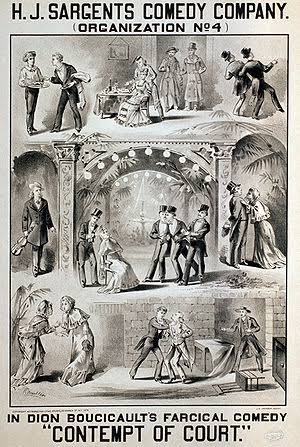
The Farce is a dramatic work designed solely to produce laughter. Originally a farce was an explanatory or additional matter introduced into the main play sometimes to increase its length. Slowly actors begin to use this as an occasion and thus it became a part of the play.

The Plot of the Farce:

In Farce no attempt is made at Fidelity to life. Its aim is merely to provide laughter. For this purpose, it employs funny incidents absurd characters, humorous situations, and witty dialogue. Farce does not aim at a realistic representation of things but provides caricature. The plot in a farce usually appears nonsensical, characters in the indulge in deception impersonations, and irrationalities. There are angry wives, helpless husbands, and funny old men indulged in the most unexpected activities. Serious and respectable people are drawn into the most undignified positions, grave and priggish persons are debunked. Most farce is centered around love affairs which themselves are caricatures. In the end, everybody comes out without any harm.

The elements of the Farce:

The elements of the farce can be seen even in the early English plays. Shakespeare’s ‘A midsummer night’s dream’ and ‘Twelfth Night’ are examples to show how farcical elements could be interspersed with comedy with great effect. Event tragedies had farcical scenes as we see in Marlowe’s Dr. Faustus.

Some Famous works of Farce:

As a separate form of entertainment, the farce came into vogue towards the close of the seventeenth century. The first popular farce was ‘The Rehearsal’ by the Duke of Buckingham. But The anti-sentimental comedy almost destroyed farce. But the anti-sentimental comedies of Sheridan and Goldsmith brought back farcical humor into English drama. Some of the scenes in Sheridan’s ‘The Rivals’ and most of the scenes in his “School for scandal” are enchantingly Farcical. Similarly in the play “She Stoops Conquer” by Goldsmith. In the Victorian period, the farce attained a sort of respectability. Farces such as ‘ The Private Secretary’ and ‘Charley’s Aunt’ were several times.

In modern times, the farce is an accepted form of dramatic entertainment. Most of the plays of Oscar Wilde and Bernard Shaw have farcical situations and dialogue. The farce requires unusual inventiveness, a craftsman, and a sense of humor on the part of the writer.

Most modern comic one-act plays tend to be farces. The purpose of such plays is only to give brief entertainment without malice and laughter without vulgarity. Modern one-act plays like ‘The Dear Departed’ are essentially farce designed to produce laughter.

Conclusion:

The Farce is a famous literary form in earlier literature. In this form, most of the scenes from the plays and characters from the novels will have some comical and entertaining content. Which boosts up the audience’s mindset. These literary forms are used to length the drama in earlier periods. But, most of the audience loved this method and they often started to use it regularly in stage dramas. Farce is used merely for the entertainment of the audience. Even now, most of the writers include some comical scenes in their works to make the plot entertaining.

Start your own business part 1

Start your own business part 2

THE HISTORICAL NOVEL

Introduction:

The Historical Novel is a work of fiction that attempts to convey the spirit manners and the social conditions of the past age with realistic details and nearly perfect fidelity to historical facts. The subject matter may compass both public and private events. The protagonist may be an actual historical figure or an invented figure. The historical novel can be The dramatic interest of plot and character with the more or less detailed picture of the varied features of the life of a particular age. The most important feature of the historical novel is its vivid reproduction of the life of a bygone age.

Even before the coming of the historical novel comer writers had used history in their novels. As a result of the impulse to word novelty during the Renaissance and after several writers made use of history. In England, Horace Walpole used a particular period in history as background to his Gothic novels.

First Historical novel:

The passing away of the feudal system created and nostalgia for the past. compared with social and economical changes caused by the French Revolution and the industrial revolution, This nostalgia created the proper climate for the emergence of the historical novel. The first great historical novel in English was Sir Walter Scott’s Waverley published in 1814. A series of novels based on Scottish history appeared. Among them, the most important is “Guy Mannering”, Kenilworth, Old Morality, and “The Heart of Midlothian”. Among the more popular of Scott’s novels are “Ivanhoe” and the Talisman dealing with the Crusades. In this novel, memory and imagination serve Scott’s creative purpose of the central narrative is supported by a strong love of humanity.

The tradition of the historical novel continued into the story and age. Charles Dicken’s “A tale of two cities” Thackeray’s “The history of Henry Esmond Esquire” George Eliot “Romola” and Charles Reade’s “The cloister and the Hearth” is important historical novels of the Victorian period. In the continent, the historical novel florist in the writings of Balzac, Dumas, and Tolstoy. It is generally agreed that Tolstoy’s “War and Peace” is the greatest among the historical novel. “Robert Grave’s I Claudius” is another historical novel of significance.

The historical novel marches on one side with the realistic novel and the other side with the national epic. Saintsbury has remarked that historical novelists give only a subordinate position to the actual historical figure and should allot a prominent position to the imaginary figure because the chief object of the novel is the interpretation of the human character.

In the Historical novel, The recreation of the spirit undertone of the bygone ages is more important than other runs to the truth. The historical novel list has to reconcile the clients of history and art.

Conclusion:

The historical novel has limitations for stop it is suffering from the weakness of both history and novel. Unless the novelist is scholarly and unprejudiced, he is likely to give you a half-digested and biased view of historical facts. It is also open to question whether the imaginative recreation of facts is preferably the fact to themselves.

The Humanitarian Movements

The Social Novel

THE SOCIAL NOVEL

The Social Novel may be defined as a fictional narrative that focuses on the varieties of human behavior in society and the way in which the characters reflect or contradict the values of that society.

In this genre, the characters are seen in the background of their social milieu and culture. The inner life of the characters find the place in such novels, greater importance is given to their conflicts and collisions with classes and believes. The essence of a social novel is the conflict between the individual and the society that surrounds him based on different concepts of values.

Two Groups of Social Novel:

Social novels can be divided into two groups.

  • The novel of Manners.
  • The novel of Civilization.

The novel of Manners:

The novel of manners is concerned with social behavior and its correctness in a given society. The concept of behavior achieves some grant moral effect as we find in the novels of Jane Austen “Pride and Prejudice” and Emma are the best examples. The novelist is preoccupied with the niceties of social conduct and often, commerce by the employment of Irony and satire exposes undesirable passions like arrogance, hypocrisy, and snobbery. Henry James’ novel ‘The ambassador’ is a successful social novel of manners. It depicts with great humor and delicacy the reaction of different American types to a European environment. Evelyn Waugh’s “A handful of dust” is a social novel of manners that presents The vision of sin and guilt in the modern world. The social novel of manners has a satiric structure as we find in Jane Austen. Even modern novelists make use of the same formula. For instance, Philip Roth satirizes the self-protective attitude of the modern middle class in his novel ‘Goodbye Columbus’.

The novel of Civilization:

The social novel of Civilization takes a comprehensive view of the whole Civilization. The best examples are Charles Dickens’s “Little Dorrit” and Tolstoy’s “War and Peace” the novel Civilization aims at revealing the meanings, principles, and social styles that govern people’s lives. The action of individuals is examined in the light of the Civilization that surrounds them. In “Little Dorrit” Dickens explores the English society dominated by the corrupt business class. In the novel Civilization characters or viewed as part of the developing environment. The splendor or shame of their past is exploding. The significance of the character’s behavior becomes clear only in the background of the Civilization which he represents. In “War and Peace” Tolstoy presents the different stages in the development of each character. The novel Civilization, sometimes, depicts the different stages in the growth of the writer’s consciousness as in Marcel Proust’s ‘Remembrance of Things Past’. Sometimes it uses our family story as in Faulkner’s ‘Sartoris’ or Galsworthy’s ‘Forsyte Saga’.

The Social Novel is a technique in literature. In which the authors express and illustrate society, ethics, etiquette, and protocols. Nowadays, various authors are following this technique in their writings. Especially, to illustrate the Epic society, Dynasty, and fictional Mythologies. This literary form serves as a device to illustrate society.

The Detective Novels

The Gothic Novels

THE AGRARIAN REVOLUTION

The term Agrarian Revolution implies the great changes that took place in the agricultural methods of England during the second half of the 17th century and the first half of the eighteenth century.

Causes of the Revolution:

  • The old open field system was wasteful of land because, according to this arrangement, every year one of the three fields was to be out of cultivation.
  • Secondly, come the old system of distribution of land was wasteful of time.
  • Thirdly, there was the necessity of confirming the customs of the village and thus made experiments in agriculture method possible.

In the 18th century, the population was increasing and so more food was needed. Owing to the scarcity of food materials there was a rise in prices. The old-fashioned farmers thought that they could get more money if they produce more. This idea was an incentive for them to improve their agricultural methods.

Reallocation of Lands:

Reallocation of lands in consolidated blocks which could be enclosed, several Enclosure Acts were passed in the reign of George II and George III. There were many cases of the poor peasants being not satisfied with the reallocation. Such people sold their small holdings to wealthy businessmen of the city who were eager to possess lands of their own. The final result of this tendency was that the class of rural inhabitants known as yeomen disappeared.

Advantages of enclosure system:

One of the advantages of the enclosure system was that it gave scope for many enterprising people to make experiments. Jethro Tull of Berkshire was the inventor of the drill for sowing seeds. He also emphasized the necessity of capital selection of seeds if good crops were to be obtained.

Another pioneer is Charles Townshend of Norfolk. He adopted Tull’s principles and paid much attention to the question of rotation of crops. He introduced the four-course rotation of turnips, barley, clover, and ryegrass, and wheat. These measures prevented an unprotective fallow. His innovation made Norfolk a leading agricultural country. With the result that in the thirty years the rental of the one farm rose from 180 pounds to 800 pounds a year.

The work of Townshend was continued by Thomas Cook. He followed the precepts of Tull and in addition fed the soil with manures including bones. In nine years he was able to grow excellent wheat crops. He also introduced new artificial foods such as oil cake under led the way in fattening cattle for the London markets. He held a yearly meeting for farmers at his house and these meetings farming topics were discussed and much advice was given and received. It is estimated that the annual rental of his estate Rose from 2,200 pounds in 1776 to 20,000 pounds in 1816.

Cattle farming:

While Norfolk landlords were thus making great improvements in arable farming, a Leicestershire farmer, Kama Robert Bakewell was revolutionizing English methods of stock breathing. Up to this time sheep had been valued chiefly for their wool, the production of mutton had been only secondary. Bakewell was the first to turn his attention to the production of meat as the main consideration of stock breeding. By patient choice and experiment, he succeeded in producing a new breed of sheep with fattened quickly and weighed heavy. His success attracted the attention of many. Farmers from far and wide visited his farm at Dishley and became converts to his new methods. Others who did pioneering work in this field were George Culley, Charles Colling, and John Salman.

Board of agriculture:

Royal patronage was also given to the moment of revolutionizing the agriculture methods. George III, affectionately known to his subjects as a farmer George, established a model farm at Windsor. The success of the moment was due to the writings of agriculture writers, the most famous was Arthur Young. When a board of agriculture was established in 1793. Young was made its secretary.

Conclusion:

With the advent of the enclosure system, the English banking system also grows, for even the wealthy landlords did not have money to do the fencing and other improvements. So they have to borrow money from the banks. Through all those methods was very desirable from the point of view of production, it had a harmful effect on the partition. The system deprived him of the privilege of grazing his cattle and cutting fuel from the commons.

What is a Novel

Picaresque Novel

THE PICARESQUE NOVEL

The Picaresque novel is a famous technique in earlier periods. These techniques were used to record the Kings’ and other person’s victories in and out of the battlefields even during his adventures. This form of literature helped in recording the real historical heroes and events from various perspectives. Many authors adapted these techniques and succeeded in making new epic fictions, mythologies, and other real events and incidents.

The Picaresque Novel originated in Spain. The term ‘Picaresque’ is derived from the Spanish ‘picaro’ meaning an anti-hero or rogue. A Picaresque novel is generally an autobiography account of the hero’s fortunes, sufferings and wanderings. It is a combination of episodic tales arranged as journeys. They episodes generally depict low life in a rambling manner and come to an abrupt ending.

The first prose fiction in the nature of the picaresque was John Lyly’s ‘Euphues’ published in 1578 detailing the loves and adventures of a young Athenian called Euphues. Six years later, Thomas Nash published his ‘Unfortunate Traveller’, a more perfect picaresque romance dealing with the travels and adventure of a page called Jacky Wilton. Defoe’s ‘Moll Flanders’ published in 1722 had an affinity with the picaresque mode of writing. But Smollett’s  ‘The Adventure of Ferdinand Count Fathom’ is a more perfect form of the picaresque. However, it was Fielding’s ‘Tom Jones’ which established the respectability of the picaresque novel. Fielding’s novel describes through 18 book’s the adventures and several love affairs of The Young anti-hero Tom Jones. Elements of the picaresque can be found in Dickens’s Nicholas Nickleby and in Joyce Cary’s “The horse’s mouth.”

The object of the picaresque novel is to take a central figure through a succession of scenes and adventures, introduce a great number of characters around him and thus build-up picture of society. In the eighteenth century and before travel was the only way to get acquainted with social life. That is why heroes in the Picaresque novels are travelling heroes. The hero in a picaresque novel is always in the Whirlpool of adventures and he has to be present in several human situations. The picaresque hero often transcends the level of the rogue into a tragic figure with human attributes as in the case of Fielding’s Tom Jones.

Another feature of the picaresque novel is the dynamic movement of the hero. He should run through a succession of scenes as Tom does during his journey to London. The novelist constructs the picture of society through the narration of the hero’s wanderings. Smollett sends his hero Roderick Random not only to London but also to France and for a ship journey. The picaresque novel may go deeper into a contemplation of the more intricate relationship between good and evil. They also reveal the strange truth that generous impulses exist even in those whom society considers as rougues. Tom Jones is a generous and manly youth in spite of the rouguish elements in his character.

Until now this technique is used by various authors for various books in the name of Mythologies, fiction, and other Genres.

Short stories within novels

All about autobiography

WHAT IS A NOVEL

The novel owes its existence to man’s interest in other men and the great panorama of human passion and action. Both the drama and the novel are compounded of the same material but in drama and the literary element is bound up with the elements of stage settings and interpretations through acting. So, Marion Crawford terms the novel as “Pocket theatre”. The novel may be defined as long narrative prose detailing the actions of fictitious people. Meredith calls it a ‘summing of actual life’. The novel combines narration and description, history and philosophy, poetry and fantasy, social criticism, and a particular view of life.

Elements of the Novel:

The novel has various elements.

  1. In the first place, it should have a plot. The novel deals with elements and actions and how these are presented is the plot.
  2. Secondly, the men and women who are involved in these elements and actions appear as characters in the novel.
  3. The third element is the dialogue the mean of interaction among the characters.
  4. The fourth element is the scene and the time of action because the characters must interact, do or suffer at some place or time.
  5. The fifth element is the style in which the narration is done.
  6. The Sixth Element is the view of life presented by the novelist.

The Plot:

The plot in a novel is the organization of incidents. The theme should have substantial value and human interest. It is primarily concerned with the things which make life strenuous, intense, and morally significant.

There are two types of plots – organic and episodic. In the first, the characters and events are well interwoven that no character or incident can be removed from the novel without causing damages to the whole. The plot and Jane Austen novels are examples. The second type of plot is loosely formed and characters and incidents have no essential bearing on each other. The picaresque novels of Fielding and even some of the novels of Dickens have episodic plots. How the various elements in the plot or organized to achieve a definite artistic purpose is called the structure. Unity in structure and plot is to be observed.

The Characterization:

Characterization is the act of presenting the characters alive and real to our imagination. The men and women in the novel must move through it like living beings they should remain in the readers’ memory after the novel is laid aside. There are two types of characterization – the direct or the analytic and the indirect or dramatic. In the analytical method, the novelist portrays his Characters from outside, dissects their passion, thoughts, and feelings, and even passes judgment upon them.

The Dialogue:

Dialogue is well managed, gives vividness, and actually to the plot and the characters. Dialogue reveals the passion and the emotion of the character and advises the movement of the plot. Dialogue should Constitute an organic element in the story. It should be natural, appropriate, and dramatic. It should be in keeping with the personality of the speaker.

The Time and Place of Action:

Time and place of action in a novel refer to the whole setting of the story, both social and material. They are novels of sea life, military life, industrial life of district life, and life of different classes of people. There are novels with a regional background; there are novels written in the historical background. whatever may be the setting, the novelist should master its details and then present a lively picture of it.

The novel is concerned with life and so the novelist’s view of life may be revealed in the novel. A novelist may make creative observations on human life. By the selection and organization of the material, and by the presentation of character and development of the plot, the novelist can show us what he thinks of life. However, the novelist should not indulge in propaganda or preaching. His philosophy is a part of the structure of the novel and should reveal itself through the interpretation of life, thought, character, and temper of the work as a whole.

The chief characteristics of Shakespearean novels

Must read two books by Paulo Coelho-2

WHAT ARE VOWELS ?

Vowels are sounds in which there is no obstruction to the flow of air as it passes from the larynx to lips . Vowels are thus produced with a stricture of ‘open approximation ‘, that is the tongue (active articulator ), is raised towards , the roof of the mouth (passive articulator),so that there is enough gap between them for the air to flow out freely and continuously , without friction . Vowels are essentially a ‘tone’ or ‘hum’ issuing from the glottis with the vocal cords vibrating . Hence all vowels are voiced sounds .The quality of a vowel depends on the shape of the cavities of the pharynx ,the mouth and the nose , which in turn depend on the position of the soft palate , the tongue and the lips during its articulation .

CLASSIFICATION OF VOWELS

Vowels may be either long or short ./I/ for example ,is short while /i:/ is long Usually vowels from the ‘nucleus’ in a syllable . They are soft , voiced and musical .Vowels can be classified on the basis of

  • THE HEIGHT TO WHICH THE TONGUE IS RAISED
  • THE PART OF THE TONGUE THAT IS RAISED
  • THE POSITION OF THE LIPS

CARDINAL VOWELS

For the proper study of vowel sounds ,we need a set of fixed vowel points as references .The vowel sounds specially selected for this purpose are called Cardinal vowels .They are used as references to describe , classify and compare the the vowels of any language . If we learn them we are learning about the range of vowels that human vocal organs can make.

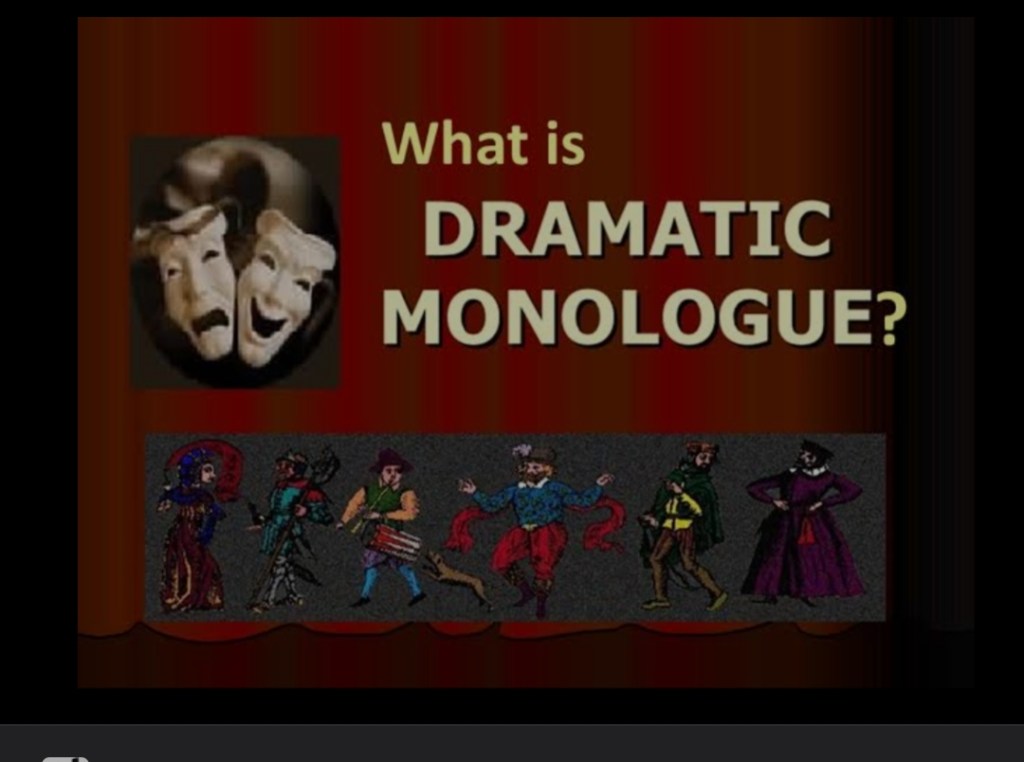
Dramatic Monologue – A Form of Poetry .

Monologue is made up of two Greek words ” μόνος mónos,” which means “alone, solitary” and λόγος lógos, “speech”


In general the term monologue means a speech presented by a single character, most often to express their thoughts aboud.

It is a speech given by a single character in a story. In drama, it is the vocalization of a character’s thoughts; in literature, the verbalization. It is traditionally a device used in theater—a speech to be given on stage.

There are different types of Monologue:

1. Dramatic monologue,
2. Soliloquy,
3. Interior monologue,

What is a dramatic monologue?

Dramatic monologue refers to a type of poetry. It is a type of poetry written in the form of a speech of an individual character.

These poems are dramatic in the sense that they have a theatrical quality; that is, the poem is meant to be read to an audience.
It is a literary form where the writer takes on the voice of a character and speaks through them.

Although dramatic monologues are found in theater and prose, the term most frequently refers to a poetic form where the poet creates a character who expresses a point of view or the main subject matter .


A dramatic monologue is also called a personal poem.
The character speaking in the poem is referred to as a “persona.”

Dramatic monologues can be told by a period , animals, objects, places, or abstract concepts like fate , love , etc.


M.H. Abrams notes the following three features of the dramatic monologue :-

• The single person, who is patently not the poet, utters the speech that makes up the whole of the poem, in a specific situation at a critical moment.

• This person addresses and interacts with one or more other people; but we know of the auditors’ presence, and what they say and do, only from clues in the discourse of the single speaker.

• The main principle controlling the poet’s choice and formulation of what the lyric speaker says is to reveal to the reader, in a way that enhances its interest, the speaker’s temperament and character.

Dramatic monologue was invented and practiced by Robert Browning followed by many famous poets like Alfred Tennyson , Dante , T. S Elliot and other Victorian poets .

The form remained popular in the 19 th and 20th century. The Victorian period represented the high point of the dramatic monologue in English poetry.

Robert Browning produced his most famous work in this form of dramatic monologue “My Last Duchess” which is quite famous till date .Browning’s poem “My Last Duchess” was one of the first dramatic monologues of the Victorian era.

Alfred, Lord Tennyson’s Ulysses, published in 1842, was a remarkable dramatic monologue in English literature during the Victorian era .

In the Modernist era, poets like T.. S. Eliot and Ezra Pound wrote persona poems
The Love Song of J. Alfred Prufrock” by T.S Elliot being one the most famous works as a dramatic monologue.

With the prevailing trend of confessionalism in poetry, during 1950s and 1960s, great poet like Gwendolyn Brooks, John Berryman, and Sylvia Plath all made notable contributions by writing dramatic monologues that grappled with subjects like the African American urban experience, mental illness, addiction, and suicidal ideation.

___________________________________________

Types of Dramatic monologue

Dramatic monologues can be categorised in three ways :-

Romantic monologues

Poems where a character speaks about a romantic relationship, either past, current, or desired is called a romantic monologue .

For example,
Dilemma” by Anthony Hecht is a romantic monologue.

Conversational Monologue

Conversational monologues are poems where the dramatic monologue is presented by the speaker as if it is part of a conversation.
Samuel Taylor Coleridge’s “The Eolian Harp” is one example.
.
Philosophical Monologue

Philosophical monologues are poems where the character explicates their personal philosophy or theories about the world.

“Lines Written a Few Miles above Tintern Abbey” by William Wordsworth is one example of a philosophical monologue.

___________________________________________

The dramatic monologue was written in the voice of a fictional character, the form sometimes makes use of a character who is already well-known so the poet can explore larger themes.
Use of dramatic monologues made the poet write about situations and subject matter that is not taken from their own lives.

Dramatic monologues are a way of expressing the view of a character and offering the audience greater insight into the character’s feelings .
Dramatic monologue was a famous form to write poetry because of its powerful way to create narrative tension as the speaker reveals crucial information to the reader in a way that allows the reader to feel the real emotions . ___________________________________________

Referral link :-How to write dramatic monologue (tips)