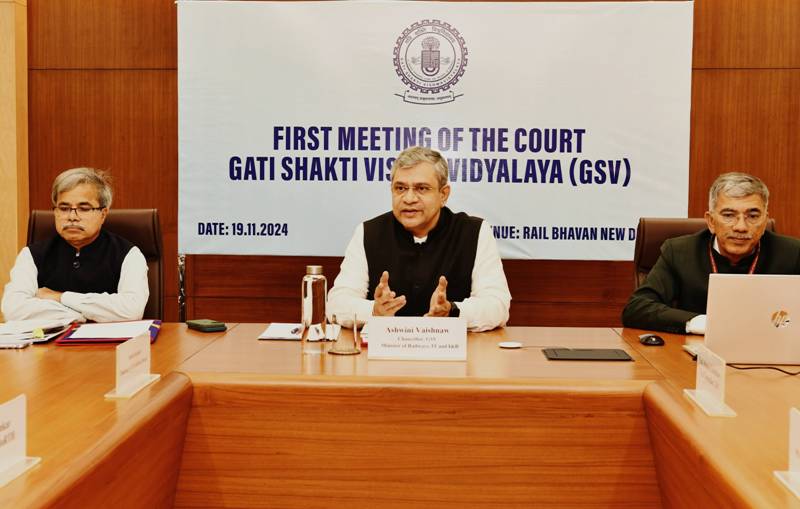
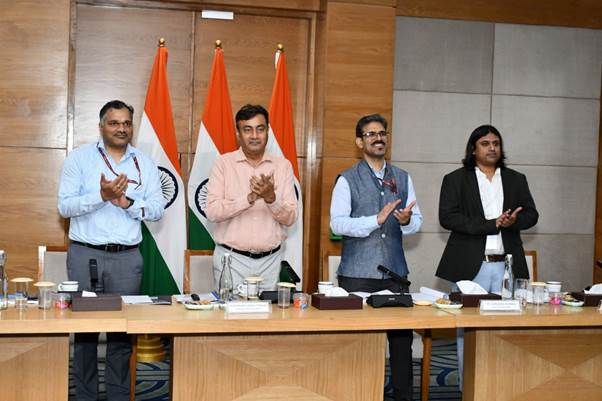
Gati Shakti Vishwavidyalaya held its 1st Court meeting in Rail Bhawan in New Delhi

Daily writing prompt
Name your top three pet peeves.

Gati Shakti Vishwavidyalaya (GSV) held its 1st Court meeting in Rail Bhawan in New Delhi today. Chairing the meeting, Sh. Ashwini Vaishnaw, Union Minister of Railways, Information & Broadcasting and Electronics & Information Technology said “GSV is set to emerge as the best university in India and World, in line with PM Shri Narendra Modi’s vision, with its focus on Industry-driven approach and employability-oriented courses for the entire transportation and logistics sectors, including railways, aviation, marine engineering, highways, shipping, logistics and defense sectors. He further said “All the newly-recruited officers of Indian Railway Management Service (IRMS) Officers shall undergo their probationary training designed by Gati Shakti Vishwavidyalaya, a combination of theoretical and practical experiences at CTIs and industry, resulting in an MBA degree from GSV. Further, new programs shall be added for Bridge and Tunnel Engineering, Aviation Operations, Maritime Infrastructure, Highway Engineering and for defense forces”.

This event was graced by Shri Satish Kumar Chairman & CEO, Railway Board, Shri V Uma Shankar, Secretary, Ministry of Road Transport and Highways, Shri Amardeep Singh Bhatia,Secretary, DPIIT, Vice-Chief of Army Staff Lt. Gen. NR Raja Subramani, Sunil Mathur,MD & CEO, Siemens India, Olivier Loison MD, Alstom India, Jaya Jagadish,MD, AMD India, Shri Sushil Kumar Singh, Chairman, Deendayal Port Authority, Prof. Manoj Choudhary,Vice-Chancellor, Gati Shakti Vishwavidyalaya, representatives of Ministry of Higher Education, Ports Shipping and Waterways, Civil Aviation, AICTE and the leading functionaries of Gati Shakti Vishwavidyalaya.

At the occasion, Prof. Manoj Choudhary Founding Vice-Chancellor, Gati Shakti Vishwavidyalaya presented a detailed progress and status report of the university since its inception on 06 Dec 2022. All the members wholesomely praised the huge strides and progress of GSV in such a short time, particularly its Industry-driven and innovation-led approach, focus and results achieved within such a short time, setting the foundation of a top-class university. The members of the Court offered several suggestions and collaborative inputs for future programs in highway engineering, ports infrastructure, artificial intelligence, green hydrogen and ports modernization, defense sectors logistics and supply chain, affiliating national academies in the infrastructure sectors, being a nodal center to other universities/institutions, infrastructure project management etc. The Annual Reports and Annual Accounts of the university were also approved to be tabled before the Parliament.

Gati Shakti Vishwavidyalaya (GSV) has quickly emerged as a game changer in the higher education sector, particularly for the transportation, logistics and infrastructure sectors. GSV Vadodara was established as a Central University through an Act of Parliament in 2022, for creating best in class manpower and talent for the entire transportation and logistics sectors. This Central University is sponsored by the Ministry of Railways, Govt. of India and is mandated to work across railways, shipping, ports, highways, roads, waterways, and aviation etc. Following a demand-driven curriculum and leveraging state of the art infrastructure of all the Centralized Training Institutes of Indian Railways, the GSV shall create a resource pool of professionals across technology, economics, management and policy comprising multidisciplinary teaching (bachelors/masters/doctoral), executive training and research. GSV shall also undertake training for Indian Railways probationers and serving officers. Being an Industry-driven and Innovation-led university, GSV has a very strong focus on collaborations with leading institutions and industries across the world.

****

Track Your Transport App to Tackle Key Challenges in Logistics

Daily writing prompt
What details of your life could you pay more attention to?

NICDC Logistics Data Services Ltd. (NLDSL) announces the launch of Unified Logistics Interface Platform (ULIP) Hackathon 2.0, a competitive event aimed at fostering innovation and developing digital solutions to tackle pressing challenges in the logistics industry. The Hackathon was officially launched at an event held under the chairmanship of Shri Rajeev Singh Thakur, Additional Secretary, Department for Promotion of Industry and Internal Trade (DPIIT), at Vanijya Bhawan.

The launch event witnessed more than 1800 attendees joining the kick-off physically and virtually, reflecting widespread industry interest in the initiative. Hackathon 2.0 marks a significant step in leveraging innovation and technology to reshape and streamline India’s logistics and supply chain sector.

Building on the success of ULIP Hackathon 1.0, which resulted in the development of cutting-edge solutions, Hackathon 2.0 invites developers, start-ups, and industry players to come together once again. The focus of this year’s hackathon is on addressing key logistics challenges such as sustainabilitycomplex supply chain processesunified documentationand multimodal logistics optimization.

Speaking on the occasion, Shri Rajeev Singh Thakur, said, “We are excited to launch ULIP Hackathon 2.0, an initiative that fosters creativity, problem-solving, and collaboration. With the tremendous success of Hackathon 1.0, we are confident that this year’s event will generate even more innovative solutions to shape the future of India’s logistics ecosystem.”

As part of its ongoing commitment to transforming the logistics sector, NLDSL also announced the launch of the Track Your Transport (TYT) application powered by ULIP. This app is designed to empower small-scale transporters and traders by addressing various facets of logistics management, from providing tracking of cargo via all modes to verification of vehicles and drivers.  TYT eliminates the need for heavy IT infrastructure investments, making it a cost-effective and user-friendly tool for the unorganized sector.

Shri Rajat Kumar Saini, CEO & MD, NICDC and Chairman, NLDSL highlighted that the TYT app is a key milestone in their efforts to bring digital empowerment to small traders and transporters. He stated, “The app provides the tools necessary to enhance operational efficiency and visibility, ensuring that small players can compete on a level playing field with the rest of the industry.” 

Track Your Transport app can be accessed via the web at http://www.trackyourtransport.in or downloaded through Android, iOS, and Digital India App Stores.

About ULIP:

ULIP is a digital gateway that allows industry players to access logistics-related datasets from various Government systems through API-based integration. Currently, the platform integrates with 37 systems from 10 ministries via 118 APIs, covering over 1800 data fields. Private sector participation in ULIP has been instrumental in amplifying its impact, with over 1000 companies registered on the ULIP portal (www.goulip.in). Additionally, these companies have developed over 100 applications, leading to more than 54 crore API transactions.

About NLDSL:

NICDC Logistics Data Services Ltd. (NLDSL) has been at the forefront of transforming India’s logistics sector through its innovative solutions like Logistics Data Bank (LDB) and ULIP. By leveraging advanced technology, NLDSL has enhanced efficiency, transparency, and digitization within the industry.

The company was established on December 30, 2015, with the primary objective of harnessing Information and Communication Technology (ICT) to enhance efficiency in the Indian logistics sector. It is a joint venture between Government of India represented by National Industrial Corridor Development and Implementation Trust (NICDIT) and Japanese IT major NEC Corporation.

***

Artificial Intelligence in Logistics

by P. Sireesha & Shehnaz Sultana


Abstract

 Logistics is one area where AI has started to have an effect. It is now a must-have part of any company’s next software system. The advent of new and developing technologies like artificial intelligence, machine learning, and block chain has changed the disjointed and disorganized logistics industry. A few of the advancements that these technologies have brought to the logistics business are autonomous trucks, predictive analysis, and smart highways. Artificial intelligence and machine learning may be quite helpful in the supply chain when it comes to expediting processes, preventing human mistake, saving time, etc.


Keywords: Artificial Intelligence, Machine Learning, Logistics, Technology, Supply Chain


1.     Introduction to Artificial Intelligence


Artificial Intelligence is the intelligence of machines which is totally opposite to the intelligence of humans or animals. AI applications include advanced web search engines (like Google search), recommendation systems (like YouTube, Amazon and Netflix), understanding human speeches (like Alexa), generative and creative tools (like Snap Chat). AI is the fastest technology which gives reply to a chat message in milliseconds where as it takes more time for humans to type and send a chat message.


2.     Meaning of AI in Logistic Companies

Logistic organizations can benefit from a wide range of capabilities including autonomous equipment and predictive analytics. AI has mostly been used in the logistics industry for four business functions namely: service operations, product and service development, marketing and sales and supply chain management

Logistics services are services which helps in the movement of goods in the supply chain, such as transportation of materials to companies, warehousing, and delivery to customers. Logistics services are very broad, so it grouped into several levels, such as 3PL, 4PL, and 5PL..

Logistics services are a very important part of supply chain management and play an important role in helping product flow control, effective planning, and efficient management of storing goods and information.

Therefore, to increase efficiency and get a better customer experience, a company should work with an experienced and trusted logistics company

7 Concepts in Logistics

7 R is a concept that is very well known and very important to be applied in the logistics activities in a company. The 7 R concept also helps companies to plan the best logistics management to deal effectively with the complexity of services. Here is the concept of 7 R in logistics.

1. Correct Product.

In the process of designing, producing, and selecting products, a company must look at the potential problems that can arise during the transportation process. Products when designed properly will greatly facilitate the logistics process. Ensuring standardization of product dimensions throughout the design process will make packaging, warehousing, product handling, and transportation much easier.

2. Corerct Customer (The Right Customer).

The customer is the core component and the focus of the supply chain process. Getting the right customers must go through several processes, such as identifying the customers to target. To get the characteristics of targeted customers, you can do market research.

Market research will give you insight into who you should target and help you stick to your budget. With good market research, a company can choose the most effective marketing strategy to reach its target customers.

3. Correct Price (Right Price).

Determining product prices is a very important part of a company because the right product price will ensure the company’s profits and business continuity. Using a good system to store and update product prices also helps to be successful in logistics management services.

4. Correct Quantity.

Producing and shipping the right amount of product is also important in logistics. The number of products is less than demand will result in customers not getting the product at the right time. However, the excess quantity will also increase warehousing costs and other related costs. So the production and delivery of products must be balanced with the demand for cost-efficiency.

5. Correct Condition.

The right conditions in logistics speak of safe delivery. Product quality must be maintained until it reaches the customer. The distribution strategy must be arranged in such a way as to maintain product quality without increasing costs.

6. Correct Time.

Time is an important factor in logistics activities. Even if the other processes are performed accurately, the whole process can fail if the timing is not right. Long-term customer and business satisfaction are only possible if products are delivered to customers on time.

7. Correct Place.

A good delivery system with location tracking is the most appropriate solution to overcome this. So the company can track the location of the product accurately and send it to the right place.

Companies providing logistic services in India

1.     TVS Supply Chain Solutions Limited

2.      Mahindra Logistics

3.     . Ekart Logistics

4.      Blue Dart

5.      DTDC

6.      DHL

7.     Delhivery

8.     FedEx

9.     Xpressbees


Role of AI in Logistic Sector

The role of AI in logistics is ultimately to smooth  operations across order processing, inventory management, supply chain and distribution in order to offer an increase customer experience. 

It can be used to do routine tasks in order to reduce costs, improve efficiency and provide better customer service. AI in e commerce logistics also provides real-time tracking and monitoring of parcels, which helps  the overall customer experience and helps consumer satisfaction. Additionally, AI improves data analysis, allowing businesses to make smart decisions and improve operations. 

This is due to the fact that AI is able to process and filter large amounts of data, which then can be used to create forecasts for future developments in intralogistics. Placing certain items in a certain order or selecting picking routes that minimise travel time are just two of many ways to optimise warehouse operations. 

Overall, the use of AI in ecommerce logistics is becoming increasingly essential in today’s fast-paced business environment, however, research shows that not everyone in the logistics space is ready to adopt AI based strategies.

·      Saving time: AI plays a crucial role in saving time, lowering expenses, enhancing productivity and improving accuracy. It helps us to save time and money by automating a variety of time consuming operations and assisting with demand forecasts. AI aids in logistics, which helps to reduce shipping costs, which in turn helps to generate more profits. AI allows computers to gather, analyze and make informed decisions in a matter of seconds saving time for humans.

·      Driverless Vehicles: AI has introduced driverless vehicles to increase the delivery procedure significantly

·      Robotics: Robotics is interconnected with intelligent machines which is an enhanced application of AI that processes logistics management


3.     Applications of AI in Logistics

·      Planning: Logistics planning needs extensive preparation that involves coordinating with suppliers, customers and various company units. Machine learning solutions can help with planning since they are effective at scenario analysis and numerical analytics both of which are important for planning

·      Forecasting Demand

i)      Organizations may leverage real-time data in their forecasting attempts thanks to AI capabilities

ii)    Manufacturers can better manage the number of deployed trucks to local warehouses and decrease operational expenses by improving their workforce planning with increased demand prediction accuracy

iii)  Local warehouses/retailers can cut storage expenses

iv)   Customers are less likely to experience stock outs that reduce customer satisfaction

·      Supply Chain Management: Artificial Intelligence assists firm in analyzing demand in real-time so that supply planning parameters can be updated dynamically to optimize supply chain low

·      Warehouse Automation: Only 12% of organizations are employing AI technology in their warehouses, according to the 2020 MHI Annual Industry Report, but that number is predicted to rise to above 60% in the next six years

·      Robots in Warehouses: Another AI technology that is being heavily invested in to improve supply chain management is Warehouse Robots. Between 2017 and 2022, the warehouse robots industry is predicted to increase at a CAGR of 11.8% with a market value of USD 2.28 billion


4.     Types of Artificial Intelligence


Artificial Intelligence can be divided into two types: (A) Type 1 (AI Based on Capability) and (B) Type 2 (AI Based on Functionality)

A.   Type 1 (AI Based on Capability)

i)      Weak AI / Narrow AI: An example of narrow artificial intelligence is the ability to intelligently carry out a certain task. Narrow AI is the most popular type of AI that is currently accessible. Narrow AI examples include:AI-powered chess game, speech recognition, image recognition, self-driving automobiles, and recommendations for purchases on online stores

ii)    General AI: An intelligence known as general artificial intelligence (AI) is capable of handling any intellectual work as effectively as a human. The goal of general artificial intelligence is to create a system that is capable of thinking like a person on its own. The goal of current global research is to create machines with general artificial intelligence.

iii)  Super AI: Super AI refers to a system’s intelligence level where computers are able to outperform humans at any task and have cognitive qualities. It is an AI-produced result. Super AI’s capacity for independent thought, reasoning, problem-solving, judgment, planning, learning, and communication are some of its primary traits.

B.    Type 2 (AI Based on Functionality)

i)      Reactive Machines: Artificial intelligence starts with robots that are purely reactive. These AI systems don’t keep track of memories or past encounters for use in the future. Google’s Alpha Go and IBM’s Deep Blue system are two instances of reactive machines.

ii)    Limited Memory: Machines with limited memory can temporarily store certain data or memories. These devices have a certain amount of time to use stored data. Example: Autonomous vehicles using a constrained memory system. These vehicles can store information to help them traverse the road, such as the speed limit, distance from other vehicles, and recent speeds of adjacent cars.

iii)  Theory of Mind: Mental theory AI should be able to communicate specifically like humans and comprehend human emotions and beliefs. Although these AI devices have not yet been constructed, researchers are working very hard to make advancements in this area.

iv)   Self-Awareness: Self-Recognition Future Artificial Intelligence is known as AI. These machines will possess consciousness, feelings, and self-awareness in addition to being extremely intelligent. These devices will surpass human intelligence. Self-awareness artificial intelligence is still a theoretical idea that does not exist in reality.

5.     Benefits of AI in Logistic Industries

·      Better Customer Services: People in the logistic industries mostly depend on reliable service providers. The greatest transport service is offered to firms and their clients by artificial intelligence technology instruments since they are efficient and in style in the business sector. Customers trust AI because it offers them dependable, individualized service. AI assists clients based on their past purchasing experiences.

·      Shipment and Delivery: AI technology tools are used by the logistics sector to improve shipment and delivery productivity. Artificial Intelligence (AI) techniques are sophisticated enough to track traffic on roadways and save gasoline. It determines the route and free time to improve customer service with the aid of the route optimization technique.

·      Marketing and Sales Optimization: Drone usage is becoming more and more popular in the logistics sector. AI offers solid technologies that can quickly improve the delivery process. Drones are utilized to safely deliver various medications and other commodities.

·      Back-Office Automation: The logistic sectors, which rely on AI to maintain workforce, email, billing, and other operational services, are the foundation of the technology’s improved benefits.

·      Smart Roads: In the logistics industry, smart roads can be of great assistance since they can minimize delays in product delivery and meet customer service requirements. Solar panels are used on smart roads to prevent ice buildup in the winter. This uses AI to support driverless vehicles for quick goods delivery.


6.     Advantages of Artificial Intelligence

·      It replies within milliseconds

·      It is most beneficial technology for everyone

·      It can solve arbitrary problems

·      It knows all the languages and it even translates the language into other languages

·      It has the higher knowledge that even a human being cannot imagine


7.     Disadvantages of Artificial Intelligence

·      Most of the human beings are addicted and dependable on the AI and not preferring to use their brain and knowledge what they have

·      People are addicted to AI in the same way that they are addicted to smart phones. The upcoming generations may totally depend on AI and Robots for their works

8.     Conclusion

AI in Logistics is a rapidly growing field that has the potential to change supply chain management. By understanding its benefits, challenges and practices for implementation business can improve efficiencies and reduce costs. As technology advances at an ever increasing rate, companies must stay ahead by investing in AI solutions specifically to their needs, if they want to remain competitive in today’s global market.


References:

Klumpp, M. (2018). Automation and artificial intelligence in business logistics systems: human reactions and collaboration requirements. International Journal of Logistics Research and Applications21(3), 224-242.


Pandian, A. P. (2019). Artificial intelligence application in smart warehousing environment for automated logistics. Journal of Artificial Intelligence1(02), 63-72.


Soltani, Z. K. (2021). The Applications of Artificial Intelligence in Logistics and Supply Chain. Turkish Journal of Computer and Mathematics Education (TURCOMAT)12(13), 4488-4499.


Woschank, M., Rauch, E., & Zsifkovits, H. (2020). A review of further directions for artificial intelligence, machine learning, and deep learning in smart logistics. Sustainability12(9), 3760.


Zhang, Y. (2019, October). The application of artificial intelligence in logistics and express delivery. In Journal of Physics: Conference Series (Vol. 1325, No. 1, p. 012085). IOP Publishing.

LINK to DOWNLOAD PDF

Sectoral Plan for Efficient Logistics (SPEL)

 The 60thNetwork Planning Group (NPG) meeting was held on 16th November 2023, under the chairpersonship of Special Secretary (Logistics), Department for Promotion of Industry and Internal Trade (DPIIT), Smt. Sumita Dawra in New Delhi.

The meeting focused ondiscussions on Sectoral Plan for Efficient Logistics (SPEL)by individual line Ministries/Departments. This initiative, among the various initiatives proposed under the Comprehensive Logistics Action Plan (CLAP) of National Logistics Policy (NLP), was proposed to ensure that a focused approach is taken in addressing logistics-related requirements at the individual sector level.

Today, the Ministry of Steel and the Ministry of Coal presented their plans to address logistics issues pertaining to infrastructure, processes, digital improvements, policies and regulatory reforms, and capacity building for a better workforce.

Ministry of Steel outlined their SPEL approach, encompassing in-depth Supply & Demand Analysis for Iron Ore and steel, Forecasted Requirements up to 2030-31 and beyond, Strategic Planning for Future Readiness in Logistics, etc. The preliminary SPEL draft is expected to be finalized shortly by the Ministry of Steel.

Ministry of Coal presented itskey findings on the Integrated Coal Evacuation Plan prepared under the aegis of Coal Logistics Policy 2023. Infrastructural gaps project requirements were presented that shall improve logistics and cost efficiency, and achieve optimum multimodal mix. Ministry envisages a 14% reduction in Rail logistics cost through railway network optimization for coal logistics. Further, there is potential to lower Co2 emissions by 100,000 Tonnes Co2 per Annum by FY30 due to a reduction in railway leads and the replacement of Road Transportation by Rail.

The chair acknowledged that the Coal Logistics Policy is a significant step toward the development of sector-specific plans to foster the efficient growth of the logistics industry within specified timelines. The Special Secretary emphasized prioritizing cross-sectoral cooperation and focus on the optimization of modal mix for holistic planning.

So far, the following actions have been taken by other Ministries addressing logistics-related requirements:

  • Comprehensive Port Connectivity Plan by Ministry of Ports, Shipping and Waterways was developed and notified.
  • Development of Cement Sectoral Plan underway
  • Department of Food and Public Distribution undertaking a study to identify optimized routes for movement of foodgrains, with aim to reducing logistic cost & transit time.
  • Department of Agriculture and Farmers Welfare has developed an Agriculture Infrastructure Fund to developing logistics-related infrastructure as a part of post-harvest management infrastructure.

*****

National Logistics Policy.

National logistics policy was initially mentioned in 2020 by Finance Minister Nirmala Sitharaman in her address regarding the budget. The government claims that there are efforts on to implement an integrated and technologically enabled approach to logistics operations, which will be effective throughout the entire process and be useful in lowering logistics costs in the nation from the current levels of 13–14% of GDP.

The Union Cabinet headed by Prime Minister Narendra Modi approved the National Logistics Policy which seeks to cut transportation costs by promoting seamless movement of goods across the country.

An umbrella policy for the logistics sector has been in the works for around three-four years. It was felt that the logistics cost in India is high compared to other developed economies. India’s logistics cost as a proportion of the Gross Domestic Product (GDP) is believed to be around 13-14 per cent. The government now aims to bring it down to single digits as soon as possible.

The primary areas of this National logistics policy 2022 will be process re-engineering, digitization, and multi-modal transportation. It is a key decision since excessive logistical costs affect how competitive domestic products are on the global market.

The National logistics policy 2022 was deemed necessary because India has higher logistics costs than other industrialised nations. India must drastically cut its logistics costs if it wants to increase the competitiveness of its exports and domestic products.

The goal of lower logistics costs is to increase economy-wide efficiency, allowing for value addition and business. The policy lays out an extensive interdisciplinary, cross-sectoral, and multijurisdictional framework for the growth of the entire logistics ecosystem in an effort to solve concerns of high cost and inefficiency.

National Logistics Policy.

National logistics policy was initially mentioned in 2020 by Finance Minister Nirmala Sitharaman in her address regarding the budget. The government claims that there are efforts on to implement an integrated and technologically enabled approach to logistics operations, which will be effective throughout the entire process and be useful in lowering logistics costs in the nation from the current levels of 13–14% of GDP.

The Union Cabinet headed by Prime Minister Narendra Modi approved the National Logistics Policy which seeks to cut transportation costs by promoting seamless movement of goods across the country.

An umbrella policy for the logistics sector has been in the works for around three-four years. It was felt that the logistics cost in India is high compared to other developed economies. India’s logistics cost as a proportion of the Gross Domestic Product (GDP) is believed to be around 13-14 per cent. The government now aims to bring it down to single digits as soon as possible.

The primary areas of this National logistics policy 2022 will be process re-engineering, digitization, and multi-modal transportation. It is a key decision since excessive logistical costs affect how competitive domestic products are on the global market.

The National logistics policy 2022 was deemed necessary because India has higher logistics costs than other industrialised nations. India must drastically cut its logistics costs if it wants to increase the competitiveness of its exports and domestic products.

The goal of lower logistics costs is to increase economy-wide efficiency, allowing for value addition and business. The policy lays out an extensive interdisciplinary, cross-sectoral, and multijurisdictional framework for the growth of the entire logistics ecosystem in an effort to solve concerns of high cost and inefficiency.

LogiXtics – Unified Logistics Interface Platform’s (ULIP) Hackathon launched by Centre

 The Department for Promotion of Industry and Internal Trade (DPIIT) has launched the Unified Logistics Interface Platform’s (ULIP) Hackathon – ‘LogiXtics’ in order to crowdsource more ideas which will benefit the logistics industry.

ULIP is designed to enhance efficiency and reduce logistics cost in India by creating a transparent platform that can provide real time information to all stakeholders and remove all asymmetry information. The ULIP Hackathon – LogiXtics is organised by NITI Aayog and Atal Innovation Mission and supported by National Industrial Corridor Development Corporation (NICDC) and NICDC Logistics Data Bank Services Limited (NLDSL).

The ULIP Hackathon was launched by Shri Amitabh Kant, CEO, NITI Aayog in the presence of Shri Amrit Lal Meena Special Secretary, Department of Logistics, Ministry of Commerce & Industry and CEO & MD, NICDC; Ms. Anna Roy, Senior Advisor, NITI Aayog and Shri Abhishek Chaudhary, Vice President, NICDC.

“Today is a very important day for us because we are trying to solve the biggest problem of logistics in India. The cost of logistics in the India is about 14% which is higher than other countries in the world. ULIP’s objective has been to work with top Indian technology organizations from the private sector and identify solutions to reduce logistics cost,” said Shri Amitabh Kant, launching the Hackathon at a virtual event yesterday.

He further congratulated NICDC for integrating the existing logistics systems of various Ministries/Departments and for the successful launch of ULIP Hackathon – LogiXtics. NICDC was mandated by NITI Aayog in January 2021 to develop ULIP by leveraging the Logistics Data Bank Project.

NITI Aayog was entrusted by the Prime Minister Shri Narendra Modi in May, 2020 with the task of exploring the role of technology in various sectors. ULIP was conceptualised as one of the technology platforms in the logistics sector.

ULIP is being developed as technology platform in the logistics sector which will provide real time information to all stakeholders and will converge visibility of multi-modal transport across the existing systems of various Ministries/Departments working in silos. Once completed, one can see huge efficiencies in the logistics sector, and which will transform it by bringing down the logistics cost and enhancing India’s competitiveness in the global trade.

With the addressed challenges in the logistics sector, a competitive event like LogiXtics under the umbrella of ULIP, invites everyone to showcase their strategic, coding and domain skills on a national-level platform to solve the existing logistics industry issues. The Hackathon is very important to achieve the vision of the ULIP platform.

Speaking at the event, Shri Amrit Lal Meena, Special Secretary, Department of Logistics and CEO& MD, NICDC added, “ULIP is also in line with the overall objective of PM GatiShakti which aims at breaking of individual silos, promote integration among various Ministries/Departments and promote real single window. It will bring more transparency and visibility to the whole trade making India logistically more efficient and competitive.”

The real usability of ULIP will further get enhanced through this Hackathon as it aims to crowdsource more ideas which will benefit the logistics industry. 

Vice President, NICDC informed that the hackathon aims to promote the Startup community, individuals or anyone with the strategic skills and domain knowledge of the sector. The hackathon is open for all and is divided into two stages – ideation stage & prototype stage.

The Logistics sector is the backbone of economic growth in India and is one of the most important accelerators of trade, which is also critical for fulfilling the objective of Aatma Nirbhar Bharat.

***