Benefits of Zero Budget Natural Farming

Intercropping is a scientifically proven practice and has
got several advantages and extends economic benefits for the farmers
particularly under adverse weather conditions. 
It is largely practiced in dry-land areas as an insurance against
failure of main crop.
Under All India Coordinated Research Project (AICRP) on
Integrated Farming Systems, intercropping systems have been studied for many
States and found profitable for farmers. Intercrops act as live mulch thereby
reducing the weeds, water requirement and also providing additional returns to
the farmers. Intercropping with leguminous crops is one of the components of
Zero Budget Natural Farming (ZBNF) and it improves the crop productivity and
soil fertility by way of fixing the atmospheric nitrogen. Further, the cow
dung, urine based formulations and botanical extracts used in ZBNF help farmers
in reducing the input cost.
The farmers practicing ZBNF either of small land holding or
large land holding prepare the low cost cow urine and dung based formulation on
farm by procuring the required inputs locally from the village or neighbouring
villages.

There is no specific time series data on
disguised unemployment in the country as the phenomenon is not easily amenable
to measurement. However, comparable time series data on employment and
unemployment is available in the form of quinquennial Survey on ‘Employment and
Unemployment Situation in India’ conducted by the National Sample Survey Office
(NSSO). The latest available data as per the quinquennial Survey estimates
indicated that workforce engaged in agriculture and allied sector has come down
from 24.74 crore in 2009-10 to 23.18 crore in 2011-12, i.e., about 6 percent.
The shift in workforce from primary (agriculture) sector to secondary and
tertiary sectors is a normal phenomenon of the development process experienced
by countries across the world and the same is true for India as well. The shift
owes to changes in the nature and scope of work arrangements in the various
sectors of the economy and the absorptive capacity of the non-agricultural
sectors to accommodate fresh entrants as well as workers hitherto engaged in
agriculture. Government has launched various schemes aiming to increase
production and productivity which make agriculture sector more viable and
thereby enhance labour productivity. Besides, Government has taken various
steps for generating employment in the country like encouraging private sector
of economy, fast-tracking various projects involving substantial investment and
increasing public expenditure on schemes like Prime Minister’s Employment
Generation Programme, Mahatma Gandhi National Rural Employment Guarantee
Scheme, Pt. Deen Dayal Upadhyaya Grameen Kaushalya Yojana and Deendyal Antodaya
Yojana-National Urban Livelihoods Mission.

National Ganga River Basin Authority

The Central Government, by a
notification dated 20.2.2009, as set up ‘National Ganga River Basin Authority’
(NGRBA)as an empowered planning, financing, monitoring and coordinating
authority for the Ganga river, in exercise of the powers conferred under the
Environment (Protection) Act,1986. The Prime Minister is ex-officio Chairperson
of the Authority, and it has as its members, the Union Ministers Concerned and the
Chief Ministers of states through which Ganga flows, viz., Uttarakhand, Uttar
Pradesh, Bihar, Jharkhand and West Bengal, among others. The objective of the
Authority is to ensure effective abatement of pollution and conservation of the
river Ganga by adopting a holistic approach with the river basin as the unit of
planning. The functions of the Authority include all measures necessary for
planning and execution of programmes for abatement of pollution in the Ganga in
keeping with sustainable development needs.

 
KEY FEATURES OF THE NEW APPROACH OF NGRBA

·        
 River
Basin will be the unit of planning and management. This is an internationally
accepted strategy for integrated management of rivers. Accordingly, a new
institutional mechanism in the form of National Ganga River Basin Authority
(NGRBA) will spearhead river conservation efforts at the national level.
Implementation will be by the State Agencies and Urban Local Bodies.
·        
 The
minimum ecological flows for the entire Ganga will be determined through modeling
exercises. NGRBA will take appropriate measures in cooperation with the States
to regulate water abstraction for marinating minimum ecological flows in the river.
·        
 Attention
would also be paid to the restoration of living parts of the river ecosystem
for its holistic treatment to enable conservation of species like dolphin,
turtles, fishes and other native and endangered species in their river.

KEY FUNCTIONS OF THE NGRBA

·        
 The NGRBA
would be responsible for addressing the problem of pollution in Ganga in a
holistic and comprehensive manner. This will include water quality minimum
ecological flows, sustainable access and other issues relevant to river ecology
and management.
·        
 The NGRBA
will not only be regulatory body but will also have developmental role in terms
of planning & monitoring of the river conservation activities and ensuring
that necessary resources are available.  The NGRBA would work for maintaining the water
quality of the river Ganga upto the acceptable standards. The pollution
abetment activities will be taken up through the existing implementation mechanisms
in the States and also through Special Purpose Vehicles (SPVs) at the pollution
hotspots.  The NGRBA will ensure minimum
ecological flow in the Ganga by regulating water abstraction and by promoting
water storage projects.
·        
 The NGRBA
will plan and monitoring programmes for clanging of Ganga and its tributaries.
To begin with, it will concentrate on Ganga main stem.
·        
 The NGRBA
would draw upon professional expertise within and outside the Government for
advise on techno-economic issues.
·        
 The
technical and administrative support to NGRBA shall be provided by the Ministry
of Environment & Forests.

· ‘PREPARATORY STEPS’ AFTER SETTING UP
NATIONAL GANGA RIVER BASIN AUTHORITY

·        
 River
Basin Management Plan: a notice inviting Expression of Interest to start the
process of selecting an appropriate agency to prepare the Ganga River Basin
Management Plan has been issued. This has been prepared taking into account
inputs received from the Central pollution control Board and the Central Water
Commission on the scope of work to be included in the Plan. 30 proposals have been
received from leading consultants. The Consultant will be finalized shortly
after two stage selection process.
·        
 Status
Paper: the Alternate Hydro Energy Centre, IIT, Roorkee has been asked to
prepare a Status Paper on Ganga which includes the experience of the Ganga
Action Plan and the present water quality. It is being finalized. The Status
paper will be presented in the first meeting of meeting of the NGRBA.
·        
 Priority
Action plan for pollution hotspots: one of the priority functions of the Authority
is to implementation river conservation works at pollution hotspots. These
activities should commence even as the comprehensive basin management plan is
under preparation. MoEF has requested the concerned State Governments to
prepare action plans for comprehensively tackling the problem of pollution in
the Ganga at the hotspots locations, such as Hardiwar, Varansani, Ahmadabad,
Kanpur, Patna and Howrah. These plans are awaited.
·        
 SPVs as
mode of implementation: the process of consolations with State Government and
Urban Local Bodies has been started to discuss he feasibility of having SPVs in
the river clearing sector and to evolve the necessary modalities viz.
Contractual arrangements, concessions agreements, etc. A meeting was organized
on 16th June 2009 with the representatives of the State Governments and the
Heads of the Urban Local Bodies as a brainstorming session to begin the process
of identifying appropriate locations and the types of river conservation
infrastructure where SPVs would be feasible.
·        
 GIS
Mapping: The National Information Centre (NIC has been entrusted with the work
of GIS based mapping of the entire Ganga Basin. This work has already
commenced. This will help the users to view and update maps and tabular data
relating to pollution abetment works, water quality etc. and analyze the data
for monitoring and effective decision making.
·        
 Memoranda
of Agreement with States: the National Institute of Urban Affairs has prepared
a modal Memorandum of Agreement which would link flow of funds to achievement
of milestones such as measurable improvements in water quality indicators, implementation
of pre determined reform measures and provision s for O&M.
·        
 Compendium of Technologies: A Compendium of
the treatment technologies available in India and aboard is being prepared by
IIT, Kanpur. This can serve as a store house for the NGRBA and would help the
State Governments and the local authorities in choosing the appropriate
technologies depending upon the totality of local  circumstances. The compendium would be
presented in the first meeting of NGRBA.
·        
 The
States have to be at the forefront of implementation of the river conservation
programme. The Authority, therefore, provides for the State Governments to
constitute State River Conservation Authorities under the chairmanship of their
Chief Ministers. However, certain States may want the States Authorities to be
constituted under the Environment (Protection) Act in which case the
notification will have to be issued by the Central Government. A model
notification in this regard has been circulated to the State Governments for
their consideration.
· 

UGC launch PARAMARSH to promote quality education

PARAMARSH
University Grants Commission (UGC) launched a new
scheme as an attempt to promote good learning amongst students of higher
education. Paramarsh, a University Grants Commission scheme for mentoring
NAAC accreditation aspirant institutions to promote quality assurance in higher education is launched by Union HRD Minister Ramesh Pokhriyal ‘Nishank.

Under the Paramarsh scheme, imminent institutions
will be mentoring colleges to achieve them high quality standards. It
would also be providing financial support to supervisory institutions with an option
to appoint an expert.  The scheme main
aim is to subjugate a national challenge of improving the quality of Higher
Education in India. Services like sharing of knowledge, information and
opportunities for research collaboration and faculty development are the major concern areas of Paramarsh scheme for Mentee Institutions.

Hub
& Spoke” model
The scheme will run under a Hub & Spoke” model called
where mentoring institute would act as a Hub will have the responsibility of
guiding the Mentee institution and the mentee institution through the secondary
branches the “Spoke” through the facilities delivered to the mentee for self-development.
It will have a centralized control over functioning, efficiency, resource
utilization to accomplish complete progress of the mentee institution. Each mentor
institute will guide five NAAC (National Assessment Accreditation Council) aspirant
colleges. The mentor institution will only be the top Indian colleges and
universities that have achieved a NAAC Score of 3.26 or an “A”
accreditation. They will share their resources and expertise with  learning institutes, which have failed to meet quality standards of NAAC score. They will also be providing proper guidance to these colleges to improve their grade or
rank. Initially 71 universities and 391 colleges have NAAC accreditation that
will mentor undermine colleges, as per guidelines issued by government in PIB (Press
information Bureau).

Importance
of NAAC Accreditation
NAAC (National Assessment Accreditation Council) was
established in 27 January 2018. It has a mission to evaluate the higher
education institute and organization to assure the quality in
terms of education, infrastructure, research, teaching & learning etc. Accreditation
of NAAC is mandatory for all the institute and organization that aims to
provide higher education to students, particularly state universities. Organizations
with top NAAC grades such as ‘A++’, ‘A+’ and ‘A’ are most sought-after
institutes for higher studies. It help student to choose the best college they
want to get admission to shape their career. Also, UGC don’t grant RUSA and financial assistance if the college or institute fails to have accredited from NAAC.
Benefits
of NAAC Accreditation for Institutions
·        
NAAC
accreditation helps learning Institution to have a SWOT analysis and provides an opportunity to improve through an informed review process.
·        
It also provides financial assistance to the institute for better development of infrastructure
building.
·        
NAAC
assessment aids educational organizations to initiate pioneering
methods of teaching.

·       Being
one of the major accreditation agencies of the country, NAAC recommendation is
mandatory  for all the higher learning institutes.

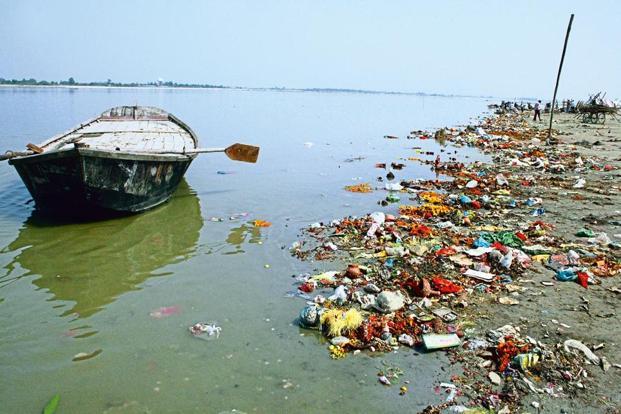
Pollution of River in India due to Untreated Waste Water Disposal

The major polluting
industries on the Ganga are the leather industries, especially near Kanpur,
which use large amounts of Chromium and other chemicals, and much of it finds
its way into the meager flow of the Ganga. Also, inadequate cremation
procedures contributes to a large number of partially burnt or unburnt corpses
floating down the Ganga, not to mention livestock corpses. 

The Ganga Basin, the
largest river basin of the country, houses about 40 percent of population of
India. During the course of its journey, municipal sewages from 29 Class-I
cities (cities with population over 1,00,000), 23 Class II cities (cities with
population between 50,000 and 1,00,000) and about 48 towns, effluents from industries
and polluting wastes from several other non-point sources are discharged into
the river Ganga resulting in its pollution. The NRCD records put the estimates
of total sewage generation in towns along river Ganga and its tributaries as
5044 MLD (Million Litres per Day). 

According to the Central Pollution Control
Board Report of 2001, the total wastewater generation on the Ganga basin is
about 6440 MLD.  Urban filth and industrial pollution are scientific
causes, but environmentalists believe that apart from industrial pollution and
sewage, the increase in number of slaughterhouse, dhobi ghats, crematoria and
slums are the major sources of pollution in these rivers. Every year, religious idols
are immersed in rivers which lose a little more of their life as they are
choked yet again.  
 

River Ganges in India

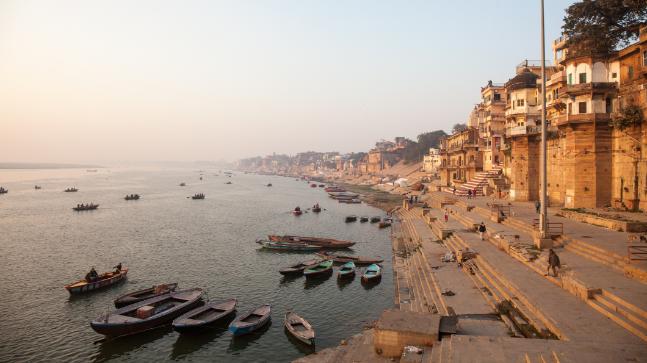
The Ganges is one of the major rivers of the Indian subcontinent, flowing east through the Gangetic Plain of northern India into Bangladesh. The 2,510 km river rises in the western Himalayas in the Uttarakhand state of India, and drains into the Sunderbans delta in the Bay of Bengal. The Ganges Basin drains 1,000,000-square-kilometre and supports one of the world’s highest density of humans. The river has been declared as India’s National River. After flowing 200 km through its narrow Himalayan valley, the Ganges debouches on the Gangetic Plain at the pilgrimage town of Haridwar. 
Further, the river follows an 800 km curving course passing through the city of Kanpur before being joined from the southwest by the Yamuna at Allahabad. Joined by numerous rivers such as the Kosi, Son, Gandaki and Ghaghra, the Ganges forms a formidable current in the stretch between Allahabad and Malda in West Bengal. On its way it passes the towns of Kanpur, Soron, Kannauj, Allahabad, Varanasi, Patna, Ghazipur, Bhagalpur, Mirzapur, Ballia, Buxar, Saidpur, and Chunar. The Ganges Basin with its fertile soil is instrumental to the agricultural economies of India and Bangladesh. The Ganges and its tributaries provide a perennial source of irrigation to a large area. 
Chief crops cultivated in the area include rice, sugarcane, lentils, oil seeds, potatoes, and wheat. Along the banks of the river, the presence of swamps and lakes provide a rich growing area for crops such as legumes, chillies, mustard, sesame, sugarcane, and jute. There are also many fishing opportunities to many along the river, though it remains highly polluted. Tourism is another related activity. Three towns holy to Hinduism – Haridwar, Allahabad, and Varanasi – attract thousands of pilgrims to its waters. 
Thousands of Hindu pilgrims arrive at these three towns to take a dip in the Ganges, which is believed to cleanse oneself of sins and help attain salvation. The rapids of the Ganges also are popular for river rafting, attracting hundreds of adventure seekers in the summer months.  

Importance of Rivers

Rivers have been used for navigation for
thousands of years. The earliest evidence of navigation is found in the Indus
Valley Civilization, which existed in northwestern Pakistan around 3300 BC.
Riverine navigation provides a cheap means of transport, and is still used
extensively on most major rivers of the world. Rivers have been a source of
food since pre-history.
They can provide a rich source of fish and other edible
aquatic life, and are a major source of fresh water, which can be used for
drinking and irrigation. It is therefore no surprise to find most of the major
cities of the world situated on the banks of rivers. Rivers help to determine
the urban form of cities and neighborhoods and their corridors often present
opportunities for urban renewal through the development of foreshore ways such
as River walks. Rivers have been important in determining political boundaries
and defending countries. The coarse sediments, gravel and sand, generated and
moved by rivers are extensively used in construction. In recent decades, there
has been a significant increase in the development of large scale power
generation projects. Rivers also provide an easy means of disposing of
waste-water and, in much of the less developed world, other wastes.  

UGC Names 23 ‘Fake Universities’, 8 from UP and 7 From Delhi In The List

New Delhi: The University Grants Commission (UGC) has released a list of 23 “self-styled, unrecognised” universities, eight of which are in Uttar Pradesh. The higher education regulator has warned students against taking admission in these institutions.
West Bengal and Odisha have two fake universities each — Indian Institute of Alternative Medicine, Institute of Alternative Medicine and Research, Nababharat Shiksha Parishad (Rourkela) and North Orissa University of Agriculture & Technology (Baripada).
“Students and public at large are hereby informed that at present 23 self-styled, unrecognised institutions are functioning in various parts of the country in contravention of the UGC Act,” UGC Secretary Rajnish Jain said.
Eight of these universities are in Uttar Pradesh, followed by Delhi (seven). Kerala, Karnataka, Maharashtra and Puducherry have a fake university each.
Unrecognised universities in UP are Varanaseya Sanskrit Vishwavidyalaya (Varanasi), Mahila Gram Vidyapith/Vishwavidyalaya (Prayagraj), Gandhi Hindi Vidyapeeth (Varanasi), National University of Electro Complex Homeopathy (Kanpur), Netaji Subhash Chandra Bose Open University (Aligarh), Uttar Pradesh Vishwavidyalaya (Mathura), Maharana Partap Shiksha Niketan Vishwavidyalaya (Pratapgarh), and Indraprastha Shiksha Parishad (Noida).
In Delhi, Commercial University Ltd, United Nations University, Vocational University, ADR Centric Juridical University, Indian Institution of Science and Engineering, Adhyatmik Vishwavidyalaya (Spiritual University) and Viswakarma Open University for Self-Employment have been declared as fake.
Badaganvi Sarkar World Open University Education Society (Karnataka), St John’s University (Kerala), Raja Arabic University (Maharashtra) and Sree Bodhi Academy of Higher Education (Puducherry) have also been included in the list.

CNG and PNG Service Begins in Patna

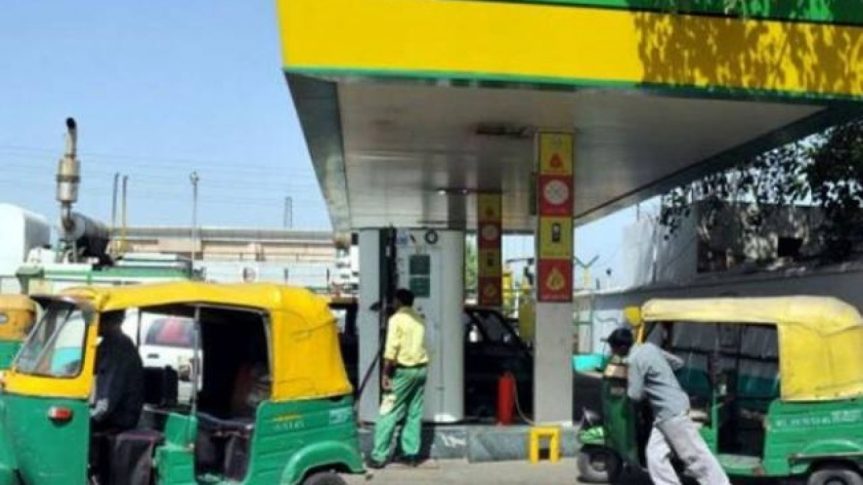
Among many of the projects Prime Minister Narendra Modi inaugurated in Bihar on Sunday, it was also the opening of two pump stations in the state capital dispensing Compressed Natural Gas (CNG), a first in the city, and also the supply of Piped Natural Gas (PNG) to thousands of households in the state capital.
A project of GAIL, formerly known as Gas Authority of India Limited, over 1500 homes on Jagdeo Path will begin receiving gas through a network of pipes on Monday. An additional 5000 households will start receiving gas by the end of March when the work on installing PNG connection is completed, GAIL chairperson B C Tripathi said.
The first customer to have the PNG service available at home was Bihar Institute of Technology (BIT) director B K Singh whose residence is on Jagdeo Path.
The first CNG fuel station went in service at Auto Care pump near Rukanpura on Bailey Road where Tripathi and legislator from Danapur Asha Devi inaugurated the service in the presence of a number of senior GAIL officials, pump owner Ajit Singh and his staff members.
The second service was opened at City Fuel Pump in Patna City.
The event, however, was not without a hitch as the station sold only four grams of gas before it developed a technical snag in the system. Women auto owners who had come there to fill their tanks had to return empty-handed. GAIL officials said the problem will be rectified by Monday when the pump will start dispensing CNG to vehicles equipped with necessary requirements.
GAIL Deputy General Manager K C Dwivedi said that while consumers will be able to buy CNG at the rate of Rs. 29 per kilogram, starting March 31 it will cost them Rs. 63.47 per kilogram, higher than the rates in Delhi, Lucknow, and Jharkhand.
GAIL would be given 1.5 acres from the land belonging to the Bihar State Road Transport Corporation’s workshop located at Phulwarisharif, he said.
The move would help curb the air pollution of the state capital as CNG enabled vehicles would start plying on city roads, Kumar said.
The capital city, whose air quality has worsened in recent past, topped the Central Pollution Control Board’s air quality index on three consecutive day from January 1, 2019.

UGC guide to student induction programme released: HRD

In a bid to develop an everlasting bond between teacher
and students, the University Grants Commission (UGC) has come up with a
new guide.
Union Minister of Human Resource Development Ramesh
Pokhriyal ‘Nishank’ today released UGC Guide to Student Induction
Programme – “Deeksharambh” in New Delhi.

To promote Deeksharambh – Student Induction Programme (SIP) in Higher
Education Institutions and its stakeholders, UGC will shortly conduct
awareness and training programmes for teachers in different regions in
the country.
“ Deeksharambh , a guide to Student Induction
Programme is to help new students adjust and feel comfortable in the new
environment, inculcate in them the ethos and culture of the
institution, help them build bonds with other students and faculty
members, and expose them to a sense of larger purpose and
self-exploration,” the minister said.
As per official sources, the
programme aims at engaging new students as soon as they take admissions
in an institution. During the induction programme, the incumbents will
be taught and made aware about the institutional policies, processes,
practices, culture and values, and their mentor groups formed.

Breaking News! New UGC scheme for Higher Education launched

In a bid to promote quality assurance in Higher Education, Union HRD
Minister Ramesh Pokhriyal ‘Nishank’ today launched  University Grants
Commission (UGC) Scheme of ‘Paramarsh.’

The scheme is aimed at mentoring National Accreditation and Assessment
Council (NAAC) Accreditation Aspirant Institutions to promote Quality
Assurance in Higher Education.

Initially 71 universities and 391 colleges with NAAC score of 3.26 and above will mentor five colleges each.
Under
the Paramarsh scheme, the leading institutions will provide regular
mentoring to help colleges achieve high quality standards. The scheme
also proposes to provide financial assistance to the mentoring
institutions and the option of appointing an expert, who can be paid a
fellowship amount of Rs 31,000 per month.
“The scheme will be a
paradigm shift in the concept of mentoring of institution by another
well performing institution to upgrade their academic performance and
enable them to get accredited by focusing in the area of curricular
aspects, teaching-learning & evaluation, research, innovation,
institutional values & practices etc,” Speaking on the occasion,”
the Minister said.
The
scheme is expected to have a major impact in addressing a national
challenge of improving the quality of Higher Education in India.
Sharing
information about the scheme, the Minister said the Scheme will be
operationalized through a “Hub & Spoke” model wherein the Mentor
Institution, called the “Hub” is centralized and will have the
responsibility of guiding the Mentee institution through the secondary
branches the “Spoke” through the services provided to the mentee for
self improvement. This allows a centralized control over operational
efficiency, resource utilization to attain overall development of the
mentee institution.
The scheme aims at enhancement of overall
quality of the Mentee Institutions and its profile as a result of
improved quality of research, teaching and learning methodologies.
Mentee Institution will also have increased exposure and speedier
adaptation to best practices. “Paramarsh” scheme will also facilitate
sharing of knowledge, information and opportunities for research
collaboration and faculty development in Mentee Institutions.
The
eligibility guidelines laid down by UGC say the mentor and the mentee
can be government, aided, private or self-financing institution. “The
mentor institution should be NAAC accredited with an A grade, having an
overall score of 3.26 and above. Any such institution recognised under
2(f) & 12B of the UGC Act 1956 will be eligible to receive UGC
grants for the purpose.
Since these grants will be used for
mentoring the institution and not for creation of any infrastructure,
the private institution can also receive funding as they do for student
teacher centric schemes,” the guidelines stated.
The “Paramarsh”
scheme will target 1000 Higher Education Institutions for mentoring with
a specific focus on quality as enumerated in the UGC “Quality Mandate”.
Mentor-Mentee relationship will not only benefit both the institutions
but also provide quality education to the 3.6 crore students who are
enrolling to Indian Higher Education system at present.

UGC, AICTE initiate steps to curb caste based discrimination

Nearly 72 cases of caste based discrimination against Scheduled
Castes and Scheduled Tribes students were reported by University Grants
Commission (UGC) in various universities and colleges across the country
during 2017-18. Most of the cases are handled and disposed off by the
authorities of concerned Universities and Colleges, as empowered under
their respective Acts and Statutes under the Higher Education.

Apart
from UGC, All India Council for Technical Education (AICTE) reported
that no such complaints were received by them from AICTE approved
Institutions during the same period.
Union Minister for Human
Resource Development, Dr. Ramesh Pokhriyal ‘Nishank’ in a written reply
in the Lok Sabha on July 8, informed that the Central Government as well
as UGC have issued several instructions from time to time to all State
Governments and Centrally Funded Education Institutions to curb
discrimination of any kind in higher educational institutions.
UGC
on June 26, 2019 advised all the Vice-Chancellor of all Universities to
constitute a committee to look into the discrimination complaints
received from the SC/ST/OBC Students/Teachers and non-teaching staff.
Besides, the other major initiatives undertaken in this regard are:-
(i)
In order to check discrimination and harassment of any section of
students and to strengthen the grievance redressal mechanism, the
University Grants Commission (Promotion of Equity in Higher Education
Institutions) Regulations, 2012 was implemented.
(ii) University
Grants Commission (Grievance Redressal) Regulations, 2012 has been
formulated. These Regulations intend to give effect in letter and spirit
to the provisions of the Constitution and other statutory provisions
and policies for prevention of discrimination on the grounds of caste
and to safeguards the interests of the students belonging to the
Scheduled Castes and Scheduled Tribes. The Regulations also seek to
provide for advancement of Scheduled Caste and Scheduled Tribe students
through setting up of Equal Opportunity Cells in each Higher Educational
Institution.
(iii) In order to make the universities/colleges
more responsive to the needs and constraints of the disadvantaged social
groups, UGC is giving financial assistance to all eligible
Colleges/Universities to establish Equal Opportunity Centres. The aim
and objective of this Scheme is to oversee the effective implementation
of policies and programmes for disadvantaged groups, to provide guidance
and counselling with respect to academic, financial, social and other
matters and to enhance the diversity within the campus.

Indian Education System Needs Reformation

Introduction –

Education is an essential to humans and one cannot imagine a
life without it. Human civilization has expanded due Education. It is education
that has given birth to culture, ethos, art and a social values in which human
prevails. Learning is elementary to education and a skill that allows a person
to improve his personality.  Apart from
being a basic necessity, a good education skill can overcome many personal and
professional barriers. Learning being central and basic to education and lack
of education can create disturbance in society. Education and learning and its
development are important for a person who desires to exchange information
meaningfully to the person and places required. 
We as a human being started developing knowledge as a proper source to
learn something as it also helped in self-control and to develop a character
for better development as an individual as well as the society. We as an individual
made ourselves to learn about many different things about social, awareness,
grooming personality and foremost are the preservation of culture for the
coming generation. However, with changing time education has become integral
part of human.  Especially in many developed
and developing countries it is now termed as a basic human right.

Education in modern India

Macaulay was the man behind the start of education in India
(as per internet suggestion) introduced education in India, especially through
his famous minute of February 1835. He called for an educational system that
would create a class of Anglicized Indians who would serve as cultural
intermediaries between the British and the Indians.

Current education system in India

Education is always an integral part of life students’ life.
Despite being a nest to many education universities, colleges and varsity,
India still lacks the quality education it needs to have. According to a survey
India will be ranking 3rd among all countries by 2020 in education. Though if
the quality of overall ranking of relevant institutions is seen clearly, out of
500 there were 2 Indian Universities and varsities were featured in the list
along with one institution from China as per a survey by education group done
in year 2000. Education system in India including other developing countries
like India needs substantial expansion. The percentage of students taking
higher education is hardly about 13 % whereas the same is varying between 28 to
90 %, across the world. The lowest % being 28 % and the same is as high as 90 %
in developed countries (As per a news report)

Why India lacks

·        
Over Population: Too many people and limited seats makes student worried
of career.  Concerned over future and
aspiration to get ion a good college is the main reason of brain drain.  
·        
Course choice: mainstream subjects like math science are being taught by
world class teachers but good institute for off-bit courses like music and
painting is tough to find.
·        
 Lack of quality higher education
in India

The benefits of an education abroad

Studying
abroad has always been associated with improving the chances for a
distinguished career prospects. Indians willing to study abroad has seen a
sheer increase in the past few years According to recent estimates by RBI
(reserve bank of India) latest figures in its monthly bulletin, outlays on
education and maintenance of close relatives grew 88% to $334 million and 21%
to $300 million, respectively.

Few reforms need to be done.

·        
Career oriented learning program: There is need
to have courses that could guarantee job placement.
·        
Job opportunities –the basic need of a student is to have a secure future
that can only be achieved by acquiring a good position in their dream
organization.
·        
Research based courses is another need to provide quality education.
·        
Focus on recruiting, training and supporting teachers.

Flood Related Hazards -Things to Know about Flooding

Flooding typically occurs when prolonged rain falls over several days,
when intense rain falls over a short period of time, or when an ice or
debris jam causes a river or stream to overflow onto the surrounding
area. Flooding can also result from the failure of a water control
structure, such as a levee or dam. The most common cause of flooding is
water due to rain and/or snowmelt that accumulates faster than soils can
absorb it or rivers can carry it away. 
Flood Related Hazards -Things to Know about Flooding
River flooding occurs when river  levels rise and overflow their banks
or the edges of their main channel and  inundate areas that are normally
dry. River flooding can be caused by heavy  rainfall, dam failures,
rapid snowmelt and ice jams. 
River flooding is classified as  Minor, Moderate, or Major based on
water height and impacts along the river. Minor river flooding means that
low-lying  areas adjacent to the stream or river, mainly rural areas and
farmland and  secondary roadways near the river flood. Moderate
flooding means water levels  rise high enough to impact homes and
businesses near the river and some  evacuations may be needed. Larger
roads and highways may also be impacted. Major flooding means that
extensive rural  and/or urban flooding is expected. Towns may become
isolated and major traffic  routes may be flooded. Evacuation of
numerous homes and business may be  required.
  
Snowmelt flooding occurs when the major source of water involved in a
flood is caused by melting snow. Unlike rainfall that can reach the soil almost immediately,
the snowpack can store the water for an extended amount of time until
temperatures rise above freezing and the snow melts. This frozen storage
delays the arrival of water to the soil for days, weeks, or even
months. Once it begins to melt and does reach the soil, water from
snowmelt behaves much as it would if it had come from rain instead of
snow by either infiltrating into the soil, running off, or both.
Flooding can occur when there is more water than the soil can absorb or
can be contained in storage capacities in the soil, rivers, lakes and
reservoirs.

Areas Most Likely to Flood During Heavy Rains

While any area can flood with enough rainfall, some areas are more
prone to flooding. It should come as little surprise that all of these
areas are either near bodies or water or are on lower ground than the
surrounding area.
  • Floodplains – The areas surrounding ocean, lakes, rivers, and streams are most prone to flooding during heavy rains.
  • Valleys and Lowlands – Any area that slopes
    downward, like a valley or gully, is more likely to flood during heavy
    rains. This includes areas that are at or below sea level.
  • Near Mountains – Even if the area is flat, water from heavy rains will flow down mountains or hills.

What areas are at risk from flash floods?

Densely populated areas are at a high risk for
flash floods. The construction of buildings, highways, driveways, and
parking lots increases runoff by reducing the amount of rain absorbed by
the ground. This runoff increases the flash flood potential.

Sometimes, streams through cities and towns are routed underground into storm drains. During heavy rain, the storm drains can become overwhelmed and flood roads and buildings. Low spots, such as underpasses, underground parking garages, and basements can become death traps.

Areas near rivers are at risk from flash floods.
Embankments, known as levees, are often built along rivers and are used
to prevent high water from flooding bordering land.

Dam failures can send a sudden destructive wall of
water downstream.

UGC Proposes Initiative for Inter-varsity Degrees

The University Grants Commission (UGC) is proposing a ‘National
Academic Credit Bank’ in higher education and if the proposal comes
through, inter-university degrees can be a reality soon, a senior UGC
official said Thursday.
UGC vice-chairman professor BhushanPatwardhan, speaking on
the sidelines of the ongoing three-day Training of Teachers (ToT) for Student
Induction Programme (SIP)here, said the proposal was similar to that existing
in some foreign universities. The initiative proposed in the place of the
current ystem of CBCS (credit-based choice system) would allow students to join
in one university, pursue it in another university and earn a degree from a
different university, a press release quoted Patwardhan as saying.
This would give a lot of flexibility to the students, the
release further quoted him as saying.
The UGC has appointed a committee which met a couple of
times to study the proposal, the release said.
The proposal was made recently in Pune and was still in
deliberation stage, he said adding with the National Academic Credit Bank,
inter-university degrees can be a reality in the near future in India.

Urban Structure and its Characteristics

 Urban structure is the arrangement of land use in urban areas. Urban planners, economists and geographers have developed several models that explain where different types of people and businesses tend to exist within the urban setting. Urban structure can also refer to urban spatial structure, which concerns the arrangement of public and private space in cities and the degree of connectivity and accessibility. 

The term “urban form” is used to describe a city’s physical characteristics. It refers to the size, shape, and configuration of an urban area or its parts. How it will be understood, structured or analyzed depends on scale. Characteristics of the urban form range from at a very localized scale, features such as building materials, facades and fenestration to at a broader scale, housing type, street type, and their spatial arrangement or layout. 

Elements of urban structure includes the following.

  • Natural environment 
  • Topography
  • Soil types (Bearing capacity) 
  • Water courses (Rivers, streams and lakes) 
  • Types of vegetation 
  • Climate and micro climate 
  • Environment characteristics
  • Landscape features 

Types of Urban Structures/Patterns

1) Grid Iron/Rectangular Pattern

The grid plan, grid street plan or gridiron plan is a type of city plan in which streets run at right angles to each other, forming a grid. The infrastructure cost for regular grid patterns is generally higher than for patterns with discontinuous streets. E.g. Plan of Chandigarh city. 
Costs for streets depend largely on four variables: street width, street length, block width and pavement width. Two inherent characteristics of the grid plan are frequent intersections and orthogonal geometry, facilitate pedestrian movement. The geometry helps with orientation and way finding and its frequent intersections with the choice and directness of route to desired destinations. 
In ancient Rome, the grid plan method of land measurement was called centuriation. The grid plan dates from antiquity and originated in multiple cultures; some of the earliest planned cities were built using grid plans.

Advantages 

  • Shorter routes 
  • Easy to extend 
  • Easy to find places 

Disadvantages 

  •  Associated with traffic congestion 
  •  Many intersections/robots
  •  Time consuming
  •  Fuel consuming
  •  Road rage/frustration

 Grid system

2) Radial/Concentric system 

Radial design offers a method for organizing visual material by arranging it around a central point. Features of radial city pattern include 
  • Inner outer ring roads linked by radiating roads 
  • Core has the business area 
  • Industrial area interspersed within the residential 
  • Periphery has green belts 

Advantages 

  • A direct line of travel 
  • Centrally directed flows 
  • Economics of a single point or origin point 
  • Less intersections 
  • Easier flow of traffic 
  • Aesthetic appeal 

Disadvantages 

  • Central congestion 
  • Local flow problems 
  • Difficult building sites 
  • Unplanned growth can create traffic problems
Radial/Concentric system

3) Linear System

The linear city was an urban plan for an elongated urban formation. The city would consist of a series of functionally specialized parallel sectors. Generally, the city would run parallel to a river and be built so that the dominant wind would blow from the residential areas to the industrial strip. As the city expanded, additional sectors would be added to the end of each band, so that the city would become ever longer, without growing wider. The sectors of a linear city would be 
  • A purely segregated zone for railway lines 
  • A zone of production and communal enterprises, with related scientific, technical and educational institutions 
  • A residential zone, including a band of social institutions, a band of residential buildings and a “children’s band” 
  • A park zone 
  • An agricultural zone with gardens and state run farms 

Advantages 

  • High accessibility 
  • Adaptability to linear growth 
  • Useful along limited edge 

Disadvantages 

  • Very sensitive to blockage 
  • Requires control of growth 
  • Lack of focus 
Linear system

4) Multi Centered System 

City grows from several independent points rather than from one central business district. 

Advantages 

  • Optional locations for focal activities and system terminals 
  • Good psychological orientation 
  • Adaptability to existing conditions 

Disadvantages 

  • Depends on stability to key locations 
  • Potential accessibility problems 
  • Tendency to dilute focal activities

Multi centered system

5) Irregular System 

No set pattern. It develops due to relief. e.g. goes around hilly areas. 

Advantages 

  • Creates aesthetic appeal due to different roads 
  • Less traffic congestion 
  • Less intersections 

Disadvantages 

  • Can get lost 
  • Travel longer distances
Irregular system